2015: The Year of Writing Boldly, Abundantly & Dangerously


Writing Dangerously by @debsnet

Get it down. Take chances. It may be bad, but it’s the only way you can do anything really good. ~ William Faulkner

For me, 2014 has been a year of writing thoughtfully, reflectively and introspectively.

As always I have been writing unit plans, assessments and resources for my students. I have been writing 140 character tweets, and participating more and more in education Twitter chats (such as #satchat #sunchat #aussieED #whatisschool and #BFC530). I have started a blog in which I have been experimenting with voice and purpose. I have been writing my PhD, which is currently at almost 80,000 words. As part of my PhD I have written a self-study chapter in which I reflect on myself as learner, educator and leader.

2015 will be my year of writing abundantly, boldly and dangerously.

Writing abundantly

In 2015 I will need to write abundantly. I will need to write words and words of thesis. I will need to pen some papers on my research. I will need to write applications and abstracts for education and research conference presentations. I will write blog posts. I will write tweets.

Each form of writing is a different kind of therapy. I am prone to over-wordiness (I love words!), to verbosity, to an inability to be concise. Thankfully, Twitter is therapy for the verbose. To distil thoughts into 140 character bites is to crystallise thinking down to its essence. I am never more concise than when I tweet. Blogging allows personal exploration of ideas in an informal space. My blog is where I can explore ideas in greater depth than a tweet, but in more informal ways than in academic writing. My thesis is the place where I get to burrow into challenging writing problems and thrash around, working hard until I break through and find a solution. The PhD is writing friend and nemesis, a beast I have to wrestle into its cave, clay I have to mould into its form (or is that stone I have to hack at until it takes shape?).

And the more I write, the more my writerly-self expands and transforms, like a shape shifter, always taking new forms in organic, non-linear ways. I am a hybrid writing being who writes as educator, school leader, researcher and bloggess. 2015 lays the challenge of balancing these overlapping writing selves.

Writing boldly

I will need to be bold in my writing in 2015.

I will need to be boldly honest, self-reflective, self-revealing and authentically-voiced in my blog posts, and in the conversations which bloom from those. I will need to be willing to disagree in Twitter conversations, in order to promote robust discussion instead of an inward-looking echo chamber of the same voices saying the same things.

In my third (and hopefully final) year of my PhD study I will need to be self-assured in discussing the contribution of my work. I will need to be confident in communicating in my own academic voice.

Yet in my boldness I will need to be sensitive to ethical issues such as how to tell others’ stories while protecting their anonymity and the authenticity of their words. Part of the reason I choose to blog and tweet under a pseudonomic identity is to protect my research participants. So boldness needs to be tempered with thoughtfulness.

Writing dangerously

Language is power. Words are tools. As a teacher of English and Literature part of my job is to help students to understand how language works (functionally, socially and globally), and help them to develop the capability to use its power to communicate, share, converse, discuss, disagree and disrupt.

Writing can be dangerous. It can be disruptive. It can be transformational for writer and reader. It can change individuals, groups, organisations and the world.

2015 is the year for all researchers, bloggers, tweeters and writers (or ‘those who write’, but don’t think of themselves as ‘writers’ as Pat Thomson explains in this post) to write fearlessly and compassionately, abundantly and concisely, reflectively and dangerously. I’m going to give it my best shot.

Happy writing!

A writer never has a vacation. For a writer life consists of either writing or thinking about writing. ~ Eugene Ionesco

write fearlessly by @debsnet

Art journal pages: scribbling as therapy, thinking & anticipation

An artist is a sketchbook with a person attached. Irwin Greenberg

New York City is the subject of much art, literature and creativity. As I explained in this blog post and comments, for my upcoming professional trip I am using a range of traditional and new media to explore, express and develop my thinking. I find that keeping a visual and written record of my observations and thoughts helps to anchor me in the moment and focus on really seeing, hearing and experiencing what is around me. My creative packing list can be found here; it outlines the ways I am intending to flânerially experience and capture my trip.

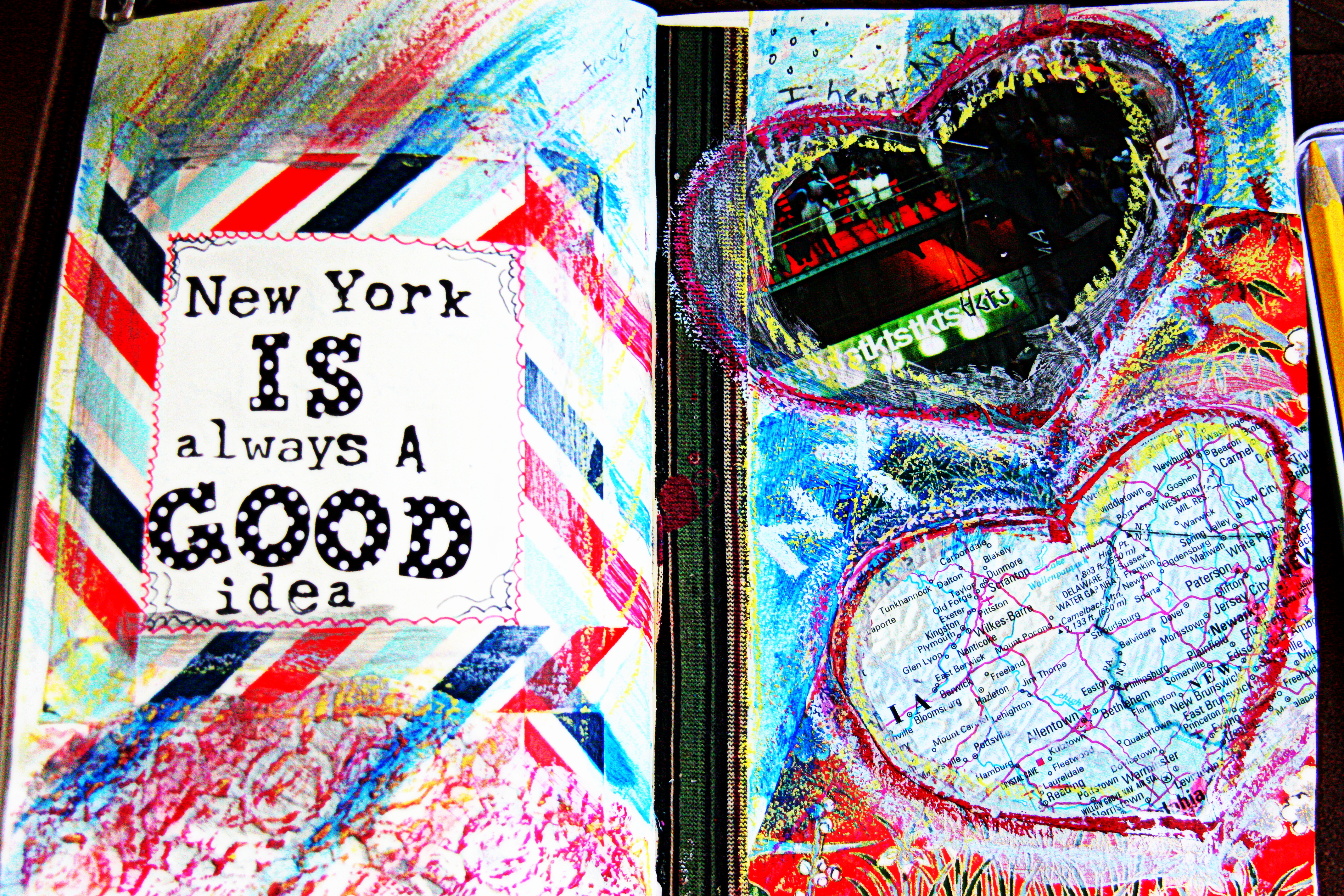
So, inspired even before I take flight, here are my collagey art journal scribblings so far …

art journal page: curiouser and curiouser!

art journal page: curiouser and curiouser!

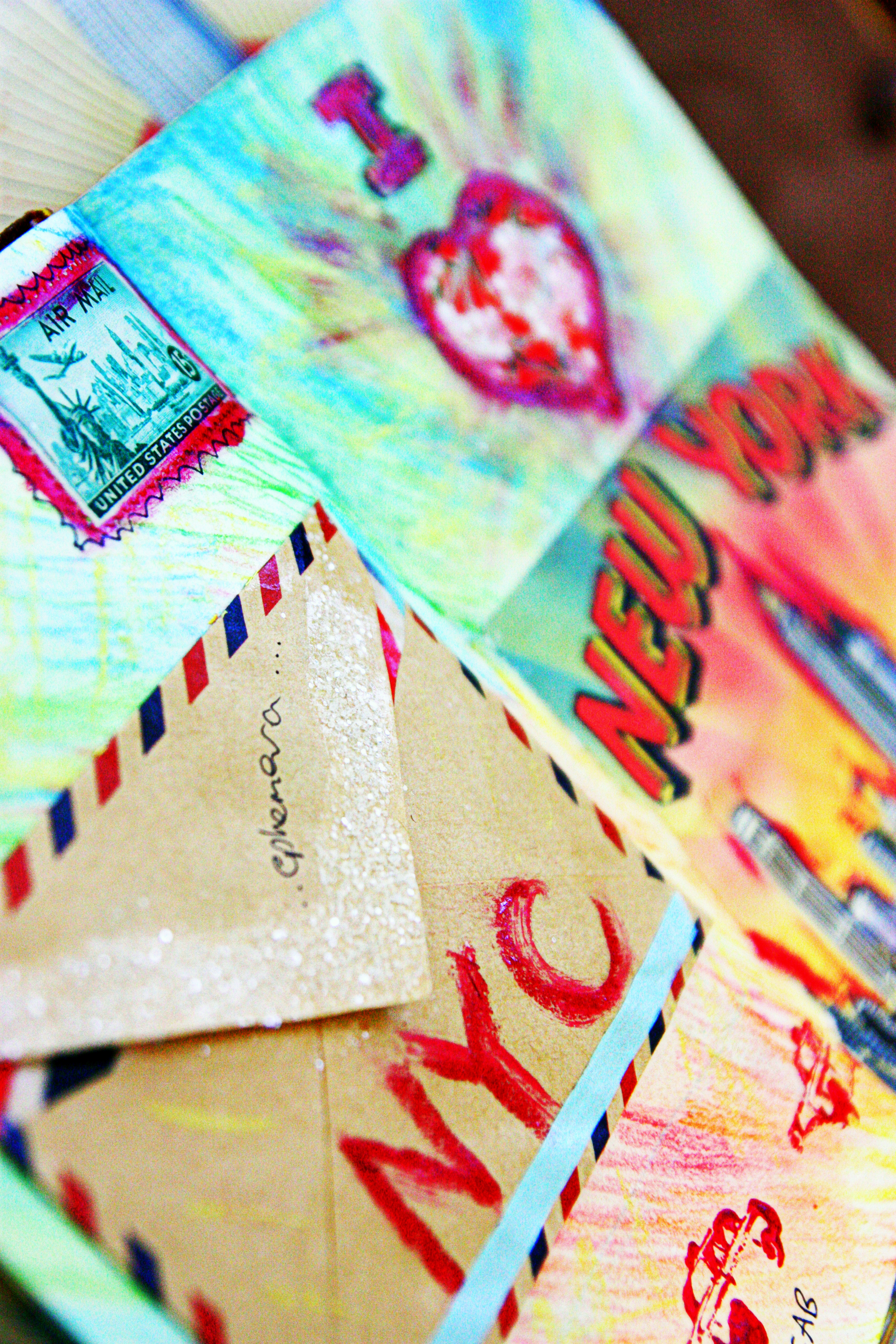
art journal page: I heart New York

art journal page: I heart New York

art journal page: New York is always a good idea

art journal page: New York is always a good idea

NYC art journal page by @debsnet https://theeduflaneuse.wordpress.com/

art journal page: don’t quit your daydream

art journal page: Perth to New York

art journal page: Perth to New York

Your walls, New York, hold up heaven, parapets of beauty stabbing into the stars! / Pillars of the universe. / Oh music in stone, poetry in sculpture, song in architectural marble, prayer in granite, an ecstasy in steel and iron and gold, singing city of the great heart, singing city, / You are Manhattan! Edwin Curran

Words on New York: Manhattan through authors’ eyes

from Candace Bushnell's 'One Fifth Avenue'

from Candace Bushnell’s ‘One Fifth Avenue’

In a previous post I shared my New York fiction reading pile, as I prepare for a professional trip to NYC, which will be my third visit to the city but my first for work. As I make my way through the pages of my NewYorkspiration, here are a few quotes from some of those books.

“Possibly there were two tigers, the famous and chaotic one that lit the tabloid frenzy, and this more dignified one, who showed itself to us alone. It was after all moving along Eighty-fourth Street, toward the block where Brandy’s Piano Bar and Perkus’s old apartment lay condemned. Perhaps this was the tiger that put things back together instead of destroying them … it regarded us or didn’t, shone its light on us and then shut it off again, and was gone, leaving only claw prints and, with its tail, an inadvertent serpentine signature lashed into a parked Mayflower van’s snowy windshield.” Jonathan Lethem, Chronic City

“The bridge had been the first disappointment. Looking at it from the roof of her house, she had thought that crossing it would make her feel like a gossamer-winged fairy flying through the air. But the actual ride over the bridge was no different than the ride above the Brooklyn streets. … New York was disappointing.” Betty Smith, A Tree Grows in Brooklyn 

“I wonder how she’ll find New York,” Enid said. “Having been away so long.” / “Exactly the same, Auntie,” Philip said. “You know New York never changes. The characters are different but the play remains the same.” Candace Bushnell, One Fifth Avenue

Two weeks til takeoff. Carpe NYC!

art journal page: I heart New York

art journal page: I heart New York


Applying the travelling mindset: embracing creativity

What, then, is a travelling mindset? Receptivity might be said to be its chief characteristic. We approach new places with humility. We carry with us no rigid ideas about what is interesting. We irritate locals because we stand on traffic islands and in narrow streets and admire what they take to be strange small details. We risk getting run over because we are intrigued by the roof of a government building or an inscription on a wall. We find a supermarket or a hairdresser’s unusually fascinating. ~ Alain de Botton

Alain de Botton described the traveling mindset as one of receptivity and openness. In 1794, Xavier de Maistre applied this mindset to his own everyday space. In my own experience, of traversing thirty three countries so far, travel is learning. Being submerged in the unfamiliar brings to the surface captivation, imagination and vulnerability.

I think being abroad is sometimes where we feel we can be most ourselves, untethered by daily routines, obligations, expectations and the mundanity and productivity of daily life.

So how is an educator to bring this outlook to professional meetings and visits abroad? My approach is one of embracing creativity.

@debsnet New York Journal

Research connects creativity with productivity, adaptability, novelty, divergent thinking, idea generation, flexibility and problem solving (see Dr Mark Runco’s 2004 article on ‘Creativity’ in the Annual Review of Psychology). For me, writing, drawing, painting, doing and making are physical mind-body processes which facilitate right brain thinking, foster creativity and enable authenticity – of thought, of action, of being.

Sir Ken Robinson’s 2006 TED Talk on how schools kill creativity has been viewed almost 30 million times. In it, he champions the cultivation of creativity and questions the rigidity of education systems which encourage conformity and compliance.

The #makered hashtag on Twitter and http://makered.org/ have plenty of ponderings, resources and perspectives on the meaningfulness of making and doing for our students.

Of course social media and this blog are 21st century extensions of traditional creative media but I am intending largely to ‘go retro’ on my October professional journey: reading print novels, keeping a visual journal, collecting tactile ephemera and enacting mindful pen-to-paper thinking. Using the camera and a journal to explore thoughts and experiences is a method of creative, reflexive, deliberate inquiry, as well as a way of recording both professional visits and New York herself.

New York #artjournal page by @debsnet

I hope this flânerial approach – that of the wanderer who is finely attuned, keenly observant and totally immersed – will help me to be at my most receptive, flexible and open to new learning.