Webs & chrysalises: Metaphors for learning & connection

Naomi Barnes, in her recent article in the digital journal, Hybrid Pedagogy, writes that “we need to start paying more attention to the random thoughts because when learning is conceptualised as a web, rather than a line, randomness becomes more meaningful.” She refers to the unanticipated blogging conversation, sparked by Steve Wheeler’s #blimage (blog+ image) challenge, that she, Helen Kara and I became involved in as we voluntarily responded to each other, layering our ideas and connecting our words.

My own experience of learning is non-linear and rhizomatic. The findings of my PhD were that this is an experience shared by individuals, groups and organisations; learning happens in surprising ways, in unexpected places. I agree with Naomi that embracing non-linear randomness might lead us to interesting places of knowledge collaboration, reimagining and production (although I do think we should acknowledge our sources of inspiration).

I mentioned in my blog post (part of the above-mentioned blogversation) on the spider-web connectivity of networked learning that metaphors, including of the spider’s web, emerged from my participants as ways to explain and explore their understanding of their professional selves, roles and relationships.
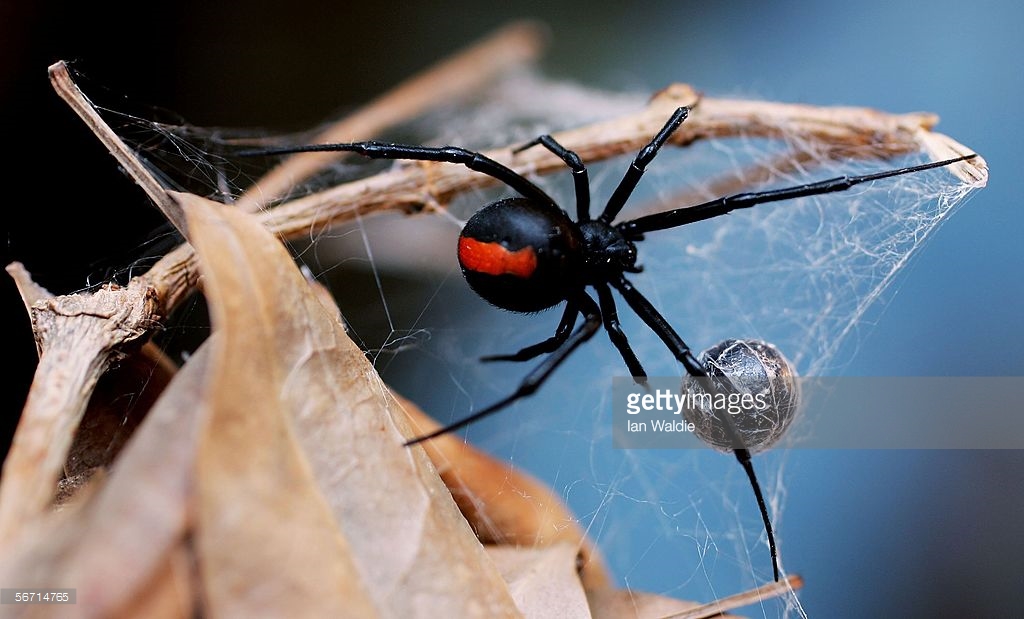
As it edges towards summer here in Australia, at home I recently found a redback spider (latrodectus hasseltii for the arachnid nerds), an Australian relative of the American black widow spider. The redback female is venomous, formidable and self-sufficient. Her web is messy. Males live on the periphery, eating her scraps. And after mating, she eats them, storing the sperm for later.

I’ve felt a little recently like a web-weaving spider. My PhD thesis is submitted, and suddenly, papers, journal articles and conference presentations are materialising. My PhD work has formed a web which widens and thickens, and in which these prey are being caught. The learning I’ve been doing from the network of scholars with whom I connect on Twitter and in the blogosphere has continued to take me to new thinking and into interesting conversations.

Now, I don’t see myself as a poisonous, man-eating widow spider, but I like that the redback is autonomous, a beacon of feminine power. I like that her web is messy and functional, not pretty and symmetrical. As well as the weaving of the physical web, the species itself has spread its tendrils out from Australia to reach New Zealand, Japan and Belgium. She has even made it into two DC comics as a supervillain who fights Robin. Unexpected places. Unpredictable influence.
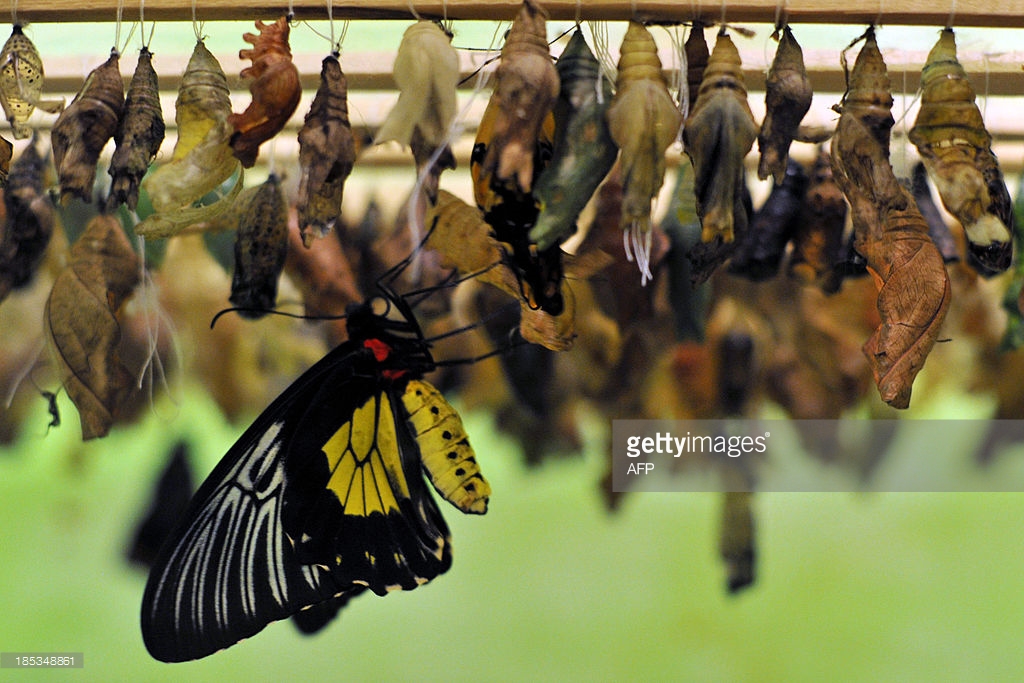
The other insect creature I’ve recently been reflecting upon is the chrysalised caterpillar-butterfly. After I submitted my thesis, I wrote the following title in a Word document and saved it: “Emerging from the chrysalis: PhD as transformative learning.” It was a blog idea for later, after proper completion, maybe. I was remembering a post I had read which argued that the PhD is not a transformative experience, but a thing to be done, a process to be completed, a means to an end. This wasn’t my experience so I thought it might be worth writing about.

And then I set the November #HDRblog15 challenge, and Kathryn Davies wrote this post about the life of a butterfly as a metaphor for the cycle of the PhD. Kathryn explores the chrysalis-PhD metaphor so thoroughly and thoughtfully, my own post idea seemed redundant. Yet my experience was affirmed by reading Kathryn’s. For me the PhD was transformative. I began my doctorate as someone who hadn’t written an academic paper or dissertation for 14 years. I was a vulnerable, soft-bellied slow-moving academic creature, my newness shiny and green. Over the course of the PhD, it has changed the way I think, the way I write and the way I read. It has changed how I perceive my identity, how I behave and how I respond. Some of these feelings I’ve written about, including a crisis of scholarly confidence, taking flight in the discussion chapter, and on being (or identifying as) a writer. And while I’ve recently said that I feel frozen in examination limbo, perhaps it’s more appropriate to say that I’m quietly growing, wriggling inside and pushing at the edges of my PhChrysalis, still a neophyte but transformed by my PhD journey.

So, I offer out to the blogoverse another post, another moment of my thinking suspended in time, another layer, another thread, another voice, another tendril reaching out to others. To be ignored, observed or grasped.

Doctoral examination limbo: Frozen in PhD carbonite

So okay― there you are in your room with the shade down and the door shut and the plug pulled out of the base of the telephone. You’ve blown up your TV and committed yourself to a thousand words a day, come hell or high water. Now comes the big question: What are you going to write about? And the equally big answer: Anything you damn well want. ~ Stephen King, On writing: A memoir of the craft

The irony isn’t lost on me that, the same month I set a blog writing challenge for PhD and other research students (and others in the academic pre- and post- doctoral world), I am struggling to find content for a PhD-related blog post. So, following Stephen King’s above-quoted advice from his excellent On writing: A memoir of the craft, I’ll write about ‘anything I damn well want’; or perhaps just anything that comes into my head as I type. This follows Pat Thomson’s technique (which she also attributes to Ray Bradbury) of writing with a blank screen and a few selected words which spark associations. Pat says it’s ‘writing fast’ or ‘running writing’ rather than ‘free writing’, but I’ll call my approach free writing here, because that’s what it feels like to me. Screen. Keypad. Words. Let them form as they will, then revisit and see what’s been made.

Part of the reason I’m finding a PhD-related post difficult is that I am currently in examination limbo. I’ve submitted the thesis and it’s been posted to three examiners, so now comes a wait of two to six months.

In this limbo period, I’ve got some papers to revise and to write, and I have work, parenting and life which go on. And thank goodness! Inger Mewburn, Thesis Whisperer, has likened completing the doctorate to running off a cliff. I can certainly relate to that, in a Road Runner cartoon kind of a way. My little animated PhD legs are still sprinting even though the thesis is submitted and I’ve run off the edge. Suspended in mid-air, legs madly cycling, I’m grateful to have work to keep me busy, purposeful and grounded.

selfie scribble

selfie scribble

Meanwhile, today as part of the #aussieED Twitter chat, we were asked to ‘sketch note’ an introduction to ourselves. I have declared my love of notebooks in previous posts about my flânerial packing list and on my pre-professional-fellowship art journalling. So I sat with my kids and scribbled some bits and pieces, watching them join together. The interesting thing about the process of thinking-while-scribbling is that thoughts and ideas emerge, seemingly through the very process of the pen scratching across the paper. Before beginning, I hadn’t mapped out what I was going to include. Much like this blog post, which is free-written, I was free-drawing. I surrendered to the moment and watched what emerged. If I did the same exercise tomorrow, or in a week, or a year, I’m sure the result would be very different (there’s a time-lapse video idea!).

And how about free-talking? I am connected with educators and doctoral students on Voxer, and I sometimes find myself using that walkie-talkie app as a useful ‘think aloud’ tool. I find that if I press the ‘transmit’ button and start talking, I don’t know what I’ll say until I’m saying it (sorry VoxSquad for the occasional ramblings). The act of talking aloud helps me to surface my thinking.

What can we learn about ourselves, what internal thoughts can we surface or capture, through the acts of writing, drawing, or talking aloud?

Here I am, in limbo between PhD submission and PhD completion, frozen in carbonite as an almost-Dr (yes – I’m anticipating The Force Awakens and am reminiscing about my favourite Star Wars moments, like Han Solo being unfrozen from carbonite). I’m wondering what might come next. Continuing to work in my current job, at my current school, business as usual? Considering what kind of role might be possible in my present context? Starting at the bottom of the pile, after a 15 year career as teacher and school leader, by dipping my toe in the academe? Heading down a consulting or alternate/indie academic pathway?

I know my current thinking, but I’m open to being carried in other directions. Free-writing, free-drawing and free-talking open up possibilities, so why not free-professional-decision-making? Lay out the materials and see what surfaces.

* This post is for the #HDRblog15 challenge. Join me to blog all things higher-degree-by-research this November!

my PhD notebook stack <3

my PhD notebook stack ❤

The Research Student Blog Challenge – #HDRblog15 – November 2015

Get involved! Let's learn together with #HDRblog15

Get involved! Let’s learn together with #HDRblog15.

Writing begets writing. Somehow, the more I write the more I write. The more I think about writing, write about thinking about writing, and write about writing, the more I write. For me, tweeting, blogging and academic writing are all writing practices, ways of thinking and writing my way to understanding. They are also ways of connecting with others. Being part of research conversation and blog conversation and Twitter conversation. Telling stories. Sharing stories. Learning from others’ stories.

There are blogs which host posts by research students such as the Thesis Whisperer and PhD Talk. There are active and dormant blogs by research students which can be hard to find in the heaving mass of the blogosphere. And some research students might wonder about what blogging could offer them, but not have the impetus to start.

I’m currently taking part in the How to Survive Your PhD MOOC (massive online course) which has expanded my network of scholars, fellow researchers and fellow writers. The course, especially through its discussion forums, #survivephd15 Twitter hashtag and Periscope live chats, has shown how much a community of past and present research students, and supervisors, can gain from engaging with each other.

I am keen to build on the momentum of this course, and on the wonderful and generous scholarly Twitteratti, with an initiative that will share the stories of research students who are juggling life and supervision with writing dissertations, theses and journal articles. My answer? The #HDRblog15 blogging challenge. I’ve called it the HDR (higher degree by research) challenge as I’d like any research students (PhD, professional doctorate, Masters), and those involved with research students, to feel welcome to join in.

The challenge will be held during the month of November 2015. Its purpose is to encourage past or present higher degree by research students, supervisors, or those interested in pursuing a higher degree by research, to connect, communicate and share resources and experiences.

The challenge involves writing at least one blog post (you might write more!) and commenting on at least one other blog post in order to develop conversation and community.

If you are new to blogging, the first step would be to set up a blog. I use wordpress.com, which is very user friendly, quick to set up and easy to manage.

Ideas for your blog post/s might include the following.

  • Sharing a celebration from or positive spin on your experience of being a research student.
  • Exploring a question you have.
  • Illuminating a challenge you have faced in your HDR journey, and how you approached or conquered it.
  • Sharing a tip or technology.
  • Exploring a metaphor for where you are in your HDR/PhD/Masters journey.
  • Explaining a strategy you have for coping with the demands of a research degree.
  • Using an image, animated gif or video as inspiration. Just make sure that, if it’s not one of your own, you attribute it to the site or person from which you got it.

So, the steps for participating in this challenge are as follows.

Step 1: Fill in your name and blog url here in this Google doc.

Step 2: Write and publish your blog post.

Step 3: Share your post in the Google doc and on the How to Survive Your PhD MOOC discussion board, if you are enrolled (but any research students, past research students, or supervisors of research students, or people interested in becoming a research student, are more than welcome!). Tweet your blog out using the #HDRblog15 hashtag. To extend your reach, you might also like to use other hashtags like #survivephd15, #phdchat, #acwri (academic writing), and #ecrchat (early career researcher chat).

Step 4: Keep an eye on the #HDRblog15 hashtag on Twitter and the Google doc to read others’ contributions as they arise.

Step 5: Comment on at least one other post.

If you’re new to blogging, remember that reading on the web, including on a mobile device, necessitates information being presented in a way that is engaging and easy to process. This means a ‘hook’ to draw your reader in, a catchy beginning to grab the reader’s attention and short paragraphs readable on small screens and on the go.

I find 800ish words is best; it’s meaty enough to explore a topic, but short enough to be readable in one sitting. I find if a blog post pushes over 1000 words, it’s getting too long and I try to think about how I can parameterise it to reign it in, or split it up.

Visualise your audience when you are writing, to help you personalise the content and lead decisions about language, style, voice and approach. Are you writing for others in your industry? Other research students? Future employers? As a record of your own thinking for yourself?

Blogging allows us to connect with others and develop ourselves. Your blog can be a free writing space where your persona can be unrestrained and experimental. I look forward to reading your contributions!

Deb

* This post is in response to the How to Survive Your PhD MOOC 2015 ‘final activity’.

* If you are a PhD student who blogs, take the time to complete this research survey for Inger Mewburn and Pat Thomson on why and how you blog.

PhD thesis S. U. B. M. I. T. T. E. D.

thesis submission gift to self: my favourite bubbles

thesis submission gift to self: my favourite bubbles

 Yay. Yay. And yay.

Right now I have very few words left in me to write a blog post, which says in itself a lot about what the final days of the PhD are like.

But here I am.

2 years and 359 days after enrolling.

I have 95,777 words (not including front matter, references or appendices).

355 cited references.

3 illustrations.

1 figure.

4 appendices.

Exhaustion gratitude excitement pride.

Delirium relief disbelief happiness.

It is Ph.inishe.D.

For now.

Until the examiners’ reports arrive.

by @debsnet

3 spiral bound copies, ready to be posted to examiners

As predicted, submission didn’t bring with it ceremonious trumpeting, thunderous cheers, or a blessing of unicorns galloping over a shimmering rainbow. But I did get hugs from my supervisors and heartfelt congratulations from the staff in the Graduate Research Office, as well as a signed congratulations card, a Polaroid photograph of me holding my thesis and a Freddo frog chocolate.

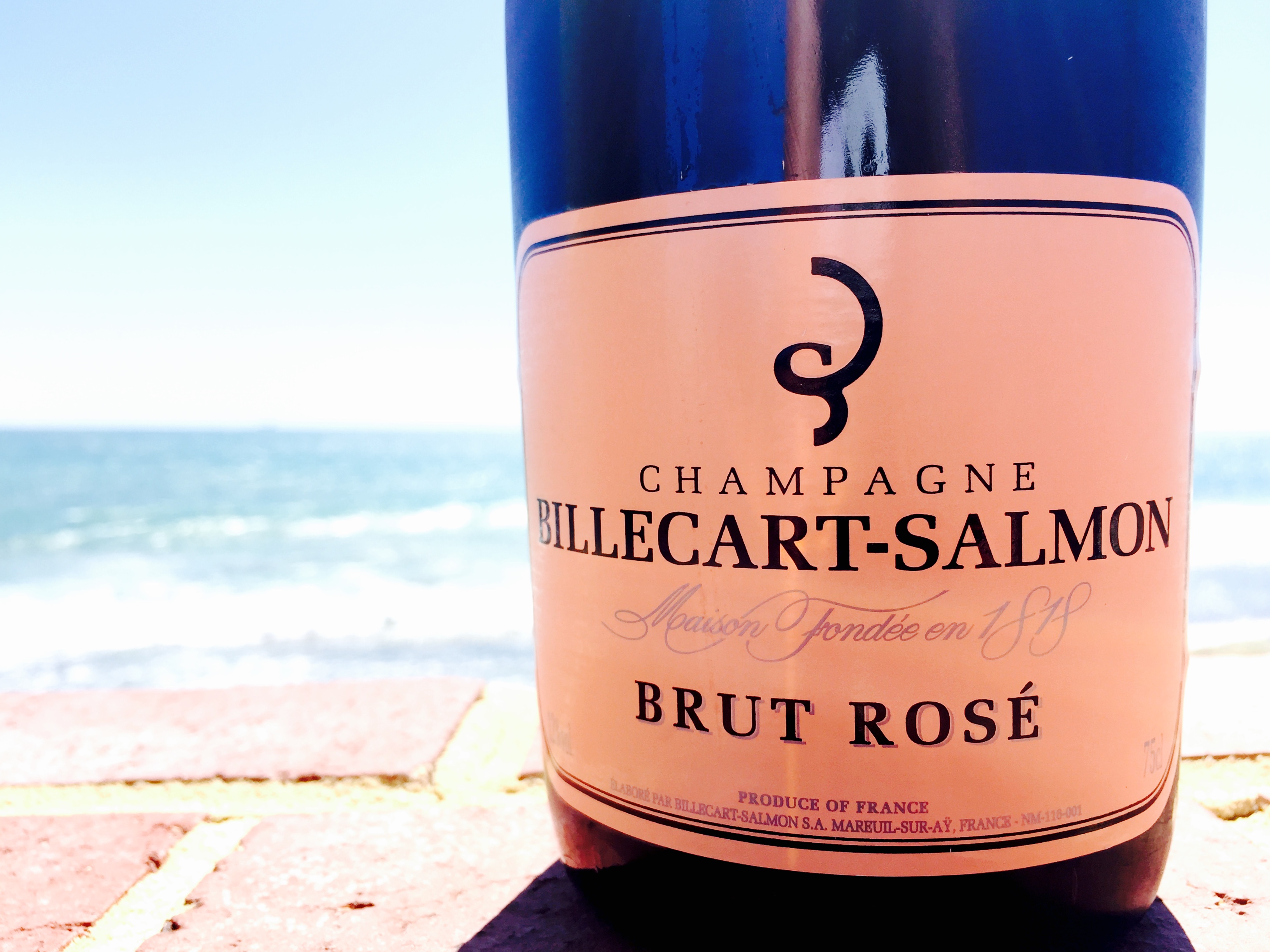
And on the way home I gifted myself a bottle of my favourite champagne, because if you can’t do that when you’ve submitted a PhD thesis, when can you?

Tonight I’m off to my school’s valedictory dinner for our Year 12 students, a big milestone for them. So I’ll get to relax and celebrate with colleagues and my Year 12s. Then I’ll celebrate with my husband and children over the weekend.

I’ve loved the PhD journey so far, but I’m looking forward to taking a break from the obsession and luxuriating in some family time and self care.

Thanks to all who supported me thus far in my PhD narrative. Your support has been so important to me.

It’s a wonderful milestone, but it’s not over! I’ve yet to see what the examiners make of my work, or the extent of recommended revisions.

To be continued … 


How to make your PhD seem like a holiday

This post is my homework this week from the How to Survive Your PhD MOOC in which we have been asked to illuminate an area of confusion through a ‘how to’ guide. While one of the things I found most difficult in my PhD was the discussion chapter (which I’ve talked about here), I thought I’d take a more light hearted approach to this task. One reason for that is that this week – in two sleeps! – I’ll be printing my thesis to be sent to the examiners. So I’m feeling all out of words and fairly brain fried.

I’ve previously asked the question: Can you love your PhD? Here I look at whether your PhD can seem like a holiday. So here’s my ‘how to’ for enjoying your PhD as though it’s an island getaway (more than a little tongue in cheek, but not entirely!).

*              *              *

a romantic night in with the thesis

a romantic night in with the thesis

Step 1: Make sure you’re over committed. This includes parenting, working, having a partner, caring for pets, dealing with life’s surprises. This way, whenever you steal time away to spend time with your PhD, it’ll feel special. Time, just the two of you, feels wonderful when it’s in the eye of a crazy life storm. Ah, special romantic PhD moments!

my kiddoes

my kiddoes

Step 2: Do your work in lovely places and comfy spaces. While a functional office might be great for productivity, there’s nothing like a gorgeous café for some academic writing or a sunny daybed for some literature reading. Cafés, as well as providing ambience for writing, have the bonus of caffeine and people, making you both energetic in your work and surrounded by fellow humans, a great antidote to feeling as though you’re working alone.

my fave #acwri daybed, with coffee

my fave #acwri daybed, with coffee

Step 3: Take a writing retreat. Take a LOT of writing retreats. While you don’t have to ‘retreat’ far (these can be close to home), they need to be in slightly unfamiliar places, preferably with great scenery and some outdoorsyness to get amongst when you’re taking breaks from the writing or revising.

#acwri in the sun by the beach

#acwri in the sun by the beach

Step 4: Choose to research something you’re passionate about, and stay true to yourself in your method and writing. This way you’re following your own research dream and digging into a part of the knowledge landscape that sustains and inspires you. Take off your shoes and curl your toes in the rich earth!

glittery inspiration & your own special randomness

glittery inspiration & your own special randomness

Et voilà! The PhD seems like a holiday, not a torment. 🙂


Preparing the thesis for examination: Days until submission

A work is never completed except by some accident such as weariness, satisfaction, the need to deliver, or death: for, in relation to who or what is making it, it can only be one stage in a series of inner transformations.. ~ Paul Valery

by @debsnet

I have reached that point of the PhD which every candidate feels might never come … only days until submission. While I have been pushing to the end, it has not been a manic panic to a firm deadline. I will be submitting within three years from enrolling but there was no real reason to work to this submission date except that I had a personal goal of completing within three years, and the thesis played along so it became possible (yay!). I did have Plans B and C in the back of my mind in case it didn’t happen as I hoped it would. I considered pushing out my self-imposed deadline, or if I was really struggling, taking six months off work and applying for a completion scholarship. As it happened, I’ve managed to achieve my personal deadline while working, so I didn’t need to activate alternate plans.

In this last week, I’ll have no more meetings with supervisors. They have a new electronic copy of the thesis and will be giving me their final feedback by phone two days before I finalise the document. Then I will be sending the final copy electronically to my principal supervisor for sighting, before we both sign off on it, after which point I’ll walk my usb stick ceremoniously to the print shop, and ask for four copies of the thesis to be printed. Whenever the printing is done (I’m told it might be same-day, or up to two working days) I’ll submit it and receive … glory? champagne? fanfare? the sound of angels singing and unicorns galloping over shimmery rainbows? … a receipt of submission.

In this post, I’d like to share a couple of tech tools that I’ve found useful in this last few weeks to submission.

While I decided not to use a professional editor for my thesis (I’ll let you know how that goes!), I was so pleased when a comment on this blog led me to PerfectIt editing software, which has a 30 day free trial – just in time for me in the month before submission. PerfectIt checks for consistency of language such as hyphenated words, use of numerals and abbreviations. Just like a spell check, you need to consider each individual case rather than clicking ‘Fix All’. Finding this software was brilliant because it helped me look at what is a really big document with a view to ensuring my word choice was consistent from start to finish.

I was also delighted to discover, just yesterday, the free online tool Recite, which checks references, including between the reference list and the body of the document. So helpful for someone like me who has done manual referencing throughout!

So the thesis is feeling, not finished, but ready for examination. The above quote by Paul Valery is often misquoted as “art is never finished; it is abandoned”. The thesis is never finished, it is submitted. I think that’s different because I could keep reading (and reading and reading). I could keep editing over and over, although I’m finding mostly minor errors now. But it’s a little like renovating a house. Just as you improve one thing (replace the curtains!) you realise the next thing to be done (the walls need to be painted!). The layers of final thesis refinement go on and on as small iterations and improvements are made. The final formatting makes it feel like the real deal; a document coming together in readiness for a home open. Yet despite my best efforts, the observer-examiner coming through might think it needs a new bathroom or a different kind of flooring, no matter how much I’ve painted or polished.

As Valery says, it is finished because of the need to deliver. And it is one in a series of small transformations; not an end-of-the-road magnum opus but a beginning-of-being-a-researcher moment of identity formation. So it feels finished enough to take flight to be judged by those outside of myself and my supervisors. We think the thesis is at doctoral examinable quality, but I’ll be interested in what three external experts, each with their own lens, think about it. Perhaps they’ll have questions about theory or method. Perhaps corrections will be minor. Maybe there’ll be no corrections at all! Isn’t that the PhD dream?

I’m trying to look at examination through the rose-coloured lens that it is a process to improve and strengthen my work, so that, as one examiner in the Mullins and Kiley (2002) paper said, it ‘glows more brightly’ on the library shelf. Surely, I think, the examiners have agreed to examine my thesis because the abstract piqued their interest in some way? And surely they will approach it with a view to both recognising my work and giving feedback to make the thesis a better product. Right?

Risky business: Living on the PhD edge

The doctoral requirement for the candidate to produce a significant and original piece of work … indicates that the most significant and original ideas can be those that are most likely to challenge the status quo or the scholarly paradigm within which they are examined. … the ‘best’ doctoral research is likely to be much riskier than modest research. ~ Professor Terry Evans

WRONG WAY GO BACK

WRONG WAY GO BACK

As I inch towards the thesis submission finish line, I have been pointed towards Terry Evans’ 2004 AARE paper, ‘Risky doctorates: Managing doctoral studies in Australia as managing risk’ by the How to Survive Your PhD MOOC. The above quote is from this paper and surfaces the interesting point that the pursuit of knowledge and science is perhaps better served by research which is willing to take risks and challenge accepted knowledge and paradigms. Yet Evans goes on to note that the performative measures imposed on academics and universities encourage modest paradigm-following research, rather than that which is risky, status-quo-challenging and paradigm-bending. That is, PhD researchers are most likely to play within the established rules of the game, in order to complete within time and assure a pass. Evans argues that this results in the loss of “unknown and incalculable benefits” to science and scholarship.

This makes me feel better and worse about the PhD thesis which I’m hoping to submit in the next few weeks. Better, because I think my research is risky; at least the bricolaged – that is, bespoke and woven-together from a number of traditions – paradigm and the way I’ve chosen to communicate my findings. I haven’t totally smashed through academic norms; my thesis is still recognisable as such. But I have pushed at the edges of what is accepted. I’ve been ok with embracing my discomfort and doing things that seem, within the traditional schema of the academe, ‘out there’. My work proposes slightly new ways to go about protecting participant anonymity and communicating participant stories. It is these things about which I am presenting at the AARE conference in November.

While I am feeling proud of my research and my writing (despite having chosen not to employ a professional editor), Evans’ paper also makes me feel nervous because I am getting ready to send my thesis off to three external experts who are to examine my thesis. In the USA and the UK PhD examination usually involves a viva voce, or oral defense, of the thesis, followed by questions. Examiners are then able to deliberate before deciding on the result. In the USA the committee is made up primarily of professors from the candidate’s university, including their supervisor (who hopefully supports the work). Under the Australian system, my thesis will be sent off to three different individuals, including one external Australian examiner and two international examiners, who don’t know me or the work at all. These three people will read my thesis and send in their (potentially conflicting reports), without any discussion between them. At least if examiners’ reports disagree about the quality of thesis, there is a majority one way or another.

While I hope that my thesis is one in which the examiners think the work is interesting an original, and the text worth reading, there’s a lot riding on the opinions of three people, coming from different places, different perspectives and different paradigms. That’s part of the challenge of a bricolaged thesis which weaves together multiple phenomena and methodological threads; there isn’t a clear box in which it fits. Risky.

writing retreat collage, by @debsnet

Having just come back from a mini revision retreat in Sydney (read: 2 nights solo, away from work and family commitments – a PhD-working-parent’s dream), I am so deep ‘in’ my text that I can’t see the wood from the trees. As I have worked at the various levels of editing, I’ve been in the forest, sometimes looking at the whole lot together, sometimes at patches in between and sometimes at teeny micro details. Undergrowth. Canopy. Bark. Branches. Veins of leaves. Reflections in dewdrops. The feel of earth and sound of sticks underfoot. Birdsong. I’m so immersed at this point that I’ve lost direction. Time to take a brief step back to regain perspective. A helicopter ride to survey the scene wouldn’t go astray.

A couple of iterations ago, my primary supervisor said, ‘You could hand it in like this,’ which gives me hope that if the text is better now, it can only be more submittable. I’ll have to see what my supervisors say tomorrow about the most recent version of my thesis. Is it good? Is it good enough? Is it risky? Is it finished? Is it finished enough? Are there mistakes? Will the examiners be sympathetic to my approach? It’s so hard to know because, while I can read other dissertations, the PhD process for me has been in isolation from other students; I don’t know where my work sits on a continuum of doctoral standards.

I guess at some point, it’s time to trust, print, send, and see.

The neverending story of the PhD

Rhymes that keep their secrets / Will unfold behind the clouds / And there upon the rainbow / Is the answer to a neverending story ~ Lyrics to ‘Neverending Story’ by Limahl. Watch the song here: https://www.youtube.com/watch?v=7Vf2sDgeu7k

Bastian atop Falkor; just like PhD-finishing triumph Source: http://thephobia.com/post/58187104333/the-neverending-story

Bastian atop Falkor the luckdragon in the film; just like PhD-finishing triumph
Source: http://thephobia.com/post/58187104333/the-neverending-story

Children of the 80s like myself will remember The Neverending Story, a quest narrative in which the protagonist escapes into a fantastical world through the pages of a magical book. What started as a 1979 German fantasy novel by Michael Ende became a 1984 film directed by Wolfgang Peterson with a deliciously-80s theme song by Limahl. When I’ve been asked what the song of my PhD would be, I often answer ‘The Neverending Story’ as it just goes on and on!

Recently, I’ve been reflecting on the seeming neverendingness of the PhD. I’ve had people in life and on Twitter congratulating me on the completion of my PhD … despite the fact I have not submitted! I think it is because I announced with glee that I had finished my full thesis draft in July. People seem to think that I surely MUST be done by now.

But no.

While the first full draft means that all the chapters are written, it does not mean that the document is (anywhere near) finished. There are some great online resources to help doctoral students with long and laborious revision and editing. Pat Thomson talks about the process of revision, as opposed to editing. Rachel Cayley’s great piece outlines the stages and layers of editing. Katherine Firth’s post on editing gives thorough and accessible strategies. And Tara Brabazon penned this Times Higher Education article which includes ten editing cycles, including ‘read every sentence underlined with a ruler’ (I have tried this). A finished first draft is 3-6 months from a finished final draft.

I kicked off my full-draft revision with a writing retreat, in which I spent about two full days and nights on the first 40 pages. This wasn’t editing. It was Frankensteinesque dismemberment and radical textual surgery, as Pat Thomson puts it. After making it through my first lot of revisions, I talked about my willingness to chop chop chop, to improve the text’s argument by streamlining it closer to its essence. I have now managed to cut what was a 110,000 word draft to 95,000 words. And the text is stronger for it, reflecting Katherine Firth’s comments on the pruning required of verbose texts:

Like a haircut when your tresses are damaged, or like a diseased rose bush, cutting a lot of stuff off can give the rest of your work a space to breathe, and promote healthy growth for that last little bit.

But still, I didn’t think that I’d be making such big changes this close to the end of the game. Just when I think I’m an Oxford comma away from being done, a new ‘a-ha’ moment or a feedback curveball comes my way.

Last week I met with my secondary supervisor who posed a question about a ten-page section of my literature review: How did it fit with the threads of argument in my thesis? On reflection, I realised that this ten pages was relevant but not central. It was something I had been strongly driven by at the beginning of my PhD, but which had become a distraction from my main argument. I was so close to the document that I hadn’t been able to question it in this way. I was attached to something that had been in my thesis from the beginning, but which no longer fit. Luckily, I was attached but not precious about this section, so when its inclusion was interrogated, I was able to say, “Ok, maybe this doesn’t fit. I’ll try lifting it out and see how it works.” I’ve cut the offending section and pasted it into another document, with the intention of reworking the material into a paper. A little of the material I’ve added into my rationale and context sections, in very small bits. The literature review now feels stronger, punchier, less bogged down, leaving the main threads of my argument to breathe.

With less than a month to go, on and on I go. Read, revise, edit, proof, receive feedback, add literature (I can’t stop myself from reading!), apply feedback, read again.

Yet despite what can feel like the dizzying highs, terrifying lows, almost-finisheds and never-finisheds of the PhD, the doctoral experience is a great example of what good learning can look like. The candidate gets to work on a project of personal passion and importance. They are invested in the work and own its purpose. They work over a long period of time, getting (hopefully) regular feedback from their Falkor-luckdragonesque supervisors which (hopefully) helps them to develop their research and writing into the best it can be within PhD parameters.

Even at submission my PhD story won’t end. Then it will be waiting for three examiners’ reports, making corrections, resubmitting. It’s a long road to ‘Dr Deb’. It’s “the neverending storrrrr-yyyyyyy! Ahh-aa-ahh! Ahh-aa-ahh! Ahh-aa-ahhhhhh!” It’s not over yet!

Recipe of a good reference list: Ingredients for PhD success

The doctoral researcher invites to the table the scholars she would like to join her for a conversation over the evening meal. … As host to this party, she makes space for the guests to talk about their work, but in relation to her own work. ~ Barbara Kamler and Pat Thomson, Helping Doctoral Students Write: Pedagogies for Supervision

Who's coming to dinner? by @debsnet

Who’s coming to dinner?

The reference list of a doctoral thesis is the summary of years of reading and developing ways to critically and respectfully talk about reading in an academic voice. It’s also a list of the ingredients of the thesis, of what was collected and selected from which to create our work.

With over 300 references, my PhD thesis reference list runs to 19 pages and almost 8000 words. As I (check and check and check and) consider that list, I ponder what makes a ‘good’ reference list.

Barbara Kamler and Pat Thomson, in their book Helping Doctoral Students Write: Pedagogies for Supervision, talk about using literatures to ‘establish the territory’ or ‘assemble the dinner party guests’. In their dinner party metaphor, which they attribute originally to John Smyth, they discuss the choosing of what literature to include as hosting a dinner party, in which the thesis writer invites to the table those scholars with which their work engages. This gets the candidate to think about what academic conversation/s their thesis inserts itself into, and with which scholarly groups they belong.

I have also read and heard that examiners sometimes read the thesis from the back (urban PhD legend or real deal?). That is, they flick straight to the references, then perhaps to the introduction, the conclusion, then … the findings? Who knows?

Tara Brabazon, for instance, in her 2010 article in the Times, writes:

Doctoral students need to be told that most examiners start marking from the back of the script. Just as cooks are judged by their ingredients and implements, we judge doctoral students by the calibre of their sources.

The moment examiners see incomplete references or find that key theorists in the topic are absent, they worry. This concern intensifies when in-text citations with no match in the bibliography are located. …

If the most basic academic protocols are not in place, the credibility of a script wavers. A bibliography is not just a bibliography: it is a canary in the doctoral mine.

If my reference list was the first thing my examiners looked at I wonder what they would be looking for or what they might think. If I’m being judged on the calibre of my sources, I wonder how my reference list reflects the quality of my scholarship.

I wonder about the ratio of old and new references. My list includes some of the godfathers and matriarchs of the areas of my research; the early works. But when it comes to texts cited from the 1990s, will the reader be wondering why I’m citing not-foundational-but-not-recent texts? Do these texts help to show that I know the field or do they call the relevancy of my list into question? I have also included recent references, including a number published this year. I’m hoping that this shows that my work draws on the very newest thinking in my field. So, I’m hopeful that this combination of old/foundational, middle (some of which are seminal texts for their field), and brand-spanking-new will create a portrait of literatures well canvassed. As Pat Thomson notes in this blog post, examiners know the field, and so will know ‘the originals’. It’s the doctoral candidate’s job to show that they know where their field came from, as well as where it is now.

I have also been thinking about the kinds of texts expected to make up the doctoral reference list. My Voxer doctoral group has thrown up the question about whether blogs and social media can be included in the reference list of a dissertation. My own understanding is that they can be – each style has guidelines for how to cite blog posts and tweets – but that the accepted norm is that a reference list is made up of academic texts, articles from peer-reviewed journals, a few doctoral dissertations and some reports from large organisations. The doctoral dissertations give me hope that mine may get cited on day too! While I’ve seen blogs and tweets used as data, I don’t see them as being considered appropriate references in most PhD theses, unless that medium is central to the field. I haven’t cited any in my own thesis.

Both Pat Thomson and Tara Brabazon mentioned the perils of sloppy or lazy scholarship, which can be revealed through an inaccurate or incomplete (according to the reader) reference list. How is the candidate to know what is enough and when is enough? I am in my final revisions, planning to submit within a month, and still I am reading and inserting citations and references! A recent post on the Thesis Whisperer blog talked about academic FOMO (fear of missing out). I have reading FOMO: the overwhelming fear that if I don’t keep reading, I will miss a seminal paper or a text of importance to my work. And as my thesis uses a bricolaged methodology (different traditions woven together), as well as three phenomena, plus some important contextual factors, there’s plenty to know and plenty to read.

So how, to use Kamler and Thomson’s metaphor, do I know when I’ve invited enough people to my dinner party? Or if they are the right guests?

I found that I started relaxing about the scope of my reference list when I began seeing the same names appearing and reappearing in the texts I was reading. ‘Oh yes,’ I could finally say, ‘I’m familiar with the key names cited here; reading this hasn’t led me to hunt down ten new references.’ But I’m pretty sure I’ll know that the reference-list-litmus-test will only be finished when I press ‘print’ on the final copy.

(Disrupting) disruption in business, academia & education

disruption: dis·rup′tion n. ~ from the Latin disruptionem ~ “a breaking asunder”; to break apart, split, shatter.

While the dictionary definition of disruption points to breaking apart, in fact now disruption often means to make anew. In business, disruption is about creating new markets and discovering undiscovered needs. Traditional products and modes are replaced by new business models, new technologies and new ways of appropriating the old. Google’s now-defunct ‘20% time’, which instigated ‘genius hour’ in classrooms around the world, was designed to nurture disruptive, moon-shot thinking. Often Uber, Airbnb and Apple are touted as examples of businesses which have displaced other services with their innovative thinking. Businesses and entrepreneurs like to see themselves as ‘disruptive’ because this means they are radical, ground-breaking and on-the-bleeding-edge of innovation.

As an English and Literature teacher, I am drawn to teaching texts which were either disruptive in their context, challenging socio-political status quos, or which feature disruptive characters. William Golding’s Lord of the Flies, George Orwell’s 1984 or Animal Farm, Margaret Atwood’s The Handmaid’s Tale and Oryx and Crake, feature films like The Matrix and The Hurt Locker. These texts allow me to challenge and extend students’ thinking, inciting discussion about humanity, history and ethics. They allow us to interrogate dominant belief systems and representations, and dig into our own values, attitudes and assumptions. Being a critical questioner of everything, including ourselves, is a key to disruption.

Tootle the disruptor-train goes off-track

Tootle the disruptor-train goes off-track

One of the books I read my own small children is Tootle, Gertrude Crampton and Tibor Gergely’s 1945 children’s book (you can see the Tootle birthday cake I made in this post on PhD-as-cake). In it, the young engine called Tootle breaks the firm rule ‘Staying on the Rails No Matter What’. Instead, he frolics through fields, making daisy chains, racing horses, talking to frogs and crushing buttercups. I continue to be dismayed that, unsurprisingly for a 1945 text, Tootle ends up complying with the rules. Rather than celebrating his individualism and his new way of being a train, he tows the line like every other locomotive. Each time I read the story, I want to shout through the pages: ‘Go your own way, little train! It’s ok to be different and subversive and joyful and live a life off the subscribed journey!‘ Clearly this says more about me than it does about the story.

In the blogosphere, I follow traditional academics, as well as independent off-centre researchers who are questioning, through action, what being an academic might look like. My PhD research uses a bricolaged paradigm and a fairly unconventional approach to writing up participant data. Bricolage refers to a kind of drawing together of a range of traditions to make a bespoke, rather than off-the-rack, approach, tailored to the particular research problem. This might be considered disruptive in the sense that it rethinks well-worn traditions and stitches them back together in a new form. Perhaps my inability to conform to one research approach is a bit like my inability to follow a recipe in the kitchen, where I’m always using recipes as a kind of springboard-guide, if I use them at all. But disruption isn’t just failing to conform, it’s finding new ways, forging new paths, building new possibilities. It’s providing alternatives to accepted ways of doing things. I think it’s so important that we define what terms mean for ourselves and our sectors, before we begin bandying and bandwagoning them about with reckless, jubilant abandon.

Some educators see the job of education as to nurture the innovative thinking of students, to prepare them for uncertain futures. In education, words like ‘edu-preneur’, ‘edu-innovation’ and ‘disruptive education’ have become popular. In my Twitter bio, I’ve used the word ‘disruptor’, to suggest that I am someone who questions and pushes at the boundaries of what is known and what is accepted, but I have questions around the thinking and behaviours of some self-professed disruptors. The irony is not lost on me; perhaps I should rethink my Twitter bio, but I like delicious words like ‘disruptor’ and ‘flâneuse’. Therein lies part of the problem. Trendy-sounding words are seductive. We like to roll them around in our mouths and social media feeds. 

On the one hand, I know business owners, writers, academics and educators who thoughtfully question the status quo, pushing the boundaries of practice and questioning accepted ways of thinking and acting. These people and their organisations are taking risks and building alternative ways of being in the world. Yet I’ve also noticed that some others bristle when their pithy, jargonistic talk of ‘being disruptive’ is questioned. Sometimes self-professed disruptors don’t take well to being challenged, or disrupted. Sometimes advocates of more traditional approaches or technologies attempt to disrupt the disruptors, but are shot down for being old-hat, stuck-in-the-past or not-on-the-bleeding-edge. Sometimes the whole discussion breaks down into paradigm-war name-slinging. I’ve spoken before about the importance of robust, respectful discussions in which we are ok with graceful disagreement and are able to listen to opposing viewpoints with compassion. I think if disruption is embraced, those doing the disruption should embrace deeper interrogation of their ideas than slick presentations or 140-character tweets might allow. This is why I love blogging and podcasts; they deepen conversation.

So, I approach the idea of disruption with both fascination and healthy scepticism. I do think we should ask what it is that might need disrupting, and why. Or perhaps what might need reconsidering, or consolidating, or investigating, or researching, or rebuilding. When buzzword-saturated talk of disruption becomes the unquestioned norm, perhaps it is those who question the dominant discourse of disruptors who are the most truly disruptive. Let’s not forget to be questioning, critical thinkers, especially within echo chambers of (disruptive, or other) discourse.

Advances are made by answering questions. Discoveries are made by questioning answers. ~ Bernhard Haisch

'Wave 1' by Annette Thas

‘Wave 1’ by Annette Thas