
Looking back on any year reveals triumphs and celebrations as well as challenges and low points. 2024 has been a year that saw an uplifting Olympics and Paralympics in Paris, and leaps in space exploration, but also ongoing cost-of-living crises, worrying levels of mental health, cybercrime, geopolitical conflict, and extreme weather events. Personally, I experienced an incredible Aboriginal cultural immersion experience in North East Arnhem Land, published 11 episodes of The Edu Salon podcast, co-authored a lead article for Australian Educational Leader with Patrick Duignan on reimagining educational leadership, and received two awards: as an Excellence Awardee for Principal of the Year in the Australian Education Awards, and the Australian Council for Educational Leaders South Australia Media Award.
As I reflect on education across 2024, three key trends have risen to the surface in my work as principal, and in the work of schools: personalised learning, GenAI, and holistic wellbeing. None of these topics are new, but they are at the forefront of current educational thinking and practice. As we enter 2025 this week, these foci will continue to shape education.
Personalised Learning
Best practice, research-informed methods of instruction are key to how we design learning and teaching in schools. Schools continue to develop ways in which students’ diverse needs and identities are served, including through engaging student voice and choice, via quality differentiation, by using technologies to enhance and personalise learning, and by tailoring pathways to individuals where appropriate. Within the intentional frameworks of learning and teaching in schools, students are increasing positioned as agents of their own learning. They set goals, influence their own learning, and shape their own learning pathways. While in school, students are studying vocational courses, earning micro credentials, undertaking early university courses, and running their own businesses. At my school, in 2024 we introduced a seed fund and mentorship program to support students pursuing their own social enterprises.
The worlds of education and work will need to continue to develop personalised learning opportunities, with a focus on diversity, adaptiveness, a global mindset, and less hierarchical structures. Generation Alpha—born 2010-2024—have information not only at their fingertips but also digitally integrated into their lives. They experience emerging technologies, fast-paced change, global influences and remote learning. Their digital experiences are personalised by algorithms and so they are accustomed to digital experiences curated to them personally. They connect, collaborate, and create online. They are innovators, entrepreneurs, technology enthusiasts. They are concerned by ethical issues such as equity and sustainability. My own children are Gen Alpha and they are questioning the value of traditional work and life pathways. They hope for life, learning and work to be self-directed, flexible, inclusive and gratifying.
Learning will continue to be personalised, as well as gamified, ‘stacked’ through a range of microlearning opportunities, and lifelong. Schools will continue to reflect on the purpose of teachers as experts who broker learning experiences for students, and schools as hubs of learning opportunities that allow each learner to thrive.
Generative AI
2024 has been a year of the rise and rise of generative AI as collaborator in learning and teaching, with tools such as ChatGPT, Microsoft Copilot and Google Gemini becoming mainstream. Technologies such as artificial intelligence, and extended realities, continue to be tools with which educators develop awareness and intentional deployment.
AI can be a useful accelerant for research, thinking and writing, reducing the time it takes to complete tasks. Using AI as a collaborator and productivity booster can support the work of those in schools. AI can, for example, be used for generating quizzes, transcribing meeting minutes, writing sample test questions, analysing curriculum documents, summarising information, explaining key concepts, drafting communications and generating exemplar responses.
Students can use AI in a range of ways, ensuring that they reference and attribute it appropriately. They might use AI to conduct initial research on a topic, search for useful resources, create digestible summaries of complex information, brainstorm ideas for creative tasks, translate language, generate practice questions, or create study schedules.
Of course, any technology must be used responsibly, ethically, safely, and with a healthy level of scepticism. Critical questions include asking ourselves and our students about biases inherent in AI models, what is excluded by an AI model, assumptions embedded in an AI ‘voice’, and how we might verify the accuracy and validity of the information provided.
Generative AI will continue to shape education as we collaborate with it and develop our use of it as a tool to enhance learning, teaching and leading. Yet teaching and leading are not purely transactional processes that can be replaced by artificial intelligence. Technologies cannot replace authentic voice, teachers that see and know their students, compassionate leadership, or nuanced and context-embedded decision making.
Holistic Wellbeing
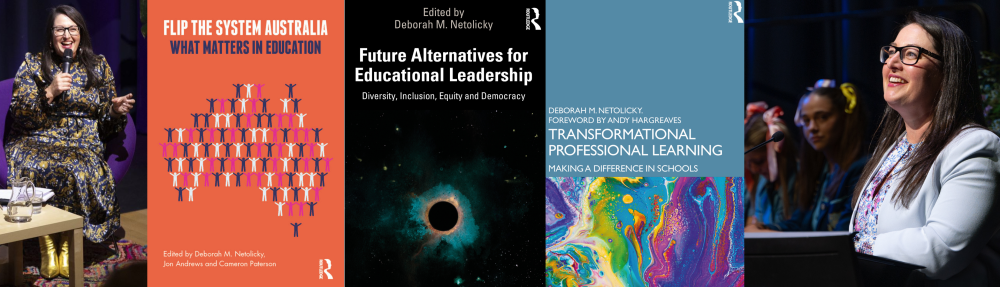
Schools are places of human connection and complexity. In my chapter for the 2019 book Flip the System Australia: What Matters in Education, I wrote that “education is not an algorithm but a human endeavour”, a line which seems more poignant now that our lives are increasingly shaped by algorithms, from the route we take to a destination, to the music to which we listen, to what we see on the internet or social media. In 2024, wellbeing has continued to emerge as something with which schools and education systems constantly grapple. Challenges include student absenteeism, student mental health, teacher recruitment and retention, and teacher and school leader wellbeing.
We need to feel safe and well if we are to learn, and so learning for students is about more than intentional teaching; it is facilitated by positive relationships and learning environments in which learning is valued, progress is expected, and mistakes are seen as opportunities to grow. For students, responsive pastoral care programs and robust pastoral structures provide a holding environment in which every child is known and noticed.
For educators, schools are considering what can be automated or relinquished from staff workloads, and how staff can be empowered to shape practices and policies. In 2024, my school worked with staff to create flexible working guidelines, enabling flexible working where possible, based on role and individual circumstance. Schools are additionally working to develop cultures for staff of safety, community, growth and being supported in their professional and personal lives, as well as the fulfilling shared purpose of educating young people and partnering with families.
Schools need to continue to provide opportunities for meaningful human connection. We need to continue to see education as a human endeavour, about people, belonging and community. In 2024, there were people in my school community who faced hardship and sorrow. It is these moments—often quiet and unseen—that remind us that the greatest privilege of leading is not in celebrating accolades or public successes, but in walking alongside others in private moments of grief and sadness. It is in these moments that the school as community comes to the fore and we most lean in to our humanity in order to support one another.
It is vital that schools create cultures of high care, high challenge and high trust for all in our school communities, including students, staff and families. I would add that these environments need to be high observation, in which we see, hear, know and support each individual. Key parts of education work are noticing, listening, empathising, and offering care. One thing we can all focus on in 2025 is paying attention to our daily interactions and being truly present with those in our community.

 the édu flâneuse