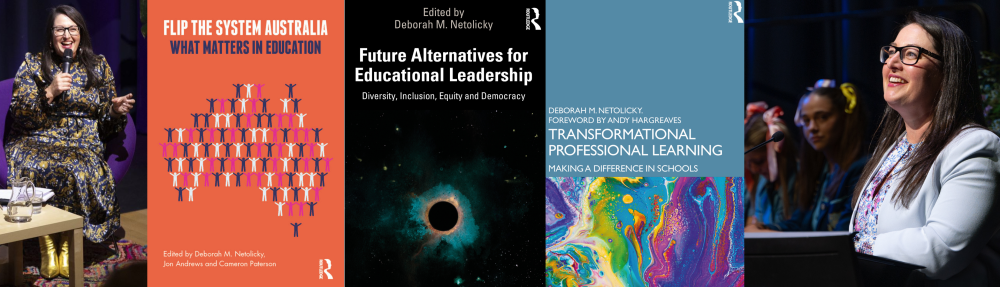
Flip the System Australia: Launching the book

credit: Daniel Grant

At the Perth Flip the System Australia book launch, the audience contributed their ideas about the book’s sub-title ‘What matters [most] in education?’

Since its release, our Flip the System Australia: What Matters in Education book has been the subject of online book clubs via Twitter and Adobe Connect. Some have blogged about the book. See this review by Darcy Moore and this blog post by Kay Oddone. The online reviews on goodreads and amazon call the book “timely”, “urgent”, “superb” and “life-changingly good”. On Twitter it has been called a “must-read”.

The book is having quite the spectacular and protracted entry into the education reading world. Part of the reason is because ‘Flip the System’ is more than a series of edited books on education. It is a movement and a way of actively engaging with and within the education system.

Before its publication, in October 2018, the three editors (myself, Jon Andrews and Cameron Paterson) presented at the ACEL conference in Melbourne on what it means to flip the system in education, and what our Australian book contributes to this global movement.

On the day of its publication, in December 2018, I chaired a symposium at the AARE conference at the University of Sydney titled ‘Education research that engages with multiple voices: Flipping the Australian education system’. Presenters included chapter authors Kevin Lowe, Melitta Hogarth, Bob Lingard, Greg Thompson and Scott Eacott.

In March 2019, co-editor Cameron Paterson hosted a TeachMeet in Sydney on flipping the education system in Australia. Presenters included Yasodai Selvakumaran, Kevin Lowe, Carla Gagliano, Scott Eacott, Mark Liddell and Corinne Campbell. Jelmer Evers, one of the editors of the original Flip the System book, Flip the System: Changing Education from the Ground Up, Skyped in to speak to the Sydney audience. You can listen to the presentations from the night on this TER podcast episode.

In April 2019 we partnered with Fogarty Foundation’s EDfutures and the Innovation Unit for a Perth book event at The Platform Space. EDfutures’ Rebecca Loftus was the MC. As a co-editor, I introduced the series of Flip the System books and outlined our Australian Flip the System book in particular. Then each of the Perth authors–myself, Keren Caple, Tomaz Lasic and Ben Lewis–each explained our contributing chapter and our take on flipping the education system.

The panel was followed by a robust, energising, and at times emotional, discussion with the audience, who included teachers, school leaders, sector leaders, researchers, parents and students. This discussion revealed many of the challenges of the current system, but also the passion and appetite for positive action. It celebrated the great work already going on in our schools, the wonderful partnerships already in play within the education system, the excellent teaching in our classrooms, meaningful partnerships between schools and parents, possibilities for meaningful change, and ways to share the important voices and work of students, teachers and school leaders.

One comment that resonated with those in the room was Adam Brooks‘ argument that we (those in schools) are the education system. Therefore, we need to be active agents of the system reality we want to see.

We can and should nudge the system from the inside out. We can and should celebrate and elevate the good work being done in our schools and the voices and stories of those doing it. We can and should advocate for what is best for our students and our school communities. We can and should agitate for the inviting of all stakeholders–including students, teachers school leaders, and parents–into education discussions and to education decision-making tables.

As we editors write in the conclusion of the book:

Flipping the system is about flattening the system, while more tightly interconnecting the members of that system. We argue for a system in which multiple education voices and stakeholders can dialogue constructively, respectfully and representatively. Democratising the system means liquefying top-down power structures and fostering trust and collaboration. It means that those from within and across the education system work together for the good of the students and families being served by the system. This is ultimately a book about the human aspects of education, so often forgotten in our data-obsessed world of numbers and metrics. Flipping the system means focusing on lived experiences, nuances, contexts, and the humanity of education. It means trusting and listening closely to the people within the system. It means co-constructing a system—of distributed, webbed, non-hierarchical and productive networks—from the ground up and the middle out. (pp.245-246).

Below are some photographs of the Perth book launch. Photo credit to Daniel Grant.

Meanwhile, keep an eye out for news of a Brisbane Flip the System Australia event coming soon.

This slideshow requires JavaScript.

Pause

Bigurda Trail by Deborah Netolicky

walking alone on the Bigurda Trail last week (Kalbarri, Western Australia)

Last year I worked with a coach. During one of our first conversations, he said, “It sounds like what you need is to pause.”

That sounded right.

“Yes!” I said. “I do pause, though. I often pause, see where I’m at, re-assess, and make a new list for what to do next.”

My coach’s wry smile stopped me. He said, “That’s an active pause, but I think you’re talking about the need for a non-active pause.”

A non-active pause? An actual pause where nothing happens but the act of pausing? I wondered what that looked like. I had spent so long working on habits and systems for efficiency and productivity that I struggled to consider the why and what this kind of pausing.

My coach emailed me the goal of ‘finding pause and energy’ after our conversation. He additionally suggested the following actions.

  1. Take moments through the course of the day to pause and just be present—not think about what’s just happened or anticipate the next step.
  2. Identify and prioritise some opportunities to just ‘be’ with husband and friends—put some energy back into those aspects of life.
  3. Identify what ‘energises’ in work and outside—perhaps identify moments in the past (at various stages) when you felt most energised.

He also sent me Adam Fraser’s framework for finding the ‘third space’ and a link to this youtube clip on ‘the third space’ (the micro transition between one activity or role and the next).

Ok, I thought. I can work on pausing. I immediately changed the mini-blackboard message in my office from ‘start now’ to ‘pause, breathe, be’. It reminded me about finding pauses in my day, but the challenge was actually taking them!

Yoga has always helped me tap into ways to be present. Last year, I began flotation tank floating, which showed me the power of sensory deprivation, of unplugging from sounds, sights and from the feeling that at every moment I should be doing something useful and productive.

Yet while I could schedule gym sessions and floats, I still found it difficult to find small ways each day to tune in to pausing or being present.

At the beginning of this year I talked to a friend whose motto for ordering coffee was to ‘have it there’. That is, when he orders coffee from a café, he takes the time to sit and enjoy it there, before moving on to the next part of his day. I wondered about the impact of ‘have it there’, instead of ‘drink it on the run’, or ‘multi-task to save time’, or ‘have it while driving or engaging with a computer or device’.

I committed this year to eating lunch away from my desk. When I’m feeling under pressure I tend to eat and work, but I decided it was important that I find 15-40 minutes per day to sit, alone or with colleagues, and mindfully eat something. I have broken that commitment twice only so far this year. I told colleagues about my lunch promise, so they have helped to keep me accountable. More than once someone has walked past my office and either invited me to sit with them, or asked, “You’re not eating lunch at your desk, are you?” So I have ended up with a little lunchtime community, as well as a pause in my day.

I have also tried to find a few minutes each day to breathe mindfully. Sometimes I find these minutes at work, sometimes at home, and sometimes just before I go to sleep. On occasion I turn off the music in my car and drive in silence. I go to the gym three times per week and try to find other activity on other days, with varying degrees of success. I have been floating in flotation tanks about every 6 weeks.

Despite my attempts at finding pause, and my focus on light-ness, I finished Term 1 feeling rushed and frantic. Last week I took leave from work, during the school holidays. During the week I tried to focus on slow, deliberate living focused on relationships and experiences, rather than goals and actions.

I read fiction in the sun. I walked. Contemplated. Embraced stillness and movement. I stayed out of social media discussions about education. I didn’t write. I didn’t read for work. I gave myself permission to eat a nutritious breakfast, and to sit and enjoy it. I played board games and had long conversations with my husband and children. I spent time outside, in nature, and alone. I hung out with friends and family. I enjoyed going to the gym and having a leisurely coffee afterwards, looking out over the ocean.

Pausing is difficult but what is even more difficult is prioritising it as important rather than ‘nice to have’. What seems so possible during a holiday is challenging to bring into the busyness of everyday working-parenting-living life.

Where do you, or where could you, find a pause in your day, your week, your month?

Diary of writing a book to manuscript completion

Today I have submitted my monograph (solo-authored book) manuscript to my publisher. No this is not an April fool’s joke!

Book writing is quite a drawn out process. I’m sure it looks different for each author, but I thought it might be useful for other authors and aspiring book writers to see a timeline to manuscript completion and submission. Below I outline the dates and steps that have gotten me to this moment.

January 2018: My husband and I are chatting on the long drive home from a family holiday, talking about our goals for the year ahead. I say that writing a monograph is something I would love to have a go at in 2018. As we talk I start to formulate the book’s purpose and structure.

When we get home, I paste up a little piece of cardboard on the bathroom mirror. It says: ‘don’t wait until you’re ready; start now’. I start.

I write a book proposal and send it to the publisher (with whom I have a previous relationship as co-editor of Flip the System Australia). The book proposal is sent out to reviewers.

February-May 2018: My book proposal floats in the review-stage ether. I wait for all of the reviews to come in. Luckily I am readying Flip the System Australia for publication as editor, so my spare time is put to good use.

June 2018: I (finally!) receive the reviews to my book proposal. I amend the proposal in response to reviews and resubmit it to the publisher.

July 2018: Negotiation of and signing of book contract happens. Wahoo! I have a date, a word limit and a mandate.

Let the writing begin.

I stick a word count timeline to my fridge. My kids begin to keep me accountable to it. “Mum, how many words have you written?” “You know you’re meant to have written X thousand by now?” “Can I cross this one off?”

August-December 2018: I write (in between working, parenting, living). I send a few chapters to peers around the world to get some early feedback.

In October I invite someone to write the foreword. They accept.

January 2019: The first draft of the book is complete. Little do I know how much work is still required in order to revise it properly.

I tweet a poll asking how an author knows their book is done.

Tweet Jan 2019

A number of people tell me I need to get some other people to read the whole thing. The whole thing? How can I ask anyone to read the whole thing?

I suck up the courage and ask some experts in the field for feedback and also for endorsements. I am delighted and surprised by people’s generosity.

I also send it out to my editor. I show my husband the introduction and he tells me it needs to be punchier and more interesting.

February 2019: Revising, revising, editing, editing. Repeat. Responding to feedback as it comes in.

March 2019: Proofing, proofing, proofing. Responding to any more feedback.

I take references out of the text to allow more space for my own words, voice and ideas. (I am a chronic over-referencer and need to remind myself: more me, less others! This is my book after all.)

I move the text from one big Word document into separate chapter documents. I finalise reference lists. I finalise the acknowledgements. I write chapter abstracts and complete the art log.

April 2019: On April Fool’s Day I wake up to the foreword in my email inbox. Hoorah! The final piece of the puzzle is here. And it is wonderful. I am super pleased.

I electronically submit my manuscript and ancillary documents to the publisher. This is not a drill.

I feel that weird feeling of wanting to keep tinkering, tinkering, tinkering. But I know that the book is as good as I can make it, in this instant. I wonder: Is done better than perfect? I assure myself that this process (unlike the PhD thesis) involves a copy editor. And that I will stand by my words in the future, even if they only capture my thinking at this moment in time.

While I know it will be exciting to hold the real book when it is eventually printed and released, the publishing reality is that by the time an actual work comes out, the author has often moved on in their thinking. My book is not yet finished, but this is a milestone worth celebrating.

I buy the same special champagne I bought in October 2015 when I submitted my PhD thesis: Billecart-Salmon Brut Rosé. I haven’t opened it yet, but I will find a time to enjoy it, and a few people with whom to share it.

From here there will continue to be about 6 months of checks and communication as the book moves through the publisher’s copy editing and production process. This includes proofing by an independent copy editor, cover design, index writing and printing.

Some time this year I’ll get the actual book in my hands!