Key concepts for leading professional learning

A recent report purports to dispel myths about professional learning, including the apparent ‘commonly held’ beliefs that ‘professional learning is a waste of time and money’ and that ‘districts should implement research-based PL programs with no modifications’. These claims run counter to much literature around professional learning which argues that effective professional learning is a lever for improving student learning and achievement by improving teaching, and that context is crucial for any education model (and that therefore any model should be tailor fit to context).

This week I presented to a group of school leaders about leading professional learning. Part of my preparation for the presentation took me back to the roots of my work in this space, and those concepts I have come across that have stuck with me, become part of my thinking, and continue to anchor my work. I explain some of these below, in addition to others I discussed on the day, such as trust, context, teacher expertise, and teacher agency, self-determination and self-efficacy.

HOLONOMY

Holonomy is an ecological concept that has captured my attention for years, drawing together the individual and the larger system. Art Costa and Bob Garmston (2015) base their conception of holonomy on Arthur Koestler’s work around the word ‘holon’ as something which operates simultaneously as a part and a whole. Holonomy encapsulates the simultaneity that each person is both an independent individual and an interdependent part of the larger system, at once self-regulating, responsive to the organisation, and able to influence those around them.

This speaks to me of what we must consider when leading professional learning: balancing the needs of the individual and the needs of the organisation or system.

HOLDING ENVIRONMENT

Introduced to me through the outstanding work of Ellie Drago-Severson on leading adult learning, is the notion of the ‘holding environment’. With its roots in Donald Winnicott’s psychology concept, this is an environment of psychological safety in which members of the community or organisation feel ‘held’ in a culture of high care and high challenge.

Ellie was the first to really challenge me to consider how we honour where each adult learner is at, differentiate learning for adults in schools, and take an invitational, growth-focused approach to professional learning.

MEANINGFUL COLLABORATION

In Chapter 4 of Transformational Professional Learning, I explore that 1) collaboration does not happen by calling a group of people a ‘team’, or by organising for a group of people to be in a room together; and 2) feeling good working with colleagues is not professionally learning. Politeness, compliance, avoidance, and silence may make for an easy, harmonious-feeling meeting, but do not result in rigorous collective work that moves individual, team and organisation forward.

Rather, collaboration occurs when there is a clear shared purpose, collective accountability, collaborative norms, a focus on data to inform, and protocols for collaborative ways of working. Taking the time to create the conditions for skillful collaboration, to structure and nurture intentional collaborative practices, and to develop people’s skills in graceful disagreement and productive conflict, facilitates meaningful collaborative opportunities that develop teachers and positively impact students.

SEMANTIC SPACE

The importance of language is explored by Robert Kegan and Lisa Lahey (2001), and Bob Garmston and Bruce Wellman (2016). The notion of semantic space—‘how we talk around here’—is outlined by Stephen Kemmis and Hannu Heikkinen (2012), and Rachel Lofthouse and Elaine Hall (2014).

Talk defines and drives emotions, relationships, belonging and action. Talk is a terrific barometer of professional culture, allowing us insights into beliefs, values and behaviours. We can ask: What are the staff water cooler conversations like at our school? How do we collectively talk about our work and practice? What questions do we ask? What contributions do we make? What shared language, and ways of speaking and listening, do we use? How do we talk around here?

In a recent episode of my podcast, The Edu Salon, Adam Voigt says: “The language that the leaders of a culture use, shapes the kids that grow in it, and they leave speaking that way as a result. If you’re looking to transform culture you can’t do it without changing words.”

I have this year written on my office whiteboard something I remember Rachel Lofthouse saying at a conference in 2017:

The talk is the work.

We need to value, focus on, create space for, and put effort, intentionality, time, and learning, into the talk in our schools.

References

Costa, A. L., & Garmston, R. J. (2006). Cognitive coaching: A foundation for Renaissance schools (2nd ed.). Heatherton, Australia: Hawker Brownlow Education.

Drago-Severson, E. (2004). Becoming adult learners: Principles and practices for effective development. Teachers College Press.

Garmston, R. J., & Wellman, B. M. (2016). The adaptive school: A sourcebook for developing collaborative groups. Rowman & Littlefield.

Kegan, R., & Lahey, L. L. (2001). How the way we talk can change the way we work: Seven languages for transformation. John Wiley & Sons.

Kemmis, S., & Heikkinen, H. L. (2012). Future perspectives: Peer-group mentoring and international practices for teacher development. In Peer-group mentoring for teacher development (pp. 160-186). Routledge.

Lofthouse, R., & Hall, E. (2014). Developing practices in teachers’ professional dialogue in England: Using coaching dimensions as an epistemic tool. Professional Development in Education, 40(5), 758-778.

Netolicky, D. M. (2019). Transformational professional learning: Making a difference in schools. Routledge.

Breaking bias

Australia was recently ranked overall 50th in the global gender gap (including 70th in ‘economic participation and opportunity’ and 99th in ‘health and survival’, but equal 1st in ‘educational attainment’). But while gender remains an issue worth discussing, our discussion needs to move beyond ‘women’ and consider complex structures and practices of power and equity. An article in yesterday’s Guardian by Sisonke Msimang argues that white women’s voices and anger are now being presented as central and as relatable, while the voices and stories of “Aboriginal women, women in hijab, women whose skin is far ‘too’ dark, and women who live on the wrong side of town; who can’t go to university and who will never report from parliament or file stories in newsrooms” are ignored. She adds that “Black women have pioneered the landscape of courage. … everywhere you look there are Black women who continue to be punished for loudly wearing their anger.”

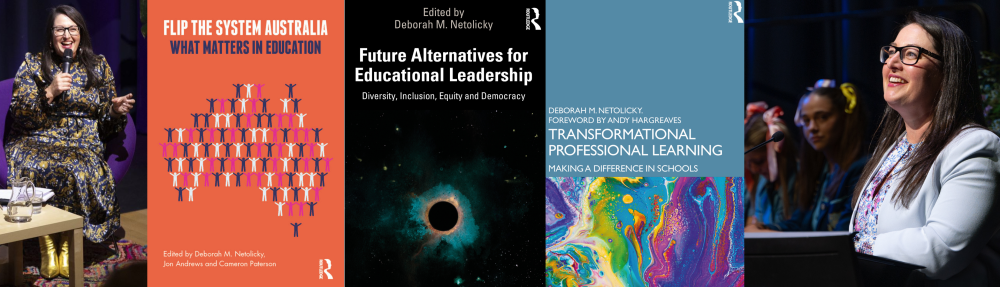
As I reflect on the IWD 2022 theme of ‘break the bias’ I continue to consider how to acknowledge my own biases and privileges, and seek to understand the ways in which I help or hinder the project of diversity, inclusion and equity. I know that posting a blog post, photo or hashtag does little to address existing biases and their impacts on groups and individuals. I know that action and advocacy are needed in micro and macro contexts, and that sometimes appropriate action might be to speak less, take up less space, or question my own way of being in the world. I am proud of edited books such as Future Alternatives for Educational Leadership (which features 19 women out of 25 authors) and Flip the System Australia, but know these are imperfect in their attempts to share a diverse range of voices.

The following blog post is on the WomenEd website as part of a suite of worldwide reflections for International Women’s Day 2022.

Source: @PIRO4D on pixabay

Each year, International Women’s Day is surrounded by questions as to why the day is needed. Yet a dig into data from any country shows that gender equity is far from a reality. Recently, the COVID-19 pandemic has exacerbated gender inequities, as this UN policy brief and this UN technical briefattest. There has been an increase in unpaid domestic and caring duties often taken up by women, an increase in gender-based violence, a decline in the availability of reproductive health services, and lack of women’s representation in pandemic planning response.

The 2022 International Women’s Day theme is ‘Break the Bias’. But how do we ‘break’ bias when it’s unconscious, unacknowledged, or invisible? With so much complexity in the social world, accepting stereotypes, tropes, and assumptions about gender can make the world a simpler place with less cognitive load, easier judgments, and faster decision making. But left unchallenged, biases can block, hinder, and harm individuals and groups in society and in organisations.

The education world should look at how bias might be influencing school communities and students’ experiences of learning, living, and being in the world. In schools, sometimes the racial, ethnic, ability, sexuality, and gender diversity of the staff does not match the diversity of the student and parent community. Sometimes there is a lack of diversity in the community, or in the teaching or leadership staff. Conscious and unconscious biases of those overseeing staff recruitment and promotion can influence who is recruited, who is promoted, and who is overlooked. Biases of educators can affect response to student behaviour.

The questions we ask of ourselves and of others can help us to understand our own biases, to challenge the biases of others, and to encourage different ways of being and behaving. In a recent conversation with Jacob Easley II on my podcast, The Edu Salon, he challenged educators to take the time to explore their professional identities, beliefs, and purpose. He suggests that a place to start is with the question of why a person is entering the teaching profession: “Is it really to work with certain types of students, and not others, those who are more like me, and not those who are different from me?” This is something we should all ask ourselves. How do we respond (to a student, parent or colleague) when someone is not ‘like me’?

We can break open, or splinter bias, if we ask good questions. How about: Do we like to teach those students mostly like ourselves? To what social issues do we draw our organisation’s attention? What and who do we ignore or pay little attention to? Who is visible, celebrated, and recognised? Who is ignored or ridiculed? Who do students see ‘out in front’ at assemblies and events? Who do the school community see in middle and senior leadership?

Do we hire mostly people like ourselves, or do we seek to recruit a diverse workforce? To whom (if at all) do we offer flexible work options? While it may seem fair to apply the same decision-making framework for all people, aiming for meritocracy can perpetuate existing advantage. Is it more equitable to consider the varying needs and barriers of individuals, and to seek to tackle those barriers on a needsbasis? What is our approach to a situation with which we are unfamiliar or to someone whose experiences and perspectives are vastly different from our own? Do we engage in uncomfortable conversations? Do we dismiss or seek to understand concerns?

We can ask these questions of ourselves and others. From there, here’s what else I think we can do.

  1. Interrogate our responses. Be ok with not knowing, with learning, discomfort, and respectful challenge. Be willing to listen and to learn. Work to identify biases in ourselves and our organisations, and the barriers and inequities they create.
  2. Anchor ourselves in our values. Be brave enough to know what kind of individual and what kind of organisation we aspire to be. ‘The community won’t accept this without resistance,’ is not a good enough reason to remain stagnant on issues of equity, social justice, diversity, and meaningful inclusion.
  3. Educate and advocate. Stand up. Support. Resist. For example, when someone is critiqued for their cultural dress or accent, speak out. When someone is not being considered for a role or promotion, question why or point to attributes and experience that may have been ignored.
  4. Implement practices and structures that support mitigating bias, such as transparent and consistent recruitment processes with diverse representation across the decision makers, thoughtful leave policies (including flexible and generous parental leave and carer’s leave), options for flexible working where possible, and an organisational culture in which staff are trusted and professional expectations take into account a diversity of life responsibilities.

We all have influence, and we all have a responsibility to take bias seriously and to engage with its realities and ramifications, even and especially when those biases work in our individual favour. If there is one thing the pandemic has taught me, it’s that we need to work for the greater good over the individual good.

This year’s IWD pose reflects ‘break the bias’.

What matters in education: Reflecting on Flip the System Australia in 2022

I was invited to speak today as part of the Future Schools webinar series. In particular, I was asked to engage with the notion of flipping the education system, based in my work in co-editing the 2019 book Flip the System Australia: What Matters in Education.

That was then

Even though today’s conversation was for a group interested in future schools and the future of schooling, thinking about it required me to reflect back to 2018, when much of the work of the Flip the System Australia book was being done. Back then, my co-editors—Jon Andrews and Cameron Paterson—and I were experiencing the then- educational environment of measurement and surveillance. This included a distrust of schools and teachers, heightened accountabilities according to quantifiable measurables in education, policy rhetoric about educational quality assurance and effectiveness, competitive comparisons of performance in high stakes standardised tests, and a push for teachers to do ‘what works’ according to simplified and dehumanised lists of apparent best practice (although, as Dylan Wiliam says, everything works somewhere, and nothing works everywhere).

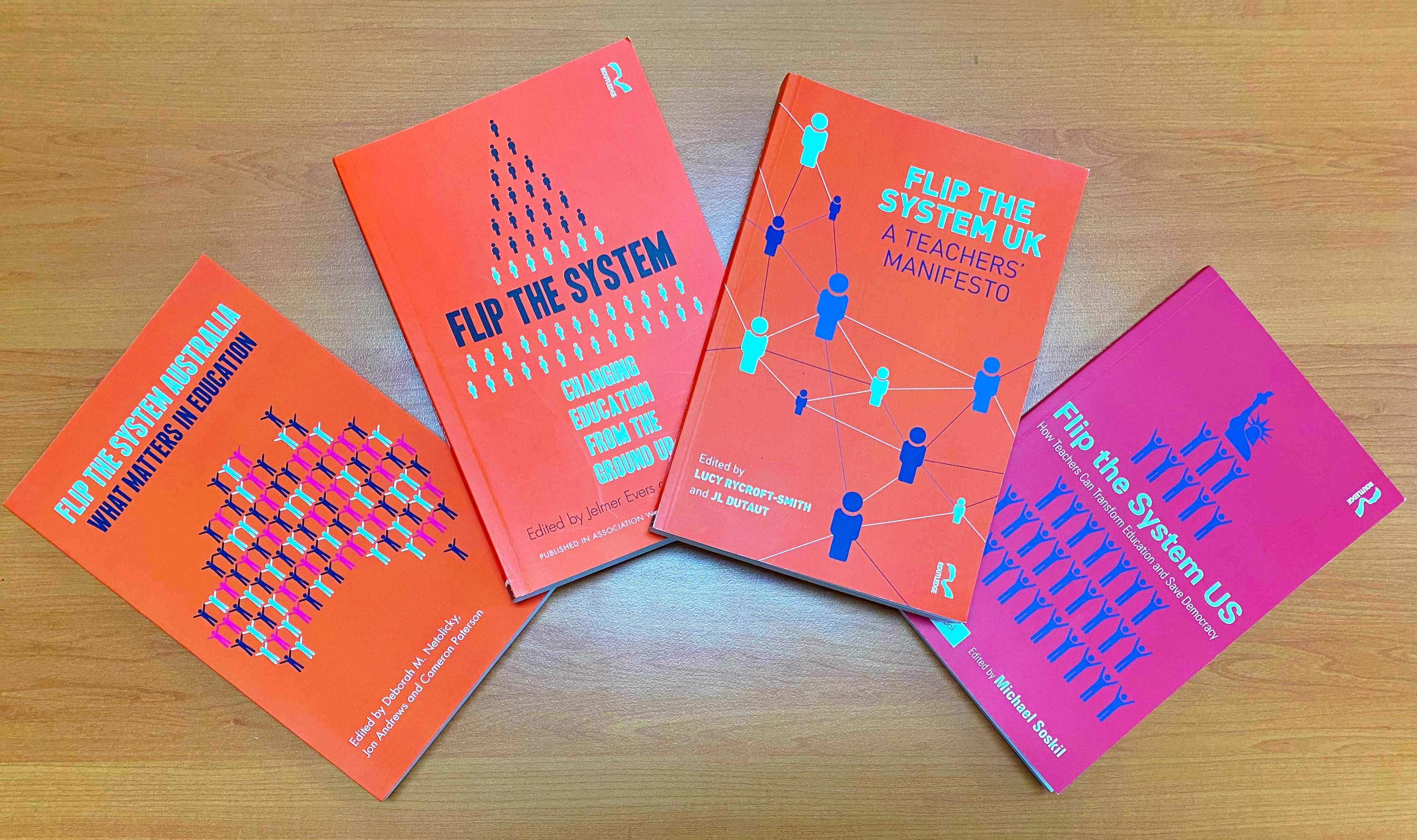
Our book built upon the Flip the System books that came before ours (from the Netherlands, Sweden, and the UK) and sought to value and promote a diverse range of voices in education talking about what matters (or what should matter), over what works. We argued for the humanising of educational narratives, the democratising of educational policy and practice, and the development of deep and sustained trust in the teaching profession.

Teachers’ being and becoming

My Flip the System Australia chapter argues for elevating the professional identities and voices of teachers and school leaders in educational research, practice, and policymaking. In the chapter, I explore the quantifying and performative measuring of teacher work as limiting the complexities of that work and reducing teacher identities to a limited range of options. I define identity in my book Transformational Professional Learning as “the situated, ongoing process through which we make sense of ourselves, to ourselves and others” (p.19). It is a constant, context-embedded process of being and becoming, with professional identities inextricably linked to personal identities; we are our whole selves at work, and our lives influence our teaching.

Teaching as a performance disconnected from identity and purpose is unsustainable. Teachers need to feel that their identities are aligned with the purpose of the profession, with shared school values, and with their daily work. Rather than being required to fit themselves to a school, teachers need to feel that they truly belong in a school community in which they share a common moral purpose and are valued for their individual selves, including their gifts and imperfections.

Embracing authenticity and embedding inclusive practices are becoming increasingly important in schools. More than that, as Jelmer Evers wrote in the Foreword to our Australian book, a shared professional identity can transcend borders and nationalities, and can form the basis of reinventing democracy and our schools.

The more things change, the more they stay the same

A focus on the humanity and the positive contribution of education to the lives of all young people remains the core purpose of education. In Flip the System Australia, Carol Campbell describes the purpose of education as “the betterment of humanity” (p.81). In my chapter, I say that “education is not an algorithm but a human endeavour” (p.16). The betterment and care of each child, and thereby the betterment of humanity, includes supporting children to be their best, most agentic and self-determining selves, able to make positive contributions to their communities and to the world.

In Australia, the 2019 Alice Springs Education Declaration, and before it the 2008 Melbourne Declaration on Educational Goals for Young Australians, expressed two key goals:

  • Goal 1: The Australian education system promotes excellence and equity; and
  • Goal 2: All young Australians become: confident and creative individuals; successful lifelong learners; and active and informed members of the community.

Yet Australia remains far from an education system that promotes, for all young Australians, excellence and equity.

Melitta Hogarth’s Flip the System Australia chapter reveals the contradictory nature of policies and practices that appear to be unbiased, but that perpetuate conservative, colonial values, and the silencing of Indigenous voices in education. She argues for Indigenous representation at every level of education leadership and decision making in Australia. Kevin Lowe in his chapter argues for collaborative, productive engagement between schools and Aboriginal and Torres Strait Islander communities. There remains ongoing disadvantage for Indigenous Australian children, in terms of education, social and health outcomes. Systemic inequities have been exacerbated by the pandemic and compounded by Western-centric curriculum and biased measures of educational success.

In Chapter 11 of Flip the System Australia, Andy Hargreaves, Shaneé Washington and Michael O’Connor shared findings on teacher wellbeing that now read as a prelude to the intensification of workload and the impacts of the pandemic that have followed. They commented that “teachers feel they are losing control over their professional decisions, … they are being asked to carry the mounting social problems of the world on their own shoulders, and, in the midst of all these things, they feel constrained and compromised by competencies and assessments they do not always believe in” (p.101). Their chapter asserts that there is no student wellbeing without teacher wellbeing. Since that chapter was written, wellbeing has escalated, making its way up the education agenda. Educators have been reminded of something we have always known that now needs our careful attention and action: that wellbeing is inseparably joined with learning and achievement.

This is now

Flipping the system is about flattening and democratising education. Three years on from the publication of Flip the System Australia, the world is facing unremitting and overlapping crises. We only need to turn on the news to see that our planet and democracy remain in peril. In education, governments are enacting fast policy (with teachers and school leaders often hearing about each new policy twist and turn during a press conference), with schools then quickly implementing the changing guidelines and protocols.

Although there are frightening data around teacher and school leader burnout and retention challenges, teachers and school leaders remain incredibly committed to serving their communities, through the most difficult of circumstances. There has been the need for, and therefore the rise of, school and teacher autonomy during the pandemic, as educators have made context-embedded decisions about what their students and communities need, and how to best work to meet these needs.

Schools have been revealed as places of connectedness, relationality, socialisation, and community, as well as learning. The last couple of years have led schools to develop innovative uses of educational technologies, flexible post-secondary pathways for students, and generous networks of educators collaborating together across countries and sectors to share, support and grow alongside one another. Effective leading has been shown to be an authentic practice of care and hope. Those working in schools have been literally changing education from the ground up, which was the catch cry of the original Flip the System book by Jelmer Evers and René Kneyber.