Tweeting and blogging: Selfish, self-serving indulgences?

Narcissus by Caravaggio http://totallyhistory.com/narcissus/

This week I’ve been mulling over a post in the TES written by Claire Narayanan in which she argues that teachers’ time is precious and they should quietly get on with their jobs, not spend time writing about it. In encouraging teachers to be ‘do-rus not gurus’ she writes:

In a world where self-promotion has rather shamelessly crept into education, the real heroes are not those who we may follow on Twitter, read about in leadership manuals or hear speak at conferences, but those who are at the chalkface.

These are the teachers who seek no recognition beyond a set of decent GCSE results; a thank-you from their headteacher every now and again and, best of all: “Thanks Sir/Miss, I enjoyed that lesson”.

They haven’t got time to attend every single TeachMeet in their region, read every piece of research written, attend every conference around the country on their subject area or update their blog. Does that mean they don’t care as much as those who do? No chance – they’re too busy marking and planning.

I found this interesting and a little challenging. Of course no-one attends ‘every’ TeachMeet, reads ‘every piece of research written’, or attends ‘every conference around the country’, but the suggestion that ‘real teachers at the chalkface’ are too busy marking and planning to entertain attending professional development, reading research, or blogging, implies that those who do make the time for these activities are perhaps neglecting their teaching jobs. Otherwise, how would they have the time? It also implies that these activities aren’t a valuable use of teachers’ time.

I agree with Claire that we shouldn’t pursue gurus and heroes in education. My PhD reveals the importance of leadership that is deliberately invisible and empowering, rather than visible, focused on the leader, or driven by outward performance. I’ve spoken of the silent work of coaches and leaders. And as a full-time teacher and school leader who also tweets, blogs, and writes peer-reviewed papers and chapters, I know the tricky balance between self care, time with family and friends, and service to the profession and to my students.

I wonder, though, about the implication that those who are on Twitter or presenting at conferences are shameless self-promoters or narcissists seeking heroic guru status. Many of those who tweet and blog, I would argue, do so because they are interested in learning from others, sharing their own perspectives and experiences, and engaging with educators from around the world.

Part of what keeps me blogging is that it helps me think through ideas and get feedback from others. Another part is how useful I find the blogs of other people in helping or challenging my thinking. I also see blogging and academic writing as a service to the profession and a way to reclaim the narrative of education from those normally at its apex. It is why I am involved in the Flip the System series of books, which offer and value the voices of school practitioners—those working at the whiteboard, in the playground, and in the boardroom—that are often ignored in education reform, and yet are crucial voices to drive change in education. As Jelmer Evers and René Kneyber suggested in the first Flip book, teachers and school leaders can be agentic forces in changing education from the ground up by participating in global education conversation.

When I asked Claire on Twitter whether she saw all who tweet, share, blog, and present as shameless self-promoters, she responded, “Not at all. I’m all for sharing and learning. We all get on with the job in the way that suits us.” We seem to agree that different things work for different people. I don’t expect everyone to use their time as I do. There are benefits and costs to choosing to spend evenings, weekends, and holidays on professional activities or presenting at conferences. Last year I paid the price of going too hard for too long without a break.

For me, social media provides an avenue for sharing, learning, and connecting. I can tweet out my thoughts into the nighttime abyss, and somewhere, someone in the world is there to respond. I found this especially useful during the isolation of my PhD. I connected via social media with generous, supportive academics, researchers, and doctoral candidates from around the world who provided crucial advice and moral support.

My understanding of the world is broader for the conversations I have with those around Australia and the world, on social media and at conferences. These conversations and relationships allow me to see outside of my own context and my own perspective. They spill sometimes into productive collaborations that shape my thinking. I wrote here that:

In a world in which we are more connected than ever, we can be buoyed, empowered and supported by our connections…. We can pay forward and give back. We can … share our knowledge, contribute our time to help others on their journeys, listen to others’ stories, and celebrate others’ milestones.

Do I think we should acknowledge and celebrate the quiet daily work of committed teachers? Absolutely. Do I think we should encourage teachers to be mindful of workload, wellbeing, and self care? Yes, yes, yes. Do I think this is mutually exclusive from professional learning, engaging with research, interacting on social media, or writing blogs? No, I do not.

Semantic space: ‘How we talk around here’

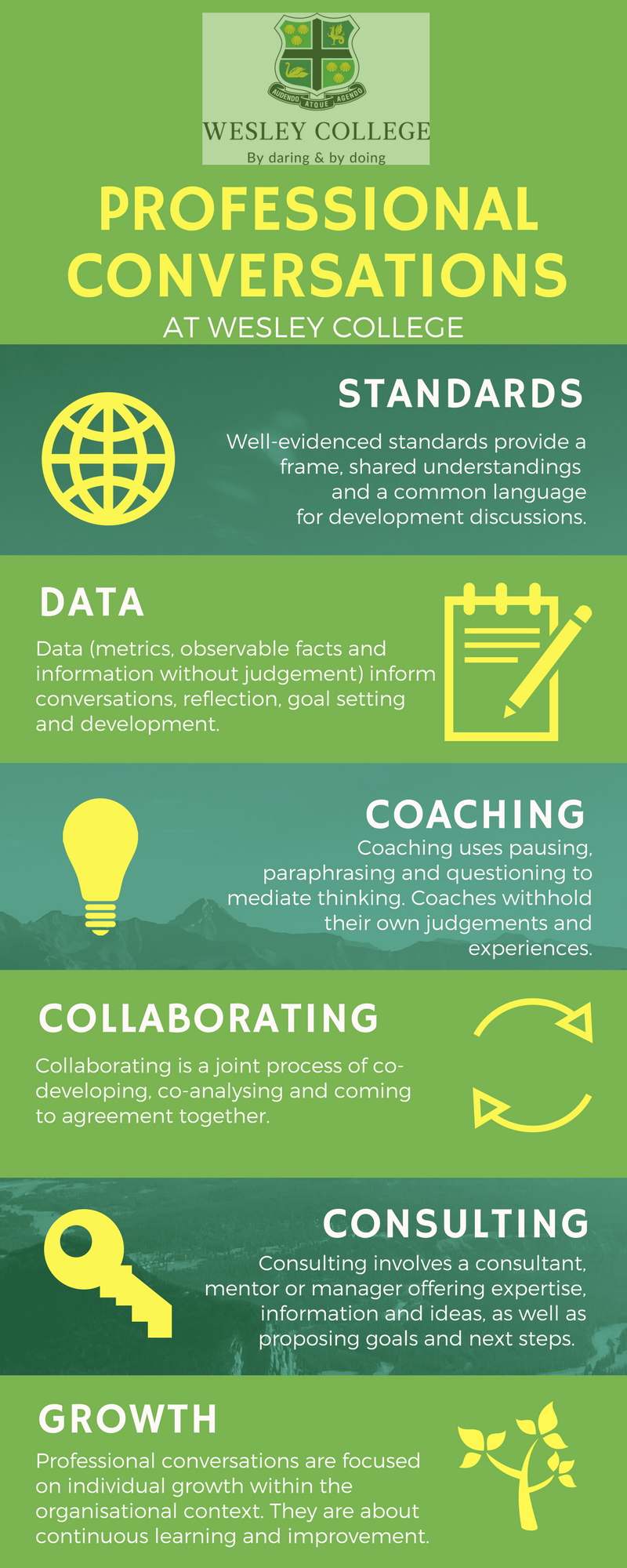
I’ve been thinking about talking and talking about talking. The pictured infographic is one I designed to distil my school’s approach to professional conversations. While deceptively simple, it is the result of a lot of research, practice, and writing, over time. In that blog post, I talk about why we use Cognitive Coaching as a coaching model for developing a collaborative professional learning culture, but also when we might deliberately use consulting, collaborating, or evaluating as ways of talking. Rather than adopting deficit models of conversation aimed to fix or tell teachers, we base our professional conversations on a belief in the capacity of everyone in our community to grow and improve.

At the Australian National Coaching Conference in Melbourne last month, I was immersed in talking about coaching, and talking with coaches. I was delighted to be on a conference panel with Christian van Niewerburgh, Rachel Lofthouse, and Alex Guedes, discussing coaching in education research. One of the points I made was around the use of terminology within a community like the one in the conference room. 400 educators and coaches were all talking about coaching at the conference, but not necessarily with the same understanding of what ‘coaching’ means.

Many of the conference attendees had what Christian van Niewerburgh calls a ‘coaching way of being’. A conversation with them is a coaching conversation. These individuals actively and intensely listen, paraphrase, pause, and ask thoughtful questions designed more for the benefit of the talker than the listener. These aren’t conversations where the other person is waiting for their turn to say their piece or pushing a personal agenda; they are ones in which the listener serves the talker via thoughtful and deliberate ways of talking and ways of being in conversation.

At the conference, Rachel Lofthouse talked about Kemmis and Heikkenen’s (2012) notion of a semantic space. I enjoyed this way of thinking about an organisation. Semantics is about linguistic meaning; the logic of language. In organisations I imagine a semantic space is about ‘how we talk around here’, the meanings of words, the way communication happens. Lofthouse and Elaine Hall (2014) define semantic space as one of professional dialogue, constituting tone, choice of words, routines of dialogue, and balance of participation in conversation. Semantic space interacts with organisional structures, physical spaces, and relationships.

Harvard academics and developmental psychologists Robert Kegan and Lisa Lahey (2001) say that our places of work are places in which certain forms of speech are promoted or encouraged, and places where other ways of talking are discouraged or made impossible. What kinds of talk are promoted in our schools? Which are limited or suppressed?

Can it ever be ‘just’ semantics? No. The words we use, the way we talk, and the way we interpret language are vital to our work, especially in education. Members of high-functioning teams, for instance, respectfully challenge one another in order to find the best ways forward. Something Rachel Lofthouse said in her conference keynote stuck with me: “Don’t talk less and work more. The talk is the work. So talk well, talk productively, talk to learn.” The way we talk can influence the way we think and the way we behave. In any organisation it’s important to figure out and work on ‘how we talk around here’ as well as why we talk, when we talk, what we talk about, and how we want to talk.

References

Kegan, R., & Lahey, L. L. (2001). How the way we talk can change the way we work: Seven languages for transformation. John Wiley & Sons.

Kemmis, S. and Heikkinen, H.L.T. (2012). Practice architectures and teacher induction. In: H.L.T. Heikkinen, H. Jokinen, and P. Tynjälä, eds. Peer-group mentoring (PGM): peer group mentoring for teachers’ professional development. London: Routledge, 144–170.

Lofthouse, R., & Hall, E. (2014). Developing practices in teachers’ professional dialogue in england: Using coaching dimensions as an epistemic tool. Professional Development in Education, 40(5), 758-778.

Digital Pedagogy

source: pixabay.com

I have worked in one-to-one schools for most of my 17-and-a-bit year teaching career, and I’ve tended to be an experimenter with and adopter of learning technologies. I’ve been known to use online discussion forums to extend class discussion around English and Literature texts and concepts. I’ve used class blogs, wikis, and backchannels as collaborative learning spaces or expansions of the classroom. I use Twitter, Google Docs, Voxer, and blogging for my own learning and development. I have participated in MOOCs (massive open online courses).

I’ve recently been considering digital pedagogy from more of an organisation and systems level, as I look into how to refine my school’s use of technologies as tools for learning and teaching. As I begin a search of what research literature might offer us in this realm (please, if you have a seminal paper or reference here – pass it my way!) I have a couple of reflections. One is that, as technology moves quickly and research moves slowly (from data generation to publication), research on digital pedagogy needs to be treated with caution. Research around technology is emergent and fast changing; by the time it is published, it may be well out of date.

My other initial reflection is that there seems to be a discrepancy between the use of digital technologies promoted by enthusiastic teachers, conferences, and technology companies, and the discussion about education technologies in academic research. The former often promotes the possibilities of technologies for learning as future-building and positive. The latter tends to reveal a more cautious or critical approach to what digital technologies can offer teaching and learning.

It’s not surprising that tech giants promote themselves to schools, but there are some worrying reports that tech corporates, such as Edmodo and Google, use schools and students to collect and track big data. Corporate agendas are something we might consider when thinking about how technologies infiltrate or colonise our schools.

Neil Selwyn (in his 2016 book Education and Technology: Key Issues and Debates) points to the limitations of digital technologies, arguing that there is a lack of genuine diversity in the educational opportunities provided by educational technologies, but rather more of the same. He notes that “any ‘individualisation’ or ‘personalisation’ involves fitting individuals around preconfigured outcomes and expectations rather than offering genuinely bespoke education. … an individual is not actively self-determining but conforming to the requirements and expectations of a mass system” (p.161).

I share Selwyn’s cautiousness around technology in schools when it is seen as a shiny new thing or an end in itself. I am more comforabtle when digital pedagogy is about choosing the tool fit for the purpose, aligned with learning objectives. Technology is part of the teacher and learner’s arsenal, not the end point in themselves.

Additionally, while digital pedagogies are often viewed with much hope for their possibilities, the realities seem to be more disappointing. Marte Blikstad-Balas and Chris Davies (in their recent Oxford Review of Education paper ‘Assessing the educational value of one-to-one devices: Have we been asking the right questions?’) show that one-to-one devices are often positioned as having benefits to pedagogical change, development of future skills, and efficiencies and cost savings. (Interestingly, at my school the photocopying bill did not decrease with the move to one-to-one devices.) In looking at three schools (two in the UK and one in Norway), Blikstad-Balas and Davies found some benefits of one-to-one devices, but these tended to be focused on convenience, instrumental use, and functionality, rather than pedagogy. The three schools studied raised concerns including ad hoc teacher enthusiasm and uptake of one-to-one-devices, and teacher scepticism around implementation of digital technologies as part of pedagogy. Students reported feeling either pressured to use devices they didn’t want to use, for purposes they didn’t see as valuable, being distracted from their learning by one-to-one devices, and finding one-to-one devices unreliable. Year 11 and 12 students reported using their one-on-one devices for whatever they wanted (such as social media and online gaming), which was often not what the teacher was instructing. These findings are a sober reminder to schools about the realities of implementing educational technologies.

The educational world is saturated with information and promotions of various digital technologies. The 2016 Horizon Report for Higher Education, for instance, identifies a number of future trends and technologies predicted to influence education. Those working in education institutions need a way to make sense of the digital noise. Selwyn’s 2016 book Is technology good for education? provides useful questions to ask ourselves when considering digital pedagogy (p.24):

  • What is actually new here?
  • What are the unintended consequences or second-order effects?
  • What are the potential gains? What are the potential losses?
  • What underlying values and agendas are implicit?
  • In whose interests does this work? Who benefits in what ways?
  • What are the social problems that digital technology is being presented as a solution to?
  • How responsive to a ‘digital fix’ are these problems likely to be?

At my school we are working with a purposeful and transparent frame for making decisions about digital technologies and pedagogies. This frame is based around our strategic intents for our students, and our beliefs around learning, good teaching, and the core business of schools. No matter what the latest tech fad or shiny device, any pedagogy needs to start with the purpose of the learning and the design of curriculum. Pedagogy first. Digital if and when appropriate.

Education Gurus

It’s easy to make your own guru memes with Canva.

Knowledge and advice for schools and about education often seem to exist in a world of commodification and memeification. There is plenty of disagreement and debate in education, and plenty of competition on bookshelves and in conference programs. Educators and academics position themselves as brands via bios, photographs, and certification badges. As an educator and a researcher I have those whose work I follow closely; academics, for instance, whose presence affects me when I meet them because their reputation and body of work precede them.

In education, we have perceived gurus. These are people who have become ubiquitous in education circles, at education conferences, and in education literature. Teachers and school leaders scramble to get tickets to their sessions and to get photographic evidence of having met them. Their words are tweeted out in soundbites ad infinitum (or is that ad nauseum?), and made into internet memes. Sometimes these individuals partner with publishers or education corporates, and so the visibility and reach of their work grows. They become the scholars or experts most cited in staff rooms, at professional learning water coolers, and in job interviews when asked how research informs practice. 

Sometimes, these gurus are teachers or principals who have gained a large following on social media and subsequently a monolithic profile. Often, they are academics who have built up bodies of work over many years, becoming more and more well-known along the way, and eventually being perceived as celebrities or gurus. Yesterday I had the pleasure of learning from Dylan Wiliam, firstly at a day long seminar, and then at my school. At one point the seminar organisers apologised for running out of Wiliam’s books, acknowledging the desire of delegates to have the book signed.
Marten Koomen has traced networks of influencers in Australian education organisations. In his new paper ‘School leadership and the cult of the guru: the neo-Taylorism of Hattie’, Scott Eacott challenges the rise of the edu guru, those academics whose work is ubiquitous and influential to the point of being uncritically accepted and canonised. Eacott pushes back against the ‘what works’ mentality in education, in which educators are sold ‘what works’ and encouraged to slavishly apply it to their own contexts. Jon Andrews, too, questions the unquestioning way in which the loudest and most prominent voices become the accepted voices. Meta-analysis and meta-meta-analysis, often translated into league tables of ‘what works’ in education, have been the subject of criticism. George Lilley and Gary Jones have both questioned meta-analysis on their blogs. I’ve written about cautions surrounding the use of meta-analysis in education, especially when it drives clickbait headlines and a silver-bullet mentality of having the answers without having to ask any questions. Yesterday Wiliam made his oft-repeated points: that everything works somewhere, nothing works everywhere, and context matters. A guru cannot provide easy answers in education, as education is too complex and contextual for that.

taken at AERA last year

Much of this conversation around the rise of the edu guru has surrounded John Hattie, although he is by no means the only globally renowned education expert likely to make conference delegates weak at the knees. I was personally uncomfortable when he was beamed in via video link to last year’s ACEL conference and began to give an ‘I have a dream’ speech about education. As an English and Literature teacher I understand the power of rhetoric and analogy to persuade and inspire, but appropriating the legacy and words of Dr Martin Luther King Junior seemed a way to gospelise a personal brand of education reform.

I don’t think that education experts, no matter how influential they become, should encourage the uncritical acceptance of their ideas as dogma, or present themselves as the bringers of the One True Thing To Rule All Things of and for education. As Dylan Wiliam, channelling Ben Goldacre, repeatedly said yesterday, “I think you’ll find it’s a little more complicated than that.”

I wonder how perceived gurus feel about being guru-ised by the education masses. In part the famous and the infamous in education are so because of their actions: accepting more and more speaking gigs, performing the game of publishing and promoting their work. Most, I would guess, do this for the same reason someone like me speaks and publishes. To contribute to education narratives and change those narratives, hopefully for the better. To be of service to the profession and the field. To explore and wrestle with ideas, trying to find ways to make sense of the complexity of education in order to improve the learning of students and the lives of teachers and school leaders.

I wondered about the rise to gurudom and the moral obligation of the academic celebrity figure last year when at AERA I saw a panel in which four educational heavy hitters—Andy Hargreaves, Michael Fullan, Linda Darling-Hammond and Diane Ravitch—all advocating for the moral imperative of educational research and practice. They spoke of lifetime journeys of work intended to make the world a better and more just place. I wondered at the time about how much an early career academic can be brave and resistant in their work, as they try to build a career via the performative pressures of the academe. Can only the guru, free from institutional performativities and the financial pressures often associated with early career academia, say what they really want to say and do the work and writing they really want to do?

I don’t think experts in education are dangerous. We need expertise and people willing to commit their lives and work to making sense of and making better the world of education and learning. But in a world where teachers and school leaders are busy racing on the mouse wheels of their own performative pressures, we need to figure out ways to support and facilitate sceptical and critical engagement with research. Even those who are highly influential and highly admired need to have their work engaged with closely and critically. The danger comes when experts become so guru-fied that the words they use become part of an unthinking professional vernacular, used by educators who haven’t looked behind the curtain or beneath the book cover.

Is formative assessment overvalued?

Call me late to the party, but last night I was surprised to see this tweet from Alfie Kohn stating that formative assessment is overvalued. I agree with his latter comment that data to see if students are improving, or have improved, are worthless until we’ve asked ‘improved at what?’, but I don’t understand the connection between the two parts of the tweet. My hunch is that my understanding of formative assessment in practice is different to Kohn’s. In this post I’ll explain my own take on formative assessment.

(Disclaimer – I understand that a tweet is limited in its 140 character form. I’m using my understanding of the tweet as a jumping off point for this post.)

From the seminal 1998 paper of Paul Black and Dylan Wiliam, ‘Inside the black box’, to subsequent work by these authors, and others, formative assessment as an evidence-based, rigorous feedback process is well-established.

Feedback can be defined as information provided by an agent regarding aspects of performance or understanding (Hattie & Timperley, 2007). Wiliam (2016) notes that anyone (teacher, learner, peer, parent) can be an agent of feedback, and that the most powerful agent of feedback is likely to be the student who takes responsibility for their own learning.

The purpose of feedback, according to Hattie and Timperley (2007) is to reduce the discrepancy between current and desired understanding. Information is used by students or teachers for improvement in an interactive dialogue between teacher and learners so that learners can become more expert and more responsible in guiding and furthering their own learning (Black & Wiliam, 2010). The interactivity, and the activity, are important. Teachers use feedback to make adjustments to planning and instruction. Students become active, empowered agents of their own learning as they self-assess, receive feedback, and act on it. Formative assessment is based in a belief that every learner can improve.

Feedback can have a significant positive influence on student learning and achievement (Stiggins & DuFour, 2009; Wiliam, 2011a, 2011b, 2016), but it is linked to emotions, relationships and environment; it can be accepted, modified, or rejected; and it can have positive or negative effects on performance (see Kluger & DeNisi, 1996).

Formative assessment involves feedback that is continuous; specific to goal, standards and task; descriptive rather than numerical or via grades; occuring within a learning context; and acted on by the learner (such as through self-assessment, re-doing the task, or outlining next steps).

It is information and interpretations from assessments, not numbers or grades, that matter (Hattie & Timperley, 2007). Numerical marks and grades operate as judgements, not aids to learning, and so students ignore comments where a mark is provided (Black, 2014; Black et al., 2004). Alfie Kohn argues against grades in this 2011 paper. Ruth Butler (1987, 1988) found that grades had no effect on achievement. Written comments based on the task, on the other hand, resulted in high levels of task involvement. Comments should identify what has been done well and what still needs improvement, and give guidance on how to make that improvement (Black et al., 2004; Wiliam, 2011b).

Feedback should not involve judgement of the person, positively or negatively. Butler’s research (1987, 1988) found that written praise had no effect on achievement, and Costa and Garmston (2003) note that learning cannot occur if a person feels threatened. While receiving feedback can be emotional, it should be designed to evoke cognition over emotion.

At a grass-roots level, teachers such as Starr Sackstein (2015, 2017) and Mark Barnes (2013, 2015) have been advocating for teachers to ‘throw out grades’, focusing instead on feedback practices such as conferencing, peer assessment, and self-assessment.

This previous blog post outlines some of my own practices around summative assessments, as well as a term I spent teaching Year 10 English without any marks or grades. I have recently developed my summative assessment feedback practices to ensure that students engage with their work more deeply before it is assessed, and then again once I have written comments, but before receiving their mark. In my classroom, formative assessment practices are a constant. They include myself and my students constantly engaging with their work, curriculum standards, syllabus points, rubrics, clear criteria for success, and setting of specific targets. These practices are entwined within a relational classroom environment of trust and challenge. Anecdotally, some of the best a-ha moments for my students come when they assess their own work against clear criteria, and come to their own realisations about how to improve. Over time, self-assessment becomes part of expected and lived practice for students in my classroom. This is not to say that I am a formative assessment expert; building formative opportunities takes ongoing teacher reflection, deliberate planning, and careful constant reading of the students.

Perhaps I have been embedding formative feedback practices into my teaching for so long that it seems obvious, but my thought on first seeing Kohn’s tweet was: of course we cannot look at data that might indicate improvement of learning without asking ‘improvement at what?’ Specific goals, standards, and comments on how and on what to improve, are part and parcel of the suite of practices of formative assessment.

Is formative assessment overvalued? I don’t think so. It is a fundamental way to improve learning, and also to build the capacity of the learner themselves.

References

Barnes, M. (2013) Role reversal: Achieving uncommonly excellent results in the student-centred classroom. Alexandria, VA: ASCD.

Barnes, M. (2015). Assessment 3.0: Throw Out Your Grade Book and Inspire Learning. Thousand Oaks, CA: Corwin.

Black, P. J. (2014). Assessment and the aims of the curriculum: An explorer’s journey. Prospects, 44, 487-501.

Black, P., Harrison, C., Lee, C., Marshall, B., & Wiliam, D. (2004). Working inside the black box: Assessment for learning in the classroom. Phi Delta Kappan, 86(1), 8-21.

Black, P. J., & Wiliam, D. (1998). Inside the Black Box: Raising standards through classroom assessment. Phi Delta Kappan, 80, 139-48.

Black, P. J., & Wiliam, D. (2010). A pleasant surprise. Phi Delta Kappan, 92(1), 47.

Butler, R. (1987). Task-involving and ego-involving properties of evaluation: Effects of different feedback conditions on motivational perceptions, interest, and performance. Journal of educational psychology79(4), 474-482.

Butler, R. (1988). Enhancing and undermining intrinsic motivation: The effects of task‐involving and ego‐involving evaluation on interest and performance. British journal of educational psychology, 58(1), 1-14.

Costa, A. L., & Garmston, R. J. (2003). Cognitive coaching in retrospect: Why it persists.

Hattie, J., & Timperley, H. (2007). The power of feedback. Review of Educational Research 77(1), 81-112.

Kluger, A. N., & DeNisi, A. (1996). The effects of feedback interventions on performance: A historical review, a meta-analysis, and a preliminary feedback intervention theory.

Kohn, A. (2011). The case against grades. Educational Leadership, 69(3), 28-33.

Sackstein, S. (2015). Hacking assessment: 10 ways to go gradeless in a traditional grade school. Cleveland, OH: Hack Learning.

Sackstein, S. (2017). Peer Feedback in the classroom: Empowering students to be experts. Alexandria, VA: ASCD.

Stiggins, R., & DuFour, R. (2009). Maximizing the power of formative assessments. Phi Delta Kappan, 90(9), 640-644.

Wiliam, D. (2011a). Embedded Formative Assessment. Bloomington, IN: Solution Tree.

Wiliam, D. (2011b) What is assessment for learning? Studies in Educational Evaluation37(1), 3-14.

Wiliam, D. (2016). Leadership for teacher learning: Creating a culture where all teachers improve so that all students succeed. Moorabbin, Australia: Hawker Brownlow Education.

Running the PISA race

The education culture of performativity is wrapped up in notions of measurement. How do we measure student success, teacher performance, effective school leadership, and successful education policy? How do we know which school systems are successful and why they are successful? How can we tease out and understand causes of performance, such as the influence of social and economic factors, the system, the school, and the teacher? These are perennial education questions, and ones which continue to become more and more important in a globalised world in which countries, schools, and teachers can be compared, and in which there is an ever-increasing weight of accountability.

Standardised testing is a central issue in this neoliberal education context. Individual schools have their own approaches to measurement, such as the one I describe in this blog post. In Australia we have NAPLAN and WACE. There is currently talk of a national Phonics Check in the early years, such as that used in the UK. Internationally we have TIMSS, PIRLS and PISA.

Steven Lewis and Anna Hogan have shown how oversimplified reports of international testing measures can contribute to oversimplified ‘fast policy’. As Marten Koomen points out, systems should respond to international testing measures but these systems are complex. Stewart Riddle and Bob Lingard wrote that looking at a single country’s PISA ranking is useless; rather we need to carefully disaggregate the data and consider social and economic factors, and differences between states, schools and groups.

This week I received in the mail a copy of new book The global education race: Taking the measure of PISA and international testing, by Sam Sellar, Greg Thompson and David Rutkowski. (Full disclosure: I got a complimentary copy.) It is a pocket rocket at about A5 size and 99 pages. In the Foreword, David Berliner and Pasi Sahlberg question the value often ascribed to PISA, noting that PISA tests are linked to the social conditions as well as school systems and that “when the race to the top gets tougher … curriculum narrows and children suffer” (p.ix).

The book demystifies the workings of PISA, using the extended metaphor of the ‘race’ as a way to make sense of what PISA is, how it works, how it might be used, and how it shouldn’t be used. The authors make their explanations accessible without ignoring the complexities of standardised international testing on a large scale. The book is at once matter of fact and told with a wry sense of humour (as a reader I’m a sucker for references to Monty Python and 1980s arcade games). The book rails against the commodification of simple solutions to solve complex problems. As I explored satirically in this He-Man inspired post (speaking of 80s references) there are plenty of edu salespeople hoping to profit from the pressures of accountability pressing in on schools and teachers. This book, however, is about helping those on the ground to understand the complexities, inner workings and possibilities of PISA.

What sets Sellar, Thompson and Rutkowski’s book apart from other literature is its ability to engage with complexity in an accessible way; to explain clearly without simplifying; and to avoid binaries and polarising divides while acknowledging differing perspectives. They note, for instance, that PISA has been innovative, carefully developed, and judiciously administered, but that such a big project will undoubtably suffer from technical issues and limitations.  They note that PISA is an assessment of select content areas of one sample on one day, but also argue that transparent standardised tests like PISA can be a useful tool for understanding social systems. They explain validity in understandable ways and show how countries can use PISA data responsibly.

The international examples help the book to be relevant to people in OECD countries around the world. For Australian readers like myself there are some gems, such as that PISA performance has become an end in itself, evidenced by the national target of improving Australia’s PISA ranking by 2025 (articulated in the 2013 Education Act). The authors call this move “astounding”. Their tongues are firmly in their cheeks when they state on page 76 that: “The aim of reversing the trend of declining PISA scores seems to be to improve PISA scores through intensifying those policies that have not worked so far. A bold move.” A bold move, indeed, and one that Simon Birmingham might want to reconsider.

The authors also recognise the desire of policy makers, educators and the media to understand PISA and to glean the most important messages it can tell us. They warn, however, about over-attribution of causality, when correlations become causal claims, pointing to the way the media and policy makers often use PISA to point to particular factors as being the cause of high or declining PISA performance. I’ve written about the dangers of policy moves like performance pay for teachers, and the authors have warnings to offer their readers about the negative effects of pairing standardised testing with punitive accountability regimes, and of governments desperately scrambling to ‘win’ against other countries. Run your own race, they argue.

The global education race presents an important challenge to policy makers and educators alike: to develop informed communities willing and able to engage in discussion of how educational measurement, including system-level measurement tools, can be judiciously used to inform policy and practice. The kind of shift they suggest is a challenge. It will require ministers, media and educators to take a non-divisive, sense-making and collaborative approach of seeking to understand, and of deep, thoughtful engagement with data and with one another.

The oasis of writing

Sometimes we need an immersion in a cooling, calming place of our choosing. That might involve turning off our devices, turning away from social media, turning towards what nourishes us. It might be sitting in silence, or playing music loud. It might be the catharsis of working with our hands, or the release of letting them rest. It might be solitude or connection, work or play, stillness or movement, mindful or mindless.

School is currently out in Western Australia, and while I am working, I have been taking time out across the break to bathe in oases of sorts. I’ve been on a brief holiday with my family, pottered around the house, seen friends and indulged in another haven of mine: academic writing.

Those of you who write for a living or are in the throes of a PhD (Oh, the unicorn-dancing-in-a-champagne-waterfall highs! Oh, the despairing bottom-of-the-dark-pit lows!) might roll your eyes or baulk at writing as an oasis. But after a term of working full-time in an exciting but challenging newly-formed role in a school, selling a house, buying a house, moving house, parenting my two lovely children, and trying to maintain relationships with family and friends, I was ready for a break from the relentlessness. From feeling like the mouse on the wheel, full of urgency and repetitive motion. Not only that, but both social media and real life have had their share of challenges lately. Academic writing has been a welcome and nurturing reprieve; simultaneously mental work and a mental break. Academic writing continues to be like my PhD, which I sometimes managed to think of as a holiday from all-the-other-things, or intellectual me-time, although without the weighty pressure or looming examination. Papers and chapters are more bite-size and more varied, and pleasingly always at different stages; just as one becomes difficult, another is coming together or being accepted.

Of course academic writing is not easy or necessarily enjoyable. With it comes challenge, struggle, sometimes brutal feedback. It helps that the acwri I’m doing at the moment is writing I want to do. I’m engaged, interested, motivated, intrigued. I’m learning, growing, pushing at the boundaries of what I know and can do. Academic writing allows me to extend myself in different ways to my school role.

Some of this writing is solo, but I’m also writing papers and chapters collaboratively, something still pretty new to me. Perhaps the collaboration is the coolest part because working with others takes me out of my usual groove, my usual ways of thinking and writing. It gets me engaging with others’ words and these spur my words on. Our words are like gifts from a science fiction world; they shapeshift and take on different lives as they are passed back and forth between authors.

This kind of writing and collaboration is somewhere for a writer to luxuriate. Nestle in. Be cocooned by the writing while at the same time deliciously confronted by it. I brace for feedback but at the same time allow myself to be vulnerable and to be shaped. To read unfamiliar theory, try alternate approaches, or to tinker with new ways of theorising, researching and writing. To have one or more other writers to generate and energise.

It’s cool. It’s fun. It’s a welcome distraction from the daily rush of work during term time and the barrage of angry educators slinging accusations at one another on Twitter (thank goodness for my arguing on EduTwitter bingo card!). This holiday break I’ve worked on a solo-authored journal paper and a collaborative chapter so far. I’ve got one more collaborative chapter to look at over the next few days. I’m looking forward to it. Like a cup of tea at the end of the day after the kids have gone to bed, for my pracademic self, straddling as I do the worlds of school and academia, academic writing can be a moment of ‘aaaaaahhhh’, of indulgence, of me-time.

On cognitive load

I’ve been thinking recently about cognitive load theory (CLT), a theory founded by John Sweller in the 1980s. Bear with me. I’m not intending to use seductive sounding terms like ‘cognitive architecture’; or to suggest that I am an expert on CLT; or to delve into discussions about intrinsic, extraneous and germane cognitive load; or to articulate the problems with self-ratings of perceived mental effort. This is more of a loose layperson’s pondering around the effects of the influence of new information on working memory.

CLT posits that human working memory cannot process many new elements at any one time. A couple of weeks ago I moved house and the resulting chaos had me realising the effects of putting a heavy load of novel information onto the working memory. Despite the mundanity of the challenges of moving into a new home (whitegoods don’t fit, furniture doesn’t work spatially, boxes crowd in threateningly, kids don’t sleep well, the house makes strange noises), in the first week at our new place I left my yoga clothes at home once and left my phone at home twice. I was constantly struggling to remember where I had to look to find plates, cling film, toiletries, members of my family. I had no sense of routine or stability.

For me, the mental work of existing somewhere new, without the automaticity that comes with entrenched habit (or, as cognitive load theorists might call it, cognitive schemata in my long term memory) was immense and intense. I felt that I was living in a fog, and existing at about 40% of my usual capacity. The simplest of tasks were arduous, time consuming, and took what seemed like excessive cognitive effort. My husband asked me what was wrong with me; I knew that the relocation had taken my working memory beyond its capacity to cope. I was moving as through wet concrete. I felt displaced.

Now, learning a new house isn’t the same as learning new, complex, domain-specific skills (although I could talk long and hard about the gurgling of the fishpond interrupting sleep, the mental effort required to drive in the right direction home from work, and the impossibility of finding a sensible place for everything in a new kitchen). No doubt there were aspects of my experience that were environmental and affective as well as cognitive. Yet, the disorder and discombobulation I felt in my first week in my new house were a stark reminder of what students might feel when confronted with new content in a classroom with which they are not yet familiar, or with a skill that they might approach without the appropriate embedded prior knowledge and automation required to succeed.

As Greg Thompson has recently blogged (channeling Derrida’s student Bernard Stiegler), writing (like this blog post) can construct a mental prosthesis, a kind of corporeal residue of an experience that, left to the memory, would fade in intensity over time. Unlike Greg in his story of being concussed in Banff, I will have no physical remnants of moving house, nor any of the entertainment value of the story. No doubt soon the uneasiness will fade into that vague unnoticed feeling of being at home in instinctive motion.

In this post on the doctorate I reflect that:

Once we have learned something, we cannot always remember what it was like to not know it, making it difficult to teach or help someone. By (b)logging my writing memories as they happen, perhaps I can archive my not-so-good-at-academic-writing self. Reflecting-on-writing by writing-about-writing – in a kind of meta-writing – helps me to document my academic writing journey. … blogging helps me to have a Hansel-and-Gretel breadcrumb trail back to my less capable self.

As someone becomes more expert, they often ‘black box’ their expertise, as Pamela Hinds explains in her 1999 paper ‘The Curse of Expertise’. Experts are unable to accurately predict the time and difficulty novices need to complete a task. Intermediate learners, Hinds finds, are more helpful for novices as they still remember and understand the problems of being a beginner. This is something I wonder about in terms of academia as well as teaching. Do doctoral supervisors ‘black box’ the PhD or EdD experience? Are they able to break down the steps of the doctorate for their students, or are veteran professors too far removed from the struggle and journey of the neophyte researcher? In a classroom, do teachers expert in their subjects have the capacities to break down the content and skills into accessible enough elements for struggling learners? Can an expert coach can break down the steps of coaching once they have internalised the philosophies, knowledge, and processes? Once the work of the mind is internalised and automated, much mindfulness and precision are needed if we are to teach others. Expertise may be a curse, but my house move has reminded me of the curse of the beginner. I yearn for repetitious automation.

So, as I use the daily practice of living in my new house as a way to build a long term memory schema, I am beginning to relax. Nothing yet feels automatic or fluid—and I still feel the newness and unfamiliarity of my surroundings—but I know that at some point I will forget the uneasy, cognitively prickly effort that came with moving house. I’ll happily float through the new place on auto-pilot, even in the dark of night or the first sleepy moments of the morning.

E4L and the value of dissent

I find it ironic that, just after a blog post in which I reflected that blogging often feels like shouting into the void, a recent post on this blog has received a robust and ongoing response, as well as plenty of rich conversation, online and in my immediate context.

I wrote earlier this month about my ponderings and cautions around the Evidence for Learning Toolkit (based heavily on the UK’s Education Endowment Fund Toolkit) currently gaining traction in Australian education circles. I felt compelled to share my thinking as the E4L Toolkit is connected with some Australian heavy hitters. It is powered by Social Ventures Australia and the Commonwealth Bank. It is advised by prominent academics from a range of Australian universities, including John Hattie who is both a champion of meta-analysis and the equivalent of an education household name. Its advisors also include high-level representatives from the Australian Council for Educational Research (ACER), the Australian Council of Education Leaders (ACEL), the Australian Curriculum, Assessment and Reporting Authority (ACARA), various independent schools associations, and various State education departments. This who’s-who is all the more reason, I think, for those in the education community to look carefully at the Toolkit and its adoption across the Australian edu-landscape.

This week, John Bush, Associate Director of Education at Social Ventures Australia and part of the leadership team of Evidence for Learning, wrote a blog post for the E4L website (the first of a series). In it, he responds specifically to some of the comments I made in my post.

John points out that my post was part of “a flurry of public comment across Australia and the UK in the value and risks of meta-analysis and synthesis of meta-analyses in education research.” Although I didn’t realise it at the time, my post did come in on the crest of a wave. Published the same day (UK time) were this article in the Times Education Supplement in which Professors Terry Wrigley and Gert Biesta call the EEF Teaching and Learning Toolkit misleading and unhelpful. There was also this response by the EEF addressing the concerns around and risks of its Toolkit.

A few days later, Rachel Buchanan posted about the need for a critical perspective when we talk about using an evidence base in education. I was also made aware
(thank you, Twitter) of this post from David Didau from last month, which questioned the objectivity of the EEF Toolkit. He has previously cogitated on the limitations of meta-analysis and effect sizes as measures in education.

In my recent post, I linked to a couple of other thoughtful blogs on the limitations of meta-analysis in educational research, one by Jon Andrews and one by Gary Jones. It’s also well worth listening to both Dan Haesler’s comments, and Cameron Malcher’s interview with E4L’s Tanya Vaughan and Janet Clinton, on this recent episode of the Teachers’ Education Review podcast.

So, amid this flurry, I was delighted when John Bush began his own considered response within a complex field: the use of evidence to inform teaching, in order to most positively impact on student learning and achievement.

Despite John’s explanations of the padlock rating system, bearing in mind the many reservations about meta-analysis, I’m not sure I’m confident with E4L’s five-padlock ‘security’ of interventions that are supported by “at least five robust and recent meta-analyses.” I was, however, relieved to read that E4L deliberately uses careful language in the Toolkit in order to facilitate nuanced understandings of the evidence it presents.

John writes that, “We do not envision the Toolkit as a resource that should dictate or direct professional decisions in schools. Instead, we hope school leaders and teachers will use it to start discussions with their peers and to help inform their professional judgement with research evidence.” These are important words, but we in education remain challenged by the tension between a desire for the simple fix and the reality of the complexities of our work. Careful language and a critical approach are important, but the appeal of the misleading media headline, the ranking on a league table, and the easy answer, remain. As a profession we need to push back against these, despite the performative culture in which we operate.

This ongoing public conversation reminded me of a podcast from Brand Newsroom in which the hosts Nic Hayes and Sarah Mitchell interview influential marketing consultant Jay Baer about his book titled Hug Your Haters. In it, Jay discusses the science of complaints. He says that praise is over-rated. Praise feels terrific, he tells us, but teaches us nothing. Negative feedback and criticism, on the other hand, teach us everything; it’s where learning and opportunity come from. Now, I wouldn’t classify myself as a hater, or a complainer, but I would probably be seen by those championing E4L Toolkit as a dissenting voice.

Being publically challenged, even gently, can be difficult, especially when we believe strongly that we are doing good work. I respect John Bush, and the folk at Evidence for Learning, for having the transparency and commitment to engage in some graceful disagreement. In doing so they are responding directly to the concerns of those like me, who, as it turns out, wasn’t blogging into a void after all. Rather, I was offering my perspective to a community of educators who seek to understand one another in order to best serve our students.

While I have moments of high cynicism and outright despair, it is blogversations like the one in which John and I are currently engaging, that can help model publically the kinds of conversations educators can and should be having. I remain cautious and critical about the Evidence for Learning Toolkit, especially in terms of the ways in which it might be adopted by educators in the busyness of their work, but I am open to developing my thinking and continuing the conversation.

Evidence For Learning in Australia

In the UK the Education Endowment Foundation (EEF) is championed by some as a tool for helping teachers, school leaders and schools to make the best decisions for their students, based on what research and evidence shows. Now in Australia, Evidence for Learning (E4L), powered by Social Ventures Australia and the Commonwealth Bank of Australia, is piggybacking on the EEF’s toolkit in order to provide an Australasian equivalent. It is advised by, among others, John Hattie, and is partnering with AITSL and with State education departments to map the toolkit to State education frameworks and the AISTL Professional Standards for Teachers and Principals.

Last year I spoke with John Bush, Associate Director of the Learning Impact Fund, about the toolkit, and this week I attended a breakfast workshop run by Dr Tanya Vaughan, Associate Director for the E4L toolkit and Honorary Fellow at the Melbourne Graduate School of Education (MGSE) at the University of Melbourne. As the Research Lead at my Australian school, I was keen to hear more about how it was progressing and what it is offering Australian schools.

The aims of the E4L Toolkit

Tanya framed the toolkit as as an instrument for helping great practice become common practice. E4L aspires to make accessible, and develop the rigour of, evidence of what works and why in education, in order to make a difference to learners. That is, it aims to build, share and use evidence to support better decision-making in schools, to in turn lead to better outcomes for students.

The E4L toolkit is free and unrestricted in order to provide all schools with access to evidence of what works best in education, regardless of budget or postcode. This, Tanya explained, will help to address the barriers for teachers engaging with research:

  • Shortage of time;
  • Overload of information; and
  • Insufficient contextualized information for practice.

I would add that much educational research is behind a pay wall in journals inaccessible to non-researchers, or in very expensive books that aren’t affordable for many schools. Tanya was adamant that “front line professionals are the heart and soul of evidence-based education practice”, and that E4L endeavoured to improve communication between professionals and researchers, teachers and ‘the evidence’. This connection between educational research and practice is one to which I am especially committed.

What does the E4L Toolkit look like?

The E4L effect size league table’s Top 5 edu-practices

A first glance, the E4L toolkit shows a set of effect-size league tables of teaching practices, each showing – via symbols – the average cost of implementation, the ‘evidence security’ of the claim, and the average month’s worth of learning impact.

Visitors to the toolkit can drill down into the site. Clicking on a single practice such as ‘feedback’ reveals summaries addressing the following questions: What is it?; How effective is it?; How secure is the evidence?; What are the costs?; and, What should I consider? Clicking further into ‘References’ reveals the studies that sit behind this practice, with abstracts. Some practices additionally have an Australasian research summary.

Tanya was clear that the toolkit presents averages. In fact, it presents averages of averages, or more accurately meta-meta-analyses. While Tanya advocated for mixed methods – including talking to leaders, teachers and students – most of what the toolkit presents are syntheses of meta-analyses and randomised control trials (often considered the ‘gold standard’ of educational research).

The lock rating symbols, showing apparent ‘security of evidence’ are based on the number of meta-analyses beneath the meta-meta-analysis. It is the notion of evidence security and the simplification of ‘what works’ to effect size league tables that has me feeling cautious about the toolkit and its potential use. In attempting to address education practitioners’ shortage of time to engage with research and the overload of research information out there, does E4L provide an oversimplified tool likely to be accepted uncritically by busy educators working in our schools?

What is meta-analysis?

Meta-analysis is a statistical analysis using an equation: the experimental mean, minus the control group mean, divided by the population standard deviation. Simpson (2017) gives us this description of what happens:

“Individual studies report quantitative measures of the outcomes of particular interventions; meta-analysts collect studies in a given area, convert outcome measures to a common metric and combine those to report an estimate which they claim represents the impact or influence of interventions in that area. Meta-meta-analysis then takes the results of meta-analyses, collected in broader fields, and combines those estimates to provide a rank ordering of those fields which make the most difference.”

Simpson’s paper, released in January this year, challenges analogies between evidence-based practice in medicine and education. Treatments in medicine, he argues, are often standard and well-specified, with agreed outcomes which are relatively easy to measure. Education is more nuanced, complex and contextual.

Simpson invokes Eysenck’s (1984) notion of comparing apples with oranges, when he points out that meta-analyses often do not compare studies with the same comparisons, measures and ranges of participants. He contends that aggregated effect sizes are more likely to show differences in research design manipulation than in effects on learners. Bloggers such as Jon Andrews, in this post, and Gary Jones, in this one, have teased out the limitations of meta-analysis as method in educational research. Gary insists that “if teachers and school leaders wish to use effect sizes generated by research to help prioritise interventions, then it is necessary to look at the original research”, rather than relying on simplified lists. Educators need to look behind the curtain.

Snook et al. (2009) argue that when averages are sought or large numbers of disparate studies amalgamated, as in meta-analyses, the complexity of education and of classrooms can be overlooked.  They also point out that any meta-analysis that does not exclude poor or inadequate studies is misleading or potentially damaging. Terhart (2011) points out that by focusing on quantifiable measures of student performance, meta-analyses ignore the broader goals of education.

Meta-analysis is singled out by Wiliam (2016) as an unsuitable technique for identifying the relative effectiveness of different approaches to student learning. He states that:

Meta-analysis is simply incapable of yielding meaningful findings that leaders can use to direct the activities of the teachers they lead.”

Wiliam’s PowerPoint presentation from last year’s ResearchED conference in Washington—titled ‘Why teaching isn’t—and probably never will be—a research-based profession (and why that’s a good thing)’—presents the problems with meta-analyses for deciding ‘what works’ in education. In the presentation, Wiliam reminds us that everything works somewhere and nothing works everywhere. He encourages us instead to ask: Under what conditions does this work?

Possibilities and reservations

In her E4L Toolkit presentation this week, Tanya Vaughan advocated for trusting the profession to be thoughtful and intelligent and to engage with the research literature that sits behind the seductive league tables of the E4L toolkit. Her call for mixed methods research—for qualitative and quantitative to “play together”—resonated with me. Many methods of research have something to offer the field, and all are limited.

My hunch is that the E4L toolkit has something to offer educators in Australia (as a starting point rather than an answer sheet), and I can see the significant work that has gone into producing it, as well as the good intentions behind it. Yet I have my reservations. I worry that an uncritical acceptance of the toolkit’s content, alluring in its apparent simplicity, will result in an impoverished understanding of ‘what research says’. We are in danger of giving education research lip service, or wading in shallow pools of evidence. The use of meta-meta-analyses as the basis for the toolkit has the potential to over-synthesise limited quantitative data to the point of distorting original findings, and ignore the limitations, qualities and complexities of the synthesised studies.

Everyone from the profession to the media is likely to translate these effect-size league tables into seemingly authoritative soundbites of ‘what works’ without taking the time to consider what might work where, for whom, and under what conditions. If Australian organisations and schools are to embrace the E4L Toolkit as part of their pursuit of having a positive impact on learners and more systematic bases on which to make decisions, I hope they do so with a cautious step and a critical eye.

References

Eysenck, H. J. (1984). Meta-analysis: An abuse of research integration. The Journal of Special Education 18(1), 41–59.

Simpson, A. (2017). The misdirection of public policy: Comparing and combining standardised effect sizes. Journal of Education Policy, 1-17.

Snook, I., O’Neill, J., Clark, J., O’Neill, A. M., & Openshaw, R. (2009). Invisible learnings? A commentary on John Hattie’s book: Visible learning: A synthesis of over 800 meta-analyses relating to achievement. New Zealand Journal of Educational Studies, 44(1), 93-106.

Terhart, E. (2011). Has John Hattie really found the holy grail of research on teaching? An extended review of Visible Learning. Journal of Curriculum Studies, 43(3), 425-438.

Wiliam, D. (2016). Leadership for teacher learning: Creating a culture where all teachers improve so that all students succeed. Moorabbin, Australia: Hawker Brownlow Education.