The Danielson Framework for Teaching as tool for professional reflection and conversation

2013 Danielson Framework for Teaching Evaluation Instrument cover

2013 Danielson Framework for Teaching Evaluation Instrument cover

The Framework for Teaching is a research-based set of components of instruction, aligned to the INTASC standards, and grounded in a constructivist view of learning and teaching. The complex activity of teaching is divided into 22 components (and 76 smaller elements) clustered into four domains of teaching responsibility. ~ Danielson Group website

I have spent a lot of time blogging about the coaching part of my school’s coaching model and some outlining the specifics of the model and the ways we use lesson data. I’ve spent less time talking about why and how we use Charlotte Danielson’s Framework for Teaching as a tool for professional reflection and conversation. In this post, I’ll illuminate some of the reasons for adopting the Framework and the ways in which we use it at my Australian school.

Danielson’s Framework—explained in the most detail in Enhancing Professional Practice: A Framework for Teaching (Danielson, 2008)—provides a map of what excellence in teaching might look like, providing a set of shared, explicit descriptors. Grounded in research, it is a thorough, multi-layered definition of good teaching which identifies a comprehensive range of teacher responsibilities. The Framework is intended to be part of transparent, active processes such as teacher reflection, professional inquiry, classroom observations, mentoring, coaching, and Human Resources processes such as recruitment, evaluation of teacher performance and appraisal. The use of such a framework depersonalises conversations about teaching, focusing discussion on specific elements of practice, rather than on the individual. It provides a shared, explicit set of descriptors.

The Framework clusters its twenty two components of teaching into four domains of teacher responsibility:

    • Domain 1: Planning and Preparation
    • Domain 2: The Classroom Environment
    • Domain 3: Instruction
    • Domain 4: Professional Responsibilities

The components are intended to be applicable to diverse settings and independent of any particular teaching methodology. Whilst these components are separated for the purpose of the Framework, they are acknowledged as interrelated parts of a complex holistic endeavour. In action, the Framework is more web-like than grid-like. This is reflected in the choice of cover artwork for The Framework for Teaching Evaluation Instrument (Danielson, 2013) which shows the four domains as an intersecting Venn diagram.

The Gates Foundation’s Measures of Effective Teaching project studied 23,000 lessons of 3,000 teacher volunteers in six USA urban school districts in order to investigate how teacher practice affects student achievement. It found that the Framework:

  • was positively associated with student achievement gains;
  • focused observers’ attention on specific aspects of teaching practice;
  • established common evidentiary standards for each level of practice; and
  • created a common vocabulary for pursuing a shared vision of effective instruction.

The project also concluded that, when implementing an instrument for teacher  evaluation (or, in our case, reflection and growth):

  • clear standards and multiple observations are required when evaluating a teacher’s practice;
  • evaluation systems should include multiple measures;
  • combining observation scores with evidence of student achievement gains and student feedback improved predictive power and reliability and identified teachers with larger gains on state tests; and
  • the true promise of classroom observations is the potential to identify strengths and address specific weaknesses in teachers’ practice.

It was our reading—of Kane and Staiger’s (2012) Measures of Effective Teaching research paper and Sartain, Stoelinga and Brown’s (2011) report on Chicago’s implementation of the Danielson Framework, as part of its Excellence in Teaching Pilot—which influenced the design of our observation model in which each teacher has four 20 minute observations per annual cycle of coaching.

For us, using Danielson is about each teacher looking at specific lesson data at a particular moment in time, and interrogating where the evidence places that data against Danielson’s framework. In any one observation, teachers’ data might be rated (by themselves, or as calibrated with a coach or manager) across three different levels. Of course with knowledge and increasing familiarity of Danielson’s framework, teachers can work with an understanding of the way it frames ‘distinguished’ teaching, aiming for that, but all teachers, no matter their expertise, will have lessons which fall across components and across bands.

Dylan Wiliam's book on my desk; just a few Post-its

Dylan Wiliam’s new book on my desk; just a few Post-its

Imagine my delight (yes, serious nerd delight) when I discovered that Dylan Wiliam’s just-released book Leadership for Teacher Learning spends seven pages (pp.45-51) outlining the research findings around the Danielson Framework. While he cautions that the Framework is limited, especially in its ability to differentiate variation among teachers, he describes it as “rigorously researched” and “the best we can do in relating student progress to classroom observations.” Wiliam cites research on which my school’s decision to use Danielson was based. He points out that it has been shown that students taught by teachers who are rated highly on the Framework make more progress. In fact, students taught by a teacher rated as ‘distinguished’ make almost 30% more progress than those rated as ‘unsatisfactory’.

For my school, the Danielson Framework for Teaching instrument—congruent with our performance review, professional development and coaching processes—helps us to develop a precise and shared language of practice. It isn’t used as a scorecard for external evaluation, something which I strongly advocate against. We instead use it in the following ways.

  • Coaches and managers are trained by a Danielson consultant in generating lesson data and using the Framework in professional conversations (which aligns with out Cognitive Coaching model for coaching conversations).
  • Teachers complete an annual online self-reflection against the Framework, in order to surface reflections about their teaching, help them set goals, and guide their thinking as they plan for the year ahead;
  • During coaching conversations, coaches help teachers to consider their lesson data against the Danielson Framework, looking closely at the descriptors and facilitating reflection against the rubrics.
  • The Danielson Framework sits alongside the Australian National Professional Standards for Teachers as a tool for deepening reflection and conversation about practice, allowing teachers to more specifically envisage, articulate and enact excellence in teaching practice.

This use of the Danielson Framework fits with our philosophical position that everyone is coachable, that all teachers have the will and skill to improve, that coaching should develop internal capacities, and that the coach is always in the service of the coachee.

Let’s not forget the magic and joy in reading

Books bombarded his shoulders, his arms, his upturned face. A book alighted, almost obediently, like a white pigeon, in his hands, wings fluttering. In the dim, wavering light, a page hung open and it was like a snowy feather, the words delicately painted thereon. In all the rush and fervour, Montag had only an instant to read a line, but it blazed in his mind for the next minute as if stamped there with fiery steel. ~ Fahrenheit 451, Ray Bradbury

fiction pile on Shell Beach

fiction pile on Shell Beach

I’ve been thinking a lot about reading recently. Learning to read, teaching to read, analysing what we read. And books. In part this is because I am immersed, always, in story. Partly it’s contextual. Recently in Australia, the Murdoch Childrens Research Institute and News Corp have partnered to launch a February ‘Raise a Reader’ campaign to encourage parents to read to their children, in an effort to improve the literacy and vocabulary of students entering school. Additionally, with school going back in Australia this week, there have been click-bait media pieces which paint either parents or teachers as the villains of children’s education. Linda Graham reminds us, though, that we need parent-teacher partnerships, not polarisation.

In this post I attempt to weave together some of my non-linear, multi-layered thoughts on reading and books. It is parents and teachers (and role models and family members and libraries and society) who can help the perceived value of reading and the effective development of literacy. Discussions of literacy, reading and books should be about effective strategies, but also about joy, play and power.

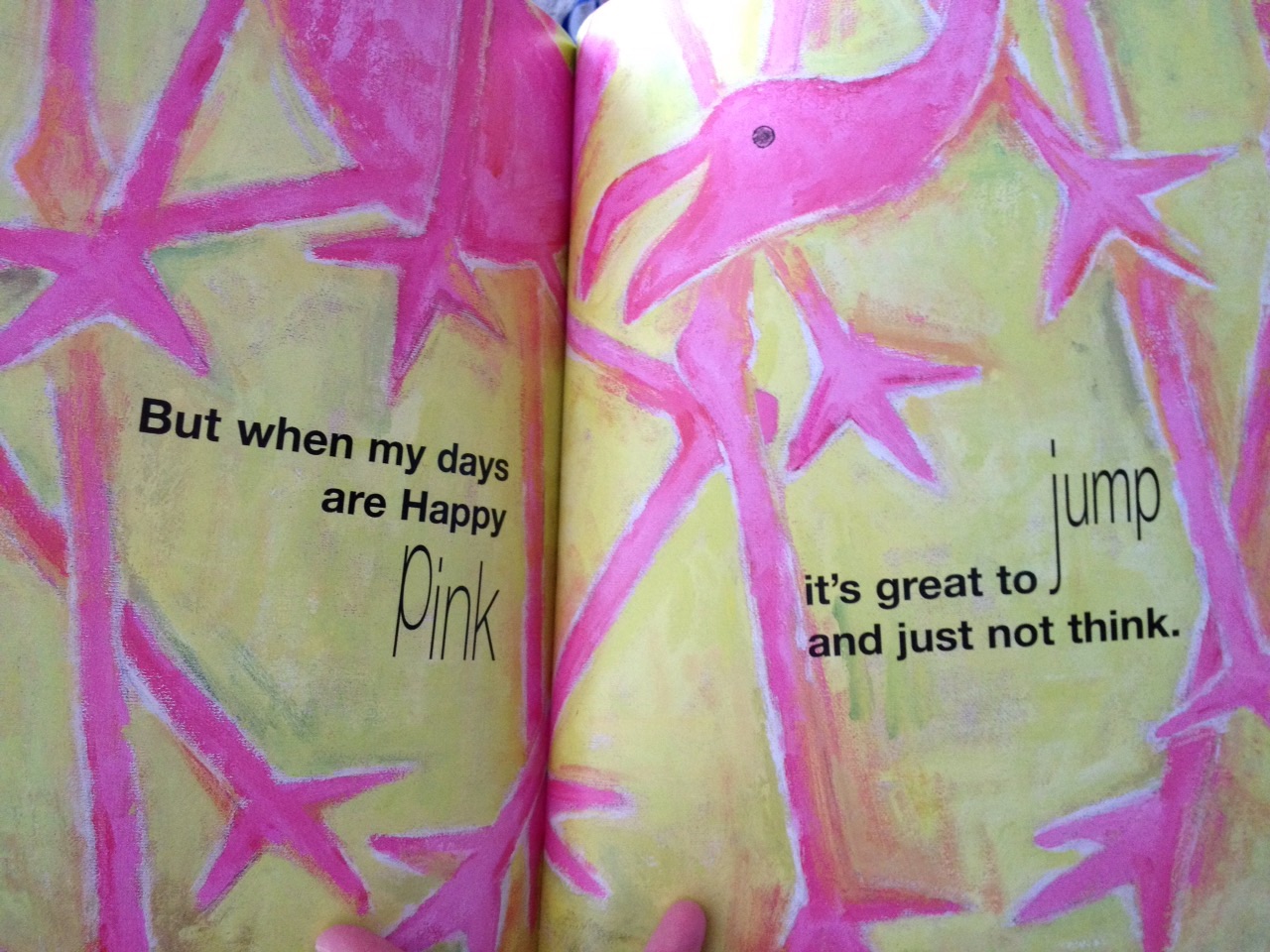
from Dr Seuss' My Many Coloured Days

from Dr Seuss’ My Many Coloured Days

I’ve been surrounded by books my whole life. My family moved a lot, but my childhood homes were linked together by the presence of books. They were sometimes (often?) more plentiful than possessions. I could take unexplored books off any shelf, without having to check the rating or ask permission. As a family, we went to the library, one night a week, when we would each return the previous week’s stack of books and take out a new stack. Science fiction for my mum. Crime fiction for my dad. And whatever books we kids wanted, changing as our tastes changed over time. My grandfather’s study was a wonderland of ancient paper and earthy leather tomes. Books in my childhood were something enjoyable. They were individual escapes but also connected us through the practice of reading, and talking about our reading.

The purpose of Newspeak was … to make all other modes of thought impossible…. Newspeak was designed not to extend but to diminish the range of thought. ~ 1984, George Orwell

Since I became an English and Literature teacher I’ve spent my work days surrounded by books (now sometimes electronic). I get to read and talk about books for a living. My Year 12 class is currently looking at dystopian texts, some of which explore the power of language to both control and free us. George Orwell’s 1984 explores the idea that minimizing language and vocabulary can diminish and control thought. Ray Bradbury’s Fahrenheit 451 explores a world where books are seen as powerful weapons of knowledge which threaten government control and societal compliance. Yet both novels also show the power of language to free and the power of human thought to prevail. Aldous Huxley’s Brave New World explores how suppressing books and controlling stories of the past can control the present. Our class has discussed the announcement of the Oxford word of 2015 as an emoji, and whether the distilling of language into pictorial representations is helpful or hindering to communication and thought. We’ve looked at words which exist only in a particular language and wondered whether you need to have a word in order to experience a thought or concept.

Books were just a commodity that had to be produced, like jam or bootlaces. ~ 1984, George Orwell

Part of my Head of English roles at three schools involved leading reading curricula and pedagogy, sometimes from the early years up until the final year of school. David Sousa’s (2014) How the Brain Learns is a good introduction to the world of the alphabetic principle, phonemes, graphemes, encoding, decoding, and the cognitive neuroscience how of learning to read. Sir Jim Rose’s (2006) Independent Review of the Teaching of Early Reading recommended that the best approach to teaching beginning readers includes discrete, high-quality, multi-sensory, systematic phonics work. It also promoted the use of sharing books, songs and rhyme as ways to develop children’s positive attitudes to literacy. Synthetic phonics is certainly important for children, but so is instilling enjoyment of reading. Always an advocate for balance, in debate and in teaching, I don’t think that phonics and whole language need to be polarised approaches. Systematic phonics instruction explicitly teaches students how to decode and encode language and to be successful readers, but it doesn’t teach them to be readers who value and enjoy reading.

In my high school English classrooms, and in student work, I can tell those students who have devoured books through their childhoods and those who haven’t. In Teaching the Brain to Read (2008), Judy Willis applies brain research to the teaching of reading. She discusses the importance of pleasure and motivation in learning to read, and the role of dopamine in learning. Students need choice, variety, and enjoyment of reading, not only drills and explicit instruction.

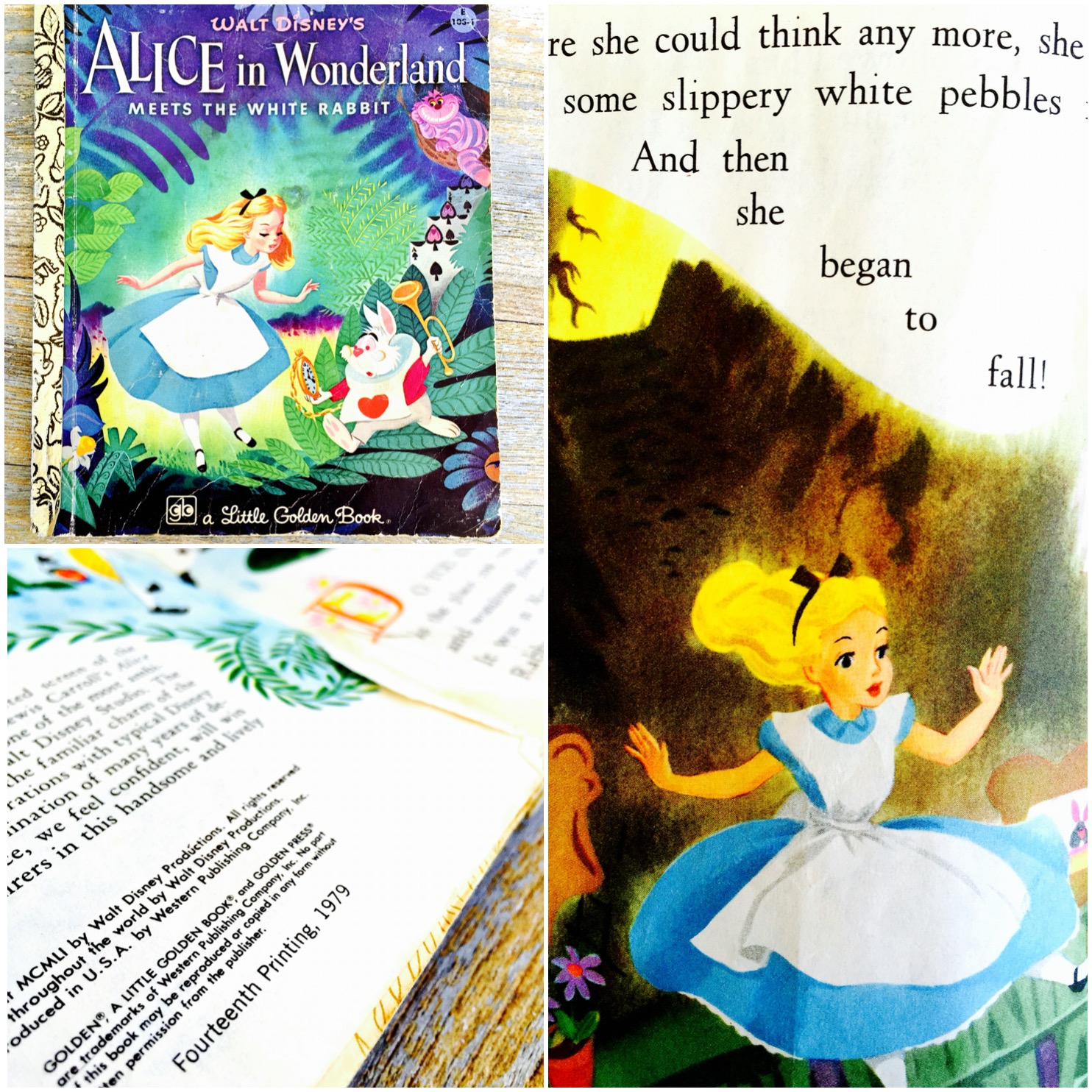
my original copy of the Alice Golden Book

my original copy of the Alice Golden Book: rabbit hole reading

When I became a parent, out came my childhood books, including tattered Golden Book volumes. Our shelves at home filled with early readers, picture books, storybooks and favourite novels. As recommended by the recent Australian ‘Raise a Reader’ campaign, we have read to our children since birth. Now 3 and 5 years old, this year in Kindergarten and Pre-Primary, our children are being exposed to the Jolly Phonics program at their local school. They bring home sets of words, in slowly spiralling levels of difficulty, to sound out and learn. They are read to at school and they take books off the shelves of their classroom. They visit the school library with their teachers and the local library with us.

The minimum we read to our kids at home is two books at bedtime. Often we read more than this in a day. This week my eldest started Pre-Primary and on his first visit to the school library he brought home a book which had 223 big pages. Between my husband and I, we read 80 pages the first night. The next two days the first thing our son did when he woke up in the morning was to run and get this book. We finished it tonight, three days after he took it out, and both boys have chosen to sit and listen to every page. This amount of reading wasn’t our choice as parents, but our son’s, so excited was he to read the stories within. He’s hoping we can read the whole thing again before he has to return it.

So as I find myself developing readers at home, being a reader myself, and exploring reading with my students (not to mention academic reading and nerdy reading for my own learning), I find the multi-layeredness of reading too unwieldy to tie down into a simple formula. There are systematic and sensible ways to conceptualise reading; these are, of course, important. And then there are the intangibles: the magic, inhaling the booky perfume (released by the glorious chemical breakdown of lignin and cellulose), the sound and feel of turning pages, and the internal world which comes alive when a book has grabbed you and pulled you deep into its world.

my eldest (then 4yo), reading to our youngest (then 2yo)

my eldest (then 4yo), ‘reading’ to our youngest (then 2yo)

Traditional Progressivity or Progressive Traditionalism: Ditch the dichotomy

Do we need to butt heads? It's not all black & white. Source: https://www.pexels.com/photo/black-and-white-africa-animals-wilderness-3158/

Do we need to butt heads? It’s not all black & white.
Source: https://www.pexels.com/photo/black-and-white-africa-animals-wilderness-3158/

I’ve never liked labels and boxes. I remember in high school when another student frustratedly asked me, “What ARE you?” I was bemused that this student was seemingly angered that my varied wardrobe (surfie t-shirts, black jeans, hippie skirts) didn’t fit one high school mould. Similarly, I’ve been a bit perplexed with the ongoing social media flurry around the ‘traditional vs. progressive’ debate, which is often positioned as being an ‘us vs. them’ or ‘right vs. wrong’ dichotomy.

I get uncomfortable when things get dichotomised as I think it increases unproductive antagonism and shuts down nuances and possibilities. Even Star Wars recognises the light in the darkness and the darkness in the light. My sentiments are similar to those of David Rogers who describes himself as a prog-trad continuum slider, and of Stephen Tierney who argues that traditional vs. progressive is a false dichotomy. I agree that traditional and progressive approaches in education aren’t warring factions. We don’t need a hard black line drawn between them. They can co-exist in schools and classrooms, with approaches moving along the continuum depending on teacher, students and the purpose of a lesson. We can attempt balance and compassion in debate and in teaching.

The trad-prog debate is often seen as rooted in ideology. As an educator I am a product of my own childhood, education, previous teachers, teaching experience and life. In order to tease out my perspective on the trad-prog sliding scale, I’ll try here to be transparent about my own beliefs about education, in order to perhaps illuminate the decisions I make about my teaching practice and my perception that we should consider traditional and progressive, rather than traditional or progressive.

I have core beliefs about what teaching should be, including that it is about empowering young people with the knowledge, skills and capacities to be critical (questioning! skeptical! even subversive!) consumers, creators and challengers of knowledge. As an English and Literature teacher I believe in the power of language, and that an ability to decode, interpret and wield language is part of empowering students to be people who can successfully navigate their worlds. I believe that students should learn the literary and artistic canon, the classics, philosophy, history, but also that these are shaped by their contexts (who wrote them? who had power? whose story is told? whose story is absent? who was unable, within that context, to share their [hi]story?). Students also need to navigate popular, multimedia and new media texts and discourses.

I teach English, a compulsory subject, to sometimes reluctant students who are studying English because they have to, not because they enjoy it or see its value. Many students struggle to find success in the English classroom, yet they have to attend. So my approaches to teaching English (as opposed to Literature, where students have chosen to do the course and are often enthusiastic and motivated) are influenced by this. I use Understanding by Design to backward plan curricula, starting with what it is that students need to know and be able to do – KNOWLEDGE. SKILLS. – as well as overarching essential questions.

Students need to be able to read, analyse, critique and develop evidenced arguments. But first they must know the content. The texts. The concepts. What a good argument looks like; what it doesn’t. I use diagnostic tools and pre-testing and rigorous assessment. I instruct, a sage-on-the-stage passionate about the content. I model analysis and argument. I provide exemplars. Texts are chosen for their merit and for their likelihood of being engaging for students. We read texts together and independently. I write. We write. They write. I work with small groups and with individuals to push them to the next phase of knowledge and understanding. I work hard on my questioning technique. I use regular formative assessments to gauge students’ understandings so that I might address pace, or go back or forward a few steps.

Yet I also on occasion – gasp – let students, to some extent, choose their own edventure, personalise their learning and have some autonomy about how they communicate their understanding. I’ve played with genius hour. I’ve negotiated tasks from an adjusted Bloomgard matrix. I use online discussion forums to develop students’ engagement with each other, and with me, around texts and concepts. I use the debate-promoting tool of the ‘human continuum’ in which students choose and defend a position along a classroom wall on a topic (To what extent is Macbeth a villain? To what extent is Frankenstein’s creature a monster?). My creative writing group has a blog in which they add to a collective story. When I’ve taught Romantic poetry, students have spent a lesson channelling their inner Romantic, taking a notebook and pen to a quiet spot around the school to write poetry which embodies Romantic ideals (a task which needs a knowledge of Romanticism and skills to control and manipulate language for effect). My creative writing lessons at the river and the cafe strip aren’t going to win any awards for knowledge-transmission. I don’t set up my desks in rows like isolated islands, but incorporate comfort and flexibility into learning spaces. I don’t see my students as vessels to be filled with knowledge. I expect students to do the work set, but I encourage them to intelligently question and challenge rather than mindlessly comply.

The thing is, I want my students to know that English is entrenched in life and ideas and society. Language is about knowledge and rules, and knowing when you’re accepting the knowledge and rules, and when you might challenge them. It can be about fun and satire and aesthetics and critique and expression and enjoyment. It can challenge the status quo or celebrate the way things are. It’s not black and white; knowledge or process; fun or seriousness; acceptance or opposition. This isn’t about my whims as the teacher or an ideal of free thinking do-what-you-like-preneurship. It’s about making deliberate practitioner decisions based on a knowledge of students, context, teaching, learning and the classroom, without feeling the need to conform to an extreme or singular view.

Students need knowledge. Students need skills. In English, they need to know and remember and synthesise and read and write and speak and listen and question and argue and persuade and create. They also need to play, experiment and develop their capacities for engaging thoughtfully, reflectively and critically with texts, ideas and … people.

Classrooms are more than effect sizes. They involve a combination of knowing and doing and feeling and being and learning and listening and thinking and wondering and working. Trust and vulnerability and relationships and identity formation. Let’s not reduce all that to a dichotomy of good vs. evil in education.

Indra’s Net: We are all connected

There is an endless net of threads throughout the universe … At every crossing of the threads there is an individual. And every individual is a crystal bead. And every crystal bead reflects. Not only the light from every other crystal in the net but also every other reflection throughout the entire universe. ~ Anne Adams

This post itself is a tangling of threads. It is in part a reflection on the first day of the national Australian Association of Research for Education (AARE) conference, which I am attending and at which I am presenting a paper. It is also part of a wider conversation I’ve been having through blogging. It was incited today by Robyn Collard’s Welcome to Country in which she used the above Anne Adams quote which refers to Indra’s Net, a Hindu and Buddhist concept that articulates the interconnectedness of the universe. It imagines each individual as a dew drop, jewel or pearl: reflective and distinctive, but also interconnected with all the other dew drops via the threads of the web. Parts and whole. Dazzling individualism within collective network.

This quote and concept added a layer to an already-layered conversation I’ve been having in the blogonet with Helen Kara and Naomi Barnes. It started with Steve Wheeler’s #blimage (blog + image) challenge. When Helen shared a photograph of tangled dew-bejeweled spiders’ webs in her garden, both Naomi and I responded to the image. Naomi wrote about the messiness of research. I wrote about how technology connects people to one another. I’ve since also written about the web-weaving spider as a metaphor for the researcher. And today I was connecting at AARE, in person, with a web of academics who I know mostly through their work and through Twitter.

So here I am again. Contemplating the web. And the dew drop jewels. And their infinite reflections and refractions. Their beauty and fragility and separateness and togetherness.

I spent much of this first day of the AARE conference in a four hour symposium in which scholars brought diverse perspectives to the same general topic of leadership in education. They agreed and disputed. They converged and diverged. It was a great example of respectful, well-considered and articulate debate. Graceful disagreement. Elegant contestation. Research as conversation.

For instance, in conceptualising leadership as artistry, Fenwick English noted the webbed connections between research, art, leadership and creativity. Scott Eacott discussed the relational aspects of leadership and of research, asking scholars to consider how their work relates to that of others. Christina Gowlett approached school leadership from a perspective of challenge and critique, agitating against dominant approaches, norms and expectations by embracing alternate theories of uncertainty and transgression.

Additionally, Gabriele Lakomski and Colin Evers discussed thinking in schools as a wide cognitive net. They define cognition as a dynamic system, comprising reciprocal interactions between people, artefacts, resources and environments. They noted that thinking is not just computationally logical-deductive; it is interpretive, intuitive, behind consciousness and beyond awareness. They explored the notion of the extended or supersized mind which distributes cognition. Our tech is our selves. Our communities and social networks are change collectives. Gabriele and Colin noted that cognition occurs “beyond skin and skull”, challenging the myths of the stand alone thinker, the heroic leader and the change agent. Individuals influence and are influenced by each other. Thinking and being is connectivity. Web not hierarchy.

These ideas resonate with the perspective I will be presenting at the Heroism Science conference in 2016, which suggests a reimagining of heroism in school leadership. That is, that school leader ‘heroes’ can work subtly, fluidly and invisibly in the service of their school communities. In education there needs to be shared vision and individual purpose, collective and individual capacity. Strengthening the web while protecting and nurturing the dew drops.

Like Costa and Garmston’s (2006) notion of holonomy (which is based on Koestler’s 1972 conceptualisation of the ‘holon’), Indra’s Net shows the dual importance of the individual and the collective. The jewel and the net. All are simultaneously together and separate. A change in one is reflected in a change in all.

So as I reflect (like the dew drop), I imagine webs of learning, webs of emotion, webs of relationships, webs of identity. I wonder: What influences the symbiosis between individual and collective? In what ways might we shape others? In what ways might others shape us? These could be questions for families, friendships, organisations, communities, nations, the world. What about our selves can we control and what choices are we making about what our own self-jewel reflects onto those around us and onto the universal web? In what ways could we harness the global mind, the universal self and the interconnectedness of humanity?

Imagine a multidimensional spider’s web in the early morning, covered with dew drops. And every dew drop contains the reflection of all the other dew drops. And in each reflected dew drop, the reflections of all the other dew drops in that reflection. And so ad infinitum. ~ Alan Watts

Reflecting on education Twitter chats

How to tune the voices on the airwaves?

How to tune the voices on the airwaves?

Chats can fall prey to … a lack of meaningful connections (with people or ideas), superficial conversations, and a lack of some sort of closure.

If mismanaged, preplanned chats can sometimes feel contrived. Better planned and executed, they might have the feel of a productive town hall meeting.

But like a town hall meeting, people can shout, speak without actually having conversations, or be lost in a crowd. You leave such a meeting asking yourself what just happened or if anything useful took place.

Sometimes the best conversations are the ones that are neither fast or slow. They are spontaneous and come from a place of honesty or concern.

Dr Ashley Tan in his September 2014 blog post

In the education world of Twitter, hashtag chats are ubiquitous and, for many, an important way to connect with other educators. I’ve talked before about how Twitter is a kind of writing and thinking practice, helping me to distil and crystallise my thinking. I participate in Twitter chats for a few reasons. In these forums, people interested in things I’m interested in are likely to be on the airwaves at the same time; I can find a tribe of sorts. I can connect with new and familiar voices in the Twitterverse.

Many chats are scheduled weekly, and happen over the course of an hour, with either one question, or more usually, a series of questions scheduled throughout the hour. There are also ‘slow chats’ which pose one question and allow those from different time zones to engage in discussion across a day or a week. I approach different chats in different ways. Sometimes I immerse myself in the chat. Sometimes I dip in and out. Sometimes I end up in a side chat having tangential conversations with people whose thinking is coalescing with mine in that moment.

You can find a schedule of the global range of education Twitter hashtag chats here.

As Greg Ashman notes in his post today, Twitter chats can connect us with fellow geeks, even when we’re feeling isolated in our own contexts. He also points out that chats often don’t allow participants to engage in the assumptions underlying their questions. In a chat we were both lightly engaged in today, there were, for instance, attempts by some participants to explore the situated, nuanced nature of the topic. There didn’t seem to me to be a clear understanding of what participants meant by the topic, or why or in what ways they felt it was important. At times it felt like people putting sticky notes up on a wall; comments were being placed alongside each other, but they were disparate and not based in the same conversation or on a foundation of common understanding.

I’d agree that often chats deal with complex concepts and unclarified terms, and sometimes they can descend into a superficial cacophony of noise where people are talking but not listening, learning or questioning. Sometimes when I have questioned the use of a term or the premise of a chat question, I’ve been engaged with by others, but I’ve also been ignored or dismissed.

Sometimes, Twitter chats can produce an echo chamber of like-minded people high-fiving each other. In some ways, this feels good, as Twitter is a place many find solidarity and support. In my participation in the PhD Twitter community, it is often moral support that I’ve sought out in times of academic struggle or isolation. But while dissent is hard in 140 characters – and can easily come across as abrasive or attacking, rather than gently provocative or inquiringly questioning – I hope for robust, rather than cursory or jargonistic, discussion from educators. Yet difficult in 140 characters.

Personally, I’ve found a solution of sorts in this blog. I use it to expand my thinking and explain it to others in more depth than even a series of tweets would allow. Blogging opens up the education conversations we have, widening and deepening debate. We can disagree more gracefully if we have more words in which to do it. I’ve really enjoyed those times in which I’ve been engaged in a conversation with other bloggers, as we build on and respond to each other.

More recently, I’ve experienced Twitter chats from the organiser side. A couple of months ago, Chris Munro, Corinne Campbell, Jon Andrews and I launched the monthly #educoachOC chat, one intended to start a conversation around coaching in education at an Oceanic-friendly timezone. My co-moderators are educators I initially met on Twitter, and now our common interests have developed into this collaboration.

After collaborating using tools such as email, Google docs, Voxer, Twitter messaging and Trillo, we planned our approach and our questions for the first chat. We also launched a blog as a home base; we wanted to make our approach clear and our thinking explicit.

The #educoachOC team learned a lot from our first chat. We reflected on how we found the chat as moderators, how we felt the conversation went between participants, and also used a Google survey to allow participants to give us feedback. In that first go, we had too many questions, which left it feeling a little disjointed at times as people jumped off interesting threads of conversation to answer the next question. One participant said they felt as though they had been coached through the chat; that we had modelled coaching through our questioning and format. One said that most contributors were pulling in the same direction and that it would be interesting if opponents of the approach challenged one another. A major reflection from that first chat was around the clarity of terms. We found participants were all talking about coaching, but seemed to have different understandings of what that meant.

In our second chat, we reduced the amount of questions and focused the chat around clarifying the group’s understanding of coaching. We were keen to build a shared understanding amongst this online community. We prefaced the chat with a blog post outlining the contestations and confusions, and some useful resources. It worked better, we reflected, and we’ll continue to collaborate and refine our approach and format. In that second chat (there’s only been two so far), we were trending in Australia, at the same time as #qanda. While we certainly didn’t intend to be a trending hashtag, that was a reflection of the level of discussion and participants’ engagement in the topic and with each other. It felt much more like a conversation which allowed us to deeply explore a topic and some of its complexities.

I think the education Twitter community does wonderful, exciting things, including through Twitter chats, in which I am immersed. But I do think we can be reflective and critical about how we run these chats, how we participate in them and how we use other media such as blogs, podcasts, Periscope and Voxer to take our conversations further, deeper and towards rigorous and elegant debate.

Collecting honest data on coaching perceptions & impacts #educoach

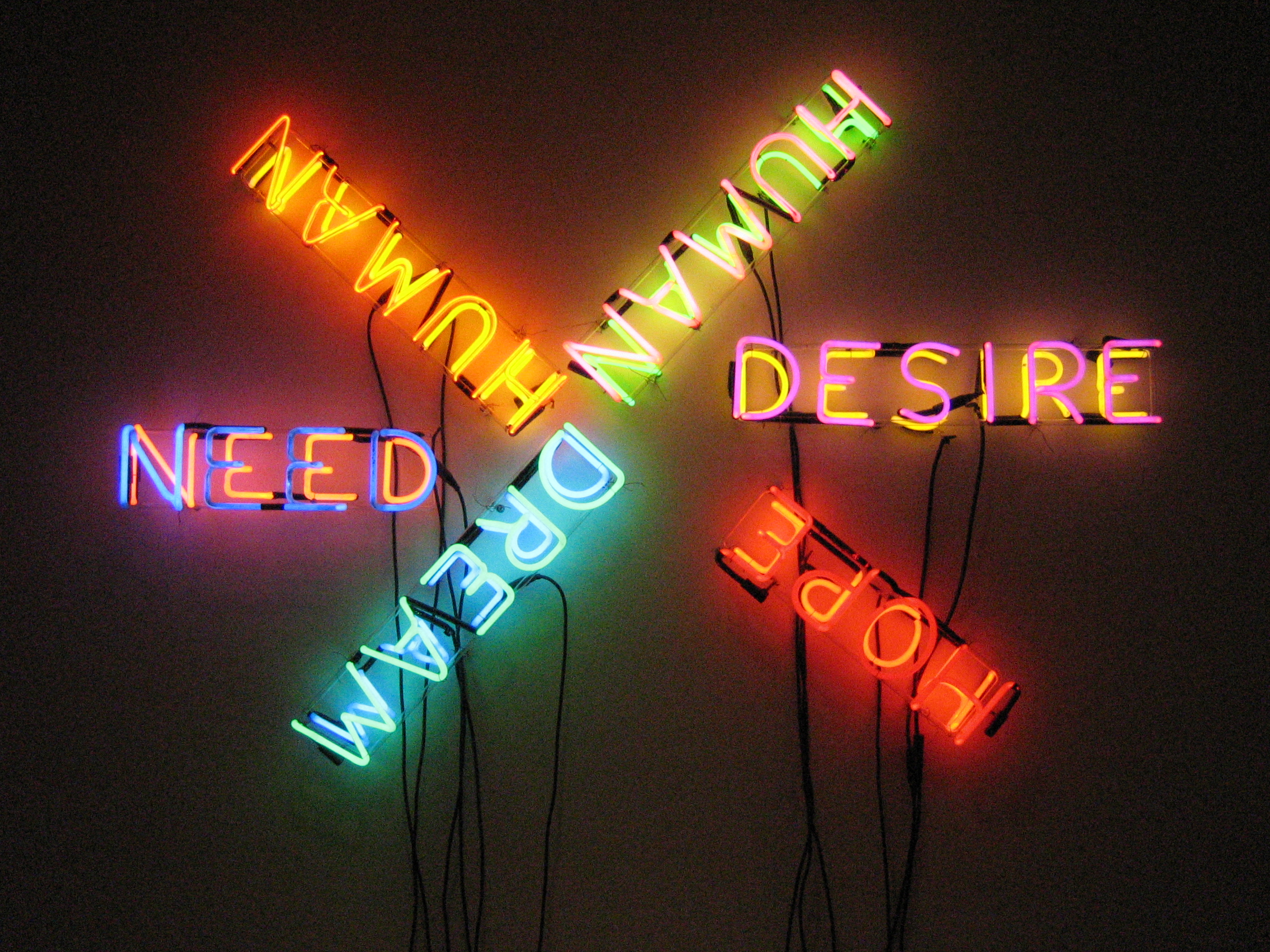
Bruce Nauman's Human/Need/Desire, 1983 ~ photo taken at MOMA

Bruce Nauman’s Human/Need/Desire, 1983 ~ photo taken at MOMA

In a gentle way, you can shake the world. ~ Mahatma Ghandi

As coaches it is important that we gather data about the impacts of our practice. As a coach we might feel a conversation or relationship has gone well, but how do we know? How can we find out the depth of our coachees’ perceptions, vulnerabilities or reflections?

This has been on my mind as this year my school’s teacher growth model, of which coaching is a central piece, moved from pilot program populated by volunteers, to mandated model which involves all teachers in the school. This is a big shift. Piloting a model with teachers who have volunteered to be involved and are keen to have a voice in school change, is very different to applying a model, no matter how flexible and differentiated, to all teachers at a school. We’ve been very aware that one size does not fit all. We’ve tried to design something which is relevant and adaptable from person to person, early to late career, pre-kindergarten to Year 12, Physical Education to English Literature. Coaching is a big part of this as the lesson data collected and the following conversation are all about the coachee; where they are at; where they would like to go.

Over the last two years I have used focus groups of teachers and coaches to gather some of the data I’ve been using to reflect and report on our impacts. This year, too, we want to gauge how we’ve gone. The intention of our model is that it is meaningful for teachers, rather than a box to be ticked or a process to be endured. We want it to nurture cross-school professional connections, open classrooms, and build internal teacher capacities. We want it to be a process which both trusts teachers and in which teachers feel they can trust. (I visually represented these intentions in this post.) So how can we see if that’s happening beyond what the coaches might observe or what information teachers might anecdotally volunteer?

In order to get a sense of how teachers are finding the process, I have recently set up an anonymous survey monkey survey with the following questions. Apart from questions 12 and 14, which are optional comment boxes, the questions are click-button ones on a Likert-style rating scale of Strongly Agree – Agree – Neutral – Disagree – Strongly Disagree. The good thing about that is that it is quick for teachers to complete, and easy to analyse. While it provides a snapshot of how teachers are finding the coaching cycle, a limitation is that it doesn’t drill down into the why of respondents’ answers.

The survey questions:

  1. I have a clear understanding of the cycle’s process, expectations and roles.
  2. I found the reflection survey useful in terms of my teaching practice.
  3. I have felt comfortable having someone (and/or a video camera) in my classroom.
  4. I found the data collected in my lesson observations useful in terms of my teaching practice.
  5. I found the coaching conversations useful in terms of my teaching practice.
  6. I have felt that my coach is approachable, supportive and trustworthy.
  7. I have found it ‘do-able’ to manage the cycle in terms of time, scheduling, and, where appropriate, technology.
  8. The cycle has helped me gain greater awareness and clarity around my teaching and what happens in my classroom.
  9. The cycle has helped me clarify my instructional goals (i.e. how and in which areas I would like to develop my teaching).
  10. The cycle has resulted in the development of one or more collegial relationships (with either my coach or another team member).
  11. I have made changes to my teaching or classroom as a result of the cycle.
  12. Optional comment: If I have made changes to my teaching or classroom, what have these been?
  13. I think the cycle has had a positive impact on my teaching practice.
  14. Optional comment: I would like to offer the following comments or suggestions for the development of the cycle from 2016.

It is important that they survey is anonymous as we want the feedback to be honest. While these are by no means comprehensive, they provide a piece of our data puzzle in looking to the impact of our observation and coaching cycle as professional learning. It is by listening to positive and critical perspectives that we can identify those things working well, and address those areas of challenge.

(Disrupting) disruption in business, academia & education

disruption: dis·rup′tion n. ~ from the Latin disruptionem ~ “a breaking asunder”; to break apart, split, shatter.

While the dictionary definition of disruption points to breaking apart, in fact now disruption often means to make anew. In business, disruption is about creating new markets and discovering undiscovered needs. Traditional products and modes are replaced by new business models, new technologies and new ways of appropriating the old. Google’s now-defunct ‘20% time’, which instigated ‘genius hour’ in classrooms around the world, was designed to nurture disruptive, moon-shot thinking. Often Uber, Airbnb and Apple are touted as examples of businesses which have displaced other services with their innovative thinking. Businesses and entrepreneurs like to see themselves as ‘disruptive’ because this means they are radical, ground-breaking and on-the-bleeding-edge of innovation.

As an English and Literature teacher, I am drawn to teaching texts which were either disruptive in their context, challenging socio-political status quos, or which feature disruptive characters. William Golding’s Lord of the Flies, George Orwell’s 1984 or Animal Farm, Margaret Atwood’s The Handmaid’s Tale and Oryx and Crake, feature films like The Matrix and The Hurt Locker. These texts allow me to challenge and extend students’ thinking, inciting discussion about humanity, history and ethics. They allow us to interrogate dominant belief systems and representations, and dig into our own values, attitudes and assumptions. Being a critical questioner of everything, including ourselves, is a key to disruption.

Tootle the disruptor-train goes off-track

Tootle the disruptor-train goes off-track

One of the books I read my own small children is Tootle, Gertrude Crampton and Tibor Gergely’s 1945 children’s book (you can see the Tootle birthday cake I made in this post on PhD-as-cake). In it, the young engine called Tootle breaks the firm rule ‘Staying on the Rails No Matter What’. Instead, he frolics through fields, making daisy chains, racing horses, talking to frogs and crushing buttercups. I continue to be dismayed that, unsurprisingly for a 1945 text, Tootle ends up complying with the rules. Rather than celebrating his individualism and his new way of being a train, he tows the line like every other locomotive. Each time I read the story, I want to shout through the pages: ‘Go your own way, little train! It’s ok to be different and subversive and joyful and live a life off the subscribed journey!‘ Clearly this says more about me than it does about the story.

In the blogosphere, I follow traditional academics, as well as independent off-centre researchers who are questioning, through action, what being an academic might look like. My PhD research uses a bricolaged paradigm and a fairly unconventional approach to writing up participant data. Bricolage refers to a kind of drawing together of a range of traditions to make a bespoke, rather than off-the-rack, approach, tailored to the particular research problem. This might be considered disruptive in the sense that it rethinks well-worn traditions and stitches them back together in a new form. Perhaps my inability to conform to one research approach is a bit like my inability to follow a recipe in the kitchen, where I’m always using recipes as a kind of springboard-guide, if I use them at all. But disruption isn’t just failing to conform, it’s finding new ways, forging new paths, building new possibilities. It’s providing alternatives to accepted ways of doing things. I think it’s so important that we define what terms mean for ourselves and our sectors, before we begin bandying and bandwagoning them about with reckless, jubilant abandon.

Some educators see the job of education as to nurture the innovative thinking of students, to prepare them for uncertain futures. In education, words like ‘edu-preneur’, ‘edu-innovation’ and ‘disruptive education’ have become popular. In my Twitter bio, I’ve used the word ‘disruptor’, to suggest that I am someone who questions and pushes at the boundaries of what is known and what is accepted, but I have questions around the thinking and behaviours of some self-professed disruptors. The irony is not lost on me; perhaps I should rethink my Twitter bio, but I like delicious words like ‘disruptor’ and ‘flâneuse’. Therein lies part of the problem. Trendy-sounding words are seductive. We like to roll them around in our mouths and social media feeds. 

On the one hand, I know business owners, writers, academics and educators who thoughtfully question the status quo, pushing the boundaries of practice and questioning accepted ways of thinking and acting. These people and their organisations are taking risks and building alternative ways of being in the world. Yet I’ve also noticed that some others bristle when their pithy, jargonistic talk of ‘being disruptive’ is questioned. Sometimes self-professed disruptors don’t take well to being challenged, or disrupted. Sometimes advocates of more traditional approaches or technologies attempt to disrupt the disruptors, but are shot down for being old-hat, stuck-in-the-past or not-on-the-bleeding-edge. Sometimes the whole discussion breaks down into paradigm-war name-slinging. I’ve spoken before about the importance of robust, respectful discussions in which we are ok with graceful disagreement and are able to listen to opposing viewpoints with compassion. I think if disruption is embraced, those doing the disruption should embrace deeper interrogation of their ideas than slick presentations or 140-character tweets might allow. This is why I love blogging and podcasts; they deepen conversation.

So, I approach the idea of disruption with both fascination and healthy scepticism. I do think we should ask what it is that might need disrupting, and why. Or perhaps what might need reconsidering, or consolidating, or investigating, or researching, or rebuilding. When buzzword-saturated talk of disruption becomes the unquestioned norm, perhaps it is those who question the dominant discourse of disruptors who are the most truly disruptive. Let’s not forget to be questioning, critical thinkers, especially within echo chambers of (disruptive, or other) discourse.

Advances are made by answering questions. Discoveries are made by questioning answers. ~ Bernhard Haisch

'Wave 1' by Annette Thas

‘Wave 1’ by Annette Thas

Spider-web connectivity: Technology for networked learning

Nobody pointed out that the web itself is a miracle. ~ E. B. White, Charlotte’s Web

tangled webs of connectivity; image from Helen Kara http://helenkara.com/2015/07/28/data/

tangled webs of connectivity; image from Helen Kara http://helenkara.com/2015/07/28/data/

This image was passed from Dr Helen Kara to Dr Naomi Barnes, after I had challenged Helen with an image for the #blimage (blog+image) blogging challenge (see how messily interconnected that is?). You can read Helen’s post here and Naomi’s post here. You can see my first #blimage post, with an explanation of the challenge, here.

Helen’s image spoke to me. It reminded me that one of my research participants used the metaphor of the spider’s web to describe the school as organisational web. It is reminiscent of the symmetrical black and white webs in my mandala colouring book. Mostly, it speaks to me of connectedness in education, in our schools and classrooms, but especially through technology and social media.

So the image forms the basis of this post about technology which connects.

The labyrinthine tangle of webs are like snow-flake-like in their perfect imperfection. The wintery stems provide angular anchors for the fragile delicacy of the web strands which stretch and overlap. Some strands extend long distances, while others are strung tightly together. There is symmetry and asymmetry. Strength and vulnerability. Flexibility and rigidity. Beauty and disorder. A clamour and a stillness.

These dewy webs evoke my experience of the professional connections I see and experience through technology and social media. My journey through various tools of connectivity as an educator has been one mirrored by others. Often I adapt before educators in my own school environment, but after those in the global spheres. As this blog approaches its first birthday, I am reflecting on how blogging has transformed my use of social media and my connections with others.

mandala sunburst

mandala sunburst

Twitter has been a place of learning for me since 2009. As with most educators, I began lurking in the background, figuring out what might be in it for me, or consuming information. I moved on to curating others’ content, and then participating in education chats. That is where I stayed for a number of years, although the more chats with which I engaged, the more people with which I connected. The chats were a place for me to participate in conversations. In fact, my favourite part of being in a Twitter chat is when a small group goes off piste into their own tangential conversation. These are moments of connection and engagement, which are epitomic of Twitter’s rhizomatic chaos; its tangle of webs. In one Twitter chat Adriano di Prato and I came up with an accidental concept of ‘leaning environments’, showing the unexpected possibilities of connecting via social media.

(I enjoyed this recent New York Magazine article about why the messiness and “vast confusion” of Twitter should be celebrated.)

Last year, I began this blog as an experiment in blogging, and as a way to log and record my fellowship experiences in New York. My continued blogging has shifted the boundaries of my self and my connections.

Not only does exploring my thoughts and ideas in 600-1000 word blog posts allow me to thrash out and clarify my thinking in more than 140 characters, it also opens up conversations with others who might want to engage with me or with the content of my posts. It is this opening of conversation which has expanded me and my network. My spider-web tendrils reach out and curl together with others’. Some connections are tentative while others are strong. Some traverse long distances while others are at arm’s length.

mandala web

mandala web

As an individual, my blog feels like an extension of myself. Colouring outside the lines of my demarcated self, I share parts of my story, my thinking, my experiences, and my teaching, researching or writing practices. These tendrils of me reach out and entangle with the labyrinth of connection and conversation in the blogosphere. I respond, and am responded to. And so I become absorbed, in part, into the often unpretty cacophonous jumble of thoughts, hyperlinks and voices.

More recently, thanks to the encouragement of Andrea StringerI have started using Voxer and I’m loving the immediacy and personal, conversational, collaborative nature of the medium. Right now, I’m involved in different professional learning groups and a doctoral researcher group. Valerie Lewis, who I’ve connected with on Voxer, in this blog post calls her Voxer PLN her ‘Vox Squad’, a kind of A-Team of professional learning and solidarity (‘I pity the fool who doesn’t Vox!’). I’ve introduced Voxer to my students as a collaborative tool for group work, and to my team of coaches as a tool for our collective growth and the ongoing refinement of our practice.

To finish this reflection on connectivity, I’ll leave you with a very different web, as a contrast. Below is a picture I took in Richmond Park when I lived in London. A solitary dew-jewelled web at sunrise. This image doesn’t speaks of connectedness in the same way that the first image of webs does. It shows a beautiful but lonely structure, tenuously clinging to the solidity of the fence posts.

Richmond Park spider web at dawn

Richmond Park spider web at dawn

Which would you rather be? The solitary web or a web in a mess of other webs? A lone voice or one of a cacophony of voices? Are we better alone or together? Can our individual voices be heard in amongst the noise of social media?

if the web were perfectly pre-set,

the spider could

never find

a perfect place to set it in; and

if the web were

perfectly adaptable,

if freedom and possibility were without limit,

the web would

lose its special identity. ~

A. R. Ammons

* Note: this is what happens when I am in the middle of tough PhD work. Lyrical, metaphorical musings and colouring-in become my creative antidote to the hard systematic work of thesis revision.

Observation to transformation: The power of classroom data for teacher growth

What we see depends mainly on what we look for. ~ John Lubbock

In my posts about my school’s teacher growth model, a growth-focused coaching initiative which sits alongside other professional development and evaluation work at the school, I have tended to focus of our use of Cognitive Coaching and the Danielson Framework for Teaching. As our model is being implemented this year, however, another aspect of the process is emerging as transformative in its own right: classroom data.

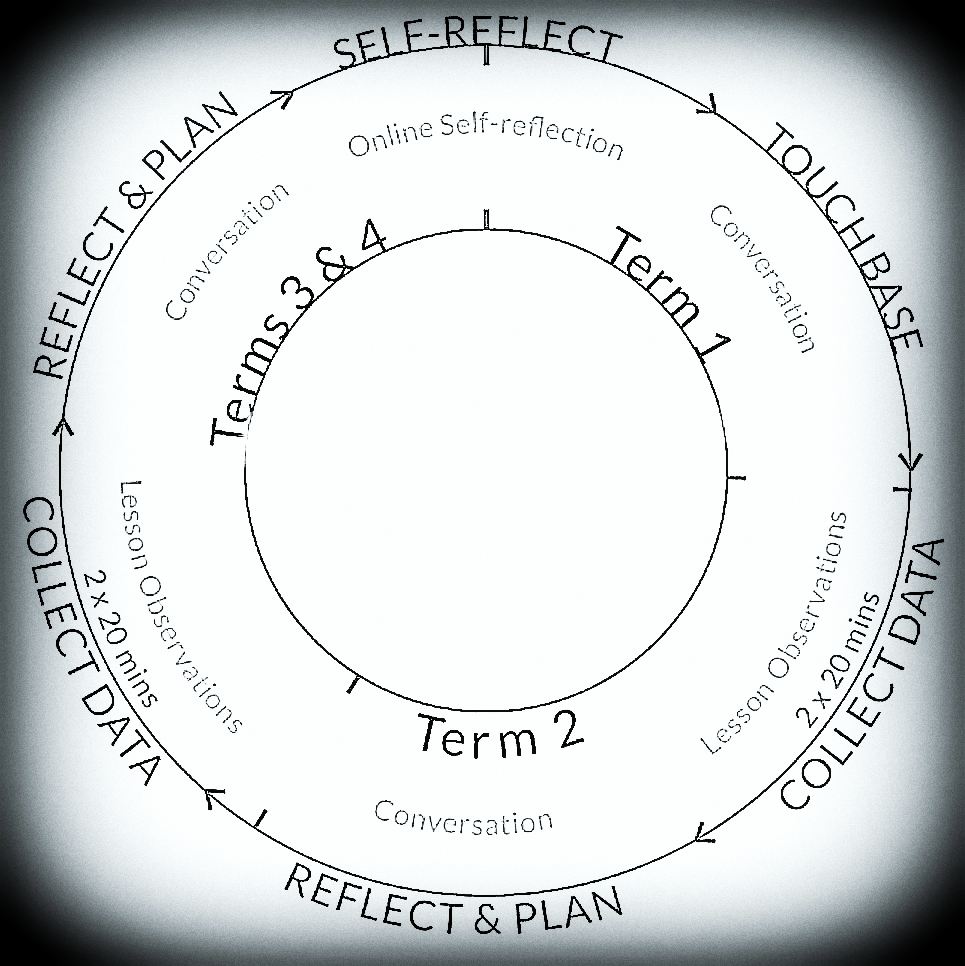
To explain how we use data in our collaborative coaching cycle, a one-year cycle looks like this:

a visual look at our coaching-observation cycle

a visual look at our coaching-observation cycle

  1. Self-reflect: Complete self-reflection against Danielson Framework for Teaching.
  2. Touch base: Pre conference with Teacher-Coach, identifying possible foci, deciding on type of lesson data to be collected.
  3. Collect data: 2 x 20 minute observations.
  4. Reflect & Plan: Post conference with Teacher-Coach following the Cognitive Coaching reflecting-into-planning conversation map and using Danielson Framework for Teaching.
  5. Repeat 2, 3 and 4.
  6. Self-reflect: Complete self-reflection against Danielson Framework for Teaching.

In this post, I would like to focus on Step 3, data generation.

You’ll notice that we use multiple short observations and the Danielson Framework for Teaching, as supported by the findings of the Measures of Effective Teaching study. A number of short observations mean that teachers build up a series of snapshots of the kinds of lessons in their classrooms, liberating them from feeling like ‘this 20 minutes is representative of all of my teaching all of the time.’ It is a moment in time on which to reflect.

*               *               *

What classroom data is generated?

Generating lesson data is a crucial part of our coaching teacher growth model. While all teachers are expected to have classroom data collected for the purposes of their reflection on practice, this is differentiated in the sense that the teacher decides what sort of data will be collected, depending on what they would like to know about their lessons. Below are the main types of lesson data we have been using.

Non-inferential observation notes

These notes usually look like verbatim scripting. That is, the observer takes down what they see and hear in a lesson. No judgements. No praise. No criticism. Just observed sights and described sounds. They include times and may also include mapping of students or classroom movement. Our coaches are trained in this kind of observation note taking. It can be challenging to take self and own biases out of lesson data, leaving just what happened for the teacher to do their own reflections and evaluations.

Observation notes are useful for looking at instructional clarity, questioning, student discussion and student group or individual work. In the case of the latter, the observer may go to students or groups and observe them or interact with them, recording interaction and responses. This means that observers can record those parts of the classroom where teachers are not. It also means that an in-class observer can glean details of student work and conversation which a video would not pick up.

A caution about this kind of note taking is that the observer bias does appear in what the observer chooses to take down. For instance, in a fast paced classroom discussion, often an observer needs to make a choice between capturing the teacher’s or the students’ responses.

The benefit of notes is that the run of the lesson is written down in black and white, without the distractions of watching multiple elements in a video.

Video

We have a few video options available to teachers for the purposes of lesson data collection. Still video. 360 degree video. SWIVL video. These each have their pros and cons, and require choices to be made, such as whose audio is picked up, or whose movement is tracked.

The 360 degree video is a more obvious piece of equipment in the classroom, but it simultaneously shows teacher and students. The SWIVL makes it easy for teachers to collect data on their iPhone or iPad, but as the camera follows the audio lanyard it privileges the person wearing it, usually the teacher.

Video is great for teachers wanting to see their own teaching, including movement and wait times. Our Physical Education, Music and Languages teachers love it, but so do those in other learning areas and various year levels.

Audio

Some teachers want laser like focus on what is said in their classrooms. They are keen to listen closely to their questioning or instructional clarity, and to their students’ responses, for instance. Like verbatim scripting, by isolating audio, teachers can pick up on very specific aspects of their teaching, although others will be missed.

*               *               *

Supplementary data include planning documents, goals and reflections, student work samples, student feedback and student achievement data. All data have their inherent biases, benefits and disadvantages. We are finding that mixing up the data so that teachers experience their classrooms in a variety of ways may be more effective than continually repeating the same data collection strategy for the same teacher.

Importantly, all data are owned exclusively by the teacher for their reflection and use. They are not for coaches or managers to use or publicise outside of the coach-coachee relationship. Focus groups with coached teachers at the school have revealed that teachers appreciate the choice and ownership over their classroom data. The trust in the coach-coachee relationship is paramount.by @debsnet

So while I have been focusing my own practice on refining my coaching skills, something else has been happening alongside. The data has been a tool for teacher learning and development, both in its own right and as part of the coaching cycle.

I’ve noticed that when, as coach, I get the data right, the conversation seems to almost take care of itself. The data, in these cases, has set off the teacher’s thinking, reflection, planning and action, before I turn up for the post conference.

In other conversations, looking at the data in detail, with well-crafted questions, can bring teachers to the point of an ‘a-ha’ moment or a change in practice. At times it is looking closely at the Danielson Framework for Teaching rubrics which allows teachers to see alternative teaching and learning possibilities, and refines their precision of language around practice. Other conversations require deeper coaching questions which drill into why lessons went the way they did, how teachers made decisions in their classrooms, what criteria they used to make those decisions, or what might have be going on for particular students in the lesson.

The data also provide an important ‘third party’ in the coaching conversation, allowing the conversation to be depersonalised and focused on the data, not the person.

Data is powerful stuff. And lesson data ‘done right’ – owned by the teacher, objective and giving the teacher a new perspective on their classroom, themselves and their students – can be transformative.

Good One, by @debsnet

Balance, not division. Compassion, not attack. Conversation, not war.

Compassion is not a relationship between the healer and the wounded. It’s a relationship between equals. Only when we know our own darkness well can we be present with the darkness of others. Compassion becomes real when we recognize our shared humanity. ~ Pema Chödrön

by @debsnet

Often I am struck by argumentative battles in traditional media, on social media and around the blogosphere. I appreciate those writers, commentators and educators who share their musings, experiences, readings, and perspectives, without using divisive loaded language or attack. I think the rantiest I have gotten was this post on the APPR reforms in New York and this one around whether teachers can be researchers, but I attempted to frame my criticism through making transparent my perspective and asking clarifying questions. Balance.

I have written a lot about my school’s coaching model, as it is kind of my baby and it’s something which I think is worth sharing; others might gain from hearing our story. Yet this coaching model is not stand alone. It is not as though teachers at my school are only coached by teacher-coaches in a non-evaluative, non-hierarchical model. In their first year at the school, teachers participate in a rigorous evaluative permanency process. Every year they have a conversation with their line manager, who touches base with them on their work, goals and classroom practice. Every third year, teachers have their coaching cycle with their manager. This is more evaluative and performative by its nature, and by the nature of the relationship. Teachers additionally work with instructional consultants. Leaders work with coaches. Professional learning community teams and action research projects work alongside. Growth and evaluation. Balance.

I have written about the creative things I trial in my classroom like a term without grades and genius hour for students and teachers. These are things at the experimental end of the spectrum of what happens in my lessons, so I share them as stories of experience and part of a conversation. I do these things to develop engagement of my often-reluctant high school English students, to build their self-efficacy and to help them learn to rely on themselves as drivers of learning, rather than entirely on me as Teacher with a capital T.

Does that mean I don’t use explicit instruction? Of course not! I explicitly teach concepts, skills and texts, although I temper this with encouraging students to do their own thinking and to trust their own thinking, rather than expecting that I can fill them, as vessels, with the answers. What are the ideas of the text? What interpretations might be drawn? Answers can come from me or from Spark Notes, but if I do my job properly, students will have the skills, understandings, language and cognitive capacity to draw their own interpretations, from their own contexts, and justify these using logic and evidence. The best student responses comprise original thinking, not regurgitated knowledge. The best teachers focus not just on effective learning (our core business, of course!) but developing learners and passion for consuming, curating and creating knowledge.

In my Head of English roles at three schools I have ensured a balance between explicit instruction and those strategies which propel love of reading, power in writing and deep intellectual engagement in ideas and discussion. Interestingly, Charlotte Danielson’s heavily-researched Framework for Teaching has its ‘proficient’ descriptors describing teaching which is expertly directed by the teacher, and its ‘distinguished’ teaching descriptors outlining lessons in which students are taking responsibility for their own learning and behaviour. Creative and explicit. Balance.

I have written about lyrical metaphors for PhD study, and only occasionally about the unsexy logistics of what the graft actually looks like. My conceptual framework draws in part from fictional literature. Does this mean my PhD is devoid of hard, critical, scientific work? No. My PhD is of course the result of the logical, systematic working through of literature, data and research problems. When writing the Limitations section in the conclusion of my thesis I was highly aware that all research has its limitations. Extensive quantitative data can show us patterns and effects, but these may be faceless. Qualitative data can drill down deep into the messy humanness of lived experience which may be unrepresentative of wider groups and therefore not generalizable. Yet each study adds its tiny piece of understanding to the layers of what is known. Research is conversation. Imaginative and systematic. Broad and deep. Balance.

I would love to use the line ‘I’m a lover not a fighter’ but I think I’m both. I believe in sharing and celebrating our stories, but I will advocate fiercely for my students, fight for what I believe is right and argue for my research. Balance.

From a history of my posts, it is probably clear that I am seduced by the lyrical, by storytelling, by creative approaches and by metaphor. Yet I am not one dimensional. Nor is my teaching, my thinking, my researching or my living. Balance.

I came across this excellent recent TED talk from Jon Ronson on the way social media has moved from giving voices to the voiceless, to an angry mob mentality of shaming and abuse, in which people seem to forget compassion and morality.

While I love robust discussions which take us out of the echo chamber of we-all-agree-high-fiving, I also think we need to approach these with compassion, thoughtfulness and a view of each other as human beings. We can disrupt with respect. We can disagree gracefully. We can advocate with civility. (And if you throw in a metaphor, you’ll totally have me!)

by @debsnet