Traditional Progressivity or Progressive Traditionalism: Ditch the dichotomy

Do we need to butt heads? It's not all black & white. Source: https://www.pexels.com/photo/black-and-white-africa-animals-wilderness-3158/

Do we need to butt heads? It’s not all black & white.
Source: https://www.pexels.com/photo/black-and-white-africa-animals-wilderness-3158/

I’ve never liked labels and boxes. I remember in high school when another student frustratedly asked me, “What ARE you?” I was bemused that this student was seemingly angered that my varied wardrobe (surfie t-shirts, black jeans, hippie skirts) didn’t fit one high school mould. Similarly, I’ve been a bit perplexed with the ongoing social media flurry around the ‘traditional vs. progressive’ debate, which is often positioned as being an ‘us vs. them’ or ‘right vs. wrong’ dichotomy.

I get uncomfortable when things get dichotomised as I think it increases unproductive antagonism and shuts down nuances and possibilities. Even Star Wars recognises the light in the darkness and the darkness in the light. My sentiments are similar to those of David Rogers who describes himself as a prog-trad continuum slider, and of Stephen Tierney who argues that traditional vs. progressive is a false dichotomy. I agree that traditional and progressive approaches in education aren’t warring factions. We don’t need a hard black line drawn between them. They can co-exist in schools and classrooms, with approaches moving along the continuum depending on teacher, students and the purpose of a lesson. We can attempt balance and compassion in debate and in teaching.

The trad-prog debate is often seen as rooted in ideology. As an educator I am a product of my own childhood, education, previous teachers, teaching experience and life. In order to tease out my perspective on the trad-prog sliding scale, I’ll try here to be transparent about my own beliefs about education, in order to perhaps illuminate the decisions I make about my teaching practice and my perception that we should consider traditional and progressive, rather than traditional or progressive.

I have core beliefs about what teaching should be, including that it is about empowering young people with the knowledge, skills and capacities to be critical (questioning! skeptical! even subversive!) consumers, creators and challengers of knowledge. As an English and Literature teacher I believe in the power of language, and that an ability to decode, interpret and wield language is part of empowering students to be people who can successfully navigate their worlds. I believe that students should learn the literary and artistic canon, the classics, philosophy, history, but also that these are shaped by their contexts (who wrote them? who had power? whose story is told? whose story is absent? who was unable, within that context, to share their [hi]story?). Students also need to navigate popular, multimedia and new media texts and discourses.

I teach English, a compulsory subject, to sometimes reluctant students who are studying English because they have to, not because they enjoy it or see its value. Many students struggle to find success in the English classroom, yet they have to attend. So my approaches to teaching English (as opposed to Literature, where students have chosen to do the course and are often enthusiastic and motivated) are influenced by this. I use Understanding by Design to backward plan curricula, starting with what it is that students need to know and be able to do – KNOWLEDGE. SKILLS. – as well as overarching essential questions.

Students need to be able to read, analyse, critique and develop evidenced arguments. But first they must know the content. The texts. The concepts. What a good argument looks like; what it doesn’t. I use diagnostic tools and pre-testing and rigorous assessment. I instruct, a sage-on-the-stage passionate about the content. I model analysis and argument. I provide exemplars. Texts are chosen for their merit and for their likelihood of being engaging for students. We read texts together and independently. I write. We write. They write. I work with small groups and with individuals to push them to the next phase of knowledge and understanding. I work hard on my questioning technique. I use regular formative assessments to gauge students’ understandings so that I might address pace, or go back or forward a few steps.

Yet I also on occasion – gasp – let students, to some extent, choose their own edventure, personalise their learning and have some autonomy about how they communicate their understanding. I’ve played with genius hour. I’ve negotiated tasks from an adjusted Bloomgard matrix. I use online discussion forums to develop students’ engagement with each other, and with me, around texts and concepts. I use the debate-promoting tool of the ‘human continuum’ in which students choose and defend a position along a classroom wall on a topic (To what extent is Macbeth a villain? To what extent is Frankenstein’s creature a monster?). My creative writing group has a blog in which they add to a collective story. When I’ve taught Romantic poetry, students have spent a lesson channelling their inner Romantic, taking a notebook and pen to a quiet spot around the school to write poetry which embodies Romantic ideals (a task which needs a knowledge of Romanticism and skills to control and manipulate language for effect). My creative writing lessons at the river and the cafe strip aren’t going to win any awards for knowledge-transmission. I don’t set up my desks in rows like isolated islands, but incorporate comfort and flexibility into learning spaces. I don’t see my students as vessels to be filled with knowledge. I expect students to do the work set, but I encourage them to intelligently question and challenge rather than mindlessly comply.

The thing is, I want my students to know that English is entrenched in life and ideas and society. Language is about knowledge and rules, and knowing when you’re accepting the knowledge and rules, and when you might challenge them. It can be about fun and satire and aesthetics and critique and expression and enjoyment. It can challenge the status quo or celebrate the way things are. It’s not black and white; knowledge or process; fun or seriousness; acceptance or opposition. This isn’t about my whims as the teacher or an ideal of free thinking do-what-you-like-preneurship. It’s about making deliberate practitioner decisions based on a knowledge of students, context, teaching, learning and the classroom, without feeling the need to conform to an extreme or singular view.

Students need knowledge. Students need skills. In English, they need to know and remember and synthesise and read and write and speak and listen and question and argue and persuade and create. They also need to play, experiment and develop their capacities for engaging thoughtfully, reflectively and critically with texts, ideas and … people.

Classrooms are more than effect sizes. They involve a combination of knowing and doing and feeling and being and learning and listening and thinking and wondering and working. Trust and vulnerability and relationships and identity formation. Let’s not reduce all that to a dichotomy of good vs. evil in education.

One word 2016: MOMENTUM

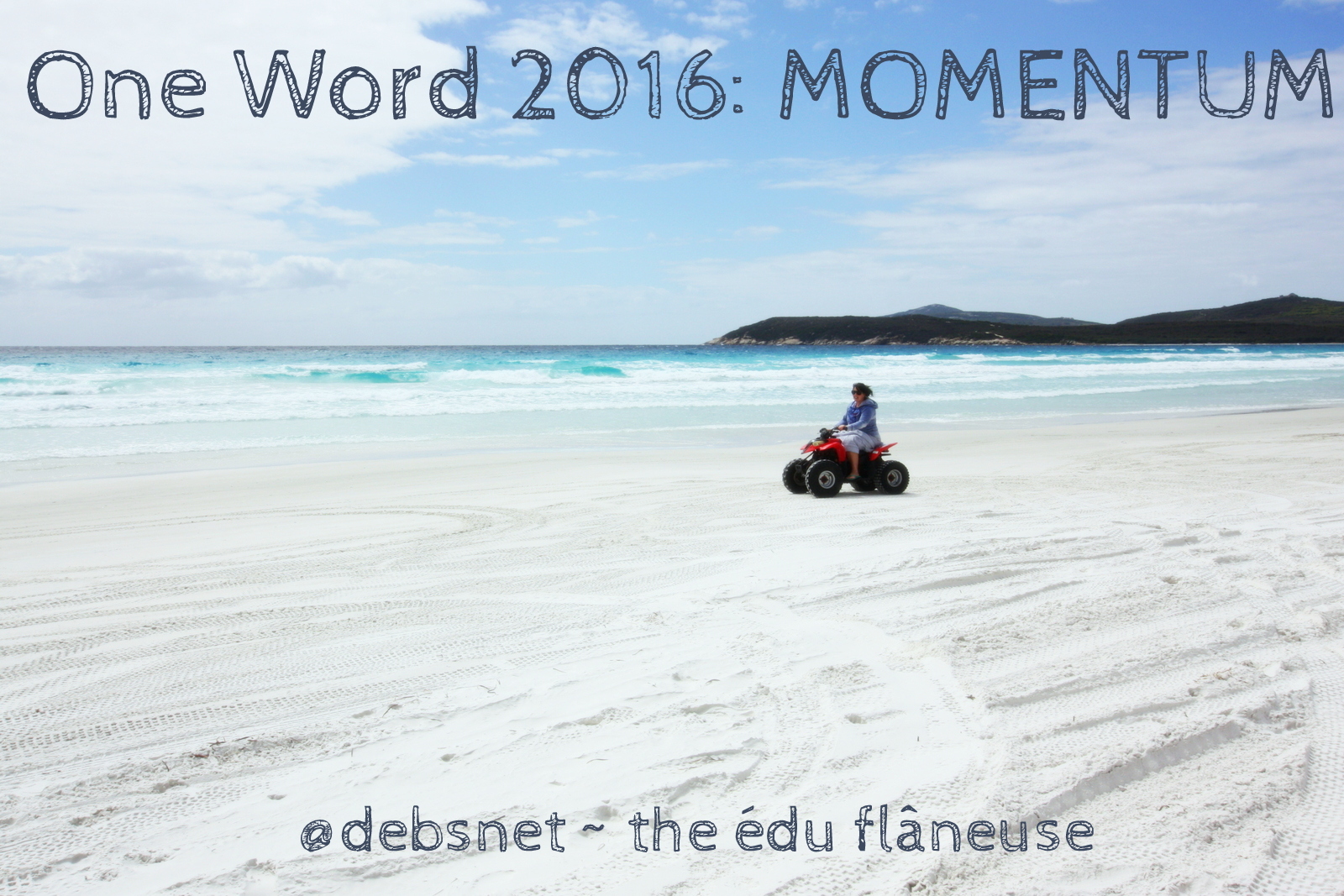
I spent the last day of 2015 in motion, quad biking along a beach.

I spent the last day of 2015 in motion, quad biking along a beach.

Last year, in the new year, I focused my attention on three words: presence, sharing and strength. I was focused on being present in each life aspect and relationship, sharing and storytelling, and building my strength in body, knowledge, connection and conviction. My 2015 ended up being focused around lots of writing, and on the one word we had written on our chalkboard at home: CONQUER. I was focused mainly on conquering my PhD thesis (and I got it submitted), but also conquering some academic papers and conferences, conquering fitness and strength goals. Seeing a daily reminder of that one word gave me a laser-like focus on finishing, completing, conquering. I pushed hard, remained motivated and hit milestones. But it also left me exhausted!

This year I was looking for a “one word” (sometimes called one little word or one word 365) which was more yin and less yang, more reflective and less explosive, more about regeneration than domination. While I was still attracted to active words like inspire, ignite and create, I considered gentler words like refine, renew and play. But none of these cover what I think my 2016 will be about. Maybe I’m not so ready for stillness or space or quiet just yet. I don’t want to be conquering in 2016, but one of my big lessons of 2015 was to put one foot in front of the other and just keep moving.

I spent my last day of 2015 quad biking with friends and family on a long pristine stretch of white beach. Snaking, quickening, turning, moving, the wind whipping around and against us. Speeding up. Slowing down. Driving away and towards and around. Playing with speed and direction, throttle and velocity, movement and pace. Feeling the terrain beneath the bike: sometimes flat, sometimes bumpy, sometimes hard, sometimes cushioned by peaks of white sand. Concentration. Adrenalin. Acceleration. The word I have come to for 2016 is MOMENTUM, from the Latin movere, meaning “to move”. This will be a year of being in motion or on the move.

my son, dressed as an angel, in motion

my son, dressed as an angel, in motion

I’m not starting 2016 from a stagnant place. I am already moving. My PhD is being examined, and will hopefully be done, dusted and doctored some time in 2016. I have some academic papers in the pipeline. The coaching professional learning model at my school is implemented and in an iterative refinement phase, and I’m in conversations about what my role might look like in 2017 and beyond. So what I want to do in 2016 is keep the momentum going, capitalise on what I’ve achieved so far and push ahead. Move.

The idea of momentum in the sense of a rolling snowball isn’t quite right for me, as that kind of momentum is quite linear. I’m thinking of something more fluid. Kayaking through rushing river water. The momentum of paintbrush over canvas. Skis slicing through snow. Music building to crescendo. Feet running off a mountain to begin a paraglide. Quad biking on a beach. This kind of momentum requires a combination of knowledge, precision, creativity and mastery. It can be messy and lead to the unexpected.

I’m not sure about the end point of my momentum. People have asked me what I’ll do after the PhD and the answer is, I don’t know. I have some ideas of what might be similar or different from what I’m doing now, but I’m not set on one course. I’m happy where I am, doing what I’m doing. But I’m open to alternative directions and possibilities. I figure if I set my intention for 2016 on being in motion – forward, diagonally, in, out, reflectively, critically, creatively – my path with open up before me. Or I’ll find that I’m already travelling along it.

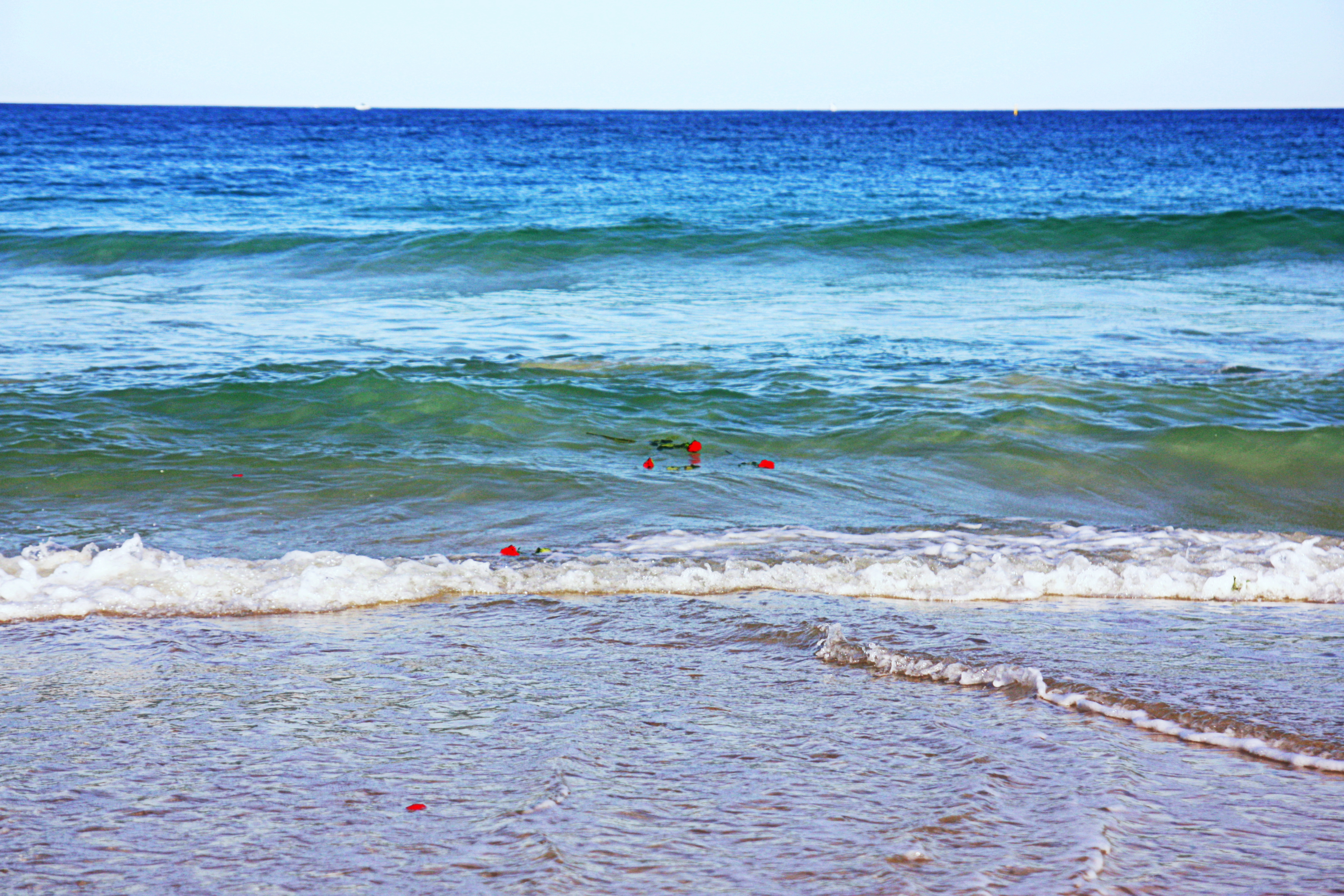
roses in the ocean, in motion carried by the waves

roses in the ocean, in motion carried by the waves

Light in the darkness & darkness in the light: Yin & yang in The Force Awakens

How many Star Wars blog posts is too many? This is my second about The Force Awakens. If you want my spoiler-free review it’s here, written the day the film was released. The following post does contain spoilers.

Woodblock print from WoodcutEmporium on Etsy. Source: https://www.etsy.com/listing/130958015/star-wars-yin-yang-woodblock-print

Woodblock print from WoodcutEmporium on Etsy.
Source: https://www.etsy.com/listing/130958015/star-wars-yin-yang-woodblock-print

I wrote in my previous post that Star Wars shows its audiences the complexity of people’s capacities for good and evil, kindness and cruelty, bravery and cowardice, zen calm and uncontrollable rage. Episode VII builds on the idea that there is both light and darkness within and around us all.

The stormtroopers are one example of how The Force Awakens teases out the complexity of our inner worlds. The First Order stormtroopers are, like their Galactic Empire predecessors, dressed in yin-yang colours of both black and white, with their white armour over black body-glove suits. I’ve always wondered why the characters who are the living arsenal of the Star Wars ‘bad guys’ wear white armour, when white is so often used in the franchise to symbolise goodness. Rather than being identical clones, the new stormtroopers are shown to have humanity and individuality, even though they are programmed henchmen of the dark organisation within the world of Star Wars.

There is ambiguity in the stormtroopers and the potential for alternate readings of them. A dominant reading might be: fascist ruling government = power-hungry murderous baddies / resistance = goodies fighting for peace and good (and power?). In a more resistant reading, within our current socio-political climate, we might ask what groups we consider to be well-armed governments with supreme power, who are hunting down groups of resistance and rebellion? What does Star Wars have to offer our world about the ways in which we view power and those who resist or challenge it, when the rebels and resistors are presented as the heroes?

In the Star Wars world presented to us in The Force Awakens, stormtroopers might be seen as victims of a dictatorship, loyal foot soldiers protecting order, or well-trained weapons of evil. The character of Finn, or FN-2187 (for fellow nerds, 2187 is the number of Leia’s cell on the Death Star in Episode IV), shows the most human side of the stormtrooper, by showing someone who, like the protagonists of the Bourne movies, despite his mental and physical programming to become a devoted warrior-soldier, rebels against conformity and embraces individuality. Is the message here that goodness can triumph? Or that the instinct for self-preservation trumps all? The first exchange between Finn and Poe is telling. When asked why he’s helping Poe, Finn replies: “Because it’s the right thing to do.” But Poe realises: “You need a pilot.” And Finn admits: “I need a pilot.” Finn wants to run, and to save himself, but, later reflects Han Solo’s reluctant heroism in the original episodes, when he returns and puts his life on the line to save his friend.

In another example of the entanglement of light and dark, in Episode VII we see Kylo Ren, while desperate to embrace his inner darkness, feeling “the pull of the light” and feeling “torn apart” by the struggle within him on his journey to villainhood. Adding to Kylo’s inner good, his real name, we discover, was ‘Ben’, the name that Obi-Wan Kenobi took on when he was in exile on Tatooine. Kylo’s choice to kill his father, to strengthen his dark powers, is reminiscent of Luke’s battle with his father and the Emperor, when the Emperor challenges Luke to strike him down, to give in to anger in order to become a servant to the dark side. In The Force Awakens, Kylo seems to struggle with his decision, but is committed to becoming like Darth Vader, his grandfather, who we know had his final moments as a good man-cyborg. Will Kylo’s fate be similar? (And will the next two movies in the trilogy be as derivative of the originals as The Force Awakens was of A New Hope? Or will there be narrative surprises along the way?)

In the lightsaber battle between Kylo and Rey, Luke’s blue lightsaber is like the sword Excalibur; it won’t budge for Kylo but flies violently past him to Rey. Kylo cannot control his anger (as we are also shown in his lightsaber slashing tantrums), while Rey, an untrained novice, closes her eyes mid-fight to “feel the Force” and strike Kylo. Here, the film sets up our main villain-hero pair, with a villain who has turned away from his family towards a powerful dark master, and a hero who is only beginning to know her own power. Kylo is set up as a baddie-in-training who might yet be saved, despite his murderous decision in Episode VII. The audience is left with the question: Is there enough yang in Kylo’s yin to bring him back to the light?

(An aside: What is Rey’s parentage? Is she Luke’s daughter? -“Rey, I am your father” – Is that why her power is so strong and why Luke’s lightsaber calls to her? Perhaps her mother was also a Jedi, which might explain why she is so intuitively powerful? Was she hidden on Jakku to protect her, as Luke was hidden on Tatooine? So is she related to Kylo? Are they cousins? Could they be brother and sister, somehow? What’s with the hug Leia gives Rey? It’s a familial kind of an embrace, complete with Skywalker family music.)

So the characters of Star Wars continue to show us the power of both the individual and the collective, and remind us that we all have choices to make about the paths we choose for ourselves. About whether we embrace darkness or light, but that both exist within us and around us. About whether, in times of stress and conflict, we choose to search for calm and goodness (the light side, the bright side, kindness, compassion, forgiveness), or we give in to negative feelings. Roll on Episode VIII.

The Force Awakens: What Star Wars tells us about humanity

This post doesn’t contain spoilers regarding what happens in Star Wars Episode VII. I promise!

I could have titled this post ‘Why I’m a big Star Wars nerd’, but it emerges from my reflections around the pro- and anti- Episode VII hype. As the film was released today, social and traditional media are filled with cries of ‘I can’t wait to see it’, ‘I’ve got no interest in seeing it’ or ‘I’d rather scratch out my eyeballs than see it’.

Why is Star Wars a franchise that people either love or dismiss? What is it about the series of films (especially Episodes IV, V and VI, and now VII) which drew so many of us in and continues to capture imaginations, 38 years after Episode IV was released? Why did I choose to go alone to the cinema (for the first time ever) to watch Episode VII today (apart from that my children were in school and I was on holidays, so I could)? Why did I watch the new episode with simultaneous anticipation, nostalgic joy, emotional investment and white-knuckle excitement?

One answer is that Star Wars films, like Shakespeare’s plays or Orwell’s novels, communicate the universality of humanity; the essence of what it is to be a person in the world. The films talk of the light and darkness within us all; our capacities for good and bad, kindness and cruelty, bravery and fear. In Star Wars, these struggles are internal and external; they happen within characters and across galaxies. Within the action-packed, emotion-charged fantasy world of Star Wars, we see the complexities of being human. We are shown the power of looking out for others, and of gaining self-control and self-awareness. We see people’s capacities for good and evil, quests for power, journeys of identity-becoming or identity-unravelling. The ethics of technology and the use and abuse of power are questioned.

Star Wars creates a universe in which heroes, male and female, ‘feel the Force’ and ‘search their feelings’. They are sensitive to the shared energies of the world around them, as well as a having a keen awareness of inner self and deeply felt emotion. It’s a world where heroes can be small, green creatures which speak in confused syntax, tall furry ones, or robots. Where mentorship and courage are found in unlikely places and anyone can save the galaxy, as long as they’re in touch with their senses and their feelings, and they have friends to support them on their journey.

At the beating heart of Star Wars is not the special effects, which have often been cutting edge for their time, but the relationships. We see the connections, compassion and conflict between friends, strangers, enemies, lovers and family, and combinations of these. These are underlined by the movies’ familiar scores, recognisable leitmotifs and iconic costumes which help to embed viewers in, and propel viewers along with, characters’ story arcs.

This time around, in Episode VII, The Force Awakens, battles for power re-emerge, but there is a little more 21st century diversity of gender and race. There is a female villain, a female heroine, a female general and a black hero, as well as the usual array of characters of various species, languages, sizes and levels of machination. While the film can be seen as an escape from reality, the universal themes of goodness, family, friendship and courage to do what is right or fight for those about whom you care, continue to resonate and have something to say about the world in which we live.

Fans of the original trilogy will be satisfied by Episode VII. It’s a fan’s film, a reawakening of the original spirit of the series, with plenty of recognisable hat-tip references. The movie brings together familiar Star Wars characters with new characters and modern special effects. It is funny and emotional. Fast paced and with enough unanswered questions to leave the audience intrigued for Episodes VIII and IX. The film doesn’t carve a new path for the Star Wars brand, but it does take its audience forward by embracing its past. My nerdy child-of-the-80s heart was bursting with old-school-meets-new-school Star Wars love.

Postscript: This post, written after a second viewing of the film, DOES contain spoilers.

Webs & chrysalises: Metaphors for learning & connection

Naomi Barnes, in her recent article in the digital journal, Hybrid Pedagogy, writes that “we need to start paying more attention to the random thoughts because when learning is conceptualised as a web, rather than a line, randomness becomes more meaningful.” She refers to the unanticipated blogging conversation, sparked by Steve Wheeler’s #blimage (blog+ image) challenge, that she, Helen Kara and I became involved in as we voluntarily responded to each other, layering our ideas and connecting our words.

My own experience of learning is non-linear and rhizomatic. The findings of my PhD were that this is an experience shared by individuals, groups and organisations; learning happens in surprising ways, in unexpected places. I agree with Naomi that embracing non-linear randomness might lead us to interesting places of knowledge collaboration, reimagining and production (although I do think we should acknowledge our sources of inspiration).

I mentioned in my blog post (part of the above-mentioned blogversation) on the spider-web connectivity of networked learning that metaphors, including of the spider’s web, emerged from my participants as ways to explain and explore their understanding of their professional selves, roles and relationships.

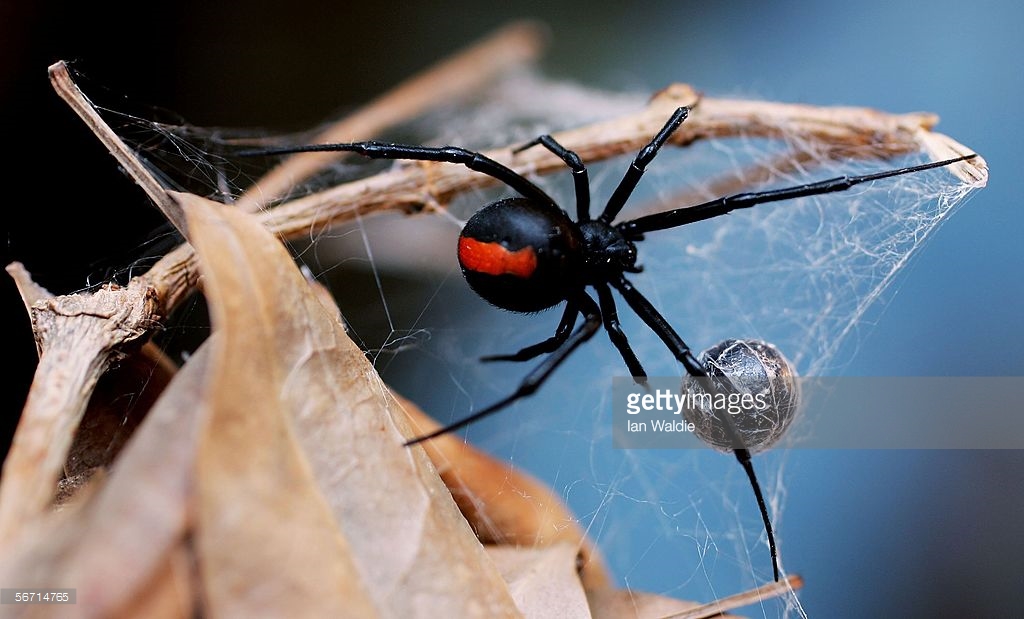
As it edges towards summer here in Australia, at home I recently found a redback spider (latrodectus hasseltii for the arachnid nerds), an Australian relative of the American black widow spider. The redback female is venomous, formidable and self-sufficient. Her web is messy. Males live on the periphery, eating her scraps. And after mating, she eats them, storing the sperm for later.

I’ve felt a little recently like a web-weaving spider. My PhD thesis is submitted, and suddenly, papers, journal articles and conference presentations are materialising. My PhD work has formed a web which widens and thickens, and in which these prey are being caught. The learning I’ve been doing from the network of scholars with whom I connect on Twitter and in the blogosphere has continued to take me to new thinking and into interesting conversations.

Now, I don’t see myself as a poisonous, man-eating widow spider, but I like that the redback is autonomous, a beacon of feminine power. I like that her web is messy and functional, not pretty and symmetrical. As well as the weaving of the physical web, the species itself has spread its tendrils out from Australia to reach New Zealand, Japan and Belgium. She has even made it into two DC comics as a supervillain who fights Robin. Unexpected places. Unpredictable influence.

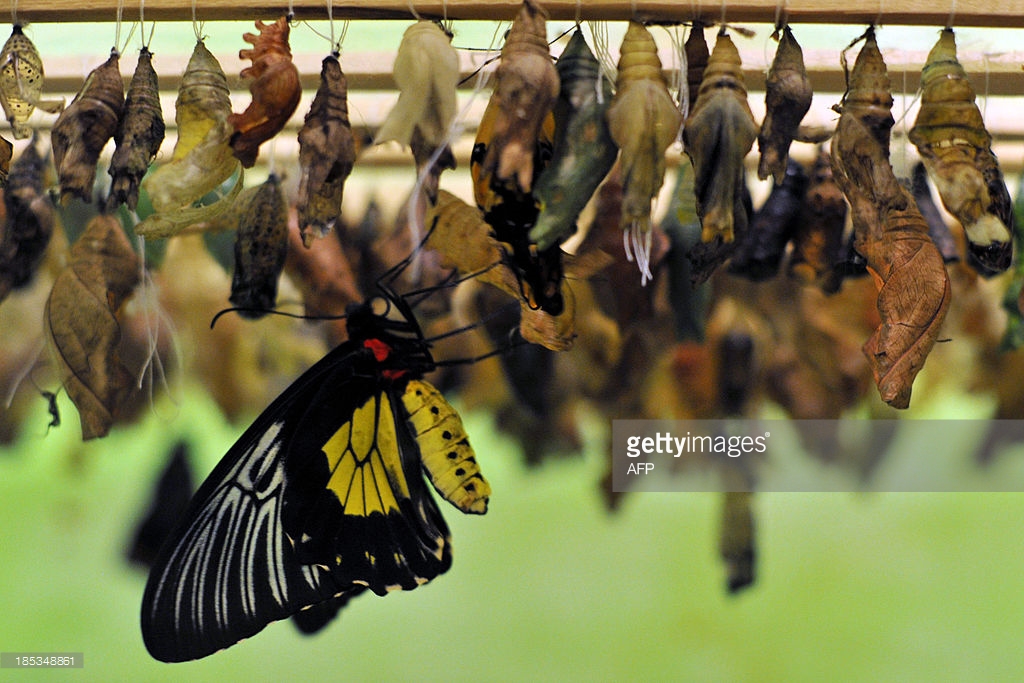
The other insect creature I’ve recently been reflecting upon is the chrysalised caterpillar-butterfly. After I submitted my thesis, I wrote the following title in a Word document and saved it: “Emerging from the chrysalis: PhD as transformative learning.” It was a blog idea for later, after proper completion, maybe. I was remembering a post I had read which argued that the PhD is not a transformative experience, but a thing to be done, a process to be completed, a means to an end. This wasn’t my experience so I thought it might be worth writing about.

And then I set the November #HDRblog15 challenge, and Kathryn Davies wrote this post about the life of a butterfly as a metaphor for the cycle of the PhD. Kathryn explores the chrysalis-PhD metaphor so thoroughly and thoughtfully, my own post idea seemed redundant. Yet my experience was affirmed by reading Kathryn’s. For me the PhD was transformative. I began my doctorate as someone who hadn’t written an academic paper or dissertation for 14 years. I was a vulnerable, soft-bellied slow-moving academic creature, my newness shiny and green. Over the course of the PhD, it has changed the way I think, the way I write and the way I read. It has changed how I perceive my identity, how I behave and how I respond. Some of these feelings I’ve written about, including a crisis of scholarly confidence, taking flight in the discussion chapter, and on being (or identifying as) a writer. And while I’ve recently said that I feel frozen in examination limbo, perhaps it’s more appropriate to say that I’m quietly growing, wriggling inside and pushing at the edges of my PhChrysalis, still a neophyte but transformed by my PhD journey.

So, I offer out to the blogoverse another post, another moment of my thinking suspended in time, another layer, another thread, another voice, another tendril reaching out to others. To be ignored, observed or grasped.

Doctoral examination limbo: Frozen in PhD carbonite

So okay― there you are in your room with the shade down and the door shut and the plug pulled out of the base of the telephone. You’ve blown up your TV and committed yourself to a thousand words a day, come hell or high water. Now comes the big question: What are you going to write about? And the equally big answer: Anything you damn well want. ~ Stephen King, On writing: A memoir of the craft

The irony isn’t lost on me that, the same month I set a blog writing challenge for PhD and other research students (and others in the academic pre- and post- doctoral world), I am struggling to find content for a PhD-related blog post. So, following Stephen King’s above-quoted advice from his excellent On writing: A memoir of the craft, I’ll write about ‘anything I damn well want’; or perhaps just anything that comes into my head as I type. This follows Pat Thomson’s technique (which she also attributes to Ray Bradbury) of writing with a blank screen and a few selected words which spark associations. Pat says it’s ‘writing fast’ or ‘running writing’ rather than ‘free writing’, but I’ll call my approach free writing here, because that’s what it feels like to me. Screen. Keypad. Words. Let them form as they will, then revisit and see what’s been made.

Part of the reason I’m finding a PhD-related post difficult is that I am currently in examination limbo. I’ve submitted the thesis and it’s been posted to three examiners, so now comes a wait of two to six months.

In this limbo period, I’ve got some papers to revise and to write, and I have work, parenting and life which go on. And thank goodness! Inger Mewburn, Thesis Whisperer, has likened completing the doctorate to running off a cliff. I can certainly relate to that, in a Road Runner cartoon kind of a way. My little animated PhD legs are still sprinting even though the thesis is submitted and I’ve run off the edge. Suspended in mid-air, legs madly cycling, I’m grateful to have work to keep me busy, purposeful and grounded.

selfie scribble

selfie scribble

Meanwhile, today as part of the #aussieED Twitter chat, we were asked to ‘sketch note’ an introduction to ourselves. I have declared my love of notebooks in previous posts about my flânerial packing list and on my pre-professional-fellowship art journalling. So I sat with my kids and scribbled some bits and pieces, watching them join together. The interesting thing about the process of thinking-while-scribbling is that thoughts and ideas emerge, seemingly through the very process of the pen scratching across the paper. Before beginning, I hadn’t mapped out what I was going to include. Much like this blog post, which is free-written, I was free-drawing. I surrendered to the moment and watched what emerged. If I did the same exercise tomorrow, or in a week, or a year, I’m sure the result would be very different (there’s a time-lapse video idea!).

And how about free-talking? I am connected with educators and doctoral students on Voxer, and I sometimes find myself using that walkie-talkie app as a useful ‘think aloud’ tool. I find that if I press the ‘transmit’ button and start talking, I don’t know what I’ll say until I’m saying it (sorry VoxSquad for the occasional ramblings). The act of talking aloud helps me to surface my thinking.

What can we learn about ourselves, what internal thoughts can we surface or capture, through the acts of writing, drawing, or talking aloud?

Here I am, in limbo between PhD submission and PhD completion, frozen in carbonite as an almost-Dr (yes – I’m anticipating The Force Awakens and am reminiscing about my favourite Star Wars moments, like Han Solo being unfrozen from carbonite). I’m wondering what might come next. Continuing to work in my current job, at my current school, business as usual? Considering what kind of role might be possible in my present context? Starting at the bottom of the pile, after a 15 year career as teacher and school leader, by dipping my toe in the academe? Heading down a consulting or alternate/indie academic pathway?

I know my current thinking, but I’m open to being carried in other directions. Free-writing, free-drawing and free-talking open up possibilities, so why not free-professional-decision-making? Lay out the materials and see what surfaces.

* This post is for the #HDRblog15 challenge. Join me to blog all things higher-degree-by-research this November!

my PhD notebook stack <3

my PhD notebook stack ❤

Doctoral supervision: From the PhD Panopticon to circle of awesome

Is it surprising that prisons resemble factories, schools, barracks, hospitals, which all resemble prisons? ~ Michel Foulcault, Discipline and Punish

chapel by @debsnet

circular chapel with spire

This week, Module 2 of the How to Survive the PhD MOOC asked us to take a photo of something in our daily lives which harks back to the history of the doctorate, and comment on it, perhaps considering the remnants of history on our own doctoral experience.

Although not medieval or at a university, I was immediately drawn to the chapel of the school at which I work. It has two elements which might be seen to allude to the history of the doctorate.

The chapel has a large spire atop it, which appears as a sharp white spike, piercing the blue sky. The spire speaks of the monastic traditions of the PhD, which was originally based on an understanding of the Bible. Whenever I’m sitting in this chapel, I’m aware of the presence of that spire, which looks like a kind of direct line to God, awaiting a lightning bolt of inspiration or knowledge, or carrying prayers to the heavens.

The circular form of the building is the other feature which has me thinking about my experience of the PhD. Could it represent an ideal cycle of PhD completion or be an Orwellian metaphor of authority, surveillance and control?

On the one hand, the symbol of the circle might help us to think of the PhD journey as a complete, unified process. Although most candidates do not experience a seamless journey, they might feel at the end of their doctoral studies that the cycle or circle is complete (not, hopefully, like they have ‘come full circle’, but that they have tied up the ends of a long process).

A circle often also suggests infinity, and certainly the PhD process can feel like it is never-ending. Just as one PhD milestone is completed, there are already more laid out before the candidate.

circle by @debsnet

In a less positive view of the circular building, I am reminded of Jeremy Bentham’s Panopticon, and Michel Foucault’s Panopticism. The Panopticon was a circular prison building with a central watchman’s tower, perfect for surveillance and control. The prisoners were separated from each other by concrete walls, and yet potentially under constant surveillance from the eye of the watchman. The watchtower emanated bright light, so that at any time each prisoner was unsure if or when they were being watched. Foucault saw the Panopticon as a symbol of power through the knowledge and observation of the watchman, and the disempowerment of the imprisoned and the watched who were robbed of knowledge.

I wonder how traditional vs. non-traditional views of the doctorate might relate to the Panopticon. Often PhD researchers are isolated, like Panopticon prisoners in their cells. They are watched over in varied ways and to differing degrees. Some may feel like they are unaware of the knowledge of the watchman, those in the academy who know what a PhD is, and what a PhD researcher should be doing; the watchtower is knowledge from which the candidate is excluded. Some might feel as though they are working away in their cells beneath the eye of no-one, abandoned by beacons of power to toil alone, un-watched and un-helped. Perhaps some research students would like more constant watching and checking in by their supervisors. Some are watched over generously by kindly supervisors who are far from the invisible authority in the blindingly-lit tower.

Despite Foucault’s observation that the idea of constant surveillance could help with self-governing behaviours – that people who think they are being watched develop agency and self-discipline – I would hope that the modern PhD experience feels very little like being invisibly surveyed by those in authority, where the candidate is power-less and the academe is power-full. PhD candidates should not be seen as a population which needs to be under the control of powers that be. Doctoral researchers should be capable of independent research and provided with supervisory support.

In my own experience of supervision, I have found that the supervisory relationship slides along a continuum as it changes over time. At first I felt very much like the enthusiastic apprentice to the knowledgeable masters. Never was I, however, expected to emulate the masters. The PhD is about creation of new knowledge, not emulation of old knowledge. In my Fine Art study we copied the Old Masters so as to understand how they did their work, but then took this knowledge and bent or broke rules to generate new ways of creating, producing or knowing. Research, like art, is conversation in which layers of meaning are added.

At some point along the way I felt as though I became a peer or collaborator in my supervision meetings, with some of my own expertise to offer, although my supervisors are still the experts in PhD completion and peer review processes. I became the expert on my own work. Finding my own voice and owning my contribution was an important step in developing my researcher identity.

I still feel sometimes as though I am working behind soundproof concrete walls, alone in the PhD studio (it has not been a cell for me). Yet connections with tweeters, bloggers, and now the How to Survive Your PhD MOOC online community, have helped me feel more connected to others experiencing the doctorate from their various vantage points. My circle has become more campfire-Kumbaya and less panoptic Orwellian control.

Tweet, blog or dissertate? On being a writer.

Good evening, ladies and gentleman. My name is Orson Welles. I am an actor. I am a writer. I am a producer. I am a director. I am a magician. I appear onstage and on the radio. Why are there so many of me and so few of you? ~ Orson Welles

book, by @debsnet

Our splintered, kaleidoscopic identities are wonderfully expressed by Orson Welles in the above quotation. Mine include writer, reader, researcher, teacher, leader, learner, mother, partner.

Do you feel like a writer? Does blogging make you a writer? Does micro-blogging? Does being a researcher automatically make you a writer? Professor Pat Thomson has written about ‘being writerly’ and practices which help you to see yourself as a writer. I tried to channel my writerly self in my 2015 – the year of writing dangerously post. I suppose this post is more about Pat’s idea of ‘being writerly‘ rather than ‘being a writer’. If you feel and behave like a writer does that make you one?

From micro to macro, this post focuses on how I use and interact with writing, including writing for purpose and audience. I wonder, are there different keystrokes (or pencil scribblings) that work for different folks? While I’m sure some people prefer tweeting or blogging, or article writing, or putting together a visual or numerical representations of their understanding (interpretative dance, anyone?), I think each platform and tool depends on our purpose for writing and audience to whom and for whom we are writing; each has its usefulness.

Below, I reflect on the platforms and tools I engage with, and what I get out of each.

Tweeting as a writing practice

I find that Tweeting, especially in a Twitter chat, is a kind of speed writing and speed thinking. Graham Wegner recently reflected that a busy Twitter chat can feel like a stampede of groupthinking sheep. Yet it is the torrential speed of Twitter chat tweets that sometimes helps me to clarify my ideas. Being pressured to aphoristically express an idea or viewpoint in a 140-character nutshell often forces me to distil and crystallise my thinking down into its essence, without agonising over it. I have previously called micro-blogging ‘therapy for the verbose’ as it is the antidote to my tendency to say things using too many words. Even my PhD thesis is over its word limit and will need trimming, streamlining and distilling. I have found Tweeting is a writing medium that helps me to most succinctly channel my thinking and keep tangents at bay.

That said, I also like the potentially tangential nature of Twitter chats. Rather than having a fear of missing what’s been said as the tweets roar by, I tend to engage with what I can, and with what peaks my interest. This often means that I spend much of a Twitter chat off to the side in a peripheral discussion, but I tend to prefer this kind of more extended conversation to the one-liner answers to a series of questions. That’s why I like the format of broader chats like #sunchat which work with one question for the hour and allow the conversation to take organic shape depending on the participants. Without the interruptions of regular questions, conversations can be deeper.

Blogging as a writing practice

As I discussed here, blogging has been personally transformative and about global collaboration. I am relatively new to blogging, having started this blog less than a year ago. In that I time I have published 55 posts on my blog, which has been viewed more than 10,000 times in more than 80 countries. Wow! I know that these numbers don’t compare with the superstar bloggers out there, but I am surprised and delighted to have a readership, and more than that, people to whom I’ve connected as a result of my writing, their reading, and our subsequent online, face to face, and voice to voice, conversations.

More than that, blogging has allowed me to take my thinking further than micro-blogging will allow, but more freely and conversationally than academic writing. For instance, I find Twitter a difficult platform to discuss issues of ethics, equity and social justice. Sometimes the subject seems too big for the platform. Some of my blog posts have emerged out of conversations on Twitter in which I have felt too restricted by space to say what I want to say; in these instances a blog can provide the complexity of thought, especially around tricky or contentious issues, which can be lost in the pithy-one-liner nature of tweeting.

PhDing and other academic writing

My PhD is a different writing beast all together, a 300 page monstrosity of a work which I am currently whittling, sculpting and (re)building into a cohesive document. The PhD can feel like a gigantic quilt which threatens to suffocate its maker; it is beautiful, creative, borrowing fabrics and threads from elsewhere while creating something new. The threads of reading and writing overlay and weave together in complex ways which have to come together in a holistic totality, while also working at the level of the small square, each vignette perfectly stitched, formed and embellished.

I recently popped my 110,000 word thesis draft into wordle.net, a website which takes text and distils it down to a visual representation of its most frequently used words. It looked like this:

my thesis wordle

my thesis wordle

I did this to see if my key themes emerged, but was subsequently more interested by words I did not expect to see there: “rather”, “just”, “really” and “something”. This led to an edit of my thesis looking for these words. I discovered that most of them were to be found in my participants’ language, but I did find that many of the “something”s belonged to me, and proceeded to weed them out of the document, replacing them with more precise or concise language. So, even turning words into a visual turned me back into my writing with a new understanding.

Academic writing such as abstracts, journals, conference papers and even the Three Minute Thesis, are others forms again. They require more laser-like focus than the big PhD book, and a clarity of structure and point. While trying to write smaller, more focused texts from the PhD can be a challenge, it is a good exercise in refining and clarifying thinking, while finding different ways to communicate important ideas.

Each of these writing platforms encourages different thinking and writing practices. Writing for different purposes and audiences allows us to layer, appliqué and augment our wordsmithery and our ways of communicating to others and to ourselves.

Every secret to a writer’s soul, every experience of his life, every quality of his mind is written large in his works. ~ Virginia Woolf

Writing, by @debsnet

Blogging under a pseudonym: the politics & ethics of anonymity in online communities

“Who are you?”

“No one of consequence.”

“I must know.”

“Get used to disappointment.”

~ William Goldman, The Princess Bride

Pinnacles shadow, by @debsnet

The literary world has a long history of authors who have written under pseudonyms. Charles Dickens, Stephen King, J. K. Rowling, Isaac Asimov, Agatha Christie, Benjamin Franklin, the Brontë sisters and Dr Seuss all had alternate author identities. Famous author-names Mark Twain and Lewis Carroll are pseudonyms. Yet while author pen names are an accepted reality of the literary world, blogging under a pseudonym often garners criticism and suspicion. I have read posts and comments in which people claim that blogging pseudonomically is about being secretive and hiding oneself behind a shield of cowardice.

For me blogging and tweeting are about being part of global conversations. Blogging allows me to expand my contribution to and engagement in those conversations in more depth than a micro 140-characters-at-a-time platform will allow. It allows me to reveal more of me, to make visible my thinking, to be transparent about my perspective.

I have written before about the ways that being connected with others online helps me to grow and to feel as though I have found my tribe of like-minded kindred spirits in contexts. This blog post, itself emerging from and at the same time inserting itself into a conversation, has arisen out of a chat today with Greg Thompson.

And yet I write this blog (the édu flâneuse) and tweet (@debsnet) from names which do not reveal my entire identity to the world. How can I make real connections in an online world in which I do not reveal my real name? What’s in a name? Is it the ticket to transparency and a guarantee of fidelity?

Those I have connected with seem to accept my authenticity despite being unable to pop my name into a search engine without first engaging in some interaction. I don’t feel that others respond to my online contributions with distrust, but I can’t be sure that some don’t look at this site or my Twitter profile and discount me as someone who lacks honesty or credibility. There are cautionary tales like this one from Corinne Campbell about the impacts of trusting people’s online identities.

There was recently some Twitter conversation about teachers’ considerations when sharing student work, within the context of the #IWishMyTeacherKnew hashtag. While it went viral, those such as Rafranz Davis questioned the issues of trust, privacy and ownership of the work and voice of others. Whose place is it to publically share details about others? In our world of relentless sharing, do we sometimes under-think the ethical ramifications of what we put online and who we might be exposing?

The pseudonymisation of my online identities is not for me about a rigorous building of a fake persona. I write very much as myself and happily share my posts with bosses, colleagues, professionals, friends and family. I discuss and share my blog with people I know in my personal and professional worlds. I enthusiastically introduce myself in real life to those people with whom I connect with online. I share my email address in direct messages on Twitter, thereby beginning lengthy conversations and sustained relationships. But while I don’t think my online persona is a controversial or argumentative one, I wonder about the ethics of publicising my self in terms of the potential ripples for others: my students, my school, my university, my research participants and even my own children.

My choice to exist online as a pseudonym is a result of grappling with issues of ethics. I have a name that is very easily traceable. One entry into Google and all public information about me is revealed, including where I work and study; who I teach and who I research.

At times I would quite like to publically claim the intellectual property in these posts. I could stamp my name on my blog and link it to my Linked In profile: ‘Look! It’s me!’ But I feel like I am being more respectful of my school, university, supervisors, students and research participants if I give them some cover between my words and their identities. My online identity isn’t only about me; I am the gatekeeper of others’ identities too.

Can we be part of a global conversation without full disclosure of who we are? Should we all be free to publically share ourselves and details of our contexts? Are there finer ethical issues at play in the blogosphere?

Perhaps there will come a time when I figure out a rationale for blogging under my name. Maybe when I submit my PhD thesis and publish papers, I’ll realise there is no such thing as ethical protection in an online world. In the meantime, I’ll endeavour to engage in global conversations in ways which are genuine, considered and with an awareness of how my words might impact on others.

Broome shadow, by @debsnetI hoped to keep this secret a little longer, because being Robert Galbraith has been such a liberating experience! It has been wonderful to publish without hype or expectation and pure pleasure to get feedback from publishers and readers under a different name. ~ J. K. Rowling

Front load your work. Be an expert. Own your contribution.

You have brains in your head. You have feet in your shoes. You can steer yourself any direction you choose. You’re on your own. And you know what you know. And you are the guy who’ll decide where to go. ~ Dr Seuss

by @debsnet

sometimes the words slowly bleed onto the page

As a mid-career professional I often feel comfortable in my work in teaching and school leadership. I might come up against challenges, but I do so with a sense that I know what I’m doing and have a sense of how to make my way through them. ‘This is what I know how to do,’ I think to myself. And forward I go without a second thought.

There are times, however, when I cannot forge forward confidently. Becoming a parent, for instance, threw me into a new situation and a new role in which I had to start from scratch. I was a newbie who had to find my way into my parent-identity and a way of parenting which worked for me. The PhD is another something which throws people into a new deep end. I have written about my realisation that my discomfort zone is my place of growth, but that doesn’t make the experience of discomfort any more … comfortable!

I type this post from the throes of my current nemesis: the PhD Discussion chapter. I wrote last month about my feelings of paralysis before beginning this chapter, and how I eventually got started. And yet here I still am, four or so iterations later and still wrangling, dancing with, building and un-building my discussion.

Part of my struggle is around scholarly confidence, reflected in the notes from my last PhD supervision meeting which read a bit like this: ‘too much other people’, ‘less others, more you’, ‘put your ideas up front.’

It seems I am clinging to the literature. I still want to prove to my reader that I have read everything I can get my hands on and I know my stuff. That I’m not a masquerader or pretender. And it seems I do this by citing and paraphrasing and putting up front the work of Others.

You know Others. In the mind of the novice researcher they deserve capital letters of knowledge because they are experienced, frequently-published, well-renowned academics, not researchers-in-training or Doctors-in-waiting.

And yet in the Discussion and Conclusion of the PhD I know I must identify myself as an expert. A person worthy of a capital letter (like a ‘Ph’ or a ‘D’). I keep reminding myself that I am an expert in my own research and that I can stand on the front foot when I discuss my findings and what they mean in the world.

So my current notes-to-self for the Discussion chapter are:

– Stop trying to prove my worth through literature.

– More me. Less others.

– Front load my work.

More than just a process of writing, this is a process of becoming. Becoming a researcher. Becoming a researcher who knows she is a researcher, feels like a researcher and makes knowledge claims like a researcher. It’s taking me many molasses-slow drafts to find my expert voice and a way of writing which foregrounds my own research and my own academic voice, while still situating my research within the existing literature. But step by step I am getting closer.

And I’ve been reading Dr Seuss’s Oh the places you’ll go! to my children recently so I am armed with the mantra that with brains in my head and feet in my shoes, I can move mountains. One painstaking word at a time.

You’re off to great places! Today is your day! Your mountain is waiting. So… get on your way! ~ Dr Seuss

You're off to great places, by @debsnet

the édu flâneuse atop an Icelandic glacier