Writing the PhD discussion chapter: from fear to flight

Don’t believe what your eyes are telling you. All they show is limitation. Look with your understanding. Find out what you already know and you will see the way to fly. ~ Richard Bach, Jonathan Livingston Seagull

flight, by @debsnet

Since beginning my PhD two and a half years ago, I have plugged away at my thesis, chipping at it bit by agonisingly small bit, sometimes having to retrace my steps or throw out whole sections of work. But it has progressed through dogged persistence, slow laborious work and a measure of creative problem solving. I have even found it to be wonderful celebrated ‘me time’ as I explained on the PhD Talk blog.

Yet as my big book pushed towards 100,000 drafted words, I arrived at the discussion chapter and … duhm duhm daaahhhhhhm … suddenly I screeched to a stop, paralysed by fear. After fairly consistent, if often brain-bending, progress, I had come to a standstill. Up until this point, my metaphors of PhD candidature had served to propel me forward through even the biggest challenges and hard-to-hear feedback. My PhD had been an elephant I had to eat one deliberate bite at a time, or a sculpture I needed to craft carefully, or a journey in which I put one footstep in front of the other (another nice metaphor is this one of the PhD as swimming). Yet, despite my supervisors’ assurances that the discussion chapter was just one more eatable bite, one more takeable step, I was immobilised.

Matt Might’s illustrated definition of the PhD, which I had initially found grounding, now seemed terrifying. While it demonstrated that a PhD need only push the boundary of knowledge a teeny tiny bit, it also reminded me that a doctorate is all about having an original contribution to the body of knowledge. An. Original. Contribution. Which. Pushes. Bends. And. Remakes. The. Boundary. Of. Knowledge. And the discussion chapter is where I need to – as Inger Mewburn (the Thesis Whisperer) says – not just state my findings but explain what my findings mean.

So after two and a half years of reading (and reading and reading), interviewing, analysing and writing (and writing and writing and writing), I found myself at a point at which I needed to explain what it all means. And to have the (as Inger puts it) scholarly confidence to assert my research as having an original and worthwhile contribution.

In my paralysis of PhDcrastinating I found Emma Burnett’s blog posts which helpfully explained how she planned to approach her discussion chapter and also what she actually did. These kinds of explications by PhD candidates are useful material for others as they approach different stages of thesis wrangling.

Pat Thomson, my go-to blogger on all things academic writing, describes the discussion chapter through the metaphor of taking flight. She explains that the discussion chapter is the place to “be your own expert, to fly where no other researcher has flown before.” No pressure. Her metaphor of discussion-chapter-as-taking-flight reminded me of Richard Bach’s allegorical novella Jonathan Livingstone Seagull in which the non-conformist seagull Jonathan works tirelessly, often on his own and sometimes as an outcast, towards a kind of flight never before achieved by any seagull. His passion-driven, sometimes lonely and relentlessly-perfectionist journey to ultimate flight could certainly be a metaphor for the PhD narrative (although as Pat Thomson reminds us, the PhD is not a lone journey, but collaborative work).

@debsnet & @patter Twitter discussion

In a useful Twitter conversation, Pat explained to me that the discussion chapter is a synthesis and interpretation of findings which takes them to a new theoretical level. Discussion is not a repeat or recap, but a presentation of a new reading of the research which links findings to literatures. As Pat’s blog post explains, this is the place for interpretation and theorisation. Taking it to the next level. As she suggests, it’s the time to earn the ‘Philosophy’ part of the PhD.

*      *      *

Eventually I found a mental space in which I could put some words to the page (just one word in front of the other, I told myself; get it down), and I got started on the … duhm duhm daaahhhhhhm … discussion chapter.

Firstly, I went back to my research questions, which had emerged from the literature review, and used these as a frame for my discussion. Then I went back into my literature chapter and pulled out the threads which related to those research questions, especially those areas in which I had identified gaps or areas for further embellishment or new perspectives. Then I went back to my data (in my case, three chapters of storied interview data from three different groups). While the end of each of my data chapters included some synthesis and interpretation of that data set, the discussion chapter was the time to bring all the threads – all literature and all data – together. My intention was to identify clearly what I had found and how this was related to existing literatures. After writing an initial draft which was more summary than analysis or insight, I left it. It was a start.

Now, after giving myself permission to take a break and finding some mental space and clarity through travel, I have returned to the chapter. As I write I am asking myself: What does my data mean (within the parameters of the research questions)? What established trends are affirmed or challenged by my study? What findings are surprising? What from my research is new in terms of, or absent from, the literatures in my area?

The chapter is still in draft form, but instead of standing still, mute and frozen, I am flapping my wings with a sense of how and where I’m going. Soon enough I’m sure I will take flight.

(For an update on how my approach to the discussion chapter evolved, the follow up is here.)

He was not bone and feather but a perfect idea of freedom and flight, limited by nothing at all. ~ Richard Bach, Jonathan Livingston Seagull

paper planes by @debsnet

We are all storytellers: immersed in my narrative worlds

Humans are storytelling organisms who, individually and socially, lead storied lives. ~ Jean Clandinin & Michael Connelly 

our constructed stories connect us

our constructed stories connect us

Whether teaching, writing, conversing or considering our own lives and identities, we are all doing one thing: storytelling.

I have recently been quiet in the Twitterverse and blogosphere, partly because more than ever before I am immersed in micro and meta layers of story.

I have been tunnelling into my PhD narrative research in every spare moment, thinking obsessively and writing dangerously. I am sharing, constructing and analysing the stories of myself, teachers and schools leaders in order to reveal insights into professional identity, professional learning and school change. I am penning my first journal article about experimental ways of telling, utilising and analysing stories in research.

When I am not researching or thinking about my narrative research, I am teaching English to high school students. Reading stories, writing stories, analysing stories, watching stories, performing stories.

Or I am with my own children, reading stories, telling stories, making storyable memories, recounting favourite moments, role playing imagined scenes with make believe characters. Or talking to my husband about his work in media and content marketing, which is all about individuals and organisations telling their stories and constructing their storied identities, in order to communicate and connect. Or blogging vignettes from my own lived story. Or planning conference presentations of my research story or the story of my school’s teacher growth model.

We are indeed storytelling creatures. While I also try to be present in each moment and to live in wonder, stories embody the ways we construct our experiences, connect with each other and the world. I write my own stories, teach the telling and interpreting of stories, and engage in the theorising of stories. Have I used the word ‘story’ enough times in this post to indicate that it is currently both intoxicating and maddening to me? Story story story.

Obsessed and submerged, back into the subterranean story cave I go …

After nourishment, shelter and companionship, stories are the thing we need most in the world. ~ Philip Pullman

by @debsnet

2015: The Year of Writing Boldly, Abundantly & Dangerously


Writing Dangerously by @debsnet

Get it down. Take chances. It may be bad, but it’s the only way you can do anything really good. ~ William Faulkner

For me, 2014 has been a year of writing thoughtfully, reflectively and introspectively.

As always I have been writing unit plans, assessments and resources for my students. I have been writing 140 character tweets, and participating more and more in education Twitter chats (such as #satchat #sunchat #aussieED #whatisschool and #BFC530). I have started a blog in which I have been experimenting with voice and purpose. I have been writing my PhD, which is currently at almost 80,000 words. As part of my PhD I have written a self-study chapter in which I reflect on myself as learner, educator and leader.

2015 will be my year of writing abundantly, boldly and dangerously.

Writing abundantly

In 2015 I will need to write abundantly. I will need to write words and words of thesis. I will need to pen some papers on my research. I will need to write applications and abstracts for education and research conference presentations. I will write blog posts. I will write tweets.

Each form of writing is a different kind of therapy. I am prone to over-wordiness (I love words!), to verbosity, to an inability to be concise. Thankfully, Twitter is therapy for the verbose. To distil thoughts into 140 character bites is to crystallise thinking down to its essence. I am never more concise than when I tweet. Blogging allows personal exploration of ideas in an informal space. My blog is where I can explore ideas in greater depth than a tweet, but in more informal ways than in academic writing. My thesis is the place where I get to burrow into challenging writing problems and thrash around, working hard until I break through and find a solution. The PhD is writing friend and nemesis, a beast I have to wrestle into its cave, clay I have to mould into its form (or is that stone I have to hack at until it takes shape?).

And the more I write, the more my writerly-self expands and transforms, like a shape shifter, always taking new forms in organic, non-linear ways. I am a hybrid writing being who writes as educator, school leader, researcher and bloggess. 2015 lays the challenge of balancing these overlapping writing selves.

Writing boldly

I will need to be bold in my writing in 2015.

I will need to be boldly honest, self-reflective, self-revealing and authentically-voiced in my blog posts, and in the conversations which bloom from those. I will need to be willing to disagree in Twitter conversations, in order to promote robust discussion instead of an inward-looking echo chamber of the same voices saying the same things.

In my third (and hopefully final) year of my PhD study I will need to be self-assured in discussing the contribution of my work. I will need to be confident in communicating in my own academic voice.

Yet in my boldness I will need to be sensitive to ethical issues such as how to tell others’ stories while protecting their anonymity and the authenticity of their words. Part of the reason I choose to blog and tweet under a pseudonomic identity is to protect my research participants. So boldness needs to be tempered with thoughtfulness.

Writing dangerously

Language is power. Words are tools. As a teacher of English and Literature part of my job is to help students to understand how language works (functionally, socially and globally), and help them to develop the capability to use its power to communicate, share, converse, discuss, disagree and disrupt.

Writing can be dangerous. It can be disruptive. It can be transformational for writer and reader. It can change individuals, groups, organisations and the world.

2015 is the year for all researchers, bloggers, tweeters and writers (or ‘those who write’, but don’t think of themselves as ‘writers’ as Pat Thomson explains in this post) to write fearlessly and compassionately, abundantly and concisely, reflectively and dangerously. I’m going to give it my best shot.

Happy writing!

A writer never has a vacation. For a writer life consists of either writing or thinking about writing. ~ Eugene Ionesco

write fearlessly by @debsnet

Kaleidoscope selves: find your tribe

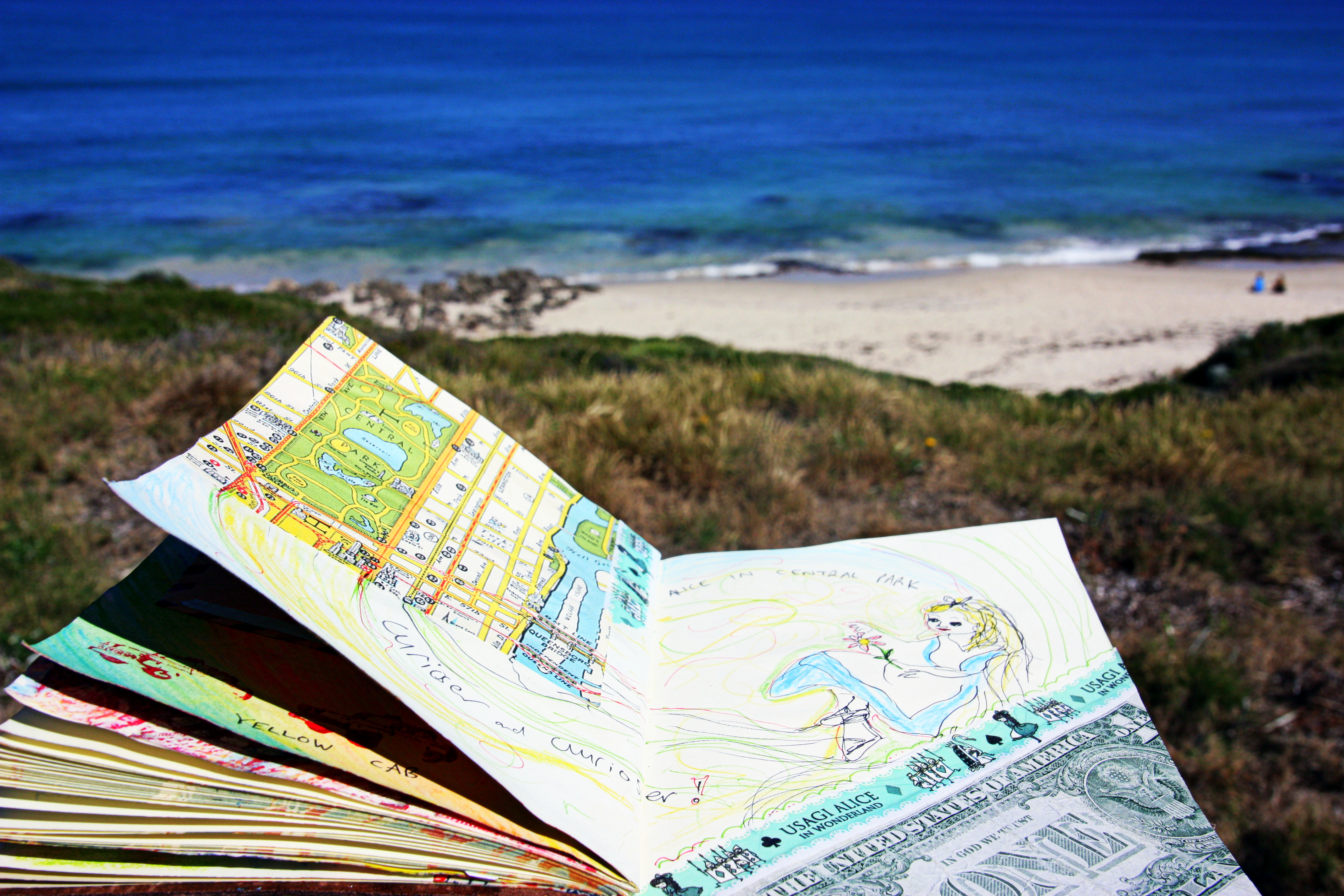
art journal page: Alice in Central Park

art journal page: Alice in Central Park

Who in the world am I? Ah, that’s the great puzzle. ~ Alice, Lewis Carroll’s Alice’s Adventures in Wonderland

José de Creeft’s Alice in Wonderland bronze statue glimmers in Central Park, polished by children’s climbing hands. Alice, of Wonderland fame, is a character who resonates with me. She is ingrained enough in my thinking that she makes more than a passing appearance in my PhD thesis. What I love about Alice is that she is open to new places and perspectives. She is curious, receptive and constantly wondering. She thrives on meeting new creatures and on having unusual, wondrous experiences. She is the imaginative adventuress who at once embodies childhood awe, strong self-assurance, rationality and fear-conquering daring. In many ways she is a flâneuse of Wonderland: wanderer, wonderer, learner and observer.

The question of self is not straightforward. Various aspects of our tangled selves collide and interlock. Or perhaps, rather than tangled webs of gossamer self-threads, we are each kaleidoscopes of self. Forged from a range of asymmetrical elements, we form the spectacularity of the beautiful changeable selves we are when viewed together through a cylinder of mirrors and light.

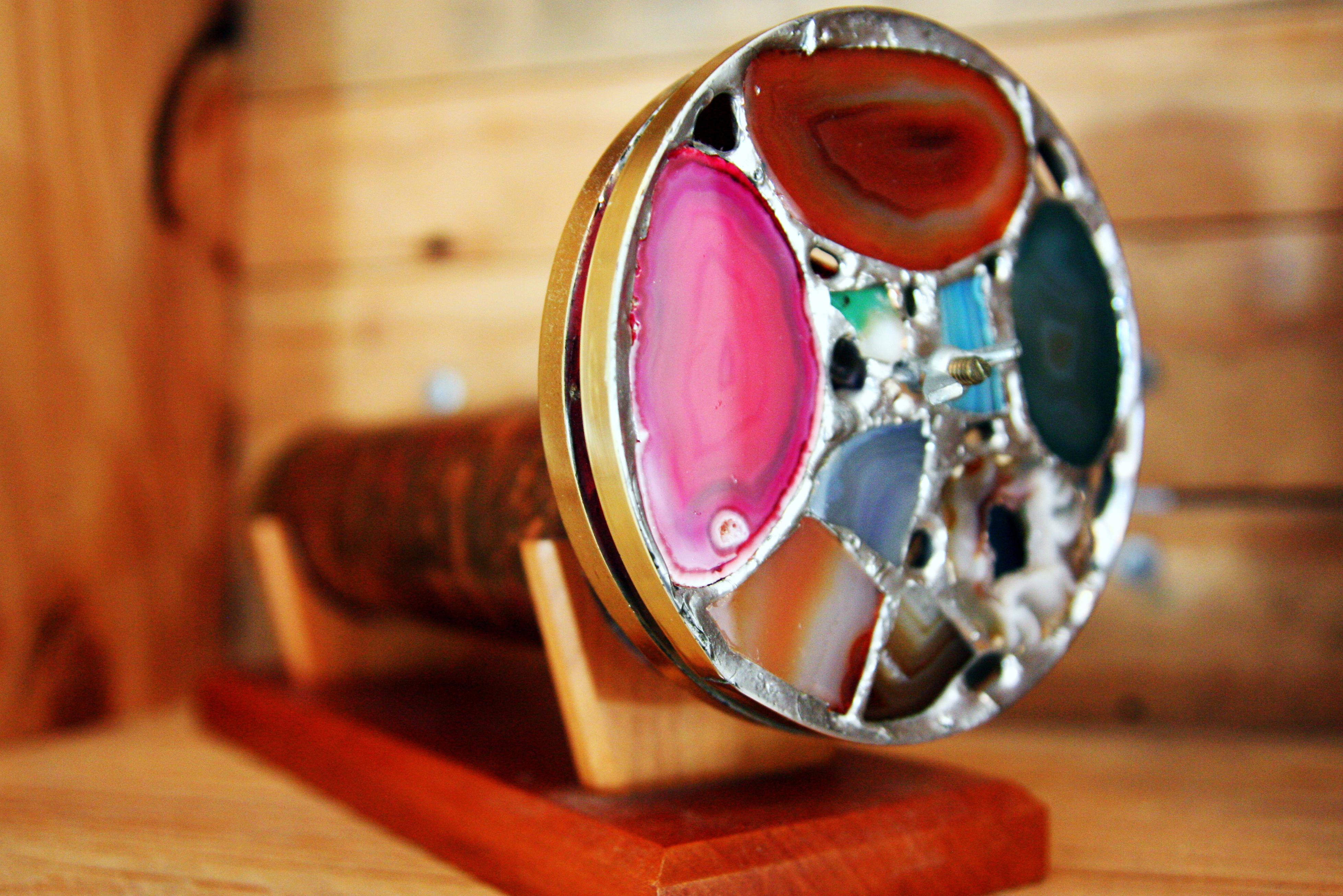
my precious stone kaleidoscope

my bronze-cylindered Arcana kaleidoscope has wheels made of glass and semi-precious stones: this one is by Australian artists Robert Cook & Jocelyn Teh

My kaleidoscopic self is made up of a number of different selves which my @debsnet Twitter bio attempts to unify:

Wanderer. Wonderer. Dreamer. Reader. Writer. Creator. Educator. PhD researcher. Passionista. Disruptor. Imaginer. Innovator. Flâneuse.

Not included are other personal selves like parent, spouse, child, sibling, friend. There are many contexts in which I share all or some of these self aspects. As the kaleidoscope turns and the light changes, people see different patterns reflected from me.

patterns as seen through my kaleidoscope

mandala-like patterns as seen through my kaleidoscope

My self-threads splinter, intertwine and blossom, as they do through the kaleidoscope viewing hole.

As I reflected in a previous post, connecting with other educators is for me about being my learner self. Connecting and collaborating widens and globalises my perspectives, while encouraging my own thinking and reflection (see Tom Whitby’s recent post about the relationship between connection and reflection). My teacher self is informed daily by my experiences as a parent, my own learning as a PhD candidate and my online participation. My Twitter interactions are influenced by my daily experiences of parenting, researching and working in a school. My parenting is influenced by my teacherly and researcherly thinking about learning and development. My PhD research self interacts with other researchers on social media as well as being informed by my in-practice educator immersion in my academic topic of study. My PhD itself incorporates me as learner, educator, writer, reader, creator and self-conscious researcher. And here on this blog my posts tangle together the threads of my learner, teacher, researcher, parent, writer and artist selves.

A dear friend of mine recently sent me this quote which I’m sure resonates with many of us:

When you find people who not only tolerate your quirks but celebrate them with cries of ‘Me too!’  be sure to cherish them. Because those weirdos are your tribe.  ~ Nanea Hoffman

It strikes me that many of those with whom I connect, in life, in education, in research and in my online PLN, are those whose quirks are similar to mine. Their kaleidoscope colours reach out to me across time, space, geography and social media.

I was recently involved in a Twitter chat with a number of educators. A few people in the chat began talking about being proud to be dorky, to be okay with failure and to constantly be learning. When I tweeted back ‘yes – fellow geeks unite!’ there was a chorus of ‘amen’ and ‘ditto’. I felt like I’d been high fived over Twitter. Here were my fellow weirdos, people who I’ve never met, connecting with me from across the world. “Yes,” they were saying, “In this moment, I get you and you get me.”

Next week I fly to New York to connect in a very real and immersive way with fellow educators, researchers and thinkers who will widen my perspectives. Perhaps I will widen theirs by sharing my Australian story. As this blog attests, I am hoping that my trip will allow my total and joyful submersion in all my aspects of selfhood. I will be thinking, writing, note taking, photographing, drawing and flâné-ing my way to new connections, new reflections and new perspectives.

The word kaleidoscope comes from the Greek words kalos, eidos and skopeō which essentially translate together into ‘beautiful form to observe’. Here’s to finding the beauty in others’ idiosyncrasies and to each of us finding our quirky global tribe.

find wonder, find perspective