Embrace your discomfort zone: bubbling in the crucible of growth

Out of your vulnerabilities will come your strength. ~ Sigmund Freud

my scribblings: Comfort vs. Discomfort Zones

my scribblings: Comfort vs. Discomfort Zones

Scholarly literature and the blogosphere are saturated with thoughts around motivation, growth and what it means to learn, lead and be the best we each can be. Some of this is around what qualities, attitudes or behaviours we need in order to weather life’s difficulties while continuously growing our selves.

Skill sets & mindsets for discomfort and growth

Carol Dweck’s much-touted work on mindset argues that our self-conceptions frame our life paths. If we perceive ourselves as having fixed immovable traits, then we are less likely to be resilient and positive in the face of challenge. Those who perceive that their talents and abilities can be developed are more able to see setbacks as opportunities for learning and growth.

Art Costa and Bob Garmston’s Cognitive Coaching model would suggest that we need to help individuals to reflect upon their own goals and experiences, figuring out their own ways to get better while assuming that each individual has the capacity to do exactly that.

In their recent book Uplifting Leadership Andy Hargreaves, Alan Boyle and Alma Harris talk about a yin-yang balance between positive energised leadership and tenacious hard work. They talk about disciplined innovation and feet-on-the-ground (rather than pie-in-the-sky) creativity. “An uplifting mindset and skill set keeps your head up high while your feet stay firmly planted on the ground.” Hargreaves, Boyle and Harris articulate the need for leaders to have visions and dreams alongside the determination to struggle through hardship and adversity. They remind us that “without dreams, profound human and social change would scarcely be possible” but that we need inspiration that incites action, daring and doing. Leaders, then, are grounded visionaries whose diligent exertion drives imagination and change.

Environments of support and challenge: being held while being pushed

In her work on adult learning, Ellie Drago-Severson talks about organisations as ‘holding environments’, spaces in which adult learners feel ‘held’ and which provide both high support and high challenge. When I spoke with Ellie this year, she emphasised the need for schools to facilitate the development of self-authoring individuals, able to take charge of their own journeys of transformation.

Charlotte Danielson, too, talks about the need for support and challenge for teacher growth. Teachers need an environment of trust, she says, in which it is safe to take risks in the spirit of ongoing professional inquiry. As I explained previously in my reflections on hearing Charlotte speak at the Australian Council for Educational Leadership 2014 conference, the need for balance – between safety in which teachers feel supported and trusting, and enough discomfort to challenge practice and change thinking and behaviour – has been pivotal in my school’s work to provide a setting for the transformation of classroom teaching, professional conversation and collaborative culture.

Enter the discomfort zone, the birthplace of rainbow growth

So while we need to feel supported enough to take risks, we need to be daring enough to be vulnerable, uncomfortable and daring. Margie Warrell calls this the ‘Courage Zone’, the place beyond comfort (but before terror and paralysis) in which risk taking and growth happens.

In my own experiences I have found this discomfort zone to be a tipping point for my own growth. Often it is in the squirmiest spaces of discomfort that my breakdowns become my breakthroughs. As I illustrated (literally) in the drawing above, my discomfort zone is a place of dark messiness, but from which rainbow-like growth can emerge. The comfort zone might be all white fluffy clouds, affirmations and unicorn-blessed pixie dust, but it also tends to be a space of inertia.

My classroom is a place in which my experience and comfort level are best served by being challenged to try new things like a recent term without marks or grades. And while my online PLN and at-school professional friends provide me with support, it is getting out of the supportive echo chamber and into dissenting debate which pushes my thinking and incites my learning.

Some of the most uncomfortable moments of my growth this year have been in my PhD work which often involves wrestling with my thesis. Support and criticism from my supervisors help me to work tenaciously through difficult research and writing problems to find solutions and make progress. As an experienced educator but novice researcher, it is interesting negotiating a space in which my learning curve is dizzyingly exponential. The best thing about grappling with and through discomfort is the unrivalled feeling of satisfaction at solving, innovating or realising learning.

Who, where or what makes you feel ‘held’ and comfortable? How at ease are you in your discomfort zone? Is it a crucible of growth for you? What do you find when you stay there and thrash around for a while?

Suffering has been stronger than all other teaching …. I have been bent and broken, but – I hope – into a better shape. ~ Charles Dickens, Great Expectations

Mostar jumper: leap into discomfort

Mostar jumper: leap into discomfort

Work-family fulfilment: The elusive sweet spot

I have never met a woman, or man, who stated emphatically, “Yes, I have it all.” Because no matter what any of us has—and how grateful we are for what we have—no one has it all. ~ Sheryl Sandberg, Lean In

Usually this édu flâneuse blog is focused on teaching, education, school leadership and research, although I have written about self, travel and gratitude. This post, which was incited by reading Annabel Crabb’s 2014 book The Wife Drought, is about partners, parents and families grappling to find collective fulfilment. What does it mean to be a partner and parent in a world where everyone is leaning in?

my two boys adventuring

my two boys adventuring

Recently, as the mother of a two and a four year old, I went on a work trip, my first solo travel since the birth of my eldest. Apart from the very occasional overnight (drop-off-at-bedtime pick-up-at-breakfast) sleepover, I had never been away from my children. My husband had travelled consistently since they were born, but this experience was new to me. As I strode at a grown-up pace through the airport, wheeling a single teeny carry-on, it struck me: this was the first time in five years, since first falling pregnant, that I had conceived of myself as a singular entity, a human being in my own right. Of course, there was still the invisible umbilical pull, but this experience of thinking-only-of-myself was both foreign and like slipping on my softest old comfies.

It got me thinking: What makes our lives whole? How do we prioritise family time, husband-wife time, career time, self-care time and home time? Can we be whole or can we only be compartmentalised parts? Is there a work-life-family-self sweet spot?

lean in to sandcastle building

lean in to sandcastle building

I like Jennifer Dulski’s concept of the Work-Life Mashup. Be with people you love and do the work that matters, she says. Focus on what’s important. I also resonated with Rosa Brooks’s response to Sheryl Sandberg’s Lean In: lean out! More is not always better. How about also leaning in to family, happiness and wellbeing?

A good friend recently leant me Annabel Crabb’s The Wife Drought: Why Women Need Wives and Men Need Lives. Crabb’s message is that, in order to achieve any semblance of work-family happiness, women need support in the home and men need more flexibility to step out of a traditional work model.

Men: supercharged by wives but missing out on lives

“Men’s careers rattle along uninterrupted,” says Crabb. Their wives are the “invisible power-pellet” which makes them more able to succeed in their own careers. “For fathers, having a family gave them a competitive edge,” while for women children make her, “less likely to be employed.” Men don’t tend to take time out from their careers when they have a family. As their children are born and grow, their work lives rocket forward on unbroken trajectories.

The downside of man as breadwinner and woman as homemaker is that fathers are excluded from “a universe of experience … and that’s a sad thing.” Why is a dad looking after his own children called being “Mr Mum” or “Daddy Daycare”, instead of just ‘being a parent’?

My husband recently went to the weekday parent induction for our eldest son’s new school, and he was one of three dads there; the other forty-plus parents were mums. Hopefully he was seen as neither a hero nor a novelty; just a proud, interested and loving parent.

Half-crazed superwomen: doing it all not having it all

Crabb cites studies and statistics which show that women are the ones who tend to adjust their schedules and take on the lioness’s share of the caring and housework responsibilities. She describes this as the age of the “half crazed ‘superwoman’” who attempts to ‘do’ work and family in equal measure, all while having “that feeling that one ought to work as if one did not have children, while raising one’s children as if one does not have a job. To do any less feels like failing at both.” Women tend to step back, step out, or figure out acrobatically-flexible ways to scratch together a work life while their children are small, or pay others to care for their kids.

I have heard an employer say, “if you want efficiency, hire a part-time mum” and Crabb asserts that she uses “every scrap of the day like an Italian farmer uses all of the pig.” We all have our multi-tasking, time-saving routines. I wrote here about the way I approach my PhD schedule. And there are always circumstances under which the delicate ecosystem of childcare, work, family and self, tips on its axis and sends us sprawling.

Social media: help or hindrance?

Social media allows us all to connect to others and share our lives. While my professional social media is focused on my intellectual interests and cultivating professional conversations, I use my personal social media to share moments of beauty or delight which I’ve carved out or stumbled upon: a sunrise at the beach, my children playing happily, a wonky birthday cake I made from scratch. My aim is not to craft an image of work-life-mashup perfection, or to suggest that this social media output is my complete reality. This is the highlights reel, not the whole picture! Crabb warns, though, that women who try to make work-family-life juggling appear easy can’t complain when the world doesn’t notice how much they are struggling to maintain their appearance of effortless togetherness.

For some, social media posts are an additional pressure. Apparently there is a thing called ‘Facebook life envy’. The mother who sees others’ decontextualised posts might wonder: How will I assemble a perfect outfit, while making grain-free dairy-free sugar-free recipes from whole foods grown in my own garden, mixing my own eco-organic-fairtrade face scrub, engineering creative craft activities, hand making personalised Christmas cards, and take a ‘no filter’ photo of a house sparklingly clean from all-natural chemical-free cleaning products?

We need to remember that social media is not life. And our lives are our own to live. 

social media is not reality

the highlight reel: social media is not reality

Finding the Work-Family Fulfilment sweet spot

Crabb concludes The Wife Drought by suggesting that we become accepting of men taking time for family or working more flexibly to achieve their own work-life-family contentment. Men should be able to lean out, she says, without being the subject of ridicule or novelty.

I’m lucky enough to have the kind of mutually supportive relationship that Tanya Plibersek talks about in Crabb’s The Wife Drought. My husband and I support each other professionally and share what we do at home. My husband believes in me as a mother, a wife, a researcher and a professional. He supports me in my dreams: to nurture a happy, connected family; earn a PhD; build a satisfying career; have a love-filled joyful adventurous life. And I support him in his: to be a present, treasured father to our boys; build a family legacy with them; grow his own businesses; develop his reach and impact; nurture professional connections and make a difference to the industries in which he is immersed.

We need to believe in each other’s capacities for awesome, and in each other’s dreams.

It may not be easy or perfect, and my husband and I may live our weekday lives by the ding of an Outlook calendar, but we both want to actively parent our children and be – really be – in their lives. We both work a semi-flexible working week. We share housework. We both have times when one of us is parenting our children and the other is working or traveling. We have lots of time when we are all together. Our boys see us, I think, as equally their parents. They experience us as a whole family unit in which we all work together to support each other as we seek individual and collective happiness. These choices are based on our beliefs. I know many happy families who make different, equally fulfilling choices for their own circumstances and principles. Each family needs to find its own changing recipe for the sweet spot of ‘this works for us, for now’ and ‘this makes us happy’.

Perhaps discussions about work-family-life fulfilment should be less debates in which we tally the percentage of housework done or hours worked or dollars earned by each partner. Can we focus more on talking with our partners and our employers about how we can support each other in our dreams for our selves and our families? What might that look like for our particular family, based on our visions, dreams, opportunities and resources?

There is no “invisible power pellet” or perfect one-size-fits-all recipe for finding the work-family-life-happiness sweet spot. We can only make choices which work for each family at any given time, riding the ebb and flow of life’s messy randomness together, and with a view to serving each individual (parents and children) and the whole.

carve out time & space for joy & simple pleasures

carve out time & space for joy & simple pleasures

Gratitude, awe & delight: lessons from Pollyanna

“The game was to just find something about everything to be glad about—no matter what ’twas.” ~ Eleanor H. Porter, Pollyanna

suburban rainbow

suburban rainbow

As the parent of two pre-school age children, I sometimes wonder about the age at which we are expected to be less excited by the world and more serious about it. At our local park, there are always children rolling down the grassy hill, rolling themselves over and over into dizzy giggles. On occasion, I have joined in with my own children, but a ‘grown-up’ covered head-to-toe in grass and leaves, or with scraped knees from climbing trees, or cupped hands filled with meticulously-chosen sea shells, doesn’t seem appropriate somehow. Yet I have been known to race out of my classroom to get a better look at a rainbow, jumping and clapping my hands, a line of bemused high school students trailing behind me. Recently, my small children and I have been playing with mirror-ball Christmas decorations in the late afternoon sunlight, painting the walls with light patterns.

mirror ball joy

mirror ball joy

Finding daily magic, seeing things from new perspectives, and allowing ourselves daily moments of presence, connection and wonder are surely the starting points for gratitude. One of my fondly-remembered childhood stories is that of Pollyanna, the girl whose ‘glad game’ and glass-full outlook changed those around her. With her rainbow-maker prisms, physical symbols of everyday magic, she promoted thankfulness, wonderment, the search for everyday magic and trying to see the good in life. In Pollyanna’s exchange with John Pendelton, they bring magic to each others’ worlds, tranforming dreariness into a fairyland of wonder:

  It was toward the end of August that Pollyanna, making an early morning call on John Pendleton, found the flaming band of blue and gold and green edged with red and violet lying across his pillow. She stopped short in awed delight.

“Why, Mr. Pendleton, it’s a baby rainbow–a real rainbow come in to pay you a visit!” she exclaimed, clapping her hands together softly. “Oh–oh–oh, how pretty it is! But how did it get in?” she cried. …

“Well, I suppose it ‘got in’ through the bevelled edge of that glass thermometer in the window,” he said wearily. “The sun shouldn’t strike it at all but it does in the morning.”

“Oh, but it’s so pretty, Mr. Pendleton! And does just the sun do that? My! if it was mine I’d have it hang in the sun all day long!”

… in a moment he was slipping off the pendants, one by one, until they lay, a round dozen of them, side by side, on the bed. “Now, my dear, suppose you take them and hook them to that little string Nora fixed across the window. If you really want to live in a rainbow–I don’t see but we’ll have to have a rainbow for you to live in!”

Pollyanna had not hung up three of the pendants in the sunlit window before she saw a little of what was going to happen. She was so excited then she could scarcely control her shaking fingers enough to hang up the rest. But at last her task was finished, and she stepped back with a low cry of delight.

It had become a fairyland–that sumptuous, but dreary bedroom. Everywhere were bits of dancing red and green, violet and orange, gold and blue. The wall, the floor, and the furniture, even to the bed itself, were aflame with shimmering bits of colour.

“Oh, oh, oh, how lovely!” breathed Pollyanna.

At the end of this exchange, Mr Pendelton says “I’m thinking that the very finest prism of them all is yourself, Pollyanna.” Pollyanna’s view of the world influences those around her. She is prismatic in the way she acts as a medium through which others’ joy and gladness can shine.

Greenflea Market, NYC

Greenflea Market, NYC

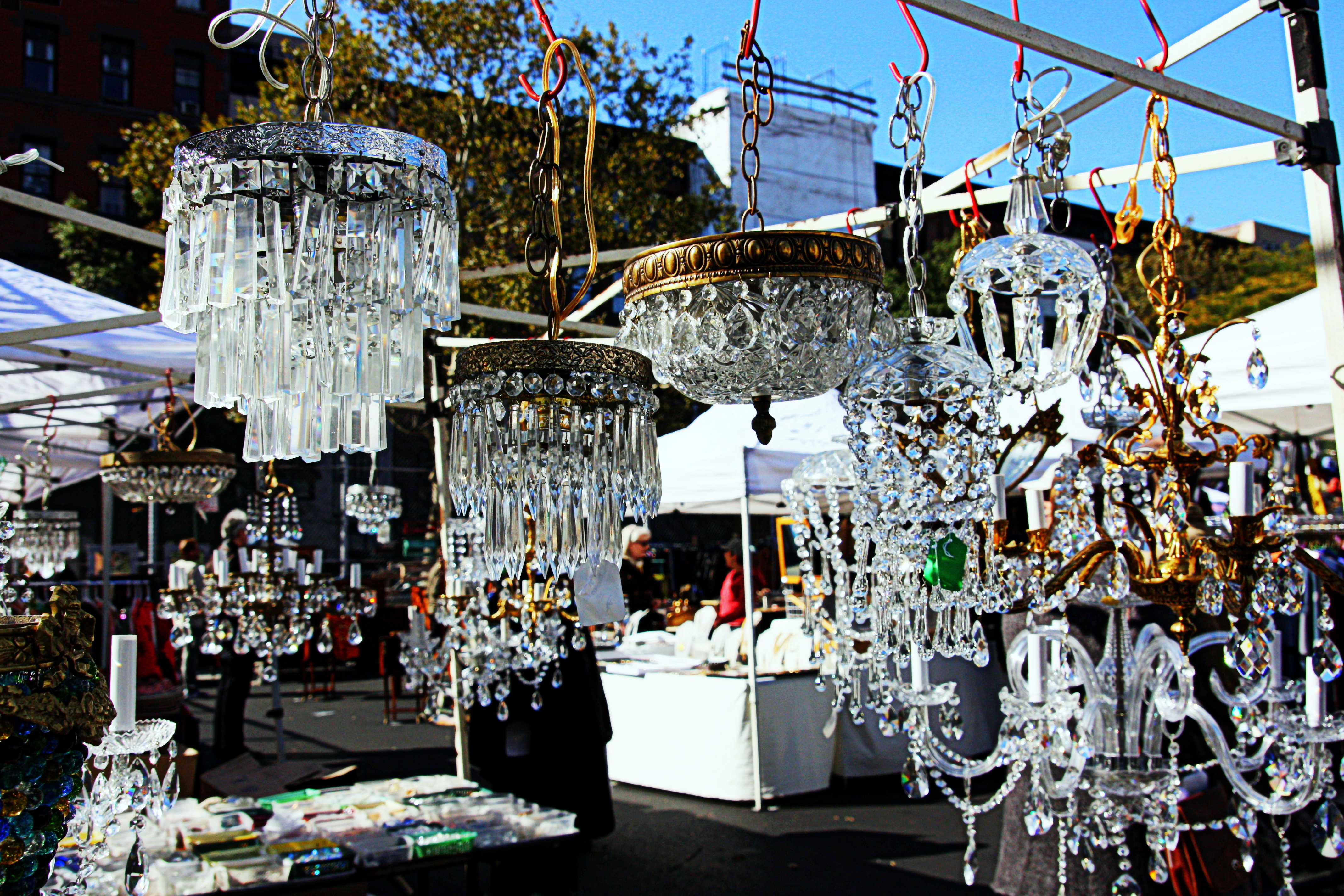
On my recent trip to New York City, I was reminded of Pollyanna. I visited the chandelier stall of Montenegrin-born Ljatif Mecikukic at the Greenflea market on Columbus Avenue. This stall is one which I have visited on all three of my visits to New York. Previously I have photographed its sun-splitting glinting crystal prettiness, but this time I also brought home a little ring of Pollyanna-style prisms, my own rainbow-making iridescence-radiating magic, stashed in my suitcase. A little Spanish chandelier from the Upper West Side:

prismatic chandelier

prismatic chandelier

Tomorrow is Thanksgiving in the USA. As I, across the world, watch the light dance through my NYC prisms, I am contemplating Pollyanna’s ‘glad game’. My gratitude list includes:

  • Incredible support from those around me, which allows me to enjoy the multiplicity of roles and joys I have chosen: as parent, educator, PhD candidate, wife, daughter, sister, friend, adventuress, flâneuse, rainbow-seeker.
  • Being celebrated for being myself by family, friends, colleagues and PLN, no matter how random, left-of-centre or nerdy that is.
  • Being supported in my always-learning always-living, by my family, critical friends, affirming friends, PhD supervisors and online PLN.
  • Opportunities for professional and personal adventures, including macro ones like international travel, and micro ones like waterfall-clambering with my children.
  • Immersion in the power of storytelling: through reading the stories – real and imagined – of others, and through my own narrative research, my work as an English and Literature teacher and this blog. It’s an honour and a privilege to hear others’ stories.

Most of us don’t live in a naïve state of perpetual optimism, and there are circumstances and life events which make being glad, thankful or grateful, very challenging. Hopefully by looking for the good in situations (and in people), and by being present in our daily lives and conversations, we can connect for long enough to feel delight, awe and wonderment (thank you, Costa and Kallick). We can be the prisms which help others see beauty in life, themselves and others.

Broome beach

Broome beach, a place for reflection, wonder, delight & sand between toes

Kaleidoscope selves: find your tribe

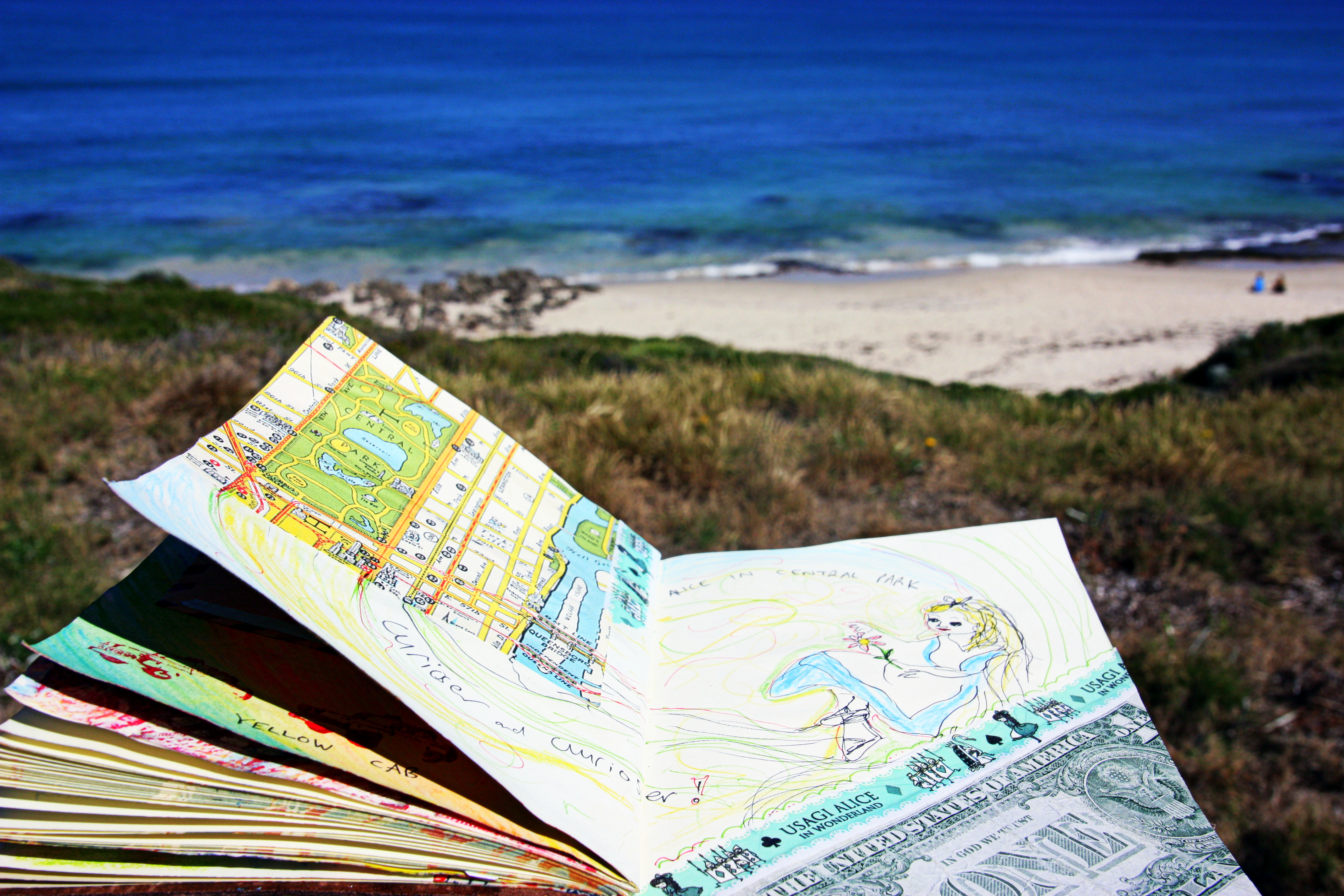
art journal page: Alice in Central Park

art journal page: Alice in Central Park

Who in the world am I? Ah, that’s the great puzzle. ~ Alice, Lewis Carroll’s Alice’s Adventures in Wonderland

José de Creeft’s Alice in Wonderland bronze statue glimmers in Central Park, polished by children’s climbing hands. Alice, of Wonderland fame, is a character who resonates with me. She is ingrained enough in my thinking that she makes more than a passing appearance in my PhD thesis. What I love about Alice is that she is open to new places and perspectives. She is curious, receptive and constantly wondering. She thrives on meeting new creatures and on having unusual, wondrous experiences. She is the imaginative adventuress who at once embodies childhood awe, strong self-assurance, rationality and fear-conquering daring. In many ways she is a flâneuse of Wonderland: wanderer, wonderer, learner and observer.

The question of self is not straightforward. Various aspects of our tangled selves collide and interlock. Or perhaps, rather than tangled webs of gossamer self-threads, we are each kaleidoscopes of self. Forged from a range of asymmetrical elements, we form the spectacularity of the beautiful changeable selves we are when viewed together through a cylinder of mirrors and light.

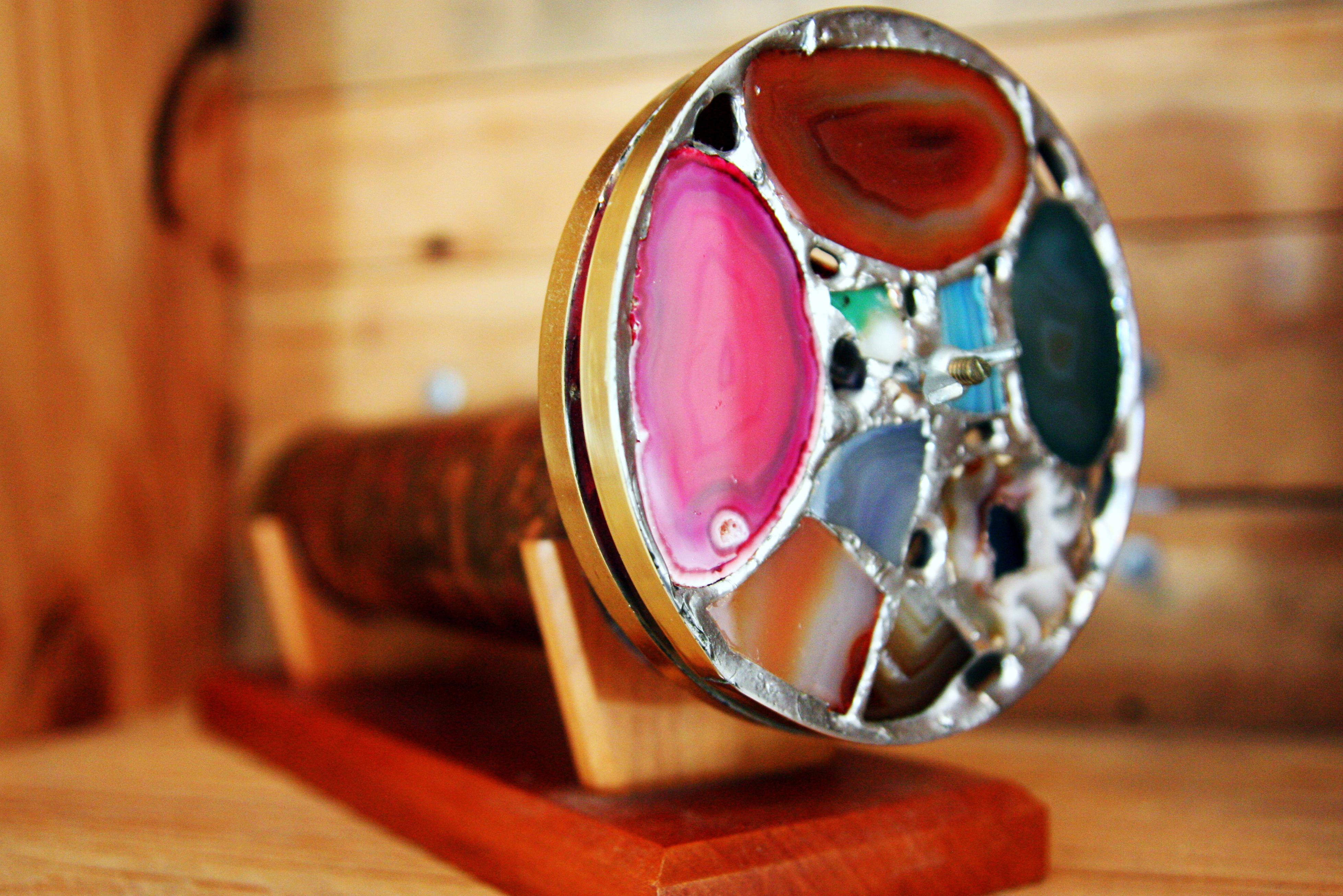
my precious stone kaleidoscope

my bronze-cylindered Arcana kaleidoscope has wheels made of glass and semi-precious stones: this one is by Australian artists Robert Cook & Jocelyn Teh

My kaleidoscopic self is made up of a number of different selves which my @debsnet Twitter bio attempts to unify:

Wanderer. Wonderer. Dreamer. Reader. Writer. Creator. Educator. PhD researcher. Passionista. Disruptor. Imaginer. Innovator. Flâneuse.

Not included are other personal selves like parent, spouse, child, sibling, friend. There are many contexts in which I share all or some of these self aspects. As the kaleidoscope turns and the light changes, people see different patterns reflected from me.

patterns as seen through my kaleidoscope

mandala-like patterns as seen through my kaleidoscope

My self-threads splinter, intertwine and blossom, as they do through the kaleidoscope viewing hole.

As I reflected in a previous post, connecting with other educators is for me about being my learner self. Connecting and collaborating widens and globalises my perspectives, while encouraging my own thinking and reflection (see Tom Whitby’s recent post about the relationship between connection and reflection). My teacher self is informed daily by my experiences as a parent, my own learning as a PhD candidate and my online participation. My Twitter interactions are influenced by my daily experiences of parenting, researching and working in a school. My parenting is influenced by my teacherly and researcherly thinking about learning and development. My PhD research self interacts with other researchers on social media as well as being informed by my in-practice educator immersion in my academic topic of study. My PhD itself incorporates me as learner, educator, writer, reader, creator and self-conscious researcher. And here on this blog my posts tangle together the threads of my learner, teacher, researcher, parent, writer and artist selves.

A dear friend of mine recently sent me this quote which I’m sure resonates with many of us:

When you find people who not only tolerate your quirks but celebrate them with cries of ‘Me too!’  be sure to cherish them. Because those weirdos are your tribe.  ~ Nanea Hoffman

It strikes me that many of those with whom I connect, in life, in education, in research and in my online PLN, are those whose quirks are similar to mine. Their kaleidoscope colours reach out to me across time, space, geography and social media.

I was recently involved in a Twitter chat with a number of educators. A few people in the chat began talking about being proud to be dorky, to be okay with failure and to constantly be learning. When I tweeted back ‘yes – fellow geeks unite!’ there was a chorus of ‘amen’ and ‘ditto’. I felt like I’d been high fived over Twitter. Here were my fellow weirdos, people who I’ve never met, connecting with me from across the world. “Yes,” they were saying, “In this moment, I get you and you get me.”

Next week I fly to New York to connect in a very real and immersive way with fellow educators, researchers and thinkers who will widen my perspectives. Perhaps I will widen theirs by sharing my Australian story. As this blog attests, I am hoping that my trip will allow my total and joyful submersion in all my aspects of selfhood. I will be thinking, writing, note taking, photographing, drawing and flâné-ing my way to new connections, new reflections and new perspectives.

The word kaleidoscope comes from the Greek words kalos, eidos and skopeō which essentially translate together into ‘beautiful form to observe’. Here’s to finding the beauty in others’ idiosyncrasies and to each of us finding our quirky global tribe.

find wonder, find perspective

The flâneuse’s packing list: a toolkit for observation & exploration

A dominant impulse on encountering beauty is the desire to hold onto it, to possess it and give it weight in our lives. There is an urge to say, ‘I was here, I saw this and it mattered to me.’ ~ Alain de Botton

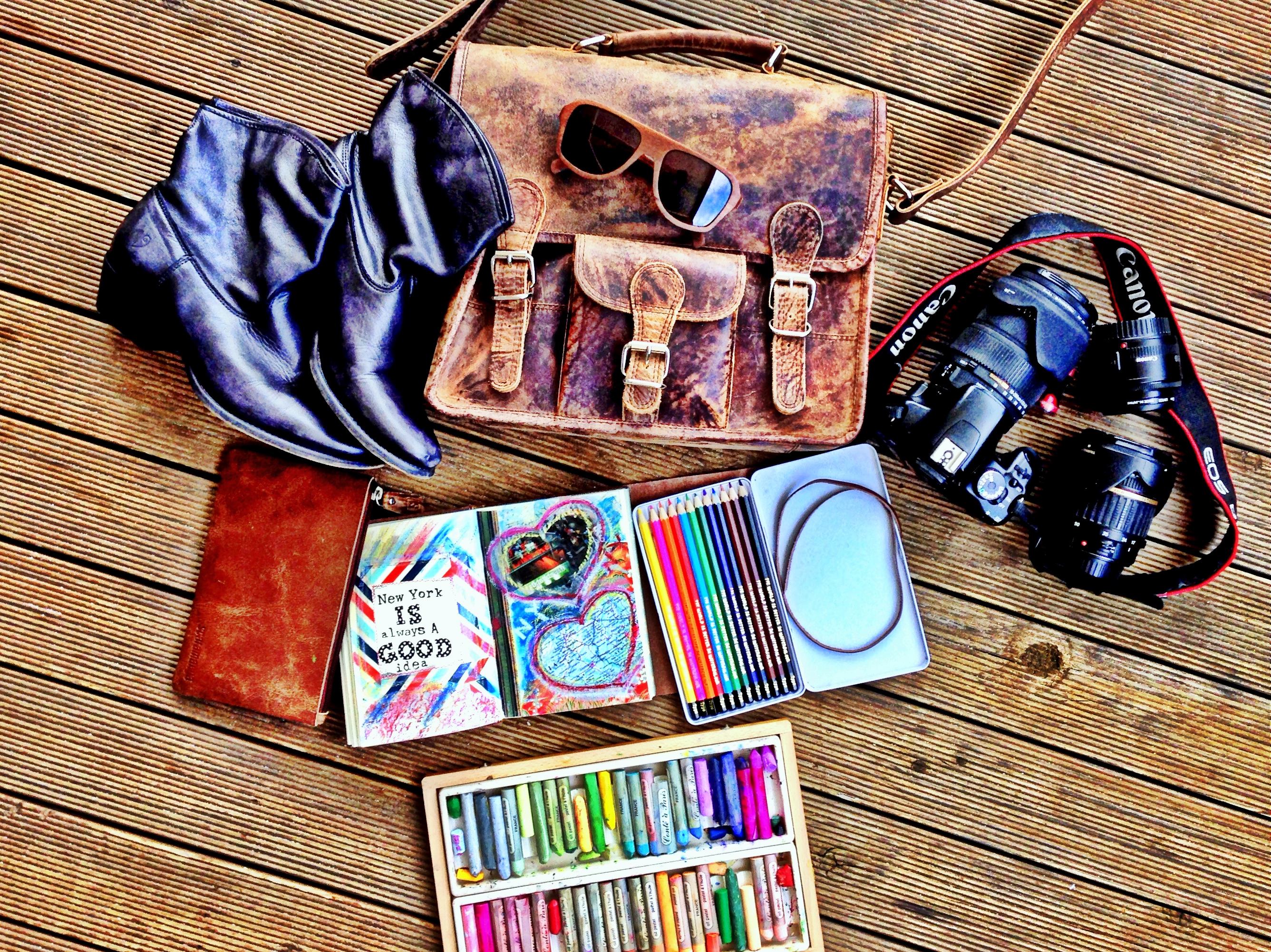
some of my favourite flânerial things

some of my favourite flânerial things

Flânerie has been described as “gastronomy of the eye” (Honoré de Balzac) and a moving and passionate photograph (Victor Fournel). It is an active and deliberate way of understanding the world. Baudelaire described the flâneur as the passionate observer, responsive spectator, reflective mirror and lover of life. Flânerie is all about acute, intentional and subtle observation. Baudelaire’s flâneur exists “incognito”, surreptitiously rejoicing in the magic all around him, at home among the unfamiliar, finding joy in urban exploration.

As I plan for my week in New York and my packing list, I’m asking myself: What does the keen observer need to assist them with attentiveness to their environment and experiences? How does an édu flâneuse attempt to capture the kaleidoscopic phantasmagoria of experience and learning?

Here are some of the things on my flânerial packing list.

art journaling supplies

art journaling supplies

A journal. Journaling is thinking and therapy. Cavallini & Co’s Roma Lussa is my canvas of choice, a beautiful soft-Florentine-leather-bound journal with marble page-edges. For taking flânerie old school. With pen. Paper. Even the trusty Conté à Paris crayons I still have from art school. As my Typo watercolour pencils declare: the world is better in watercolour … and charcoal, and crayon, and paint!

camera gear

camera gear

Cameras & accoutrements. The flâneuse needs a variety of lenses through which to frame and record experiences. I am taking my Canon DSLR and lenses, as well as my iPhone and olloclip lenses to allow for snapping on the go.

A laptop. For writing, blogging and editing photos. Of course this can be done on an iPad (which is much more portable) but I prefer typing to tapping and the extra control and diversity my laptop provides.

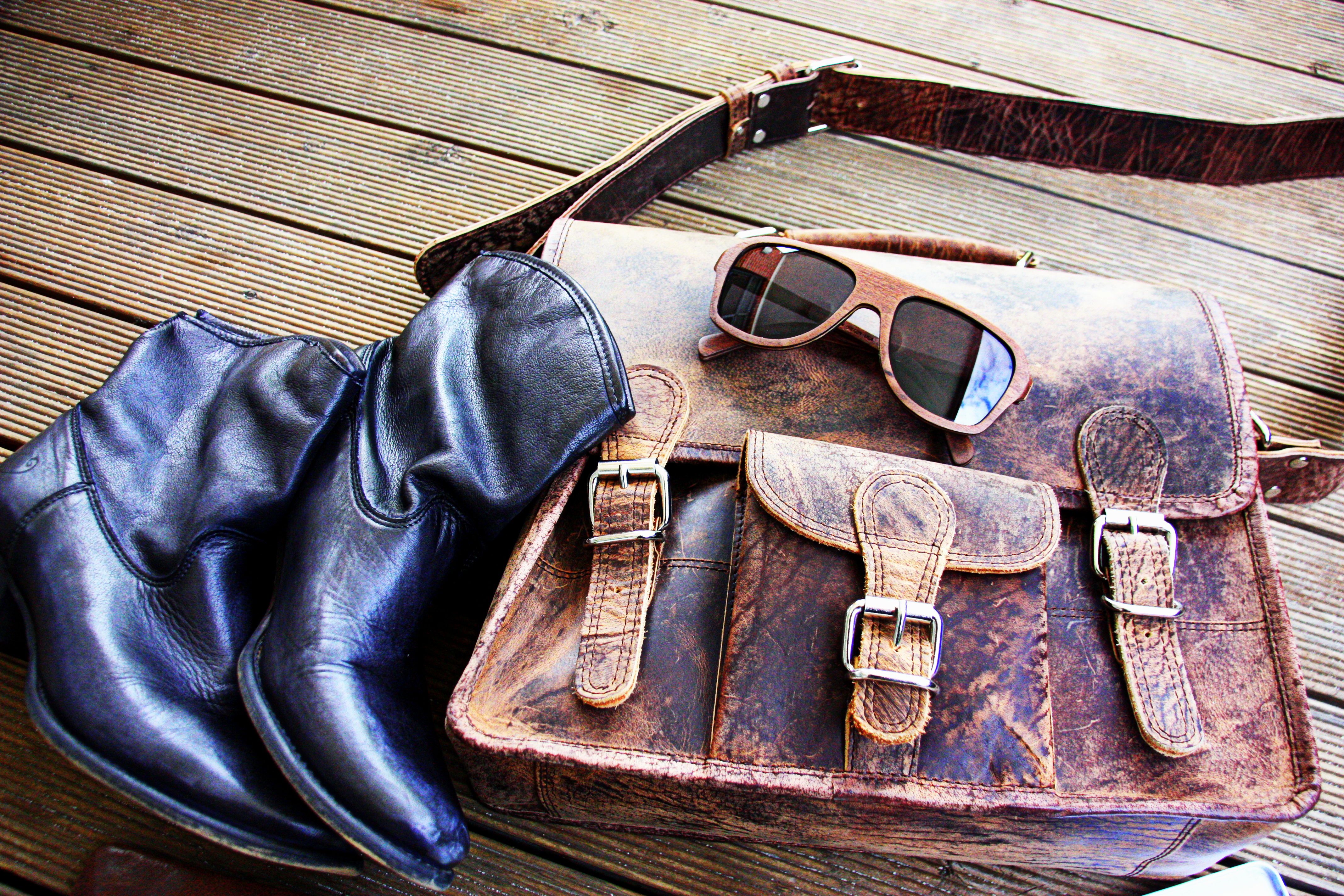
flânerial fashion

flânerial fashion

Flânerial fashion. Exploring shoes. Eco sunglasses. Leather satchel big enough to carry laptop and/or camera and/or journal. The 19th century flâneur was always bedecked in attire appropriate for urban exploration. With style.

(Pictured above are my handmade Portugese Felmini ankle boots, Scaramanga leather satchel and Shwood wooden sunglasses.)

So there you have it: my flâneuse’s toolkit, ready for taking artiness on the road to observe, explore, jot, snap, scribble and sketch.

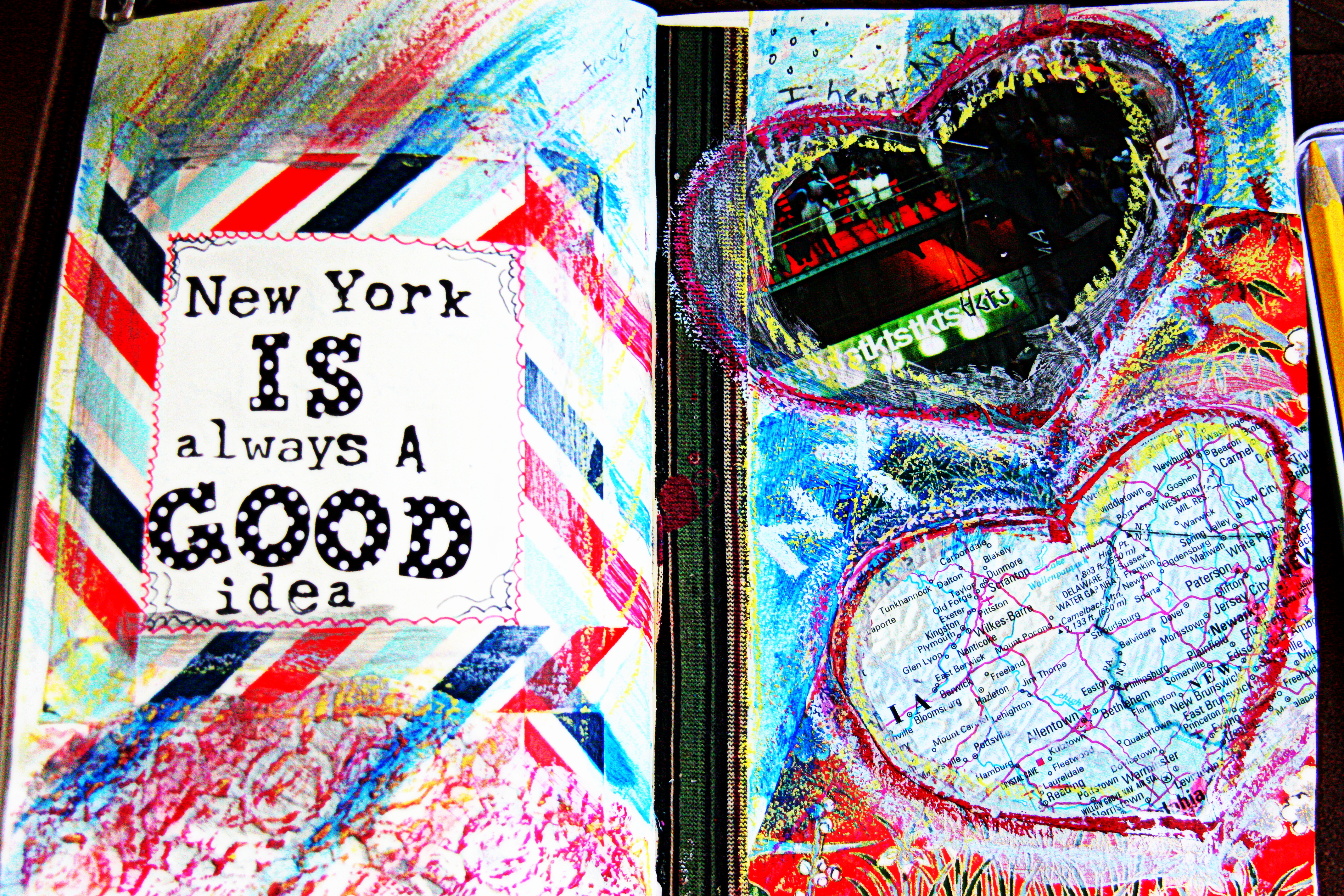
art journal page: New York is always a good idea

A life lived learning: a tribute to my grandfather

I have always imagined that paradise will be a kind of library. ~ Jorge Luis Borges

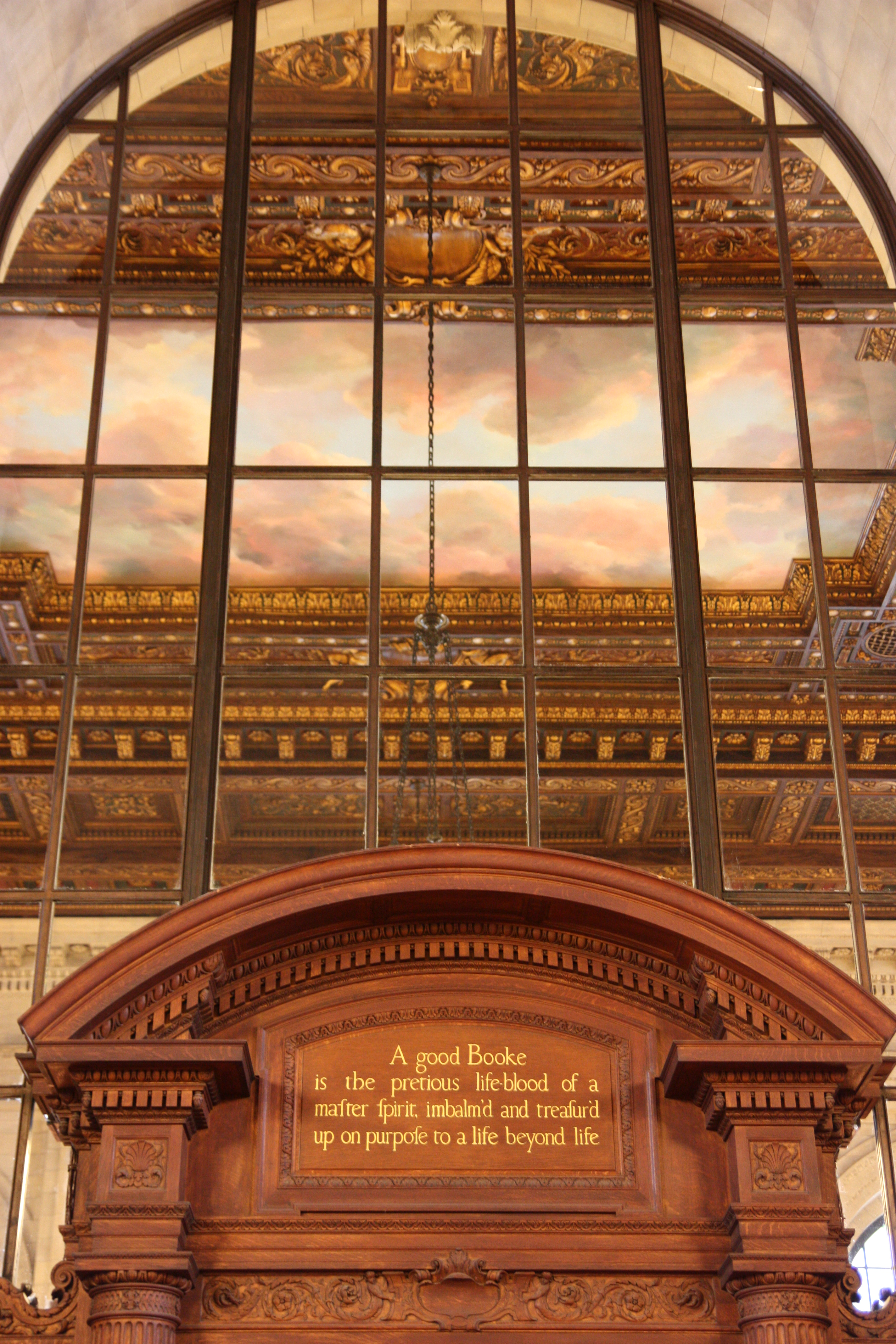
New York Public Library by @debsnet

New York Public Library ~ ‘A good Booke is the precious life-blood of a master spirit, imbalm’d and treasur’d up on purpose to a life beyond life.’

In education, we talk a lot about lifelong learning, and about how to inspire in our students (or perhaps preserve in our children) curiosity, passion and the desire to know, to discover, to push at boundaries. To be continuous creators, thinkers, questioners and enactors of their thinking and beliefs.

As an English and Literature teacher, and lifelong reader, who grew up surrounded by books, the physical book is for me a symbol of self-directed, voluntary learning. As a girl I was able to peruse bookshelves throughout my childhood home and pull books from the shelves, at will, to read and re-read. These books were not vetted for age-appropriateness but were a range of children’s books, novels, classics and encyclopaedias to which I had unfettered access.

Other vivid memories are of being in the study of my grandfather, who was a collector and binder of rare and beautiful books. His study was wall-to-wall floor-to-ceiling wooden bookcases, saturated with the overwhelming smell of old paper, worn leather and decaying adhesives. It was a paradise for the book lover!

Overnight my grandfather quietly passed away in his bed, at ninety years of age, his spectacles on and a book in his hand. He was a Doctor of Philosophy, a scientist, a professor, a poet and a thinker, who was reading and writing narratives, scientific writing and verse until his last breath. He was the epitome of a lifelong learner, a deliberate scientific questioner of knowledge and someone always willing to engage in hefty intellectual debate. Only yesterday he and I were discussing strategies for academic, thesis and poetry writing.

I discovered today that my grandfather has left me two of his prized books: an early copy of Sir Walter Raleigh’s History of the World and an antique Chinese text which is a concertina series of Chinese customs, paired with hand painted calligraphy scenes, and bound between curved carved wooden covers. Both are books I remember connecting with the first time he gingerly passed them into my hands in his study. I remember feeling their weight (the Raleigh is heavy!), fingering the irregular textures, and smelling that old book smell (read more about the science of that here in Jessica Leber’s Fast Company post) as I sank into the cocoon of his old chair.

Books by @debsnet  IMG_1399

Raleigh Collage by @debsnet

As well as being objects that I will cherish, these books are symbolic for me of a life lived learning, something I aspire to, and to which I hope my students and my children will aspire.

Travel anticipation makes the journey last longer

Most travel is best of all in the anticipation or the remembering; the reality has more to do with losing your luggage. ~ Regina Nadelson

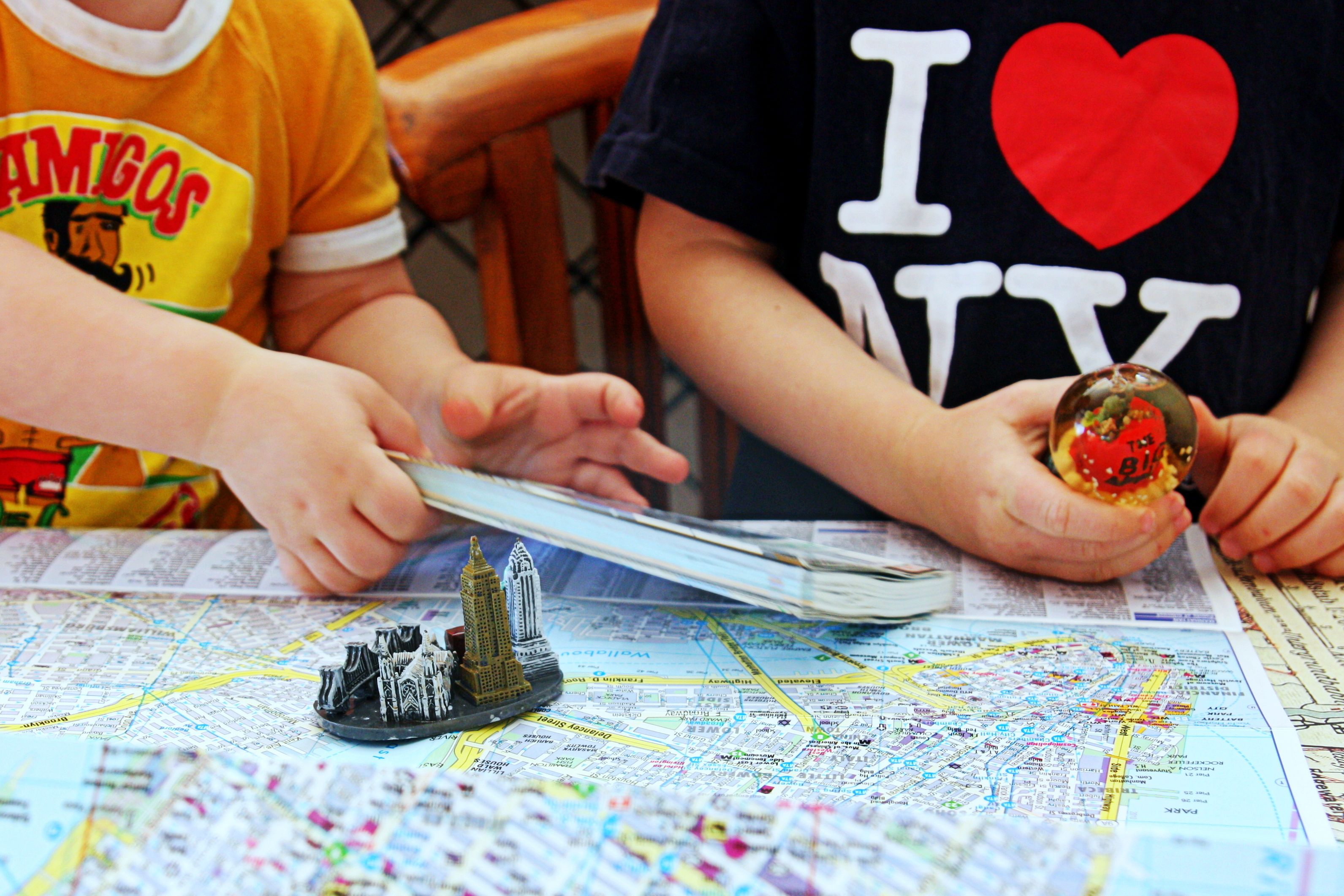
BoysPlanningNYC

Mr 2 and Mr 4 are happily helping me plan my NYC itinerary.

Map Collage by @debsnet https://theeduflaneuse.wordpress.com/

We have a huge family world map with colour coded stickers which record our travels, but New York City guides might be their new bedtime stories.