For the love of books: On the tactile PhD thesis

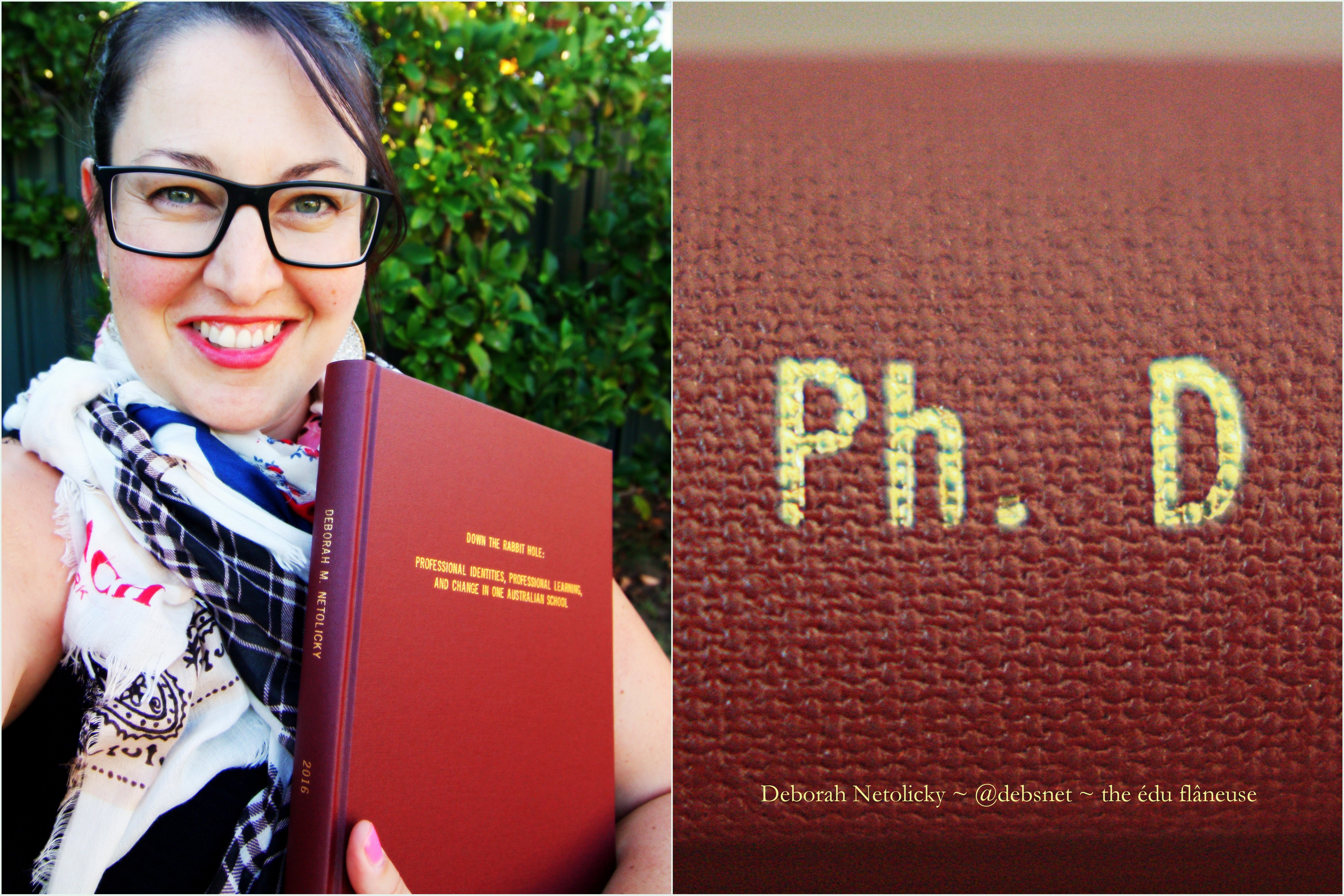
the shameless joy of the thesis selfie & those three little letters emblazoned in gold

the shameless joy of the thesis selfie & those three little letters emblazoned in gold

Having books bound signifies respect for the book; it indicates that people not only love to read, but they view it an important occupation. ~ Fyodor Dostoyevsky, Demons

The chemical breakdown of the smell of books was the subject of a 2009 study (downloadable here and nicely summarised here), but those smells are about more than science. They are about emotions and memories. Libraries. Being read to snuggled in beds. Reading alone in beanbags, on sunny window ledges or in hidden cubbies or corners. Dragons and sleuths and science and fantasy. Escape into other worlds and other lives. Empathy, fear, disgust, happiness, tears. The pads of fingers on pages. The whoosh of the page turning. The thud of a closing book. The grief when a trilogy or series ends.

I’ve written before about the memories of my grandfather’s study, filled as it was with old books, including the two prized books he left to me. My grandfather wasn’t a Ron Burgundy kind of man, but he did have many leather bound books. He was an academic, a professor and a book binder. (He also made those little wooden ships and magically placed them inside bottles.) The smell of old books–which is described here by Deepak Mehta as bibliochor, inspired by the word petrichor–takes me back to sitting in the cushiony chair in that study, having books gingerly passed into my hands. Feeling their physical and symbolic weight. He didn’t live long enough to see me finish my PhD and share my own Big Book with him, but I was lucky enough to be able to share the first part of my PhD journey with him.

This week I was full of nerdy book-loving joy when I picked up the hard bound copies of my PhD thesis. I’m an English and Literature teacher, reader, bibliophagist, smeller of books, narrative researcher and writer of texts. So it stands to reason that I would be obsessively perfectionist about the physical thesis book (totally reasonable, right?). I agonised over font, paper and end papers.

What’s in a font? That which we write in Helvetica by any other font would read as sweetly.

I always envisaged my thesis volume as channelling the old storybooks and encyclopaedias (remember those?) of my childhood. My selection of the font Garamond acknowledges that serif fonts are more readable, while visually referencing the traditional old-style serif typefaces of literary fiction. Garamond is a sixteenth century French artisanal font based on the work of Claude Garamond, and it is lovely in italics. It was a more beautiful option that the conventional Times New Roman. Apparently TNR is mandated in some institutions but as its inception was to squeeze the most text into the columns of The Times, it’s a bit squishy and a bit ubiquitous.

If you are thinking about thesis fonts, check out Anitra Not’s wonderful Slideshare on how to make a beautiful thesis. There should be a word for ‘the joy brought by beautiful typeface’. I don’t think that thinking about the beauty and readability of your thesis is total phdcrastination; there’s some method in wanting to present your work in a way that resonates with its purpose.

O, feel of paper and smell of page!

While my university prints theses on heavier-than-usual copy paper, I ended up researching papers on which I might print the thesis. I eventually settled on an archival paper watermarked with the National Archives of Australia registered trademark. It was cream rather than white and a bit textural rather than super-smooth. I tested the paper for its ability to handle the illustrations in my thesis and printed double-sided, to keep the thickness down and save some paper, rather than for aesthetics (there was a bit of show-through).

I also bought some white Japanese Unryushi paper to act as endpapers after I discovered that getting marbled endpapers in Australia is prohibitively difficult (my granddad would have known where and how to get some).
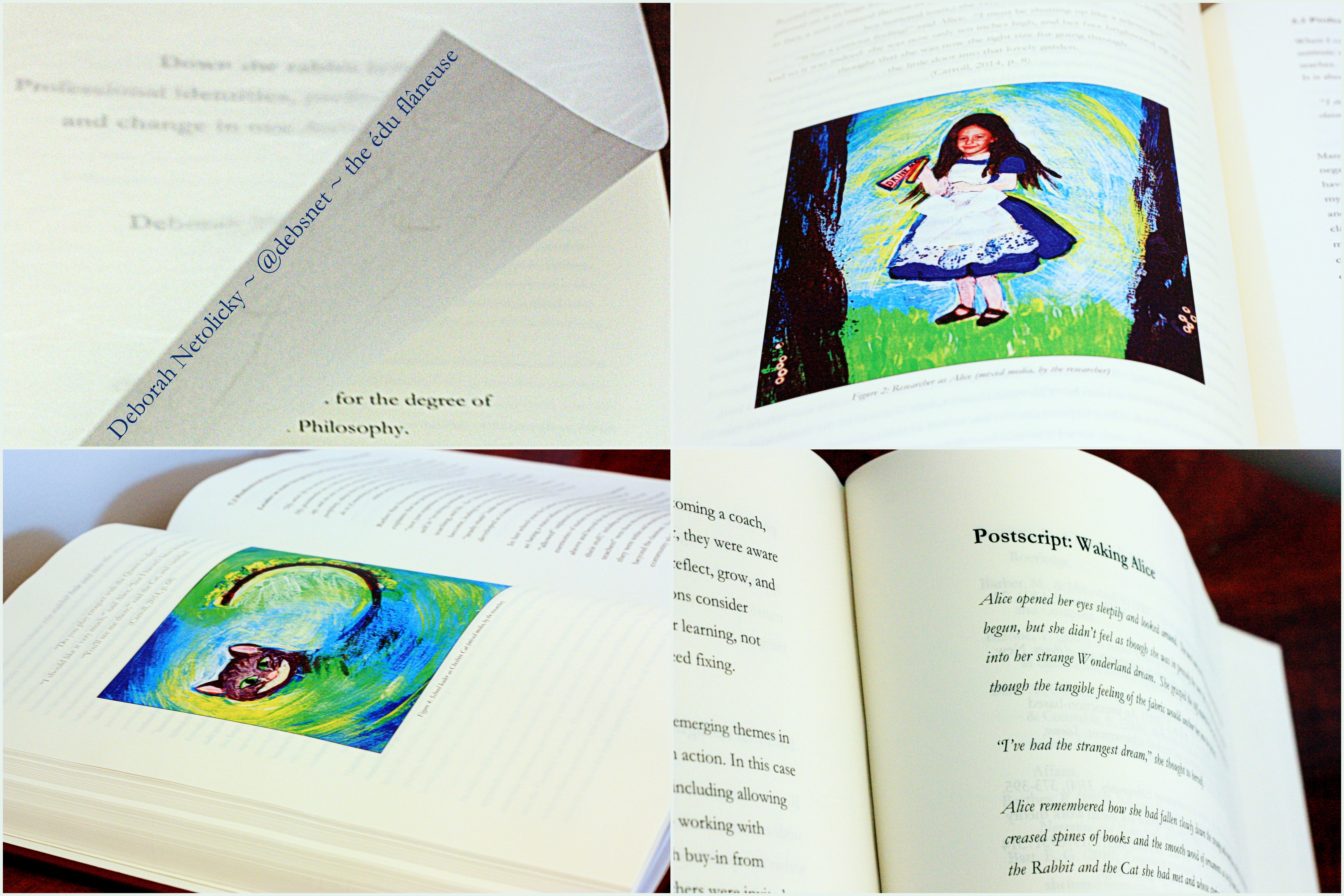
thesis pages

thesis pages

Bound pages nestled within the regal carapace

To bind a doctoral dissertation is not just to join pages prosaically together into a document. There are medieval bookbinding traditions and regal colours. In Australia there isn’t really a choice in the actual binding as each university tends to have theses bound by a particular book binder, to particular specifications. The traditional binding is in buckram cloth with gold lettering. Each university has different colours associated with each degree. At my university, the PhD thesis is bound in maroon, so maroon it was. The nice thing about that was that on the day I picked up my pile of five theses (one for the university library, one for each supervisor, one for the school at which I conducted my study and one for me) people congratulated me as I walked through the grounds. “Well done!” “Congratulations!”
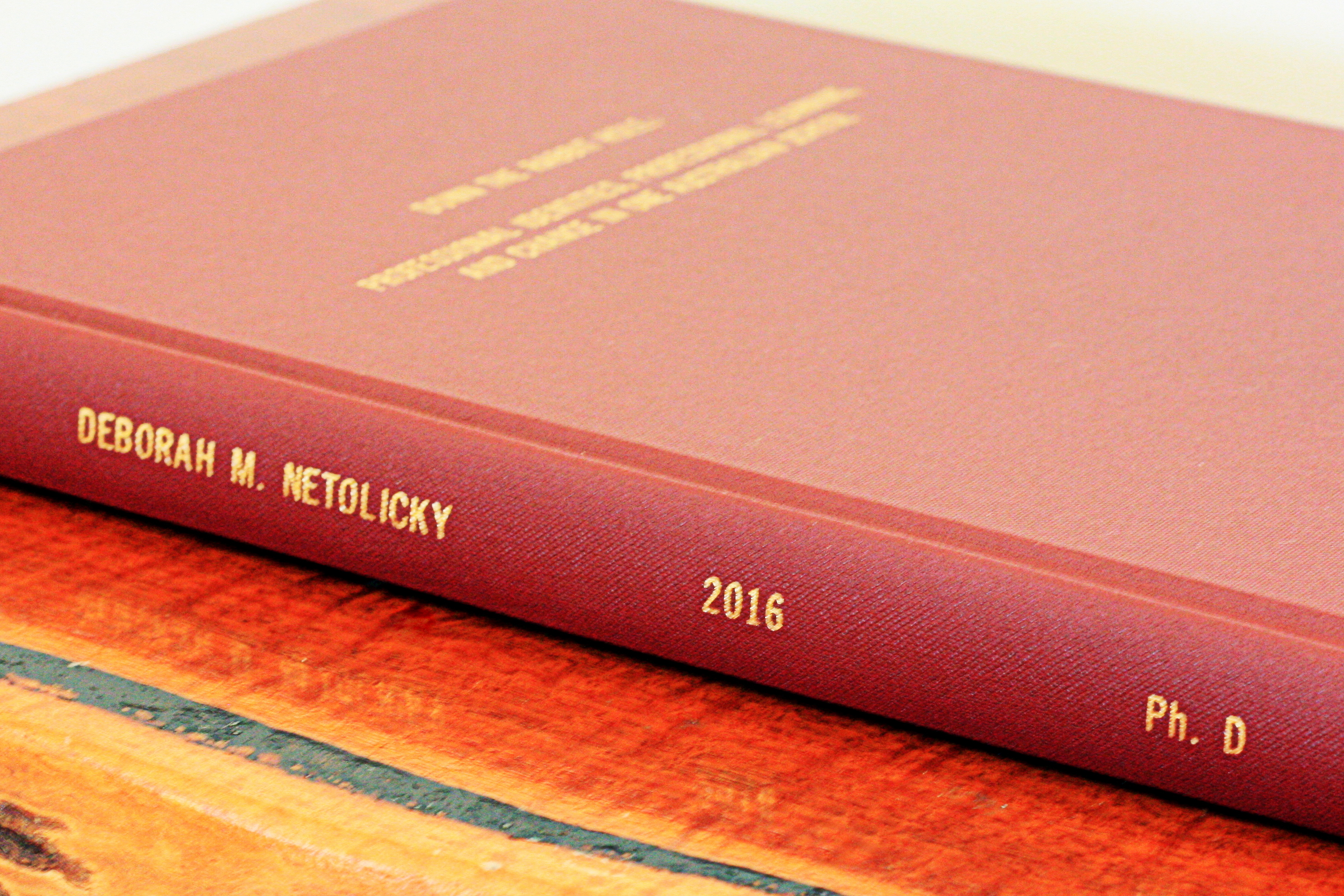
The Big Book

The Big Book

Of course, none of this matters in the big picture. A font does not make or break the substance of a thesis. A bound thesis needs to meet its university library’s specifications, but no more than that. I know that my thesis could have been printed in Arial or Times New Roman, on ordinary copy paper, and it would have been of the same written quality. Now that most theses will be read online, the archival quality of the thesis makes even less difference than in the past.

Yet, my own love of books and their tactile, olfactory and objet d’ art properties meant that I put a lot of cognitive and emotive energy into the physical book. And I took a lot of joy from experiencing the finished product. It might have been my favourite PhD moment so far. If you’re like me, go ahead and embrace your inner book nerd.

It’s ok to be a book-perfectionist. It’s ok to love your finished thesis, imperfect as it might be. Think of it as a handmade quilt, full of the humanness of your mark. For me the choice of font, slightly textural end papers and creamy archival paper were about valuing the text and helping my reader enter the narrative of my thesis, which uses Alice’s Adventures in Wonderland as a literary lens. The tactile experience of turning those first pages might help them down the rabbit hole of the text and into the world of story, into the study and back to their childhood memories of reading.

bookish gifts for my supervisors

bookish gifts for my supervisors
Diary of a PhD completion: All the feels

The thane of Cawdor lives. Why do you dress me In borrowed robes? ~ Shakespeare’s Macbeth

In my last post, I described how I felt once I knew that my thesis amendments had been approved by my supervisors. I really didn’t think that this very pointy end of the PhD would be complex. Surely there would be a quiet moment of joy followed by the pop of a champagne cork. Well, I was right about the champagne, but the last week has been more of a rollercoaster than I imagined. It turns out that finishing a doctorate is wound up in some messy identity-entangled feelings. Below, I try to give a sense of what that looked and felt like for me.

My week’s diary of PhD completion went something like this.

Friday: Supervisors sign off on the amended thesis. Form goes to the Dean for university sign off. Elation. Excitement. Light can be seen at the end of the tunnel. Hugs. Champagne. I tell my kids. My 5 year old shouts “Wooohooo! No more PhD!” I remember that I’ve been doing this most of their lives (they were 6 months and 2 years old when I started; now they are 4 and 5).

Saturday and Sunday: Checking and re-checking the thesis, especially the amendments. I fully proof the first and last chapters, line by line, punctuation mark by punctuation mark. Obsess over commas and hyphens, or the lack of commas and hyphens. Wonder why I’m so unable to let go of a document which I’ve been told is done. My husband takes me to lunch on the coast on a glorious day. I drink a bellini. We cheers to the thesis being done.

Monday: Dean signs off on my thesis. It’s through. Accepted. Officially done. I jump up and down. Whooping. Air-punching. Triumph.

Tuesday: I’m still tinkering with the already-approved thesis. I’m haunted by nightmares and daydreams of mistakes existing somewhere in the 300 page document despite it being checked by me, two supervisors and three examiners. Impossible obsession with checking over and over. And over. I keep reminding myself the thesis has been signed off. It is considered doctorate worthy. I save the document as a pdf to stop myself from my compulsive tinkering. I sneak another peek. Ok, maybe more than one.

Wednesday: Wake with a cracking headache, knowing that today is the day I print the final final final copies for permanent binding (buckram cloth! gold letters!). One of which will live on the library shelf (maybe never to be opened). Anxiety builds as I worry that this final copy means there can be no more tinkering. I am overwhelmed by the pressure of printing the tangible final pages. It’s a relinquishing of control. If there are errors, they will be inked there for eternity. I feel increasingly ill as I print and check the final copies of my thesis. I take the box of printed pages in to university and submit them to the library to be sent for final binding. I drive to pick up sick child from school; no time to savour the moment. I upload the thesis document to the university library. Fall into a heap of exhaustion and hollowness. It’s the thesis finishing comedown, an emotional and energetic crumbling, a descent into the post-thesis abyss. I tweet my feelings of emptiness and strangeness. Responses come: yes, the mourning, the crash, the void. Others have felt this, too. I head out for dinner and champagne. Company helps and I’m reminded that – without lab partners, a writing group or colleagues at the university – my journey is mostly in my head. I’ve been the working mama who comes and goes from uni in a blinding flash, working mostly alone, often in the night. It’s good to be out, and to talk about it. And to talk about other things to forget about it.

Thursday: I get word that my thesis is online. There it is, a citation with my name on it, and a downloadable document. My thesis title in black and white. My words out of my head and into the world. My work now in the public realm. Elation again. Pride. And then the crack of the Imposter Syndrome whip. I hadn’t felt it until now. I was perfectly comfortable being a PhD candidate. An eager student. A work in progress. Of course I am still a neophyte. A partially-formed apprentice scholar. I realise I’m almost doctored, but feel unworthy of the title. I know I’ve worked hard for this. My family has both sacrificed and benefited from my doing the PhD; we’ve lived it. I know I’ve walked the path that leads to the ‘Dr’ and the medieval flourish of the Tudor bonnet. Yet I hear Macbeth’s line in my head “Why do you dress me in borrowed robes?” My sense of identity hasn’t caught up with the reality of finishing the PhD. My new almost-doctor-ness feels ill-fitting. My neverending PhD story is coming to an end. Or is that a beginning? When I started the doctorate I saw its completion as the pinnacle. Now I realise it’s entry level.

Friday: I notice missing Oxford commas in the text. I begin to think about the work I’ve now projected out into the world. I remember how non-traditional my thesis is. That it was risky. That some might be inspired by my novel approach and others bemused or horrified. I reflect on how I have attempted to push at the boundaries of what an acceptable thesis is. I’ve worked within the accepted parameters of a thesis (introduction, literature, method, results, discussion; some use of the distant academic voice). But I’ve also challenged the traditional thesis genre by embracing creativity, shifting voices, and a literary lens as a way to make meaning. I wonder how my attempt to create a text which compels and propels the reader will be received now that it lives outside of my laptop and my head. I’m comforted by accepted journal articles and conference papers which affirm that my work fits somewhere. I breathe.

The ride continues. Maybe soon, I’ll grow into the robes.

all the feels means all the bubbles

all the feels means all the bubbles

How it feels to finish – really finish – a PhD thesis

No book can ever be finished. While working on it we learn just enough to find it immature the moment we turn away from it. ~ Karl Popper

Yesterday, I watched my supervisors sign the form which declares that I have completed my thesis revisions and adequately addressed the examiners’ reports. In fact, my amendments go over and above those required by the examiners. I’ve taken on plenty of non-compulsory feedback and done some extra editing, so that (as Mullins and Kiley, 2002, put it) my thesis will ‘glow more brightly’ on the library shelf (or online repository).

The reason I’ve been revising more than necessary is that while the thesis is still in my hands and control, my perfectionism has been running rampant. I’ve been waking in the night thinking about the minutest of textual details and having night terrors of opening a freshly bound copy to a jarring typographical error. I’ve been proofing chapters line by line, unable to limit myself to addressing the recommended amendments. But finally, it seems, the thesis is done. Soon I will be notified that I can print the final copies for permanent binding. You know, the glorious ones with buckram covers and golden lettering.

After my final supervision meeting, in which the thesis was finished and signed off on, I tweeted out that I felt somewhere between these images …

Jay Gatsby & Frodo Baggins as metaphors for doctoral completion

Jay Gatsby & Frodo Baggins as metaphors for doctoral completion

Jay Gatsby is an interesting analogy for someone at the end of the doctoral journey. Perhaps there’s a celebratory note, glorification of the doctorate, the pursuit of greatness, party-like excitement, or even a smugness to completing the PhD. But Gatsby was the ultimate imposter who re-invented his identity. He pursued an outward appearance that belied his own past and insecurities. Imposter syndrome can encroach into the nearly-doctored or newly-doctored persona. Do I deserve this? Do others know my limitations? Was my dissertation really enough to warrant a PhD? Am I worthy of the title ‘Dr’?

Frodo Baggins can also provide a lens for reflection on finishing the thesis. In some ways the PhD can seem like the quest to return the ring to the fires of Mordor. Frodo Baggins, as the ring-bearer tasked with a seemingly impossible mission, is central to the job. He emerges emotional, exhausted and battle weary. But it’s the multi-membered fellowship, and additional others supporting them, which work together for ultimate success. Luck and coincidence play a part, too. And persistence. Frodo doesn’t have magical powers or super strength or skill. He is ordinary. But he has persistence, grit, stick-to-it-iveness. In the PhD, the doctoral researcher is central to the successful completion of the task. They need to work through challenges, persist despite being knocked down, move onwards even when hitting a dead end or sinking into a swamp. But they cannot do it alone. Supervisors, family, friends and others are critical to completion.

Additionally, at the Crack of Doom Frodo struggles to release the ring. He has become attached to it. So while his friends fight armies of evil, he stands at the precipice of the end of his quest, above the fires of Mount Doom, unable to let go of the thing which he has carried, like an ever-heavier burden, for so long. Of course not all doctorates feel like a burden. One can love the PhD, but maybe even this fondness can have a Stockholm Syndrome type attachment; we learn to feel comfortable in capture. I feel a sadness that my PhD is coming to an end. It’s hard to let it go.

And when is a piece of writing finished? Ninna Meier recently explored the unfinishedness of writing, the layering of writerly thinking and identity, and the ways that reviewers and co-authors help to move a piece of writing forward. She talks about revisiting earlier writing and being appalled at its unfinishedness. How, she asks, could her past-writer-self have thought it was ok when her present-writer-self is surprised and horrified?

My thesis felt finished when I submitted it for examination, but after space and time away from it, along with the lens of examiners’ comments, I was able to see it as still requiring work. Now, after the amendments have been done, it has been signed off on as complete and worthy of the doctorate. No doubt, however, my future writer self will look back in surprise that I ever thought it was ok. I will see glaring naivety and cringe worthy phrasing. I can already see a (somewhat experimental and diversionary) paragraph which might well cause my future writer self to wince, but for now I’m attached to leaving it in.

Although the PhD can feel never ending, it does end. For me, the work is done. So, for now, while I wait for the wheel of academia to slowly turn, for university administration to do its administering, I wait, work, write papers, read trashy fiction. And drink champagne. I finally feel like I’ve hit a milestone worth stopping to celebrate, no matter what my future self might think. Next will come more steps: final printing, binding, the floppy velvet hat and the two letters in front of my name. Then achievement will really be unlocked.

The PhD as collaborative work not lone journey

light at the end of the tunnel

light at the end of the tunnel (taken with an iPhone & Olloclip in an old train tunnel)

though the road is rocky / sure feels good to me ~ Bob Marley

Sometimes my PhD has felt like a solitary slog, with long isolated times deep in the subterranean thesis cave. At times of intellectual and emotional struggle, the embers of self-belief and persistence can seem to be dying in the darkness and enormity of the work at hand. The sounds of keystrokes and the scratching of pen on paper echo through seemingly empty caverns. Hands knead and brows furrow in the silence. Fist-pump moments of success swirl in a vortex of separateness. The occasional tweet is sent out as a kind of SOS, with hashtags punctuating the despair or grim solitude; #amwriting #sendhelp #needcoffee #phdchat.

The feeling of isolation is partly why I am so grateful when anyone asks about my PhD. I know that others don’t like being asked about their progress on what is a long process seemingly without an end. But for me, “How’s it going?” becomes an invitation to bring my experiences out from inside my head and make them real through talk. Sharing with someone who seems interested is a relief. I am awash with gratefulness for those who have been willing to hear about my PhD work.

In fact the PhD is not a solo effort, but collaborative, work. It is shaped by personal and supervisory relationships, by reading, by feedback, and by the examination process. As I do my post-examination thesis revisions, I’m aware that the final document, while stamped with my name, only exists in its final form because of the fluid interactions, over years, with others.

I have been influenced by the words and work of scholars (there are 376 references in my reference list at last count). In this way, my work emerges out of, situates itself alongside, or reacts against, the work of others. Research is academic conversation.

I have read the blogged experiences of others and the advice of online academics, which have shaped my understanding of my own experiences. People I know through social media have shown support and engaged me in conversation.

My supervisors have read my work, given feedback, and coached me through challenges. My mum read my work, especially early on, and helped me to talk about and think through my ideas. My research proposal panel provided advice and feedback on the direction I intended to take. Editors and peer reviewers, from journals and conferences, have commented on the ways in which I have shared my doctoral work through the writing of academic papers. Conference goers have listened to me present and engaged me in conversation about my work, or asked questions which have helped me think it through. My examiners have provided feedback to which I am currently responding.

So whose work is the PhD? Mine, all mine? Not really. The words are those I have written but on which others have made comment. The sweat and tears on the page are mine, but informed and supported by the words and actions of others. A PhD thesis is indelibly shaped by webs of influence. As Pat Thomson points out, the PhD is not a wholly individualistic journey, but a social and relational one. Even a political one. Whose is the responsibility for a candidate’s progress, success or failure, and the quality of the final thesis?

As I finish up my post-examination amendments, I’m aware that the text I’m presenting to the world is what it is because of the messy web of influences on me, my work and my writing. The one page of acknowledgements seems to be hardly enough to communicate the social networked nature of a dissertation.


Doing PhD revisions: The last thesis embrace

Gustav Klimt's 'Der Kuss', 1908 http://www.klimt.com/en/gallery/women.html

Gustav Klimt’s ‘Der Kuss’, 1908 http://www.klimt.com/en/gallery/women.html

This week I received news that my PhD will be awarded, subject to changes to my thesis. Wahoo! What a relief after months of examination limbo.

The requirement to address examiner comments is interchangeably referred to as doing corrections, amendments or revisions to the thesis. The actual process from receiving the official letter and examiners’ reports goes like this at my Australian university. Under the direction of my supervisors, I am to address the recommendations suggested in the examiners’ reports. When my supervisors and I are happy that all comments have been considered and any relevant changes made, we can sign off that it’s been done. This needs to be documented in the kind of table sent to journal editors outlining recommendation, response, and any resulting change to the text. Our response to the examiners’ reports then goes to the Dean, for sign off at that level. Then I’ll be notified that I can print my thesis and lodge it at the library for binding (one for me, one for the university library, one for each of my supervisors, and any more I fancy). I also need to submit to the library a digital copy of the thesis for the online repository of university theses. At this point my degree can be tabled at the university’s appropriate council (when they next meet after all these steps) at which I will be conferred the degree: PhD me!

While it is tempting to feel like getting revisions recommended in the examiners’ reports is some kind of failure, I am grateful to my examiners for their advice. I thought I wanted the ‘Gold star! Perfect work! Here, have a PhD without as much as a corrected typo!’ response (hey, who wouldn’t?), but of course it turns out that drawing on the expertise of three experienced academics will help me to strengthen my work before it goes out into the world and onto the interweb plastered with my name.

Some examiner comments were glowing (yay!). Others confirmed what was original about my work (phew!). There were some comments which were a delight to read and a wonderful affirmation of my thinking, researching and writing. There were no referencing errors and only a couple of typos in the 300 odd pages, despite me choosing to edit the work myself rather than employ a copy editor to check it for me.

Some of the examiners’ comments pointed towards the need for me to clarify areas of the thesis. These comments showed me the importance of the first chapter in setting up the readers’ expectations for the thesis. My thesis takes a novel approach (no doubt not to everyone’s taste and probably unexpected to many thesis readers) so I am doing some work on the first page of the introduction and elsewhere to make my approach clear. I can see that I need to help the reader know what to expect – or as one examiner said, ‘pre-imagine’ – the journey on which my thesis will take them.

Other examiner comments were around the need to cite less and take on the role of expert more in my closing chapters. I have struggled with that before (you can read about it here and here) and it seems I can move my closing chapters more convincingly towards authority and, as one examiner put it, audaciousness. This is all part of the PhD as identity work; becoming a researcher, becoming a writer, becoming a scholar. This seems to me an ongoing process of self reimagining. As we rework our scholarly texts, we rewrite our scholarly identities. We write ourselves through our work. I write myself into being.

Thesis corrections are an exercise in considering feedback. It requires being open to seeing our work through others’ eyes and working to apply that understanding to strengthen the text, and to our writing of future academic texts. If someone has misunderstood something, how can I make it clearer? If someone has suggested a new direction or additional layer of analysis, how might I consider that for now, or for the future? If someone has a criticism, how might I present a response or strengthen my case? It’s important to (do our best to) put any emotion or attachment aside and consider how expertise, and even criticism, from others might help us to develop our scholarly thinking, our research method and our academic writing.

Responding to reviewer comments for academic journals has given me some practice at applying professional distance to revisions, but thesis corrections are different. While a journal article often goes back to the reviewers for re-reading, the PhD thesis (unless required to be re-examined) does not go back to examiners for another look. The PhD candidate awarded amendments without re-examination needs to engage with, consider and respond to all examiner recommendations. But the candidate, as soon-to-be-doctored researcher and expert in their own research, can make decisions (under the advisement of their supervisors) on what is appropriate for their thesis. As Thesis Whisperer Inger Mewburn says in her post about doing thesis amendments, the examiner reports are suggestions, not a shopping list.

Personally, I have found this opportunity to get back into my thesis (albeit, briefly!) as a moment to luxuriate for the last time in an experience which I have found so personally rewarding. While, as wishcrys (Crystal Abidin) writes recently, it can be a lonely and seemingly neverending road, I resonate too with this post by almost-double-doctored Carloyn Ee on feeling misty-eyed fondness for the PhD experience. As a working mother of small children who has been doing a PhD in the ‘spare’ moments of my life, it has been an indulgence and a pleasure. That’s not to say it has been easy (it hasn’t) or that life hasn’t gotten in the way (it has). But my PhD has been an artistic endeavour and a love affair. This is my last embrace and I am enjoying it!


Using coaching in qualitative research interviews

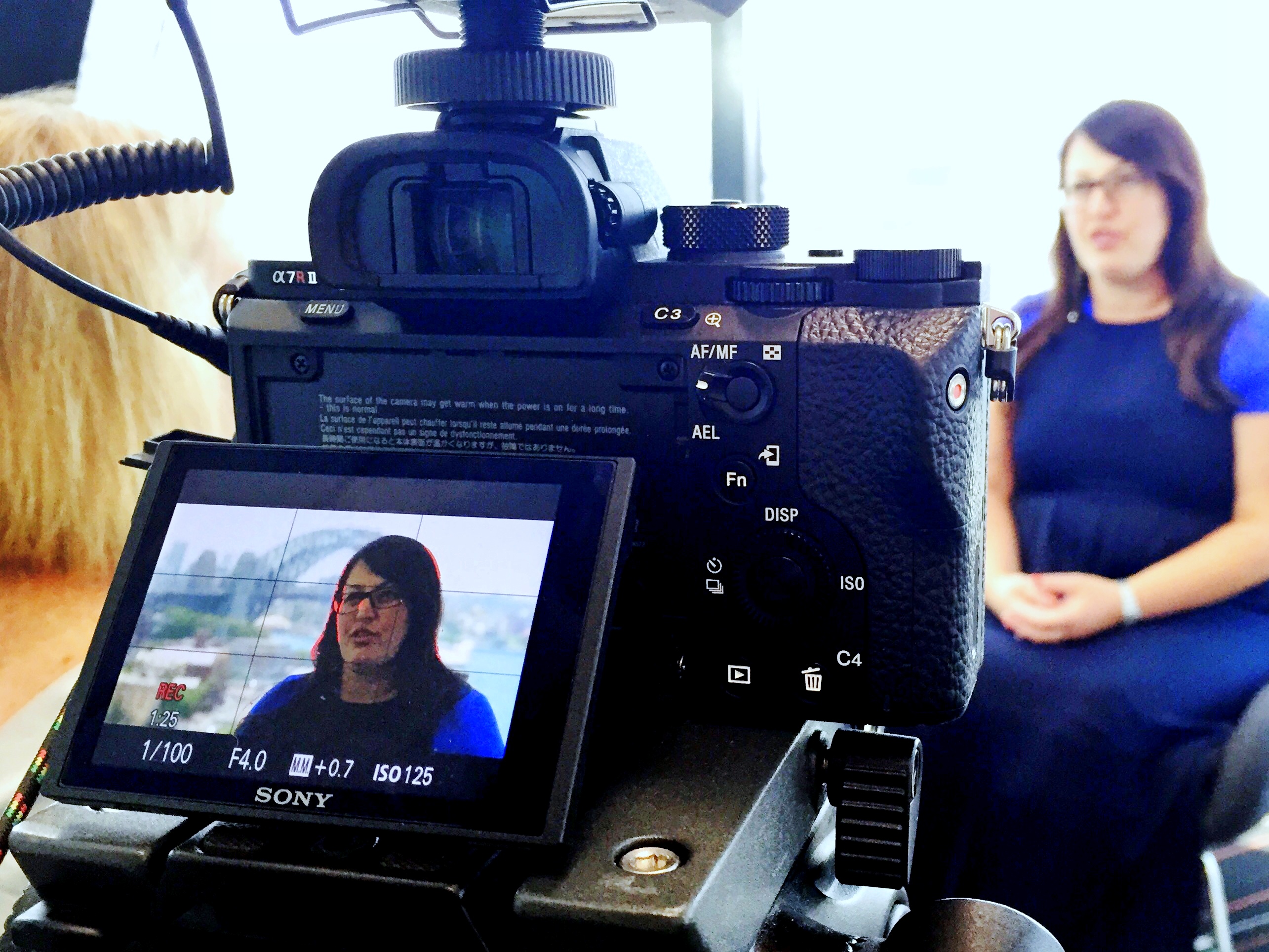
being interviewed about my research

being interviewed about my research, in front of Sydney Harbour

In my last post, I tried to illuminate some of the internal dialogue and thinking that goes on in the coach’s mind during a coaching conversation. On Twitter, in response to that post, Avril Nicholl reminded me that being deliberate about interaction, and explicit about role, is applicable to qualitative interviewing. So in this post I’ll explain how I used my coaching toolbox when I was conducting qualitative interviews for my PhD.

My PhD experience of the qualitative interview comes from both participant and researcher perspectives. I interviewed one group of participants for my study, as interviewer and researcher. But ethical issues resulted in another group, and me, being interviewed by an independent interviewer. So I was interviewer, designer of protocols and questions for someone else to interview some participants, and an interviewed participant in my research.

Interview is a widely used way of generating data, especially when the researcher is seeking to explore feelings, relationships, beliefs, identities, and insights about people in action in their social worlds. As I discussed here, the creation of meaning is a complex interaction dependent on meaning-maker and context. Narrative researchers often agree that participant stories are not fully formed, waiting to be drawn from the person. Rather, meanings are made on the spot; shaped by the questions asked, the interview structure, the interview environment and the interviewer themselves. Interviews do not just recall knowledge; they produce it, in the moment.

Anecdotally, I experienced this myself in being interviewed for my study by the independent interviewer, who I had briefed on interviewing me and other participants. I had written the questions and the protocols, so I was surprised by the experience of being interviewed for my own study. In thinking aloud, or being probed to think further or differently, my own thinking was not only illuminated, but deepened, extended and re-shaped, even though I knew what the questions and foci beforehand.

The interviews for my PhD sat somewhere between semi-structured and un-structured, designed to elicit storytelling from participants. I wanted to, as narrative research doyenne Catherine Riessman suggests, “follow participants down their diverse trails” (in ‘Analysis of personal narratives’, 2002). I wanted interviews to be less about my agenda (although of course my study had its foci) and more about surfacing participant stories in all their messiness and humanness.

Planned questions were sparing; there were only a few. These were based on the phenomena on which the study focused. Mostly, these anchor questions started with, “Tell me about …” There were also suggestions for probing questions. The interviews were designed to be broadly consistent for each participant (in question order and focus) but the structure of the interview was flexible enough to explore tangents which emerged from each participant’s responses.

When interviewing, I was explicit about my role as researcher and interviewer, especially because I was interviewing people from within my own professional context. I used my coaching toolbox to give me a structure and approach for research interviewing. I applied an interviewer listening pattern of ‘pause, paraphrase, ask question’ (borrowed from Costa & Garmston’s 2006 Cognitive Coaching). This interview structure encouraged participant storytelling, while allowing patterns and idiosyncracies to emerge.

I was aware of leaving space in conversation for pausing and thinking, rather than jumping in when there was silence (as I mentioned in my previous post, restraint and pausing are areas of personal mindfulness for me). My coaching training on eye movement (see visual representation above for more on how to recognise eye cues) allowed me to see what sort of thinking the interviewee was doing, which helped me to wait while that thinking happened; I knew if I jumped in with another question I would be interrupting the person’s internal dialogue or their recollection of an experience. Usually the silence in the interviews didn’t last long but instead was a jumping off point for the participant to speak further; it was a space in which the interviewee was thinking and after which their story would continue.

I found that, rather than asking questions, I was attempting to distil, clarify, or abstract the person’s thinking with a well-considered paraphrase. While the focusing questions were necessary to direct responses onto the research foci, a Cognitive Coaching approach allowed me to ‘get out of the way’ of participants, following them along their own stories as they directed and developed their own responses. After the interviews I had feedback from a number of participants who said that for them the interview was useful, a great conversation, and a luxurious space in which to reflect on their own professional selves and practices. The research interview was valued by participants as an opportunity which provided the space and structure for learning and reflection.

My Cognitive Coaching training also helped to bring to my awareness, during the interviews, to the importance of trust, rapport, body language mirroring, pausing and paraphrasing. Conscious of maintaining rapport, I did not take notes, but allowed a Dictaphone to capture the audio. I watched the conversation body language in a kind of meta out-of-body looking-in-from-outside experience, and often found myself mirroring the interviewee’s body language. I was mindful of how participants used their bodies and hands to express their ideas and their relationships to things. This allowed me to pick up on the nuances of their thinking. Were they sequencing points on their fingers or in the air in a linear pattern? Were they expanding themselves and their ideas out into abstraction or magnitude, or bringing them close to their chests, showing something was dear to them? Non-verbal cues helped me to paraphrase participants’ responses.

For me, coaching and being coached has influenced the way I have conversations in all sorts of arenas. As a parent, as a partner, as a friend, as a teacher and as an interviewer. As a PhD candidate and neophyte researcher, the coach’s toolbox was helpful in developing my approach to qualitative interviews. As interviewer and coach, my PhD interview transcripts and audio provided data for reflection on my practices.

While the role and purpose of a research interviewer is different to the role and purpose of a coach, the principles and skills are transferrable: belief in the capacity of the individual, active listening, paraphrasing, asking questions which mediate thinking, and keeping oneself (coach/interviewer) out of the conversation. Both kinds of conversation – coaching and research interviewing – should be primarily about the person doing the thinking, talking, sharing, storytelling. Although the coach or interviewer of course influences the words and thoughts generated, they should aim to be almost-invisible catalyst, mirror and conduit.

On writing: Is it dense to be complex?

writing is power (my image, of course!)

writing is power (my image, of course!)

Writing can be bold and dangerous and disruptive. It can be quiet and still and sneaky. It can be melodious and rhythmic and beautiful. It can be subversive and challenging and difficult to read. As a reader and a teacher of English and Literature, I am a believer in the power of language, of words, of literature, of story and of writing. To educate and to soothe. To challenge and to change. It’s why writing is so important for everyone. Writing – and being able to enact authorial intent, to release thought and emotion through words on a page or screen or device – is power.

I teach my students of English to write for audience and purpose. For whom are they writing? What is their purpose? To persuade, to shock, to inform, to inspire, to call to action, to explain, to intrigue? As authors, once they have identified for whom and why they are writing, they can make choices of form, structure and language. I teach them the ‘rules’ of various genres and forms so that they know how to use them, and how to deliberately break them. The same goes for any writer: know your game, how to play and conform, and how to challenge or subvert.

I find blogging an interesting form in the sense that the audience is sometimes unclear. In some ways I write it for myself – as a web log of reflections. Yet I write around particular topics, and I know that I have a readership of individuals and groups who are (it seems!) interested in what I have to say. In some ways I write to share my story so that others might glean something from it, in part because I get so much from others blogging their journeys or writing ‘aloud’ their thoughts and theories as they form. I like even more the collaborative nature of blogging; when it opens up conversation, in comments, on social media or in new blog posts. As Pat Thomson writes, writing can be identity work; it can be a way into being and into connection. And as author and self-publisher, a blogger is free to write how and about what they choose. It’s a kind of free writing.

Academic writing is a different beast. Some academic writers work to make their writing accessible to a broader audience than the academe or a narrow field of scholars. Sometimes I use my thesaurus in reverse (‘What’s a simpler way of saying this?’). But often, as Greg Thompson and Linda Graham have suggested recently, academese can be complex, esoteric and hard to decode precisely because of the densities and intricacies of the ideas being tussled with. Readers and writers of academic prose need to work hard, grappling with words and concepts. Sometimes it seems that every third academic writer invents a new word just to sound more obtuse and scholarly than the next. Yet these discourse-specific terms can be the result of the sweat and tears of theorisation; ‘How do I best communicate this theory?’ Like literature, often celebrated for its multi-levelled complexity, academic texts often need to be read and re-read in order to be understood, and on different levels. Academic allegory. A journey into knowing.

One’s own writing, too, can involve struggle. Using big words isn’t necessarily gratuitous chest-beating in order to show off or project cleverness; it can be the result of ideas and words wrestled with, toiled over, written and re-written. Boundaries pushed at persistently. Knowledge formed or reimagined. I am a neophyte in the world of academia, but my PhD has taught me that writing in academia can mean taking one step forward to take ten steps back. Often I write my way into understanding, like Naomi Barnes who sees writing as inquiry and blogging as process.

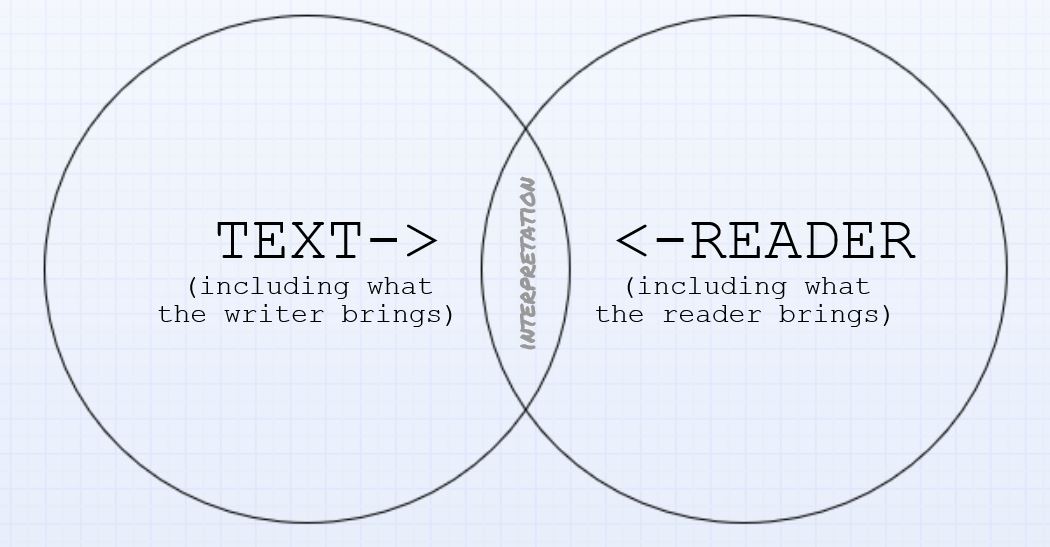
my crude Venn diagram of the writing-reading process

my crude Venn diagram of the writing-reading process

Meaning is made at the junction between text (as performed by the writer) and reader. The writer brings themselves to the text, with all their own context, authorial processes, beliefs, assumptions, knowledge, gaps in knowledge and writerly decisions. The reader, too brings their self, context, beliefs, values, and skills of interpretation to the written piece. It’s in that zinging middle space – like in the tension between the fingers of Adam and God on the Sistine Chapel ceiling – that meaning is made. It’s why no reading of a text is ever the same, and why there can never be a ‘right’ interpretation, only perhaps a dominant one.

In today’s world there are a range of places and forms in which authors can communicate their work, theorise, research, think and write. Writers make decisions based on what they want to communicate and who they are reaching out to (or away from). They can choose big words, small words, combative words, inclusive words. They can simplify or complicate. They might write to situate themselves in a particular discourse, within a particular conversation, or with a particular group.

Readers, too, make choices. To read, engage, re-read, give up, struggle through. Or to respond and engage by writing, writing, writing.

5 things I learned in 2015

Beware the barrenness of a busy life. ~ Socrates

Epiphanies and moments of clarity can be simple and, on reflection, obvious. The following list of ‘5 things I learned in 2015’ may seem like statements of the bleeding obvious. They are nothing new, and yet this year I’ve seen new refractions from, and noticed more minute details of, these simple truths. They have been affirmed for me this year through my experiences of being and becoming. Of teaching, leading, parenting, coaching, being coached, researching and writing.

local café wisdom

local café wisdom

1. Doing many things at once can work, but it’s also important to take breaks.

In the last few years I’ve been working 0.8 of a teaching and leadership job at a school, parenting two pre-schoolers and working on my PhD (now submitted – woot!). While I always had a sense that this was working for me in its strange busy way, it wasn’t until my first writing retreat this year that I understood how much. On my retreat, I found it difficult to stay on my one task – editing the PhD thesis draft – for a full weekend. I realised that my routine of intense short bursts of PhD, in among the other many things in my life, worked for me. These short, regular, time-constrained bursts of energetic PhD work were intensive and focused. They felt like an indulgence, some intellectual ‘me-time’ in which I could luxuriate, a brain-bending haven from my other responsibilities. It helped me to love my PhD, while also appreciating the specialness of my teaching, leading and parenting roles.

Yet, as I discovered, relentless busyness is not sustainable. Breaks are required. Real, curl-your-toes-in-the-sand, unplug, breathe deeply and love abundantly kind of breaks. Nourishment for wellbeing. Care for self and others. Time to breathe.

2. Welcome resistance & engage in respectful disagreement.

On my blog, which is now 16 months old, as in Twitter and in my professional life, I have been becoming more comfortable with, and encouraging of, disagreement, although I prefer dissent to be served in a respectful, articulate and reasoned manner. And I prefer disruption which emerges from deep purpose, rather than trendy buzzwordification. Last year I completed the Adaptive Schools Foundation course, which champions graceful disagreement as a key element of high-performing groups. I’ve written a few blog posts which err on the side of controversial. I’ve engaged in Twitter debate. I’ve experienced my first peer review comments from academic journals, and attempted to take critique as an opportunity to strengthen my work. And in my role leading and implementing a school coaching initiative for teachers, I have welcomed the contributions of those who are resistant to the change.

I’ve found those individuals who might be dismissed as ‘resistors’ or negative voices, to be important ones worthy of close listening. I find myself asking those who disagree to take the time to explain their view to me. I listen intently, wondering, ‘What can I learn here? How might this help me to make what we’re doing better, stronger, and meaningful for a wider range of people?’

I am reminded of this line of Richard Bach’s from his novella Illusions:

There is no such thing as a problem without a gift for you in its hands. You seek problems because you need their gifts.

It is often in engaging with those who disagree with us, that we are taken to new places in our own thinking, helped to consider alternate perspectives, or are able to find solutions which we may otherwise not have reached.

3. Trust individuals. Believe in their capacity. Choose empowerment.

Punitive accountability measures which promote fear and compliance can only undermine teachers’ and school leaders’ professions, identities and practices. Through my experiences of coaching, my PhD research into school leadership and organisational change, and my observations of systems of teacher evaluation around the world, I have become increasingly convinced of the need to focus on empowerment and growth, through support and trust. It’s the belief upon which my school’s coaching model is based.

4. Connections with others are powerful.

We know that connecting with others is powerful. One of my ‘three words’ for 2015 was ‘sharing’ and another was ‘presence’, both words which speak of connecting with others and being present in relationships.

This year, not only have my personal and face-to-face professional relationships been impactful, but so have connections I have made online. For the first time this year, I began to meet ‘in real life’ individuals I’ve connected with on Twitter and through my blog. Catching up over drinks, breakfast or the conference room had been a seamless transition from tweet, blog post or Voxer message, to in-person banter, support and inspiration. I’ve engaged in wonderful blogging conversations. I’ve become bewitched with the potential of our interconnectedness and the ways in which technology might help us grow support networks and knowledge webs.

5. Teeny regular steps add up to a long journey.

My PhD was the thing that brought home this truth to me. Over three years I plugged away with little step after little step, finding stolen moments of doctoral time in the cracks in my days and nights. Regular, persistent effort. Sometimes forward; sometimes back; but maintaining forward momentum. And then I looked back along the path I’d walked and found that it added up to a thesis. So my big lesson was, just put one foot in front of the other. Keep going!

sunset, Gnarabup

sunset, Gnarabup

‘WRITE ME’: Writing to be, writing to know, writing to connect

Round the keyboard was a paper label, with the words ‘WRITE ME’ beautifully printed on it in large letters. Alice ventured to touch the keys, and, finding the sensation to be addictive and quite wonderful in its staccato rhythm, very soon found she had written a page! Three pages! “What a curious feeling!” said Alice, “I must be becoming a writer.” And so it was indeed, for there were words on the screen and the pads of her fingers were singing with a kind of joy.

~ adapted from Lewis Carroll’s Alice’s Adventures in Wonderland

'WRITE ME'

‘WRITE ME’

It is coming to the end of #AcWriMo, ‘Academic Writing Month’, when, for the duration of November, academic writers take to social media with valiant goals of words written and writing tasks completed. I know how good it feels to watch the words grow. But writing is more than increasing words. It is reading. It is cutting out words. It is drafting words upon words that don’t work; words which are the evidence of problem-solving processes, etched onto white screens or into notebooks; for erasure or storage in shadowy places, not for publication.

In my PhD, and in this blog, I use writing as a medium of reflective and analytic thinking. ‘Writing aloud’ or ‘free writing’ is one way in which I sometimes see where the words take me and which surprising and non-linear burrows I might be catapulted through.

This post emerges out of a blog and Twitter conversation with three academics around writing and autoethnography: Helen Kara (who writes here about ‘showing her workings’ and revealing the personal), Naomi Barnes (who muses here about autoethnography as a vehicle between the personal and theoretical) and Katie Collins (who responds here with her thoughts about writing as thinking, as filter on reality and as power). Here, I offer my own thoughts to this conversation.

I was ushered into this conversation by Helen, but was already familiar with Katie’s work. Once Alice’s Adventures in Wonderland was enmeshed into the fibres of my PhD thesis, I went looking for someone else who had done something similar (because surely I couldn’t be the first), and came across Katie’s then-recently-published dissertation. We had done different things with Alice, but the novel clearly resonated for both of us.

While I didn’t use Deleuzian theory in my PhD, Deleuze’s 1990 Logic of Sense reflects some of my thinking of Alice as a novel of identity contestation, fluid becoming and un-becoming, through language. Carroll’s fantastical, imaginative world questions adult realities and plays with the power and (non)sense of words. Deleuze positions Alice at the borders. As a neophyte researcher who has made some non-traditional choices, I have felt that I have operated in some ways at the borders, questioning and pushing at the edge of where I am expected to be, what I’m expected to do and how I’m expected to do it. Being at once curious about, filled with wonder for, and at odds with, the world is an affinity I feel with Alice. (This week I will present on my use of the Alice metaphor in my PhD, at the Australian Association for Research in Education conference.)

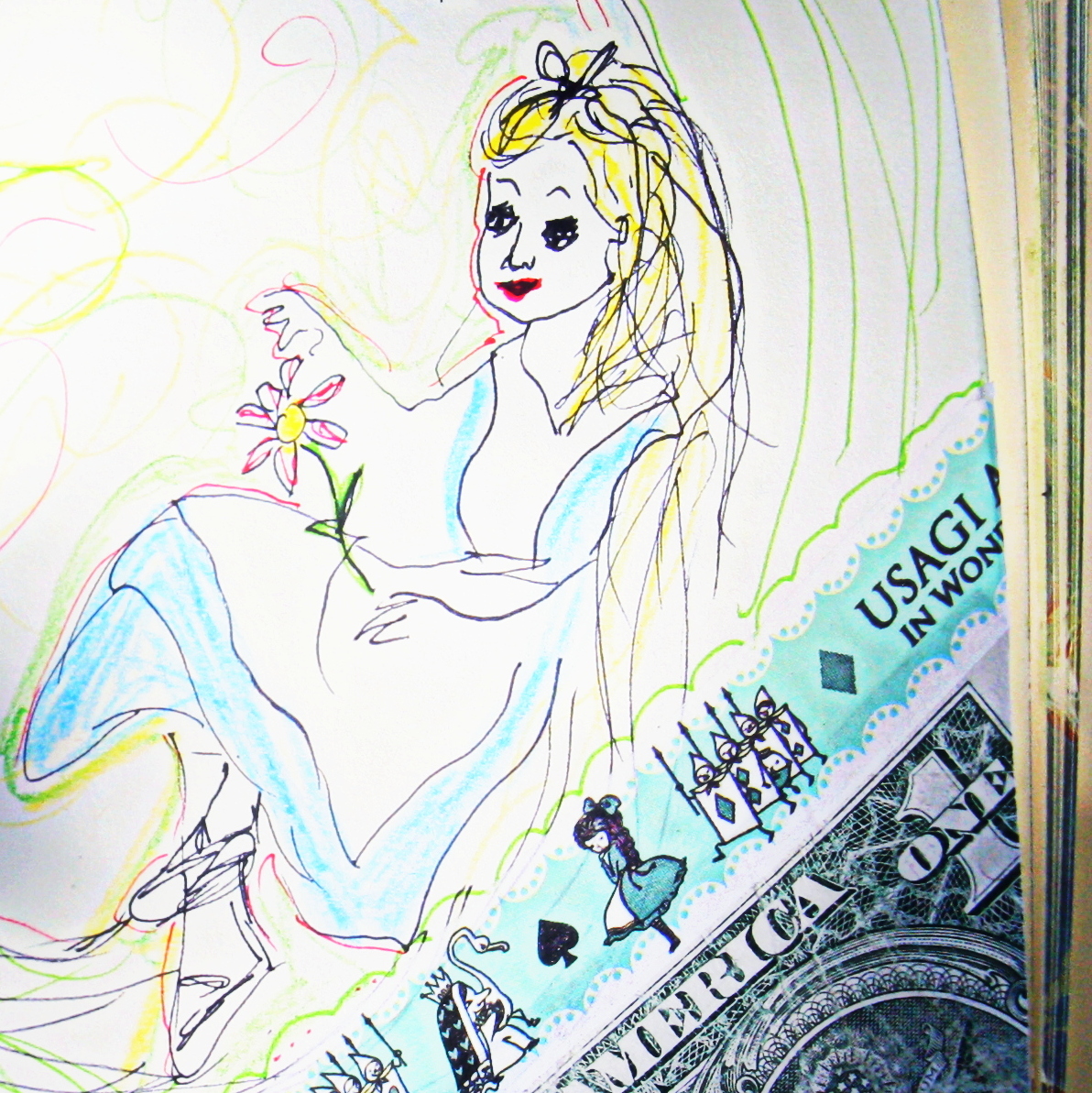
crudely sketching Alice

crudely sketching Alice in my notebook

While for my PhD I didn’t adopt autoethnography per se, I did use the autoethnographer’s lens as part of my conceptual bricolage. That is, I saw myself as research instrument, self-conscious participant and immersed, self-identified insider member of my study. Michael Schwalbe’s 1996 metaphor resonated: reflections on my self were both door and mirror; a way in to others and a way back to self.

My PhD thesis self-story (I was interviewed as one of my own participants; but that’s another tale) had the purpose of making transparent my own worldview (along the lines of Helen’s ‘showing my workings’), but it also had another function: to help me know myself. As I worked to find the words to explore and articulate my own lived experiences of the phenomena I was studying, I found, as others have, that I wrote my way into knowing, wrote my world into a version of its reality and constructed my own story in new ways, through the talk-aloud experience of the interviews and the process of forming and finding the words to frame my narrative.

I wrote at one point about writing a PhD as like freeing a sculpture from stone, but I wonder if the process of writing is one in which we free what already exists within, or if it is more than this. Creation? Collage? Weaving? Moulding? None of these seems to adequately embody the process of writing which seems to come simultaneously from within and without; from past, present and future; from materials tangible and intangible. It is deliberate and intuitive; visible and invisible.

And so, I continue to welcome opportunities to write my way into being, to write my way into understanding and to connect my words and thoughts with those of others.

I came across this 'Pour Me' cocktail the night of this Twitter conversation. Coincidence?

I came across this ‘Pour Me’ cocktail the night of this Twitter conversation. Coincidence?

What I now know about the doctorate: Illuminating the PhDarkness

I was delighted to be invited to present on my research (which is, in part, around coaching in a school context) at yesterday’s inaugural Australian Coaching in Education Research Seminar. My presentation – to a room of academics, educators, doctoral candidates and prospective doctoral candidates – looked at sharing both my own study and my post-submission understanding of doctoral research. In this post I use some of the slides from that presentation to look at the latter part: what I now know about the PhD.

the outline of my #EdCoachRES presentation

the outline of my #EdCoachRES presentation

I saw the PhD, some times and in some ways, as a long dark tunnel or rabbit burrow. That is, when we are standing at the mouth of the tunnel it is dark and unilluminated. And sometimes we have to dig. As I had never been a doctoral researcher, I didn’t know what doctoral research looked like. I didn’t know what a good PhD looked like. I didn’t know what the process looked like. These are things we can’t really know until the end.

That said, while my supervisors were not experts in my particular fields or methodology, they were experts in the doctoral process and in supervision. This is reminiscent of my work in coaching at my school. There, coaches aren’t experts in all pedagogy in all areas; they are teachers who are experts in being coaches, in having professional conversations in which the coachee’s thinking is teased out and shifted to different levels of abstraction, in ways to use the Danielson Framework for Teaching to refine teachers’ reflections on their practice. My supervisors were a lot like coaches, in that they facilitated my thinking about my research and writing, and helped me grow into a less-neophyte more-autonomous researcher. But they were also experts and mentors who sometimes chose to give me directive advice, or asked me to develop a clearer rationale for something I wanted to try (like using illustrations in the PhD thesis – who does that?). They helped me to keep focused, especially when I got excited about alternate pathways or theories.

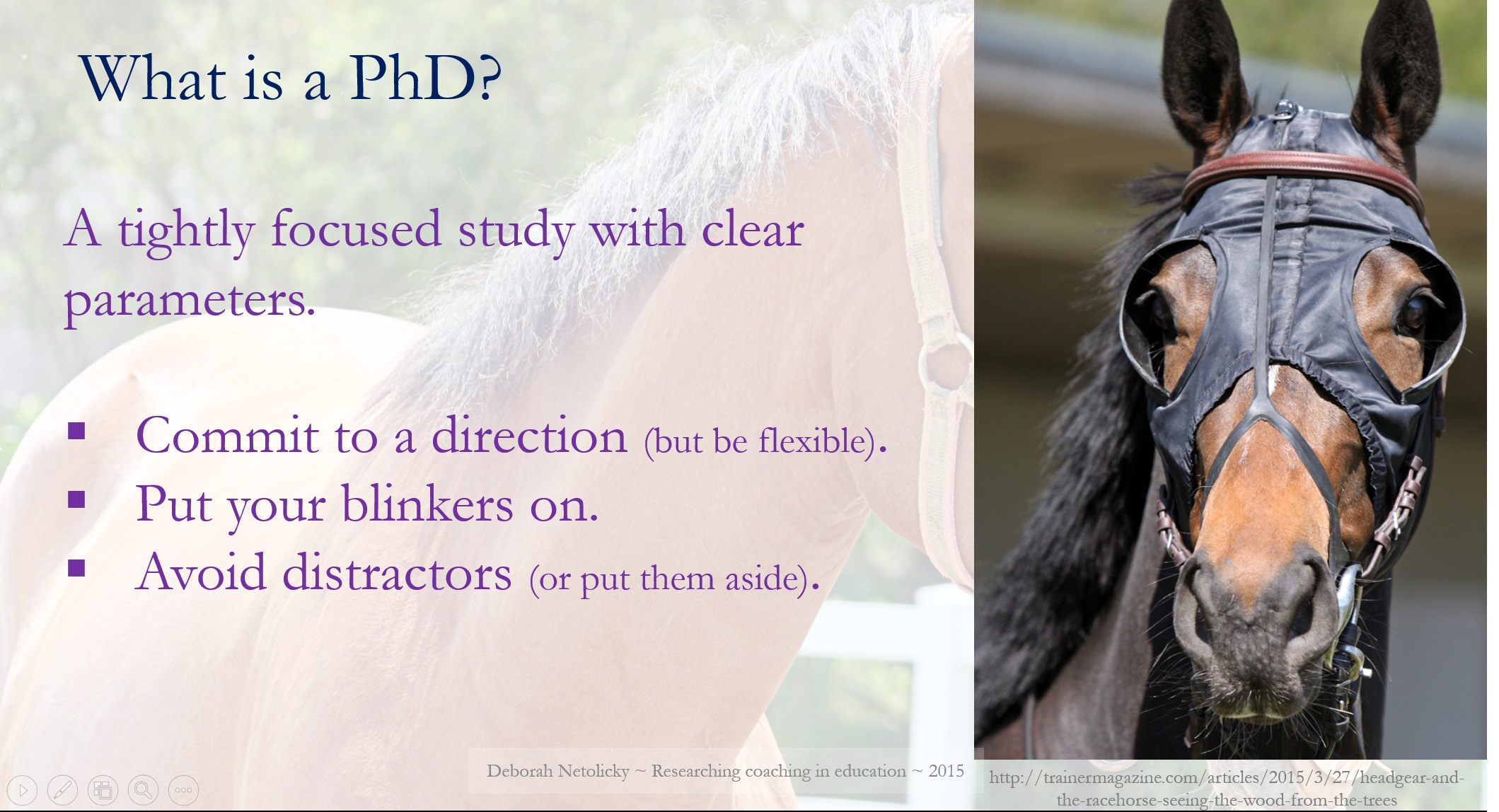
Put your PhD blinkers on

Put your PhD blinkers on

The PhD is a tightly focused study. No matter how curious or impassioned we are, a single three-year-equivalent study can’t be all encompassing. We can’t cover everything that interests us or explore every avenue which takes our fancy. Like the racehorse, we need to put our blinkers on in order to make it to the finish line. Those really intriguing tangential ideas and large chunks of deleted text (for instance, I axed 20,000 words between the first full draft and the final draft) can be put into a folder for another time, another project, another paper. Of course, research studies are iterative, so we need to be flexible and open to changing course, but as Tara Brabazon says in this 2010 Times article:

the best doctorates are small. They are tightly constituted and justify students’ choice of one community of scholars over others while demonstrating that they have read enough to make the decision on academic rather than time-management grounds.

by @debsnet

Bearing in mind that PhDs are tightly focused and that all research has limitations, these were the questions I thought were most important for any doctoral researcher to ask themselves:

  • How will my research add to scholarly conversations?
  • What question/s or problem/s of theory or practice might I hope to answer?
  • What will my method offer? What might it eclipse (limitations)?

That is, what can or will this research do? What can’t or won’t it do? We need to be ok with what a particular study, from a particular worldview, using a particular method, can do. And what it can’t. We need to own the limitations of our work.

my go-to online advisors

my go-to online advisors

I shared some of those academics-who-blog who have been particularly influential for me in my PhD writing and understanding. These are those whose generosity of knowledge helped me to understand the process of knowing the PhD, doing the PhD and being the PhD. Their work helped to illuminate the PhDarkness for me. An example was Pat Thomson’s help in the writing of my discussion chapter at a time when I was asking myself what a discussion chapter was, and trying to figure out how to best approach and develop mine. The academic bloggers named in this slide have reams of useful posts about endless aspects of the PhD, academic writing and getting published. Additionally, Helen Kara is writing short eBooks for doctoral students, while Pat Thomson and Babara Kamler have the super-useful book, Helping Doctoral Students Write: Pedagogies for Supervision.

I have found the reflections of others useful and so I share some of my own story on this blog because perhaps my words will shine a light into the shadows for someone else looking for help in a time of doctoral uncertainty. My working-through-writing-frustrations blog posts might help others when they come to that point in their journey, by which time I may have happily forgotten about how hard it was for me at the time!  As sometimes the curse of expertise – thank you, How to Survive Your PhD MOOC for pointing me towards Pamela Hinds’ 1999 work on this – means that once we have learned something, we cannot always remember what it was like to not know it, making it difficult to teach or help someone. By (b)logging my writing memories as they happen, perhaps I can archive my not-so-good-at-academic-writing self. Reflecting-on-writing by writing-about-writing – in a kind of meta-writing – helps me to document my academic writing journey. While I don’t think I’ve been in the game long enough to automate too much, blogging helps me to have a Hansel-and-Gretel breadcrumb trail back to my less capable self, before certain things become ‘black boxed’.

putting the PhD in perspective

putting the PhD in perspective

Finally, (my own version of) the PhD is only something I understand (sort of) now that I am at its end. It is unknowable before then. Each step of the way felt like a step into the darkness. Sometimes I felt like I had a flashlight to light the immediate way or a lightsaber to slice confidently into the tunnel. Sometimes I felt that I was fumbling around in the dark and feeling my way. Sometimes I went the wrong way and had to go back. But as Matt Might shows in his illustrated guide to the PhD, and as Mullins and Kiley (2002) show in their paper ‘It’s a PhD, not a Nobel Prize,’ the tightly-focused you-can’t-do-it-all parameters of a PhD mean that a PhD needs ‘only’ to add a miniscule aspect to the world’s knowledge; it’s a small blip in a larger conversation. Let yours be like a tiny jewel: small, intense, luminous.