5 things I learned in 2015

Beware the barrenness of a busy life. ~ Socrates

Epiphanies and moments of clarity can be simple and, on reflection, obvious. The following list of ‘5 things I learned in 2015’ may seem like statements of the bleeding obvious. They are nothing new, and yet this year I’ve seen new refractions from, and noticed more minute details of, these simple truths. They have been affirmed for me this year through my experiences of being and becoming. Of teaching, leading, parenting, coaching, being coached, researching and writing.

local café wisdom

local café wisdom

1. Doing many things at once can work, but it’s also important to take breaks.

In the last few years I’ve been working 0.8 of a teaching and leadership job at a school, parenting two pre-schoolers and working on my PhD (now submitted – woot!). While I always had a sense that this was working for me in its strange busy way, it wasn’t until my first writing retreat this year that I understood how much. On my retreat, I found it difficult to stay on my one task – editing the PhD thesis draft – for a full weekend. I realised that my routine of intense short bursts of PhD, in among the other many things in my life, worked for me. These short, regular, time-constrained bursts of energetic PhD work were intensive and focused. They felt like an indulgence, some intellectual ‘me-time’ in which I could luxuriate, a brain-bending haven from my other responsibilities. It helped me to love my PhD, while also appreciating the specialness of my teaching, leading and parenting roles.

Yet, as I discovered, relentless busyness is not sustainable. Breaks are required. Real, curl-your-toes-in-the-sand, unplug, breathe deeply and love abundantly kind of breaks. Nourishment for wellbeing. Care for self and others. Time to breathe.

2. Welcome resistance & engage in respectful disagreement.

On my blog, which is now 16 months old, as in Twitter and in my professional life, I have been becoming more comfortable with, and encouraging of, disagreement, although I prefer dissent to be served in a respectful, articulate and reasoned manner. And I prefer disruption which emerges from deep purpose, rather than trendy buzzwordification. Last year I completed the Adaptive Schools Foundation course, which champions graceful disagreement as a key element of high-performing groups. I’ve written a few blog posts which err on the side of controversial. I’ve engaged in Twitter debate. I’ve experienced my first peer review comments from academic journals, and attempted to take critique as an opportunity to strengthen my work. And in my role leading and implementing a school coaching initiative for teachers, I have welcomed the contributions of those who are resistant to the change.

I’ve found those individuals who might be dismissed as ‘resistors’ or negative voices, to be important ones worthy of close listening. I find myself asking those who disagree to take the time to explain their view to me. I listen intently, wondering, ‘What can I learn here? How might this help me to make what we’re doing better, stronger, and meaningful for a wider range of people?’

I am reminded of this line of Richard Bach’s from his novella Illusions:

There is no such thing as a problem without a gift for you in its hands. You seek problems because you need their gifts.

It is often in engaging with those who disagree with us, that we are taken to new places in our own thinking, helped to consider alternate perspectives, or are able to find solutions which we may otherwise not have reached.

3. Trust individuals. Believe in their capacity. Choose empowerment.

Punitive accountability measures which promote fear and compliance can only undermine teachers’ and school leaders’ professions, identities and practices. Through my experiences of coaching, my PhD research into school leadership and organisational change, and my observations of systems of teacher evaluation around the world, I have become increasingly convinced of the need to focus on empowerment and growth, through support and trust. It’s the belief upon which my school’s coaching model is based.

4. Connections with others are powerful.

We know that connecting with others is powerful. One of my ‘three words’ for 2015 was ‘sharing’ and another was ‘presence’, both words which speak of connecting with others and being present in relationships.

This year, not only have my personal and face-to-face professional relationships been impactful, but so have connections I have made online. For the first time this year, I began to meet ‘in real life’ individuals I’ve connected with on Twitter and through my blog. Catching up over drinks, breakfast or the conference room had been a seamless transition from tweet, blog post or Voxer message, to in-person banter, support and inspiration. I’ve engaged in wonderful blogging conversations. I’ve become bewitched with the potential of our interconnectedness and the ways in which technology might help us grow support networks and knowledge webs.

5. Teeny regular steps add up to a long journey.

My PhD was the thing that brought home this truth to me. Over three years I plugged away with little step after little step, finding stolen moments of doctoral time in the cracks in my days and nights. Regular, persistent effort. Sometimes forward; sometimes back; but maintaining forward momentum. And then I looked back along the path I’d walked and found that it added up to a thesis. So my big lesson was, just put one foot in front of the other. Keep going!

sunset, Gnarabup

sunset, Gnarabup

Blogging and learning are versions of reality inseparable from our emotional state

The world is your exercise book, the pages on which you do your sums. It is not reality, though you may express reality there if you wish. You are also free to write lies, or nonsense, or to tear the pages. ~ Richard Bach, Illusions

I'm grateful to be nominated in this category of the #Eddies15

I’m grateful to be nominated in this category of the #Eddies15

As I crawl over the finish line of the school year in Australia, I’ve had the lovely news that this blog has been nominated for the ‘Best Individual Blog’ edublog award in 2015. I am grateful for the nomination, and if you fancy voting for me or anyone else, you can vote here.

As I’ve reflected on this nomination, I’ve been wondering about my choices as a learner and blogger. This week, as part of our end-of-year staff planning and PD days, four hours was set aside for an activity, self-chosen from a list of options, in which we would experience being a novice learner. This was followed by reflections on that experience and its possibilities for learning and assessment in our classrooms. Options included Zumba, water skiing, life drawing, ukulele making, tennis, coding and stage combat.

It was interesting to see the criteria people used to make their choice. Some chose something they knew they were good at, based on personal criteria of having fun and achieving success, at a time of year when many are tired and emotionally vulnerable. Some chose something that would really challenge them and during which they would feel the discomfort of the novice learner, putting themselves in the position many of our students are in every day. I was somewhere in the middle. With a Fine Art degree, I’ve done my share of drawing, so I didn’t choose that, an activity in which I would feel quite at home. But I also didn’t choose something like stage combat, which I thought might be a really great challenge, but in which I had the equal possibility of being exhilarated by conquering the task, or feeling frustration, discomfort and disappointment (or both!). In making my decision, I considered the school’s intentions and instructions, as well as my own emotional wellbeing and what it was I wanted to achieve from the day. It reminded me that each of my students enters my class in a particular internal place, of which I might not be aware. 

my ukulele from kit to finished product

my ukulele from kit to finished product

I self-selected the ukulele making challenge. I figured this was both fun and something I hadn’t done before. Despite my comfort with discomfort as a place of learning and transformation, it was a safe choice. And I kind of wanted a ukulele, so I was seduced by the possibility of having a product at the end. There also seemed something lyrical about the uke itself, played as it is by Hawaiian musicians such as  Israel Kamakawiwo`ole (hear his beautiful rendition of ‘Over the Rainbow’ here).

As it turns out, this activity was an opportunity to work with people from across the school, many of whom I don’t often get the chance to work with or learn from. It was a wonderful chance to be ‘in flow’ in a workshop, gluing sanding, designing, decorating. I experienced firsthand why my students might want to stay in the woodwork workshop rather than packing away to come to my English class! It reminded me of our Year 10 English Term 4 unit, in which there are no marks or grades; both teacher and student were liberated from measuring success and failure. It was really up to the learners to decide how hard they wanted to work, how important the task was to them and what level of challenge was appropriate for them. Many, including our colleague who was our teacher for the day, worked through their lunchbreak. As well as intrinsic motivation, there was plenty of interdependence, as colleagues sought each other out for help and collaborative learning along the way. Barely any of us used the written instructions as our preferred way of learning.

What I loved was the way that, even though we all started with the same Wolfelele kit, the resultant products bore the marks and personalities of their makers. 

some of the range of ukuleles made during our activity

some of the range of ukuleles made during our activity

With this blog I also make choices about the marks I make, the stories I share, and the things I choose to leave off or leave out. While this blog isn’t quite my highlight reel, I do tend to privilege positive stories, rather than those times in which I am feeling stuck or vulnerable. The more uncomfortable posts tend to be around intellectual disequilibrirum (a word I’m borrowing from Costa and Garmston). There is interdepence, too, in the way many posts are inspired by, or in conversation with, others.

The #Eddies15 edublog nomination is affirming, in that it reflects that the writing I send out into the blogosphere touches someone somewhere. I’m also aware that, like any text, it presents versions of reality, time-frozen snapshots. It reflects my choices, my self as an author, my connections with others in the blogging community, and my state of self at ay given moment.

Postscript: This blog was voted fourth best individual blog in the 2015 edublog awards. You can see the winners list here.

Indra’s Net: We are all connected

There is an endless net of threads throughout the universe … At every crossing of the threads there is an individual. And every individual is a crystal bead. And every crystal bead reflects. Not only the light from every other crystal in the net but also every other reflection throughout the entire universe. ~ Anne Adams

This post itself is a tangling of threads. It is in part a reflection on the first day of the national Australian Association of Research for Education (AARE) conference, which I am attending and at which I am presenting a paper. It is also part of a wider conversation I’ve been having through blogging. It was incited today by Robyn Collard’s Welcome to Country in which she used the above Anne Adams quote which refers to Indra’s Net, a Hindu and Buddhist concept that articulates the interconnectedness of the universe. It imagines each individual as a dew drop, jewel or pearl: reflective and distinctive, but also interconnected with all the other dew drops via the threads of the web. Parts and whole. Dazzling individualism within collective network.

This quote and concept added a layer to an already-layered conversation I’ve been having in the blogonet with Helen Kara and Naomi Barnes. It started with Steve Wheeler’s #blimage (blog + image) challenge. When Helen shared a photograph of tangled dew-bejeweled spiders’ webs in her garden, both Naomi and I responded to the image. Naomi wrote about the messiness of research. I wrote about how technology connects people to one another. I’ve since also written about the web-weaving spider as a metaphor for the researcher. And today I was connecting at AARE, in person, with a web of academics who I know mostly through their work and through Twitter.

So here I am again. Contemplating the web. And the dew drop jewels. And their infinite reflections and refractions. Their beauty and fragility and separateness and togetherness.

I spent much of this first day of the AARE conference in a four hour symposium in which scholars brought diverse perspectives to the same general topic of leadership in education. They agreed and disputed. They converged and diverged. It was a great example of respectful, well-considered and articulate debate. Graceful disagreement. Elegant contestation. Research as conversation.

For instance, in conceptualising leadership as artistry, Fenwick English noted the webbed connections between research, art, leadership and creativity. Scott Eacott discussed the relational aspects of leadership and of research, asking scholars to consider how their work relates to that of others. Christina Gowlett approached school leadership from a perspective of challenge and critique, agitating against dominant approaches, norms and expectations by embracing alternate theories of uncertainty and transgression.

Additionally, Gabriele Lakomski and Colin Evers discussed thinking in schools as a wide cognitive net. They define cognition as a dynamic system, comprising reciprocal interactions between people, artefacts, resources and environments. They noted that thinking is not just computationally logical-deductive; it is interpretive, intuitive, behind consciousness and beyond awareness. They explored the notion of the extended or supersized mind which distributes cognition. Our tech is our selves. Our communities and social networks are change collectives. Gabriele and Colin noted that cognition occurs “beyond skin and skull”, challenging the myths of the stand alone thinker, the heroic leader and the change agent. Individuals influence and are influenced by each other. Thinking and being is connectivity. Web not hierarchy.

These ideas resonate with the perspective I will be presenting at the Heroism Science conference in 2016, which suggests a reimagining of heroism in school leadership. That is, that school leader ‘heroes’ can work subtly, fluidly and invisibly in the service of their school communities. In education there needs to be shared vision and individual purpose, collective and individual capacity. Strengthening the web while protecting and nurturing the dew drops.

Like Costa and Garmston’s (2006) notion of holonomy (which is based on Koestler’s 1972 conceptualisation of the ‘holon’), Indra’s Net shows the dual importance of the individual and the collective. The jewel and the net. All are simultaneously together and separate. A change in one is reflected in a change in all.

So as I reflect (like the dew drop), I imagine webs of learning, webs of emotion, webs of relationships, webs of identity. I wonder: What influences the symbiosis between individual and collective? In what ways might we shape others? In what ways might others shape us? These could be questions for families, friendships, organisations, communities, nations, the world. What about our selves can we control and what choices are we making about what our own self-jewel reflects onto those around us and onto the universal web? In what ways could we harness the global mind, the universal self and the interconnectedness of humanity?

Imagine a multidimensional spider’s web in the early morning, covered with dew drops. And every dew drop contains the reflection of all the other dew drops. And in each reflected dew drop, the reflections of all the other dew drops in that reflection. And so ad infinitum. ~ Alan Watts

Webs & chrysalises: Metaphors for learning & connection

Naomi Barnes, in her recent article in the digital journal, Hybrid Pedagogy, writes that “we need to start paying more attention to the random thoughts because when learning is conceptualised as a web, rather than a line, randomness becomes more meaningful.” She refers to the unanticipated blogging conversation, sparked by Steve Wheeler’s #blimage (blog+ image) challenge, that she, Helen Kara and I became involved in as we voluntarily responded to each other, layering our ideas and connecting our words.

My own experience of learning is non-linear and rhizomatic. The findings of my PhD were that this is an experience shared by individuals, groups and organisations; learning happens in surprising ways, in unexpected places. I agree with Naomi that embracing non-linear randomness might lead us to interesting places of knowledge collaboration, reimagining and production (although I do think we should acknowledge our sources of inspiration).

I mentioned in my blog post (part of the above-mentioned blogversation) on the spider-web connectivity of networked learning that metaphors, including of the spider’s web, emerged from my participants as ways to explain and explore their understanding of their professional selves, roles and relationships.

As it edges towards summer here in Australia, at home I recently found a redback spider (latrodectus hasseltii for the arachnid nerds), an Australian relative of the American black widow spider. The redback female is venomous, formidable and self-sufficient. Her web is messy. Males live on the periphery, eating her scraps. And after mating, she eats them, storing the sperm for later.

I’ve felt a little recently like a web-weaving spider. My PhD thesis is submitted, and suddenly, papers, journal articles and conference presentations are materialising. My PhD work has formed a web which widens and thickens, and in which these prey are being caught. The learning I’ve been doing from the network of scholars with whom I connect on Twitter and in the blogosphere has continued to take me to new thinking and into interesting conversations.

Now, I don’t see myself as a poisonous, man-eating widow spider, but I like that the redback is autonomous, a beacon of feminine power. I like that her web is messy and functional, not pretty and symmetrical. As well as the weaving of the physical web, the species itself has spread its tendrils out from Australia to reach New Zealand, Japan and Belgium. She has even made it into two DC comics as a supervillain who fights Robin. Unexpected places. Unpredictable influence.

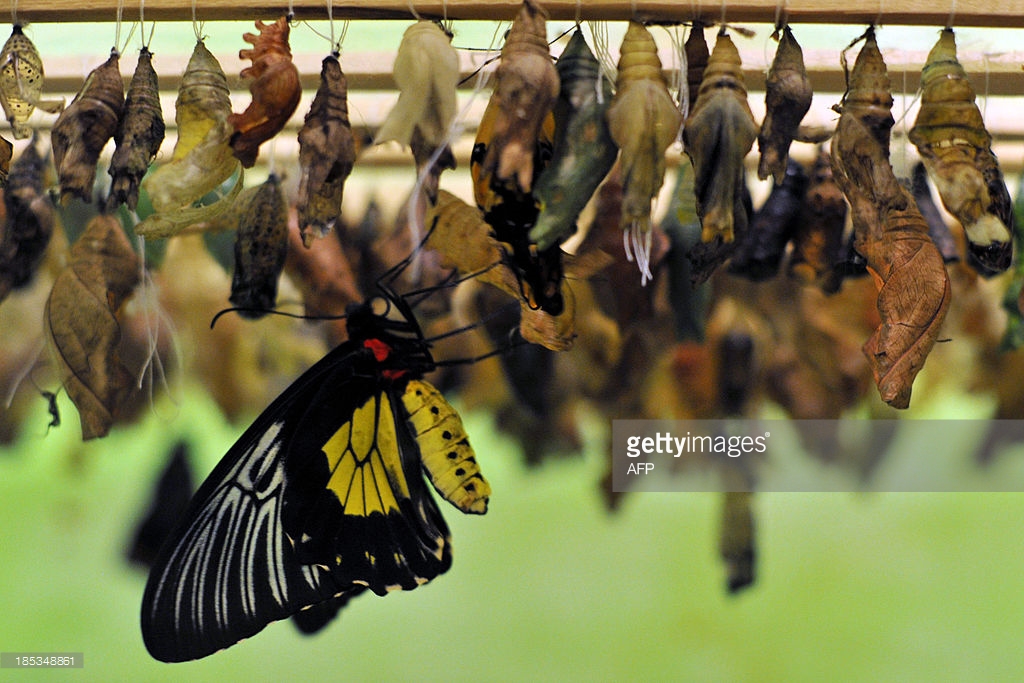
The other insect creature I’ve recently been reflecting upon is the chrysalised caterpillar-butterfly. After I submitted my thesis, I wrote the following title in a Word document and saved it: “Emerging from the chrysalis: PhD as transformative learning.” It was a blog idea for later, after proper completion, maybe. I was remembering a post I had read which argued that the PhD is not a transformative experience, but a thing to be done, a process to be completed, a means to an end. This wasn’t my experience so I thought it might be worth writing about.

And then I set the November #HDRblog15 challenge, and Kathryn Davies wrote this post about the life of a butterfly as a metaphor for the cycle of the PhD. Kathryn explores the chrysalis-PhD metaphor so thoroughly and thoughtfully, my own post idea seemed redundant. Yet my experience was affirmed by reading Kathryn’s. For me the PhD was transformative. I began my doctorate as someone who hadn’t written an academic paper or dissertation for 14 years. I was a vulnerable, soft-bellied slow-moving academic creature, my newness shiny and green. Over the course of the PhD, it has changed the way I think, the way I write and the way I read. It has changed how I perceive my identity, how I behave and how I respond. Some of these feelings I’ve written about, including a crisis of scholarly confidence, taking flight in the discussion chapter, and on being (or identifying as) a writer. And while I’ve recently said that I feel frozen in examination limbo, perhaps it’s more appropriate to say that I’m quietly growing, wriggling inside and pushing at the edges of my PhChrysalis, still a neophyte but transformed by my PhD journey.

So, I offer out to the blogoverse another post, another moment of my thinking suspended in time, another layer, another thread, another voice, another tendril reaching out to others. To be ignored, observed or grasped.

What’s in a shape? Why I don’t *heart* the Twitter heart

Seeing comes before words. The child looks and recognises before it can speak. ~ John Berger, Ways of Seeing

I've resorted to making my own gold star out of hacked up Post-Its

I’ve resorted to making my own gold star out of hacked up Post-Its

The Twitterverse exploded yesterday with an update to the ‘favourite’ icon. Where there has always been a gold star, with the words “you favourited this” or “@soandso favourited this”, suddenly there was a red heart. A glaringly red heart, like a gaping wound carved into the blue skin of Twitter.

I’m mourning the loss of the gold star and all that its presence in my Twitter world represented. I’ll start by explaining how I used the Twitter gold star.

  • It was a bookmark. “I want to find this again so I’m saving it” or “I’m saving this to read later.”
  • It was a thank you for a comment or share.
  • It was a log of conversations and comments to which I wanted to return.
  • It was a LOL or a high five. “Hilarious!” or “haha good one.”
  • It was a like. “Good share / nice post /effective point,” usually followed by a retweet. But it wasn’t just a like.

As well as being reminiscent of award stickers from school days, the gold star, in conjunction with its description as a ‘favourite’, was a nuanced symbol of Twitter communication.

And now it’s been replaced with a glib red heart. Superficial. Facile. Flippant. Lacking in nuance. These strings of blood-red hearts in my feed make me feel like I must be in some kind of sappy, thoughtless feeling-saturated love-in.

I don’t mind giving a bit of heart love while watching a Periscope broadcast. I don’t mind the practice of likes on Facebook and Instagram. In these worlds, a user can ‘like’ something in a transient way, and then forget about it. Click. Forget. Liking works for me because on Facebook I’m engaging about my non-work non-academic life. On Twitter I’m often engaging in discussion on education, research, politics, parenting or work. As a point of difference, Twitter gives us a record of those things we’ve favourited (or now, ‘liked’) meaning that the star/heart favourite/like is a way of curating a feed of personalised information. This is a good thing.

The change in language is a change in purpose. ‘Liking’ a post is different to ‘favouriting’ it. Do I want to *star* a confronting article, an opposing viewpoint or a harrowing news story? Maybe. Would I want to *heart* it? No.

Twitter says the star was confusing to newcomers. It was versatile.

Twitter says the heart is more expressive. It is less expressive and more one-dimensional.

Twitter says the heart is a universal cross-cultural symbol. Yes. Of love. Twitter isn’t about love for all its users. I don’t follow celebrities, unless you count edu-gurus and academic-crushes. So I don’t want to dole out ‘likes’ or ‘hearts’.

Those of us who use Twitter as a professional and intellectual tool have been left without one of our favourite aspects of that tool; the ability to keep a log of those things which interest, intrigue or provoke us, without necessarily ‘liking’ them.

To some, Twitter’s new attempt to engage and build its user base might be a simple change of shape and colour, but shapes and colours carry meanings. A gold star is a symbol of quality. A red heart is a symbol of emotion. I love Twitter but want to engage with ideas in that space, not spew out feelings.

Bring back my gold star.

Appropriation vs. attribution. What’s ok in our digital world?

is online appropriation repurposing & piracy cause for alarm? (yes - I took this photo - does that mean it's your for the taking?)

Is online appropriation, repurposing & piracy cause for alarm? (I took this photo. Does that mean it’s yours for the taking?)

The Internet has been a blessing and a curse. The curse we know: A lot of people appropriating your intellectual property without paying for it. But I think it’s important to realise the blessing of the Internet, which is that everybody has a voice and you can break through. ~ Gloria Estafan

Ownership in the digital world is a slippery issue. In academia, the parameters are straightforward; if you are repeating or even building upon the ideas or words of someone else, you cite them. Period. Yet this same practice does not consistently apply in the blogosphere, Twitterverse, or classroom. I have found my original photos, from my blog, on others’ blogs, without attribution (after requests from me, these have been attributed). There are regular comments on social media like ‘I’m stealing that’. In a recent MOOC in which I am participating, one person made a meme from another person’s words, without attributing them. If I tweet or blog out some words, are they part of the public domain, and there for the taking?

I was recently pointed toward a post by Seán McHugh on his feelings about Creative Commons, especially in a teaching context. In fact, the tweet which pointed me towards Seán’s post said “Maybe y’all would be interested in learning about ‘constructive plagiarism’ from @proteanteacher”. Learning about constructive plagiarism? The English teacher and PhD researcher in me shuddered at the thought of how one might ‘constructively’ plagiarise. In what possible ways might taking someone else’s ideas or words or images without attribution be considered positively as ‘constructive’, I wondered.

In his post, Seán says, about using pictures from the web: “It’s theft? Nonsense. Can we please STOP lying to our kids? While a handful of CC activists relentlessly pursue their moral crusade, the rest of us in the real world will need to figure out how best to work within a web where ‘piracy’ is rampant, symptomatic of deeper issues that are a great deal more complex than the simplistic arguments pushed by those who should know better.” He points out that piracy is not theft as the original still exists. Yet industries such as music and film have laws against the pirating of original works. While some online content isn’t directly related to people’s livelihood, sometimes it is. And should it matter whether someone is making money from their authorship? Does that give them more right to own their own work?

I agree with Seán that our level of attribution might depend on our purpose. If a teacher asks a high school student to search for an image to stimulate a piece of poetry writing, it might not need to be attributed. If the student is going to publish the poem with the image, then I would argue that it does. Part of teaching digital citizenship should be around what it is to be a responsible, considerate digital citizen who respects the intellectual and creative work of others.

‘Piracy’ and ‘pirating’ are terms that have become trendy in some education circles thanks to Dave Burgess’ ‘Teach Like a Pirate’ phenomenon. Pirates can be seen as an imaginative metaphor for excitement on the high seas, or for murderous violence, as Corinne Campbell explores as part of her response to the book Teach Like a Pirate. Corinne writes, “On a personal note, I find the PIRATE acronym unfortunate, and quite frankly, offensive. … When I think of pirates, I don’t think of Disney and Jack Sparrow. For me the word triggers thoughts of the very real, very dangerous pirates who take rob, murder, rape and take hostages in seas today. I ‘get’ that most people don’t feel that way and love to buy into the Disney version, so I tried hard to squash my objections, but anything that trivialises rape and murder while celebrating those who commit such crimes is going to get my hackles up.” (This is only one part of Corinne’s post; she also has good things to say, so see the full post for a fuller picture.)

Is saying we’re not stealing or plagiarising something, but ‘pirating’ it, better? Is it a more ‘fun’, imaginative form of plagiarism or taking from another person? Is it ok because we haven’t removed the original? Or is it immoral, discourteous, or at the very least, lazy, to take someone else’s creative or intellectual property, and present it as our own, or as author-less?

In his post, Seán McHugh writes that “when we’re watching someone’s amazing, riveting, bullet point riddled PowerPoint, I do not assume that any images contained therein are images they created themselves or ‘own’, in fact, like most people, I believe, we assume the opposite; the images they use to illustrate their work are not theirs unless they say otherwise.” There are interesting assumptions at work here. Why would we assume that what a person presents is not their work? When I present at conferences using PowerPoint, I always caption images with author and source, if they are not my own. On my blog, I use mostly my own photos, or if the images are not mine, I clearly acknowledge the creator and/or source. I recently wanted a glorious picture of an octopus for my ‘Why I Love Twitter’ blog post, and found a lovely illustration after some Google searching. I used the found image, attributed the creator and source of the work in the caption, and tweeted it out to the illustrator so that they knew their work had been used. I’ve been part of the wonderful #blimage (blog + image) challenge, but in that challenge, people were asked to attribute the images to their creators.

I agree with Seán that the use of others’ work is a moral issue. Like him, I operate from the perspective of “do as you would be done by”, but that seems to mean different things to him as to me. I don’t use Creative Commons but I do feel a moral obligation to recognise and attribute the work of others. For me it is about courtesy, professionalism, respect and integrity.

In a recent Brand Newsroom podcast – at about the 19 minute mark – Sarah Mitchell, talking about Scott Stratten’s keynote at the annual Content Marketing World event says, “just because you can take something doesn’t mean you should take something”. She uses the analogy of fruit piled up outside a greengrocer; we wouldn’t take it just because it’s there. In an alternate view, author Neil Gaiman talks in this video about how he came to view piracy of his work as advertising, allowing an author to reach more people.

What do you think? Is using others’ images or words in your online content without attribution ok and an accepted part of being in a digitally connected world where no one owns anything? Is it lazy or inconsiderate content creation? Is it morally corrupt authorial practice? What kinds of explicit practices, agreements or common understandings might we need to help us navigate the terrain of ownership and attribution in our digital world?

The Research Student Blog Challenge – #HDRblog15 – November 2015

Get involved! Let's learn together with #HDRblog15

Get involved! Let’s learn together with #HDRblog15.

Writing begets writing. Somehow, the more I write the more I write. The more I think about writing, write about thinking about writing, and write about writing, the more I write. For me, tweeting, blogging and academic writing are all writing practices, ways of thinking and writing my way to understanding. They are also ways of connecting with others. Being part of research conversation and blog conversation and Twitter conversation. Telling stories. Sharing stories. Learning from others’ stories.

There are blogs which host posts by research students such as the Thesis Whisperer and PhD Talk. There are active and dormant blogs by research students which can be hard to find in the heaving mass of the blogosphere. And some research students might wonder about what blogging could offer them, but not have the impetus to start.

I’m currently taking part in the How to Survive Your PhD MOOC (massive online course) which has expanded my network of scholars, fellow researchers and fellow writers. The course, especially through its discussion forums, #survivephd15 Twitter hashtag and Periscope live chats, has shown how much a community of past and present research students, and supervisors, can gain from engaging with each other.

I am keen to build on the momentum of this course, and on the wonderful and generous scholarly Twitteratti, with an initiative that will share the stories of research students who are juggling life and supervision with writing dissertations, theses and journal articles. My answer? The #HDRblog15 blogging challenge. I’ve called it the HDR (higher degree by research) challenge as I’d like any research students (PhD, professional doctorate, Masters), and those involved with research students, to feel welcome to join in.

The challenge will be held during the month of November 2015. Its purpose is to encourage past or present higher degree by research students, supervisors, or those interested in pursuing a higher degree by research, to connect, communicate and share resources and experiences.

The challenge involves writing at least one blog post (you might write more!) and commenting on at least one other blog post in order to develop conversation and community.

If you are new to blogging, the first step would be to set up a blog. I use wordpress.com, which is very user friendly, quick to set up and easy to manage.

Ideas for your blog post/s might include the following.

  • Sharing a celebration from or positive spin on your experience of being a research student.
  • Exploring a question you have.
  • Illuminating a challenge you have faced in your HDR journey, and how you approached or conquered it.
  • Sharing a tip or technology.
  • Exploring a metaphor for where you are in your HDR/PhD/Masters journey.
  • Explaining a strategy you have for coping with the demands of a research degree.
  • Using an image, animated gif or video as inspiration. Just make sure that, if it’s not one of your own, you attribute it to the site or person from which you got it.

So, the steps for participating in this challenge are as follows.

Step 1: Fill in your name and blog url here in this Google doc.

Step 2: Write and publish your blog post.

Step 3: Share your post in the Google doc and on the How to Survive Your PhD MOOC discussion board, if you are enrolled (but any research students, past research students, or supervisors of research students, or people interested in becoming a research student, are more than welcome!). Tweet your blog out using the #HDRblog15 hashtag. To extend your reach, you might also like to use other hashtags like #survivephd15, #phdchat, #acwri (academic writing), and #ecrchat (early career researcher chat).

Step 4: Keep an eye on the #HDRblog15 hashtag on Twitter and the Google doc to read others’ contributions as they arise.

Step 5: Comment on at least one other post.

If you’re new to blogging, remember that reading on the web, including on a mobile device, necessitates information being presented in a way that is engaging and easy to process. This means a ‘hook’ to draw your reader in, a catchy beginning to grab the reader’s attention and short paragraphs readable on small screens and on the go.

I find 800ish words is best; it’s meaty enough to explore a topic, but short enough to be readable in one sitting. I find if a blog post pushes over 1000 words, it’s getting too long and I try to think about how I can parameterise it to reign it in, or split it up.

Visualise your audience when you are writing, to help you personalise the content and lead decisions about language, style, voice and approach. Are you writing for others in your industry? Other research students? Future employers? As a record of your own thinking for yourself?

Blogging allows us to connect with others and develop ourselves. Your blog can be a free writing space where your persona can be unrestrained and experimental. I look forward to reading your contributions!

Deb

* This post is in response to the How to Survive Your PhD MOOC 2015 ‘final activity’.

* If you are a PhD student who blogs, take the time to complete this research survey for Inger Mewburn and Pat Thomson on why and how you blog.

Why I love Twitter & I hope it has a future

beautiful illustration of Pacific Giant Octopus by Sandy Pell @SandyCanvas Retrieved http://pellvetica.com/west-coast-wildlife-illustrations/

beautiful illustration of Pacific Giant Octopus by Sandy Pell @SandyCanvas
Retrieved http://pellvetica.com/west-coast-wildlife-illustrations/

The qualities that make Twitter seem inane and half-baked are what makes it so powerful. ~ Jonathan Zittrain (quoted here)

Twitter is a gargantuan, wild, slippery creature, although its 316 million users don’t look so big compared to Facebook’s 1.5 billion. The comparison makes it look more like a small and enthusiastic party, but still one marginally bigger than that of Instagram and Google+, both currently at 3 million users.

While my last post questioned how the education community might ‘do’ education Twitter chats better – and was critical of some of the ways Twitter and its users shape interactions – the fact remains that I love Twitter.

I get a lot of my news on Twitter, often before it’s on the news. Partly, that’s because I tend not to watch the news as I don’t want my three year old and five year old to see it. Mostly, I get exposure to a wide range of views on education and research from educators and academics around the world. Some of these views inspire me and provoke my thinking. Others disappoint or enrage me. I get to geek out on Twitter about things that my friends, family and even colleagues might not care about.

I participate in education Twitter chats, which can sometimes feel like traveling at speed down a raging river, in a downpour. I don’t try to keep up with everything that comes through my Twitter feed. I dip in. I dip out. I take long soaks. I take breaks. I engage with what crosses my path and takes my fancy, without FOMO (fear of missing out) on what I might miss.

I’ve had Twitter discussions and resulting blog conversations. I’ve met people first on Twitter, then in person. I’ve collaborated with my Twitter PLN (personal learning network) on Voxer. I’ve connected with a community of MOOC (massive open online course) participants on Twitter, through the course hashtag and during live Periscope broadcasts. I’ve joined with fellow Twitteratti to launch the #educoachOC monthly Twitter chat. I’ve enjoyed the web of connectivity to people and ideas.

Twitter can be a bespoke news service, individualised professional learning, a vortex of distraction, a cheer squad and a firing squad. It can be connecting with fellow-somethings (for me, fellow Australians, fellow PhD students, fellow educators, fellow parents, fellow lovers of X, Y and Z). There’s a hashtag for everything from the general and global (#acwri) to the specific (#academicswithcats) and local (#aussieED), and the inane (#geekpickuplines).

I’m often surprised and delighted by the kindness on Twitter. I’ve had esteemed academics take time to offer me advice in tweets. And in the last few weeks I’ve had a couple of incredible offers from people I’ve never met. One offered to proof read my PhD thesis (and this was someone who has completed their PhD, so knew the enormity of what that meant) and one offered to help me if I ever wanted to conceptualise my thesis as a book. Here was generosity possible because of a global open platform of sharing, co-learning and hashtags like #WeAreBetterTogether.

Today is 21 October 2015, the day predicted by 1980s movie Back to the Future as having hoverboards (where’s mine?), flying DeLorean time machines, ubiquitous screens, self-tying shoe-laces, self-drying jackets, thumbprint recognition and holograms. What the film didn’t predict was a world of constant connectedness, citizen journalism and the hierarchical flattening of Twitter where journalists, politicians, celebrities and activists interact with anyone in the world with a smartphone.

In the last few months there have been articles which have celebrated the messy convolution of Twitter, positioned Twitter as an uncontrolled platform of abuse, and questioned the future of Twitter as an unmarketable commodity as “there’s no money in free speech” or in being the world’s independent newsroom. With freedom of speech comes the good and the bad of humanity. My personal experience, which is shaped by who I follow and how I use Twitter, is consistent with the first article: Twitter is unwieldy, messy, individualised and wonderful. I hope by some social media miracle, Twitter is allowed to remain unkempt, untamed and uncontrolled.

So Twitter is like a giant, slippery octopus which is constantly writhing and growing new tentacles. On one hand, why try to restrain it and wrestle it into a box? On the other, what if the octopus is flailing and sinking? What could another iteration of Twitter look like? What might a Google takeover do to the Twitterverse? Clean it up and make it more user friendly? Or transform it into an assembly line of cookie cutter news and views? Like the fax machine in Back to the Future is it a technology which we think has a place in our future, but really doesn’t? Just hold on while I post this to my Myspace account …

Reflecting on education Twitter chats

How to tune the voices on the airwaves?

How to tune the voices on the airwaves?

Chats can fall prey to … a lack of meaningful connections (with people or ideas), superficial conversations, and a lack of some sort of closure.

If mismanaged, preplanned chats can sometimes feel contrived. Better planned and executed, they might have the feel of a productive town hall meeting.

But like a town hall meeting, people can shout, speak without actually having conversations, or be lost in a crowd. You leave such a meeting asking yourself what just happened or if anything useful took place.

Sometimes the best conversations are the ones that are neither fast or slow. They are spontaneous and come from a place of honesty or concern.

Dr Ashley Tan in his September 2014 blog post

In the education world of Twitter, hashtag chats are ubiquitous and, for many, an important way to connect with other educators. I’ve talked before about how Twitter is a kind of writing and thinking practice, helping me to distil and crystallise my thinking. I participate in Twitter chats for a few reasons. In these forums, people interested in things I’m interested in are likely to be on the airwaves at the same time; I can find a tribe of sorts. I can connect with new and familiar voices in the Twitterverse.

Many chats are scheduled weekly, and happen over the course of an hour, with either one question, or more usually, a series of questions scheduled throughout the hour. There are also ‘slow chats’ which pose one question and allow those from different time zones to engage in discussion across a day or a week. I approach different chats in different ways. Sometimes I immerse myself in the chat. Sometimes I dip in and out. Sometimes I end up in a side chat having tangential conversations with people whose thinking is coalescing with mine in that moment.

You can find a schedule of the global range of education Twitter hashtag chats here.

As Greg Ashman notes in his post today, Twitter chats can connect us with fellow geeks, even when we’re feeling isolated in our own contexts. He also points out that chats often don’t allow participants to engage in the assumptions underlying their questions. In a chat we were both lightly engaged in today, there were, for instance, attempts by some participants to explore the situated, nuanced nature of the topic. There didn’t seem to me to be a clear understanding of what participants meant by the topic, or why or in what ways they felt it was important. At times it felt like people putting sticky notes up on a wall; comments were being placed alongside each other, but they were disparate and not based in the same conversation or on a foundation of common understanding.

I’d agree that often chats deal with complex concepts and unclarified terms, and sometimes they can descend into a superficial cacophony of noise where people are talking but not listening, learning or questioning. Sometimes when I have questioned the use of a term or the premise of a chat question, I’ve been engaged with by others, but I’ve also been ignored or dismissed.

Sometimes, Twitter chats can produce an echo chamber of like-minded people high-fiving each other. In some ways, this feels good, as Twitter is a place many find solidarity and support. In my participation in the PhD Twitter community, it is often moral support that I’ve sought out in times of academic struggle or isolation. But while dissent is hard in 140 characters – and can easily come across as abrasive or attacking, rather than gently provocative or inquiringly questioning – I hope for robust, rather than cursory or jargonistic, discussion from educators. Yet difficult in 140 characters.

Personally, I’ve found a solution of sorts in this blog. I use it to expand my thinking and explain it to others in more depth than even a series of tweets would allow. Blogging opens up the education conversations we have, widening and deepening debate. We can disagree more gracefully if we have more words in which to do it. I’ve really enjoyed those times in which I’ve been engaged in a conversation with other bloggers, as we build on and respond to each other.

More recently, I’ve experienced Twitter chats from the organiser side. A couple of months ago, Chris Munro, Corinne Campbell, Jon Andrews and I launched the monthly #educoachOC chat, one intended to start a conversation around coaching in education at an Oceanic-friendly timezone. My co-moderators are educators I initially met on Twitter, and now our common interests have developed into this collaboration.

After collaborating using tools such as email, Google docs, Voxer, Twitter messaging and Trillo, we planned our approach and our questions for the first chat. We also launched a blog as a home base; we wanted to make our approach clear and our thinking explicit.

The #educoachOC team learned a lot from our first chat. We reflected on how we found the chat as moderators, how we felt the conversation went between participants, and also used a Google survey to allow participants to give us feedback. In that first go, we had too many questions, which left it feeling a little disjointed at times as people jumped off interesting threads of conversation to answer the next question. One participant said they felt as though they had been coached through the chat; that we had modelled coaching through our questioning and format. One said that most contributors were pulling in the same direction and that it would be interesting if opponents of the approach challenged one another. A major reflection from that first chat was around the clarity of terms. We found participants were all talking about coaching, but seemed to have different understandings of what that meant.

In our second chat, we reduced the amount of questions and focused the chat around clarifying the group’s understanding of coaching. We were keen to build a shared understanding amongst this online community. We prefaced the chat with a blog post outlining the contestations and confusions, and some useful resources. It worked better, we reflected, and we’ll continue to collaborate and refine our approach and format. In that second chat (there’s only been two so far), we were trending in Australia, at the same time as #qanda. While we certainly didn’t intend to be a trending hashtag, that was a reflection of the level of discussion and participants’ engagement in the topic and with each other. It felt much more like a conversation which allowed us to deeply explore a topic and some of its complexities.

I think the education Twitter community does wonderful, exciting things, including through Twitter chats, in which I am immersed. But I do think we can be reflective and critical about how we run these chats, how we participate in them and how we use other media such as blogs, podcasts, Periscope and Voxer to take our conversations further, deeper and towards rigorous and elegant debate.

Happy birthday to the édu flâneuse: Reflections on a year of blogging

I don’t think there is any truth. There are only points of view. ~ Allen Ginsberg

happy 1st birthday

happy 1st birthday to me

Over the weekend the édu flâneuse blog had its first birthday, and so I’ve been reflecting about what a year’s worth of blogging has meant for me.

As a blogger, I am small fry. But with 15,000 views in over 100 countries in a year, this blog is being read. That’s many more views in many more places than I am sure my PhD thesis will receive! When I see my analytics I wonder how those people in Libya or Uzbekistan or Iceland have stumbled across my words. What drew them in? In what surroundings and on what device did they read? What did they take away?

The blog’s top 5 most-viewed posts have been:

  1. Teacher Growth: Helping teachers open their gates from the inside. A post about the beliefs underpinning my school’s teacher-growth-focused coaching model.
  2. Can and should teachers be (viewed as) researchers? The first post where I dared to say something which might be considered controversial.
  3. Work-family fulfilment: The elusive sweet spot. In which I attempted to explain my approach to making the family-work-study-self ecosystem work for me.
  4. No grades? No marks? No worries. An explanation of a term of Year 10 English with no marks and no grades, and its surprising outcomes.
  5. 2015: The Year of Writing Boldly, Abundantly & Dangerously. Where I set myself the challenge of being deliberately writerly in 2015, in my blog, my thesis and elsewhere.

Blogging has allowed me the opportunity to reflect, to work through my thinking, to share snippets of those things about which I am passionate, and most importantly to connect with others. It is an antidote to isolation (for me this is so important in my PhD, where I am largely without a face-to-face community of peers). Sometimes it just feels good to throw some thoughts out into the ether in the hope that they might resonate with someone else who comes across them, a kind of blogging message-in-a-bottle tossed out to sea.

Matt Esterman has written about the separate-together-ness of our offline and online identities. This blog allows me to explore parts of myself online which would be mind-yawningly dull to many in my offline life. It has allowed me to find a tribe of like-minded (lovable) weirdoes who want to engage with me around passions, interests and experiences.

Blogging has allowed me to make real connections, with real people, some of whom I chat to on Voxer, and some who I’ve since met with in real actual life. It has expanded the depth of my participation in the online world in a way which isn’t possible in even a long line of 140-character tweets. While Twitter forces us to haiku-ise our ideas (therapy for my verbosity), blogging allows longer-but-still-focused explorations of thought. And it is a free form of writing which provides reflection on, and escape from, the constraints of academic and thesis writing. I find that the more rigid my thesis schedule and the more rigorous my PhD work, the more lyrical and creative my blog posts become.

My favourite posts have been those which opened up online and offline discussion, in which I responded to someone else’s thinking or writing, or from which I was responded to. These posts, connected as they are to other people and other posts in the intricate spider-web network of the blogosphere, add layers to blogversation or lenses to well-worn issues.

Today, Naomi Barnes published a post in direct reply to one of mine, about the knowledge-building nature of blogging in a kind of collaborative parallel dialogue. She writes:

We stop being experts and start being co-learners. We have part of the knowledge. Not all of it and not necessarily true. We break the teacher-student archetype and become networked learners. Use the Web, the network, the connections, to create new knowledge. Crowd sourced, collaborative knowledge. Wikipedia on steroids. ~ Naomi Barnes

Naomi’s post challenges us to consider what the blogosphere and online knowledge might look like if we spoke more collectively, rather than as a cacophony of voices speaking in our disparate shadows or on our disconnected milk crates. She is daring us to harness blogging, the web, social media and technology for what they could do, for what they have the potential to be.

Thank you to my édu flâneuse readership so far, for indulging my pursuit of flânerial being and blogging, and especially to those who take the time to comment, retweet, respond and connect. This blogging thing is a vehicle for personal learning and global communitification. I’m in for another year.