
The ‘Flip the System Australia’ book is in production

Flip the System

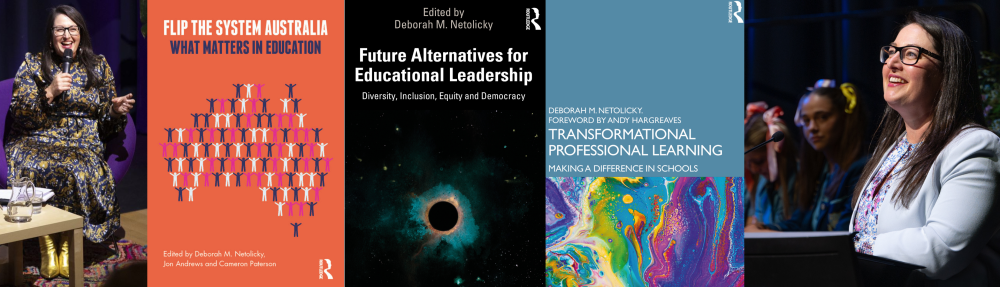
This week the book manuscript for Flip the System Australia: What matters in education, has moved from the editorial team to the production team at Routledge. It is ‘in press’, which means that the full manuscript will be copy-edited, typeset and a cover designed. You can check out the contents and pre-order it here.

The book is edited by Jon Andrews, Cameron Paterson and I. It includes a collection of 27 chapters by a range of educators, mostly from Australia but also perspectives from around the world. The contributing teachers, school leaders, educators and scholars are: Jon Andrews, Gert Biesta, Susan Bradbeer, Paul Browning, Carol Campbell, Keren Caple, Kelly Cheung, Flossie S. G. Chua, Rebecca Cody, Benjamin Doxtdator, Scott Eacott, Melissa Fotea, Carla Gagliano, Ryan Gill, Dan Haesler, Gavin Hays, Andy Hargreaves, Adam Hendry, Anna Hogan, Melitta Hogarth, Tomaz Lasic, Ben Lewis, Bob Lingard, Rachel Lofthouse, Kevin Lowe, Cameron Malcher, Chris Munro, Deborah Netolicky (me!), Michael T. O’Connor, Cameron Paterson, David Perkins, David Rutkowski, Pasi Sahlberg, Sam Sellar, Yasodai Selvakumaran, Greg Thompson, Ray Trotter, Shaneé Washington, and Daniel Wilson.

What draws the book’s contributions together is their ‘flip the education system’ theme. The Flip the System movement is not our own. The first book in the series (preceded itself by other publications, which we explain in the book) was Flip the System: Changing education from the ground up, edited by Dutch teachers Jelmer Evers and René Kneyber (2016). The Swedish version, Flip the system: Förändra skolan från grunden, was edited by Per Kornhall, Jelmer Evers and René Kneyber (2017). The UK version, Flip the System UK: A teachers’ manifesto, was edited by teachers Lucy Rycroft-Smith and Jean-Louis Dutaut (2018). Flip the System is a loose kind of series in which the notion of ‘flipping the education system’ evolves as diverse international voices explore what this might look like.

In previous Flip the System books, the editors and authors have called for a reprofessionalising of the teaching profession; an education system in which teachers are empowered to influence the education system, rather than being dictated to by top-down bureaucracy. When I explained this theme to a colleague recently, their response was laughing out loud. Is the idea, of teachers being empowered to shape the education landscape, laughable?

Certainly it is easy to feel disempowered as a teacher in an education system obsessed with measurement and competition. Education appears to be a political football constantly booted around for votes. It is also an increasingly corporatised arena in which companies peddle solutions and generate relentless data.

Can those in schools—teachers and school leaders, and even students—be empowered agents in the system, rather than fodder for the education machine? We think so.

To give an idea of the kinds of material covered by the book, sub-themes of the chapters in Flip the System Australia include:

  • Democratising education and addressing inequity.
  • Resistance to mechanisms or systems driven by performance, dehumanised measurement, increased competition, and constant edu-surveillance.
  • Replacing top-down accountability with support for teachers and teacher-led, inside-out reform.
  • Teacher leadership, autonomy, empowerment, and professionalism.
  • Elevating the voices of those working in schools.
  • Learning and leading for a system that honours those who spend each day in our schools, including teachers, school leaders, students and families.

As Jon, Cam and I have edited this book, we have realised why teacher voices are often absent from education debates. It isn’t just that teachers are not usually invited to decision making tables, or that they are often placed at the bottom of education power structures. There are ethical dimensions to our work which mean that we cannot always share our stories or give the media newsworthy soundbites. Our stories are also those of our students and our communities, and we are responsible for protecting them. Also, teaching is complex and demanding work, and teachers and school leaders are in the service of their students. Where is the time for contributing to the system when we are busily working inside the system?

We three editors each work full time in our schools. We have written our chapters and edited this book in our ‘leisure time’ (note the ironic inverted commas). I was surprised to realise that while we have each met each other (I have met Jon; I have met Cam; they have met one another), at no point have the three of us been in the same physical room together. The magic of Skype, Zoom, Google Docs, Twitter, and Dropbox have meant that we could collaborate from afar, in our own timezones and our own time.

We have done this work, as Flip the System editors and authors have done before us, because we think that this book and these authors have something important to contribute to the conversation on education. We are thrilled to be able to give a platform to teachers, school leaders and education researchers. We are grateful for the generosity of the contributing authors. We know there are voices missing from this book, but we hope the book can be part of a move to diversify the voices to whom others listen around education.

Flip the System Australia is coming. And we can’t wait to hold a print copy in our hands.

You can follow the progress of the book on Twitter via @flipthesystemoz and #FliptheSystemOz.

Gonski 2.0: Promoting a deficit view of Australian teachers

eroded wall

source: pixabay @aitoff

There are things I like about the Gonski 2.0 report. I have written, for instance, about the promotion in the report of professional collaboration and learning for teachers and school leaders, and the suggestion that teachers need time to focus on teaching, and school leaders need time to focus on instructional leadership over administration. Education Minister Simon Birmingham has previously said that he hoped Gonski 2.0 would be a unifying basis for a focus on evidence-based classroom practice. There is little detail in the report around evidence-based classroom practice, although there is the recommendation for a “national evidence institute to share best-practice and evidence-based innovations faster and more widely.” I would suggest that the report is not a unifying one around which educators can rally.

What has made me uncomfortable is the deficit perspective it provides on Australian schools, teachers and leaders. For example, the statement that Australia has “an industrial model of school education that reflects a 20th century aspiration to deliver mass education to all children” seems a stretch. I know ‘industrial model’ is a favourite term from those wanting to push innovation agendas, but anyone in today’s Australian classrooms, from early learning to late high school, knows that they are hardly factories for unthinking worker bees. In fact, the criticism of Australian education as industrial 20th century factories of mass production sits in opposition to the basis of much of the report on economic imperatives and the need to prepare students for the future of work (or perhaps this is what it means to have a 21st century industrial model of education). The focus on data generation, data tracking and accountabilities, if anything, seems to promote education as more machine than human endeavour.

The report’s deficit narrative about education is based on the problem it poses: that Australian education has widespread “declining performance” and “performance slippage” as measured by PISA testing. This is the basis on which the report argues that “Australian education has failed a generation of Australian school children by not enabling them to reach their full learning potential.” Wow. As a number of scholars have argued—such as Sam Sellar, Greg Thompson and David Rutkowski in their excellent book The Global Education Race—while there are things we can learn from PISA, there is much that we cannot, and using PISA to compare education across different countries is often unhelpful and misleading. Singapore is singled out as an exemplar of PISA achievement, despite the fact that its school cultures, curriculum and education practices are at odds with the Gonski 2 report’s suggestions of learning progressions and individualisation of learning.

The report calls many schools “cruising schools” and explains that these are schools that are maintaining average achievement from year to year, but not improving. The rhetoric of ‘cruising schools’ and ‘one year’s growth per year of schooling’ (also prominent in the report) has been used by Professor John Hattie for some time. Yet it constructs schools whose academic achievement remains steady but not improving as somehow coasting along (lazily or incompetently seems to be the implication) without progress, according to NAPLAN data. Apart from the fact that NAPLAN itself has been often called into question as a measure of student learning, the report surmises that “the explanation might be that Australian teachers, schools systems and schools are not equipped to identify and effectively support cruising students and schools to improve.” Here the teachers, schools and entire education system are posited as the reason for schools whose achievement appears steady but not improving, when NAPLAN data is used as the measure of achievement.

The report proposes that Australian education needs to do a number of things that I would argue most Australian educators are already doing: continuously improve our practice and service to our students; set high expectations for students, educators and schools; adjust our teaching for the needs of our students; and—my favourite—“maximise each student’s learning growth each year, rather than simply supporting each student to attain the minimum proficiency for the year level.” That last one is one I am sure many teachers read with a double-take, because I don’t know a teacher or a school who sees their job as to ‘simply support each student to attain the minimum proficiency for the year level.’

Teachers around the country already focus on student data, formative assessment and responding to student needs, something the report promotes as ways forward. Tailored teaching is given a fairly broad definition in the report. It “involves adapting the way the curriculum and learning activities are presented and adjusting pedagogy to the different needs of students based on evidence about the most effective interventions, gained from an understanding of individual students’ starting points and their growth in learning.” The report is hazy on the details of what ‘individualised learning’ and ‘personalised learning’ look like, how personalised it is expecting teaching and learning to be, and how this dovetails with preparing students with the knowledge, skills and understandings they need to be ethical, empowered and contributing citizens.

There are places where the report acknowledges work that has been and is being done in Australian education. It additionally provides Australian case studies of what it considers to be good practice, and direct quotes from submissions it received from various stakeholders, showing that it has listened to Australian educators. It has a whole chapter entitled ‘Creating, supporting and valuing a profession of expert educators’, but seems to base this on the premise that teachers aren’t currently good enough and need to be improved. It is hard to wade through the Gonski 2 recommendations without feeling like ‘supporting and valuing a profession of expert educators’ isn’t really something in which the review panel believes. On reading the Gonski 2 report, it is hard to move past the distrust of the teaching profession underlying its content and the deficit narrative to which it seems to be contributing. Australia is not Singapore, Shanghai or Canada, all education systems held up as exemplars in the report. Of course we can and should improve Australian education. Of course we should have high expectations of students and educators. Of course we should develop our knowledge of effective teaching, learning and leading. Of course we should continue to develop our engagement with research and evidence. But Australian education is not a factory model of mass education production. It is not a calamitous problem to be solved, a bunch of broken individuals to be fixed, or a commercial opportunity ready to be flooded by corporate solutions. Australian teachers, school leaders and schools deserve trust, respect, support and involvement in policymaking.

Individualising staff performance development

doorway, Oia, 2008

This year at my school we are trialling a different approach to performance development and review processes. Historically, we have had a range of processes and each year staff have been assigned to the process they are ‘up for’ based on a chronological cycle. This has tended to mean that in the first year of employment at the school, staff go through a probation process. The next three years have involved a linear cycle of two years of coaching around teaching practice, followed by a year in which the staff member engages in reflection and performance review with their line manager around their role. And so on. Each year staff also have a reflection and goal-setting conversation with their line manager, which functions as an important check-in for the manager and a key feedback process for the staff member.

These processes aim to engender trust, build capacity, and provide support, while also facilitating a relationship between person and manager around performance, development, and needs. They are founded on a belief that our staff are capable professionals who have the capacity and the will to grow professionally; and an expectation that they will endeavour to improve, no matter how good they already are. Data, research, coaching, collaboration, mentoring, and self-reflection are all tools embedded into these processes.

Yet, despite the best intentions of these processes, and their basis in research, some staff have felt that the school-based development processes have not met their needs, or have not been meaningful. It has had me wondering:

How might school-based performance development be differentiated to meet the needs, aspirations and career stages of staff?

So this year we are trialling a non-linear, more individualised approach to our performance development. Teachers, for instance, will negotiate with their manager a choice from a number of options. Options for teaching staff include:

  • Coaching around practice with a teacher trained as a Cognitive Coach; involves using low-inference data for reflection and capacity building within a confidential and trusting space; leaders can opt to be coached by a peer or other leader
  • Working with an expert teacher who acts as a kind of classroom consultant; might include team teaching and mentoring with specific advice around classroom practice.
  • A reflection and feedback process with their line manager (which needs to happen every 3-4 years)
  • An internally-designed leadership development program for aspirant or early career leaders; includes leadership profiles, school leaders running sessions
  • A professional learning group, bringing staff together from across the school to engage in scholarly literature, reflection, and shared practice.
    • Teaching best practice
    • Pedagogies of learning spaces
    • ICT for teaching and learning
    • Post-graduate study

All staff will continue to complete their yearly reflection and goal setting conversation with their line manager. In order to support this work, all our school leaders, many of whom have previously completed the Cognitive Coaching Foundation course, are undertaking GROWTH Coaching training. This training will help them to guide and enhance the goal setting of the people they manage, and it supports our organisational belief (based in research and knowledge of our own context) that coaching is a powerful vehicle for building individual, collaborative and organisational capacity. We will also continue to provide additional leadership support and development.

The above options do not cover everything that educators do to develop themselves and others. All managers regularly check-in on the performance of their staff; they do not wait until the rigorous formal process rolls around. We have staff who mentor pre-service teachers, contribute to professional associations, present at conferences, write textbooks, or complete post-graduate study. The above school-based options do, however, provide a more flexible suite of alternatives that honour where our staff are at in their career journeys. As always, we will ask for honest feedback from staff as we seek to find ways to serve our students, staff, and the shared purpose of the organisation.

Building a school research culture

source: pixabay.com @ninocare

This year has been my first in a new role, the oddly titled ‘Dean of Research and Pedagogy’. I have a broad portfolio, including such things as pedagogy from PK-12 and overseeing the work of the Library, but two major aspects of the role are:

  • Building a professional learning culture of continual improvement, data generation and analysis. This includes overseeing the professional learning agenda and staff development, overseeing teacher action research projects, supporting our staff doing post-graduate study, leadership development, coaching teachers and leaders, and refining performance and growth processes.
  • Research innovation and support. This is about disseminating and building a body of research that promotes quality pedagogy and teacher improvement, executing evidence-based strategic initiatives, and working to develop a data analytics culture.

I sat down at the beginning of 2017 to map out how I was going to address these aspects of my role. What was the underlying strategy? What were the deliverables? Who were the key stakeholders? At the end of each year, how might I know I had been successful? What evidence of my own influence might I see if I was being successful in nudging the ever-nebulous school culture?

I wrote a two-year strategic plan (a working document that I revisit regularly) and put some measures for myself in place.

What follows is not my plan or those measures, but the kinds of things I have tried this year in my attempt at developing the research culture of the school.

  1. Harnessing internal and external expertise

As I explained in this recent blog post, staff development can include coaching, mentoring, consulting, courses, conferences and regular opportunities for goal setting and performance review. It includes collaborative learning experiences and those that occur over time. It includes harnessing both external and internal expertise.

This year a new initiative related to my role was called the Leadership Forum, a once-per-term cheese-and-wine event dreamt up and co-launched with the Director of Strategy. All of our school leaders, from Coaches and Year Co-ordinators to Heads of Faculty and the Executive, are invited each term to an early evening of cheese, wine, and connecting around leadership. This is an opportunity to connect the strategy of the school with the operational and relational work of our leaders.

The first Forum of the year was run by myself and the Director of Strategy, in which we took leaders through a process of reflecting upon research findings on effective school leadership, and then worked with them to set goals for themselves and their teams, aligned with the strategy of the organisation. For the second forum, we welcomed Professor Dylan Wiliam. For the third we ran a panel of three principals who spoke openly about their journeys of school leadership. And this final term, we welcomed Professor Pasi Sahlberg. This Forum provides one example of a way to engage teachers and leaders in current conversations around education, and with research and researchers.

Bringing experts into the school, and having them speak to our context, meant that their words and points connected more strongly with the people in the room. Also, staff enjoyed the collaborative experience of hearing them speak, together, so conversations have continued well after each presentation finished. Creating these kinds of crucibles of collaboration, and following up with books or articles that build upon the presentations, has been one way to nudge people’s thinking, especially when presenters are provocative or challenging.

  1. Research reports

I have published six of what I call the ‘Research Report’ to staff this year. The report is intended to provide all staff access to current thinking, research, and writing, around education. Across the year the report provides resources (from academic and theoretical, to popular and easily accessible) relevant to our specific school context, including to various sub-schools, faculties, and strategic priorities. The selected readings are a small selection rather than a comprehensive collection. Staff are encouraged to dip in and out according to their personal and professional interests.

I have been interested to note those people who have provided positive feedback about the report; many are non-teaching staff—from the Bursar to the administration staff—who have appreciated being able to immerse themselves in, or dip into, educational thinking, and have this shared in an accessible way. Making research accessible to all democratises the community and empowers everyone to have conversations around education. It has incited many corridor conversations, as well as more formal ones.

  1. Publishing on school platforms

Research is partly about communication and dissemination. In a school environment it is important that research can be made accessible for the community.

This year, on the school blog, I have written about things such as measuring success in education, professional conversations, and digital learning. In these posts I have referenced research in order to model how research can inform the thinking of educators and schools.

I was interviewed for the school podcast around the question, ‘What makes a great teacher?’, and I’ve written for and presented at other forums, in school and nationally.

Communicating in blogs, podcasts, and presentations, allows research to become alive and humanised.

  1. Keeping the staff professional reading library current

I am a card-carrying member of The Book Depository and have ordered plenty of resources for the professional reading library at school, in order to provide staff with the opportunity to engage with current research. At the end of each term, I promote a selection of books by emailing about them and placing them on a red trolley for the end-of-term staff morning tea in the Library.

I remind staff that professional reading can be counted as an informal professional learning activity under our Teacher Registration Board Professional Learning Activities Policy, so they can log it as part of their 20 professional learning hours per year for teacher registration.

  1. Keeping myself current

I could not do this role without keeping myself up to date with research. My adjunct position at a university helps to keep me current (as I have access to research literature behind the pay wall). It also allows me to do thorough literature reviews, such as those I have completed this year on digital learning and school libraries. I now have staff asking me to find current research literature for them to inform the work they are doing.

  1. Collaboration

It should go without saying that none of this happens without collaboration with a web of stakeholders. Relationships are key in this role. There’s no point me being in my office, reading away like the nerd I am, if no one is engaging with me or the work. Much of my day is spent in formal meetings or informal conversations.

One of the indicators of my success is when people seek me out, such as for individual coaching around career or professional development or a staff issue, to work with a team around a problem of practice, to generate data to gauge their impact, or to help with a Masters dissertation or PhD application.

One challenge to anyone in this kind of Research Lead role is the reality of the lives of teachers and school leaders. Educators are busy, pressed on from all angles, constantly rushing to their next class, to mark their next assignment, to jump through the next accountability hoop. Leisurely time and space to sit back and drink from the fire hose of current research literature is a fantasy. In addition, as this Deans for Impact blog post explains, teachers have deeply held sets of cultural and personal beliefs about learning and about how to best serve their students.

Engaging in research, and in discussions and explorations about research, can help teachers to interrogate those beliefs and bring together science, evidence, and systematic thinking with their praxis (wisdom of practice). We should value teachers’ lived experiences of lessons, relationships, students, and bringing content to life through pedagogy. We can also work to incrementally develop school cultures in which research becomes a part of ‘the way we do things around here’.

The power of clear messaging

Cervantes sign

Cervantes sign

While professional learning is the internal process of knowing, learning and becoming, professional development tends to refer to activities, courses, sessions, talks or conferences that teachers attend, voluntarily or otherwise. While it’s more trendy now to say ‘CPD’ (continuing professional development) than ‘PD’, one-off rather than sustained learning continues to pepper the lives of teachers as they and their schools attempt to improve themselves, keep up to date with the profession and meet legal and professional requirements.

The Australian school year has begun, which means that teachers have been given the opportunity to enjoy or endure staff days. Staff days prior to the commencement of the academic year tend to include time for planning, collaboration and setting up classrooms, as well as guest speakers, seminars or the kind of scattergun PD that hopes to land somewhere in the audience and maybe make a difference.

How do schools make decisions as to what kinds of development, collaboration and individual growth they facilitate for their staff? Especially in light of provocative reports like that from the TNTP (2015), The mirage: Confronting the hard truth about our quest for teacher development, which suggested that we do not yet know what helps teachers to improve the quality of their instruction? The TNTP report (of a two year study into teacher professional learning of over 10,000 teachers and 500 school leaders in three USA public school districts) found that, despite schools and systems investing time and money into professional learning of teachers, no clear patterns emerged to suggest which deliberate efforts improved teacher performance, as measured by teacher evaluation scores (using the education district’s final evaluation score, calculated using the district’s official methodology).

The TNTP report did note one school system whose teachers and students consistently performed better and improved more than the three public school districts. The report states that this better-performing, teacher-developing system had a more disciplined and coherent system for teacher development, a clear vision of success, and a network-wide culture of high expectations and continuous growth. Coherent system. Clear vision. Cohesive culture.

This year, my school decided not to invite a dizzyingly inspirational guest speaker or enlist the services of an external expert to run PD with our staff on those days. Instead our focus was on honouring, respecting and utilising internal expertise, and on communicating clear messaging around the school’s strategic priorities for the year. Valuing tacit knowledge and lived professional experience was important, as the strategic priorities were not new, either for the school or in education. The message, from the school executive and senior leadership team, to teachers, psychologists, education assistants and non-teaching staff, was that there are three key priorities for the year, summarised as three simple words. And that none of these was new, but rather things that teachers and other staff engage in every day, in and out of their classrooms.

What we aimed to do on our staff days was what Hargreaves and Shirley describe in their book The fourth way: The inspirational future for educational change as “explore the nitty gritty challenges of their practice through thoughtful exchanges with colleagues and in relation to relevant research” (2009, p. 93). We provided presentations from internal experts and leaders, including a panel of community members, as well as accessible readings and time for colleagues to collaborate with one another, both in their teams and with others from across the school.

The sense I got from our staff days was that staff were:

  • Relieved at the lack of new initiatives and the deliberate slowness in rolling out current projects; we continue to move forward, but in a measured way.
  • Comfortable with the clarity, simplicity and consistency of the messaging.
  • Grateful to be informed of and included in the strategic direction of the school.
  • Energised by the opportunity to work in a structured way with colleagues, around how the school’s strategic priorities would come alive in their own contexts.

I am often inspired by Ellie Drago-Severson’s work on adult learning, and the notion of the ‘holding environment’ as one of high support and high challenge, where people feel both ‘held’ and encouraged to be their best. Additionally, plenty of literature around school change talks about the need for shared vision, as does the 2016 ACER Professional Learning Community Framework for Australian schools. It is worth considering at length how to share school vision with the community so that it is lived, breathed, understood and propelled by those across the organisation. Everyone from the principal to parents and students have a part to play in knitting a community together around a common purpose. This year, those three words communicated from the executive down are helping to bind our community more closely together with common vision and shared purpose.

Rethinking professional learning: an academic paper for JPCC

This week I’m thrilled to see my paper ‘Rethinking professional learning for teachers and school leaders’ published in the Journal of Professional Capital and Community. This journal, whose Editor in Chief is Andy Hargreaves, boasts an Editorial Board including Linda Darling-Hammond, Michael Fullan, Alma Harris, Karen Seashore Louis, Pasi Sahlberg, Helen Timperley and Yong Zhao. My paper appears in Volume 1, Issue 4, alongside a theoretical paper by Dennis Shirley. As an early career researcher, I couldn’t ask for more distinguished company.

Even more pleasing is that the journal is open access during 2016, so free for anyone to download and read. Open access to the paper means that it can be accessed by practitioners who so often don’t get to read and engage with the literature in (often pay walled) academic journals. In fact, it has already been downloaded (at today’s count) 1689 times. Wow. That’s a bunch more times than my PhD thesis.

The paper, which draws from the lived experiences of teachers, middle leaders (often a forgotten group in education literature) and executive leaders in one Australian school, outlines the findings of my PhD around what makes professional learning that transforms beliefs and practices. It discusses my study’s response to the questions:

  1. What is the role of professional learning on identities or growth?; and
  2. What professional learning is transformational?

My PhD found that transformational learning (as defined by Ellie Drago-Severson, 2009, as that which actively shifts cognition, emotion, and capacity) is: collaborative and individual; occurring in life, school, and work; and requiring elements of support and challenge. Not only was it lifelong, but it was life-wide. For these participants, it is life experiences, as well as professional experiences, that influence their professional beliefs and practices. The following is a table, which didn’t make the final cut of the paper, shows the range of features of professional learning found in my study.

tabulated findings around professional learning

tabulated findings around professional learning

This table shows the variety of experiences that educators in my study considered transformational for themselves. These experiences included relationships with family members; role models and anti-models of teaching and leadership; post graduate study; difficult life experiences; becoming a parent; and connecting with others at conferences or via social media. It included heutagogical (self-determined) learning, as I outlined for this blog post for the Heutagogy Community of Practice.

It also included, especially for leaders operating at an executive level, the time and space for silence, reflection and thinking. The research interviews themselves proved to be spaces of learning for some of the school leaders, who saw them as an opportunity to be listened to intently and to think deeply about their learning and leading.

The participants in my study had some important cautions about professional learning and about school interventions. They cautioned that a mandated approach to professional learning, even if differentiated, might not address the needs of all professional learners. They wondered about how to honour the individual teacher and the organisational priorities when leading professional learning in schools.

The paper concludes that, while my study intended to explore the ways in which educators’ experiences of professional learning form and transform their senses of professional identity, it found that it is not just professional learning, but life experiences that shape professional identities and practices. That is, our teacher selves and teacher actions are moulded by critical experiences that tangle with and shape our identities, lives, relationships, and emotions. The best professional learning, as suggested by this study, is highly individualised and knottily enmeshed with educators’ senses of self, of who we are professionally.

Anyone who teaches knows that we cannot separate our teacher selves from our non-teacher selves. As teachers our lives affect our learning and teaching, and our learning and teaching influences our lives. For many teachers, ‘life’ and ‘work’ are well beyond blurred. We are humans who teach and teachers who exist as humans in the world. The leaders in this study tended to describe themselves as either teachers who lead or as leaders who teach; they remained teachers in their identity self-perceptions. See this post for further musings about the notion of teacher identity, that ‘being a teacher’ stays with many of us beyond our years in the classroom.

One suggestion to emerge from this paper is that we would benefit from rethinking what it is that we consider and label as ‘professional learning’. Professional learning is not hours logged on a spreadsheet or entered into an app. It is not necessarily being in a room with other educators at a course or conference that is labelled ‘professional learning’ (although it might be). It is those critical moments across our lives and work that shape the core of who we are, in and out of the classroom and the boardroom. Professional learning can be personal, unexpected, unscheduled, nonlinear, messy, unbounded, and unacknowledged.

Can we redefine ‘professional learning’ in more expansive and flexible ways? How might we acknowledge those hours educators spend blogging, or studying, or tweeting, or visiting schools, or collaborating intensively, or volunteering in the service of others? How can leaders lead the learning of teachers in ways that honour their individual learning trajectories and their own agency? How might we rethink our systems and schools in order to focus, not on hours of what is easily labelled or effortlessly deployed (staff day scattergun PD, anyone?), but on what actually engages us and changes our cognition and our capacities?

Trust and support teachers: My New Voice Scholarship panel speech

speaking yesterday at the Melbourne Convention Centre

speaking yesterday at the Melbourne Convention Centre

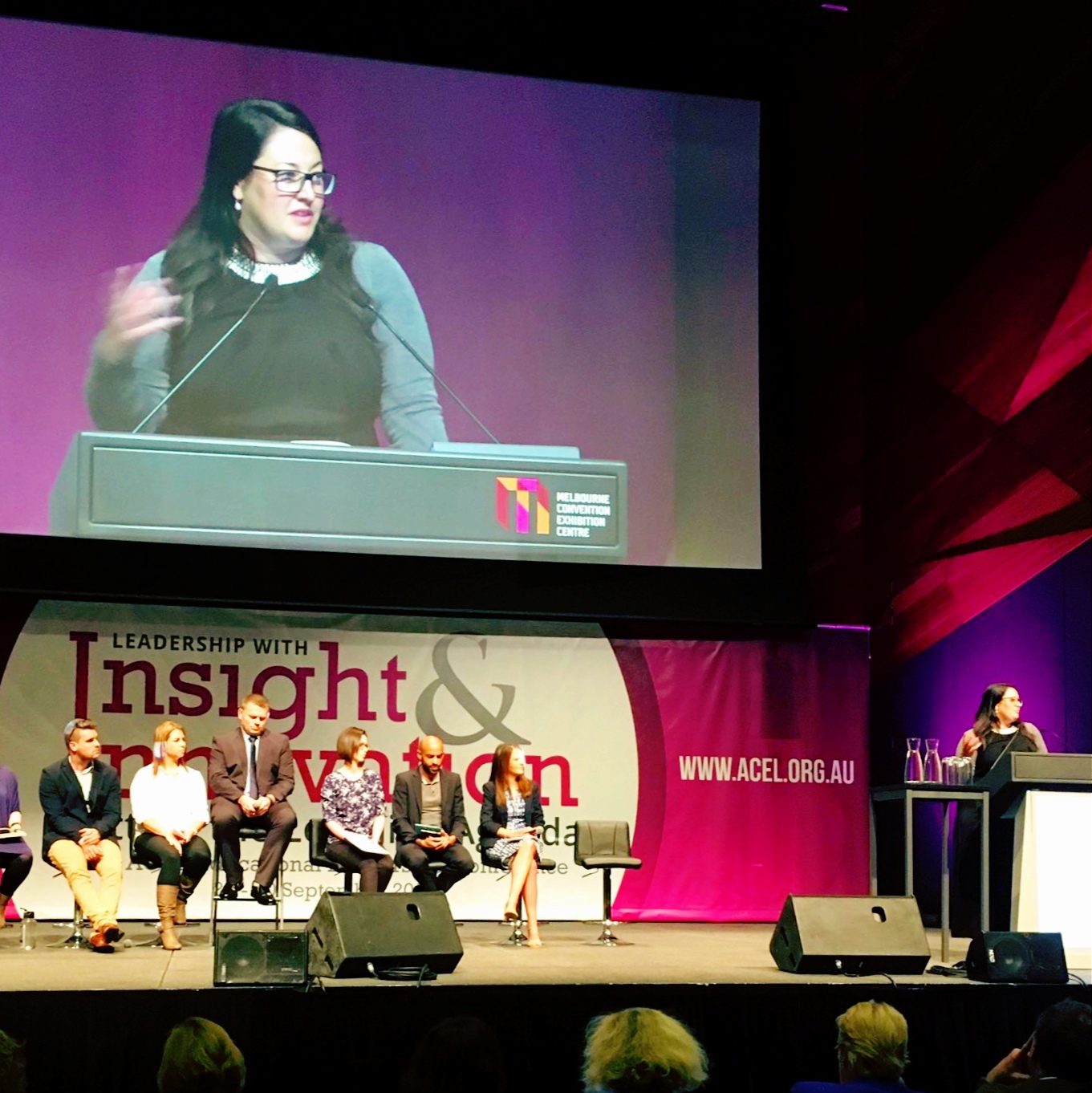
Yesterday I had the pleasure of speaking on a panel of ACEL New Voice Scholars (list of awardees here) at the Melbourne Convention Centre. As a representative of new Australian voices in educational leadership research, I spoke in front of an auditorium of 1200 educators in response to the provocation: ‘If you could wave a magic wand, how would you transform education?’

The following is a version of that speech (I tend to go off the cuff a bit, so it’s not identical). It is based on this think piece I wrote for the ACEL Perspectives publication which is more measured and referenced, and less rhetoric-laden than my speech. I’ve added links to other blog posts to this post, as feedback from those at the conference has been that they would like to know more about the school professional learning model about which I spoke.

Thank you to the Australian Council for Educational Leaders for offering me the platform-soapbox-orangecrate from which to speak passionately about what I think is important for leaders, teachers and students in our schools.

*                                                      *                                                      *

(Hello etc. …)

I am an English teacher by trade and have spent the last 17 years teaching and leading in schools in Australia and the UK. Most recently I have been leading a strategic project that developed a whole-school coaching model at my school, designed to do a number of things, including:

  • Improve teacher classroom practice;
  • Develop teachers’ capacities for reflection;
  • Depersonalise and open classrooms;
  • Develop a common language of practice; and
  • Improve the quality of professional conversation.

This intervention was strategically aligned, so it was top down in terms of being aligned with the strategic vision of the school, initiated by the principal and supported by the school board. But it was also middle out and bottom up, as the model was developed by teams of teachers, led by me. We took a deliberately slow process of prototyping, piloting, iterating and refining this context-specific intervention.

At the same time, while also parenting two small children, I completed a PhD in which I asked what it is that makes professional learning transformational and how school leaders can best lead professional learning for teachers.

(It was at this point that I said something like, “My doctorate was conferred in April, so if you see me around the conference, you can call me Dr Deb” which has resulted in everyone from the MC to delegates calling me ‘Dr Deb’ ever since!)

As someone who bestrides educational practice and research, I don’t believe there is a silver bullet or magic wand that can transform education, but I do believe we can work to positively influence it.

Two things we can focus on, in order to positively impact on our students’ learning, are the trust and growth of teachers.

At my school, we have developed a model for teacher growth that uses Cognitive Coaching, non-inferential lesson data, and the Danielson Framework for Teaching, to help teachers reflect on and grow their practice.

Non-inferential lesson data—that is, data that is, as much as possible, non-judgemental and informational—and shared standards of teaching, help our teachers to develop the depth and precision of their reflections on practice, while Cognitive Coaching helps teachers to surface their own thinking about how they can improve. Cognitive Coaching is not about solution-providing or advice-giving, but about mediating the thinking of teachers and helping them to find their own solutions to problems of practice, based on a belief in their internal capacity to do so. To paraphrase Dylan Wiliam: teachers know their own classroom and their own students best.

My PhD found that coaching, among other things, can transform teachers’ beliefs and practices. It also found that school leaders have an important part to play in leading the learning of teachers.

We need to avoid those policies and practices that pit teachers and schools against one another (such as merit pay), that promote competition and commodification, or that focus on external metrics, performative measures, rewards or punishments. These are all things that demotivate, de-professionalise and demean our profession.

To support teacher professional growth and improvement in practice, we need to focus on trusting teachers to be professionals with the capacity to grow. We need to properly support their growth through context-specific interventions for which we provide adequate training, sufficient time, appropriate resources, and processes to systematically review our effectiveness.

In this way, within our own schools, we can heighten teachers’ self-awareness, self-efficacy and collaborative expertise and positively influence student learning.

Mapping quality teaching

Sidney Poitier in To Sir, with Love Source: http://www.rockshockpop.com/forums/c

Sidney Poitier in’ To Sir, with Love’. Source: http://www.rockshockpop.com/forums/

This is the third post in a series of posts on quality teaching. You can also read:

Part 1, which explored the terms ‘teacher quality’ and ‘quality teaching’; and,

Part 2, which outlined those things that effective teachers have been found to do.

*                 *                  *

If we accept that the quality of what teachers do in their classrooms influences student learning, and that quality teaching has some agreed characteristics, what can teachers, schools and systems do? How does the profession come to a common understanding of what good teaching looks like? Amid teaching debates like ‘traditional vs. progressive’, what is it that teachers should be striving to do?

Some question and warn against the itemising of teaching into a set of prescriptive elements, and many agree that attempting to quantify the complexity of teaching is fraught with difficulty. Many scholars and educators have nonetheless worked to identity what quality teaching looks like and what effective teachers do, trying to capture what teaching encompasses. These authors attempt to detail, describe, interpret, and evaluate the elements of teaching; to find what quality instruction looks like and the conditions necessary for developing the quality of teachers’ instruction.

Many authors suggest that in order to develop their teaching, teachers need a ‘map’ of where to go and how to get there. In his 2004 book Successful school change, Claude Goldenberg reflected on his work with a USA primary school over five years. He noted that the school and teacher change model he and the principal implemented was too abstract and unspecified. He added that “we should have been more nuts-and-bolts oriented, in the sense of specifying more clearly what teachers were to do in various settings, including their classrooms” (p. 173).

In order for teachers to improve, not only do teachers have to want to improve, they must know how to improve and on what aspects they would benefit from focusing their attention. Schools can benefit from frameworks that provide the knowledge base of what good teaching looks like, as well as processes that facilitate the improvement of practice. A map of teaching involves a clear set of agreed standards and a way to think systematically about the complexity of the task. Mapping teaching can be less about identifying quality and proving teacher performance. It can be about empowering teachers to improve, developing a common understanding and shared language of practice.

Examples of attempts to address the need for a framework or map of the intricacies of teacher practice include the Danielson Group’s Framework for Teaching, the Marzano Causal Teacher Evaluation Model, and the Australian Institute of Teaching and School Leadership (AITSL) National Professional Standards for Teachers.

The Danielson Framework for Teaching, endorsed by Dylan Wiliam in his 2016 book Leadership for Teacher Learning, has been shown to: identify the most effective teachers and positively correlate their quality with student achievement gains; focus observers’ attention on specific aspects of teaching practice; establish common evidentiary standards for each level of practice; and create a common vocabulary for pursuing a shared vision of effective instruction. Students showed the most academic growth in classrooms with teachers who rated highly on the Framework, and the least academic growth in classrooms with teachers who received the lowest ratings.

Marzano’s model has also been tested in studies and meta-analyses, which report that using the instructional strategies of the model improves student achievement and helps teachers develop themselves professionally.

In evaluating the perceptions of the AITSL Professional Standards, AITSL has found that pre-service teachers were the most enthusiastic about the potential of the use of the Standards in their practice and their students’ learning, school leaders were most engaged in the implementation of the Standards, and non-pre-service teachers were least likely to perceive the Standards as useful in changing their practice or impacting their students. AITSL’s measures have concentrated on educators’ perceptions of their tool.

Frameworks such as Danielson’s, Marzano’s, and AITSL’s may have a place in helping teachers to achieve clear, measurable targets, but schools and systems using these tools need to be considered in their purpose and process of their implementation. My school uses the Danielson Framework (overlaid with the national AITSL Standards) as a third point in conversations, in order to help novice and veteran teachers to reflect on their lessons with specificity. It is a tool, as part of a large toolbox, for developing shared understanding.

My PhD study found that the Danielson Framework for Teaching, when used as part of a non-judgmental model of teacher growth, helps to develop teachers’ precision of reflection around teaching practice and a common language for talking about teaching and what it can look like. At my school, teachers who develop familiarity with the Framework and its descriptors find that while teaching they mentally aim for the descriptors of ‘Distinguished’ teaching; knowledge of the Framework shapes their decisions and their classroom practices.

As much of the world grapples with how to wrestle the octopus of ‘teaching’ into a small, rigid glass jar of pithy statements or political one-liners, we need to be wary of atomising teaching into disparate parts, but we can be equally open to tools that might help us deepen our professional understandings and practices. We can focus on dialogue, interrogation of practice, reflection, collaboration and growth, and on researching and critically appraising the frameworks and measures available to us.

What do ‘quality teachers’ do?

Jaime Escalante in 'Stand and Deliver'. Source: http://remezcla.com/film/edward-james-olmos-on-stand-and-delivers-25th-anniversary-and-the-release-of-filly-brown/

Jaime Escalante in ‘Stand and Deliver’. Source: http://remezcla.com/film/

This is Part 2 in a series of posts on ‘teacher quality’ and ‘quality teaching’. You can also read Part 1 and Part 3

In response to my last post, I’ve received a lot of comments from those who bristle at the use of the term ‘teacher quality’ to label teachers and demean the profession; it is, however, a term used profusely in research and policy literatures. I’ve used the term here as shorthand for ‘teachers whose practice positively influences student learning.’

*                 *                  *

As the quality of teachers’ teaching is generally agreed to be an important school-based influencer of student achievement, researchers have attempted to identify aspects of teaching as demonstrating evidence of positive effect on student achievement.

In reviewing literature for my PhD, I found five elements that emerged as agreed elements of what ‘quality teachers’ do. I have cited some of the references that mention each aspect, although there are larger webs of literature for each of the five threads explained below.

______________________________________________________

1) Quality teachers purposefully design learning opportunities

Teachers have excellent knowledge of their content, pedagogies, their students, and how their students learn. They apply this knowledge to planning programmes, lessons, student groupings and assessments with clear, transparent performance targets. The purposeful designing of learning opportunities is articulated in references such as Bransford and Darling-Hammond’s Preparing teachers for a changing world: What teachers should learn and be able to do, Shulman’s (2004) essay ‘Communities of learners and communities of teachers’, and Linda Darling-Hammond’s seminal The right to learn: A blueprint for creating schools that work.

2) Quality teachers diagnose student progress to inform both teaching and learning

Grant Wiggins and Jay McTighe (in their 2007 Schooling by Design) wrote that teachers facilitate the setting of challenging goals and high standards, designing the work so that learners believe in their own capacity for success, and adjusting plans in light of unexpected or inappropriate results. Jim Rose in his 2006 Independent review of the teaching of early reading noted that high quality teaching should inform realistic and ambitious target-setting.

3) Quality teachers fight for their students’ learning

A couple of references point to the importance of advocacy in teaching. In 1986, Philip Jackson argued that effective teachers fight for what they believe about teaching and learning, acting independently to advocate for their students. Wasley, Hampel and Clark (1997) spent three years observing and interviewing six students in five USA schools for their book Kids and school reform. They found that good teachers believe that each of their students can learn; and have the skills and capacity to engage in debate on behalf of their students’ learning.

4) Quality teachers personalise learning for students

Teachers balance the needs of the learner, the knowledge and skills students need to acquire (what they teach and why), assessment and feedback, and embeddedness in community. They select appropriate classroom design, instructional strategies, and subject matter to help each student learn, with a diversity of teaching methods including: reciprocal teaching, direct instruction, problem solving methods, explanation, elaboration, modelling, plans to direct task performance, sequencing, drill repetition, optimising peer learning, providing strategy cues, domain-specific processing, clear instructional goals, setting challenging goals and teaching students self-verbalisation and meta cognitive strategies. They respond with immediacy and a sensitivity to the here-and-now, showing flexibility by valuing freedom of thought and movement in the classroom. The emphasis on sensitivity towards, and individualisation of approaches for, students, is evident in Bransford and Darling-Hammond’s Preparing teachers for a changing world: What teachers should learn and be able to do and Philip Jackson’s The practice of teaching.

5) Quality teachers provide meaningful and appropriate feedback.

In Schooling by Design, Grant Wiggins and Jay McTighe pressed the importance of backwards assessment design, providing ongoing feedback with immediate opportunities to use it, and implementing strategies to develop learner autonomy, thus making self-assessment and self-adjustment a key goal of teaching. The work of Dylan Wiliam and Rick Stiggins promotes formative assessment as a way to frequently check for understanding and to engage students in self-reflective, self-regulated learning.

______________________________________________________

The above-mentioned studies suggest that quality teaching requires teachers to have a sound and continually developing knowledge of content and pedagogy. This supports the definition of teacher quality I identified in my last post: ‘knowing what to teach and knowing how to teach’. Quality teaching, according to the above cited works, involves teacher self-reflection, planning of well-structured units and lessons, focusing on higher order thinking, managing the classroom effectively, utilising an arsenal of effective teaching strategies, individualising learning, setting challenging goals for all students, knowing where each student is ‘at,’ facilitating each student’s progress to the next level, and giving effective, targeted, timely feedback.

Anne Freese (in her 1999 paper ‘The role of reflection on pre-service teachers’ development in the context of a professional development school’) describes herself as an educator (albeit in a higher education, rather than a school, context, so perhaps from a potato perspective) and in doing so resonates with the above threads of quality teaching:

I am more like a coach who structures the learning events and co-inquires. . . . I have become more comfortable modelling and making public my thinking about teaching, and risking being vulnerable as I put my own teaching under scrutiny. This is a different role from that of being the `expert’ and the dispenser of knowledge. (p. 908)

Here Freese underscores the teacher’s purposeful designing of learning by structuring what she calls “learning events,” suggesting deliberate design of student-focused learning experiences. She makes her thinking “public” and sees herself as coach and co-inquirer, vulnerable in her collaboration as co-learner with her students. Freese highlights the notion of self-reflection in her comment about having the willingness and capacity to put her “own teaching under scrutiny.” Freese’s description reflects Wiggins and McTighe’s description of those teachers who demonstrate ‘quality’ practice as designers, diagnosers, facilitators, and constructors of learning and learners.

As teachers, schools and systems have conversations around how to improve the learning of students by improving what happens in classrooms, it’s important that we continue to attempt to build a shared understanding of exactly what we mean when we say things like ‘quality teaching’.

Teasing out ‘teacher quality’

This post is the first in a series exploring the popular notion of improving teacher quality in order to improve student learning and achievement.

You can also read Part 2 ‘What do quality teachers do?‘ and Part 3 ‘Mapping teacher quality‘.

*                 *                  *

For some time, scholarly literatures have generally agreed that, within the school sphere of influence, the quality of teachers’ teaching is the most influential school-based variable in terms of improving student learning and achievement. (We need to remember, however, that student learning and achievement are influenced primarily by many factors that are hardest for policy makers and schools to influence, such as students’ attitudes and abilities, socioeconomic context, parents’ education and peers.) Now, everywhere we look in education there are institutes and government policies and school websites all hailing the catch cry: ‘teacher quality!’

The term ‘teacher quality’ is in danger of being subsumed in what I call the ‘hashtagification’ of education terminology, in which words like ‘mindset’ and ‘grit’ become ubiquitous platitudes shared in sound bites or 140 character tweets. When we use words in education, we need to read the literature and research about them, tease them out, and come to a shared understanding about what are often dense concepts around the complexity of teaching.

During my PhD I spent time (ok, years) reading up on, among other things, ‘teacher quality’. Its definitions, its features, studies that aimed to measure its impacts. While I can’t distil those years of reading into a blog post, this post is a starting point (for comments, conversations, future posts) as well as a call to others to spend time cogitating over and teasing out the terms we use in edu-spheres.

‘Teacher quality’ is used to denote the quality of teachers’ teaching, in terms of its effectiveness in adding value to student learning. While it is sometimes used in terms of the individual teacher, many scholars argue that teacher quality should be considered in terms of collaborative expertise, rather than the solo hero teacher (so wonderfully written about here by Corinne Campbell). That is, while an individual teacher can have an influence on student learning, a move to improve the quality of teaching (and thereby, student learning) needs to focus on teachers as a collective.

One of my favourite images of collaborative expertise comes from Susan Rosenholtz in her book Teachers’ workplace: The social organisation of schools. She writes that in learning-enriched settings “an abundant spirit of continuous improvement” seems to “hover school-wide, because no one ever stopped learning to teach,” describing educators in effective schools as “clumped together in a critical mass, like uranium fuel rods in a reactor” (1991, p. 208). That image is a powerful reminder of what we in schools and education might aim for: a critical mass of huddled-together teachers feeding off each other’s energies, knowledge and practices. It’s also why competitive or punitive measures, like performance pay for teachers, are damaging to the profession. Collaboratively improving teacher quality is based on a notion with which most teachers would agree: that no matter how good our teaching is, no matter how well-planned and well-intentioned, we can always improve.

Two definitions of ‘teacher quality’ resonated with me in my reading. Firstly, the Educational Testing Service, in their 2004 publication Where we stand on teacher quality, defines it as: knowing what to teach and knowing how to teach. This definition hones in on the planning, classroom instruction, and assessment aspects of teacher quality, on the professional knowledge and skills upon which teachers can build in their pursuit of improving the quality of their teaching. Secondly, in their best evidence synthesis of international research on ‘teaching for quality,’ Zammit et al. (2007) define teacher quality as consisting of three intersecting factors: sociocultural context; professional knowledge, skills and practices used to meet student needs; and personal, relational and professional attributes. This second definition reminds us that teachers’ experiences are always situated within their professional contexts and entangled with personal and relational experiences. Teaching is not just about knowledge and skills, but about identities, contexts and emotions, too.

Some of those who write about teacher quality focus on the impact of teaching on student achievement and the others consider how we might break down or compartmentalise teaching in order to distil and define what quality teaching is; how it looks, sounds, and feels, and how it might be mapped, measured, or developed. Many grapple with the tensions between the desire to define and measure teaching, and its immeasurable complexity. In my Australian school, we investigated a number of tools that attempted to map what good teaching might look like. We chose to use the Danielson Framework for Teaching as our frame for professional reflection and conversation. Its rubrics help our teachers to drill down into their own practice, and into the AITSL Professional Standards for Teachers, giving them a sense of what those standards can look like at various levels of practice.

Teaching is such a complex phenomenon, it shouldn’t be reduced down to clichéd catch cries devoid of meaning. Despite the problematic nature of defining what teacher quality actually means, much available research shows that what a teacher does in the classroom is a crucial determinant in improving student achievement, and something we should spend some time teasing out in order to understand it in more detail. When we use terms in education—‘teacher quality’, ‘growth mindset’, ‘coaching’, ‘grit’, ‘vision’—let’s ensure that we work hard at figuring out what those mean and where our understandings might be shared, incomplete or requiring further discussion.