Teasing out ‘teacher quality’

This post is the first in a series exploring the popular notion of improving teacher quality in order to improve student learning and achievement.

You can also read Part 2 ‘What do quality teachers do?‘ and Part 3 ‘Mapping teacher quality‘.

*                 *                  *

For some time, scholarly literatures have generally agreed that, within the school sphere of influence, the quality of teachers’ teaching is the most influential school-based variable in terms of improving student learning and achievement. (We need to remember, however, that student learning and achievement are influenced primarily by many factors that are hardest for policy makers and schools to influence, such as students’ attitudes and abilities, socioeconomic context, parents’ education and peers.) Now, everywhere we look in education there are institutes and government policies and school websites all hailing the catch cry: ‘teacher quality!’

The term ‘teacher quality’ is in danger of being subsumed in what I call the ‘hashtagification’ of education terminology, in which words like ‘mindset’ and ‘grit’ become ubiquitous platitudes shared in sound bites or 140 character tweets. When we use words in education, we need to read the literature and research about them, tease them out, and come to a shared understanding about what are often dense concepts around the complexity of teaching.

During my PhD I spent time (ok, years) reading up on, among other things, ‘teacher quality’. Its definitions, its features, studies that aimed to measure its impacts. While I can’t distil those years of reading into a blog post, this post is a starting point (for comments, conversations, future posts) as well as a call to others to spend time cogitating over and teasing out the terms we use in edu-spheres.

‘Teacher quality’ is used to denote the quality of teachers’ teaching, in terms of its effectiveness in adding value to student learning. While it is sometimes used in terms of the individual teacher, many scholars argue that teacher quality should be considered in terms of collaborative expertise, rather than the solo hero teacher (so wonderfully written about here by Corinne Campbell). That is, while an individual teacher can have an influence on student learning, a move to improve the quality of teaching (and thereby, student learning) needs to focus on teachers as a collective.

One of my favourite images of collaborative expertise comes from Susan Rosenholtz in her book Teachers’ workplace: The social organisation of schools. She writes that in learning-enriched settings “an abundant spirit of continuous improvement” seems to “hover school-wide, because no one ever stopped learning to teach,” describing educators in effective schools as “clumped together in a critical mass, like uranium fuel rods in a reactor” (1991, p. 208). That image is a powerful reminder of what we in schools and education might aim for: a critical mass of huddled-together teachers feeding off each other’s energies, knowledge and practices. It’s also why competitive or punitive measures, like performance pay for teachers, are damaging to the profession. Collaboratively improving teacher quality is based on a notion with which most teachers would agree: that no matter how good our teaching is, no matter how well-planned and well-intentioned, we can always improve.

Two definitions of ‘teacher quality’ resonated with me in my reading. Firstly, the Educational Testing Service, in their 2004 publication Where we stand on teacher quality, defines it as: knowing what to teach and knowing how to teach. This definition hones in on the planning, classroom instruction, and assessment aspects of teacher quality, on the professional knowledge and skills upon which teachers can build in their pursuit of improving the quality of their teaching. Secondly, in their best evidence synthesis of international research on ‘teaching for quality,’ Zammit et al. (2007) define teacher quality as consisting of three intersecting factors: sociocultural context; professional knowledge, skills and practices used to meet student needs; and personal, relational and professional attributes. This second definition reminds us that teachers’ experiences are always situated within their professional contexts and entangled with personal and relational experiences. Teaching is not just about knowledge and skills, but about identities, contexts and emotions, too.

Some of those who write about teacher quality focus on the impact of teaching on student achievement and the others consider how we might break down or compartmentalise teaching in order to distil and define what quality teaching is; how it looks, sounds, and feels, and how it might be mapped, measured, or developed. Many grapple with the tensions between the desire to define and measure teaching, and its immeasurable complexity. In my Australian school, we investigated a number of tools that attempted to map what good teaching might look like. We chose to use the Danielson Framework for Teaching as our frame for professional reflection and conversation. Its rubrics help our teachers to drill down into their own practice, and into the AITSL Professional Standards for Teachers, giving them a sense of what those standards can look like at various levels of practice.

Teaching is such a complex phenomenon, it shouldn’t be reduced down to clichéd catch cries devoid of meaning. Despite the problematic nature of defining what teacher quality actually means, much available research shows that what a teacher does in the classroom is a crucial determinant in improving student achievement, and something we should spend some time teasing out in order to understand it in more detail. When we use terms in education—‘teacher quality’, ‘growth mindset’, ‘coaching’, ‘grit’, ‘vision’—let’s ensure that we work hard at figuring out what those mean and where our understandings might be shared, incomplete or requiring further discussion.

The teachable moment: A vignette from Year 12 English

detail from 'Ophelia' by Sir John Everett Millais ~ source: www.tate.org.uk

detail from ‘Ophelia’ by Sir John Everett Millais ~ source: http://www.tate.org.uk

This week was one in which I seized on a teachable moment. I’m not talking here about Robert Havinghurst’s developmental moment, but Frederic Lozo’s notion that a high interest situation can lend itself to discussion of a particular topic. In Unit 4 of Year 12 ATAR English, we’re looking at perspectives, versions of reality, attitudes and values. These are terms with which students are familiar, but concepts that they sometimes struggle to apply effectively to the analysis of texts. We’re exploring how language works to construct viewpoints, and how audiences’ contexts work to make meaning.

As I listened to the radio on the way into work on Monday, I heard the audio of the comments of AFL heavyweights Eddie McGuire, James Brayshaw and Danny Frawley. The radio segment aired last Monday, but it was a blog post by Erin Riley that drew attention to it over the weekend.

Below is the transcript of the controversial Triple M radio segment for the Big Freeze event at the MCG last Monday. In it, the men laugh and joke about drowning female sports journalist Caroline Wilson, before calling her a “black widow” (a North American spider much like the Australian Redback spider that I discuss here). McGuire says he’ll pay $50,000 if she stays under the water, and Frawley says he will “hold her under” the water to make sure she doesn’t come back up.

McGuire: In fact I reckon we should start the campaign for a one-person slide next year. Caroline Wilson. And I’ll put in 10 grand straight away – make it 20. [laughter] And if she stays under, 50. [laughter] What do you reckon guys? Who else is up there? I know you’re in JB?

James Brayshaw: No, yep, Straight in.

Danny Frawley: I’ll be in amongst it Ed.

McGuire: Is Duck there?

Wayne Carey: Yes, I’m here mate.

McGuire: Duck’s in. Danny’s in – already spoken up.

Frawley: Yeah I’m in Ed.

McGuire: I could do an auction here today.

Frawley: I’ll actually jump in and make sure she doesn’t – I’ll hold her under, Ed.

McGuire: I reckon we could charge 10,000 for everyone to stand around the outside and bomb her.

Damien Barrett: I’m on Caro’s side now, Ed. I’m on Caro’s side these days, Ed.

McGuire: She’ll burn you like everyone else, mate. She’s like the black widow. She just sucks you in and gets you and you start talking to her and then bang! She gets you.

Brayshaw: If you ran that auction from down there, I reckon you’d start grabbing some bids out of the seats too. There’d be money piling in everywhere.

McGuire: It’ll be magnificent. I think we should do that next year. It’s all good for footy.

Brayshaw: Bloody oath.

I thought it was an opportunity to tease out key course concepts and text analysis skills with my class of Year 12 boys. Considering this audio as a text would also allow us to talk about the impacts of the language we use about other people, about feminist ideology, and about what might count as acceptable or unacceptable language directed at particular groups, and for whom.

So, I opened Monday’s lesson by playing my class the audio text of this exchange. The questions that led our analysis and discussion were:

  1. What is being valued in this text?
  2. What are the attitudes communicated by the text?
  3. What factors might influence the listener’s response?

The students individually wrote their responses, before we opened it up for a class discussion. Their initial responses ranged from ‘that’s threatening and derogatory’ and ‘they’re being sexist’ to ‘I don’t really see why it’s such a big deal’ and ‘no-one would make a fuss if those comments were about a man’. They pretty much spanned the range of comments being bandied about in new and traditional media. We were able to tease out these comments and explore how each listener’s own context, beliefs, values and attitudes influence their making of meaning. Students were able to challenge each other’s’ views. Some personalised the comments by thinking about women they knew, pointing out that Wilson was someone’s sister or mother or daughter. Most agreed that joking about drowning someone wasn’t “playful banter”. Some talked about the responsibility of those in the public eye to model decent behaviour and respect for other humans. Some questioned whether McGuire was in fact treating Wilson as an equal by saying something he would equally say about a man. Some talked about the text as a reflection of social issues, or of issues within the sporting culture of the AFL. They discussed what was ‘ok’ or ‘not ok’ to say, and why.

I was able to draw this discussion back to teaching points about our key course concept of perspectives. We considered Wilson’s perspective, and listened to her radio comments about the incident. We considered McGuire’s perspective and listened to his first apology (personal side note: yesterday’s first attempt at an apology missed the point so spectacularly that he issued a second apology today). We discussed how texts, and the way we make meaning from texts, reflect values, attitudes and perspectives. I then used this exercise to segue into looking at these concepts in a short story we had read the previous lesson.

The lesson, which emerged partly on the car ride to school, allowed me to seize on a topical news item around people and a context with which my class are familiar. I was able to use this material to present a real-world text example to teach key course concepts. My observation was that students’ responses to the studied short story, in the task that followed, were nuanced and insightful, possibly as a result of this lesson starter. Looking at their work from this lesson, I think they left understanding the terminology more clearly than when they arrived.

I was able to encourage students to reflect on their own assumptions, attitudes and values. For the English course, and for life, they need to be aware of themselves as consumers of information and responders to the language of others. They also need to consider and own the language they use. I do think it is important to be clear about respectful language towards others in our classrooms, but my teacher approach to McGuire et al.’s comments was not to rant from a feminist soapbox. While towards the end of the class discussion, I did briefly share my own response, and model self-reflection about why that was my response, my main techniques were questioning and managing class discussion, thereby drawing out and leveraging students’ own views. 

As a teacher, I think that part of my job is to encourage students be kind, thoughtful human beings willing to call out discrimination and advocate for others, even when it’s uncomfortable to do so. Importantly, the classroom needs to be space where unpopular opinions are heard and explored, not belittled and shut down. The classroom can provide a safe place for robust discussion, thoughtfully-argued disagreement, self-reflection and challenging of viewpoints.

Art can be taught: On knowing, doing and thinking Art

Art is power. ~ Henry Wadsworth Longfellow

As someone with a Fine Art degree, who studied Art through high school and university, I often hear comments from others like “I’m not artistic,” “I’m not arty,” “I can’t do art,” or “I can’t even draw stick figures” (this last one from my dad). As the daughter of an artist-educator (my mum), perhaps people think that anything arty I produce is the result of some kind of genetic sorcery. That Art is in the genes and in the bones. You’ve got it or you don’t. And yet, we don’t view many other things this way.

My mum always said that learning to paint is like learning to play a musical instrument, something needing hours and years of careful instruction and diligent practice. Of course some people have more aptitude than others, but it seems accepted that anyone can learn a musical instrument, if they learn the knowledge and skills, and then practice, guided by a teacher.

Playing a sport also needs a coach and regular teaching, training and playing. My 5 year old son recently started ‘Auskick’ Australian Rules Football. Did they give him a ball and send him onto the field to play a game, only to send him off when he didn’t know what to do, with cries of, “You’re just not sporty!”? No. They’re starting with skills and drills, small groups of children with coaches who are guiding them through the basics, giving them opportunities to develop and setting them practice goals in between sessions. First the knowledge (how the game is played, rules, positions, teamwork) and the skills (handballs, kicks, marks, tackles, disposals) are learned and honed. Again, some will have more innate talent than others, but all can learn, engage and participate.

The same goes for Art. Learning artistic knowledge and skills leads to artistic capability.

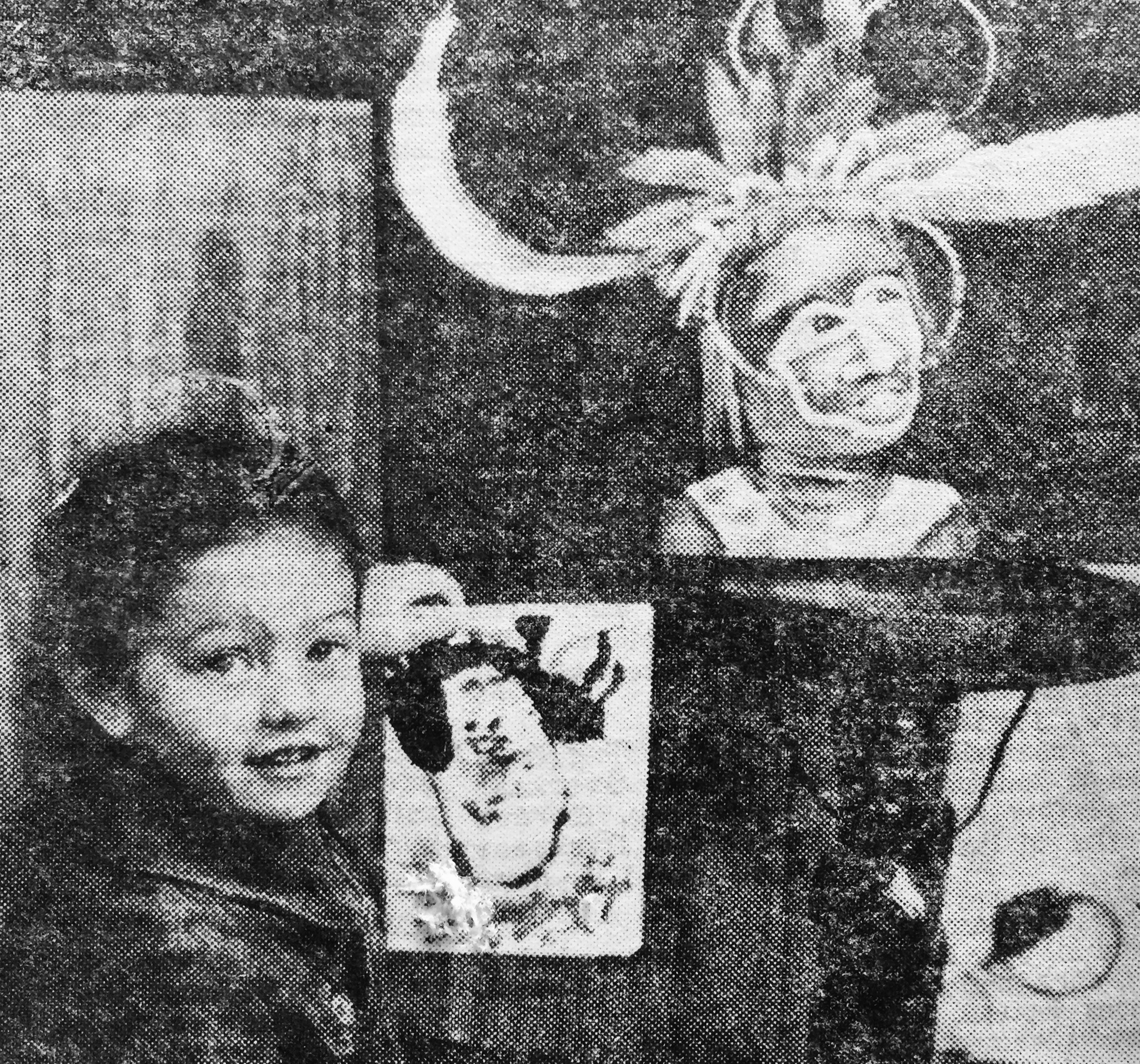
from a 1980s newspaper clipping; me & my painting beside my mum's painting

from a 1980s newspaper clipping; me & my painting beside my mum’s painting

My mum taught me age-appropriate artistic techniques from an early age. Her teaching meant that my attempts at Art looked good for my age, but these were carefully taught strategies. She ran Art classes out of our garage where she taught other kids the same tricks—learned, practiced on newspaper and then enacted on canvas. Parents were impressed. This wasn’t magical ability, but careful teaching by someone who was a knowledgeable, skilled practitioner and an experienced teacher. My mum now teaches my kids how to draw and paint, and they experience the same success. Is it genetics? No, it’s teaching.

And imitation and practice. As a teenager I would sit and draw. Copying posters, copying faces, copying landscapes. Over and over until I got it right, or at least better. My scribbling was informed by knowledge I had been taught about proportion, perspective, shading, the way colours work and techniques for using a variety of materials. I also copied the Old Masters, as many Art students do. Being able to replicate others’ work teaches how to follow the rules. Then an artist can think about and experiment with how they might be bent or broken.

field of flowers painted by my 5yo, as taught by my mum

field of flowers painted by my 5yo, taught by my mum

But Art is also more than knowledge and technique. It is communication and conversation. As I discussed in this post, artists respond to the world and to other artists. Like bloggers, writers or commentators in other disciplines, artists use the language of Art to protest, to provoke or to celebrate. It’s why Manet’s Olympia was so scandalous in its time. It’s why Pop Art and Dada, and even Impressionism were, in their time, an ‘up yours’ to what had come before and a challenge about what could be. Art has always been about communication, storytelling and symbolism (just look at any cave paintings or religious Art), but especially since photography made copies of reality possible, artists challenge what Art is and what its purpose might be.

I paint objects as I think them, not as I see them. ~ Pablo Picasso

Today’s blog post is a response to this one by Greg Ashman, who reflected on his own experiences of Art. Also, tomorrow is Mother’s Day here in Australia, and my mum and grandma have both majorly influenced my love, appreciation and practice of Art. Like Greg, one of my parents is (among other things) an artist. She is currently in America for an exhibition. Like Greg, most of my high school Art classes began with an instruction like, “there’s something: draw/paint/sculpt it,” without much other direction.

Yet the totality of my experience is very different. My mum gave me the grounding in the knowledge, skills and thinking of Art. My grandma still explains artworks and their intricate meanings to me. At university I was taught skills from welding and glass pouring to printmaking and drawing. I was taught Art History, and have since taught this in London at A-Level. I wrote a 25,000 word Fine Art dissertation. Once, I won a national art criticism prize based on the description my grandma gave me of an artwork. The artwork was in the gallery basement and as she was a gallery guide she was able to recall it from memory and describe it to me. When I finally saw the work, I realised that my critique was more inspired because of the image she gave me through her description. The piece was published in a national journal. I’ve written about the PhD as sculpture. I painted illustrations for my thesis.

thesis illustration

thesis illustration

I take my kids each year to Sculptures by the Sea in Perth (here are my pics from 2015 and 2016) and we talk about what our favourites are, and why. I recently took my 5 year old to the State Art gallery and he looked at a large canvas painted dark purple and said, “That is NOT art!” Then we talked about what art was and what criteria made something Art. I didn’t tell him my own views, but was more interested in encouraging him to think about his own thinking and his own assumptions about what makes something Art.

If it’s in a gallery, is it Art? Is Damien Hirst’s Mother and Child Divided (a mother cow and her calf, cut in half and displayed in formaldehyde), or Andres Serrano’s Piss Christ (a photograph of a small plastic crucifix submerged in a glass of the artist’s urine), Art? What about Robert Rauschenberg’s Erased de Kooning, in which he took a drawing by another artist, and erased it? Or Marcel Duchamp’s signed urinal, Fountain?

For me, Art can be a way of seeing, a way of thinking and a way of doing. It’s not something people are inherently bad at, or good at, but a concept and process in which to be engaged. Its value is in that engagement. Can I teach someone to paint a landscape or draw a realistic figure? Sure. Can I teach someone to think more like an artist? That’s trickier, but, like learning to think using a mathematical, theoretical or scientific lens, it’s worth the effort.

All in all, the creative act is not performed by the artist alone.. the spectator brings the work in contact with the external world by deciphering and interpreting its inner qualifications and thus adds his contribution to the creative act. ~ Marcel Duchamp

Teacher efficacy, agency & leadership #aera16

iconic Abe

iconic Abe

This afternoon I spent 3 hours at two round table sessions at AERA in Washington DC, hearing about and talking about teacher leadership and agency. Then on the way home from drinks with Sarah Thomas, who I know through Twitter and Voxer, I stumbled across the #satchatOZ chat on Twitter which was talking about teacher leadership. So whilst I’m jetlagged and brain-exhausted from a day of conferencing, I want to get my raw thoughts down before they’re overrun with tomorrow’s thoughts (with some of my photos, because: DC).

Three terms that came up today in the two roundtable sessions I attended were: efficacy, agency and leadership. Self-efficacy is about how well someone thinks they can do something; a self-belief in their own capacity. Agency is the capacity to act as well as the acting itself; to be an agent is not just to have the internal capability to do, but to actually do the doing. I wonder, can someone be an active agent, capable of action and change, without the self-belief in their capacity to do so? Possibly. Can someone have a sense of self-efficacy, but without the agency to be effective? Probably.

Leadership, meanwhile, is a slippery word. People can be leaders by name or position, but this doesn’t guarantee that people are led by them. Leadership and agency are not just individual, but also collective. Can someone be a leader without a followership? A leader can be defined by their title, but more often they are defined by their influence on others, their organization or the system in which they operate. Teachers without official positions of responsibility can be, and are, leaders in their fields. They are active agents who effectively translate their beliefs and purpose into reality through deliberate and effective action.

In leadership and agency in schools, context is a key consideration. The holonomous* environment of a school is one in which the sum and the parts are inseparable. If schools want teachers to be reflective, growth-focused and agentic, they need to trust in their teachers and provide an environment in which risks and exposing one’s vulnerability are ok. In a culture of teacher-scoring and fear, teachers are less likely to be agents of positive growth and more likely to be compliant servants to a punitive system. Movements like #flipthesystem, which are explored in Jelmer Evers and René Kneyber’s book, advocate for further teacher voice and action in education reform. Localised reforms like my school’s teacher growth model are practice-based examples of in-school teacher leadership in action.

In the introduction to Linda Darling-Hammond’s presidential AERA address this afternoon, she was described as identifying as a teacher, but having become a researcher so that she could be a strong voice listened to by policy makers and powers that be. She saw research as a way enact and propel change.

DC daffodil cityscape

DC daffodil cityscape

While I didn’t frame my PhD research through the lens of teacher leadership and agency, it could be seen through that lens. I explored teachers and school leaders’ perceptions of identity, learning and school change, within a particular context. That context was the coaching intervention I was leading at my school, a formative growth-based model of teacher growth and development.

What emerged from my study, when looked at in terms of teacher leadership and agency, was that teachers are deeply tied to their senses of self within their senses of their context. That is, teacher self-efficacy and agency develop when teachers feel an individual purpose, an alignment with context and that they are empowered with voice and influence in their own organization. In this case, the school empowered teachers to be active agents with a voice in school reform. Additionally, the formative aspect of the coaching model for growth was fiercely protected; teachers are not scored and judged, but are able to collect lesson data and participate in coaching conversations in order to grow themselves. This kind of trust requires some relinquishing of power from those at the traditional hierarchical apex.

As someone who connects with others on Twitter and writes on this blog, I think that technology and social media give us tools to develop our teacher voice and engage in conversations about education. I know of teachers who would be considered leaders both in their schools, and in the wider land of education, due to their public thinking, writing and advocacy. I also know those who are known more for their leadership in the social media or conference arenas, than in their own day-to-day school contexts.

As others have noted, Twitter flattens hierarchies and empowers users. Bonnie Stewart’s research into academic Twitter found that there are different spheres of, and criteria for, influence on Twitter than in higher education institutions. The same is true in other educational contexts. Government ministers are drawn into public conversation with teachers on the ground. Social media and blogging can be leveraged by teachers to allow them voice and agency, to advocate or agitate. As Greg Ashman and Rory Gribbell note in their recent blog posts, bloggers can and have been agents of political and educational change, a pluralistic chorus of voices to which people are listening.

Teachers can and should be advocates for their students and their schools. They can and should pursue research and opportunities to understand, revise and reimagine what is known in education. Those leading schools and systems in official roles can encourage teachers’ growth and leadership by questioning traditionally hierarchical power structures and considering more distributed and inclusive ones. In this way, teachers can be encouraged to lead within their contexts, instead of feeling as though they are fighting against the system or preserving their survival within it.


* Check out Costa & Garmston’s 2006 Cognitive Coaching text or my PhD dissertation for discussion of holonomy.

mural at the Library of Congress

mural at the Library of Congress

On (teacherly) identities: Who am I and who gets to decide?

Know thyself.

my multiple selves reflected back at me

my multiple selves reflected back at me

In policy, research and practice, the teacher voice is a vulnerable and vital one, but other perspectives (student, school leader, academic, parent) are also important in educational discourses. What or who is a teacher in terms of identity? I don’t mean job description, the kind of thing you’d find on a curriculum vitae or Twitter bio where people often label their current professional role. Teacher. Principal. Consultant. Advisor. Coach. Lecturer. Professor. Some might quibble over whether a teacher of teachers who used to teach in schools is in fact a teacher, as Stewart Riddle recently found. Yet labels don’t explain the complexities of self in terms of being a living human in the world.

The field of identity is sometimes lamented as being confused, contested and slippery, with different definitions meaning different things in different contexts. Theorisation of the self has a long history, appearing as early as 1902. At times identity has been seen as fixed and singular, but now more often it is seen as shifting and plural.

My PhD thesis defined identity as the “ongoing sense-making process of contextually-embedded perceived-selves-in-flux”. I see identity as process rather than product, as shifting rather than fixed, and as constructed and operated by the individual. It is a constant process of being and becoming. We are never finished. We don’t foreclose on an identity, but fluidly negotiate a variety of self-perceptions in a variety of contexts. We imagine and enact our identities by looking at past, present and potential future selves.

Additionally, identities are individual and collaborative. We construct our versions of ourselves based, not only on our perceptions and imaginings of self, but on our relationships with others, organisations and contexts. Costa and Garmston’s concept of holonomy is based on Koestler’s ‘holon’ which describes something which is simultaneously part and whole. Holonomy can be used to conceptualise the symbiotic interrelationship between individual and group or organisation.

My PhD looked at professional identity, in conjunction with professional learning and school change, in order to explore what it is that shapes educators’ development of professional identity perceptions, what shifts those self-perceptions, and in what ways schools and systems might work with a greater understanding of educator identities when designing and implementing education reform. My doctoral study found that professional learning deeply involves senses of self. Learning which taps into who educators see and feel they are, has the most impact on beliefs, thoughts, behaviours, and practices.

I often write on this blog about identity (look! there’s a tab for that). Writerly identity, doctorly identity, teacherly identity, researcherly identity, experty identity, parenty identity, coachy identity. I create stuff. I teach stuff. I tell stories. I learn stuff. I write stuff. I coach people. I lead teams and projects. I read. I am coached. I am led. I am a learner, a parent, a teacher, a researcher, a coach, a flâneuse.

So, as we are selves in action and in motion, can we decide when someone starts or stops being or becoming a teacher? I wonder about what makes a teacher identity. Surely it’s not something that enters a person as they set foot in their first school classroom and leaves them the moment they step out of their last taught lesson at a school. If I left the classroom for academia, would I no longer be a teacher? Well, maybe not a ‘current school teacher’, but I wouldn’t shed my teacherly-ness or my years of identity-forming teacherly-experiences. What about teachers who teach for decades and then retire? I guess those wanting labels might call them former teachers or retired teachers, but might they still identify as teachers? Many school leaders in my PhD study saw themselves as teachers first and foremost, and leaders/teachers of teachers second; for all, serving the student was at the centre of their senses of self.

Who gets to tell us what roles we can and cannot identify with? Who is the keeper of the labels? I’d argue that we are the constructors, operators and refiners of our own identities. Who am I and who gets to decide? Me.

The Danielson Framework for Teaching as tool for professional reflection and conversation

2013 Danielson Framework for Teaching Evaluation Instrument cover

2013 Danielson Framework for Teaching Evaluation Instrument cover

The Framework for Teaching is a research-based set of components of instruction, aligned to the INTASC standards, and grounded in a constructivist view of learning and teaching. The complex activity of teaching is divided into 22 components (and 76 smaller elements) clustered into four domains of teaching responsibility. ~ Danielson Group website

I have spent a lot of time blogging about the coaching part of my school’s coaching model and some outlining the specifics of the model and the ways we use lesson data. I’ve spent less time talking about why and how we use Charlotte Danielson’s Framework for Teaching as a tool for professional reflection and conversation. In this post, I’ll illuminate some of the reasons for adopting the Framework and the ways in which we use it at my Australian school.

Danielson’s Framework—explained in the most detail in Enhancing Professional Practice: A Framework for Teaching (Danielson, 2008)—provides a map of what excellence in teaching might look like, providing a set of shared, explicit descriptors. Grounded in research, it is a thorough, multi-layered definition of good teaching which identifies a comprehensive range of teacher responsibilities. The Framework is intended to be part of transparent, active processes such as teacher reflection, professional inquiry, classroom observations, mentoring, coaching, and Human Resources processes such as recruitment, evaluation of teacher performance and appraisal. The use of such a framework depersonalises conversations about teaching, focusing discussion on specific elements of practice, rather than on the individual. It provides a shared, explicit set of descriptors.

The Framework clusters its twenty two components of teaching into four domains of teacher responsibility:

    • Domain 1: Planning and Preparation
    • Domain 2: The Classroom Environment
    • Domain 3: Instruction
    • Domain 4: Professional Responsibilities

The components are intended to be applicable to diverse settings and independent of any particular teaching methodology. Whilst these components are separated for the purpose of the Framework, they are acknowledged as interrelated parts of a complex holistic endeavour. In action, the Framework is more web-like than grid-like. This is reflected in the choice of cover artwork for The Framework for Teaching Evaluation Instrument (Danielson, 2013) which shows the four domains as an intersecting Venn diagram.

The Gates Foundation’s Measures of Effective Teaching project studied 23,000 lessons of 3,000 teacher volunteers in six USA urban school districts in order to investigate how teacher practice affects student achievement. It found that the Framework:

  • was positively associated with student achievement gains;
  • focused observers’ attention on specific aspects of teaching practice;
  • established common evidentiary standards for each level of practice; and
  • created a common vocabulary for pursuing a shared vision of effective instruction.

The project also concluded that, when implementing an instrument for teacher  evaluation (or, in our case, reflection and growth):

  • clear standards and multiple observations are required when evaluating a teacher’s practice;
  • evaluation systems should include multiple measures;
  • combining observation scores with evidence of student achievement gains and student feedback improved predictive power and reliability and identified teachers with larger gains on state tests; and
  • the true promise of classroom observations is the potential to identify strengths and address specific weaknesses in teachers’ practice.

It was our reading—of Kane and Staiger’s (2012) Measures of Effective Teaching research paper and Sartain, Stoelinga and Brown’s (2011) report on Chicago’s implementation of the Danielson Framework, as part of its Excellence in Teaching Pilot—which influenced the design of our observation model in which each teacher has four 20 minute observations per annual cycle of coaching.

For us, using Danielson is about each teacher looking at specific lesson data at a particular moment in time, and interrogating where the evidence places that data against Danielson’s framework. In any one observation, teachers’ data might be rated (by themselves, or as calibrated with a coach or manager) across three different levels. Of course with knowledge and increasing familiarity of Danielson’s framework, teachers can work with an understanding of the way it frames ‘distinguished’ teaching, aiming for that, but all teachers, no matter their expertise, will have lessons which fall across components and across bands.

Dylan Wiliam's book on my desk; just a few Post-its

Dylan Wiliam’s new book on my desk; just a few Post-its

Imagine my delight (yes, serious nerd delight) when I discovered that Dylan Wiliam’s just-released book Leadership for Teacher Learning spends seven pages (pp.45-51) outlining the research findings around the Danielson Framework. While he cautions that the Framework is limited, especially in its ability to differentiate variation among teachers, he describes it as “rigorously researched” and “the best we can do in relating student progress to classroom observations.” Wiliam cites research on which my school’s decision to use Danielson was based. He points out that it has been shown that students taught by teachers who are rated highly on the Framework make more progress. In fact, students taught by a teacher rated as ‘distinguished’ make almost 30% more progress than those rated as ‘unsatisfactory’.

For my school, the Danielson Framework for Teaching instrument—congruent with our performance review, professional development and coaching processes—helps us to develop a precise and shared language of practice. It isn’t used as a scorecard for external evaluation, something which I strongly advocate against. We instead use it in the following ways.

  • Coaches and managers are trained by a Danielson consultant in generating lesson data and using the Framework in professional conversations (which aligns with out Cognitive Coaching model for coaching conversations).
  • Teachers complete an annual online self-reflection against the Framework, in order to surface reflections about their teaching, help them set goals, and guide their thinking as they plan for the year ahead;
  • During coaching conversations, coaches help teachers to consider their lesson data against the Danielson Framework, looking closely at the descriptors and facilitating reflection against the rubrics.
  • The Danielson Framework sits alongside the Australian National Professional Standards for Teachers as a tool for deepening reflection and conversation about practice, allowing teachers to more specifically envisage, articulate and enact excellence in teaching practice.

This use of the Danielson Framework fits with our philosophical position that everyone is coachable, that all teachers have the will and skill to improve, that coaching should develop internal capacities, and that the coach is always in the service of the coachee.

Let’s not forget the magic and joy in reading

Books bombarded his shoulders, his arms, his upturned face. A book alighted, almost obediently, like a white pigeon, in his hands, wings fluttering. In the dim, wavering light, a page hung open and it was like a snowy feather, the words delicately painted thereon. In all the rush and fervour, Montag had only an instant to read a line, but it blazed in his mind for the next minute as if stamped there with fiery steel. ~ Fahrenheit 451, Ray Bradbury

fiction pile on Shell Beach

fiction pile on Shell Beach

I’ve been thinking a lot about reading recently. Learning to read, teaching to read, analysing what we read. And books. In part this is because I am immersed, always, in story. Partly it’s contextual. Recently in Australia, the Murdoch Childrens Research Institute and News Corp have partnered to launch a February ‘Raise a Reader’ campaign to encourage parents to read to their children, in an effort to improve the literacy and vocabulary of students entering school. Additionally, with school going back in Australia this week, there have been click-bait media pieces which paint either parents or teachers as the villains of children’s education. Linda Graham reminds us, though, that we need parent-teacher partnerships, not polarisation.

In this post I attempt to weave together some of my non-linear, multi-layered thoughts on reading and books. It is parents and teachers (and role models and family members and libraries and society) who can help the perceived value of reading and the effective development of literacy. Discussions of literacy, reading and books should be about effective strategies, but also about joy, play and power.

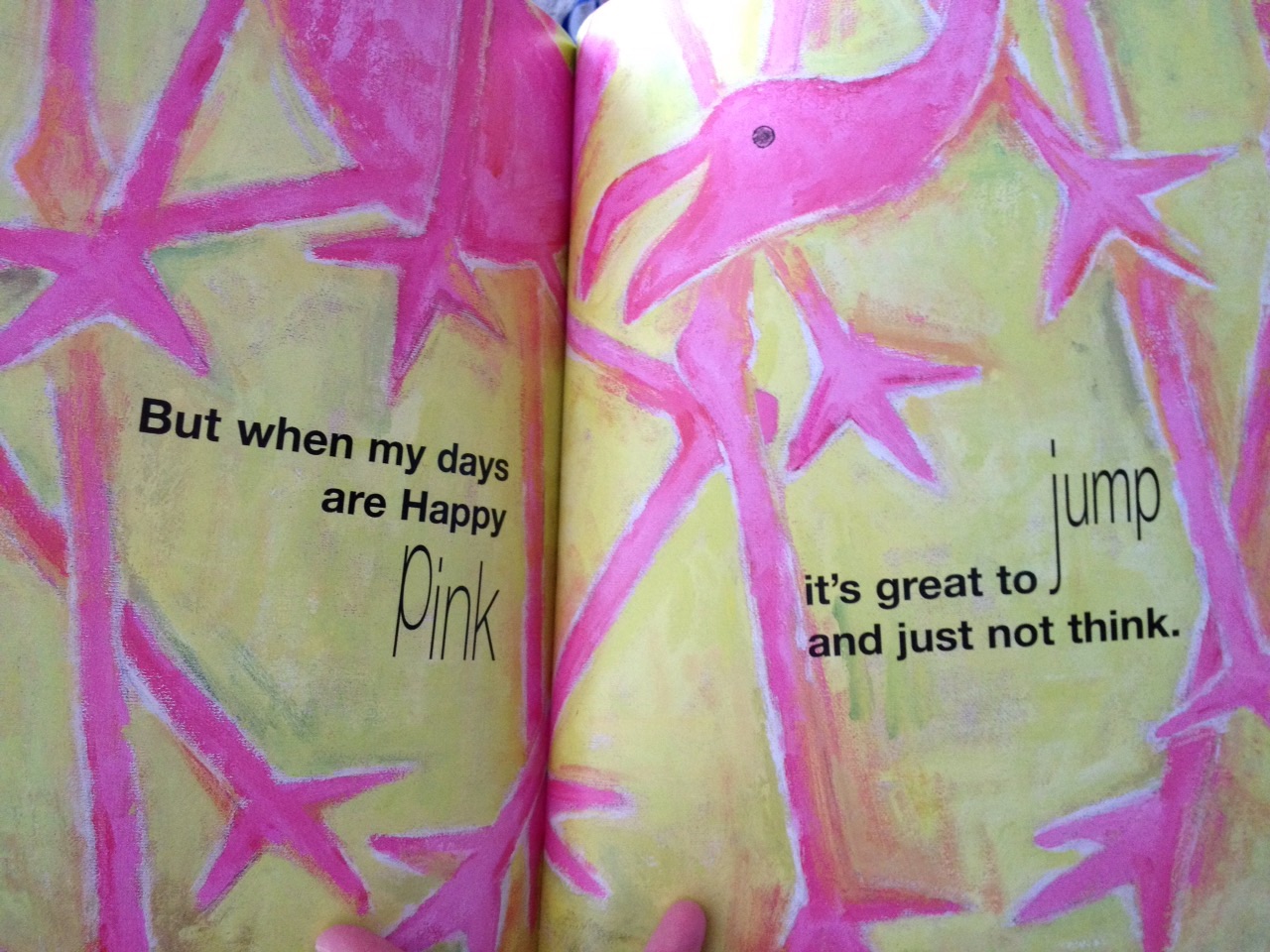
from Dr Seuss' My Many Coloured Days

from Dr Seuss’ My Many Coloured Days

I’ve been surrounded by books my whole life. My family moved a lot, but my childhood homes were linked together by the presence of books. They were sometimes (often?) more plentiful than possessions. I could take unexplored books off any shelf, without having to check the rating or ask permission. As a family, we went to the library, one night a week, when we would each return the previous week’s stack of books and take out a new stack. Science fiction for my mum. Crime fiction for my dad. And whatever books we kids wanted, changing as our tastes changed over time. My grandfather’s study was a wonderland of ancient paper and earthy leather tomes. Books in my childhood were something enjoyable. They were individual escapes but also connected us through the practice of reading, and talking about our reading.

The purpose of Newspeak was … to make all other modes of thought impossible…. Newspeak was designed not to extend but to diminish the range of thought. ~ 1984, George Orwell

Since I became an English and Literature teacher I’ve spent my work days surrounded by books (now sometimes electronic). I get to read and talk about books for a living. My Year 12 class is currently looking at dystopian texts, some of which explore the power of language to both control and free us. George Orwell’s 1984 explores the idea that minimizing language and vocabulary can diminish and control thought. Ray Bradbury’s Fahrenheit 451 explores a world where books are seen as powerful weapons of knowledge which threaten government control and societal compliance. Yet both novels also show the power of language to free and the power of human thought to prevail. Aldous Huxley’s Brave New World explores how suppressing books and controlling stories of the past can control the present. Our class has discussed the announcement of the Oxford word of 2015 as an emoji, and whether the distilling of language into pictorial representations is helpful or hindering to communication and thought. We’ve looked at words which exist only in a particular language and wondered whether you need to have a word in order to experience a thought or concept.

Books were just a commodity that had to be produced, like jam or bootlaces. ~ 1984, George Orwell

Part of my Head of English roles at three schools involved leading reading curricula and pedagogy, sometimes from the early years up until the final year of school. David Sousa’s (2014) How the Brain Learns is a good introduction to the world of the alphabetic principle, phonemes, graphemes, encoding, decoding, and the cognitive neuroscience how of learning to read. Sir Jim Rose’s (2006) Independent Review of the Teaching of Early Reading recommended that the best approach to teaching beginning readers includes discrete, high-quality, multi-sensory, systematic phonics work. It also promoted the use of sharing books, songs and rhyme as ways to develop children’s positive attitudes to literacy. Synthetic phonics is certainly important for children, but so is instilling enjoyment of reading. Always an advocate for balance, in debate and in teaching, I don’t think that phonics and whole language need to be polarised approaches. Systematic phonics instruction explicitly teaches students how to decode and encode language and to be successful readers, but it doesn’t teach them to be readers who value and enjoy reading.

In my high school English classrooms, and in student work, I can tell those students who have devoured books through their childhoods and those who haven’t. In Teaching the Brain to Read (2008), Judy Willis applies brain research to the teaching of reading. She discusses the importance of pleasure and motivation in learning to read, and the role of dopamine in learning. Students need choice, variety, and enjoyment of reading, not only drills and explicit instruction.

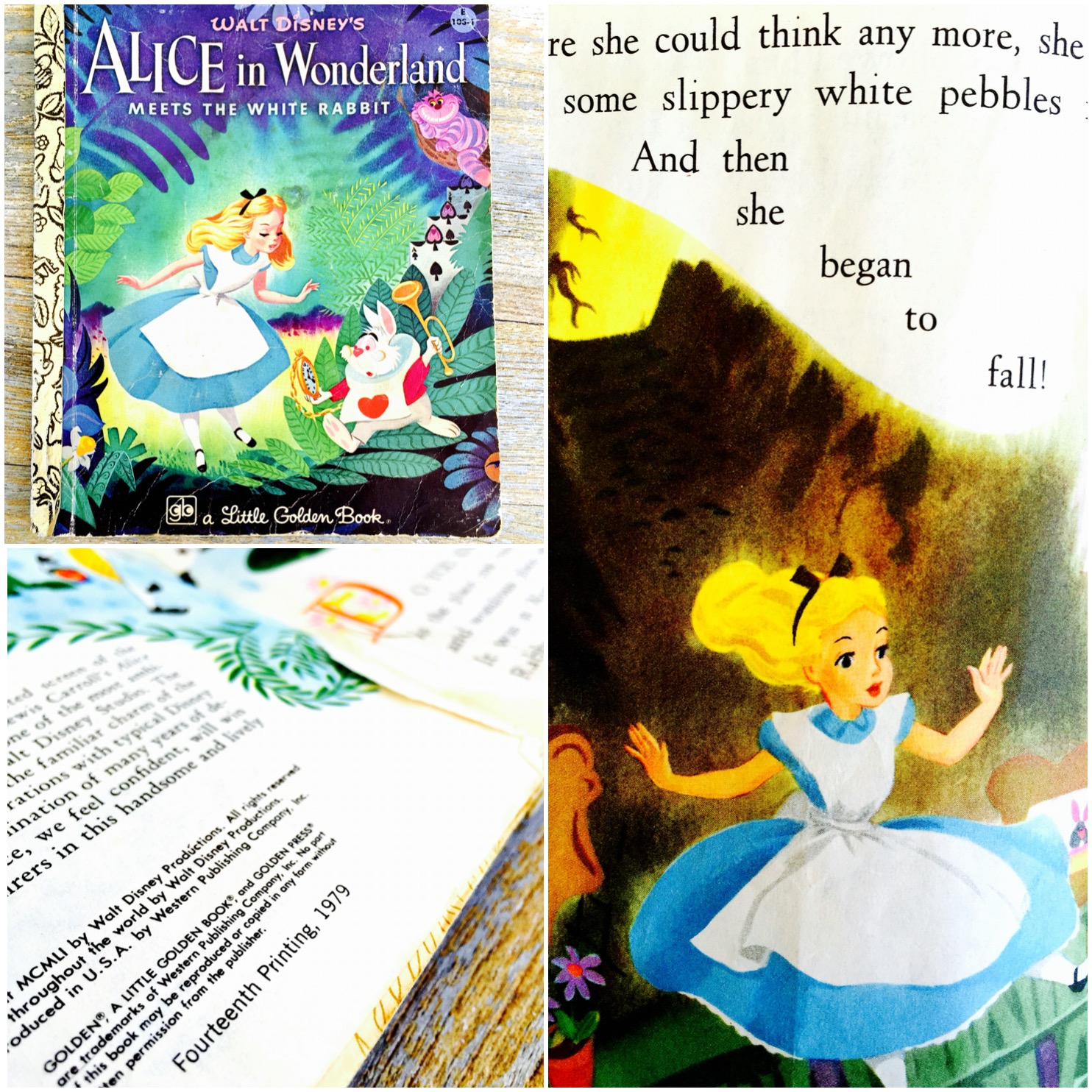
my original copy of the Alice Golden Book

my original copy of the Alice Golden Book: rabbit hole reading

When I became a parent, out came my childhood books, including tattered Golden Book volumes. Our shelves at home filled with early readers, picture books, storybooks and favourite novels. As recommended by the recent Australian ‘Raise a Reader’ campaign, we have read to our children since birth. Now 3 and 5 years old, this year in Kindergarten and Pre-Primary, our children are being exposed to the Jolly Phonics program at their local school. They bring home sets of words, in slowly spiralling levels of difficulty, to sound out and learn. They are read to at school and they take books off the shelves of their classroom. They visit the school library with their teachers and the local library with us.

The minimum we read to our kids at home is two books at bedtime. Often we read more than this in a day. This week my eldest started Pre-Primary and on his first visit to the school library he brought home a book which had 223 big pages. Between my husband and I, we read 80 pages the first night. The next two days the first thing our son did when he woke up in the morning was to run and get this book. We finished it tonight, three days after he took it out, and both boys have chosen to sit and listen to every page. This amount of reading wasn’t our choice as parents, but our son’s, so excited was he to read the stories within. He’s hoping we can read the whole thing again before he has to return it.

So as I find myself developing readers at home, being a reader myself, and exploring reading with my students (not to mention academic reading and nerdy reading for my own learning), I find the multi-layeredness of reading too unwieldy to tie down into a simple formula. There are systematic and sensible ways to conceptualise reading; these are, of course, important. And then there are the intangibles: the magic, inhaling the booky perfume (released by the glorious chemical breakdown of lignin and cellulose), the sound and feel of turning pages, and the internal world which comes alive when a book has grabbed you and pulled you deep into its world.

my eldest (then 4yo), reading to our youngest (then 2yo)

my eldest (then 4yo), ‘reading’ to our youngest (then 2yo)

Traditional Progressivity or Progressive Traditionalism: Ditch the dichotomy

Do we need to butt heads? It's not all black & white. Source: https://www.pexels.com/photo/black-and-white-africa-animals-wilderness-3158/

Do we need to butt heads? It’s not all black & white.
Source: https://www.pexels.com/photo/black-and-white-africa-animals-wilderness-3158/

I’ve never liked labels and boxes. I remember in high school when another student frustratedly asked me, “What ARE you?” I was bemused that this student was seemingly angered that my varied wardrobe (surfie t-shirts, black jeans, hippie skirts) didn’t fit one high school mould. Similarly, I’ve been a bit perplexed with the ongoing social media flurry around the ‘traditional vs. progressive’ debate, which is often positioned as being an ‘us vs. them’ or ‘right vs. wrong’ dichotomy.

I get uncomfortable when things get dichotomised as I think it increases unproductive antagonism and shuts down nuances and possibilities. Even Star Wars recognises the light in the darkness and the darkness in the light. My sentiments are similar to those of David Rogers who describes himself as a prog-trad continuum slider, and of Stephen Tierney who argues that traditional vs. progressive is a false dichotomy. I agree that traditional and progressive approaches in education aren’t warring factions. We don’t need a hard black line drawn between them. They can co-exist in schools and classrooms, with approaches moving along the continuum depending on teacher, students and the purpose of a lesson. We can attempt balance and compassion in debate and in teaching.

The trad-prog debate is often seen as rooted in ideology. As an educator I am a product of my own childhood, education, previous teachers, teaching experience and life. In order to tease out my perspective on the trad-prog sliding scale, I’ll try here to be transparent about my own beliefs about education, in order to perhaps illuminate the decisions I make about my teaching practice and my perception that we should consider traditional and progressive, rather than traditional or progressive.

I have core beliefs about what teaching should be, including that it is about empowering young people with the knowledge, skills and capacities to be critical (questioning! skeptical! even subversive!) consumers, creators and challengers of knowledge. As an English and Literature teacher I believe in the power of language, and that an ability to decode, interpret and wield language is part of empowering students to be people who can successfully navigate their worlds. I believe that students should learn the literary and artistic canon, the classics, philosophy, history, but also that these are shaped by their contexts (who wrote them? who had power? whose story is told? whose story is absent? who was unable, within that context, to share their [hi]story?). Students also need to navigate popular, multimedia and new media texts and discourses.

I teach English, a compulsory subject, to sometimes reluctant students who are studying English because they have to, not because they enjoy it or see its value. Many students struggle to find success in the English classroom, yet they have to attend. So my approaches to teaching English (as opposed to Literature, where students have chosen to do the course and are often enthusiastic and motivated) are influenced by this. I use Understanding by Design to backward plan curricula, starting with what it is that students need to know and be able to do – KNOWLEDGE. SKILLS. – as well as overarching essential questions.

Students need to be able to read, analyse, critique and develop evidenced arguments. But first they must know the content. The texts. The concepts. What a good argument looks like; what it doesn’t. I use diagnostic tools and pre-testing and rigorous assessment. I instruct, a sage-on-the-stage passionate about the content. I model analysis and argument. I provide exemplars. Texts are chosen for their merit and for their likelihood of being engaging for students. We read texts together and independently. I write. We write. They write. I work with small groups and with individuals to push them to the next phase of knowledge and understanding. I work hard on my questioning technique. I use regular formative assessments to gauge students’ understandings so that I might address pace, or go back or forward a few steps.

Yet I also on occasion – gasp – let students, to some extent, choose their own edventure, personalise their learning and have some autonomy about how they communicate their understanding. I’ve played with genius hour. I’ve negotiated tasks from an adjusted Bloomgard matrix. I use online discussion forums to develop students’ engagement with each other, and with me, around texts and concepts. I use the debate-promoting tool of the ‘human continuum’ in which students choose and defend a position along a classroom wall on a topic (To what extent is Macbeth a villain? To what extent is Frankenstein’s creature a monster?). My creative writing group has a blog in which they add to a collective story. When I’ve taught Romantic poetry, students have spent a lesson channelling their inner Romantic, taking a notebook and pen to a quiet spot around the school to write poetry which embodies Romantic ideals (a task which needs a knowledge of Romanticism and skills to control and manipulate language for effect). My creative writing lessons at the river and the cafe strip aren’t going to win any awards for knowledge-transmission. I don’t set up my desks in rows like isolated islands, but incorporate comfort and flexibility into learning spaces. I don’t see my students as vessels to be filled with knowledge. I expect students to do the work set, but I encourage them to intelligently question and challenge rather than mindlessly comply.

The thing is, I want my students to know that English is entrenched in life and ideas and society. Language is about knowledge and rules, and knowing when you’re accepting the knowledge and rules, and when you might challenge them. It can be about fun and satire and aesthetics and critique and expression and enjoyment. It can challenge the status quo or celebrate the way things are. It’s not black and white; knowledge or process; fun or seriousness; acceptance or opposition. This isn’t about my whims as the teacher or an ideal of free thinking do-what-you-like-preneurship. It’s about making deliberate practitioner decisions based on a knowledge of students, context, teaching, learning and the classroom, without feeling the need to conform to an extreme or singular view.

Students need knowledge. Students need skills. In English, they need to know and remember and synthesise and read and write and speak and listen and question and argue and persuade and create. They also need to play, experiment and develop their capacities for engaging thoughtfully, reflectively and critically with texts, ideas and … people.

Classrooms are more than effect sizes. They involve a combination of knowing and doing and feeling and being and learning and listening and thinking and wondering and working. Trust and vulnerability and relationships and identity formation. Let’s not reduce all that to a dichotomy of good vs. evil in education.

Balance, not division. Compassion, not attack. Conversation, not war.

Compassion is not a relationship between the healer and the wounded. It’s a relationship between equals. Only when we know our own darkness well can we be present with the darkness of others. Compassion becomes real when we recognize our shared humanity. ~ Pema Chödrön

by @debsnet

Often I am struck by argumentative battles in traditional media, on social media and around the blogosphere. I appreciate those writers, commentators and educators who share their musings, experiences, readings, and perspectives, without using divisive loaded language or attack. I think the rantiest I have gotten was this post on the APPR reforms in New York and this one around whether teachers can be researchers, but I attempted to frame my criticism through making transparent my perspective and asking clarifying questions. Balance.

I have written a lot about my school’s coaching model, as it is kind of my baby and it’s something which I think is worth sharing; others might gain from hearing our story. Yet this coaching model is not stand alone. It is not as though teachers at my school are only coached by teacher-coaches in a non-evaluative, non-hierarchical model. In their first year at the school, teachers participate in a rigorous evaluative permanency process. Every year they have a conversation with their line manager, who touches base with them on their work, goals and classroom practice. Every third year, teachers have their coaching cycle with their manager. This is more evaluative and performative by its nature, and by the nature of the relationship. Teachers additionally work with instructional consultants. Leaders work with coaches. Professional learning community teams and action research projects work alongside. Growth and evaluation. Balance.

I have written about the creative things I trial in my classroom like a term without grades and genius hour for students and teachers. These are things at the experimental end of the spectrum of what happens in my lessons, so I share them as stories of experience and part of a conversation. I do these things to develop engagement of my often-reluctant high school English students, to build their self-efficacy and to help them learn to rely on themselves as drivers of learning, rather than entirely on me as Teacher with a capital T.

Does that mean I don’t use explicit instruction? Of course not! I explicitly teach concepts, skills and texts, although I temper this with encouraging students to do their own thinking and to trust their own thinking, rather than expecting that I can fill them, as vessels, with the answers. What are the ideas of the text? What interpretations might be drawn? Answers can come from me or from Spark Notes, but if I do my job properly, students will have the skills, understandings, language and cognitive capacity to draw their own interpretations, from their own contexts, and justify these using logic and evidence. The best student responses comprise original thinking, not regurgitated knowledge. The best teachers focus not just on effective learning (our core business, of course!) but developing learners and passion for consuming, curating and creating knowledge.

In my Head of English roles at three schools I have ensured a balance between explicit instruction and those strategies which propel love of reading, power in writing and deep intellectual engagement in ideas and discussion. Interestingly, Charlotte Danielson’s heavily-researched Framework for Teaching has its ‘proficient’ descriptors describing teaching which is expertly directed by the teacher, and its ‘distinguished’ teaching descriptors outlining lessons in which students are taking responsibility for their own learning and behaviour. Creative and explicit. Balance.

I have written about lyrical metaphors for PhD study, and only occasionally about the unsexy logistics of what the graft actually looks like. My conceptual framework draws in part from fictional literature. Does this mean my PhD is devoid of hard, critical, scientific work? No. My PhD is of course the result of the logical, systematic working through of literature, data and research problems. When writing the Limitations section in the conclusion of my thesis I was highly aware that all research has its limitations. Extensive quantitative data can show us patterns and effects, but these may be faceless. Qualitative data can drill down deep into the messy humanness of lived experience which may be unrepresentative of wider groups and therefore not generalizable. Yet each study adds its tiny piece of understanding to the layers of what is known. Research is conversation. Imaginative and systematic. Broad and deep. Balance.

I would love to use the line ‘I’m a lover not a fighter’ but I think I’m both. I believe in sharing and celebrating our stories, but I will advocate fiercely for my students, fight for what I believe is right and argue for my research. Balance.

From a history of my posts, it is probably clear that I am seduced by the lyrical, by storytelling, by creative approaches and by metaphor. Yet I am not one dimensional. Nor is my teaching, my thinking, my researching or my living. Balance.

I came across this excellent recent TED talk from Jon Ronson on the way social media has moved from giving voices to the voiceless, to an angry mob mentality of shaming and abuse, in which people seem to forget compassion and morality.

While I love robust discussions which take us out of the echo chamber of we-all-agree-high-fiving, I also think we need to approach these with compassion, thoughtfulness and a view of each other as human beings. We can disrupt with respect. We can disagree gracefully. We can advocate with civility. (And if you throw in a metaphor, you’ll totally have me!)

by @debsnet

Can and should teachers be (viewed as) researchers?

Sarajevo bullets, by @debsnetWhen we respect teaching as an intellectual activity and give teachers the opportunities to raise serious questions about what they teach, how they teach and the larger goals for which they are striving, they can play a dramatic role in transforming their institutions. ~ Peter Senge, Schools that Learn: A Fifth Discipline Fieldbook for Educators, Parents, and Everyone who Cares about Education

This month – April 2015 – is the month in which Dylan Wiliam argued in the TES magazine that teaching cannot and will not be a research-led profession, in which Tom Bennett responded that evidence-based education is dead (but that evidence-informed education lives), and in which John Hattie was quoted in a TES article as saying that teachers should not try to be researchers and that ‘I don’t have any time for making teachers researchers.’ In response to his own question, ‘Asking teachers to be researchers?’ he replies, ‘They are not.’

In this article Hattie is also quoted as saying that teachers should use the “literacy and sensibility of research to inform their practice” and that the worlds of research (by academics, not teachers) and teaching should “orbit together”. This resonates with Tom Bennett’s assertion that teaching be evidence-informed (but not evidence-based) and with the mandate of researchED which is to raise research literacy in the teaching profession and promote conversations between teaching and academic communities (my post about researchED Sydney 2014 is here).

As someone whose identity straddles ‘teacher’ and novice ‘researcher’ (as a PhD candidate coming towards the end of my PhD journey) I agree that research should inform teaching, leading and educational practice, and that worlds of education and the academy should work in collaboration. I am not sure, however, that we should draw a divisive line with ‘teacher’ on one side and ‘researcher’ on the other.

When I read the TES article which presented quotes from Hattie, a number of questions arose for me. What does Hattie mean when he says that teachers are not (and perhaps cannot be) researchers? What is his definition of ‘researcher’?

Is he discouraging teachers from reading academic literature and collecting data to inform their practice? Is he telling teachers they cannot be (taught to be) systematic thinkers who investigate, trial, collaborate, communicate and utilise scholarly literature and evidence to inform their practice?

Many teachers have been involved in action research projects, or Masters or PhD dissertations. Are these teachers, too, incapable of conducting and applying research thinking and methods? For me this is an issue of identity, of sense of self. Am I a teacher who researches? A researcher who teaches? A teacher and a researcher? Is Hattie suggesting that these identities are unavailable to me?

Is research in a real educational context by a real educator less valid than that of an academic from a university?

Many have responded to this conversation. Kevan Collins, chief executive of the Education Endowment Foundation, warns against encouraging teachers not to pursue evidence, as he articulates in this TES article.

Teacher Chris Parsons explores how the teaching profession might strategically develop its use of evidence to inform practice.

PhD candidate Charlotte Pezaro, writing for the Australian Association of Educational Research, explores ways in which academics and teachers might interact.

Policy analyst Patrick Watson in this post argues that we need to identify research which is worthwhile for informing practice, build the research-literacy of teachers and encourage action research to facilitate reflection and deeper understanding.

The 2012 Grattan Institute report ‘Catching Up: Learning from the best school systems in East Asia’ asserts that high-performing school systems view teachers as researchers, continually developing their knowledge base through practices such as professional reading and action research. My PhD cites examples of literatures which promotes participatory action research as transformative for individual practice and collaborative cultures. All research and all researchers have limitations. I wonder what the impact is of viewing teachers as researchers and of encouraging teachers to think of themselves as researchers. How does it shape teachers’ identities, self-perceptions and practices if they are encouraged to be consumers, curators, engagers and creators of research? Perhaps it is partly a question (to reflect Dweck’s work) of developing a research mindset.

One of Wiliam’s points is that research cannot tell us what could be only what we already know. If we are always basing our practice on what has been done, we aren’t innovating or trialling new possibilities. Teaching and schools should be about more than doing what has been done and what is known; it should be about moving forward and even about innovation and creativity.

Perhaps teachers who see themselves as researchers could call themselves ‘teachers as innovative, research-literate, reflective, evidence-informed, systematically-thinking, data-using-and-interrogating practitioners who drive their own learning and improvement in regards to what benefits their students.’ Or maybe that’s a bit long.

While I understand that the issue of whether teachers can or should be researchers is nuanced, complex and riddled with semantic argument, I (as someone who identifies as teacher and researcher) would like to think we can view teachers as researchers, by my definition, if not by Hattie’s.