Harvesting good work: Reap what you sow

I’m not a farmer, not even a green thumb really. While I quite enjoy gardening and have a composter, I’ve learned to populate my garden with plants that survive on a healthy dose of neglect. (Side note on the composter: there is something joyful about shredding old copies of my PhD thesis drafts and feeding them to the worms.) Despite my lack of horticultural know-how, I’ve recently been considering the farming—and biblical—metaphor that you reap what you sow.

I often see others I admire reaping the rewards of their work. These people aren’t slaves to the performative measures of a neoliberal system, or narcissists seeking the spotlight of social media celebrity. They are humans–professionals, thinkers, theorists and practitioners–dedicated to work they believe is important. To doing it, sharing it, making a difference.

Since the final throes of my PhD in March, things have been happening in seemingly organic ways. Of course the PhD got done-and-fairy-dusted, and the thesis published online. The first paper from my PhD has since been published: ‘Coaching for professional growth in one Australian school: “oil in water”’, in the International Journal of Mentoring and Coaching in Education. I have another paper in press, due out next month. Two more are sitting on editors’ or reviewers’ desks. Two drafts are on the desk of a co-author. I have been interviewed on the Teachers’ Education Review podcast and on 2SER Sydney community radio. I had a piece published in The Conversation this week, about the dangers of pursuing performance pay for teachers. I am in discussions about bookish things, too.

And I’ve been on some kind of accidental-on-purpose conference circuit. AERA in DC in April. researchED in Melbourne in May. The International Symposium for Coaching and Positive Psychology in Education in Sydney in June (this Thursday and Friday). Heroism Science in Perth in July. For (little old) me, alongside my work at my school, all this seems like armfuls of hand-picked produce.

I’m not sure why I’m surprised at the pace of my recent schedule of outside-of-work commitments (also known as the unpaid-but-rewarding work that is academic writing and presenting), and the fact that I’ve started to be approached, rather than doing the approaching myself. But I am quietly bemused that I seem to be in a harvesting part of a cycle, even though I know that this is actually the result of hard and persistent work. The seeds for the current abundance were selected, sown and tended a while ago. Papers were written and reviewed (and reviewed and reviewed). Abstracts were drafted and submitted. Relationships were formed and cultivated. Presentations were prepared. Work was done. A lot of it. In my evenings and on my weekends and in my down time, and in all the little nooks and crannies of my life where I could fit reading, writing, collaborating, learning and connecting. Thank goodness for the wonderful people who support me, from my family and friends, to my colleagues and professional learning network, the Twitterati and my Voxer Squad.

I believe in doing good work. For me this is enacted in ways that are without a linear frame. I’m never quite sure where I’ll end up, or even where exactly I’m intending to go. It’s about doing work that I’m passionate about and feel is important, whether in service of my students, my coachees, my school, or knowledge in the world. In my writing, too, I often try things out, head down trails unsure of where they lead, double back, try again.

So, for now I continue to sow seeds I think are worth sowing. Write and research those things I think are worth writing and researching. Say things I think are worth saying. Teach what I think is worth teaching, in ways I think are most worth doing. Seek to learn those things I think are most worth learning.

The fun thing about this kind of sowing is that it’s like planting mystery seeds. I never quite know what influences or impacts something I do now might have in the future. It’s why the reaping feels like Christmas morning.

The best bit is how rewarding all the persistent and consistent hard work is. I like the work itself. I love the struggle and the triumph. I love the connections and the relationships that bubble up and take form. I love the unexpected rhizomatic results. A failed planting. A teeny green seedling reaching up from damp dark earth. A basketful of glossy fruit. A knotted beanstalk reaching up to the clouds.

Academic activism: Scholars, let your moral passion drive you #aera16

Iwo Jima at sunrise

Iwo Jima at sunrise

The theme of much of my day at the AERA conference yesterday was around scholarly activism. This post, which also shares a few of my photo snaps from DC, reflects on what yesterday’s sessions had to teach me about being a scholar. This comes at an important point in my journey. Now that the PhD is done, I’m thinking about what work I’ll do next in my school, my research and my academic writing.

In one roundtable session, a paper by Stefani Relles and Randy Clemens used the metaphor of punk rock for academics who use DIY scholarship in their quest for social justice. They theorized punk rock scholarship as grounded, activist and disruptive, using comparisons to skateboarders, graffiti artists and musicians of the punk movement. I reflected that a punk rock scholar might circumvent or disrupt traditional academic practices by self-publishing, using social media, blogging, or embracing open access and saying no to pay-walled publishing. But there was discussion at the roundtable about the extent to which an academic can be an outlaw. How disruptive can one be within the system, which places particular norms, pressures and metrics on those working within the academy? How might academics navigate the need for a pay check and tenure with their passion for social justice? Is it a case of corporate Bruce Wayne by day and vigilante Batman by night?

Similar issues emerged in a six-paper session about post-qualitative methodologies in which scholars were pushing at the boundaries of, dissolving, or letting go of, accepted Western ways of knowing and researching. Audience questions included those about how to exist within an academy while challenging or dismissing much of what it holds to be true or important.

Georgetown blossoms

Georgetown blossoms

Yesterday the notion of scholarly activism also emerged in a panel of what some might call superstar or celebrity academics. A discussion between Michael Fullan, Andy Hargreaves, Linda Darling-Hammond and Diane Ravitch was moderated by Washington Post education reporter Valerie Strauss. One theme which emerged was the importance of researching and writing from a burning core of moral passion. In discussing their books, the authors talked about what had inspired and driven them to write. In each case it was a sense that a book needed to be written, an argument needed to be made, something had to be said, an idea or group needed to be mobilised. Their writing was framed as political activism and advocacy. It had an emotional and moral component. Andy Hargreaves noted that writing should be based on the nobility of an idea.

Diane Ravitch’s story pointed to the need for persistence with moral purpose. She told the audience that her best-selling, award-winning book The Death and Life of the Great American School System: How Testing and Choice are Undermining Education was initially turned down by 15 publishers. At 77 years of age she is also an example of the power of social media and blogging. Her blog has more than 14,000 posts with more than 27 million page views. This speaks to the opportunities for scholars to leverage social media and the blogosphere to communicate their work and their messages to wide audiences. Tweeting and blogging can be scholarly writing practices.

Jefferson

Jefferson

I wonder about how much career stage and level of influence make a difference to the extent to which it is possible to disrupt the status quo. As a PhD candidate, I pushed at the boundaries of the traditional in my thesis, but I was also keenly aware of the need for my dissertation to be recognizable (by the all-important examiners) as an acceptable academic text. I pushed and agitated, but within the limits of what I thought I could get away with while still passing the PhD. Are those earlier in their careers, or in universities on contracts, less able to agitate, disrupt and advocate? Or is it again a case of Diana Prince sometimes, Wonder Woman at others? Clark Kent and Superman? The acceptable academic versus the one fighting for what they believe at their core to be the most important work?

The AERA conference itself is in some ways an exercise in homogeneity. While with about 18,000 in attendance, there is a wide range of topics being covered, most attending are dressed in variations of the same theme. Outwardly, there is an expectation of the academic, graduate student and educator. Do we wear our capes beneath our clothing? Is it our words and our work that are the heroes and the punk rockers?

Yesterday answered many of the questions I’ve been asking myself about what work to choose to do next. I think the answer might be simple. Do the work you believe at your core to be important. Say what needs to be said. Be guided by moral passion, social justice and fundamental purpose.

Folger Shakespeare Library

Folger Shakespeare Library

For the love of books: On the tactile PhD thesis

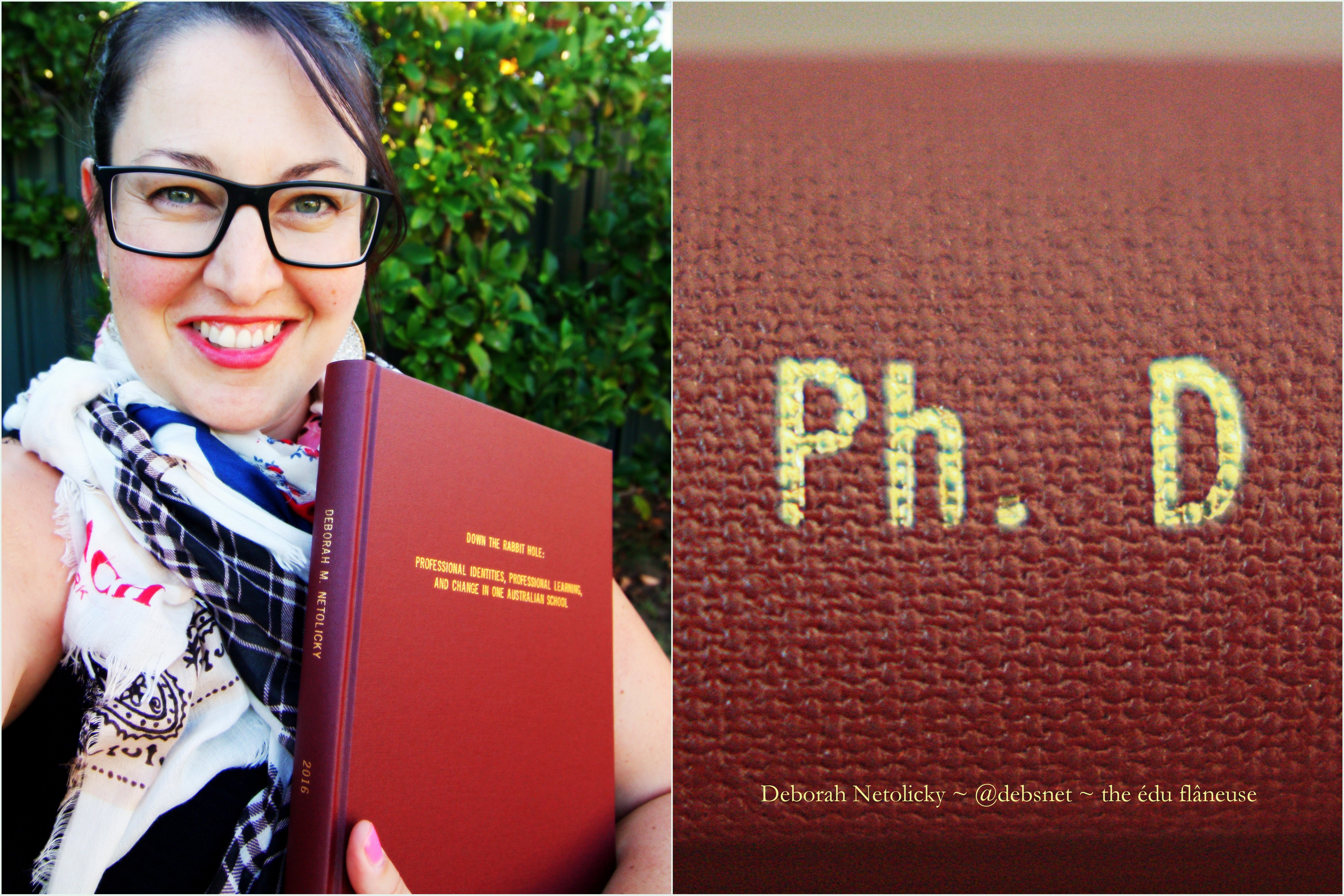
the shameless joy of the thesis selfie & those three little letters emblazoned in gold

the shameless joy of the thesis selfie & those three little letters emblazoned in gold

Having books bound signifies respect for the book; it indicates that people not only love to read, but they view it an important occupation. ~ Fyodor Dostoyevsky, Demons

The chemical breakdown of the smell of books was the subject of a 2009 study (downloadable here and nicely summarised here), but those smells are about more than science. They are about emotions and memories. Libraries. Being read to snuggled in beds. Reading alone in beanbags, on sunny window ledges or in hidden cubbies or corners. Dragons and sleuths and science and fantasy. Escape into other worlds and other lives. Empathy, fear, disgust, happiness, tears. The pads of fingers on pages. The whoosh of the page turning. The thud of a closing book. The grief when a trilogy or series ends.

I’ve written before about the memories of my grandfather’s study, filled as it was with old books, including the two prized books he left to me. My grandfather wasn’t a Ron Burgundy kind of man, but he did have many leather bound books. He was an academic, a professor and a book binder. (He also made those little wooden ships and magically placed them inside bottles.) The smell of old books–which is described here by Deepak Mehta as bibliochor, inspired by the word petrichor–takes me back to sitting in the cushiony chair in that study, having books gingerly passed into my hands. Feeling their physical and symbolic weight. He didn’t live long enough to see me finish my PhD and share my own Big Book with him, but I was lucky enough to be able to share the first part of my PhD journey with him.

This week I was full of nerdy book-loving joy when I picked up the hard bound copies of my PhD thesis. I’m an English and Literature teacher, reader, bibliophagist, smeller of books, narrative researcher and writer of texts. So it stands to reason that I would be obsessively perfectionist about the physical thesis book (totally reasonable, right?). I agonised over font, paper and end papers.

What’s in a font? That which we write in Helvetica by any other font would read as sweetly.

I always envisaged my thesis volume as channelling the old storybooks and encyclopaedias (remember those?) of my childhood. My selection of the font Garamond acknowledges that serif fonts are more readable, while visually referencing the traditional old-style serif typefaces of literary fiction. Garamond is a sixteenth century French artisanal font based on the work of Claude Garamond, and it is lovely in italics. It was a more beautiful option that the conventional Times New Roman. Apparently TNR is mandated in some institutions but as its inception was to squeeze the most text into the columns of The Times, it’s a bit squishy and a bit ubiquitous.

If you are thinking about thesis fonts, check out Anitra Not’s wonderful Slideshare on how to make a beautiful thesis. There should be a word for ‘the joy brought by beautiful typeface’. I don’t think that thinking about the beauty and readability of your thesis is total phdcrastination; there’s some method in wanting to present your work in a way that resonates with its purpose.

O, feel of paper and smell of page!

While my university prints theses on heavier-than-usual copy paper, I ended up researching papers on which I might print the thesis. I eventually settled on an archival paper watermarked with the National Archives of Australia registered trademark. It was cream rather than white and a bit textural rather than super-smooth. I tested the paper for its ability to handle the illustrations in my thesis and printed double-sided, to keep the thickness down and save some paper, rather than for aesthetics (there was a bit of show-through).

I also bought some white Japanese Unryushi paper to act as endpapers after I discovered that getting marbled endpapers in Australia is prohibitively difficult (my granddad would have known where and how to get some).

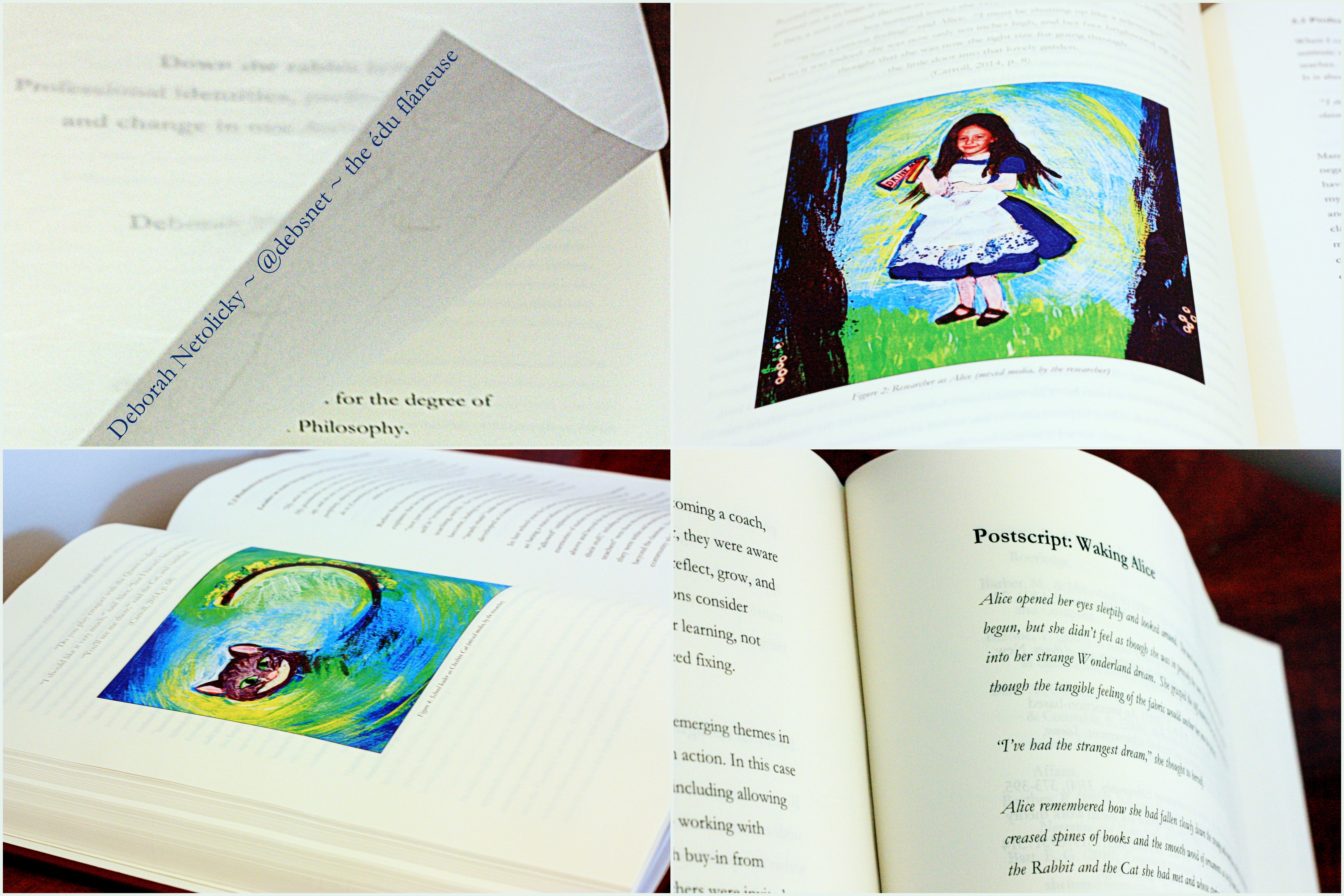
thesis pages

thesis pages

Bound pages nestled within the regal carapace

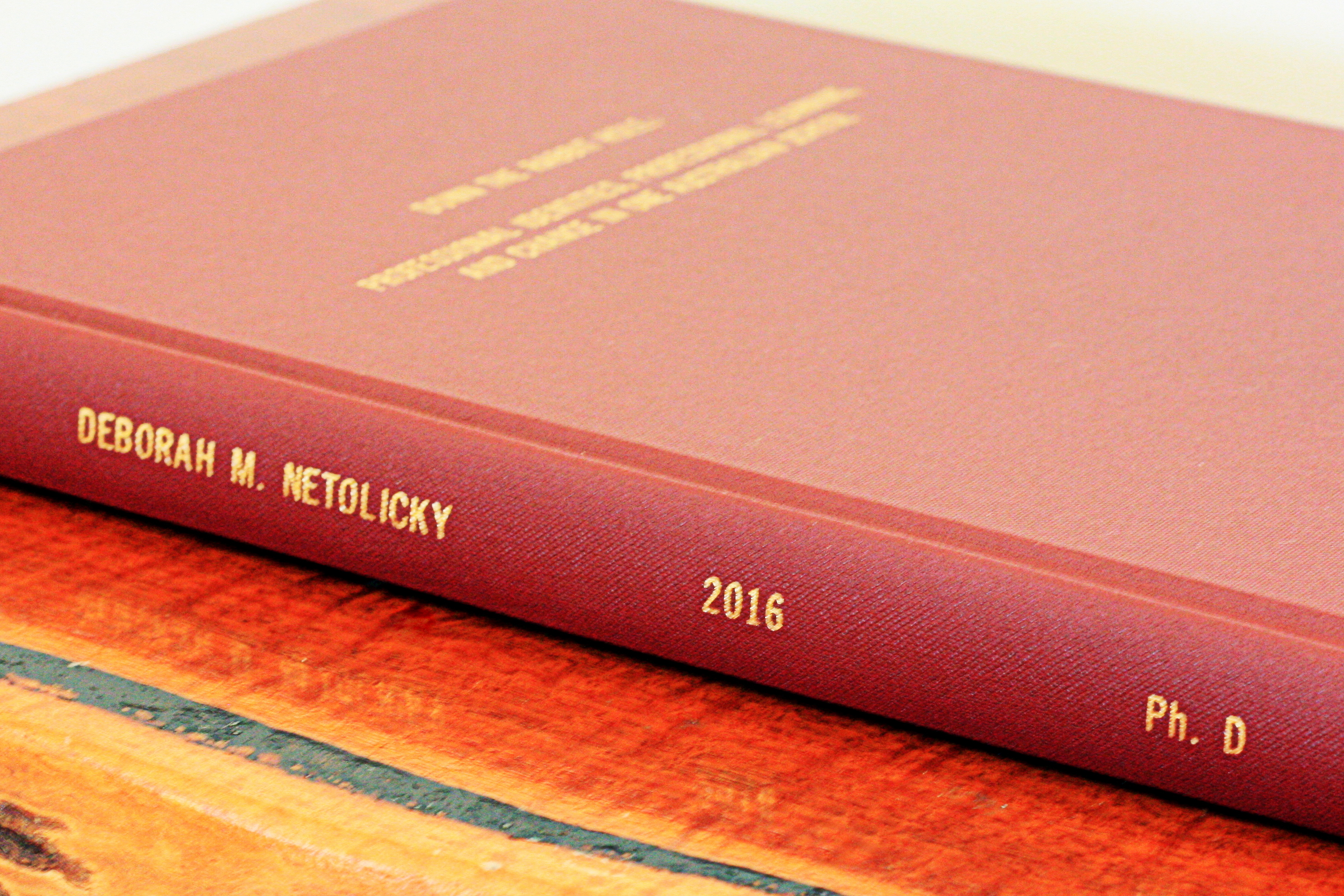
To bind a doctoral dissertation is not just to join pages prosaically together into a document. There are medieval bookbinding traditions and regal colours. In Australia there isn’t really a choice in the actual binding as each university tends to have theses bound by a particular book binder, to particular specifications. The traditional binding is in buckram cloth with gold lettering. Each university has different colours associated with each degree. At my university, the PhD thesis is bound in maroon, so maroon it was. The nice thing about that was that on the day I picked up my pile of five theses (one for the university library, one for each supervisor, one for the school at which I conducted my study and one for me) people congratulated me as I walked through the grounds. “Well done!” “Congratulations!”

The Big Book

The Big Book

Of course, none of this matters in the big picture. A font does not make or break the substance of a thesis. A bound thesis needs to meet its university library’s specifications, but no more than that. I know that my thesis could have been printed in Arial or Times New Roman, on ordinary copy paper, and it would have been of the same written quality. Now that most theses will be read online, the archival quality of the thesis makes even less difference than in the past.

Yet, my own love of books and their tactile, olfactory and objet d’ art properties meant that I put a lot of cognitive and emotive energy into the physical book. And I took a lot of joy from experiencing the finished product. It might have been my favourite PhD moment so far. If you’re like me, go ahead and embrace your inner book nerd.

It’s ok to be a book-perfectionist. It’s ok to love your finished thesis, imperfect as it might be. Think of it as a handmade quilt, full of the humanness of your mark. For me the choice of font, slightly textural end papers and creamy archival paper were about valuing the text and helping my reader enter the narrative of my thesis, which uses Alice’s Adventures in Wonderland as a literary lens. The tactile experience of turning those first pages might help them down the rabbit hole of the text and into the world of story, into the study and back to their childhood memories of reading.

bookish gifts for my supervisors

bookish gifts for my supervisors

On writing: Is it dense to be complex?

writing is power (my image, of course!)

writing is power (my image, of course!)

Writing can be bold and dangerous and disruptive. It can be quiet and still and sneaky. It can be melodious and rhythmic and beautiful. It can be subversive and challenging and difficult to read. As a reader and a teacher of English and Literature, I am a believer in the power of language, of words, of literature, of story and of writing. To educate and to soothe. To challenge and to change. It’s why writing is so important for everyone. Writing – and being able to enact authorial intent, to release thought and emotion through words on a page or screen or device – is power.

I teach my students of English to write for audience and purpose. For whom are they writing? What is their purpose? To persuade, to shock, to inform, to inspire, to call to action, to explain, to intrigue? As authors, once they have identified for whom and why they are writing, they can make choices of form, structure and language. I teach them the ‘rules’ of various genres and forms so that they know how to use them, and how to deliberately break them. The same goes for any writer: know your game, how to play and conform, and how to challenge or subvert.

I find blogging an interesting form in the sense that the audience is sometimes unclear. In some ways I write it for myself – as a web log of reflections. Yet I write around particular topics, and I know that I have a readership of individuals and groups who are (it seems!) interested in what I have to say. In some ways I write to share my story so that others might glean something from it, in part because I get so much from others blogging their journeys or writing ‘aloud’ their thoughts and theories as they form. I like even more the collaborative nature of blogging; when it opens up conversation, in comments, on social media or in new blog posts. As Pat Thomson writes, writing can be identity work; it can be a way into being and into connection. And as author and self-publisher, a blogger is free to write how and about what they choose. It’s a kind of free writing.

Academic writing is a different beast. Some academic writers work to make their writing accessible to a broader audience than the academe or a narrow field of scholars. Sometimes I use my thesaurus in reverse (‘What’s a simpler way of saying this?’). But often, as Greg Thompson and Linda Graham have suggested recently, academese can be complex, esoteric and hard to decode precisely because of the densities and intricacies of the ideas being tussled with. Readers and writers of academic prose need to work hard, grappling with words and concepts. Sometimes it seems that every third academic writer invents a new word just to sound more obtuse and scholarly than the next. Yet these discourse-specific terms can be the result of the sweat and tears of theorisation; ‘How do I best communicate this theory?’ Like literature, often celebrated for its multi-levelled complexity, academic texts often need to be read and re-read in order to be understood, and on different levels. Academic allegory. A journey into knowing.

One’s own writing, too, can involve struggle. Using big words isn’t necessarily gratuitous chest-beating in order to show off or project cleverness; it can be the result of ideas and words wrestled with, toiled over, written and re-written. Boundaries pushed at persistently. Knowledge formed or reimagined. I am a neophyte in the world of academia, but my PhD has taught me that writing in academia can mean taking one step forward to take ten steps back. Often I write my way into understanding, like Naomi Barnes who sees writing as inquiry and blogging as process.

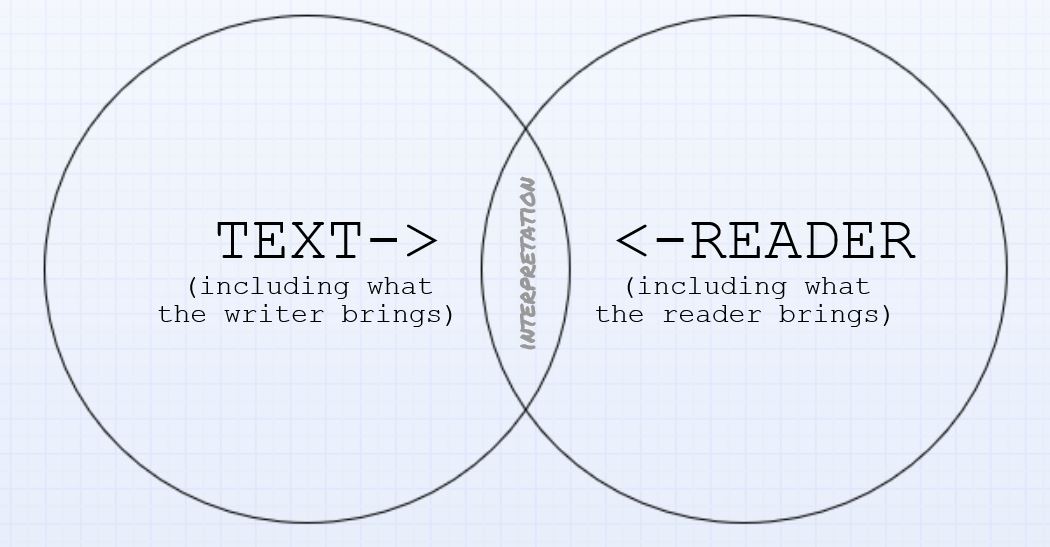
my crude Venn diagram of the writing-reading process

my crude Venn diagram of the writing-reading process

Meaning is made at the junction between text (as performed by the writer) and reader. The writer brings themselves to the text, with all their own context, authorial processes, beliefs, assumptions, knowledge, gaps in knowledge and writerly decisions. The reader, too brings their self, context, beliefs, values, and skills of interpretation to the written piece. It’s in that zinging middle space – like in the tension between the fingers of Adam and God on the Sistine Chapel ceiling – that meaning is made. It’s why no reading of a text is ever the same, and why there can never be a ‘right’ interpretation, only perhaps a dominant one.

In today’s world there are a range of places and forms in which authors can communicate their work, theorise, research, think and write. Writers make decisions based on what they want to communicate and who they are reaching out to (or away from). They can choose big words, small words, combative words, inclusive words. They can simplify or complicate. They might write to situate themselves in a particular discourse, within a particular conversation, or with a particular group.

Readers, too, make choices. To read, engage, re-read, give up, struggle through. Or to respond and engage by writing, writing, writing.

Blogging and learning are versions of reality inseparable from our emotional state

The world is your exercise book, the pages on which you do your sums. It is not reality, though you may express reality there if you wish. You are also free to write lies, or nonsense, or to tear the pages. ~ Richard Bach, Illusions

I'm grateful to be nominated in this category of the #Eddies15

I’m grateful to be nominated in this category of the #Eddies15

As I crawl over the finish line of the school year in Australia, I’ve had the lovely news that this blog has been nominated for the ‘Best Individual Blog’ edublog award in 2015. I am grateful for the nomination, and if you fancy voting for me or anyone else, you can vote here.

As I’ve reflected on this nomination, I’ve been wondering about my choices as a learner and blogger. This week, as part of our end-of-year staff planning and PD days, four hours was set aside for an activity, self-chosen from a list of options, in which we would experience being a novice learner. This was followed by reflections on that experience and its possibilities for learning and assessment in our classrooms. Options included Zumba, water skiing, life drawing, ukulele making, tennis, coding and stage combat.

It was interesting to see the criteria people used to make their choice. Some chose something they knew they were good at, based on personal criteria of having fun and achieving success, at a time of year when many are tired and emotionally vulnerable. Some chose something that would really challenge them and during which they would feel the discomfort of the novice learner, putting themselves in the position many of our students are in every day. I was somewhere in the middle. With a Fine Art degree, I’ve done my share of drawing, so I didn’t choose that, an activity in which I would feel quite at home. But I also didn’t choose something like stage combat, which I thought might be a really great challenge, but in which I had the equal possibility of being exhilarated by conquering the task, or feeling frustration, discomfort and disappointment (or both!). In making my decision, I considered the school’s intentions and instructions, as well as my own emotional wellbeing and what it was I wanted to achieve from the day. It reminded me that each of my students enters my class in a particular internal place, of which I might not be aware. 

my ukulele from kit to finished product

my ukulele from kit to finished product

I self-selected the ukulele making challenge. I figured this was both fun and something I hadn’t done before. Despite my comfort with discomfort as a place of learning and transformation, it was a safe choice. And I kind of wanted a ukulele, so I was seduced by the possibility of having a product at the end. There also seemed something lyrical about the uke itself, played as it is by Hawaiian musicians such as  Israel Kamakawiwo`ole (hear his beautiful rendition of ‘Over the Rainbow’ here).

As it turns out, this activity was an opportunity to work with people from across the school, many of whom I don’t often get the chance to work with or learn from. It was a wonderful chance to be ‘in flow’ in a workshop, gluing sanding, designing, decorating. I experienced firsthand why my students might want to stay in the woodwork workshop rather than packing away to come to my English class! It reminded me of our Year 10 English Term 4 unit, in which there are no marks or grades; both teacher and student were liberated from measuring success and failure. It was really up to the learners to decide how hard they wanted to work, how important the task was to them and what level of challenge was appropriate for them. Many, including our colleague who was our teacher for the day, worked through their lunchbreak. As well as intrinsic motivation, there was plenty of interdependence, as colleagues sought each other out for help and collaborative learning along the way. Barely any of us used the written instructions as our preferred way of learning.

What I loved was the way that, even though we all started with the same Wolfelele kit, the resultant products bore the marks and personalities of their makers. 

some of the range of ukuleles made during our activity

some of the range of ukuleles made during our activity

With this blog I also make choices about the marks I make, the stories I share, and the things I choose to leave off or leave out. While this blog isn’t quite my highlight reel, I do tend to privilege positive stories, rather than those times in which I am feeling stuck or vulnerable. The more uncomfortable posts tend to be around intellectual disequilibrirum (a word I’m borrowing from Costa and Garmston). There is interdepence, too, in the way many posts are inspired by, or in conversation with, others.

The #Eddies15 edublog nomination is affirming, in that it reflects that the writing I send out into the blogosphere touches someone somewhere. I’m also aware that, like any text, it presents versions of reality, time-frozen snapshots. It reflects my choices, my self as an author, my connections with others in the blogging community, and my state of self at ay given moment.

Postscript: This blog was voted fourth best individual blog in the 2015 edublog awards. You can see the winners list here.

‘WRITE ME’: Writing to be, writing to know, writing to connect

Round the keyboard was a paper label, with the words ‘WRITE ME’ beautifully printed on it in large letters. Alice ventured to touch the keys, and, finding the sensation to be addictive and quite wonderful in its staccato rhythm, very soon found she had written a page! Three pages! “What a curious feeling!” said Alice, “I must be becoming a writer.” And so it was indeed, for there were words on the screen and the pads of her fingers were singing with a kind of joy.

~ adapted from Lewis Carroll’s Alice’s Adventures in Wonderland

'WRITE ME'

‘WRITE ME’

It is coming to the end of #AcWriMo, ‘Academic Writing Month’, when, for the duration of November, academic writers take to social media with valiant goals of words written and writing tasks completed. I know how good it feels to watch the words grow. But writing is more than increasing words. It is reading. It is cutting out words. It is drafting words upon words that don’t work; words which are the evidence of problem-solving processes, etched onto white screens or into notebooks; for erasure or storage in shadowy places, not for publication.

In my PhD, and in this blog, I use writing as a medium of reflective and analytic thinking. ‘Writing aloud’ or ‘free writing’ is one way in which I sometimes see where the words take me and which surprising and non-linear burrows I might be catapulted through.

This post emerges out of a blog and Twitter conversation with three academics around writing and autoethnography: Helen Kara (who writes here about ‘showing her workings’ and revealing the personal), Naomi Barnes (who muses here about autoethnography as a vehicle between the personal and theoretical) and Katie Collins (who responds here with her thoughts about writing as thinking, as filter on reality and as power). Here, I offer my own thoughts to this conversation.

I was ushered into this conversation by Helen, but was already familiar with Katie’s work. Once Alice’s Adventures in Wonderland was enmeshed into the fibres of my PhD thesis, I went looking for someone else who had done something similar (because surely I couldn’t be the first), and came across Katie’s then-recently-published dissertation. We had done different things with Alice, but the novel clearly resonated for both of us.

While I didn’t use Deleuzian theory in my PhD, Deleuze’s 1990 Logic of Sense reflects some of my thinking of Alice as a novel of identity contestation, fluid becoming and un-becoming, through language. Carroll’s fantastical, imaginative world questions adult realities and plays with the power and (non)sense of words. Deleuze positions Alice at the borders. As a neophyte researcher who has made some non-traditional choices, I have felt that I have operated in some ways at the borders, questioning and pushing at the edge of where I am expected to be, what I’m expected to do and how I’m expected to do it. Being at once curious about, filled with wonder for, and at odds with, the world is an affinity I feel with Alice. (This week I will present on my use of the Alice metaphor in my PhD, at the Australian Association for Research in Education conference.)

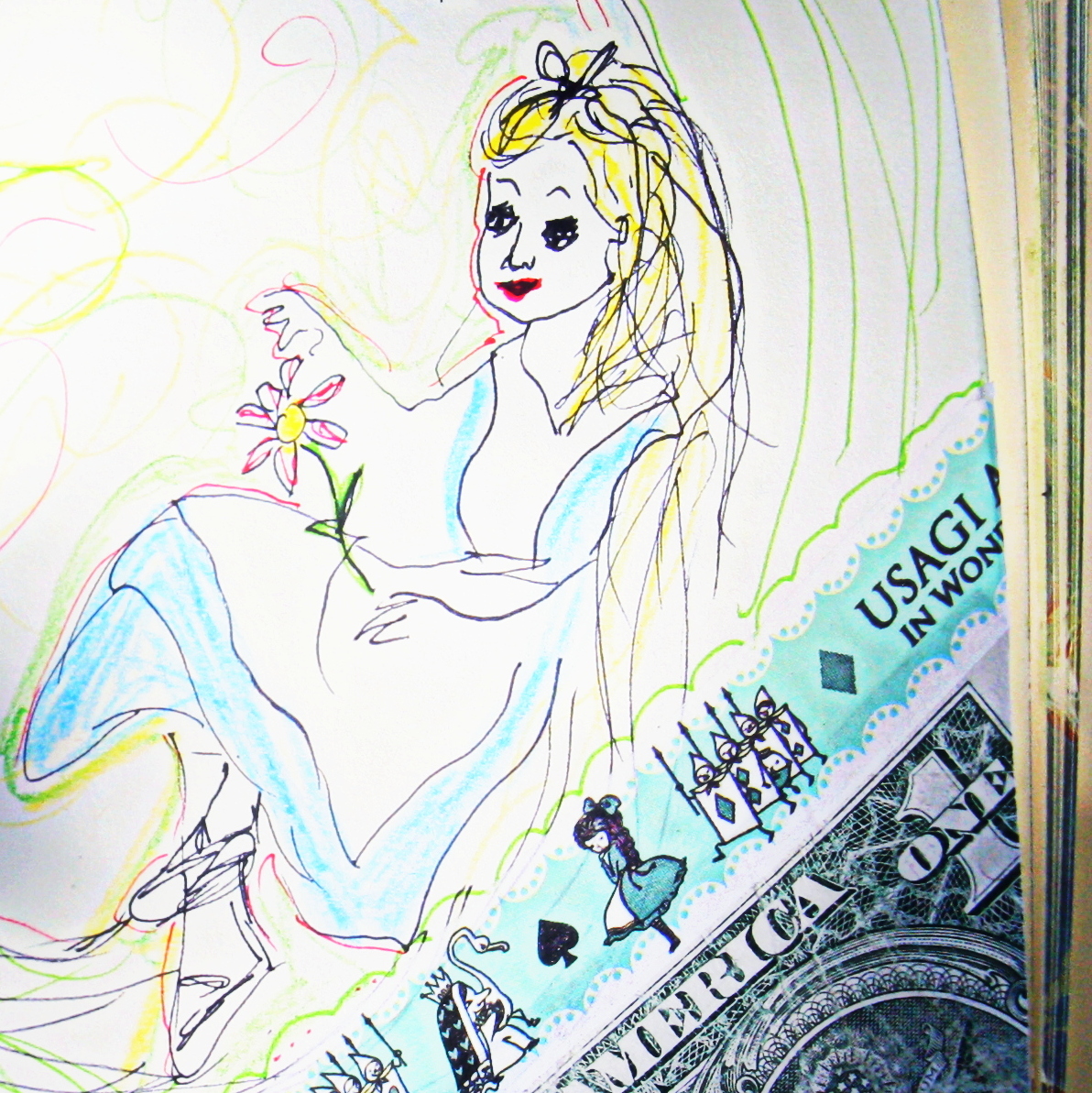
crudely sketching Alice

crudely sketching Alice in my notebook

While for my PhD I didn’t adopt autoethnography per se, I did use the autoethnographer’s lens as part of my conceptual bricolage. That is, I saw myself as research instrument, self-conscious participant and immersed, self-identified insider member of my study. Michael Schwalbe’s 1996 metaphor resonated: reflections on my self were both door and mirror; a way in to others and a way back to self.

My PhD thesis self-story (I was interviewed as one of my own participants; but that’s another tale) had the purpose of making transparent my own worldview (along the lines of Helen’s ‘showing my workings’), but it also had another function: to help me know myself. As I worked to find the words to explore and articulate my own lived experiences of the phenomena I was studying, I found, as others have, that I wrote my way into knowing, wrote my world into a version of its reality and constructed my own story in new ways, through the talk-aloud experience of the interviews and the process of forming and finding the words to frame my narrative.

I wrote at one point about writing a PhD as like freeing a sculpture from stone, but I wonder if the process of writing is one in which we free what already exists within, or if it is more than this. Creation? Collage? Weaving? Moulding? None of these seems to adequately embody the process of writing which seems to come simultaneously from within and without; from past, present and future; from materials tangible and intangible. It is deliberate and intuitive; visible and invisible.

And so, I continue to welcome opportunities to write my way into being, to write my way into understanding and to connect my words and thoughts with those of others.

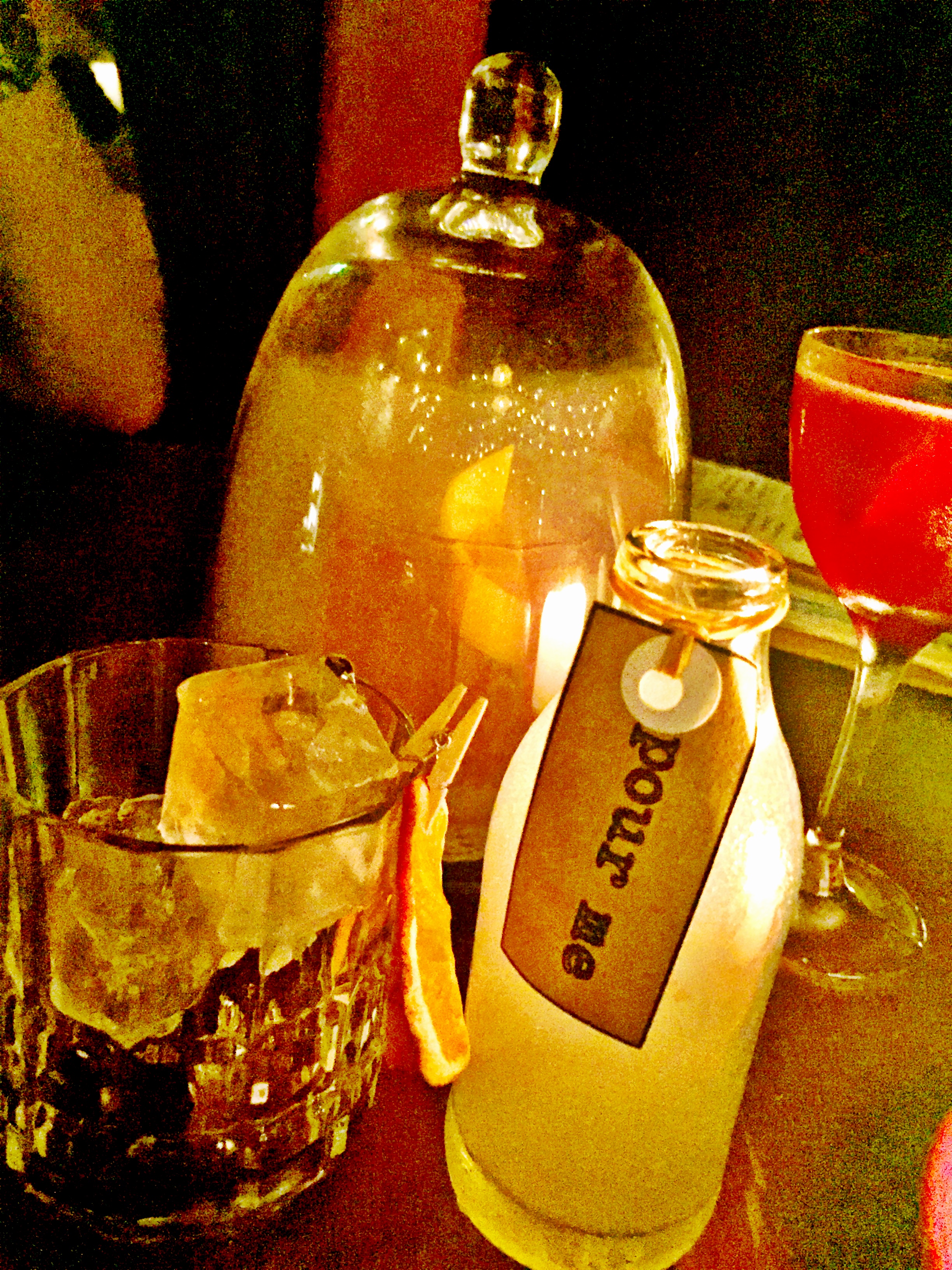
I came across this 'Pour Me' cocktail the night of this Twitter conversation. Coincidence?

I came across this ‘Pour Me’ cocktail the night of this Twitter conversation. Coincidence?

Webs & chrysalises: Metaphors for learning & connection

Naomi Barnes, in her recent article in the digital journal, Hybrid Pedagogy, writes that “we need to start paying more attention to the random thoughts because when learning is conceptualised as a web, rather than a line, randomness becomes more meaningful.” She refers to the unanticipated blogging conversation, sparked by Steve Wheeler’s #blimage (blog+ image) challenge, that she, Helen Kara and I became involved in as we voluntarily responded to each other, layering our ideas and connecting our words.

My own experience of learning is non-linear and rhizomatic. The findings of my PhD were that this is an experience shared by individuals, groups and organisations; learning happens in surprising ways, in unexpected places. I agree with Naomi that embracing non-linear randomness might lead us to interesting places of knowledge collaboration, reimagining and production (although I do think we should acknowledge our sources of inspiration).

I mentioned in my blog post (part of the above-mentioned blogversation) on the spider-web connectivity of networked learning that metaphors, including of the spider’s web, emerged from my participants as ways to explain and explore their understanding of their professional selves, roles and relationships.

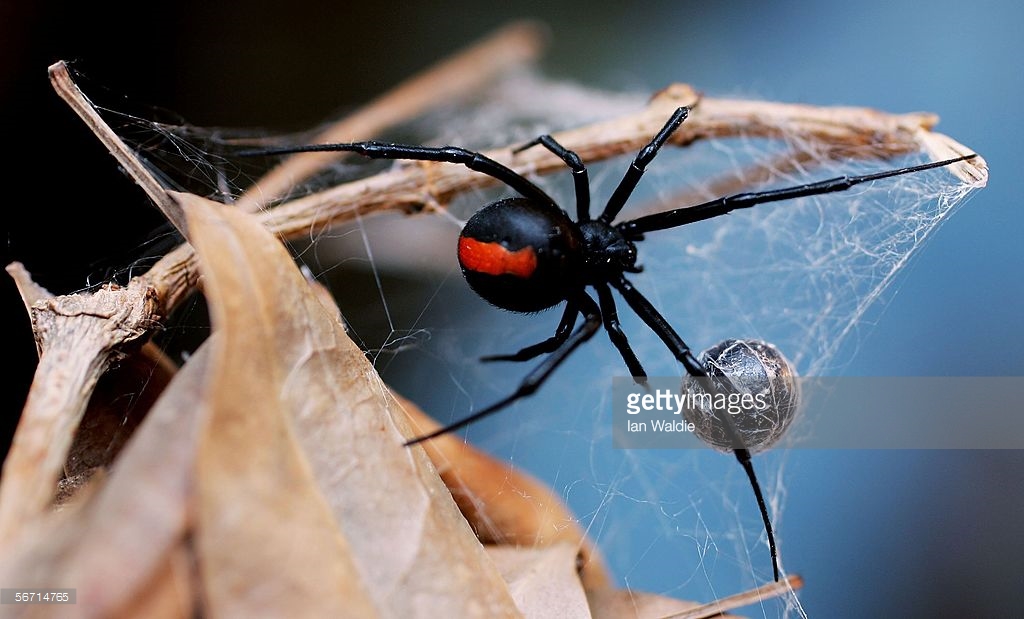
As it edges towards summer here in Australia, at home I recently found a redback spider (latrodectus hasseltii for the arachnid nerds), an Australian relative of the American black widow spider. The redback female is venomous, formidable and self-sufficient. Her web is messy. Males live on the periphery, eating her scraps. And after mating, she eats them, storing the sperm for later.

I’ve felt a little recently like a web-weaving spider. My PhD thesis is submitted, and suddenly, papers, journal articles and conference presentations are materialising. My PhD work has formed a web which widens and thickens, and in which these prey are being caught. The learning I’ve been doing from the network of scholars with whom I connect on Twitter and in the blogosphere has continued to take me to new thinking and into interesting conversations.

Now, I don’t see myself as a poisonous, man-eating widow spider, but I like that the redback is autonomous, a beacon of feminine power. I like that her web is messy and functional, not pretty and symmetrical. As well as the weaving of the physical web, the species itself has spread its tendrils out from Australia to reach New Zealand, Japan and Belgium. She has even made it into two DC comics as a supervillain who fights Robin. Unexpected places. Unpredictable influence.

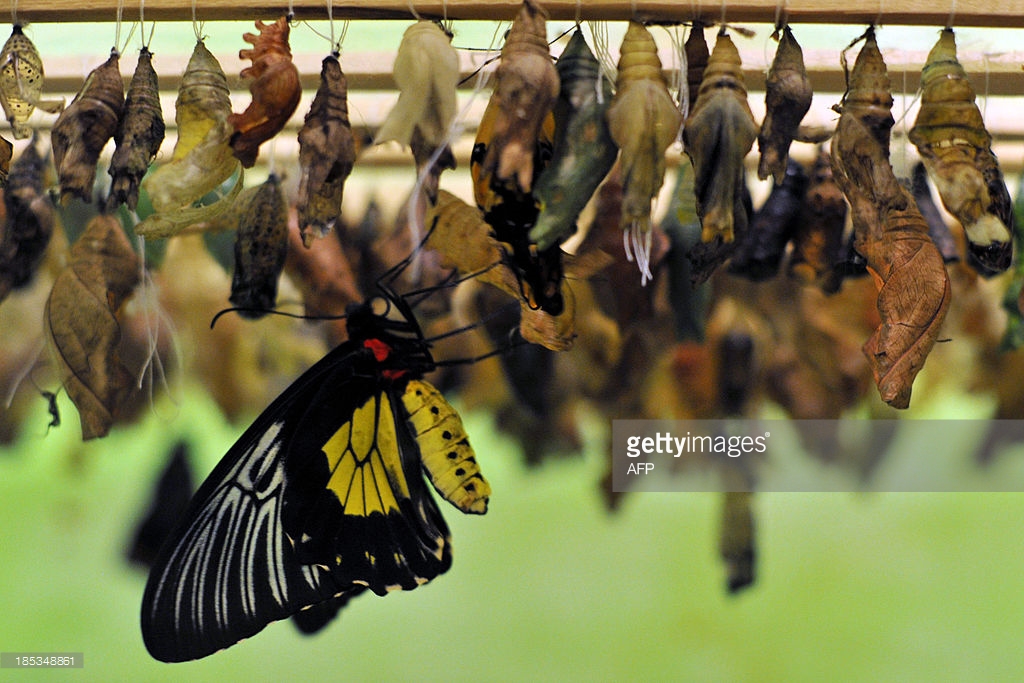
The other insect creature I’ve recently been reflecting upon is the chrysalised caterpillar-butterfly. After I submitted my thesis, I wrote the following title in a Word document and saved it: “Emerging from the chrysalis: PhD as transformative learning.” It was a blog idea for later, after proper completion, maybe. I was remembering a post I had read which argued that the PhD is not a transformative experience, but a thing to be done, a process to be completed, a means to an end. This wasn’t my experience so I thought it might be worth writing about.

And then I set the November #HDRblog15 challenge, and Kathryn Davies wrote this post about the life of a butterfly as a metaphor for the cycle of the PhD. Kathryn explores the chrysalis-PhD metaphor so thoroughly and thoughtfully, my own post idea seemed redundant. Yet my experience was affirmed by reading Kathryn’s. For me the PhD was transformative. I began my doctorate as someone who hadn’t written an academic paper or dissertation for 14 years. I was a vulnerable, soft-bellied slow-moving academic creature, my newness shiny and green. Over the course of the PhD, it has changed the way I think, the way I write and the way I read. It has changed how I perceive my identity, how I behave and how I respond. Some of these feelings I’ve written about, including a crisis of scholarly confidence, taking flight in the discussion chapter, and on being (or identifying as) a writer. And while I’ve recently said that I feel frozen in examination limbo, perhaps it’s more appropriate to say that I’m quietly growing, wriggling inside and pushing at the edges of my PhChrysalis, still a neophyte but transformed by my PhD journey.

So, I offer out to the blogoverse another post, another moment of my thinking suspended in time, another layer, another thread, another voice, another tendril reaching out to others. To be ignored, observed or grasped.

Doctoral examination limbo: Frozen in PhD carbonite

So okay― there you are in your room with the shade down and the door shut and the plug pulled out of the base of the telephone. You’ve blown up your TV and committed yourself to a thousand words a day, come hell or high water. Now comes the big question: What are you going to write about? And the equally big answer: Anything you damn well want. ~ Stephen King, On writing: A memoir of the craft

The irony isn’t lost on me that, the same month I set a blog writing challenge for PhD and other research students (and others in the academic pre- and post- doctoral world), I am struggling to find content for a PhD-related blog post. So, following Stephen King’s above-quoted advice from his excellent On writing: A memoir of the craft, I’ll write about ‘anything I damn well want’; or perhaps just anything that comes into my head as I type. This follows Pat Thomson’s technique (which she also attributes to Ray Bradbury) of writing with a blank screen and a few selected words which spark associations. Pat says it’s ‘writing fast’ or ‘running writing’ rather than ‘free writing’, but I’ll call my approach free writing here, because that’s what it feels like to me. Screen. Keypad. Words. Let them form as they will, then revisit and see what’s been made.

Part of the reason I’m finding a PhD-related post difficult is that I am currently in examination limbo. I’ve submitted the thesis and it’s been posted to three examiners, so now comes a wait of two to six months.

In this limbo period, I’ve got some papers to revise and to write, and I have work, parenting and life which go on. And thank goodness! Inger Mewburn, Thesis Whisperer, has likened completing the doctorate to running off a cliff. I can certainly relate to that, in a Road Runner cartoon kind of a way. My little animated PhD legs are still sprinting even though the thesis is submitted and I’ve run off the edge. Suspended in mid-air, legs madly cycling, I’m grateful to have work to keep me busy, purposeful and grounded.

selfie scribble

selfie scribble

Meanwhile, today as part of the #aussieED Twitter chat, we were asked to ‘sketch note’ an introduction to ourselves. I have declared my love of notebooks in previous posts about my flânerial packing list and on my pre-professional-fellowship art journalling. So I sat with my kids and scribbled some bits and pieces, watching them join together. The interesting thing about the process of thinking-while-scribbling is that thoughts and ideas emerge, seemingly through the very process of the pen scratching across the paper. Before beginning, I hadn’t mapped out what I was going to include. Much like this blog post, which is free-written, I was free-drawing. I surrendered to the moment and watched what emerged. If I did the same exercise tomorrow, or in a week, or a year, I’m sure the result would be very different (there’s a time-lapse video idea!).

And how about free-talking? I am connected with educators and doctoral students on Voxer, and I sometimes find myself using that walkie-talkie app as a useful ‘think aloud’ tool. I find that if I press the ‘transmit’ button and start talking, I don’t know what I’ll say until I’m saying it (sorry VoxSquad for the occasional ramblings). The act of talking aloud helps me to surface my thinking.

What can we learn about ourselves, what internal thoughts can we surface or capture, through the acts of writing, drawing, or talking aloud?

Here I am, in limbo between PhD submission and PhD completion, frozen in carbonite as an almost-Dr (yes – I’m anticipating The Force Awakens and am reminiscing about my favourite Star Wars moments, like Han Solo being unfrozen from carbonite). I’m wondering what might come next. Continuing to work in my current job, at my current school, business as usual? Considering what kind of role might be possible in my present context? Starting at the bottom of the pile, after a 15 year career as teacher and school leader, by dipping my toe in the academe? Heading down a consulting or alternate/indie academic pathway?

I know my current thinking, but I’m open to being carried in other directions. Free-writing, free-drawing and free-talking open up possibilities, so why not free-professional-decision-making? Lay out the materials and see what surfaces.

* This post is for the #HDRblog15 challenge. Join me to blog all things higher-degree-by-research this November!

my PhD notebook stack <3

my PhD notebook stack ❤

Appropriation vs. attribution. What’s ok in our digital world?

is online appropriation repurposing & piracy cause for alarm? (yes - I took this photo - does that mean it's your for the taking?)

Is online appropriation, repurposing & piracy cause for alarm? (I took this photo. Does that mean it’s yours for the taking?)

The Internet has been a blessing and a curse. The curse we know: A lot of people appropriating your intellectual property without paying for it. But I think it’s important to realise the blessing of the Internet, which is that everybody has a voice and you can break through. ~ Gloria Estafan

Ownership in the digital world is a slippery issue. In academia, the parameters are straightforward; if you are repeating or even building upon the ideas or words of someone else, you cite them. Period. Yet this same practice does not consistently apply in the blogosphere, Twitterverse, or classroom. I have found my original photos, from my blog, on others’ blogs, without attribution (after requests from me, these have been attributed). There are regular comments on social media like ‘I’m stealing that’. In a recent MOOC in which I am participating, one person made a meme from another person’s words, without attributing them. If I tweet or blog out some words, are they part of the public domain, and there for the taking?

I was recently pointed toward a post by Seán McHugh on his feelings about Creative Commons, especially in a teaching context. In fact, the tweet which pointed me towards Seán’s post said “Maybe y’all would be interested in learning about ‘constructive plagiarism’ from @proteanteacher”. Learning about constructive plagiarism? The English teacher and PhD researcher in me shuddered at the thought of how one might ‘constructively’ plagiarise. In what possible ways might taking someone else’s ideas or words or images without attribution be considered positively as ‘constructive’, I wondered.

In his post, Seán says, about using pictures from the web: “It’s theft? Nonsense. Can we please STOP lying to our kids? While a handful of CC activists relentlessly pursue their moral crusade, the rest of us in the real world will need to figure out how best to work within a web where ‘piracy’ is rampant, symptomatic of deeper issues that are a great deal more complex than the simplistic arguments pushed by those who should know better.” He points out that piracy is not theft as the original still exists. Yet industries such as music and film have laws against the pirating of original works. While some online content isn’t directly related to people’s livelihood, sometimes it is. And should it matter whether someone is making money from their authorship? Does that give them more right to own their own work?

I agree with Seán that our level of attribution might depend on our purpose. If a teacher asks a high school student to search for an image to stimulate a piece of poetry writing, it might not need to be attributed. If the student is going to publish the poem with the image, then I would argue that it does. Part of teaching digital citizenship should be around what it is to be a responsible, considerate digital citizen who respects the intellectual and creative work of others.

‘Piracy’ and ‘pirating’ are terms that have become trendy in some education circles thanks to Dave Burgess’ ‘Teach Like a Pirate’ phenomenon. Pirates can be seen as an imaginative metaphor for excitement on the high seas, or for murderous violence, as Corinne Campbell explores as part of her response to the book Teach Like a Pirate. Corinne writes, “On a personal note, I find the PIRATE acronym unfortunate, and quite frankly, offensive. … When I think of pirates, I don’t think of Disney and Jack Sparrow. For me the word triggers thoughts of the very real, very dangerous pirates who take rob, murder, rape and take hostages in seas today. I ‘get’ that most people don’t feel that way and love to buy into the Disney version, so I tried hard to squash my objections, but anything that trivialises rape and murder while celebrating those who commit such crimes is going to get my hackles up.” (This is only one part of Corinne’s post; she also has good things to say, so see the full post for a fuller picture.)

Is saying we’re not stealing or plagiarising something, but ‘pirating’ it, better? Is it a more ‘fun’, imaginative form of plagiarism or taking from another person? Is it ok because we haven’t removed the original? Or is it immoral, discourteous, or at the very least, lazy, to take someone else’s creative or intellectual property, and present it as our own, or as author-less?

In his post, Seán McHugh writes that “when we’re watching someone’s amazing, riveting, bullet point riddled PowerPoint, I do not assume that any images contained therein are images they created themselves or ‘own’, in fact, like most people, I believe, we assume the opposite; the images they use to illustrate their work are not theirs unless they say otherwise.” There are interesting assumptions at work here. Why would we assume that what a person presents is not their work? When I present at conferences using PowerPoint, I always caption images with author and source, if they are not my own. On my blog, I use mostly my own photos, or if the images are not mine, I clearly acknowledge the creator and/or source. I recently wanted a glorious picture of an octopus for my ‘Why I Love Twitter’ blog post, and found a lovely illustration after some Google searching. I used the found image, attributed the creator and source of the work in the caption, and tweeted it out to the illustrator so that they knew their work had been used. I’ve been part of the wonderful #blimage (blog + image) challenge, but in that challenge, people were asked to attribute the images to their creators.

I agree with Seán that the use of others’ work is a moral issue. Like him, I operate from the perspective of “do as you would be done by”, but that seems to mean different things to him as to me. I don’t use Creative Commons but I do feel a moral obligation to recognise and attribute the work of others. For me it is about courtesy, professionalism, respect and integrity.

In a recent Brand Newsroom podcast – at about the 19 minute mark – Sarah Mitchell, talking about Scott Stratten’s keynote at the annual Content Marketing World event says, “just because you can take something doesn’t mean you should take something”. She uses the analogy of fruit piled up outside a greengrocer; we wouldn’t take it just because it’s there. In an alternate view, author Neil Gaiman talks in this video about how he came to view piracy of his work as advertising, allowing an author to reach more people.

What do you think? Is using others’ images or words in your online content without attribution ok and an accepted part of being in a digitally connected world where no one owns anything? Is it lazy or inconsiderate content creation? Is it morally corrupt authorial practice? What kinds of explicit practices, agreements or common understandings might we need to help us navigate the terrain of ownership and attribution in our digital world?

The Research Student Blog Challenge – #HDRblog15 – November 2015

Get involved! Let's learn together with #HDRblog15

Get involved! Let’s learn together with #HDRblog15.

Writing begets writing. Somehow, the more I write the more I write. The more I think about writing, write about thinking about writing, and write about writing, the more I write. For me, tweeting, blogging and academic writing are all writing practices, ways of thinking and writing my way to understanding. They are also ways of connecting with others. Being part of research conversation and blog conversation and Twitter conversation. Telling stories. Sharing stories. Learning from others’ stories.

There are blogs which host posts by research students such as the Thesis Whisperer and PhD Talk. There are active and dormant blogs by research students which can be hard to find in the heaving mass of the blogosphere. And some research students might wonder about what blogging could offer them, but not have the impetus to start.

I’m currently taking part in the How to Survive Your PhD MOOC (massive online course) which has expanded my network of scholars, fellow researchers and fellow writers. The course, especially through its discussion forums, #survivephd15 Twitter hashtag and Periscope live chats, has shown how much a community of past and present research students, and supervisors, can gain from engaging with each other.

I am keen to build on the momentum of this course, and on the wonderful and generous scholarly Twitteratti, with an initiative that will share the stories of research students who are juggling life and supervision with writing dissertations, theses and journal articles. My answer? The #HDRblog15 blogging challenge. I’ve called it the HDR (higher degree by research) challenge as I’d like any research students (PhD, professional doctorate, Masters), and those involved with research students, to feel welcome to join in.

The challenge will be held during the month of November 2015. Its purpose is to encourage past or present higher degree by research students, supervisors, or those interested in pursuing a higher degree by research, to connect, communicate and share resources and experiences.

The challenge involves writing at least one blog post (you might write more!) and commenting on at least one other blog post in order to develop conversation and community.

If you are new to blogging, the first step would be to set up a blog. I use wordpress.com, which is very user friendly, quick to set up and easy to manage.

Ideas for your blog post/s might include the following.

  • Sharing a celebration from or positive spin on your experience of being a research student.
  • Exploring a question you have.
  • Illuminating a challenge you have faced in your HDR journey, and how you approached or conquered it.
  • Sharing a tip or technology.
  • Exploring a metaphor for where you are in your HDR/PhD/Masters journey.
  • Explaining a strategy you have for coping with the demands of a research degree.
  • Using an image, animated gif or video as inspiration. Just make sure that, if it’s not one of your own, you attribute it to the site or person from which you got it.

So, the steps for participating in this challenge are as follows.

Step 1: Fill in your name and blog url here in this Google doc.

Step 2: Write and publish your blog post.

Step 3: Share your post in the Google doc and on the How to Survive Your PhD MOOC discussion board, if you are enrolled (but any research students, past research students, or supervisors of research students, or people interested in becoming a research student, are more than welcome!). Tweet your blog out using the #HDRblog15 hashtag. To extend your reach, you might also like to use other hashtags like #survivephd15, #phdchat, #acwri (academic writing), and #ecrchat (early career researcher chat).

Step 4: Keep an eye on the #HDRblog15 hashtag on Twitter and the Google doc to read others’ contributions as they arise.

Step 5: Comment on at least one other post.

If you’re new to blogging, remember that reading on the web, including on a mobile device, necessitates information being presented in a way that is engaging and easy to process. This means a ‘hook’ to draw your reader in, a catchy beginning to grab the reader’s attention and short paragraphs readable on small screens and on the go.

I find 800ish words is best; it’s meaty enough to explore a topic, but short enough to be readable in one sitting. I find if a blog post pushes over 1000 words, it’s getting too long and I try to think about how I can parameterise it to reign it in, or split it up.

Visualise your audience when you are writing, to help you personalise the content and lead decisions about language, style, voice and approach. Are you writing for others in your industry? Other research students? Future employers? As a record of your own thinking for yourself?

Blogging allows us to connect with others and develop ourselves. Your blog can be a free writing space where your persona can be unrestrained and experimental. I look forward to reading your contributions!

Deb

* This post is in response to the How to Survive Your PhD MOOC 2015 ‘final activity’.

* If you are a PhD student who blogs, take the time to complete this research survey for Inger Mewburn and Pat Thomson on why and how you blog.