The Connected Learner: Reflections on Connected Educator Month #CE14

spring in my garden: iceberg roses blooming

spring in my garden: iceberg roses blooming

Adventure is a path. Real adventure – self-determined, self-motivated, often risky – forces you to have firsthand encounters with the world. The world the way it is, not the way you imagine it. ~ Mark Jenkins

As Spring springs here in Australia and Fall falls in the USA (where I am headed in two weeks), I have been reading a lot about how October is Connected Educator month. You can read more from Craig Kemp (Twitter as PD), Tom Whitby (on the connected mindset) and Pernille Ripp (the downside to being a connected educator).

It has me wondering: what about being a connected learner? Because for me, being a ‘connected educator’ means connecting to be challenged, to be supported and to learn.

Twitter is a platform which allows plenty of connection and learning. On Twitter I …

  • Learn from others around the world – educators, thought leaders, researchers, students, people in other industries, friends and like-minded individuals. I get to read others’ ideas and share my own, and this means I am in a constant place of learning.
  • Contribute to a localised community hub of learning and thinking, sharing ideas on-the-spot such as at conferences during presentations; I simultaneously contribute to and consume the stream of learning-community responses.
  • Engage with people with whom I disagree, thereby engaging in debate and widening my perspectives. Corinne Campbell has written about why we need to be careful about the ‘echo chamber’ and only connecting with those who mirror ourselves.
  • Connect to those in similar situations to myself. This is why I follow #phdchat and #acwri, because as a working parent who is also a PhD candidate (read more about that here), I am not part of a student or researcher community, apart from during my supervisory meetings. Engaging with these hashtags allows me to learn from others while feeling that I am not alone in my PhD experiences. It means that when I am deep in my researching or writing burrow, I can send a shout out (a Twitter SOS, if you like) about my research experience (something that most people in my day to day life don’t connect with) and feel connected to others in the same boat. It allows me, in my moments of isolation and academic struggle, to feel heard by someone out there! I agree with George Couros in his post about why we need to be able to find these kindred spirits outside of our own immediate contexts.

Now, with this recently-begun blogging experiment (Will it continue after my professional learning New York trip? That is yet to be decided!) I have been connecting by sharing my musings (in more than 140 characters), my photographs and my journal scribbles. The very act of writing helps my thinking and the growth of my professional ideas. The subsequent connections with others is about mutual interest and growth. Blogging has helped me refine my own thinking while widening my global learning community (or professional learning network).

Similarly to the ACEL Conference at which I presented this month (you can read my reflections here), my upcoming visit to New York will have me really connecting, face to face, with inspiring thinkers, school leaders, educators and researchers, with whom I have found connections through various avenues, from introductions to cold-emailing. Here Clara Galan reminds us of the importance of connecting in real life as well as in the virtual world.

So for me October is definitely Connected Educator month, but more than that, it is about connected learning. Educators and others around the world connect online and in person, learning together to grow themselves and come up with better outcomes in their arenas of work and influence. Fellow nerds of the world, unite, in any and every way you can!

O, Manhattan!


O, Manhattan!


Words on New York: Manhattan through authors’ eyes

from Candace Bushnell's 'One Fifth Avenue'

from Candace Bushnell’s ‘One Fifth Avenue’

In a previous post I shared my New York fiction reading pile, as I prepare for a professional trip to NYC, which will be my third visit to the city but my first for work. As I make my way through the pages of my NewYorkspiration, here are a few quotes from some of those books.

“Possibly there were two tigers, the famous and chaotic one that lit the tabloid frenzy, and this more dignified one, who showed itself to us alone. It was after all moving along Eighty-fourth Street, toward the block where Brandy’s Piano Bar and Perkus’s old apartment lay condemned. Perhaps this was the tiger that put things back together instead of destroying them … it regarded us or didn’t, shone its light on us and then shut it off again, and was gone, leaving only claw prints and, with its tail, an inadvertent serpentine signature lashed into a parked Mayflower van’s snowy windshield.” Jonathan Lethem, Chronic City

“The bridge had been the first disappointment. Looking at it from the roof of her house, she had thought that crossing it would make her feel like a gossamer-winged fairy flying through the air. But the actual ride over the bridge was no different than the ride above the Brooklyn streets. … New York was disappointing.” Betty Smith, A Tree Grows in Brooklyn 

“I wonder how she’ll find New York,” Enid said. “Having been away so long.” / “Exactly the same, Auntie,” Philip said. “You know New York never changes. The characters are different but the play remains the same.” Candace Bushnell, One Fifth Avenue

Two weeks til takeoff. Carpe NYC!

art journal page: I heart New York

art journal page: I heart New York


The flâneuse’s packing list: a toolkit for observation & exploration

A dominant impulse on encountering beauty is the desire to hold onto it, to possess it and give it weight in our lives. There is an urge to say, ‘I was here, I saw this and it mattered to me.’ ~ Alain de Botton

some of my favourite flânerial things

some of my favourite flânerial things

Flânerie has been described as “gastronomy of the eye” (Honoré de Balzac) and a moving and passionate photograph (Victor Fournel). It is an active and deliberate way of understanding the world. Baudelaire described the flâneur as the passionate observer, responsive spectator, reflective mirror and lover of life. Flânerie is all about acute, intentional and subtle observation. Baudelaire’s flâneur exists “incognito”, surreptitiously rejoicing in the magic all around him, at home among the unfamiliar, finding joy in urban exploration.

As I plan for my week in New York and my packing list, I’m asking myself: What does the keen observer need to assist them with attentiveness to their environment and experiences? How does an édu flâneuse attempt to capture the kaleidoscopic phantasmagoria of experience and learning?

Here are some of the things on my flânerial packing list.

art journaling supplies

art journaling supplies

A journal. Journaling is thinking and therapy. Cavallini & Co’s Roma Lussa is my canvas of choice, a beautiful soft-Florentine-leather-bound journal with marble page-edges. For taking flânerie old school. With pen. Paper. Even the trusty Conté à Paris crayons I still have from art school. As my Typo watercolour pencils declare: the world is better in watercolour … and charcoal, and crayon, and paint!

camera gear

camera gear

Cameras & accoutrements. The flâneuse needs a variety of lenses through which to frame and record experiences. I am taking my Canon DSLR and lenses, as well as my iPhone and olloclip lenses to allow for snapping on the go.

A laptop. For writing, blogging and editing photos. Of course this can be done on an iPad (which is much more portable) but I prefer typing to tapping and the extra control and diversity my laptop provides.

flânerial fashion

flânerial fashion

Flânerial fashion. Exploring shoes. Eco sunglasses. Leather satchel big enough to carry laptop and/or camera and/or journal. The 19th century flâneur was always bedecked in attire appropriate for urban exploration. With style.

(Pictured above are my handmade Portugese Felmini ankle boots, Scaramanga leather satchel and Shwood wooden sunglasses.)

So there you have it: my flâneuse’s toolkit, ready for taking artiness on the road to observe, explore, jot, snap, scribble and sketch.

art journal page: New York is always a good idea

Reflections on ACEL 2014: learning, leading, teaching

Effective change is a matter of both will and skill. People have to want to do it, and they have to know how to do it. ~ Levin

Passion & Purpose at ACEL conference Melbourne by @debsnet https://theeduflaneuse.wordpress.com/

2014 ACEL Conference lanyard on the Southbank boardwalk: passion & purpose

I have spent this week in Melbourne at the 2014 Australian Council for Educational Leadership Conference, including presenting a breakout session with colleagues about our school’s story so far: of building a professional growth model, based on our own context, vision and beliefs about learning, teaching and leading.

It was affirming to hear the keynote speakers’ key messages reflect the real work that we are doing at my school. Some of those keynote takeaways, as aligned with my school’s work around professional growth and culture were …

We know that teaching is complex

Noel Pearson highlighted for the over 1000 delegates that effective instruction is at the heart of education.

Charlotte Danielson reminded the audience of over 1000 delegates that “teaching is so hard it can never be perfect” and that the complex, demanding cognitive work of teaching required educators’ ongoing quest to improve teaching practice, in order to improve students’ learning. She joked that, while doctors’ work is complex, they get to see one patient at a time; “I would call that tutoring.”

In his panel response to Charlotte’s keynote, Phillip Heath, Head of Sydney’s Barker College, emphasised the importance of focusing on celebrating the full, highly cerebral, in-the-moment and sacred nature of teaching, rather than on exposing and shaming failures, or ticking boxes.

Our school’s model of professional growth and culture is focused on a default position of meaningful teacher-owned growth.

Building minds, inspiring learners

Charlotte Danielson also reminded the audience about the constructivist nature of learning for students and teachers; that learning is done by the learner in an active intellectual process. Danielson pointed to conversations in which an observer or leader advises a teacher after a classroom observation, and in which the teacher passively endures the feedback. “Who is doing the work?” she asked. The Danielson Framework for Teaching, or as she pointed out, any framework for teaching, is a conduit for teacher learning which allows teachers to do the thinking for themselves.

Tim Flannery encouraged educators to encourage exploring, imagining and being open to organismic change.

John Medina shared his knowledge around increasing the brain’s executive function, the part of the brain (responsible for openness to cognitive and behavioural change) that we are attempting to access in our teachers by applying a Cognitive Coaching approach to professional conversation and reflection.

Richard Gerver talked passionately about the need for developing self-managing people and systems. Our model’s key aim is the development of teacher-driven, teacher-owned self-managing, self-monitoring and self-modifying teachers-as-learners.

Leading with clarity, coherence and collaboration

Richard Gerver highlighted the importance of the clarity and coherence in educational leadership.

Tim Flannery encouraged collective wisdom over individual genius, the harnessing of the informed community rather than the singular expert.

Linda Darling-Hammond reminded us that “teaching is a team sport” and that the greatest achievement gains are from those schools in which educators work together with a coherent approach. Beware ‘popcorn reform’, she said, with which we might innovate our way to edu-failure. What we need is to learn from each other’s successes and failures; teachers, schools, districts and nations.

Both Linda Darling-Hammond and Noel Pearson underlined the importance of backward design: having students’ learning outcomes and futures in mind when designing their education. For Pearson, this future was “giving people the capabilities to choose lives they have reason to value.” In particular, he advocates for Indigenous Australians to realise the potential, talent and creativity which afford them real choice and the mobility to orbit between external worlds and their indigenous homes, cultures, languages, traditions and peoples.

Charlotte Danielson reminded us about distributed leadership; it is not the principal but all teachers who are responsible for leading learning in schools. Leading and learning are about collaborative growth, not punitive measures. “We’re not going to fire our way to Finland,” she said. “We need to learn our way there instead,” by  coming together as communities of teachers which use a common framework as a scaffold to provide common definitions of good teaching, a common language with which to talk about teaching and shared understandings about what good teaching is and how teachers might enact it. This, Danielson says, helps to avoid conversations in which teachers and leaders use the same words but mean different things.

John Hattie challenged educators to “change the narrative” of education by building the profession and taking pride in teachers, rather than in buildings, resources, websites or canteen menus.

Yesterday, when presenting at the conference, my colleague described our school’s continuing journey as an “evolution not a revolution”, an ongoing, organic and iterative process which is based in our own context and the needs of our teachers and staff.

We have been taking the approach of ‘go slow to go fast’, deliberately unfurling a new initiative by allowing it to bubble up out of the school’s strategic vision and then be piloted, driven and owned by teachers. We have been attempting to distribute leadership in a project which is connected by clear, coherent, school-wide organisation-aligned threads of vision and practice.

Safety and challenge for growth

Charlotte Danielson talked about getting the balance right between support and challenge for teachers; schools need to provide an environment of trust in which it is safe to take risks in the spirit of ongoing professional inquiry.

This need for balance – between safety in which teachers feel supported and trusting, and enough discomfort to challenge practice and change thinking and behaviour – has been a cornerstone for us in providing the setting for transformation of classroom teaching, professional conversation and collaborative culture.

Thank you, ACEL for an affirming experience of layered, interlocking ideas.

Champagne at Crown Melbourne by @debsnet https://theeduflaneuse.wordpress.com/

champagne view from Crown Casino, Melbourne

Ideas to anchor school change

Without new experiences, something inside of us sleeps. The sleeper must awaken. ~ Frank Herbert

NYC art journal page by @debsnet https://theeduflaneuse.wordpress.com/

One of my art journal pages: ‘Don’t quit your daydream’

I recently completed the Adaptive Schools Foundation Seminar during which some of Garmston and Wellman’s foundational ideas really resonated with me in terms of school change (these are outlined in the course and in the source book The Adaptive School: A sourcebook for developing collaborative groups, 2nd ed., 2013).

1. Centrality of identity, beliefs and values

The Adaptive Schools book and course place emphasis on the importance of being conscious of teachers’ identities: their core beliefs, values and senses of self. These, rather than being set aside, are acknowledged and drawn upon in collaborative school practices. Graceful disagreement is seen as a path to developing group cohesiveness, empathy and shared identity. The teacher as person is honoured as an individual within the school, and a part of the school group.

2. The importance of talk

How we talk in schools, say Garmston and Wellman, influences our schools and our personal and collective experiences of them. Talk creates reality. This is why at my school we are using the Danielson Framework for Teaching (to provide a common language for talking about teaching) and Cognitive Coaching conversations (to provide a common way of encouraging teachers to think about their own teaching, in a way which allows the coach to facilitate the development of a teacher’s thinking, while at the same time getting out of the way of that thinking).

3. Tiny events create major disturbances

This is Garmston and Wellman’s third underlying principle of what they call ‘nonlinear dynamical’ systems, like schools. This principle affirms my experience of the unexpected, chaotic butterfly effects of incremental changes, which are sometimes unnoticeable or unmeasurable.

Teachers involved in our coaching cycle have commented that seeing another teacher’s lesson impacted their own practice in the following days; that reflecting on their teaching against the Danielson Framework brought foci and deliberate intent to their subsequent lessons; and that coaching conversations sometimes impacted their thinking long after the conversation had finished. Teacher coaches have noted that their Cognitive Coaching training has shaped the ways in which they communicate, not only with colleagues, but also with students and even with their own friends and families.

The Cognitive Coaching course has also impacted on my thinking around teacher growth and school change.

4. Holonomy

The notion of ‘holonomy’ is not from Adaptive Schools, but is from Costa and Garmston’s Cognitive Coaching (see Cognitive Coaching: A foundation for Renaissance schools, 2nd ed., 2006). It is the conceptualisation of the bringing together of individual (teacher) and organisation (school). The teacher is both influenced by and influencer of the school, involved in a continuously responsive relationship. The teachers as parts, and the school as whole system, work organically and symbiotically together.

For me, this notion of the interdependence between human individualism and organisational systems should be a key focus in school change initiatives. For my school, part of our approach has been designing a professional learning cycle based on the school’s strategic vision, and then having teachers pilot, drive and design the change. For us, the importance of honouring both organisation and teacher in a slow and deliberate process has been more important than fast change.

This coming week I will be at the Australian Council For Educational Leaders conference, sharing our story with other schools and departments who are working to develop the capacity of their teachers. And this time next month I will be in the middle of my visits to New York educators and researchers. I’m looking forward to having face to face conversations with those with whom I have connected via email and online, and seeing how they negotiate the tensions (and connections!) between teacher and school.

New York Is Always A Good Idea by @debsnet https://theeduflaneuse.wordpress.com/

New York as a site for insights around teacher growth

A collection of superstar teachers cannot produce the results of interdependent colleagues who share and develop professional practices together. ~ Garmston and Wellman, 2009

NYC snow dome by @debsnet https://theeduflaneuse.wordpress.com/

As I mentioned in my first post, New York is an apt place to conduct my professional learning visits – next month – which are focused around the roll out and implementation of a growth model of teacher professional learning. Our teacher growth model emerges out of the strategic vision, mission and values of the school, and uses:
– non-judgmental classroom observations
– the Danielson Framework for Teaching; and
– a Cognitive Coaching approach to professional conversations around practice, reflection and growth.

NYC has been rolling out the Common Core Learning Standards and Advance, the NYC system of teacher evaluation and improvement. 2011-13 was the preparation phase, including research such as the Gates Foundation’s Measures of Effective Teaching project. 2013-14 was the enactment phase and 2014-15 is the phase for reflection and refinement.

The NYCDOE’s 2014-15 Citywide Instructional Expectations call on schools to:
1. Ensure knowledge of students and their work, and use this knowledge as the starting point for planning;
2. Integrate policy into an established, clearly articulated instructional focus; and,
3. Develop a culture of collaborative professional learning that enables school and individual development.
There is a focus on supporting schools in building coherence among their culture, structures, and instructional core and supporting them in reaching the benchmarks for school quality described in the Quality Review Rubric.

The primary NYC teacher evaluation model – Measures of Teacher Practice (MOTP) – involves each teacher:
– Assessing their own practice against the Danielson Framework for Teaching;
– Being observed multiple times by a principal or administrator;
– Reviewing evidence and artefacts which demonstrate their teaching practice; and
– Receiving feedback on these observations and evidence;
– Receiving student survey feedback.

I enjoyed Lisa Nielson’s post on using digital portfolios to ‘capture practice’ and showcase teacher effectiveness. Lisa says that putting together a portfolio on the four domains of the Danielson Framework is “an incredible opportunity to do something that is rare in the teaching profession. It provides an opportunity for teachers to release the great work they are doing from the classroom and share it with the world. It also provides a common language and method for looking at and sharing the work we do.” My hunch is that many teachers do not see the Framework as an opportunity for growth and connecting through professional conversation. Perhaps this depends on the context in and focus for which it is used?

The immediate difference I can see between the model being developed by my Australian school and the NYC Advance program is one of emphasis. Advance seems focused on evaluation, whereas our focus is on teacher growth. That is, our deliberate default position is one of focusing on self-directed growth, rather than on external evaluation or performance management, although in some situations consulting, collaborating and evaluating might be appropriate.

On their website, the Danielson Group outlines the tension between evaluation and growth: “tension between these two purposes; a system of accountability can feel like an ‘inspection’ to teachers, while one entirely focused on professional learning can result in underperforming teachers not receiving important information about their teaching.”

Charlotte Danielson talks about her framework not originally being designed as an evaluation system, although that’s how it was quickly adopted around the world. Her video on The Collaborative Observation Process explains Danielson’s focus on growth rather than inspection. For my school’s context, this was central to our approach to using the Framework. I look forward to exploring this further with Charlotte when I meet with her next week and later next month.

Certainly my school is passionate about developing the culture of professional learning and protecting the meaningfulness of a formalised reflection process for teachers. Our approach is one in which the teacher is in control of the process; they self-direct their own foci and are Cognitively Coached through their thinking about and reflection on non-inferential data, collected from their classroom practice by a teacher-coach (that is, someone without an administrative position, whose role is to observe, listen and facilitate thinking).

Do any educators have experience with how Danielson’s Framework for Teaching is being used in their schools or districts? I am very interested in successes, lessons learned and stories of schools, leaders and teachers.

Applying the travelling mindset: embracing creativity

What, then, is a travelling mindset? Receptivity might be said to be its chief characteristic. We approach new places with humility. We carry with us no rigid ideas about what is interesting. We irritate locals because we stand on traffic islands and in narrow streets and admire what they take to be strange small details. We risk getting run over because we are intrigued by the roof of a government building or an inscription on a wall. We find a supermarket or a hairdresser’s unusually fascinating. ~ Alain de Botton

Alain de Botton described the traveling mindset as one of receptivity and openness. In 1794, Xavier de Maistre applied this mindset to his own everyday space. In my own experience, of traversing thirty three countries so far, travel is learning. Being submerged in the unfamiliar brings to the surface captivation, imagination and vulnerability.

I think being abroad is sometimes where we feel we can be most ourselves, untethered by daily routines, obligations, expectations and the mundanity and productivity of daily life.

So how is an educator to bring this outlook to professional meetings and visits abroad? My approach is one of embracing creativity.

@debsnet New York Journal

Research connects creativity with productivity, adaptability, novelty, divergent thinking, idea generation, flexibility and problem solving (see Dr Mark Runco’s 2004 article on ‘Creativity’ in the Annual Review of Psychology). For me, writing, drawing, painting, doing and making are physical mind-body processes which facilitate right brain thinking, foster creativity and enable authenticity – of thought, of action, of being.

Sir Ken Robinson’s 2006 TED Talk on how schools kill creativity has been viewed almost 30 million times. In it, he champions the cultivation of creativity and questions the rigidity of education systems which encourage conformity and compliance.

The #makered hashtag on Twitter and http://makered.org/ have plenty of ponderings, resources and perspectives on the meaningfulness of making and doing for our students.

Of course social media and this blog are 21st century extensions of traditional creative media but I am intending largely to ‘go retro’ on my October professional journey: reading print novels, keeping a visual journal, collecting tactile ephemera and enacting mindful pen-to-paper thinking. Using the camera and a journal to explore thoughts and experiences is a method of creative, reflexive, deliberate inquiry, as well as a way of recording both professional visits and New York herself.

New York #artjournal page by @debsnet

I hope this flânerial approach – that of the wanderer who is finely attuned, keenly observant and totally immersed – will help me to be at my most receptive, flexible and open to new learning.

A life lived learning: a tribute to my grandfather

I have always imagined that paradise will be a kind of library. ~ Jorge Luis Borges

New York Public Library by @debsnet

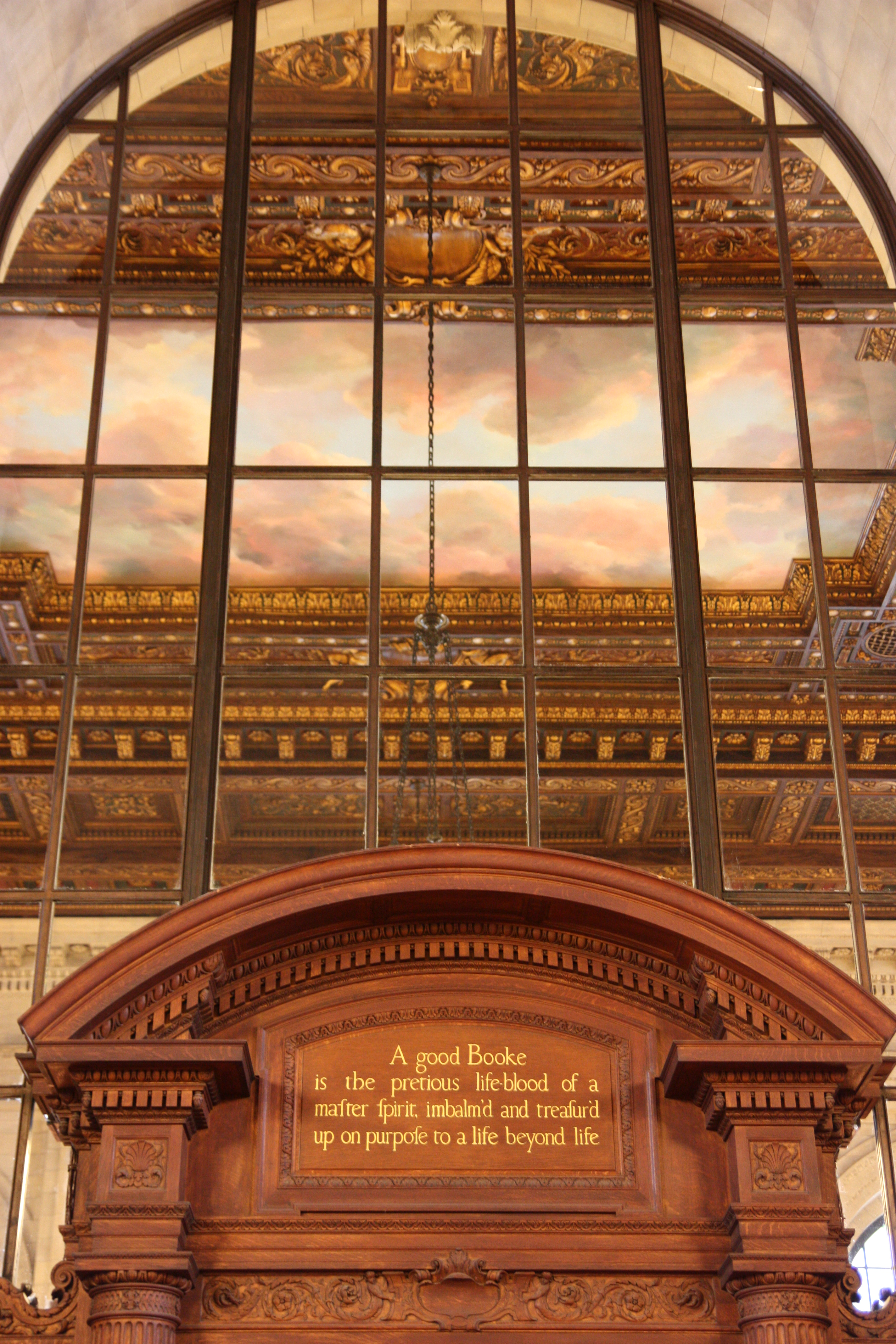
New York Public Library ~ ‘A good Booke is the precious life-blood of a master spirit, imbalm’d and treasur’d up on purpose to a life beyond life.’

In education, we talk a lot about lifelong learning, and about how to inspire in our students (or perhaps preserve in our children) curiosity, passion and the desire to know, to discover, to push at boundaries. To be continuous creators, thinkers, questioners and enactors of their thinking and beliefs.

As an English and Literature teacher, and lifelong reader, who grew up surrounded by books, the physical book is for me a symbol of self-directed, voluntary learning. As a girl I was able to peruse bookshelves throughout my childhood home and pull books from the shelves, at will, to read and re-read. These books were not vetted for age-appropriateness but were a range of children’s books, novels, classics and encyclopaedias to which I had unfettered access.

Other vivid memories are of being in the study of my grandfather, who was a collector and binder of rare and beautiful books. His study was wall-to-wall floor-to-ceiling wooden bookcases, saturated with the overwhelming smell of old paper, worn leather and decaying adhesives. It was a paradise for the book lover!

Overnight my grandfather quietly passed away in his bed, at ninety years of age, his spectacles on and a book in his hand. He was a Doctor of Philosophy, a scientist, a professor, a poet and a thinker, who was reading and writing narratives, scientific writing and verse until his last breath. He was the epitome of a lifelong learner, a deliberate scientific questioner of knowledge and someone always willing to engage in hefty intellectual debate. Only yesterday he and I were discussing strategies for academic, thesis and poetry writing.

I discovered today that my grandfather has left me two of his prized books: an early copy of Sir Walter Raleigh’s History of the World and an antique Chinese text which is a concertina series of Chinese customs, paired with hand painted calligraphy scenes, and bound between curved carved wooden covers. Both are books I remember connecting with the first time he gingerly passed them into my hands in his study. I remember feeling their weight (the Raleigh is heavy!), fingering the irregular textures, and smelling that old book smell (read more about the science of that here in Jessica Leber’s Fast Company post) as I sank into the cocoon of his old chair.

Books by @debsnet  IMG_1399

Raleigh Collage by @debsnet

As well as being objects that I will cherish, these books are symbolic for me of a life lived learning, something I aspire to, and to which I hope my students and my children will aspire.

New York anticipatory reading

Books are lighthouses erected in the great sea of time. ~ E. P. Whipple

NYC Books by @debsnet

Here is my little pile of NYC reading.

I have collected actual books! I have a Kindle which is much more practical for travelling, but I still like the sensory experience of reading: the look of a book cover, the feel of paper, the smell of the page and the sound of it turning.

In amongst professional reading, book club reading and PhD reading, I will read some of these before I go and some while I am away. The ones that come away with me will be ‘paid forward’ to people I meet along the way, so that they can find new homes … and so that I don’t need to pack them for the journey home.

My picks are quintessential novels of New-York-ness: Kerouac’s On the Road (ok, so only minorly relevant to NYC, but a key text in American travel and psyche), Salinger’s Catcher in the Rye, Lethem’s Chronic City, Smith’s A Tree Grows in Brooklyn, Cunningham’s The Snow Queen and Bushnell’s One Fifth Avenue.

I am starting with The Snow Queen, a book named after the 1844 Hans Christian Andersen fairy tale which also inspired the animated film Frozen.

It’s been coming down since midnight. Snow eddies and tumbles as the point of equinox passes, and the sky starts all but imperceptibly turning from its nocturnal blackish brown to the lucid velvety gray of first morning, New York’s only innocent sky. ~ The Snow Queen

What are your best NYC reads?

Teacher (un)learning: immersive, experiential & ongoing

‘How do your teachers learn?’ Most answers I get follow along traditional lines: ‘They go to conferences.’ ‘They take after-school workshops.’ ‘They read books.’ They see their teachers’ learning as an event, not an ongoing process. ~ Will Richardson, 2012

Will Richardson reminds us that learning is an ongoing process, not a series of disconnected one-off occurrences. Professional learning is about the organic journey of the teacher; it’s not a set of tick boxes to be ticked or a number of mandated hours to be filled.

NYC Collage @debsnet

The self-directed-and-organisation-supported professional learning travel upon which I am embarking brings into focus the concept of teacher learning and how it might look. It is this focus that raises the sort of question I am asking on behalf my school while I am in New York: how can we best support teachers in their self-directed growth as passionate practitioners?

One learning movement with plenty of momentum is the unschooling / uncollege / unconference movement.

In unschooling the intellectual, emotional and physical freedom of the child is privileged over the perceived imprisonment by formulaic school curricula, strict structures and inflexible spaces. Just check out the #unschooling hashtag on Twitter.

At uncollege students are educated by real-world experiences, often outside their comfort zones.

Unconferences or edcamps are free, participant-driven conferences.

Does a travelling fellowship like my upcoming one, which focuses on the experiential professional learning of the fellow as well as the contribution of that learning to the organisation, fit into this kind of free-range self-learning?

Does this kind of learning reflect the best kind of learning for our teachers? It is driven by the learner, involves collaboration with others, and is experiential, ‘real world’ and deeply immersive.

A question many school leaders and educators have been addressing for some time is: How might we more fully embed the edcamp / unlearning / experiential / community-based / learner- driven learning into our schools?

How might we ensure that professional learning is meaningful and transformative for teachers?