Easy as pie? How a PhD, & other complex work, is like a cake

Metaphors have a way of holding the most truth in the least space. ~ Orson Scott Card

Number 3 racetrack cake by @debsnet

Number 3 racetrack cake, with handmade bunting & teeny cars

As an English and Literature teacher, I love a metaphor, especially an extended one. I have spoken about one of my PhD metaphors before: thesis as a stone sculpture. Metaphors even bubbled up unexpectedly in my PhD data as participants searched for meaningful language to explore their identities.

In some ways this post is a response to, or extension of, Anitra Nottingham’s Thesis Whisperer post ‘My thesis is a cupcake, not a dragon.’ In it, she talks about making novelty birthday cakes for her children. She goes on to use the metaphor of cupcake for her Masters thesis and cake for a PhD thesis.

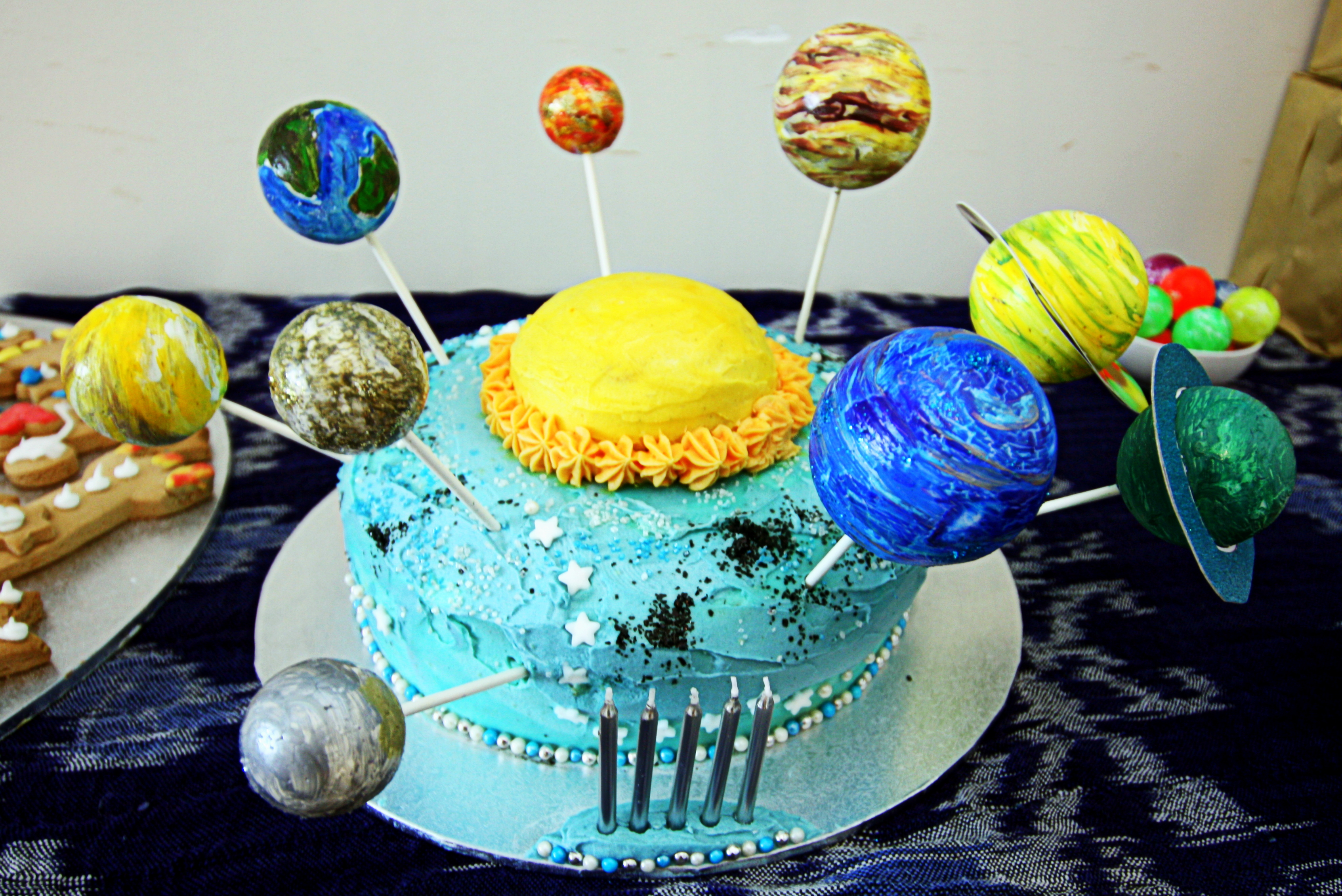
I was reminded of Anitra’s post over the weekend as I prepared for my eldest child’s 5th birthday. A novelty birthday cake is a lot like a thesis, I thought, as I pierced the galaxy outer-space solar-system cake with the planets I had hand-painted (cake decorating makes for great phdcrastinating).

the weekend's outer space solar system cake

the weekend’s outer space solar system cake; I am a child of the 80s so Pluto, beautiful dwarf planet, is there

I love to make my children’s birthday cakes from scratch, not that I find it easy or that I have an aptitude for it! I rarely bake; it’s not something I’m great at, and often my baking is asymmetrical and (goofily? lovingly?) imperfect. But I feel like a cake is more than the sum of its ingredients. I am convinced that my children and their guests can taste the love and trying-to-make-it-wonderful effort that goes into a homemade birthday cake.

Tootle cake, the Golden Book train who likes to play in meadows rather than stay on the rails

Tootle cake, the Golden Book train who likes to play in meadows rather than stay on the rails

A thesis, too, is more than the sum of its parts, more than the words on its pages. As I revise the full draft of my thesis, I am reading with the reader in mind (and trying to avoid boring or annoying them – see Pat Thomson’s post from an examiner perspective). I am hoping that examiners and other readers will ‘taste’ the passion, the challenges overcome, the obsessive dedication, and the satisfaction and enjoyment that comes with taking a PhD project to completion.

Both cake and thesis start with a problem. How am I going to embody the essence of this? Both cake and thesis require a balance of systematisation and creativity, recipe-following and individuality. What tools and ingredients will I need? What methodological processes will I follow to ensure a sturdy finished product which stands up? How might I make this original and my own interpretation?

Like a thesis, sometimes a cake doesn’t work at first and the creator needs to start again, or find creative solutions (usually involving using icing as glue or camouflage).

Octonauts cake

Octonauts cake, complete with sunken figurine (note to self: add heavy bits at the last minute)

It might seem trivial to compare the PhD thesis to making a cake (and of course there are many many differences between a thesis and a cake!), but I find that metaphors, in distilling meaning down to its simplest and yet most poetic form, help me to make sense of complex work. Their simplicity helps to keep me going.

The quote at the beginning of this post resonates: a metaphor can hold the most truth in the least space.

What are your metaphors for your complex work?

The low-tech PhD & whole-document thinking: How I use Microsoft Word to write my thesis

The real problem is not whether machines think but whether men do. ~ B. F. Skinner

What counts as writing the thesis 'old school'?

What counts as writing the thesis ‘old school’?

I have spoken before about my love of creative physical media as a way into thinking, and about some of my favourite retro tools (like *gasp* pencils!). My approach to writing my thesis would probably also be considered pretty old school. I haven’t been using a typewriter or writing into wet clay with a reed pen, but it’s been pretty straightforward and low tech. I recorded interviews on a dictaphone, not an iPad (although the usb attachment meant audio files were easily transferred to computer). I use Moleskine-esque Typo Shop buffalo journals to take notes during supervisor meetings. I manually record references into my word processed document (I know, I know, there are plenty of great referencing tools like EndNote and Mendeley). Sometimes I even take actual paper books out of an actual library, books that have that wonderful old-book-smell which e-readers have yet to provide (a scratch-n-sniff sticker would do!).

So, today when Inger Mewburn, Thesis Whisperer, shared this New Yorker article about our love of physical analog notebooking, and PhD researcher Samuel Dent tweeted advice to first year PhD students to create a thesis template document from Day 1 of the PhD, I have phdcrastinated my way into writing this post. Possibly the most pragmatic and least creative post I’ve written, it takes on the rather unsexy topic of how I’ve been using Microsoft Word to write my PhD thesis.

While not along my normal lyrical lines of thesis as sculpture or research as artistic conversation this post is partly motivated by hearing about PhD students who, shortly before submission, collate their chapters into the final document. This approach is very different to my own as I have written in one document from the start. Here I’ll explain a little about what I’ve been doing and what the effect has been for me.

Using Microsoft Word headings

After my research proposal was accepted, I opened a ‘PhD draft’ document, placed my title on the first page and entered my main headings. At the beginning of the process these were state-the-astonishingly-obvious headings like ‘Introduction’, ‘Literature Review’, ‘Methodology’, ‘Method’, ‘Data’, ‘Findings’ and ‘Conclusion’. Innovation and levels of sub-headings came later as my thinking developed, research threads emerged and the document formed and transformed.

So, my thesis title and my headings have evolved and changed over time. The structure of the thesis remains similar, but now the Table of Contents tells a story and acts as a kind of mini-outline of the structure, ideas and intricacies of the document. The biggest structural changes were in my data section as I grappled with how best to share participant perspectives while preserving their anonymity.

Using Word’s heading styles (and adjusting these to meet APA style specifications) means the Table of Contents changes as my thesis develops; it is easy to automatically update the Contents at the click of a mouse.

The other feature of headings that I use constantly as I write is navigation. I write with the left hand navigation pane open to ‘headings’ and as I need to move around my document, I can scroll and click into where I want to go, jumping around at will.

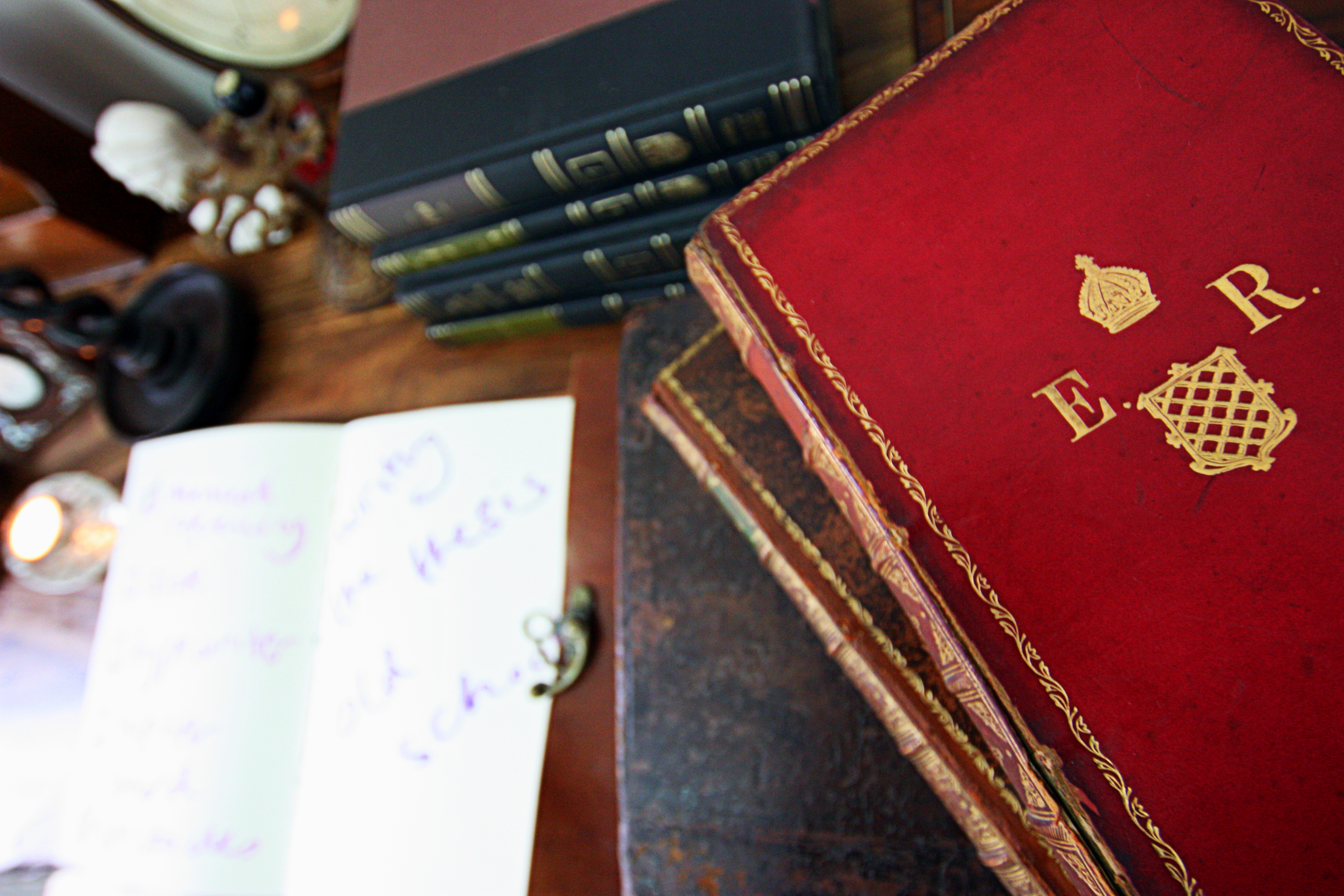
I had all these things lying around the house ... I really do love old school.

Setting up this shot was as simple as gathering together a few things from home. I really do love old school.

Saving regularly

My saving routine is that I save my thesis document as a new file at least once a month or any time before I do some big revisions. This means that I have a record of its growth over time and can dip back into previous documents if I have lost a reference in amongst some cutting and pasting. It also feels like a security blanket for revisions, in case I want to resurrect some deleted writing. Of course, the latter never happens, but it’s a reassurance that softens the psychological blow of deleting large chunks of text.

The nice thing about having this rolling record of thesis development is realising how far I’ve come. I have found that in the PhD it’s very easy to focus on all the things yet to do, all the heights still to scale. From time to time, to combat this looking-forward and focus on what has been accomplished, I open up a draft dated one year ago. It always surprises and delights me to see how far I’ve come. At times the whole structure has shifted, and at other times those chapters that were empty have been filled. I allow myself a moment of basking in the pleasure of realising what I have done, before catapulting myself back into the abyss of what I have yet to do.

When I send chapters or sections to my supervisors I copy the relevant text and paste it into a new document to send to them, so I have these separate documents saved, too.

Another useful feature is ‘Compare documents’ (go to Review -> Compare) which allows me to compare two drafts of the same text and see what has changed in the editing process.

Whole document thinking

Having my thesis as one evolving document has some practical uses such as checking where in the text I have cited a particular author or used a particular term. It makes it simple to ‘find-replace’ if I have to change a term throughout the text.

More importantly, though, it has facilitated my thinking about the thesis as a holistic story with threads running through it, rather than as a series of disparate chunks. Now that the almost-a-full-draft document sits at 111,000 words including abstract, acknowledgements and references (hopefully to be edited down), I can look back down the long tunnel of drafts and see how my research has grown from its first seed to its almost-full form.

photo by @debsnet

Research as conversation: contemplating Wicked and the Mona Lisa

Something has changed within me. Something is not the same. I’m through with playing by the rules of someone else’s game. … It’s time to trust my instincts, close my eyes, and leap. ~ Elphaba, Wicked

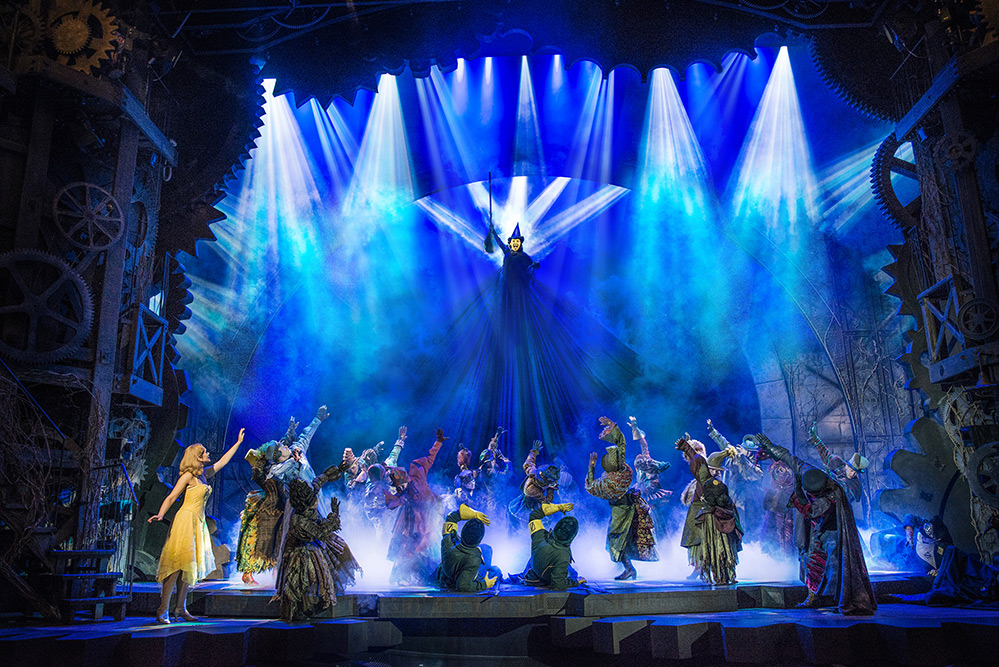
This week I took my mum to Wicked the musical. It was the third time I’ve seen it, the first being in London’s West End in 2007. I still remember the goose bumps that raced up my arms as Elphaba rose into the darkness singing that she was “defying gravity”. After seeing the show with my mum, our talk turned to art, research, and my thesis. Yep, that’s how my mum and I roll. So how did Wicked prompt talk about research?

Wicked is an example of a literary and artistic work which inserts itself into a discussion. It adds to a conversation started by the 1900 L. Frank Baum novel The Wonderful Wizard of Oz and the 1939 film The Wizard of Oz. Loosely based on the 1995 Gregory Maguire novel Wicked: The Life and Times of the Wicked Witch of the West, it refers to the original story, reinventing, reimagining and conferring new meaning. It takes the Oz-Dorothy-Witches narrative from one of the value of journey, the longing for home and good triumphing over evil. It transforms the well known children’s story into a tale of the Other, accepting difference, embracing our authentic selves and fighting for what is right in the face of corrupt political systems. It takes the imagery of the written story and the film interpretation and recreates these in fresh ways through music, set design, costume (the shoes! the millinery!) and dialogue. Clever references to Dorothy’s story are woven into this back story about witches Elphaba and Glinda. In this way Wicked is a creative product which adds layers of meaning and injects new insights and perspectives into an existing story.

Artists also ‘speak’ to each other through their work. The long history of reimaginings of the Mona Lisa, a few of which I have juxtaposed below, illustrates how artists comment on each other’s work through their creations, adding to a dialogue about what art might be, how art might be created and what art might have to say about the world it inhabits.

art is conversation

art is conversation

Commenting on Da Vinci’s 1517 painting, Mona Lisa, or La Gioconda, in 1919 Marcel Duchamp drew a moustache and goatee on a cheap postcard reproduction, labelled it L.H.O.O.Q. (a pun) and exhibited it in a gallery. Duchamp’s appropriation and reinterpretation of one of the world’s most famous paintings brought into question its value and challenged the then-definition of fine art. In 1954, Salvador Dali produced a work in which he added his own eyes, moustache and hands filled with coins in Self Portrait as Mona Lisa, in a kind of artistic high five to Duchamp. Pop artist Andy Warhol used the Mona Lisa image in his 60s screen prints, blurring lines between high art and popular culture. In Warhol’s work, Mona is reproduced through the then-controversial-in-the-art-context screen printing process. She is repeated in primary colours to reflect assembly-line mass production, questioning the place of art in an increasingly mass-produced consumerist world. These artworks show how artists use their processes and subjects to talk to each other across time. Each uses subject and method to add a new layer of meaning, present a critique or pose a challenge to what has come before.

Research, too, is part of a conversation. Like writers and artists, theorists communicate with each other through their work over time. A literature review places research within the historic conversation. Where and with whom does it fit? Whom or what might it challenge? Research methods draw from what has come before. The approaches of old masters and contemporary talent become models to emulate, springboards from which to adapt or materials with which to weave new forms. Discussions and conclusions are places in which researchers form reimaginings and state contributions to the greater conversation, to existing knowledge.

Research writing, too, is steeped in academic tradition, in a conversation of form and language. Some choose to adhere strictly to the expectations of academic or dissertation genres, and some choose to push and challenge those boundaries. My thesis, while not a creative work in the sense that an arts thesis with exegesis might be, draws on literary as well as academic traditions. It uses a literary work as a conceptual frame in order to draw metaphorical meaning.

Some might not agree with seeing research as creative-product-in-historic-conversation, perceiving it as a lyrical idea which undercuts the systematic science of research. Of course research is logical and systematic. It can be viewed as science but it can also be seen as story, as creative work and even as sculpture. A recent post by Lara Corr on the thesis whisperer blog talks about the creative elements of research. She plays with the ideas of being a master builder and colouring outside the lines. Pat Thomson’s post on discussion chapter as flight influenced my posts about starting the discussion chapter and building a researcher identity through it.

In Wicked, Elphaba comes to a place in which she chooses a new path and embraces a new identity. Have you found a place in your research or work where you were able to defy gravity and fly? To add your layer to the conversation in which you are engaging?

As somebody told me lately, everyone deserves the chance to fly! And if I’m flying solo, at least I’m flying free. To those who ground me, take a message back from me. Tell them how I am defying gravity! ~ Elphaba, Wicked
Front load your work. Be an expert. Own your contribution.

You have brains in your head. You have feet in your shoes. You can steer yourself any direction you choose. You’re on your own. And you know what you know. And you are the guy who’ll decide where to go. ~ Dr Seuss

by @debsnet

sometimes the words slowly bleed onto the page

As a mid-career professional I often feel comfortable in my work in teaching and school leadership. I might come up against challenges, but I do so with a sense that I know what I’m doing and have a sense of how to make my way through them. ‘This is what I know how to do,’ I think to myself. And forward I go without a second thought.

There are times, however, when I cannot forge forward confidently. Becoming a parent, for instance, threw me into a new situation and a new role in which I had to start from scratch. I was a newbie who had to find my way into my parent-identity and a way of parenting which worked for me. The PhD is another something which throws people into a new deep end. I have written about my realisation that my discomfort zone is my place of growth, but that doesn’t make the experience of discomfort any more … comfortable!

I type this post from the throes of my current nemesis: the PhD Discussion chapter. I wrote last month about my feelings of paralysis before beginning this chapter, and how I eventually got started. And yet here I still am, four or so iterations later and still wrangling, dancing with, building and un-building my discussion.

Part of my struggle is around scholarly confidence, reflected in the notes from my last PhD supervision meeting which read a bit like this: ‘too much other people’, ‘less others, more you’, ‘put your ideas up front.’

It seems I am clinging to the literature. I still want to prove to my reader that I have read everything I can get my hands on and I know my stuff. That I’m not a masquerader or pretender. And it seems I do this by citing and paraphrasing and putting up front the work of Others.

You know Others. In the mind of the novice researcher they deserve capital letters of knowledge because they are experienced, frequently-published, well-renowned academics, not researchers-in-training or Doctors-in-waiting.

And yet in the Discussion and Conclusion of the PhD I know I must identify myself as an expert. A person worthy of a capital letter (like a ‘Ph’ or a ‘D’). I keep reminding myself that I am an expert in my own research and that I can stand on the front foot when I discuss my findings and what they mean in the world.

So my current notes-to-self for the Discussion chapter are:

– Stop trying to prove my worth through literature.

– More me. Less others.

– Front load my work.

More than just a process of writing, this is a process of becoming. Becoming a researcher. Becoming a researcher who knows she is a researcher, feels like a researcher and makes knowledge claims like a researcher. It’s taking me many molasses-slow drafts to find my expert voice and a way of writing which foregrounds my own research and my own academic voice, while still situating my research within the existing literature. But step by step I am getting closer.

And I’ve been reading Dr Seuss’s Oh the places you’ll go! to my children recently so I am armed with the mantra that with brains in my head and feet in my shoes, I can move mountains. One painstaking word at a time.

You’re off to great places! Today is your day! Your mountain is waiting. So… get on your way! ~ Dr Seuss

You're off to great places, by @debsnet

the édu flâneuse atop an Icelandic glacier


Writing the PhD discussion chapter: from fear to flight

Don’t believe what your eyes are telling you. All they show is limitation. Look with your understanding. Find out what you already know and you will see the way to fly. ~ Richard Bach, Jonathan Livingston Seagull

flight, by @debsnet

Since beginning my PhD two and a half years ago, I have plugged away at my thesis, chipping at it bit by agonisingly small bit, sometimes having to retrace my steps or throw out whole sections of work. But it has progressed through dogged persistence, slow laborious work and a measure of creative problem solving. I have even found it to be wonderful celebrated ‘me time’ as I explained on the PhD Talk blog.

Yet as my big book pushed towards 100,000 drafted words, I arrived at the discussion chapter and … duhm duhm daaahhhhhhm … suddenly I screeched to a stop, paralysed by fear. After fairly consistent, if often brain-bending, progress, I had come to a standstill. Up until this point, my metaphors of PhD candidature had served to propel me forward through even the biggest challenges and hard-to-hear feedback. My PhD had been an elephant I had to eat one deliberate bite at a time, or a sculpture I needed to craft carefully, or a journey in which I put one footstep in front of the other (another nice metaphor is this one of the PhD as swimming). Yet, despite my supervisors’ assurances that the discussion chapter was just one more eatable bite, one more takeable step, I was immobilised.

Matt Might’s illustrated definition of the PhD, which I had initially found grounding, now seemed terrifying. While it demonstrated that a PhD need only push the boundary of knowledge a teeny tiny bit, it also reminded me that a doctorate is all about having an original contribution to the body of knowledge. An. Original. Contribution. Which. Pushes. Bends. And. Remakes. The. Boundary. Of. Knowledge. And the discussion chapter is where I need to – as Inger Mewburn (the Thesis Whisperer) says – not just state my findings but explain what my findings mean.

So after two and a half years of reading (and reading and reading), interviewing, analysing and writing (and writing and writing and writing), I found myself at a point at which I needed to explain what it all means. And to have the (as Inger puts it) scholarly confidence to assert my research as having an original and worthwhile contribution.

In my paralysis of PhDcrastinating I found Emma Burnett’s blog posts which helpfully explained how she planned to approach her discussion chapter and also what she actually did. These kinds of explications by PhD candidates are useful material for others as they approach different stages of thesis wrangling.

Pat Thomson, my go-to blogger on all things academic writing, describes the discussion chapter through the metaphor of taking flight. She explains that the discussion chapter is the place to “be your own expert, to fly where no other researcher has flown before.” No pressure. Her metaphor of discussion-chapter-as-taking-flight reminded me of Richard Bach’s allegorical novella Jonathan Livingstone Seagull in which the non-conformist seagull Jonathan works tirelessly, often on his own and sometimes as an outcast, towards a kind of flight never before achieved by any seagull. His passion-driven, sometimes lonely and relentlessly-perfectionist journey to ultimate flight could certainly be a metaphor for the PhD narrative (although as Pat Thomson reminds us, the PhD is not a lone journey, but collaborative work).

@debsnet & @patter Twitter discussion

In a useful Twitter conversation, Pat explained to me that the discussion chapter is a synthesis and interpretation of findings which takes them to a new theoretical level. Discussion is not a repeat or recap, but a presentation of a new reading of the research which links findings to literatures. As Pat’s blog post explains, this is the place for interpretation and theorisation. Taking it to the next level. As she suggests, it’s the time to earn the ‘Philosophy’ part of the PhD.

*      *      *

Eventually I found a mental space in which I could put some words to the page (just one word in front of the other, I told myself; get it down), and I got started on the … duhm duhm daaahhhhhhm … discussion chapter.

Firstly, I went back to my research questions, which had emerged from the literature review, and used these as a frame for my discussion. Then I went back into my literature chapter and pulled out the threads which related to those research questions, especially those areas in which I had identified gaps or areas for further embellishment or new perspectives. Then I went back to my data (in my case, three chapters of storied interview data from three different groups). While the end of each of my data chapters included some synthesis and interpretation of that data set, the discussion chapter was the time to bring all the threads – all literature and all data – together. My intention was to identify clearly what I had found and how this was related to existing literatures. After writing an initial draft which was more summary than analysis or insight, I left it. It was a start.

Now, after giving myself permission to take a break and finding some mental space and clarity through travel, I have returned to the chapter. As I write I am asking myself: What does my data mean (within the parameters of the research questions)? What established trends are affirmed or challenged by my study? What findings are surprising? What from my research is new in terms of, or absent from, the literatures in my area?

The chapter is still in draft form, but instead of standing still, mute and frozen, I am flapping my wings with a sense of how and where I’m going. Soon enough I’m sure I will take flight.

(For an update on how my approach to the discussion chapter evolved, the follow up is here.)

He was not bone and feather but a perfect idea of freedom and flight, limited by nothing at all. ~ Richard Bach, Jonathan Livingston Seagull

paper planes by @debsnet