A life lived learning: a tribute to my grandfather

I have always imagined that paradise will be a kind of library. ~ Jorge Luis Borges
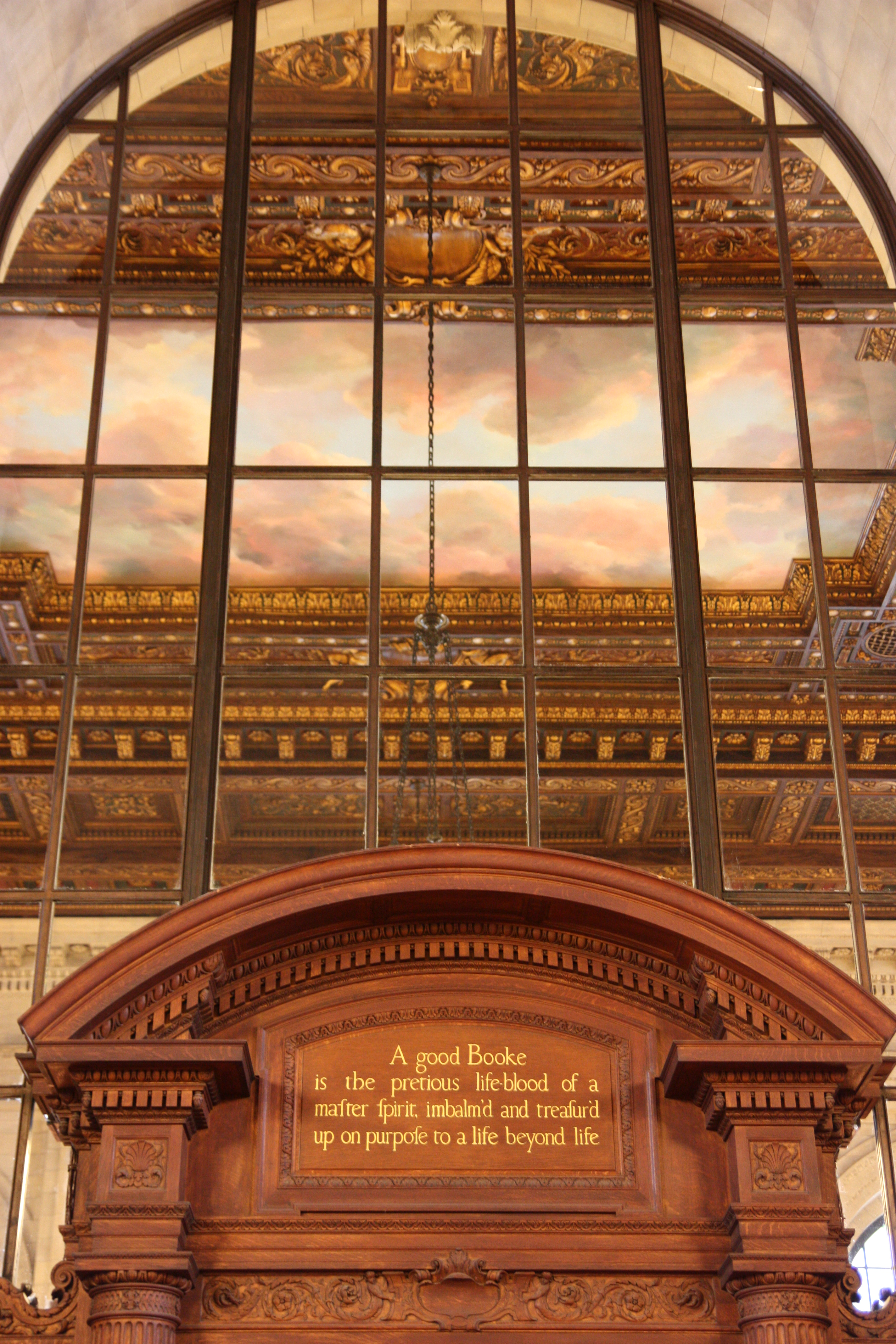
New York Public Library by @debsnet

New York Public Library ~ ‘A good Booke is the precious life-blood of a master spirit, imbalm’d and treasur’d up on purpose to a life beyond life.’

In education, we talk a lot about lifelong learning, and about how to inspire in our students (or perhaps preserve in our children) curiosity, passion and the desire to know, to discover, to push at boundaries. To be continuous creators, thinkers, questioners and enactors of their thinking and beliefs.

As an English and Literature teacher, and lifelong reader, who grew up surrounded by books, the physical book is for me a symbol of self-directed, voluntary learning. As a girl I was able to peruse bookshelves throughout my childhood home and pull books from the shelves, at will, to read and re-read. These books were not vetted for age-appropriateness but were a range of children’s books, novels, classics and encyclopaedias to which I had unfettered access.

Other vivid memories are of being in the study of my grandfather, who was a collector and binder of rare and beautiful books. His study was wall-to-wall floor-to-ceiling wooden bookcases, saturated with the overwhelming smell of old paper, worn leather and decaying adhesives. It was a paradise for the book lover!

Overnight my grandfather quietly passed away in his bed, at ninety years of age, his spectacles on and a book in his hand. He was a Doctor of Philosophy, a scientist, a professor, a poet and a thinker, who was reading and writing narratives, scientific writing and verse until his last breath. He was the epitome of a lifelong learner, a deliberate scientific questioner of knowledge and someone always willing to engage in hefty intellectual debate. Only yesterday he and I were discussing strategies for academic, thesis and poetry writing.

I discovered today that my grandfather has left me two of his prized books: an early copy of Sir Walter Raleigh’s History of the World and an antique Chinese text which is a concertina series of Chinese customs, paired with hand painted calligraphy scenes, and bound between curved carved wooden covers. Both are books I remember connecting with the first time he gingerly passed them into my hands in his study. I remember feeling their weight (the Raleigh is heavy!), fingering the irregular textures, and smelling that old book smell (read more about the science of that here in Jessica Leber’s Fast Company post) as I sank into the cocoon of his old chair.

Books by @debsnet  IMG_1399

Raleigh Collage by @debsnet

As well as being objects that I will cherish, these books are symbolic for me of a life lived learning, something I aspire to, and to which I hope my students and my children will aspire.

New York anticipatory reading

Books are lighthouses erected in the great sea of time. ~ E. P. Whipple

NYC Books by @debsnet

Here is my little pile of NYC reading.

I have collected actual books! I have a Kindle which is much more practical for travelling, but I still like the sensory experience of reading: the look of a book cover, the feel of paper, the smell of the page and the sound of it turning.

In amongst professional reading, book club reading and PhD reading, I will read some of these before I go and some while I am away. The ones that come away with me will be ‘paid forward’ to people I meet along the way, so that they can find new homes … and so that I don’t need to pack them for the journey home.

My picks are quintessential novels of New-York-ness: Kerouac’s On the Road (ok, so only minorly relevant to NYC, but a key text in American travel and psyche), Salinger’s Catcher in the Rye, Lethem’s Chronic City, Smith’s A Tree Grows in Brooklyn, Cunningham’s The Snow Queen and Bushnell’s One Fifth Avenue.

I am starting with The Snow Queen, a book named after the 1844 Hans Christian Andersen fairy tale which also inspired the animated film Frozen.

It’s been coming down since midnight. Snow eddies and tumbles as the point of equinox passes, and the sky starts all but imperceptibly turning from its nocturnal blackish brown to the lucid velvety gray of first morning, New York’s only innocent sky. ~ The Snow Queen

What are your best NYC reads?

Travel anticipation makes the journey last longer

Most travel is best of all in the anticipation or the remembering; the reality has more to do with losing your luggage. ~ Regina Nadelson

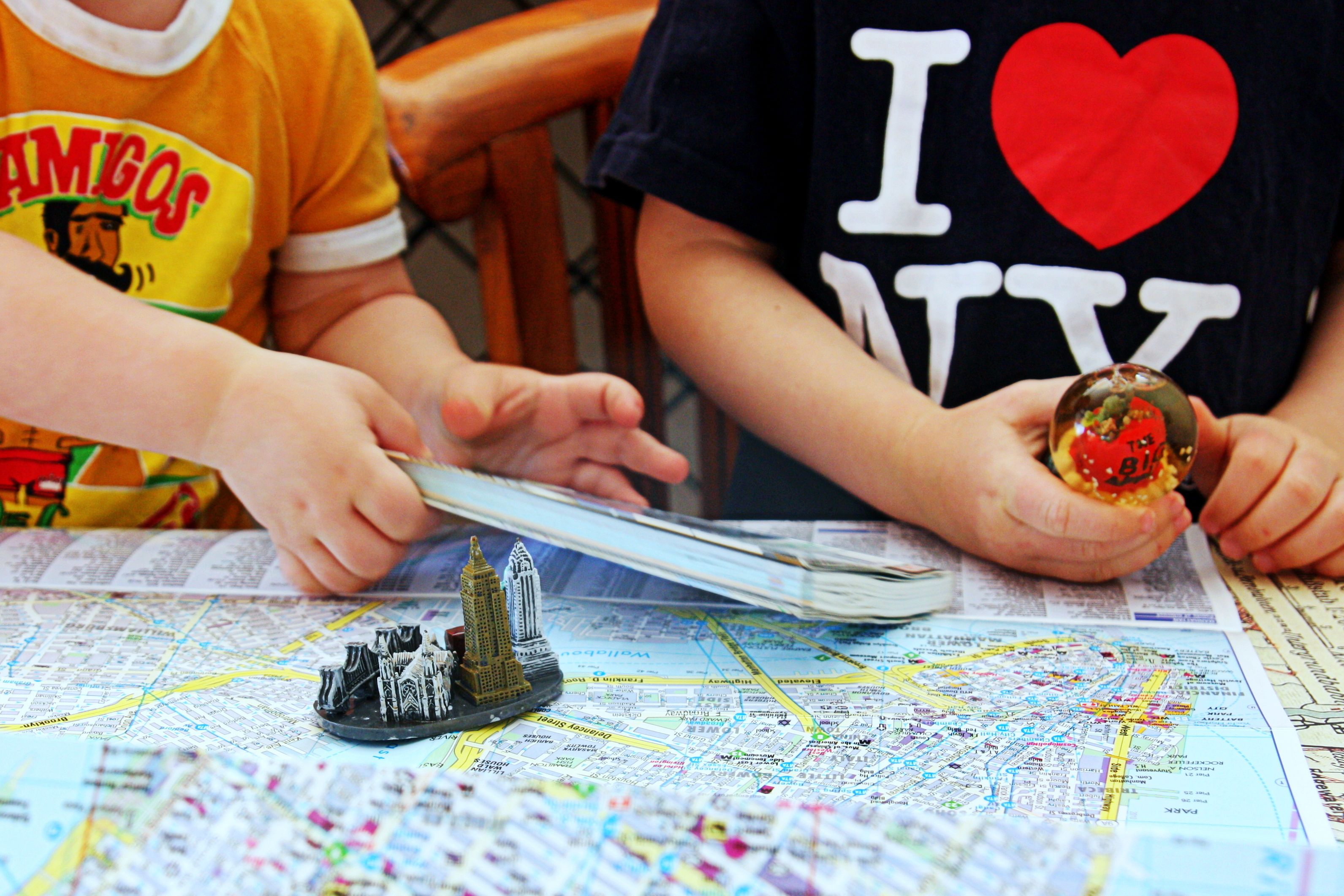
BoysPlanningNYC

Mr 2 and Mr 4 are happily helping me plan my NYC itinerary.

Map Collage by @debsnet https://theeduflaneuse.wordpress.com/

We have a huge family world map with colour coded stickers which record our travels, but New York City guides might be their new bedtime stories.

Lucky (edu)fellow: beginnings of a flânerial professional trip

It’s time to bring the magic and wonder back into teaching. It’s time to recover the missionary spirit and deep moral purpose of engaging and inspiring all our students. It’s time to put down the spreadsheets and look to each other and elsewhere for how to get beyond the present turning point so we can transform our society and our schools. Hargreaves and Shirley, 2009

Two months til take off.

How does an Australian educator end up planning her way to New York City for a week, in search of insights into teacher learning, implementing teacher growth models in school contexts and using the Charlotte Danielson Framework for Teaching?

Because she is a lucky fellow.

I have been fortunate enough to receive a travelling fellowship from my Australian school in order to undertake an investigative series of visits to educators, school leaders, researchers and edu-experts in New York.

My meetings and visits cover one week in and around New York City. My week will be focused, as Hargreaves and Shirley suggest, on looking ‘to each other and elsewhere’ for learning and growth: my professional growth, teachers’ growth and the growth of my school’s professional learning culture.

Hargreaves and Shirley’s focus on the transformative ‘magic and wonder’ of teaching reflects my own fundamental beliefs about commitment to student learning. Our core business as teachers is enabling our students to find magic and wonder in the world around them, and empowering them to be thinkers, learners and leaders. As teachers, we should see teaching and learning as wonder-finding, wonder-generating and wonder-full.

The particular context for my upcoming professional trip is my school’s teacher growth initiative, which emerges from the widespread research-supported assertion that teacher quality is a crucial determinant in improving student achievement and learning.

Since 2012, I have been working with a diverse team of teachers at my school to design and pilot an idiosyncratic professional learning model intended to refine individual practice and capacity for self-reflection, appropriate to my school’s context. Another key aim of our model is the facilitation of a more passionate, reflective, purposeful community of professional learners in which individual teachers participate in ongoing communal activity to continuously develop the effectiveness of student learning by improving the quality of their teaching.

So, our aim has been to craft a process which is teacher-centred, teacher-directed and focused on teachers’ capacities for reflection and self-actualisation. We are using the Charlotte Danielson Framework for Teaching and a Cognitive Coaching model of coaching as the basis of our professional learning model. The Framework for Teaching (one of a number of maps for teacher practice, chosen because of its relevance to our specific context) gives us a common language for talking about our teaching, and a targeted specificity of focus for our reflections and conversations about evidence and practice. Cognitive Coaching is helping us to focus on growth rather than judgment, with our notion of ‘coaching’ being one of mediating the thinking of the teacher, rather than providing instructional feedback.

New York is the perfect place to refine our thinking as we continue to roll out our own model. The Danielson Framework for Teaching is one of those approved by the New York State Education Department as part of its implementation of the provisions of Education Law 3012-c regarding annual professional performance reviews (APPR) of classroom teachers and building principals. The New York City Department of Education (NYCDOE) has been implementing use of the Danielson Framework since June 2013, after three years of piloting and researching it in NYC schools.

During my time in New York, I am especially interested to see in what ways schools and districts have been implementing the Framework for Teaching; what might be success stories or lessons learned from their experiences so far; different approaches to school leadership in these kinds of initiatives; how data are collected and used to measure success; and any resources, references or contacts which might help my school, especially in its implementation stage, to begin in January 2015.

Can any educators out there share their experiences of current teacher growth or teacher evaluation systems?