
To me, language has always felt creative, unpredictable, and full of possibility, and I have often thought of myself as a writer. I read fiction voraciously and wrote stories and poetry from a young age. In Year 3 I attempted to write a novel, with my protagonist, Lesley, emulating the characters I so loved reading about – Carolyn Keene’s Nancy Drew and Enid Blyton’s Famous Five and Secret Seven.
I began this edu flaneuse blog site in 2014, and enjoy writing my way into thinking through those professional things on my mind, gaining more clarity as a result. Writing my PhD, and later my solo-authored book, Transformational Professional Learning, were labours of constant learning and problem solving. How could I synthesise the literature? How might I use narrative and creative methods to communicate data? How can I translate research for an audience of educators? Writing and editing collaboratively have helped to hone my writing and to show me how to connect my thoughts to those of others in a kind of symphony of cohesion and difference.
It was through engaging with academic writing during my PhD that I discovered the em dash (—), which quickly became my favourite punctuation mark after the fabulously-named interrobang (?!). The long line of the em dash so elegantly allows the inclusion of parenthetical information into sentences in a cleaner way than through the use of commas, colons or parentheses. And yet now I find myself self-editing the em dash out of my writing as it has become an ‘AI tell’ thanks to ChatGPT’s enthusiastic use of it.
Reading websites and scrolling through social media captions, we notice the rhetorical moves and linguistic frames of LLM chatbots. Drawn originally from human writing—journalism, academic papers, blog posts, books—they congeal together to form a homogeneity of language. We are all beginning to sound the same and to mimic this kind of writing. Moon et al. (2025) found that, despite LLMs’ potential to enhance individual creativity, the widespread use of LLMs can homogenise language and diminish the collective diversity of creative ideas. Kobak et al. (2025) found that hundreds of words have abruptly increased their frequency in academic writing since ChatGPT became available, with LLMs having an unprecedented effect on scientific writing.
Our feeds are saturated by stylistic repetition, standardisation of voice, and smoothing of identity. Posts are accurate and well-edited, but lack individuality and variety.
We see contrastive frames like “it’s not a, it’s b,” “not c, but d,” and “the real risk isn’t e, it’s f.”
We see announcements of significance like “this distinction matters,” “that matters,” “this is what people miss,” “an uncomfortable truth,” “what is often overlooked is,” and “a simple but powerful idea.”
We see coherence markers such as “at its core,” “the challenge then, is,” “the task is not merely g, but h,” and “over time, a pattern begins to emerge”.
We see softening of arguments such as through “a quiet shift,” “a subtle tension,” “there is a quieter story,” and “a small but significant move.”
These phrases are all drawn from human writing and are not in themselves problematic. We all have patterns in the way we write. What is problematic, for me, is when all our patterns become the same and what is left is a frictionless and profound-sounding rhetoric that does not engage with specificities, difficulties and surprising nuances, where the reassurance of credibility is a façade for shallowness of thought. AI was trained to sound like us, but now we are beginning to sound like AI.
As we accept AI-shaped writing and begin to internalise chatbot cadence, it is worth considering the relationship between language and thought. The overuse of formulaic rhetocial patterns echoes the warning of George Orwell’s concept of newspeak from the novel 1984 – that a narrowing of language can also narrow what it is possible to think.
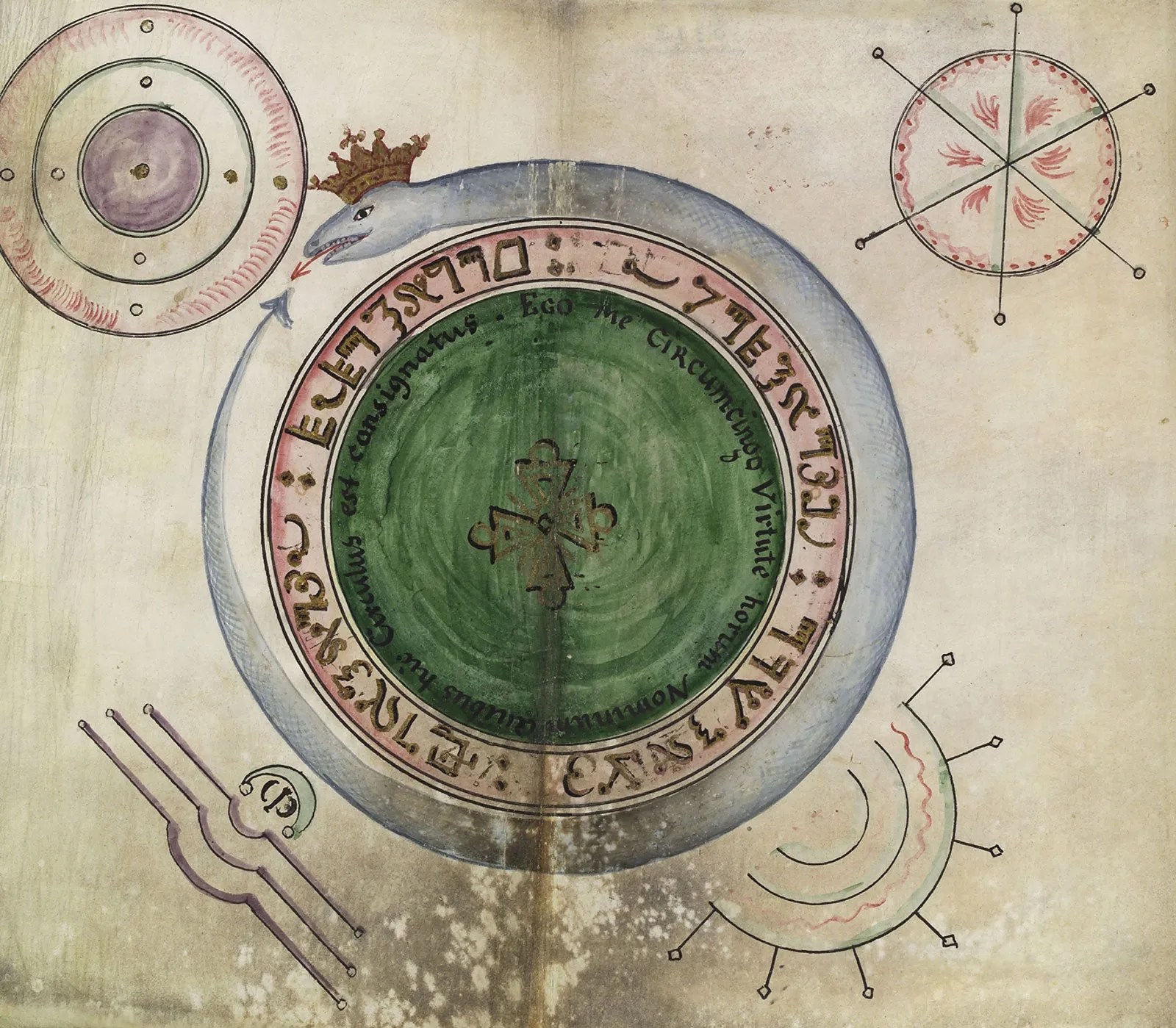
I am reminded of the ancient circular symbol of the Ouroboros serpent devouring its own tail – as though language is devouring itself in a never-ending Ouroborosic loop of sameness. Human language has trained the machine. Machine language is saturating human feeds. Humans are adapting our language to the machine’s version of human language. Writing is no longer a creative outlet where our brains grapple with words and structures, we explore the messiness of thought through writing, and we explore our voice and what it has the power to say. Rather, language is a shortcut to a clean and quick product.
However, the Ouroboros is not only an image of self-destruction. It is also an image of renewal through its endless cycle of ending and beginning, consuming and becoming. We can notice and interrupt the language loops we find ourselves in. We can celebrate idiosyncrasies of thought and voice through our writing with words that are specific to our contexts, our histories and our identities. We can embrace sounding fully like ourselves, even when that is messy, unformed and imperfect. With or without em dashes.
References
Kobak, D., González-Márquez, R., Horvát, E. Á., & Lause, J. (2025). Delving into LLM-assisted writing in biomedical publications through excess vocabulary. Science Advances, 11(27), eadt3813.
Moon, K., Green, A. E., & Kushlev, K. (2025). Homogenizing effect of large language models (LLMs) on creative diversity: An empirical comparison of human and ChatGPT writing. Computers in Human Behavior: Artificial Humans, 100207.

