
Leadership lessons from school principals

source: pixabay.com by @ThinkTanks

Part of my role in overseeing professional learning at my school is building a variety of ways to develop the capacities of leaders. Our termly leadership forum, a new initiative this year, provides a place and space for all of our leaders – from coaches and pastoral leaders, to heads of faculty, senior leadership, and the Executive team. We meet each term for an evening of wine, cheese, provocation, and connection. In Term 1 I ran a session with the Director of Strategy on thinking about leadership in terms of research, organisation, team, and self. In Term 2 we welcomed Professor Dylan Wiliam to our forum.

This term we welcomed a panel of three independent school principals to present to our school’s leaders. These three panellists represented more than three decades of principalship between them. They had some clear messages about leadership for leaders at all levels, including the following.

……

Embrace opportunities

The panel encouraged everyone to embrace and pursue available opportunities, to take on challenges and pursue work and service that energise, inspire, and motivate us, and that align with our framework of personal beliefs and values. For me this is about aiming to do good work, without a clear vision of where this might take me.

Be yourself

All three principals said something that resonates with my own philosophy: in order to lead effectively, we need to be authentic. That is, rather than trying to perform the identity we think others are hoping for, each of us can be ourselves. Being ourselves means knowing ourselves. To be authentic leaders, we each need a clear sense of our own core values and beliefs, and a willingness to be transparent in our thinking.

Back yourself

The stories of these three principals showed that we need to be ‘in it to win it’; that is, to put our hat in the ring even when we might not be the obvious choice for a leadership position. Backing ourselves means having the courage and confidence to put our hands up to take on responsibility, and having the self-awareness to know what we bring (and don’t bring) to the work and leading we do. Part of this also means to be unafraid to challenge others or to call out injustice, and to have the capacity to be decisive even when faced with challenging issues.

Receive and give encouragement

All three principals had at some point received a ‘shoulder tap’ where a colleague or more senior leader had suggested they apply for a leadership position they had not considered. I have also had these experiences where someone has recognised for me an opportunity that I didn’t recognise for myself. These are moments that can help us to reimagine of what we are capable, and where our paths might take us. I am grateful to those who have taken the time or opportunity to challenge me on the limitations I have sometimes set for myself.

We can each listen to advice from others and be open to opportunities we may not have considered for ourselves. Each of us can also find opportunities to recognise, acknowledge, and encourage those around us; to let others know when we see leadership potential in them; and to pull others up with us, championing their work and helping them and others to see their possibilities.

……

The panel also had plenty to say about being a principal. Principalship is leadership as service that can have very real impacts on those in the role. As the results of the Australian Principal Health and Wellbeing survey show, Australian principals score lower than the general population on positive measures of wellbeing, quality of life, and mental health; but higher on negative measures such as stress, depression and sleeping trouble. Our panel discussed their own self-care strategies and the ways in which they look after themselves as they navigate what is complex, unrelenting, ethically-challenging, and often isolated work.

Our panel also noted that ‘principal’ is a leadership position that can be reached via a range of pathways. This encouragement comes at a time when Australia has a shortage of those aspiring to principalship, with a looming shortage as the majority of Australian principals reach or near retirement age.

The message from our panel was that being a principal is doable. Their stories brought a human side to the role and one panellist noted that the principalship is not a special place for an elite few but something to which many can aspire, and in which many can find success. The caveat here was that aspirant principals needed to be those with a strong values framework who is clearly aligned with the core values and mission of the school they are leading, and an ability to make decisions under pressure.

The lessons from this panel of principals are relevant for those aspiring to leadership and those already leading. Whether we have a leadership title, or are seeking opportunities to positively influence the world around us, we can be authentic and true to ourselves. We can be motivated by what energises us and by our desire to make a difference in the world. We can be courageous in our action and communication, make deliberate ethical decisions, and enact well-considered actions that are based on a solid foundation of self-awareness, self-efficacy, and self-belief.
What does it mean to be a leader?

leadership according to the internet

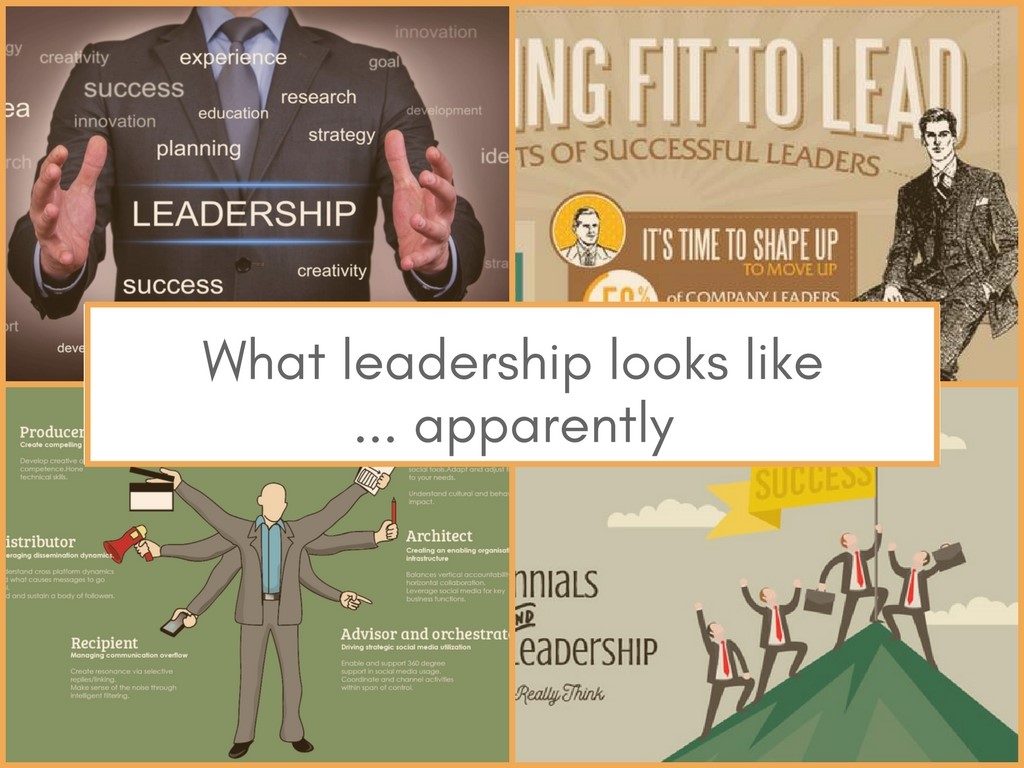
One thing that drives me mad in my social media feeds are the images that accompany articles on leadership. Infographics about leaders often feature male suited figures. An Google image search for ‘leader’ results in swarms of male figures in front of a group or standing atop a mountain. This presents a very limited notion of what a leader is or to what leaders should aspire. The men photographed or illustrated for these images of leadership tend to be white and photogenic, and wearing suits or capes. Leader as man. Leader as hero. Leader as at the apex. Leader as forging ahead.

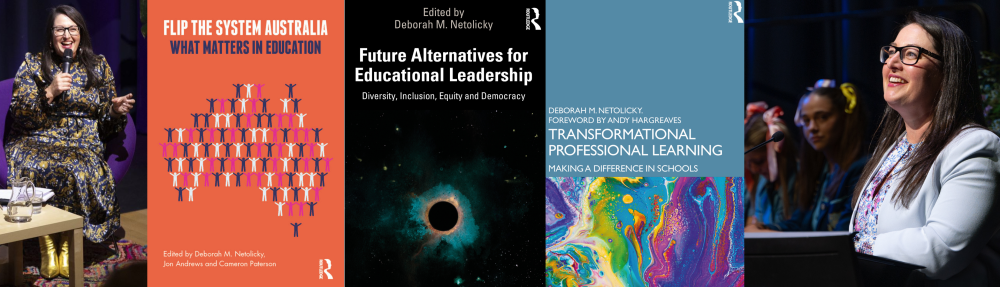
Some of the academic writing I’ve been doing around leadership, in the form of journal articles and book chapters, has me revisiting my thinking around leadership. I’ve written before about challenging traditional notions of what a leader is and what they do. I wonder how my own approach and journey might play a part in offering alternative narratives of leadership. How does my story allow others to imagine a leader who may not be out in front, or on top, or male, or in a suit, or wearing a cape? How might leaders or aspirant leaders give themselves permission to lead differently, or to aspire to images of leadership that are different: softer, more collaborative, less visible, more joyful?

This isn’t about being a woman or a man, but about everyone being able to access a continuum of ways of being and leading. Or perhaps it isn’t a continuum but a web of possibilities, connected but divergent.

I have always lived the educational cliché – doing my very best, striving for high achievement, immersing myself in lifelong learning. Many of the leaders in my PhD study said the same: not only had they drunk the Kool-Aid of education, but they also felt its essence down to their bones. Leading, teaching, and learning aren’t add-ons or aspirations, but ways of being based on deeply held beliefs.

I have been a school leader since my first principal took a chance on me by promoting me to a Head of Faculty position in my second year of teaching. I was 22 years of age. I was tasked with leading teachers who had been teaching for more years than I had been living. My approach then, similarly to my approach now, was around building trust and relationships as the foundation stones of leadership. As Bryk and Schneider (2002) assert, relational trust is the connective tissue that binds together individuals with the common mission of advancing the education and welfare of students.

Now, my leadership style is based in an understanding of leadership literature, valuing of relationships, belief in the capacities of those I lead, and willingness to listen equally to enthusiastic perspectives and dissenting voices. My PhD and current role mean that I am a practitioner committed to I research-informed and data-rich practice. I also, however, place great value in practitioner experience, the wisdom of professional practice, and the capacity of those with whom I work, to grow, improve, and serve their students and communities.

My approach to school and cultural change is ‘go slow to go fast’. Deliberate, collaborative change coaxes buy-in and ownership from stakeholders. It involves creating a shared need, designing a shared vision, and then energising, mobilising, and building the capacities and motivations of others to propel change. This kind of leadership isn’t about me, but about how to fire holonomy (Costa & Garmston, 2015): the nuanced interactions between ‘me’ and ‘we’, individual and organisation, cog and machine. As Andy Hargreaves and Michael Fullan (2012) point out, the group is more powerful than the individual in school and system change.

The reason that I continue to blog, to edit and contribute to books, to act as a peer reviewer for journal articles, to engage at conferences and online, is because I want to be part of shaping narratives of education and leadership. It is my hope that through sharing my voice I can be part of offering alternatives and providing solutions.

I have had two children along the way, and have navigated my way through the decision-making that comes with finding ways to be a good parent, a good spouse, and to do work that I think makes a difference in the world. As a leader I am mindful of the example I set for others in the decisions I make around work, family, and wellbeing.

As a leader, I don’t aspire to embody the hero, perform the all-knowing problem-fixer, or forge ahead with innovation at a rate of knots. I aim to be my authentic self and work to empower and elevate others in what Andy Hargreaves, Alan Boyle, and Alma Harris (2014) call ‘uplifting leadership’. Sometimes leading means holding the line or being calm in the eye of a storm. It often means giving others what they need based simultaneously on a balcony view of the macro picture, and an intimate understanding of the individual.

References

Bryk, A., & Schneider, B. (2002). Trust in schools: A core resource for improvement. Russell Sage Foundation.

Costa, A. L., & Garmston, R. J. (2015). Cognitive Coaching: Developing self-directed leaders and learners. Hawker Brownlow Education.

Hargreaves, A., Boyle, A., & Harris, A. (2014). Uplifting leadership: How organisations, teams, and communities raise performance. John Wiley & Sons.

Hargreaves, A., & Fullan, M. (2012). Professional capital: Transforming teaching in every school. Teachers College Press.