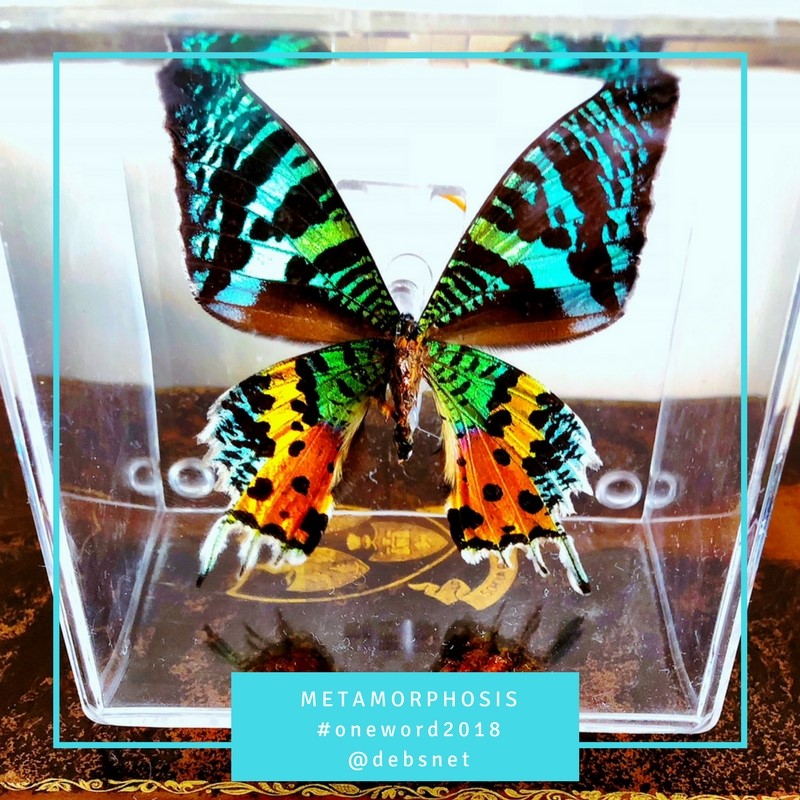
METAMORPHOSIS and emerging from the chrysalis: #oneword2018

taxidermy butterfly left to me by my scientist grandfather

It’s that time of year when we’re recovering from the holiday season and gearing up, or regenerating, for the new year. It’s a time, often, of reflecting on the year that’s been and planning for the year ahead. For the last few years I have used a ‘oneword’ to clarify my intent for my year. While I sometimes forget the oneword intentionality I have set, especially when life is at its busiest or most pear-shaped, mostly I find that choosing a single word allows me to bring a mindfulness to my year that is based on an essential focus to which it is easy to return across a year.

In 2015 it was CONQUER, as I worked at a ruthless pace to submit my PhD in between parenting my two young children and working 0.8 at my school.

In 2016 it was MOMENTUM, as I tried to capitalise on my PhD through lots of presenting (including at AERA) and writing from my thesis, still in the spaces between life and work.

In 2017 it was NOURISH, as I worked to clarify my work and life by focusing on that which nourished me.

On 2017 …

In 2017 my oneword embodied itself in multiple aspects of my life. As my youngest child entered full-time school, I returned to full-time work that has been nourishing in its focus. That is, I’ve been grateful to spend my time in areas of passion and purpose: teacher professional learning, building a research culture, focusing on staff development, and leading the Library, as well as teaching English.

In 2017 I have said ‘yes’ to projects because they are nourishing experiences for me, or because I have been burning to say something. My formal 2017 publications, for example, have been:

I have also joined the Board at my children’s school, and become a member of Evidence for Learning’s Research Use and Evaluation Committee. These commitments are about contribution, giving back, and making a difference; through them I receive the nourishment that comes from doing something worthwhile.

In 2017 I have spent nourishing time with my family, including a couple of lovely holidays. I have been seeing a new personal trainer whose strength and conditioning sessions have meant that my regular three-day-long headaches seem to have disappeared. Working with him has meant looking after my body, paying more attention to it, and getting stronger.

To 2018 …

2018 is around the corner and I’ve been considering what might be my fundamental intention for a year that already feels like an ending before it has begun. The end of 2018 will mark 10 years since I returned to Australia from the UK. That decade is a time in which I have had my two children, from pregnancy to babies to primary school students. It’s the decade in which I completed my PhD. The end of 2018 will mark a full decade of working at my current school (well and truly my longest ever period of employment). And at the end of next year I will have a zero birthday. The years from 2009-2018 feel like a chrysalis from which I will emerge at the end of next year. (I’m no doubt influenced here by the book I’ve just finished: Stephen and Owen King’s 715-page novel Sleeping Beauties in which women around the world are falling asleep indefinitely and being cocooned in mysterious chrysalides.) This seems a perfect time for looking back and looking forward.
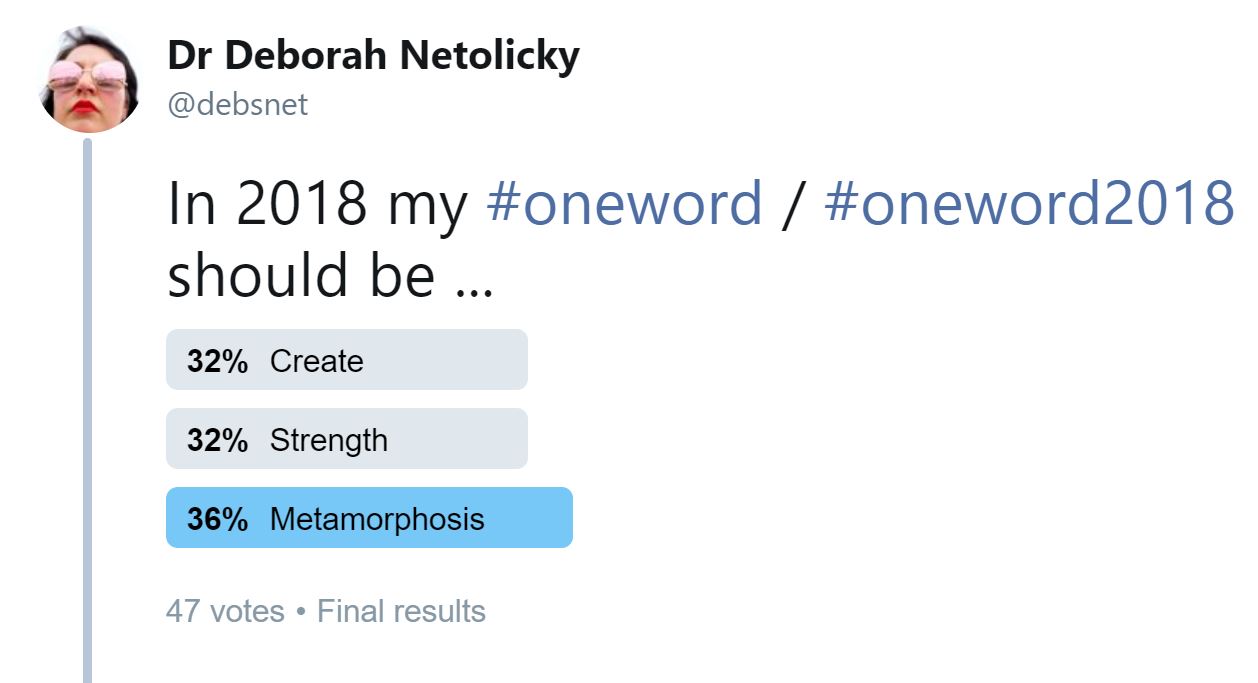
On Twitter it was a close race ….

For 2018 I have considered the word CREATE because I have some projects I’m keen to progress. I have considered STRENGTH because I would benefit from focusing on the strength of my body as well as the strength of my advocacy for others and perhaps for myself. But I am going to tackle a more complex and messy word this year: METAMORPHOSIS.

It’s not that I think 2018 will be filled with transformation. In fact, it’s more likely to be about consolidation and simplification (think Marie Kondo’s KonMari method applied to life, or perhaps Sarah Knight’s life-changing magic of … ahem … figuring out what not to worry about). METAMORPHOSIS isn’t just about change. It isn’t that I think I’ll grow proverbial wings in the space of a year. But it is about development and moving on to another stage. For me that stage is mid-teaching-career, post baby-having, post-PhD stage. It’s time to figure out what ‘mid’ and ‘post’ look like when they are my ‘now’.

METAMORPHOSIS is also about letting go. It is about shedding old skins, old bodies, old habits, old values, old dreams. It is about considering what I want to take into my next decade, and what I’m willing to leave behind. After a few packed but fragmented years, full of simultaneous, competing, overlapping commitments (teaching! school leadership! PhD! academic writing! presenting at conferences! pregnancies! parenting! moving house! all at the same time!), it’s about re-assessing how I am spending my time and considering where it might be that all my endeavour is leading me.

The questions I will ask in 2018 in order to be mindful of METAMORPHOSIS in 2018 are:

  • What might flight, freedom, joy, and purpose look like and feel like for me?
  • How might I imagine the next decade and what might I need to do to get there?
  • What do I want to focus on doing and what can I stop doing, or do less of, in order to fulfil that focus?

Flipping the flippin’ education system

I have been thrilled in the last couple of weeks to be part of the Flip the System publishing movement. Its inception was the original 2016 book, dreamed up and brought to fruition by Dutch teachers Jelmer Evers and René Kneyber: Flip the System: Changing education from the ground up. In it, a number of contributors discuss the purpose of education. They urge schools and teachers to resist complying with the decrees of policymakers or kowtowing to external accountability measures. Rather, they promote trusting the teaching profession to influence the education system from the bottom up and the inside out. You can see Jelmer speak in his TEDX talk about how he and René conceptualised subverting the system to promote teacher agency and collaboration.

Then, on 29 November 2017, a new book—Flip the System UK: A Teachers’ Manifesto, edited by Lucy Rycroft-Smith and Jean-Louis Dutaut—was published. This book applies the notion of flipping the system to a UK context, offering a suite of voices intended to elevate teacher professionalism and empower teachers to effect change from within the education system. In this UK volume is a chapter I have co-written with Australian teachers Jon Andrews and Cameron Paterson, entitled ‘Flipping the system: A perspective from Down Under’. Here, we offer a way of thinking about flipping the system from an Australian perspective. That Flip the System UK sold out its first print run in its first night of publication says something about the magnetism of this movement. Editor Lucy Rycroft-Smith has been tweeting some excellent threads about the book from her @honeypisquared Twitter account. These are wonderful précis of the book’s contents, especially for those of us who have yet to receive our print copies of the book.

What these contributions to the Flip the System books so far show, are the commonalities amongst the global community of teachers. The Netherlands, the UK, Australia, and other countries around the world, are all facing reform agendas driven, not by those in classrooms or schools, but by those appointed to governments or catapulted to guru status, or those who might profit from their own reform recommendations (“Look! Education is in crisis. <Insert oft-wheeled-out-reason-for-education-crisis>. Here, buy my silver bullet / snake oil.“).

It was thrilling to have my first book chapter published in the last couple of weeks (hoorah! with more chapters in the long publishing pipeline). Even more exciting was that Jon Andrews, Cameron Paterson and I also signed our own book contract for a Flip the System Australia book. In it, we, along with an arsenal of incredible authors, will situate the Australian context within the global milieu, standing on the shoulders of Evers, Kneyber, Rycroft-Smith, Dutaut, and the Flip the System contributors thus far. From an Austraian lens, we and our contributing authors will argue for the wisdom of practitioners and the agency of the teaching profession, and for allowing teachers to take the lead as a trusted and meaningful part of global education conversation, policy, and practice.

So, a book chapter, a book contract, and being part of a global movement to re-professionalise, re-empower, and re-claim teaching? I’m flipping excited!

The Australian Association of Research in Education conference: Reflections on #AARE2017

snapshots of my AARE 2017, in Canberra

AARE provides a crucible for communicating, and sometimes collaborating around or arguing about, current thinking around education and education research. For many it also provides permission to stop and be immersed in their research field in a more collective way; time and space for thinking individually and together, and opportunities for challenging conversation and building lists readings. I believe that it is an important conference to consider for those like me (school-leader-teacher-and-researchers), as I explain in my reflection on the conference last year.

This was my third AARE.

In 2015 I presented in what was then the Narrative Inquiry SIG (now the Qualitative Research Methodologies SIG). Last year, in 2016, I made a late decision to attend the conference due to my new role at my school, so was purely a passenger in terms of the content of the conference. This year I presented twice, once in the Educational Leadership SIG and once in the Teachers’ Work and Lives SIG. The titles of these presentations have been:

  • Using extended literary metaphor and characters as analytical and conceptual tools: Creating a layered storyworld while preserving participant anonymity;
  • The Cheshire Cat: Redefining the school leader through unexpected metaphor (in a symposium titled ‘Slaying the edu-hero: Metaphors for alternative ways of leading’); and
  • What shifts the identities and practices of teachers and school leaders: Expanding notions of professional learning.

These titles reveal something of the broad but interconnected nature of my scholarly interests thus far. I have, in my presentations and conference presence, been a ‘SIG swinger’, attending sessions from multiple Special Interest Groups rather than committing to one common thread throughout the conference. Sometimes it is attending a session from well outside of my own areas that sparks in me the kernel of a way to think about something differently. Those presentations within my area help me to better understand the field and consider the place of my own work in the context of others’. As someone working in a school, attending AARE helps to keep my understanding of what’s happening in Australian education research current.

The sessions I attended this year were rich. They revealed scholarship that was rigorous, but also showed researchers grappling with the complexities of their work, and with the education world in and with which we all exist.

My own presentations were opportunities to communicate and publicly explore my scholarly work, but also to be invited by others to re-see or re-think my work. Some comments and discussion during my symposium on educational leadership challenged my symposium group to think critically about the lenses we were exploring, adopting, and playing with, in order to consider whose voices or perspectives are being omitted or marginalised in the process. We were challenged to see more clearly our own embedded socio-cultural biases and assumptions, that show themselves even when we attempt to work against them. There was also some great discussion in the individual paper session I presented in, around professional learning, teacher voice, relational trust in schools, teacher time, and school resourcing.

My reflections have been that this third experience of the AARE was the best yet, for me. But since the conference ended yesterday, I have been trying to figure out why that is.

As it is my third conference, I recognise many scholars in the conference, and this spills over into conversations over breakfast, coffee, lunch, and dinner. So the conference program (as is so often the case) is only one layer of learning, thinking, and conversing; much of the discussion happens in the in-between conference spaces. It was these liminal conference spaces that were particularly rewarding for me this time around. Between my attendance at AARE and AERA over the last few years, my academic writing, my academic collaborations, and my blog, now when I connect with delegates at AARE, people are able to engage with me about my research, my thinking, and my writing. At this conference, delegates (including early career researchers school-leader-scholar-boundary-spanners like myself, and professors) engaged me, questioned me, encouraged me, and directly challenged me. This is not about fan clubs, echo chambers, or discourse communities. It is about being in a critical community, unafraid to be critical, to push back, to resist, to trouble, to reveal, to be uncomfortable with one another.

Incidental conversations and provocative paper presentations now bubble in my mind as I turn over possibilities for future work, and questions about my reading, writing, and myself as a scholar. The AARE conference can provide space for the time and permission to think and talk about scholarship and education in a community of national and international scholars from various institutions, career stages, and -ologies. It is also a site of scholarly being, knowing, and doing.