
NEW BOOK KLAXON: Future Alternatives for Educational Leadership

“The work of an educator has never been challenged the way it is today. Leadership in education during current political turmoil, economic uncertainty, and global health crisis may sound like a mission impossible. But wait, this future-focused volume comes to the rescue for educational leaders from classrooms to ministerial cabinets. It is a must-read for anyone hoping to understand what it is to be a leader in the post-pandemic world.”

Pasi Sahlberg – Professor of Education Policy, The University of New South Wales and author of Finnish Lessons 3.0: What Can the World Learn from Educational Change in Finland

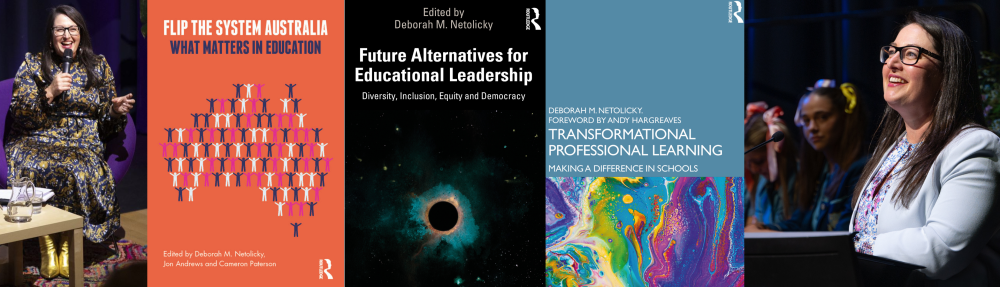
I am beyond thrilled to announce the soon-to-be-released book Future Alternatives for Educational Leadership: Diversity, Inclusion, Equity and Democracy, an exciting edited collection of contributions by outstanding authors in the field of educational leadership.

As its title suggests, this book presents future alternatives in the educational leadership space. Its contributions consider the history of the field of educational leadership, what the reality of educational leadership is right now, and importantly, what is needed in educational leadership next.

This book offers provocations for what’s now and what’s next in educational leadership, simultaneously bringing the field both back to its basics—of equity, democracy, humanity, and education for all—and forward to productive, innovative, and necessary possibilities. Written during the pandemic reality of 2020, this collection shares the global voices and expertise of prominent and emerging leaders, scholars, and practitioners in education from the UK, USA, South America, Canada, Europe, Australia, and the Middle East. Authors engage with the complexities and uncertainties of leading in education. They examine research, reflections, and real stories from which school leaders, education system leaders, policymakers, and researchers in the field of educational leadership, can learn, and in which they will find honesty, authority, and inspiration to guide the future of the field. The new perspectives and hopeful alternatives presented in this outstanding book are essential to researchers, school leaders, policymakers, and are key to advancing education into positive and democratic futures.

I have edited this outstanding volume and am incredible grateful to the book’s contributors for their thought-provoking, important chapters, written during the tumult of 2020, often during rolling lockdowns, university and school closures and reopenings, remote teaching, educational upheaval, fast policy, anxiety, uncertainty, and crises.

Thank you to Beatriz Pont for writing the Foreword and to Professors Yong Zhao, Jane Wilkinson, Pasi Sahlberg and Ellie Drago-Severson for their endorsements of the book. Yong Zhao describes it as “a fantastic collection of brilliant voicesa much-needed hopeful volume“. Jane Wilkinson calls it a “timely and important book” providing “a rich and diverse set of insights into the past, present, and potential future of educational leadership“. Ellie Drago-Severson says it is “a treasure trove of insights and wisdom to help shift paradigms in educational leadership“. Pasi Sahlberg asserts that the book is a “future-focused volume” that “comes to the rescue for educational leaders from classrooms to ministerial cabinets” and “a must-read for anyone hoping to understand what it is to be a leader in the post-pandemic world.

I can’t wait until the book is published. In the meantime, check the link to the book (currently available for pre-order and on sale) and the Table of Contents below for more details.

Future Alternatives for Educational Leadership: Table of Contents

  • Foreword. Beatriz Pont
  • Introduction: What’s now and what’s next in educational leadership. Deborah M. Netolicky

Section I: Knowledge and Theory of Educational Leadership

1. Back to the future: Recuperating educational administration? Pat Thomson

2. Leading forward by salvaging for the future. Christine Grice

3. Wayfinding: Navigating complexity for sustainable school leadership. Deborah M. Netolicky and Claire Golledge

4. Leading in context: Lessons from Nuance. Michael Fullan

5. Distributed leadership and networking: Exploring the evidence base. Cecilia Azorín, Alma Harris, and Michelle Jones

Section 2: Diversity and Inclusion in Educational Leadership

6. Multilevel distributed leadership: From why to how. Asmaa Alfadala, Richard Paquin Morel, and James P. Spillane

7. “Deadly leadership” in the pursuit of Indigenous education excellence. Suraiya Hameed, Marnee Shay, and Jodie Miller

8. Leadership, identity, and intersectionality. Andy Hargreaves and Dennis Shirley

9. Women as leaders in education: What works and what must we improve? Vivienne Porritt

10. A tale of two leaders: Reflecting on senior co-leadership in higher education. Karen Edge

Section 3: Systems and Structures for Educational Leadership

11. Leading large-scale educational change in the 21st Century: Educational leadership pre-, during, and post-pandemic. Carol Campbell

12. Educational administration’s Paradises Lost: A flâneur/se stroll through the futures past. Eugenie A. Samier

13. Schools as ecosystems of leadership: Leading by all and for all. Liliana Mularczyk

14. Leading to liberate learning: Educational change meets social movements. Santiago Rincón-Gallardo

15. What could education leadership look like outside the system? Annie Kidder, Eloise Tan, and Christine Corso

  • Conclusion: Educational leadership for all. Deborah M. Netolicky
Authors of Future Alternatives for Educational Leadership

Staff wellbeing: Time and money

source: @nikkotations at unsplash.com

In 2019 I blogged about the increasing concerns about teacher and school leader wellbeing. I’ve lately been thinking a lot about wellbeing in education. It was brought into stark focus during the pandemic reality of 2020. I wrote in this journal 2020 article in the Journal of Professional Capital and Community that:

At this time more than ever, we must consider humans before outcomes, students before results and wellbeing before learning.

I discussed wellbeing in this 2020 contribution for the special edition e-book Education Disrupted, Education Reimagined: Responses from education’s frontline during the COVID-19 pandemic and beyond, published by the World Innovation Summit for Education, Salzburg Global Seminar and the Diplomatic Courier. In it, I stated the following.

We need to put safety, health, and wellbeing before formal education, curriculum, pedagogy, and especially assessment. Community, connectedness and relationships need to be at the forefront of education decisions and practices. This is a time to focus first on the humanity in education, from a position of seeking to understand and accommodate for the complex circumstances of those in our communities.

Wellbeing continues to become a hotter and hotter topic in education.

Wellbeing is noted as part of a ‘right driver’ in Michael Fullan’s new paper ‘The right drivers for whole system success’ in which he argues that wellbeing and learning are inextricably integrated into a foundation based on equity, knowledge, engagement and connection to the world. The Association of Independent Schools of NSW has just launched a 12-18 month program on navigating whole school wellbeing. This week the Gallop Inquiry released its findings around the complexity and workload intensification of teaching, and the need for teachers to have more time to plan, collaborate, and monitor student learning. Ask any teacher what they need more of and the answer will be: time!

Yesterday, a UK educator tweeted about the use of school funds to send care packages to staff while they are in lockdown and working from home. A long thread of replies ensued, with a range of responses from ‘school leadership do/should pay for gifts and wellbeing initiatives for staff out of their own pockets’ to ‘this is improper use of school funds’ and ‘staff wellbeing is more than buying treats’. Many tweeters invoked the Nolan Principles, suggesting that buying food or paying for things that might be considered wellbeing initiatives for staff constituted unethical or dishonest use of school funds, or that every dollar or pound spent in a school needs to have a direct impact on student outcomes.

In my view (although it is something most of us do or have done), teachers shouldn’t be expected to buy classroom materials out of their wages, nor should school leaders have to provide staff wellbeing initiatives out of their own salaries. Teaching is a caring profession, but the trope of the hero teacher who sacrifices their own needs, money and health for the good of their students is unhelpful. Educators need to give themselves permission to fit their own oxygen masks first, so that they can serve others. Schools should be able to consider ways in which they can take care of their staff, appropriate to their own budget and context. Looking after staff takes time and money. A school leader’s time spent checking in with a staff member; a thank you card; tea and coffee in the staff room; providing relief cover for a teacher’s lesson so they can collaborate with colleagues, attend a course or address a personal matter; a morning tea; the flu (or coronavirus!) vaccine; investing in professional learning. At what point does spending money on staff and on developing the wider culture of a school, become controversial?

Wellbeing is one of the pillars of my school’s new strategic plan, so we are having robust discussions about how to support the wellbeing of all in our community, and about what being well really means. Our discussions are about culture, feel, belonging, workload, teamness, a sense of purpose and togetherness. Wellbeing and learning are the foundation of my school’s framework for our K-12 learners to explicitly engage with those attributes found to be those of people who continue to learn and engage in meaningful work throughout their lives.

Wellbeing (as well as learning and teaching) is at the heart of our new staff development suite, which is based in Martin Seligman’s PERMA framework, as a way to support staff’s (P) positive emotions, (E) engagement in valuable work, (R) rewarding relationships, (M) meaning in their work, and (A) achievement and feeling of accomplishment. The suite of staff development options is based not on evaluation and surveillance, but on a sense of belonging, authentic connectedness, vibrant professional community, purposeful collaboration, central purpose, and meaningful feedback. It is focused on the voice, choice, ownership and agency of staff. It takes time and investment in people. Professional learning, too, costs money, and is part of improving student outcomes and teacher expertise, but also about wellbeing through valuing and growing staff, and supporting them to reach their goals.

When it comes to staff wellbeing, as I noted in the above recent blog post,

Staff wellbeing is more than free food and fitness classes, although these can be nice to have. Nurturing staff wellbeing might take various forms, such as providing initiatives that support staff health, modelling sustainable work-life behaviours, maintaining predictable timelines, ensuring clear policies and procedures, streamlining communication, considering workload issues, ensuring a range of internal and external support mechanisms are available for staff, recognising staff efforts, celebrating staff achievements, leading with empathy, and making decisions with the needs of staff in mind.

Trust, too, is key to the wellbeing of the teaching profession. Schools need to cultivate cultures of trust. Teachers need to be trusted by parents, the media, and government. Trusting teachers to be the professional experts they are allows teachers to focus on their core business of teaching and supporting the students in their care. Looking after staff is key to retaining them within positive cultures of people working together for the good of their community. Nuanced attention to staff wellbeing takes intentionality, thoughtfulness, a framework for decision making, time, and often money.

Distance Learning Round 3: Applying what we’ve learned

Screenshot from today’s video lesson.

In Western Australia we have been lucky that our periods of COVID-19-related lockdown or distance learning have been counted in weeks, not months. In fact, until the weekend, we had gone almost ten months with no community transmission of coronavirus.

Monday was to be the first day of the academic year for most students in Western Australia, but as 2020 taught us, COVID-19 disruption can strike at any time and change circumstances. One hotel quarantine case of the B117 variant of the novel coronavirus, and Perth was put into a five-day lockdown at 6pm on Sunday night, hours before the first day of school was due to begin. The Premier’s announcement came at lunchtime Sunday, giving school leaders just enough time to meet to plan the response, organise communications, and open schools so that staff could drop in before lockdown commenced to collect anything they might need for remote teaching.

Luckily, this was unlike the announcement in April last year that pressured schools and teachers with significant extra work to begin a hybrid learning environment with students learning from home and from school, simultaneously. Rather, what was announced was a one-week extension of the school holidays. Schools did not need to open for essential workers, nor did they have to provide resources for learning from home. Many independent schools had, however, already started their school years, so student lockers were filled with books and boarders had arrived at boarding houses. Other schools, having not started the school year, had IT devices and books not yet distributed to students.

Government schools are honouring the Monday to Friday extension of the holiday break. Some independent schools launched into remote learning from Tuesday or Wednesday for all students K-12. At my school, we took a balanced approach. The academic year for our K-10 students was postponed for the week, with teachers spending their time at home preparing lessons for Week 2, possibly to be delivered using distance learning if the lockdown is extended due to testing or case numbers. After two days of teacher preparation (of remote lesson plans, instructional videos, Teams functionalities and resources), teaching of courses in Years 11 and 12 began today (Wednesday) via distance learning.

This lockdown and period of remote learning feels different to the scramble in March last year. Even then, we were considered and prepared in our approach. In 2020, in the most isolated city in the world, we had seen the virus coming across the globe like a tidal wave we knew would reach our shores. But it was still a case of building the plane while flying it, and finding ways to listen to our community to figure out what was working well and what could be improved. This time our plan had been refined by deep reflection on lessons learned from our last two rounds of distance learning, and we continued to base our decisions on the following key principles.

  • The wellbeing of all in our community, including students, families and staff. We did not want to rush into providing a home learning scenario for all students as families and teachers were busy preparing their households for the lockdown. Parents and teachers were organising to work from home, while having their children at home.
  • Clear and streamlined communication. Everyone was consuming and coming to terms with fast-changing news, a new suite of rules and restrictions. A bombardment of communication from the school, or from teachers about remote learning, was not what our community needed on top of the firehose of information they were processing. We ensured clear communication through a couple of key channels. Our All Staff Microsoft Team allowed for detailed, dynamic communication for and among staff.
  • Clarity of plan. In 2020, while learning in Western Australian schools returned to face to face, the leadership team continued to iterate and improve the distance learning model for what we thought might be a ‘next time’. That plan—what we called Distance Learning 3.0, as well as previous emergency response planning—made Sunday’s planning much easier. We knew what was likely to work, and we could swiftly tweak the plan for the current scenario and for what is most appropriate for our community, based on a range of previous feedback.
  • Collaboration. It has been heartening to see the collaboration between staff in our virtual spaces this week. Staff are creating how-to videos for one another, sharing resources, and reaching out. There is an incredible and uplifting sense of solidarity and staff community, even when a bushfire emergency was added to this week’s lockdown scenario.

In the last year, we’ve learned a lot in education about how to bring humanity together with precision of instruction and collaborative technologies so that remote learning is effective, reassuring and provides connectedness. Today, on our first day of distance learning with Year 11 and 12 students, there has been tremendous uptake and engagement by students. I have been buoyed by feedback from teachers, parents and students, and energised by interactions with my own class and their openness to beginning our course at a distance.

Going slowly, carefully, and with clarity in our response to the latest lockdown has allayed overwhelm and anxiety. It has given time, space and resources for teachers to design remote education for their students that is excellent, equitable and realistic for the context in which we find ourselves. Our approach balances best practice in remote teaching and learning with safeguarding the wellbeing of students, families and staff. We have been able to respond realistically, responsibly and with agility to changes in circumstance, and will continue to do so. With any luck, our five-day lockdown will end after five days.