Reflections on ACEL 2014: learning, leading, teaching

Effective change is a matter of both will and skill. People have to want to do it, and they have to know how to do it. ~ Levin

Passion & Purpose at ACEL conference Melbourne by @debsnet https://theeduflaneuse.wordpress.com/

2014 ACEL Conference lanyard on the Southbank boardwalk: passion & purpose

I have spent this week in Melbourne at the 2014 Australian Council for Educational Leadership Conference, including presenting a breakout session with colleagues about our school’s story so far: of building a professional growth model, based on our own context, vision and beliefs about learning, teaching and leading.

It was affirming to hear the keynote speakers’ key messages reflect the real work that we are doing at my school. Some of those keynote takeaways, as aligned with my school’s work around professional growth and culture were …

We know that teaching is complex

Noel Pearson highlighted for the over 1000 delegates that effective instruction is at the heart of education.

Charlotte Danielson reminded the audience of over 1000 delegates that “teaching is so hard it can never be perfect” and that the complex, demanding cognitive work of teaching required educators’ ongoing quest to improve teaching practice, in order to improve students’ learning. She joked that, while doctors’ work is complex, they get to see one patient at a time; “I would call that tutoring.”

In his panel response to Charlotte’s keynote, Phillip Heath, Head of Sydney’s Barker College, emphasised the importance of focusing on celebrating the full, highly cerebral, in-the-moment and sacred nature of teaching, rather than on exposing and shaming failures, or ticking boxes.

Our school’s model of professional growth and culture is focused on a default position of meaningful teacher-owned growth.

Building minds, inspiring learners

Charlotte Danielson also reminded the audience about the constructivist nature of learning for students and teachers; that learning is done by the learner in an active intellectual process. Danielson pointed to conversations in which an observer or leader advises a teacher after a classroom observation, and in which the teacher passively endures the feedback. “Who is doing the work?” she asked. The Danielson Framework for Teaching, or as she pointed out, any framework for teaching, is a conduit for teacher learning which allows teachers to do the thinking for themselves.

Tim Flannery encouraged educators to encourage exploring, imagining and being open to organismic change.

John Medina shared his knowledge around increasing the brain’s executive function, the part of the brain (responsible for openness to cognitive and behavioural change) that we are attempting to access in our teachers by applying a Cognitive Coaching approach to professional conversation and reflection.

Richard Gerver talked passionately about the need for developing self-managing people and systems. Our model’s key aim is the development of teacher-driven, teacher-owned self-managing, self-monitoring and self-modifying teachers-as-learners.

Leading with clarity, coherence and collaboration

Richard Gerver highlighted the importance of the clarity and coherence in educational leadership.

Tim Flannery encouraged collective wisdom over individual genius, the harnessing of the informed community rather than the singular expert.

Linda Darling-Hammond reminded us that “teaching is a team sport” and that the greatest achievement gains are from those schools in which educators work together with a coherent approach. Beware ‘popcorn reform’, she said, with which we might innovate our way to edu-failure. What we need is to learn from each other’s successes and failures; teachers, schools, districts and nations.

Both Linda Darling-Hammond and Noel Pearson underlined the importance of backward design: having students’ learning outcomes and futures in mind when designing their education. For Pearson, this future was “giving people the capabilities to choose lives they have reason to value.” In particular, he advocates for Indigenous Australians to realise the potential, talent and creativity which afford them real choice and the mobility to orbit between external worlds and their indigenous homes, cultures, languages, traditions and peoples.

Charlotte Danielson reminded us about distributed leadership; it is not the principal but all teachers who are responsible for leading learning in schools. Leading and learning are about collaborative growth, not punitive measures. “We’re not going to fire our way to Finland,” she said. “We need to learn our way there instead,” by  coming together as communities of teachers which use a common framework as a scaffold to provide common definitions of good teaching, a common language with which to talk about teaching and shared understandings about what good teaching is and how teachers might enact it. This, Danielson says, helps to avoid conversations in which teachers and leaders use the same words but mean different things.

John Hattie challenged educators to “change the narrative” of education by building the profession and taking pride in teachers, rather than in buildings, resources, websites or canteen menus.

Yesterday, when presenting at the conference, my colleague described our school’s continuing journey as an “evolution not a revolution”, an ongoing, organic and iterative process which is based in our own context and the needs of our teachers and staff.

We have been taking the approach of ‘go slow to go fast’, deliberately unfurling a new initiative by allowing it to bubble up out of the school’s strategic vision and then be piloted, driven and owned by teachers. We have been attempting to distribute leadership in a project which is connected by clear, coherent, school-wide organisation-aligned threads of vision and practice.

Safety and challenge for growth

Charlotte Danielson talked about getting the balance right between support and challenge for teachers; schools need to provide an environment of trust in which it is safe to take risks in the spirit of ongoing professional inquiry.

This need for balance – between safety in which teachers feel supported and trusting, and enough discomfort to challenge practice and change thinking and behaviour – has been a cornerstone for us in providing the setting for transformation of classroom teaching, professional conversation and collaborative culture.

Thank you, ACEL for an affirming experience of layered, interlocking ideas.

Champagne at Crown Melbourne by @debsnet https://theeduflaneuse.wordpress.com/

champagne view from Crown Casino, Melbourne

Ideas to anchor school change

Without new experiences, something inside of us sleeps. The sleeper must awaken. ~ Frank Herbert

NYC art journal page by @debsnet https://theeduflaneuse.wordpress.com/

One of my art journal pages: ‘Don’t quit your daydream’

I recently completed the Adaptive Schools Foundation Seminar during which some of Garmston and Wellman’s foundational ideas really resonated with me in terms of school change (these are outlined in the course and in the source book The Adaptive School: A sourcebook for developing collaborative groups, 2nd ed., 2013).

1. Centrality of identity, beliefs and values

The Adaptive Schools book and course place emphasis on the importance of being conscious of teachers’ identities: their core beliefs, values and senses of self. These, rather than being set aside, are acknowledged and drawn upon in collaborative school practices. Graceful disagreement is seen as a path to developing group cohesiveness, empathy and shared identity. The teacher as person is honoured as an individual within the school, and a part of the school group.

2. The importance of talk

How we talk in schools, say Garmston and Wellman, influences our schools and our personal and collective experiences of them. Talk creates reality. This is why at my school we are using the Danielson Framework for Teaching (to provide a common language for talking about teaching) and Cognitive Coaching conversations (to provide a common way of encouraging teachers to think about their own teaching, in a way which allows the coach to facilitate the development of a teacher’s thinking, while at the same time getting out of the way of that thinking).

3. Tiny events create major disturbances

This is Garmston and Wellman’s third underlying principle of what they call ‘nonlinear dynamical’ systems, like schools. This principle affirms my experience of the unexpected, chaotic butterfly effects of incremental changes, which are sometimes unnoticeable or unmeasurable.

Teachers involved in our coaching cycle have commented that seeing another teacher’s lesson impacted their own practice in the following days; that reflecting on their teaching against the Danielson Framework brought foci and deliberate intent to their subsequent lessons; and that coaching conversations sometimes impacted their thinking long after the conversation had finished. Teacher coaches have noted that their Cognitive Coaching training has shaped the ways in which they communicate, not only with colleagues, but also with students and even with their own friends and families.

The Cognitive Coaching course has also impacted on my thinking around teacher growth and school change.

4. Holonomy

The notion of ‘holonomy’ is not from Adaptive Schools, but is from Costa and Garmston’s Cognitive Coaching (see Cognitive Coaching: A foundation for Renaissance schools, 2nd ed., 2006). It is the conceptualisation of the bringing together of individual (teacher) and organisation (school). The teacher is both influenced by and influencer of the school, involved in a continuously responsive relationship. The teachers as parts, and the school as whole system, work organically and symbiotically together.

For me, this notion of the interdependence between human individualism and organisational systems should be a key focus in school change initiatives. For my school, part of our approach has been designing a professional learning cycle based on the school’s strategic vision, and then having teachers pilot, drive and design the change. For us, the importance of honouring both organisation and teacher in a slow and deliberate process has been more important than fast change.

This coming week I will be at the Australian Council For Educational Leaders conference, sharing our story with other schools and departments who are working to develop the capacity of their teachers. And this time next month I will be in the middle of my visits to New York educators and researchers. I’m looking forward to having face to face conversations with those with whom I have connected via email and online, and seeing how they negotiate the tensions (and connections!) between teacher and school.

New York Is Always A Good Idea by @debsnet https://theeduflaneuse.wordpress.com/

New York as a site for insights around teacher growth

A collection of superstar teachers cannot produce the results of interdependent colleagues who share and develop professional practices together. ~ Garmston and Wellman, 2009

NYC snow dome by @debsnet https://theeduflaneuse.wordpress.com/

As I mentioned in my first post, New York is an apt place to conduct my professional learning visits – next month – which are focused around the roll out and implementation of a growth model of teacher professional learning. Our teacher growth model emerges out of the strategic vision, mission and values of the school, and uses:
– non-judgmental classroom observations
– the Danielson Framework for Teaching; and
– a Cognitive Coaching approach to professional conversations around practice, reflection and growth.

NYC has been rolling out the Common Core Learning Standards and Advance, the NYC system of teacher evaluation and improvement. 2011-13 was the preparation phase, including research such as the Gates Foundation’s Measures of Effective Teaching project. 2013-14 was the enactment phase and 2014-15 is the phase for reflection and refinement.

The NYCDOE’s 2014-15 Citywide Instructional Expectations call on schools to:
1. Ensure knowledge of students and their work, and use this knowledge as the starting point for planning;
2. Integrate policy into an established, clearly articulated instructional focus; and,
3. Develop a culture of collaborative professional learning that enables school and individual development.
There is a focus on supporting schools in building coherence among their culture, structures, and instructional core and supporting them in reaching the benchmarks for school quality described in the Quality Review Rubric.

The primary NYC teacher evaluation model – Measures of Teacher Practice (MOTP) – involves each teacher:
– Assessing their own practice against the Danielson Framework for Teaching;
– Being observed multiple times by a principal or administrator;
– Reviewing evidence and artefacts which demonstrate their teaching practice; and
– Receiving feedback on these observations and evidence;
– Receiving student survey feedback.

I enjoyed Lisa Nielson’s post on using digital portfolios to ‘capture practice’ and showcase teacher effectiveness. Lisa says that putting together a portfolio on the four domains of the Danielson Framework is “an incredible opportunity to do something that is rare in the teaching profession. It provides an opportunity for teachers to release the great work they are doing from the classroom and share it with the world. It also provides a common language and method for looking at and sharing the work we do.” My hunch is that many teachers do not see the Framework as an opportunity for growth and connecting through professional conversation. Perhaps this depends on the context in and focus for which it is used?

The immediate difference I can see between the model being developed by my Australian school and the NYC Advance program is one of emphasis. Advance seems focused on evaluation, whereas our focus is on teacher growth. That is, our deliberate default position is one of focusing on self-directed growth, rather than on external evaluation or performance management, although in some situations consulting, collaborating and evaluating might be appropriate.

On their website, the Danielson Group outlines the tension between evaluation and growth: “tension between these two purposes; a system of accountability can feel like an ‘inspection’ to teachers, while one entirely focused on professional learning can result in underperforming teachers not receiving important information about their teaching.”

Charlotte Danielson talks about her framework not originally being designed as an evaluation system, although that’s how it was quickly adopted around the world. Her video on The Collaborative Observation Process explains Danielson’s focus on growth rather than inspection. For my school’s context, this was central to our approach to using the Framework. I look forward to exploring this further with Charlotte when I meet with her next week and later next month.

Certainly my school is passionate about developing the culture of professional learning and protecting the meaningfulness of a formalised reflection process for teachers. Our approach is one in which the teacher is in control of the process; they self-direct their own foci and are Cognitively Coached through their thinking about and reflection on non-inferential data, collected from their classroom practice by a teacher-coach (that is, someone without an administrative position, whose role is to observe, listen and facilitate thinking).

Do any educators have experience with how Danielson’s Framework for Teaching is being used in their schools or districts? I am very interested in successes, lessons learned and stories of schools, leaders and teachers.

Applying the travelling mindset: embracing creativity

What, then, is a travelling mindset? Receptivity might be said to be its chief characteristic. We approach new places with humility. We carry with us no rigid ideas about what is interesting. We irritate locals because we stand on traffic islands and in narrow streets and admire what they take to be strange small details. We risk getting run over because we are intrigued by the roof of a government building or an inscription on a wall. We find a supermarket or a hairdresser’s unusually fascinating. ~ Alain de Botton

Alain de Botton described the traveling mindset as one of receptivity and openness. In 1794, Xavier de Maistre applied this mindset to his own everyday space. In my own experience, of traversing thirty three countries so far, travel is learning. Being submerged in the unfamiliar brings to the surface captivation, imagination and vulnerability.

I think being abroad is sometimes where we feel we can be most ourselves, untethered by daily routines, obligations, expectations and the mundanity and productivity of daily life.

So how is an educator to bring this outlook to professional meetings and visits abroad? My approach is one of embracing creativity.

@debsnet New York Journal

Research connects creativity with productivity, adaptability, novelty, divergent thinking, idea generation, flexibility and problem solving (see Dr Mark Runco’s 2004 article on ‘Creativity’ in the Annual Review of Psychology). For me, writing, drawing, painting, doing and making are physical mind-body processes which facilitate right brain thinking, foster creativity and enable authenticity – of thought, of action, of being.

Sir Ken Robinson’s 2006 TED Talk on how schools kill creativity has been viewed almost 30 million times. In it, he champions the cultivation of creativity and questions the rigidity of education systems which encourage conformity and compliance.

The #makered hashtag on Twitter and http://makered.org/ have plenty of ponderings, resources and perspectives on the meaningfulness of making and doing for our students.

Of course social media and this blog are 21st century extensions of traditional creative media but I am intending largely to ‘go retro’ on my October professional journey: reading print novels, keeping a visual journal, collecting tactile ephemera and enacting mindful pen-to-paper thinking. Using the camera and a journal to explore thoughts and experiences is a method of creative, reflexive, deliberate inquiry, as well as a way of recording both professional visits and New York herself.

New York #artjournal page by @debsnet

I hope this flânerial approach – that of the wanderer who is finely attuned, keenly observant and totally immersed – will help me to be at my most receptive, flexible and open to new learning.

A life lived learning: a tribute to my grandfather

I have always imagined that paradise will be a kind of library. ~ Jorge Luis Borges

New York Public Library by @debsnet

New York Public Library ~ ‘A good Booke is the precious life-blood of a master spirit, imbalm’d and treasur’d up on purpose to a life beyond life.’

In education, we talk a lot about lifelong learning, and about how to inspire in our students (or perhaps preserve in our children) curiosity, passion and the desire to know, to discover, to push at boundaries. To be continuous creators, thinkers, questioners and enactors of their thinking and beliefs.

As an English and Literature teacher, and lifelong reader, who grew up surrounded by books, the physical book is for me a symbol of self-directed, voluntary learning. As a girl I was able to peruse bookshelves throughout my childhood home and pull books from the shelves, at will, to read and re-read. These books were not vetted for age-appropriateness but were a range of children’s books, novels, classics and encyclopaedias to which I had unfettered access.

Other vivid memories are of being in the study of my grandfather, who was a collector and binder of rare and beautiful books. His study was wall-to-wall floor-to-ceiling wooden bookcases, saturated with the overwhelming smell of old paper, worn leather and decaying adhesives. It was a paradise for the book lover!

Overnight my grandfather quietly passed away in his bed, at ninety years of age, his spectacles on and a book in his hand. He was a Doctor of Philosophy, a scientist, a professor, a poet and a thinker, who was reading and writing narratives, scientific writing and verse until his last breath. He was the epitome of a lifelong learner, a deliberate scientific questioner of knowledge and someone always willing to engage in hefty intellectual debate. Only yesterday he and I were discussing strategies for academic, thesis and poetry writing.

I discovered today that my grandfather has left me two of his prized books: an early copy of Sir Walter Raleigh’s History of the World and an antique Chinese text which is a concertina series of Chinese customs, paired with hand painted calligraphy scenes, and bound between curved carved wooden covers. Both are books I remember connecting with the first time he gingerly passed them into my hands in his study. I remember feeling their weight (the Raleigh is heavy!), fingering the irregular textures, and smelling that old book smell (read more about the science of that here in Jessica Leber’s Fast Company post) as I sank into the cocoon of his old chair.

Books by @debsnet  IMG_1399

Raleigh Collage by @debsnet

As well as being objects that I will cherish, these books are symbolic for me of a life lived learning, something I aspire to, and to which I hope my students and my children will aspire.

Teacher (un)learning: immersive, experiential & ongoing

‘How do your teachers learn?’ Most answers I get follow along traditional lines: ‘They go to conferences.’ ‘They take after-school workshops.’ ‘They read books.’ They see their teachers’ learning as an event, not an ongoing process. ~ Will Richardson, 2012

Will Richardson reminds us that learning is an ongoing process, not a series of disconnected one-off occurrences. Professional learning is about the organic journey of the teacher; it’s not a set of tick boxes to be ticked or a number of mandated hours to be filled.

NYC Collage @debsnet

The self-directed-and-organisation-supported professional learning travel upon which I am embarking brings into focus the concept of teacher learning and how it might look. It is this focus that raises the sort of question I am asking on behalf my school while I am in New York: how can we best support teachers in their self-directed growth as passionate practitioners?

One learning movement with plenty of momentum is the unschooling / uncollege / unconference movement.

In unschooling the intellectual, emotional and physical freedom of the child is privileged over the perceived imprisonment by formulaic school curricula, strict structures and inflexible spaces. Just check out the #unschooling hashtag on Twitter.

At uncollege students are educated by real-world experiences, often outside their comfort zones.

Unconferences or edcamps are free, participant-driven conferences.

Does a travelling fellowship like my upcoming one, which focuses on the experiential professional learning of the fellow as well as the contribution of that learning to the organisation, fit into this kind of free-range self-learning?

Does this kind of learning reflect the best kind of learning for our teachers? It is driven by the learner, involves collaboration with others, and is experiential, ‘real world’ and deeply immersive.

A question many school leaders and educators have been addressing for some time is: How might we more fully embed the edcamp / unlearning / experiential / community-based / learner- driven learning into our schools?

How might we ensure that professional learning is meaningful and transformative for teachers?

Social media for teacher professional learning

Teaching is forever an unfinished profession … never complete, never conquered, always being developed, always changing. Grundy & Robison, 2004

One thing that is emerging from my PhD research into teacher learning is the power of social media, Twitter in particular, as a professional learning tool and community.

For educators and researchers, Twitter means we can find like-minded individuals, even when those in our own organisations don’t share our passions or practices.

Social media connects us outside of our physical sphere – our schools, districts and countries – to professionals, thinkers and writers around the world who generate and share information, ideas, practices and activism which inspires, incites or affirms us.

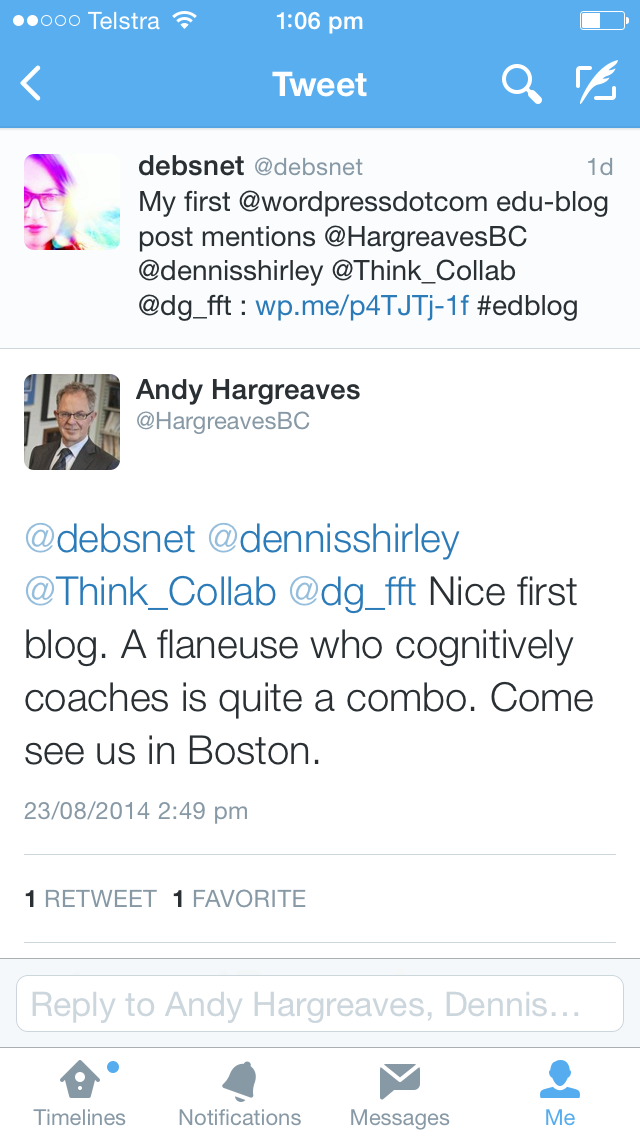
Imagine my delight when global school change titan Andy Hargreaves responded to my first (ever) blog post. Here was social media linking me to one of education’s thought leaders whose work shapes my classroom teaching, my school leadership practice and my PhD research.

In 2013, Kathryn Holmes, Greg Preston, Kylie Shaw and Rachel Buchanan published a paper which found that “Twitter is a valuable conduit for accessing new and relevant educational resources on the internet and also as a viable means of social support for like-minded educators. The cost effective nature of the microblogging platform ensures that it can act as a medium for sustained professional development, while leaving the individual participants to control and take ownership of the learning.” So Twitter can be socially and intellectually supportive, and it can facilitate and drive sustained engaged learning which is owned by the individual.

Jon Tait explains Twitter’s role as professional development platform in his blog post and has designed this infographic to summarise Twitter uses for teachers.

JonTait_TwitterTeacherInfographic

As I move for the first time from content curation to content creation (this being my second-ever blog post), the functions of the professional social media world and those who engage in it are a point of reflection.  Who will read my words and see my images? Who will interact with my thinking and add their own? How might social media support, connect and educate me?

Lucky (edu)fellow: beginnings of a flânerial professional trip

It’s time to bring the magic and wonder back into teaching. It’s time to recover the missionary spirit and deep moral purpose of engaging and inspiring all our students. It’s time to put down the spreadsheets and look to each other and elsewhere for how to get beyond the present turning point so we can transform our society and our schools. Hargreaves and Shirley, 2009

Two months til take off.

How does an Australian educator end up planning her way to New York City for a week, in search of insights into teacher learning, implementing teacher growth models in school contexts and using the Charlotte Danielson Framework for Teaching?

Because she is a lucky fellow.

I have been fortunate enough to receive a travelling fellowship from my Australian school in order to undertake an investigative series of visits to educators, school leaders, researchers and edu-experts in New York.

My meetings and visits cover one week in and around New York City. My week will be focused, as Hargreaves and Shirley suggest, on looking ‘to each other and elsewhere’ for learning and growth: my professional growth, teachers’ growth and the growth of my school’s professional learning culture.

Hargreaves and Shirley’s focus on the transformative ‘magic and wonder’ of teaching reflects my own fundamental beliefs about commitment to student learning. Our core business as teachers is enabling our students to find magic and wonder in the world around them, and empowering them to be thinkers, learners and leaders. As teachers, we should see teaching and learning as wonder-finding, wonder-generating and wonder-full.

The particular context for my upcoming professional trip is my school’s teacher growth initiative, which emerges from the widespread research-supported assertion that teacher quality is a crucial determinant in improving student achievement and learning.

Since 2012, I have been working with a diverse team of teachers at my school to design and pilot an idiosyncratic professional learning model intended to refine individual practice and capacity for self-reflection, appropriate to my school’s context. Another key aim of our model is the facilitation of a more passionate, reflective, purposeful community of professional learners in which individual teachers participate in ongoing communal activity to continuously develop the effectiveness of student learning by improving the quality of their teaching.

So, our aim has been to craft a process which is teacher-centred, teacher-directed and focused on teachers’ capacities for reflection and self-actualisation. We are using the Charlotte Danielson Framework for Teaching and a Cognitive Coaching model of coaching as the basis of our professional learning model. The Framework for Teaching (one of a number of maps for teacher practice, chosen because of its relevance to our specific context) gives us a common language for talking about our teaching, and a targeted specificity of focus for our reflections and conversations about evidence and practice. Cognitive Coaching is helping us to focus on growth rather than judgment, with our notion of ‘coaching’ being one of mediating the thinking of the teacher, rather than providing instructional feedback.

New York is the perfect place to refine our thinking as we continue to roll out our own model. The Danielson Framework for Teaching is one of those approved by the New York State Education Department as part of its implementation of the provisions of Education Law 3012-c regarding annual professional performance reviews (APPR) of classroom teachers and building principals. The New York City Department of Education (NYCDOE) has been implementing use of the Danielson Framework since June 2013, after three years of piloting and researching it in NYC schools.

During my time in New York, I am especially interested to see in what ways schools and districts have been implementing the Framework for Teaching; what might be success stories or lessons learned from their experiences so far; different approaches to school leadership in these kinds of initiatives; how data are collected and used to measure success; and any resources, references or contacts which might help my school, especially in its implementation stage, to begin in January 2015.

Can any educators out there share their experiences of current teacher growth or teacher evaluation systems?