Leading the use of research in schools

drummers

source: pixabay.com @skeeze

I recently had the pleasure of speaking with Dan Haesler on his podcast Habits of Leadership. You can listen to the 30 minute episode here.

We talked about using research in schools and about the importance of considering our own biases, limitations, assumptions and blind spots. We discussed how we might go about questioning these and being open to changing our minds.

We talked about teachers being extremely busy with their daily work. Teachers cannot be required to do the additional work of reading peer-reviewed scientific papers or sourcing expensive academic books. Some of us choose to do this, but it certainly should not be the expectation. Schools need to think of smart and accessible ways to engage teachers in research. I shared some of the initiatives at my school, such as my termly research report, our leadership forum, encouraging staff professional reading and our research-informed professional learning groups.

We talked about data, which is ubiquitous in schools. All data can tell us something, just like all research can tell us some things and not others. High stakes testing data is one data point worth reflecting on, but it is only one indicator. Teachers need time to collaborate meaningfully around a range of data if ‘data’ is to make a difference to teaching and learning. We talked about the importance of middle leaders and teacher leaders in this work of leading and improving teaching.

Even those types of evidence considered top tier ‘best evidence’ (randomised control trials systematic reviews and quasi-experimental studies) can only show schools what has worked (somewhere, for someone), not what works or what might work. Context remains queen. As I have written on the CEM (Centre for Evaluation and Monitoring) blog, schools need to ask questions of evidence such as: Where did the studied intervention work? For whom? Under what conditions? How many participants were in the study? From what school contexts? How were data generated? What were the ethical considerations and how were these dealt with?

We talked about leadership, including ways of leading that privilege the development of the group, rather than the celebration of the individual. In my view, when leading strategy or change in schools, we need to start with what we value (purpose and values), who we are (mission and identity) and where we want to be (strategic direction). Then we can consider how the best available evidence can help us make the best decisions for our context and community.

The artefacts of a school—such as policies and procedures—should align with the school’s purpose and beliefs. The norms of behaviour—‘how we do things around here’—should follow. It’s no good if the Senior Leadership Team is banging one drum and walking in one direction, if no-one is with them!

Leadership isn’t about a privileged few positional roles at the apex of an organisation. It is about a nourishing ecosystem of leading and learning. In The Fifth Discipline, Peter Senge writes that “the bad leader is he who the people despise; the good leader is he who the people praise” but that “the great leader is he who the people say, ‘We did it ourselves.’” For me this reflects that leadership is at its core about:

  • believing in and building the capacity of those in our schools;
  • building cultures of trust where staff are simultaneously supported and challenged;
  • resourcing and supporting meaningful, productive (sometimes uncomfortable) collaboration; and
  • developing consistent, systematic, ethical protocols for evidence use and decision making.

Book cover design for ‘Transformational Professional Learning’

Netolicky BOOK COVER

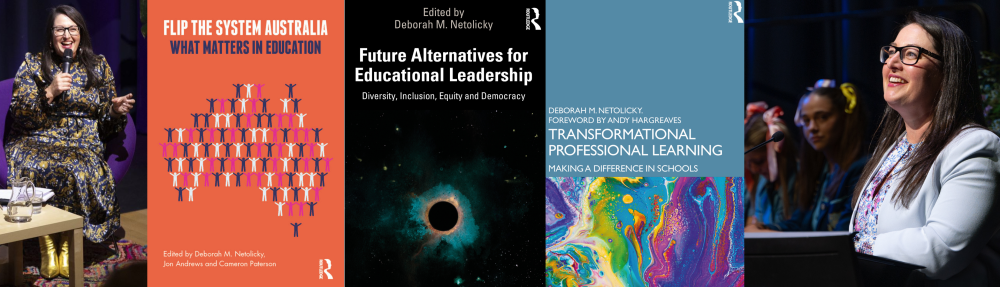
My book Transformational Professional Learning: Making a Difference in Schools has a cover design!

For me, the image on the cover speaks to transformation, collaboration, the interaction between the individual and the organisation, the fluidity of identities, the complexity of learning, the non-linearity of growth, and the humanity of education.

It is available for pre-order from the hyperlink above (due for release on 20 September), where you can also read the table of contents and the book’s first reviews.

It is also available for pre-order–in paperback, hard back and eBook versions–from other online booksellers like bookdepository and Amazon.

My editor and I have worked with the publisher to reduce the price of the book from AUD$60 to the more teacher friendly AUD$39.99 (already reduced further by some sites), although some sellers don’t yet have the updated price.

Education is not broken. Teachers do not need fixing.

abandoned chairs

source: @MichaelGaida on pixabay

This week, New South Wales MP Mark Latham, of the Australian One Nation party, discussed the One Nation NSW education policy. The policy uses language like “embarrassing” to describe Australia’s performance on PISA testing, as well as constructing teachers as “substandard” and “underperforming”, arguing that many should be reported and “removed”. It states that “what gets measures [sic] gets done”. It advocates for introducing performance-based pay for teachers, based on measuring teacher performance; “for example, testing a class at the beginning and end of the year and assessing the improvement (or regression) in results over the 10-month period.” Of course, measuring so-called teacher effectiveness is notoriously unreliable and a teacher’s influence on the students in their care is multifaceted. Check out the Twitter hashtag #OurWorkCannotBeMeasured through which teachers describe student progress or teacher work that cannot be quantified through an oversimplified performance measure.

On Thursday, as a result of an article I wrote for The Conversation back in 2016 on performance pay for teachers, I was invited to comment on ABC New South Wales radio about Mr Latham’s proposal. I explained during the interview that performance pay for teachers has no evidence for improving student achievement. Rather, merit-based pay is damaging. It creates toxic cultures of fear, isolation and competition. It leads to reduced collegiality and collaboration, less innovation, exacerbated wellbeing issues and the dehumanisation of teachers and students to data points.

During the interview I was asked, “What will fix all these problems we have in our education system?” My response was that “while there are issues, part of the problem is this notion that the education system needs fixing, that the system is broken, that schools and teachers are failing and we need to fix them. We have excellent teachers doing incredible work in our schools. Part of what is going to help the system is trusting teachers to do their jobs and providing trust, support, resourcing and time, instead of punishments, rewards and accusations.”

The experience of this brief radio interview—squeezed into the school day in between lessons and meetings in the last week of Term 2—led me to reflect on themes in my upcoming book. Titled Transformational professional learning: Making a difference in schools, it includes chapters on collaboration, mentoring, coaching, self-directed learning, professional standards and leadership for professional learning.

When people ask me what my book is about I say, “professional learning for teachers and school leaders” (usually followed by a tongue-in-cheek “it’s a real page-turner”). It is about that, but it is also about significantly more.

My book is about trusting and supporting the profession through meaningful opportunities to grow. It is about why, how and on what education stakeholders can best spend time, money and resources, for positive outcomes. It is about treating those working in schools as professionals who are experts in their work but who can always improve, not because they are deficient, but because their work is complex and entangled with identities, relationships, society and humanity. It is about policy that takes the long view rather than aiming for quick wins, and about leadership that empowers rather than inspects or punishes.

It is about nurturing collaboration and collegiality, over surveillance and isolation. It is about those things that systems and organisations can do to develop the capacity of those within the system. It is about how to build productive organisational cultures that simultaneously value, honour and sustain each individual and the group as a whole. It is about meaningfully considering workload and wellbeing, so that teachers and school leaders can best serve their students and communities without sacrificing themselves, burning out or taking shortcuts to stay afloat. These themes are relevant to other organisations and systems, too, not just to education.

When I reflect on my upcoming book, one of its central messages is this:

Education is not broken. Teachers do not need fixing. There is outstanding work going on every day in schools around Australia and the world. We should focus on trusting and empowering the teaching profession.

Sharing research in schools through a Research Report

‘The research says’ is often an empty statement used as a basis for an argument for a particular education reform, approach or product. I encourage teachers to ask: What research? Whose interests are served by this claim? Where did the studied intervention work? For whom? Under what conditions? How many participants were in the study? From what school contexts? How were data generated? What were the ethical considerations and how were these dealt with? How relevant is this to our context?

Dylan Wiliam has recently noted in a TES article that:

“classrooms are just too complicated for research ever to tell teachers what to do. Teachers need to know about research, to be sure, so that they can make smarter decisions about where to invest their time, but teachers, and school leaders need to become critical consumers of research – using research evidence where it is available and relevant, but also recognising that there are many things teachers need to make decisions about where there is no research evidence, and also realising that sometimes the research that is available may not be applicable in a particular context…. Evidence is important, of course, but what is more important is that we need to build teacher expertise and professionalism so that teachers can make better judgments about when, and how, to use research.”

I agree that teachers and school leaders need to become critical consumers of research. A number of us additionally participate in research degrees. While research can inform our decision making in classrooms and schools, the teaching profession is a profession of experts, who should be trusted to serve their students and respected for their expertise. Teachers can and should engage with research.

There are a number of ways via which schools can engage in research. I have written on this blog and in my upcoming book about what I call the ‘Research Report’ at my school. I introduced this Report in 2017 as one approach to developing a research culture in a school. It is a document that I regularly publish to the whole staff. This involves everyone—including administration and operations—in our core purpose of education. It illuminates current debates, incites corridor discussion about teaching, and provides bite-size, user-friendly resources for busy teachers and school leaders. I love getting bailed up by a member of the administration team, finance department, executive or teaching staff for a discussion about one of the references from the Report.

The Report is not a place for only long reads or complex academic papers, although these are included when relevant. Often, the research I share is easily accessible via links, and sometimes via podcasts and videos. The report is not a panacea or an echo chamber; I include controversial and sometimes conflicting resources to spark thinking and encourage dialogue.

My Research Report is one small attempt–among a suite of protocols, practices and collaborative structures–to engage staff with research findings, and with systematic and scientific ways of thinking. It is a cogitation and conversation starter, intended to develop a rich and robust professional culture.

While I began in 2017 with two reports per term, I found that this was too much for staff, so now each term I populate one Report that includes three Report sections with around three resources each. Foci are based around strategic priorities and/or current issues. For instance, to align with NAIDOC week, this term’s report included a section on intercultural understanding. I use PowerPoint to collate these together and publish ‘teaser’ quotes for each resource.

I have had some people ask me what these Research Reports look like, so below I have included an example slide deck with snippets of previous Reports. Let me know if it’s of use, or if your school does something similar.

This slideshow requires JavaScript.

Success indicators of a professional learning model

source: pixabay @djoanis

For many years, my school has been developing and fine-tuning our internal professional learning processes based on a foundation of trust in our staff and a belief that school and staff can support one another to grow together in ways that are meaningful and have profound positive impacts on individuals and community.

In 2018 we launched a choice-based set of pathways for staff professional learning, moving away from a linear, chronological cycle of mandated processes for staff development. Rather than being assigned, these pathways, differentiated for teachers and leaders at various levels (and outlined in this previous post), are decided through negotiation between each staff member and their line manager, as part of the annual reflection, goal setting and development conversation. These school-based options provide a flexible suite of alternatives that honour where our staff are at in their career journeys, and provide meaningful and research-supported ways for them to develop as teachers and leaders.

The process of setting goals, planning related actions and choosing an internal organisation-embedded professional learning pathway, is done in a cascading fashion from the beginning of each year. The school executive set the school goals and actions; then leaders set their own team and self goals, actions and pathways; then teachers set their own development goals and negotiate a pathway. In this way, individual goals are aligned within the framework of school strategic direction and priorities. The process also includes a reflection against the AITSL professional standards for teachers or principals, as appropriate to person and role.

I have been reflecting lately on measures of success of this model. How might we know that our approach to internal professional learning is having a positive impact? As part of the model’s implementation, we generate ongoing honest feedback from staff in order to refine the model each year, including via focus groups and anonymous surveys. For instance, in the annual staff survey, the pathway options, especially the Professional Learning Groups, were rated highly by staff. Additionally, our staff satisfaction with professional learning is above the national benchmark.

Lately I have been interested to see some unexpected measures of the success of this model come to light.

Firstly, in this second year of implementation, staff have been owning and advocating for their negotiated pathway. For instance, some staff were told that due to logistics, numbers or staff leave arrangements, their chosen option would not be viable. In these cases, staff have fought hard to maintain their choice, including planning alternate timelines and strategies for the pathway to be completed. They have been arguing the reasons for their choice, why it is meaningful to them, and how they can make it work in robust ways. We have had some people negotiating to be coached or mentored by particular staff with clear reasons as to why this is a meaningful partnership, and outlining the rigorous work they completed ahead of the pathways’ official start date. So not only have staff chosen options about which they are passionate, but they have begun the work of their chosen option ahead of time because of their belief in the value of its contribution to their professional growth.

Secondly, staff have been opting in to extra options on top of the required single choice. A number of staff have chosen to participate, for instance, in a Professional Learning Group on top of another process. This shows the value staff see in these collaborative groups that bring staff from across the school together to share thinking and practice around common interests and strategic priorities.

A number of staff are involved in the model as both participant themselves, and as a key actor in the learning of others. The model is leaking out to be owned and run by a range of staff who are acting as mentors, coaches and leaders of initiatives. This year I still oversee the Professional Learning Groups but am no longer running all of them; other staff are leading in their areas of interest, expertise and strategic priority. They are doing a wonderful job of breathing their own individual approaches to these groups, which are almost all oversubscribed.

Another measure of success of the overarching process is the explicit and reflective connection I am now seeing between applications for external professional learning and a person’s goals. The goal setting that happens at the beginning of the year has ongoing knock-on effects, including influencing the intentionality of staff professional development. Staff are clear about how their professional learning builds upon school strategy, team goals and their own personal goals, and they are active in seeking relevant professional learning opportunities.

It’s interesting to see the unexpected ways in which a change like our negotiated professional learning pathways model can influence professional culture, conversation and ‘the way we do things around here’. The COVA—choice, ownership, voice and authenticity—principles have resulted in increased staff engagement in and ownership of their internal professional learning, as well as connecting staff from disparate areas of the school. It reminds me of a participant quote from my PhD about the non-linear, surprising impacts of change: “it’s like oil in water”, fluid, unexpected and marvellous to watch.


Post script: I’m excited to be able to share more about this and other experiences in my upcoming book, available for pre-order from the publisher and all good booksellers: Transformational Professional Learning: Making a Difference in Schools.

Future of Schooling Policy: VIDEO

Last Tuesday I was part of a panel on the future of schooling policy (i.e. education policy that affects schools and schooling experiences of young people) at the University of Western Australia’s Public Policy Institute. The video is embedded above.

Some points I make (when I start speaking at around 23.30):

  • Those who work in schools should be part of education and policy conversations.
  • Education is full of polarising discourses. For instance, the inspiring hero teacher vs. the teacher failing their students and schools blamed for a gamut of social problems. Knowledge vs. skills and capabilities. Increasing control vs. autonomy of schools and principals.
  • Our educators are committed people doing outstanding work.
  • School leaders are responsible for navigating the tensions between policy expectations and accountability measures, and meeting the very human needs of their communities.
  • NAPLAN is one data point but this data is not necessarily valid for school comparison.
  • Measuring school and school leader success via standardised testing makes them high stakes and encourages gaming the system rather than the education of students and the support of staff.
  • Wellbeing and workload of those working in our schools, including teachers and leaders, is of concern.

During the question time, I comment that:

  • An overemphasis on testing comparison and metrics of measurement can oversimplify education.
  • Teacher quality is an important in-school factor that influences student learning, but there are other more influential factors such as socio-economic status, parents’ education and early reading.
  • Digital nativity does not equate to digital literacy. Considering technology in schools should be based on first considering purpose, tools fit for purpose, equity of access and teaching students to be savvy, responsible users.
  • The proliferation of information and resources on the internet, adaptive learning technologies, and does not do away with the need for teachers.

Happy watching!

How to #BalanceforBetter this International Women’s Day?

IWD2019

I realise that this year’s International Women’s Day theme #BalanceforBetter is focused on advocating for more gender balance for a better world. It’s about more women as leaders, on boards, and in STEM. It’s about closing the gender pay gap and accelerating gender equity.

But I keep seeing the #BalanceforBetter hashtag and thinking about my personal battles with ‘balance’ as a woman. I have over the last 12-18 months been working on the notion of balance in my life. Redressing the balance towards self-care, wellbeing, health and mental space, factors that have been crowded out by busyness, work, commitment to family, wanting to make a difference. I have written about trying to say ‘no’ to more things and to prioritise what matters.

I’ve been writing a book as part of my push to be ‘10% braver’ as the #WomenEd squad would say. Two other projects are examples of my advocacy for women; as co-editor of the recently-published book Flip the System Australia: What matters in education, we ensured that more than half of the chapters were contributed to by women authors, and I have co-edited a special issue of the Journal of Educational Administration and History in which we offer female-authored papers on re-imagining school leadership. I’ve been lifting heavy weights to feel physically stronger and floating in floatation tanks to feel mentally lighter. I know this is a first-world take on the notion of ‘balance’. I’m in a privileged enough position that I can consider my writing, wellbeing, family and leisure time. I have choices available to me, which is not the case for all women.

This week I saw the following sculpture at Perth’s Cottesloe beach as part of the Sculpture by the Sea exhibition.

1E6A3477

It is by Hamish McMillan and is called ‘Internment’. The wire figure interned within the cage slumps over his desk, met by the words, ‘Nice work, Jeff!’ on his computer screen. He is surrounded by boxes with messages of those things perpetuating his imprisonment in a toxic work culture: “obligation to colleagues”, “I make a difference”, “credit card due”, “mortgage due”, “failure is not an option”. How many of us are chained to our devices or caged within our work worlds because of obligation, inspiration, ambition, bills to pay, or the desire to make a difference? At what cost? Is it being a ‘bad feminist’ if a woman does not aspire to a powerful, well-paid management position? Or is it just making good choices that suit us, even if it does nothing to balance gender roles at the highest levels of the workforce? Three female politicians have recently left the Australian Liberal Party. Sticking it out in an unsatisfying, harmful or misogynistic work environment may not be worth the power, pay and prestige it provides.

In my field of education, the longitudinal Australian Principal Occupational Health, Safety and Wellbeing Survey of principals and deputy principals has found that in these top school roles, a disproportionate number of women are consistently paid less than their male colleagues. It also found that physical violence towards principals and deputy principals is now 37% or 1 in 3 principals (9.3 times the rate of the general population). Women are most at risk with 40% experiencing violence compared to 32% of men. So women principals and deputy principals in Australia are more likely to be paid less and also more likely to experience physical violence in their work than their male counterparts. This survey also reveals worrying trends in work hours, mental wellbeing and physical health for principals and deputy principals, something that dissuades potential candidates, particularly women, from aspiring to and applying for these roles.

Those who lead organisations or who stand on the stage normalise ideas about who can lead, who should speak and to whom we should apparently listen. Often in leadership roles, keynote presentations and film, advertising or media representations of leadership, women are under-represented. So what can we do to #BalanceforBetter?

Organisations can consider how to advance women in their ranks, including into top jobs, governance positions and roles traditionally held by men. Conference organisers, event planners and awards panels can continue to work on broadening the diversity of those who present, sit on panels (no manels, please!) and receive awards. The media can stop asking women how they cope with juggling work with family, while not asking the same of men. Colleagues can refuse to tolerate off-hand remarks that are sexist or demeaning to women, even when masked as ‘jokes’. Men can question those things they take for granted or see as normal, that perhaps work in their favour, but do not benefit the women around them. Researchers can consider the diversity of their citation practices. Women can consider how to equalise and advocate for gender balance in their organisations, and also how to find a sense of balance and wellbeing in our own lives. We can all take positive, even micro, actions towards more balance.

Building trust in schools: A long game

source: pixabay @geralt

“Good schools are intrinsically social enterprises that depend heavily on cooperative endeavours among the varied participants who comprise the school community. Relational trust constitutes the connective tissue that binds these individuals together around advancing the welfare of children.”

Bryk & Schneider, 2002, p. 144

As the new school year begins in Australia, I have been reflecting on our staff days, on future professional learning and staff development, and on how the work we have done in this space has, over time, been shifting the culture of the school. In this post I describe some of the actions take over recent years towards a professional culture of growth, collaboration and trust.

As a school we have been clear in our goals for professional culture: that we are about growth and development, not deficit. We are about expecting and supporting our excellent staff to be better, not policing or fixing them. Each of us works to improve what we do, because no matter how good we are, we can always be better. Each member of our staff has the right and responsibility to develop professionally, and the school has the responsibility to support the development of our staff as professionals through ongoing professional learning. We know that teaching, and teacher professional learning done right, can improve student achievement. Our internal processes of professional learning and collaboration are important because we know that immersive, sustained and collaborative professional learning is more likely to have a positive, ongoing impact than one-off experiences.

Between 2012 and 2014, we researched, planned, piloted and refined a coaching model and trained all coaches and leaders in Cognitive Coaching. We used the Danielson Framework as a tool for teacher reflection on low-inference lesson data. In 2015 and 2016 we implemented and bedded down the coaching model across the school.

Since the implementation of the coaching model, we continue to work persistently on the underpinning philosophy, norms and protocols for professional conversations, shaping our organisation’s semantic space, or ‘how we talk around here’. We continue to iterate the ways in which professional learning happens within the school, in addition to supporting staff to pursue external professional development opportunities.

In 2017 I wrote a new professional learning policy and launched a refreshed professional learning application form in order to make clear the principles, practices, staff expectations and decision-making frame for professional learning for teaching staff. I worked to build a research culture. Coaching of teachers by trained coaches continued. Coaching and mentoring of leaders by senior leaders was trialed. A teacher mentor role was introduced that provides a more directed and consultative alternative to working with a coach. We have found our teacher mentors are appreciated by new graduates and by those staff wanting to work closely with an experienced, expert colleague on an element of their teaching practice. New leaders continued to be trained in Cognitive Coaching. Some leaders additionally completed Crucial Conversations and Crucial Accountability courses on having difficult or performance management conversations. We introduced a once-per-term leadership forum, an evening event during which all school leaders have the opportunity to come together around leadership. These forums have involved sharing the expertise of those leaders within our school and also external experts such as Dylan Wiliam, Pasi Sahlberg, Eric Sheninger, Professor Christian van Nieuwerburgh and school principals.

In 2018 we made a few more changes in response to the needs of our staff. We introduced GROWTH coaching training for coaches and leaders, especially to facilitate goal-setting conversations between managers and direct reports. This has spilled over into staff coaching one another informally, and in teachers and pastoral leaders using GROWTH coaching for student goal setting in subject and pastoral arenas. We moved away from a linear, chronological cycle of mandated internal professional learning processes and introduced negotiated internal professional learning pathways for teachers and for leaders. These allow for differentiation, voice and choice for our staff, acknowledging them as capable, self-reflective adult learners who know their own needs. This included the addition of professional learning groups around common areas of interest. It also included an internally designed and run leadership development program for new and aspirant leaders.

This year we are continuing to refine what we do for staff learning and culture, based on data. Senior leadership constantly seeks feedback—through both anonymous surveys and open conversations or focus groups—in order to iterate what we do to better serve the staff, students, and parents of the school.

Over these years as I have led the coaching model and professional learning at the school, I have noticed incremental shifts in culture. Coaching language and behaviours have seeped into daily conversations. Staff are increasingly willing to give honest and critical feedback, including to management, with a view that their views will be listened to, taken seriously and used to inform decision making. People have more tools for having tricky, sensitive or uncomfortable conversations. They are more often–gently and respectfully–holding their peers or their direct reports to account.

Collaboration and productive work doesn’t happen because we are a bunch of people in a room or a school together. We don’t do our best collaborative work when we are all getting along. High functioning organisational cultures have high levels of support for their people, but also high levels of challenge. They also have clear roles, expectations and norms. There is a sense of collegiality, shared purpose and shared identity, but also a willingness to work through honest feedback, respectful dissent and graceful disagreement. As I look back and look forward to the work we have done at my school, and continue to do, it is about incrementally moving the culture forward to one of increasing trust, productive collaboration, and a place of balance where all members of the community are at once respected, honoured, supported individuals, and an integrated, valued part of something bigger than themselves. Building trust in schools is a long game, and one in which the outcomes are slippery and hard to quantify. But it’s worthwhile and rewarding.

References

Bryk, A. S., & Schneider, B. (2002). Trust in schools: A core resource for improvement. New York: Russel Sage.

Flip the System Australia: Book club questions

Steven Kolber and others on Twitter have been discussing the possibility of a Twitter book club around the recently published (and excellent!) education book Flip the System Australia: What matters in education. Based in the unique Australian context, this book situates Australian education policy, research and practice within the international education narrative. It argues that professionals within schools should be supported, empowered and welcomed into policy discourse, not dictated to by top-down bureaucracy. It advocates for a flipping, flattening and democratising of the education system, in Australia and around the world. It brings together the voices of teachers, school leaders and scholars in order to offer diverse perspectives, important challenges and hopeful alternatives to the current education system.

As one of the editors, and author of Chapter 1, below  I share a first pass at some possible questions for readers, based around the sections of the book. My co-editors and the book’s various authors may have additional or alternative ideas.

Foreword and Introduction

  • What do you understand the editors to mean by the term ‘flip the system’? How is this relevant to education? Does the phrase connect with you, or would you describe it in a different way?
  • Why do you think this book might be important? What might Australia have to offer the education world?
  • What do you hope to get out of reading the book?

Part I: Teacher identity, voice and autonomy

  • How do the authors in this section focus on what matters, rather than what works? What does matter in education?
  • What comments do the authors make about commercialisation in education? Do these resonate with your own experience?
  • Why and where might teachers voices be shared? Do you think this is important and even possible? Why / why not?

Part II: Collaborative expertise

  • What kinds of collaboration do the authors present as effective and beneficial? Why is collaborative expertise something worth investing in and pursuing?
  • What warnings do the authors offer around collaboration in education? What differentiates good, productive collaboration from toxic or ineffective collaboration?
  • What is the role of wellbeing in collaboration between teachers, school leaders, schools and education systems?

Part III: Social justice

  • To what systemic inequities do the authors refer? Which of these reflect your own experience?
  • What is the role of voices and stories, versus policies and systems, in democratising education and addressing inequity? In what arenas could and should equity in education be addressed?
  • What are teachers, schools and systems already doing? What could they stop doing and what could they start doing to address social justice issues in education?

Part IV: Professional learning

  • What is the role of professional learning in a flipped education system? Why is it important?
  • How do the authors describe effective professional learning? How does this sit with your own experience of professional learning for educators?
  • What seem to be the necessary conditions for professional learning to be effective and make a difference? What points made by the authors should be considered by school and system leaders?

Part V: Leadership

  • What are the tensions and complex demands of school leadership, as described by the authors?
  • What do the authors of this section suggest as ways to effectively lead in schools and education systems? On what should leaders focus? What should they do and what should they avoid doing?
  • Do the authors in this section agree, or are there conflicting accounts of what is important in school leadership? What does this reveal about the complexities of leadership in education?

Conclusion

  • This is a book that shares diverse perspectives from a range of authors from a multiplicity of contexts. What threads and themes did you notice as you read the book? What draws the book’s contributions together? What differences did you notice?
  • What quote stuck with you from one of the chapters? Whose chapter stood out to you, spoke to you, or surprised you?
  • What is your overall response to the book? How are you left feeling?
  • What do you now understand the phrase ‘flip the system’ to mean? How might you flip the system in your own education context?