Workload and anxiety

grass tree panorama

grass tree panorama

I have tonight breezed in the door to home with dirt caked in my nostrils and shoes, smelling of sweat and the Australian bush, utterly dishevelled after five days of Year 9 camp. Going on camp was important; it was an opportunity for me to get to know more closely my pastoral group, the class I’ll be travelling with on their high school journey for the next four years.

The group built cohesion and relationships across the week. Individuals and the team were challenged by everything from expedition hiking, camping, eating and toileting, to abseiling over cliff faces into caves, surfing big Margaret River swell, and completing a high ropes course.

I recognise the significance of the week of camping for my students, while simultaneously trying to quell the rising panic that comes from a week away, ‘out of the office’. Not only was it a lot of work to prepare to be away—planning a week’s worth of lessons and resources, shopping and packing for camp, making sure the things required for our house sale-and-purchase were in order before I left, getting through the Famous Five novel I’ve been reading with my kids—but I’m returning to being (at least) a week behind my work.

Yes, lessons will have been taught while I’ve been away, but the double pile of marking I left behind wasn’t marked by marking fairies while I was away (darn those marking fairies; never there for you when you really need them!). Deadlines remain as they were, despite me being unable to make progress for a week (although I did take a notebook on which to scribble ideas). I feel in debit with my family, like I need to spend extra time with my kids and husband, like I somehow owe ‘extra’ because I left them for five days.

So I am feeling behind in my work and behind at home. I am pulled between the tension of wanting to do the right thing at home by immersing myself in time with my family; to do the right thing by work by catching up on marking, policy-writing and strategic project implementation plans; and to do the right thing by myself by painting my chipped toenails, exercising my aching body and finding time for solitude and seeing friends.

Workload and homeload as a working parent are always a tricky balance that can easily tip on their delicate axes. While I currently feel sucked into a vortex of mild anxiety, I know rationally that I will catch up. Sometime, I will catch up. In the meantime, I’ll breathe, do my best with the time I have available, and remember some of the stunning vistas I enjoyed while on camp in the West Aussie great outdoors.

my home for the week

my home for the week

Redgate Beach

Redgate Beach

abseiling into Brides Cave

abseiling into Brides Cave

Karri forrest

Why selling a house is like finishing a doctorate

Sold! Now what?

Sold! Now what?

This week my husband and I sold our house and bought another one, so it’s been a week filled with terrifying leaps of faith, trembling uncertainty, and dizzying highs that have involved actual whooping and jumping up and down. During this selling-buying-a-home experience, I was viscerally reminded of what it feels like at the end stages of a PhD.

Firstly, no matter how much work you have put in to getting your home ready for sale (or getting your PhD ready for examination), you don’t know how it’s going to go in the marketplace (or examiners’ eyes). There’s nail-biting insecurity that you won’t get the result you want. The waiting is insomnia-inducing. What if there is a low offer or no offer (a major revisions or a revise and resubmit)?

Secondly, there is no clear ending to the process, and no clear-cut moment to celebrate. We put our house on the market in January, like submitting a PhD to examiners, and then we have waited for results to come in. On Sunday night we received an offer, but it didn’t seem time to open the champagne. Nor did it the next night when we accepted that offer. Yes, we had sold our house, but celebrating the possibility of being without a home for our family didn’t seem appropriate. We put an offer on another house, but until it was accepted we didn’t feel we could celebrate. Even then (and we did celebrate) we are still faced with small milestones to complete and dominoes to fall, before we know that both sales are unconditional (finance, inspections, settlement).

Similarly, the end of the PhD seems to go on and on. There’s thesis submission. There’s the waiting game for examiners’ reports. Often, there’re the revisions. There is acceptance of those corrections and conferral of the degree and the title of ‘Doctor’ (which for me, was marked by having just presented at the AERA conference in DC). The printing of the bound PhD thesis that will luxuriate on the library shelf. The rollercoaster of completion emotions. There is graduation. Then there’s the first aeroplane boarding pass with ‘Dr’ on it, and the first post-graduation event when you get to wear the floppy hat and doctoral robes. There’s even the identity tussle as you come to terms with your doctorness, just as I’m sure my husband and I will need to transition from our current home, which we love and in which we have raised two young boys, to a new home which offers up the stage for the next chapter in our story.

It was interesting for me to note the way that an unrelated life event could bring my memories of the tail end of my PhD rushing back so vividly. Perhaps some of life’s most rewarding experiences are those which test our mental toughness, give us sleepless nights, and which don’t have clear cut endings.

Teaching and leading schools in a #posttruth word of #altfacts

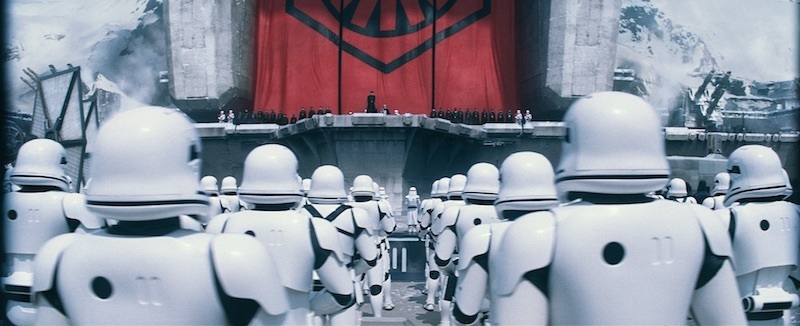
General Hux's speech in The Force Awakens (reddit.com)

General Hux’s speech in The Force Awakens (source – reddit.com)

Post-truth: relating to or denoting circumstances in which objective facts are less influential in shaping public opinion than appeals to emotion and personal belief. ~ Oxford Dictionary

To my continued astonishment, we are living in a post-truth world. ‘Post-truth’ was the Oxford Dictionary’s 2016 word of the year. The Trump administration in its first week seemed to impersonate the Star Wars totalitarian First Order when it claimed that it was not lying but providing the public with ‘alternative facts’. Then, gag orders were placed on a number of government agencies, including the Department of Agriculture, the Environmental Protection Agency and the Department of Health and Human Services. (Hurrah for whoever tweeted rebelliously about inauguration crowds and climate change from the National Parks Service ‘Badlands National Park’ account.) 

For a Western government to blatantly deny reality is at once baffling and terrifying. Hello, propaganda. Hello, the invocation of untruths (sorry, ‘alternative facts’) to smother any unfavourable actuality.

We shouldn’t be surprised. The misuse and abuse of language and facts is something that dystopian and speculative fiction has been warning of for decades, and something that history tells us has the ability to tap into the hive mind and rally societies around a common, often chilling, cause or leader. 

In this post I’ll explore the notion of a post-truth world of alternative facts and empty emotive rhetoric, around two arenas in my own life: teaching English and Literature, and my new role at my school, which encompasses in part engagement with research across the school.

First, to teaching in a post-truth world …

With the school year beginning next week, my Year 12 English team are finalising the texts to be taught and studied this Australian academic year. We’ve been tossing up between two contemporary texts about modern issues like gender, sporting culture and bullying, but every day the news and my social media feed give me a nagging feeling, a tugging at my literary shirt sleeve, a whisper to pause, take stock, listen. And dig out a dystopian classic.

Last year we taught the 12s Fahrenheit 451, a text that portrays books as dangerous threats to government control and societal compliance. This year perhaps we should teach Orwell’s 1984. Its Ministry of Truth, that falsifies historical events, and Newspeak, a language that restricts freedom of thought, are more relevant than ever. In fact, Orwell’s novel has this week rocketed to number 1 on the Amazon best sellers list.

A more recent text also comes to mind. Lionel Shriver’s 2016 The Mandibles, set between 2029 and 2047, is an economic dystopia that imagines the USA’s collapse. In her novel, the bungling US government has little respect for its citizens. First world problems like gluten intolerance disappear as violence and poverty rise. It is Mexico that builds an electrified, computerised, constantly-surveyed fence to keep desperate Americans illegals out.

Of course as a teacher of English and Literature I teach versions of reality and multiplicity of perspectives, but that plurality doesn’t stretch to bald-faced lies for the purposes of propaganda, banning scientists from speaking, or removing language like ‘climate change’ from government policy and websites. Language matters. It shapes thought. It wields power. It’s our job as teachers to elevate our students’ capacities to engage critically with their world. To be sceptical consumers of what they see, hear and read, and to be empowered to use language as an agentic tool.

Next, to school leadership in a world of alternative facts …

I am also coming to terms with how schools might respond to this post-truth world. This is especially relevant to me as I have just begun a new role at my school (new to me and new to the school). It is a senior leadership role that encompasses the use of evidence and research to make informed decisions from the classroom to the boardroom, as well to underpin and frame pedagogy, professional learning, performance review processes and capacity building across the organisation.

In this paper published online on 18 January, Brown and Greany (2017, p.1)—thanks to Gary Jones, whose blog is a great resource in this space, for sharing it—write:

Educational evidence rarely translates into simple, linear changes in practice in the ways that what-works advocates might hope. Instead, … evidence must be combined with practitioner expertise to create new knowledge which improves decision making and enriches practice so that, ultimately, children’s learning is enhanced.

This focus on what Brown and Greany call ‘what matters’ as well as ‘what works’ resonates with me. As Jon Andrews (channelling Marilyn Cochran-Smith) reminds us, teaching is unforgivingly complex. If we schools and educators are to really engage with research, then we need to honour our own contexts and value our own wisdom of practice. Teachers and schools can and should engage with research. I’m grateful that my school is able to create a role like mine in order to elevate evidence and research, execute research initiatives, and further embed scientific thinking and data analytics into the fabric of the school a culture. I’m grateful that there are schools around the world bringing evidence, mindfulness and crticiality to their decision making and pedagogy.

In a post-truth world, how do we balance a respect for truth, evidence and reason, with an honouring of plurality, multiplicity and praxis? How might we use literature or research as vehicles for respecting perspectives, while exploring challenges and possibilities?

Anchoring, coping, organising: Post-It power

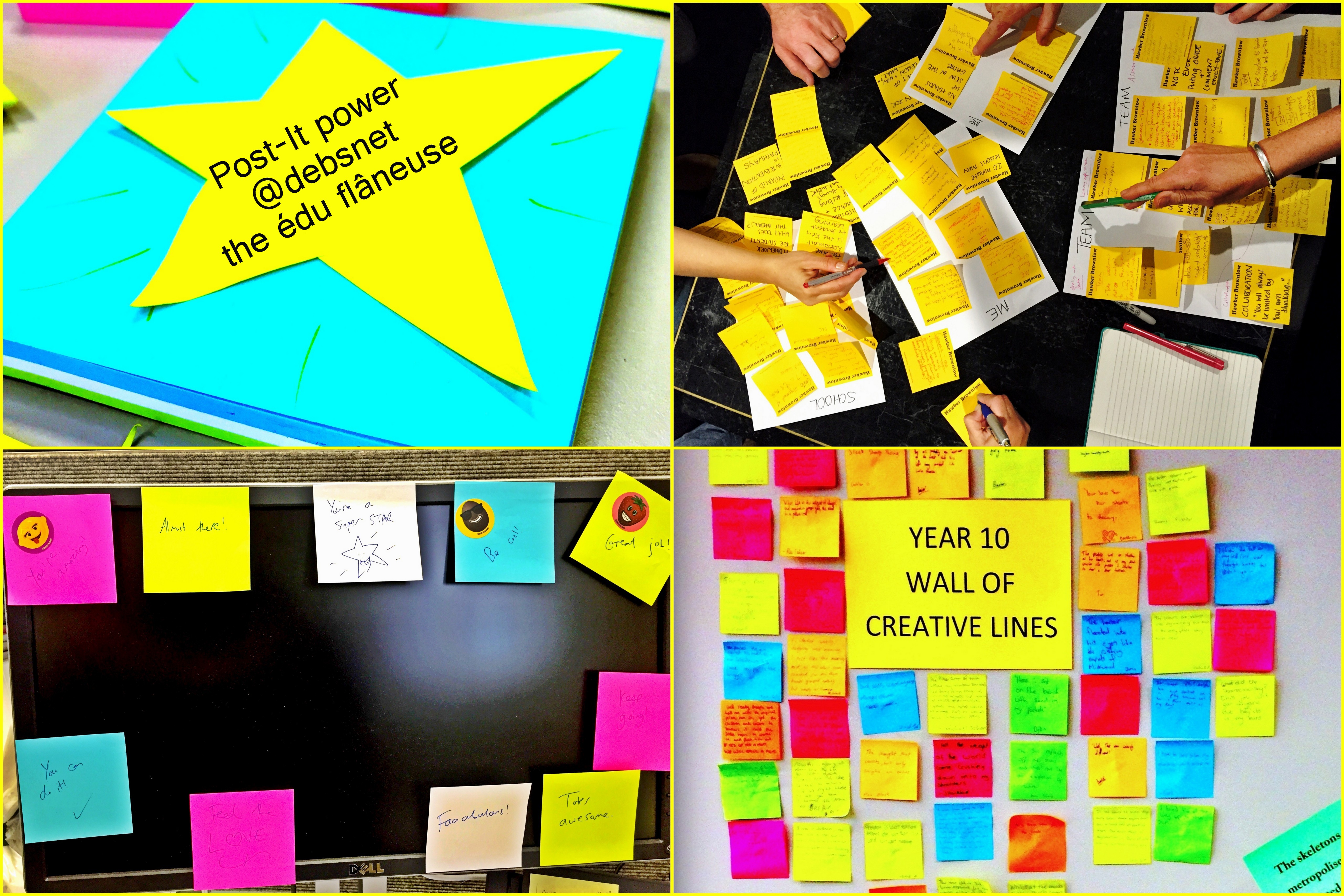
some of my Post-It moments

some of my Post-It moments

Great results, can be achieved with small forces. ~ Sun Tsu, The Art of War

Sometimes when it all seems too much, we need to distil all-the-things down to their essence. We need to simplify, to find a tangible anchor for the chaos of change or a reassuring system to help us bear the weight of pressure.

1940s Hungarian communist leader Mátyás Rákosi coined the term szalámitaktika or ‘salami tactics’. In order to gradually amass power, little bit by little bit, the idea is to attack a huge goal one tiny and deliberate slice at a time. When applied to big tasks or bold goals, szalámitaktika reflects the cliched saying ‘How do you eat an elephant? One bite at a time.’ It’s also reminiscent of Bill Murray’s title character in the 1991 film What About Bob? whose therapist prescribes him ‘baby steps’ to help him get through his day by focusing on literally putting one foot in front of the other. These simple approaches helped me to trudge my way through the work of a PhD. One step, one bite, one slice at a time.

At the moment educators in Australia are coming towards the end of our school year. Many of us dream that this is the time of year that we wind down, gently relaxing towards the summer holidays in a slow-motion dance of joyful teaching and leisurely planning for the next school year. Insert cocktail-drink-with-umbrella emoji.

The reality is that this time of year, for many of us, is manic, overwhelming and crushing in its pace and pressure. My way of dealing with the current mania is by tackling my to-do-lists with military precision and the salami-tactics baby-steps approach. My main arsenal in this operation? Trello? Spreadsheets? A wall of IdeaPaint scrawled with notes? No. It’s a stack of Post-Its.

The humble Post-It, an accidental invention born from a failed adhesive, has potent power. When Steve Jobs died in 2011, around the world people posted Post-It note messages on the windows of Apple Stores around the world. The Apple Store in Munich created a mural of Jobs’ face out of 4001 Post-Its. This month, these jewel-like beacons have been used in Subway Therapy in Manhattan, a post-US-election project incited by artist Matthew Chavez. Chavez set up a tunnel in the NYC Subway as a public art space onto which anyone could post their messages of support, optimism or hopelessness.

Post-Its can be used for collaboration. I’ve enjoyed getting staff or students to use them to draw together and reorganise ideas. Post-Its can be used for annotation, communication, display, feedback, personal notes and even for delight. Last year, a colleague was having a rough week. I took multi-coloured packets of Post-Its and covered her computer monitor with Post-It messages of ‘you can do it’ and ‘you’re awesome!’ and other such platitudes. It was silly enough to lift my colleague’s spirits. She left those notes there for some time.

But what I’m using Post-Its for now is to anchor me, organise me and help me cope with multiple work streams. I’ve used a Post-It note system for some time. I write a weekly or long-term to-do list on a Post-It, or more often a series of notes, and post them up in front of my desk. Sometimes I also have one or more desktop Post-Its going; these are my short term lists.

Importantly, as I complete tasks, I cross things off the Post-It list and triumphantly screw the Post-It up and throw it in the bin when the to-dos are done. The triumphant scrunching and tossing into the bin is an important ritualistic part of this method. It is in the closing of the fist, the flourish of the wrist and watching the note hit the trash that I feel a sense of accomplishment. This year I tried to move to a notepad system, but found that the notepad pages were too big; each could house an overwhelming list of to-dos that grew and grew and never seemed to be done. I could cross them off but I never felt that I was getting near the end of the list. I felt more despair and less success. I returned to Post-Its. They are small. They lend themselves to being do-able.

When I have a lot on the go at once, I adjust my Post-It system. Post-Its can be moved around and re-arranged. I can have different Post-Its for different categories of work. I can colour-code. I currently have a series of long-term and daily Post-Its on the go, but their manageable size means that I can feel a sense of accomplishment when I ‘finish’ one, or I can re-organise my thinking on a new note or series of notes.

My whole year has been about momentum, about putting one foot in front of the other, about being in motion. By deploying Post-It notes with military precision and ninja-like agility (or so I imagine), I am able to slice off one piece of salami, one bite of elephant, at a time. These unexceptional adhesive squares give me something tangible to hold onto in times of intense work. Their modest size allows me to celebrate small, daily successes, and I can breathe deeper and easier as I slowly watch my to-do lists dwindling, changing, or at least becoming more manageable.

It’s the little things.

On the emotional, human dimension of teaching

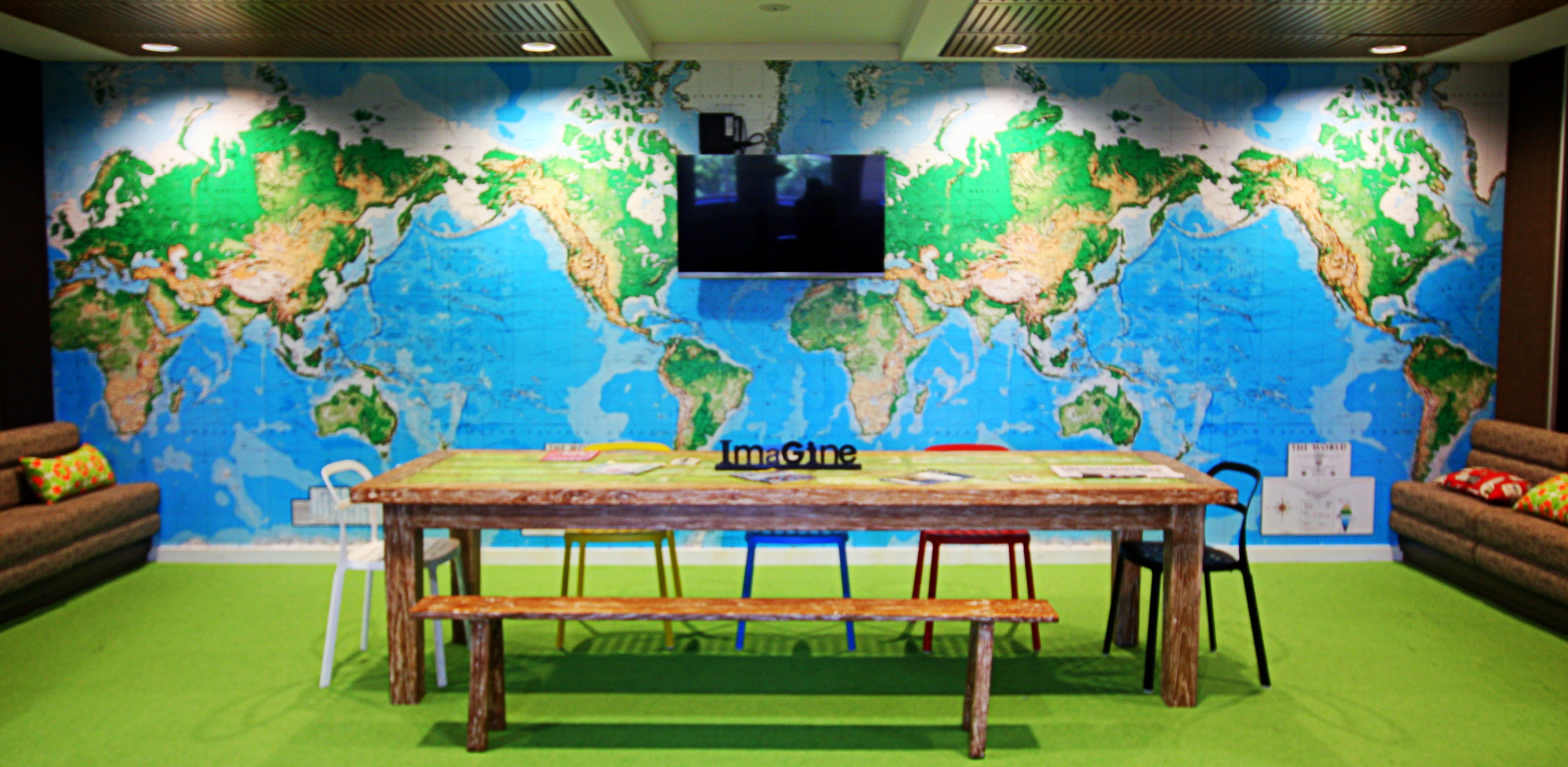
A world map for World Teachers’ Day (photo by me)

On today, World Teachers’ Day*, I‘m going to reflect on my experience of teachers as a school student. I’ve written about what research indicates about ‘good teaching’, but this post shares my personal story of the teachers I remember, and how they shaped me as a teacher.

Growing up, but especially during high school, I didn’t want to be a teacher. I think partly this was because of my dislike for those in authority who saw their role as to uphold what I saw as petty rules. While on the one hand I was a geek who diligently completed my school work and strove for academic success, I did not want to fit into norms set by others. I skipped some classes. I didn’t see the point in wearing the school uniform, unless it was to shackle me to conformity as part of a homogenous group. One year in high school I called the State Education Department and checked their rules on wearing uniform, and then asked that they contact my school to explain that uniform was not legally enforceable. It turned out that the only enforceable guideline at the time was that students in government schools be neat and tidy in appearance. (Yes, I was that student.)

In Year 8, my English teacher insisted that I rewrite a creative story entitled ‘Stop, thief!’ Although I had worked hard and long to craft the story, she told me that a thief should not be good looking with a “chiseled jaw,” and that I was to rewrite him as ugly with a hooked nose and hunched back if I wanted to pass. This felt to me to be an unjust response, one that not only supported what I considered to be an unrealistic and one-dimensional stereotype, but one which failed to acknowledge my effort and deliberate authorial decisions. I wanted my villain to be good looking!

In Year 10, after approaching a teacher to transfer into his higher Mathematics class, I did not pursue the subject change after he told me he wouldn’t speak to me unless I tucked my shirt in.

These experiences contributed to my view of the identity of ‘teacher’ as authority figure and stickler for petty rules, an identity I had no desire to emulate.

After deciding eventually, and almost accidentally, to pursue teaching as a profession, my “I don’t want to be a teacher” sentiment morphed into “I never want to be a teacher like that but I do want to be this kind of teacher.”  As a teacher I am often an advocator for looser rules (such as encouraging mobile technology in class, rather than banning mobile devices) and am guilty of ignoring those rules which I think are there for control and assertion of authority, rather than for learning and developing students into self-regulating, autonomous, responsible, thinking individuals.

At school I connected with teachers who I thought cared about me and my learning, who gave me some scope to try alternative methods and pathways of learning, and who did unexpected things: the Literature teacher who helped the class read a difficult novel by providing coffee and breakfast while we listened to the audio book; the Mathematics teacher who differentiated to allow her students to feel success; the English teacher who would surprise the class by wearing elements of costume while enacting scenes from texts. 

I try to emulate these things in my own teaching, thinking of little ways to surprise and inspire. I began one lesson while standing on a chair, conducting with a pair of drumsticks I had confiscated. I take students to the river or the high street to write. I surprised a very serious class of International Baccalaureate Diploma students, with whom I had been doing difficult laborious text analysis work, by providing them with textas, pencils, reams of paper, and chocolate biscuits (Arnott’s Tim Tams and Mint Slices for my Australian readers). At the end of all our hard work trying to understand 800-plus page Anna Karenina, they were to spend a couple of hours creating a visual representation of the novel. The result was a thoughtful and inspired creation, a train driven by Tolstoy, in which each carriage visually represented a key moment in the novel, with a lit candle at the front of the train and a burnt-out candle at its end, representing Anna’s journey.

A later experience, as a postgraduate student in a class during my Graduate Diploma of Education, supported and developed these earlier experiences of the emotional dimension of being a student and of the impact of teachers and classrooms on student confidence. There I was, in a class of mature age Graduate Diploma of Education students. I was the youngest, at 20 years old, and the oldest among us was 62. We were asked to share our memories of the best and then the worst teacher we had ever had. What I noticed as my fellow students, themselves almost-teachers, responded to this question, was the emotions they seemed to experience as they recalled their memories of teachers who either inspired and encouraged them, or who made them feel small, exposed, and uncared about. I was reminded of the famous quotation, attributed to a number of people including Carl Buehner and Maya Angelou: “People will forget what you said, people will forget what you did, but people will never forget how you made them feel.”

It occurred to me during that Grad. Dip. Ed. class that the impact of a teacher, and their behaviour, on a student, each student, can be powerful and lifelong. That what for the teacher may be a throwaway line on a bad day, may for the student be a criticism which cuts deep and lasts a lifetime. It reminded me of the vulnerability of students and the turbulence of finding a sense of self throughout childhood and adolescence. This led me to continually reflect upon the effect I am having on students, my building of relationships, and my self-monitoring of things which may be seen by students as hurtful.

So while I often take an intellectual approach to teaching, looking to evidence, research and impacts, I think we also need to remember and recognise the deeply emotional, human experience of being both student and teacher. Happy World Teachers’ Day!

* World Teachers’ Day is held internationally on 5 October, but as this usually falls in the Australian school holidays, Australia celebrates it on the last Friday of October.

Power of a nerd herd: Ode to my people

Nerd Face Emoji

It seemed Liv had spent the last eighteen years in search of her people, and in one sudden explosion of fate, they’d all been brought together in this place in time. Her eyes filled with tears as a sudden awareness filled her. They were all nerds.” ~ Danika Stone, All the Feels

The word ‘nerd’ is often given a bad name, being associated with relational ineptitude and being socially outcast. But for me nerdiness is about finding joy in knowledge: attaining it, interrogating it, producing it. Immersion in it. Consuming, curating and creating.

I love it when a nerd is positioned as a central figure of a story. One example is astronaut and botanist Mark Watney, the protagonist in Andy Weir’s 2011 novel The Martian. At one point Watney, stranded on Mars alone, yells, “Hell yeah! I’m a botanist! Fear my botany powers!” Watney embraces his nerdiness, calling himself a “space pirate” and invoking the metaphor of Iron Man when he catapults himself into space near the novel’s end. The story arc of the novel, and the Ridley Scott film in which Matt Damon plays Watney, is carried by this nerd-hero and his melding of science knowledge and affable humour. Watney is the epitome of the lovable nerd.

Recently, I’ve been reflecting on those people in my professional and personal spheres who make me feel like I’m at home when I’m with them. Many of these are fellow nerds. That is, we connect over our mutual love of something geeky (reading, writing, teaching, research, literature, coaching, art, science, story). We have a shared joy in finding things out and in doing purposeful work.

These are family and friends who, while I was completing my PhD, asked me about my research and listened to my responses. They are colleagues who get excited about a project we’re working on. Who co-plan courses, lessons, cross-curricular opportunities and assessments with a fervent enthusiasm and a twinkle in their eye. Who understand, or at least watch with knowing amusement, when I get excited about a new academic text or education book arriving on my desk (O, Book Depository, my faithful friend!), or about a paper being published. Who smile patiently when I cyclone into their office full of ideas busting to get out of my head or words tumbling out of my mouth. They are the past or present principal who continues to show an interest in and support of my work. Who sometimes says ‘yes’ and sometimes challenges me to think and do more.

They are the mentor or coach who waits while I work through my messy thoughts and helps me to arrive at cleaner ones. They are the colleague and bloggers who trust me enough to listen to their unformed thoughts or read their still-emerging ideas.
They are the professional friend who coaches me on Voxer or takes a phone call to help me work through a professional problem or issue. They are my PhD supervisors who gave me the space to explore some off-the-wall ideas, while challenging me to construct airtight rationales for non-traditional approaches. They are the well-known academic who shares their expertise via social media, flattening hierarchies and transgressing time zones. They are the conference-goer who stops me in the corridor after my presentation to talk for an hour, before moving our conversation to the long lunch it deserves. They are the co-author I’ve never met face to face, or spoken to on the phone, but with whom I’ve collaborated, co-written, and whose thinking and writing has pushed mine into new crevices.

They are my kind PLN who engage thoughtfully with me on Twitter, respond to my blog posts and meet up with me in cities around the world. Twitter is full of generosity. In my PhD acknowledgements, I thanked family and friends who had shown an interest and those in the social media world who had provided an antidote to isolation when I felt alone in my own head in the PhD wilderness.

Those people who feel like my tribe provide a space that is at once safe and challenging, celebratory and questioning, inspiring and industrious. It’s a place I can be excited about an idea, a text or a possibility. I can geek out and nerd it up without risking an eye roll or a snigger. I can share narrow interests and pursue broad passions.

In a world in which we are more connected than ever, we can be buoyed, empowered and supported by our connections, our people, our herd, our tribe, our squad. We can pay forward and give back. We can support each other’s nerdy excitement. In the karmic circle of knowing, learning, doing, being, leading and caring, we can share our knowledge, contribute our time to help others on their journeys, listen to others’ stories and celebrate others’ milestones.

Thank you to my fellow nerds who give me a sense of belonging and allow me the luxury of knowing that my personal brand of nerd has plenty of places to call home.

Achievement unlocked: I think I am Nerd Face Emoji.

Achievement unlocked: I think I am Nerd Face Emoji.


Questioning heroic leadership: The visible-invisible hero

heroes

Our notions of heroism change over time. The construction and reception of heroes is dependent on context. Often the heroes of a time and place are only decided in hindsight when their actions and the consequences of those actions are weighed by the collective, the media or Hollywood scriptwriters.

Texts can reflect the values, anxieties and aspirations of their time and place. For example, the Star Wars franchise has changed its notions of the hero over time. Early Star Wars films had some diversity back in the 1970s. Leia was an independent hero who could stand up for herself and played a key part in the Rebel Alliance. But she was still pictured as the pretty woman handing medals to the male heroes. Lando Calrissian was a non-white heroic figure, but a more minor and less honourable character than the two white males, Luke and Han. Diversity and Otherness were also foregrounded by the multiple alien species in the films, from everyone’s favourite heroic Wookie, to sinister or repulsive villains.

Fast forward almost forty years and Rei and Finn, the heroes of the 2015 Star Wars Episode VII (which I have written about here and here), show the shift in the hero’s representation in terms of gender and race.

Meanwhile, Batman is a hero whose representation has evolved over time, from the silly unintimidating comical figure of the 1960s television show, to the tortured, vengeful, imposing figures of recent films. Newer Batmans, including those played by Christian Bale and Ben Affleck, are psychologically darker and more complex.

In 2016, heroes like Deadpool and the new Ghostbusters question the traditional portrayal of the hero. Deadpool, like the animated hero Shrek, challenges stereotypical hero behaviour. He is rude, lewd and without a noble cause. The new Ghostbusters expand our vision of how heroes might look. The Game of Thrones franchise, too, agitates reader and viewer expectations of the hero by presenting us with complex, shifting characters who dance along and frequently cross the line between heroism and villainy.

To leadership …

How is the realm of leadership affected by the fluid definitions of heroism, dependent as they are on the time and place in which any real, mythological or fictional hero is created and received?

Today I’ll be speaking at the Rise and Future of Heroism Science Conference in order to explore what insights the data from my PhD has to offer the field of heroism, and what heroism has to offer the arena of leadership.

The questions I ask are:

  • Must the school leader hero be a charismatic, selfless visionary? A beacon of bravery and a moral crusader?
  • Are alternate leadership metaphors and narratives helpful for thinking about contemporary leadership in schools?

My answer, based in the emergent themes from the interview data of school leaders in my PhD study, is that the traditional lone hero on an individualistic quest is not an appropriate metaphor for the school leader. The leaders in my study reflected notions of servant, distributed, caregiver or transparent leadership.

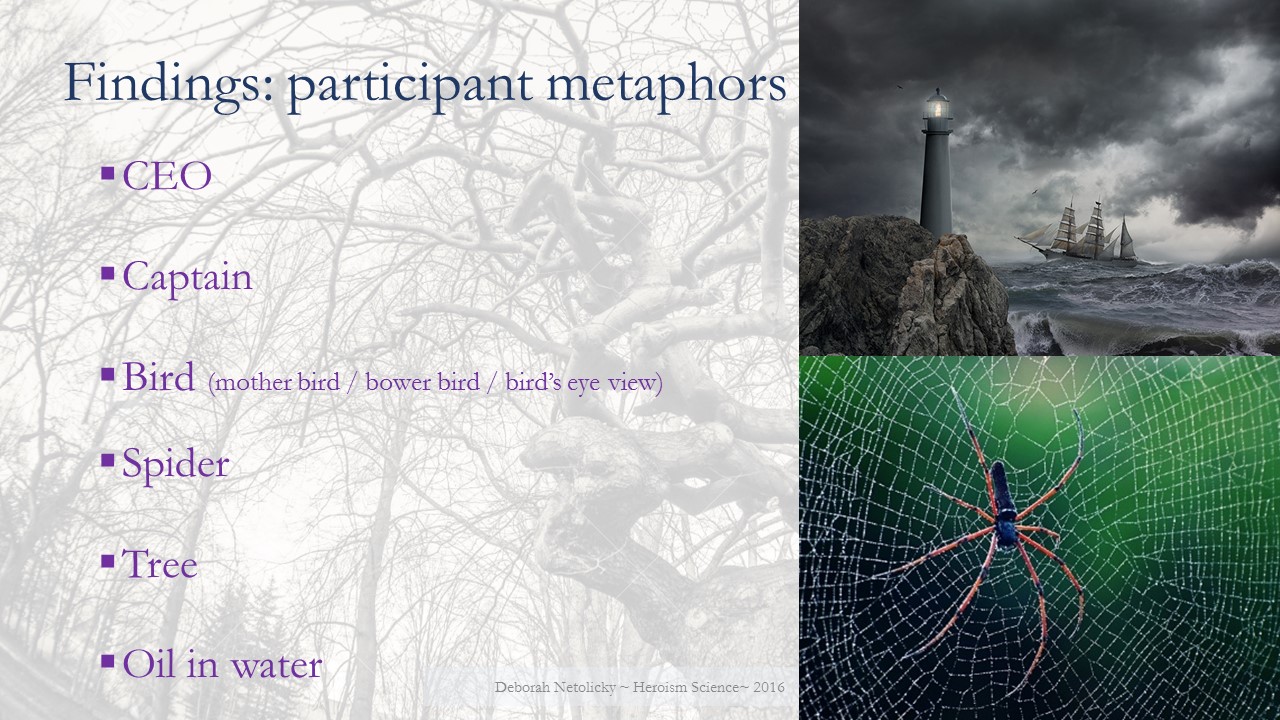
Participants offered up their own metaphors for heroic leadership, revealing that heroism when leading others can be fluid, deliberate and imperceptible.

by Deborah Netolicky

In my PhD thesis, I applied the literary character of the Cheshire Cat to emblematically articulate the visible-invisible school leader, who deliberately appears and disappears, showing only part of themselves depending on the needs of those who they lead. The Cheshire Cat leader empowers others to find their way through their professional Wonderlands. Sometimes they are the encouraging grin, the glimmering eyes, the disappearing tail. At times they are the disembodied voice, mentoring, coaching or guiding. Unlike the autocratic and unlikeable Red Queen, the Cat is a mysterious guide who operates from the aerial view of the tree, with an understanding of the bigger picture.

The image of leaders posturing as white knights of school improvement, wielding swords of change and self-promotion, is seductive but unhelpful. Heroism in school leadership can be deliberate, fluid and at times imperceptible. School leaders can focus on the collective good and intentionally navigate visibility and invisibility (although I wonder to what extent deliberately imperceptible leadership can feel like being an under-appreciated Santa Claus, and how leaders feel when their machinations to build the capacities of others go unnoticed).

My PhD suggests that leadership that serves a community or organisation, and the individuals within it, need not be highly visible. Heroism in leadership can be about deliberate invisibility, the barely discernible swish of a tail and the disappearing gleam of a Cheshire grin.

Ecosystems of work, study and relationships

Eduardo Kobra's Chelsea mural, photographed from the High Line in NYC in 2014

Eduardo Kobra’s Chelsea mural, photographed from the High Line in NYC in 2014. Because: relationships. And New York.

How do you do all the things?

I’ve made the conscious decision to be there for my kids while they’re little.

My husband is actually great. He makes the kids’ lunches on Fridays.

I can’t go for that promotion. I’m planning to get pregnant / I’d have to put my kids in after school and vacation care / My husband works full time.

I wish I had the support you do.

How does your husband cope when you’re away? Poor guy!

It’s not the role I wanted but I’m so lucky my work has allowed me to come back part-time after having children.

Wow, you’re amazing!

These are some of the comments that I’ve heard said to myself, to other women or by other women. Meanwhile, my husband has had comments directed his way such as:

How do you cope when your wife is away?

How did you manage while your wife did her PhD?

I bet you haven’t eaten a good meal in months.

Do you get your wife back now?

So it’s Daddy Daycare today?

Wow, you’re amazing!

There seem to be assumptions at work about both the nature of the PhD and the gendered nature of work, study and home. In this recent vlog, Professors Tara Brabazon and Steve Redhead talk about the relational aspects of the PhD experience. Tara talks about the online blogerature that links doing a PhD to divorce or relationship problems. I wonder why that is.

Maybe it’s because the PhD can feel like a lonely experience. It is a hard but wonderful slog that happens inside the head and on the keyboard of the candidate. It must be difficult for a partner or family member to understand what is actually happening for the person conducting research. Conversely, the PhD takes the candidate away from their partner or family or friends while they thrash about with their research and their thesis beast. I imagine that relationships can suffer and people in the candidate’s life can feel abandoned, left to their own brand of loneliness while the candidate furrows their brow in seemingly indulgent internal struggle, disappearing into inner worlds, or like I did, off to cafes to think and write.

The PhD also happens over a long time. Years. Sometimes three years and often longer. Four, five, six, seven, eight, nine, ten years in some cases. And one thing that is guaranteed across such a project is that life will happen. And get in the way. Inevitably, challenges will arise outside of the PhD, whether that be around health or finances or children or career or loss. In my three year candidature, I had some very tough personal times that had an impact on work and study, and on me personally. Life events can put a strain on our delicate ecosystems in which all our commitments interact.

I like Tara and Steve’s approach of supervising the PhD candidate’s whole life, including their web of relationships like partners and children. It takes a holistic view of the PhD, framing it as a collaborative work, rather than a lone journey.

Gender also seems to play a part in common comments about study, work, and their impacts on relationships. Why the frequent assumption that when a husband goes away, wheeling his case out the door with reckless abandon, all is as it should be, while when a wife goes away, she must fill the fridge and freezer with nutritious groceries and organic meals, pre-organise all child care arrangements and tape her itinerary and a list of important phone numbers to her husband’s forehead? Why the oft-joked-about assumption that a husband would struggle to run his own household or look after his own children? My husband and kids have a great time whenever I travel. Granted, they eat more chips and play more iPad than when I’m at home, but I am waved off and welcomed back by smiling faces, just the same as my husband when he goes away.

There are some who have fun with gender assumptions. On Twitter, the @manwhohasitall account makes fun of gendered comments often directed at women, by re-framing them for a male audience. This article on how to avoid a ‘manel’ (all male panel) gives some of the excuses used to exclude women from presenting and paneling.

Jacqueline Lunn here talks about the culture of women feeling grateful for part time work. I can certainly relate to the notion of being appreciative of being allowed flexibility in my workplace, rather than advocating for my bigger dreams, especially when I first returned to work from each of my maternity leaves. 

But I also acknowledge that working part time was a choice. I deliberately sought the time and flexibility that would allow me to do good work while being a good parent. I couldn’t, or rather wouldn’t, have accepted an amazing full time position while my children were pre-school age as I wanted to avoid using before, after school and vacation care if possible. I’m also well aware that my choices are highly personal and privileged. They have only been possible because of the support available to me, in the form of my mum, my husband, friends and bosses. That my husband runs his own business has meant that he has the kind of flexibility not often offered to men in the workplace. Why so few cries for men to ‘Lean out!’ of the workplace for a more balanced life and enriched relationships with partners, family and children?

The choices my husband and I have made are far from perfect; that is, they’ve involved compromise and prioritising. But they are what has worked for us at various times. They have been fluid and shifting choices, as situations evolved. 

Our individual and collective ecosystems of relationships, work and study are delicate and mercurial. My hope is that individuals, partners and families are increasingly able to make the choices that work for them at any given time, without being bombarded with judgement or assumptions from others or media.

Textiles & academic writing: Material, process, product


This post, which could also be titled ‘remembering my 1990s feminist self’ is a re-emergence of some thinking I did a long time ago in my early years at university. After leaving school, I completed a Fine Art degree, followed by an Honours year. I’m writing this post as a way into self-inquiry, a way to write myself towards my hunch that my early days as a feminist-textile-artist-writer have underscored my more recent PhD work and academic writing. Big thanks to Katie Collins whose wonderful blog post on subversive material metaphors in academic writing sparked my thinking.

I was a painter from a young age, thanks to my artist mother, but I chose to study textiles as a major in my undergraduate Fine Art degree, rather than painting. This choice was due to the meanings inherent in textile materials, processes and products. A textile artist can weave in metal or print on latex. They can make work in the blacksmith forge or the sculpture studio. They can work with cardboard or furniture or paint or dye or thread or canvas or wire or plastic or found objects. The visceral and sensory experience of working with materials is central to the artistic process.

The materials a textile artist chooses, and the scale at which they magnify or miniaturise those materials, are deliberate meaning-making choices. The artist can choose needlework and hand-dying, or industrial Warhol-esque mass printing. They can applique or cut away. They can build or melt. They can assemble or destroy. They can stitch or slice. They can focus on the macro or the micro, staggering their viewer with enormous size or encouraging the viewer to come in, up close and personal.

Textiles is personal and political. It is also a subversive arena for artists, and often a feminist one. It pushes or rails against the stratification of ‘Art’, which has often meant the dichotomising of cerebral, thinking highbrow Art (upper-case ‘A’, often seen as done by men), and functional or decorative art (lower-case ‘a’, often associated with women and femininity). Historically, women were objects of art: she the body to be gazed at and sculpted. Or objects of art were personified as women: she the landscape to be scrutinised and painted.

The art historical devaluing of textiles pivots on its early treatment by critics, galleries and institutions. Aesthetic disciplines depend on recognised ‘powers that be’ to promote and uphold them. Early galleries and history books excluded textiles. Unlike painting and sculpture, textiles was historically seen as an unimportant discipline, undeserving of discussion, not worth deconstructing for message or meaning. The association of textiles with the devalued domestic space of the home, the opposite of the glorified public space of the art gallery, contributes to its dismissal.

So, why am I back here, thinking about textiles as feminist discourse or subversive act? Because Katie Collins’ post brought memories of my past self bubbling to the surface. And I am wondering to what extent my long-ago thinking and artistic practice, around the meanings inherent in working in and writing about textiles, has influenced my current and recent research and academic writing. On reflection, my PhD incorporated disruptive elements. While fitting largely within an accepted academic paradigm, it quietly challenged the ways that knowledge is traditionally written about. I used narrative method, literary metaphor and created three multimedia illustrations for the thesis, corporeal expressions of my thinking.

Now that I’m back in the eye of this needle, I need to think further about how textiles might provide a metaphor for research and academic writing.

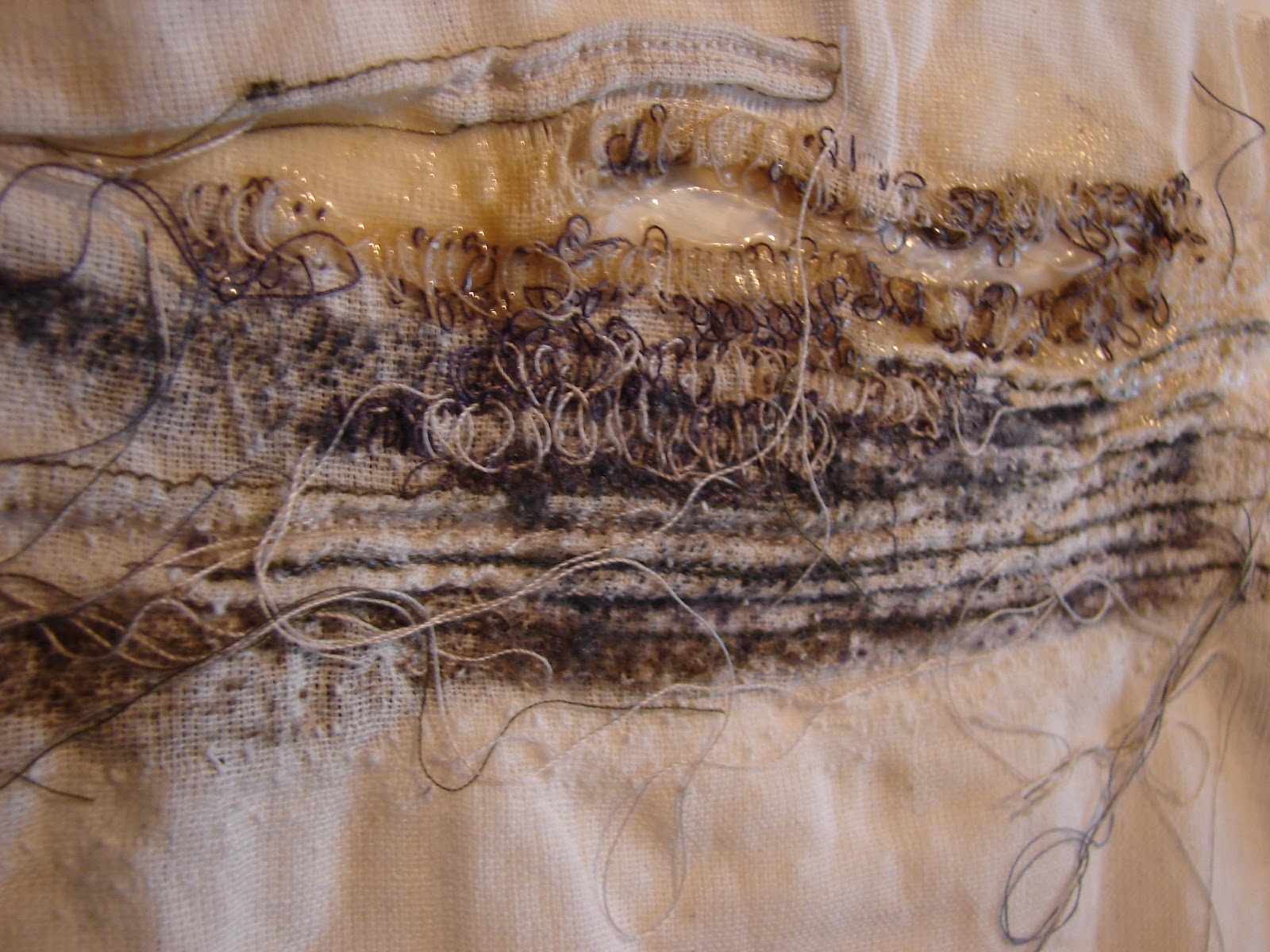
In the meantime, below I will type an extract from a paper that won me the Allport Writing Award in 1998, and was published in Textile Fibre Forum. It was an analysis of Vivienne Binns’ artwork Mrs Cook’s Waistcoat. The piece gives a sense of where my thinking was around textiles as feminist activism in the late 1990s. I have deliberately omitted an image of the artwork as I’m wondering if the text itself can paint the picture for you.

(For non-Australian readers, Captain James Cook was a British explorer who claimed to ‘discover’ the south eastern coast of Australia in 1770.)

_________________________________________

Extract from ‘Mrs Cook’s Waistcoat: Rewriting history through cloth’

by Deborah M. Netolicky (1998), Textile Fibre Forum, Volume 53.

Mrs Cook’s Waistcoat may be read as one woman’s attempt to rewrite and reinterpret human history. Here Vivienne Binns contributes to the discourse on journey, adventure, and historical significance, telling the pain-filled woman’s story of discovery and adventure—the burden of waiting and worrying, as opposed to doing and dying. Through this work she questions platitudes of the day, such as “men work and women weep”. Binns demonstrates that women were not passive, but were actively working contributing, storytelling, and recording their own histories, written in needlework.

Binns uses journey as metaphor, identifying with Mrs Cook’s expedition as expressed through the waistcoat for Mr Cook. She challenges the value placed on women’s histories and women’s work by challenging the notion that Mrs Cook’s journey was insignificant in terms of human history. She has chosen to elevate its significance, giving it voice, implanting it in the discourse of high art.

… Captain Cook’s wife is the “Mrs Cook” referred to by the title of the work which tells the story of her laboring over a waistcoat for her husband while he is away on a long voyage. The waistcoat mapnel is larger-than-life, describing the legendary reputation of Captain Cook in Australian myth-making, and the amplified importance that Binns intends to give to the making of the waistcoat.

Binns connects the historical representation and exploration of Cook’s journey with issues of women’s value, women’s history, and the construction of gender. In her version of this story, the ocean water is a metaphor for a bewitching, intoxicating vacillating, unpredictable femininity and female identity … Cook, the white, middle-class male, is discovering, navigating, defining, and fixing the limits of the Pacific Ocean. He is writing the experiences, histories, and memories of and for the water, which has no voice. It is formless, restless, intuitive, irrational, and passive, in need of taming, subjugating, explaining and defining by the rational, scientific logic of male discourse.

Nature is tamed by culture. Binns places herself in the middle ground. She associates herself as water, as a woman employing subconscious, intuitive processes – her own emotions, remembrances, and ideas about certain colours, materials, and ways of working. On the other hand, she calmly calculates, selects, and constructs her images, associating herself with the heroic explorer, just as the artist does on a continuous intellectual journey to discover new meanings. This marriage of antithetical metaphors reflects Binns’ concerns with shaping perceptions of women’s ways of knowing, living, researching, remembering, experiencing, and making. By yoking the two ways of working, she gives equal value to each.

…The waistcoat can be seen as a woman’s way of writing and recording history. Women write history in fabric, men write history in text. Binns makes Mrs Cook’s journey of waiting, sewing, and weeping, as valid as Captain Cook’s journey. The labour and time involved in making this waistcoat explain the wife’s dedication and devotion to her far-away husband. Binns questions the trivialisation of women’s roles surrounding issues of the domestic and ‘crafty’. … She uses the processes, materials, and experiences of women—traditional metaphors of women’s work—to weave a myth about women’s forgotten places in history.

Penetrated openings are created by slicing, cutting, and scarring the fabric, fabric that represents flesh as well a material. … Rolled up papers (the stuff of men’s work) penetrate exposed fabric (the stuff of women’s work); paper penetrates fabric; men’s work penetrates women’s work; culture penetrates nature. The slits in the fabric are peeled back like open sores, mirroring the multiple stab wounds that were the cause of Cook’s death. The ultimate satire of the story is that while Mrs Cook is lovingly creating the waistcoat for her husband, he is already dead, his stab wounds mirrored in her handiwork. This is reflected in the typed and hand-written text, which permeates through a layer of white paint: “Mrs Cook embroidered… this time the Captain did not return and the waistcoat remains unfinished”. This irony elevates her personal anguish, and points to the difference in men’s discourses and women’s ways of speaking through needlework.

…Binns … uses traditionally female and domestic techniques of women’s work: embroidery, pattern-cutting, and sewing. There is a sense of Mrs Cook’s physical involvement in this garment, her time, effort, and care. It is stitched, cut, glued. Elements, images, textures, and metaphors are exposed, denied, revealed, concealed, constructed, deconstructed, veiled, disguised, patterned, decorated slashed, sliced, torn, ripped, reconstructed. The piece is layered with the corporeal stuff of memory.

… Binns does not create a new reality, but reflects and reinterprets the existing one in a way that gives it new meaning. She puts one moment in one woman’s life under the microscope until it boils, making her audience reconsider women’s lives, women’s history and women’s art.

Words from the Bard #Shakespeare400

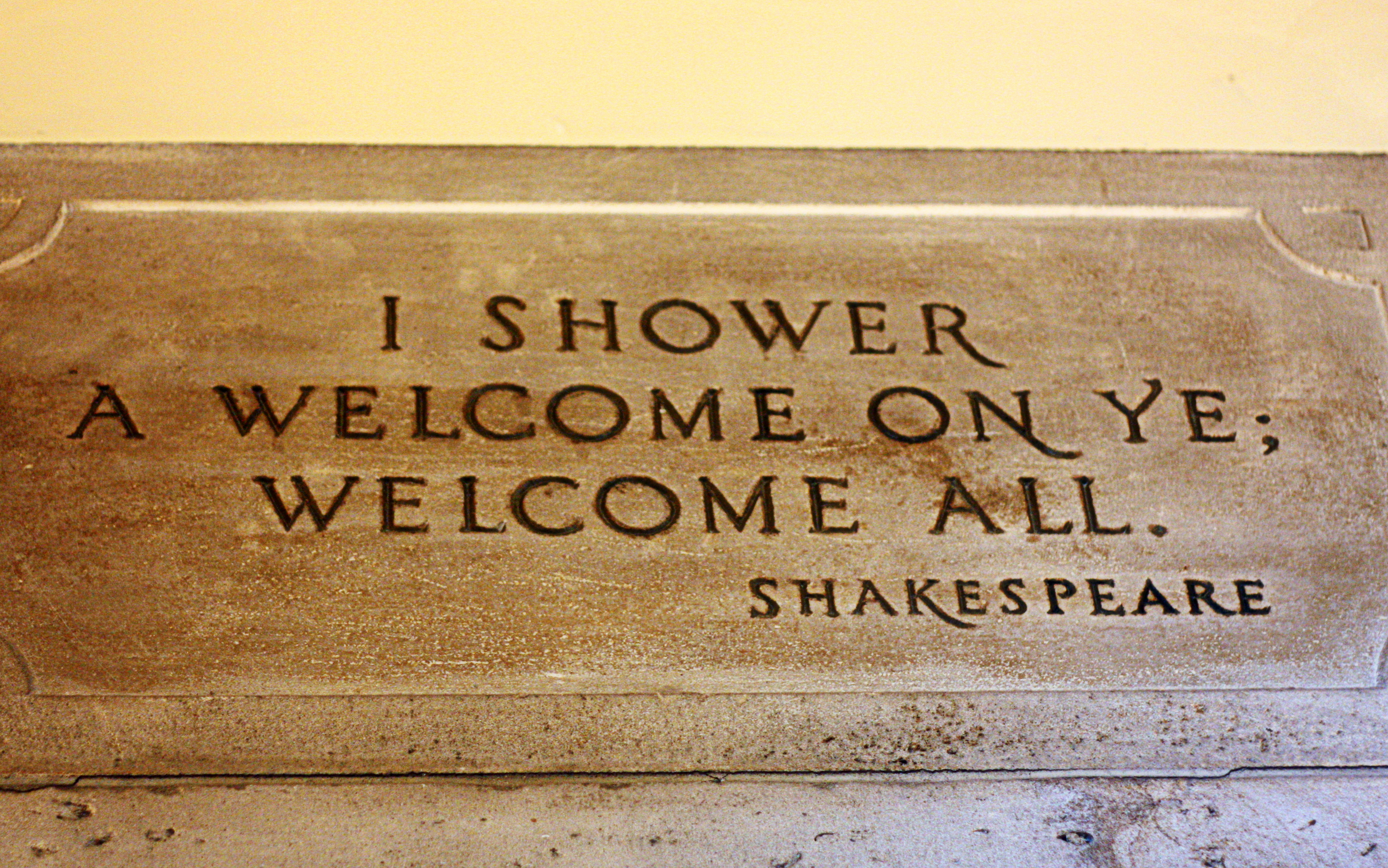
over-door plaque at the Folger Shakespeare Library

over-door plaque at the Folger Shakespeare Library

The 23rd of April–yesterday– was the 400th anniversary of Shakespeare’s death.  As an English and Literature teacher I’m a believer in the power of reading and writing. And I’m a Shakespeare nerd. I loved teaching Shakespeare for the three years I lived in London. There it all was! The Globe Theatre, Stratford-Upon-Avon, the streets and boards upon which Shakespeare lived and on which his work breathed. Two weeks ago I visited the Folger Shakespeare Library in Washington DC, which houses the world’s largest collection of Shakespeare’s works and artefacts, including 160,000 books, 60,000 manuscripts and 90,000 works of art. It’s Shakespeare nerd heaven.

Why are the Bard’s plays taught ubiquitously in English language and literature classrooms around the world, 400 years after his death? Because his work is considered to be universal and relevant across time and space. His plays and sonnets have influenced the very formation of the English language: the words we use and how we use them. He writes about things which resonate deep in the core of humanity: love, jealousy, history, ambition, rage, war, passion, flesh, and being a flawed person in the world.

So, today I thought I’d share a few of my favourite quotes from Shakespeare’s plays, along with some of my photos of the wonderful Folger Shakespeare Library.

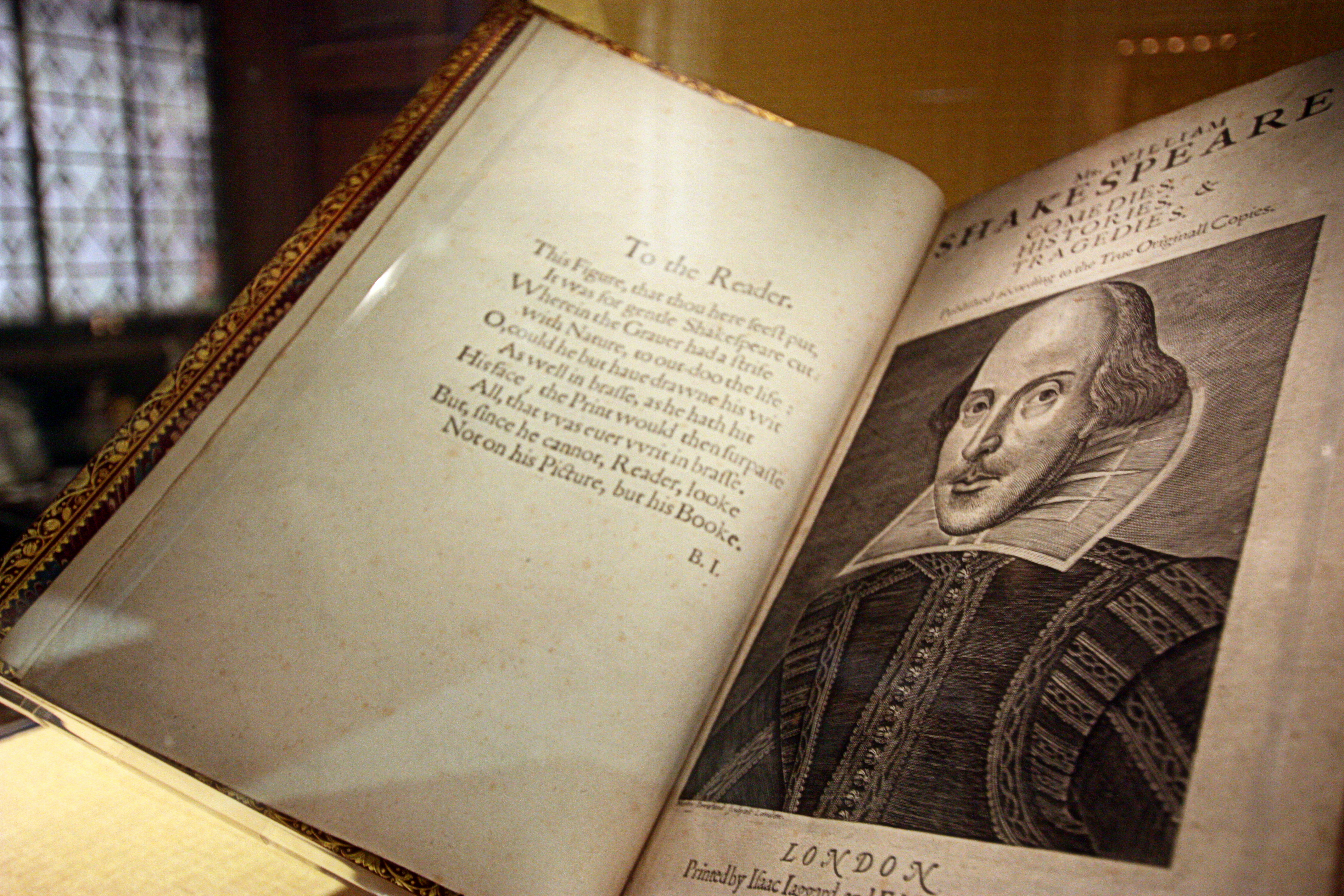
a 1623 Shakespeare First Folio, seen with my own eyeballs ("eyeball" - a word invented by the Bard)

a 1623 Shakespeare First Folio, seen with my own eyeballs (“eyeball” – a word invented by the Bard)

What’s in a name? ~ Juliet, Romeo and Juliet

Juliet’s famous line draws into question notions of identity. What does it matter what we’re called? Does a name or a title change who we are, or who we are perceived to be? I kept my maiden name when I got married, embedded as it was in my sense of who I am. Recently I got to change my title from ‘Ms’ to ‘Dr’ which has come with its own inner identity wrangling. This question is still relevant today, as the language we use to define and describe (ourselves, the world, anything, everything) shapes the meanings we make and the realities we create.

This above all: To thine own self be true. ~ Polonius, Hamlet

An oft-cited line, here’s a case of art speaking a universal truth: the importance of being true to oneself. Shakespeare reminds us to live authentically and purposefully.

If you prick us, do we not bleed? ~ Shylock, Merchant of Venice

While Shylock’s speech ends in vengeance, it begins with a powerful, emotive plea for social justice and equality. This plea can be seen (from a particular angle) to challenge the beliefs of Shakespeare’s time. It also challenges modern audiences to consider their own prejudices and kindnesses. Who in our contemporary world is treated with a lack of empathy or humanity? Who is voiceless or powerless? Who is willing to stand up for justice and fair treatment of all? What is fair?

Shylock’s character is complex and open to different interpretations. Is he villain, victim or man of integrity? He challenges viewers to reflect on themselves, the world in which they live, the way they treat others and the way they conduct themselves.

Screw your courage to the sticking place. ~ Lady Macbeth, Macbeth

Lady Macbeth is initially the backbone in her relationship with Macbeth, although she later goes mad. Here she is at the beginning of the play, strong, resolute and convincing. She calls on spirits to “unsex me” in her drive to take on the strong masculine role alongside her then-weak husband. The actions of Lady Macbeth and her husband are murderous, driven by ambition. The complexities of their relationship explore still-relevant themes of power, gender and love.

Macbeth, like Shylock, is a complex and flawed character open to interpretation. The play encourages us to reflect upon to the extent to which we are each responsible for our own actions and on our own “black and deep desires.”

What angel wakes me from my flowery bed? ~ Titania, A Midsummer Night’s Dream

I love this line. Titania is enchanted as she wakes, but who wouldn’t want to have these words sleepily uttered to them as soon as a lover opened their eyes?

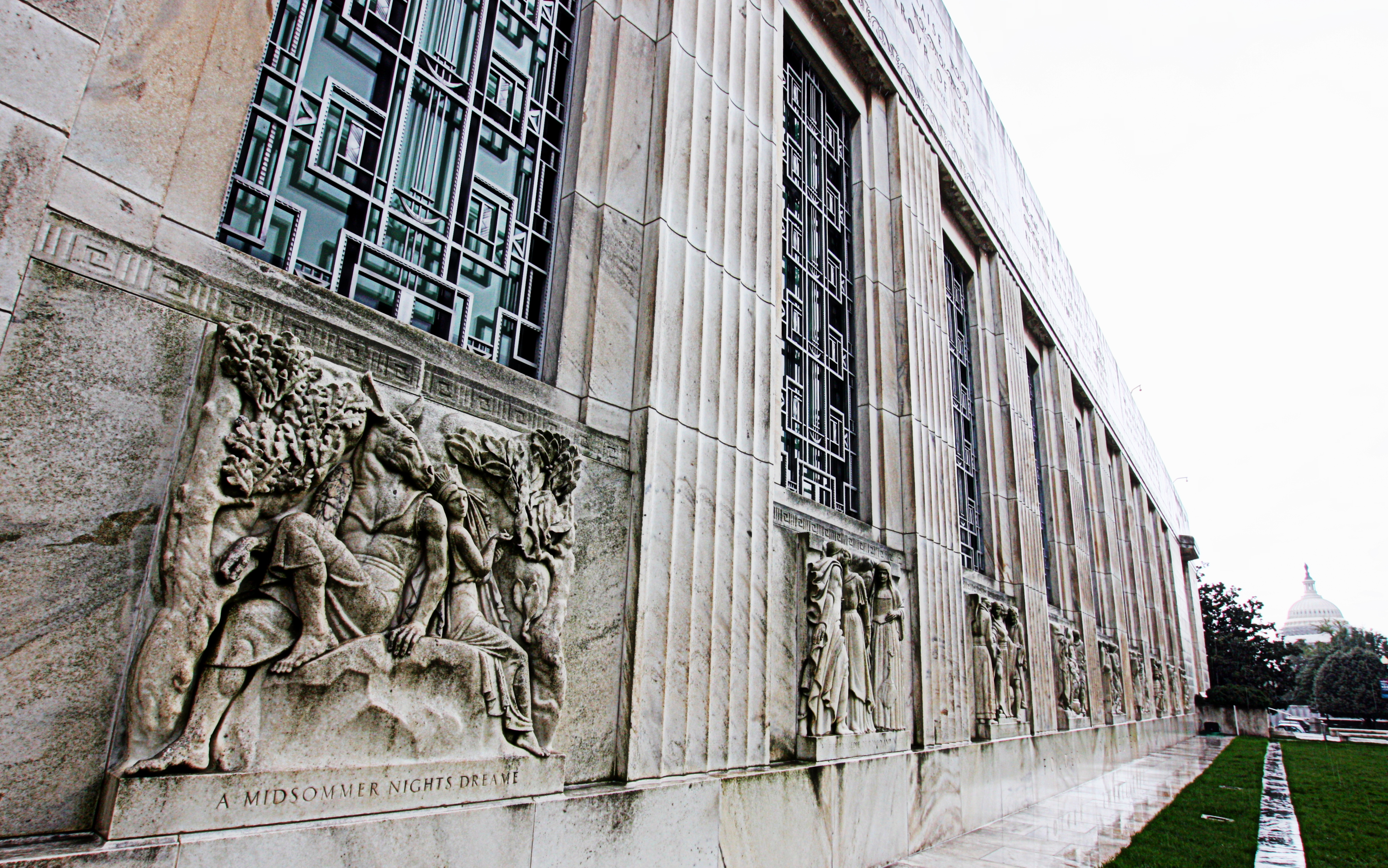
The Folger Shakespeare Library, with the Capitol in the background

The Folger Shakespeare Library, with the Capitol in the background