Professional identity & professional learning: Reflections on my TER podcast interview

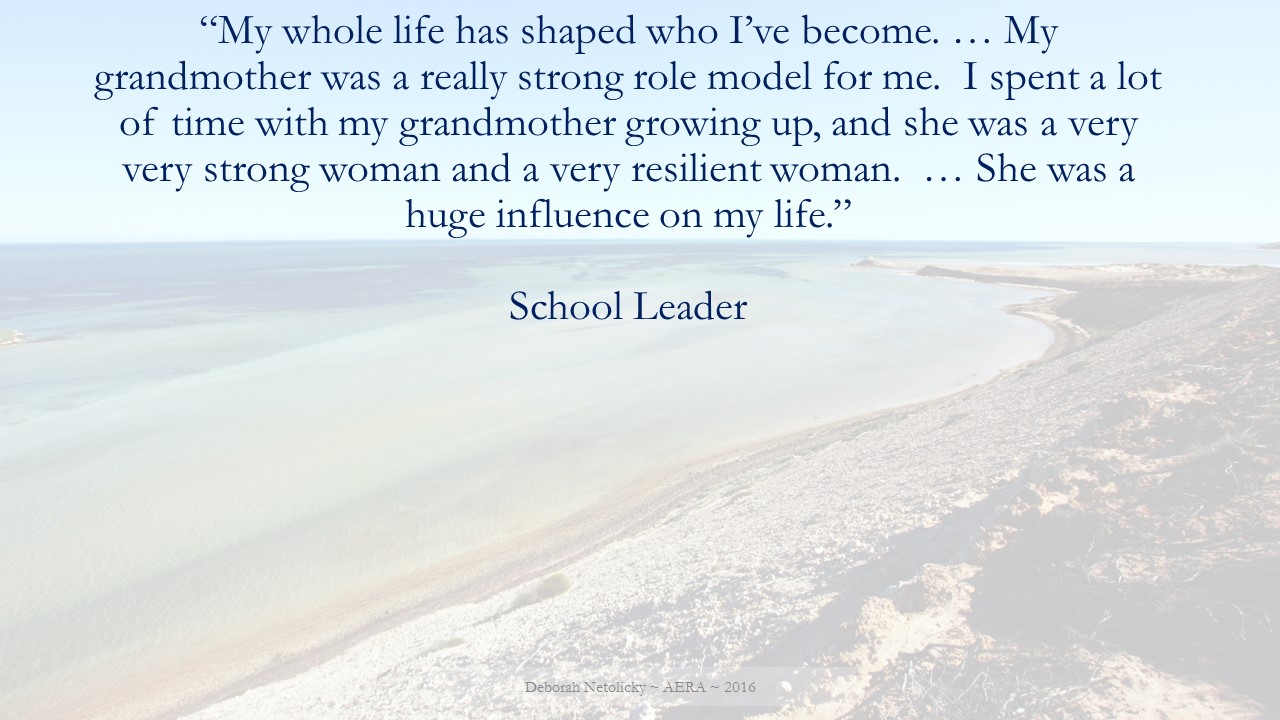
identity is liquid (aka Little Lagoon, Shark Bay)

identity is liquid (aka Little Lagoon, Shark Bay)

Recently I was interviewed by Cameron Malcher for the TER podcast about my PhD. You can listen to the interview, which was released on Sunday (it kicks in at the 35 minute mark). My favourite part of the podcast was Cameron’s concluding thoughts that were sparked by the interview. Below is not a blow by blow account, but a reflection on what we discussed.

What is professional identity?

In my PhD I defined identity as “ongoing sense-making process of contextually-embedded perceived-selves-in-flux”. It is a process rather than a product, a constant state of becoming. It is fluid rather than fixed. It is constantly shifting, as suggested by Fred Dervin’s notion of identity as liquid. It is socially constructed and contextual; that is, identities are co-constructed with others, and we are different versions of ourselves in different situations, with different people.

Factors that make up our professional identities include our beliefs, values and assumptions. Our identities are created and rewritten through language, through the ways we tell the stories of ourselves, to ourselves.

On the blogosphere and the Twitterverse there have been arguments about the disconnect between who owns identity and labels, suggesting that some think that identity is superimposed on us by others’ perceptions, while some believe that we own and make our own identities. The socially constructed nature of identities suggests that both have merit. We write ourselves for ourselves, and our self-perceptions rely on how others perceive and interact with us (although this interactions can be rejection of others’ perceptions, as well as acceptance).

Why consider professional identity in education?

Teaching is deeply personal. Part of the reason I brought professional identity together with learning, leading, and school change is that I think they are inseparable. Looking at education reform through the lived experiences and identities of those in schools is key to understanding its impacts. Professional learning and the leading of schools need to take teachers’ and leaders’ senses of selves into account, and engage with them.

Focus of my research

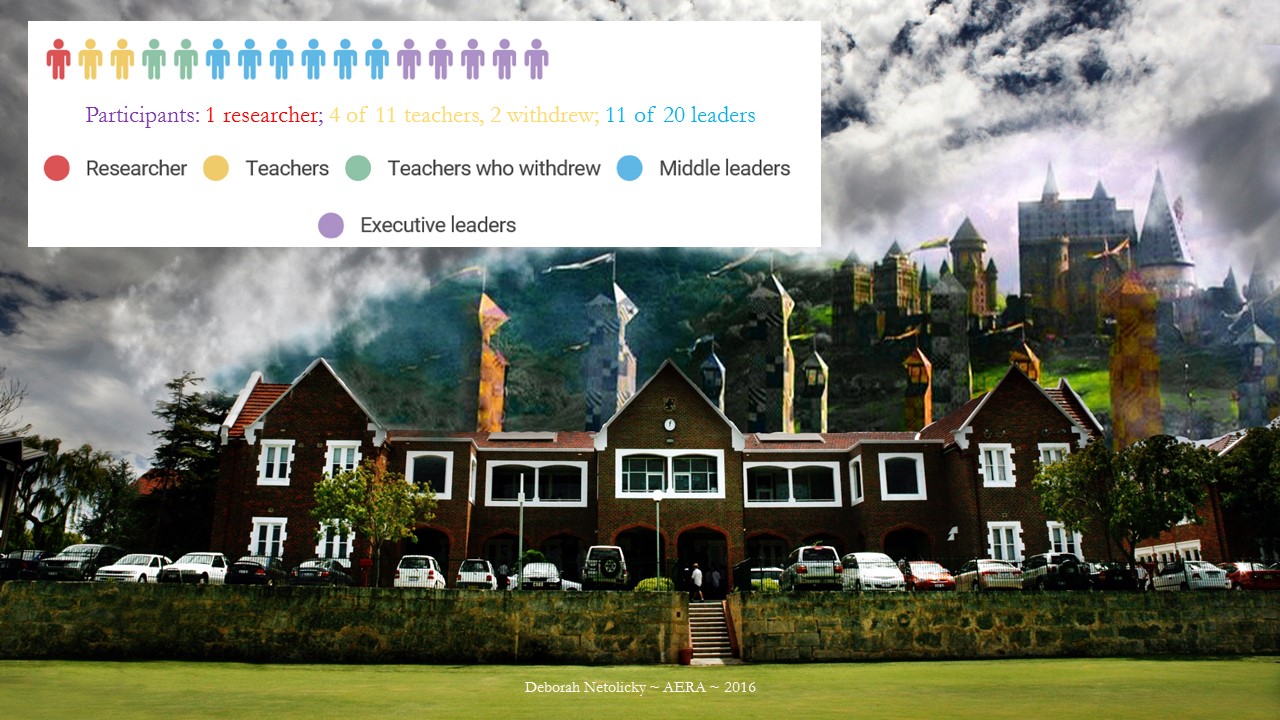
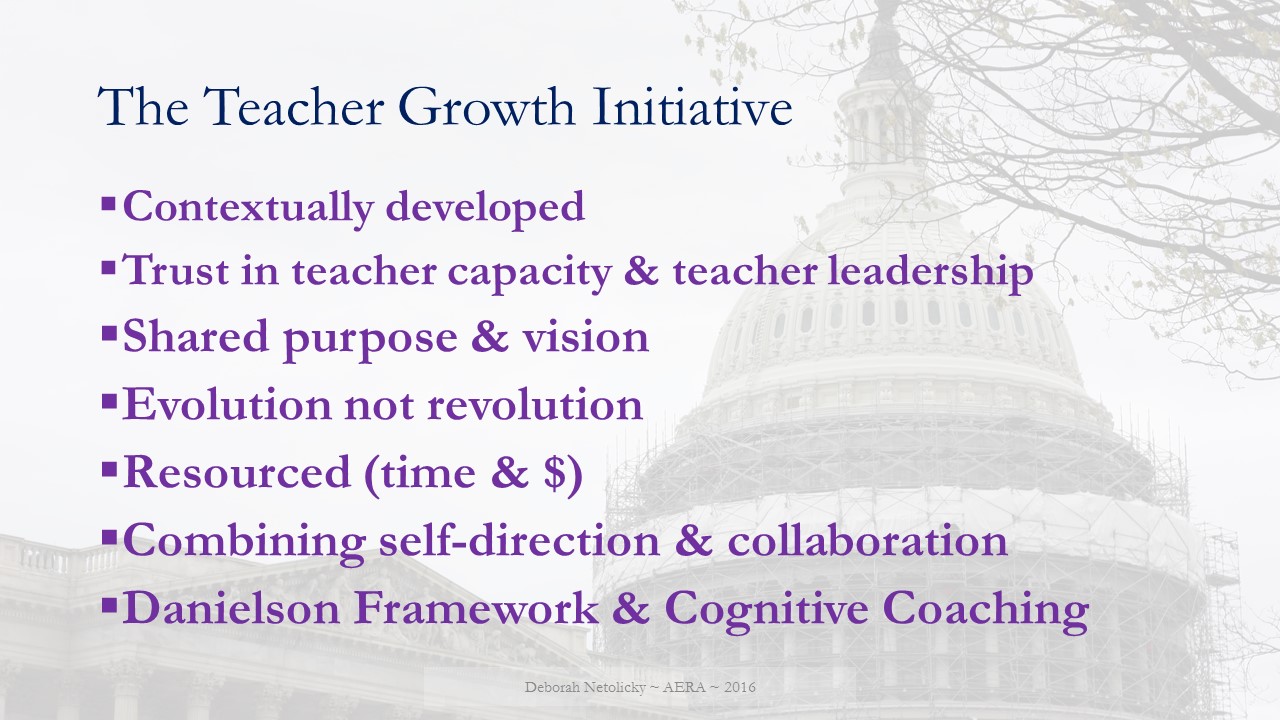
I conducted research within my own school and examined the stories of 14 teachers and leaders, including myself. The background context was a school-based teacher growth initiative.

I used narrative research to explore how these educators’ professional identities interacted with their learning and with school change. I was interested in what it is that shapes and shifts educators’ professional identity perceptions and in what ways schools and systems might work with a greater understanding of educator identities when designing and implementing education reform.

My narrative approach involved interviewing participants in ways that encouraged storytelling, including using coaching protocols, and then storying those data. It required me to be reflexive as the researcher. The experience of my PhD was personally and professionally transformative for me. I loved it, and it was incredible professional learning. In particular, the luxury of listening to educators’ stories was a joy and a privilege. I presented at AARE last year on my creative, literary approach to storying data, and this Saturday I’m presenting on my ethical decision making at the researchED conference in Melbourne.

Research findings

My research found that:

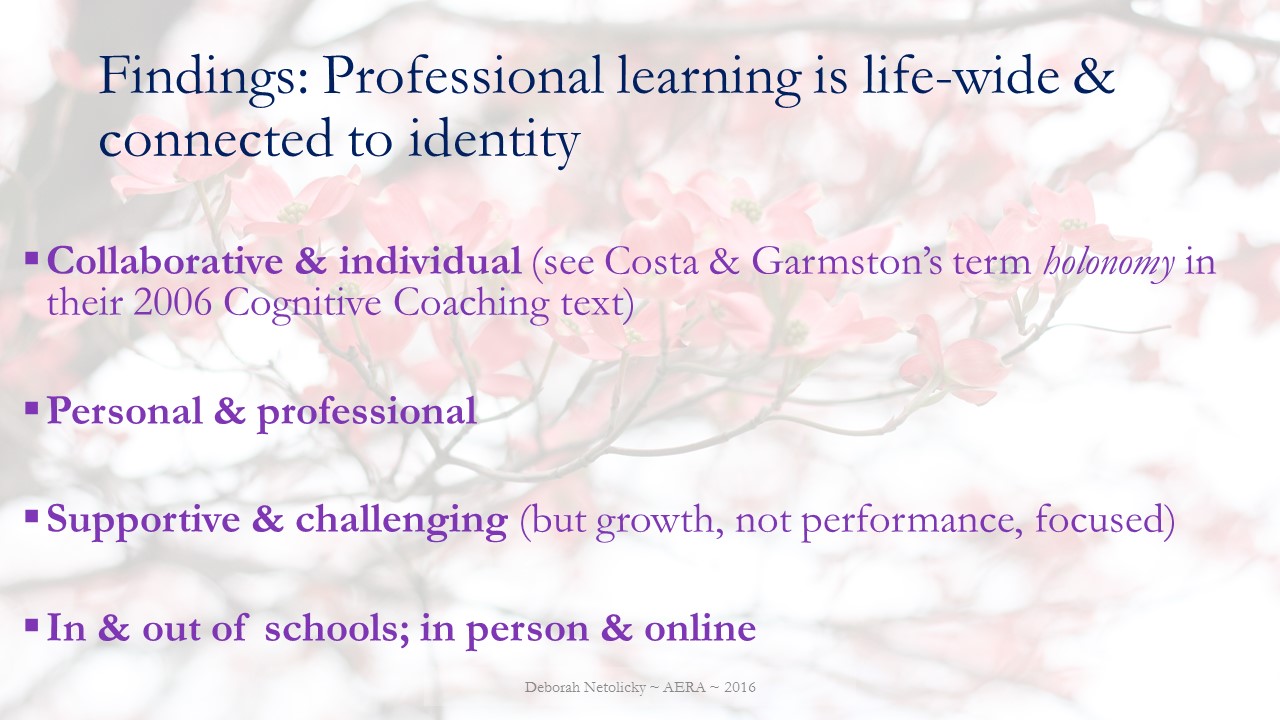
  • We professionally learn throughout our lives. Our professional learning encompasses life moments that are professional and personal, formal and informal, in schools and out of schools, singular and collaborative. Professional are shaped by good and bad experiences, by role models and anti-models.
  • Learning which taps into who educators see and feel they are, has the most impact on their beliefs, thoughts, behaviours, and practices.
  • Coaching and being coached is identity shaping, shifting teachers’ and leaders’ beliefs about learning and teaching.
  • The Danielson Framework for Teaching can be a useful tool for teacher self-reflection when used by teachers for their own growth.
  • School reform and school cultures which trust the capacities of teachers to reflect and improve is empowering and capacity building.

Implications of my research

With the caveat that my PhD was highly contexualised (considering the nature of the school and individuals I studied) the findings have something to offer the education world.

Firstly, there is a need to broaden the definition of professional learning, to allow teachers and schools to think more broadly about what it is that transforms educators, and who drives the professional learning of teachers. In my own leadership practice I am wondering how professional learning might be more autonomous and individualised. About how professionals might choose and follow, with support and opportunity, their own growth trajectories. About how schools and systems might acknowledge and encourage heutagogical (self-determined) learning.

Secondly, schools and systems can work from their own contexts to design and slowly iterate models of professional learning, from the bottom up and the middle out. As many scholars point out, effective education reforms are contextual. They cannot be lifted from one school or nation and dropped on another. Change in schools should be at a slow evolution-not-revolution pace, and based in assessing available evidence and current context.

As a result of my reading and research, I advocate for distributed and empowering leadership in schools, and school systems that trust teachers. I am a card-carrying, flag-waving fan of the Flip the System movement, which champions the agency and voice of teachers within their own systems. Teachers and school leaders have the internal capacity for analysis, reflection and growth. The individual should be honoured, valued and supported, within the holistic collective of the organisation and the system.


Santa Claus Phenomenon: The hidden magic of coaching & leading

It’s not until you’re a grown up that you realise Christmas doesn’t just ‘happen’. That magical day was pulled together by the incredibly stressed adults in your family. ~ Rosie Waterland in this post about Christmas

Sometimes in adult life we engineer magic. With glee we secretly make the miraculous and enchanting happen for others.

As parents, we realise how engineered the magic of Christmas is. We kind of know it when we discover that our parents are really Santa, but it’s not until we create Santa for our own children that we appreciate the hard work that goes into it.

All the preamble, that constant constructing of stories of Santa and reindeer and the intricate goings-on of Christmas Eve. Answering questions about store Santas and how Santa gets into the house and where the reindeer park the sleigh. Stealthy gift shopping, gift assembling and gift wrapping. On Christmas Eve there’s waiting until the children are definitely asleep and then assembling the gifts, artfully nibbling a cookie, enthusiastically chomping a carrot, dusting snowy footprints to the tree (and then closing the pet out so they don’t ruin the footprints overnight). This is magic that requires long term planning and strategic operation. 

Then: Christmas morning! Children wake. Santa’s magic comes alive. The Santa narrative seems not only possible, but real and wonderful. The children shower gratitude on the mysterious and benevolent figure of Santa. There are joyous cries of, “Thank you, Santa!” and “Santa got me exactly what I wanted!” How they glow with appreciation for the jolly red fellow and his generosity. Somehow he knew exactly what they needed at this point in their lives.

Of course, I do all of this because I enjoy the looks of amazement on my children’s faces and the thought that they feel part of something fantastical. But sometimes, as a parent, I secretly think, ‘It was us! It’s us you should be thanking!’ In these moments, I want my children to realise that all that joy is down to my husband and I. We contrived and concocted this whole thing. Of course I don’t ruin the magic. I encourage their belief and enjoy their wonder (they are currently 4 and 5). But part of me still sometimes wants recognition for all the hard work of being Santa and providing the magic.

Christmas Eve vignette from our place

Christmas Eve vignette from our place

There are two professional roles where I think this Santa Claus Phenomenon (no, it’s not a thing; I just made it up) plays out in professional life: the coach and the leader. It’s not that these roles are magical, but both have a sense of hard work going on behind the scenes, potentially without recognition from the recipient. Like the parents acting as Santa, both roles require the person to provide others with what they most need in that moment.

Coaching is hard cognitive work. In this post, I used the metaphor of the duck to describe the coaching experience; the duck’s legs paddle manically below the surface while above the water, all seems serene. So the coach works hard, but in order to be effective, this work needs to be imperceptible to the coachee. In fact, in order to best serve the coachee, the work of the coach needs to draw out and draw on the coach’s inner resources, so that they shine brightly. The coach is the hidden passageway or the mirror to self.

Similarly, a leader who empowers their staff can sometimes feel like the unsung hero. This kind of leadership is the subtle and invisible kind. Stepping back so others can step forward. Subtly coaching and nudging and encouraging and scaffolding. This isn’t brave sword-wielding white-knight stuff, the celebrated charismatic leader on the public stage. It’s about believing in and nurturing others’ capacities, in sometimes imperceptible ways. It is hard work with plenty of setting up and engineering for successes, but it’s done quietly in the background and sometimes no one sees this leader’s careful preparation and toil.

How do coaches who want to build the internal resources of their coachees, and leaders who aim to build their organisations by developing their people, interact with the Santa Claus Phenomenon? How do coaches and leaders celebrate or measure their wins? One way in a coaching conversation is in the responses to the question at the end in which the coach asks something like “How has your thinking shifted from the beginning of the conversation to now?” Leaders can know their own impacts by tracking the progress of their teams and individuals. But perhaps in both cases, others won’t notice the impacts, or the careful steps the leader conducted to get there.

I’ve written a paper for the Heroism Science conference that explores the idea of the less-visible leader. The leader who empowers. The coach who helps develop the coachee’s self-efficacy through layered and complex, but barely visible, practice. I wonder how this kind of leadership plays out in reality. Is the knowledge of one’s own impact enough? What happens when others don’t recognise that a coach or leader is engineering the magic? What if, from outside, it seems like the coach or leader isn’t doing anything? Is that as it should be–the noble but unseen work of coaching and leadership–or is it problematic?

On professional learning: My #AERA16 presentation slides

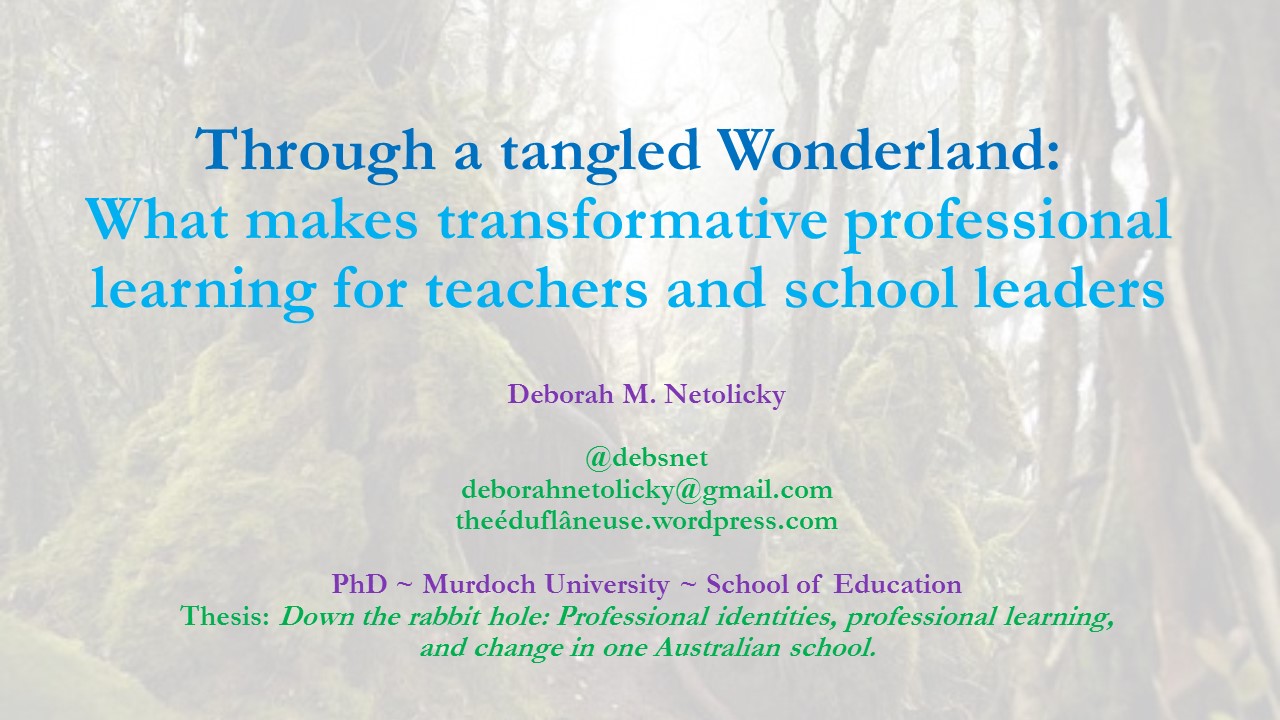
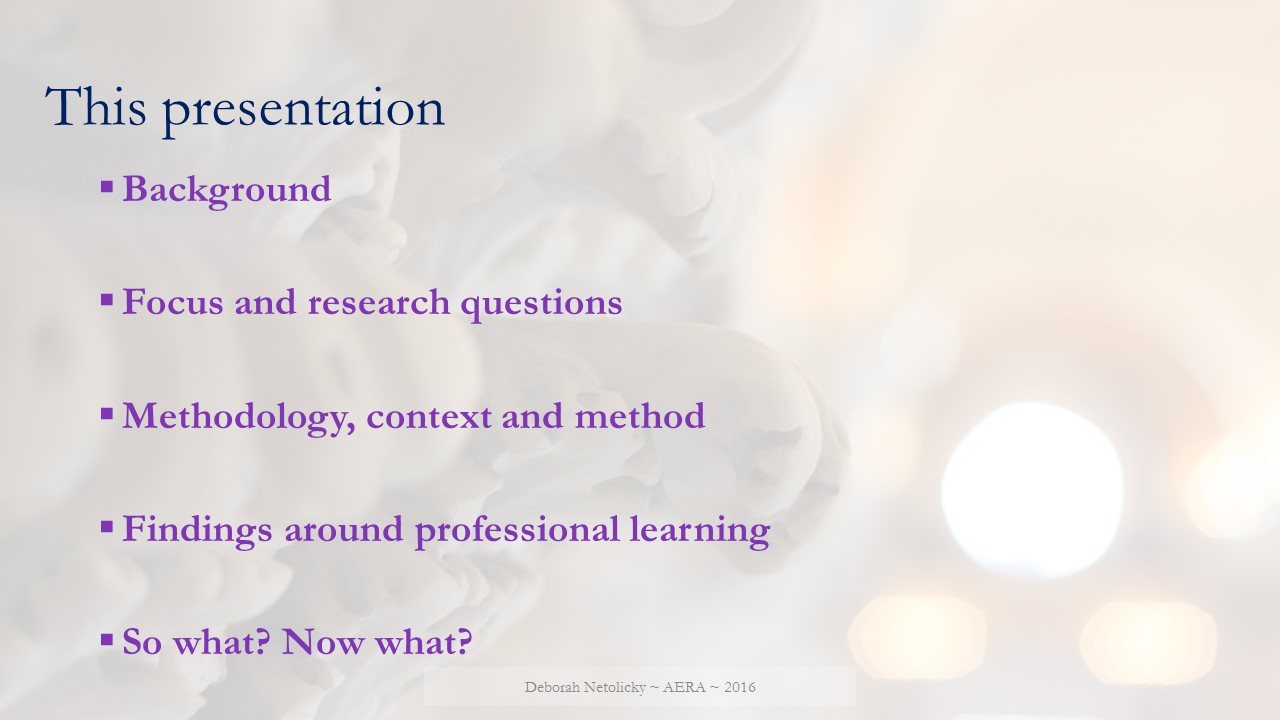
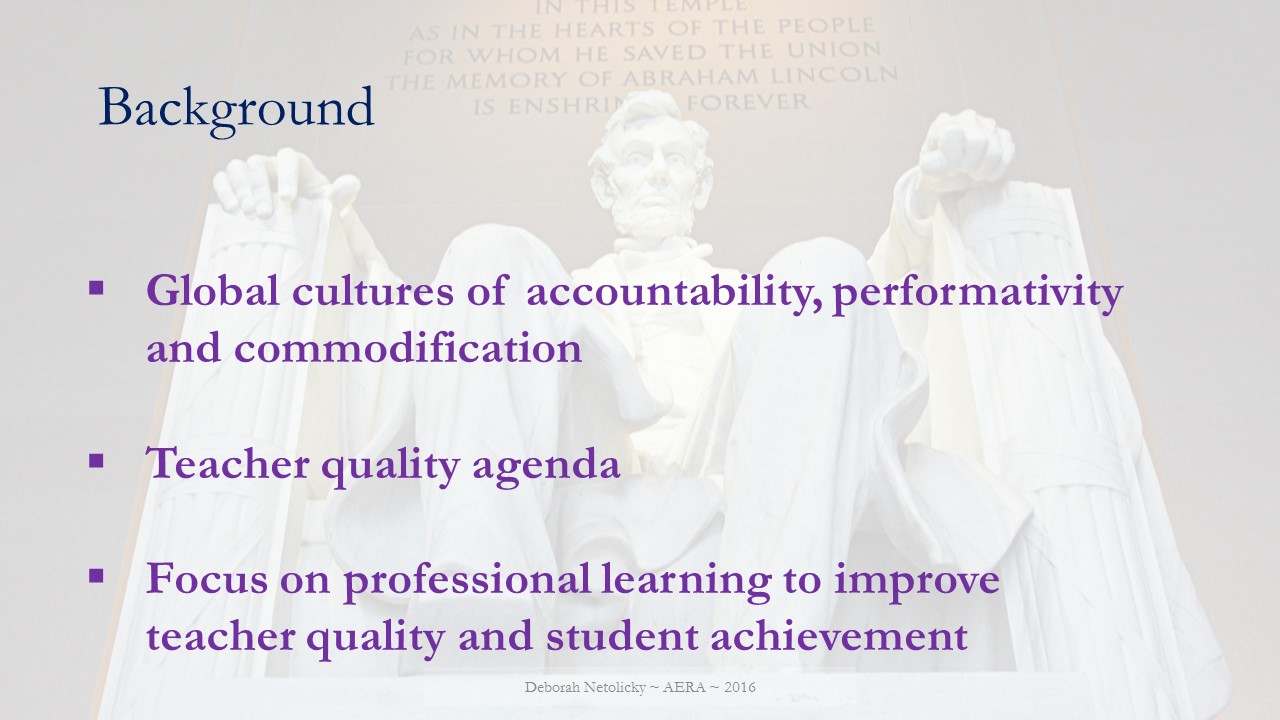
Yesterday I presented a paper in Washington DC at the American Educational Research Association national conference, in its 100th year. This particular paper outlines my PhD’s general findings around professional learning for teachers and school leaders. It was great that more than 50 people turned up to the session, in which four papers on professional learning, including mine, were presented. The papers were a complimentary combination that really spoke to each other; I learned a lot from my co-presenters. We had plenty of generous feedback and robust discussion which spilled out into the hallway for almost an hour after the session ended, and then beyond.

My full paper will be available in the online repository when the 2016 papers go live. In the meantime, here are copies of my presentation slides. The slides were designed for me to talk to, not read from, so much of the content is thin. That is, they’re light on text and light on references (see the paper for more depth), but you’ll get a sense of my main points. Of course I didn’t get through them all and ended up skipping over the participant quotes (19 slides in 12 minutes? What was I thinking? #overexcited #lessonlearned).

If you’re interested in more, my dissertation, which looks at professional learning in more depth, as well as its interactions with professional identity and school culture and change, can be downloaded here.

From my experience so far I can highly recommend the AERA national meeting. It’s a friendly conference with an impossibly wide range of interesting and important work being shared, and connections being made.

Slide1

Slide2

Slide3

Slide4

Slide5

Slide6

Slide7

Slide8

Slide9

Slide10

Slide11

Slide12

Slide13

Slide14

Slide15

Slide16

Slide17

Slide18

Slide19

Coaches, fit your own oxygen masks! How do we support the coach’s needs?

As a coach, and leader of a team of coaches, I spend a lot of time thinking and writing about the needs of the coachee. Coaching is all about the coachee. The context in which coaching happens must establish and maintain trust. In my school, this means that the coaching conversation, when it happens with one of our team of trained cognitive coaches, is confidential. The details of any observed lessons or coaching conversations are not passed on outside of the coach-coachee relationship. Line managers are still expected to be aware of the teaching, development and work of their staff. Managers might pop in to lessons and conduct their own conversations, but the person’s coach is not a place for others to glean information. We have been very deliberate about protecting the sanctity of the coach-coachee relationship as, without trust, the conversation is no longer a safeguarded space for formalised reflection. It would become tainted with hints of evaluation, accountability and fear that could hinder honesty and prevent vulnerability.

A coach uses their coaching toolbox of strategies and awarenesses to minister to the coachee. To reflect, facilitate, provoke and deepen the coachee’s thinking, by paraphrasing and asking questions, while applying a nuanced understanding of non-verbal language and of cognition. When coaches reflect, they do so to develop their craft in order to better help others to build internal capacity, to better create a non-judgmental space for coachees to freely explore their thoughts and experiences, to paraphrase with more precision or question with more sophistication, to more deeply internalize the many layers of coaching knowledge and practice.

But recently I’ve been wondering about the needs of the coach. I’ve been a coach in some coaching conversations which have been emotional or confronting for the coachee. I’ve found myself affected by the emotion of the conversation, deeply immersed as I am in rapport with that person. I have left these conversations wanting to debrief, but aware of the moral obligation to maintain confidentiality for my coachee. When confidentiality is promised to the coachee, so that the conversation can be a safe space for talk, where can the coach go to reflect on their own experiences? How does a coach refine their practice if they are unable to share their experience of the conversation?

Coaches require somewhere for the coach to go in order to refine their coaching practice through reflection and planning, and as a tool for self-care. Fit your own oxygen mask before helping others, and all that. What support do coaches need? Who coaches the coaches? Where and how might they access support in ways which are mindful of the trust put in the coach to be trusted fortress of coachee information? What responsibility do organisations have in providing support structures for their coaches?

I’m lucky to work with a team of coaches at my school. We have all been trained in Cognitive Coaching, in non-inferential lesson observations and in using the Danielson Framework for Teaching as a tool for teacher reflection. In our meetings and in our Voxer group, we are able to debrief with each other to some extent, or to throw out questions to the collective mind when we come up against coaching challenges. We never use coachees’ names in these discussions or divulge identifiable information, so we tend to talk cautiously around issues or questions we have. For example: How might we differentiate our coaching model for highly-reflective or highly experienced teachers? What questions might be useful for surfacing deeper or more abstract thinking? How might we respond in a coaching conversation which becomes highly emotional for the coachee? We might have textbook answers from our training, but talking about and around these sorts of questions helps us to tease out our beliefs about coaching, our coaching practices and the tensions within our specific context. It helps to develop our shared understandings and language of coaching, as a collaborative group of coaches.

Ideally, a coach would be provided the opportunity to be coached on their coaching. In my coaching team we sometimes participant in meta-coaching (coaching about coaching) with each other. While we don’t ask our coachees to permit us to collect data during conversations, we can do this when we coach each other. A video or audio recording, or a transcript of questions and paraphrases, can act as data on which the coach can be coached around their own practice. We tend to do this in training or within our own coach group, so as not to impact our conversations with coachees. There’s nothing more likely to shatter the sense of a trusting, safe space than setting an iPad or dictaphone on the table to record the conversation!

Of course a coach can debrief at home, to a partner or family member, which might allow an opportunity to download. But this won’t necessarily provide a high level of support in working through an issue or experience.

Another possibility is finding support from coach-educators outside one’s own school context. I’m grateful to have connected with other Australian educators who are using and leading coaching in their own schools. On Voxer, we are able to discuss the issues in our own contexts, again without divulging names or identities of others. I can ask a question of the group and receive thoughtful, informed feedback from those who share my view of coaching but have different tools and knowledge at their disposal. Sometimes a paraphrase from another coach is all I need to see my own issue more clearly. Coaches informally coaching coaches, at point of need. It’s brilliant DIY professional support. I’ve found this invaluable in allowing me to think aloud about, and be coached through, wonderings or experiences, while protecting the confidentiality of my coachees.

Learning through sharing with other coaches is one reason that a few of us—myself, Chris Munro, Corinne Campbell and Jon Andrews—started the monthly Twitter chat #educoachOC. This one hour chat, which we co-moderate on the first Monday of each month, is a vehicle for bringing together those involved in coaching in education. The discussions are often rich and allow coaches, and those leading coaching initiatives in schools and systems, to explore the commonalities and differences, privileges and challenges. I emerge from that hour feeling understood and invigorated.

Being a coach (like being a principal or CEO, I imagine) can be lonely work, because the coach is required to keep what’s said in the coaching conversation, in that coaching conversation. As coaches, it’s important that we find ways to develop our practice and support our own needs, while protecting the trust of the coaching relationship. We need to support coaches, so that coaches can best address the needs of those they coach.

The Danielson Framework for Teaching as tool for professional reflection and conversation

2013 Danielson Framework for Teaching Evaluation Instrument cover

2013 Danielson Framework for Teaching Evaluation Instrument cover

The Framework for Teaching is a research-based set of components of instruction, aligned to the INTASC standards, and grounded in a constructivist view of learning and teaching. The complex activity of teaching is divided into 22 components (and 76 smaller elements) clustered into four domains of teaching responsibility. ~ Danielson Group website

I have spent a lot of time blogging about the coaching part of my school’s coaching model and some outlining the specifics of the model and the ways we use lesson data. I’ve spent less time talking about why and how we use Charlotte Danielson’s Framework for Teaching as a tool for professional reflection and conversation. In this post, I’ll illuminate some of the reasons for adopting the Framework and the ways in which we use it at my Australian school.

Danielson’s Framework—explained in the most detail in Enhancing Professional Practice: A Framework for Teaching (Danielson, 2008)—provides a map of what excellence in teaching might look like, providing a set of shared, explicit descriptors. Grounded in research, it is a thorough, multi-layered definition of good teaching which identifies a comprehensive range of teacher responsibilities. The Framework is intended to be part of transparent, active processes such as teacher reflection, professional inquiry, classroom observations, mentoring, coaching, and Human Resources processes such as recruitment, evaluation of teacher performance and appraisal. The use of such a framework depersonalises conversations about teaching, focusing discussion on specific elements of practice, rather than on the individual. It provides a shared, explicit set of descriptors.

The Framework clusters its twenty two components of teaching into four domains of teacher responsibility:

    • Domain 1: Planning and Preparation
    • Domain 2: The Classroom Environment
    • Domain 3: Instruction
    • Domain 4: Professional Responsibilities

The components are intended to be applicable to diverse settings and independent of any particular teaching methodology. Whilst these components are separated for the purpose of the Framework, they are acknowledged as interrelated parts of a complex holistic endeavour. In action, the Framework is more web-like than grid-like. This is reflected in the choice of cover artwork for The Framework for Teaching Evaluation Instrument (Danielson, 2013) which shows the four domains as an intersecting Venn diagram.

The Gates Foundation’s Measures of Effective Teaching project studied 23,000 lessons of 3,000 teacher volunteers in six USA urban school districts in order to investigate how teacher practice affects student achievement. It found that the Framework:

  • was positively associated with student achievement gains;
  • focused observers’ attention on specific aspects of teaching practice;
  • established common evidentiary standards for each level of practice; and
  • created a common vocabulary for pursuing a shared vision of effective instruction.

The project also concluded that, when implementing an instrument for teacher  evaluation (or, in our case, reflection and growth):

  • clear standards and multiple observations are required when evaluating a teacher’s practice;
  • evaluation systems should include multiple measures;
  • combining observation scores with evidence of student achievement gains and student feedback improved predictive power and reliability and identified teachers with larger gains on state tests; and
  • the true promise of classroom observations is the potential to identify strengths and address specific weaknesses in teachers’ practice.

It was our reading—of Kane and Staiger’s (2012) Measures of Effective Teaching research paper and Sartain, Stoelinga and Brown’s (2011) report on Chicago’s implementation of the Danielson Framework, as part of its Excellence in Teaching Pilot—which influenced the design of our observation model in which each teacher has four 20 minute observations per annual cycle of coaching.

For us, using Danielson is about each teacher looking at specific lesson data at a particular moment in time, and interrogating where the evidence places that data against Danielson’s framework. In any one observation, teachers’ data might be rated (by themselves, or as calibrated with a coach or manager) across three different levels. Of course with knowledge and increasing familiarity of Danielson’s framework, teachers can work with an understanding of the way it frames ‘distinguished’ teaching, aiming for that, but all teachers, no matter their expertise, will have lessons which fall across components and across bands.

Dylan Wiliam's book on my desk; just a few Post-its

Dylan Wiliam’s new book on my desk; just a few Post-its

Imagine my delight (yes, serious nerd delight) when I discovered that Dylan Wiliam’s just-released book Leadership for Teacher Learning spends seven pages (pp.45-51) outlining the research findings around the Danielson Framework. While he cautions that the Framework is limited, especially in its ability to differentiate variation among teachers, he describes it as “rigorously researched” and “the best we can do in relating student progress to classroom observations.” Wiliam cites research on which my school’s decision to use Danielson was based. He points out that it has been shown that students taught by teachers who are rated highly on the Framework make more progress. In fact, students taught by a teacher rated as ‘distinguished’ make almost 30% more progress than those rated as ‘unsatisfactory’.

For my school, the Danielson Framework for Teaching instrument—congruent with our performance review, professional development and coaching processes—helps us to develop a precise and shared language of practice. It isn’t used as a scorecard for external evaluation, something which I strongly advocate against. We instead use it in the following ways.

  • Coaches and managers are trained by a Danielson consultant in generating lesson data and using the Framework in professional conversations (which aligns with out Cognitive Coaching model for coaching conversations).
  • Teachers complete an annual online self-reflection against the Framework, in order to surface reflections about their teaching, help them set goals, and guide their thinking as they plan for the year ahead;
  • During coaching conversations, coaches help teachers to consider their lesson data against the Danielson Framework, looking closely at the descriptors and facilitating reflection against the rubrics.
  • The Danielson Framework sits alongside the Australian National Professional Standards for Teachers as a tool for deepening reflection and conversation about practice, allowing teachers to more specifically envisage, articulate and enact excellence in teaching practice.

This use of the Danielson Framework fits with our philosophical position that everyone is coachable, that all teachers have the will and skill to improve, that coaching should develop internal capacities, and that the coach is always in the service of the coachee.

Indra’s Net: We are all connected

There is an endless net of threads throughout the universe … At every crossing of the threads there is an individual. And every individual is a crystal bead. And every crystal bead reflects. Not only the light from every other crystal in the net but also every other reflection throughout the entire universe. ~ Anne Adams

This post itself is a tangling of threads. It is in part a reflection on the first day of the national Australian Association of Research for Education (AARE) conference, which I am attending and at which I am presenting a paper. It is also part of a wider conversation I’ve been having through blogging. It was incited today by Robyn Collard’s Welcome to Country in which she used the above Anne Adams quote which refers to Indra’s Net, a Hindu and Buddhist concept that articulates the interconnectedness of the universe. It imagines each individual as a dew drop, jewel or pearl: reflective and distinctive, but also interconnected with all the other dew drops via the threads of the web. Parts and whole. Dazzling individualism within collective network.

This quote and concept added a layer to an already-layered conversation I’ve been having in the blogonet with Helen Kara and Naomi Barnes. It started with Steve Wheeler’s #blimage (blog + image) challenge. When Helen shared a photograph of tangled dew-bejeweled spiders’ webs in her garden, both Naomi and I responded to the image. Naomi wrote about the messiness of research. I wrote about how technology connects people to one another. I’ve since also written about the web-weaving spider as a metaphor for the researcher. And today I was connecting at AARE, in person, with a web of academics who I know mostly through their work and through Twitter.

So here I am again. Contemplating the web. And the dew drop jewels. And their infinite reflections and refractions. Their beauty and fragility and separateness and togetherness.

I spent much of this first day of the AARE conference in a four hour symposium in which scholars brought diverse perspectives to the same general topic of leadership in education. They agreed and disputed. They converged and diverged. It was a great example of respectful, well-considered and articulate debate. Graceful disagreement. Elegant contestation. Research as conversation.

For instance, in conceptualising leadership as artistry, Fenwick English noted the webbed connections between research, art, leadership and creativity. Scott Eacott discussed the relational aspects of leadership and of research, asking scholars to consider how their work relates to that of others. Christina Gowlett approached school leadership from a perspective of challenge and critique, agitating against dominant approaches, norms and expectations by embracing alternate theories of uncertainty and transgression.

Additionally, Gabriele Lakomski and Colin Evers discussed thinking in schools as a wide cognitive net. They define cognition as a dynamic system, comprising reciprocal interactions between people, artefacts, resources and environments. They noted that thinking is not just computationally logical-deductive; it is interpretive, intuitive, behind consciousness and beyond awareness. They explored the notion of the extended or supersized mind which distributes cognition. Our tech is our selves. Our communities and social networks are change collectives. Gabriele and Colin noted that cognition occurs “beyond skin and skull”, challenging the myths of the stand alone thinker, the heroic leader and the change agent. Individuals influence and are influenced by each other. Thinking and being is connectivity. Web not hierarchy.

These ideas resonate with the perspective I will be presenting at the Heroism Science conference in 2016, which suggests a reimagining of heroism in school leadership. That is, that school leader ‘heroes’ can work subtly, fluidly and invisibly in the service of their school communities. In education there needs to be shared vision and individual purpose, collective and individual capacity. Strengthening the web while protecting and nurturing the dew drops.

Like Costa and Garmston’s (2006) notion of holonomy (which is based on Koestler’s 1972 conceptualisation of the ‘holon’), Indra’s Net shows the dual importance of the individual and the collective. The jewel and the net. All are simultaneously together and separate. A change in one is reflected in a change in all.

So as I reflect (like the dew drop), I imagine webs of learning, webs of emotion, webs of relationships, webs of identity. I wonder: What influences the symbiosis between individual and collective? In what ways might we shape others? In what ways might others shape us? These could be questions for families, friendships, organisations, communities, nations, the world. What about our selves can we control and what choices are we making about what our own self-jewel reflects onto those around us and onto the universal web? In what ways could we harness the global mind, the universal self and the interconnectedness of humanity?

Imagine a multidimensional spider’s web in the early morning, covered with dew drops. And every dew drop contains the reflection of all the other dew drops. And in each reflected dew drop, the reflections of all the other dew drops in that reflection. And so ad infinitum. ~ Alan Watts

Reflecting on education Twitter chats

How to tune the voices on the airwaves?

How to tune the voices on the airwaves?

Chats can fall prey to … a lack of meaningful connections (with people or ideas), superficial conversations, and a lack of some sort of closure.

If mismanaged, preplanned chats can sometimes feel contrived. Better planned and executed, they might have the feel of a productive town hall meeting.

But like a town hall meeting, people can shout, speak without actually having conversations, or be lost in a crowd. You leave such a meeting asking yourself what just happened or if anything useful took place.

Sometimes the best conversations are the ones that are neither fast or slow. They are spontaneous and come from a place of honesty or concern.

Dr Ashley Tan in his September 2014 blog post

In the education world of Twitter, hashtag chats are ubiquitous and, for many, an important way to connect with other educators. I’ve talked before about how Twitter is a kind of writing and thinking practice, helping me to distil and crystallise my thinking. I participate in Twitter chats for a few reasons. In these forums, people interested in things I’m interested in are likely to be on the airwaves at the same time; I can find a tribe of sorts. I can connect with new and familiar voices in the Twitterverse.

Many chats are scheduled weekly, and happen over the course of an hour, with either one question, or more usually, a series of questions scheduled throughout the hour. There are also ‘slow chats’ which pose one question and allow those from different time zones to engage in discussion across a day or a week. I approach different chats in different ways. Sometimes I immerse myself in the chat. Sometimes I dip in and out. Sometimes I end up in a side chat having tangential conversations with people whose thinking is coalescing with mine in that moment.

You can find a schedule of the global range of education Twitter hashtag chats here.

As Greg Ashman notes in his post today, Twitter chats can connect us with fellow geeks, even when we’re feeling isolated in our own contexts. He also points out that chats often don’t allow participants to engage in the assumptions underlying their questions. In a chat we were both lightly engaged in today, there were, for instance, attempts by some participants to explore the situated, nuanced nature of the topic. There didn’t seem to me to be a clear understanding of what participants meant by the topic, or why or in what ways they felt it was important. At times it felt like people putting sticky notes up on a wall; comments were being placed alongside each other, but they were disparate and not based in the same conversation or on a foundation of common understanding.

I’d agree that often chats deal with complex concepts and unclarified terms, and sometimes they can descend into a superficial cacophony of noise where people are talking but not listening, learning or questioning. Sometimes when I have questioned the use of a term or the premise of a chat question, I’ve been engaged with by others, but I’ve also been ignored or dismissed.

Sometimes, Twitter chats can produce an echo chamber of like-minded people high-fiving each other. In some ways, this feels good, as Twitter is a place many find solidarity and support. In my participation in the PhD Twitter community, it is often moral support that I’ve sought out in times of academic struggle or isolation. But while dissent is hard in 140 characters – and can easily come across as abrasive or attacking, rather than gently provocative or inquiringly questioning – I hope for robust, rather than cursory or jargonistic, discussion from educators. Yet difficult in 140 characters.

Personally, I’ve found a solution of sorts in this blog. I use it to expand my thinking and explain it to others in more depth than even a series of tweets would allow. Blogging opens up the education conversations we have, widening and deepening debate. We can disagree more gracefully if we have more words in which to do it. I’ve really enjoyed those times in which I’ve been engaged in a conversation with other bloggers, as we build on and respond to each other.

More recently, I’ve experienced Twitter chats from the organiser side. A couple of months ago, Chris Munro, Corinne Campbell, Jon Andrews and I launched the monthly #educoachOC chat, one intended to start a conversation around coaching in education at an Oceanic-friendly timezone. My co-moderators are educators I initially met on Twitter, and now our common interests have developed into this collaboration.

After collaborating using tools such as email, Google docs, Voxer, Twitter messaging and Trillo, we planned our approach and our questions for the first chat. We also launched a blog as a home base; we wanted to make our approach clear and our thinking explicit.

The #educoachOC team learned a lot from our first chat. We reflected on how we found the chat as moderators, how we felt the conversation went between participants, and also used a Google survey to allow participants to give us feedback. In that first go, we had too many questions, which left it feeling a little disjointed at times as people jumped off interesting threads of conversation to answer the next question. One participant said they felt as though they had been coached through the chat; that we had modelled coaching through our questioning and format. One said that most contributors were pulling in the same direction and that it would be interesting if opponents of the approach challenged one another. A major reflection from that first chat was around the clarity of terms. We found participants were all talking about coaching, but seemed to have different understandings of what that meant.

In our second chat, we reduced the amount of questions and focused the chat around clarifying the group’s understanding of coaching. We were keen to build a shared understanding amongst this online community. We prefaced the chat with a blog post outlining the contestations and confusions, and some useful resources. It worked better, we reflected, and we’ll continue to collaborate and refine our approach and format. In that second chat (there’s only been two so far), we were trending in Australia, at the same time as #qanda. While we certainly didn’t intend to be a trending hashtag, that was a reflection of the level of discussion and participants’ engagement in the topic and with each other. It felt much more like a conversation which allowed us to deeply explore a topic and some of its complexities.

I think the education Twitter community does wonderful, exciting things, including through Twitter chats, in which I am immersed. But I do think we can be reflective and critical about how we run these chats, how we participate in them and how we use other media such as blogs, podcasts, Periscope and Voxer to take our conversations further, deeper and towards rigorous and elegant debate.

Collecting honest data on coaching perceptions & impacts #educoach

Bruce Nauman's Human/Need/Desire, 1983 ~ photo taken at MOMA

Bruce Nauman’s Human/Need/Desire, 1983 ~ photo taken at MOMA

In a gentle way, you can shake the world. ~ Mahatma Ghandi

As coaches it is important that we gather data about the impacts of our practice. As a coach we might feel a conversation or relationship has gone well, but how do we know? How can we find out the depth of our coachees’ perceptions, vulnerabilities or reflections?

This has been on my mind as this year my school’s teacher growth model, of which coaching is a central piece, moved from pilot program populated by volunteers, to mandated model which involves all teachers in the school. This is a big shift. Piloting a model with teachers who have volunteered to be involved and are keen to have a voice in school change, is very different to applying a model, no matter how flexible and differentiated, to all teachers at a school. We’ve been very aware that one size does not fit all. We’ve tried to design something which is relevant and adaptable from person to person, early to late career, pre-kindergarten to Year 12, Physical Education to English Literature. Coaching is a big part of this as the lesson data collected and the following conversation are all about the coachee; where they are at; where they would like to go.

Over the last two years I have used focus groups of teachers and coaches to gather some of the data I’ve been using to reflect and report on our impacts. This year, too, we want to gauge how we’ve gone. The intention of our model is that it is meaningful for teachers, rather than a box to be ticked or a process to be endured. We want it to nurture cross-school professional connections, open classrooms, and build internal teacher capacities. We want it to be a process which both trusts teachers and in which teachers feel they can trust. (I visually represented these intentions in this post.) So how can we see if that’s happening beyond what the coaches might observe or what information teachers might anecdotally volunteer?

In order to get a sense of how teachers are finding the process, I have recently set up an anonymous survey monkey survey with the following questions. Apart from questions 12 and 14, which are optional comment boxes, the questions are click-button ones on a Likert-style rating scale of Strongly Agree – Agree – Neutral – Disagree – Strongly Disagree. The good thing about that is that it is quick for teachers to complete, and easy to analyse. While it provides a snapshot of how teachers are finding the coaching cycle, a limitation is that it doesn’t drill down into the why of respondents’ answers.

The survey questions:

  1. I have a clear understanding of the cycle’s process, expectations and roles.
  2. I found the reflection survey useful in terms of my teaching practice.
  3. I have felt comfortable having someone (and/or a video camera) in my classroom.
  4. I found the data collected in my lesson observations useful in terms of my teaching practice.
  5. I found the coaching conversations useful in terms of my teaching practice.
  6. I have felt that my coach is approachable, supportive and trustworthy.
  7. I have found it ‘do-able’ to manage the cycle in terms of time, scheduling, and, where appropriate, technology.
  8. The cycle has helped me gain greater awareness and clarity around my teaching and what happens in my classroom.
  9. The cycle has helped me clarify my instructional goals (i.e. how and in which areas I would like to develop my teaching).
  10. The cycle has resulted in the development of one or more collegial relationships (with either my coach or another team member).
  11. I have made changes to my teaching or classroom as a result of the cycle.
  12. Optional comment: If I have made changes to my teaching or classroom, what have these been?
  13. I think the cycle has had a positive impact on my teaching practice.
  14. Optional comment: I would like to offer the following comments or suggestions for the development of the cycle from 2016.

It is important that they survey is anonymous as we want the feedback to be honest. While these are by no means comprehensive, they provide a piece of our data puzzle in looking to the impact of our observation and coaching cycle as professional learning. It is by listening to positive and critical perspectives that we can identify those things working well, and address those areas of challenge.

Coaching fields forever #educoach #twistedpair

strawberry fields forever

strawberry fields forever

Today’s blog post is a response to two blogging challenges: the #educoach October blog challenge and the #twistedpair blog challenge set by Steve Wheeler, in which a blog post needs to blend two disparate things. I’ve decided to pair coaching (something of my journey as/to coach here) and picking strawberries. (Although now that I look back on Steve’s challenge, he asks us to pair people or characters, not things; still, I hope this counts as a strange duo.)

So how is coaching like strawberry picking?

Today I took my two young children to pick strawberries. After a week of working relentlessly on my PhDdeep in the thesis cave where it’s dark and solitary, and with a sprained ankleit was so good to get out into the sunshine and the dirt. 

The first rows were dry and over picked; there wasn’t much to find. We fossicked and looked, but our box remained sparsely populated. It wasn’t until we walked further afield that we found bushes that were greener, bushier and more bountiful. Even then, it wasn’t until we crouched, paid attention to a particular plant, and looked deeply into its foliage, that we found the glossiest and juiciest strawberries, protected by shade and unseen by others who had trudged by without stopping to examine that plant and explore its blossoms, leaves and unseen-from-the-outside fruit.

This reminds me of coaching, which requires us to approach a person, the coachee, uncertain of what we might find or where we might find it.  We cannot assume where they are at, or where the conversation is going to go. In order to uncover and bring to the surface thinking which they haven’t previously accessed—not to mention the a-ha moment, or ‘cognitive shift’ as it’s called in Cognitive Coaching—we need to be present, pay attention, and expertly use questioning to reveal those glossy, or rotten, unsurfaced thoughts which help that person to take their own reflection, practice or dilemma to the next level.

by @debsnet

part of our haul

Not only that, but as I picked the strawberries this morning, and later washed and sorted them this afternoon, I noticed their snowflake-like idiosyncrasies. Each was recognisably a strawberry, but each was a slightly different shape, colour and texture, with a stalk which bent a different way, or seeds which sat differently against its skin. Some were under-ripe, some had just begun to turn, and others were at the apex of their strawberry-eating life: red, shiny, firm and glorious. Each coachee is an individual, and they are in a different place each time we meet with them. So while a coach might apply a coaching conversation map or set of tools to all coachees, each relationship and each conversation will look different, shaped by its person, time and place.

Combining two very different things seems a disruptive way to approach a topic. I’m interested in how we might bring new understandings to familiar concepts or practices by attempting a twisted pairing. I’ve written before about research and Wicked, the musical, and my PhD as a sculpture or birthday cake. I’m wondering what else I might uncover about myself as coach through analogy or metaphor.

by @debsnet

strawberry blossom in the sunshine; perfect potential

Coaching: My state of play ~ #educoachOC

Let’s open the door for teachers to power us forward in defining the most promising paths for public school improvement. ~ Kim Farris-Berg & Edward Dirkswager, Flip the System

MET rooftop, by @debsnet

Tonight’s inaugural #educoachOC Twitter chat, of which I am a co-moderator, is titled ‘State of Play’. That is, my co-moderators and I are intending to gauge where our professional learning network are at in their coaching journeys and contexts, and to facilitate the sharing of stories.

In the lead up to the chat, I thought I would consider my own ‘state of play’; where I’m currently at with coaching.

My current role in my school involves, in part, bringing current research literature into the school context, and making it accessible to staff, leaders and the school board. My main brief has been to research, design and enact a bespoke, context-specific teacher growth model which brings that research to life. That is, I’ve been working with teachers, leaders and consultants to tailor evidence-based school-aligned professional growth practice, for and within my school’s context. This work has come both from the top down (initiated by the principal, and emerging out of the school’s vision and strategic intents) and the bottom up (driven, designed and piloted by teams of teachers).

In 2012, when I wrote a research paper for my school on how to improve teacher quality, I began looking seriously at coaching literature. In addition, in October 2012 I began my PhD study (I’m hoping to submit my thesis next month!) which asks what it is that shapes teachers and school leaders. What transforms professional identities and practices? What incites growth and change in educators? Part of the answer to these questions lies in coaching. I’m about to submit an article to an academic journal which outlines my research findings around coaching as a tool for professional growth.

As part of the training for the enactment of our teacher growth model, in 2013 I did the Cognitive Coaching Foundation course for the first time, as this was the model of coaching my school decided upon. I did the course again in 2014, and again this year. While I have repeated the course mainly for team-building reasons, I have found that re-visiting the material and the conversations has allowed me to add nuances and layers of complexity to my coaching practice. It has allowed me to internalise some of the skills and tools, and to refine others.

Our Teacher-Coaches (a small team of teachers trained and practised in Cognitive Coaching, lesson observation techniques and the Danielson Framework for Teaching – my elite squad!) and I began with piloting and iterative design-and-refine stages in 2013 and 2014. Across 2013-2014 there were 19 Teacher-Coach team members and an additional 11 teachers who volunteered to be coached; 30 teachers – from across year levels, subject areas and career stages – experienced the pilot model.

This year we have moved to a fully implemented model in which all teachers at our school are involved in a coaching cycle every year. The cycle is three-yearly, so in Years 1 and 2, teachers are coached by a Teacher-Coach, and in the third year, teachers are coached by their line manager. This third year is based in coaching, but managers also draw from consultative and evaluative toolboxes as appropriate.

My coaching dream is twofold. I have a ‘future perfect’ for myself as a coach, and also for my school. For me, I hope to continue to grow my own practice, to become a masterful coach who is able to paraphrase and craft questions in ways which clarify and extend a coachee’s thinking, while paying attention to where a coachee is operating and where they might be able to cognitively move. I’d like to be able to help even the most reflective practitioners to experience what Cognitive Coaching calls ‘cognitive shift’, in which the coachee has an ‘a-ha!’ moment of realisation which allows them to move beyond their current state.

For my school, I hope to see the continued development of a coaching model of teacher growth which is based in a positive belief in the capacities of teachers to choose their own trajectories of learning, to analyse and grow their own practice, to reflect deeply.

This year I have seen teachers take their own lesson observation data and share it with colleagues and line managers in order to start important conversations and share practice. I hope to continue to see the power of data to transform, not only individual practice, but collective capacity and professional community as an organic learning mass.

So, that’s a little about my own ‘state of play’. I look forward to hearing more tonight about where others are in their coaching journeys. The chat’s questions can be found here. Happy coaching!