Gonski 2.0: Promoting a deficit view of Australian teachers

eroded wall

source: pixabay @aitoff

There are things I like about the Gonski 2.0 report. I have written, for instance, about the promotion in the report of professional collaboration and learning for teachers and school leaders, and the suggestion that teachers need time to focus on teaching, and school leaders need time to focus on instructional leadership over administration. Education Minister Simon Birmingham has previously said that he hoped Gonski 2.0 would be a unifying basis for a focus on evidence-based classroom practice. There is little detail in the report around evidence-based classroom practice, although there is the recommendation for a “national evidence institute to share best-practice and evidence-based innovations faster and more widely.” I would suggest that the report is not a unifying one around which educators can rally.

What has made me uncomfortable is the deficit perspective it provides on Australian schools, teachers and leaders. For example, the statement that Australia has “an industrial model of school education that reflects a 20th century aspiration to deliver mass education to all children” seems a stretch. I know ‘industrial model’ is a favourite term from those wanting to push innovation agendas, but anyone in today’s Australian classrooms, from early learning to late high school, knows that they are hardly factories for unthinking worker bees. In fact, the criticism of Australian education as industrial 20th century factories of mass production sits in opposition to the basis of much of the report on economic imperatives and the need to prepare students for the future of work (or perhaps this is what it means to have a 21st century industrial model of education). The focus on data generation, data tracking and accountabilities, if anything, seems to promote education as more machine than human endeavour.

The report’s deficit narrative about education is based on the problem it poses: that Australian education has widespread “declining performance” and “performance slippage” as measured by PISA testing. This is the basis on which the report argues that “Australian education has failed a generation of Australian school children by not enabling them to reach their full learning potential.” Wow. As a number of scholars have argued—such as Sam Sellar, Greg Thompson and David Rutkowski in their excellent book The Global Education Race—while there are things we can learn from PISA, there is much that we cannot, and using PISA to compare education across different countries is often unhelpful and misleading. Singapore is singled out as an exemplar of PISA achievement, despite the fact that its school cultures, curriculum and education practices are at odds with the Gonski 2 report’s suggestions of learning progressions and individualisation of learning.

The report calls many schools “cruising schools” and explains that these are schools that are maintaining average achievement from year to year, but not improving. The rhetoric of ‘cruising schools’ and ‘one year’s growth per year of schooling’ (also prominent in the report) has been used by Professor John Hattie for some time. Yet it constructs schools whose academic achievement remains steady but not improving as somehow coasting along (lazily or incompetently seems to be the implication) without progress, according to NAPLAN data. Apart from the fact that NAPLAN itself has been often called into question as a measure of student learning, the report surmises that “the explanation might be that Australian teachers, schools systems and schools are not equipped to identify and effectively support cruising students and schools to improve.” Here the teachers, schools and entire education system are posited as the reason for schools whose achievement appears steady but not improving, when NAPLAN data is used as the measure of achievement.

The report proposes that Australian education needs to do a number of things that I would argue most Australian educators are already doing: continuously improve our practice and service to our students; set high expectations for students, educators and schools; adjust our teaching for the needs of our students; and—my favourite—“maximise each student’s learning growth each year, rather than simply supporting each student to attain the minimum proficiency for the year level.” That last one is one I am sure many teachers read with a double-take, because I don’t know a teacher or a school who sees their job as to ‘simply support each student to attain the minimum proficiency for the year level.’

Teachers around the country already focus on student data, formative assessment and responding to student needs, something the report promotes as ways forward. Tailored teaching is given a fairly broad definition in the report. It “involves adapting the way the curriculum and learning activities are presented and adjusting pedagogy to the different needs of students based on evidence about the most effective interventions, gained from an understanding of individual students’ starting points and their growth in learning.” The report is hazy on the details of what ‘individualised learning’ and ‘personalised learning’ look like, how personalised it is expecting teaching and learning to be, and how this dovetails with preparing students with the knowledge, skills and understandings they need to be ethical, empowered and contributing citizens.

There are places where the report acknowledges work that has been and is being done in Australian education. It additionally provides Australian case studies of what it considers to be good practice, and direct quotes from submissions it received from various stakeholders, showing that it has listened to Australian educators. It has a whole chapter entitled ‘Creating, supporting and valuing a profession of expert educators’, but seems to base this on the premise that teachers aren’t currently good enough and need to be improved. It is hard to wade through the Gonski 2 recommendations without feeling like ‘supporting and valuing a profession of expert educators’ isn’t really something in which the review panel believes. On reading the Gonski 2 report, it is hard to move past the distrust of the teaching profession underlying its content and the deficit narrative to which it seems to be contributing. Australia is not Singapore, Shanghai or Canada, all education systems held up as exemplars in the report. Of course we can and should improve Australian education. Of course we should have high expectations of students and educators. Of course we should develop our knowledge of effective teaching, learning and leading. Of course we should continue to develop our engagement with research and evidence. But Australian education is not a factory model of mass education production. It is not a calamitous problem to be solved, a bunch of broken individuals to be fixed, or a commercial opportunity ready to be flooded by corporate solutions. Australian teachers, school leaders and schools deserve trust, respect, support and involvement in policymaking.

Middle leaders: The forgotten stratum

willow tree, Denmark, Western Australia

School leadership is full of tensions and complexities. As I discovered while reviewing literature for my PhD, middle leadership is the forgotten realm of research in education. There is plenty of research on pre-service teachers (no doubt these participants are easy for those working in universities to recruit), a lot on teachers, and loads on principals. There is much less on those in the middle. The principal, even when not touted as the charismatic hero, is the focus of much school leadership discourse, despite the popularising of distributed leadership and teacher leadership. Of course, the principal of any school is central. They set the tone, lead the vision, directly manage senior leaders, deal confidentially with sensitive issues, and much more. But a school’s leadership culture does not begin and end with the principal. Those in the middle manage up and down, in and out, and are often sandwiched between being advocates of the teams they lead and a cohesive voice of management. They are pressed upon from below and above.

If school vision is to be enacted or school culture is to be shifted, middle leaders who directly lead teams of teachers, are key. These middle voices are often ignored in scholarly literature and in media narratives. This gap was why it was important to me (having been myself a middle leader in schools for many years) to draw on the voices of middle leaders in my doctorate.

In my last post I outlined what my school is trialing for teachers in terms of development options within the organisation (complimentary to, but not to be confused with, professional learning offered within the school and also outside of school through courses and conferences). Below I outline the options we have available to middle leaders. That teacher and middle leaders have similar-but-different options acknowledges their varied needs. Even within the middle leadership stratum, there are a diverse range of needs and experiences, from early-career or new leaders, to very experienced veterans more suited to giving back to the profession. The options this year for our middle leaders are as follows.

  • Coaching with a coach who might be a peer, another leader from the within school, or possibly an external person. Unlike the teachers, who are coached around their teaching practice, leaders are likely to be coached around their leadership.
  • A reflection and feedback process with their line manager (which needs to happen every 3-4 years). For leaders, this occurs around their role description, and may dip into the AITSL Standards for Principals rather than only the Standards for Teachers, as appropriate.
  • Working with an expert teacher who acts as a kind of classroom consultant. This is likely to be most relevant for instructional leaders such as Heads of Faculty.
  • An internally-designed leadership development programfor aspirant or early career leaders; includes leadership profiles, senior and executive school leaders running sessions.
  • professional learning group, bringing staff together from across the school to engage in scholarly literature, reflection, and shared practice.
    • Teaching best practice
    • Pedagogies of learning spaces
    • ICT for teaching and learning
    • Post-graduate study

Additionally, leaders at my school attend coaching training and a once-a-term Leadership Forum (examples from last year include presentations from Dylan Wiliam and Pasi Sahlberg, a panel of local principals, and an internal session on goals and strategy). These initiatives are intended to develop leaders’ knowledge and skills, and also a shared culture of how we approach professional conversation, our own learning and collaboration with one another.

This approach to staff development, one that is bedded in the organisation but also flexible to individual needs, reminds me of a quote from one of my middle leader PhD participants. Theirs is a metaphor that sticks with me as I go about my work in staff development and professional learning.

“I see the vision as more like the trunk of the tree; it’s the main thing that we all sort of hang off, and we do.  But we’re all going to be branches that come out from that trunk, and we do have our own little sub-branches occasionally that we can then look at as well, but we still are connected to that trunk of that tree.”

The notion of a school as a tree is resonant with the concept of holonomy (see Costa and Garmston, Koestler, or other posts on this blog). Deep roots, a strong shared trunk, thick team branches, and spindlier individual branches diverging out in idiosyncratic directions. Individual and school are simultaneously together and apart, different and one, part and whole, connected and separate. It is my hope that in my work I can at once support the growth of individual and school, as well as their complex and symbiotic interrelationship.

Building a school research culture

source: pixabay.com @ninocare

This year has been my first in a new role, the oddly titled ‘Dean of Research and Pedagogy’. I have a broad portfolio, including such things as pedagogy from PK-12 and overseeing the work of the Library, but two major aspects of the role are:

  • Building a professional learning culture of continual improvement, data generation and analysis. This includes overseeing the professional learning agenda and staff development, overseeing teacher action research projects, supporting our staff doing post-graduate study, leadership development, coaching teachers and leaders, and refining performance and growth processes.
  • Research innovation and support. This is about disseminating and building a body of research that promotes quality pedagogy and teacher improvement, executing evidence-based strategic initiatives, and working to develop a data analytics culture.

I sat down at the beginning of 2017 to map out how I was going to address these aspects of my role. What was the underlying strategy? What were the deliverables? Who were the key stakeholders? At the end of each year, how might I know I had been successful? What evidence of my own influence might I see if I was being successful in nudging the ever-nebulous school culture?

I wrote a two-year strategic plan (a working document that I revisit regularly) and put some measures for myself in place.

What follows is not my plan or those measures, but the kinds of things I have tried this year in my attempt at developing the research culture of the school.

  1. Harnessing internal and external expertise

As I explained in this recent blog post, staff development can include coaching, mentoring, consulting, courses, conferences and regular opportunities for goal setting and performance review. It includes collaborative learning experiences and those that occur over time. It includes harnessing both external and internal expertise.

This year a new initiative related to my role was called the Leadership Forum, a once-per-term cheese-and-wine event dreamt up and co-launched with the Director of Strategy. All of our school leaders, from Coaches and Year Co-ordinators to Heads of Faculty and the Executive, are invited each term to an early evening of cheese, wine, and connecting around leadership. This is an opportunity to connect the strategy of the school with the operational and relational work of our leaders.

The first Forum of the year was run by myself and the Director of Strategy, in which we took leaders through a process of reflecting upon research findings on effective school leadership, and then worked with them to set goals for themselves and their teams, aligned with the strategy of the organisation. For the second forum, we welcomed Professor Dylan Wiliam. For the third we ran a panel of three principals who spoke openly about their journeys of school leadership. And this final term, we welcomed Professor Pasi Sahlberg. This Forum provides one example of a way to engage teachers and leaders in current conversations around education, and with research and researchers.

Bringing experts into the school, and having them speak to our context, meant that their words and points connected more strongly with the people in the room. Also, staff enjoyed the collaborative experience of hearing them speak, together, so conversations have continued well after each presentation finished. Creating these kinds of crucibles of collaboration, and following up with books or articles that build upon the presentations, has been one way to nudge people’s thinking, especially when presenters are provocative or challenging.

  1. Research reports

I have published six of what I call the ‘Research Report’ to staff this year. The report is intended to provide all staff access to current thinking, research, and writing, around education. Across the year the report provides resources (from academic and theoretical, to popular and easily accessible) relevant to our specific school context, including to various sub-schools, faculties, and strategic priorities. The selected readings are a small selection rather than a comprehensive collection. Staff are encouraged to dip in and out according to their personal and professional interests.

I have been interested to note those people who have provided positive feedback about the report; many are non-teaching staff—from the Bursar to the administration staff—who have appreciated being able to immerse themselves in, or dip into, educational thinking, and have this shared in an accessible way. Making research accessible to all democratises the community and empowers everyone to have conversations around education. It has incited many corridor conversations, as well as more formal ones.

  1. Publishing on school platforms

Research is partly about communication and dissemination. In a school environment it is important that research can be made accessible for the community.

This year, on the school blog, I have written about things such as measuring success in education, professional conversations, and digital learning. In these posts I have referenced research in order to model how research can inform the thinking of educators and schools.

I was interviewed for the school podcast around the question, ‘What makes a great teacher?’, and I’ve written for and presented at other forums, in school and nationally.

Communicating in blogs, podcasts, and presentations, allows research to become alive and humanised.

  1. Keeping the staff professional reading library current

I am a card-carrying member of The Book Depository and have ordered plenty of resources for the professional reading library at school, in order to provide staff with the opportunity to engage with current research. At the end of each term, I promote a selection of books by emailing about them and placing them on a red trolley for the end-of-term staff morning tea in the Library.

I remind staff that professional reading can be counted as an informal professional learning activity under our Teacher Registration Board Professional Learning Activities Policy, so they can log it as part of their 20 professional learning hours per year for teacher registration.

  1. Keeping myself current

I could not do this role without keeping myself up to date with research. My adjunct position at a university helps to keep me current (as I have access to research literature behind the pay wall). It also allows me to do thorough literature reviews, such as those I have completed this year on digital learning and school libraries. I now have staff asking me to find current research literature for them to inform the work they are doing.

  1. Collaboration

It should go without saying that none of this happens without collaboration with a web of stakeholders. Relationships are key in this role. There’s no point me being in my office, reading away like the nerd I am, if no one is engaging with me or the work. Much of my day is spent in formal meetings or informal conversations.

One of the indicators of my success is when people seek me out, such as for individual coaching around career or professional development or a staff issue, to work with a team around a problem of practice, to generate data to gauge their impact, or to help with a Masters dissertation or PhD application.

One challenge to anyone in this kind of Research Lead role is the reality of the lives of teachers and school leaders. Educators are busy, pressed on from all angles, constantly rushing to their next class, to mark their next assignment, to jump through the next accountability hoop. Leisurely time and space to sit back and drink from the fire hose of current research literature is a fantasy. In addition, as this Deans for Impact blog post explains, teachers have deeply held sets of cultural and personal beliefs about learning and about how to best serve their students.

Engaging in research, and in discussions and explorations about research, can help teachers to interrogate those beliefs and bring together science, evidence, and systematic thinking with their praxis (wisdom of practice). We should value teachers’ lived experiences of lessons, relationships, students, and bringing content to life through pedagogy. We can also work to incrementally develop school cultures in which research becomes a part of ‘the way we do things around here’.

Educators: Hold the line on voice, autonomy, and trust

Can we hold the line in the face of challenging circumstances?

This week I was thrilled to welcome Professor Pasi Sahlberg to my Western Australian school to talk to our leaders—from coaches and team leaders to Heads of Faculty, senior leadership and the Executive—about school leadership and what high performing education systems do. Pasi’s list covers things about which many of us leading in schools, and researching and writing about education, are concerned: collaboration, learning and wellbeing, trust-based responsibility, continuous improvement, and equity. They are also guiding principles for teachers in classrooms, who use what Pasi calls ‘small data’ every day. In my PhD, which was based around effective school change and transformational professional learning, these were also themes that emerged; in particular, my research surfaced trust, professional collaboration, and continuous improvement through a range of educator-centred experiences.

I am reminded of the chapter I have co-authored in the upcoming Flip the System UK: A Teachers’ Manifesto book. In it, Jon Andrews, Cameron Paterson, and I, cite Sahlberg’s concept of the Global Education Reform Movement (GERM) and its destructive influence on teacher voice, power, and agency. We argue for a re-professionalising and re-humanising of teaching and education.

I am reminded, too, of my speech to the Australian Council for Educational Leaders conference last year about trusting and supporting teachers. In his new book, FinnishED Leadership: Four big, inexpensive ideas to transform education, Sahlberg supports the autonomy of teachers and schools. He writes:

Strengthen collective autonomy of schools by giving teachers more independence from bureaucracy and simultaneously investing in teamwork in your school. This enhances social capital that is proved to be a critical aspect of building trust within education and enhancing student learning. (p.43)

He notes that the Finnish government spends 30 times more funds on the professional learning and development of educators than on accountability procedures, such as tests and surveys.

We live in a time of compliance and performativity. Australian schools are like tin cans being crushed from the outside-in by a focus on the results external testing (NAPLAN, HSC, WACE, VCE, PIRLS, TIMMS, PISA, the upcoming Phonics Check) and on publicly published league tables and competition-based publications such as the myschool website.

When Pasi spoke to leaders at my school, robust discussion ensued. He challenged us to ask what is within our control, what it is that we can change, what we would do if we could enact our dream for the best way of serving our students, starting tomorrow. He challenged us to question the systemic and regulatory parameters within which we operate, and to hold the line on those things we know will make a difference to our students.

Sahlberg’s work is supported by that of others, such as Michael Fullan’s on the wrong drivers for education reform, and Fullan’s work with Andy Hargreaves on professional capital in their book, Professional Capital: Transforming teaching in every school, and in the Journal of Professional Capital and Community. The Flip the System movement, too, beginning with Jelmer Evers and René Kneyber’s book Flip the System, brings together and champions the voices of teachers, academics and education experts in order to reclaim the space of education discourse for those working within schools.

So, what can we do in our own contexts? How might we reshape the narrative of education, or advocate for the following?

Less testing

More collaboration

Less accountability

More equity

Less competition

More trust

Leadership lessons from school principals

source: pixabay.com by @ThinkTanks

Part of my role in overseeing professional learning at my school is building a variety of ways to develop the capacities of leaders. Our termly leadership forum, a new initiative this year, provides a place and space for all of our leaders – from coaches and pastoral leaders, to heads of faculty, senior leadership, and the Executive team. We meet each term for an evening of wine, cheese, provocation, and connection. In Term 1 I ran a session with the Director of Strategy on thinking about leadership in terms of research, organisation, team, and self. In Term 2 we welcomed Professor Dylan Wiliam to our forum.

This term we welcomed a panel of three independent school principals to present to our school’s leaders. These three panellists represented more than three decades of principalship between them. They had some clear messages about leadership for leaders at all levels, including the following.

……

Embrace opportunities

The panel encouraged everyone to embrace and pursue available opportunities, to take on challenges and pursue work and service that energise, inspire, and motivate us, and that align with our framework of personal beliefs and values. For me this is about aiming to do good work, without a clear vision of where this might take me.

Be yourself

All three principals said something that resonates with my own philosophy: in order to lead effectively, we need to be authentic. That is, rather than trying to perform the identity we think others are hoping for, each of us can be ourselves. Being ourselves means knowing ourselves. To be authentic leaders, we each need a clear sense of our own core values and beliefs, and a willingness to be transparent in our thinking.

Back yourself

The stories of these three principals showed that we need to be ‘in it to win it’; that is, to put our hat in the ring even when we might not be the obvious choice for a leadership position. Backing ourselves means having the courage and confidence to put our hands up to take on responsibility, and having the self-awareness to know what we bring (and don’t bring) to the work and leading we do. Part of this also means to be unafraid to challenge others or to call out injustice, and to have the capacity to be decisive even when faced with challenging issues.

Receive and give encouragement

All three principals had at some point received a ‘shoulder tap’ where a colleague or more senior leader had suggested they apply for a leadership position they had not considered. I have also had these experiences where someone has recognised for me an opportunity that I didn’t recognise for myself. These are moments that can help us to reimagine of what we are capable, and where our paths might take us. I am grateful to those who have taken the time or opportunity to challenge me on the limitations I have sometimes set for myself.

We can each listen to advice from others and be open to opportunities we may not have considered for ourselves. Each of us can also find opportunities to recognise, acknowledge, and encourage those around us; to let others know when we see leadership potential in them; and to pull others up with us, championing their work and helping them and others to see their possibilities.

……

The panel also had plenty to say about being a principal. Principalship is leadership as service that can have very real impacts on those in the role. As the results of the Australian Principal Health and Wellbeing survey show, Australian principals score lower than the general population on positive measures of wellbeing, quality of life, and mental health; but higher on negative measures such as stress, depression and sleeping trouble. Our panel discussed their own self-care strategies and the ways in which they look after themselves as they navigate what is complex, unrelenting, ethically-challenging, and often isolated work.

Our panel also noted that ‘principal’ is a leadership position that can be reached via a range of pathways. This encouragement comes at a time when Australia has a shortage of those aspiring to principalship, with a looming shortage as the majority of Australian principals reach or near retirement age.

The message from our panel was that being a principal is doable. Their stories brought a human side to the role and one panellist noted that the principalship is not a special place for an elite few but something to which many can aspire, and in which many can find success. The caveat here was that aspirant principals needed to be those with a strong values framework who is clearly aligned with the core values and mission of the school they are leading, and an ability to make decisions under pressure.

The lessons from this panel of principals are relevant for those aspiring to leadership and those already leading. Whether we have a leadership title, or are seeking opportunities to positively influence the world around us, we can be authentic and true to ourselves. We can be motivated by what energises us and by our desire to make a difference in the world. We can be courageous in our action and communication, make deliberate ethical decisions, and enact well-considered actions that are based on a solid foundation of self-awareness, self-efficacy, and self-belief.

What does it mean to be a leader?

leadership according to the internet

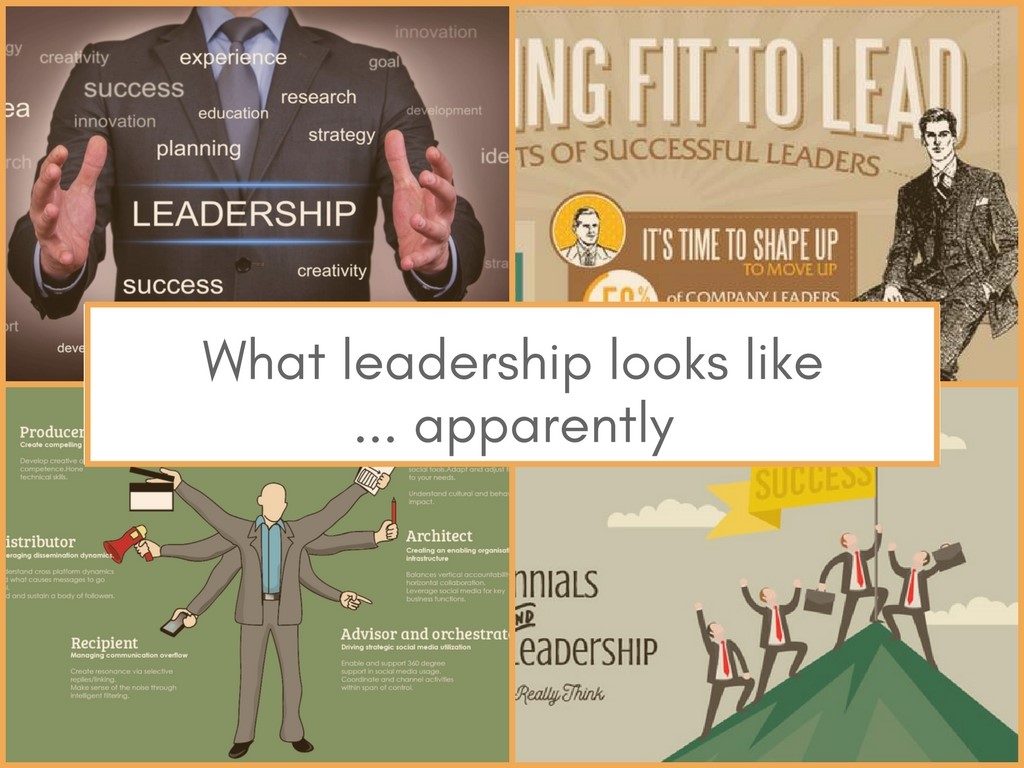
One thing that drives me mad in my social media feeds are the images that accompany articles on leadership. Infographics about leaders often feature male suited figures. An Google image search for ‘leader’ results in swarms of male figures in front of a group or standing atop a mountain. This presents a very limited notion of what a leader is or to what leaders should aspire. The men photographed or illustrated for these images of leadership tend to be white and photogenic, and wearing suits or capes. Leader as man. Leader as hero. Leader as at the apex. Leader as forging ahead.

Some of the academic writing I’ve been doing around leadership, in the form of journal articles and book chapters, has me revisiting my thinking around leadership. I’ve written before about challenging traditional notions of what a leader is and what they do. I wonder how my own approach and journey might play a part in offering alternative narratives of leadership. How does my story allow others to imagine a leader who may not be out in front, or on top, or male, or in a suit, or wearing a cape? How might leaders or aspirant leaders give themselves permission to lead differently, or to aspire to images of leadership that are different: softer, more collaborative, less visible, more joyful?

This isn’t about being a woman or a man, but about everyone being able to access a continuum of ways of being and leading. Or perhaps it isn’t a continuum but a web of possibilities, connected but divergent.

I have always lived the educational cliché – doing my very best, striving for high achievement, immersing myself in lifelong learning. Many of the leaders in my PhD study said the same: not only had they drunk the Kool-Aid of education, but they also felt its essence down to their bones. Leading, teaching, and learning aren’t add-ons or aspirations, but ways of being based on deeply held beliefs.

I have been a school leader since my first principal took a chance on me by promoting me to a Head of Faculty position in my second year of teaching. I was 22 years of age. I was tasked with leading teachers who had been teaching for more years than I had been living. My approach then, similarly to my approach now, was around building trust and relationships as the foundation stones of leadership. As Bryk and Schneider (2002) assert, relational trust is the connective tissue that binds together individuals with the common mission of advancing the education and welfare of students.

Now, my leadership style is based in an understanding of leadership literature, valuing of relationships, belief in the capacities of those I lead, and willingness to listen equally to enthusiastic perspectives and dissenting voices. My PhD and current role mean that I am a practitioner committed to I research-informed and data-rich practice. I also, however, place great value in practitioner experience, the wisdom of professional practice, and the capacity of those with whom I work, to grow, improve, and serve their students and communities.

My approach to school and cultural change is ‘go slow to go fast’. Deliberate, collaborative change coaxes buy-in and ownership from stakeholders. It involves creating a shared need, designing a shared vision, and then energising, mobilising, and building the capacities and motivations of others to propel change. This kind of leadership isn’t about me, but about how to fire holonomy (Costa & Garmston, 2015): the nuanced interactions between ‘me’ and ‘we’, individual and organisation, cog and machine. As Andy Hargreaves and Michael Fullan (2012) point out, the group is more powerful than the individual in school and system change.

The reason that I continue to blog, to edit and contribute to books, to act as a peer reviewer for journal articles, to engage at conferences and online, is because I want to be part of shaping narratives of education and leadership. It is my hope that through sharing my voice I can be part of offering alternatives and providing solutions.

I have had two children along the way, and have navigated my way through the decision-making that comes with finding ways to be a good parent, a good spouse, and to do work that I think makes a difference in the world. As a leader I am mindful of the example I set for others in the decisions I make around work, family, and wellbeing.

As a leader, I don’t aspire to embody the hero, perform the all-knowing problem-fixer, or forge ahead with innovation at a rate of knots. I aim to be my authentic self and work to empower and elevate others in what Andy Hargreaves, Alan Boyle, and Alma Harris (2014) call ‘uplifting leadership’. Sometimes leading means holding the line or being calm in the eye of a storm. It often means giving others what they need based simultaneously on a balcony view of the macro picture, and an intimate understanding of the individual.

References

Bryk, A., & Schneider, B. (2002). Trust in schools: A core resource for improvement. Russell Sage Foundation.

Costa, A. L., & Garmston, R. J. (2015). Cognitive Coaching: Developing self-directed leaders and learners. Hawker Brownlow Education.

Hargreaves, A., Boyle, A., & Harris, A. (2014). Uplifting leadership: How organisations, teams, and communities raise performance. John Wiley & Sons.

Hargreaves, A., & Fullan, M. (2012). Professional capital: Transforming teaching in every school. Teachers College Press.

Semantic space: ‘How we talk around here’

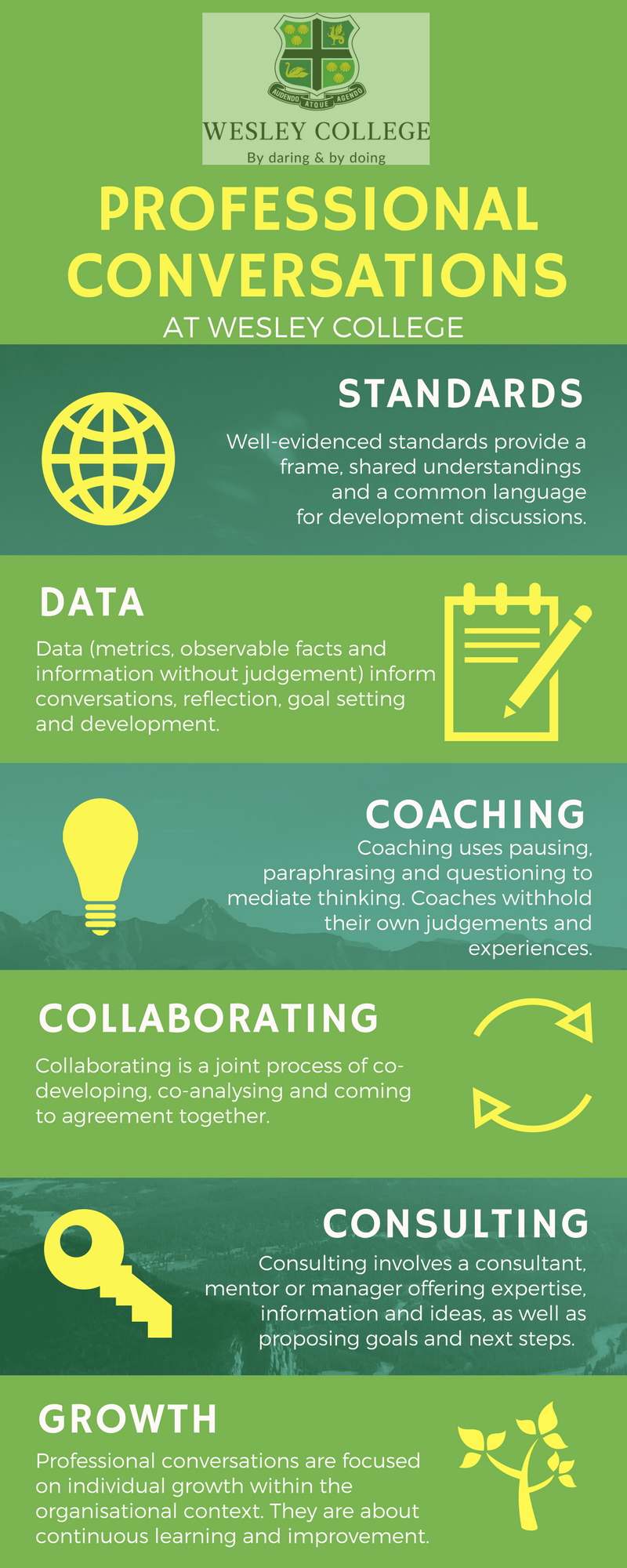
I’ve been thinking about talking and talking about talking. The pictured infographic is one I designed to distil my school’s approach to professional conversations. While deceptively simple, it is the result of a lot of research, practice, and writing, over time. In that blog post, I talk about why we use Cognitive Coaching as a coaching model for developing a collaborative professional learning culture, but also when we might deliberately use consulting, collaborating, or evaluating as ways of talking. Rather than adopting deficit models of conversation aimed to fix or tell teachers, we base our professional conversations on a belief in the capacity of everyone in our community to grow and improve.

At the Australian National Coaching Conference in Melbourne last month, I was immersed in talking about coaching, and talking with coaches. I was delighted to be on a conference panel with Christian van Niewerburgh, Rachel Lofthouse, and Alex Guedes, discussing coaching in education research. One of the points I made was around the use of terminology within a community like the one in the conference room. 400 educators and coaches were all talking about coaching at the conference, but not necessarily with the same understanding of what ‘coaching’ means.

Many of the conference attendees had what Christian van Niewerburgh calls a ‘coaching way of being’. A conversation with them is a coaching conversation. These individuals actively and intensely listen, paraphrase, pause, and ask thoughtful questions designed more for the benefit of the talker than the listener. These aren’t conversations where the other person is waiting for their turn to say their piece or pushing a personal agenda; they are ones in which the listener serves the talker via thoughtful and deliberate ways of talking and ways of being in conversation.

At the conference, Rachel Lofthouse talked about Kemmis and Heikkenen’s (2012) notion of a semantic space. I enjoyed this way of thinking about an organisation. Semantics is about linguistic meaning; the logic of language. In organisations I imagine a semantic space is about ‘how we talk around here’, the meanings of words, the way communication happens. Lofthouse and Elaine Hall (2014) define semantic space as one of professional dialogue, constituting tone, choice of words, routines of dialogue, and balance of participation in conversation. Semantic space interacts with organisional structures, physical spaces, and relationships.

Harvard academics and developmental psychologists Robert Kegan and Lisa Lahey (2001) say that our places of work are places in which certain forms of speech are promoted or encouraged, and places where other ways of talking are discouraged or made impossible. What kinds of talk are promoted in our schools? Which are limited or suppressed?

Can it ever be ‘just’ semantics? No. The words we use, the way we talk, and the way we interpret language are vital to our work, especially in education. Members of high-functioning teams, for instance, respectfully challenge one another in order to find the best ways forward. Something Rachel Lofthouse said in her conference keynote stuck with me: “Don’t talk less and work more. The talk is the work. So talk well, talk productively, talk to learn.” The way we talk can influence the way we think and the way we behave. In any organisation it’s important to figure out and work on ‘how we talk around here’ as well as why we talk, when we talk, what we talk about, and how we want to talk.

References

Kegan, R., & Lahey, L. L. (2001). How the way we talk can change the way we work: Seven languages for transformation. John Wiley & Sons.

Kemmis, S. and Heikkinen, H.L.T. (2012). Practice architectures and teacher induction. In: H.L.T. Heikkinen, H. Jokinen, and P. Tynjälä, eds. Peer-group mentoring (PGM): peer group mentoring for teachers’ professional development. London: Routledge, 144–170.

Lofthouse, R., & Hall, E. (2014). Developing practices in teachers’ professional dialogue in england: Using coaching dimensions as an epistemic tool. Professional Development in Education, 40(5), 758-778.

Reflecting on the school leader

The bad leader is he who the people despise; the good leader is he who the people praise; the great leader is he who the people say, “We did it ourselves”. ~ Peter Senge, The Fifth Discipline

Part of my PhD literature review encompassed what makes effective school leadership, and effective leadership of change or reform in schools. If you don’t fancy savouring all 300 odd pages of my dissertation, the summary of my literature search determined that effective school leaders:

  • Develop shared vision;
  • Have high expectations and clear accountabilities;
  • Develop an environment of trust;
  • Empower others and allow them autonomy, space, and support to lead;
  • Solve complex problems;
  • Engage with the wider community; act as storyteller and sense-maker; and
  • Balance instructional and transformational leadership.

Many of these points are reflected in the Australian Professional Standards for Principals, which break school leadership down into the following components:

  • Leading teaching and learning;
  • Developing self and others;
  • Leading improvement, innovation, and change;
  • Leading the management of the school; and
  • Engaging and working with the community.

Both of these lists cross over one another, and each seems simple in its short-list nature (5 dot points! How hard can it be?), but looking closely at many of these aspects of school leadership quickly reveals the complexity of the mandate. On top of that, school leadership teams are under pressure from constant measures of their performance. Leadership itself becomes a quantified, evaluated performance. Meanwhile, on a daily basis leaders constantly code-switch as they move from the classroom, to the boardroom, to the parents’ committee, to the community event, to the performance management conversation, to the staff member or student who needs support.

My PhD study found that school leaders are constantly navigating internal, relational, and organisational identities. These complex and sometimes competing identities affect leaders’ experiences and decision making. The leaders in my study were moving, often deliberately and relentlessly, between leadership modes that were directive and empowering, hero and servant, visible and invisible.

Leading is a constant state of becoming and of identity work. Peter Gronn, in his 2003 book The new work of educational leaders: Changing leadership practice in an era of school reform, reminds us that leaders’ senses of who they are, and who they aspire to be, play a pivotal role in their engagement with their work. Having multiple leadership roles in my current school has meant that it is not only me who has had to shift my self-perceptions or identity enactments, but also my colleagues who have had to see me in new ways across my time at the school. Additionally, I have multiple, competing identities that exist simultaneously with my school identity; as parent, spouse, sibling, daughter, researcher. Boundary spanner and pracademic. Identities like plates precariously spinning atop spidery poles.

While Gronn suggests that individuals rework their perspectives in relation to their contexts, my PhD found that, while context does shape professional identity, individuals also choose their contexts to fit their own identities. My leader participants indicated that they stayed in schools that resonated with their senses of professional self, and left schools in which they did not feel aligned with organisational purpose and action. That is, school contexts shape leaders, and leaders shape their contexts. Leaders can and do choose schools with which they feel an identity fit, and leave schools in which they feel they do not fit.

Wellbeing is a real issue in school leadership, as reflected in the results of the longitudinal Riley study, which has found that Australian principals score lower than the general population on positive measures of wellbeing, quality of life, and mental health; but higher on negative measures such as stress, depression and sleeping trouble. Leaders need formal and informal support, as well as their own strategies for self-care and renewal. It might be that school leadership can be summarised in a series of dot points, but it is contextual, complex, and lonely. It is challenging and rewarding, exhausting and exhilarating.

Running the PISA race

The education culture of performativity is wrapped up in notions of measurement. How do we measure student success, teacher performance, effective school leadership, and successful education policy? How do we know which school systems are successful and why they are successful? How can we tease out and understand causes of performance, such as the influence of social and economic factors, the system, the school, and the teacher? These are perennial education questions, and ones which continue to become more and more important in a globalised world in which countries, schools, and teachers can be compared, and in which there is an ever-increasing weight of accountability.

Standardised testing is a central issue in this neoliberal education context. Individual schools have their own approaches to measurement, such as the one I describe in this blog post. In Australia we have NAPLAN and WACE. There is currently talk of a national Phonics Check in the early years, such as that used in the UK. Internationally we have TIMSS, PIRLS and PISA.

Steven Lewis and Anna Hogan have shown how oversimplified reports of international testing measures can contribute to oversimplified ‘fast policy’. As Marten Koomen points out, systems should respond to international testing measures but these systems are complex. Stewart Riddle and Bob Lingard wrote that looking at a single country’s PISA ranking is useless; rather we need to carefully disaggregate the data and consider social and economic factors, and differences between states, schools and groups.

This week I received in the mail a copy of new book The global education race: Taking the measure of PISA and international testing, by Sam Sellar, Greg Thompson and David Rutkowski. (Full disclosure: I got a complimentary copy.) It is a pocket rocket at about A5 size and 99 pages. In the Foreword, David Berliner and Pasi Sahlberg question the value often ascribed to PISA, noting that PISA tests are linked to the social conditions as well as school systems and that “when the race to the top gets tougher … curriculum narrows and children suffer” (p.ix).

The book demystifies the workings of PISA, using the extended metaphor of the ‘race’ as a way to make sense of what PISA is, how it works, how it might be used, and how it shouldn’t be used. The authors make their explanations accessible without ignoring the complexities of standardised international testing on a large scale. The book is at once matter of fact and told with a wry sense of humour (as a reader I’m a sucker for references to Monty Python and 1980s arcade games). The book rails against the commodification of simple solutions to solve complex problems. As I explored satirically in this He-Man inspired post (speaking of 80s references) there are plenty of edu salespeople hoping to profit from the pressures of accountability pressing in on schools and teachers. This book, however, is about helping those on the ground to understand the complexities, inner workings and possibilities of PISA.

What sets Sellar, Thompson and Rutkowski’s book apart from other literature is its ability to engage with complexity in an accessible way; to explain clearly without simplifying; and to avoid binaries and polarising divides while acknowledging differing perspectives. They note, for instance, that PISA has been innovative, carefully developed, and judiciously administered, but that such a big project will undoubtably suffer from technical issues and limitations.  They note that PISA is an assessment of select content areas of one sample on one day, but also argue that transparent standardised tests like PISA can be a useful tool for understanding social systems. They explain validity in understandable ways and show how countries can use PISA data responsibly.

The international examples help the book to be relevant to people in OECD countries around the world. For Australian readers like myself there are some gems, such as that PISA performance has become an end in itself, evidenced by the national target of improving Australia’s PISA ranking by 2025 (articulated in the 2013 Education Act). The authors call this move “astounding”. Their tongues are firmly in their cheeks when they state on page 76 that: “The aim of reversing the trend of declining PISA scores seems to be to improve PISA scores through intensifying those policies that have not worked so far. A bold move.” A bold move, indeed, and one that Simon Birmingham might want to reconsider.

The authors also recognise the desire of policy makers, educators and the media to understand PISA and to glean the most important messages it can tell us. They warn, however, about over-attribution of causality, when correlations become causal claims, pointing to the way the media and policy makers often use PISA to point to particular factors as being the cause of high or declining PISA performance. I’ve written about the dangers of policy moves like performance pay for teachers, and the authors have warnings to offer their readers about the negative effects of pairing standardised testing with punitive accountability regimes, and of governments desperately scrambling to ‘win’ against other countries. Run your own race, they argue.

The global education race presents an important challenge to policy makers and educators alike: to develop informed communities willing and able to engage in discussion of how educational measurement, including system-level measurement tools, can be judiciously used to inform policy and practice. The kind of shift they suggest is a challenge. It will require ministers, media and educators to take a non-divisive, sense-making and collaborative approach of seeking to understand, and of deep, thoughtful engagement with data and with one another.

E4L and the value of dissent

I find it ironic that, just after a blog post in which I reflected that blogging often feels like shouting into the void, a recent post on this blog has received a robust and ongoing response, as well as plenty of rich conversation, online and in my immediate context.

I wrote earlier this month about my ponderings and cautions around the Evidence for Learning Toolkit (based heavily on the UK’s Education Endowment Fund Toolkit) currently gaining traction in Australian education circles. I felt compelled to share my thinking as the E4L Toolkit is connected with some Australian heavy hitters. It is powered by Social Ventures Australia and the Commonwealth Bank. It is advised by prominent academics from a range of Australian universities, including John Hattie who is both a champion of meta-analysis and the equivalent of an education household name. Its advisors also include high-level representatives from the Australian Council for Educational Research (ACER), the Australian Council of Education Leaders (ACEL), the Australian Curriculum, Assessment and Reporting Authority (ACARA), various independent schools associations, and various State education departments. This who’s-who is all the more reason, I think, for those in the education community to look carefully at the Toolkit and its adoption across the Australian edu-landscape.

This week, John Bush, Associate Director of Education at Social Ventures Australia and part of the leadership team of Evidence for Learning, wrote a blog post for the E4L website (the first of a series). In it, he responds specifically to some of the comments I made in my post.

John points out that my post was part of “a flurry of public comment across Australia and the UK in the value and risks of meta-analysis and synthesis of meta-analyses in education research.” Although I didn’t realise it at the time, my post did come in on the crest of a wave. Published the same day (UK time) were this article in the Times Education Supplement in which Professors Terry Wrigley and Gert Biesta call the EEF Teaching and Learning Toolkit misleading and unhelpful. There was also this response by the EEF addressing the concerns around and risks of its Toolkit.

A few days later, Rachel Buchanan posted about the need for a critical perspective when we talk about using an evidence base in education. I was also made aware
(thank you, Twitter) of this post from David Didau from last month, which questioned the objectivity of the EEF Toolkit. He has previously cogitated on the limitations of meta-analysis and effect sizes as measures in education.

In my recent post, I linked to a couple of other thoughtful blogs on the limitations of meta-analysis in educational research, one by Jon Andrews and one by Gary Jones. It’s also well worth listening to both Dan Haesler’s comments, and Cameron Malcher’s interview with E4L’s Tanya Vaughan and Janet Clinton, on this recent episode of the Teachers’ Education Review podcast.

So, amid this flurry, I was delighted when John Bush began his own considered response within a complex field: the use of evidence to inform teaching, in order to most positively impact on student learning and achievement.

Despite John’s explanations of the padlock rating system, bearing in mind the many reservations about meta-analysis, I’m not sure I’m confident with E4L’s five-padlock ‘security’ of interventions that are supported by “at least five robust and recent meta-analyses.” I was, however, relieved to read that E4L deliberately uses careful language in the Toolkit in order to facilitate nuanced understandings of the evidence it presents.

John writes that, “We do not envision the Toolkit as a resource that should dictate or direct professional decisions in schools. Instead, we hope school leaders and teachers will use it to start discussions with their peers and to help inform their professional judgement with research evidence.” These are important words, but we in education remain challenged by the tension between a desire for the simple fix and the reality of the complexities of our work. Careful language and a critical approach are important, but the appeal of the misleading media headline, the ranking on a league table, and the easy answer, remain. As a profession we need to push back against these, despite the performative culture in which we operate.

This ongoing public conversation reminded me of a podcast from Brand Newsroom in which the hosts Nic Hayes and Sarah Mitchell interview influential marketing consultant Jay Baer about his book titled Hug Your Haters. In it, Jay discusses the science of complaints. He says that praise is over-rated. Praise feels terrific, he tells us, but teaches us nothing. Negative feedback and criticism, on the other hand, teach us everything; it’s where learning and opportunity come from. Now, I wouldn’t classify myself as a hater, or a complainer, but I would probably be seen by those championing E4L Toolkit as a dissenting voice.

Being publically challenged, even gently, can be difficult, especially when we believe strongly that we are doing good work. I respect John Bush, and the folk at Evidence for Learning, for having the transparency and commitment to engage in some graceful disagreement. In doing so they are responding directly to the concerns of those like me, who, as it turns out, wasn’t blogging into a void after all. Rather, I was offering my perspective to a community of educators who seek to understand one another in order to best serve our students.

While I have moments of high cynicism and outright despair, it is blogversations like the one in which John and I are currently engaging, that can help model publically the kinds of conversations educators can and should be having. I remain cautious and critical about the Evidence for Learning Toolkit, especially in terms of the ways in which it might be adopted by educators in the busyness of their work, but I am open to developing my thinking and continuing the conversation.