The Danielson Framework for Teaching as tool for professional reflection and conversation

2013 Danielson Framework for Teaching Evaluation Instrument cover

2013 Danielson Framework for Teaching Evaluation Instrument cover

The Framework for Teaching is a research-based set of components of instruction, aligned to the INTASC standards, and grounded in a constructivist view of learning and teaching. The complex activity of teaching is divided into 22 components (and 76 smaller elements) clustered into four domains of teaching responsibility. ~ Danielson Group website

I have spent a lot of time blogging about the coaching part of my school’s coaching model and some outlining the specifics of the model and the ways we use lesson data. I’ve spent less time talking about why and how we use Charlotte Danielson’s Framework for Teaching as a tool for professional reflection and conversation. In this post, I’ll illuminate some of the reasons for adopting the Framework and the ways in which we use it at my Australian school.

Danielson’s Framework—explained in the most detail in Enhancing Professional Practice: A Framework for Teaching (Danielson, 2008)—provides a map of what excellence in teaching might look like, providing a set of shared, explicit descriptors. Grounded in research, it is a thorough, multi-layered definition of good teaching which identifies a comprehensive range of teacher responsibilities. The Framework is intended to be part of transparent, active processes such as teacher reflection, professional inquiry, classroom observations, mentoring, coaching, and Human Resources processes such as recruitment, evaluation of teacher performance and appraisal. The use of such a framework depersonalises conversations about teaching, focusing discussion on specific elements of practice, rather than on the individual. It provides a shared, explicit set of descriptors.

The Framework clusters its twenty two components of teaching into four domains of teacher responsibility:

    • Domain 1: Planning and Preparation
    • Domain 2: The Classroom Environment
    • Domain 3: Instruction
    • Domain 4: Professional Responsibilities

The components are intended to be applicable to diverse settings and independent of any particular teaching methodology. Whilst these components are separated for the purpose of the Framework, they are acknowledged as interrelated parts of a complex holistic endeavour. In action, the Framework is more web-like than grid-like. This is reflected in the choice of cover artwork for The Framework for Teaching Evaluation Instrument (Danielson, 2013) which shows the four domains as an intersecting Venn diagram.

The Gates Foundation’s Measures of Effective Teaching project studied 23,000 lessons of 3,000 teacher volunteers in six USA urban school districts in order to investigate how teacher practice affects student achievement. It found that the Framework:

  • was positively associated with student achievement gains;
  • focused observers’ attention on specific aspects of teaching practice;
  • established common evidentiary standards for each level of practice; and
  • created a common vocabulary for pursuing a shared vision of effective instruction.

The project also concluded that, when implementing an instrument for teacher  evaluation (or, in our case, reflection and growth):

  • clear standards and multiple observations are required when evaluating a teacher’s practice;
  • evaluation systems should include multiple measures;
  • combining observation scores with evidence of student achievement gains and student feedback improved predictive power and reliability and identified teachers with larger gains on state tests; and
  • the true promise of classroom observations is the potential to identify strengths and address specific weaknesses in teachers’ practice.

It was our reading—of Kane and Staiger’s (2012) Measures of Effective Teaching research paper and Sartain, Stoelinga and Brown’s (2011) report on Chicago’s implementation of the Danielson Framework, as part of its Excellence in Teaching Pilot—which influenced the design of our observation model in which each teacher has four 20 minute observations per annual cycle of coaching.

For us, using Danielson is about each teacher looking at specific lesson data at a particular moment in time, and interrogating where the evidence places that data against Danielson’s framework. In any one observation, teachers’ data might be rated (by themselves, or as calibrated with a coach or manager) across three different levels. Of course with knowledge and increasing familiarity of Danielson’s framework, teachers can work with an understanding of the way it frames ‘distinguished’ teaching, aiming for that, but all teachers, no matter their expertise, will have lessons which fall across components and across bands.

Dylan Wiliam's book on my desk; just a few Post-its

Dylan Wiliam’s new book on my desk; just a few Post-its

Imagine my delight (yes, serious nerd delight) when I discovered that Dylan Wiliam’s just-released book Leadership for Teacher Learning spends seven pages (pp.45-51) outlining the research findings around the Danielson Framework. While he cautions that the Framework is limited, especially in its ability to differentiate variation among teachers, he describes it as “rigorously researched” and “the best we can do in relating student progress to classroom observations.” Wiliam cites research on which my school’s decision to use Danielson was based. He points out that it has been shown that students taught by teachers who are rated highly on the Framework make more progress. In fact, students taught by a teacher rated as ‘distinguished’ make almost 30% more progress than those rated as ‘unsatisfactory’.

For my school, the Danielson Framework for Teaching instrument—congruent with our performance review, professional development and coaching processes—helps us to develop a precise and shared language of practice. It isn’t used as a scorecard for external evaluation, something which I strongly advocate against. We instead use it in the following ways.

  • Coaches and managers are trained by a Danielson consultant in generating lesson data and using the Framework in professional conversations (which aligns with out Cognitive Coaching model for coaching conversations).
  • Teachers complete an annual online self-reflection against the Framework, in order to surface reflections about their teaching, help them set goals, and guide their thinking as they plan for the year ahead;
  • During coaching conversations, coaches help teachers to consider their lesson data against the Danielson Framework, looking closely at the descriptors and facilitating reflection against the rubrics.
  • The Danielson Framework sits alongside the Australian National Professional Standards for Teachers as a tool for deepening reflection and conversation about practice, allowing teachers to more specifically envisage, articulate and enact excellence in teaching practice.

This use of the Danielson Framework fits with our philosophical position that everyone is coachable, that all teachers have the will and skill to improve, that coaching should develop internal capacities, and that the coach is always in the service of the coachee.


Indra’s Net: We are all connected

There is an endless net of threads throughout the universe … At every crossing of the threads there is an individual. And every individual is a crystal bead. And every crystal bead reflects. Not only the light from every other crystal in the net but also every other reflection throughout the entire universe. ~ Anne Adams

This post itself is a tangling of threads. It is in part a reflection on the first day of the national Australian Association of Research for Education (AARE) conference, which I am attending and at which I am presenting a paper. It is also part of a wider conversation I’ve been having through blogging. It was incited today by Robyn Collard’s Welcome to Country in which she used the above Anne Adams quote which refers to Indra’s Net, a Hindu and Buddhist concept that articulates the interconnectedness of the universe. It imagines each individual as a dew drop, jewel or pearl: reflective and distinctive, but also interconnected with all the other dew drops via the threads of the web. Parts and whole. Dazzling individualism within collective network.

This quote and concept added a layer to an already-layered conversation I’ve been having in the blogonet with Helen Kara and Naomi Barnes. It started with Steve Wheeler’s #blimage (blog + image) challenge. When Helen shared a photograph of tangled dew-bejeweled spiders’ webs in her garden, both Naomi and I responded to the image. Naomi wrote about the messiness of research. I wrote about how technology connects people to one another. I’ve since also written about the web-weaving spider as a metaphor for the researcher. And today I was connecting at AARE, in person, with a web of academics who I know mostly through their work and through Twitter.

So here I am again. Contemplating the web. And the dew drop jewels. And their infinite reflections and refractions. Their beauty and fragility and separateness and togetherness.

I spent much of this first day of the AARE conference in a four hour symposium in which scholars brought diverse perspectives to the same general topic of leadership in education. They agreed and disputed. They converged and diverged. It was a great example of respectful, well-considered and articulate debate. Graceful disagreement. Elegant contestation. Research as conversation.

For instance, in conceptualising leadership as artistry, Fenwick English noted the webbed connections between research, art, leadership and creativity. Scott Eacott discussed the relational aspects of leadership and of research, asking scholars to consider how their work relates to that of others. Christina Gowlett approached school leadership from a perspective of challenge and critique, agitating against dominant approaches, norms and expectations by embracing alternate theories of uncertainty and transgression.

Additionally, Gabriele Lakomski and Colin Evers discussed thinking in schools as a wide cognitive net. They define cognition as a dynamic system, comprising reciprocal interactions between people, artefacts, resources and environments. They noted that thinking is not just computationally logical-deductive; it is interpretive, intuitive, behind consciousness and beyond awareness. They explored the notion of the extended or supersized mind which distributes cognition. Our tech is our selves. Our communities and social networks are change collectives. Gabriele and Colin noted that cognition occurs “beyond skin and skull”, challenging the myths of the stand alone thinker, the heroic leader and the change agent. Individuals influence and are influenced by each other. Thinking and being is connectivity. Web not hierarchy.

These ideas resonate with the perspective I will be presenting at the Heroism Science conference in 2016, which suggests a reimagining of heroism in school leadership. That is, that school leader ‘heroes’ can work subtly, fluidly and invisibly in the service of their school communities. In education there needs to be shared vision and individual purpose, collective and individual capacity. Strengthening the web while protecting and nurturing the dew drops.

Like Costa and Garmston’s (2006) notion of holonomy (which is based on Koestler’s 1972 conceptualisation of the ‘holon’), Indra’s Net shows the dual importance of the individual and the collective. The jewel and the net. All are simultaneously together and separate. A change in one is reflected in a change in all.

So as I reflect (like the dew drop), I imagine webs of learning, webs of emotion, webs of relationships, webs of identity. I wonder: What influences the symbiosis between individual and collective? In what ways might we shape others? In what ways might others shape us? These could be questions for families, friendships, organisations, communities, nations, the world. What about our selves can we control and what choices are we making about what our own self-jewel reflects onto those around us and onto the universal web? In what ways could we harness the global mind, the universal self and the interconnectedness of humanity?

Imagine a multidimensional spider’s web in the early morning, covered with dew drops. And every dew drop contains the reflection of all the other dew drops. And in each reflected dew drop, the reflections of all the other dew drops in that reflection. And so ad infinitum. ~ Alan Watts

Collecting honest data on coaching perceptions & impacts #educoach

Bruce Nauman's Human/Need/Desire, 1983 ~ photo taken at MOMA

Bruce Nauman’s Human/Need/Desire, 1983 ~ photo taken at MOMA

In a gentle way, you can shake the world. ~ Mahatma Ghandi

As coaches it is important that we gather data about the impacts of our practice. As a coach we might feel a conversation or relationship has gone well, but how do we know? How can we find out the depth of our coachees’ perceptions, vulnerabilities or reflections?

This has been on my mind as this year my school’s teacher growth model, of which coaching is a central piece, moved from pilot program populated by volunteers, to mandated model which involves all teachers in the school. This is a big shift. Piloting a model with teachers who have volunteered to be involved and are keen to have a voice in school change, is very different to applying a model, no matter how flexible and differentiated, to all teachers at a school. We’ve been very aware that one size does not fit all. We’ve tried to design something which is relevant and adaptable from person to person, early to late career, pre-kindergarten to Year 12, Physical Education to English Literature. Coaching is a big part of this as the lesson data collected and the following conversation are all about the coachee; where they are at; where they would like to go.

Over the last two years I have used focus groups of teachers and coaches to gather some of the data I’ve been using to reflect and report on our impacts. This year, too, we want to gauge how we’ve gone. The intention of our model is that it is meaningful for teachers, rather than a box to be ticked or a process to be endured. We want it to nurture cross-school professional connections, open classrooms, and build internal teacher capacities. We want it to be a process which both trusts teachers and in which teachers feel they can trust. (I visually represented these intentions in this post.) So how can we see if that’s happening beyond what the coaches might observe or what information teachers might anecdotally volunteer?

In order to get a sense of how teachers are finding the process, I have recently set up an anonymous survey monkey survey with the following questions. Apart from questions 12 and 14, which are optional comment boxes, the questions are click-button ones on a Likert-style rating scale of Strongly Agree – Agree – Neutral – Disagree – Strongly Disagree. The good thing about that is that it is quick for teachers to complete, and easy to analyse. While it provides a snapshot of how teachers are finding the coaching cycle, a limitation is that it doesn’t drill down into the why of respondents’ answers.

The survey questions:

  1. I have a clear understanding of the cycle’s process, expectations and roles.
  2. I found the reflection survey useful in terms of my teaching practice.
  3. I have felt comfortable having someone (and/or a video camera) in my classroom.
  4. I found the data collected in my lesson observations useful in terms of my teaching practice.
  5. I found the coaching conversations useful in terms of my teaching practice.
  6. I have felt that my coach is approachable, supportive and trustworthy.
  7. I have found it ‘do-able’ to manage the cycle in terms of time, scheduling, and, where appropriate, technology.
  8. The cycle has helped me gain greater awareness and clarity around my teaching and what happens in my classroom.
  9. The cycle has helped me clarify my instructional goals (i.e. how and in which areas I would like to develop my teaching).
  10. The cycle has resulted in the development of one or more collegial relationships (with either my coach or another team member).
  11. I have made changes to my teaching or classroom as a result of the cycle.
  12. Optional comment: If I have made changes to my teaching or classroom, what have these been?
  13. I think the cycle has had a positive impact on my teaching practice.
  14. Optional comment: I would like to offer the following comments or suggestions for the development of the cycle from 2016.

It is important that they survey is anonymous as we want the feedback to be honest. While these are by no means comprehensive, they provide a piece of our data puzzle in looking to the impact of our observation and coaching cycle as professional learning. It is by listening to positive and critical perspectives that we can identify those things working well, and address those areas of challenge.

Observation to transformation: The power of classroom data for teacher growth

What we see depends mainly on what we look for. ~ John Lubbock

In my posts about my school’s teacher growth model, a growth-focused coaching initiative which sits alongside other professional development and evaluation work at the school, I have tended to focus of our use of Cognitive Coaching and the Danielson Framework for Teaching. As our model is being implemented this year, however, another aspect of the process is emerging as transformative in its own right: classroom data.

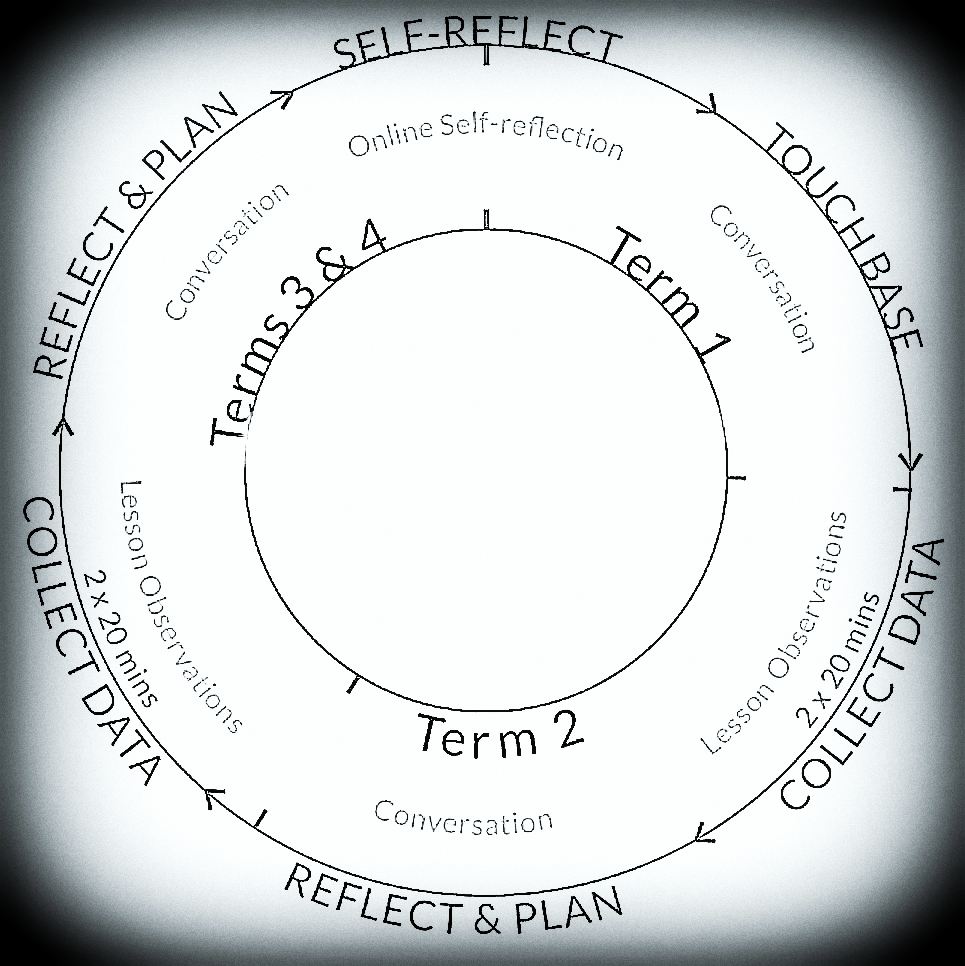
To explain how we use data in our collaborative coaching cycle, a one-year cycle looks like this:

a visual look at our coaching-observation cycle

a visual look at our coaching-observation cycle

  1. Self-reflect: Complete self-reflection against Danielson Framework for Teaching.
  2. Touch base: Pre conference with Teacher-Coach, identifying possible foci, deciding on type of lesson data to be collected.
  3. Collect data: 2 x 20 minute observations.
  4. Reflect & Plan: Post conference with Teacher-Coach following the Cognitive Coaching reflecting-into-planning conversation map and using Danielson Framework for Teaching.
  5. Repeat 2, 3 and 4.
  6. Self-reflect: Complete self-reflection against Danielson Framework for Teaching.

In this post, I would like to focus on Step 3, data generation.

You’ll notice that we use multiple short observations and the Danielson Framework for Teaching, as supported by the findings of the Measures of Effective Teaching study. A number of short observations mean that teachers build up a series of snapshots of the kinds of lessons in their classrooms, liberating them from feeling like ‘this 20 minutes is representative of all of my teaching all of the time.’ It is a moment in time on which to reflect.

*               *               *

What classroom data is generated?

Generating lesson data is a crucial part of our coaching teacher growth model. While all teachers are expected to have classroom data collected for the purposes of their reflection on practice, this is differentiated in the sense that the teacher decides what sort of data will be collected, depending on what they would like to know about their lessons. Below are the main types of lesson data we have been using.

Non-inferential observation notes

These notes usually look like verbatim scripting. That is, the observer takes down what they see and hear in a lesson. No judgements. No praise. No criticism. Just observed sights and described sounds. They include times and may also include mapping of students or classroom movement. Our coaches are trained in this kind of observation note taking. It can be challenging to take self and own biases out of lesson data, leaving just what happened for the teacher to do their own reflections and evaluations.

Observation notes are useful for looking at instructional clarity, questioning, student discussion and student group or individual work. In the case of the latter, the observer may go to students or groups and observe them or interact with them, recording interaction and responses. This means that observers can record those parts of the classroom where teachers are not. It also means that an in-class observer can glean details of student work and conversation which a video would not pick up.

A caution about this kind of note taking is that the observer bias does appear in what the observer chooses to take down. For instance, in a fast paced classroom discussion, often an observer needs to make a choice between capturing the teacher’s or the students’ responses.

The benefit of notes is that the run of the lesson is written down in black and white, without the distractions of watching multiple elements in a video.

Video

We have a few video options available to teachers for the purposes of lesson data collection. Still video. 360 degree video. SWIVL video. These each have their pros and cons, and require choices to be made, such as whose audio is picked up, or whose movement is tracked.

The 360 degree video is a more obvious piece of equipment in the classroom, but it simultaneously shows teacher and students. The SWIVL makes it easy for teachers to collect data on their iPhone or iPad, but as the camera follows the audio lanyard it privileges the person wearing it, usually the teacher.

Video is great for teachers wanting to see their own teaching, including movement and wait times. Our Physical Education, Music and Languages teachers love it, but so do those in other learning areas and various year levels.

Audio

Some teachers want laser like focus on what is said in their classrooms. They are keen to listen closely to their questioning or instructional clarity, and to their students’ responses, for instance. Like verbatim scripting, by isolating audio, teachers can pick up on very specific aspects of their teaching, although others will be missed.

*               *               *

Supplementary data include planning documents, goals and reflections, student work samples, student feedback and student achievement data. All data have their inherent biases, benefits and disadvantages. We are finding that mixing up the data so that teachers experience their classrooms in a variety of ways may be more effective than continually repeating the same data collection strategy for the same teacher.

Importantly, all data are owned exclusively by the teacher for their reflection and use. They are not for coaches or managers to use or publicise outside of the coach-coachee relationship. Focus groups with coached teachers at the school have revealed that teachers appreciate the choice and ownership over their classroom data. The trust in the coach-coachee relationship is paramount.by @debsnet

So while I have been focusing my own practice on refining my coaching skills, something else has been happening alongside. The data has been a tool for teacher learning and development, both in its own right and as part of the coaching cycle.

I’ve noticed that when, as coach, I get the data right, the conversation seems to almost take care of itself. The data, in these cases, has set off the teacher’s thinking, reflection, planning and action, before I turn up for the post conference.

In other conversations, looking at the data in detail, with well-crafted questions, can bring teachers to the point of an ‘a-ha’ moment or a change in practice. At times it is looking closely at the Danielson Framework for Teaching rubrics which allows teachers to see alternative teaching and learning possibilities, and refines their precision of language around practice. Other conversations require deeper coaching questions which drill into why lessons went the way they did, how teachers made decisions in their classrooms, what criteria they used to make those decisions, or what might have be going on for particular students in the lesson.

The data also provide an important ‘third party’ in the coaching conversation, allowing the conversation to be depersonalised and focused on the data, not the person.

Data is powerful stuff. And lesson data ‘done right’ – owned by the teacher, objective and giving the teacher a new perspective on their classroom, themselves and their students – can be transformative.

Good One, by @debsnet

Implementing a coaching model: One school’s approach

If threat, fear, pain even in the most minute portions are perceived, neurological and chemical processes occur which prepare the system for survival, not reflection. ~ Costa and Garmston

tulips in Monet’s Giverny garden: a beautiful example of individual and collective growth

Coaching has contested definitions and a range of models which include instructional coaching, peer coaching, literacy coaching, GROW coaching, Growth Coaching and Cognitive Coaching. In education, schools and systems have a variety of approaches to adopting and rolling out coaching models. In the lead up to Saturday’s #satchatoc Twitter chat on coaching, I thought I would write this post to outline some of my views. I know they are hard to articulate in 140 characters!

This post is based in my research and experience, and are of course coloured by these. Bear in mind when reading that I am one person, in one context, with one set of experiences, conducting one study. It’s one perspective of many. I enjoy being part of a wider conversation around coaching.

My coaching training is in Cognitive Coaching (I have done the Foundation course three times now in three consecutive years), in which I have experience as a coach and coachee. My PhD and school-based research has familiarised me with other models of coaching, with my thesis reference list running to almost 8000 words, with a portion of that around coaching research, as part of my focus on transformational professional learning. I also continue to work with a number of classroom consultants who have observed my lessons and worked with me to improve my classroom practice in a variety of ways from more to less directive. (While some might call this ‘coaching’, in a Cognitive Coaching sense, having a pedagogical expert giving you advice on your practice is called ‘consulting’.)

This post looks to outline my school’s particular approach to developing our coaching model, our guiding principles and the emerging practices, in order to share them and open up a conversation around others’ coaching principles and practices.

Start with context and vision.

The most important thing for me is this: start with and work from your school’s context. There is not a one-size-fits-all model, but rather each school should consider their values, vision, mission, current work going on and where the academic staff and professional growth processes are at. Where is your starting point? What do you want your end point to be?

When I was charged with researching, piloting and implementing a growth-based professional learning model at my school the principal said, “What I want is for this to grow the vibrant professional learning culture of our school.” Our model emerged from this aim and the school’s strategic intents. It aligned with work already being done, rather than being a tacked-on innovation. This reflects work from those such as Fullan and Senge on cohesive shared vision and aligned practice.

These were our aims:

'Take one' (or take all!) for your school

‘Take one’ (or take all!) for your school

Go slow to go fast. School change is an evolution not a revolution.

An outline of our model’s development goes something like this:

In 2012 I wrote a research and recommendation paper which took into account the school’s context, the strategic plan and current research on teacher quality, professional learning and school reform. In 2013 I worked with a team of teachers to pilot the recommended model and develop it for our context. We decided that after that initial pilot year, the model wasn’t yet ready, so I worked with another team of teachers in 2014 to continue the pilot. In the second pilot year we refined our model. Each year we collected data from the coaches and coached teachers through online surveys, online discussions, and focus groups. Each year I reported to the school board and principal who provided strategic feedback. In 2015 we have been rolling out the model at a whole school level, with teachers across the school. Each year we have used a Schooling by Design (Wiggins & McTighe) template to backwards plan our work with our goals in mind, aligned with deliberate action.

This is a very condensed run-down but it shows that we chose to go slow. We wanted the process to be owned and driven by teachers. We did not have a performativity and accountability agenda, but were interested in increasing the capacity and efficacy of teachers, in helping them on their own trajectories of growth. As I explained in this post, our model is about helping teachers open their doors from the inside.

Buy-in was key, and the decision to have teachers lead the development of our model, guided by research, the strategic plan and data we collected on our impacts, was very deliberate.

Believe in the capacity of all individuals to solve their own problems, do their own thinking and drive their own learning.

This belief has been the foundation of our use of Cognitive Coaching as the coaching model: everyone is coachable. I was initially skeptical of Cognitive Coaching. It seemed like common sense: build trust, listen actively, pause, paraphrase. Well, duh. And what about if people don’t have the capacity to do their own reflection? What if they need my expertise, for me to help them become their better selves? These were my reservations.

But what I love about the Cognitive Coaching course (remember: I’ve done it three times!) is that it is saturated with research and the why. Like the coaching model itself, it is about changing thinking in order to change practice.

Examples of research that shaped my thinking are: Costa and Garmston’s 2003 paper which points out on page 5 that “if threat, fear, pain even in the most minute portions are perceived, neurological and chemical processes occur which prepare the system for survival, not reflection”; and another study by Boyatzis and Jack (2010) which looked at brain imaging during coaching and found that “by spending 30 minutes talking about a person’s desired, personal vision, we could light up (activate) the parts of the brain 5-7 days later that are associated with cognitive, perceptual and emotional openness and better functioning.”

I realised that being helpful to coachees (and don’t we all want to be helpful and have a positive impact?) was helping them do their own thinking, their own reflecting.

In my consequent experiences as coach and coachee, I have found that people have the capacity to be highly self-aware, if given the opportunity.

The best feeling as a coach is when a coachee experiences what Cognitive Coaching calls ‘cognitive shift’, a moment of new previously-untapped realisation.

As I develop my own coaching practice I have realised how many layers of expertise and deceptively simple skill a coach requires. Incorporating the Five States of Mind, tracking eye movement, paraphrasing of non-verbal as well as verbal language, and artful asking of the right question for the right person at the right moment, are skills I continue to develop. As a coach it is like being a duck who appears to glide across the pond whilst its legs are madly paddling under water. There is a lot going on in the coaching brain! While I think everyone is coachable, I am not sure everyone can be a coach.

by @debsnet

Impacts

As a coach this year in our now-rolled-out model, my belief in the power of Cognitive Coaching continues to be affirmed. The approach has been well-received by teachers who are realising that this process is not about evaluation or accountability, but about their growth and authored by them. The other aspects of our model are also working. Lesson data is proving to be potentially transformational in its own right (that is another post for another time). The Danielson Framework for Teaching is enhancing teachers’ precision of reflection and goal setting around their practice.

We continue to collect data from a number of sources to continue to iterate the model. This includes external student achievement data, internal perception surveys and focus groups.

I want to leave you with this quote from Andy Hargreaves and Jane Skelton (2012), which really sums up for me what coaching should be about (my emphasis):

In some of its earliest origins, coaching is a learning journey undertaken willingly by travellers together. However, in the context of large-scale systematic reform, coaching has too often turned into enforced transportations from boardrooms into classrooms of unreflective practices based on inflexible ideologies or exaggerated sources of evidence.

A coach is a vehicle. But in education, it is not an inanimate one. Should a coach be a mere deliverer of other people’s goods and chattels? Or should the coach carry learners and learning along a self-chosen journey together? Are coaches providers of service learning, or vehicles that deliver people into bureaucratic servitude? Like life coaches, should educational coaches develop people’s own capacity to help themselves, or is their role to watch over teachers’ fidelity to or compliance with externally prescribed practice? …

It takes a big man or woman to step aside from surgery and actively help others take their place at the cutting edge of their profession. And it takes a great coach to stand up for the moral purpose of their work that is or should be at the core of all coaching – developing people, not implementing policies; building capacity rather than enforcing compliance; and giving colleagues a professional service rather than delivering them into ideological servitude.

by @debsnet

Can anyone be a coach? Selecting coaches for a school teacher growth model.

Coaches, to attain psychological safety and cognitive demand, must attend to both learning and relationship. ~ Costa and Garmston

Can anyone be a coach?

Who can and should coach?

My school has a variety of people in a multiplicity of roles to help teachers develop their practice, including colleagues in PLC groups, line managers who balance nurturing and evaluative roles, and classroom consultants who offer teachers specific targeted advice on strategies to improve their instructive practice. Our teacher growth model sits alongside these other roles and relationships. The role of coach is a specific and clearly delineated one.

While I believe that everyone is coachable, I’m not sure that everyone can be a coach. In my everyone is coachable post, I explain the dichotomy of peer (or reciprocal) coaching, and expert coaching (sometimes called mentoring). We have opted for  teachers-trained-as-coaches to be the coaches for our model. These teacher-coaches are in some ways peers, as they do not hold a managerial position, and are experts in the sense of knowing how to record non-inferential teacher-owned lesson data, work with the Danielson Framework for Teaching and conduct Cognitive Coaching conversations.

Teachers choose what lesson data might be meaningful for them, whether written verbatim transcripts, audio recording of lessons or video recording (including 360 degree video or SWIVL video). For each coaching conversation, data is taken from two twenty minute lesson segments (for the rationale of we do multiple short observations, rather than full lessons, see p.25 of this Measures of Effective Teaching study report). The teacher coach, from a different year level and discipline, is responsible for helping teachers decide on the most useful data for collection, collecting that data and facilitating the reflection around that data.

by @debsnet

The aim of Cognitive Coaching – to ‘convey a valued person from where they are, to where they want to be’ – shapes our view of the coaching role. The metaphor of the horse-drawn stage coach is used in Cognitive Coaching training. A passenger does not get into a coach, for the coach-driver to say, ‘Welcome, I’ll be taking you to a destination of my choice today.’ Instead it is the coach’s passenger who decides on the destination, and the coach’s job to get them there. So the definition of coach for us is: non-judgmental mediator of thinking committed to helping each teacher grow their own practice along their own trajectory.

Last week I had the opportunity to reconnect with a consultant and trainer for both the Danielson Group (on Charlotte Danielson’s Framework for Teaching including involvement in the MET study) and Thinking Collaborative (Cognitive Coaching and Adaptive Schools). What was really pleasing was that from her outsider perspective she felt that our coaches were thoughtful, reflective and approachable, with a really clear sense of their role. In their work with her across the week, the coaches demonstrated their understanding of the role as building a non-hierarchical trust relationship which is centrally focused on the teacher being coached.

'Where to today?' ~ the person, not the coach, chooses the direction & destination

‘Where to today?’ ~ the person, not the coach, chooses the direction & destination

This was affirming because we have been very deliberate about the selection and training of our coaching team. Firstly, we advertised internally for teacher-coaches and conducted interviews in which candidates were required to both conduct a coaching conversation (ten minutes) and answer interview questions about the role (thirty minutes). In the conversation, we looked for each person’s ability to develop rapport, be non-judgemental, pause, paraphrase and ask mediative questions. In the interview portion of selection, we asked the following questions:

  • What does being a coach mean to you and why does this role interest you?
  • Please give us an overview of how your background and experience are applicable to this role.
  • What do you think the main issues are with regard to being a coach for teachers?
  • What sorts of things help you develop your own teaching, and how might these apply to this role?

We assessed candidates on their ability to reflect on and analyse their own coaching conversation; coaching experience and knowledge; consciousness of self and others; efficacy; craftsmanship as a coach; interdependence; flexibility; and capacity to be a continuous learner. Some of those selected to be coaches had no prior experience or training, while some had been involved in the pilot model.

Having a dedicated, trained, collaborative and focused team allows us to discuss and work through coaching challenges such as ensuring the process is meaningful for highly-reflective veteran teachers. These are staff who are incredibly experienced, responsive to their students and with longstanding internalised classroom decision making. We are finding that two things are helping our coaches to reach these teachers:

  • Using the Danielson Framework for Teaching as a rigorous reflective instrument, giving some precision to teachers’ reflections and helping to bring consciousness to the decisions teachers are making in their classrooms.
  • Crafting a range of mediative questions for helping teachers analyse why lessons went the way they did, encouraging teachers to consider how they make decisions in their classrooms, what criteria they use to make those decisions or what might be going on for particular students.

Having a dedicated coaching team allows us to add layers to coaches’ coaching practice. Continuing to work and train together, and experimenting with meta-coaching (the coach being coached), is helping the coaching team to grow their own practice.

Additionally we are considering how technology might help coaches. While we are already using technology like SWIVL for some classrooms observations, we are considering how Voxer might be used for in-between coaching, to overcome logistical issues of having to meet face-to-face, or to give coachees ‘take away’ questions. Chris Munro tells me he has been trialling coaching via Voxer. Certainly it would allow the coach to listen carefully to the coachee and thoughtfully craft paraphrases and questions.

So, my school has worked from the belief that it isn’t enough for a coach to be given an acronym to follow or a laminated A4 conversation map; coaching is much more than following a protocol. As our model intends to be meaningful for all teachers at the school, coaches need to have nuances of training and expertise to apply mindfully in their practice. As we continue to iterate our model, we are adding tools to our arsenal and finding ways to differentiate and personalise the growth process for each teacher.

We all have the extraordinary coded within us, waiting to be released. ~ Jean Houston

keeping our focus on growth ~ growing people, not fixing people

keeping our focus on growth ~ growing people, not fixing people

Reflections on the conference experience: Hawker Brownlow Melbourne 2015

Human interaction remains the key component of changing education. ~ Eric Sheninger

Yarra River, Melbourne

Yarra River, Melbourne

I have spent the last four days at the Hawker Brownlow Education Conference in Melbourne, an annual conference which brings big name educational thinkers together from around the world to present immersive sessions on educational issues of the moment. What follows is my reflection on the conference experience and the value of the conference model for learning.

I selected my conference sessions based on my particular areas of current interest. While Dylan Wiliam opened the conference by using William Schmidt’s warning against teaching an inflexible curriculum which is ‘a mile wide and an inch thick,’ my recent work in professional learning and effective school change has been an inch wide and a mile deep. The sessions I chose were therefore along this same vein and were intended to take me even deeper.

Many of the speakers’ points resonated with what I already know and affirmed my own thinking and practices. These added some layers of complexity to my existing understandings and acted as springboards for conversations around education.

Dylan Wiliam and Bruce Wellman pointed out that we learn when we are uncomfortable. Wiliam said, ‘we learn more when we’re wrong,’ while Wellman talked about the discomfort that comes with working towards understanding. He pointed out that teams and individuals need to be willing to squirm and grapple with challenging questions. A comfortable team is not a learning team.

Caulfield Racecourse view from the HBE conference

Caulfield Racecourse view from the HBE conference

Learning communities were a thread which appeared in the sessions I attended. Wellman, co-author of The Adaptive School, discussed how skilful high-performing groups share intellectual and emotional space, which includes being comfortable with pauses in discussion. Silence is not the enemy of learning and collaboration, but an ally.

Wellman pointed out that being in the same room together does not make a group a community of learners. Anthony Muhammad added that a professional learning community is not a collaborative team which meets regularly, but a systemic contextually-embedded paradigm which raises collective knowledge through collective inquiry. Much like the Adaptive School material, which advocates ‘graceful disagreement’ as a norm of effective teams, Muhammad maintains that constructive, professional disagreement is the foundation of innovation.

Muhammad’s work at Levey Middle School reflects that of my own school in that it emerged out of the specific context of that school and where its community and practices were at. While our context is vastly different, we too have built our teacher growth model out of our school’s mission, vision, values, existing work and knowledge of our students, teachers and leaders.

Part of our model is based around how feedback and conversation might be deliberately harnessed in order to build teacher capacity and amplify the learning culture of the school. Wellman says that feedback is ‘in the moment, about the past, to affect the future.’ He points out that advice has very little impact on the advisee, and instead advocates for using clear, shared standards and a focus on learning, within an environment of trust. The focus on learning is about meeting the person where they are. ‘Wherever I meet you in your practice,’ he says, ‘we’re going to grow from there.’ He adds that, ‘We are starving our master teachers of rich conversations; they are hungry to talk about the whys of what they are doing.’

As outlined in Lipton and Wellman’s Learning-Focused Supervision, Wellman sees standards as rallying points for important conversations which set aspirations for goal setting and growth. My Australian school similarly uses Charlotte Danielson’s Framework for Teaching as a tool for developing shared understandings about teaching; and for reflection and data-based conversation around teaching practice. Our approach also gels with Wellman’s assertion that feedback should be customised and appropriate for the individual; one size does not fit all. Our model of teacher growth incorporates differentiation in terms of what sort of data teachers collect from their lessons and the ways in which coaches approach each conversation. As with the metaphor of the stage coach, our coaching model is about helping the coachee get to their desired destination.

Melbourne autumn

Melbourne autumn

One of Wellman’s points about data analysis was that, when looking at data, we should focus on analysing reasons for successes, rather than failure. What are the successful students or teachers doing? What knowledge and strategies do they have? How can we develop those in others? (He also has a great strategy for teams looking at student achievement data in which he employs prediction to engage people in their assumptions about what the data might hold, before revealing the data.)

At the end of the conference I met up with Eric Sheninger who had just landed in Melbourne for his first time working with Australian educators, districts and conferences (he will be keynoting at the EduTECH conference in Brisbane next week). I had tweeted a pile of books from the conference two days earlier, including Eric’s, with no idea that he was en route to Melbourne. Ours was an impromptu meeting which arose out of a morning Twitter conversation. We met up and chatted about our work, global educational thinkers, the world of connected educators and DIY professional learning. During our conversation, Eric pointed me towards some great apps which will be useful collaborative tools for my work with student and teacher learners, such as Verso, Tozzl and Padlet.

In addition, my first night in Melbourne had me meeting with some of my Twitter PLN – Greg Curran, Chris Munro and Jo Prestia – to discuss coaching in school settings, research journeys and approaches to school intervention implementation.

Both in and out of the conference I fielded questions about what my PhD is about. This was a great opportunity to hone my ideas about what is most important about my research and communicating that in effective ways.

So there were affirming moments in, and out, of the conference, which added nuanced layers to my thinking. Yet on reflection, I realise that much of what a conference can bring for the delegate are conversations with others, unexpected moments of collaboration, and the space and time to process and reflect. Although I was surprised at the lack of a backchannel at a national conference, by both presenters and delegates, – Where was the Tweetstream? – I found valuable connections with my own colleagues, other educators, presenters and connected educators who weren’t affiliated with the conference but were open to connecting in person.

Federation Square, Melbourne

Federation Square, Melbourne

On teacher evaluation & the New York APPR reforms: a view from Down Under

There are no such things as limits to growth, because there are no limits to the human capacity for intelligence, imagination, and wonder. ~ Ronald Reagan

NYC skyline, by @debsnet

As part of the Education Transformation Act of 2015, New York State is reforming its Annual Professional Performance Review (APPR) and Teacher Effectiveness rating system.

Grant Wiggins in his open letter to Governor Cuomo calls the APPR reforms a “step backward” which disempowers teachers.

NY Middle School Principal Lisa Meade voiced her concerns here and put out the call out to New York educators to respond to the proposed teacher evaluation reforms. Educator Christina Luce added to the conversation in her post, asserting that, while she supports an annual professional reflection and review, the proposed reforms are narrow, punitive and make “an already horrendous evaluation system even worse”.

While I am not a New York educator, I felt compelled to offer a perspective from a different system. My visits with schools and educators last October helped me to learn about how teacher evaluation is approached in New York. While some of the challenges faced were global, shared with Australian schools, some were surprising to me. I wrote various posts documenting my reflections in New York including:

  • My visit to a school in Westchester which opened my eyes to the constraints on New York schools in teacher evaluation;
  • My visit to a school on the Upper East side which reminded me about the need for schools to find teacher evaluation and growth processes appropriate to their context;
  • Meeting Ellie Drago-Serverson at Columbia University to discuss the best environments and practices to facilitate adult learning;
  • Meeting with Charlotte Danielson and Cindy Tocci around effective applications of the Framework for Teaching for teacher growth and evaluation; and
  • Meeting with New York City professional development provider Teaching Matters, an organisation which bases its work in a belief about the capacity of teachers to be leaders and for schools to be vibrant places of distributed leadership.

slice of harlem, by @debsnet

The proposed APPR reforms seem to make an already limited system of scoring even narrower, based on data that I imagine does little to reflect a holistic picture of a teacher, their teaching, and their students’ learning. While the use of these kinds of data for measuring teacher effectiveness have been questioned (see for instance this post and this post by Grant Wiggins), I have instead focused on how these reforms sit with my own beliefs about teacher learning.

Costa and Garmston in this paper talk about safety, but not comfort, being a prerequisite for learning, pointing out that the brain works in such a way that if we do not feel safe, we cannot think and learn. They note that sensory signals entering the brain travel first to the thalamus, then to the amygdala or threat detector, and then to the neocortex where thinking happens. “If threat, fear, pain even in the most minute portions are perceived, neurological and chemical processes occur which prepare the system for survival, not reflection.” While learning often happens in a space of what they call ‘disequilibrium’, or what I call the discomfort zone, there needs to be safety and trust for thinking, reflection and growth to occur. The New York teacher effectiveness system does not seem to allow for a safe environment of learning and growth, but rather opens up the potential for fear and a fight-or-flight response.

This notion of safety-but-disequilibrium is supported by Ellie Drago-Severson’s concept of high-support high-challenge ‘holding environments’ as the optimal environments for adult learning. By Dan Pink’s work on motivation which he notes is extinguished by punitive approaches. By David Rock’s work which shows that carrot-and-stick approaches result in resistance. In reflections by Robert Evans that teachers resist externally imposed change. By the Adaptive Schools foundational concepts of trust and of honouring both the individual and the system.

Upper East Side, NYC, by @debsnet

In light of how the brain works and how thinking and motivation are ignited, the New York teacher evaluation system, current and proposed, doesn’t make sense to me. It is a punitive deficit model which assumes that teachers are underperforming, unprofessional and in need of external measures to bring them up to scratch. In a recent paper, Dylan Wiliam points out that “each teacher has a better idea of what will improve the learning of their students, in their classroom, in the context of what they are teaching them, than anyone else.” Teachers should be trusted to be professionals and given the support, and challenge, to grown on their professional journeys.

My school’s teacher growth model is based on a belief in the capacity of teachers. It is based in a belief that everyone is coachable. That is, that teachers want the best for their students and that they are fully capable, with support, of setting goals, analysing data and improving their practice in ways which most benefit their students.

Wiggins is right when he says these reforms disempower teachers. Surely if we want teachers to get better, it isn’t scoring them we should be primarily concerned with, but growing them. Teachers should receive ongoing support to refine their practice and focus on becoming increasingly better at serving their students’ pastoral and learning needs. I absolutely agree with regular performance check-ins and goal setting work, but I also believe in teachers.

My hope for any school system would be that teachers are given opportunities for growth born out of a belief in their capacities and in their important work with our children, rather than public scorecards based on questionable measures.

New York, I’m thinking of you, your teachers, your school leaders and your students.

NYC, by @debsnet

Can and should teachers be (viewed as) researchers?

Sarajevo bullets, by @debsnetWhen we respect teaching as an intellectual activity and give teachers the opportunities to raise serious questions about what they teach, how they teach and the larger goals for which they are striving, they can play a dramatic role in transforming their institutions. ~ Peter Senge, Schools that Learn: A Fifth Discipline Fieldbook for Educators, Parents, and Everyone who Cares about Education

This month – April 2015 – is the month in which Dylan Wiliam argued in the TES magazine that teaching cannot and will not be a research-led profession, in which Tom Bennett responded that evidence-based education is dead (but that evidence-informed education lives), and in which John Hattie was quoted in a TES article as saying that teachers should not try to be researchers and that ‘I don’t have any time for making teachers researchers.’ In response to his own question, ‘Asking teachers to be researchers?’ he replies, ‘They are not.’

In this article Hattie is also quoted as saying that teachers should use the “literacy and sensibility of research to inform their practice” and that the worlds of research (by academics, not teachers) and teaching should “orbit together”. This resonates with Tom Bennett’s assertion that teaching be evidence-informed (but not evidence-based) and with the mandate of researchED which is to raise research literacy in the teaching profession and promote conversations between teaching and academic communities (my post about researchED Sydney 2014 is here).

As someone whose identity straddles ‘teacher’ and novice ‘researcher’ (as a PhD candidate coming towards the end of my PhD journey) I agree that research should inform teaching, leading and educational practice, and that worlds of education and the academy should work in collaboration. I am not sure, however, that we should draw a divisive line with ‘teacher’ on one side and ‘researcher’ on the other.

When I read the TES article which presented quotes from Hattie, a number of questions arose for me. What does Hattie mean when he says that teachers are not (and perhaps cannot be) researchers? What is his definition of ‘researcher’?

Is he discouraging teachers from reading academic literature and collecting data to inform their practice? Is he telling teachers they cannot be (taught to be) systematic thinkers who investigate, trial, collaborate, communicate and utilise scholarly literature and evidence to inform their practice?

Many teachers have been involved in action research projects, or Masters or PhD dissertations. Are these teachers, too, incapable of conducting and applying research thinking and methods? For me this is an issue of identity, of sense of self. Am I a teacher who researches? A researcher who teaches? A teacher and a researcher? Is Hattie suggesting that these identities are unavailable to me?

Is research in a real educational context by a real educator less valid than that of an academic from a university?

Many have responded to this conversation. Kevan Collins, chief executive of the Education Endowment Foundation, warns against encouraging teachers not to pursue evidence, as he articulates in this TES article.

Teacher Chris Parsons explores how the teaching profession might strategically develop its use of evidence to inform practice.

PhD candidate Charlotte Pezaro, writing for the Australian Association of Educational Research, explores ways in which academics and teachers might interact.

Policy analyst Patrick Watson in this post argues that we need to identify research which is worthwhile for informing practice, build the research-literacy of teachers and encourage action research to facilitate reflection and deeper understanding.

The 2012 Grattan Institute report ‘Catching Up: Learning from the best school systems in East Asia’ asserts that high-performing school systems view teachers as researchers, continually developing their knowledge base through practices such as professional reading and action research. My PhD cites examples of literatures which promotes participatory action research as transformative for individual practice and collaborative cultures. All research and all researchers have limitations. I wonder what the impact is of viewing teachers as researchers and of encouraging teachers to think of themselves as researchers. How does it shape teachers’ identities, self-perceptions and practices if they are encouraged to be consumers, curators, engagers and creators of research? Perhaps it is partly a question (to reflect Dweck’s work) of developing a research mindset.

One of Wiliam’s points is that research cannot tell us what could be only what we already know. If we are always basing our practice on what has been done, we aren’t innovating or trialling new possibilities. Teaching and schools should be about more than doing what has been done and what is known; it should be about moving forward and even about innovation and creativity.

Perhaps teachers who see themselves as researchers could call themselves ‘teachers as innovative, research-literate, reflective, evidence-informed, systematically-thinking, data-using-and-interrogating practitioners who drive their own learning and improvement in regards to what benefits their students.’ Or maybe that’s a bit long.

While I understand that the issue of whether teachers can or should be researchers is nuanced, complex and riddled with semantic argument, I (as someone who identifies as teacher and researcher) would like to think we can view teachers as researchers, by my definition, if not by Hattie’s.

Everyone is coachable: we are all capable of change & growth

All who wish to continually improve their craft … never lose the need to be coached. ~ Art Costa & Bob Garmston

dedicated to those who dream, by @debsnet

I was recently asked a question on Twitter: ‘Are some teachers un-mentorable?’ My response was along the lines of, ‘No-one is unmentorable or uncoachable; a person always has the capacity for growth.’ This belief underpins my ideas about school change and my school’s teacher growth model on which I presented at researchED conference in Sydney and ACEL in Melbourne.

In scholarly literatures, coaching (sometimes used interchangeable with the term ‘mentoring’, such as in the writings of Ellie Drago-Severson, who I talked with last year) seems to be divided into expert coaching and peer coaching.

Expert coaching involves an expert or master who provides guidance to a less-experienced apprentice. This includes Jim Knight’s instructional coaching in which the expert instructional coach provides judgements, feedback and suggestions, based on their expertise.

The other kind of coaching is peer or reciprocal coaching in which someone is paired with those of a similar level of expertise. These peers proceed to coach or mentor each other in a collaborative and non-hierarchical way. This approach, which is intended to develop a collaborative learning culture as well as the individual’s practice, includes models like instructional rounds, in which teachers form small professional learning groups which collectively work to enhance their practice.

Both coaching trends are based on use of data for growth (in a teaching sense, this would be some kind of classroom observation data) but are underpinned by different principles and beliefs. Expert coaching models assume that people learn best when someone with more knowledge and experience provides them with specific, targeted feedback for improvement, while the peer coaching models assumes that it is by working together that we can improve.

One form of coaching which can be conducted by a peer or an expert is Costa and Garmston’s Cognitive Coaching which is based in brain research like this which suggests that we are most likely to grow when we do thinking ourselves, rather than receive thoughts doled out by others. Cognitive Coaching focuses on developing individuals as self-directed learners who consciously reflect upon, conceptualise and apply understandings from one experience to the next. It is a data-based, non-judgemental, developmental and reflective model for conversations for planning, reflecting and problem resolving, as well as a tool for developing professional communities that value interdependence and individual capacity for self-directed learning.

The goal of Cognitive Coaching is the growth of individual and organisation through the development both of autonomy (of the individual) and interdependence (the development of a holonomous organisational culture in which individuals function as both autonomous, independent individuals and interdependent, responsive members of the larger system).

Unlike expert models of coaching which involve specific coach feedback, judgements and suggestions, Cognitive Coaching involves mediated processing. The Cognitive coach does not offer judgements, feedback or advice, but asks ‘artfully vague’ questions or presents impartial observational or other data, followed by silence, in order to encourage the cognitive and reflective processes of the teacher. There is certainly an art to the asking of well-crafted cognition-provoking questions, as I have found in my journey as a coach. This approach is intended to create personal change through new connections in the brain and reconstruct knowledge through a conscious, reflective approach to new experiences.

By avoiding positive and negative value judgements and opinion, by coaching ‘without manipulation,’ Cognitive Coaching aims to transform an individual’s beliefs about learning and refine their cognitive maps by encouraging them to talk and think about their decisions. In this way, talking aloud leads to examination and refinement of choices and behaviours.

The use of a Cognitive Coaching process for teacher learning and development is supported by Charlotte Danielson’s work (you can find my conversation with Charlotte here) in which she notes that mentors, supervisors, evaluators and colleagues should beware of imposing their own styles or preferences when observing. The question is not “Is this how I would do it?” but “Given the context, what is appropriate?” She also advises that classroom observations must be accompanied by conferences before and after observed lessons.

My own experiences as cognitive coach and coachee have shown me the power of this kind of coaching to allow people’s own internal resources to kick in to gear, their own passions and thinking to light up, and their confidence to solve their own problems and forge their own paths to soar. It has shown me the power of really being listened to and being given a safe, trusting place in which to verbally explore situations. It has also shown me that when you own your ‘a-ha’ moments, the learning sticks. Change happens. Practice shifts.

So, returning to the question of the uncoachable or unmentorable teacher, I wonder about the intent of the coaching or mentoring.

Cognitive Coaching aims to ‘convey a valued person from where they are, to where they want to be.’ There are some important assumptions being made here. The person is valued. They are assumed to be motivated and capable of reflection and growth. And they are helped on their learning journey to a destination to which they aspire. This model of coaching is not a deficiency model based on where the manager wishes the person would go or what an expert has identified as an area of growth. It is about the person. And. Where. THEY. Want. To. Go.

Do I believe that absolutely any teacher, any person, can be coached or mentored into professional growth? Absolutely.

We believe that all human beings are capable of change, that we continue to grow cognitively throughout our lifetime and that we all possess a vast reservoir of untapped potential. ~ Art Costa & Bob Garmston

buddha, by @debsnet