Why blog? Personal evolution & community transformation

There is nothing to writing. All you do is sit down at a typewriter and bleed. ~ Ernest Hemingway

doorway

doorway

I began this blog a few months ago as a way to explore, record and share my thinking around a particular self-directed professional learning experience: a trip from Australia to New York intended to gain insights around teacher effectiveness, teacher evaluation and teacher growth. The trip was amazing personally and professionally. I met with schools, school leaders, teachers, researchers and global edu-experts who challenged and inspired.

Now that initial blogging purpose is sated and I find myself wondering: should I continue blogging?

My first instinct is: yes. And that mainly emerges out of the enjoyment I have found in reflecting, writing, sharing and engaging with others as a result of my posts. I alluded in post about social media for educators, this post about being a connected educator and this one about finding your professional global tribe, that Twitter has been invaluable in connecting me with other like-minded (and non-like-minded – just as important!) people. Blogging, however, allows for much more developed thinking than tweeting. Twitter can facilitate 140 character conversations, but it doesn’t allow you to burrow deep into ideas and give them a shake. So since blogging, I have been blogging about blogging, and now I’m at it again.

My reservations about continuing a blog are primarily about time. I am a parent of two pre-school age children, an educator at an Australian school, and a PhD candidate who is two years, 150 pages and 300 references into my thesis (more about how I juggle those things here). Right now as I write a blog post about whether I’ll write future blog posts, there is a long list of other things I could be doing.

And yet, here I am.

Partly because this blog has allowed me to explore my own thinking around my work and study. It is a free space to write. I have my PhD to write too, but blogging is a space in which I can write without pressure and with more freedom of style and content. It keeps me thinking and learning and connects me with other thinkers and learners.

I also know what other blogs give me. They can be transformational, inciting change, encouraging action and inspiring thinking through the sharing of stories, expertise and others’ intellectual struggles around big and small ideas. They promote reflection, conversation and growth, in the blogger and the reader. Perhaps my own musings might provide insights for others, open a window to my context, challenge another’s thinking or facilitate connections across geographical and philosophical boundaries?

So I feel propelled to continue blogging, but I wonder how that journey might evolve, if anyone will read my posts, and if that even matters. Certainly I would (will?) be a blogger who blogs when I have something to say, rather than to chase numbers of clicks on a page.

Western Australia by @debsnet

possibilities

Kaleidoscope selves: find your tribe

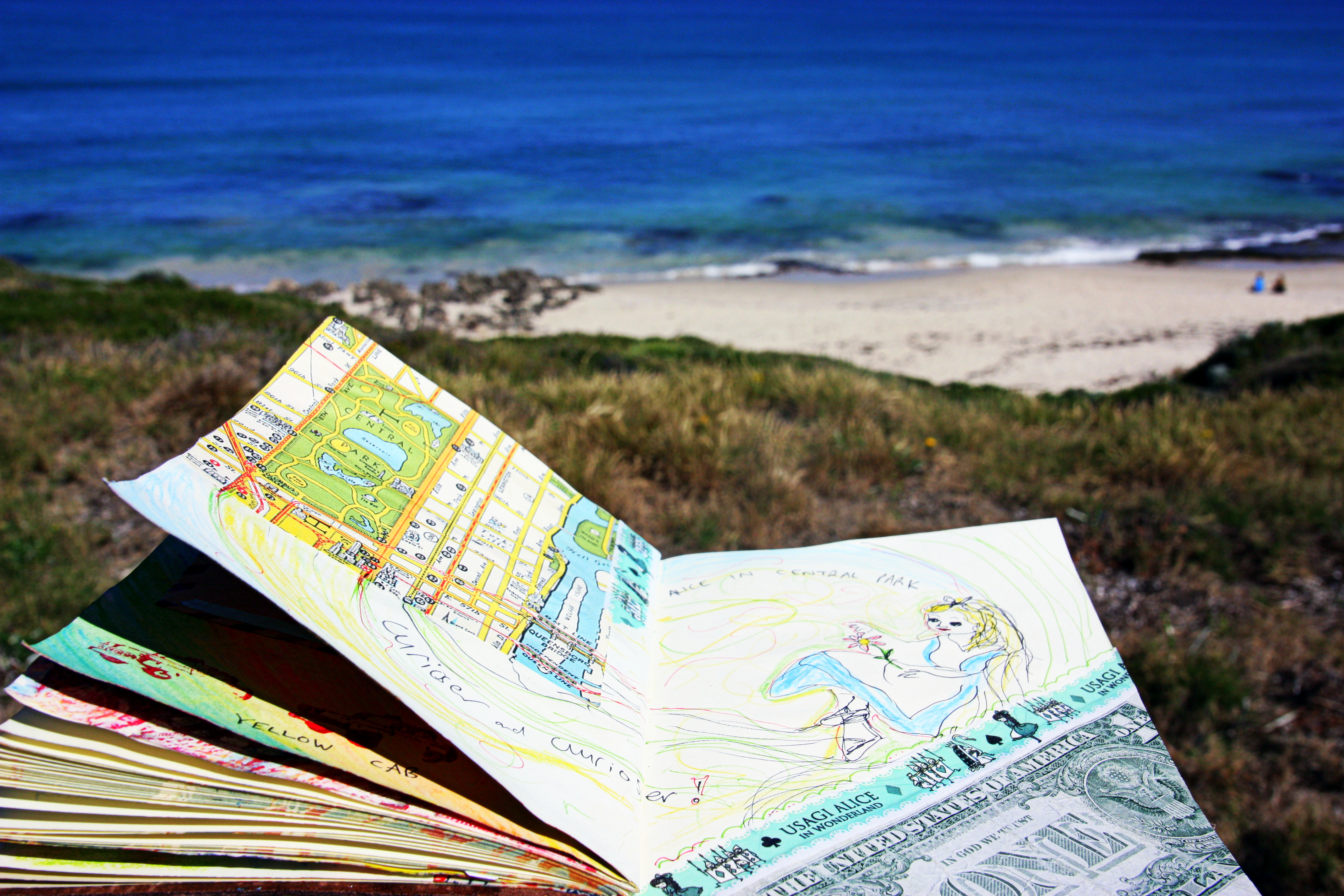
art journal page: Alice in Central Park

art journal page: Alice in Central Park

Who in the world am I? Ah, that’s the great puzzle. ~ Alice, Lewis Carroll’s Alice’s Adventures in Wonderland

José de Creeft’s Alice in Wonderland bronze statue glimmers in Central Park, polished by children’s climbing hands. Alice, of Wonderland fame, is a character who resonates with me. She is ingrained enough in my thinking that she makes more than a passing appearance in my PhD thesis. What I love about Alice is that she is open to new places and perspectives. She is curious, receptive and constantly wondering. She thrives on meeting new creatures and on having unusual, wondrous experiences. She is the imaginative adventuress who at once embodies childhood awe, strong self-assurance, rationality and fear-conquering daring. In many ways she is a flâneuse of Wonderland: wanderer, wonderer, learner and observer.

The question of self is not straightforward. Various aspects of our tangled selves collide and interlock. Or perhaps, rather than tangled webs of gossamer self-threads, we are each kaleidoscopes of self. Forged from a range of asymmetrical elements, we form the spectacularity of the beautiful changeable selves we are when viewed together through a cylinder of mirrors and light.

my precious stone kaleidoscope

my bronze-cylindered Arcana kaleidoscope has wheels made of glass and semi-precious stones: this one is by Australian artists Robert Cook & Jocelyn Teh

My kaleidoscopic self is made up of a number of different selves which my @debsnet Twitter bio attempts to unify:

Wanderer. Wonderer. Dreamer. Reader. Writer. Creator. Educator. PhD researcher. Passionista. Disruptor. Imaginer. Innovator. Flâneuse.

Not included are other personal selves like parent, spouse, child, sibling, friend. There are many contexts in which I share all or some of these self aspects. As the kaleidoscope turns and the light changes, people see different patterns reflected from me.

patterns as seen through my kaleidoscope

mandala-like patterns as seen through my kaleidoscope

My self-threads splinter, intertwine and blossom, as they do through the kaleidoscope viewing hole.

As I reflected in a previous post, connecting with other educators is for me about being my learner self. Connecting and collaborating widens and globalises my perspectives, while encouraging my own thinking and reflection (see Tom Whitby’s recent post about the relationship between connection and reflection). My teacher self is informed daily by my experiences as a parent, my own learning as a PhD candidate and my online participation. My Twitter interactions are influenced by my daily experiences of parenting, researching and working in a school. My parenting is influenced by my teacherly and researcherly thinking about learning and development. My PhD research self interacts with other researchers on social media as well as being informed by my in-practice educator immersion in my academic topic of study. My PhD itself incorporates me as learner, educator, writer, reader, creator and self-conscious researcher. And here on this blog my posts tangle together the threads of my learner, teacher, researcher, parent, writer and artist selves.

A dear friend of mine recently sent me this quote which I’m sure resonates with many of us:

When you find people who not only tolerate your quirks but celebrate them with cries of ‘Me too!’  be sure to cherish them. Because those weirdos are your tribe.  ~ Nanea Hoffman

It strikes me that many of those with whom I connect, in life, in education, in research and in my online PLN, are those whose quirks are similar to mine. Their kaleidoscope colours reach out to me across time, space, geography and social media.

I was recently involved in a Twitter chat with a number of educators. A few people in the chat began talking about being proud to be dorky, to be okay with failure and to constantly be learning. When I tweeted back ‘yes – fellow geeks unite!’ there was a chorus of ‘amen’ and ‘ditto’. I felt like I’d been high fived over Twitter. Here were my fellow weirdos, people who I’ve never met, connecting with me from across the world. “Yes,” they were saying, “In this moment, I get you and you get me.”

Next week I fly to New York to connect in a very real and immersive way with fellow educators, researchers and thinkers who will widen my perspectives. Perhaps I will widen theirs by sharing my Australian story. As this blog attests, I am hoping that my trip will allow my total and joyful submersion in all my aspects of selfhood. I will be thinking, writing, note taking, photographing, drawing and flâné-ing my way to new connections, new reflections and new perspectives.

The word kaleidoscope comes from the Greek words kalos, eidos and skopeō which essentially translate together into ‘beautiful form to observe’. Here’s to finding the beauty in others’ idiosyncrasies and to each of us finding our quirky global tribe.

find wonder, find perspective

The Connected Learner: Reflections on Connected Educator Month #CE14

spring in my garden: iceberg roses blooming

spring in my garden: iceberg roses blooming

Adventure is a path. Real adventure – self-determined, self-motivated, often risky – forces you to have firsthand encounters with the world. The world the way it is, not the way you imagine it. ~ Mark Jenkins

As Spring springs here in Australia and Fall falls in the USA (where I am headed in two weeks), I have been reading a lot about how October is Connected Educator month. You can read more from Craig Kemp (Twitter as PD), Tom Whitby (on the connected mindset) and Pernille Ripp (the downside to being a connected educator).

It has me wondering: what about being a connected learner? Because for me, being a ‘connected educator’ means connecting to be challenged, to be supported and to learn.

Twitter is a platform which allows plenty of connection and learning. On Twitter I …

  • Learn from others around the world – educators, thought leaders, researchers, students, people in other industries, friends and like-minded individuals. I get to read others’ ideas and share my own, and this means I am in a constant place of learning.
  • Contribute to a localised community hub of learning and thinking, sharing ideas on-the-spot such as at conferences during presentations; I simultaneously contribute to and consume the stream of learning-community responses.
  • Engage with people with whom I disagree, thereby engaging in debate and widening my perspectives. Corinne Campbell has written about why we need to be careful about the ‘echo chamber’ and only connecting with those who mirror ourselves.
  • Connect to those in similar situations to myself. This is why I follow #phdchat and #acwri, because as a working parent who is also a PhD candidate (read more about that here), I am not part of a student or researcher community, apart from during my supervisory meetings. Engaging with these hashtags allows me to learn from others while feeling that I am not alone in my PhD experiences. It means that when I am deep in my researching or writing burrow, I can send a shout out (a Twitter SOS, if you like) about my research experience (something that most people in my day to day life don’t connect with) and feel connected to others in the same boat. It allows me, in my moments of isolation and academic struggle, to feel heard by someone out there! I agree with George Couros in his post about why we need to be able to find these kindred spirits outside of our own immediate contexts.

Now, with this recently-begun blogging experiment (Will it continue after my professional learning New York trip? That is yet to be decided!) I have been connecting by sharing my musings (in more than 140 characters), my photographs and my journal scribbles. The very act of writing helps my thinking and the growth of my professional ideas. The subsequent connections with others is about mutual interest and growth. Blogging has helped me refine my own thinking while widening my global learning community (or professional learning network).

Similarly to the ACEL Conference at which I presented this month (you can read my reflections here), my upcoming visit to New York will have me really connecting, face to face, with inspiring thinkers, school leaders, educators and researchers, with whom I have found connections through various avenues, from introductions to cold-emailing. Here Clara Galan reminds us of the importance of connecting in real life as well as in the virtual world.

So for me October is definitely Connected Educator month, but more than that, it is about connected learning. Educators and others around the world connect online and in person, learning together to grow themselves and come up with better outcomes in their arenas of work and influence. Fellow nerds of the world, unite, in any and every way you can!

O, Manhattan!

O, Manhattan!


Social media for teacher professional learning

Teaching is forever an unfinished profession … never complete, never conquered, always being developed, always changing. Grundy & Robison, 2004

One thing that is emerging from my PhD research into teacher learning is the power of social media, Twitter in particular, as a professional learning tool and community.

For educators and researchers, Twitter means we can find like-minded individuals, even when those in our own organisations don’t share our passions or practices.

Social media connects us outside of our physical sphere – our schools, districts and countries – to professionals, thinkers and writers around the world who generate and share information, ideas, practices and activism which inspires, incites or affirms us.

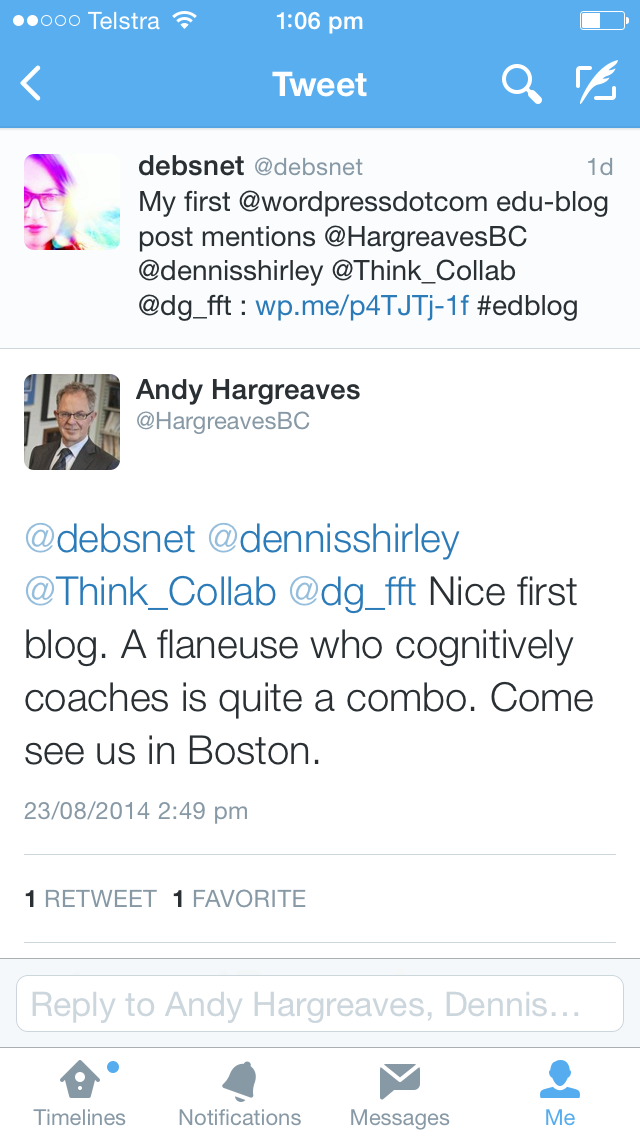
Imagine my delight when global school change titan Andy Hargreaves responded to my first (ever) blog post. Here was social media linking me to one of education’s thought leaders whose work shapes my classroom teaching, my school leadership practice and my PhD research.

In 2013, Kathryn Holmes, Greg Preston, Kylie Shaw and Rachel Buchanan published a paper which found that “Twitter is a valuable conduit for accessing new and relevant educational resources on the internet and also as a viable means of social support for like-minded educators. The cost effective nature of the microblogging platform ensures that it can act as a medium for sustained professional development, while leaving the individual participants to control and take ownership of the learning.” So Twitter can be socially and intellectually supportive, and it can facilitate and drive sustained engaged learning which is owned by the individual.

Jon Tait explains Twitter’s role as professional development platform in his blog post and has designed this infographic to summarise Twitter uses for teachers.

JonTait_TwitterTeacherInfographic

As I move for the first time from content curation to content creation (this being my second-ever blog post), the functions of the professional social media world and those who engage in it are a point of reflection.  Who will read my words and see my images? Who will interact with my thinking and add their own? How might social media support, connect and educate me?