Research and education: a match made in the conference room? #rEDSyd

Luna Park, Opera House, Harbour Bridge

 If you want to go fast, go alone. If you want to go far, go together. African Proverb

I have just returned from presenting at the researchED conference in Sydney. As explained on its website, researchED, founded by Glaswegian Tom Bennett (you can read his reflection on the day here), is a “grass-roots, teacher-led organisation aimed at improving research literacy in the educational communities, dismantling myths in education, getting the best research where it is needed most, and providing a platform for educators, academics, and all other parties to meet and discuss what does and doesn’t work in the great project of raising our children.”

It is the first time this conference has come to Australia and I was pleased to, through attending and presenting, be part of a movement to close the gap between educational research and practice, between academic theorising and school reality.

view from Sydney Harbour Bridge

view from Sydney Harbour Bridge

As a hybrid teacher-leader-researcher I believe in consuming, curating and creating research in order to influence theory and shape practice. At the researchED Sydney conference, I presented with a colleague on our school’s emerging-from-research teacher-professional-learning-and-growth model. It was a current example of how a school might utilise research and a scientific-but-also-people-driven process to develop a strategically aligned, evidence-based, context-appropriate initiative.

Opera House

Opera House

Some of our key presentation messages about school change were:

  • Go slow to go fast. School change is an evolution not a revolution.
  • Start with context and vision. Align initiatives and interventions with it.
  • Believe in the capacity of all individuals to solve their own problems, do their own thinking and drive their own learning.

This next image reflects those things we hoped our model would achieve. We have data measures planned to measure, as much as we can and in a variety of ways, the impact of this model.

'Take one' (or take all!) for your school

‘Take one’ (or take all!) for your school

The researchED conference (or is it a movement?) was one example of a forum for real life, cross-continental, global sharing of research-influenced education practice. You can read some other blog reflections here and here. We need frames and contexts which facilitate conversations between school and academic worlds, in order to facilitate more considered and systematic approaches to education.

Luna Park

Luna Park

Build it and they will come: Creating spaces for learning and working

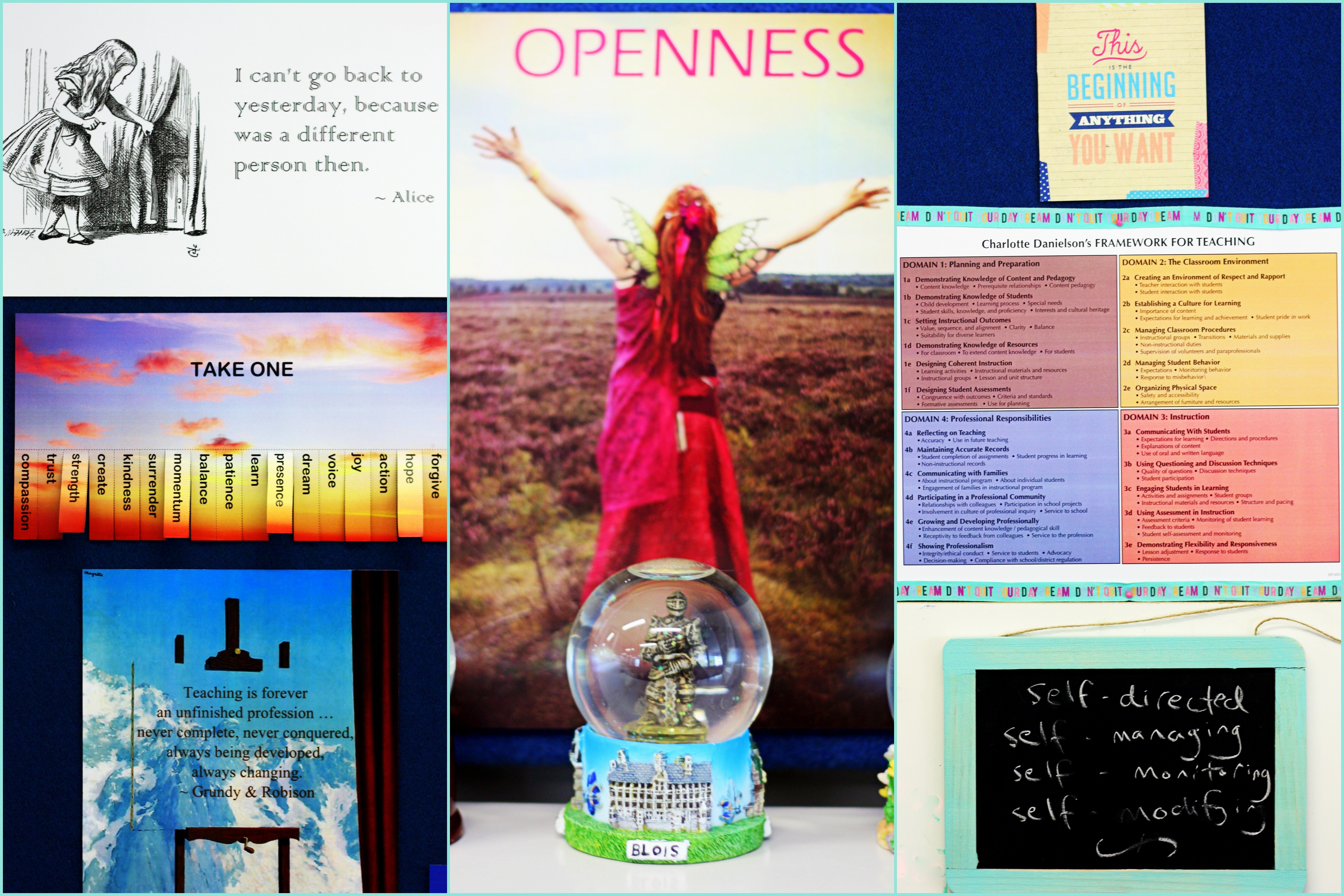
pin-up board montage

pin-up board montage

I had come to a place where I was meant to be. I don’t mean anything so prosaic as a sense of coming home. This was different, very different. It was like arriving at a place much safer than home. ~ Pat Conroy, The Lords of Discipline

At the start of this school year, I have been obsessed. Obsessed with learning and working environments. Over the summer I wrote about my own learning and writing places. Since school has started here in Australia I have been focusing on the spaces in which I work and teach: my classrooms and a new office space for my team of coaches (these are the teachers who will be coaching teachers in our school-based teacher growth model).

My thinking about working and learning spaces is based on a few personal principles:

  • Comfort. This is physical comfort (Is it comfy? Can each individual make themselves comfortable?) and emotional comfort (Does each person feel like they belong? Is the space welcoming and emotionally cosy?).
  • Flexibility. I am a great lover of flexible spaces. What I have found – in classrooms, working with colleagues, writing in cafes for my PhD thesis and watching my own children and husband interact with environments – is that we all have preferred ways of being in a space. When we are working at home, my husband stands at a tall bench while I recline on a couch. Given movable pieces like beanbags and floor cushions, children and young adults will take charge of a space and make it their own, changing groupings or even purposes of furniture. Each will find a nook in which, or stool on which, they feel they belong.
  • Appeal. While we don’t necessarily want our classrooms, offices or homes to look like something out of a Scandinavian design magazine, for me it is important to pay attention to bringing visual appeal to a space. This might be about colour, space, playfulness, details, natural materials or tactility.
  • Ownership. How can the space belong to the people who use it? This might include student-driven spaces and displays in classrooms, family-focused rooms at home, or offices which bear the mark of those who work there.
  • Purpose. The work of Prakash Nair and Randall Fielding (including their excellent publications) explains spaces in terms of purpose: campfire spaces for learning from someone else, watering hole spaces to learn collaboratively with others and quiet cave-like spaces for nestling into learning from and with yourself.

What follows are some examples of these principles in action. Get ready for a picture-fest.

Home spaces

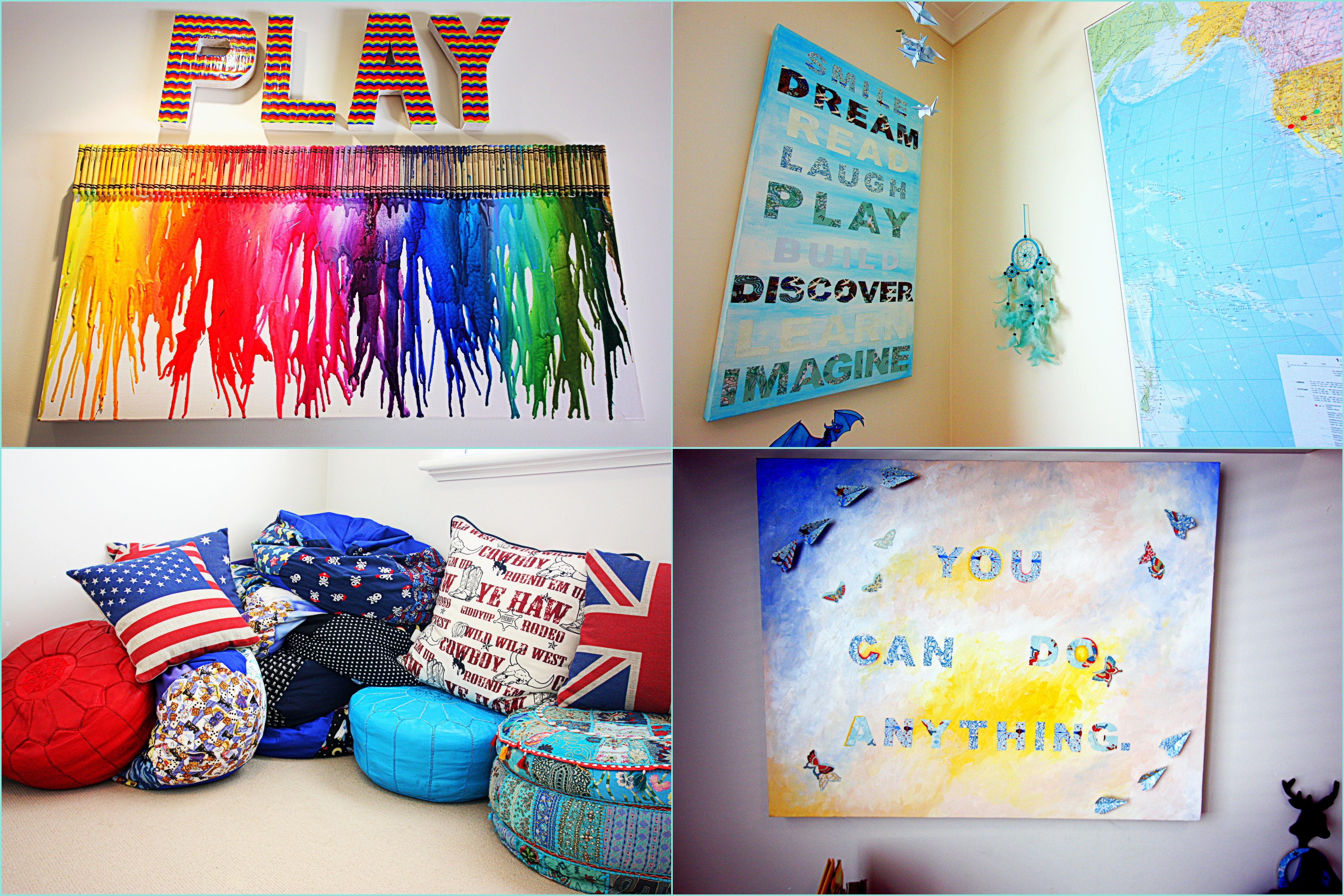
My space principles apply in my home, too. We have piles of beanbags, cushions and ottomans which get moved around the house depending on the space required or game at hand. I have DIYed artwork for the walls of my children’s play and sleeping places. (There is something about DIY that really appeals to me. Maybe it is the catharsis of creativity but I always feel that, if I make something, I instil that something with a piece of myself, my energy and my investment in the person or people for whom I am making it. This goes for my kids’ birthday cakes, the things I have made for their rooms, the artwork I create for friends and family, and the learning and office spaces I have had a hand in designing for students and colleagues.)

DIY artwork & soft furnishings

DIY artwork & soft furnishings in the ‘kids spaces’ in my home

Open learning spaces

When I was Head of Faculty at my school, I had the opportunity to work with a team to design and furbish renovated classrooms. These two immersive spaces are my favourites.
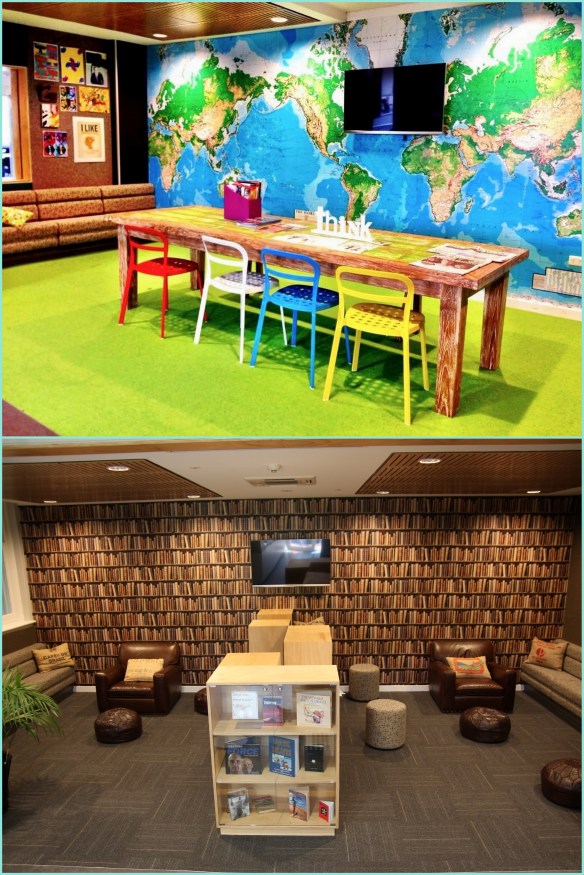
How would you feel learning here?

How would you feel learning here?

Classrooms

Early learning teachers seem to be great at creating environments for their students. In my (limited) experience, this is especially true of Reggio and IB inquiry classrooms. High school classrooms and school offices, however, tend (and I am generalising) to default to ‘seated at grey desks and chairs’ as the main way to learn and work.

This year in our high school English classrooms, we have removed teacher desks (that bastion of symbolic power) which means that teachers need to be flexible about where and how they work. It also encourages teachers to get in amongst their students rather than sitting apart from them or getting students to come to them.

Additionally, we have added more multi-level seating options. Rugs, beanbags, cushions, ottomans and tall benches not only add a homely comfy feel to a classroom environment, they importantly allow for flexibility of space and choice of how individuals work.

Extra whiteboards or walls painted with Idea Paint give the room multiple points of teaching and learning focus (as recommended by learning spaces and places guru, Professor Stephen Heppell).

I spent last Sunday afternoon at IKEA buying high pile rugs, partly for this sense of homey comfort, and partly to add some tactile awesomeness to the shoeless learning / barefoot teaching we are going to try. I haven’t scheduled any official ‘shoeless learning’ time yet, but since mentioning it to my classes, a number of my students have asked at the start of each class if they can work with their shoes off.

comfy classroom spaces

comfy classroom spaces

The best thing about doing this to a classroom is watching the students. They walk in. They look around slowly and with a mixture of confusion and delight. Most sit at their normal desks. Some hover around the new comfy corner. Someone asks, “Is this for us?” “Are we allowed to sit here?” And the next thing you know, they are making it their own and nestling in. They sit on the floor around low tables. They use cushions as tabletops and footstools as chairs. They lie on rugs. They stand around tall benches. They sink into couches. They feel valued and engaged. They find it easier to find their flow.

Offices

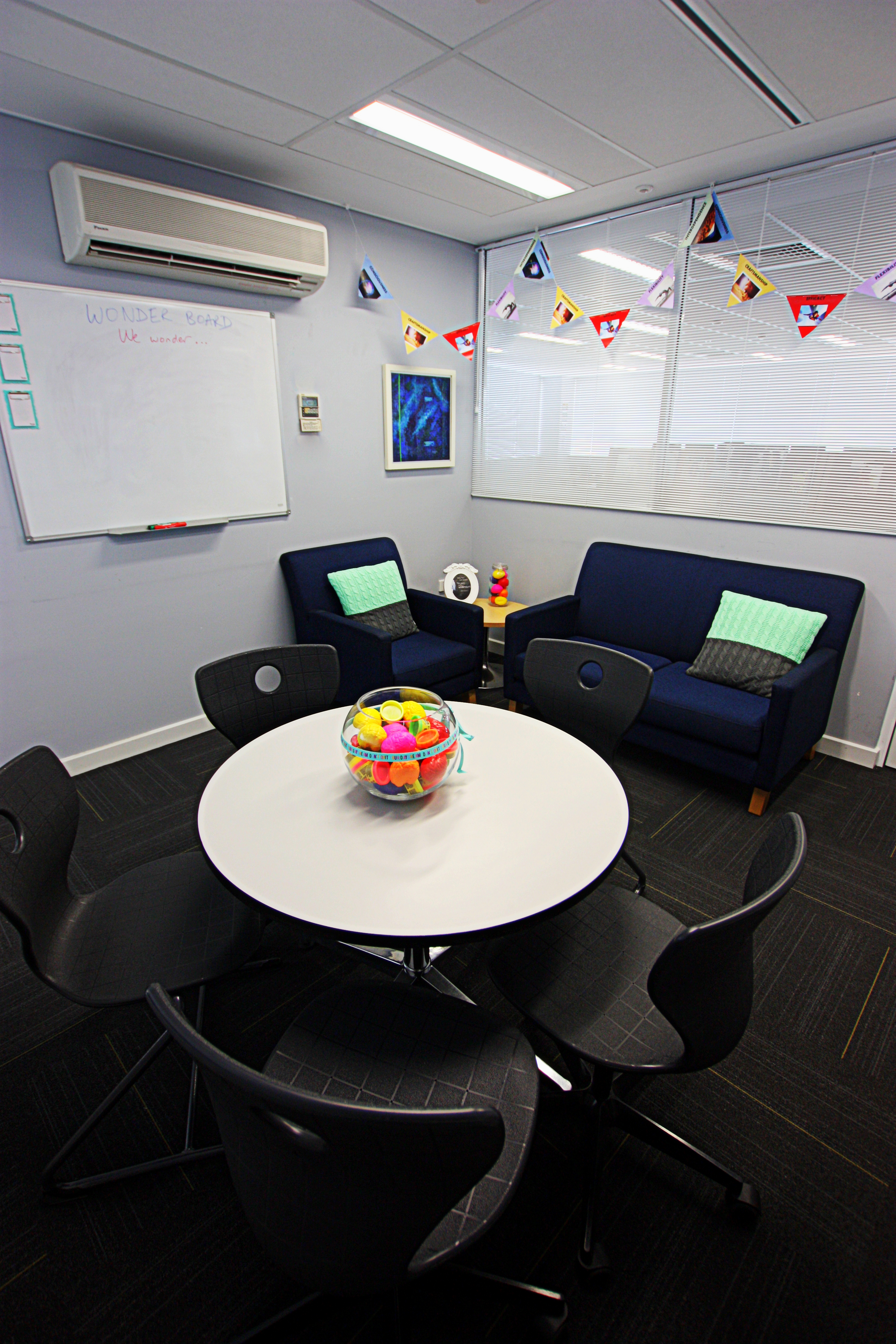
I was delighted to hear that my team of teacher coaches would have a war room in which to meet, explore ideas and have coaching conversations. When I inherited the space it had two big tables, a desktop computer and two chairs. I had those removed and got to work reimagining the space for our purpose.

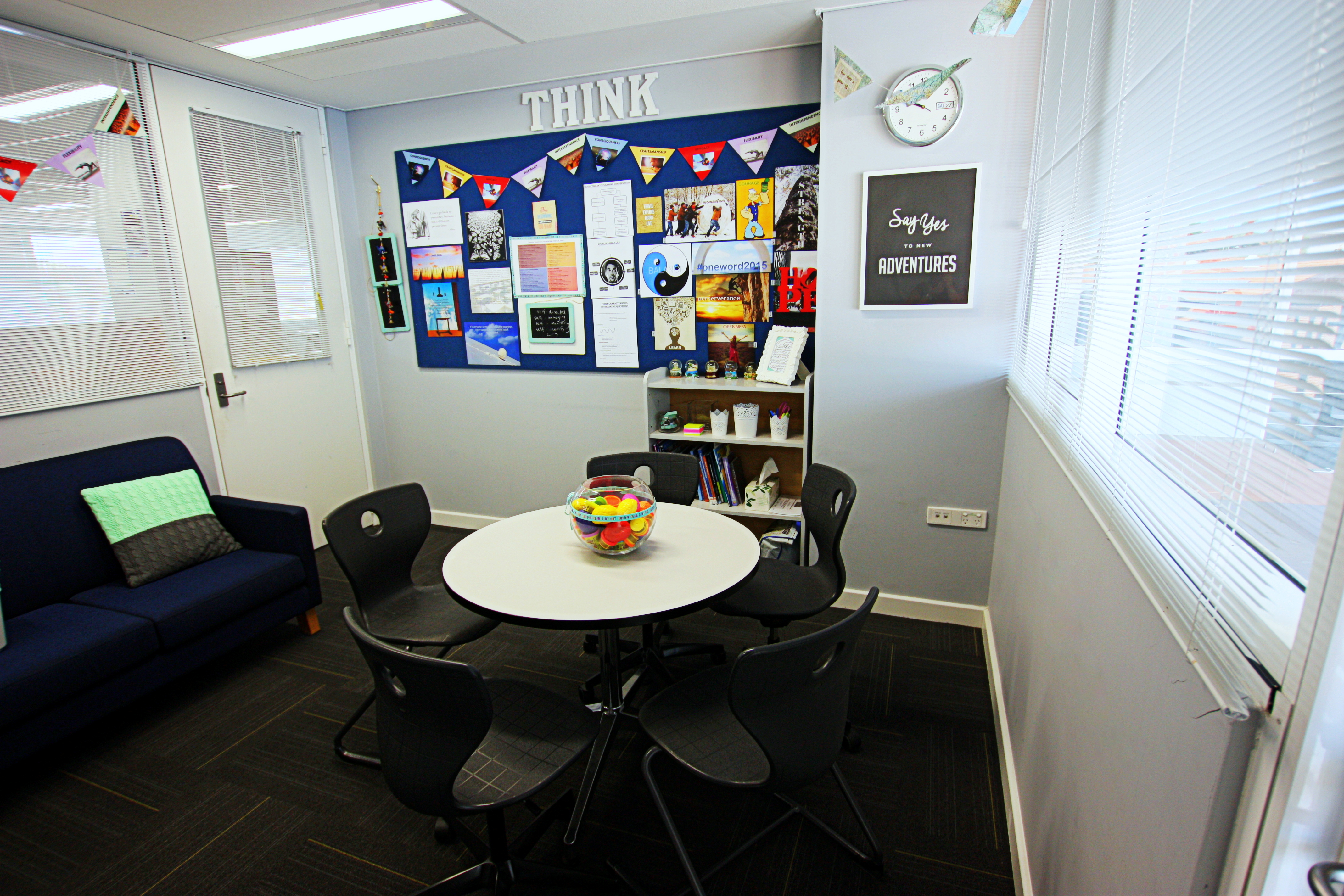
My dream for this space was of collaboration, conversation, co-learning and reflection, so from around the school and storeroom, I found a round table and some chairs, a couch, an armchair, a small bookshelf, a whiteboard and a little table. In they went. I also have two beanbags on order.

teacher office by @debsnet

be deliberate about office furniture

Then it was time to work on emotional comfort and visual appeal.
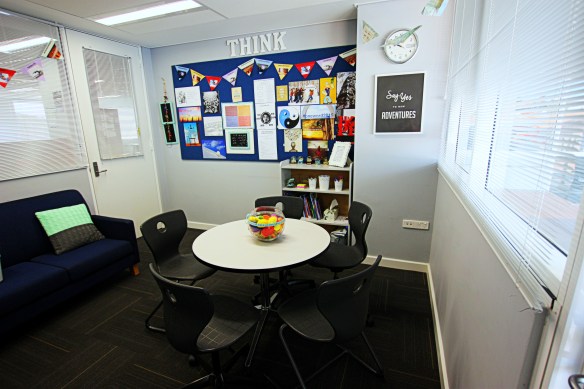
consider floor, wall, tabletop and ceiling spaces

consider floor, wall, tabletop and ceiling spaces

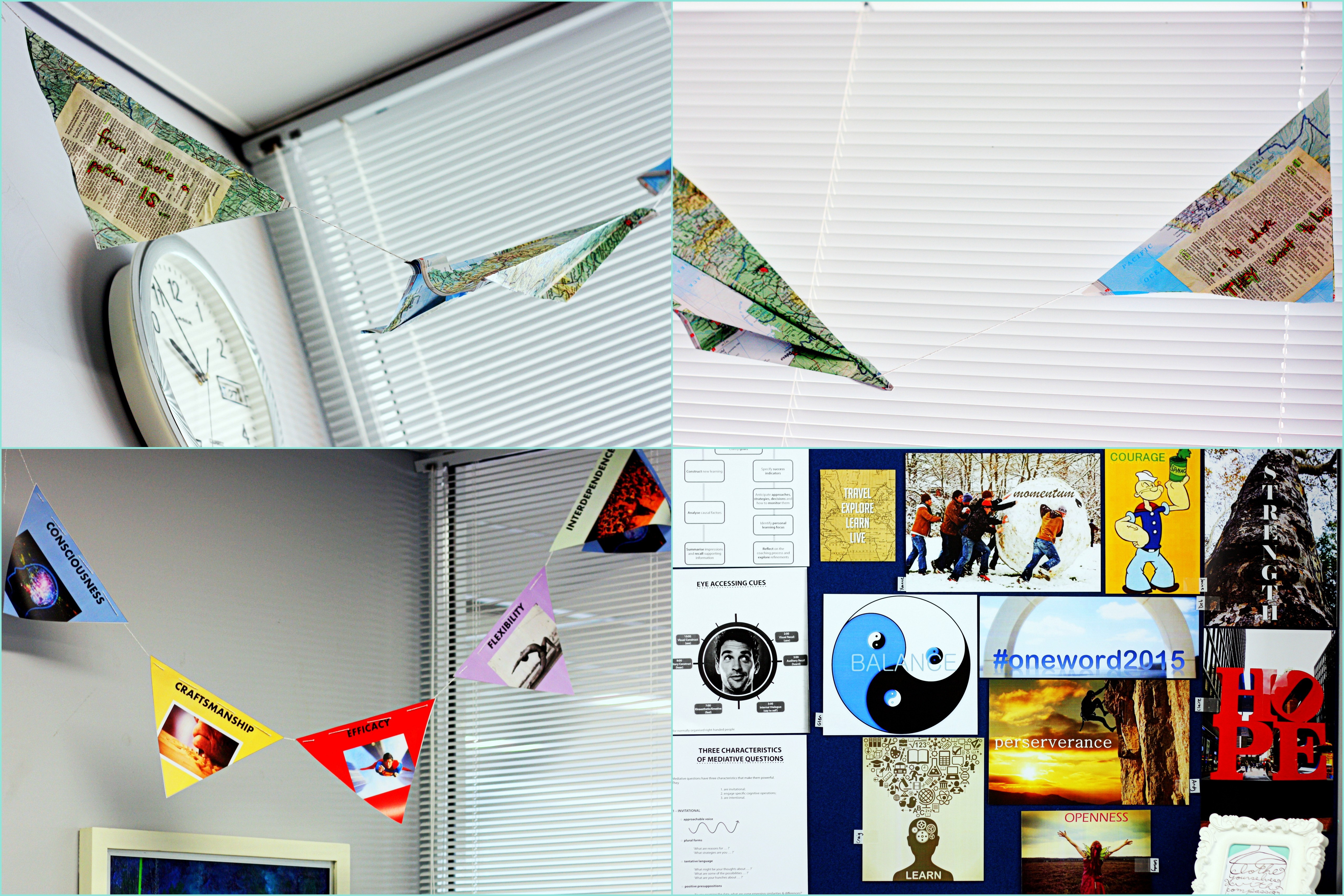
I DIYed some bespoke decorations like the ‘5 States of Mind’ bunting (a concept from Cognitive Coaching) and hanging paper planes. I added and repurposed some bits and pieces from my own house (including some snow domes and the blue painting which is one I painted years ago and has been gathering dust in my garage). A few touches from IKEA and Typo made the office look less officey.

I chose to frame posters rather than laminate them so the feel was more home and less classroom.

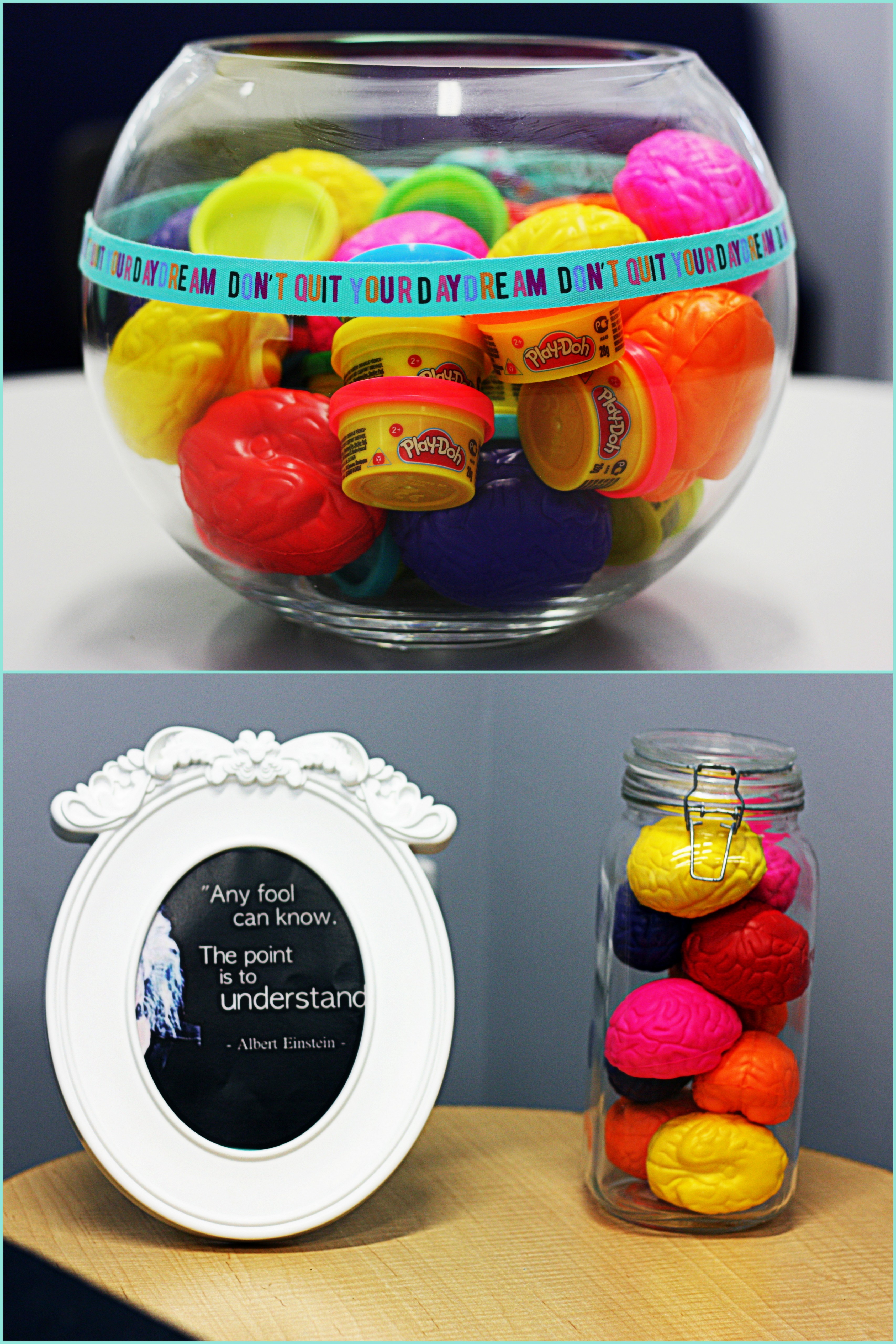
Initially, I wanted a plant for the table, but I knew it wouldn’t survive holidays unwatered, so I opted for a bowl full of Play-Doh and squeezy brains: tactile playthings for kinaesthetic thinkers.

details from my team office

details from my team office

Importantly, the quotes in frames and the ‘one words’ on the pin-up board are directly from members of the team. It is their goals, visions and inspirations which have come together in this space. I can feel the collaborative energy there. I hope they can, too.

TeacherCoachOffice5

What are your own principles for designing learning or working environments? Where are your favourite places to learn or work?
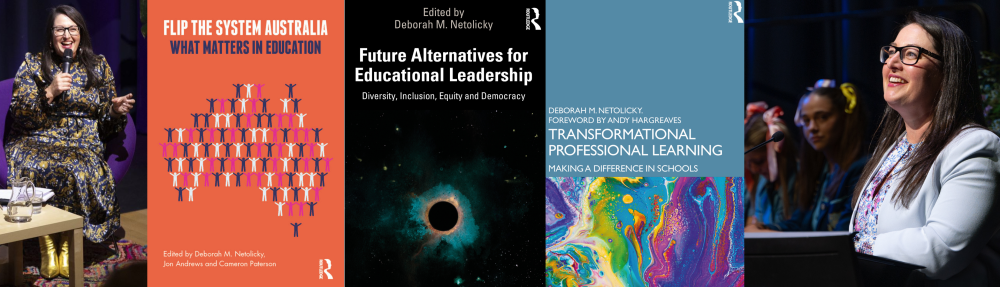
Teacher Growth: Helping teachers open their gates from the inside

This post on my Australian school’s teacher growth model was originally written as a guest post for Starr Sackstein, acclaimed educator, author and bloggess extraordinaire. It was inspired by a #sunchat Twitter chat moderated by Starr, which challenged me to talk more specifically about the professional learning and culture model I keep going on about …

~ ~ ~

No one can persuade another to change. Each of us guards a gate of change that can only be opened from the inside. We cannot open the gate of another, either by argument or emotional appeal. ~ Marilyn Ferguson

open your gate from the inside

How do you help someone open their gate from the inside?

The global education community tends to agree that better teaching equals better student achievement. Schools, districts and nations have taken this notion and used it in attempts to improve the quality of teachers through professional development and teacher evaluation systems.

There is a long continuum of possibilities for developing teachers and teaching, but it seems that many systems sit solidly at the teacher-evaluation-for-improvement end. When I visited the USA I was surprised at the quantitative, and at times punitive, approaches being used to score and evaluate teachers. Eric Saibel’s recent post questions whether all the work and time put into teacher evaluation has made a difference to teaching or student learning. In this thoughtful video conversation Eric talks with Starr Sackstein about ideas for meaningful teacher feedback and growth.

As a teacher, school leader, researcher and parent, teacher growth and evaluation are areas of immersion and passion for me. My own ideas are based on my:

  • Experiences as a classroom teacher in Australia and the UK;
  • Experiences as Head of Faculty in Australian schools;
  • Recent visits to New York schools, researchers and edu-experts;
  • Current PhD research on what makes transformative professional learning and leadership; and
  • In-school strategic work on researching, piloting and developing a teacher growth model for my Australian school. We are at full implementation phase this calendar year.

To develop my school’s teacher growth model we have used a Schooling by Design backwards design approach to planning and implementation. This has allowed us to align our vision, purpose, evidence and action. This has centred us around our own context and our goals of improving the learning of our students and developing the professional culture of our school.

Our change management philosophies of ‘go slow to go fast’ and ‘evolution not revolution’ have given us permission and time to tailor the model to our context and nurture teacher buy-in. Adaptive Schools, which I have written about here, has influenced our work by providing us with models of collaborative strategically-aligned change.

Our model itself is based in a belief that schools are relational places where trust is key to risk taking, growth, willingness to be vulnerable, deprivatising classrooms and learning from, with and alongside each other. It involves teachers-trained-as-coaches (and, every few years, administrators) who help teachers to use non-judgemental lesson data (written scripting, video, audio) as the basis for reflection against the Danielson Framework for Teaching and teachers’ own goals. The Danielson Framework was chosen for its research-basis and specificity. We like that ‘distinguished’ teaching is all about what the students are doing.

As well as meeting with Charlotte Danielson in Melbourne and Princeton (where we spoke about the nature of coaching and my school’s use of her Framework), I heard her speak at the 2014 Australian Council for Educational Leaders Conference in which she explained the importance of a trust environment of challenge and support for teachers, and teaching frameworks as conduits for the thinking of the teacher, rather than telling by the administrator. Ellie Drago-Severson agrees that adult learning needs an environment of support and challenge. Her work on ‘holding environments’ and adult learning is based in trusting the capacity of adult learners. I spoke with her in October about her work with schools and the importance of starting slow and building momentum. We are similarly focused on self-directed teacher growth with a belief in the capacity of teachers to reflect, learn and grow.

As the cornerstone of our conversations, Cognitive Coaching places our emphasis heavily on the coach as non-threatening facilitator of teacher thinking, rather than feedback-giver and scorer. The coach focuses on facilitating the teacher’s thinking, not giving advice or solving problems. This approach is partly based on research like this which shows that what actually gets our brains to be open and changeable is compassionate, positive conversation which sparks our own thinking.

The opening quote by Marilyn Ferguson reflects my thinking on teacher growth and evaluation: teachers need to be supported in opening their own gates from the inside. If, as David Rock and Dan Pink have explained, rewards and punishments don’t motivate, change behaviour or facilitate creativity, how can we encourage students and teachers to be intrinsically motivated, passion-driven, continuous learners who seek improvement through curiosity, reflection, collaboration and risk tasking?

Does your teacher growth or evaluation model encourage self-directed growth and a culture of professional learning? How might you build trust, apply a belief in the capacity of teachers, or develop collaboration in your own context?

it's all about the growth

it’s all about the growth

Powerful & unforseen consequences: our butterfly impacts

#leaningenvironments - evolution of a new edu-revolution?

#leaningenvironments – evolution of a new edu-revolution?

 A cloud from a minor volcanic eruption in Iceland—a small disturbance in the complex mechanism of life on the Earth—can bring to a standstill the aerial traffic over an entire continent. ~ Slavoj Žižek

With the start of the Australian school year almost here – a year in which I am working to implement the teacher-growth model on which I have been working for two and a half years – I have been thinking about what it is that makes a trusting, impassioned, vibrant community of continuous learners.

Ok, as both the subject of my work and of my PhD research, I have been doing more than thinking about this. I have read close to 300 references and written about 85,000 words around effective school change, what makes effective leadership and what kinds of learning teachers find transformational. I have blogged briefly about some key ideas to anchor school change, about the importance of embracing discomfort for growth and about my own learning environments.

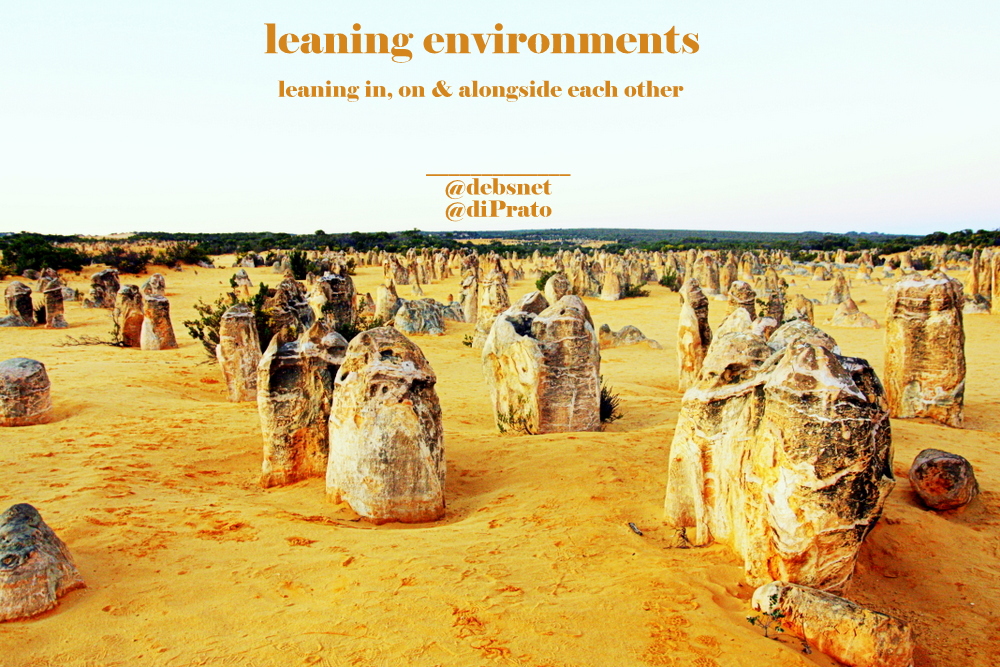
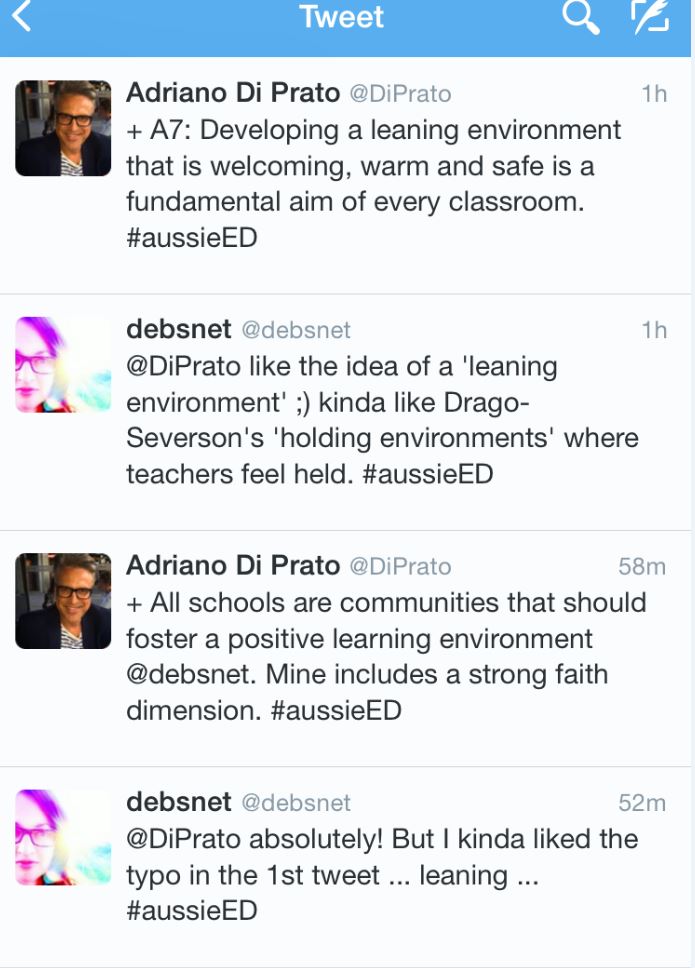
Tonight I was participating in the #aussieED Twitter chat when Australian educator Adriano Di Prato tweeted that ‘developing a leaning environment that is welcoming, warm and safe is a fundamental aim of every classroom.’ Now, I knew that Adriano meant ‘learning environment’ when he typed ‘leaning environment’ in a fast-paced Twitter chat, but it got me thinking: How are schools ‘leaning environments’?

It reminded me of psychologist and professor Ellie Drago-Severson’s notion of ‘holding environments’ (which I wrote a bit about here) in which she asserts the importance of teachers feeling ‘held’ by their learning and working environments, especially if positive change is to take place.

It reminded me of Costa and Garmston’s notion of ‘holonomy’ (explained in the Cognitive Coaching course material) in which the parts (individuals) and whole (organisation) are interdependent.

It reminded me of this great moment last year when a group of commuters on an Australian train platform used their leaning-together momentum to tilt a train and free a man trapped between the train and the platform.

So I tweeted back about ‘leaning environments’, and all of a sudden we were back-and-forthing about how the word ‘lean’ might apply to school environments. Would it be about individuals ‘leaning in’ to the community, to opportunities, towards each other? Could it be about students, teachers, parents and leaders ‘leaning on’ or ‘leaning alongside’ or ‘leaning with’ each other? Might it be ‘leaning out’, away from those things which should matter less but sometimes drive schooling (high stakes testing, grades, league tables)?

the power of a Tweeted typo

the power of a Tweeted typo

Fellow edu-Tweeter Melissa Daniels noticed the banter and asked whether this could be “the education revolution that started with a typo?” leading to another discussion about innovation, revolution and the evolution of ideas, all in 140 character bites.

Tweet @debsnet @DiPrato @PensiveM

This was an invigorating discussion for me, not because I thought it was to be the next big thing in education, but because of the thrill of the unsurprising serendipitous connections, conversations, ideas, thinking and challenges that come out of conversations and connections with like-minded like-passioned others. Here was a vibrant online environment of trusting, holding, leaning (in, out, on, with, alongside), impassioned, creative, continuous learners.

It also reminded me of our unforseen impacts. We never know the impact of a conversation, a word, a decision, or a typo.

I have noticed this in my self, in conversations or moments which stay with me until an idea bubbles to the surface. I have noticed it in my work with teachers and students, who often take some time to realise what moments or relationships have shaped them. I have noticed it in my PhD research participants, many of whom told me that the very act of being interviewed for my research changed something for them, opened something up, surfaced a reflection or became a moment of learning.

So, don’t ignore life’s typos. Even the seemingly tiniest things can have powerful & unforseen consequences.

You never know when you might uncover the next revolution.

Small shifts in your thinking, and small changes in your energy, can lead to massive alterations of your end result. ~ Kevin Michel

Montenegro by @debsnet

Presence, Sharing, Strength: 3 words for 2015

presence * sharing * strength ~ words for 2015 against the backdrop of my New Year's Day

presence * sharing * strength ~ my words for 2015 against the backdrop of my New Year’s Day

Hope smiles from the threshold of the year to come, whispering, ‘It will be happier.’ ~ Alfred Tennyson 

We have passed across the threshold of the year to come. The new year is upon us.

While I tend to reflect constantly and set small, achievable goals, it’s been a while since I have set a New Year’s resolution (and I don’t intend to start here; what follows is an alternative approach to finding focus at the inception of another trip around the sun). While I love a good list, and an inspiring goal, I also love a good vision. Like organisations, individuals function optimally when we align our words and actions with a clear, coherent sense of identity and vision. Chris Brogan advocates for a simple personal visioning exercise to develop our own personal vision for the year ahead: ‘3 words’. Interestingly, some people (like educator Kirsten Wilson here) use this approach intuitively.

This is my first year of utilising the 3 words approach, and here they are:

Presence

This is a year of being present for me; of hereness, mindfulness and breathing into each moment. Presence, as I wrote about here, is an ongoing daily focus for me. My life, like most lives, is filled with competing, overlapping commitments, including my family, teaching, leadership role, PhD research, wellbeing and relationships. I have written about how I approach doing a PhD and my thinking around finding work-family commitment. My intention is to commit to being absolutely present in each of these spaces. If I can minimise distractions and focus fully on experiencing the person or task at hand, I can be immersed, productive and joyful. I can nurture relationships and be effective in my work and writing. I don’t want to see 2015 as a mad juggle of life’s components, but as a kind of ecosystem of interconnected wonderfulness in which all elements can be honoured and enjoyed. In amongst the doing needs to be the being.

Sharing

Sharing is reciprocal and collaborative. I read what others share. I share my thoughts on social media and on this blog. I share the stories of others in my PhD (which uses narrative research to examine transformative adult learning and school change). This word could have been ‘connecting’, ‘storytelling’, ‘expression’, ‘conversation’, ‘communication’, ‘collaboration’ or ‘tribe’ but none of those capture quite what I mean by ‘sharing’. In 2015 I am sharing – hopes, dreams, stories, pedagogy, beliefs, leadership approaches, writing strategies – with my friends, family, PhD, supervisors, PLN, Twitterverse, blogosphere and hopefully even some thesis examiners (although that might not be until 2016). As I discussed in my post about writing dangerously, I will be writing various texts in various styles to be shared with various audiences. Sharing our own thinking makes connections, starts conversations and builds collaboration. Sharing is viral, organic and transformational.

Strength

In 2015 I want to be strong in body, convicted in belief, confident in voice and resilient in character. A strength regime therefore involves physical bodily exercise including strength training, development of writerly voice (especially important in the final stages of my PhD), honouring my deeply held beliefs, and confidence in sharing my thinking in blogs, at conferences and in academic articles. Strength in myself and my identity means being able to stand up for my ideas, believe in my approach and be accepting of my own idiosyncracies, my own creative ways of thinking, my own imperfections and my own brand of ‘lovably weird’.

If you are looking for more visioning inspiration, check out the 2015 #3words blog posts of C. C. Chapman, Joyce Sullivan and Sheree Martin. Educators, check out Dave Burgess’s Teach like a PIRATE: Passion, Immersion, Rapport, Ask & analyse, Transformation and Enthusiasm – kind of a vision and a list all rolled into one acronym. ‘Piracy’ would be a pretty good word.

What are your 3 words for 2015? I would love to hear them.

It is a mistake to try to look too far ahead. The chain of destiny can only be grasped one link at a time. ~ Winston Churchill

into the future we go

into the future we go

No grades? No marks? No worries.

We need to ensure that feedback causes a cognitive rather than an emotional reaction – in other words, feedback should cause thinking. … it should be more work for the recipient than the donor. Indeed, the whole purpose of feedback should be to increase the extent to which students are owners of their own learning. ~ Dylan William

Is there a joyful feedback loop?

Is there a joyful feedback loop?

I remember from my own experience as a school student what feedback can feel like, especially in those subjects at which I did not excel. A harsh or critical word, a page bleeding with red pen, or a mark – that number always so final and inflexible – can be crushing, humiliating or incomprehensible to a child or adolescent.

An approach to feedback

As a high school teacher, I never mark in red. I try to build into units of work multiple formative opportunities which allow students to try things, reflect upon their learning, and try again.

I encourage students to see a mark, not as an endpoint, but as a formative learning opportunity. I explicitly tell students that a mark is one number attached to one moment in time, not a judgement of them and their worth. That even summative assessments are really learning opportunities, to reflect on areas of strength, realisations of learning and areas for development.

I implement a post-test feedback process in order to facilitate this cognitive rather than emotional reaction to the result achieved for a piece of work, in an attempt to ignite, rather than shut down, students’ thinking.

My usual process after a test or assessment is this:

  1. I provide whole-class oral and white-boarded feedback based on the assessment rubric and patterns in student responses.
  2. Students write a quick prediction and reflection based on that oral feedback and their understanding of their preparation for that assessment and how they think they went.
  3. I give the assessment back, on which is written individual feedback in relation to the rubric. Students do not receive a mark or grade (yet).
  4. Each student silently writes a reflection on their work (including areas of strength, areas for development and strategies for future growth) and has a consequent individual conversation with me about their reflection. Sometimes this step also involves identifying a part of the assessment to re-do for their own growth.
  5. Students receive their mark and are then able to re-reflect or make a time to see me to discuss how they went, why, and how they might approach future work.

While many of them initially find this process excruciating (‘Just give me the mark!’), I hope that it helps them to develop skills for using their experiences, successes and disappointments as moments for reflection and growth, rather than emotive reaction and cognitive shutdown.

All this seems to have a lot of what ‘I’ the teacher am doing, but really the focus in on how best to facilitate the thinking of the students, and propel their understanding of assessments as data for growth, as opportunities for micro-transformation.

‘No marks, no grades’ in action

One of my classes is currently finishing up a term unit which has had no marks and no grades. Nada. Zip. Zilch.

That is, for this term, every student in Year 10 was able to choose a unit from a series of choices offered by the Faculty which would be run as a project-based and unmarked unit.

I was sceptical about this approach. While I endeavour to lead students away from their marks and towards their learning, I wondered if they would continue to work if there was no mark at the end. Would they apply themselves when they realised that there were no marks up for grabs, no traditional scoring of their efforts, no numerical way to compare themselves against their peers? What would happen when students realised that the work didn’t ‘count’, in the traditional school sense, towards a mark or grade?

To my surprise and delight, I have reached the last week of what has been a term of focused, engaged, passionate and diligent work by my students. My instincts about the pleasing way the students have worked, and the good (at times inspired, origial, creative or prolific) work they have produced, tell me that some combination of the following factors may have facilitated this.

  1. Students had ownership. They chose the unit, thereby placing themselves in the class, declaring an interest in the content and a desire to be there.
  2. Students and teacher were liberated from marks and grades. In a class with a very diverse range of abilities, I was able to work with students at their level and stage. I could help weaker students to move their work forward without having to disappoint them with a low mark after submission. I was able to extend and encourage more gifted students beyond what might have been considered mainstream curriculum.
  3. There have been other non-mark non-grade measures of success along the way. For each minor task I chose the top student responses and awarded small prizes to those who had produced the best work. I also offered opportunities for the class to off-campus mini-excursions, if work was completed, motivators which helped to keep students on track with milestones along the way.
  4. Student passion and purpose was harnessed through a passion-based project-based approach to tasks. As teacher I was guide, facilitator, collaborator and mentor to their work.
  5. Authenticity of audience. We organised an end-of-term showcase of student work, a kind of walk-through exhibition in which student work was displayed and celebrated. Students took responsibility for selecting and displaying work, and were able to share this work with community. We also kept class blogs which were creative, collaborative, organic explorations of ideas.

It turns out I should have remembered Dan Pink’s assertion that carrots and sticks (a mark or grade can be either), squash motivation and crush creativity. That people are intrinsically motivated by a desire for purposeful self-authorship. This recent un-marked un-graded unit was an example of students working with a sense of personal pride, personal voice and personal purpose.

@debsnet https://theeduflaneuse.wordpress.com/

Why blog? Personal evolution & community transformation

There is nothing to writing. All you do is sit down at a typewriter and bleed. ~ Ernest Hemingway

doorway

doorway

I began this blog a few months ago as a way to explore, record and share my thinking around a particular self-directed professional learning experience: a trip from Australia to New York intended to gain insights around teacher effectiveness, teacher evaluation and teacher growth. The trip was amazing personally and professionally. I met with schools, school leaders, teachers, researchers and global edu-experts who challenged and inspired.

Now that initial blogging purpose is sated and I find myself wondering: should I continue blogging?

My first instinct is: yes. And that mainly emerges out of the enjoyment I have found in reflecting, writing, sharing and engaging with others as a result of my posts. I alluded in post about social media for educators, this post about being a connected educator and this one about finding your professional global tribe, that Twitter has been invaluable in connecting me with other like-minded (and non-like-minded – just as important!) people. Blogging, however, allows for much more developed thinking than tweeting. Twitter can facilitate 140 character conversations, but it doesn’t allow you to burrow deep into ideas and give them a shake. So since blogging, I have been blogging about blogging, and now I’m at it again.

My reservations about continuing a blog are primarily about time. I am a parent of two pre-school age children, an educator at an Australian school, and a PhD candidate who is two years, 150 pages and 300 references into my thesis (more about how I juggle those things here). Right now as I write a blog post about whether I’ll write future blog posts, there is a long list of other things I could be doing.

And yet, here I am.

Partly because this blog has allowed me to explore my own thinking around my work and study. It is a free space to write. I have my PhD to write too, but blogging is a space in which I can write without pressure and with more freedom of style and content. It keeps me thinking and learning and connects me with other thinkers and learners.

I also know what other blogs give me. They can be transformational, inciting change, encouraging action and inspiring thinking through the sharing of stories, expertise and others’ intellectual struggles around big and small ideas. They promote reflection, conversation and growth, in the blogger and the reader. Perhaps my own musings might provide insights for others, open a window to my context, challenge another’s thinking or facilitate connections across geographical and philosophical boundaries?

So I feel propelled to continue blogging, but I wonder how that journey might evolve, if anyone will read my posts, and if that even matters. Certainly I would (will?) be a blogger who blogs when I have something to say, rather than to chase numbers of clicks on a page.

Western Australia by @debsnet

possibilities

Teaching Matters: the challenges of putting theory into school practice

The personal is linked irrevocably to practice. It is as if the teacher is his or her practice. Teacher practice is the maximum point of vulnerability. Classroom teaching is the arena of greatest anxiety and insecurity. ~ Goodson, 1991

Teaching Matters

Teaching Matters

It’s amazing how flying across the world can result in familiar conversations! In my meeting with New York City professional development provider Teaching Matters, the same challenges and tensions came up for both our contexts in terms of professional learning, supporting teachers and developing distributed leadership: time and buy-in. That is, finding appropriate time for teachers to thoughtfully engage in meaningful work, and providing the philosophy and conditions which allow teachers to buy in to that work.

Teaching Matters is an independent provider of customised professional development to teachers and leaders of New York City public schools. Their aim is, by partnering with and training teachers and school leaders, to increase teacher effectiveness, raise teacher performance and positively influence student learning. Their organisation is built on a philosophy of sustainable change; that is, to build capacity in the schools with which they work, in order to help each school to build its own effective teams and teachers. They base their work in a belief about the capacity of teachers to be leaders and for schools to be vibrant places of distributed leadership. Their job, as they see it, is to help schools develop their own cultures and skill sets to ensure effective leading and teaching.

Understanding the busyness of being a teacher and the need for workable, applicable solutions for teachers, Teaching Matters balances its work between building schools as professional communities, and providing accessible protocols, tools and techniques for use in teaching, assessing, improving instruction, establishing PLCs, coaching and leading. Teacher buy-in, for them, is linked to teachers’ perceptions about change being something which will be manageable as well as useful. They are therefore highly aware of the need to support teachers professionally while also saving them time and work. The problem of innovation fatigue – “another additional thing” constantly being added to teachers’ workloads – seems an international phenomenon which needs to be considered when designing anything new to be implemented in schools.

My work on professional learning and growth is within my own school and with my own community, whereas Teaching Matters needs to “synergise” with the diverse school cultures and people with which they work. Much of their work is based on that of Daniel Venables, author of A Guide to Effective Teacher Teams (2011) and How Teachers Can Turn Data into Action (2014) and founder of the Center for Authentic PLCs. Venables focuses on the development of high-functioning professional learning communities to facilitate positive school change.

We discussed the challenge and opportunity of leveraging data to monitor and inform change, such as teacher self-reflections against the Danielson Framework to, for instance, allow the identification of community professional development needs.

A question that came up in our meeting was around the use of the Danielson Framework. My school is using it for teacher growth, through cycles of observation and coaching, but to what extent might it also inform teacher planning or the work of teaching teams?

I heart NY

I heart NY

One of the Teaching Matters foci – data-driven collaborative inquiry as a way to improve student outcomes – sits snugly with my school’s work on developing a data-supported coaching cycle of teacher reflection and growth. Interestingly, one of their documents suggests that the best teams of teachers are those who teach the same content and share the same learning goals.

The Teaching Matters approach to peer observation involves the following steps of a teacher being observed by one or more members of their teaching team:

  • A pre-observation conversation in which the teacher outlines the lesson context and the teacher and observer/s discuss the time and focus of the observation (20 mins).
  • A classroom observation (or video) in which the observer/s takes notes on what the teacher is doing, what the students are doing and what practices are being used by teacher which relate to goals for student learning (30-45 mins).
  • A post-observation conversation in which the observer/s share observations, questions, constructive suggestions and future steps/strategies (45 mins; protocols are based on ‘Conversations: Turning Points Transforming Middle Schools,’ Teachers working together to improve instruction (4, 2) 2004)

Our model differs to this one in:

  • its length of lesson observation (ours are 2 x 20 minutes, rather than 1 x 30-45 minutes);
  • the type of data taken (our observers take all non-inferential data – just what happens rather than impressions about what is happening); and
  • its approach to post-observation conversation (ours is a Cognitive Coaching approach which does not involve ‘constructive feedback’ or lesson advice; our teacher coaches are there to guide the teacher’s own thinking about their lesson rather than provide comments about it themselves).

While our coaches do find that seeing others’ lessons influences their own teaching, this is not a formalised part of the conversation for us; the conversation is focused on the teacher being observed. I can see the Teaching Matters model as very useful collaborative work: peers in the same team observing each other’s lessons and using that as a basis for team discussion of pedagogy. Perhaps this might be something we can add to suggestions for strategies that teams can use to collaboratively develop pedagogy?

While working in content-similar or year-level-similar teams allows for collaboration on and experimentation with similar approaches, my school has also found value in teaming teachers from disparate parts of the school to broaden perspectives while also connecting teachers around those aspects of teaching which are common across year levels and subject areas.

Like Teaching Matters, what we want to provide for our teachers and leaders is both a philosophical foundation and a useful toolbox of processes and strategies, to help teams and individuals self-direct their growth.

HOPE at 7th & 53rd

HOPE at 7th & 53rd

A teacher growth reconnaissance mission: takeoff

If you actually look like your passport photo, you aren’t well enough to travel. ~ Sir Vivian Fuchs

For the last few years I have been working with others in my school on a consciously-developed, research-based and teacher-driven model for teacher growth and professional collaboration. Our work over the research and pilot years has been based in some central assumptions around learning, school change and leadership: that all teachers have the capacity for reflection and growth; that going slowly and deliberately will result in more positive roll-out; that leadership is distributed; and that leaders are responsible for facilitating the self-driven self-managed learning of others, rather than telling, advising and solving.

Pleasingly, our work so far seems to be fostering that which it originally set out to cultivate by:

  • developing a common language for and shared understanding of ‘good teaching’;
  • strengthening professional culture by connecting teachers across the school, and by formalising professional conversations about teaching practice;
  • depersonalising classrooms, with teachers more open to and familiar with having others in their lessons;
  • providing a formalised process of reflection which is meaningful to teachers, allowing them to improve their teaching and develop their capacity for reflection while honouring their individuality and respecting their capabilities; and
  • supporting teachers as leaders and experts, both in their collaboration with others and in their own capacity for self-reflection and growth.

Our experience continues to be that our work on teacher growth has subtle immeasurable ‘butterfly effects’ across our teaching, relationships and communities.

Grand Central

Grand Central

As I explained in my very first post and another post, I now have the privilege of traveling to New York in order to gain some international insights for our Australian work.

Sitting in the departure lounge at Sydney International Airport I am reflecting upon what I might find during my time in New York visiting educators, researchers, trailblazers and edu-organisations. It’s time to ride on a big jet plane and find out.

awaiting departure at Sydney International Airport

awaiting departure at Sydney International Airport

Kaleidoscope selves: find your tribe

art journal page: Alice in Central Park

art journal page: Alice in Central Park

Who in the world am I? Ah, that’s the great puzzle. ~ Alice, Lewis Carroll’s Alice’s Adventures in Wonderland

José de Creeft’s Alice in Wonderland bronze statue glimmers in Central Park, polished by children’s climbing hands. Alice, of Wonderland fame, is a character who resonates with me. She is ingrained enough in my thinking that she makes more than a passing appearance in my PhD thesis. What I love about Alice is that she is open to new places and perspectives. She is curious, receptive and constantly wondering. She thrives on meeting new creatures and on having unusual, wondrous experiences. She is the imaginative adventuress who at once embodies childhood awe, strong self-assurance, rationality and fear-conquering daring. In many ways she is a flâneuse of Wonderland: wanderer, wonderer, learner and observer.

The question of self is not straightforward. Various aspects of our tangled selves collide and interlock. Or perhaps, rather than tangled webs of gossamer self-threads, we are each kaleidoscopes of self. Forged from a range of asymmetrical elements, we form the spectacularity of the beautiful changeable selves we are when viewed together through a cylinder of mirrors and light.

my precious stone kaleidoscope

my bronze-cylindered Arcana kaleidoscope has wheels made of glass and semi-precious stones: this one is by Australian artists Robert Cook & Jocelyn Teh

My kaleidoscopic self is made up of a number of different selves which my @debsnet Twitter bio attempts to unify:

Wanderer. Wonderer. Dreamer. Reader. Writer. Creator. Educator. PhD researcher. Passionista. Disruptor. Imaginer. Innovator. Flâneuse.

Not included are other personal selves like parent, spouse, child, sibling, friend. There are many contexts in which I share all or some of these self aspects. As the kaleidoscope turns and the light changes, people see different patterns reflected from me.

patterns as seen through my kaleidoscope

mandala-like patterns as seen through my kaleidoscope

My self-threads splinter, intertwine and blossom, as they do through the kaleidoscope viewing hole.

As I reflected in a previous post, connecting with other educators is for me about being my learner self. Connecting and collaborating widens and globalises my perspectives, while encouraging my own thinking and reflection (see Tom Whitby’s recent post about the relationship between connection and reflection). My teacher self is informed daily by my experiences as a parent, my own learning as a PhD candidate and my online participation. My Twitter interactions are influenced by my daily experiences of parenting, researching and working in a school. My parenting is influenced by my teacherly and researcherly thinking about learning and development. My PhD research self interacts with other researchers on social media as well as being informed by my in-practice educator immersion in my academic topic of study. My PhD itself incorporates me as learner, educator, writer, reader, creator and self-conscious researcher. And here on this blog my posts tangle together the threads of my learner, teacher, researcher, parent, writer and artist selves.

A dear friend of mine recently sent me this quote which I’m sure resonates with many of us:

When you find people who not only tolerate your quirks but celebrate them with cries of ‘Me too!’  be sure to cherish them. Because those weirdos are your tribe.  ~ Nanea Hoffman

It strikes me that many of those with whom I connect, in life, in education, in research and in my online PLN, are those whose quirks are similar to mine. Their kaleidoscope colours reach out to me across time, space, geography and social media.

I was recently involved in a Twitter chat with a number of educators. A few people in the chat began talking about being proud to be dorky, to be okay with failure and to constantly be learning. When I tweeted back ‘yes – fellow geeks unite!’ there was a chorus of ‘amen’ and ‘ditto’. I felt like I’d been high fived over Twitter. Here were my fellow weirdos, people who I’ve never met, connecting with me from across the world. “Yes,” they were saying, “In this moment, I get you and you get me.”

Next week I fly to New York to connect in a very real and immersive way with fellow educators, researchers and thinkers who will widen my perspectives. Perhaps I will widen theirs by sharing my Australian story. As this blog attests, I am hoping that my trip will allow my total and joyful submersion in all my aspects of selfhood. I will be thinking, writing, note taking, photographing, drawing and flâné-ing my way to new connections, new reflections and new perspectives.

The word kaleidoscope comes from the Greek words kalos, eidos and skopeō which essentially translate together into ‘beautiful form to observe’. Here’s to finding the beauty in others’ idiosyncrasies and to each of us finding our quirky global tribe.

find wonder, find perspective