The cognitive load of school communication

Source: Lucent_Designs_dinoson20 on pixabay

I have recently been thinking about cognitive load as it relates to AI and our wider experience of communication in schools, as well as the experience of students in classrooms.

The recent La Trobe University guide The Science of Learning and Generative AI (Tanti, Maddox & Phillips, 2026) draws attention to the limits of human attention and working memory. Effective teaching does not seek to make learning effortless, but rather to remove unnecessary cognitive clutter so that students can direct their attention towards thinking that builds understanding: retrieving, elaborating, connecting and applying.

The guide also considers the role of technology. Digital tools can help when they reduce unnecessary complexity or provide useful scaffolds. They can hinder when they create distraction, fragment attention, overwhelm with information, or do too much of the thinking on behalf of the learner. The research is about learning, not school communication, but it has me thinking about the communication environments we create in schools.

Communication requires work by communicator and receiver. There is work involved in deciding what to communicate, how and when. There is also work involved in receiving, locating, interpreting and responding. I have been wondering how schools might streamline and improve communication load for everyone in the school community.

When communication feels too hard

Schools have much to communicate, through a growing range of channels. McCrindle’s recent research (Renton & McCrindle, 2026) suggests that almost four in five parents experience some kind of challenge with communication from their child’s school. 26% identify too many apps and platforms as a problem, 24% receive too much information they feel is irrelevant to them, and 19% struggle to know where to find the information they need. Parents also identify communication that feels cold or impersonal, one-sided communication and slow response times as sources of frustration.

Of course, families want communication. They want to know how their child is going, and not only academically. McCrindle found that parents place equal value on behaviour and social updates, and grades and academic results, both at 55%. Parents report greater satisfaction with academic communication than with information about their child’s social and emotional wellbeing.

At my school, we never seem to feel that we have communication exactly right. Our annual parent survey usually surfaces some frustrations or frictions relating to communication. We continue to ask families what works for them and how we can do better, while interrogating our systems, processes and practices.

Parents are juggling workloads, life administration and digital noise, alongside family, social and community commitments. Some are navigating communication from multiple schools, for multiple children, and across multiple co-curricular activities.

One question we have been considering is:

How much work does our communication ask the recipient to do?

Does a parent need to search across platforms? Work out whether a message is relevant to them? Interpret what action is required? Find a date buried in a paragraph? Decide which staff member to contact?

Each additional step or question the receiver needs to undertake or ask is a small demand on their attention. Across a week, a term, multiple children and multiple organisations, those demands accumulate and navigating a school’s communications can feel too hard.

Making communication easier to find

At my school, our school app has become the central source of truth for whole-school communication. If the school has communicated something families need to know, they should be able to find it there. This reflects the wish from one parent in the McCrindle study for a single platform where notices, assignments and activities could be found without having to search for them everywhere. The broader findings point to the same frustration around multiple platforms and difficulty locating information. Schools are constrained, however, by the differing capabilities of apps and systems available. There are few genuine one-stop shops.

Every new communication channel or publication creates another place for information to live, another place for families to look and another thing for staff to maintain. For us, improving communication has therefore also involved de-implementation. The fortnightly whole-school newsletter has gone, replaced by smaller, more targeted communication through the app, while celebration happens largely through social media and the school website. Likewise, the traditional long-form end-of-semester academic report has been replaced by continuous reporting through our learning management systems, allowing families to see feedback closer to the learning rather than waiting months for a retrospective summary.

Predictability also helps to lighten the load of receiving communication. When families know where communication will appear and when to expect it, there is less need for constant checking. While not every communication can be anticipated, as a school we plan the cadence of communication so that regular communication can become expected. Rhythm and predictability make it easier for families to know where to look and what to expect, and for staff to plan what needs to be communicated.

What is worth asking people to show up for?

Communication is not only what appears in an inbox or app. There is also the volume of events families are invited, and sometimes expected, to attend, and which in turn staff are expected to plan and attend.

McCrindle’s research suggests that families value experiences that bring them into direct contact with their child’s learning and school community. Half of parents say they prefer attending student performances and creative showcases, 49% value one-to-one parent-teacher meetings, and 48% celebratory awards and graduation events. When asked what would bring them to an after-hours event, 58% nominate seeing their own child perform or showcase their work and 49% a private conversation with a teacher about their child’s progress.

As my school continues to examine an already busy school calendar, we are trying to be more judicious about what we ask busy families to come to school for, what might be better communicated asynchronously, and when physical presence and coming together matter most.

The same question applies to staff. An evening event that asks something of family time also asks something of the time of the teachers and other staff who make it possible. If someone has been at school since early morning, we need to consider how many after-hours events can reasonably sit within a week or a term.

Communication that is sustainable for everyone

This question of sustainability is increasingly visible in written communication. The McCrindle findings surface that parents value and expect responsiveness. McCrindle found that 21% of parents expect a response to a non-urgent teacher email on the same school day and another 45% within 24 hours. 66% expect a response inside 24 hours and 90% within 48 hours. Teachers, meanwhile, need time and attention to prepare, teach, give feedback, assess, record and respond to the many other demands of their work. When we consider the load of communications on school stakeholders, we need also consider staff.

There is a newer dimension to this, too. Generative AI has made it possible to produce long, polished and detailed correspondence with very little effort. A 2026 Browne Jacobson survey of school leaders in England found that 45% had seen an increase in complaints that appeared to be AI-generated or AI-enhanced. In the United States, the 2025 EdWeek Research Center survey found that 19% of district leaders and 16% of school leaders were certain they had received an AI-drafted complaint, with another 19% and 14% respectively suspecting they had. One in four educators who had received or suspected an AI-generated complaint said it took longer to respond. Respondents particularly described complaints as unusually lengthy, comprehensive and legalistic.

While AI can substantially reduce the effort required to produce a complex email, it does not reduce the professional work required to receive and respond to one. A teacher or school leader still needs to understand the concern, establish what has happened, exercise judgement and respond with care. We must avoid creating environments in which the sheer ease of producing communication contributes to greater volume, complexity and expectation for everyone.

This is also occurring within a changing Australian workforce and industrial context. Teacher workload is increasingly being scrutinised, made visible and, in some settings, more explicitly quantified. Recent agreements in independent schools, for example, require greater transparency around face-to-face teaching hours and extracurricular expectations, while national workforce policy explicitly seeks to reduce unnecessary teacher and school leader workload.

An expectation of responsiveness is an expectation of time. So is an evening parent event, a lengthy complaint that requires investigation, or another channel that staff need to monitor and maintain. These things cannot sit outside our thinking about workload simply because they have historically been part of the relational work of schools.

At my school, our expectations are explicit. Staff use approved communication channels and communicate in ways that are professional, transparent, purposeful and connected to their role. Communication with parents and caregivers should support constructive partnership and student wellbeing. Emails and phone messages are acknowledged within an agreed timeframe. Staff also set professional boundaries around after-hours communication. Routine work emails are not expected to be monitored or answered outside working hours, on non-working days or during leave.

Where to now?

Schools should work to design communication with an awareness that attention and time are finite for everyone in the system. For families, that might mean fewer places to search, communication that is relevant to them, and greater predictability about what arrives where and when. For staff, it means systems and expectations that recognise that reading, investigating and responding are part of the work of communication too.

Our not-insignificant challenge is to make school communication clear, relevant and easy to navigate without creating new layers of volume, complexity or expectation elsewhere. That requires ongoing attention to what we communicate, as well as to the systems, rhythms and expectations that sit around it.

References

Renton, S., & McCrindle, M. (2026). Communicating with today’s parents: Designing effective parent partnerships for stronger school communities. McCrindle Research. https://mccrindle.com.au

Tanti, M., Maddox, A., & Phillips, E. (2026). The Science of Learning and Generative AI: A guide for secondary teachers. La Trobe University. https://doi.org/10.26181/32775462


The beauty of the cognitive detour

cyborg flâneuse image created with Gemini

Cognitive meandering takes us to places that an AI response or algorithmic feed cannot. Many decisions in my life and ideas in my work have emerged not from seeking them directly, but as unexpected by-products of following a line of inquiry. It might start with an unexpected encounter that reverberates beyond the present moment and stays with me. It may be a comment, podcast episode or passage of prose that keeps returning to my mind, inviting further consideration, mental stretch, or a bubble of inspiration. It might be a resource or idea discovered while looking for something else. The value of these moments lies partly in their unpredictability and their resistance to engineering and control. They are unbidden intersections of curiosity and chance. While there is often a question, tension or curiosity that sets us in motion, the most interesting discoveries frequently emerge along the way rather than at the intended destination.

This blog is an enactment of the concept of flânerie, which I see as a philosophy of attention and a deliberate practice of observing, noticing, engaging, and following the randomness of human experience. It embraces serendipity over efficiency. Here on the blog, I write to offer unfinished expressions of thought and explorations of sense-making. I write my way into understanding, often unsure of where the text will take me, or where I am taking the reader.

We are, however, currently living in a world more in favour of the quick and polished output, now so achievable via technology.

Our technologies do more than help us communicate. They become fused into how we think. They transform how we access knowledge, connect with others, and construct our identities. The codex, slate, printing press, pen, typewriter, word processor, internet search engine, and smartphone, each altered the relationship between thought and expression. Each was met with a mixture of enthusiasm, anxiety and resistance. Plato worried that writing would erode memory and lead to people relying on written accounts rather than memory. The emergence of the printing press led to concerns that the technology would lead to laziness, loss of essential skills, the spread of questionable information, and societal (even moral) decay. Commentary on early smartphone and laptop use shared worries about diminished learning, reduced cognitive abilities, and social disconnection.

Generative artificial intelligence is the latest chapter in this long story of the co-evolution of humans and machines. AI has become our ubiquitous companion, even when we are not choosing for it to be. It can synthesise, summarise, organise, recommend and generate, moving quickly through vast amounts of information, identifying patterns and acting as a thinking partner or assistant. Yet AI often privileges the clean destination over the messy journey. It rewards uniform outputs over the friction of relational encounters or cognitive struggle. We can leap directly from a prompt to a finished piece, short-circuiting the productive discomfort of staring at a blank page, wrestling to find the words, or grappling with the idea. Labour and effort disappear, along with surprise and uncertainty.

Recent research has raised questions about whether heavy reliance on AI-assisted writing may contribute to what Kosmyna and colleagues describe as ‘cognitive debt’.

When individuals fail to critically engage with a subject, their writing might become biased and superficial. This pattern reflects the accumulation of cognitive debt, a condition in which repeated reliance on external systems like LLMs replaces the effortful cognitive processes required for independent thinking.” (Kosmyna et al., 2025)

This systematic outsourcing risks flattening the idiosyncrasies that make our writing our own. Writing can become homogenised into predictable, standardised ways of expressing ourselves. Even reading swathes of AI-generated text affects how we then go on to write, as we internalise the patterns we consume.

Nearly a decade ago, well before LLMs reshaped our daily work, I wrote about ‘cyborg scholarship’ (Netolicky, 2017). My exploration drew on Donna Haraway and the cyborgs in the television series Westworld, trapped in their repetitive loops. Those loops are authored by someone else, but the characters break free to find and generate their own variations from the plan. I argued then that the academic writer was already an integration of organism and machine, entangled with technologies.

Even further back, M.T. Anderson’s 2002 novel, Feed, envisioned a world where humans completely outsource their cognition to a neural network, trading wondering and wandering for the instant gratification of an individualised, commercialised feed delivered directly into their consciousness. The characters exist in an entirely detour-less existence with every desire anticipated and every answer provided.

If we are to be both cyborg and flâneuse we cannot treat AI as a shortcut to bypass thought. Instead, we can resist the quick conclusion and the erasure of the cognitive adventure. We can work to partner with technologies as tools for deeper interrogation, to ask good questions, to expose and challenge biases, to interrogate thinking, and to spend time in uncertainty (even if bots are largely programmed to please rather than to challenge us).

In a world increasingly oriented towards optimisation and AI-assisted efficiency, we should intentionally preserve the forms of wandering, uncertainty, struggle and serendipity that contribute to human thinking. Let us stay open to the generative detour, the accidental discovery, and the beautiful, essential messiness of a mind wandering its way into being and becoming. At times, let us consciously choose the longer route.

References

Kosmyna, N., Hauptmann, E., Yuan, Y. T., Situ, J., Liao, X. H., Beresnitzky, A. V., … & Maes, P. (2025). Your brain on ChatGPT: Accumulation of cognitive debt when using an AI assistant for essay writing task. arXiv preprint arXiv:2506.088724. https://arxiv.org/pdf/2506.08872

Netolicky, D. M. (2017). Cyborgs, desiring-machines, bodies without organs, and Westworld: Interrogating academic writing and scholarly identity. KOME: An International Journal of Pure Communication Inquiry5(1), 91-103. https://komejournal.com/files/KOME_DN.pdf

The effects of AI on human cognition and connection

Source: djovan on pixabay

ChatGPT is one of the world’s 10 most-visited websites and people are increasingly turning to AI to think, write, summarise, plan, counsel and even connect in a social sense. This month the OECD released its Introducing the OECD AI Capability Indicators Report, mapping current AI capabilities against the human capabilities of: language; social interaction; problem solving; creativity; metacognition and critical thinking; robotic intelligence; knowledge, learning and memory; vision; manipulation; and robotic intelligence. The report notes that AI currently lacks advanced reasoning and ethical reasoning capabilities. It adds that AI has weak social perception and struggles to infer social interactions, adjust for the emotional weight of a situation, or wrestle with ambiguity.

Reflecting on the professional moments I experienced this week, those in which I felt most fulfilled were human moments of connection, often filled with emotion and ambiguity. Sitting with parents in conversation about what it means to support young people to flourish in adolescence, at our ‘Thriving in the Middle School’ parent event. Touring an old scholar through the school and hearing her stories of her 1970s education and what continues to resonate for her 50 years later. Announcing the school’s new student leaders and feeling the palpable nervousness and excitement in the auditorium, and the subsequent pride and joy of those elected to leadership positions. Collaboratively solving the newspaper crossword in the staff room with colleagues. Watching students shine in the drama production. These are human experiences that technology cannot replicate.

The increasing use of AI Large Language Models (LLMs) is influencing our capacity for lateral thought, problem solving, creativity and human connection.

During my PhD research I could access publications online, but I needed to read them, synthesise them and analyse them myself. I could get help transcribing interviews, but I needed to sit with my participants, immerse myself in the data, draw out themes over time, and write my way into knowledge and understanding.

As I write this blog post, I am integrating knowledge and exploring ideas. I am thinking and writing my perspective into being in an organic way that engages me in cognition, reflection and construction of argument. I am utilising and connecting my cognitive architecture. If I had produced this post using AI to write it, I would benefit from the outcome, but not the process. There may be less friction between reader and written piece, as LLMs apply consistency of tone, genre and word choice based on programmed patterns. The piece may well have been more logically structured, with sub-headings, bullet points and a predictable cadence of language. It may use a number of em dashes, a favourite punctuation mark of ChatGPT writing. (On a side note, I am disappointed that the em dash has become a ‘tell’ of AI writing as it is one of my favourite punctuation marks after the interrobang, and ChatGPT’s use of it emerges from the credible human authorship, including academic sources, on which the LLM is trained). My piece may have been affected by AI’s cultural and linguistic biases (largely US-centric and masculine), and ‘hallucinations’, in which it makes up information and references.

How does our relationship with reading, writing and thinking change when we can paste swathes of content into a LLM and ask it to provide a neat summary? Or to ‘write a X in the style of Y person’ or to ‘generate an academic report on X topic using Y resources’?

If we get someone else, or AI, to do our reading or writing, we do less thinking. This recent research by a team at MIT explores the ‘cognitive cost’ or ‘cognitive debt’ of using AI to outsource our thinking. While ChatGPT outperforms students on many writing tasks including essay writing, this study found that students who used ChatGPT produced essays similar to one another. Human assessors described the AI-assisted essays as lengthy, academic-sounding and accurate, but “soulless”. The standard ideas, formulaic approaches and reoccurring statements reflected an AI homogeneity of argument and ‘echo chamber’ of ideas that lacked individuality and uniqueness. The research found that AI assistance reduced cognitive load and reduced cognitive friction. This made the task easier, potentially freeing up cognitive resources to allow the brain to reallocate effort toward executive functions. However, this convenience came at a cognitive cost as users defaulted to the easy option of the task being finished with minimal effort, rather than critically evaluating the AI-generated output or value-adding their own content. Those who engaged the most brain connectivity and activation, around memory and creative thinking, were in the group who used their ‘brain only’ to write the essay .

We need to consider what we are willing to outsource to technology, and for what purpose. Is our desired result an outcome or a process? Producing or thinking? Output or connection? ‘Done’ or continuously improving? How might AI free us to do more that is human without narrowing our capacity for thought and connection?

As we continue to explore how AI and technologies might replicate human capabilities, we need to lean in to our humanity and into what relational human connection and critical thought can continue to offer us. Our shared humanity and our capacity for cognition, emotion, connection, and ethical engagement remains paramount.

Reflecting on 2023 as we move into 2024

2023 was a year of the increasing impact of generative Artificial Intelligence, devastating international conflicts, a global economic downturn, a King’s coronation, the Barbie movie, climate crises (with 2023 the hottest year on record), the Australian referendum on an Indigenous Voice to Parliament, the Matilda’s playing in the semi-final of the FIFA Women’s World Cup, and financial pressures for households due to rising interest rates and inflation. Educators engaged with AI, VR, AR, entrepreneurship, micro credentialling, evolving curriculum priorities, personalisation, complex wellbeing issues, youth mental health crises, workload pressures, workforce shortages, cybersecurity, sustainability, and equity. 2023 was the first year since 2020 when everything seemed ‘back’ and ‘on’. Many people I have spoken to have commented that to them the year felt full and fast.

For me, 2023 was a big year of growth and memory making. I moved with my family from Perth to Adelaide. This meant buying a new family home (and then renovating it while living in it), our two children beginning at their new school and in new sporting teams, and our family exploring our new city and state.

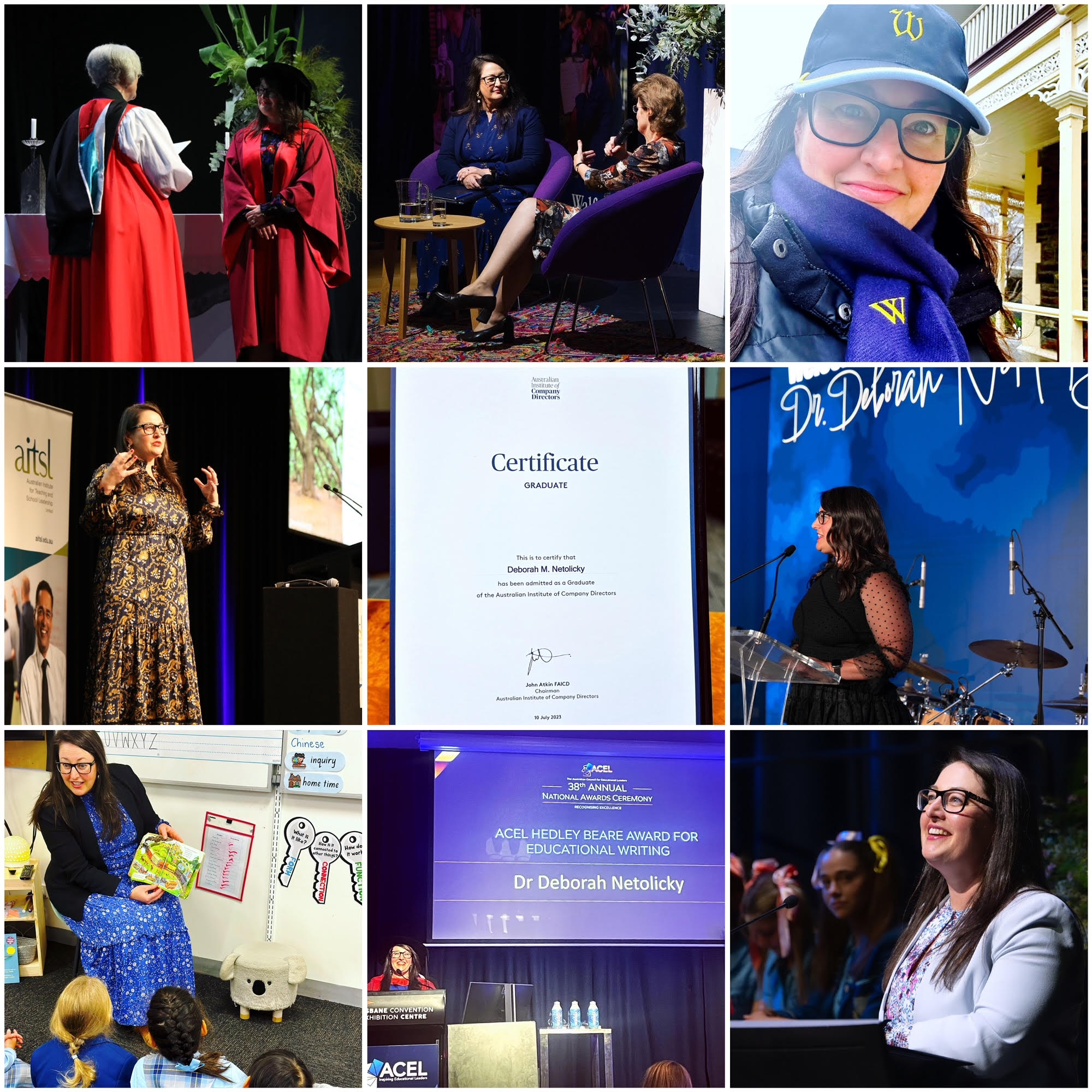
I began as Principal at Walford Anglican School for Girls, where this year we launched our 2023-2025 Strategic Plan, a new scholarship, a wellbeing dog program, staff learning communities, and a staff wellbeing committee. We refreshed the school’s values in consultation with students and introduced values awards. We engaged extensively in Reconciliation, service, enterprise learning, a glowing IB PYP evaluation, and designing bespoke senior secondary pathways for students. We undertook significant stakeholder consultation as part of a review and redesign of the uniform. We reviewed the shape of the school day and the café menu, and built new play spaces for our early and junior years. I have learned much about traffic safety and significant trees. We enjoyed community events and incredible showcases of student talent and hard work.

Additionally, this year I was appointed as Adjunct Senior Fellow at the University of Adelaide, and a Member of Editorial Advisory Board for the Journal of Professional Capital and Community. I completed and graduated from the AICD Company Directors Course. I recorded and released nine episodes of The Edu Salon. I co-authored the book chapter ‘Grappling with Pracademia in Education: Forms, Functions, and Futures’ with Paul Campbell and Trista Hollweck, published in the book Professional Development for Practitioners in Academia. I presented a keynote at the AITSL National Summit for Highly Accomplished and Lead Teachers. With Summer Howarth I presented to school leaders at an ACEL SA ‘Hot Topic’ event, and alongside Kevin Richardson at an AHISA SA event for aspirant principals. It was an honour to be awarded the ACEL Hedley Beare Award for Academic Writing, and to be listed on The Educator’s Most Influential Educator List and Hot List of innovative Australian educators. I travelled to Bali, Kangaroo Island, Rottnest Island, Cairns, Melbourne, Sydney, and Perth, and celebrated 20 years of marriage.

2024 is a new year, filled at this early stage with uncertainty, as well as hope and possibility. I wish all in my network a wonderful year ahead, and one in which you find joy, meaning, peace, and time to nourish, replenish and rejuvenate yourselves amongst the challenges the year will undoubtedly bring.