
Powerful & unforseen consequences: our butterfly impacts

#leaningenvironments - evolution of a new edu-revolution?

#leaningenvironments – evolution of a new edu-revolution?

 A cloud from a minor volcanic eruption in Iceland—a small disturbance in the complex mechanism of life on the Earth—can bring to a standstill the aerial traffic over an entire continent. ~ Slavoj Žižek

With the start of the Australian school year almost here – a year in which I am working to implement the teacher-growth model on which I have been working for two and a half years – I have been thinking about what it is that makes a trusting, impassioned, vibrant community of continuous learners.

Ok, as both the subject of my work and of my PhD research, I have been doing more than thinking about this. I have read close to 300 references and written about 85,000 words around effective school change, what makes effective leadership and what kinds of learning teachers find transformational. I have blogged briefly about some key ideas to anchor school change, about the importance of embracing discomfort for growth and about my own learning environments.

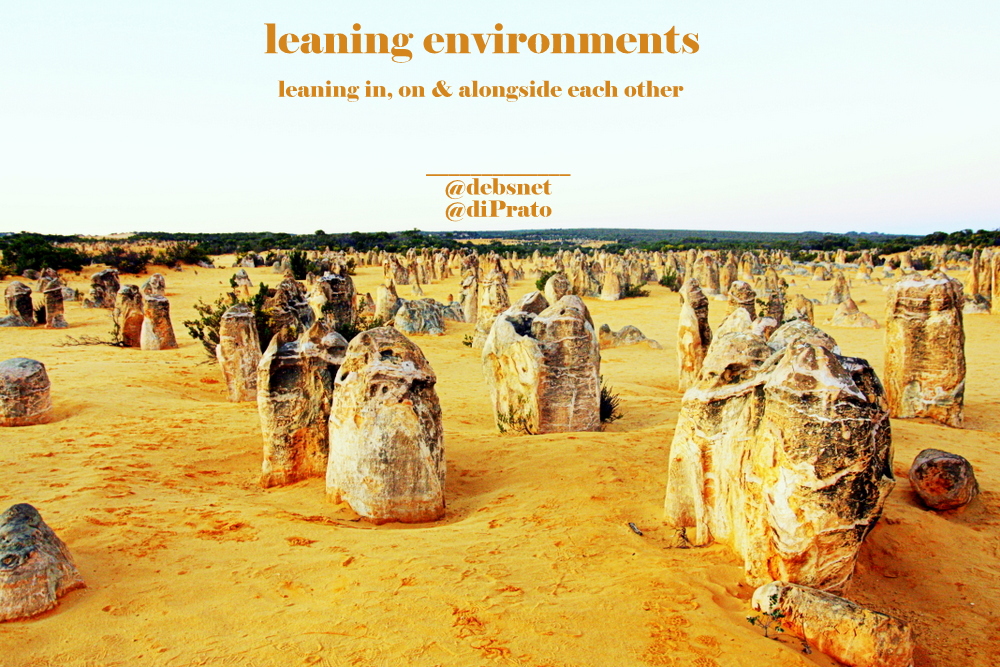
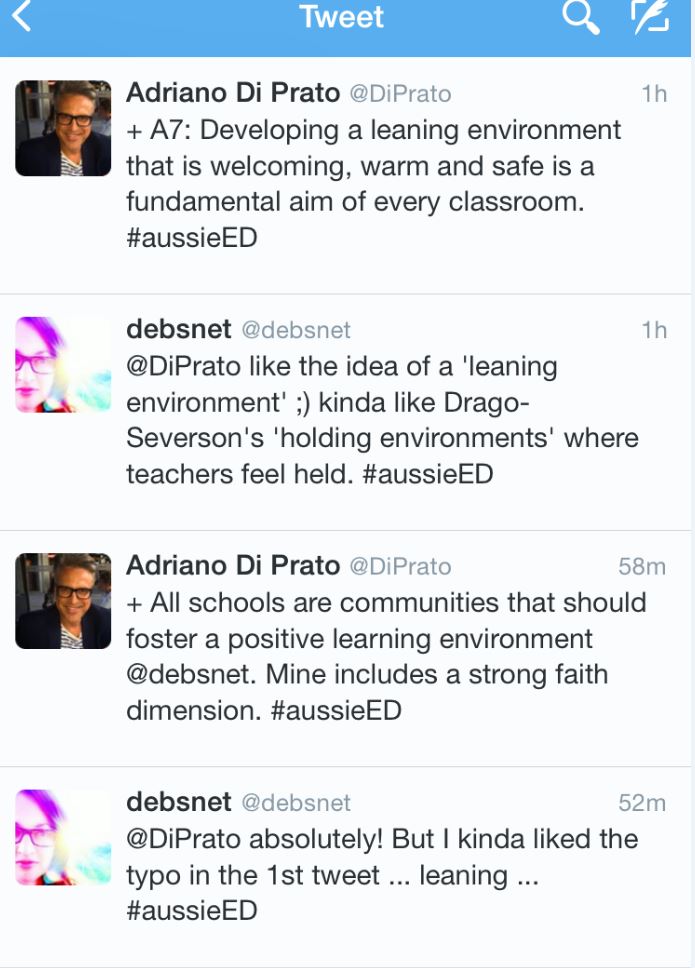
Tonight I was participating in the #aussieED Twitter chat when Australian educator Adriano Di Prato tweeted that ‘developing a leaning environment that is welcoming, warm and safe is a fundamental aim of every classroom.’ Now, I knew that Adriano meant ‘learning environment’ when he typed ‘leaning environment’ in a fast-paced Twitter chat, but it got me thinking: How are schools ‘leaning environments’?

It reminded me of psychologist and professor Ellie Drago-Severson’s notion of ‘holding environments’ (which I wrote a bit about here) in which she asserts the importance of teachers feeling ‘held’ by their learning and working environments, especially if positive change is to take place.

It reminded me of Costa and Garmston’s notion of ‘holonomy’ (explained in the Cognitive Coaching course material) in which the parts (individuals) and whole (organisation) are interdependent.

It reminded me of this great moment last year when a group of commuters on an Australian train platform used their leaning-together momentum to tilt a train and free a man trapped between the train and the platform.

So I tweeted back about ‘leaning environments’, and all of a sudden we were back-and-forthing about how the word ‘lean’ might apply to school environments. Would it be about individuals ‘leaning in’ to the community, to opportunities, towards each other? Could it be about students, teachers, parents and leaders ‘leaning on’ or ‘leaning alongside’ or ‘leaning with’ each other? Might it be ‘leaning out’, away from those things which should matter less but sometimes drive schooling (high stakes testing, grades, league tables)?

the power of a Tweeted typo

the power of a Tweeted typo

Fellow edu-Tweeter Melissa Daniels noticed the banter and asked whether this could be “the education revolution that started with a typo?” leading to another discussion about innovation, revolution and the evolution of ideas, all in 140 character bites.

Tweet @debsnet @DiPrato @PensiveM

This was an invigorating discussion for me, not because I thought it was to be the next big thing in education, but because of the thrill of the unsurprising serendipitous connections, conversations, ideas, thinking and challenges that come out of conversations and connections with like-minded like-passioned others. Here was a vibrant online environment of trusting, holding, leaning (in, out, on, with, alongside), impassioned, creative, continuous learners.

It also reminded me of our unforseen impacts. We never know the impact of a conversation, a word, a decision, or a typo.

I have noticed this in my self, in conversations or moments which stay with me until an idea bubbles to the surface. I have noticed it in my work with teachers and students, who often take some time to realise what moments or relationships have shaped them. I have noticed it in my PhD research participants, many of whom told me that the very act of being interviewed for my research changed something for them, opened something up, surfaced a reflection or became a moment of learning.

So, don’t ignore life’s typos. Even the seemingly tiniest things can have powerful & unforseen consequences.

You never know when you might uncover the next revolution.

Small shifts in your thinking, and small changes in your energy, can lead to massive alterations of your end result. ~ Kevin Michel

Montenegro by @debsnet

Why blog? Personal evolution & community transformation

There is nothing to writing. All you do is sit down at a typewriter and bleed. ~ Ernest Hemingway

doorway

doorway

I began this blog a few months ago as a way to explore, record and share my thinking around a particular self-directed professional learning experience: a trip from Australia to New York intended to gain insights around teacher effectiveness, teacher evaluation and teacher growth. The trip was amazing personally and professionally. I met with schools, school leaders, teachers, researchers and global edu-experts who challenged and inspired.

Now that initial blogging purpose is sated and I find myself wondering: should I continue blogging?

My first instinct is: yes. And that mainly emerges out of the enjoyment I have found in reflecting, writing, sharing and engaging with others as a result of my posts. I alluded in post about social media for educators, this post about being a connected educator and this one about finding your professional global tribe, that Twitter has been invaluable in connecting me with other like-minded (and non-like-minded – just as important!) people. Blogging, however, allows for much more developed thinking than tweeting. Twitter can facilitate 140 character conversations, but it doesn’t allow you to burrow deep into ideas and give them a shake. So since blogging, I have been blogging about blogging, and now I’m at it again.

My reservations about continuing a blog are primarily about time. I am a parent of two pre-school age children, an educator at an Australian school, and a PhD candidate who is two years, 150 pages and 300 references into my thesis (more about how I juggle those things here). Right now as I write a blog post about whether I’ll write future blog posts, there is a long list of other things I could be doing.

And yet, here I am.

Partly because this blog has allowed me to explore my own thinking around my work and study. It is a free space to write. I have my PhD to write too, but blogging is a space in which I can write without pressure and with more freedom of style and content. It keeps me thinking and learning and connects me with other thinkers and learners.

I also know what other blogs give me. They can be transformational, inciting change, encouraging action and inspiring thinking through the sharing of stories, expertise and others’ intellectual struggles around big and small ideas. They promote reflection, conversation and growth, in the blogger and the reader. Perhaps my own musings might provide insights for others, open a window to my context, challenge another’s thinking or facilitate connections across geographical and philosophical boundaries?

So I feel propelled to continue blogging, but I wonder how that journey might evolve, if anyone will read my posts, and if that even matters. Certainly I would (will?) be a blogger who blogs when I have something to say, rather than to chase numbers of clicks on a page.

Western Australia by @debsnet

possibilities

Reflections on ACEL 2014: learning, leading, teaching

Effective change is a matter of both will and skill. People have to want to do it, and they have to know how to do it. ~ Levin

Passion & Purpose at ACEL conference Melbourne by @debsnet https://theeduflaneuse.wordpress.com/

2014 ACEL Conference lanyard on the Southbank boardwalk: passion & purpose

I have spent this week in Melbourne at the 2014 Australian Council for Educational Leadership Conference, including presenting a breakout session with colleagues about our school’s story so far: of building a professional growth model, based on our own context, vision and beliefs about learning, teaching and leading.

It was affirming to hear the keynote speakers’ key messages reflect the real work that we are doing at my school. Some of those keynote takeaways, as aligned with my school’s work around professional growth and culture were …

We know that teaching is complex

Noel Pearson highlighted for the over 1000 delegates that effective instruction is at the heart of education.

Charlotte Danielson reminded the audience of over 1000 delegates that “teaching is so hard it can never be perfect” and that the complex, demanding cognitive work of teaching required educators’ ongoing quest to improve teaching practice, in order to improve students’ learning. She joked that, while doctors’ work is complex, they get to see one patient at a time; “I would call that tutoring.”

In his panel response to Charlotte’s keynote, Phillip Heath, Head of Sydney’s Barker College, emphasised the importance of focusing on celebrating the full, highly cerebral, in-the-moment and sacred nature of teaching, rather than on exposing and shaming failures, or ticking boxes.

Our school’s model of professional growth and culture is focused on a default position of meaningful teacher-owned growth.

Building minds, inspiring learners

Charlotte Danielson also reminded the audience about the constructivist nature of learning for students and teachers; that learning is done by the learner in an active intellectual process. Danielson pointed to conversations in which an observer or leader advises a teacher after a classroom observation, and in which the teacher passively endures the feedback. “Who is doing the work?” she asked. The Danielson Framework for Teaching, or as she pointed out, any framework for teaching, is a conduit for teacher learning which allows teachers to do the thinking for themselves.

Tim Flannery encouraged educators to encourage exploring, imagining and being open to organismic change.

John Medina shared his knowledge around increasing the brain’s executive function, the part of the brain (responsible for openness to cognitive and behavioural change) that we are attempting to access in our teachers by applying a Cognitive Coaching approach to professional conversation and reflection.

Richard Gerver talked passionately about the need for developing self-managing people and systems. Our model’s key aim is the development of teacher-driven, teacher-owned self-managing, self-monitoring and self-modifying teachers-as-learners.

Leading with clarity, coherence and collaboration

Richard Gerver highlighted the importance of the clarity and coherence in educational leadership.

Tim Flannery encouraged collective wisdom over individual genius, the harnessing of the informed community rather than the singular expert.

Linda Darling-Hammond reminded us that “teaching is a team sport” and that the greatest achievement gains are from those schools in which educators work together with a coherent approach. Beware ‘popcorn reform’, she said, with which we might innovate our way to edu-failure. What we need is to learn from each other’s successes and failures; teachers, schools, districts and nations.

Both Linda Darling-Hammond and Noel Pearson underlined the importance of backward design: having students’ learning outcomes and futures in mind when designing their education. For Pearson, this future was “giving people the capabilities to choose lives they have reason to value.” In particular, he advocates for Indigenous Australians to realise the potential, talent and creativity which afford them real choice and the mobility to orbit between external worlds and their indigenous homes, cultures, languages, traditions and peoples.

Charlotte Danielson reminded us about distributed leadership; it is not the principal but all teachers who are responsible for leading learning in schools. Leading and learning are about collaborative growth, not punitive measures. “We’re not going to fire our way to Finland,” she said. “We need to learn our way there instead,” by  coming together as communities of teachers which use a common framework as a scaffold to provide common definitions of good teaching, a common language with which to talk about teaching and shared understandings about what good teaching is and how teachers might enact it. This, Danielson says, helps to avoid conversations in which teachers and leaders use the same words but mean different things.

John Hattie challenged educators to “change the narrative” of education by building the profession and taking pride in teachers, rather than in buildings, resources, websites or canteen menus.

Yesterday, when presenting at the conference, my colleague described our school’s continuing journey as an “evolution not a revolution”, an ongoing, organic and iterative process which is based in our own context and the needs of our teachers and staff.

We have been taking the approach of ‘go slow to go fast’, deliberately unfurling a new initiative by allowing it to bubble up out of the school’s strategic vision and then be piloted, driven and owned by teachers. We have been attempting to distribute leadership in a project which is connected by clear, coherent, school-wide organisation-aligned threads of vision and practice.

Safety and challenge for growth

Charlotte Danielson talked about getting the balance right between support and challenge for teachers; schools need to provide an environment of trust in which it is safe to take risks in the spirit of ongoing professional inquiry.

This need for balance – between safety in which teachers feel supported and trusting, and enough discomfort to challenge practice and change thinking and behaviour – has been a cornerstone for us in providing the setting for transformation of classroom teaching, professional conversation and collaborative culture.

Thank you, ACEL for an affirming experience of layered, interlocking ideas.

Champagne at Crown Melbourne by @debsnet https://theeduflaneuse.wordpress.com/

champagne view from Crown Casino, Melbourne

Applying the travelling mindset: embracing creativity

What, then, is a travelling mindset? Receptivity might be said to be its chief characteristic. We approach new places with humility. We carry with us no rigid ideas about what is interesting. We irritate locals because we stand on traffic islands and in narrow streets and admire what they take to be strange small details. We risk getting run over because we are intrigued by the roof of a government building or an inscription on a wall. We find a supermarket or a hairdresser’s unusually fascinating. ~ Alain de Botton

Alain de Botton described the traveling mindset as one of receptivity and openness. In 1794, Xavier de Maistre applied this mindset to his own everyday space. In my own experience, of traversing thirty three countries so far, travel is learning. Being submerged in the unfamiliar brings to the surface captivation, imagination and vulnerability.

I think being abroad is sometimes where we feel we can be most ourselves, untethered by daily routines, obligations, expectations and the mundanity and productivity of daily life.

So how is an educator to bring this outlook to professional meetings and visits abroad? My approach is one of embracing creativity.

@debsnet New York Journal

Research connects creativity with productivity, adaptability, novelty, divergent thinking, idea generation, flexibility and problem solving (see Dr Mark Runco’s 2004 article on ‘Creativity’ in the Annual Review of Psychology). For me, writing, drawing, painting, doing and making are physical mind-body processes which facilitate right brain thinking, foster creativity and enable authenticity – of thought, of action, of being.

Sir Ken Robinson’s 2006 TED Talk on how schools kill creativity has been viewed almost 30 million times. In it, he champions the cultivation of creativity and questions the rigidity of education systems which encourage conformity and compliance.

The #makered hashtag on Twitter and http://makered.org/ have plenty of ponderings, resources and perspectives on the meaningfulness of making and doing for our students.

Of course social media and this blog are 21st century extensions of traditional creative media but I am intending largely to ‘go retro’ on my October professional journey: reading print novels, keeping a visual journal, collecting tactile ephemera and enacting mindful pen-to-paper thinking. Using the camera and a journal to explore thoughts and experiences is a method of creative, reflexive, deliberate inquiry, as well as a way of recording both professional visits and New York herself.

New York #artjournal page by @debsnet

I hope this flânerial approach – that of the wanderer who is finely attuned, keenly observant and totally immersed – will help me to be at my most receptive, flexible and open to new learning.

Teacher (un)learning: immersive, experiential & ongoing

‘How do your teachers learn?’ Most answers I get follow along traditional lines: ‘They go to conferences.’ ‘They take after-school workshops.’ ‘They read books.’ They see their teachers’ learning as an event, not an ongoing process. ~ Will Richardson, 2012

Will Richardson reminds us that learning is an ongoing process, not a series of disconnected one-off occurrences. Professional learning is about the organic journey of the teacher; it’s not a set of tick boxes to be ticked or a number of mandated hours to be filled.

NYC Collage @debsnet

The self-directed-and-organisation-supported professional learning travel upon which I am embarking brings into focus the concept of teacher learning and how it might look. It is this focus that raises the sort of question I am asking on behalf my school while I am in New York: how can we best support teachers in their self-directed growth as passionate practitioners?

One learning movement with plenty of momentum is the unschooling / uncollege / unconference movement.

In unschooling the intellectual, emotional and physical freedom of the child is privileged over the perceived imprisonment by formulaic school curricula, strict structures and inflexible spaces. Just check out the #unschooling hashtag on Twitter.

At uncollege students are educated by real-world experiences, often outside their comfort zones.

Unconferences or edcamps are free, participant-driven conferences.

Does a travelling fellowship like my upcoming one, which focuses on the experiential professional learning of the fellow as well as the contribution of that learning to the organisation, fit into this kind of free-range self-learning?

Does this kind of learning reflect the best kind of learning for our teachers? It is driven by the learner, involves collaboration with others, and is experiential, ‘real world’ and deeply immersive.

A question many school leaders and educators have been addressing for some time is: How might we more fully embed the edcamp / unlearning / experiential / community-based / learner- driven learning into our schools?

How might we ensure that professional learning is meaningful and transformative for teachers?