TES book review of ‘Transformational Professional Learning’

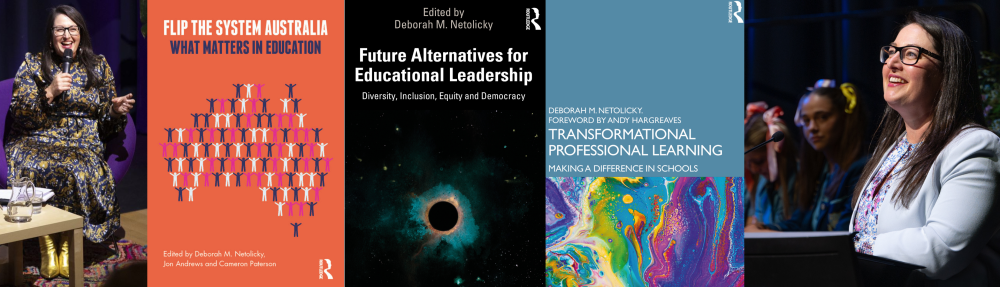
This week, the Times Educational Supplement published a review of my book by Clare Sealy. Clare is a prominent voice in education in the UK. After years as a primary school principal she is now Head of Curriculum and Standards for the States of Guernsey. She has a wealth of experience in school and system leadership in education. We agree about the importance of a knowledge-rich curriculum and of understanding cognitive load for learning and revision.

I thank Clare for taking the time to read my book and write a review. As the book’s author, I have reflected on some of her opinions about the book, which she describes as “useful but flawed”. I share these responses below.

False promises

Clare argues that by including the term ‘transformational’ in the book’s title—Transformational Professional Learning: Making a Difference in Schools—I was ‘setting myself up for a fall’.

“Surely, thinks the reader,” she writes, “if I read this, I will experience a deep – nay, transformational – shift in my understanding. The earth will move, the scales will fall from my eyes, my cup will runneth over. Inevitably then, with the bar set so high, this book disappoints.”

The term ‘transformational’ in the title is defined in Chapter 1 as a way to describe a particular view of professional learning: one concerned with those experiences and processes that have an impact on what teachers and school leaders think, believe, feel, and do. I deliberately spend some time discussing and defining the term transformational professional learning. I differentiate the term ‘transformative’ (associated with Jack Mezirow’s transformative learning theory) from ‘transformational’ as it is used in professional learning literature in order to be as clear as I can about the framework for the book’s discussion.

It wasn’t my intention to promise readers that they will be transformed through their reading of the book, and this isn’t something I promise. I do say that the book makes the case for professional learning that positively shapes teacher practices that improve student learning. If, however, a reader feels that their cup has runneth over through their reading of the book, that’s a lovely bonus.

The optimist

Clare points out that I am “slightly more optimistic than the research” I cite. I can probably be described as a critical optimist or an optimistic skeptic. My optimism helps to sustain me through the often negative press the teaching profession gets, and propels me in the work and advocacy I do. My cautiousness and skepticism helps me to challenge claims, consider alternatives, and make careful decisions.

Underwhelming conclusion

Clare finds my conclusion ‘underwhelming’.

My conclusion that ‘it depends’ and ‘context matters’ may be underwhelming, but as a practising educator, I prefer this to overreaching promises of ‘what works’.

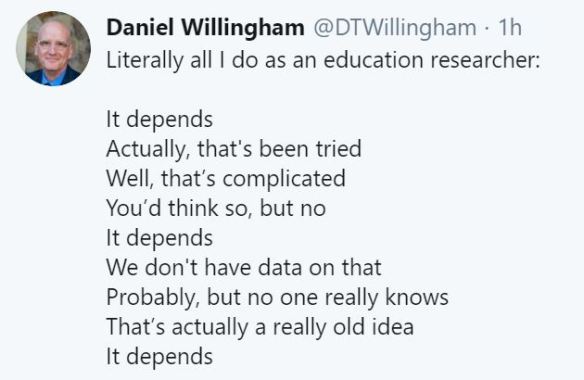
Today, Daniel Willingham tweeted the following:
DTW

“It depends.” This is the reality of much education research and is reflected in the conclusion where I write:

“As in other education fields, the answer to the question ‘What works?’ is often ‘It depends’. However, accepting the complexities and nuances of professional learning does not preclude us from knowing what is likely to be effective, and in what kinds of professional learning schools would benefit from investing” (p.131).

As I say in the book, there is no one-size-fits-all model for individual or organisational professional learning, although I hope that my book points educators in profitable directions likely to be advantageous for students, teachers, and school leaders.

Clare adds that, “the truth, however unpalatable, is preferable to false promises.” That is, as I understand it, it’s better to acknowledge the unsexy reality of what we do and don’t know about what works in professional learning, than to conjure up deliciously simple checklists that overpromise, underdeliver, and don’t take nuance into account.

My book deliberately rallies against the oversimplification of education problems and solutions. It puts trust back into the hands of those working in schools, who know their students, staff, and communities. It is those working in schools who are best positioned to put research evidence to work by applying it with professional judgement and knowledge of their context.

Issues with coaching

While I spend Chapter 5 defining and discussing mentoring, instructional coaching, peer coaching and cognitive coaching, Clare comments that she would have liked to see more discussion around the difference between instruction coaching, mentoring and self-directed coaching. She is particularly interested in a more detailed examination of instructional coaching. (For those interested, there are plenty of resources on Jim Knight’s Instructional Coaching Group website.)

Coaching is indeed a slippery term. What we mean when we talk about coaching needs specificity and shared understanding. In my view, instructional coaching, peer coaching, cognitive coaching, GROWTH coaching, executive coaching, mentoring, and consulting all have a purpose and a place in the professional learning landscape. We need to fit the tool to the individual, the context, and the purpose.

I agree with Clare’s comment that novice teachers need modelling and scaffolding, while experienced teachers learn better from opportunities to reflect on their extensive experience. In Chapter 8, I describe the varying needs of teachers at different career stages and explain how my school differentiated staff development in order to meet the diverse needs, aspirations, and career stages of staff. This model included mentoring or instructional coaching for early career teachers and coaching or collaborative approaches for more experienced teachers, on a case-by-case basis.

The positives

As the author of the reviewed book, I was drawn to the more critical aspects of the review, but there is plenty there that is also positive. Some excerpts include the following.

“Most have some sympathy with Netolicky’s diagnosis of the problem with much that passes for professional learning.”

“Netolicky reminds us that you don’t change a teacher simply by giving them better information. What really changes people is not just informational learning but transformational learning, that is ‘actively changing how a person knows though shifts in cognition, emotion and capacity’.”

“The chapter on collaborative professional learning is perhaps the most useful. It blows away any easy assumptions that if we all just did loads of lesson studies and collaborative learning, then everything would be fine. Since this approach is often peddled as a panacea to top-down approaches, it is good to have a rigorous analysis of what needs to happen for this to be effective.”

“This book gives a useful overview of different approaches to professional development and their relative strengths and weaknesses.”

“Netolicky has done us a service in reading the research and sharing it with us.”

Teachers and school leaders: well-being or ill-being?

Concern about teacher and school leader wellbeing

Teacher and school leader wellbeing is an increasing issue for education systems around the world. Some commentators call teaching a profession in ‘crisis’ or ‘distress’. Many sources point to the emotional, mental, and physical health of those working in schools as something that needs to be seriously considered.

Some literature suggests that one quarter of those who begin teaching leave the profession in the first five years, often citing mental health, emotional exhaustion, workload, and wellbeing issues as reasons.

The Gonski 2.0 report (Gonski et al., 2018) names unstable employment patterns, and a heavy and increasingly complex workload, as reasons for attrition in the teaching profession.

A week ago The Guardian published this article on increasing teacher workload, saying that according to one UK teacher wellbeing index, “nearly three-quarters of teachers and 84% of school leaders now describe themselves as ‘stressed’, and more than a third of education professionals have experienced a mental health issue in the past academic year. Almost half (49%) believe their workplace is having a negative impact on their mental health and wellbeing.”

The longitudinal Australian Principal Occupational Health, Safety and Wellbeing Survey of principals and deputy principals reveals worrying trends in school leader wellbeing. The 2018 survey (Riley, 2019) involved 5934 participants. Its findings include the following.

  • 53% of principals worked upwards of 56 hours per week during term with ~24% working upwards of 61-65 hours per week;
  • 40-45% of participants take prescription medication for a diagnosed condition.
  • Principals experience high levels of job demands (1.5 times the general population) emotional demands (1.7 times) and emotional labour (1.7 times) being the highest demands when compared to the general population. This is correlated with higher levels of burnout (1.6 times higher), stress symptoms (1.7 times higher), difficulty sleeping (2.2 times higher), cognitive stress (1.5 times higher), somatic symptoms (1.3 times higher), and, depressive symptoms (1.3 times higher).
  • The two greatest sources of stress for principals and deputies are Sheer Quantity of Work, and Lack of Time to Focus on Teaching and Learning.
  • Principals’ stress is caused largely by increasing Mental Health Issues of Students, Mental Health Issues of Staff, and Teacher Shortages.
  • The prevalence rate for Threats of Violence is 45%, with close to 1 in 2 principals receiving a threat.

In their chapter in Flip the System Australia: What Matters in Education, Andy Hargreaves et al. (2019) acknowledge that teachers struggle to collaborate effectively amidst the frenetic rate of reform in education and ever-increasing workloads and accountabilities. They assert that there is no student wellbeing without teacher wellbeing, so teacher wellbeing is something we need to care about.

Should teachers and school leaders be expected to put the needs of the children in their care ahead of their own health and their own children? Should they be expected to teach social, emotional, and life skills, as well as the curriculum? Should they be scored and performance managed based on limited and limiting accountability measures? Should they be pressured into spending their leisure time working and their own money on resources because it shows that they care and are ‘good teachers’? Should overwork, late night emails, and accessibility during weekends and holidays be normalised?

If wellbeing of staff is an issue in our education system, what can leaders do, and what can we each do for ourselves?

Leadership of staff wellbeing

School leadership is key to staff wellbeing. Just this week, WorkSafe has launched an investigation into one Australian school, its psychosocial environment, and the psychological and physical safety of its staff.

Wellbeing in schools is about more than meditation, yoga, fitness classes, and complimentary employee counselling. These have their place (and I enjoyed workplace yoga for years), but addressing teacher and school leader wellbeing also means seriously considering workload, expectations, and accountabilities.

Those leading systems and schools need to ask: How do our norms and culture contribute to wellbeing or ill-being? What is the work that is really important and that makes a difference? What can we take off teachers’ plates? How do we balance high professional expectations with high levels of support? What does it look like when we treat our staff as human beings with relationships, bodies, and lives?

Schools need to think carefully about teachers’ multiple, competing duties, and make time for meaningful collaboration around student work, student data, curriculum, and pedagogy, as well as time for teachers’ core business: actually teaching (and planning and assessing).

The Gonski 2.0 report suggests that “much greater assistance could be given to reduce their [teachers’] hands-on administrative workload, particularly in schools that are part of a larger system. This assistance includes: exploring reduction and/or simplification in administrative burdens placed on schools and their reporting requirements (including simplification of work health and safety requirements); appointing more dedicated administrative resources to schools; identifying quality external providers to which schools may be able to outsource some administrative responsibilities; and exploring new models for school management including chief operating officers or business managers accountable to the principal” (p.88).

School leaders can make transparent decisions, underpinned by organisational vision and clear principles. We can exercise compassion. We can resist hyper accountabilities, narrow frameworks for assessing teachers, and negative narratives of schooling. We can create our own measures of success for our schools, teachers, and students. We can enable flexible working arrangements, and ensure we listen to and encourage honest feedback from our staff.

We can also consider an approach to professional learning that is about growth. This can include staff voice and choice, and supportive processes such and mentoring and coaching. In this way, leaders can acknowledge the complexity and humanity of teaching and schooling, and facilitating staff autonomy and agency. Staff can feel like trusted, valued professionals and authors of their own learning and development.

Individual wellbeing

wellbeing

some of my wellbeing spaces

Those of us working in education need to give ourselves permission to protect and nourish our own health and relationships. That means time to sleep, to exercise, to enjoy nutritious food, to be silent and still, to be with our families, to spend time with our friends, to attend our children’s events, to breathe. It means prioritising these things even when the work feels crushing or breakneck in ways that seem to squeeze out everything else.

Like many who work in education, I find putting work to the side a challenge, but the old adage applies: we need to fit our own oxygen mask before we can assist others. We need to look after ourselves if we are to effectively serve our staff, students, and school communities. Personal wellbeing is not optional.

When author, prison officer, social justice advocate and education powerhouse Celia Lashlie died in 2015, her family published some of her final words:

“We become complacent about the need to take care of ourselves… always something more to do. Some of this is driven by our desire to save the world, others driven by the desire we have to reach the many goals we have set ourselves – many of them superficial.

Late last year I slowly became unwell. The stress of the lifestyle I was living, the demands I made of myself, the demands the people made of me and expected to meet became too great and as 2014 closed I was diagnosed with pancreatic cancer that had spread to my liver. No treatment, no cure, only palliative care. I’d waited too long to look after myself and my body broke.”

For me, these words were a sober reminder to educators that while we may want to do our utmost to make a positive difference, we should also work hard at looking after ourselves.


References

Gonski et al. 2018. Through Growth to Achievement Report of the Review to Achieve Educational Excellence in Australian Schools.

Hargreaves, A., Washington, S., & O’Connor, M. (2019). Flipping their lids: teachers’ well-being in crisis. In D. Netolicky, J. Andrews, & C. Paterson (eds.), Flip the System Australia: What Matters in Education, 93-104. Abingdon: Routledge.

Riley, P. 2019. The Australian Principal Occupational Health, Safety and Wellbeing Survey 2018 Data.

Teacher research

Set up for today’s presentation via Zoom

Today I had the pleasure of being the opening speaker, via Zoom from Perth, at the King’s Institute Research Symposium at The King’s School in Parramatta. In this blog I outline some of the thoughts I shared.

The pracademic

Those working in schools doing post-graduate study or action research, might be considered a pracademics. The word ‘pracademic’ is used to describe those in their field who simultaneously straddle the dual worlds of practice and scholarship, industry work and research. In education, these are the boundary-spanners who operate as the bridge between the worlds of education research and that of classroom and school. We bring a research lens to our work in schools, and we bring lived experience to our writing and research.

Pracademics have a crucial role to play in connecting the dots between scholarly and practical domains in ways that empower those working in schools to meaningfully engage with research and to contribute outwards to narratives about education. This is about speaking out as well as bringing in.

As I reflect on my own pracademia, I realise that since completing my PhD in 2016, while continuing to work full time in a school, I have produced:

  • 8 peer-reviewed papers in academic journals;
  • 6 academic book chapters;
  • 1 co-edited book – Flip the System Australia: What Matters in Education;
  • 1 monograph – Transformational Professional Learning: Making a Difference in Schools; and
  • blog posts and opinion pieces.

I have spoken regularly at conferences in Australia and overseas, on podcasts and in radio interviews. I also peer review papers for academic journals and write academic book reviews.

As someone who is employed in a school, this is a kind of moonlighting that occurs in volunteered time. These certainly aren’t things I would encourage all teachers to do, but engaging in or with research does meaningfully inform my practice in my school. My overlapping double roles inform one another. The hybridity of the pracademic provides credibility within the school environment, a  perspective that understands the realities of schools. Those of us engaging in research in our schools bring important contextual, relational and practical knowledge to research.

Teacher research is important

We are operating in an education world in which evidence-based practice is promoted and sometimes expected, and in which the field of medicine is seen as a benchmark against which education should measure itself. Schools, school leaders, and teachers are increasingly expected to be research literate, to be informed by research and evidence in our decisions and practices.

We are often presented with arguments that begin with sweeping and unsubstantiated statements like ‘the research says’. ‘Evidence-informed’, ‘research-based’ and ‘data driven’ are buzzwords. They appear in education reports, blogs, media, academic papers, speeches by consultants, books, in school staff rooms and in discussions on social media.

Teacher research and involvement with research is important, especially because so often education research knowledge remains separated from teaching practitioner knowledge. Much education scholarship is written in the structure and language of the academe. Often it resides behind a paywall (at USD$40 per article) or an expensive price tag (at upwards of $200 per book), making it inaccessible for many who work in schools.  Meanwhile, consultants and corporations promote often oversimplified, diluted or misleading solutions to education problems, while claiming that their solutions are based in research. However, as those of use working in schools know, context matters a lot. And the answer to ‘what works?’ is often ‘it depends’.

Teacher research helps us to:

  • make better decisions for our own contexts;
  • include student voice in school change;
  • listen to the voice and experiences of teachers;
  • engage teacher autonomy and agency; and
  • measure the impact of any changes we are making, setting our own success criteria, rather than relying on external metrics.

Teacher research seeks to understand and improve. It does not aim to provide prescriptions, mechanistic approaches, recipes, checklists or league tables. It is about engaging thoughtfully, critically and systematically with evidence, research, our own contexts and our own professional judgement.

Teachers engaging in research and research methodologies means we are applying these to our own contexts, and are also better placed to assess the relevance of other research and evidence we come across. We can make more meaningful sense of the research upon which advice and claims are based. It helps us to be careful of accepting simplified answers at face value. It gives us confidence in our own professional judgement and strengthens our willingness to interrogate claims of ‘the research says’.

Teacher research leads to better outcomes for students

Research cannot and should not tell teachers what to do, but research and other evidence has value in schools and can point us in directions worth pursuing. We improve our schools and our teaching when we integrate professional expertise with evidence and research. It is through practitioner research that we can marry the complex, human work of teaching with a critical, scientific mindset.

Teacher research can help those of us working in schools to make the best decisions for those in our classrooms and communities. It can help teachers and schools decide what is likely to be the best way to invest time and resources.

Practitioner research is an iterative, active, ongoing process that can hone our professional judgments and help to put us in a better position to bring about improved student learning and achievement, as well as other positive school-based results. It requires an ongoing, collaborative commitment to learning, understanding, critically examining what we think we know about what might work in schools to bring about the best outcomes for our students. That is ultimately what we are all here for.