
Unknown's avatar

About Dr Deborah M. Netolicky

School Principal | PhD | GAICD | Educator | Author | Podcaster (The Edu Salon) | Blogger (the édu flâneuse)

Santa Claus Phenomenon: The hidden magic of coaching & leading

It’s not until you’re a grown up that you realise Christmas doesn’t just ‘happen’. That magical day was pulled together by the incredibly stressed adults in your family. ~ Rosie Waterland in this post about Christmas

Sometimes in adult life we engineer magic. With glee we secretly make the miraculous and enchanting happen for others.

As parents, we realise how engineered the magic of Christmas is. We kind of know it when we discover that our parents are really Santa, but it’s not until we create Santa for our own children that we appreciate the hard work that goes into it.

All the preamble, that constant constructing of stories of Santa and reindeer and the intricate goings-on of Christmas Eve. Answering questions about store Santas and how Santa gets into the house and where the reindeer park the sleigh. Stealthy gift shopping, gift assembling and gift wrapping. On Christmas Eve there’s waiting until the children are definitely asleep and then assembling the gifts, artfully nibbling a cookie, enthusiastically chomping a carrot, dusting snowy footprints to the tree (and then closing the pet out so they don’t ruin the footprints overnight). This is magic that requires long term planning and strategic operation. 

Then: Christmas morning! Children wake. Santa’s magic comes alive. The Santa narrative seems not only possible, but real and wonderful. The children shower gratitude on the mysterious and benevolent figure of Santa. There are joyous cries of, “Thank you, Santa!” and “Santa got me exactly what I wanted!” How they glow with appreciation for the jolly red fellow and his generosity. Somehow he knew exactly what they needed at this point in their lives.

Of course, I do all of this because I enjoy the looks of amazement on my children’s faces and the thought that they feel part of something fantastical. But sometimes, as a parent, I secretly think, ‘It was us! It’s us you should be thanking!’ In these moments, I want my children to realise that all that joy is down to my husband and I. We contrived and concocted this whole thing. Of course I don’t ruin the magic. I encourage their belief and enjoy their wonder (they are currently 4 and 5). But part of me still sometimes wants recognition for all the hard work of being Santa and providing the magic.

Christmas Eve vignette from our place

Christmas Eve vignette from our place

There are two professional roles where I think this Santa Claus Phenomenon (no, it’s not a thing; I just made it up) plays out in professional life: the coach and the leader. It’s not that these roles are magical, but both have a sense of hard work going on behind the scenes, potentially without recognition from the recipient. Like the parents acting as Santa, both roles require the person to provide others with what they most need in that moment.

Coaching is hard cognitive work. In this post, I used the metaphor of the duck to describe the coaching experience; the duck’s legs paddle manically below the surface while above the water, all seems serene. So the coach works hard, but in order to be effective, this work needs to be imperceptible to the coachee. In fact, in order to best serve the coachee, the work of the coach needs to draw out and draw on the coach’s inner resources, so that they shine brightly. The coach is the hidden passageway or the mirror to self.

Similarly, a leader who empowers their staff can sometimes feel like the unsung hero. This kind of leadership is the subtle and invisible kind. Stepping back so others can step forward. Subtly coaching and nudging and encouraging and scaffolding. This isn’t brave sword-wielding white-knight stuff, the celebrated charismatic leader on the public stage. It’s about believing in and nurturing others’ capacities, in sometimes imperceptible ways. It is hard work with plenty of setting up and engineering for successes, but it’s done quietly in the background and sometimes no one sees this leader’s careful preparation and toil.

How do coaches who want to build the internal resources of their coachees, and leaders who aim to build their organisations by developing their people, interact with the Santa Claus Phenomenon? How do coaches and leaders celebrate or measure their wins? One way in a coaching conversation is in the responses to the question at the end in which the coach asks something like “How has your thinking shifted from the beginning of the conversation to now?” Leaders can know their own impacts by tracking the progress of their teams and individuals. But perhaps in both cases, others won’t notice the impacts, or the careful steps the leader conducted to get there.

I’ve written a paper for the Heroism Science conference that explores the idea of the less-visible leader. The leader who empowers. The coach who helps develop the coachee’s self-efficacy through layered and complex, but barely visible, practice. I wonder how this kind of leadership plays out in reality. Is the knowledge of one’s own impact enough? What happens when others don’t recognise that a coach or leader is engineering the magic? What if, from outside, it seems like the coach or leader isn’t doing anything? Is that as it should be–the noble but unseen work of coaching and leadership–or is it problematic?

Art can be taught: On knowing, doing and thinking Art

Art is power. ~ Henry Wadsworth Longfellow

As someone with a Fine Art degree, who studied Art through high school and university, I often hear comments from others like “I’m not artistic,” “I’m not arty,” “I can’t do art,” or “I can’t even draw stick figures” (this last one from my dad). As the daughter of an artist-educator (my mum), perhaps people think that anything arty I produce is the result of some kind of genetic sorcery. That Art is in the genes and in the bones. You’ve got it or you don’t. And yet, we don’t view many other things this way.

My mum always said that learning to paint is like learning to play a musical instrument, something needing hours and years of careful instruction and diligent practice. Of course some people have more aptitude than others, but it seems accepted that anyone can learn a musical instrument, if they learn the knowledge and skills, and then practice, guided by a teacher.

Playing a sport also needs a coach and regular teaching, training and playing. My 5 year old son recently started ‘Auskick’ Australian Rules Football. Did they give him a ball and send him onto the field to play a game, only to send him off when he didn’t know what to do, with cries of, “You’re just not sporty!”? No. They’re starting with skills and drills, small groups of children with coaches who are guiding them through the basics, giving them opportunities to develop and setting them practice goals in between sessions. First the knowledge (how the game is played, rules, positions, teamwork) and the skills (handballs, kicks, marks, tackles, disposals) are learned and honed. Again, some will have more innate talent than others, but all can learn, engage and participate.

The same goes for Art. Learning artistic knowledge and skills leads to artistic capability.

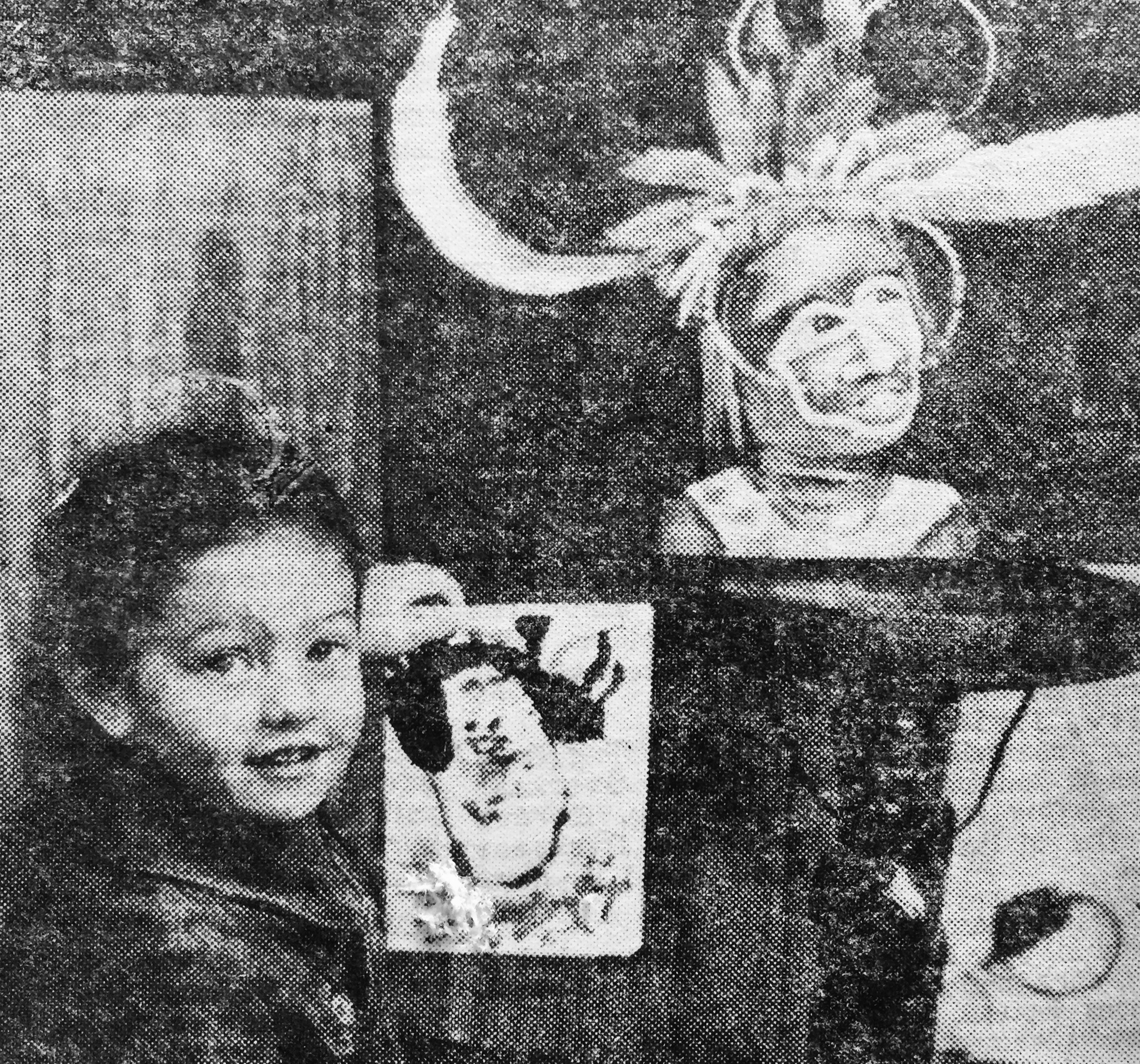
from a 1980s newspaper clipping; me & my painting beside my mum's painting

from a 1980s newspaper clipping; me & my painting beside my mum’s painting

My mum taught me age-appropriate artistic techniques from an early age. Her teaching meant that my attempts at Art looked good for my age, but these were carefully taught strategies. She ran Art classes out of our garage where she taught other kids the same tricks—learned, practiced on newspaper and then enacted on canvas. Parents were impressed. This wasn’t magical ability, but careful teaching by someone who was a knowledgeable, skilled practitioner and an experienced teacher. My mum now teaches my kids how to draw and paint, and they experience the same success. Is it genetics? No, it’s teaching.

And imitation and practice. As a teenager I would sit and draw. Copying posters, copying faces, copying landscapes. Over and over until I got it right, or at least better. My scribbling was informed by knowledge I had been taught about proportion, perspective, shading, the way colours work and techniques for using a variety of materials. I also copied the Old Masters, as many Art students do. Being able to replicate others’ work teaches how to follow the rules. Then an artist can think about and experiment with how they might be bent or broken.

field of flowers painted by my 5yo, as taught by my mum

field of flowers painted by my 5yo, taught by my mum

But Art is also more than knowledge and technique. It is communication and conversation. As I discussed in this post, artists respond to the world and to other artists. Like bloggers, writers or commentators in other disciplines, artists use the language of Art to protest, to provoke or to celebrate. It’s why Manet’s Olympia was so scandalous in its time. It’s why Pop Art and Dada, and even Impressionism were, in their time, an ‘up yours’ to what had come before and a challenge about what could be. Art has always been about communication, storytelling and symbolism (just look at any cave paintings or religious Art), but especially since photography made copies of reality possible, artists challenge what Art is and what its purpose might be.

I paint objects as I think them, not as I see them. ~ Pablo Picasso

Today’s blog post is a response to this one by Greg Ashman, who reflected on his own experiences of Art. Also, tomorrow is Mother’s Day here in Australia, and my mum and grandma have both majorly influenced my love, appreciation and practice of Art. Like Greg, one of my parents is (among other things) an artist. She is currently in America for an exhibition. Like Greg, most of my high school Art classes began with an instruction like, “there’s something: draw/paint/sculpt it,” without much other direction.

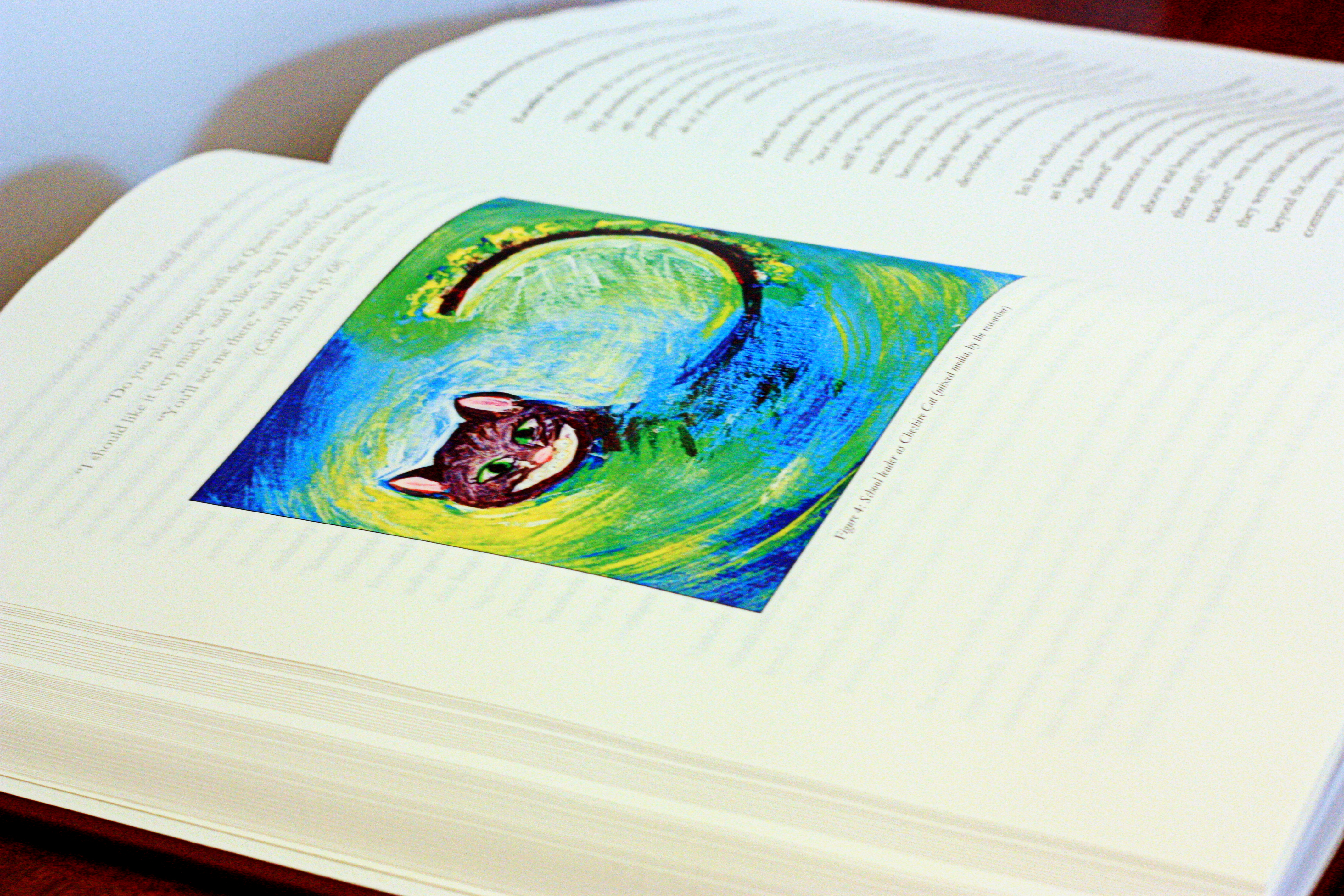
Yet the totality of my experience is very different. My mum gave me the grounding in the knowledge, skills and thinking of Art. My grandma still explains artworks and their intricate meanings to me. At university I was taught skills from welding and glass pouring to printmaking and drawing. I was taught Art History, and have since taught this in London at A-Level. I wrote a 25,000 word Fine Art dissertation. Once, I won a national art criticism prize based on the description my grandma gave me of an artwork. The artwork was in the gallery basement and as she was a gallery guide she was able to recall it from memory and describe it to me. When I finally saw the work, I realised that my critique was more inspired because of the image she gave me through her description. The piece was published in a national journal. I’ve written about the PhD as sculpture. I painted illustrations for my thesis.

thesis illustration

thesis illustration

I take my kids each year to Sculptures by the Sea in Perth (here are my pics from 2015 and 2016) and we talk about what our favourites are, and why. I recently took my 5 year old to the State Art gallery and he looked at a large canvas painted dark purple and said, “That is NOT art!” Then we talked about what art was and what criteria made something Art. I didn’t tell him my own views, but was more interested in encouraging him to think about his own thinking and his own assumptions about what makes something Art.

If it’s in a gallery, is it Art? Is Damien Hirst’s Mother and Child Divided (a mother cow and her calf, cut in half and displayed in formaldehyde), or Andres Serrano’s Piss Christ (a photograph of a small plastic crucifix submerged in a glass of the artist’s urine), Art? What about Robert Rauschenberg’s Erased de Kooning, in which he took a drawing by another artist, and erased it? Or Marcel Duchamp’s signed urinal, Fountain?

For me, Art can be a way of seeing, a way of thinking and a way of doing. It’s not something people are inherently bad at, or good at, but a concept and process in which to be engaged. Its value is in that engagement. Can I teach someone to paint a landscape or draw a realistic figure? Sure. Can I teach someone to think more like an artist? That’s trickier, but, like learning to think using a mathematical, theoretical or scientific lens, it’s worth the effort.

All in all, the creative act is not performed by the artist alone.. the spectator brings the work in contact with the external world by deciphering and interpreting its inner qualifications and thus adds his contribution to the creative act. ~ Marcel Duchamp

Performance pay: Don’t do it, Australia

Today the Australian media has reported that the Federal government is going to spend an extra $1.2 billion on education between 2018-2020, but that part of this money will go towards linking teacher pay to performance.

I am writing to urge Australia not to spend precious education budget money on teacher performance pay.

Performance pay initiatives have been experimented with around the world, including in Nashville, New York City, Dallas, North Carolina, Michigan, Israel, England, Kenya and India. See Leigh’s (2013) “The economics and politics of teacher merit pay,” which argues that merit pay negatively impacts teacher collegiality. Hattie, in his 2015 papers on what works and what doesn’t work in education, says that performance pay results in teachers working fewer hours with more stress and less enthusiasm. I agree with his warnings against trying to fix people and systems, and his suggestions that instead that the focus be on growth and collaboration.

Performance pay alienates teachers and is unsupported by evidence. There are those such as Hargreaves and Fullan (in their 2012 Professional capital) who criticise performance pay as demeaning, commodifiying and oversimplifying teaching and education. Until now I have been relieved that Australia has not gone the route of many North American states with teacher evaluation models that score teachers and schools. (I voiced my despair at the New York APPR reforms when they were announced.) Fullan and Quinn (in their 2016 Coherence) note that a policy focus on punitive accountability measures is crude, demotivating and has no chance of working. Wiliam (in his 2014 paper “The formative evaluation of teaching performance”) sees measures of teacher effectiveness as unreliable, noting that when teacher performance measures are linked to job or financial decisions, teachers are unlikely to innovate, tending instead to performance-teach to the evaluation. Also importantly, as Kemmis notes (in his 2010 chapter “What is professional practice?”), the quality of teaching and of teachers is not measurable by tests. So performance pay pits teachers against each other around questionable metrics.

These views are consistent with work around motivation, such as that by Dan Pink, David Rock and Mihaly Csikszentmihalyi. Punishments and rewards don’t improve practice.

Negative drivers of change are ineffective in driving positive transformation. What Australia doesn’t need is to cultivate cultures of fear, competition and compliance in our schools. We need to invest in teachers and in education (a thousand times, yes!), but performance pay which alienates the profession and is ineffective in improving it, is not the way to go. We need collaboration, not compliance and competition. We need initiatives that trust and encourage teachers and principals to grow their practices and their schools. Australian educators need voice, agency and support to improve, not punitive sticks and accountability carrots.

Please, Australia, say ‘no’ to performance pay.

___________________________________

Update: Since publishing this blog post I have written this piece on performance pay for teachers for The Conversation. I was also interviewed on Sydney radio station 2SER about this issue. You can listen here.

On the day I wrote this post, other grass roots education commentators have also reacted to today’s education funding announcements. Here is a list …

Joel Alexander: Merit pay in primary school is about as bad as it gets

Jon Andrews: Cruel optimism – Pay, performance and promises

Greg Ashman: How should Labor respond to the Australian government’s education proposals?

TER podcast with Cameron Malcher and Corinne Campbell: School funding special

Why I’m going to researchED Melbourne #rEdMel

Research evidence is essential to the task of improving outcomes for young people, but research will never be able to tell teachers what to do, because the contexts in which teachers work are so variable. What research can do is identify which directions are likely to be the most profitable avenues for teachers to explore. ~ Dylan Wiliam, Leadership for Teacher Learning, 2016

Why would a Western Australian fly to Melbourne for a one day conference? Here’s why researchED is drawing me to the East this May: cognitive conflict and robust discussion around educational matters.

In drawing together academics and education practitioners working in schools, researchED conferences are less about transmission of information and more about provocations and conversations. researchED’s tagline is ‘working out what works’, and those that gather at its events around the globe are interested in working out what works in education, for the benefit of the world’s children. The website tells us researchED’s mission:

researchED is a grass-roots, teacher-led organisation aimed at improving research literacy in the educational communities, dismantling myths in education, getting the best research where it is needed most, and providing a platform for educators, academics, and all other parties to meet and discuss what does and doesn’t work in the great project of raising our children.

Whether individuals come from Australia, Europe or the USA (all locations where researchED events have been held) they share the goal of bridging the gap between research and classroom practice.

As Dylan Wiliam points out, research cannot tell teachers and schools what to do, but it can inform the decisions educators make, and help them follow trails most likely to be beneficial for their students. Tom Bennett, the founder and director of researchED, says that researchED’s mission is to “to make teachers research-literate and pseudo-science proof.” That is, teachers need to be critical consumers, curators and questioners of information and of evidence.

Gary Jones, who is coming from the UK to present at and attend researchED Melbourne, has written an excellent guide to evidence-based decision making in schools. He points out a number of popular ideas in education that are not backed by evidence and reminds educators of the need to be conscientious, judicious and explicit in their use of evidence to make decisions and shape practices.

I’ve made my view clear that teachers can and should be researchers. Taking research into account, enacting practitioner-research practices, and engaging with scholarly literatures, is important in an educational world focused increasingly on accountability, performativity and rapid change. Sometimes, the best thing for a teacher or school to do is to press ‘pause’ and ask some critical questions of the evidence they are accepting or the practices in which they are engaging.

As a teacher and school leader who has recently completed a PhD, I can see the benefits of research thinking to the school environment. It means applying carefully considered and thoughtfully designed methodologies to decision making and innovation. It means trusting in teachers to be a core part of school reforms. Research becomes, not an add-on, but a way of being which is embodied and enacted by educators as they go about their important work.

researchED is part of a global movement to give teachers voice and agency in their work, their schools and their systems, while ensuring that school leadership and classroom practice is informed by research and evidence. Conversation between academics, researchers, leaders, policy makers and teachers can help all involved in education to best serve the students at the heart of our education systems. A wonderful publishing example of this kind of movement is Jelmer Evers and René Kneyber’s book Flip the System, which brings together the voices of teachers, academics and education experts in order to reclaim the space of education discourse for those working as cogs in the neoliberal machine.

So I’ll see you at researchED Melbourne. There will be interesting research and practice shared. There will be classroom perspectives and scholary ones. There will be graceful disagreement. I’m looking forward to presenting among the diverse voices, and learning from them.

(Here is my post on last year’s researchED conference in Sydney, at which I also presented.)

Brighton Bathhouses

Words from the Bard #Shakespeare400

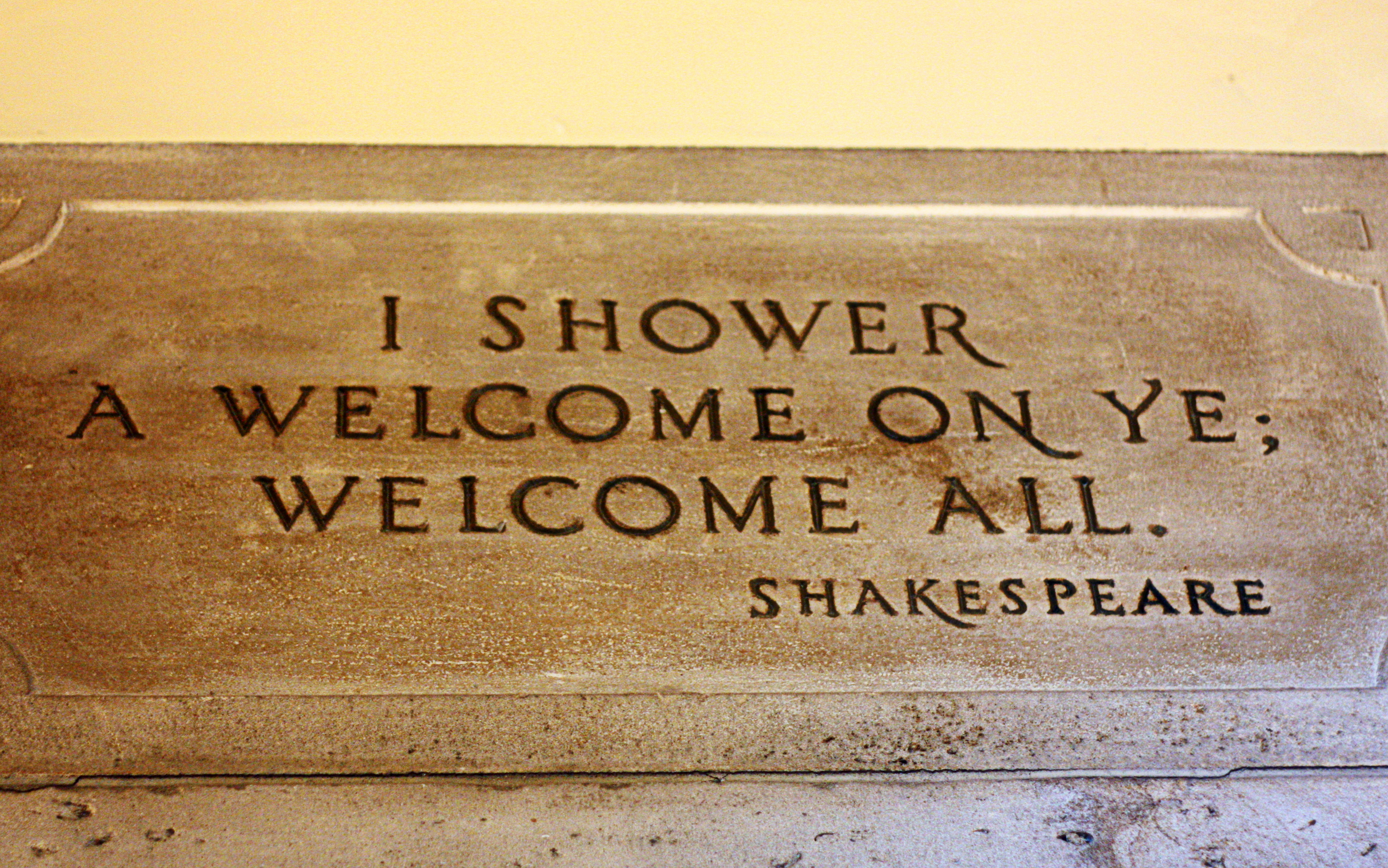
over-door plaque at the Folger Shakespeare Library

over-door plaque at the Folger Shakespeare Library

The 23rd of April–yesterday– was the 400th anniversary of Shakespeare’s death.  As an English and Literature teacher I’m a believer in the power of reading and writing. And I’m a Shakespeare nerd. I loved teaching Shakespeare for the three years I lived in London. There it all was! The Globe Theatre, Stratford-Upon-Avon, the streets and boards upon which Shakespeare lived and on which his work breathed. Two weeks ago I visited the Folger Shakespeare Library in Washington DC, which houses the world’s largest collection of Shakespeare’s works and artefacts, including 160,000 books, 60,000 manuscripts and 90,000 works of art. It’s Shakespeare nerd heaven.

Why are the Bard’s plays taught ubiquitously in English language and literature classrooms around the world, 400 years after his death? Because his work is considered to be universal and relevant across time and space. His plays and sonnets have influenced the very formation of the English language: the words we use and how we use them. He writes about things which resonate deep in the core of humanity: love, jealousy, history, ambition, rage, war, passion, flesh, and being a flawed person in the world.

So, today I thought I’d share a few of my favourite quotes from Shakespeare’s plays, along with some of my photos of the wonderful Folger Shakespeare Library.

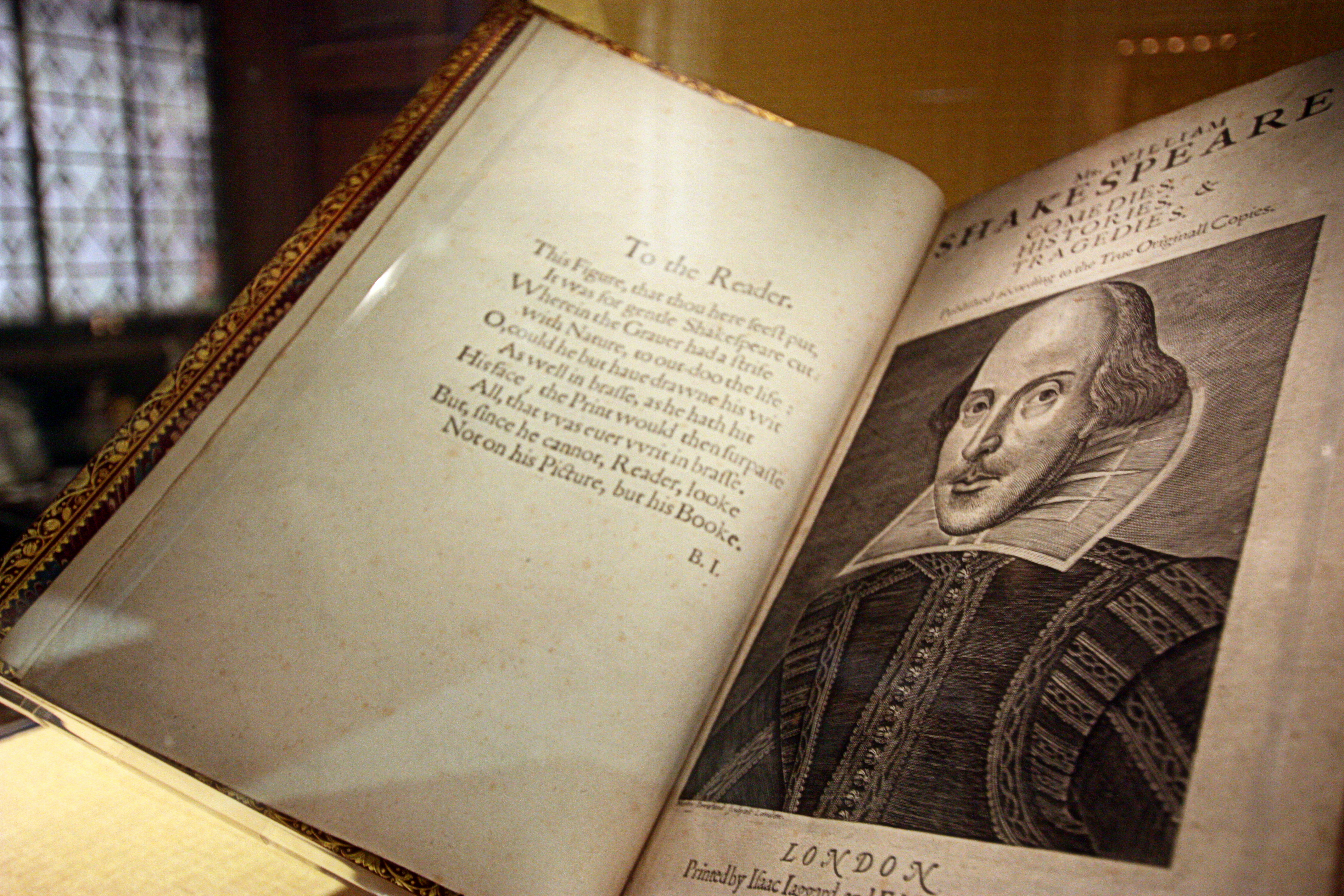
a 1623 Shakespeare First Folio, seen with my own eyeballs ("eyeball" - a word invented by the Bard)

a 1623 Shakespeare First Folio, seen with my own eyeballs (“eyeball” – a word invented by the Bard)

What’s in a name? ~ Juliet, Romeo and Juliet

Juliet’s famous line draws into question notions of identity. What does it matter what we’re called? Does a name or a title change who we are, or who we are perceived to be? I kept my maiden name when I got married, embedded as it was in my sense of who I am. Recently I got to change my title from ‘Ms’ to ‘Dr’ which has come with its own inner identity wrangling. This question is still relevant today, as the language we use to define and describe (ourselves, the world, anything, everything) shapes the meanings we make and the realities we create.

This above all: To thine own self be true. ~ Polonius, Hamlet

An oft-cited line, here’s a case of art speaking a universal truth: the importance of being true to oneself. Shakespeare reminds us to live authentically and purposefully.

If you prick us, do we not bleed? ~ Shylock, Merchant of Venice

While Shylock’s speech ends in vengeance, it begins with a powerful, emotive plea for social justice and equality. This plea can be seen (from a particular angle) to challenge the beliefs of Shakespeare’s time. It also challenges modern audiences to consider their own prejudices and kindnesses. Who in our contemporary world is treated with a lack of empathy or humanity? Who is voiceless or powerless? Who is willing to stand up for justice and fair treatment of all? What is fair?

Shylock’s character is complex and open to different interpretations. Is he villain, victim or man of integrity? He challenges viewers to reflect on themselves, the world in which they live, the way they treat others and the way they conduct themselves.

Screw your courage to the sticking place. ~ Lady Macbeth, Macbeth

Lady Macbeth is initially the backbone in her relationship with Macbeth, although she later goes mad. Here she is at the beginning of the play, strong, resolute and convincing. She calls on spirits to “unsex me” in her drive to take on the strong masculine role alongside her then-weak husband. The actions of Lady Macbeth and her husband are murderous, driven by ambition. The complexities of their relationship explore still-relevant themes of power, gender and love.

Macbeth, like Shylock, is a complex and flawed character open to interpretation. The play encourages us to reflect upon to the extent to which we are each responsible for our own actions and on our own “black and deep desires.”

What angel wakes me from my flowery bed? ~ Titania, A Midsummer Night’s Dream

I love this line. Titania is enchanted as she wakes, but who wouldn’t want to have these words sleepily uttered to them as soon as a lover opened their eyes?

The Folger Shakespeare Library, with the Capitol in the background

The Folger Shakespeare Library, with the Capitol in the background

Liquid becoming: Reflections on post-PhD identity and momentum

Reflections on how

things can change across a year.

Liquid becoming.


Identities like

ice floes. Shifting. Writing self

into being. Flux.


Mutable quicksand

liquefying, swallowing.

Consumed or dissolved.


What does it mean to

be doctor me? One foot in

front of the other.

cherry tree trunk, Tidal Basin, DC

cherry tree trunk, Tidal Basin, DC

I’m finding myself in a moment of reflection, hence the above haiku-ification of my thoughts.

If I look back one year ago, I was blogging about blogging anonymously. I was introducing myself to people at conferences who knew my Twitter profile but would not have recognised my avatar, or my online name. Recently I have been letting go of that anonymity and this month updated my avatar and my name on my social media accounts, making myself identifiable and searchable. Although I’m still not sure entirely how I feel about that.

A year ago I was in the throes of struggling with my PhD thesis discussion chapter. Since then, the PhD is done. I am doctored. But my ‘doctor’ identity has yet to catch up with me. In changing my Twitter name and the title on my frequent flyer account (in-flight medical emergencies, here I come!) I’m hoping that my doctor-ness might start to feel like a part of who I am.

one of my favourite PhD memes

one of my favourite PhD memes

In the last year, wonderful unexpected things have happened in rhizomatic ways. I have been invited to speak at events. This blog was nominated for the Edublog Awards, and came fourth in the Best Individual Blog category. It was recommended by the likes of Professor Tara Brabazon, in this keynote podcast. I have had two peer-reviewed papers accepted for publication. My paper submission to the AERA conference was accepted, and so I went to Washington DC to present it and attend the conference. In the last eight months I have been involved in founding and co-moderating the monthly #educoachOC Twitter chat. The Times Higher Education blog asked to publish one of my blog posts (interestingly, one I would never have put forward). I’ve developed collegial, thinkerly and writerly relationships with people on Twitter and WordPress, many of whom I haven’t met in person. I’m in discussions with scholars about writing book chapters and co-authoring papers. These unforeseeable delights have shaped my year into something rewarding, interesting and surprising.

I write these things down partly to marvel at their coming into being, and partly to wonder about how it is that they have happened while I have quietly (or perhaps not so quietly) gone about my life and work.

In January I focused on a personal ‘one word’ for this year: ‘momentum’. The word ‘momentum’ continues to resonate with me. While I’m sure things will continue to happen and evolve, I have no Grand Plan. I continue to work at my Australian school. I continue to write papers from my doctoral dissertation. I continue to think about possibilities for work, research, presenting and writing that might serve my students, colleagues, school and the education community, while fuelling my own passion and inner nerd heart. I’m hoping that this one-foot-in-front-of-the-other approach (the same approach I used to get through the PhD) will build momentum, and that rewarding partnerships and important work will continue to bubble up and come into being.

It is Fred Dervin who writes about identities as liquid. I imagine the liquid mirror in the film The Matrix, which I also talked about in this post on reflexivity. But that liquid mirror was one that consumed the person, rather than the person themselves being liquid, which is, I think, a more uncomfortable concept. To be always shifting, always fluid, always becoming and even unbecoming.

As I simultaneously feel myself unravelling and re-forming, attempting to take some shape, I’m waiting for more stable internal identity ground for myself, post-PhD. In the meantime, I guess I can surf the shifting ice floes or try to luxuriate in the quicksand instability of feeling more inner liquidity than usual?

cherry tree trunk, Tidal Basin, DC

cherry tree trunk, Tidal Basin, DC

Academic activism: Scholars, let your moral passion drive you #aera16

Iwo Jima at sunrise

Iwo Jima at sunrise

The theme of much of my day at the AERA conference yesterday was around scholarly activism. This post, which also shares a few of my photo snaps from DC, reflects on what yesterday’s sessions had to teach me about being a scholar. This comes at an important point in my journey. Now that the PhD is done, I’m thinking about what work I’ll do next in my school, my research and my academic writing.

In one roundtable session, a paper by Stefani Relles and Randy Clemens used the metaphor of punk rock for academics who use DIY scholarship in their quest for social justice. They theorized punk rock scholarship as grounded, activist and disruptive, using comparisons to skateboarders, graffiti artists and musicians of the punk movement. I reflected that a punk rock scholar might circumvent or disrupt traditional academic practices by self-publishing, using social media, blogging, or embracing open access and saying no to pay-walled publishing. But there was discussion at the roundtable about the extent to which an academic can be an outlaw. How disruptive can one be within the system, which places particular norms, pressures and metrics on those working within the academy? How might academics navigate the need for a pay check and tenure with their passion for social justice? Is it a case of corporate Bruce Wayne by day and vigilante Batman by night?

Similar issues emerged in a six-paper session about post-qualitative methodologies in which scholars were pushing at the boundaries of, dissolving, or letting go of, accepted Western ways of knowing and researching. Audience questions included those about how to exist within an academy while challenging or dismissing much of what it holds to be true or important.

Georgetown blossoms

Georgetown blossoms

Yesterday the notion of scholarly activism also emerged in a panel of what some might call superstar or celebrity academics. A discussion between Michael Fullan, Andy Hargreaves, Linda Darling-Hammond and Diane Ravitch was moderated by Washington Post education reporter Valerie Strauss. One theme which emerged was the importance of researching and writing from a burning core of moral passion. In discussing their books, the authors talked about what had inspired and driven them to write. In each case it was a sense that a book needed to be written, an argument needed to be made, something had to be said, an idea or group needed to be mobilised. Their writing was framed as political activism and advocacy. It had an emotional and moral component. Andy Hargreaves noted that writing should be based on the nobility of an idea.

Diane Ravitch’s story pointed to the need for persistence with moral purpose. She told the audience that her best-selling, award-winning book The Death and Life of the Great American School System: How Testing and Choice are Undermining Education was initially turned down by 15 publishers. At 77 years of age she is also an example of the power of social media and blogging. Her blog has more than 14,000 posts with more than 27 million page views. This speaks to the opportunities for scholars to leverage social media and the blogosphere to communicate their work and their messages to wide audiences. Tweeting and blogging can be scholarly writing practices.

Jefferson

Jefferson

I wonder about how much career stage and level of influence make a difference to the extent to which it is possible to disrupt the status quo. As a PhD candidate, I pushed at the boundaries of the traditional in my thesis, but I was also keenly aware of the need for my dissertation to be recognizable (by the all-important examiners) as an acceptable academic text. I pushed and agitated, but within the limits of what I thought I could get away with while still passing the PhD. Are those earlier in their careers, or in universities on contracts, less able to agitate, disrupt and advocate? Or is it again a case of Diana Prince sometimes, Wonder Woman at others? Clark Kent and Superman? The acceptable academic versus the one fighting for what they believe at their core to be the most important work?

The AERA conference itself is in some ways an exercise in homogeneity. While with about 18,000 in attendance, there is a wide range of topics being covered, most attending are dressed in variations of the same theme. Outwardly, there is an expectation of the academic, graduate student and educator. Do we wear our capes beneath our clothing? Is it our words and our work that are the heroes and the punk rockers?

Yesterday answered many of the questions I’ve been asking myself about what work to choose to do next. I think the answer might be simple. Do the work you believe at your core to be important. Say what needs to be said. Be guided by moral passion, social justice and fundamental purpose.

Folger Shakespeare Library

Folger Shakespeare Library

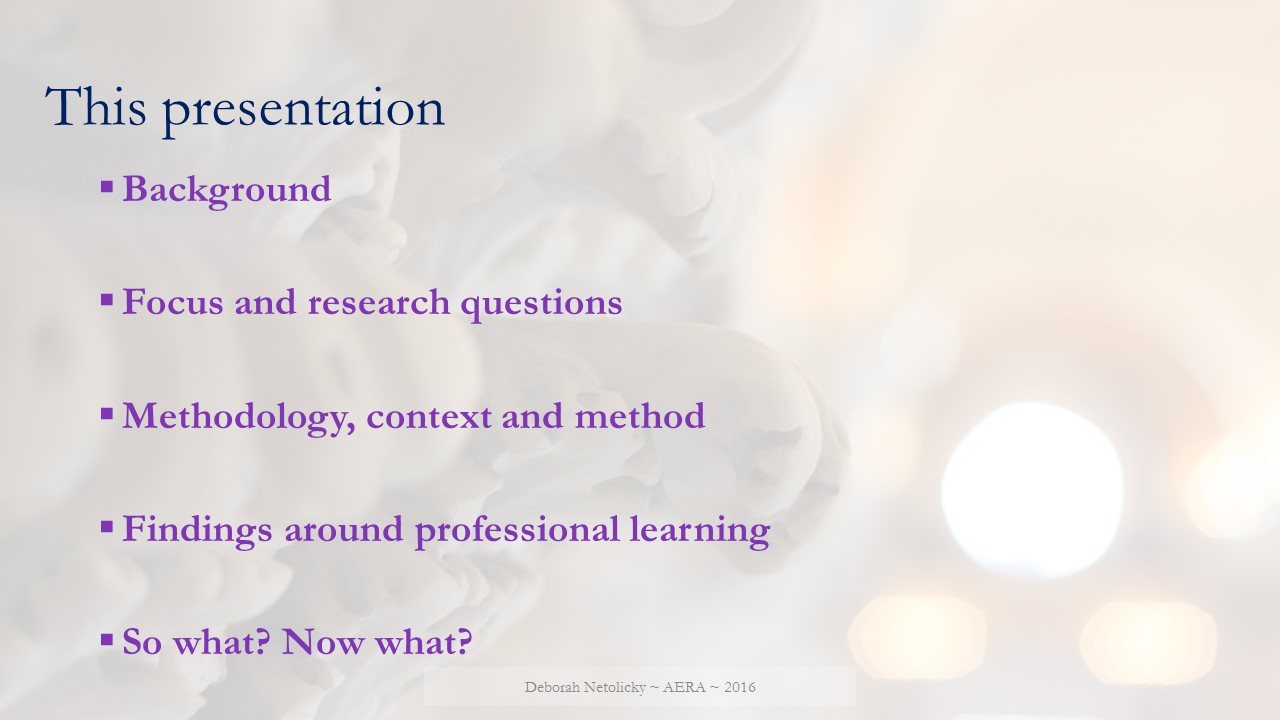
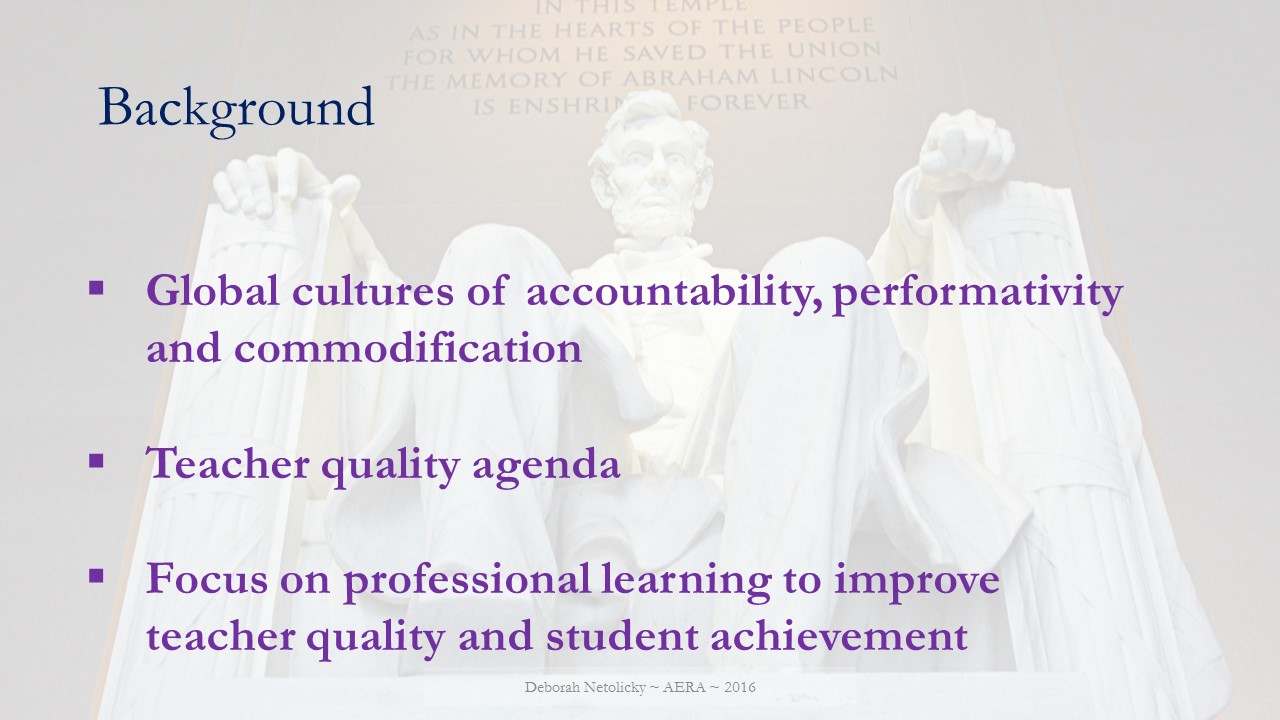
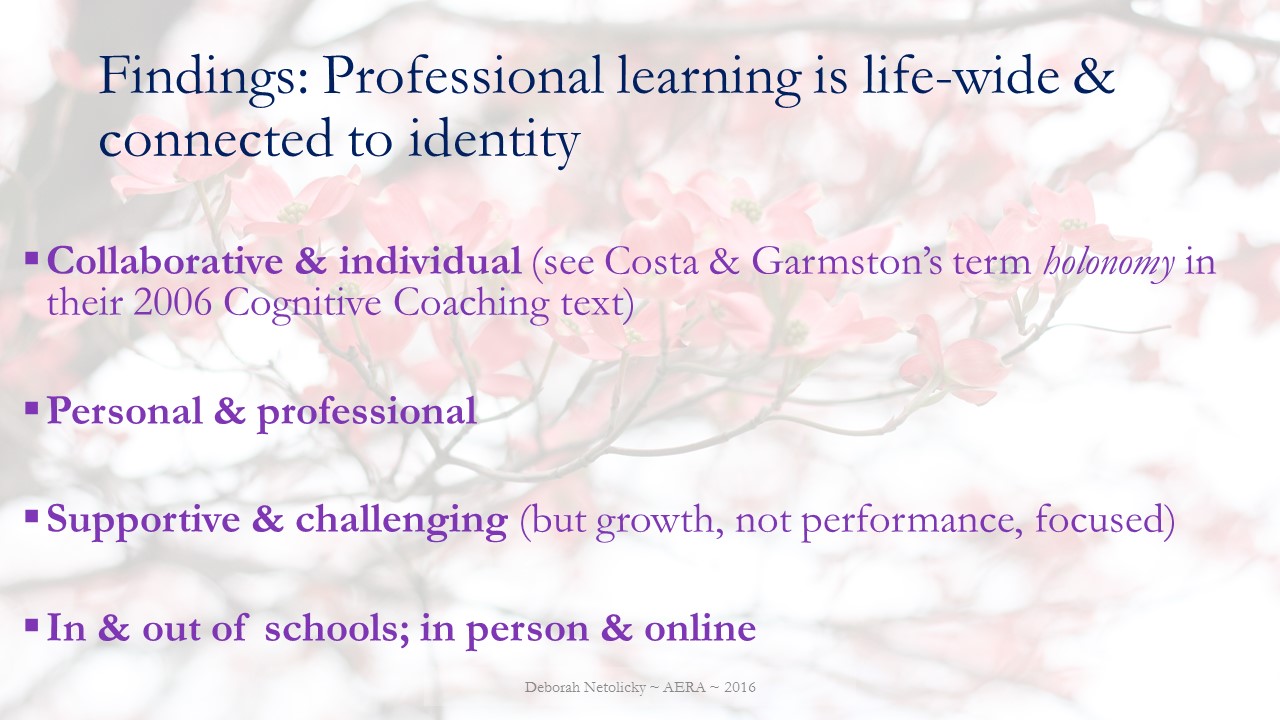
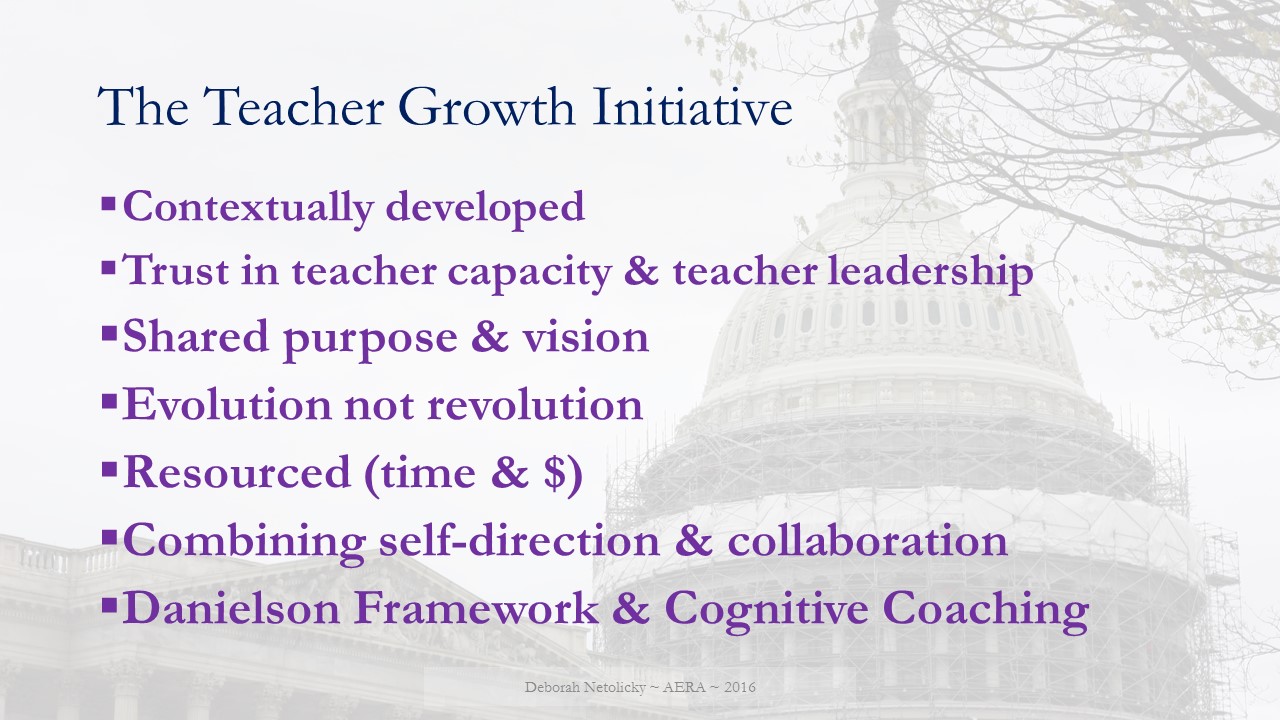
On professional learning: My #AERA16 presentation slides

Yesterday I presented a paper in Washington DC at the American Educational Research Association national conference, in its 100th year. This particular paper outlines my PhD’s general findings around professional learning for teachers and school leaders. It was great that more than 50 people turned up to the session, in which four papers on professional learning, including mine, were presented. The papers were a complimentary combination that really spoke to each other; I learned a lot from my co-presenters. We had plenty of generous feedback and robust discussion which spilled out into the hallway for almost an hour after the session ended, and then beyond.

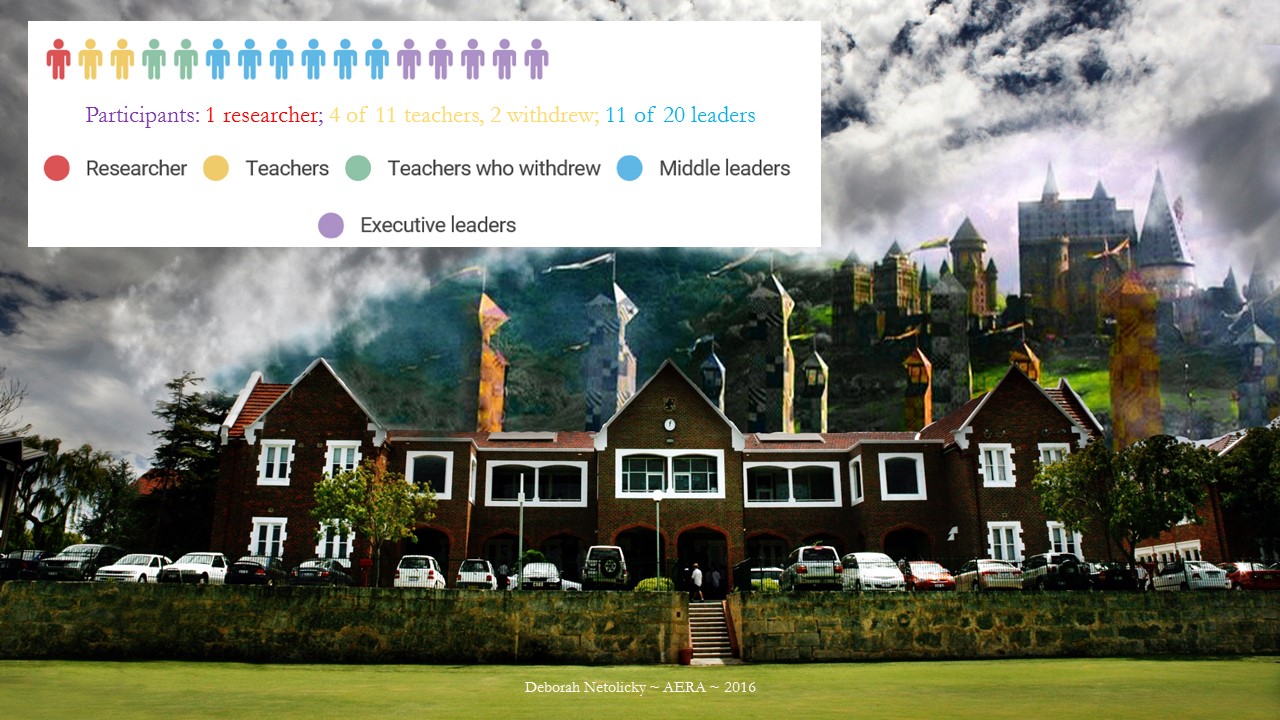
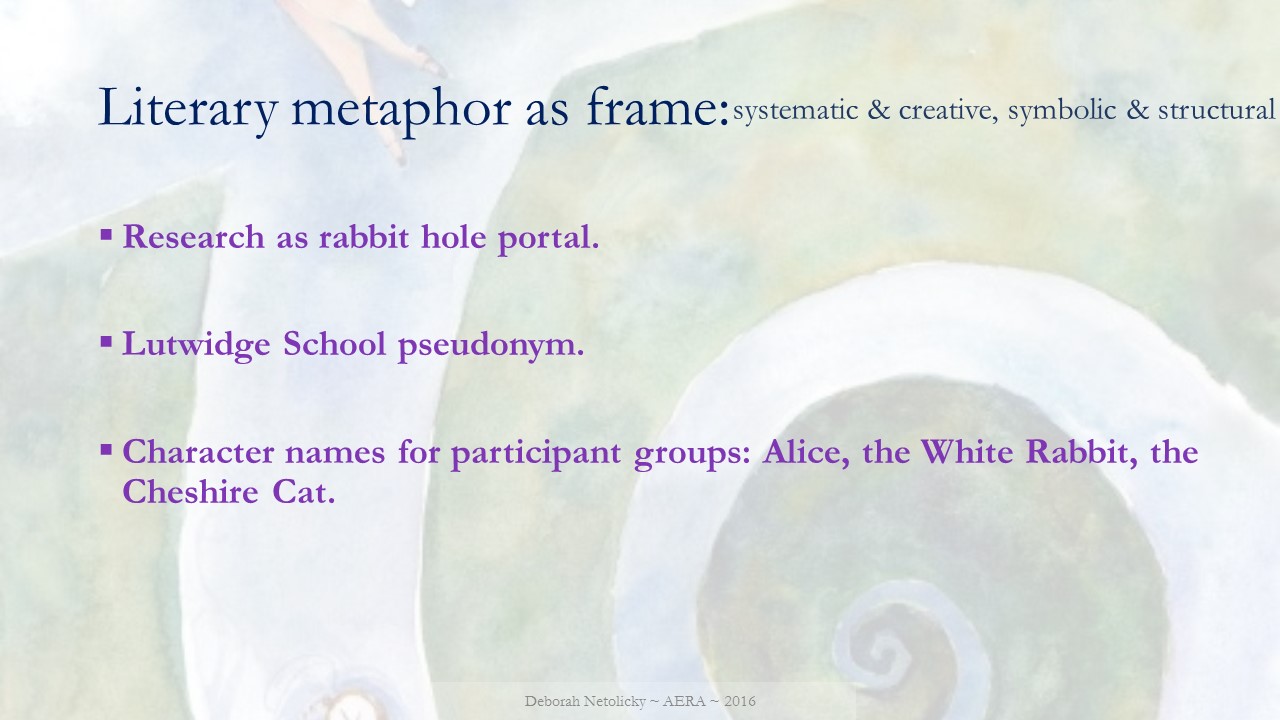
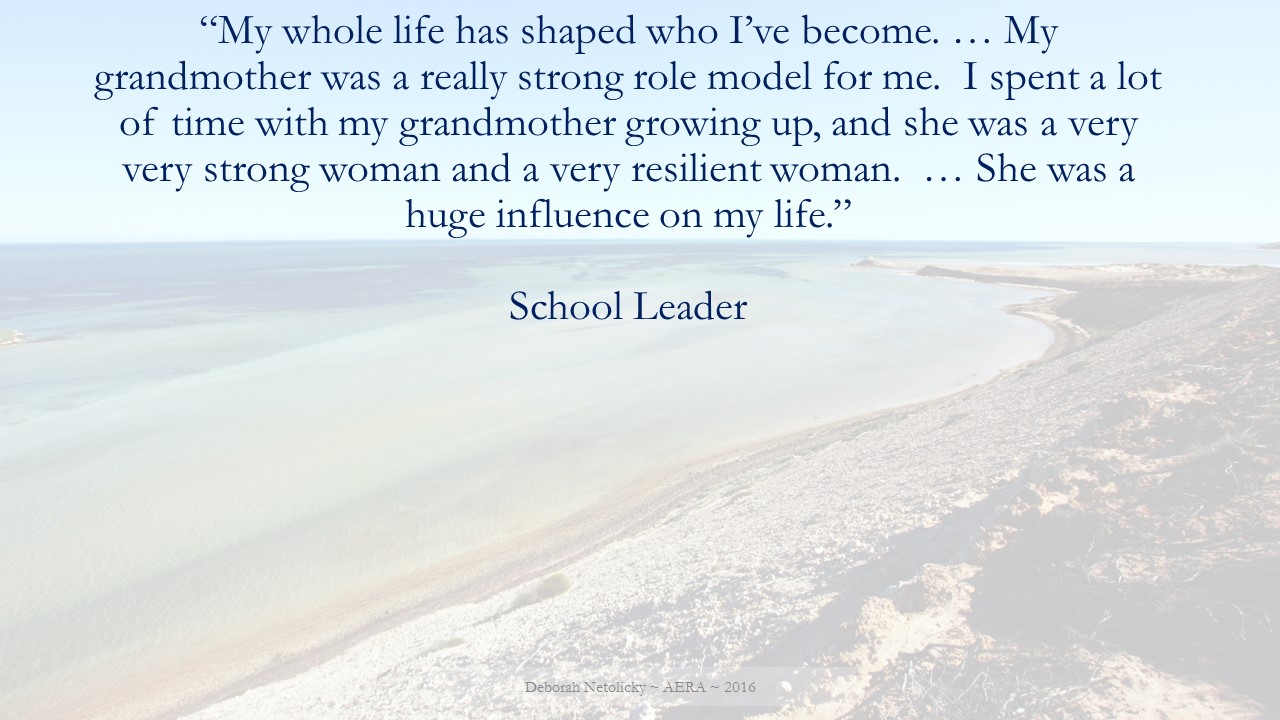
My full paper will be available in the online repository when the 2016 papers go live. In the meantime, here are copies of my presentation slides. The slides were designed for me to talk to, not read from, so much of the content is thin. That is, they’re light on text and light on references (see the paper for more depth), but you’ll get a sense of my main points. Of course I didn’t get through them all and ended up skipping over the participant quotes (19 slides in 12 minutes? What was I thinking? #overexcited #lessonlearned).

If you’re interested in more, my dissertation, which looks at professional learning in more depth, as well as its interactions with professional identity and school culture and change, can be downloaded here.

From my experience so far I can highly recommend the AERA national meeting. It’s a friendly conference with an impossibly wide range of interesting and important work being shared, and connections being made.

Slide1

Slide2

Slide3

Slide4

Slide5

Slide6

Slide7

Slide8

Slide9

Slide10

Slide11

Slide12

Slide13

Slide14

Slide15

Slide16

Slide17

Slide18

Slide19

Teacher efficacy, agency & leadership #aera16

iconic Abe

iconic Abe

This afternoon I spent 3 hours at two round table sessions at AERA in Washington DC, hearing about and talking about teacher leadership and agency. Then on the way home from drinks with Sarah Thomas, who I know through Twitter and Voxer, I stumbled across the #satchatOZ chat on Twitter which was talking about teacher leadership. So whilst I’m jetlagged and brain-exhausted from a day of conferencing, I want to get my raw thoughts down before they’re overrun with tomorrow’s thoughts (with some of my photos, because: DC).

Three terms that came up today in the two roundtable sessions I attended were: efficacy, agency and leadership. Self-efficacy is about how well someone thinks they can do something; a self-belief in their own capacity. Agency is the capacity to act as well as the acting itself; to be an agent is not just to have the internal capability to do, but to actually do the doing. I wonder, can someone be an active agent, capable of action and change, without the self-belief in their capacity to do so? Possibly. Can someone have a sense of self-efficacy, but without the agency to be effective? Probably.

Leadership, meanwhile, is a slippery word. People can be leaders by name or position, but this doesn’t guarantee that people are led by them. Leadership and agency are not just individual, but also collective. Can someone be a leader without a followership? A leader can be defined by their title, but more often they are defined by their influence on others, their organization or the system in which they operate. Teachers without official positions of responsibility can be, and are, leaders in their fields. They are active agents who effectively translate their beliefs and purpose into reality through deliberate and effective action.

In leadership and agency in schools, context is a key consideration. The holonomous* environment of a school is one in which the sum and the parts are inseparable. If schools want teachers to be reflective, growth-focused and agentic, they need to trust in their teachers and provide an environment in which risks and exposing one’s vulnerability are ok. In a culture of teacher-scoring and fear, teachers are less likely to be agents of positive growth and more likely to be compliant servants to a punitive system. Movements like #flipthesystem, which are explored in Jelmer Evers and René Kneyber’s book, advocate for further teacher voice and action in education reform. Localised reforms like my school’s teacher growth model are practice-based examples of in-school teacher leadership in action.

In the introduction to Linda Darling-Hammond’s presidential AERA address this afternoon, she was described as identifying as a teacher, but having become a researcher so that she could be a strong voice listened to by policy makers and powers that be. She saw research as a way enact and propel change.

DC daffodil cityscape

DC daffodil cityscape

While I didn’t frame my PhD research through the lens of teacher leadership and agency, it could be seen through that lens. I explored teachers and school leaders’ perceptions of identity, learning and school change, within a particular context. That context was the coaching intervention I was leading at my school, a formative growth-based model of teacher growth and development.

What emerged from my study, when looked at in terms of teacher leadership and agency, was that teachers are deeply tied to their senses of self within their senses of their context. That is, teacher self-efficacy and agency develop when teachers feel an individual purpose, an alignment with context and that they are empowered with voice and influence in their own organization. In this case, the school empowered teachers to be active agents with a voice in school reform. Additionally, the formative aspect of the coaching model for growth was fiercely protected; teachers are not scored and judged, but are able to collect lesson data and participate in coaching conversations in order to grow themselves. This kind of trust requires some relinquishing of power from those at the traditional hierarchical apex.

As someone who connects with others on Twitter and writes on this blog, I think that technology and social media give us tools to develop our teacher voice and engage in conversations about education. I know of teachers who would be considered leaders both in their schools, and in the wider land of education, due to their public thinking, writing and advocacy. I also know those who are known more for their leadership in the social media or conference arenas, than in their own day-to-day school contexts.

As others have noted, Twitter flattens hierarchies and empowers users. Bonnie Stewart’s research into academic Twitter found that there are different spheres of, and criteria for, influence on Twitter than in higher education institutions. The same is true in other educational contexts. Government ministers are drawn into public conversation with teachers on the ground. Social media and blogging can be leveraged by teachers to allow them voice and agency, to advocate or agitate. As Greg Ashman and Rory Gribbell note in their recent blog posts, bloggers can and have been agents of political and educational change, a pluralistic chorus of voices to which people are listening.

Teachers can and should be advocates for their students and their schools. They can and should pursue research and opportunities to understand, revise and reimagine what is known in education. Those leading schools and systems in official roles can encourage teachers’ growth and leadership by questioning traditionally hierarchical power structures and considering more distributed and inclusive ones. In this way, teachers can be encouraged to lead within their contexts, instead of feeling as though they are fighting against the system or preserving their survival within it.


* Check out Costa & Garmston’s 2006 Cognitive Coaching text or my PhD dissertation for discussion of holonomy.

mural at the Library of Congress

mural at the Library of Congress