Research-informed education practice: More than lip service and shallow pools

stromatolites in shallow pools

stromatolites in shallow pools, Shark Bay

In a variety of educational contexts I have recently heard everyone from keynote speakers to respected educational practitioners talk about research in education, especially the notion of bringing a knowledge of research into schools.

The general gist of what I’ve been hearing is ‘we need research-informed practice’ and ‘we need to look to the best research to inform decision making in schools’. These are statements I absolutely agree with, but digging a little deeper has led to disappointment. When people have gone on to explain what they mean by those fashionable sweeping statements, they have mentioned one or two researchers or studies of which they are aware. These oft-mentioned authors or studies seem to be those that are highly promoted, wheeled out by well-funded organisations or publishers, or neatly packaged into half-day workshops or laminated sheets. Some are those promoted as a one-stop-shop of what works in education: the simple answer for which we’ve all been searching!

The problem is that education is not simple, and neither is research. Learning, teaching and school leadership, are highly complex and contextual. There can be no simple answer, magic wand, silver bullet or laminated sheet of pretty-looking graphs that can transform education. (I was, however, recently challenged to have a go at thinking about in which directions we might look in order to improve teaching and learning.) As Dylan Wiliam suggests, research can point us in profitable directions, illuminating those interventions on which we might best spend our time.

Research, too, is highly complex and multifaceted. To engage effectively with research, educators need to understand its limits and what it can offer. All research is limited. I’m well aware of the limitations of my own research. I know my research has something to offer, but that offering is a small nudge, a keyhole insight, a singular thread in a tangled web. Academic writers are constantly delineating the parameters of their work; what their work has done and can show, and what it hasn’t done and can’t show. Each study or paper or chapter illuminates a different part of the tangled web of research in education.

As educators teaching, or leading teachers, we need, not just to be able to spout a couple of scholarly names, assert that ‘so-and-so tells us that X doesn’t work’ or make decisions based on appearing to engage with research. We need to engage with, pore over and deeply interrogate—with a critical eye—a range of research. Jon Andrews points out that deeply influential people who penetrate huge educational conversations and decisions may be going unchallenged by the profession at large. Marten Koomen traces some of these influential figures and their spheres of edu-influence.

John Hattie’s meta-analyses are often referred to in education circles as examples of research that tells us what works; it is certainly his name that I am currently hearing most often in schools and at conferences. I respect Hattie’s work and that there are things it can tell us, but am skeptical about the ways in which it has been universally adopted as a ubiquitous beacon of research light in the edu-darkness. Dylan Wiliam, in his 2016 book Leadership for Teacher Learning, discusses the limitations of meta-analyses and their application in education, cautioning that “meta-analysis is simply incapable of yielding meaningful findings that leaders can use to direct the activities of the teachers they lead” (p. 96). Snook et al. and Terhart also present critical perspectives on Hattie’s book Visible Learning. This is just one example of how a particular set of results has become so widespread that it unquestioningly becomes part of the fabric of edu-talk.

We can’t pat ourselves on the back for unquestioningly consuming the most pervasive or seductively-packaged research. Gary Jones’ blog is a good place to start for those looking for considered sense-making around how schools might interact with research.

I am committed to playing a part in bringing the worlds of research and practice, theory and action, academia and schools, meaningfully and purposefully together so that they speak to and inform one another. It’s why I am pleased by the schools in Australia embracing school-university partnerships and internal roles like Head of Research. This recent report (by Tom Bennett, featuring Alex Quigley and Carl Hendrick) tracks some of the impacts, successes and challenges of Research Lead roles in schools in the UK.

I believe that schools can lead and generate research. They can develop roles and processes that bring critical organisational mindfulness to the movable feast of edu-research and how practitioners might navigate, probe and be informed by it. Let’s do more than wade in shallow pools of research literature or pay lip service to being research-informed. Instead, let’s find ways to lead and embed research thinking and informed decision making into the fabric of what we do.


Rethinking professional learning: an academic paper for JPCC

This week I’m thrilled to see my paper ‘Rethinking professional learning for teachers and school leaders’ published in the Journal of Professional Capital and Community. This journal, whose Editor in Chief is Andy Hargreaves, boasts an Editorial Board including Linda Darling-Hammond, Michael Fullan, Alma Harris, Karen Seashore Louis, Pasi Sahlberg, Helen Timperley and Yong Zhao. My paper appears in Volume 1, Issue 4, alongside a theoretical paper by Dennis Shirley. As an early career researcher, I couldn’t ask for more distinguished company.

Even more pleasing is that the journal is open access during 2016, so free for anyone to download and read. Open access to the paper means that it can be accessed by practitioners who so often don’t get to read and engage with the literature in (often pay walled) academic journals. In fact, it has already been downloaded (at today’s count) 1689 times. Wow. That’s a bunch more times than my PhD thesis.

The paper, which draws from the lived experiences of teachers, middle leaders (often a forgotten group in education literature) and executive leaders in one Australian school, outlines the findings of my PhD around what makes professional learning that transforms beliefs and practices. It discusses my study’s response to the questions:

  1. What is the role of professional learning on identities or growth?; and
  2. What professional learning is transformational?

My PhD found that transformational learning (as defined by Ellie Drago-Severson, 2009, as that which actively shifts cognition, emotion, and capacity) is: collaborative and individual; occurring in life, school, and work; and requiring elements of support and challenge. Not only was it lifelong, but it was life-wide. For these participants, it is life experiences, as well as professional experiences, that influence their professional beliefs and practices. The following is a table, which didn’t make the final cut of the paper, shows the range of features of professional learning found in my study.

tabulated findings around professional learning

tabulated findings around professional learning

This table shows the variety of experiences that educators in my study considered transformational for themselves. These experiences included relationships with family members; role models and anti-models of teaching and leadership; post graduate study; difficult life experiences; becoming a parent; and connecting with others at conferences or via social media. It included heutagogical (self-determined) learning, as I outlined for this blog post for the Heutagogy Community of Practice.

It also included, especially for leaders operating at an executive level, the time and space for silence, reflection and thinking. The research interviews themselves proved to be spaces of learning for some of the school leaders, who saw them as an opportunity to be listened to intently and to think deeply about their learning and leading.

The participants in my study had some important cautions about professional learning and about school interventions. They cautioned that a mandated approach to professional learning, even if differentiated, might not address the needs of all professional learners. They wondered about how to honour the individual teacher and the organisational priorities when leading professional learning in schools.

The paper concludes that, while my study intended to explore the ways in which educators’ experiences of professional learning form and transform their senses of professional identity, it found that it is not just professional learning, but life experiences that shape professional identities and practices. That is, our teacher selves and teacher actions are moulded by critical experiences that tangle with and shape our identities, lives, relationships, and emotions. The best professional learning, as suggested by this study, is highly individualised and knottily enmeshed with educators’ senses of self, of who we are professionally.

Anyone who teaches knows that we cannot separate our teacher selves from our non-teacher selves. As teachers our lives affect our learning and teaching, and our learning and teaching influences our lives. For many teachers, ‘life’ and ‘work’ are well beyond blurred. We are humans who teach and teachers who exist as humans in the world. The leaders in this study tended to describe themselves as either teachers who lead or as leaders who teach; they remained teachers in their identity self-perceptions. See this post for further musings about the notion of teacher identity, that ‘being a teacher’ stays with many of us beyond our years in the classroom.

One suggestion to emerge from this paper is that we would benefit from rethinking what it is that we consider and label as ‘professional learning’. Professional learning is not hours logged on a spreadsheet or entered into an app. It is not necessarily being in a room with other educators at a course or conference that is labelled ‘professional learning’ (although it might be). It is those critical moments across our lives and work that shape the core of who we are, in and out of the classroom and the boardroom. Professional learning can be personal, unexpected, unscheduled, nonlinear, messy, unbounded, and unacknowledged.

Can we redefine ‘professional learning’ in more expansive and flexible ways? How might we acknowledge those hours educators spend blogging, or studying, or tweeting, or visiting schools, or collaborating intensively, or volunteering in the service of others? How can leaders lead the learning of teachers in ways that honour their individual learning trajectories and their own agency? How might we rethink our systems and schools in order to focus, not on hours of what is easily labelled or effortlessly deployed (staff day scattergun PD, anyone?), but on what actually engages us and changes our cognition and our capacities?

Trust and support teachers: My New Voice Scholarship panel speech

speaking yesterday at the Melbourne Convention Centre

speaking yesterday at the Melbourne Convention Centre

Yesterday I had the pleasure of speaking on a panel of ACEL New Voice Scholars (list of awardees here) at the Melbourne Convention Centre. As a representative of new Australian voices in educational leadership research, I spoke in front of an auditorium of 1200 educators in response to the provocation: ‘If you could wave a magic wand, how would you transform education?’

The following is a version of that speech (I tend to go off the cuff a bit, so it’s not identical). It is based on this think piece I wrote for the ACEL Perspectives publication which is more measured and referenced, and less rhetoric-laden than my speech. I’ve added links to other blog posts to this post, as feedback from those at the conference has been that they would like to know more about the school professional learning model about which I spoke.

Thank you to the Australian Council for Educational Leaders for offering me the platform-soapbox-orangecrate from which to speak passionately about what I think is important for leaders, teachers and students in our schools.

*                                                      *                                                      *

(Hello etc. …)

I am an English teacher by trade and have spent the last 17 years teaching and leading in schools in Australia and the UK. Most recently I have been leading a strategic project that developed a whole-school coaching model at my school, designed to do a number of things, including:

  • Improve teacher classroom practice;
  • Develop teachers’ capacities for reflection;
  • Depersonalise and open classrooms;
  • Develop a common language of practice; and
  • Improve the quality of professional conversation.

This intervention was strategically aligned, so it was top down in terms of being aligned with the strategic vision of the school, initiated by the principal and supported by the school board. But it was also middle out and bottom up, as the model was developed by teams of teachers, led by me. We took a deliberately slow process of prototyping, piloting, iterating and refining this context-specific intervention.

At the same time, while also parenting two small children, I completed a PhD in which I asked what it is that makes professional learning transformational and how school leaders can best lead professional learning for teachers.

(It was at this point that I said something like, “My doctorate was conferred in April, so if you see me around the conference, you can call me Dr Deb” which has resulted in everyone from the MC to delegates calling me ‘Dr Deb’ ever since!)

As someone who bestrides educational practice and research, I don’t believe there is a silver bullet or magic wand that can transform education, but I do believe we can work to positively influence it.

Two things we can focus on, in order to positively impact on our students’ learning, are the trust and growth of teachers.

At my school, we have developed a model for teacher growth that uses Cognitive Coaching, non-inferential lesson data, and the Danielson Framework for Teaching, to help teachers reflect on and grow their practice.

Non-inferential lesson data—that is, data that is, as much as possible, non-judgemental and informational—and shared standards of teaching, help our teachers to develop the depth and precision of their reflections on practice, while Cognitive Coaching helps teachers to surface their own thinking about how they can improve. Cognitive Coaching is not about solution-providing or advice-giving, but about mediating the thinking of teachers and helping them to find their own solutions to problems of practice, based on a belief in their internal capacity to do so. To paraphrase Dylan Wiliam: teachers know their own classroom and their own students best.

My PhD found that coaching, among other things, can transform teachers’ beliefs and practices. It also found that school leaders have an important part to play in leading the learning of teachers.

We need to avoid those policies and practices that pit teachers and schools against one another (such as merit pay), that promote competition and commodification, or that focus on external metrics, performative measures, rewards or punishments. These are all things that demotivate, de-professionalise and demean our profession.

To support teacher professional growth and improvement in practice, we need to focus on trusting teachers to be professionals with the capacity to grow. We need to properly support their growth through context-specific interventions for which we provide adequate training, sufficient time, appropriate resources, and processes to systematically review our effectiveness.

In this way, within our own schools, we can heighten teachers’ self-awareness, self-efficacy and collaborative expertise and positively influence student learning.

Is teaching an art?

close-up of Monet's Nymphea at the Musée de l'Orangerie

close-up of Monet’s Nymphea at the Musée de l’Orangerie

How can we appreciate an artist’s work or know an artist’s worth?

We can see the genius of Frida Kahlo in one of her paintings, get a flavour of her life at La Casa Azul in Mexico City, or understand her dramatic story arc through a comprehensive exhibition of art she produced throughout her life. We can marvel equally at one of Monet’s early Impressionist works as at the spectacular exhibition of his Nymphea in the naturally-lit oval rooms of the Musée de l’Orangerie. One of Salvador Dalí’s paintings can give us insight into his skill, style and artistic significance, but a visit to his Teatre-Museu in Figueres allows us to more deeply know his life, work and mad genius.

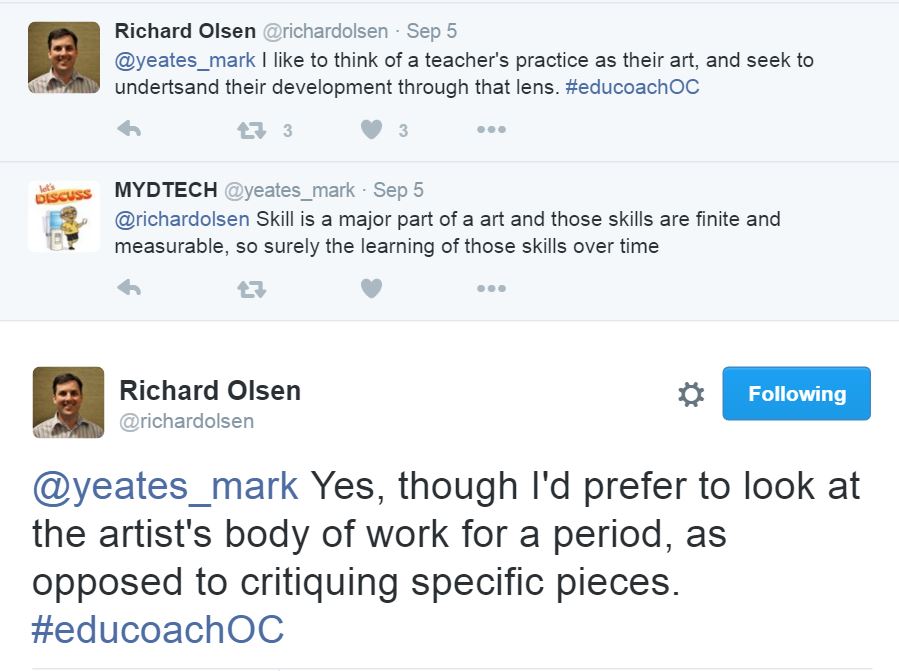
Richard Olsen tweeted in the #educoachOC chat this week that he considered teaching an art, and that he thought that when being appraised, teachers’ teaching should be looked at as a body of work, rather than as individual pieces. You can see Richard’s tweets, which got me thinking, in the screenshot below. His view is consistent with those who warn against the compartmentalisation and atomisation of teaching into disparate, de-contextualised bits.

There are also, however, those who advocate for clear maps and standards of teaching in order to develop shared understandings of what good teaching might look, sound and feel like. My own school uses the Danielson Framework for Teaching as a tool for developing our shared language of teaching and the precision of our reflections on and planning for teaching and learning. These reflections are also based on lesson data snapshots of practice, which provide the basis for Cognitive Coaching conversations. Our approach seems to fit into Richard’s notion of “critiquing specific pieces”, rather than looking at a body of work. Yet fine-grained lesson data and consequent reflections allow teachers to drill down into aspects of their teaching practice, while acknowledging that one lesson is only ever a moment in time, a snapshot of practice, a through-the-keyhole-peek into their teaching as a whole.

Many, including Robert Marzano, describe teaching as an art and a science. The notion of blending art and science, creativity and systematisation, resonates with me. It was the approach I took to my PhD research, one that I outline in this paper in Narrative Inquiry. I have blogged about viewing research as sculpture, as art-esque conversation, about teaching Art, and about textiles as political metaphor for academic writing and identity.

Elliot Eisner’s body of work explores education as artistry and connoisseurship. Eisner advocates for the arts as a frame for re-imagining education as innovative, artistic practice, rather than as a cookie-cutter or assembly-line one. Conceptualising teaching as an art, or arts, or artistic, assumes a complexity, a non-linearness, a rich tangled web of intangibles and un-pin-downables.

Is teaching art or science? Or both? Is it inappropriate to look at a single work, a close-up of the brushstrokes or the marks made by the sculptor’s tool? Should we only talk about teaching in terms of bodies of work, portfolios of evidence, the whole and not the parts? Can Michelangelo’s David be separated from his Pietà, the Sistine Chapel ceiling and his unfinished ‘slaves’? Can or should meaning be sought in a singular laboured-over artwork, or in a dusty pile of experimental sketches found in the attic? Or should we only assess or seek meaning in a body of work accumulated over time?

How might a teacher’s performance be appraised? How can the whole, as well as the parts be considered? Of what use is the performance of teaching for observations by management, versus relaxed one-on-one discussions with students or an experimental lesson tried for the first time? And of what use are the ‘individual works’ such as unit plans, student work examples, lesson data and external test results? Data from particular lessons can provide a tangible, depersonalised third point for professional conversations, just as a particular work of art can be representative of an artist’s work. An exhibition from a particular period of an artist’s work can give a broader picture of their work during that time. A posthumous exhibition of their life’s work can provide the broad narrative of how their work has evolved. These are all different but meaningful lenses for appreciation and critique; each is a useful way of viewing the work and worth of the artist or teacher.

On the one hand, teaching does become a body of work over time. A life’s work for some. This gestalt includes ever-expanding subject knowledge, evolving pedagogies, relational skills and behaviour management tools. Many of the things teachers do become internalised, less-deliberate moves, part of a way of being. Perhaps a teacher should not be judged by a lesson that they teach or one set of student results, but there is value in each piece of work being reflected upon and closely considered for the understandings it might surface about that teacher’s practice; the details it might reveal; or the points of celebration, critique or change it might incite.

#educoachOC Chat 11: Differentiating Coaching

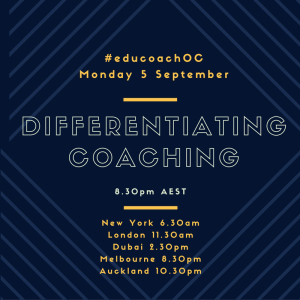
Tonight (or this morning if you are in the northern hemisphere) is the #educoachOC monthly chat. We’re talking diffefentiating coaching.

I’m really interested in what the global edu-coaching community has to say about how we might tailor coaching to address a variety of coachee needs and contexts.

Dr Deborah M. Netolicky's avatar#educoachOC

educoachOC

This Monday, on 5 September, our monthly #educoachOC chat will be exploring the topic of differentiating coaching.

If coaching is viewed as a catalyst and support for professional growth, then the process should be able to be applied to any individual’s contexts and priorities. Often we see coaching as a model differentiated by its open processes and intent to focus on the individual being coached. But does any coaching process, framework or approach fit most individuals and their growth needs?

In education, coaches are involved in coaching people at a variety of places in their careers and personal lives. People come into a coaching conversation with different priorities, different starting points and different needs. Early career teachers. Mid-career teachers. Veteran teachers. Highly reflective practitioners. Less reflective practitioners. Those struggling with change processes, work contexts or personal events. Aspiring leaders. New leaders. Middle leaders. Executive leaders.

As coaching is about helping…

View original post 235 more words

Schools can lead and generate research #AHISA16

Rottnest rainbow, by Deborah Netolicky

This week I’m attending the AHISA (Association of Heads of Independent Schools of Australia) conference, which brings school leaders from around Australia together for a few days of visiting schools, conferencing, and networking. In my daily life, conversing with educators, many of whom I’ve never met, in other spaces and places tends to happen through social media (Twitter, blogging, Voxer). This week, however, via the AHISA conference, I’ve had the pleasure of catching up with those I have met and know well: my first principal and a variety of leaders with whom I have worked in Perth, Melbourne, and London. As someone who has worked in independent schools in Australia and the UK (for over 16 years, except for 6 months at a London comprehensive) this conference visit has been in some ways like watching my career flash before my eyes, as I’ve reconnected with various colleagues I’ve worked with at various times and places across the last decade and a half. It’s a reunion and a catch up with those I’ve worked over the years, a chance to talk with current colleagues about how the conference relates to our current work, and a place to make new connections with school leaders from around the nation.

In the conference sessions, I’ve been following a thread that is important for my own current work: professional learning for teachers and leaders, especially that emerging deliberately out of specific contexts. These sessions are relevant to me and my school because I have led a whole-school, evidence-based strategic intervention: a coaching-for-professional-growth model. This role has involved, since 2012, canvassing research literatures, writing papers, presenting to the school Board each year, and leading teams of teachers to prototype and iterate a context-specific model to support teacher and leader growth. This intervention was top-down (driven by the school’s strategic vision) as well as middle-out and bottom-up (developed by teams of teachers, led by me and overseen by the school Executive). It has meant generating data around the impacts of our work and tracing the influence of the model on teaching, learning, leading, school culture and the organisational language of professional conversation.

At the AHISA conference, the best workshop presentations for me have been those that have outlined how a school or system has applied systematic, research-informed, evidence-generating methodologies, with a clear aim.

Dr Gary Jones (2016) points out that schools can use evidence to make better decisions. He elevates the following from Barends, Rousseau and Briner (2014) as a frame for evidence-informed decision making in education:

  • Asking: translating a practical issue or problem into an answerable question;
  • Acquiring: systematically searching for and retrieving the evidence;
  • Appraising: critically judging the trustworthiness and relevance of the evidence;
  • Aggregating: weighing and pulling together the evidence;
  • Applying: incorporating the evidence into the decision making process; and
  • Assessing: evaluating the outcome of the decision taken.

Evidence might include: published academic research that quantitatively or qualitatively analyses empirical data; data, facts, and figures gathered from the school; specialised professional experience and judgements of relevant practitioners; and values, views, and concerns of relevant stakeholders. Schools can value and consider a range of research, as well as tacit knowledge and the richness of their own context.

As Dylan Wiliam points out in his 2016 book Leadership for Teacher Learning (and elsewhere), research cannot tell teachers and schools what to do, but can inform their decision making and their efforts. We can look to research for likely-to-be-productive avenues in education, rather than for recipes or silver bullet solutions to be unquestioningly followed.

In fact, schools can lead research, not just follow it. They can generate research, not only consume it. School leaders and teachers can be researchers, can apply research thinking, and can be critical questioners of research literature. They can challenge each other, participate in respectful debate, investigate contradictory positions, or consider multiple possibilities. They can pilot, prototype, and iterate new ways of doing things, while collecting data on the progress and impacts of interventions.

It has been great this week to connect with past, current, and future colleagues at the AHISA Leading, Learning, and Caring conference. It has been even more pleasing to see the work of some educators and schools in applying evidence-informed and data-generating design thinking to their complex work. Still, there are those who could more rigorously interrogate their assumptions, practices, and uses of research literature. There are those from whom others would benefit if they contributed their thoughts to edu-dialogues. Many of us would benefit from listening more closely to others. Whether affirming, querying, or dissenting, it is a range of thoughtful voices from multiple perspectives that together can shift the narrative, practice, and evidenced understanding of education.

Mapping quality teaching

Sidney Poitier in To Sir, with Love Source: http://www.rockshockpop.com/forums/c

Sidney Poitier in’ To Sir, with Love’. Source: http://www.rockshockpop.com/forums/

This is the third post in a series of posts on quality teaching. You can also read:

Part 1, which explored the terms ‘teacher quality’ and ‘quality teaching’; and,

Part 2, which outlined those things that effective teachers have been found to do.

*                 *                  *

If we accept that the quality of what teachers do in their classrooms influences student learning, and that quality teaching has some agreed characteristics, what can teachers, schools and systems do? How does the profession come to a common understanding of what good teaching looks like? Amid teaching debates like ‘traditional vs. progressive’, what is it that teachers should be striving to do?

Some question and warn against the itemising of teaching into a set of prescriptive elements, and many agree that attempting to quantify the complexity of teaching is fraught with difficulty. Many scholars and educators have nonetheless worked to identity what quality teaching looks like and what effective teachers do, trying to capture what teaching encompasses. These authors attempt to detail, describe, interpret, and evaluate the elements of teaching; to find what quality instruction looks like and the conditions necessary for developing the quality of teachers’ instruction.

Many authors suggest that in order to develop their teaching, teachers need a ‘map’ of where to go and how to get there. In his 2004 book Successful school change, Claude Goldenberg reflected on his work with a USA primary school over five years. He noted that the school and teacher change model he and the principal implemented was too abstract and unspecified. He added that “we should have been more nuts-and-bolts oriented, in the sense of specifying more clearly what teachers were to do in various settings, including their classrooms” (p. 173).

In order for teachers to improve, not only do teachers have to want to improve, they must know how to improve and on what aspects they would benefit from focusing their attention. Schools can benefit from frameworks that provide the knowledge base of what good teaching looks like, as well as processes that facilitate the improvement of practice. A map of teaching involves a clear set of agreed standards and a way to think systematically about the complexity of the task. Mapping teaching can be less about identifying quality and proving teacher performance. It can be about empowering teachers to improve, developing a common understanding and shared language of practice.

Examples of attempts to address the need for a framework or map of the intricacies of teacher practice include the Danielson Group’s Framework for Teaching, the Marzano Causal Teacher Evaluation Model, and the Australian Institute of Teaching and School Leadership (AITSL) National Professional Standards for Teachers.

The Danielson Framework for Teaching, endorsed by Dylan Wiliam in his 2016 book Leadership for Teacher Learning, has been shown to: identify the most effective teachers and positively correlate their quality with student achievement gains; focus observers’ attention on specific aspects of teaching practice; establish common evidentiary standards for each level of practice; and create a common vocabulary for pursuing a shared vision of effective instruction. Students showed the most academic growth in classrooms with teachers who rated highly on the Framework, and the least academic growth in classrooms with teachers who received the lowest ratings.

Marzano’s model has also been tested in studies and meta-analyses, which report that using the instructional strategies of the model improves student achievement and helps teachers develop themselves professionally.

In evaluating the perceptions of the AITSL Professional Standards, AITSL has found that pre-service teachers were the most enthusiastic about the potential of the use of the Standards in their practice and their students’ learning, school leaders were most engaged in the implementation of the Standards, and non-pre-service teachers were least likely to perceive the Standards as useful in changing their practice or impacting their students. AITSL’s measures have concentrated on educators’ perceptions of their tool.

Frameworks such as Danielson’s, Marzano’s, and AITSL’s may have a place in helping teachers to achieve clear, measurable targets, but schools and systems using these tools need to be considered in their purpose and process of their implementation. My school uses the Danielson Framework (overlaid with the national AITSL Standards) as a third point in conversations, in order to help novice and veteran teachers to reflect on their lessons with specificity. It is a tool, as part of a large toolbox, for developing shared understanding.

My PhD study found that the Danielson Framework for Teaching, when used as part of a non-judgmental model of teacher growth, helps to develop teachers’ precision of reflection around teaching practice and a common language for talking about teaching and what it can look like. At my school, teachers who develop familiarity with the Framework and its descriptors find that while teaching they mentally aim for the descriptors of ‘Distinguished’ teaching; knowledge of the Framework shapes their decisions and their classroom practices.

As much of the world grapples with how to wrestle the octopus of ‘teaching’ into a small, rigid glass jar of pithy statements or political one-liners, we need to be wary of atomising teaching into disparate parts, but we can be equally open to tools that might help us deepen our professional understandings and practices. We can focus on dialogue, interrogation of practice, reflection, collaboration and growth, and on researching and critically appraising the frameworks and measures available to us.

What do ‘quality teachers’ do?

Jaime Escalante in 'Stand and Deliver'. Source: http://remezcla.com/film/edward-james-olmos-on-stand-and-delivers-25th-anniversary-and-the-release-of-filly-brown/

Jaime Escalante in ‘Stand and Deliver’. Source: http://remezcla.com/film/

This is Part 2 in a series of posts on ‘teacher quality’ and ‘quality teaching’. You can also read Part 1 and Part 3

In response to my last post, I’ve received a lot of comments from those who bristle at the use of the term ‘teacher quality’ to label teachers and demean the profession; it is, however, a term used profusely in research and policy literatures. I’ve used the term here as shorthand for ‘teachers whose practice positively influences student learning.’

*                 *                  *

As the quality of teachers’ teaching is generally agreed to be an important school-based influencer of student achievement, researchers have attempted to identify aspects of teaching as demonstrating evidence of positive effect on student achievement.

In reviewing literature for my PhD, I found five elements that emerged as agreed elements of what ‘quality teachers’ do. I have cited some of the references that mention each aspect, although there are larger webs of literature for each of the five threads explained below.

______________________________________________________

1) Quality teachers purposefully design learning opportunities

Teachers have excellent knowledge of their content, pedagogies, their students, and how their students learn. They apply this knowledge to planning programmes, lessons, student groupings and assessments with clear, transparent performance targets. The purposeful designing of learning opportunities is articulated in references such as Bransford and Darling-Hammond’s Preparing teachers for a changing world: What teachers should learn and be able to do, Shulman’s (2004) essay ‘Communities of learners and communities of teachers’, and Linda Darling-Hammond’s seminal The right to learn: A blueprint for creating schools that work.

2) Quality teachers diagnose student progress to inform both teaching and learning

Grant Wiggins and Jay McTighe (in their 2007 Schooling by Design) wrote that teachers facilitate the setting of challenging goals and high standards, designing the work so that learners believe in their own capacity for success, and adjusting plans in light of unexpected or inappropriate results. Jim Rose in his 2006 Independent review of the teaching of early reading noted that high quality teaching should inform realistic and ambitious target-setting.

3) Quality teachers fight for their students’ learning

A couple of references point to the importance of advocacy in teaching. In 1986, Philip Jackson argued that effective teachers fight for what they believe about teaching and learning, acting independently to advocate for their students. Wasley, Hampel and Clark (1997) spent three years observing and interviewing six students in five USA schools for their book Kids and school reform. They found that good teachers believe that each of their students can learn; and have the skills and capacity to engage in debate on behalf of their students’ learning.

4) Quality teachers personalise learning for students

Teachers balance the needs of the learner, the knowledge and skills students need to acquire (what they teach and why), assessment and feedback, and embeddedness in community. They select appropriate classroom design, instructional strategies, and subject matter to help each student learn, with a diversity of teaching methods including: reciprocal teaching, direct instruction, problem solving methods, explanation, elaboration, modelling, plans to direct task performance, sequencing, drill repetition, optimising peer learning, providing strategy cues, domain-specific processing, clear instructional goals, setting challenging goals and teaching students self-verbalisation and meta cognitive strategies. They respond with immediacy and a sensitivity to the here-and-now, showing flexibility by valuing freedom of thought and movement in the classroom. The emphasis on sensitivity towards, and individualisation of approaches for, students, is evident in Bransford and Darling-Hammond’s Preparing teachers for a changing world: What teachers should learn and be able to do and Philip Jackson’s The practice of teaching.

5) Quality teachers provide meaningful and appropriate feedback.

In Schooling by Design, Grant Wiggins and Jay McTighe pressed the importance of backwards assessment design, providing ongoing feedback with immediate opportunities to use it, and implementing strategies to develop learner autonomy, thus making self-assessment and self-adjustment a key goal of teaching. The work of Dylan Wiliam and Rick Stiggins promotes formative assessment as a way to frequently check for understanding and to engage students in self-reflective, self-regulated learning.

______________________________________________________

The above-mentioned studies suggest that quality teaching requires teachers to have a sound and continually developing knowledge of content and pedagogy. This supports the definition of teacher quality I identified in my last post: ‘knowing what to teach and knowing how to teach’. Quality teaching, according to the above cited works, involves teacher self-reflection, planning of well-structured units and lessons, focusing on higher order thinking, managing the classroom effectively, utilising an arsenal of effective teaching strategies, individualising learning, setting challenging goals for all students, knowing where each student is ‘at,’ facilitating each student’s progress to the next level, and giving effective, targeted, timely feedback.

Anne Freese (in her 1999 paper ‘The role of reflection on pre-service teachers’ development in the context of a professional development school’) describes herself as an educator (albeit in a higher education, rather than a school, context, so perhaps from a potato perspective) and in doing so resonates with the above threads of quality teaching:

I am more like a coach who structures the learning events and co-inquires. . . . I have become more comfortable modelling and making public my thinking about teaching, and risking being vulnerable as I put my own teaching under scrutiny. This is a different role from that of being the `expert’ and the dispenser of knowledge. (p. 908)

Here Freese underscores the teacher’s purposeful designing of learning by structuring what she calls “learning events,” suggesting deliberate design of student-focused learning experiences. She makes her thinking “public” and sees herself as coach and co-inquirer, vulnerable in her collaboration as co-learner with her students. Freese highlights the notion of self-reflection in her comment about having the willingness and capacity to put her “own teaching under scrutiny.” Freese’s description reflects Wiggins and McTighe’s description of those teachers who demonstrate ‘quality’ practice as designers, diagnosers, facilitators, and constructors of learning and learners.

As teachers, schools and systems have conversations around how to improve the learning of students by improving what happens in classrooms, it’s important that we continue to attempt to build a shared understanding of exactly what we mean when we say things like ‘quality teaching’.

Teasing out ‘teacher quality’

This post is the first in a series exploring the popular notion of improving teacher quality in order to improve student learning and achievement.

You can also read Part 2 ‘What do quality teachers do?‘ and Part 3 ‘Mapping teacher quality‘.

*                 *                  *

For some time, scholarly literatures have generally agreed that, within the school sphere of influence, the quality of teachers’ teaching is the most influential school-based variable in terms of improving student learning and achievement. (We need to remember, however, that student learning and achievement are influenced primarily by many factors that are hardest for policy makers and schools to influence, such as students’ attitudes and abilities, socioeconomic context, parents’ education and peers.) Now, everywhere we look in education there are institutes and government policies and school websites all hailing the catch cry: ‘teacher quality!’

The term ‘teacher quality’ is in danger of being subsumed in what I call the ‘hashtagification’ of education terminology, in which words like ‘mindset’ and ‘grit’ become ubiquitous platitudes shared in sound bites or 140 character tweets. When we use words in education, we need to read the literature and research about them, tease them out, and come to a shared understanding about what are often dense concepts around the complexity of teaching.

During my PhD I spent time (ok, years) reading up on, among other things, ‘teacher quality’. Its definitions, its features, studies that aimed to measure its impacts. While I can’t distil those years of reading into a blog post, this post is a starting point (for comments, conversations, future posts) as well as a call to others to spend time cogitating over and teasing out the terms we use in edu-spheres.

‘Teacher quality’ is used to denote the quality of teachers’ teaching, in terms of its effectiveness in adding value to student learning. While it is sometimes used in terms of the individual teacher, many scholars argue that teacher quality should be considered in terms of collaborative expertise, rather than the solo hero teacher (so wonderfully written about here by Corinne Campbell). That is, while an individual teacher can have an influence on student learning, a move to improve the quality of teaching (and thereby, student learning) needs to focus on teachers as a collective.

One of my favourite images of collaborative expertise comes from Susan Rosenholtz in her book Teachers’ workplace: The social organisation of schools. She writes that in learning-enriched settings “an abundant spirit of continuous improvement” seems to “hover school-wide, because no one ever stopped learning to teach,” describing educators in effective schools as “clumped together in a critical mass, like uranium fuel rods in a reactor” (1991, p. 208). That image is a powerful reminder of what we in schools and education might aim for: a critical mass of huddled-together teachers feeding off each other’s energies, knowledge and practices. It’s also why competitive or punitive measures, like performance pay for teachers, are damaging to the profession. Collaboratively improving teacher quality is based on a notion with which most teachers would agree: that no matter how good our teaching is, no matter how well-planned and well-intentioned, we can always improve.

Two definitions of ‘teacher quality’ resonated with me in my reading. Firstly, the Educational Testing Service, in their 2004 publication Where we stand on teacher quality, defines it as: knowing what to teach and knowing how to teach. This definition hones in on the planning, classroom instruction, and assessment aspects of teacher quality, on the professional knowledge and skills upon which teachers can build in their pursuit of improving the quality of their teaching. Secondly, in their best evidence synthesis of international research on ‘teaching for quality,’ Zammit et al. (2007) define teacher quality as consisting of three intersecting factors: sociocultural context; professional knowledge, skills and practices used to meet student needs; and personal, relational and professional attributes. This second definition reminds us that teachers’ experiences are always situated within their professional contexts and entangled with personal and relational experiences. Teaching is not just about knowledge and skills, but about identities, contexts and emotions, too.

Some of those who write about teacher quality focus on the impact of teaching on student achievement and the others consider how we might break down or compartmentalise teaching in order to distil and define what quality teaching is; how it looks, sounds, and feels, and how it might be mapped, measured, or developed. Many grapple with the tensions between the desire to define and measure teaching, and its immeasurable complexity. In my Australian school, we investigated a number of tools that attempted to map what good teaching might look like. We chose to use the Danielson Framework for Teaching as our frame for professional reflection and conversation. Its rubrics help our teachers to drill down into their own practice, and into the AITSL Professional Standards for Teachers, giving them a sense of what those standards can look like at various levels of practice.

Teaching is such a complex phenomenon, it shouldn’t be reduced down to clichéd catch cries devoid of meaning. Despite the problematic nature of defining what teacher quality actually means, much available research shows that what a teacher does in the classroom is a crucial determinant in improving student achievement, and something we should spend some time teasing out in order to understand it in more detail. When we use terms in education—‘teacher quality’, ‘growth mindset’, ‘coaching’, ‘grit’, ‘vision’—let’s ensure that we work hard at figuring out what those mean and where our understandings might be shared, incomplete or requiring further discussion.

The teachable moment: A vignette from Year 12 English

detail from 'Ophelia' by Sir John Everett Millais ~ source: www.tate.org.uk

detail from ‘Ophelia’ by Sir John Everett Millais ~ source: http://www.tate.org.uk

This week was one in which I seized on a teachable moment. I’m not talking here about Robert Havinghurst’s developmental moment, but Frederic Lozo’s notion that a high interest situation can lend itself to discussion of a particular topic. In Unit 4 of Year 12 ATAR English, we’re looking at perspectives, versions of reality, attitudes and values. These are terms with which students are familiar, but concepts that they sometimes struggle to apply effectively to the analysis of texts. We’re exploring how language works to construct viewpoints, and how audiences’ contexts work to make meaning.

As I listened to the radio on the way into work on Monday, I heard the audio of the comments of AFL heavyweights Eddie McGuire, James Brayshaw and Danny Frawley. The radio segment aired last Monday, but it was a blog post by Erin Riley that drew attention to it over the weekend.

Below is the transcript of the controversial Triple M radio segment for the Big Freeze event at the MCG last Monday. In it, the men laugh and joke about drowning female sports journalist Caroline Wilson, before calling her a “black widow” (a North American spider much like the Australian Redback spider that I discuss here). McGuire says he’ll pay $50,000 if she stays under the water, and Frawley says he will “hold her under” the water to make sure she doesn’t come back up.

McGuire: In fact I reckon we should start the campaign for a one-person slide next year. Caroline Wilson. And I’ll put in 10 grand straight away – make it 20. [laughter] And if she stays under, 50. [laughter] What do you reckon guys? Who else is up there? I know you’re in JB?

James Brayshaw: No, yep, Straight in.

Danny Frawley: I’ll be in amongst it Ed.

McGuire: Is Duck there?

Wayne Carey: Yes, I’m here mate.

McGuire: Duck’s in. Danny’s in – already spoken up.

Frawley: Yeah I’m in Ed.

McGuire: I could do an auction here today.

Frawley: I’ll actually jump in and make sure she doesn’t – I’ll hold her under, Ed.

McGuire: I reckon we could charge 10,000 for everyone to stand around the outside and bomb her.

Damien Barrett: I’m on Caro’s side now, Ed. I’m on Caro’s side these days, Ed.

McGuire: She’ll burn you like everyone else, mate. She’s like the black widow. She just sucks you in and gets you and you start talking to her and then bang! She gets you.

Brayshaw: If you ran that auction from down there, I reckon you’d start grabbing some bids out of the seats too. There’d be money piling in everywhere.

McGuire: It’ll be magnificent. I think we should do that next year. It’s all good for footy.

Brayshaw: Bloody oath.

I thought it was an opportunity to tease out key course concepts and text analysis skills with my class of Year 12 boys. Considering this audio as a text would also allow us to talk about the impacts of the language we use about other people, about feminist ideology, and about what might count as acceptable or unacceptable language directed at particular groups, and for whom.

So, I opened Monday’s lesson by playing my class the audio text of this exchange. The questions that led our analysis and discussion were:

  1. What is being valued in this text?
  2. What are the attitudes communicated by the text?
  3. What factors might influence the listener’s response?

The students individually wrote their responses, before we opened it up for a class discussion. Their initial responses ranged from ‘that’s threatening and derogatory’ and ‘they’re being sexist’ to ‘I don’t really see why it’s such a big deal’ and ‘no-one would make a fuss if those comments were about a man’. They pretty much spanned the range of comments being bandied about in new and traditional media. We were able to tease out these comments and explore how each listener’s own context, beliefs, values and attitudes influence their making of meaning. Students were able to challenge each other’s’ views. Some personalised the comments by thinking about women they knew, pointing out that Wilson was someone’s sister or mother or daughter. Most agreed that joking about drowning someone wasn’t “playful banter”. Some talked about the responsibility of those in the public eye to model decent behaviour and respect for other humans. Some questioned whether McGuire was in fact treating Wilson as an equal by saying something he would equally say about a man. Some talked about the text as a reflection of social issues, or of issues within the sporting culture of the AFL. They discussed what was ‘ok’ or ‘not ok’ to say, and why.

I was able to draw this discussion back to teaching points about our key course concept of perspectives. We considered Wilson’s perspective, and listened to her radio comments about the incident. We considered McGuire’s perspective and listened to his first apology (personal side note: yesterday’s first attempt at an apology missed the point so spectacularly that he issued a second apology today). We discussed how texts, and the way we make meaning from texts, reflect values, attitudes and perspectives. I then used this exercise to segue into looking at these concepts in a short story we had read the previous lesson.

The lesson, which emerged partly on the car ride to school, allowed me to seize on a topical news item around people and a context with which my class are familiar. I was able to use this material to present a real-world text example to teach key course concepts. My observation was that students’ responses to the studied short story, in the task that followed, were nuanced and insightful, possibly as a result of this lesson starter. Looking at their work from this lesson, I think they left understanding the terminology more clearly than when they arrived.

I was able to encourage students to reflect on their own assumptions, attitudes and values. For the English course, and for life, they need to be aware of themselves as consumers of information and responders to the language of others. They also need to consider and own the language they use. I do think it is important to be clear about respectful language towards others in our classrooms, but my teacher approach to McGuire et al.’s comments was not to rant from a feminist soapbox. While towards the end of the class discussion, I did briefly share my own response, and model self-reflection about why that was my response, my main techniques were questioning and managing class discussion, thereby drawing out and leveraging students’ own views. 

As a teacher, I think that part of my job is to encourage students be kind, thoughtful human beings willing to call out discrimination and advocate for others, even when it’s uncomfortable to do so. Importantly, the classroom needs to be space where unpopular opinions are heard and explored, not belittled and shut down. The classroom can provide a safe place for robust discussion, thoughtfully-argued disagreement, self-reflection and challenging of viewpoints.