Implementing a coaching model: One school’s approach

If threat, fear, pain even in the most minute portions are perceived, neurological and chemical processes occur which prepare the system for survival, not reflection. ~ Costa and Garmston

tulips in Monet’s Giverny garden: a beautiful example of individual and collective growth

Coaching has contested definitions and a range of models which include instructional coaching, peer coaching, literacy coaching, GROW coaching, Growth Coaching and Cognitive Coaching. In education, schools and systems have a variety of approaches to adopting and rolling out coaching models. In the lead up to Saturday’s #satchatoc Twitter chat on coaching, I thought I would write this post to outline some of my views. I know they are hard to articulate in 140 characters!

This post is based in my research and experience, and are of course coloured by these. Bear in mind when reading that I am one person, in one context, with one set of experiences, conducting one study. It’s one perspective of many. I enjoy being part of a wider conversation around coaching.

My coaching training is in Cognitive Coaching (I have done the Foundation course three times now in three consecutive years), in which I have experience as a coach and coachee. My PhD and school-based research has familiarised me with other models of coaching, with my thesis reference list running to almost 8000 words, with a portion of that around coaching research, as part of my focus on transformational professional learning. I also continue to work with a number of classroom consultants who have observed my lessons and worked with me to improve my classroom practice in a variety of ways from more to less directive. (While some might call this ‘coaching’, in a Cognitive Coaching sense, having a pedagogical expert giving you advice on your practice is called ‘consulting’.)

This post looks to outline my school’s particular approach to developing our coaching model, our guiding principles and the emerging practices, in order to share them and open up a conversation around others’ coaching principles and practices.

Start with context and vision.

The most important thing for me is this: start with and work from your school’s context. There is not a one-size-fits-all model, but rather each school should consider their values, vision, mission, current work going on and where the academic staff and professional growth processes are at. Where is your starting point? What do you want your end point to be?

When I was charged with researching, piloting and implementing a growth-based professional learning model at my school the principal said, “What I want is for this to grow the vibrant professional learning culture of our school.” Our model emerged from this aim and the school’s strategic intents. It aligned with work already being done, rather than being a tacked-on innovation. This reflects work from those such as Fullan and Senge on cohesive shared vision and aligned practice.

These were our aims:

'Take one' (or take all!) for your school

‘Take one’ (or take all!) for your school

Go slow to go fast. School change is an evolution not a revolution.

An outline of our model’s development goes something like this:

In 2012 I wrote a research and recommendation paper which took into account the school’s context, the strategic plan and current research on teacher quality, professional learning and school reform. In 2013 I worked with a team of teachers to pilot the recommended model and develop it for our context. We decided that after that initial pilot year, the model wasn’t yet ready, so I worked with another team of teachers in 2014 to continue the pilot. In the second pilot year we refined our model. Each year we collected data from the coaches and coached teachers through online surveys, online discussions, and focus groups. Each year I reported to the school board and principal who provided strategic feedback. In 2015 we have been rolling out the model at a whole school level, with teachers across the school. Each year we have used a Schooling by Design (Wiggins & McTighe) template to backwards plan our work with our goals in mind, aligned with deliberate action.

This is a very condensed run-down but it shows that we chose to go slow. We wanted the process to be owned and driven by teachers. We did not have a performativity and accountability agenda, but were interested in increasing the capacity and efficacy of teachers, in helping them on their own trajectories of growth. As I explained in this post, our model is about helping teachers open their doors from the inside.

Buy-in was key, and the decision to have teachers lead the development of our model, guided by research, the strategic plan and data we collected on our impacts, was very deliberate.

Believe in the capacity of all individuals to solve their own problems, do their own thinking and drive their own learning.

This belief has been the foundation of our use of Cognitive Coaching as the coaching model: everyone is coachable. I was initially skeptical of Cognitive Coaching. It seemed like common sense: build trust, listen actively, pause, paraphrase. Well, duh. And what about if people don’t have the capacity to do their own reflection? What if they need my expertise, for me to help them become their better selves? These were my reservations.

But what I love about the Cognitive Coaching course (remember: I’ve done it three times!) is that it is saturated with research and the why. Like the coaching model itself, it is about changing thinking in order to change practice.

Examples of research that shaped my thinking are: Costa and Garmston’s 2003 paper which points out on page 5 that “if threat, fear, pain even in the most minute portions are perceived, neurological and chemical processes occur which prepare the system for survival, not reflection”; and another study by Boyatzis and Jack (2010) which looked at brain imaging during coaching and found that “by spending 30 minutes talking about a person’s desired, personal vision, we could light up (activate) the parts of the brain 5-7 days later that are associated with cognitive, perceptual and emotional openness and better functioning.”

I realised that being helpful to coachees (and don’t we all want to be helpful and have a positive impact?) was helping them do their own thinking, their own reflecting.

In my consequent experiences as coach and coachee, I have found that people have the capacity to be highly self-aware, if given the opportunity.

The best feeling as a coach is when a coachee experiences what Cognitive Coaching calls ‘cognitive shift’, a moment of new previously-untapped realisation.

As I develop my own coaching practice I have realised how many layers of expertise and deceptively simple skill a coach requires. Incorporating the Five States of Mind, tracking eye movement, paraphrasing of non-verbal as well as verbal language, and artful asking of the right question for the right person at the right moment, are skills I continue to develop. As a coach it is like being a duck who appears to glide across the pond whilst its legs are madly paddling under water. There is a lot going on in the coaching brain! While I think everyone is coachable, I am not sure everyone can be a coach.

by @debsnet

Impacts

As a coach this year in our now-rolled-out model, my belief in the power of Cognitive Coaching continues to be affirmed. The approach has been well-received by teachers who are realising that this process is not about evaluation or accountability, but about their growth and authored by them. The other aspects of our model are also working. Lesson data is proving to be potentially transformational in its own right (that is another post for another time). The Danielson Framework for Teaching is enhancing teachers’ precision of reflection and goal setting around their practice.

We continue to collect data from a number of sources to continue to iterate the model. This includes external student achievement data, internal perception surveys and focus groups.

I want to leave you with this quote from Andy Hargreaves and Jane Skelton (2012), which really sums up for me what coaching should be about (my emphasis):

In some of its earliest origins, coaching is a learning journey undertaken willingly by travellers together. However, in the context of large-scale systematic reform, coaching has too often turned into enforced transportations from boardrooms into classrooms of unreflective practices based on inflexible ideologies or exaggerated sources of evidence.

A coach is a vehicle. But in education, it is not an inanimate one. Should a coach be a mere deliverer of other people’s goods and chattels? Or should the coach carry learners and learning along a self-chosen journey together? Are coaches providers of service learning, or vehicles that deliver people into bureaucratic servitude? Like life coaches, should educational coaches develop people’s own capacity to help themselves, or is their role to watch over teachers’ fidelity to or compliance with externally prescribed practice? …

It takes a big man or woman to step aside from surgery and actively help others take their place at the cutting edge of their profession. And it takes a great coach to stand up for the moral purpose of their work that is or should be at the core of all coaching – developing people, not implementing policies; building capacity rather than enforcing compliance; and giving colleagues a professional service rather than delivering them into ideological servitude.

by @debsnet

Choose your own Edventure: Letting genius blossom

Neither a lofty degree of intelligence nor imagination nor both together go to the making of genius. Love, love, love, that is the soul of genius. ~ Mozart

letting genius blossom

letting genius blossom

Yesterday, first semester ended at my Australian school (ah!). As I settle in for a break, my reflections keep bringing me back to the idea of immersive, meaningful and transformative learning for all: students, educators, academics. This is learning which privileges the intellectual freedom of the individual and trusts in each person’s capacity for self-directed growth.

In a school sense, I have been using variations of Genius Hour (a version of Google’s now-defunct 20% time) in my senior English classrooms. I found that in a high school context when I have four lessons per week, the idea of 20% time didn’t work as well as less-frequent, longer-lasting ‘genius’ projects. So instead I build ‘choose your own way to explore your understandings and inspirations’ time into units of work.

This time isn’t a total free-for-all but uses as its basis an essential question from a unit of work (like ‘Who is responsible for our actions?’ from a Macbeth unit) or a text we are studying. In this way, students use the course content as a springboard from which they can grow their ideas and design their works of genius. While this vies away from students choosing entirely their own passions, it reflects Google’s move to only focus on projects which align with its core mission and purpose. I have found that some focus helps as a starting point and that parameters can push creativity. And it means I can articulate its purpose in my English courses.

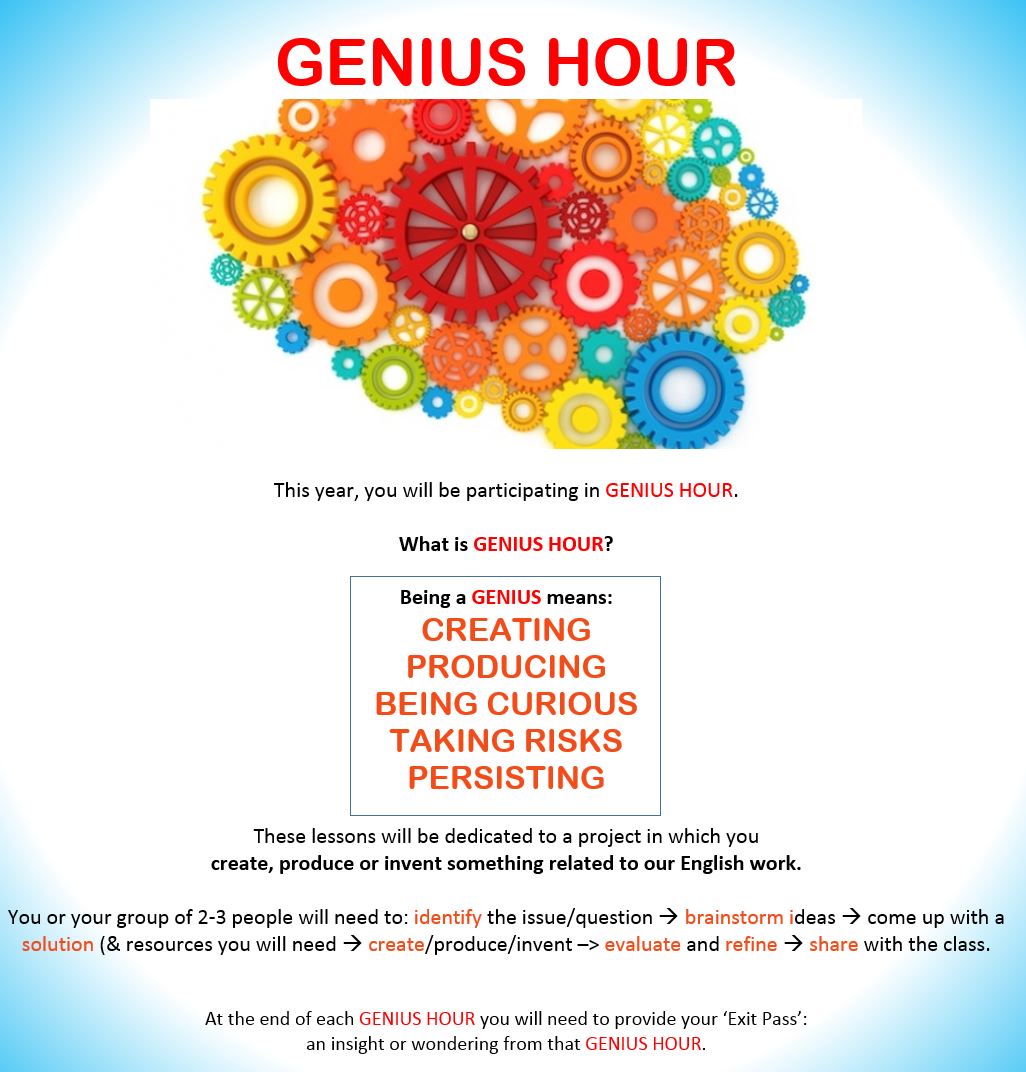
my Genius Hour poster

my Genius Hour poster

This Genius Hour work is much like things I’ve done before, with a new name attached. I like the name because it assumes that students are capable of ‘genius’. It says, “I believe you have the capacity for brilliance.” And in giving learners freedom, Genius Hour says, “I know you are capable of independence of learning, thought and creation.” It is this assumption of the awesomeness inside everyone which I like the most.

It reminds me of when I use BloomGard task options like the example below. This approach allows students to have ownership over their learning while encouraging creativity and creation (especially as I only offer the three highest levels of Blooms).

a BloomGard example

a BloomGard example

One of my favourite Genius Hour type moments was in 2004 when I was teaching the rigorous and relentless IB Diploma course. My class had spent three weeks smashing through the 800+ pages of Tolstoy’s Anna Karenina in analytic fury. At the end of it we had a two and a half hour class (which we always had each fortnight). I brought in paper, art materials, plus iconic Australian biscuits: Tim Tams and Mint Slices. I told my class they had that time to create a visual representation of the novel. What they produced was beyond amazing. A class of heavily science-maths-leaning students was abuzz with collaboration and coloured-pencil creativity. They chose key scenes from the novel and illustrated these in a series of train carriages, with Tolstoy driving the train. The artwork, which spanned the entire length of a classroom wall when it was done, started with a lit candle and ended with a snuffed out candle, symbolising Anna’s journey. The mood was electric and the class protected that work and talked about it for a long time afterwards as a defining moment in their year.

Monet's Nymphéas

Monet’s Nymphéas: painterly genius of floating blossoms

The other school-based experience propelling my reflections on immersive independent learning is my work in coaching some of the early learning teachers at my school. Watching a class of four or five year olds being given extensive reign to develop and interact with their learning environments, choose their own work (often play-based) and collaborate on self-chosen ideas, had me wondering: What does it say when the students at a school with the most ownership over their learning are the youngest ones? What happens as classrooms and curricula trust in students less and less?

I’ve also been thinking about adult learning. As adult learners, we should be following our own passions and directing our own learning. Some of my most transformative learning has been immersive and driven by me, especially my PhD study and the professional learning trip I took to New York last year.

Researching my PhD has allowed me to totally immerse myself in my educational passions, driving my own learning with the support of my supervisors, my school and others. It has thrown me into and through my discomfort zone in the most brain-bending and delicious ways. My trip to New York last year, in which I organised meetings with school leaders, professors and world-renowned edu-experts, allowed me the time and away-from-home-ness to really immerse myself in my learning. This blog was a way to track my experiences and reflections. Andrea Stringer is currently on her own self-directed professional gauntlet, and has been using her blog, Periscope and the Twitter hashtag #EdVentures to track her learning and share it with others. My recent PhD writing retreat was another example of immersive self-directed passion-driven learning, with a blog post reflection allowing me to think more deeply about my writing processes.

Surely our core business as educators is to nurture our students to be innovative, efficacious ever-learners who trust in their own capacities for growth and follow their own dreams? Surely it is the job of school leaders to provide the same opportunities for their staff? We want for students and educators to balance persistence with creativity. To pursue design thinking and moonshot-bluesky-rainbowunicorn thinking.

How else can we promote and enact immersive, choose-your-own-edventure learning? What might be more ways we can trust our students and ourselves to follow passions and drive own learning?

thrive, flourish, grow

thrive, flourish, grow

Tweet, blog or dissertate? On being a writer.

Good evening, ladies and gentleman. My name is Orson Welles. I am an actor. I am a writer. I am a producer. I am a director. I am a magician. I appear onstage and on the radio. Why are there so many of me and so few of you? ~ Orson Welles

book, by @debsnet

Our splintered, kaleidoscopic identities are wonderfully expressed by Orson Welles in the above quotation. Mine include writer, reader, researcher, teacher, leader, learner, mother, partner.

Do you feel like a writer? Does blogging make you a writer? Does micro-blogging? Does being a researcher automatically make you a writer? Professor Pat Thomson has written about ‘being writerly’ and practices which help you to see yourself as a writer. I tried to channel my writerly self in my 2015 – the year of writing dangerously post. I suppose this post is more about Pat’s idea of ‘being writerly‘ rather than ‘being a writer’. If you feel and behave like a writer does that make you one?

From micro to macro, this post focuses on how I use and interact with writing, including writing for purpose and audience. I wonder, are there different keystrokes (or pencil scribblings) that work for different folks? While I’m sure some people prefer tweeting or blogging, or article writing, or putting together a visual or numerical representations of their understanding (interpretative dance, anyone?), I think each platform and tool depends on our purpose for writing and audience to whom and for whom we are writing; each has its usefulness.

Below, I reflect on the platforms and tools I engage with, and what I get out of each.

Tweeting as a writing practice

I find that Tweeting, especially in a Twitter chat, is a kind of speed writing and speed thinking. Graham Wegner recently reflected that a busy Twitter chat can feel like a stampede of groupthinking sheep. Yet it is the torrential speed of Twitter chat tweets that sometimes helps me to clarify my ideas. Being pressured to aphoristically express an idea or viewpoint in a 140-character nutshell often forces me to distil and crystallise my thinking down into its essence, without agonising over it. I have previously called micro-blogging ‘therapy for the verbose’ as it is the antidote to my tendency to say things using too many words. Even my PhD thesis is over its word limit and will need trimming, streamlining and distilling. I have found Tweeting is a writing medium that helps me to most succinctly channel my thinking and keep tangents at bay.

That said, I also like the potentially tangential nature of Twitter chats. Rather than having a fear of missing what’s been said as the tweets roar by, I tend to engage with what I can, and with what peaks my interest. This often means that I spend much of a Twitter chat off to the side in a peripheral discussion, but I tend to prefer this kind of more extended conversation to the one-liner answers to a series of questions. That’s why I like the format of broader chats like #sunchat which work with one question for the hour and allow the conversation to take organic shape depending on the participants. Without the interruptions of regular questions, conversations can be deeper.

Blogging as a writing practice

As I discussed here, blogging has been personally transformative and about global collaboration. I am relatively new to blogging, having started this blog less than a year ago. In that I time I have published 55 posts on my blog, which has been viewed more than 10,000 times in more than 80 countries. Wow! I know that these numbers don’t compare with the superstar bloggers out there, but I am surprised and delighted to have a readership, and more than that, people to whom I’ve connected as a result of my writing, their reading, and our subsequent online, face to face, and voice to voice, conversations.

More than that, blogging has allowed me to take my thinking further than micro-blogging will allow, but more freely and conversationally than academic writing. For instance, I find Twitter a difficult platform to discuss issues of ethics, equity and social justice. Sometimes the subject seems too big for the platform. Some of my blog posts have emerged out of conversations on Twitter in which I have felt too restricted by space to say what I want to say; in these instances a blog can provide the complexity of thought, especially around tricky or contentious issues, which can be lost in the pithy-one-liner nature of tweeting.

PhDing and other academic writing

My PhD is a different writing beast all together, a 300 page monstrosity of a work which I am currently whittling, sculpting and (re)building into a cohesive document. The PhD can feel like a gigantic quilt which threatens to suffocate its maker; it is beautiful, creative, borrowing fabrics and threads from elsewhere while creating something new. The threads of reading and writing overlay and weave together in complex ways which have to come together in a holistic totality, while also working at the level of the small square, each vignette perfectly stitched, formed and embellished.

I recently popped my 110,000 word thesis draft into wordle.net, a website which takes text and distils it down to a visual representation of its most frequently used words. It looked like this:

my thesis wordle

my thesis wordle

I did this to see if my key themes emerged, but was subsequently more interested by words I did not expect to see there: “rather”, “just”, “really” and “something”. This led to an edit of my thesis looking for these words. I discovered that most of them were to be found in my participants’ language, but I did find that many of the “something”s belonged to me, and proceeded to weed them out of the document, replacing them with more precise or concise language. So, even turning words into a visual turned me back into my writing with a new understanding.

Academic writing such as abstracts, journals, conference papers and even the Three Minute Thesis, are others forms again. They require more laser-like focus than the big PhD book, and a clarity of structure and point. While trying to write smaller, more focused texts from the PhD can be a challenge, it is a good exercise in refining and clarifying thinking, while finding different ways to communicate important ideas.

Each of these writing platforms encourages different thinking and writing practices. Writing for different purposes and audiences allows us to layer, appliqué and augment our wordsmithery and our ways of communicating to others and to ourselves.

Every secret to a writer’s soul, every experience of his life, every quality of his mind is written large in his works. ~ Virginia Woolf

Writing, by @debsnet

Reflections on the conference experience: Hawker Brownlow Melbourne 2015

Human interaction remains the key component of changing education. ~ Eric Sheninger

Yarra River, Melbourne

Yarra River, Melbourne

I have spent the last four days at the Hawker Brownlow Education Conference in Melbourne, an annual conference which brings big name educational thinkers together from around the world to present immersive sessions on educational issues of the moment. What follows is my reflection on the conference experience and the value of the conference model for learning.

I selected my conference sessions based on my particular areas of current interest. While Dylan Wiliam opened the conference by using William Schmidt’s warning against teaching an inflexible curriculum which is ‘a mile wide and an inch thick,’ my recent work in professional learning and effective school change has been an inch wide and a mile deep. The sessions I chose were therefore along this same vein and were intended to take me even deeper.

Many of the speakers’ points resonated with what I already know and affirmed my own thinking and practices. These added some layers of complexity to my existing understandings and acted as springboards for conversations around education.

Dylan Wiliam and Bruce Wellman pointed out that we learn when we are uncomfortable. Wiliam said, ‘we learn more when we’re wrong,’ while Wellman talked about the discomfort that comes with working towards understanding. He pointed out that teams and individuals need to be willing to squirm and grapple with challenging questions. A comfortable team is not a learning team.

Caulfield Racecourse view from the HBE conference

Caulfield Racecourse view from the HBE conference

Learning communities were a thread which appeared in the sessions I attended. Wellman, co-author of The Adaptive School, discussed how skilful high-performing groups share intellectual and emotional space, which includes being comfortable with pauses in discussion. Silence is not the enemy of learning and collaboration, but an ally.

Wellman pointed out that being in the same room together does not make a group a community of learners. Anthony Muhammad added that a professional learning community is not a collaborative team which meets regularly, but a systemic contextually-embedded paradigm which raises collective knowledge through collective inquiry. Much like the Adaptive School material, which advocates ‘graceful disagreement’ as a norm of effective teams, Muhammad maintains that constructive, professional disagreement is the foundation of innovation.

Muhammad’s work at Levey Middle School reflects that of my own school in that it emerged out of the specific context of that school and where its community and practices were at. While our context is vastly different, we too have built our teacher growth model out of our school’s mission, vision, values, existing work and knowledge of our students, teachers and leaders.

Part of our model is based around how feedback and conversation might be deliberately harnessed in order to build teacher capacity and amplify the learning culture of the school. Wellman says that feedback is ‘in the moment, about the past, to affect the future.’ He points out that advice has very little impact on the advisee, and instead advocates for using clear, shared standards and a focus on learning, within an environment of trust. The focus on learning is about meeting the person where they are. ‘Wherever I meet you in your practice,’ he says, ‘we’re going to grow from there.’ He adds that, ‘We are starving our master teachers of rich conversations; they are hungry to talk about the whys of what they are doing.’

As outlined in Lipton and Wellman’s Learning-Focused Supervision, Wellman sees standards as rallying points for important conversations which set aspirations for goal setting and growth. My Australian school similarly uses Charlotte Danielson’s Framework for Teaching as a tool for developing shared understandings about teaching; and for reflection and data-based conversation around teaching practice. Our approach also gels with Wellman’s assertion that feedback should be customised and appropriate for the individual; one size does not fit all. Our model of teacher growth incorporates differentiation in terms of what sort of data teachers collect from their lessons and the ways in which coaches approach each conversation. As with the metaphor of the stage coach, our coaching model is about helping the coachee get to their desired destination.

Melbourne autumn

Melbourne autumn

One of Wellman’s points about data analysis was that, when looking at data, we should focus on analysing reasons for successes, rather than failure. What are the successful students or teachers doing? What knowledge and strategies do they have? How can we develop those in others? (He also has a great strategy for teams looking at student achievement data in which he employs prediction to engage people in their assumptions about what the data might hold, before revealing the data.)

At the end of the conference I met up with Eric Sheninger who had just landed in Melbourne for his first time working with Australian educators, districts and conferences (he will be keynoting at the EduTECH conference in Brisbane next week). I had tweeted a pile of books from the conference two days earlier, including Eric’s, with no idea that he was en route to Melbourne. Ours was an impromptu meeting which arose out of a morning Twitter conversation. We met up and chatted about our work, global educational thinkers, the world of connected educators and DIY professional learning. During our conversation, Eric pointed me towards some great apps which will be useful collaborative tools for my work with student and teacher learners, such as Verso, Tozzl and Padlet.

In addition, my first night in Melbourne had me meeting with some of my Twitter PLN – Greg Curran, Chris Munro and Jo Prestia – to discuss coaching in school settings, research journeys and approaches to school intervention implementation.

Both in and out of the conference I fielded questions about what my PhD is about. This was a great opportunity to hone my ideas about what is most important about my research and communicating that in effective ways.

So there were affirming moments in, and out, of the conference, which added nuanced layers to my thinking. Yet on reflection, I realise that much of what a conference can bring for the delegate are conversations with others, unexpected moments of collaboration, and the space and time to process and reflect. Although I was surprised at the lack of a backchannel at a national conference, by both presenters and delegates, – Where was the Tweetstream? – I found valuable connections with my own colleagues, other educators, presenters and connected educators who weren’t affiliated with the conference but were open to connecting in person.

Federation Square, Melbourne

Federation Square, Melbourne

On teacher evaluation & the New York APPR reforms: a view from Down Under

There are no such things as limits to growth, because there are no limits to the human capacity for intelligence, imagination, and wonder. ~ Ronald Reagan

NYC skyline, by @debsnet

As part of the Education Transformation Act of 2015, New York State is reforming its Annual Professional Performance Review (APPR) and Teacher Effectiveness rating system.

Grant Wiggins in his open letter to Governor Cuomo calls the APPR reforms a “step backward” which disempowers teachers.

NY Middle School Principal Lisa Meade voiced her concerns here and put out the call out to New York educators to respond to the proposed teacher evaluation reforms. Educator Christina Luce added to the conversation in her post, asserting that, while she supports an annual professional reflection and review, the proposed reforms are narrow, punitive and make “an already horrendous evaluation system even worse”.

While I am not a New York educator, I felt compelled to offer a perspective from a different system. My visits with schools and educators last October helped me to learn about how teacher evaluation is approached in New York. While some of the challenges faced were global, shared with Australian schools, some were surprising to me. I wrote various posts documenting my reflections in New York including:

  • My visit to a school in Westchester which opened my eyes to the constraints on New York schools in teacher evaluation;
  • My visit to a school on the Upper East side which reminded me about the need for schools to find teacher evaluation and growth processes appropriate to their context;
  • Meeting Ellie Drago-Serverson at Columbia University to discuss the best environments and practices to facilitate adult learning;
  • Meeting with Charlotte Danielson and Cindy Tocci around effective applications of the Framework for Teaching for teacher growth and evaluation; and
  • Meeting with New York City professional development provider Teaching Matters, an organisation which bases its work in a belief about the capacity of teachers to be leaders and for schools to be vibrant places of distributed leadership.

slice of harlem, by @debsnet

The proposed APPR reforms seem to make an already limited system of scoring even narrower, based on data that I imagine does little to reflect a holistic picture of a teacher, their teaching, and their students’ learning. While the use of these kinds of data for measuring teacher effectiveness have been questioned (see for instance this post and this post by Grant Wiggins), I have instead focused on how these reforms sit with my own beliefs about teacher learning.

Costa and Garmston in this paper talk about safety, but not comfort, being a prerequisite for learning, pointing out that the brain works in such a way that if we do not feel safe, we cannot think and learn. They note that sensory signals entering the brain travel first to the thalamus, then to the amygdala or threat detector, and then to the neocortex where thinking happens. “If threat, fear, pain even in the most minute portions are perceived, neurological and chemical processes occur which prepare the system for survival, not reflection.” While learning often happens in a space of what they call ‘disequilibrium’, or what I call the discomfort zone, there needs to be safety and trust for thinking, reflection and growth to occur. The New York teacher effectiveness system does not seem to allow for a safe environment of learning and growth, but rather opens up the potential for fear and a fight-or-flight response.

This notion of safety-but-disequilibrium is supported by Ellie Drago-Severson’s concept of high-support high-challenge ‘holding environments’ as the optimal environments for adult learning. By Dan Pink’s work on motivation which he notes is extinguished by punitive approaches. By David Rock’s work which shows that carrot-and-stick approaches result in resistance. In reflections by Robert Evans that teachers resist externally imposed change. By the Adaptive Schools foundational concepts of trust and of honouring both the individual and the system.

Upper East Side, NYC, by @debsnet

In light of how the brain works and how thinking and motivation are ignited, the New York teacher evaluation system, current and proposed, doesn’t make sense to me. It is a punitive deficit model which assumes that teachers are underperforming, unprofessional and in need of external measures to bring them up to scratch. In a recent paper, Dylan Wiliam points out that “each teacher has a better idea of what will improve the learning of their students, in their classroom, in the context of what they are teaching them, than anyone else.” Teachers should be trusted to be professionals and given the support, and challenge, to grown on their professional journeys.

My school’s teacher growth model is based on a belief in the capacity of teachers. It is based in a belief that everyone is coachable. That is, that teachers want the best for their students and that they are fully capable, with support, of setting goals, analysing data and improving their practice in ways which most benefit their students.

Wiggins is right when he says these reforms disempower teachers. Surely if we want teachers to get better, it isn’t scoring them we should be primarily concerned with, but growing them. Teachers should receive ongoing support to refine their practice and focus on becoming increasingly better at serving their students’ pastoral and learning needs. I absolutely agree with regular performance check-ins and goal setting work, but I also believe in teachers.

My hope for any school system would be that teachers are given opportunities for growth born out of a belief in their capacities and in their important work with our children, rather than public scorecards based on questionable measures.

New York, I’m thinking of you, your teachers, your school leaders and your students.

NYC, by @debsnet

Can and should teachers be (viewed as) researchers?

Sarajevo bullets, by @debsnetWhen we respect teaching as an intellectual activity and give teachers the opportunities to raise serious questions about what they teach, how they teach and the larger goals for which they are striving, they can play a dramatic role in transforming their institutions. ~ Peter Senge, Schools that Learn: A Fifth Discipline Fieldbook for Educators, Parents, and Everyone who Cares about Education

This month – April 2015 – is the month in which Dylan Wiliam argued in the TES magazine that teaching cannot and will not be a research-led profession, in which Tom Bennett responded that evidence-based education is dead (but that evidence-informed education lives), and in which John Hattie was quoted in a TES article as saying that teachers should not try to be researchers and that ‘I don’t have any time for making teachers researchers.’ In response to his own question, ‘Asking teachers to be researchers?’ he replies, ‘They are not.’

In this article Hattie is also quoted as saying that teachers should use the “literacy and sensibility of research to inform their practice” and that the worlds of research (by academics, not teachers) and teaching should “orbit together”. This resonates with Tom Bennett’s assertion that teaching be evidence-informed (but not evidence-based) and with the mandate of researchED which is to raise research literacy in the teaching profession and promote conversations between teaching and academic communities (my post about researchED Sydney 2014 is here).

As someone whose identity straddles ‘teacher’ and novice ‘researcher’ (as a PhD candidate coming towards the end of my PhD journey) I agree that research should inform teaching, leading and educational practice, and that worlds of education and the academy should work in collaboration. I am not sure, however, that we should draw a divisive line with ‘teacher’ on one side and ‘researcher’ on the other.

When I read the TES article which presented quotes from Hattie, a number of questions arose for me. What does Hattie mean when he says that teachers are not (and perhaps cannot be) researchers? What is his definition of ‘researcher’?

Is he discouraging teachers from reading academic literature and collecting data to inform their practice? Is he telling teachers they cannot be (taught to be) systematic thinkers who investigate, trial, collaborate, communicate and utilise scholarly literature and evidence to inform their practice?

Many teachers have been involved in action research projects, or Masters or PhD dissertations. Are these teachers, too, incapable of conducting and applying research thinking and methods? For me this is an issue of identity, of sense of self. Am I a teacher who researches? A researcher who teaches? A teacher and a researcher? Is Hattie suggesting that these identities are unavailable to me?

Is research in a real educational context by a real educator less valid than that of an academic from a university?

Many have responded to this conversation. Kevan Collins, chief executive of the Education Endowment Foundation, warns against encouraging teachers not to pursue evidence, as he articulates in this TES article.

Teacher Chris Parsons explores how the teaching profession might strategically develop its use of evidence to inform practice.

PhD candidate Charlotte Pezaro, writing for the Australian Association of Educational Research, explores ways in which academics and teachers might interact.

Policy analyst Patrick Watson in this post argues that we need to identify research which is worthwhile for informing practice, build the research-literacy of teachers and encourage action research to facilitate reflection and deeper understanding.

The 2012 Grattan Institute report ‘Catching Up: Learning from the best school systems in East Asia’ asserts that high-performing school systems view teachers as researchers, continually developing their knowledge base through practices such as professional reading and action research. My PhD cites examples of literatures which promotes participatory action research as transformative for individual practice and collaborative cultures. All research and all researchers have limitations. I wonder what the impact is of viewing teachers as researchers and of encouraging teachers to think of themselves as researchers. How does it shape teachers’ identities, self-perceptions and practices if they are encouraged to be consumers, curators, engagers and creators of research? Perhaps it is partly a question (to reflect Dweck’s work) of developing a research mindset.

One of Wiliam’s points is that research cannot tell us what could be only what we already know. If we are always basing our practice on what has been done, we aren’t innovating or trialling new possibilities. Teaching and schools should be about more than doing what has been done and what is known; it should be about moving forward and even about innovation and creativity.

Perhaps teachers who see themselves as researchers could call themselves ‘teachers as innovative, research-literate, reflective, evidence-informed, systematically-thinking, data-using-and-interrogating practitioners who drive their own learning and improvement in regards to what benefits their students.’ Or maybe that’s a bit long.

While I understand that the issue of whether teachers can or should be researchers is nuanced, complex and riddled with semantic argument, I (as someone who identifies as teacher and researcher) would like to think we can view teachers as researchers, by my definition, if not by Hattie’s.

Everyone is coachable: we are all capable of change & growth

All who wish to continually improve their craft … never lose the need to be coached. ~ Art Costa & Bob Garmston

dedicated to those who dream, by @debsnet

I was recently asked a question on Twitter: ‘Are some teachers un-mentorable?’ My response was along the lines of, ‘No-one is unmentorable or uncoachable; a person always has the capacity for growth.’ This belief underpins my ideas about school change and my school’s teacher growth model on which I presented at researchED conference in Sydney and ACEL in Melbourne.

In scholarly literatures, coaching (sometimes used interchangeable with the term ‘mentoring’, such as in the writings of Ellie Drago-Severson, who I talked with last year) seems to be divided into expert coaching and peer coaching.

Expert coaching involves an expert or master who provides guidance to a less-experienced apprentice. This includes Jim Knight’s instructional coaching in which the expert instructional coach provides judgements, feedback and suggestions, based on their expertise.

The other kind of coaching is peer or reciprocal coaching in which someone is paired with those of a similar level of expertise. These peers proceed to coach or mentor each other in a collaborative and non-hierarchical way. This approach, which is intended to develop a collaborative learning culture as well as the individual’s practice, includes models like instructional rounds, in which teachers form small professional learning groups which collectively work to enhance their practice.

Both coaching trends are based on use of data for growth (in a teaching sense, this would be some kind of classroom observation data) but are underpinned by different principles and beliefs. Expert coaching models assume that people learn best when someone with more knowledge and experience provides them with specific, targeted feedback for improvement, while the peer coaching models assumes that it is by working together that we can improve.

One form of coaching which can be conducted by a peer or an expert is Costa and Garmston’s Cognitive Coaching which is based in brain research like this which suggests that we are most likely to grow when we do thinking ourselves, rather than receive thoughts doled out by others. Cognitive Coaching focuses on developing individuals as self-directed learners who consciously reflect upon, conceptualise and apply understandings from one experience to the next. It is a data-based, non-judgemental, developmental and reflective model for conversations for planning, reflecting and problem resolving, as well as a tool for developing professional communities that value interdependence and individual capacity for self-directed learning.

The goal of Cognitive Coaching is the growth of individual and organisation through the development both of autonomy (of the individual) and interdependence (the development of a holonomous organisational culture in which individuals function as both autonomous, independent individuals and interdependent, responsive members of the larger system).

Unlike expert models of coaching which involve specific coach feedback, judgements and suggestions, Cognitive Coaching involves mediated processing. The Cognitive coach does not offer judgements, feedback or advice, but asks ‘artfully vague’ questions or presents impartial observational or other data, followed by silence, in order to encourage the cognitive and reflective processes of the teacher. There is certainly an art to the asking of well-crafted cognition-provoking questions, as I have found in my journey as a coach. This approach is intended to create personal change through new connections in the brain and reconstruct knowledge through a conscious, reflective approach to new experiences.

By avoiding positive and negative value judgements and opinion, by coaching ‘without manipulation,’ Cognitive Coaching aims to transform an individual’s beliefs about learning and refine their cognitive maps by encouraging them to talk and think about their decisions. In this way, talking aloud leads to examination and refinement of choices and behaviours.

The use of a Cognitive Coaching process for teacher learning and development is supported by Charlotte Danielson’s work (you can find my conversation with Charlotte here) in which she notes that mentors, supervisors, evaluators and colleagues should beware of imposing their own styles or preferences when observing. The question is not “Is this how I would do it?” but “Given the context, what is appropriate?” She also advises that classroom observations must be accompanied by conferences before and after observed lessons.

My own experiences as cognitive coach and coachee have shown me the power of this kind of coaching to allow people’s own internal resources to kick in to gear, their own passions and thinking to light up, and their confidence to solve their own problems and forge their own paths to soar. It has shown me the power of really being listened to and being given a safe, trusting place in which to verbally explore situations. It has also shown me that when you own your ‘a-ha’ moments, the learning sticks. Change happens. Practice shifts.

So, returning to the question of the uncoachable or unmentorable teacher, I wonder about the intent of the coaching or mentoring.

Cognitive Coaching aims to ‘convey a valued person from where they are, to where they want to be.’ There are some important assumptions being made here. The person is valued. They are assumed to be motivated and capable of reflection and growth. And they are helped on their learning journey to a destination to which they aspire. This model of coaching is not a deficiency model based on where the manager wishes the person would go or what an expert has identified as an area of growth. It is about the person. And. Where. THEY. Want. To. Go.

Do I believe that absolutely any teacher, any person, can be coached or mentored into professional growth? Absolutely.

We believe that all human beings are capable of change, that we continue to grow cognitively throughout our lifetime and that we all possess a vast reservoir of untapped potential. ~ Art Costa & Bob Garmston

buddha, by @debsnet

We are all storytellers: immersed in my narrative worlds

Humans are storytelling organisms who, individually and socially, lead storied lives. ~ Jean Clandinin & Michael Connelly 

our constructed stories connect us

our constructed stories connect us

Whether teaching, writing, conversing or considering our own lives and identities, we are all doing one thing: storytelling.

I have recently been quiet in the Twitterverse and blogosphere, partly because more than ever before I am immersed in micro and meta layers of story.

I have been tunnelling into my PhD narrative research in every spare moment, thinking obsessively and writing dangerously. I am sharing, constructing and analysing the stories of myself, teachers and schools leaders in order to reveal insights into professional identity, professional learning and school change. I am penning my first journal article about experimental ways of telling, utilising and analysing stories in research.

When I am not researching or thinking about my narrative research, I am teaching English to high school students. Reading stories, writing stories, analysing stories, watching stories, performing stories.

Or I am with my own children, reading stories, telling stories, making storyable memories, recounting favourite moments, role playing imagined scenes with make believe characters. Or talking to my husband about his work in media and content marketing, which is all about individuals and organisations telling their stories and constructing their storied identities, in order to communicate and connect. Or blogging vignettes from my own lived story. Or planning conference presentations of my research story or the story of my school’s teacher growth model.

We are indeed storytelling creatures. While I also try to be present in each moment and to live in wonder, stories embody the ways we construct our experiences, connect with each other and the world. I write my own stories, teach the telling and interpreting of stories, and engage in the theorising of stories. Have I used the word ‘story’ enough times in this post to indicate that it is currently both intoxicating and maddening to me? Story story story.

Obsessed and submerged, back into the subterranean story cave I go …

After nourishment, shelter and companionship, stories are the thing we need most in the world. ~ Philip Pullman

by @debsnet

Research and education: a match made in the conference room? #rEDSyd

Luna Park, Opera House, Harbour Bridge

 If you want to go fast, go alone. If you want to go far, go together. African Proverb

I have just returned from presenting at the researchED conference in Sydney. As explained on its website, researchED, founded by Glaswegian Tom Bennett (you can read his reflection on the day here), is a “grass-roots, teacher-led organisation aimed at improving research literacy in the educational communities, dismantling myths in education, getting the best research where it is needed most, and providing a platform for educators, academics, and all other parties to meet and discuss what does and doesn’t work in the great project of raising our children.”

It is the first time this conference has come to Australia and I was pleased to, through attending and presenting, be part of a movement to close the gap between educational research and practice, between academic theorising and school reality.

view from Sydney Harbour Bridge

view from Sydney Harbour Bridge

As a hybrid teacher-leader-researcher I believe in consuming, curating and creating research in order to influence theory and shape practice. At the researchED Sydney conference, I presented with a colleague on our school’s emerging-from-research teacher-professional-learning-and-growth model. It was a current example of how a school might utilise research and a scientific-but-also-people-driven process to develop a strategically aligned, evidence-based, context-appropriate initiative.

Opera House

Opera House

Some of our key presentation messages about school change were:

  • Go slow to go fast. School change is an evolution not a revolution.
  • Start with context and vision. Align initiatives and interventions with it.
  • Believe in the capacity of all individuals to solve their own problems, do their own thinking and drive their own learning.

This next image reflects those things we hoped our model would achieve. We have data measures planned to measure, as much as we can and in a variety of ways, the impact of this model.

'Take one' (or take all!) for your school

‘Take one’ (or take all!) for your school

The researchED conference (or is it a movement?) was one example of a forum for real life, cross-continental, global sharing of research-influenced education practice. You can read some other blog reflections here and here. We need frames and contexts which facilitate conversations between school and academic worlds, in order to facilitate more considered and systematic approaches to education.

Luna Park

Luna Park

Moved by Giants: a moment of wonder

Giant marionettes captivate a city

There is a sacredness in tears. They are not the mark of weakness, but of power. They speak more eloquently than ten thousand tongues. They are messengers of overwhelming grief…and unspeakable love. ~ Washington Irving

In education we often talk about innovation. How do we innovate as educators? How do we help students to be creators of boxless thinking and imaginative action? How do we preserve our childlike delight in the world?

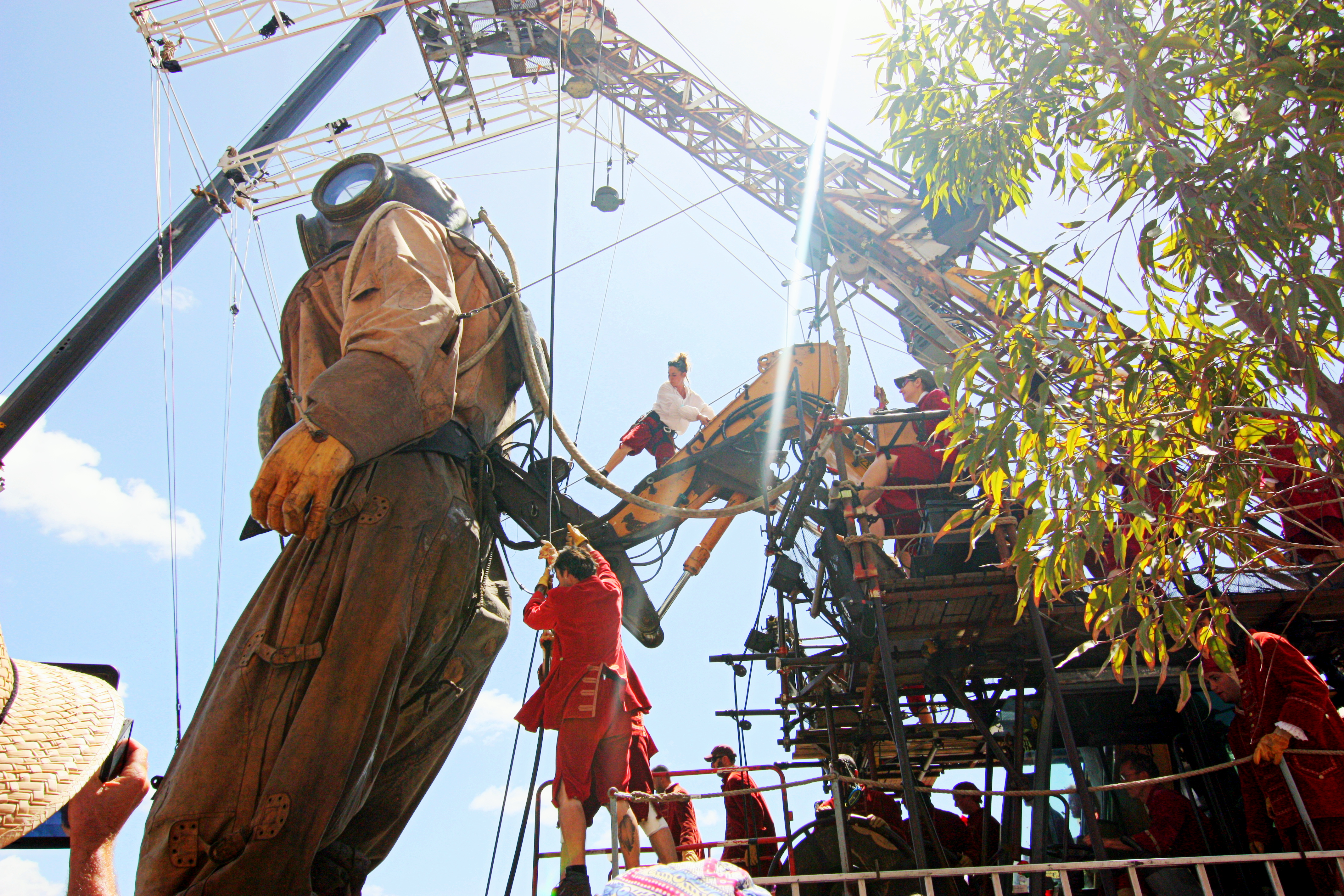
This weekend French artist, director and dreamer Jean-Luc Courcoult, and his group Royal de Luxe, brought their Giants to Australia for the first time, as part of the 2015 Perth International Arts Festival. These giant marionettes acted out a story over two and a half days through the city streets. They were innovation incarnate, creativity in action, dreams come to life.

The city was captivated, with 1.4 million people – half the population – converging in the city centre to be a part of this experiential phenomenon.

My experience of the Giants was one which allowed me to be intensely in the moment, fully and bone-tinglingly present (beautifully aligned with one of my 3 words for 2015: ‘presence’).

My pictures only capture one moment of many, and one marionette of two. You can read and see some coverage here, read the official Festival material and see the Giants’ adventures in other cities. I was grateful for the social media assault which allowed me to follow the journeys of both Giants throughout their time in Perth.

The Giant Diver awakens

The Giant Diver awakens

The Diver is lifted up before he begins his walk through the city streets

These images don’t do justice to being there amidst what was an awe-inspiring and magical spectacle. The sonar beeps, didgeridoo and haunting music playing from the band float. The gasps and emotional astonishment of the crowd. The beyond-amazed believing-in-magic faces of children and adults.

As I watched the 11m diver awaken from the footpath outside the train station, rise into the sky and then start walking in front of me, I was moved. There was something about the music, the scale, the movement, the crowds and community atmosphere which left me shaking and in tears, even as I held my son to my hip so that he could see.

That evening, when I asked my four year old what his favourite part of the day was, he turned to me with a look of absolute joy and wonderment and said in a loud whisper, “The giant looked at me!’

It is a rare and special thing to be unexpectedly and powerfully moved. To experience innovation, risk taking and a crazy idea taken to its limits. To be part of a meta narrative and a community tidal wave. I highly recommend it.

boots made for walking

boots made for walking