School leadership and resisting performativity

Performativity is a technology, a culture and a mode of regulation that employs judgements, comparisons and displays as means of incentive, control, attrition and change based on rewards and sanctions (both material and symbolic). The performances (of individual subjects or organisations) serve as measures of productivity or output, or displays of ‘quality’, or ‘moments’ of promotion or inspection. As such they stand for, encapsulate or represent the worth, quality or value of an individual or organisation within a field of judgement. (Ball, 2003, p.216)

We live in an education world that is highly-metricised and focused on hyper-accountability. Students, teachers and school leaders exist in a world in which data and high-stakes testing rule with a policy-clad fist. Countries, schools and students are pitted against each other. The media creates polarising narratives – public vs. private schooling, parents vs. teachers, home vs. school, this country vs. Finland or China. Governments create policies like competitive performance pay for teachers and additional testing.

Sahlberg (2011) frames the Global Education Reform Movement (GERM) as a viral force of accountability, performativity, and commodification. Ball (2003) notes the panopticism of managing schools; all are watched and simultaneously scrambling to be visible in the ‘right’ ways. Zhao (2016) acknowledges the strong desire for measuring students, teachers, and schools, but argues for treating numbers with suspicion and expanding what is measured in education. Biesta (2015) notes that the view of education as encompassing only academic achievement in a small and selective number of domains and subject areas, is a limited one. He warns:

The problem with excellence is that it very quickly leads to a competitive mind-set, where some schools or some education systems are supposed to be more excellent than others. In my view, the duty of education is to ensure that there is good education for everyone everywhere.

This notion of democratisation rather than contestation or commodification is radical in our current edu-climate. Ball identifies institutional self-interest, pragmatics and performative worth as the new ethical systems of education. Heffernan (2016) points out that principals’ behaviour has changed as the focus of schools has shifted towards one led by performative numbers and specific sets of data; principals work to improve data. She cautions against “focusing on improving these specific data sets to the detriment of other, holistic, pursuits in education that are not so easily quantified and measured” (p.389). Keddie et al. (2011) express concern that the narrowing of priorities due to performative schooling cultures has pushed to the margins schools’ focus on social justice and equity. Ball suggests that ‘values schizophrenia’ is experienced by educators whereby they sacrifice their commitment, judgement and authenticity for impression and performance.

Leading in schools is complex at the best and easiest of times. Plenty of scholars have identified the qualities of effective school leaders. One example is Gurr and Day (2014), who in their reflections on 15 stories of successful school principals across 13 countries, identify successful principals as: having high expectations; being both heroic and empowering in their leadership; developing collective, shared vision; taking on the symbolic role of storyteller and sense-maker; embodying integrity, trust, and transparency; being people centred; and balancing instructional and transformational leadership. Navigating these multiple and complex roles is challenging even when everything is going well and there is plenty to celebrate. When things get tough and demanding, leaders are really tested.

In a world that values metrics over stories and test scores over empathy, it takes courage to hold the line on egalitarianism, advocating for individuals with difficult circumstances, or mining richer seams of data than the popular ones of NAPLAN, PISA, TIMSS, tertiary entrance examination scores, and an ever-increasing litany of tests. It can be daring and dangerous to advocate for an education that does more than pander to market perception, external measures and competitive league tables.

Sometimes, leaders have to make difficult but unpopular decisions for the greater good of the organisation, for the many, or for the principles of education. Leaders’ decisions can be objected to by those without the big picture context or an understanding of a situation’s complexities. Leaders can listen to others’ feedback and take it on board in decision-making, and they can be as transparent as possible in their communication. (Academic writing, especially the blind peer review process, has helped to shape my acceptance of and willingness to learn from dissenting voices, brutal criticism and those who disagree with me. I’ve applied this in my school context by finding ways to ask for honest, sometimes anonymous, feedback from others in order to inform my practice and the education reform initiatives in which I have been involved.)

Can we adopt Biesta’s call to pursue ‘good education for everyone everywhere’ while also pursuing excellence? Can leaders of schools help to create counter- or simultaneous narratives to those of high-stakes accountability around narrow foci?  I think leaders can buck against the push for compliance, performance and the enterprise mindset. We can choose resistance to performative pressures, although not without a price.

*           *           *

Post-script: Interested in democratising education? This Re-Imagining Education for Democracy Summit, in Queensland in November, could be a great place for presentation and discussion of ideas. It’s being spearheaded by Stewart Riddle, who wrote this 2014 Conversation piece Education is a public good, not a private commodity.

References

Ball, S. J. (2003). The teacher’s soul and the terrors of performativity. Journal of Education Policy, 18(2), 215-228

Biesta, G. (2015). What is education for? On good education, teacher judgement, and educational professionalism. Eurpoean Journal of Education Research, Development and Policy, 50(1), pp 75-87.

Gurr, D., & Day, C. (2014). Thinking about leading schools. In C. Day & D.Gurr (Eds.), Leading schools successfully: Stories from the field (pp. 194-208). Abingdon, OX: Routledge.

Heffernan, A. (2016). The emperor’s perfect map: Leadership by numbers. Australian Educational Researcher, 43(3), 377-391.

Keddie, A., Mills, M., & Pendergast, D. (2011). Fabricating an identity in neo-liberal times: Performaing schooling as ‘number one’. Oxford Review of Education 37(1), pp. 75-92.

Sahlberg, P. (2011). Finnish lessons. New York, NY. Teachers College.

Zhao, Y.  (2016). Numbers can lie: The meaning and limitations of test scores. In Y. Zhao (Ed.), Counting what counts: Reframing education outcomes (pp. 13-29). Bloomington, IN: Solution Tree.


The power of clear messaging

Cervantes sign

Cervantes sign

While professional learning is the internal process of knowing, learning and becoming, professional development tends to refer to activities, courses, sessions, talks or conferences that teachers attend, voluntarily or otherwise. While it’s more trendy now to say ‘CPD’ (continuing professional development) than ‘PD’, one-off rather than sustained learning continues to pepper the lives of teachers as they and their schools attempt to improve themselves, keep up to date with the profession and meet legal and professional requirements.

The Australian school year has begun, which means that teachers have been given the opportunity to enjoy or endure staff days. Staff days prior to the commencement of the academic year tend to include time for planning, collaboration and setting up classrooms, as well as guest speakers, seminars or the kind of scattergun PD that hopes to land somewhere in the audience and maybe make a difference.

How do schools make decisions as to what kinds of development, collaboration and individual growth they facilitate for their staff? Especially in light of provocative reports like that from the TNTP (2015), The mirage: Confronting the hard truth about our quest for teacher development, which suggested that we do not yet know what helps teachers to improve the quality of their instruction? The TNTP report (of a two year study into teacher professional learning of over 10,000 teachers and 500 school leaders in three USA public school districts) found that, despite schools and systems investing time and money into professional learning of teachers, no clear patterns emerged to suggest which deliberate efforts improved teacher performance, as measured by teacher evaluation scores (using the education district’s final evaluation score, calculated using the district’s official methodology).

The TNTP report did note one school system whose teachers and students consistently performed better and improved more than the three public school districts. The report states that this better-performing, teacher-developing system had a more disciplined and coherent system for teacher development, a clear vision of success, and a network-wide culture of high expectations and continuous growth. Coherent system. Clear vision. Cohesive culture.

This year, my school decided not to invite a dizzyingly inspirational guest speaker or enlist the services of an external expert to run PD with our staff on those days. Instead our focus was on honouring, respecting and utilising internal expertise, and on communicating clear messaging around the school’s strategic priorities for the year. Valuing tacit knowledge and lived professional experience was important, as the strategic priorities were not new, either for the school or in education. The message, from the school executive and senior leadership team, to teachers, psychologists, education assistants and non-teaching staff, was that there are three key priorities for the year, summarised as three simple words. And that none of these was new, but rather things that teachers and other staff engage in every day, in and out of their classrooms.

What we aimed to do on our staff days was what Hargreaves and Shirley describe in their book The fourth way: The inspirational future for educational change as “explore the nitty gritty challenges of their practice through thoughtful exchanges with colleagues and in relation to relevant research” (2009, p. 93). We provided presentations from internal experts and leaders, including a panel of community members, as well as accessible readings and time for colleagues to collaborate with one another, both in their teams and with others from across the school.

The sense I got from our staff days was that staff were:

  • Relieved at the lack of new initiatives and the deliberate slowness in rolling out current projects; we continue to move forward, but in a measured way.
  • Comfortable with the clarity, simplicity and consistency of the messaging.
  • Grateful to be informed of and included in the strategic direction of the school.
  • Energised by the opportunity to work in a structured way with colleagues, around how the school’s strategic priorities would come alive in their own contexts.

I am often inspired by Ellie Drago-Severson’s work on adult learning, and the notion of the ‘holding environment’ as one of high support and high challenge, where people feel both ‘held’ and encouraged to be their best. Additionally, plenty of literature around school change talks about the need for shared vision, as does the 2016 ACER Professional Learning Community Framework for Australian schools. It is worth considering at length how to share school vision with the community so that it is lived, breathed, understood and propelled by those across the organisation. Everyone from the principal to parents and students have a part to play in knitting a community together around a common purpose. This year, those three words communicated from the executive down are helping to bind our community more closely together with common vision and shared purpose.

Teaching and leading schools in a #posttruth word of #altfacts

General Hux's speech in The Force Awakens (reddit.com)

General Hux’s speech in The Force Awakens (source – reddit.com)

Post-truth: relating to or denoting circumstances in which objective facts are less influential in shaping public opinion than appeals to emotion and personal belief. ~ Oxford Dictionary

To my continued astonishment, we are living in a post-truth world. ‘Post-truth’ was the Oxford Dictionary’s 2016 word of the year. The Trump administration in its first week seemed to impersonate the Star Wars totalitarian First Order when it claimed that it was not lying but providing the public with ‘alternative facts’. Then, gag orders were placed on a number of government agencies, including the Department of Agriculture, the Environmental Protection Agency and the Department of Health and Human Services. (Hurrah for whoever tweeted rebelliously about inauguration crowds and climate change from the National Parks Service ‘Badlands National Park’ account.) 

For a Western government to blatantly deny reality is at once baffling and terrifying. Hello, propaganda. Hello, the invocation of untruths (sorry, ‘alternative facts’) to smother any unfavourable actuality.

We shouldn’t be surprised. The misuse and abuse of language and facts is something that dystopian and speculative fiction has been warning of for decades, and something that history tells us has the ability to tap into the hive mind and rally societies around a common, often chilling, cause or leader. 

In this post I’ll explore the notion of a post-truth world of alternative facts and empty emotive rhetoric, around two arenas in my own life: teaching English and Literature, and my new role at my school, which encompasses in part engagement with research across the school.

First, to teaching in a post-truth world …

With the school year beginning next week, my Year 12 English team are finalising the texts to be taught and studied this Australian academic year. We’ve been tossing up between two contemporary texts about modern issues like gender, sporting culture and bullying, but every day the news and my social media feed give me a nagging feeling, a tugging at my literary shirt sleeve, a whisper to pause, take stock, listen. And dig out a dystopian classic.

Last year we taught the 12s Fahrenheit 451, a text that portrays books as dangerous threats to government control and societal compliance. This year perhaps we should teach Orwell’s 1984. Its Ministry of Truth, that falsifies historical events, and Newspeak, a language that restricts freedom of thought, are more relevant than ever. In fact, Orwell’s novel has this week rocketed to number 1 on the Amazon best sellers list.

A more recent text also comes to mind. Lionel Shriver’s 2016 The Mandibles, set between 2029 and 2047, is an economic dystopia that imagines the USA’s collapse. In her novel, the bungling US government has little respect for its citizens. First world problems like gluten intolerance disappear as violence and poverty rise. It is Mexico that builds an electrified, computerised, constantly-surveyed fence to keep desperate Americans illegals out.

Of course as a teacher of English and Literature I teach versions of reality and multiplicity of perspectives, but that plurality doesn’t stretch to bald-faced lies for the purposes of propaganda, banning scientists from speaking, or removing language like ‘climate change’ from government policy and websites. Language matters. It shapes thought. It wields power. It’s our job as teachers to elevate our students’ capacities to engage critically with their world. To be sceptical consumers of what they see, hear and read, and to be empowered to use language as an agentic tool.

Next, to school leadership in a world of alternative facts …

I am also coming to terms with how schools might respond to this post-truth world. This is especially relevant to me as I have just begun a new role at my school (new to me and new to the school). It is a senior leadership role that encompasses the use of evidence and research to make informed decisions from the classroom to the boardroom, as well to underpin and frame pedagogy, professional learning, performance review processes and capacity building across the organisation.

In this paper published online on 18 January, Brown and Greany (2017, p.1)—thanks to Gary Jones, whose blog is a great resource in this space, for sharing it—write:

Educational evidence rarely translates into simple, linear changes in practice in the ways that what-works advocates might hope. Instead, … evidence must be combined with practitioner expertise to create new knowledge which improves decision making and enriches practice so that, ultimately, children’s learning is enhanced.

This focus on what Brown and Greany call ‘what matters’ as well as ‘what works’ resonates with me. As Jon Andrews (channelling Marilyn Cochran-Smith) reminds us, teaching is unforgivingly complex. If we schools and educators are to really engage with research, then we need to honour our own contexts and value our own wisdom of practice. Teachers and schools can and should engage with research. I’m grateful that my school is able to create a role like mine in order to elevate evidence and research, execute research initiatives, and further embed scientific thinking and data analytics into the fabric of the school a culture. I’m grateful that there are schools around the world bringing evidence, mindfulness and crticiality to their decision making and pedagogy.

In a post-truth world, how do we balance a respect for truth, evidence and reason, with an honouring of plurality, multiplicity and praxis? How might we use literature or research as vehicles for respecting perspectives, while exploring challenges and possibilities?

Personal and organisational vision

vision

The only thing worse than being blind is having sight but no vision. ~ Helen Keller

A key theme in literature about school change is the need for compelling, coherent, and shared vision. See, for instance, Hargreaves and Shirley’s 2009 The fourth way, Senge’s 2012 The fifth discipline, Fullan’s 2001 Leading in a culture of change or Fullan and Quinn’s 2016 Coherence. For Peter Senge, shared vision is one part of nurturing a ‘fearless and open community inquiry’. For Michael Fullan, not only is shared understanding and purpose of members of an organisation important, but any new initiative must be coherently connected with the culture, mission, and moral imperative of the school in order for the change to be sustained over time.

So vision is important, but in order to propel a school forward it must be shared. While the individual teacher is sometimes the focus of school reform (improve the quality of each teacher’s teaching!), it is collective expertise–in teams, schools and the profession–that can shift beliefs, practices and narratives in education.

We need to constantly consider the symbiosis between individual and group, teacher and school, person and system.

Personal vision, that of the individual, is sometimes overlooked in the conceptualisation of vision in education. Yet educators’ identities, emotions, lived experiences and visions (for the kind teachers and leaders we aspire to be, for the influences we aspire to have on our students and school communities) are an important ingredient in the educational landscape. In her 2006 book Seeing through teachers’ eyes, Karen Hammerness longitudinally explored four teachers’ visions, and how these evolved and were enacted over time. She found that teachers were continually searching for a place that aligned with their visions for their students and their classrooms; they were always looking for a match between their identity and their context.

So schools seek to develop commonality of vision and purpose, while individuals seek to align with their contexts in terms of their own beliefs, identities and the purpose that propels them in their work.

Schools are more than workplaces; they are organismic settings for learning, collaboration and transformation. At worst, they can be ill-fitting contexts or pits of anxiety. How we feel and fit in our context influences our work and our community, and the experiences of our students.

I’ve written before about Costa and Garmston’s notion of holonomy (see Cognitive Coaching: A foundation for Renaissance schools), which draws together the individual and the larger system, whether that be team, organisation, profession or system. Costa and Garmston base their conception of holonomy on Arthur Koestler’s work around the word “holon” as something which operates simultaneously as a part and a whole. The holon is independent and interdependent, disparate and united. Koestler combines the Greek word “holos” meaning whole, and the suffix “on,” which indicates a particle or part, in order to conceive of the holon as a part-whole.

Each person is both independent agent and interdependent part of the group, responsive to the larger system. Holonomous individuals, according to Costa and Garmston, possess the capabilities to maintain self-directedness while acting independently and interdependently; they are simultaneously self-regulating, responsive to the organisation and able to influence those around them. They are flexible and efficacious, simultaneously part and whole.

As I work in my own school in the arenas of professional growth and performance review, we are working towards, not just a shared vision, but also processes, practices and structures that are connected with the through-lines of our personal and organisational visioning, our shared beliefs, values and purpose.

Aligning what schools do with shared vision and purpose can be challenging work, requiring constant focus and attention to the relationship between intent and enaction. There are tensions to navigate if a school’s vision is at odds with external measures and expectations. Or if a school’s vision is at odds with those of its individuals.

How might schools find ways to address tensions between their contextual purpose, and an educational system that might rub against their grain? How might schools draw individuals into personal and organisational visioning? How might we each continue to kindle our internal purpose, that of our colleagues and that of our profession? I have some answers for my own context, but am continually asking these kinds of questions.

Rethinking professional learning: an academic paper for JPCC

This week I’m thrilled to see my paper ‘Rethinking professional learning for teachers and school leaders’ published in the Journal of Professional Capital and Community. This journal, whose Editor in Chief is Andy Hargreaves, boasts an Editorial Board including Linda Darling-Hammond, Michael Fullan, Alma Harris, Karen Seashore Louis, Pasi Sahlberg, Helen Timperley and Yong Zhao. My paper appears in Volume 1, Issue 4, alongside a theoretical paper by Dennis Shirley. As an early career researcher, I couldn’t ask for more distinguished company.

Even more pleasing is that the journal is open access during 2016, so free for anyone to download and read. Open access to the paper means that it can be accessed by practitioners who so often don’t get to read and engage with the literature in (often pay walled) academic journals. In fact, it has already been downloaded (at today’s count) 1689 times. Wow. That’s a bunch more times than my PhD thesis.

The paper, which draws from the lived experiences of teachers, middle leaders (often a forgotten group in education literature) and executive leaders in one Australian school, outlines the findings of my PhD around what makes professional learning that transforms beliefs and practices. It discusses my study’s response to the questions:

  1. What is the role of professional learning on identities or growth?; and
  2. What professional learning is transformational?

My PhD found that transformational learning (as defined by Ellie Drago-Severson, 2009, as that which actively shifts cognition, emotion, and capacity) is: collaborative and individual; occurring in life, school, and work; and requiring elements of support and challenge. Not only was it lifelong, but it was life-wide. For these participants, it is life experiences, as well as professional experiences, that influence their professional beliefs and practices. The following is a table, which didn’t make the final cut of the paper, shows the range of features of professional learning found in my study.

tabulated findings around professional learning

tabulated findings around professional learning

This table shows the variety of experiences that educators in my study considered transformational for themselves. These experiences included relationships with family members; role models and anti-models of teaching and leadership; post graduate study; difficult life experiences; becoming a parent; and connecting with others at conferences or via social media. It included heutagogical (self-determined) learning, as I outlined for this blog post for the Heutagogy Community of Practice.

It also included, especially for leaders operating at an executive level, the time and space for silence, reflection and thinking. The research interviews themselves proved to be spaces of learning for some of the school leaders, who saw them as an opportunity to be listened to intently and to think deeply about their learning and leading.

The participants in my study had some important cautions about professional learning and about school interventions. They cautioned that a mandated approach to professional learning, even if differentiated, might not address the needs of all professional learners. They wondered about how to honour the individual teacher and the organisational priorities when leading professional learning in schools.

The paper concludes that, while my study intended to explore the ways in which educators’ experiences of professional learning form and transform their senses of professional identity, it found that it is not just professional learning, but life experiences that shape professional identities and practices. That is, our teacher selves and teacher actions are moulded by critical experiences that tangle with and shape our identities, lives, relationships, and emotions. The best professional learning, as suggested by this study, is highly individualised and knottily enmeshed with educators’ senses of self, of who we are professionally.

Anyone who teaches knows that we cannot separate our teacher selves from our non-teacher selves. As teachers our lives affect our learning and teaching, and our learning and teaching influences our lives. For many teachers, ‘life’ and ‘work’ are well beyond blurred. We are humans who teach and teachers who exist as humans in the world. The leaders in this study tended to describe themselves as either teachers who lead or as leaders who teach; they remained teachers in their identity self-perceptions. See this post for further musings about the notion of teacher identity, that ‘being a teacher’ stays with many of us beyond our years in the classroom.

One suggestion to emerge from this paper is that we would benefit from rethinking what it is that we consider and label as ‘professional learning’. Professional learning is not hours logged on a spreadsheet or entered into an app. It is not necessarily being in a room with other educators at a course or conference that is labelled ‘professional learning’ (although it might be). It is those critical moments across our lives and work that shape the core of who we are, in and out of the classroom and the boardroom. Professional learning can be personal, unexpected, unscheduled, nonlinear, messy, unbounded, and unacknowledged.

Can we redefine ‘professional learning’ in more expansive and flexible ways? How might we acknowledge those hours educators spend blogging, or studying, or tweeting, or visiting schools, or collaborating intensively, or volunteering in the service of others? How can leaders lead the learning of teachers in ways that honour their individual learning trajectories and their own agency? How might we rethink our systems and schools in order to focus, not on hours of what is easily labelled or effortlessly deployed (staff day scattergun PD, anyone?), but on what actually engages us and changes our cognition and our capacities?

Trust and support teachers: My New Voice Scholarship panel speech

speaking yesterday at the Melbourne Convention Centre

speaking yesterday at the Melbourne Convention Centre

Yesterday I had the pleasure of speaking on a panel of ACEL New Voice Scholars (list of awardees here) at the Melbourne Convention Centre. As a representative of new Australian voices in educational leadership research, I spoke in front of an auditorium of 1200 educators in response to the provocation: ‘If you could wave a magic wand, how would you transform education?’

The following is a version of that speech (I tend to go off the cuff a bit, so it’s not identical). It is based on this think piece I wrote for the ACEL Perspectives publication which is more measured and referenced, and less rhetoric-laden than my speech. I’ve added links to other blog posts to this post, as feedback from those at the conference has been that they would like to know more about the school professional learning model about which I spoke.

Thank you to the Australian Council for Educational Leaders for offering me the platform-soapbox-orangecrate from which to speak passionately about what I think is important for leaders, teachers and students in our schools.

*                                                      *                                                      *

(Hello etc. …)

I am an English teacher by trade and have spent the last 17 years teaching and leading in schools in Australia and the UK. Most recently I have been leading a strategic project that developed a whole-school coaching model at my school, designed to do a number of things, including:

  • Improve teacher classroom practice;
  • Develop teachers’ capacities for reflection;
  • Depersonalise and open classrooms;
  • Develop a common language of practice; and
  • Improve the quality of professional conversation.

This intervention was strategically aligned, so it was top down in terms of being aligned with the strategic vision of the school, initiated by the principal and supported by the school board. But it was also middle out and bottom up, as the model was developed by teams of teachers, led by me. We took a deliberately slow process of prototyping, piloting, iterating and refining this context-specific intervention.

At the same time, while also parenting two small children, I completed a PhD in which I asked what it is that makes professional learning transformational and how school leaders can best lead professional learning for teachers.

(It was at this point that I said something like, “My doctorate was conferred in April, so if you see me around the conference, you can call me Dr Deb” which has resulted in everyone from the MC to delegates calling me ‘Dr Deb’ ever since!)

As someone who bestrides educational practice and research, I don’t believe there is a silver bullet or magic wand that can transform education, but I do believe we can work to positively influence it.

Two things we can focus on, in order to positively impact on our students’ learning, are the trust and growth of teachers.

At my school, we have developed a model for teacher growth that uses Cognitive Coaching, non-inferential lesson data, and the Danielson Framework for Teaching, to help teachers reflect on and grow their practice.

Non-inferential lesson data—that is, data that is, as much as possible, non-judgemental and informational—and shared standards of teaching, help our teachers to develop the depth and precision of their reflections on practice, while Cognitive Coaching helps teachers to surface their own thinking about how they can improve. Cognitive Coaching is not about solution-providing or advice-giving, but about mediating the thinking of teachers and helping them to find their own solutions to problems of practice, based on a belief in their internal capacity to do so. To paraphrase Dylan Wiliam: teachers know their own classroom and their own students best.

My PhD found that coaching, among other things, can transform teachers’ beliefs and practices. It also found that school leaders have an important part to play in leading the learning of teachers.

We need to avoid those policies and practices that pit teachers and schools against one another (such as merit pay), that promote competition and commodification, or that focus on external metrics, performative measures, rewards or punishments. These are all things that demotivate, de-professionalise and demean our profession.

To support teacher professional growth and improvement in practice, we need to focus on trusting teachers to be professionals with the capacity to grow. We need to properly support their growth through context-specific interventions for which we provide adequate training, sufficient time, appropriate resources, and processes to systematically review our effectiveness.

In this way, within our own schools, we can heighten teachers’ self-awareness, self-efficacy and collaborative expertise and positively influence student learning.

Schools can lead and generate research #AHISA16

Rottnest rainbow, by Deborah Netolicky

This week I’m attending the AHISA (Association of Heads of Independent Schools of Australia) conference, which brings school leaders from around Australia together for a few days of visiting schools, conferencing, and networking. In my daily life, conversing with educators, many of whom I’ve never met, in other spaces and places tends to happen through social media (Twitter, blogging, Voxer). This week, however, via the AHISA conference, I’ve had the pleasure of catching up with those I have met and know well: my first principal and a variety of leaders with whom I have worked in Perth, Melbourne, and London. As someone who has worked in independent schools in Australia and the UK (for over 16 years, except for 6 months at a London comprehensive) this conference visit has been in some ways like watching my career flash before my eyes, as I’ve reconnected with various colleagues I’ve worked with at various times and places across the last decade and a half. It’s a reunion and a catch up with those I’ve worked over the years, a chance to talk with current colleagues about how the conference relates to our current work, and a place to make new connections with school leaders from around the nation.

In the conference sessions, I’ve been following a thread that is important for my own current work: professional learning for teachers and leaders, especially that emerging deliberately out of specific contexts. These sessions are relevant to me and my school because I have led a whole-school, evidence-based strategic intervention: a coaching-for-professional-growth model. This role has involved, since 2012, canvassing research literatures, writing papers, presenting to the school Board each year, and leading teams of teachers to prototype and iterate a context-specific model to support teacher and leader growth. This intervention was top-down (driven by the school’s strategic vision) as well as middle-out and bottom-up (developed by teams of teachers, led by me and overseen by the school Executive). It has meant generating data around the impacts of our work and tracing the influence of the model on teaching, learning, leading, school culture and the organisational language of professional conversation.

At the AHISA conference, the best workshop presentations for me have been those that have outlined how a school or system has applied systematic, research-informed, evidence-generating methodologies, with a clear aim.

Dr Gary Jones (2016) points out that schools can use evidence to make better decisions. He elevates the following from Barends, Rousseau and Briner (2014) as a frame for evidence-informed decision making in education:

  • Asking: translating a practical issue or problem into an answerable question;
  • Acquiring: systematically searching for and retrieving the evidence;
  • Appraising: critically judging the trustworthiness and relevance of the evidence;
  • Aggregating: weighing and pulling together the evidence;
  • Applying: incorporating the evidence into the decision making process; and
  • Assessing: evaluating the outcome of the decision taken.

Evidence might include: published academic research that quantitatively or qualitatively analyses empirical data; data, facts, and figures gathered from the school; specialised professional experience and judgements of relevant practitioners; and values, views, and concerns of relevant stakeholders. Schools can value and consider a range of research, as well as tacit knowledge and the richness of their own context.

As Dylan Wiliam points out in his 2016 book Leadership for Teacher Learning (and elsewhere), research cannot tell teachers and schools what to do, but can inform their decision making and their efforts. We can look to research for likely-to-be-productive avenues in education, rather than for recipes or silver bullet solutions to be unquestioningly followed.

In fact, schools can lead research, not just follow it. They can generate research, not only consume it. School leaders and teachers can be researchers, can apply research thinking, and can be critical questioners of research literature. They can challenge each other, participate in respectful debate, investigate contradictory positions, or consider multiple possibilities. They can pilot, prototype, and iterate new ways of doing things, while collecting data on the progress and impacts of interventions.

It has been great this week to connect with past, current, and future colleagues at the AHISA Leading, Learning, and Caring conference. It has been even more pleasing to see the work of some educators and schools in applying evidence-informed and data-generating design thinking to their complex work. Still, there are those who could more rigorously interrogate their assumptions, practices, and uses of research literature. There are those from whom others would benefit if they contributed their thoughts to edu-dialogues. Many of us would benefit from listening more closely to others. Whether affirming, querying, or dissenting, it is a range of thoughtful voices from multiple perspectives that together can shift the narrative, practice, and evidenced understanding of education.

Questioning heroic leadership: The visible-invisible hero

heroes

Our notions of heroism change over time. The construction and reception of heroes is dependent on context. Often the heroes of a time and place are only decided in hindsight when their actions and the consequences of those actions are weighed by the collective, the media or Hollywood scriptwriters.

Texts can reflect the values, anxieties and aspirations of their time and place. For example, the Star Wars franchise has changed its notions of the hero over time. Early Star Wars films had some diversity back in the 1970s. Leia was an independent hero who could stand up for herself and played a key part in the Rebel Alliance. But she was still pictured as the pretty woman handing medals to the male heroes. Lando Calrissian was a non-white heroic figure, but a more minor and less honourable character than the two white males, Luke and Han. Diversity and Otherness were also foregrounded by the multiple alien species in the films, from everyone’s favourite heroic Wookie, to sinister or repulsive villains.

Fast forward almost forty years and Rei and Finn, the heroes of the 2015 Star Wars Episode VII (which I have written about here and here), show the shift in the hero’s representation in terms of gender and race.

Meanwhile, Batman is a hero whose representation has evolved over time, from the silly unintimidating comical figure of the 1960s television show, to the tortured, vengeful, imposing figures of recent films. Newer Batmans, including those played by Christian Bale and Ben Affleck, are psychologically darker and more complex.

In 2016, heroes like Deadpool and the new Ghostbusters question the traditional portrayal of the hero. Deadpool, like the animated hero Shrek, challenges stereotypical hero behaviour. He is rude, lewd and without a noble cause. The new Ghostbusters expand our vision of how heroes might look. The Game of Thrones franchise, too, agitates reader and viewer expectations of the hero by presenting us with complex, shifting characters who dance along and frequently cross the line between heroism and villainy.

To leadership …

How is the realm of leadership affected by the fluid definitions of heroism, dependent as they are on the time and place in which any real, mythological or fictional hero is created and received?

Today I’ll be speaking at the Rise and Future of Heroism Science Conference in order to explore what insights the data from my PhD has to offer the field of heroism, and what heroism has to offer the arena of leadership.

The questions I ask are:

  • Must the school leader hero be a charismatic, selfless visionary? A beacon of bravery and a moral crusader?
  • Are alternate leadership metaphors and narratives helpful for thinking about contemporary leadership in schools?

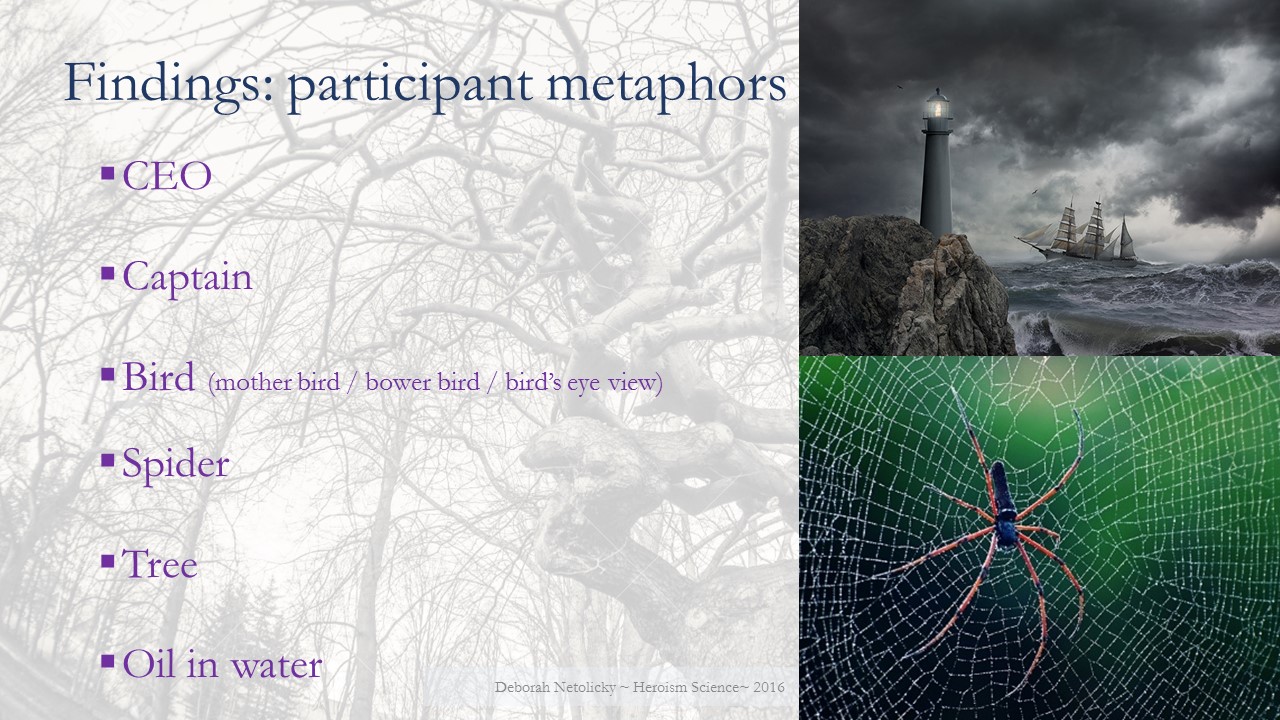
My answer, based in the emergent themes from the interview data of school leaders in my PhD study, is that the traditional lone hero on an individualistic quest is not an appropriate metaphor for the school leader. The leaders in my study reflected notions of servant, distributed, caregiver or transparent leadership.

Participants offered up their own metaphors for heroic leadership, revealing that heroism when leading others can be fluid, deliberate and imperceptible.

by Deborah Netolicky

In my PhD thesis, I applied the literary character of the Cheshire Cat to emblematically articulate the visible-invisible school leader, who deliberately appears and disappears, showing only part of themselves depending on the needs of those who they lead. The Cheshire Cat leader empowers others to find their way through their professional Wonderlands. Sometimes they are the encouraging grin, the glimmering eyes, the disappearing tail. At times they are the disembodied voice, mentoring, coaching or guiding. Unlike the autocratic and unlikeable Red Queen, the Cat is a mysterious guide who operates from the aerial view of the tree, with an understanding of the bigger picture.

The image of leaders posturing as white knights of school improvement, wielding swords of change and self-promotion, is seductive but unhelpful. Heroism in school leadership can be deliberate, fluid and at times imperceptible. School leaders can focus on the collective good and intentionally navigate visibility and invisibility (although I wonder to what extent deliberately imperceptible leadership can feel like being an under-appreciated Santa Claus, and how leaders feel when their machinations to build the capacities of others go unnoticed).

My PhD suggests that leadership that serves a community or organisation, and the individuals within it, need not be highly visible. Heroism in leadership can be about deliberate invisibility, the barely discernible swish of a tail and the disappearing gleam of a Cheshire grin.

Harvesting good work: Reap what you sow

I’m not a farmer, not even a green thumb really. While I quite enjoy gardening and have a composter, I’ve learned to populate my garden with plants that survive on a healthy dose of neglect. (Side note on the composter: there is something joyful about shredding old copies of my PhD thesis drafts and feeding them to the worms.) Despite my lack of horticultural know-how, I’ve recently been considering the farming—and biblical—metaphor that you reap what you sow.

I often see others I admire reaping the rewards of their work. These people aren’t slaves to the performative measures of a neoliberal system, or narcissists seeking the spotlight of social media celebrity. They are humans–professionals, thinkers, theorists and practitioners–dedicated to work they believe is important. To doing it, sharing it, making a difference.

Since the final throes of my PhD in March, things have been happening in seemingly organic ways. Of course the PhD got done-and-fairy-dusted, and the thesis published online. The first paper from my PhD has since been published: ‘Coaching for professional growth in one Australian school: “oil in water”’, in the International Journal of Mentoring and Coaching in Education. I have another paper in press, due out next month. Two more are sitting on editors’ or reviewers’ desks. Two drafts are on the desk of a co-author. I have been interviewed on the Teachers’ Education Review podcast and on 2SER Sydney community radio. I had a piece published in The Conversation this week, about the dangers of pursuing performance pay for teachers. I am in discussions about bookish things, too.

And I’ve been on some kind of accidental-on-purpose conference circuit. AERA in DC in April. researchED in Melbourne in May. The International Symposium for Coaching and Positive Psychology in Education in Sydney in June (this Thursday and Friday). Heroism Science in Perth in July. For (little old) me, alongside my work at my school, all this seems like armfuls of hand-picked produce.

I’m not sure why I’m surprised at the pace of my recent schedule of outside-of-work commitments (also known as the unpaid-but-rewarding work that is academic writing and presenting), and the fact that I’ve started to be approached, rather than doing the approaching myself. But I am quietly bemused that I seem to be in a harvesting part of a cycle, even though I know that this is actually the result of hard and persistent work. The seeds for the current abundance were selected, sown and tended a while ago. Papers were written and reviewed (and reviewed and reviewed). Abstracts were drafted and submitted. Relationships were formed and cultivated. Presentations were prepared. Work was done. A lot of it. In my evenings and on my weekends and in my down time, and in all the little nooks and crannies of my life where I could fit reading, writing, collaborating, learning and connecting. Thank goodness for the wonderful people who support me, from my family and friends, to my colleagues and professional learning network, the Twitterati and my Voxer Squad.

I believe in doing good work. For me this is enacted in ways that are without a linear frame. I’m never quite sure where I’ll end up, or even where exactly I’m intending to go. It’s about doing work that I’m passionate about and feel is important, whether in service of my students, my coachees, my school, or knowledge in the world. In my writing, too, I often try things out, head down trails unsure of where they lead, double back, try again.

So, for now I continue to sow seeds I think are worth sowing. Write and research those things I think are worth writing and researching. Say things I think are worth saying. Teach what I think is worth teaching, in ways I think are most worth doing. Seek to learn those things I think are most worth learning.

The fun thing about this kind of sowing is that it’s like planting mystery seeds. I never quite know what influences or impacts something I do now might have in the future. It’s why the reaping feels like Christmas morning.

The best bit is how rewarding all the persistent and consistent hard work is. I like the work itself. I love the struggle and the triumph. I love the connections and the relationships that bubble up and take form. I love the unexpected rhizomatic results. A failed planting. A teeny green seedling reaching up from damp dark earth. A basketful of glossy fruit. A knotted beanstalk reaching up to the clouds.

Teacher efficacy, agency & leadership #aera16

iconic Abe

iconic Abe

This afternoon I spent 3 hours at two round table sessions at AERA in Washington DC, hearing about and talking about teacher leadership and agency. Then on the way home from drinks with Sarah Thomas, who I know through Twitter and Voxer, I stumbled across the #satchatOZ chat on Twitter which was talking about teacher leadership. So whilst I’m jetlagged and brain-exhausted from a day of conferencing, I want to get my raw thoughts down before they’re overrun with tomorrow’s thoughts (with some of my photos, because: DC).

Three terms that came up today in the two roundtable sessions I attended were: efficacy, agency and leadership. Self-efficacy is about how well someone thinks they can do something; a self-belief in their own capacity. Agency is the capacity to act as well as the acting itself; to be an agent is not just to have the internal capability to do, but to actually do the doing. I wonder, can someone be an active agent, capable of action and change, without the self-belief in their capacity to do so? Possibly. Can someone have a sense of self-efficacy, but without the agency to be effective? Probably.

Leadership, meanwhile, is a slippery word. People can be leaders by name or position, but this doesn’t guarantee that people are led by them. Leadership and agency are not just individual, but also collective. Can someone be a leader without a followership? A leader can be defined by their title, but more often they are defined by their influence on others, their organization or the system in which they operate. Teachers without official positions of responsibility can be, and are, leaders in their fields. They are active agents who effectively translate their beliefs and purpose into reality through deliberate and effective action.

In leadership and agency in schools, context is a key consideration. The holonomous* environment of a school is one in which the sum and the parts are inseparable. If schools want teachers to be reflective, growth-focused and agentic, they need to trust in their teachers and provide an environment in which risks and exposing one’s vulnerability are ok. In a culture of teacher-scoring and fear, teachers are less likely to be agents of positive growth and more likely to be compliant servants to a punitive system. Movements like #flipthesystem, which are explored in Jelmer Evers and René Kneyber’s book, advocate for further teacher voice and action in education reform. Localised reforms like my school’s teacher growth model are practice-based examples of in-school teacher leadership in action.

In the introduction to Linda Darling-Hammond’s presidential AERA address this afternoon, she was described as identifying as a teacher, but having become a researcher so that she could be a strong voice listened to by policy makers and powers that be. She saw research as a way enact and propel change.

DC daffodil cityscape

DC daffodil cityscape

While I didn’t frame my PhD research through the lens of teacher leadership and agency, it could be seen through that lens. I explored teachers and school leaders’ perceptions of identity, learning and school change, within a particular context. That context was the coaching intervention I was leading at my school, a formative growth-based model of teacher growth and development.

What emerged from my study, when looked at in terms of teacher leadership and agency, was that teachers are deeply tied to their senses of self within their senses of their context. That is, teacher self-efficacy and agency develop when teachers feel an individual purpose, an alignment with context and that they are empowered with voice and influence in their own organization. In this case, the school empowered teachers to be active agents with a voice in school reform. Additionally, the formative aspect of the coaching model for growth was fiercely protected; teachers are not scored and judged, but are able to collect lesson data and participate in coaching conversations in order to grow themselves. This kind of trust requires some relinquishing of power from those at the traditional hierarchical apex.

As someone who connects with others on Twitter and writes on this blog, I think that technology and social media give us tools to develop our teacher voice and engage in conversations about education. I know of teachers who would be considered leaders both in their schools, and in the wider land of education, due to their public thinking, writing and advocacy. I also know those who are known more for their leadership in the social media or conference arenas, than in their own day-to-day school contexts.

As others have noted, Twitter flattens hierarchies and empowers users. Bonnie Stewart’s research into academic Twitter found that there are different spheres of, and criteria for, influence on Twitter than in higher education institutions. The same is true in other educational contexts. Government ministers are drawn into public conversation with teachers on the ground. Social media and blogging can be leveraged by teachers to allow them voice and agency, to advocate or agitate. As Greg Ashman and Rory Gribbell note in their recent blog posts, bloggers can and have been agents of political and educational change, a pluralistic chorus of voices to which people are listening.

Teachers can and should be advocates for their students and their schools. They can and should pursue research and opportunities to understand, revise and reimagine what is known in education. Those leading schools and systems in official roles can encourage teachers’ growth and leadership by questioning traditionally hierarchical power structures and considering more distributed and inclusive ones. In this way, teachers can be encouraged to lead within their contexts, instead of feeling as though they are fighting against the system or preserving their survival within it.


* Check out Costa & Garmston’s 2006 Cognitive Coaching text or my PhD dissertation for discussion of holonomy.

mural at the Library of Congress

mural at the Library of Congress