Spider-web connectivity: Technology for networked learning

Nobody pointed out that the web itself is a miracle. ~ E. B. White, Charlotte’s Web

tangled webs of connectivity; image from Helen Kara http://helenkara.com/2015/07/28/data/

tangled webs of connectivity; image from Helen Kara http://helenkara.com/2015/07/28/data/

This image was passed from Dr Helen Kara to Dr Naomi Barnes, after I had challenged Helen with an image for the #blimage (blog+image) blogging challenge (see how messily interconnected that is?). You can read Helen’s post here and Naomi’s post here. You can see my first #blimage post, with an explanation of the challenge, here.

Helen’s image spoke to me. It reminded me that one of my research participants used the metaphor of the spider’s web to describe the school as organisational web. It is reminiscent of the symmetrical black and white webs in my mandala colouring book. Mostly, it speaks to me of connectedness in education, in our schools and classrooms, but especially through technology and social media.

So the image forms the basis of this post about technology which connects.

The labyrinthine tangle of webs are like snow-flake-like in their perfect imperfection. The wintery stems provide angular anchors for the fragile delicacy of the web strands which stretch and overlap. Some strands extend long distances, while others are strung tightly together. There is symmetry and asymmetry. Strength and vulnerability. Flexibility and rigidity. Beauty and disorder. A clamour and a stillness.

These dewy webs evoke my experience of the professional connections I see and experience through technology and social media. My journey through various tools of connectivity as an educator has been one mirrored by others. Often I adapt before educators in my own school environment, but after those in the global spheres. As this blog approaches its first birthday, I am reflecting on how blogging has transformed my use of social media and my connections with others.

mandala sunburst

mandala sunburst

Twitter has been a place of learning for me since 2009. As with most educators, I began lurking in the background, figuring out what might be in it for me, or consuming information. I moved on to curating others’ content, and then participating in education chats. That is where I stayed for a number of years, although the more chats with which I engaged, the more people with which I connected. The chats were a place for me to participate in conversations. In fact, my favourite part of being in a Twitter chat is when a small group goes off piste into their own tangential conversation. These are moments of connection and engagement, which are epitomic of Twitter’s rhizomatic chaos; its tangle of webs. In one Twitter chat Adriano di Prato and I came up with an accidental concept of ‘leaning environments’, showing the unexpected possibilities of connecting via social media.

(I enjoyed this recent New York Magazine article about why the messiness and “vast confusion” of Twitter should be celebrated.)

Last year, I began this blog as an experiment in blogging, and as a way to log and record my fellowship experiences in New York. My continued blogging has shifted the boundaries of my self and my connections.

Not only does exploring my thoughts and ideas in 600-1000 word blog posts allow me to thrash out and clarify my thinking in more than 140 characters, it also opens up conversations with others who might want to engage with me or with the content of my posts. It is this opening of conversation which has expanded me and my network. My spider-web tendrils reach out and curl together with others’. Some connections are tentative while others are strong. Some traverse long distances while others are at arm’s length.

mandala web

mandala web

As an individual, my blog feels like an extension of myself. Colouring outside the lines of my demarcated self, I share parts of my story, my thinking, my experiences, and my teaching, researching or writing practices. These tendrils of me reach out and entangle with the labyrinth of connection and conversation in the blogosphere. I respond, and am responded to. And so I become absorbed, in part, into the often unpretty cacophonous jumble of thoughts, hyperlinks and voices.

More recently, thanks to the encouragement of Andrea StringerI have started using Voxer and I’m loving the immediacy and personal, conversational, collaborative nature of the medium. Right now, I’m involved in different professional learning groups and a doctoral researcher group. Valerie Lewis, who I’ve connected with on Voxer, in this blog post calls her Voxer PLN her ‘Vox Squad’, a kind of A-Team of professional learning and solidarity (‘I pity the fool who doesn’t Vox!’). I’ve introduced Voxer to my students as a collaborative tool for group work, and to my team of coaches as a tool for our collective growth and the ongoing refinement of our practice.

To finish this reflection on connectivity, I’ll leave you with a very different web, as a contrast. Below is a picture I took in Richmond Park when I lived in London. A solitary dew-jewelled web at sunrise. This image doesn’t speaks of connectedness in the same way that the first image of webs does. It shows a beautiful but lonely structure, tenuously clinging to the solidity of the fence posts.

Richmond Park spider web at dawn

Richmond Park spider web at dawn

Which would you rather be? The solitary web or a web in a mess of other webs? A lone voice or one of a cacophony of voices? Are we better alone or together? Can our individual voices be heard in amongst the noise of social media?

if the web were perfectly pre-set,

the spider could

never find

a perfect place to set it in; and

if the web were

perfectly adaptable,

if freedom and possibility were without limit,

the web would

lose its special identity. ~

A. R. Ammons

* Note: this is what happens when I am in the middle of tough PhD work. Lyrical, metaphorical musings and colouring-in become my creative antidote to the hard systematic work of thesis revision.

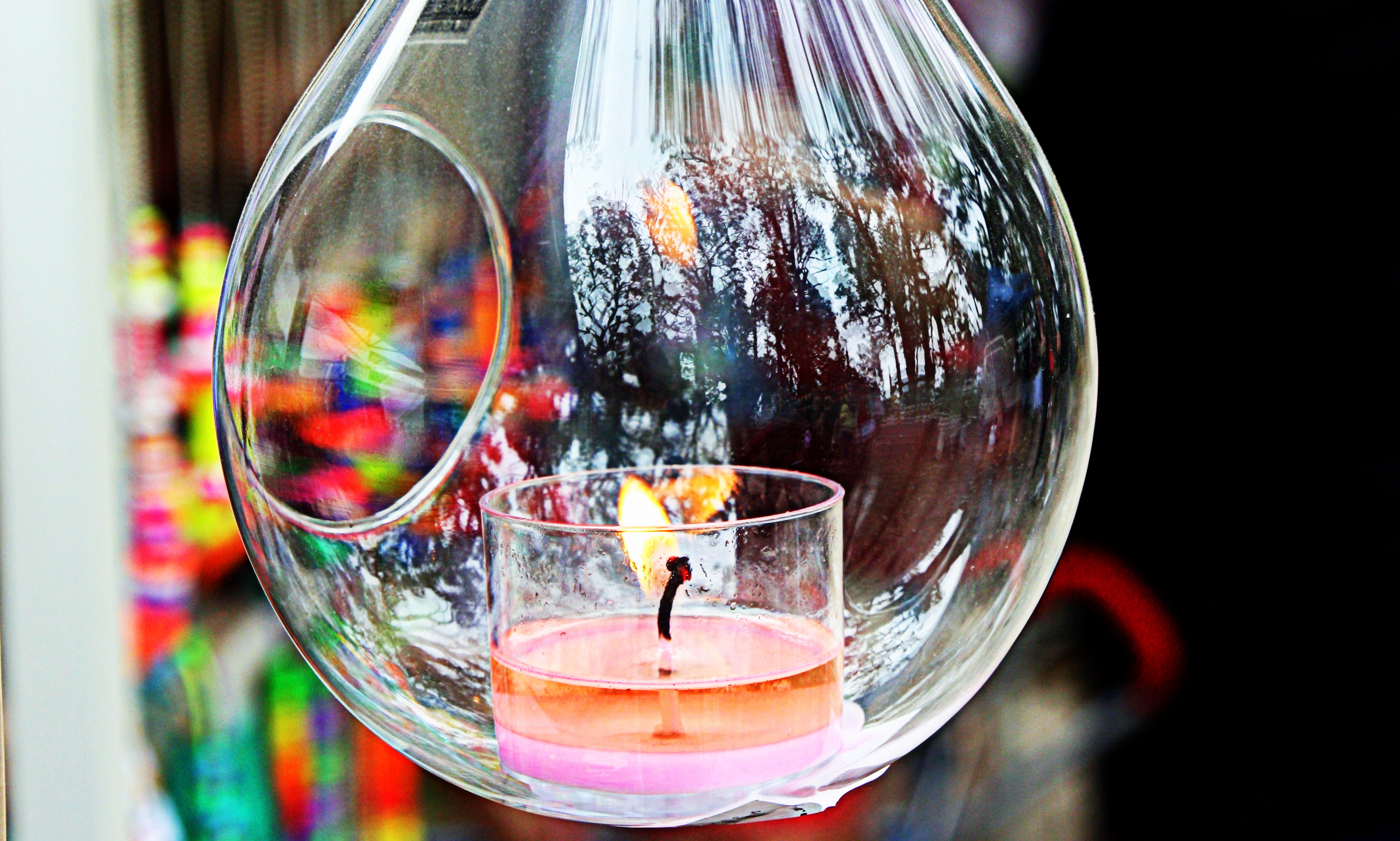
Balance, not division. Compassion, not attack. Conversation, not war.

Compassion is not a relationship between the healer and the wounded. It’s a relationship between equals. Only when we know our own darkness well can we be present with the darkness of others. Compassion becomes real when we recognize our shared humanity. ~ Pema Chödrön

by @debsnet

Often I am struck by argumentative battles in traditional media, on social media and around the blogosphere. I appreciate those writers, commentators and educators who share their musings, experiences, readings, and perspectives, without using divisive loaded language or attack. I think the rantiest I have gotten was this post on the APPR reforms in New York and this one around whether teachers can be researchers, but I attempted to frame my criticism through making transparent my perspective and asking clarifying questions. Balance.

I have written a lot about my school’s coaching model, as it is kind of my baby and it’s something which I think is worth sharing; others might gain from hearing our story. Yet this coaching model is not stand alone. It is not as though teachers at my school are only coached by teacher-coaches in a non-evaluative, non-hierarchical model. In their first year at the school, teachers participate in a rigorous evaluative permanency process. Every year they have a conversation with their line manager, who touches base with them on their work, goals and classroom practice. Every third year, teachers have their coaching cycle with their manager. This is more evaluative and performative by its nature, and by the nature of the relationship. Teachers additionally work with instructional consultants. Leaders work with coaches. Professional learning community teams and action research projects work alongside. Growth and evaluation. Balance.

I have written about the creative things I trial in my classroom like a term without grades and genius hour for students and teachers. These are things at the experimental end of the spectrum of what happens in my lessons, so I share them as stories of experience and part of a conversation. I do these things to develop engagement of my often-reluctant high school English students, to build their self-efficacy and to help them learn to rely on themselves as drivers of learning, rather than entirely on me as Teacher with a capital T.

Does that mean I don’t use explicit instruction? Of course not! I explicitly teach concepts, skills and texts, although I temper this with encouraging students to do their own thinking and to trust their own thinking, rather than expecting that I can fill them, as vessels, with the answers. What are the ideas of the text? What interpretations might be drawn? Answers can come from me or from Spark Notes, but if I do my job properly, students will have the skills, understandings, language and cognitive capacity to draw their own interpretations, from their own contexts, and justify these using logic and evidence. The best student responses comprise original thinking, not regurgitated knowledge. The best teachers focus not just on effective learning (our core business, of course!) but developing learners and passion for consuming, curating and creating knowledge.

In my Head of English roles at three schools I have ensured a balance between explicit instruction and those strategies which propel love of reading, power in writing and deep intellectual engagement in ideas and discussion. Interestingly, Charlotte Danielson’s heavily-researched Framework for Teaching has its ‘proficient’ descriptors describing teaching which is expertly directed by the teacher, and its ‘distinguished’ teaching descriptors outlining lessons in which students are taking responsibility for their own learning and behaviour. Creative and explicit. Balance.

I have written about lyrical metaphors for PhD study, and only occasionally about the unsexy logistics of what the graft actually looks like. My conceptual framework draws in part from fictional literature. Does this mean my PhD is devoid of hard, critical, scientific work? No. My PhD is of course the result of the logical, systematic working through of literature, data and research problems. When writing the Limitations section in the conclusion of my thesis I was highly aware that all research has its limitations. Extensive quantitative data can show us patterns and effects, but these may be faceless. Qualitative data can drill down deep into the messy humanness of lived experience which may be unrepresentative of wider groups and therefore not generalizable. Yet each study adds its tiny piece of understanding to the layers of what is known. Research is conversation. Imaginative and systematic. Broad and deep. Balance.

I would love to use the line ‘I’m a lover not a fighter’ but I think I’m both. I believe in sharing and celebrating our stories, but I will advocate fiercely for my students, fight for what I believe is right and argue for my research. Balance.

From a history of my posts, it is probably clear that I am seduced by the lyrical, by storytelling, by creative approaches and by metaphor. Yet I am not one dimensional. Nor is my teaching, my thinking, my researching or my living. Balance.

I came across this excellent recent TED talk from Jon Ronson on the way social media has moved from giving voices to the voiceless, to an angry mob mentality of shaming and abuse, in which people seem to forget compassion and morality.

While I love robust discussions which take us out of the echo chamber of we-all-agree-high-fiving, I also think we need to approach these with compassion, thoughtfulness and a view of each other as human beings. We can disrupt with respect. We can disagree gracefully. We can advocate with civility. (And if you throw in a metaphor, you’ll totally have me!)

by @debsnet

Viva la boredom? A #blimage challenge post.

This blog post is part of the #blimage (blog-from-image) challenge recently set by Steve Wheeler and Amy Burvall. You can learn more about it on this video https://youtu.be/-7K8cA-Iub8. This particular image was set by Steve in this post.

*         *         *

The past is for learning and letting go. You can’t revisit it. It vanishes. ~ Adele Parks

photo by Steve Wheeler

photo by Steve Wheeler

At first this image, provided by Steve Wheeler, sparked thoughts of learning environments. Here is a graveyard of old wooden desks. Scratched. Graffitied. All bunched together in some kind of storage space. Left. Forgotten. Abandoned. Past their used by date. The sad scrawled face in the bottom right corner, a symbol of the kind of soul-crushing 50s -industrialist schooling that Sir Ken Robinson champions against.

I thought about how the classroom of today has changed, and was reminded of my thoughts around flexible, comfortable learning spaces.

But when I look at this image what I really get is a rocket back to my own schooling. Wooden desks engraved by compasses and ball point pens, with lift-up tops revealing stationary and lunch boxes and gum and whole pieces of fruit.

I’m reminded of how my fellow students and I would sit, listen, mess around, or tackle boredom. There were no smart phones, no apps, no laptops, no Smart screens, no texting. We passed notes on actual paper. We looked out of the window. We scribbled onto or carved into the rough wooden surfaces of our desks which lay in rows, etching them with our individual markings, evidence of our existence.

Recently my husband and I drove more than 800km in one day to this spectacular place, with Mr 3 and Mr then-4 in the car. We could have taken a dvd player. We could have hooked them up to please-keep-quiet digital devices most of the way. But we chose not to. We made a conscious decision that the very very long car trip (about 9 hours) was to be spent mostly old school. We sang songs. Listened to music. Talked. Played ‘eye spy’ (for the 3 year old we mostly played by colour instead of letter). Snacks, notebooks, a couple of monster trucks. C-o-n-v-e-r-s-a-t-i-o-n. It was a retro road trip.

There were 2 occasions in each car trip (we had to do the return 9-hour journey, too!) when we let them have an iPad. For 20 minutes they were able to have 5-minutely turns, so 10 minutes each; 20 minutes each all up per session. Sharing. Waiting. Practicing patience. Being grateful.

Parents might ask: Why would we do this to ourselves? Teachers might ask: Why aren’t we immersing our children in available technologies?

The answer is that we think it is good to be bored. Or rather, to have the self-capacity to figure out what to do with our selves or our brains when we are bored. Without a screen.

While I am a literature nerd who loves to read and smell books, and use old school tactile technologies, I’m also an educator who uses BYOD, the back channel, OneNote, virtual classrooms, discussion forums, Voxer, Twitter, personal and student blogging, podcasts, vodcasts, student created content, online surveys.

So when I look at Steve’s desk-graveyard image with its tactile wooden shapes and the student-made markings, I’m taken back to a classroom where a student’s main technology is their brain. With maybe some paper, ball point pens, and a compass.

It makes me think about letting the learning, not the tech, guide us. And ensuring that our children and our students see their brains as the best tech at their disposal.

Viva la boredom? Or at least viva la ability to use our brains and our character in ways that allow us to be still, be grateful, be learning, be creative. Like a blog post written around an image chosen by someone else, parameters can push us to creativity.

I love the idea of #blimage, so to end this post I’m throwing out another image, to ‘pay forward’ the challenge. So, bloggers, do your worst with this pic (just attribute the image back to me :)):

Shell Beach, by @debsnet

Tweet, blog or dissertate? On being a writer.

Good evening, ladies and gentleman. My name is Orson Welles. I am an actor. I am a writer. I am a producer. I am a director. I am a magician. I appear onstage and on the radio. Why are there so many of me and so few of you? ~ Orson Welles

book, by @debsnet

Our splintered, kaleidoscopic identities are wonderfully expressed by Orson Welles in the above quotation. Mine include writer, reader, researcher, teacher, leader, learner, mother, partner.

Do you feel like a writer? Does blogging make you a writer? Does micro-blogging? Does being a researcher automatically make you a writer? Professor Pat Thomson has written about ‘being writerly’ and practices which help you to see yourself as a writer. I tried to channel my writerly self in my 2015 – the year of writing dangerously post. I suppose this post is more about Pat’s idea of ‘being writerly‘ rather than ‘being a writer’. If you feel and behave like a writer does that make you one?

From micro to macro, this post focuses on how I use and interact with writing, including writing for purpose and audience. I wonder, are there different keystrokes (or pencil scribblings) that work for different folks? While I’m sure some people prefer tweeting or blogging, or article writing, or putting together a visual or numerical representations of their understanding (interpretative dance, anyone?), I think each platform and tool depends on our purpose for writing and audience to whom and for whom we are writing; each has its usefulness.

Below, I reflect on the platforms and tools I engage with, and what I get out of each.

Tweeting as a writing practice

I find that Tweeting, especially in a Twitter chat, is a kind of speed writing and speed thinking. Graham Wegner recently reflected that a busy Twitter chat can feel like a stampede of groupthinking sheep. Yet it is the torrential speed of Twitter chat tweets that sometimes helps me to clarify my ideas. Being pressured to aphoristically express an idea or viewpoint in a 140-character nutshell often forces me to distil and crystallise my thinking down into its essence, without agonising over it. I have previously called micro-blogging ‘therapy for the verbose’ as it is the antidote to my tendency to say things using too many words. Even my PhD thesis is over its word limit and will need trimming, streamlining and distilling. I have found Tweeting is a writing medium that helps me to most succinctly channel my thinking and keep tangents at bay.

That said, I also like the potentially tangential nature of Twitter chats. Rather than having a fear of missing what’s been said as the tweets roar by, I tend to engage with what I can, and with what peaks my interest. This often means that I spend much of a Twitter chat off to the side in a peripheral discussion, but I tend to prefer this kind of more extended conversation to the one-liner answers to a series of questions. That’s why I like the format of broader chats like #sunchat which work with one question for the hour and allow the conversation to take organic shape depending on the participants. Without the interruptions of regular questions, conversations can be deeper.

Blogging as a writing practice

As I discussed here, blogging has been personally transformative and about global collaboration. I am relatively new to blogging, having started this blog less than a year ago. In that I time I have published 55 posts on my blog, which has been viewed more than 10,000 times in more than 80 countries. Wow! I know that these numbers don’t compare with the superstar bloggers out there, but I am surprised and delighted to have a readership, and more than that, people to whom I’ve connected as a result of my writing, their reading, and our subsequent online, face to face, and voice to voice, conversations.

More than that, blogging has allowed me to take my thinking further than micro-blogging will allow, but more freely and conversationally than academic writing. For instance, I find Twitter a difficult platform to discuss issues of ethics, equity and social justice. Sometimes the subject seems too big for the platform. Some of my blog posts have emerged out of conversations on Twitter in which I have felt too restricted by space to say what I want to say; in these instances a blog can provide the complexity of thought, especially around tricky or contentious issues, which can be lost in the pithy-one-liner nature of tweeting.

PhDing and other academic writing

My PhD is a different writing beast all together, a 300 page monstrosity of a work which I am currently whittling, sculpting and (re)building into a cohesive document. The PhD can feel like a gigantic quilt which threatens to suffocate its maker; it is beautiful, creative, borrowing fabrics and threads from elsewhere while creating something new. The threads of reading and writing overlay and weave together in complex ways which have to come together in a holistic totality, while also working at the level of the small square, each vignette perfectly stitched, formed and embellished.

I recently popped my 110,000 word thesis draft into wordle.net, a website which takes text and distils it down to a visual representation of its most frequently used words. It looked like this:

my thesis wordle

my thesis wordle

I did this to see if my key themes emerged, but was subsequently more interested by words I did not expect to see there: “rather”, “just”, “really” and “something”. This led to an edit of my thesis looking for these words. I discovered that most of them were to be found in my participants’ language, but I did find that many of the “something”s belonged to me, and proceeded to weed them out of the document, replacing them with more precise or concise language. So, even turning words into a visual turned me back into my writing with a new understanding.

Academic writing such as abstracts, journals, conference papers and even the Three Minute Thesis, are others forms again. They require more laser-like focus than the big PhD book, and a clarity of structure and point. While trying to write smaller, more focused texts from the PhD can be a challenge, it is a good exercise in refining and clarifying thinking, while finding different ways to communicate important ideas.

Each of these writing platforms encourages different thinking and writing practices. Writing for different purposes and audiences allows us to layer, appliqué and augment our wordsmithery and our ways of communicating to others and to ourselves.

Every secret to a writer’s soul, every experience of his life, every quality of his mind is written large in his works. ~ Virginia Woolf

Writing, by @debsnet

Blogging under a pseudonym: the politics & ethics of anonymity in online communities

“Who are you?”

“No one of consequence.”

“I must know.”

“Get used to disappointment.”

~ William Goldman, The Princess Bride

Pinnacles shadow, by @debsnet

The literary world has a long history of authors who have written under pseudonyms. Charles Dickens, Stephen King, J. K. Rowling, Isaac Asimov, Agatha Christie, Benjamin Franklin, the Brontë sisters and Dr Seuss all had alternate author identities. Famous author-names Mark Twain and Lewis Carroll are pseudonyms. Yet while author pen names are an accepted reality of the literary world, blogging under a pseudonym often garners criticism and suspicion. I have read posts and comments in which people claim that blogging pseudonomically is about being secretive and hiding oneself behind a shield of cowardice.

For me blogging and tweeting are about being part of global conversations. Blogging allows me to expand my contribution to and engagement in those conversations in more depth than a micro 140-characters-at-a-time platform will allow. It allows me to reveal more of me, to make visible my thinking, to be transparent about my perspective.

I have written before about the ways that being connected with others online helps me to grow and to feel as though I have found my tribe of like-minded kindred spirits in contexts. This blog post, itself emerging from and at the same time inserting itself into a conversation, has arisen out of a chat today with Greg Thompson.

And yet I write this blog (the édu flâneuse) and tweet (@debsnet) from names which do not reveal my entire identity to the world. How can I make real connections in an online world in which I do not reveal my real name? What’s in a name? Is it the ticket to transparency and a guarantee of fidelity?

Those I have connected with seem to accept my authenticity despite being unable to pop my name into a search engine without first engaging in some interaction. I don’t feel that others respond to my online contributions with distrust, but I can’t be sure that some don’t look at this site or my Twitter profile and discount me as someone who lacks honesty or credibility. There are cautionary tales like this one from Corinne Campbell about the impacts of trusting people’s online identities.

There was recently some Twitter conversation about teachers’ considerations when sharing student work, within the context of the #IWishMyTeacherKnew hashtag. While it went viral, those such as Rafranz Davis questioned the issues of trust, privacy and ownership of the work and voice of others. Whose place is it to publically share details about others? In our world of relentless sharing, do we sometimes under-think the ethical ramifications of what we put online and who we might be exposing?

The pseudonymisation of my online identities is not for me about a rigorous building of a fake persona. I write very much as myself and happily share my posts with bosses, colleagues, professionals, friends and family. I discuss and share my blog with people I know in my personal and professional worlds. I enthusiastically introduce myself in real life to those people with whom I connect with online. I share my email address in direct messages on Twitter, thereby beginning lengthy conversations and sustained relationships. But while I don’t think my online persona is a controversial or argumentative one, I wonder about the ethics of publicising my self in terms of the potential ripples for others: my students, my school, my university, my research participants and even my own children.

My choice to exist online as a pseudonym is a result of grappling with issues of ethics. I have a name that is very easily traceable. One entry into Google and all public information about me is revealed, including where I work and study; who I teach and who I research.

At times I would quite like to publically claim the intellectual property in these posts. I could stamp my name on my blog and link it to my Linked In profile: ‘Look! It’s me!’ But I feel like I am being more respectful of my school, university, supervisors, students and research participants if I give them some cover between my words and their identities. My online identity isn’t only about me; I am the gatekeeper of others’ identities too.

Can we be part of a global conversation without full disclosure of who we are? Should we all be free to publically share ourselves and details of our contexts? Are there finer ethical issues at play in the blogosphere?

Perhaps there will come a time when I figure out a rationale for blogging under my name. Maybe when I submit my PhD thesis and publish papers, I’ll realise there is no such thing as ethical protection in an online world. In the meantime, I’ll endeavour to engage in global conversations in ways which are genuine, considered and with an awareness of how my words might impact on others.

Broome shadow, by @debsnetI hoped to keep this secret a little longer, because being Robert Galbraith has been such a liberating experience! It has been wonderful to publish without hype or expectation and pure pleasure to get feedback from publishers and readers under a different name. ~ J. K. Rowling

Reflections on the conference experience: Hawker Brownlow Melbourne 2015

Human interaction remains the key component of changing education. ~ Eric Sheninger

Yarra River, Melbourne

Yarra River, Melbourne

I have spent the last four days at the Hawker Brownlow Education Conference in Melbourne, an annual conference which brings big name educational thinkers together from around the world to present immersive sessions on educational issues of the moment. What follows is my reflection on the conference experience and the value of the conference model for learning.

I selected my conference sessions based on my particular areas of current interest. While Dylan Wiliam opened the conference by using William Schmidt’s warning against teaching an inflexible curriculum which is ‘a mile wide and an inch thick,’ my recent work in professional learning and effective school change has been an inch wide and a mile deep. The sessions I chose were therefore along this same vein and were intended to take me even deeper.

Many of the speakers’ points resonated with what I already know and affirmed my own thinking and practices. These added some layers of complexity to my existing understandings and acted as springboards for conversations around education.

Dylan Wiliam and Bruce Wellman pointed out that we learn when we are uncomfortable. Wiliam said, ‘we learn more when we’re wrong,’ while Wellman talked about the discomfort that comes with working towards understanding. He pointed out that teams and individuals need to be willing to squirm and grapple with challenging questions. A comfortable team is not a learning team.

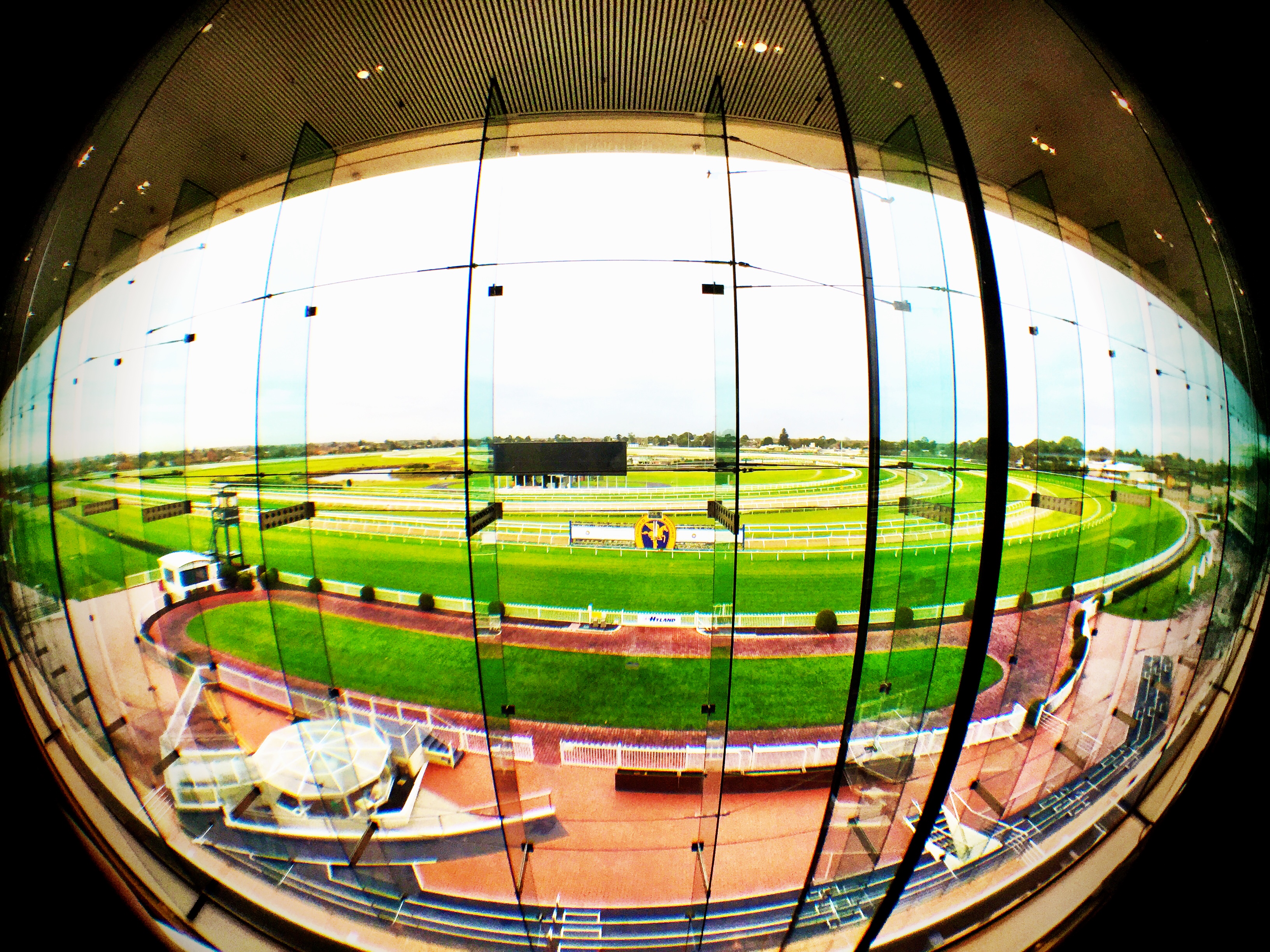
Caulfield Racecourse view from the HBE conference

Caulfield Racecourse view from the HBE conference

Learning communities were a thread which appeared in the sessions I attended. Wellman, co-author of The Adaptive School, discussed how skilful high-performing groups share intellectual and emotional space, which includes being comfortable with pauses in discussion. Silence is not the enemy of learning and collaboration, but an ally.

Wellman pointed out that being in the same room together does not make a group a community of learners. Anthony Muhammad added that a professional learning community is not a collaborative team which meets regularly, but a systemic contextually-embedded paradigm which raises collective knowledge through collective inquiry. Much like the Adaptive School material, which advocates ‘graceful disagreement’ as a norm of effective teams, Muhammad maintains that constructive, professional disagreement is the foundation of innovation.

Muhammad’s work at Levey Middle School reflects that of my own school in that it emerged out of the specific context of that school and where its community and practices were at. While our context is vastly different, we too have built our teacher growth model out of our school’s mission, vision, values, existing work and knowledge of our students, teachers and leaders.

Part of our model is based around how feedback and conversation might be deliberately harnessed in order to build teacher capacity and amplify the learning culture of the school. Wellman says that feedback is ‘in the moment, about the past, to affect the future.’ He points out that advice has very little impact on the advisee, and instead advocates for using clear, shared standards and a focus on learning, within an environment of trust. The focus on learning is about meeting the person where they are. ‘Wherever I meet you in your practice,’ he says, ‘we’re going to grow from there.’ He adds that, ‘We are starving our master teachers of rich conversations; they are hungry to talk about the whys of what they are doing.’

As outlined in Lipton and Wellman’s Learning-Focused Supervision, Wellman sees standards as rallying points for important conversations which set aspirations for goal setting and growth. My Australian school similarly uses Charlotte Danielson’s Framework for Teaching as a tool for developing shared understandings about teaching; and for reflection and data-based conversation around teaching practice. Our approach also gels with Wellman’s assertion that feedback should be customised and appropriate for the individual; one size does not fit all. Our model of teacher growth incorporates differentiation in terms of what sort of data teachers collect from their lessons and the ways in which coaches approach each conversation. As with the metaphor of the stage coach, our coaching model is about helping the coachee get to their desired destination.

Melbourne autumn

Melbourne autumn

One of Wellman’s points about data analysis was that, when looking at data, we should focus on analysing reasons for successes, rather than failure. What are the successful students or teachers doing? What knowledge and strategies do they have? How can we develop those in others? (He also has a great strategy for teams looking at student achievement data in which he employs prediction to engage people in their assumptions about what the data might hold, before revealing the data.)

At the end of the conference I met up with Eric Sheninger who had just landed in Melbourne for his first time working with Australian educators, districts and conferences (he will be keynoting at the EduTECH conference in Brisbane next week). I had tweeted a pile of books from the conference two days earlier, including Eric’s, with no idea that he was en route to Melbourne. Ours was an impromptu meeting which arose out of a morning Twitter conversation. We met up and chatted about our work, global educational thinkers, the world of connected educators and DIY professional learning. During our conversation, Eric pointed me towards some great apps which will be useful collaborative tools for my work with student and teacher learners, such as Verso, Tozzl and Padlet.

In addition, my first night in Melbourne had me meeting with some of my Twitter PLN – Greg Curran, Chris Munro and Jo Prestia – to discuss coaching in school settings, research journeys and approaches to school intervention implementation.

Both in and out of the conference I fielded questions about what my PhD is about. This was a great opportunity to hone my ideas about what is most important about my research and communicating that in effective ways.

So there were affirming moments in, and out, of the conference, which added nuanced layers to my thinking. Yet on reflection, I realise that much of what a conference can bring for the delegate are conversations with others, unexpected moments of collaboration, and the space and time to process and reflect. Although I was surprised at the lack of a backchannel at a national conference, by both presenters and delegates, – Where was the Tweetstream? – I found valuable connections with my own colleagues, other educators, presenters and connected educators who weren’t affiliated with the conference but were open to connecting in person.

Federation Square, Melbourne

Federation Square, Melbourne

Giving ourselves permission for a break: time away as self-care and strategic productivity

“What day is it?” asked Winnie the Pooh. “It’s today,” squeaked Piglet. “My favorite day,” said Pooh” ~ A.A. Milne

Villa Artis, Bali by @debsnet

Early tomorrow morning I will be on a plane to an island destination for a holiday with family and friends. I should be dreaming of silky cool pool water, fire-coloured sunsets over the ocean, meandering rice paddies reflecting blue skies, the sizzle of seafood on the beach and the clink of ice blocks in cocktail glasses.

Canggu beach, by @debsnet

And yet I have been thrashing around trying to decide whether or not to work or study or blog while I am away. Or whether I can leave it all behind and take a real break, despite ceaseless deadlines. I wonder if this is a common phenomenon in a world in which we are constantly connected to each other, constantly available to our workplaces and constantly curating, creating and sharing vignetted content of our lives and work. While flexible working hours can allow us to make adaptable life choices and social media can allow us to connect with others, do they also contribute to a cycle of relentlessness which we find difficult to break away from?

rice paddies, Umalas, by @debsnet

I have decided that I need to take a full thinking, writing, marking, everything break from my worlds of work, research and writing. One of my three words of 2015 is ‘presence’, so partly this break is about a commitment to being present with my children, husband and friends during our trip. But it is also about being ok with taking an actual break and with a commitment to self-care. I am someone who sees blogging as a break from PhD writing. Or PhD writing as a break from marking. So the idea of a break from all-of-the-things is foreign and has taken some self-convincing.

offerings, Bali, by @debsnet

There are others who have reflected on the importance of self-care, even as we catapult ourselves towards our goals. Raul Pacheco-Vega wrote on self-care in academia and the importance of privileging your own health and wellbeing. New Zealand author Celia Lashlie, who I’ve had the pleasure of hearing speak about her work, died in February after releasing a statement which read, “My wish is that others will learn to stop before I did, to take into account the limitations of their physical bodies and to take the time to listen to the yearnings of their soul. It is in the taking care of ourselves we learn the ability to take care of others.”

Seminyak sunset, by @debsnet

I love my work and my research, and most of the time I find a tenuous work-family balance. I wrote on the PhD Talk blog about the way that normally it works for me to have many things on the go, as doing any one of them feels like a holiday from the others. I also spoke there about the importance of quiet in-between times. That is, often I make the most cognitive or creative progress, on my PhD thesis or a strategic work problem, when I am walking, or driving, or taking time to be quiet and still. So luxuriating in a full, unadulterated, brazen break is also a strategy to vacation, to vacate the demands of everyday life, in order that I might return with some mental clarity and physical energy to tackle the rest of this year, which includes for me, finishing my PhD thesis and successfully implementing the professional learning and growth model at my school.

So give yourself permission for a break, small or large. To unplug from emails, tweeting, writing or planning. To take care of yourself, curl your toes in the earth and immerse yourself in somewhere, somehow or someone that gives you joy.

(Photos in this post are from a previous trip.)

(How did it go? The post-script to this post can be found here.)

Sea Circus, Bali, by @debsnet

We are all storytellers: immersed in my narrative worlds

Humans are storytelling organisms who, individually and socially, lead storied lives. ~ Jean Clandinin & Michael Connelly 

our constructed stories connect us

our constructed stories connect us

Whether teaching, writing, conversing or considering our own lives and identities, we are all doing one thing: storytelling.

I have recently been quiet in the Twitterverse and blogosphere, partly because more than ever before I am immersed in micro and meta layers of story.

I have been tunnelling into my PhD narrative research in every spare moment, thinking obsessively and writing dangerously. I am sharing, constructing and analysing the stories of myself, teachers and schools leaders in order to reveal insights into professional identity, professional learning and school change. I am penning my first journal article about experimental ways of telling, utilising and analysing stories in research.

When I am not researching or thinking about my narrative research, I am teaching English to high school students. Reading stories, writing stories, analysing stories, watching stories, performing stories.

Or I am with my own children, reading stories, telling stories, making storyable memories, recounting favourite moments, role playing imagined scenes with make believe characters. Or talking to my husband about his work in media and content marketing, which is all about individuals and organisations telling their stories and constructing their storied identities, in order to communicate and connect. Or blogging vignettes from my own lived story. Or planning conference presentations of my research story or the story of my school’s teacher growth model.

We are indeed storytelling creatures. While I also try to be present in each moment and to live in wonder, stories embody the ways we construct our experiences, connect with each other and the world. I write my own stories, teach the telling and interpreting of stories, and engage in the theorising of stories. Have I used the word ‘story’ enough times in this post to indicate that it is currently both intoxicating and maddening to me? Story story story.

Obsessed and submerged, back into the subterranean story cave I go …

After nourishment, shelter and companionship, stories are the thing we need most in the world. ~ Philip Pullman

by @debsnet

Powerful & unforseen consequences: our butterfly impacts

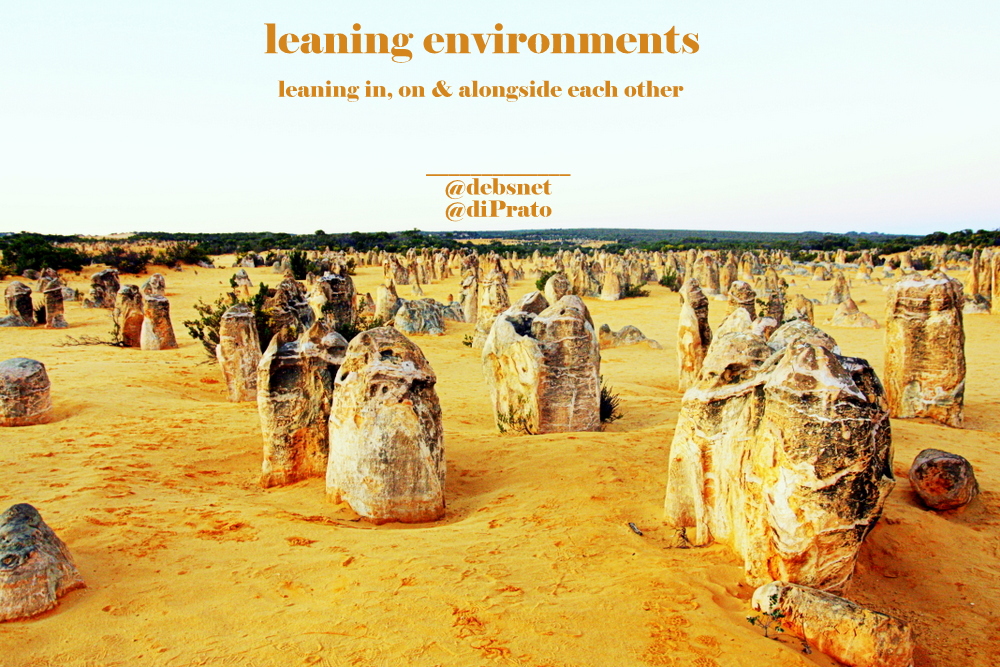
#leaningenvironments - evolution of a new edu-revolution?

#leaningenvironments – evolution of a new edu-revolution?

 A cloud from a minor volcanic eruption in Iceland—a small disturbance in the complex mechanism of life on the Earth—can bring to a standstill the aerial traffic over an entire continent. ~ Slavoj Žižek

With the start of the Australian school year almost here – a year in which I am working to implement the teacher-growth model on which I have been working for two and a half years – I have been thinking about what it is that makes a trusting, impassioned, vibrant community of continuous learners.

Ok, as both the subject of my work and of my PhD research, I have been doing more than thinking about this. I have read close to 300 references and written about 85,000 words around effective school change, what makes effective leadership and what kinds of learning teachers find transformational. I have blogged briefly about some key ideas to anchor school change, about the importance of embracing discomfort for growth and about my own learning environments.

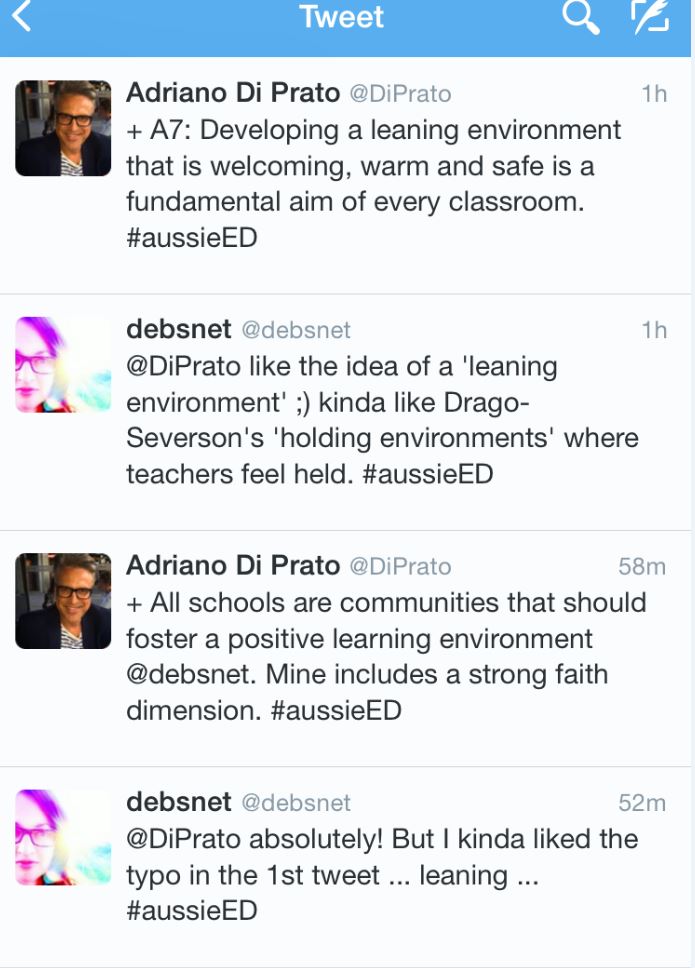
Tonight I was participating in the #aussieED Twitter chat when Australian educator Adriano Di Prato tweeted that ‘developing a leaning environment that is welcoming, warm and safe is a fundamental aim of every classroom.’ Now, I knew that Adriano meant ‘learning environment’ when he typed ‘leaning environment’ in a fast-paced Twitter chat, but it got me thinking: How are schools ‘leaning environments’?

It reminded me of psychologist and professor Ellie Drago-Severson’s notion of ‘holding environments’ (which I wrote a bit about here) in which she asserts the importance of teachers feeling ‘held’ by their learning and working environments, especially if positive change is to take place.

It reminded me of Costa and Garmston’s notion of ‘holonomy’ (explained in the Cognitive Coaching course material) in which the parts (individuals) and whole (organisation) are interdependent.

It reminded me of this great moment last year when a group of commuters on an Australian train platform used their leaning-together momentum to tilt a train and free a man trapped between the train and the platform.

So I tweeted back about ‘leaning environments’, and all of a sudden we were back-and-forthing about how the word ‘lean’ might apply to school environments. Would it be about individuals ‘leaning in’ to the community, to opportunities, towards each other? Could it be about students, teachers, parents and leaders ‘leaning on’ or ‘leaning alongside’ or ‘leaning with’ each other? Might it be ‘leaning out’, away from those things which should matter less but sometimes drive schooling (high stakes testing, grades, league tables)?

the power of a Tweeted typo

the power of a Tweeted typo

Fellow edu-Tweeter Melissa Daniels noticed the banter and asked whether this could be “the education revolution that started with a typo?” leading to another discussion about innovation, revolution and the evolution of ideas, all in 140 character bites.

Tweet @debsnet @DiPrato @PensiveM

This was an invigorating discussion for me, not because I thought it was to be the next big thing in education, but because of the thrill of the unsurprising serendipitous connections, conversations, ideas, thinking and challenges that come out of conversations and connections with like-minded like-passioned others. Here was a vibrant online environment of trusting, holding, leaning (in, out, on, with, alongside), impassioned, creative, continuous learners.

It also reminded me of our unforseen impacts. We never know the impact of a conversation, a word, a decision, or a typo.

I have noticed this in my self, in conversations or moments which stay with me until an idea bubbles to the surface. I have noticed it in my work with teachers and students, who often take some time to realise what moments or relationships have shaped them. I have noticed it in my PhD research participants, many of whom told me that the very act of being interviewed for my research changed something for them, opened something up, surfaced a reflection or became a moment of learning.

So, don’t ignore life’s typos. Even the seemingly tiniest things can have powerful & unforseen consequences.

You never know when you might uncover the next revolution.

Small shifts in your thinking, and small changes in your energy, can lead to massive alterations of your end result. ~ Kevin Michel

Montenegro by @debsnet

2015: The Year of Writing Boldly, Abundantly & Dangerously


Writing Dangerously by @debsnet

Get it down. Take chances. It may be bad, but it’s the only way you can do anything really good. ~ William Faulkner

For me, 2014 has been a year of writing thoughtfully, reflectively and introspectively.

As always I have been writing unit plans, assessments and resources for my students. I have been writing 140 character tweets, and participating more and more in education Twitter chats (such as #satchat #sunchat #aussieED #whatisschool and #BFC530). I have started a blog in which I have been experimenting with voice and purpose. I have been writing my PhD, which is currently at almost 80,000 words. As part of my PhD I have written a self-study chapter in which I reflect on myself as learner, educator and leader.

2015 will be my year of writing abundantly, boldly and dangerously.

Writing abundantly

In 2015 I will need to write abundantly. I will need to write words and words of thesis. I will need to pen some papers on my research. I will need to write applications and abstracts for education and research conference presentations. I will write blog posts. I will write tweets.

Each form of writing is a different kind of therapy. I am prone to over-wordiness (I love words!), to verbosity, to an inability to be concise. Thankfully, Twitter is therapy for the verbose. To distil thoughts into 140 character bites is to crystallise thinking down to its essence. I am never more concise than when I tweet. Blogging allows personal exploration of ideas in an informal space. My blog is where I can explore ideas in greater depth than a tweet, but in more informal ways than in academic writing. My thesis is the place where I get to burrow into challenging writing problems and thrash around, working hard until I break through and find a solution. The PhD is writing friend and nemesis, a beast I have to wrestle into its cave, clay I have to mould into its form (or is that stone I have to hack at until it takes shape?).

And the more I write, the more my writerly-self expands and transforms, like a shape shifter, always taking new forms in organic, non-linear ways. I am a hybrid writing being who writes as educator, school leader, researcher and bloggess. 2015 lays the challenge of balancing these overlapping writing selves.

Writing boldly

I will need to be bold in my writing in 2015.

I will need to be boldly honest, self-reflective, self-revealing and authentically-voiced in my blog posts, and in the conversations which bloom from those. I will need to be willing to disagree in Twitter conversations, in order to promote robust discussion instead of an inward-looking echo chamber of the same voices saying the same things.

In my third (and hopefully final) year of my PhD study I will need to be self-assured in discussing the contribution of my work. I will need to be confident in communicating in my own academic voice.

Yet in my boldness I will need to be sensitive to ethical issues such as how to tell others’ stories while protecting their anonymity and the authenticity of their words. Part of the reason I choose to blog and tweet under a pseudonomic identity is to protect my research participants. So boldness needs to be tempered with thoughtfulness.

Writing dangerously

Language is power. Words are tools. As a teacher of English and Literature part of my job is to help students to understand how language works (functionally, socially and globally), and help them to develop the capability to use its power to communicate, share, converse, discuss, disagree and disrupt.

Writing can be dangerous. It can be disruptive. It can be transformational for writer and reader. It can change individuals, groups, organisations and the world.

2015 is the year for all researchers, bloggers, tweeters and writers (or ‘those who write’, but don’t think of themselves as ‘writers’ as Pat Thomson explains in this post) to write fearlessly and compassionately, abundantly and concisely, reflectively and dangerously. I’m going to give it my best shot.

Happy writing!

A writer never has a vacation. For a writer life consists of either writing or thinking about writing. ~ Eugene Ionesco

write fearlessly by @debsnet