
Three trends shaping education in 2025

Image created using ChatGPT.

Looking back on any year reveals triumphs and celebrations as well as challenges and low points. 2024 has been a year that saw an uplifting Olympics and Paralympics in Paris, and leaps in space exploration, but also ongoing cost-of-living crises, worrying levels of mental health, cybercrime, geopolitical conflict, and extreme weather events. Personally, I experienced an incredible Aboriginal cultural immersion experience in North East Arnhem Land, published 11 episodes of The Edu Salon podcast, co-authored a lead article for Australian Educational Leader with Patrick Duignan on reimagining educational leadership, and received two awards: as an Excellence Awardee for Principal of the Year in the Australian Education Awards, and the Australian Council for Educational Leaders South Australia Media Award.

As I reflect on education across 2024, three key trends have risen to the surface in my work as principal, and in the work of schools: personalised learning, GenAI, and holistic wellbeing. None of these topics are new, but they are at the forefront of current educational thinking and practice. As we enter 2025 this week, these foci will continue to shape education.

Personalised Learning

Best practice, research-informed methods of instruction are key to how we design learning and teaching in schools. Schools continue to develop ways in which students’ diverse needs and identities are served, including through engaging student voice and choice, via quality differentiation, by using technologies to enhance and personalise learning, and by tailoring pathways to individuals where appropriate. Within the intentional frameworks of learning and teaching in schools, students are increasing positioned as agents of their own learning. They set goals, influence their own learning, and shape their own learning pathways. While in school, students are studying vocational courses, earning micro credentials, undertaking early university courses, and running their own businesses. At my school, in 2024 we introduced a seed fund and mentorship program to support students pursuing their own social enterprises.

The worlds of education and work will need to continue to develop personalised learning opportunities, with a focus on diversity, adaptiveness, a global mindset, and less hierarchical structures. Generation Alpha—born 2010-2024—have information not only at their fingertips but also digitally integrated into their lives. They experience emerging technologies, fast-paced change, global influences and remote learning. Their digital experiences are personalised by algorithms and so they are accustomed to digital experiences curated to them personally. They connect, collaborate, and create online. They are innovators, entrepreneurs, technology enthusiasts. They are concerned by ethical issues such as equity and sustainability. My own children are Gen Alpha and they are questioning the value of traditional work and life pathways. They hope for life, learning and work to be self-directed, flexible, inclusive and gratifying.

Learning will continue to be personalised, as well as gamified, ‘stacked’ through a range of microlearning opportunities, and lifelong. Schools will continue to reflect on the purpose of teachers as experts who broker learning experiences for students, and schools as hubs of learning opportunities that allow each learner to thrive.

Generative AI

2024 has been a year of the rise and rise of generative AI as collaborator in learning and teaching, with tools such as ChatGPT, Microsoft Copilot and Google Gemini becoming mainstream. Technologies such as artificial intelligence, and extended realities, continue to be tools with which educators develop awareness and intentional deployment.

AI can be a useful accelerant for research, thinking and writing, reducing the time it takes to complete tasks. Using AI as a collaborator and productivity booster can support the work of those in schools. AI can, for example, be used for generating quizzes, transcribing meeting minutes, writing sample test questions, analysing curriculum documents, summarising information, explaining key concepts, drafting communications and generating exemplar responses.

Students can use AI in a range of ways, ensuring that they reference and attribute it appropriately. They might use AI to conduct initial research on a topic, search for useful resources, create digestible summaries of complex information, brainstorm ideas for creative tasks, translate language, generate practice questions, or create study schedules.

Of course, any technology must be used responsibly, ethically, safely, and with a healthy level of scepticism. Critical questions include asking ourselves and our students about biases inherent in AI models, what is excluded by an AI model, assumptions embedded in an AI ‘voice’, and how we might verify the accuracy and validity of the information provided.

Generative AI will continue to shape education as we collaborate with it and develop our use of it as a tool to enhance learning, teaching and leading. Yet teaching and leading are not purely transactional processes that can be replaced by artificial intelligence. Technologies cannot replace authentic voice, teachers that see and know their students, compassionate leadership, or nuanced and context-embedded decision making.

Holistic Wellbeing

Schools are places of human connection and complexity. In my chapter for the 2019 book Flip the System Australia: What Matters in Education, I wrote that “education is not an algorithm but a human endeavour”, a line which seems more poignant now that our lives are increasingly shaped by algorithms, from the route we take to a destination, to the music to which we listen, to what we see on the internet or social media. In 2024, wellbeing has continued to emerge as something with which schools and education systems constantly grapple. Challenges include student absenteeism, student mental health, teacher recruitment and retention, and teacher and school leader wellbeing.

We need to feel safe and well if we are to learn, and so learning for students is about more than intentional teaching; it is facilitated by positive relationships and learning environments in which learning is valued, progress is expected, and mistakes are seen as opportunities to grow. For students, responsive pastoral care programs and robust pastoral structures provide a holding environment in which every child is known and noticed.

For educators, schools are considering what can be automated or relinquished from staff workloads, and how staff can be empowered to shape practices and policies. In 2024, my school worked with staff to create flexible working guidelines, enabling flexible working where possible, based on role and individual circumstance. Schools are additionally working to develop cultures for staff of safety, community, growth and being supported in their professional and personal lives, as well as the fulfilling shared purpose of educating young people and partnering with families.

Schools need to continue to provide opportunities for meaningful human connection. We need to continue to see education as a human endeavour, about people, belonging and community. In 2024, there were people in my school community who faced hardship and sorrow. It is these moments—often quiet and unseen—that remind us that the greatest privilege of leading is not in celebrating accolades or public successes, but in walking alongside others in private moments of grief and sadness. It is in these moments that the school as community comes to the fore and we most lean in to our humanity in order to support one another.

It is vital that schools create cultures of high care, high challenge and high trust for all in our school communities, including students, staff and families. I would add that these environments need to be high observation, in which we see, hear, know and support each individual. Key parts of education work are noticing, listening, empathising, and offering care. One thing we can all focus on in 2025 is paying attention to our daily interactions and being truly present with those in our community.


The global landscape of educational leadership

On 31 October, UNESCO launched the 2024/5 Global Education Monitoring (GEM) Report, Leadership in Education: Lead for Learning, which engages with Sustainable Development Goal 4 ‘Quality Education’. The report explores global research and practice in educational leadership, capturing the current landscape, possibilities, practices and challenges of leadership in education around the world.

Below, I briefly summarise some of my key takeaways from the GEM Report.

Impact: School leadership matters

The report notes that leadership in schools is second only to teaching in the classroom for its capacity to impact on student outcomes and experiences. If we are to improve outcomes for students, it is vital to understand the impacts, influence and ingredients of school leadership.

The report notes that those principals who have a significant positive impact on schools tend to set transformative directions, use policies and reforms to drive purposeful change, enable safe and positive environments, build relationships, develop people, provide feedback, manage resources strategically, and work to improve classroom teaching. It also notes that school principals in Australia have been reporting higher levels of stress, burnout and depression in recent years (with women reporting this more than men), with workload quantity, lack of time for engaging with important work, and the seeming impossibility of managing life outside of the job, being major reported causes.

Australia’s Professional Standards for Principals, developed by the Australian Institute for Teaching and School Leadership in 2014, define the principal’s role as focused on five areas: leading teaching and learning, developing self and others, leading improvement and change, managing the school, and working with the community. Based on the work of Ken Leithwood, the GEM Report identifies four key roles of the school leader as: setting expectations and vision, focusing on learning and leading instruction, fostering collaboration, and developing people to improve school outcomes.

Autonomy: There can be no leadership without the opportunity to make decisions

The context for leadership affects those things a leader does in setting expectations, such as sharing vision, holding high expectations, setting a personal example, representing the community, and staying abreast of trends, data and information to inform decision making. Standards and accountability mechanisms for schools and school leaders vary from system to system and school to school. The GEM Report found that in 20 high-income countries, the more principals had the primary responsibility for human and financial resource decisions, the more likely it was that a country would be among those ranked more highly in terms of average performance in mathematics.

School leaders have more chance to make a positive difference if they have autonomy, support and well-defined responsibilities. Education systems need to empower school principals with sufficient autonomy to manage financial and human resources and to make decisions related to teaching and learning. Autonomy must, however, come with adequate support, sufficient resourcing and appropriate accountability measures.

Collaboration: School leaders cannot and should not lead alone

School leaders are not solo heroes, but part of an enmeshed ecosystem of influence. As I often say, leading is an action and a way of being, not a role or a formal title. All can lead. In schools, this might mean senior leaders, middle leaders, teachers, school services staff, students, parents and community members.

Shared school leadership and collaboration among empowered stakeholders strengthens decision making, contributes to enacting a shared vision, and leads to lasting improvements in educational outcomes and school cultures. School leaders have a central role to play in developing school culture and climate; maintaining a safe, healthy school environment; raising resources strategically, building networks; managing risk; nurturing collaboration; enabling others to act; and consulting with families and community.

School leaders who build the capacity of others, ensure they are accessible, provide training and resources, foster a collaborative environment, involve others in decision making, are involved in collaborative structures and processes, and distribute leadership among and across the organisation, are more likely to see the school’s vision realised.

Schools can promote shared school leadership by establishing clear communication channels, ensuring transparent decision-making processes, implementing regular feedback mechanisms, ensuring clarity of roles, and recognising unique contributions. School leaders can keep track of staff professional development needs, provide individualised professional support and mentoring opportunities, ensure evaluation of practice, and reward good performance.

Collaborative relationships (such as those built through committees, teams and other collaborative structures) strengthen governance, improve decision making, enhance accountability, and foster inclusive and resilient environments. Fostering safe, inclusive and culturally responsive environments is key to ensuring a climate of care and challenge where collaboration can thrive, where shared vision can be realised, and where all students, staff and wider community can flourish.

Culture: Who do we want to be, together?

Source: @spalla67 on pixabay

I have talked with staff this week about together creating the conditions for all of us to grow as a community of learners, through fostering an environment of high support and high challenge. Our staff have been preparing for the return of students and coming together to work through the idea of organisational culture, including hearing from students about their experiences of and insights into our school culture.

We have been wondering: Who are we now, and who do we want to be and become?

Peter Drucker famously said that “Culture eats Strategy for breakfast”, implying that strategy falls flat without a positive culture that empowers and supports the people in an organisation to enact the strategy. While most would agree that culture is important in organisations, it is one of those fluid, nebulous, and slippery terms that evades clear definition. Richard Perrin defines organisational culture as “the sum of values and rituals which serve as ‘glue’ to integrate members of the organisation.” The metaphor of glue is central; culture binds individuals together as a collective. Culture is about those things we share, consciously and unconsciously. When I think about culture, those things we share, or aim to share, include:

  • Purpose – Our shared why.
  • Values – What underpins our beliefs and actions.
  • Stories and symbols – What we say about ourselves, to ourselves and to others.
  • Relationships – How and who we are with each other.
  • Behaviours – How we do things around here.
  • Language – How we talk around here.

Herb Kelleher famously said that “culture is what people do when no one is looking.” We perform culture through our presence and our actions, seen and unseen, accepted and challenged. As Lieutenant-General David Morrison’s oft-cited message goes: “The standard we walk past is the standard we accept.” We become enculturated through our immersion in a culture and our observations of how a place and its people present, interact, and operate. As a new principal to a school this year, I am at the outset of my own journey of enculturation; of absorbing, being influenced by, and being initiated into, an existing culture.

In their work on culture this week, our staff were guided by organisational psychologist Hayley Lokan, from ISC Consulting, who described culture and both intangible and palpable. She shared Robert Kreitner and Angelo Kinicki’s definition of culture as “the set of shared, taken-for-granted implicit assumptions that a group holds and that determines how it perceives, thinks about, and reacts to its various environments”. Hayley likened culture to an iceberg and challenged us to look beyond the visible aspects of culture to interrogate our deep-seated assumptions. It reminded me of one of the findings from my PhD study: that in order to change our behaviour we often need to change our beliefs. In order to shift culture we need to challenge our norms, and our accepted attitudes, beliefs, and behaviours. Story, symbols, rituals, and traditions are important markers of and continuers of culture, but we need to be honest about those things that we allow to continue that are not aligned with our moral purpose or current community. Context, as always, is Queen, and our communities and their needs change over time.

This week’s staff workshops and student panel on culture revealed insights into the school. Staff described the school’s culture as supportive, caring, welcoming, inclusive, kind, collaborative, friendly, aspirant, dedicated, proud, respectful, hard working, and with a mixture of tradition and trailblazing dynamism. Students in a panel discussion described the culture as safe, caring, close-knit, empowering, inclusive, and one in which students feel encouraged to be their best while being supported during times of difficulty. In exploratory discussions about the future of our culture, staff began to wonder about how we might elevate wellbeing, agency, and celebration of the diversity of the individual, to strengthen what is great about our culture and to grow with our community.

If we can build and maintain a culture of trust in which there is openness, honest and gracious feedback, diverse voices, varied aspirations, and a commitment to lifting each other up, we can all learn, lead, be well, and be in community with one another. We will continue to ask ourselves, our students and our wider community:

  • What about our culture do we want to keep?
  • What about our culture might we like to change or develop?
  • What are our next steps to move forward with intentionality?

Professional learning post-pandemic

Source: Alina Grubnak on unsplash.com

During the pandemic, professional learning, like everything else, needed to adapt. With many borders closed, air travel less available, and people experiencing varying stages of public restrictions and lockdowns around the world, more learning happened at home. Like remote learning for schools and higher education organisations, professional learning courses and conferences pivoted to online formats. Presenters presented from home, and participants participated from home. Education organisations capitalised on cost-effective online options for professional learning.

At my school we looked to the virtual, but also to the local and internal. We engaged consultants in targeted and ongoing work alongside our staff, provided opportunities for staff to present their expertise and practice to one another, and arranged time and forums for staff to engage collaboratively in whole-school strategic priorities. We continued, when and where possible, to provide opportunities for intentional and meaningful face-to-face professional learning and to connect with external experts and organisations.

Virtual professional learning, so ubiquitous in 2020 and 2021, has many benefits. It is better for the planet. Without travel and catering, it has lower carbon and economic costs, and a lower environmental impact. It allows greater equity of access for those who may not be able to afford travel, accommodation, and conference costs.

A 2021 paper in Nature Sustainability by Skiles et al. and a 2022 paper by Yates and colleagues in The Lancet confirm that virtual conferences provide environmental sustainability and participant equity benefits. The virtual format overcomes social, economic, and travel-related barriers for those most likely to be impacted by these. It increases participation and representation of those from institutions and countries with limited resources, women, professionals with a disability, and early career researchers and practitioners. It also provides opportunities for increased accessibility through the use of live captions, live chatbox Q&A, and recording sessions for participants to watch later.

However, virtual professional learning has its downsides. After a couple of years of online learning formats, there is a level of Zoom or virtual professional learning fatigue. Digital access in low income countries continues to be a barrier to participation in virtual conferences. Despite some sessions being recorded, time zones of global conferences often favour those in Europe and America. As someone in Western Australia, rarely have the times of international virtual conferences been friendly. Over the last couple of years, I have been scheduled to present at times such as 1am and 4am. Learning or presenting from home also requires the presenter or participant to manage competing demands, not to mention juggling the use of a stretched wifi network across the household’s multiple devices and technology needs. I have attempted to listen to virtual conference keynotes in my kitchen while cooking dinner and trying to focus on the words of the speaker rather than the sounds of my family.

There is something immersive and nourishing about the in-person conference experience. While I may have been able to attend more conferences virtually than I would have been able to in person over recent years, I have missed being there, in situ, with the sights, sounds and smells of another place. I have missed the time afforded by solo travel to sit with ideas, consider them, and think beyond the transactional busyness of the day-to-day. It is often ‘being away’ that allows the space for clarity and creativity of thought, moving us beyond the narrowness of the here and now, to broader perspectives and possibilities. Mostly, I have missed the human connection, including serendipitous meetings; and corridor, coffee, and dinner conversations with colleagues and presenters.

I have found in my own research (Netolicky, 2016a, 2016b, 2020), that professional learning is highly individualised, context-specific, and that the ways in which we professionally learn are many and varied. Experiences that shape our professional beliefs and practices can be professional and personal, formal and informal, in and out of so-called ‘professional learning’ contexts, solo or collaborative. Effective professional learning can cost a little or a lot. It can happen in person or online. It can take air miles, accommodation budgets, and well-known presenters, or be located on site at work, or in a car while listening to a podcast, or at home via a webinar. Professional learning is a core part of staff belonging and wellbeing. For schools, it should be judicious and simultaneously aligned with the individual’s professional goals and the school’s strategic priorities. It benefits from being ongoing in some way – whether that is a continuing partnership between professional learning provider and school, through a mentoring or coaching relationship, or by a small group of colleagues sharing and developing their learning together after attending a conference or course.

As the world opens back up, and previous models of professional learning become possible once more, Yates et al. challenge us to find new, innovative, and hybrid ways to provide professional learning. They challenge us to focus on planetary health and equity, as well as on effective learning, networking, and collaboration. Organisations can and should continue to consider in what ways they invest in and support the learning of their staff, the kinds of opportunities they provide and promote, their professional learning environmental footprint, and the inclusivity of their offerings and practices.

References

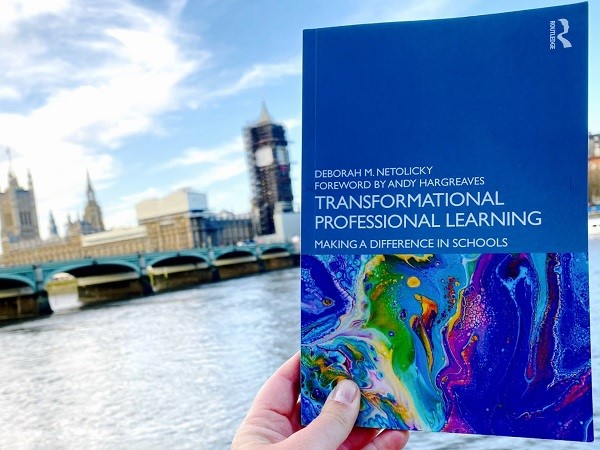
Netolicky, D. M. (2020). Transformational professional learning: Making a difference in schools. Routledge.

Netolicky, D. M. (2016a). Down the rabbit hole: Professional identities, professional learning, and change in one Australian school (Doctoral dissertation, Murdoch University).

Netolicky, D. M. (2016b). Rethinking professional learning for teachers and school leaders. Journal of professional capital and community, 1(4), 270-285.

Skiles, M., Yang, E., Reshef, O., Muñoz, D. R., Cintron, D., Lind, M. L., Calleja, P. P., Nerenberg, R., Armani, A., Faust, M. K., & Kumar, M. (2022). Conference demographics and footprint changed by virtual platforms. Nature Sustainability5(2), 149-156.

Yates, J., Kadiyala, S., Li, Y., Levy, S., Endashaw, A., Perlick, H., & Wilde, P. (2022). Can virtual events achieve co-benefits for climate, participation, and satisfaction? Comparative evidence from five international Agriculture, Nutrition and Health Academy Week conferences. The Lancet Planetary Health6(2).

Key concepts for leading professional learning

A recent report purports to dispel myths about professional learning, including the apparent ‘commonly held’ beliefs that ‘professional learning is a waste of time and money’ and that ‘districts should implement research-based PL programs with no modifications’. These claims run counter to much literature around professional learning which argues that effective professional learning is a lever for improving student learning and achievement by improving teaching, and that context is crucial for any education model (and that therefore any model should be tailor fit to context).

This week I presented to a group of school leaders about leading professional learning. Part of my preparation for the presentation took me back to the roots of my work in this space, and those concepts I have come across that have stuck with me, become part of my thinking, and continue to anchor my work. I explain some of these below, in addition to others I discussed on the day, such as trust, context, teacher expertise, and teacher agency, self-determination and self-efficacy.

HOLONOMY

Holonomy is an ecological concept that has captured my attention for years, drawing together the individual and the larger system. Art Costa and Bob Garmston (2015) base their conception of holonomy on Arthur Koestler’s work around the word ‘holon’ as something which operates simultaneously as a part and a whole. Holonomy encapsulates the simultaneity that each person is both an independent individual and an interdependent part of the larger system, at once self-regulating, responsive to the organisation, and able to influence those around them.

This speaks to me of what we must consider when leading professional learning: balancing the needs of the individual and the needs of the organisation or system.

HOLDING ENVIRONMENT

Introduced to me through the outstanding work of Ellie Drago-Severson on leading adult learning, is the notion of the ‘holding environment’. With its roots in Donald Winnicott’s psychology concept, this is an environment of psychological safety in which members of the community or organisation feel ‘held’ in a culture of high care and high challenge.

Ellie was the first to really challenge me to consider how we honour where each adult learner is at, differentiate learning for adults in schools, and take an invitational, growth-focused approach to professional learning.

MEANINGFUL COLLABORATION

In Chapter 4 of Transformational Professional Learning, I explore that 1) collaboration does not happen by calling a group of people a ‘team’, or by organising for a group of people to be in a room together; and 2) feeling good working with colleagues is not professionally learning. Politeness, compliance, avoidance, and silence may make for an easy, harmonious-feeling meeting, but do not result in rigorous collective work that moves individual, team and organisation forward.

Rather, collaboration occurs when there is a clear shared purpose, collective accountability, collaborative norms, a focus on data to inform, and protocols for collaborative ways of working. Taking the time to create the conditions for skillful collaboration, to structure and nurture intentional collaborative practices, and to develop people’s skills in graceful disagreement and productive conflict, facilitates meaningful collaborative opportunities that develop teachers and positively impact students.

SEMANTIC SPACE

The importance of language is explored by Robert Kegan and Lisa Lahey (2001), and Bob Garmston and Bruce Wellman (2016). The notion of semantic space—‘how we talk around here’—is outlined by Stephen Kemmis and Hannu Heikkinen (2012), and Rachel Lofthouse and Elaine Hall (2014).

Talk defines and drives emotions, relationships, belonging and action. Talk is a terrific barometer of professional culture, allowing us insights into beliefs, values and behaviours. We can ask: What are the staff water cooler conversations like at our school? How do we collectively talk about our work and practice? What questions do we ask? What contributions do we make? What shared language, and ways of speaking and listening, do we use? How do we talk around here?

In a recent episode of my podcast, The Edu Salon, Adam Voigt says: “The language that the leaders of a culture use, shapes the kids that grow in it, and they leave speaking that way as a result. If you’re looking to transform culture you can’t do it without changing words.”

I have this year written on my office whiteboard something I remember Rachel Lofthouse saying at a conference in 2017:

The talk is the work.

We need to value, focus on, create space for, and put effort, intentionality, time, and learning, into the talk in our schools.

References

Costa, A. L., & Garmston, R. J. (2006). Cognitive coaching: A foundation for Renaissance schools (2nd ed.). Heatherton, Australia: Hawker Brownlow Education.

Drago-Severson, E. (2004). Becoming adult learners: Principles and practices for effective development. Teachers College Press.

Garmston, R. J., & Wellman, B. M. (2016). The adaptive school: A sourcebook for developing collaborative groups. Rowman & Littlefield.

Kegan, R., & Lahey, L. L. (2001). How the way we talk can change the way we work: Seven languages for transformation. John Wiley & Sons.

Kemmis, S., & Heikkinen, H. L. (2012). Future perspectives: Peer-group mentoring and international practices for teacher development. In Peer-group mentoring for teacher development (pp. 160-186). Routledge.

Lofthouse, R., & Hall, E. (2014). Developing practices in teachers’ professional dialogue in England: Using coaching dimensions as an epistemic tool. Professional Development in Education, 40(5), 758-778.

Netolicky, D. M. (2019). Transformational professional learning: Making a difference in schools. Routledge.

What matters in education: Reflecting on Flip the System Australia in 2022

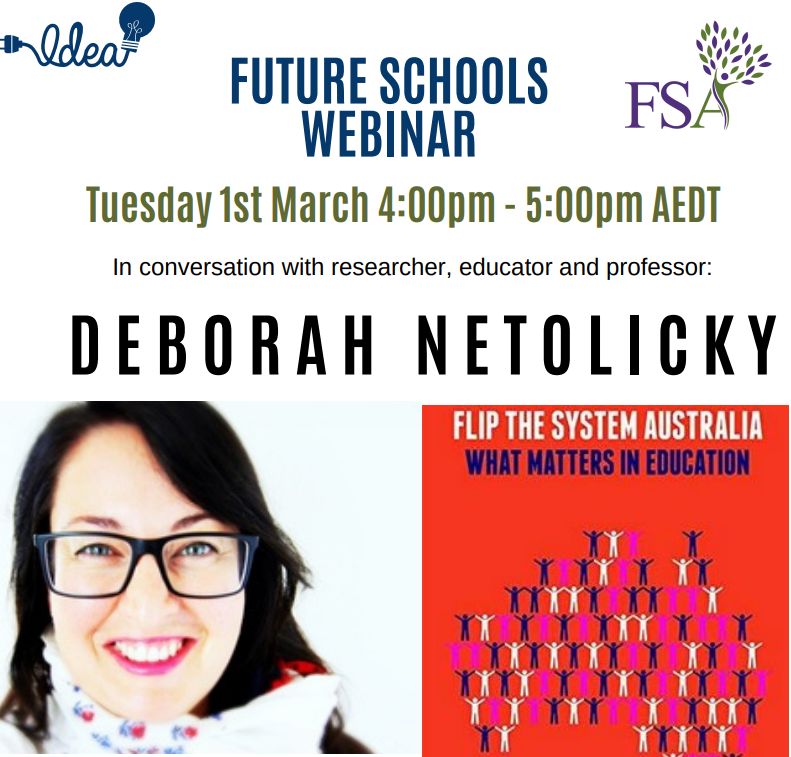
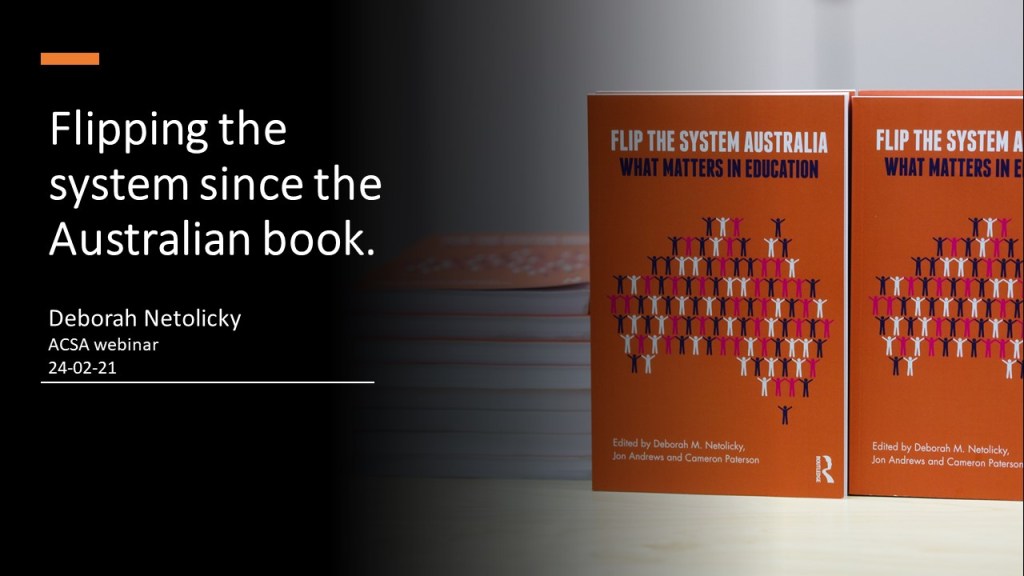
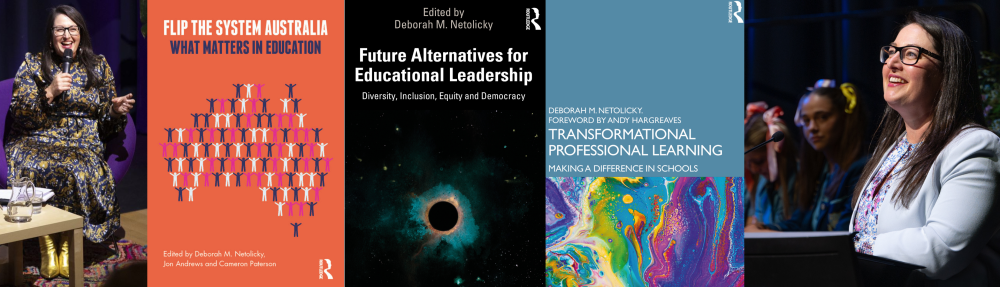
I was invited to speak today as part of the Future Schools webinar series. In particular, I was asked to engage with the notion of flipping the education system, based in my work in co-editing the 2019 book Flip the System Australia: What Matters in Education.

That was then

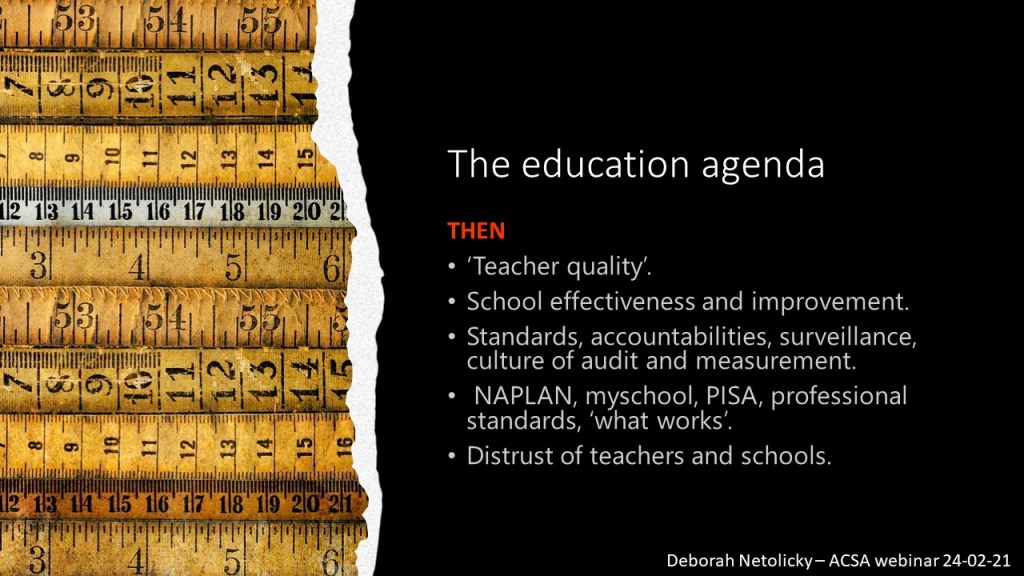
Even though today’s conversation was for a group interested in future schools and the future of schooling, thinking about it required me to reflect back to 2018, when much of the work of the Flip the System Australia book was being done. Back then, my co-editors—Jon Andrews and Cameron Paterson—and I were experiencing the then- educational environment of measurement and surveillance. This included a distrust of schools and teachers, heightened accountabilities according to quantifiable measurables in education, policy rhetoric about educational quality assurance and effectiveness, competitive comparisons of performance in high stakes standardised tests, and a push for teachers to do ‘what works’ according to simplified and dehumanised lists of apparent best practice (although, as Dylan Wiliam says, everything works somewhere, and nothing works everywhere).

Our book built upon the Flip the System books that came before ours (from the Netherlands, Sweden, and the UK) and sought to value and promote a diverse range of voices in education talking about what matters (or what should matter), over what works. We argued for the humanising of educational narratives, the democratising of educational policy and practice, and the development of deep and sustained trust in the teaching profession.

Teachers’ being and becoming

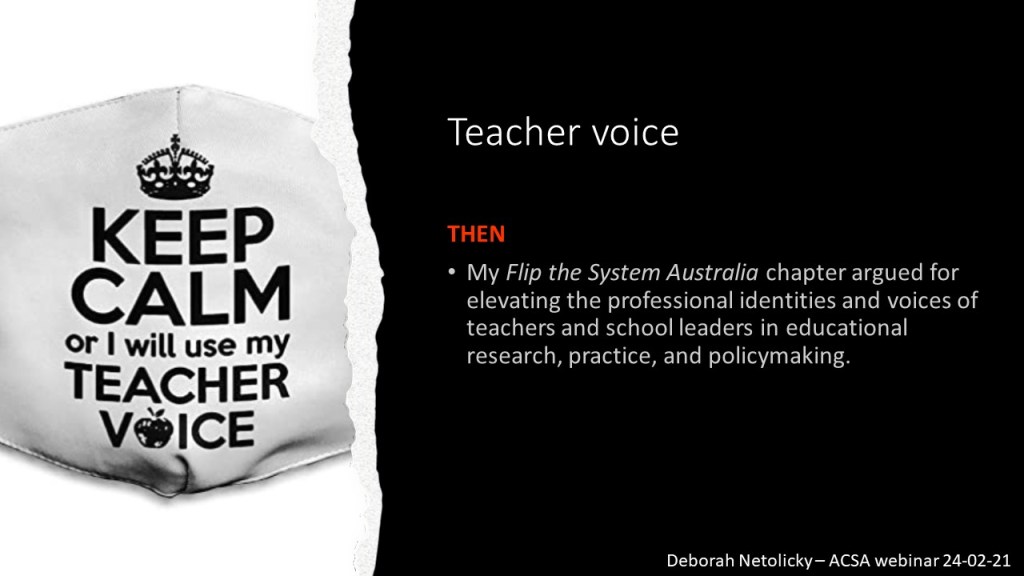
My Flip the System Australia chapter argues for elevating the professional identities and voices of teachers and school leaders in educational research, practice, and policymaking. In the chapter, I explore the quantifying and performative measuring of teacher work as limiting the complexities of that work and reducing teacher identities to a limited range of options. I define identity in my book Transformational Professional Learning as “the situated, ongoing process through which we make sense of ourselves, to ourselves and others” (p.19). It is a constant, context-embedded process of being and becoming, with professional identities inextricably linked to personal identities; we are our whole selves at work, and our lives influence our teaching.

Teaching as a performance disconnected from identity and purpose is unsustainable. Teachers need to feel that their identities are aligned with the purpose of the profession, with shared school values, and with their daily work. Rather than being required to fit themselves to a school, teachers need to feel that they truly belong in a school community in which they share a common moral purpose and are valued for their individual selves, including their gifts and imperfections.

Embracing authenticity and embedding inclusive practices are becoming increasingly important in schools. More than that, as Jelmer Evers wrote in the Foreword to our Australian book, a shared professional identity can transcend borders and nationalities, and can form the basis of reinventing democracy and our schools.

The more things change, the more they stay the same

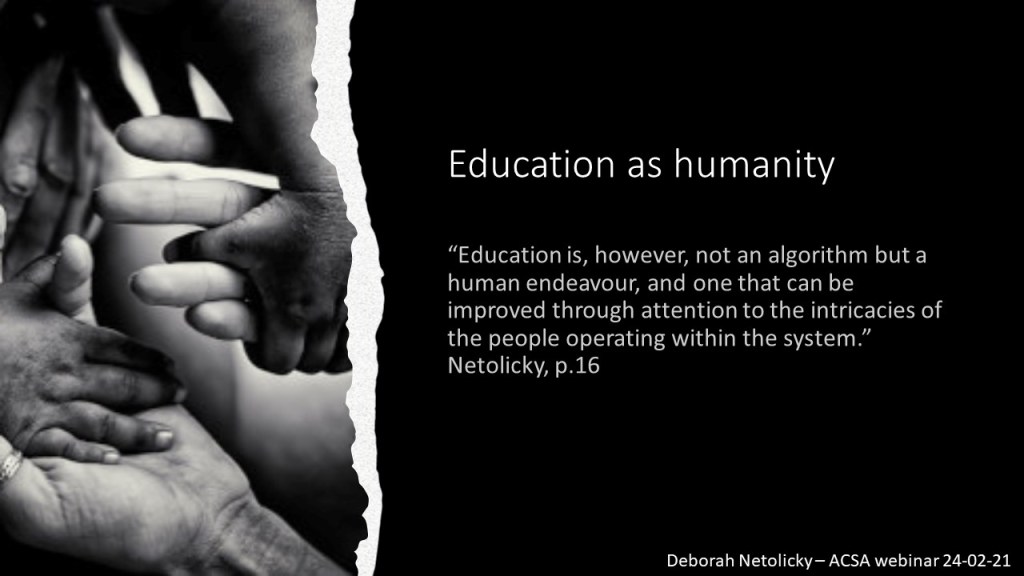
A focus on the humanity and the positive contribution of education to the lives of all young people remains the core purpose of education. In Flip the System Australia, Carol Campbell describes the purpose of education as “the betterment of humanity” (p.81). In my chapter, I say that “education is not an algorithm but a human endeavour” (p.16). The betterment and care of each child, and thereby the betterment of humanity, includes supporting children to be their best, most agentic and self-determining selves, able to make positive contributions to their communities and to the world.

In Australia, the 2019 Alice Springs Education Declaration, and before it the 2008 Melbourne Declaration on Educational Goals for Young Australians, expressed two key goals:

  • Goal 1: The Australian education system promotes excellence and equity; and
  • Goal 2: All young Australians become: confident and creative individuals; successful lifelong learners; and active and informed members of the community.

Yet Australia remains far from an education system that promotes, for all young Australians, excellence and equity.

Melitta Hogarth’s Flip the System Australia chapter reveals the contradictory nature of policies and practices that appear to be unbiased, but that perpetuate conservative, colonial values, and the silencing of Indigenous voices in education. She argues for Indigenous representation at every level of education leadership and decision making in Australia. Kevin Lowe in his chapter argues for collaborative, productive engagement between schools and Aboriginal and Torres Strait Islander communities. There remains ongoing disadvantage for Indigenous Australian children, in terms of education, social and health outcomes. Systemic inequities have been exacerbated by the pandemic and compounded by Western-centric curriculum and biased measures of educational success.

In Chapter 11 of Flip the System Australia, Andy Hargreaves, Shaneé Washington and Michael O’Connor shared findings on teacher wellbeing that now read as a prelude to the intensification of workload and the impacts of the pandemic that have followed. They commented that “teachers feel they are losing control over their professional decisions, … they are being asked to carry the mounting social problems of the world on their own shoulders, and, in the midst of all these things, they feel constrained and compromised by competencies and assessments they do not always believe in” (p.101). Their chapter asserts that there is no student wellbeing without teacher wellbeing. Since that chapter was written, wellbeing has escalated, making its way up the education agenda. Educators have been reminded of something we have always known that now needs our careful attention and action: that wellbeing is inseparably joined with learning and achievement.

This is now

Flipping the system is about flattening and democratising education. Three years on from the publication of Flip the System Australia, the world is facing unremitting and overlapping crises. We only need to turn on the news to see that our planet and democracy remain in peril. In education, governments are enacting fast policy (with teachers and school leaders often hearing about each new policy twist and turn during a press conference), with schools then quickly implementing the changing guidelines and protocols.

Although there are frightening data around teacher and school leader burnout and retention challenges, teachers and school leaders remain incredibly committed to serving their communities, through the most difficult of circumstances. There has been the need for, and therefore the rise of, school and teacher autonomy during the pandemic, as educators have made context-embedded decisions about what their students and communities need, and how to best work to meet these needs.

Schools have been revealed as places of connectedness, relationality, socialisation, and community, as well as learning. The last couple of years have led schools to develop innovative uses of educational technologies, flexible post-secondary pathways for students, and generous networks of educators collaborating together across countries and sectors to share, support and grow alongside one another. Effective leading has been shown to be an authentic practice of care and hope. Those working in schools have been literally changing education from the ground up, which was the catch cry of the original Flip the System book by Jelmer Evers and René Kneyber.

Flipping the system – Where are we now?

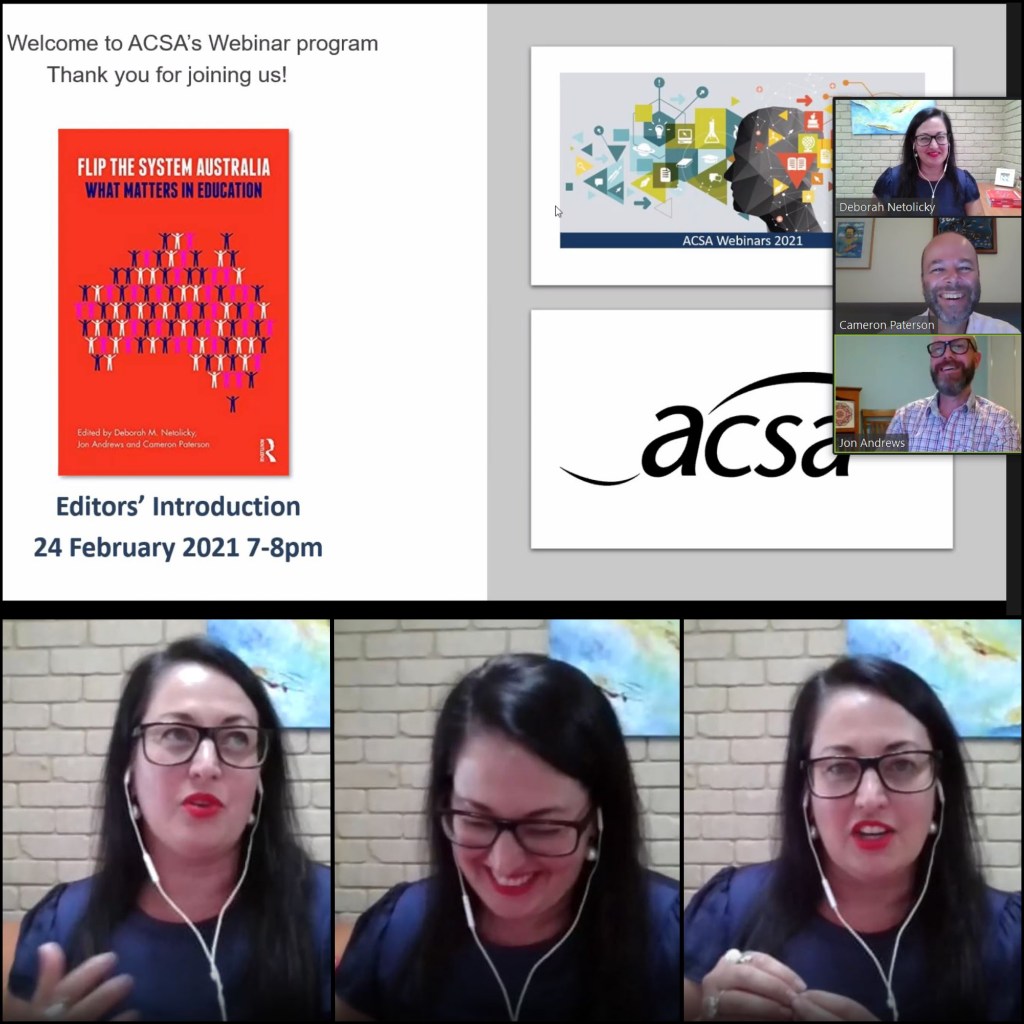
Recently I had the pleasure of collaborating with interstate colleagues Cameron Paterson and Jon Andrews in a webinar for the Australian Curriculum Studies Association (ACSA), in which we explored the notion of flipping the education system.

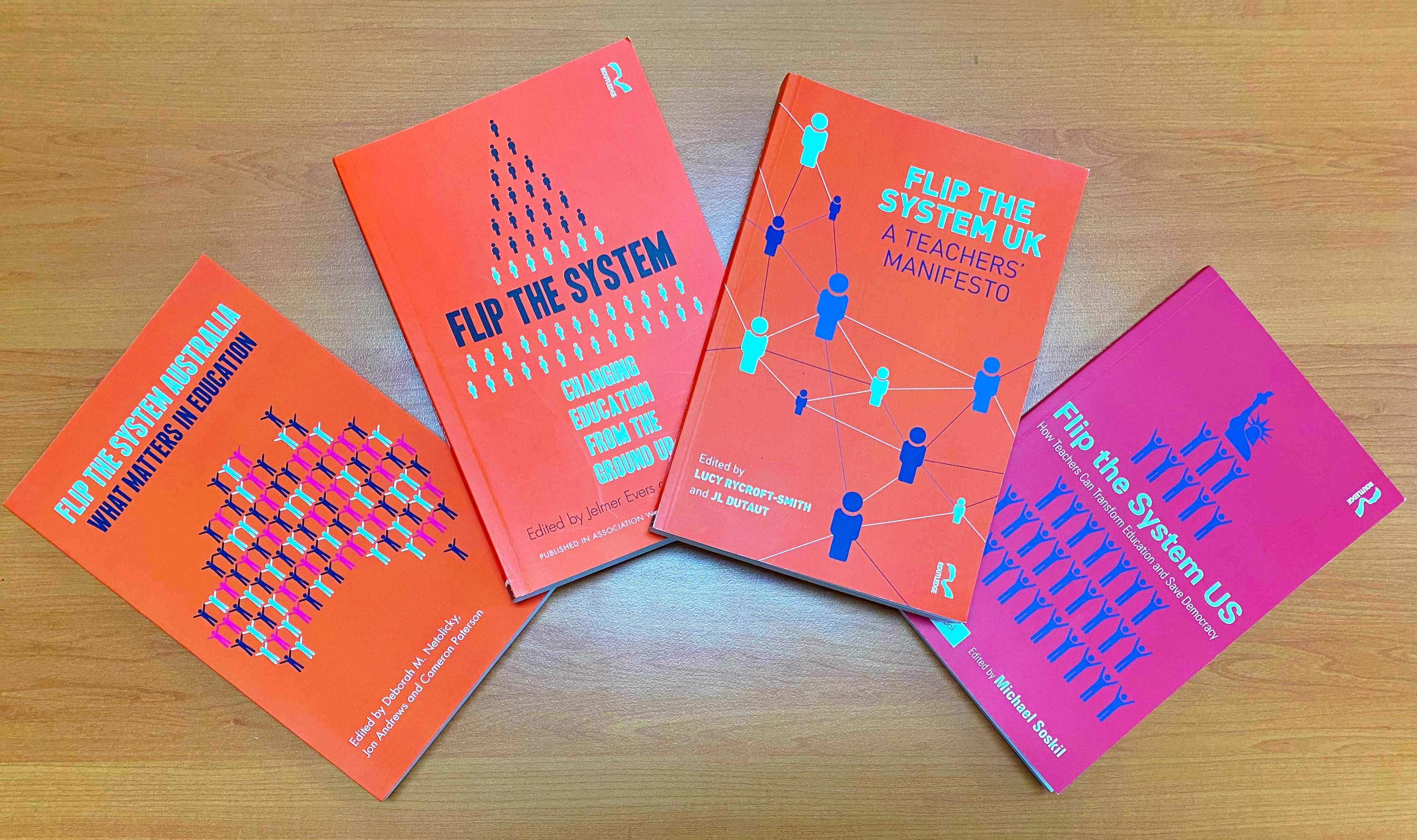
‘Flip the System’ is part of a movement, as Cameron would say, and of a series of books, including the following.

  • Flip the System: Changing Education from the Ground Up (Evers & Kneyber, 2016);
  • Flip the System: Förändra Skolan från Grunden (Kornhall, Evers, & Kneyber, 2017);
  • Flip the System UK: A Teachers’ Manifesto, (Rycroft-Smith & Dutaut, 2018);
  • Our book Flip the System Australia: What Matters in Education (Netolicky, Andrews, & Paterson, 2019); and most recently
  • Flip the System US: How Teachers Can Transform Education and Save Democracy (Soskil, 2021).

The books deal with issues around teacher agency, voice and professionalism; and democratising education and addressing inequity.

During the ACSA webinar in February, we editors of the Australian book reflected on how our thinking around flipping the system has changed or stayed the same in the last couple of years, especially in light of recent contextual factors such as the global COVID-19 pandemic and the NSW Gallop Inquiry into the work of teachers and principals and how it has changed since 2004.

In my ‘presentation’ piece during the webinar (from minutes 34-43), I reflected on the neoliberal education agenda to which we were responding as we worked on the Australian book in 2017 and 2018. We were writing and editing the book amidst the rise of the idea of ‘teacher quality’ and (often dubious, quantitative and punitive) ways of attempting to measure that nebulous ‘quality’. The education discourse was rife with talk and policy around school effectiveness, improvement, standards, accountabilities, surveillance, competition, and standardised testing. Teachers were teaching and school leaders were leading amidst a culture of audit and measurement, a distrust of teachers and schools, and an obsession with ‘what works’ (usually without any nuance around what might work where, for whom, and under what conditions). Simplistic, seductive ‘silver bullet’ solutions and hierarchical league tables (of teaching strategies or of schools or school systems) were all the rage in education. My chapter in the book was on teacher identity and teacher voice. It argued for elevating the professional identities and voices of teachers and school leaders in educational research, practice, and policymaking.

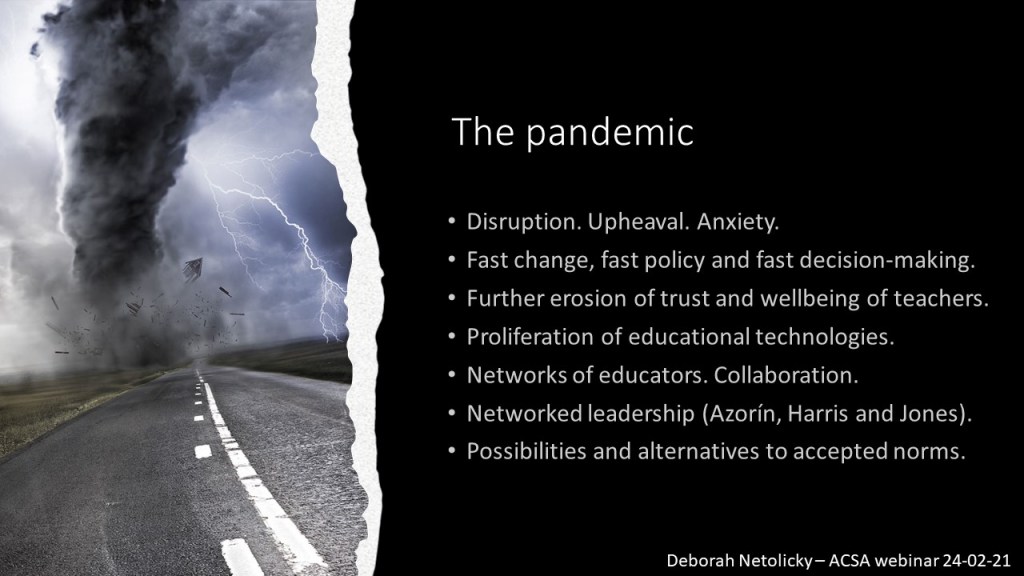
Fast forward to 2021, and the pandemic is disrupting education along with lives, families, societies, economies, and industries. Citizens have submitted to increasing government control. From policymaking to educating, we’ve been building the plane while flying it. Sometimes governments and education leaders have got it right, and sometimes not. Some challenges have arisen in education and some issues have come into sharper relief.

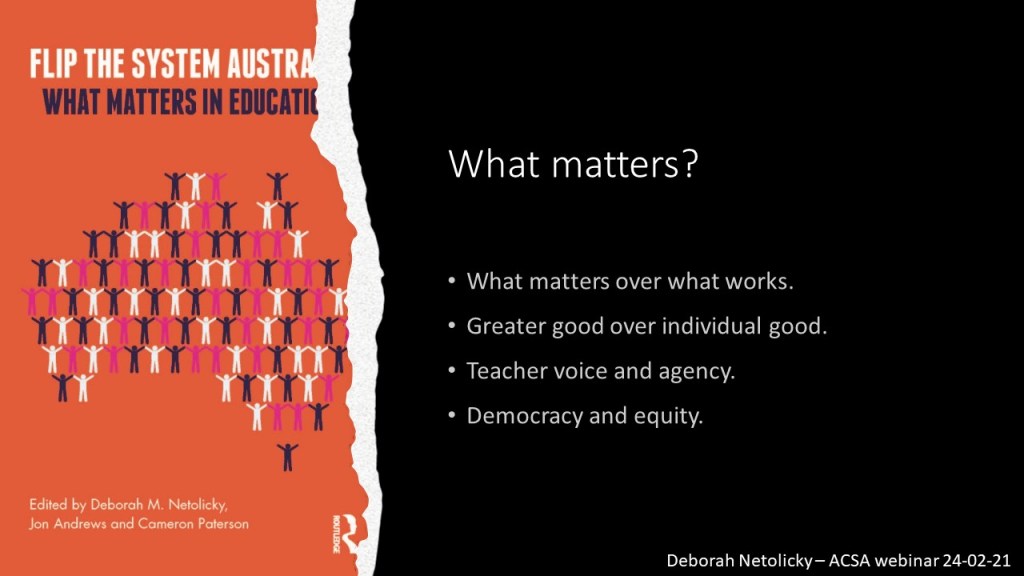
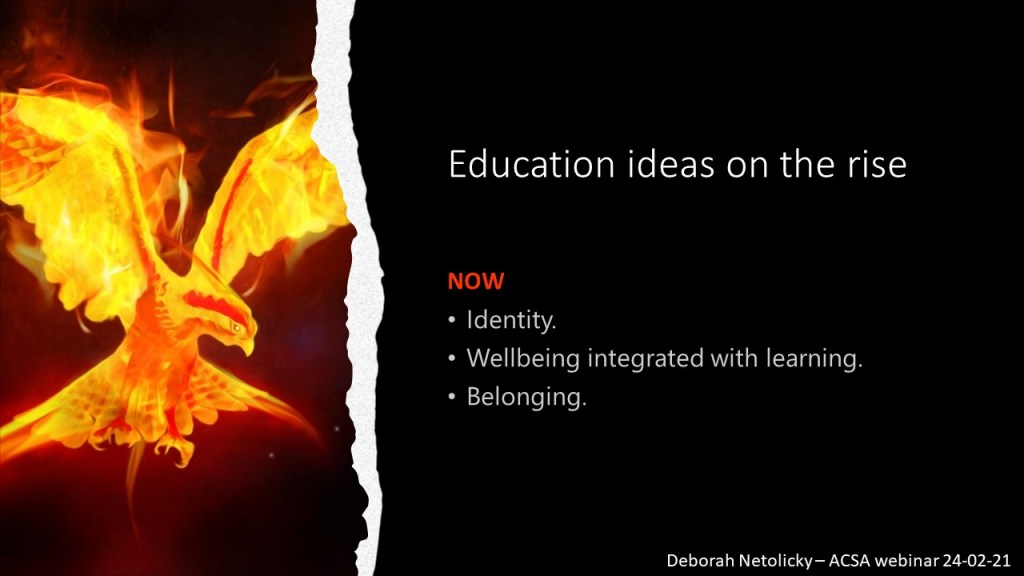
There are also opportunities emerging, such as strengthened global networks of educators working and learning together. Since we edited Flip the System Australia some ideas are becoming more prominent in education, as well as in other fields: identity, wellbeing integrated with learning, and belonging.

Some ideas around the essence of flipping the education system remain the same. We should continue to focus on what matters over what works, on the greater good over individual good, on strengthening teacher voice and agency, and on democracy and equity. We should continue to engage with education as a human endeavour.

You can view my slides above and watch the video via this link.

Staff development and wellbeing

Source: @suju pixabay.com

Wellbeing is an area in schools that is becoming increasingly important, including the wellbeing of staff. Being well, and being an organisation that supports staff to be well, is complex. This is especially true in schools where work comes in intense, relentless waves, and caring for others can deplete staff resources for looking after themselves.

Staff wellbeing is more than free food and fitness classes, although these can be nice to have. Nurturing staff wellbeing might take various forms, such as providing initiatives that support staff health, modelling sustainable work-life behaviours, maintaining predictable timelines, ensuring clear policies and procedures, streamlining communication, considering workload issues, ensuring a range of internal and external support mechanisms are available for staff, recognising staff efforts, celebrating staff achievements, leading with empathy, and making decisions with the needs of staff in mind.

Meaningful work, a sense of community, shared values, and a feeling of ‘fit’, are also important. Investing in staff professional learning, valuing staff by supporting them in pursuing their own goals, and working to develop staff sense of belonging to community, are ways to foster staff wellbeing. We feel buoyed when we feel that through our work we are part of something bigger than ourselves and that we are making a positive difference beyond ourselves. We want to know that what we do matters. And we want to be able to contribute professionally without eroding our own wellbeing or burning out.

Collaborative, vibrant cultures of trust allow staff to flourish. I have often quoted an excerpt from Susan Rosenholtz’s 1991 book Teachers’ workplace: The social organisation of schools. She describes educators in effective schools as “clumped together in a critical mass, like uranium fuel rods in a reactor” (p. 208). I love to imagine a school’s staff as a mass of fuel rods, huddled together and buzzing with an energy that feeds the group, creating fission that results in a chain reaction of positive changes rippling through the organisation.

Somehow, in 2020, in my teaching and learning portfolio at my school, we managed to review and redesign our student school reports, craft a Teaching and Learning Philosophy, and develop Learner Attributes that describe the qualities of lifelong learners that we aim to cultivate in our students. All while working with Executive and Council to finalise the school Strategic Plan. In addition, we managed to develop a refreshed staff development model, which I am thrilled to launch with staff this week as they return for the new academic year.

Importantly, the staff development model has emerged out of collaboration and consultation with staff in all areas of the school, in all sorts of roles (from teaching to administration), from multiple faculties and multiple year levels. The meetings I had last year with groups of staff passionate about the professional growth of themselves and others were always energising and left me filled with excitement for the possibilities. Emerging as it did from people within the school, I am pleased that the resulting model aligns with the best of what research says provides meaningful opportunities for professional learning, and with my own belief that staff development should be focused on growth and support, and on trusting and empowering staff to develop themselves in ways that are meaningful to them.

The staff development model builds on what has existed previously. Key features include:

  • Alignment with school strategy while honouring individual needs.
  • Opportunities for all staff, not only teaching staff. We are and educational organisation committed to the development of all our people, so staff development needs to reflect this.
  • A focus on staff individuality and agency. The COVA principles apply: choice, ownership, voice, and authenticity.
  • A range of development and review processes that include self-reflection against professional standards, goal setting, easy-to-generate feedback from appropriate stakeholders, and intentional, supportive conversation.
  • A suite of options from which staff can choose, with differentiation for career stage, professional interests, and vocational aspirations. These options were developed by a range of staff who know their colleagues and the school culture. I’m eager to see how they are received and taken up.

I look forward to building on the foundation of this model, and working iteratively with staff to improve it over time based on staff needs and feedback. Tomorrow, staff return and we will feel the buzz of the beginning of another year, grateful to be together (although at a physical distance appropriate for our COVID-19 times) and ready for what lies ahead.

INTERVIEW: Collaboration in schools

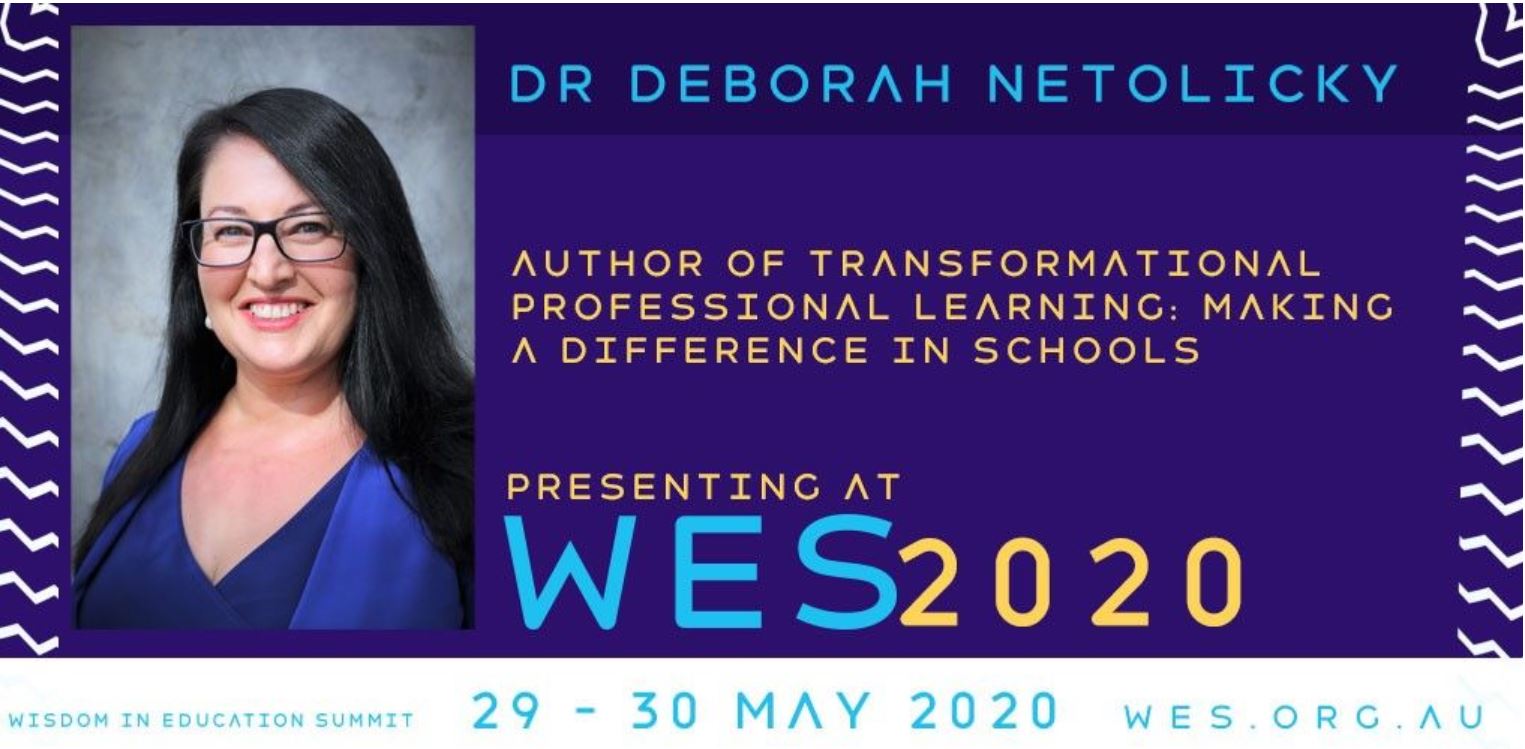
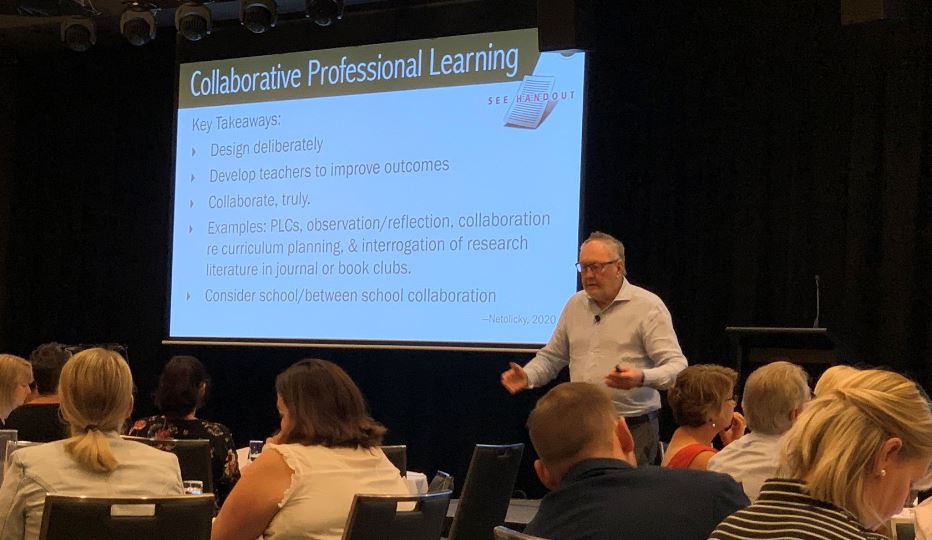
Deb WES pic

I was recently interviewed by Ben Reeves, ahead of the Wisdom in Education Summit to be held in May at Wesley College in Melbourne. At the conference, which aims to explore collaborative practices that enhance student learning, I will be speaking on collaboration that makes transformational professional learning possible. Other speakers include Andy Hargreaves, Summer Howarth, Tracey Ezard and Selena Fisk.

A snippet of the interview appears below.

This is the part where we talked about collaboration that might be transformational, rather than collaboration done as unthinking practice of being together as a group, or as a practice of feeling good rather than really doing good work together.

Ben: What makes collaboration a type of transformative learning, rather than merely a group meeting; or feeling good in a team; or perhaps least desirably, a toxic team environment?

Me: What is often called ‘collaboration’ doesn’t necessarily involve or incite learning, let alone that which is transformational. Putting a group of people in a room together does not mean collaboration is happening. Feeling good, enjoying doing something in a group, or experiencing something fun or memorable together, also doesn’t mean learning, growth or effective practice is happening. Politely agreeing with each other is another way that being in a team or group becomes about compliance and forced harmony, a kind of pretend collegiality where members nod or remain silent, waiting for a meeting to be over or avoiding conflict at all costs.

Our best and most transformational collaborative work comes when a group can engage respectfully in productive conflict with one another, using data analysis and dialogue to find a solution to a shared problem for which they take collective responsibility. High-functioning groups are those who can gracefully and robustly challenge one another within an environment of trust and psychological safety, while adhering to agreed norms of behaviour, using skills of effective collaboration, and employing deliberate collaborative structures.

So often in schools, teachers or leaders get together in meetings, teams or committees. However, these crucibles of apparent collaboration have no guarantee of actually allowing effective collaboration to occur. Sometimes we seem to be meeting because there is a meeting in the calendar, because it’s ‘what we do’, or because we’re expected to meet. How do we make meetings, team work or professional collaboration effective or even transformational? As I indicate in the response above, true collaboration requires skills, norms and intentionality.

In my book Transformational Professional Learning: Making a Difference in Schools I spend a chapter discussing collaborative professional learning and collaboration as a  vehicle for learning. In it, I explore examples such as professional learning communities and lesson study. On his recent trip to Australia, Michael Fullan pointed to the key takeaways from that chapter. In my book I outline them like this:

  • Professional collaboration can benefit students and teachers, but needs to be deliberately designed around research-based principles and practices. Putting educators in a room together is not enough!
  • Professional collaboration should be based on the clear shared purpose of improving outcomes for students, by developing teachers in meaningful and sustained ways.
  • Key to collaborative professional learning are relationships, norms, protocols, processes, and data analysis that allow productive conflict, collective responsibility, and peer accountability. Getting along, enjoying the process, or patting each other on the back, does not equal collaboration.
  • Examples of effective collaborative professional learning modes include professional learning communities, observation and reflection processes (such as instructional rounds and lesson study), moderation marking meetings, less formal peer observation, collaboration over curriculum planning, and interrogation of research literature in journal or book clubs.
  • Within school and between school collaboration should be considered.

Michael summarised these points in the following slide.

Fullan TPL pic

You can read the interview in its entirety on LinkedIn here. In addition to collaboration, Ben asked me about pracademia, praxis, identity and transformation.

Teachers and school leaders: Being better

We can always be better

As teachers, school leaders and those working in education, we have a moral obligation to the students we serve to commit to continuous improvement. We need to always strive to be better, because no matter how good we are, we can always improve. Not only is teaching so complex that it’s impossible to perfect (as Dylan Wiliam humorously explains in this short video), but with each new class or cohort, there are fresh idiosyncrasies and circumstances to consider that should influence our practice.

This idea is well worn. Charlotte Danielson explains that “teaching is so hard that it’s never perfect. No matter how good it is, it could always be better.” Dylan Wiliam asserts that “all teachers need to improve their practice—not because they are not good enough, but because they can be even better.”

How we get better

Interestingly, Wiliam also suggests that what we should be getting better at is what we’re already good at, rather than our identified deficiencies. He writes:

“The greatest benefits to students are likely to come from teachers becoming even more expert in their strengths. … when teachers themselves make the decision about what it is that they wish to prioritise for their own professional development, they are more likely to ‘make it work’.”

That is, rather than focusing on deficiencies and finding fault, teachers should be empowered to drive our own improvement and leverage our strengths.

As educators we can improve by engaging in robust processes of self-reflection, goal setting, data generation, data analysis and action. We can use data and the best available evidence to reflect on what we know, and consider how to improve from where we are now, to where we want to be so that we can optimally educate our students.

Staff development processes can support teachers by being efficient, transparent, consistent and based on best practice. Schools can provide psychological safety and cultures of trust that support teachers to be and become the best they can be.

We can also support teachers and school leaders to engage in meaningful collaboration and transformational professional learning as levers for ongoing learning and improvement.

Questions we can each ask ourselves as our 2020 school year kicks off

  • What could be a focus for ‘better’ in my teaching, leadership or education work in 2020?
  • What are some things I could do to move this forward?
  • Who or what could I access for support?
  • What is my first small step towards ‘better’ in this area?

Better together

I opened my presentation to staff this year with the following two artworks: M. C. Escher’s 1953 lithograph Relativity and Piet Mondrian’s 1908 painting The Red Tree.

M.C. Escher’s ‘Relativity’

The version of reality represented in Relativity has the appearance that everyone is going nowhere, round in circles, or in divergent directions. The figures are disconnected from each other. They don’t engage with one another, but rather accept their individual reality and head in their individual direction, on their own path, doing discrete and seemingly unconnected tasks.

There are three different forces of gravity operating in the artwork, and the characters within it exist simultaneously in their different gravitational worlds, without awareness of each other’s different situations. In schools our work can be like this: disconnected and ad hoc, with each of us moving in our own direction according to our own rules, preferences or perceptions of where we could be going and what we could be doing.

Piet Mondrian’s ‘The Red Tree’

In The Red Tree, each branch is going and growing its own way, yet each is connected at the trunk. The trunk may be seen as a metaphor for the shared vision of a school, and the branches as teams and individuals diverging off from, but still connected with, the solid central body of the organisation.

This is what I think we’re aiming for in schools: connection between stakeholders and a shared vision, while honouring individuality and what we each bring and can contribute.

We’re better together, especially when we can simultaneously unite in moral purpose, vision and direction, while allowing each individual to flourish, shine and explore their own path, supported by and integrated with the trunk.