Questioning heroic leadership: The visible-invisible hero

heroes

Our notions of heroism change over time. The construction and reception of heroes is dependent on context. Often the heroes of a time and place are only decided in hindsight when their actions and the consequences of those actions are weighed by the collective, the media or Hollywood scriptwriters.

Texts can reflect the values, anxieties and aspirations of their time and place. For example, the Star Wars franchise has changed its notions of the hero over time. Early Star Wars films had some diversity back in the 1970s. Leia was an independent hero who could stand up for herself and played a key part in the Rebel Alliance. But she was still pictured as the pretty woman handing medals to the male heroes. Lando Calrissian was a non-white heroic figure, but a more minor and less honourable character than the two white males, Luke and Han. Diversity and Otherness were also foregrounded by the multiple alien species in the films, from everyone’s favourite heroic Wookie, to sinister or repulsive villains.

Fast forward almost forty years and Rei and Finn, the heroes of the 2015 Star Wars Episode VII (which I have written about here and here), show the shift in the hero’s representation in terms of gender and race.

Meanwhile, Batman is a hero whose representation has evolved over time, from the silly unintimidating comical figure of the 1960s television show, to the tortured, vengeful, imposing figures of recent films. Newer Batmans, including those played by Christian Bale and Ben Affleck, are psychologically darker and more complex.

In 2016, heroes like Deadpool and the new Ghostbusters question the traditional portrayal of the hero. Deadpool, like the animated hero Shrek, challenges stereotypical hero behaviour. He is rude, lewd and without a noble cause. The new Ghostbusters expand our vision of how heroes might look. The Game of Thrones franchise, too, agitates reader and viewer expectations of the hero by presenting us with complex, shifting characters who dance along and frequently cross the line between heroism and villainy.

To leadership …

How is the realm of leadership affected by the fluid definitions of heroism, dependent as they are on the time and place in which any real, mythological or fictional hero is created and received?

Today I’ll be speaking at the Rise and Future of Heroism Science Conference in order to explore what insights the data from my PhD has to offer the field of heroism, and what heroism has to offer the arena of leadership.

The questions I ask are:

  • Must the school leader hero be a charismatic, selfless visionary? A beacon of bravery and a moral crusader?
  • Are alternate leadership metaphors and narratives helpful for thinking about contemporary leadership in schools?

My answer, based in the emergent themes from the interview data of school leaders in my PhD study, is that the traditional lone hero on an individualistic quest is not an appropriate metaphor for the school leader. The leaders in my study reflected notions of servant, distributed, caregiver or transparent leadership.

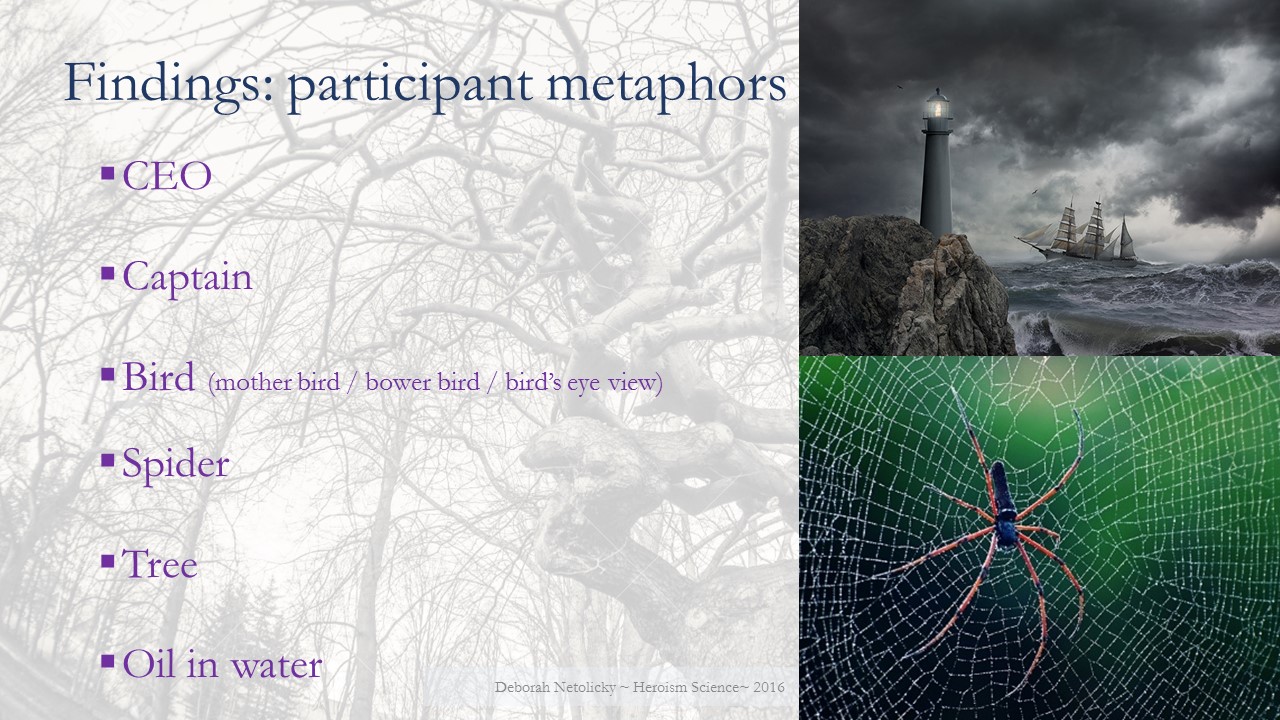
Participants offered up their own metaphors for heroic leadership, revealing that heroism when leading others can be fluid, deliberate and imperceptible.

by Deborah Netolicky

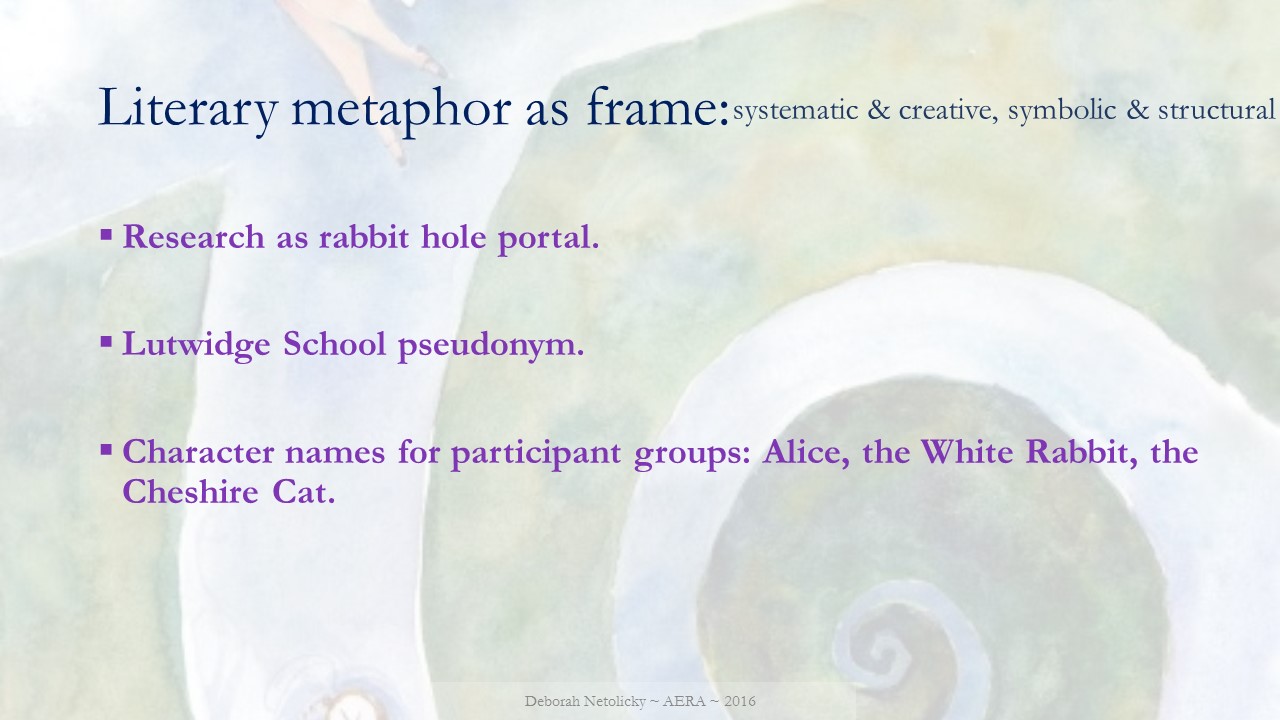
In my PhD thesis, I applied the literary character of the Cheshire Cat to emblematically articulate the visible-invisible school leader, who deliberately appears and disappears, showing only part of themselves depending on the needs of those who they lead. The Cheshire Cat leader empowers others to find their way through their professional Wonderlands. Sometimes they are the encouraging grin, the glimmering eyes, the disappearing tail. At times they are the disembodied voice, mentoring, coaching or guiding. Unlike the autocratic and unlikeable Red Queen, the Cat is a mysterious guide who operates from the aerial view of the tree, with an understanding of the bigger picture.

The image of leaders posturing as white knights of school improvement, wielding swords of change and self-promotion, is seductive but unhelpful. Heroism in school leadership can be deliberate, fluid and at times imperceptible. School leaders can focus on the collective good and intentionally navigate visibility and invisibility (although I wonder to what extent deliberately imperceptible leadership can feel like being an under-appreciated Santa Claus, and how leaders feel when their machinations to build the capacities of others go unnoticed).

My PhD suggests that leadership that serves a community or organisation, and the individuals within it, need not be highly visible. Heroism in leadership can be about deliberate invisibility, the barely discernible swish of a tail and the disappearing gleam of a Cheshire grin.

Professional identity & professional learning: Reflections on my TER podcast interview

identity is liquid (aka Little Lagoon, Shark Bay)

identity is liquid (aka Little Lagoon, Shark Bay)

Recently I was interviewed by Cameron Malcher for the TER podcast about my PhD. You can listen to the interview, which was released on Sunday (it kicks in at the 35 minute mark). My favourite part of the podcast was Cameron’s concluding thoughts that were sparked by the interview. Below is not a blow by blow account, but a reflection on what we discussed.

What is professional identity?

In my PhD I defined identity as “ongoing sense-making process of contextually-embedded perceived-selves-in-flux”. It is a process rather than a product, a constant state of becoming. It is fluid rather than fixed. It is constantly shifting, as suggested by Fred Dervin’s notion of identity as liquid. It is socially constructed and contextual; that is, identities are co-constructed with others, and we are different versions of ourselves in different situations, with different people.

Factors that make up our professional identities include our beliefs, values and assumptions. Our identities are created and rewritten through language, through the ways we tell the stories of ourselves, to ourselves.

On the blogosphere and the Twitterverse there have been arguments about the disconnect between who owns identity and labels, suggesting that some think that identity is superimposed on us by others’ perceptions, while some believe that we own and make our own identities. The socially constructed nature of identities suggests that both have merit. We write ourselves for ourselves, and our self-perceptions rely on how others perceive and interact with us (although this interactions can be rejection of others’ perceptions, as well as acceptance).

Why consider professional identity in education?

Teaching is deeply personal. Part of the reason I brought professional identity together with learning, leading, and school change is that I think they are inseparable. Looking at education reform through the lived experiences and identities of those in schools is key to understanding its impacts. Professional learning and the leading of schools need to take teachers’ and leaders’ senses of selves into account, and engage with them.

Focus of my research

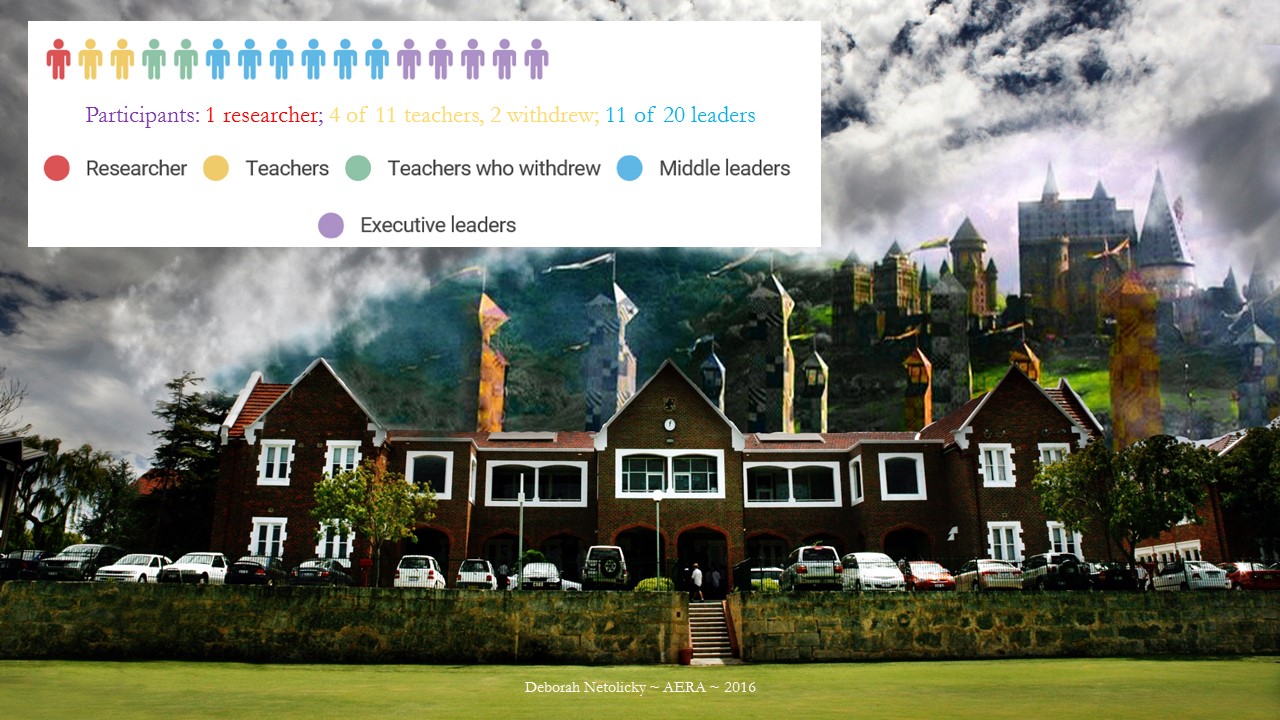
I conducted research within my own school and examined the stories of 14 teachers and leaders, including myself. The background context was a school-based teacher growth initiative.

I used narrative research to explore how these educators’ professional identities interacted with their learning and with school change. I was interested in what it is that shapes and shifts educators’ professional identity perceptions and in what ways schools and systems might work with a greater understanding of educator identities when designing and implementing education reform.

My narrative approach involved interviewing participants in ways that encouraged storytelling, including using coaching protocols, and then storying those data. It required me to be reflexive as the researcher. The experience of my PhD was personally and professionally transformative for me. I loved it, and it was incredible professional learning. In particular, the luxury of listening to educators’ stories was a joy and a privilege. I presented at AARE last year on my creative, literary approach to storying data, and this Saturday I’m presenting on my ethical decision making at the researchED conference in Melbourne.

Research findings

My research found that:

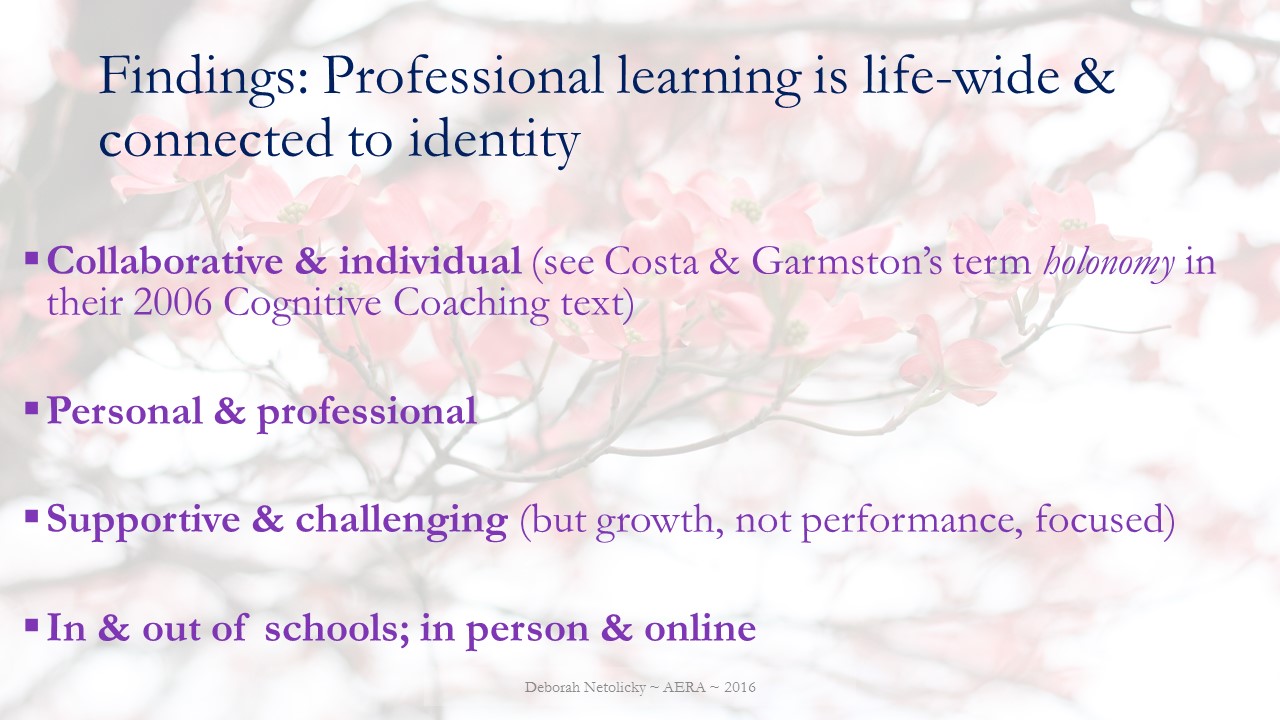
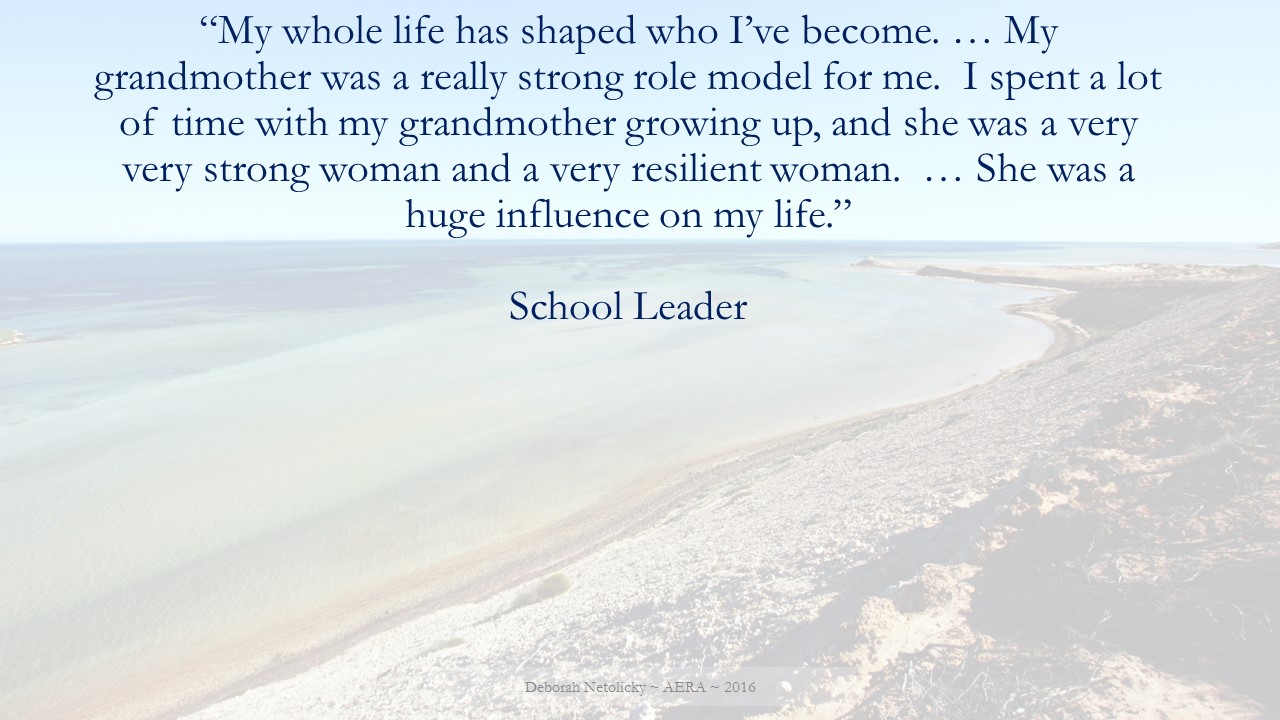
  • We professionally learn throughout our lives. Our professional learning encompasses life moments that are professional and personal, formal and informal, in schools and out of schools, singular and collaborative. Professional are shaped by good and bad experiences, by role models and anti-models.
  • Learning which taps into who educators see and feel they are, has the most impact on their beliefs, thoughts, behaviours, and practices.
  • Coaching and being coached is identity shaping, shifting teachers’ and leaders’ beliefs about learning and teaching.
  • The Danielson Framework for Teaching can be a useful tool for teacher self-reflection when used by teachers for their own growth.
  • School reform and school cultures which trust the capacities of teachers to reflect and improve is empowering and capacity building.

Implications of my research

With the caveat that my PhD was highly contexualised (considering the nature of the school and individuals I studied) the findings have something to offer the education world.

Firstly, there is a need to broaden the definition of professional learning, to allow teachers and schools to think more broadly about what it is that transforms educators, and who drives the professional learning of teachers. In my own leadership practice I am wondering how professional learning might be more autonomous and individualised. About how professionals might choose and follow, with support and opportunity, their own growth trajectories. About how schools and systems might acknowledge and encourage heutagogical (self-determined) learning.

Secondly, schools and systems can work from their own contexts to design and slowly iterate models of professional learning, from the bottom up and the middle out. As many scholars point out, effective education reforms are contextual. They cannot be lifted from one school or nation and dropped on another. Change in schools should be at a slow evolution-not-revolution pace, and based in assessing available evidence and current context.

As a result of my reading and research, I advocate for distributed and empowering leadership in schools, and school systems that trust teachers. I am a card-carrying, flag-waving fan of the Flip the System movement, which champions the agency and voice of teachers within their own systems. Teachers and school leaders have the internal capacity for analysis, reflection and growth. The individual should be honoured, valued and supported, within the holistic collective of the organisation and the system.

On professional learning: My #AERA16 presentation slides

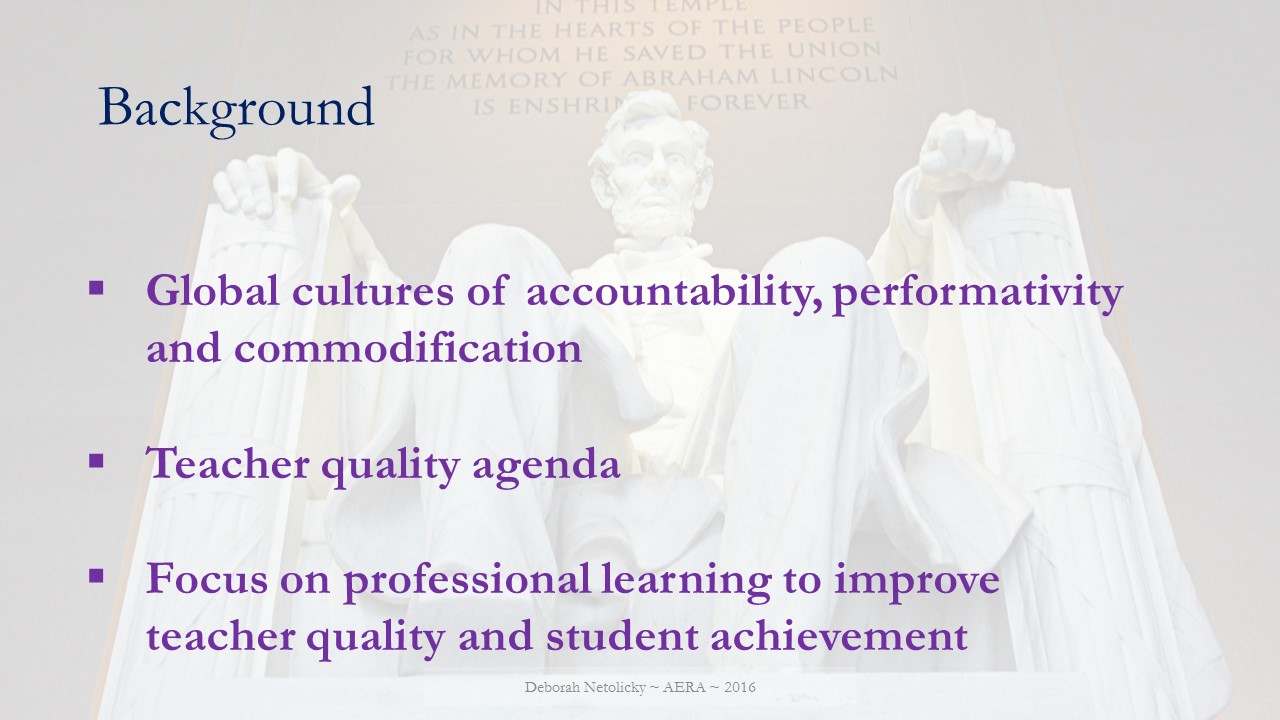
Yesterday I presented a paper in Washington DC at the American Educational Research Association national conference, in its 100th year. This particular paper outlines my PhD’s general findings around professional learning for teachers and school leaders. It was great that more than 50 people turned up to the session, in which four papers on professional learning, including mine, were presented. The papers were a complimentary combination that really spoke to each other; I learned a lot from my co-presenters. We had plenty of generous feedback and robust discussion which spilled out into the hallway for almost an hour after the session ended, and then beyond.

My full paper will be available in the online repository when the 2016 papers go live. In the meantime, here are copies of my presentation slides. The slides were designed for me to talk to, not read from, so much of the content is thin. That is, they’re light on text and light on references (see the paper for more depth), but you’ll get a sense of my main points. Of course I didn’t get through them all and ended up skipping over the participant quotes (19 slides in 12 minutes? What was I thinking? #overexcited #lessonlearned).

If you’re interested in more, my dissertation, which looks at professional learning in more depth, as well as its interactions with professional identity and school culture and change, can be downloaded here.

From my experience so far I can highly recommend the AERA national meeting. It’s a friendly conference with an impossibly wide range of interesting and important work being shared, and connections being made.

Slide1

Slide2

Slide3

Slide4

Slide5

Slide6

Slide7

Slide8

Slide9

Slide10

Slide11

Slide12

Slide13

Slide14

Slide15

Slide16

Slide17

Slide18

Slide19

Teacher efficacy, agency & leadership #aera16

iconic Abe

iconic Abe

This afternoon I spent 3 hours at two round table sessions at AERA in Washington DC, hearing about and talking about teacher leadership and agency. Then on the way home from drinks with Sarah Thomas, who I know through Twitter and Voxer, I stumbled across the #satchatOZ chat on Twitter which was talking about teacher leadership. So whilst I’m jetlagged and brain-exhausted from a day of conferencing, I want to get my raw thoughts down before they’re overrun with tomorrow’s thoughts (with some of my photos, because: DC).

Three terms that came up today in the two roundtable sessions I attended were: efficacy, agency and leadership. Self-efficacy is about how well someone thinks they can do something; a self-belief in their own capacity. Agency is the capacity to act as well as the acting itself; to be an agent is not just to have the internal capability to do, but to actually do the doing. I wonder, can someone be an active agent, capable of action and change, without the self-belief in their capacity to do so? Possibly. Can someone have a sense of self-efficacy, but without the agency to be effective? Probably.

Leadership, meanwhile, is a slippery word. People can be leaders by name or position, but this doesn’t guarantee that people are led by them. Leadership and agency are not just individual, but also collective. Can someone be a leader without a followership? A leader can be defined by their title, but more often they are defined by their influence on others, their organization or the system in which they operate. Teachers without official positions of responsibility can be, and are, leaders in their fields. They are active agents who effectively translate their beliefs and purpose into reality through deliberate and effective action.

In leadership and agency in schools, context is a key consideration. The holonomous* environment of a school is one in which the sum and the parts are inseparable. If schools want teachers to be reflective, growth-focused and agentic, they need to trust in their teachers and provide an environment in which risks and exposing one’s vulnerability are ok. In a culture of teacher-scoring and fear, teachers are less likely to be agents of positive growth and more likely to be compliant servants to a punitive system. Movements like #flipthesystem, which are explored in Jelmer Evers and René Kneyber’s book, advocate for further teacher voice and action in education reform. Localised reforms like my school’s teacher growth model are practice-based examples of in-school teacher leadership in action.

In the introduction to Linda Darling-Hammond’s presidential AERA address this afternoon, she was described as identifying as a teacher, but having become a researcher so that she could be a strong voice listened to by policy makers and powers that be. She saw research as a way enact and propel change.

DC daffodil cityscape

DC daffodil cityscape

While I didn’t frame my PhD research through the lens of teacher leadership and agency, it could be seen through that lens. I explored teachers and school leaders’ perceptions of identity, learning and school change, within a particular context. That context was the coaching intervention I was leading at my school, a formative growth-based model of teacher growth and development.

What emerged from my study, when looked at in terms of teacher leadership and agency, was that teachers are deeply tied to their senses of self within their senses of their context. That is, teacher self-efficacy and agency develop when teachers feel an individual purpose, an alignment with context and that they are empowered with voice and influence in their own organization. In this case, the school empowered teachers to be active agents with a voice in school reform. Additionally, the formative aspect of the coaching model for growth was fiercely protected; teachers are not scored and judged, but are able to collect lesson data and participate in coaching conversations in order to grow themselves. This kind of trust requires some relinquishing of power from those at the traditional hierarchical apex.

As someone who connects with others on Twitter and writes on this blog, I think that technology and social media give us tools to develop our teacher voice and engage in conversations about education. I know of teachers who would be considered leaders both in their schools, and in the wider land of education, due to their public thinking, writing and advocacy. I also know those who are known more for their leadership in the social media or conference arenas, than in their own day-to-day school contexts.

As others have noted, Twitter flattens hierarchies and empowers users. Bonnie Stewart’s research into academic Twitter found that there are different spheres of, and criteria for, influence on Twitter than in higher education institutions. The same is true in other educational contexts. Government ministers are drawn into public conversation with teachers on the ground. Social media and blogging can be leveraged by teachers to allow them voice and agency, to advocate or agitate. As Greg Ashman and Rory Gribbell note in their recent blog posts, bloggers can and have been agents of political and educational change, a pluralistic chorus of voices to which people are listening.

Teachers can and should be advocates for their students and their schools. They can and should pursue research and opportunities to understand, revise and reimagine what is known in education. Those leading schools and systems in official roles can encourage teachers’ growth and leadership by questioning traditionally hierarchical power structures and considering more distributed and inclusive ones. In this way, teachers can be encouraged to lead within their contexts, instead of feeling as though they are fighting against the system or preserving their survival within it.


* Check out Costa & Garmston’s 2006 Cognitive Coaching text or my PhD dissertation for discussion of holonomy.

mural at the Library of Congress

mural at the Library of Congress

5 things I learned in 2015

Beware the barrenness of a busy life. ~ Socrates

Epiphanies and moments of clarity can be simple and, on reflection, obvious. The following list of ‘5 things I learned in 2015’ may seem like statements of the bleeding obvious. They are nothing new, and yet this year I’ve seen new refractions from, and noticed more minute details of, these simple truths. They have been affirmed for me this year through my experiences of being and becoming. Of teaching, leading, parenting, coaching, being coached, researching and writing.

local café wisdom

local café wisdom

1. Doing many things at once can work, but it’s also important to take breaks.

In the last few years I’ve been working 0.8 of a teaching and leadership job at a school, parenting two pre-schoolers and working on my PhD (now submitted – woot!). While I always had a sense that this was working for me in its strange busy way, it wasn’t until my first writing retreat this year that I understood how much. On my retreat, I found it difficult to stay on my one task – editing the PhD thesis draft – for a full weekend. I realised that my routine of intense short bursts of PhD, in among the other many things in my life, worked for me. These short, regular, time-constrained bursts of energetic PhD work were intensive and focused. They felt like an indulgence, some intellectual ‘me-time’ in which I could luxuriate, a brain-bending haven from my other responsibilities. It helped me to love my PhD, while also appreciating the specialness of my teaching, leading and parenting roles.

Yet, as I discovered, relentless busyness is not sustainable. Breaks are required. Real, curl-your-toes-in-the-sand, unplug, breathe deeply and love abundantly kind of breaks. Nourishment for wellbeing. Care for self and others. Time to breathe.

2. Welcome resistance & engage in respectful disagreement.

On my blog, which is now 16 months old, as in Twitter and in my professional life, I have been becoming more comfortable with, and encouraging of, disagreement, although I prefer dissent to be served in a respectful, articulate and reasoned manner. And I prefer disruption which emerges from deep purpose, rather than trendy buzzwordification. Last year I completed the Adaptive Schools Foundation course, which champions graceful disagreement as a key element of high-performing groups. I’ve written a few blog posts which err on the side of controversial. I’ve engaged in Twitter debate. I’ve experienced my first peer review comments from academic journals, and attempted to take critique as an opportunity to strengthen my work. And in my role leading and implementing a school coaching initiative for teachers, I have welcomed the contributions of those who are resistant to the change.

I’ve found those individuals who might be dismissed as ‘resistors’ or negative voices, to be important ones worthy of close listening. I find myself asking those who disagree to take the time to explain their view to me. I listen intently, wondering, ‘What can I learn here? How might this help me to make what we’re doing better, stronger, and meaningful for a wider range of people?’

I am reminded of this line of Richard Bach’s from his novella Illusions:

There is no such thing as a problem without a gift for you in its hands. You seek problems because you need their gifts.

It is often in engaging with those who disagree with us, that we are taken to new places in our own thinking, helped to consider alternate perspectives, or are able to find solutions which we may otherwise not have reached.

3. Trust individuals. Believe in their capacity. Choose empowerment.

Punitive accountability measures which promote fear and compliance can only undermine teachers’ and school leaders’ professions, identities and practices. Through my experiences of coaching, my PhD research into school leadership and organisational change, and my observations of systems of teacher evaluation around the world, I have become increasingly convinced of the need to focus on empowerment and growth, through support and trust. It’s the belief upon which my school’s coaching model is based.

4. Connections with others are powerful.

We know that connecting with others is powerful. One of my ‘three words’ for 2015 was ‘sharing’ and another was ‘presence’, both words which speak of connecting with others and being present in relationships.

This year, not only have my personal and face-to-face professional relationships been impactful, but so have connections I have made online. For the first time this year, I began to meet ‘in real life’ individuals I’ve connected with on Twitter and through my blog. Catching up over drinks, breakfast or the conference room had been a seamless transition from tweet, blog post or Voxer message, to in-person banter, support and inspiration. I’ve engaged in wonderful blogging conversations. I’ve become bewitched with the potential of our interconnectedness and the ways in which technology might help us grow support networks and knowledge webs.

5. Teeny regular steps add up to a long journey.

My PhD was the thing that brought home this truth to me. Over three years I plugged away with little step after little step, finding stolen moments of doctoral time in the cracks in my days and nights. Regular, persistent effort. Sometimes forward; sometimes back; but maintaining forward momentum. And then I looked back along the path I’d walked and found that it added up to a thesis. So my big lesson was, just put one foot in front of the other. Keep going!

sunset, Gnarabup

sunset, Gnarabup

Coaching: My state of play ~ #educoachOC

Let’s open the door for teachers to power us forward in defining the most promising paths for public school improvement. ~ Kim Farris-Berg & Edward Dirkswager, Flip the System

MET rooftop, by @debsnet

Tonight’s inaugural #educoachOC Twitter chat, of which I am a co-moderator, is titled ‘State of Play’. That is, my co-moderators and I are intending to gauge where our professional learning network are at in their coaching journeys and contexts, and to facilitate the sharing of stories.

In the lead up to the chat, I thought I would consider my own ‘state of play’; where I’m currently at with coaching.

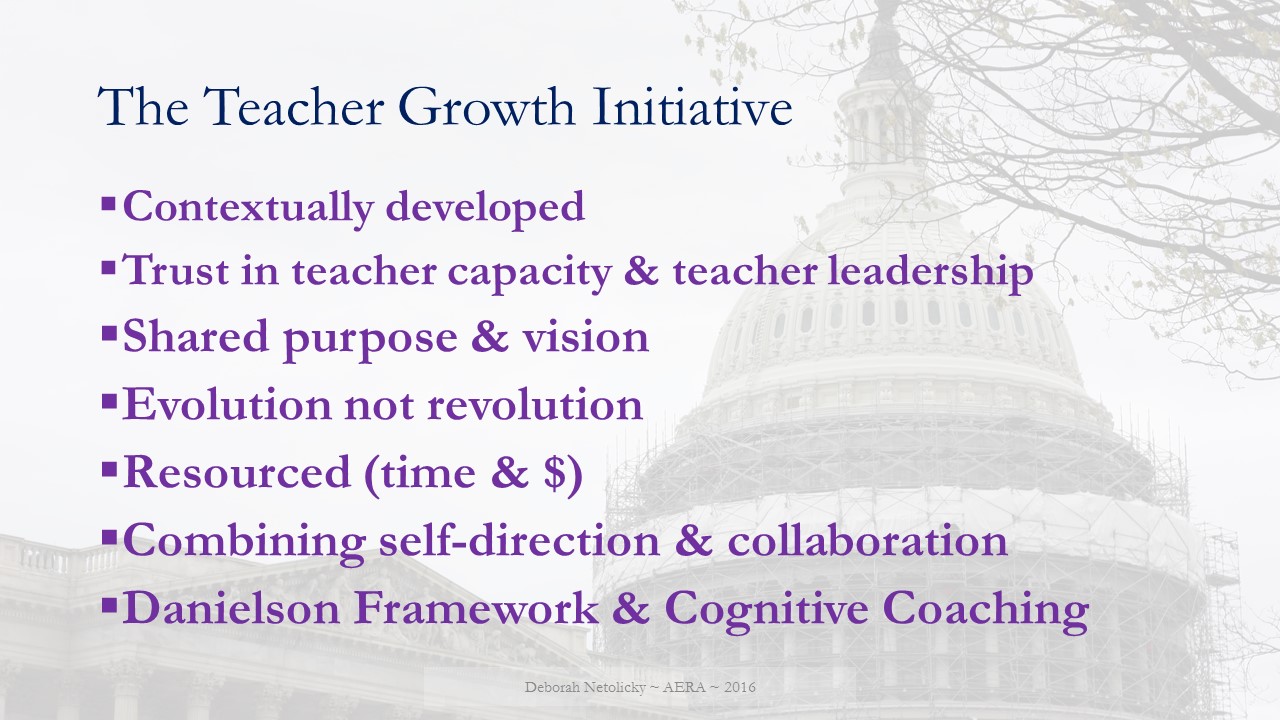
My current role in my school involves, in part, bringing current research literature into the school context, and making it accessible to staff, leaders and the school board. My main brief has been to research, design and enact a bespoke, context-specific teacher growth model which brings that research to life. That is, I’ve been working with teachers, leaders and consultants to tailor evidence-based school-aligned professional growth practice, for and within my school’s context. This work has come both from the top down (initiated by the principal, and emerging out of the school’s vision and strategic intents) and the bottom up (driven, designed and piloted by teams of teachers).

In 2012, when I wrote a research paper for my school on how to improve teacher quality, I began looking seriously at coaching literature. In addition, in October 2012 I began my PhD study (I’m hoping to submit my thesis next month!) which asks what it is that shapes teachers and school leaders. What transforms professional identities and practices? What incites growth and change in educators? Part of the answer to these questions lies in coaching. I’m about to submit an article to an academic journal which outlines my research findings around coaching as a tool for professional growth.

As part of the training for the enactment of our teacher growth model, in 2013 I did the Cognitive Coaching Foundation course for the first time, as this was the model of coaching my school decided upon. I did the course again in 2014, and again this year. While I have repeated the course mainly for team-building reasons, I have found that re-visiting the material and the conversations has allowed me to add nuances and layers of complexity to my coaching practice. It has allowed me to internalise some of the skills and tools, and to refine others.

Our Teacher-Coaches (a small team of teachers trained and practised in Cognitive Coaching, lesson observation techniques and the Danielson Framework for Teaching – my elite squad!) and I began with piloting and iterative design-and-refine stages in 2013 and 2014. Across 2013-2014 there were 19 Teacher-Coach team members and an additional 11 teachers who volunteered to be coached; 30 teachers – from across year levels, subject areas and career stages – experienced the pilot model.

This year we have moved to a fully implemented model in which all teachers at our school are involved in a coaching cycle every year. The cycle is three-yearly, so in Years 1 and 2, teachers are coached by a Teacher-Coach, and in the third year, teachers are coached by their line manager. This third year is based in coaching, but managers also draw from consultative and evaluative toolboxes as appropriate.

My coaching dream is twofold. I have a ‘future perfect’ for myself as a coach, and also for my school. For me, I hope to continue to grow my own practice, to become a masterful coach who is able to paraphrase and craft questions in ways which clarify and extend a coachee’s thinking, while paying attention to where a coachee is operating and where they might be able to cognitively move. I’d like to be able to help even the most reflective practitioners to experience what Cognitive Coaching calls ‘cognitive shift’, in which the coachee has an ‘a-ha!’ moment of realisation which allows them to move beyond their current state.

For my school, I hope to see the continued development of a coaching model of teacher growth which is based in a positive belief in the capacities of teachers to choose their own trajectories of learning, to analyse and grow their own practice, to reflect deeply.

This year I have seen teachers take their own lesson observation data and share it with colleagues and line managers in order to start important conversations and share practice. I hope to continue to see the power of data to transform, not only individual practice, but collective capacity and professional community as an organic learning mass.

So, that’s a little about my own ‘state of play’. I look forward to hearing more tonight about where others are in their coaching journeys. The chat’s questions can be found here. Happy coaching!

Observation to transformation: The power of classroom data for teacher growth

What we see depends mainly on what we look for. ~ John Lubbock

In my posts about my school’s teacher growth model, a growth-focused coaching initiative which sits alongside other professional development and evaluation work at the school, I have tended to focus of our use of Cognitive Coaching and the Danielson Framework for Teaching. As our model is being implemented this year, however, another aspect of the process is emerging as transformative in its own right: classroom data.

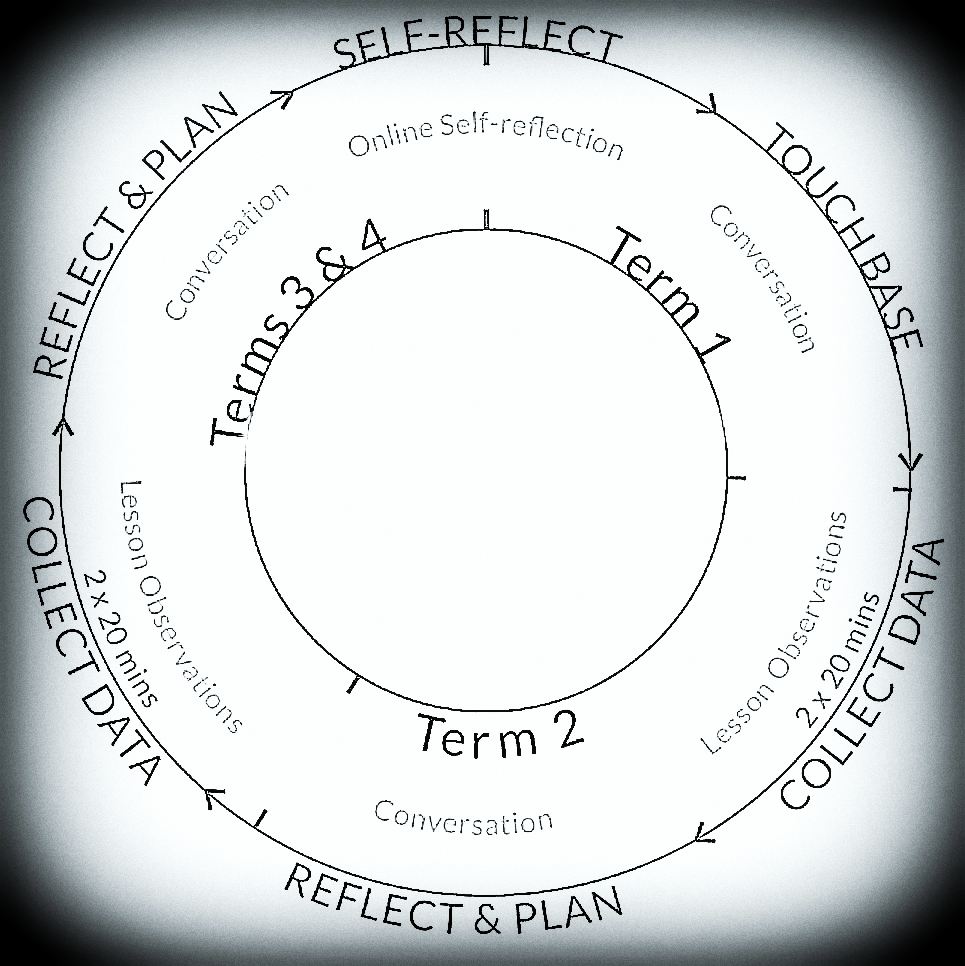
To explain how we use data in our collaborative coaching cycle, a one-year cycle looks like this:

a visual look at our coaching-observation cycle

a visual look at our coaching-observation cycle

  1. Self-reflect: Complete self-reflection against Danielson Framework for Teaching.
  2. Touch base: Pre conference with Teacher-Coach, identifying possible foci, deciding on type of lesson data to be collected.
  3. Collect data: 2 x 20 minute observations.
  4. Reflect & Plan: Post conference with Teacher-Coach following the Cognitive Coaching reflecting-into-planning conversation map and using Danielson Framework for Teaching.
  5. Repeat 2, 3 and 4.
  6. Self-reflect: Complete self-reflection against Danielson Framework for Teaching.

In this post, I would like to focus on Step 3, data generation.

You’ll notice that we use multiple short observations and the Danielson Framework for Teaching, as supported by the findings of the Measures of Effective Teaching study. A number of short observations mean that teachers build up a series of snapshots of the kinds of lessons in their classrooms, liberating them from feeling like ‘this 20 minutes is representative of all of my teaching all of the time.’ It is a moment in time on which to reflect.

*               *               *

What classroom data is generated?

Generating lesson data is a crucial part of our coaching teacher growth model. While all teachers are expected to have classroom data collected for the purposes of their reflection on practice, this is differentiated in the sense that the teacher decides what sort of data will be collected, depending on what they would like to know about their lessons. Below are the main types of lesson data we have been using.

Non-inferential observation notes

These notes usually look like verbatim scripting. That is, the observer takes down what they see and hear in a lesson. No judgements. No praise. No criticism. Just observed sights and described sounds. They include times and may also include mapping of students or classroom movement. Our coaches are trained in this kind of observation note taking. It can be challenging to take self and own biases out of lesson data, leaving just what happened for the teacher to do their own reflections and evaluations.

Observation notes are useful for looking at instructional clarity, questioning, student discussion and student group or individual work. In the case of the latter, the observer may go to students or groups and observe them or interact with them, recording interaction and responses. This means that observers can record those parts of the classroom where teachers are not. It also means that an in-class observer can glean details of student work and conversation which a video would not pick up.

A caution about this kind of note taking is that the observer bias does appear in what the observer chooses to take down. For instance, in a fast paced classroom discussion, often an observer needs to make a choice between capturing the teacher’s or the students’ responses.

The benefit of notes is that the run of the lesson is written down in black and white, without the distractions of watching multiple elements in a video.

Video

We have a few video options available to teachers for the purposes of lesson data collection. Still video. 360 degree video. SWIVL video. These each have their pros and cons, and require choices to be made, such as whose audio is picked up, or whose movement is tracked.

The 360 degree video is a more obvious piece of equipment in the classroom, but it simultaneously shows teacher and students. The SWIVL makes it easy for teachers to collect data on their iPhone or iPad, but as the camera follows the audio lanyard it privileges the person wearing it, usually the teacher.

Video is great for teachers wanting to see their own teaching, including movement and wait times. Our Physical Education, Music and Languages teachers love it, but so do those in other learning areas and various year levels.

Audio

Some teachers want laser like focus on what is said in their classrooms. They are keen to listen closely to their questioning or instructional clarity, and to their students’ responses, for instance. Like verbatim scripting, by isolating audio, teachers can pick up on very specific aspects of their teaching, although others will be missed.

*               *               *

Supplementary data include planning documents, goals and reflections, student work samples, student feedback and student achievement data. All data have their inherent biases, benefits and disadvantages. We are finding that mixing up the data so that teachers experience their classrooms in a variety of ways may be more effective than continually repeating the same data collection strategy for the same teacher.

Importantly, all data are owned exclusively by the teacher for their reflection and use. They are not for coaches or managers to use or publicise outside of the coach-coachee relationship. Focus groups with coached teachers at the school have revealed that teachers appreciate the choice and ownership over their classroom data. The trust in the coach-coachee relationship is paramount.by @debsnet

So while I have been focusing my own practice on refining my coaching skills, something else has been happening alongside. The data has been a tool for teacher learning and development, both in its own right and as part of the coaching cycle.

I’ve noticed that when, as coach, I get the data right, the conversation seems to almost take care of itself. The data, in these cases, has set off the teacher’s thinking, reflection, planning and action, before I turn up for the post conference.

In other conversations, looking at the data in detail, with well-crafted questions, can bring teachers to the point of an ‘a-ha’ moment or a change in practice. At times it is looking closely at the Danielson Framework for Teaching rubrics which allows teachers to see alternative teaching and learning possibilities, and refines their precision of language around practice. Other conversations require deeper coaching questions which drill into why lessons went the way they did, how teachers made decisions in their classrooms, what criteria they used to make those decisions, or what might have be going on for particular students in the lesson.

The data also provide an important ‘third party’ in the coaching conversation, allowing the conversation to be depersonalised and focused on the data, not the person.

Data is powerful stuff. And lesson data ‘done right’ – owned by the teacher, objective and giving the teacher a new perspective on their classroom, themselves and their students – can be transformative.

Good One, by @debsnet

Implementing a coaching model: One school’s approach

If threat, fear, pain even in the most minute portions are perceived, neurological and chemical processes occur which prepare the system for survival, not reflection. ~ Costa and Garmston

tulips in Monet’s Giverny garden: a beautiful example of individual and collective growth

Coaching has contested definitions and a range of models which include instructional coaching, peer coaching, literacy coaching, GROW coaching, Growth Coaching and Cognitive Coaching. In education, schools and systems have a variety of approaches to adopting and rolling out coaching models. In the lead up to Saturday’s #satchatoc Twitter chat on coaching, I thought I would write this post to outline some of my views. I know they are hard to articulate in 140 characters!

This post is based in my research and experience, and are of course coloured by these. Bear in mind when reading that I am one person, in one context, with one set of experiences, conducting one study. It’s one perspective of many. I enjoy being part of a wider conversation around coaching.

My coaching training is in Cognitive Coaching (I have done the Foundation course three times now in three consecutive years), in which I have experience as a coach and coachee. My PhD and school-based research has familiarised me with other models of coaching, with my thesis reference list running to almost 8000 words, with a portion of that around coaching research, as part of my focus on transformational professional learning. I also continue to work with a number of classroom consultants who have observed my lessons and worked with me to improve my classroom practice in a variety of ways from more to less directive. (While some might call this ‘coaching’, in a Cognitive Coaching sense, having a pedagogical expert giving you advice on your practice is called ‘consulting’.)

This post looks to outline my school’s particular approach to developing our coaching model, our guiding principles and the emerging practices, in order to share them and open up a conversation around others’ coaching principles and practices.

Start with context and vision.

The most important thing for me is this: start with and work from your school’s context. There is not a one-size-fits-all model, but rather each school should consider their values, vision, mission, current work going on and where the academic staff and professional growth processes are at. Where is your starting point? What do you want your end point to be?

When I was charged with researching, piloting and implementing a growth-based professional learning model at my school the principal said, “What I want is for this to grow the vibrant professional learning culture of our school.” Our model emerged from this aim and the school’s strategic intents. It aligned with work already being done, rather than being a tacked-on innovation. This reflects work from those such as Fullan and Senge on cohesive shared vision and aligned practice.

These were our aims:

'Take one' (or take all!) for your school

‘Take one’ (or take all!) for your school

Go slow to go fast. School change is an evolution not a revolution.

An outline of our model’s development goes something like this:

In 2012 I wrote a research and recommendation paper which took into account the school’s context, the strategic plan and current research on teacher quality, professional learning and school reform. In 2013 I worked with a team of teachers to pilot the recommended model and develop it for our context. We decided that after that initial pilot year, the model wasn’t yet ready, so I worked with another team of teachers in 2014 to continue the pilot. In the second pilot year we refined our model. Each year we collected data from the coaches and coached teachers through online surveys, online discussions, and focus groups. Each year I reported to the school board and principal who provided strategic feedback. In 2015 we have been rolling out the model at a whole school level, with teachers across the school. Each year we have used a Schooling by Design (Wiggins & McTighe) template to backwards plan our work with our goals in mind, aligned with deliberate action.

This is a very condensed run-down but it shows that we chose to go slow. We wanted the process to be owned and driven by teachers. We did not have a performativity and accountability agenda, but were interested in increasing the capacity and efficacy of teachers, in helping them on their own trajectories of growth. As I explained in this post, our model is about helping teachers open their doors from the inside.

Buy-in was key, and the decision to have teachers lead the development of our model, guided by research, the strategic plan and data we collected on our impacts, was very deliberate.

Believe in the capacity of all individuals to solve their own problems, do their own thinking and drive their own learning.

This belief has been the foundation of our use of Cognitive Coaching as the coaching model: everyone is coachable. I was initially skeptical of Cognitive Coaching. It seemed like common sense: build trust, listen actively, pause, paraphrase. Well, duh. And what about if people don’t have the capacity to do their own reflection? What if they need my expertise, for me to help them become their better selves? These were my reservations.

But what I love about the Cognitive Coaching course (remember: I’ve done it three times!) is that it is saturated with research and the why. Like the coaching model itself, it is about changing thinking in order to change practice.

Examples of research that shaped my thinking are: Costa and Garmston’s 2003 paper which points out on page 5 that “if threat, fear, pain even in the most minute portions are perceived, neurological and chemical processes occur which prepare the system for survival, not reflection”; and another study by Boyatzis and Jack (2010) which looked at brain imaging during coaching and found that “by spending 30 minutes talking about a person’s desired, personal vision, we could light up (activate) the parts of the brain 5-7 days later that are associated with cognitive, perceptual and emotional openness and better functioning.”

I realised that being helpful to coachees (and don’t we all want to be helpful and have a positive impact?) was helping them do their own thinking, their own reflecting.

In my consequent experiences as coach and coachee, I have found that people have the capacity to be highly self-aware, if given the opportunity.

The best feeling as a coach is when a coachee experiences what Cognitive Coaching calls ‘cognitive shift’, a moment of new previously-untapped realisation.

As I develop my own coaching practice I have realised how many layers of expertise and deceptively simple skill a coach requires. Incorporating the Five States of Mind, tracking eye movement, paraphrasing of non-verbal as well as verbal language, and artful asking of the right question for the right person at the right moment, are skills I continue to develop. As a coach it is like being a duck who appears to glide across the pond whilst its legs are madly paddling under water. There is a lot going on in the coaching brain! While I think everyone is coachable, I am not sure everyone can be a coach.

by @debsnet

Impacts

As a coach this year in our now-rolled-out model, my belief in the power of Cognitive Coaching continues to be affirmed. The approach has been well-received by teachers who are realising that this process is not about evaluation or accountability, but about their growth and authored by them. The other aspects of our model are also working. Lesson data is proving to be potentially transformational in its own right (that is another post for another time). The Danielson Framework for Teaching is enhancing teachers’ precision of reflection and goal setting around their practice.

We continue to collect data from a number of sources to continue to iterate the model. This includes external student achievement data, internal perception surveys and focus groups.

I want to leave you with this quote from Andy Hargreaves and Jane Skelton (2012), which really sums up for me what coaching should be about (my emphasis):

In some of its earliest origins, coaching is a learning journey undertaken willingly by travellers together. However, in the context of large-scale systematic reform, coaching has too often turned into enforced transportations from boardrooms into classrooms of unreflective practices based on inflexible ideologies or exaggerated sources of evidence.

A coach is a vehicle. But in education, it is not an inanimate one. Should a coach be a mere deliverer of other people’s goods and chattels? Or should the coach carry learners and learning along a self-chosen journey together? Are coaches providers of service learning, or vehicles that deliver people into bureaucratic servitude? Like life coaches, should educational coaches develop people’s own capacity to help themselves, or is their role to watch over teachers’ fidelity to or compliance with externally prescribed practice? …

It takes a big man or woman to step aside from surgery and actively help others take their place at the cutting edge of their profession. And it takes a great coach to stand up for the moral purpose of their work that is or should be at the core of all coaching – developing people, not implementing policies; building capacity rather than enforcing compliance; and giving colleagues a professional service rather than delivering them into ideological servitude.

by @debsnet

Choose your own Edventure: Letting genius blossom

Neither a lofty degree of intelligence nor imagination nor both together go to the making of genius. Love, love, love, that is the soul of genius. ~ Mozart

letting genius blossom

letting genius blossom

Yesterday, first semester ended at my Australian school (ah!). As I settle in for a break, my reflections keep bringing me back to the idea of immersive, meaningful and transformative learning for all: students, educators, academics. This is learning which privileges the intellectual freedom of the individual and trusts in each person’s capacity for self-directed growth.

In a school sense, I have been using variations of Genius Hour (a version of Google’s now-defunct 20% time) in my senior English classrooms. I found that in a high school context when I have four lessons per week, the idea of 20% time didn’t work as well as less-frequent, longer-lasting ‘genius’ projects. So instead I build ‘choose your own way to explore your understandings and inspirations’ time into units of work.

This time isn’t a total free-for-all but uses as its basis an essential question from a unit of work (like ‘Who is responsible for our actions?’ from a Macbeth unit) or a text we are studying. In this way, students use the course content as a springboard from which they can grow their ideas and design their works of genius. While this vies away from students choosing entirely their own passions, it reflects Google’s move to only focus on projects which align with its core mission and purpose. I have found that some focus helps as a starting point and that parameters can push creativity. And it means I can articulate its purpose in my English courses.

my Genius Hour poster

my Genius Hour poster

This Genius Hour work is much like things I’ve done before, with a new name attached. I like the name because it assumes that students are capable of ‘genius’. It says, “I believe you have the capacity for brilliance.” And in giving learners freedom, Genius Hour says, “I know you are capable of independence of learning, thought and creation.” It is this assumption of the awesomeness inside everyone which I like the most.

It reminds me of when I use BloomGard task options like the example below. This approach allows students to have ownership over their learning while encouraging creativity and creation (especially as I only offer the three highest levels of Blooms).

a BloomGard example

a BloomGard example

One of my favourite Genius Hour type moments was in 2004 when I was teaching the rigorous and relentless IB Diploma course. My class had spent three weeks smashing through the 800+ pages of Tolstoy’s Anna Karenina in analytic fury. At the end of it we had a two and a half hour class (which we always had each fortnight). I brought in paper, art materials, plus iconic Australian biscuits: Tim Tams and Mint Slices. I told my class they had that time to create a visual representation of the novel. What they produced was beyond amazing. A class of heavily science-maths-leaning students was abuzz with collaboration and coloured-pencil creativity. They chose key scenes from the novel and illustrated these in a series of train carriages, with Tolstoy driving the train. The artwork, which spanned the entire length of a classroom wall when it was done, started with a lit candle and ended with a snuffed out candle, symbolising Anna’s journey. The mood was electric and the class protected that work and talked about it for a long time afterwards as a defining moment in their year.

Monet's Nymphéas

Monet’s Nymphéas: painterly genius of floating blossoms

The other school-based experience propelling my reflections on immersive independent learning is my work in coaching some of the early learning teachers at my school. Watching a class of four or five year olds being given extensive reign to develop and interact with their learning environments, choose their own work (often play-based) and collaborate on self-chosen ideas, had me wondering: What does it say when the students at a school with the most ownership over their learning are the youngest ones? What happens as classrooms and curricula trust in students less and less?

I’ve also been thinking about adult learning. As adult learners, we should be following our own passions and directing our own learning. Some of my most transformative learning has been immersive and driven by me, especially my PhD study and the professional learning trip I took to New York last year.

Researching my PhD has allowed me to totally immerse myself in my educational passions, driving my own learning with the support of my supervisors, my school and others. It has thrown me into and through my discomfort zone in the most brain-bending and delicious ways. My trip to New York last year, in which I organised meetings with school leaders, professors and world-renowned edu-experts, allowed me the time and away-from-home-ness to really immerse myself in my learning. This blog was a way to track my experiences and reflections. Andrea Stringer is currently on her own self-directed professional gauntlet, and has been using her blog, Periscope and the Twitter hashtag #EdVentures to track her learning and share it with others. My recent PhD writing retreat was another example of immersive self-directed passion-driven learning, with a blog post reflection allowing me to think more deeply about my writing processes.

Surely our core business as educators is to nurture our students to be innovative, efficacious ever-learners who trust in their own capacities for growth and follow their own dreams? Surely it is the job of school leaders to provide the same opportunities for their staff? We want for students and educators to balance persistence with creativity. To pursue design thinking and moonshot-bluesky-rainbowunicorn thinking.

How else can we promote and enact immersive, choose-your-own-edventure learning? What might be more ways we can trust our students and ourselves to follow passions and drive own learning?

thrive, flourish, grow

thrive, flourish, grow

Can anyone be a coach? Selecting coaches for a school teacher growth model.

Coaches, to attain psychological safety and cognitive demand, must attend to both learning and relationship. ~ Costa and Garmston

Can anyone be a coach?

Who can and should coach?

My school has a variety of people in a multiplicity of roles to help teachers develop their practice, including colleagues in PLC groups, line managers who balance nurturing and evaluative roles, and classroom consultants who offer teachers specific targeted advice on strategies to improve their instructive practice. Our teacher growth model sits alongside these other roles and relationships. The role of coach is a specific and clearly delineated one.

While I believe that everyone is coachable, I’m not sure that everyone can be a coach. In my everyone is coachable post, I explain the dichotomy of peer (or reciprocal) coaching, and expert coaching (sometimes called mentoring). We have opted for  teachers-trained-as-coaches to be the coaches for our model. These teacher-coaches are in some ways peers, as they do not hold a managerial position, and are experts in the sense of knowing how to record non-inferential teacher-owned lesson data, work with the Danielson Framework for Teaching and conduct Cognitive Coaching conversations.

Teachers choose what lesson data might be meaningful for them, whether written verbatim transcripts, audio recording of lessons or video recording (including 360 degree video or SWIVL video). For each coaching conversation, data is taken from two twenty minute lesson segments (for the rationale of we do multiple short observations, rather than full lessons, see p.25 of this Measures of Effective Teaching study report). The teacher coach, from a different year level and discipline, is responsible for helping teachers decide on the most useful data for collection, collecting that data and facilitating the reflection around that data.

by @debsnet

The aim of Cognitive Coaching – to ‘convey a valued person from where they are, to where they want to be’ – shapes our view of the coaching role. The metaphor of the horse-drawn stage coach is used in Cognitive Coaching training. A passenger does not get into a coach, for the coach-driver to say, ‘Welcome, I’ll be taking you to a destination of my choice today.’ Instead it is the coach’s passenger who decides on the destination, and the coach’s job to get them there. So the definition of coach for us is: non-judgmental mediator of thinking committed to helping each teacher grow their own practice along their own trajectory.

Last week I had the opportunity to reconnect with a consultant and trainer for both the Danielson Group (on Charlotte Danielson’s Framework for Teaching including involvement in the MET study) and Thinking Collaborative (Cognitive Coaching and Adaptive Schools). What was really pleasing was that from her outsider perspective she felt that our coaches were thoughtful, reflective and approachable, with a really clear sense of their role. In their work with her across the week, the coaches demonstrated their understanding of the role as building a non-hierarchical trust relationship which is centrally focused on the teacher being coached.

'Where to today?' ~ the person, not the coach, chooses the direction & destination

‘Where to today?’ ~ the person, not the coach, chooses the direction & destination

This was affirming because we have been very deliberate about the selection and training of our coaching team. Firstly, we advertised internally for teacher-coaches and conducted interviews in which candidates were required to both conduct a coaching conversation (ten minutes) and answer interview questions about the role (thirty minutes). In the conversation, we looked for each person’s ability to develop rapport, be non-judgemental, pause, paraphrase and ask mediative questions. In the interview portion of selection, we asked the following questions:

  • What does being a coach mean to you and why does this role interest you?
  • Please give us an overview of how your background and experience are applicable to this role.
  • What do you think the main issues are with regard to being a coach for teachers?
  • What sorts of things help you develop your own teaching, and how might these apply to this role?

We assessed candidates on their ability to reflect on and analyse their own coaching conversation; coaching experience and knowledge; consciousness of self and others; efficacy; craftsmanship as a coach; interdependence; flexibility; and capacity to be a continuous learner. Some of those selected to be coaches had no prior experience or training, while some had been involved in the pilot model.

Having a dedicated, trained, collaborative and focused team allows us to discuss and work through coaching challenges such as ensuring the process is meaningful for highly-reflective veteran teachers. These are staff who are incredibly experienced, responsive to their students and with longstanding internalised classroom decision making. We are finding that two things are helping our coaches to reach these teachers:

  • Using the Danielson Framework for Teaching as a rigorous reflective instrument, giving some precision to teachers’ reflections and helping to bring consciousness to the decisions teachers are making in their classrooms.
  • Crafting a range of mediative questions for helping teachers analyse why lessons went the way they did, encouraging teachers to consider how they make decisions in their classrooms, what criteria they use to make those decisions or what might be going on for particular students.

Having a dedicated coaching team allows us to add layers to coaches’ coaching practice. Continuing to work and train together, and experimenting with meta-coaching (the coach being coached), is helping the coaching team to grow their own practice.

Additionally we are considering how technology might help coaches. While we are already using technology like SWIVL for some classrooms observations, we are considering how Voxer might be used for in-between coaching, to overcome logistical issues of having to meet face-to-face, or to give coachees ‘take away’ questions. Chris Munro tells me he has been trialling coaching via Voxer. Certainly it would allow the coach to listen carefully to the coachee and thoughtfully craft paraphrases and questions.

So, my school has worked from the belief that it isn’t enough for a coach to be given an acronym to follow or a laminated A4 conversation map; coaching is much more than following a protocol. As our model intends to be meaningful for all teachers at the school, coaches need to have nuances of training and expertise to apply mindfully in their practice. As we continue to iterate our model, we are adding tools to our arsenal and finding ways to differentiate and personalise the growth process for each teacher.

We all have the extraordinary coded within us, waiting to be released. ~ Jean Houston

keeping our focus on growth ~ growing people, not fixing people

keeping our focus on growth ~ growing people, not fixing people