Teaching Matters: the challenges of putting theory into school practice

The personal is linked irrevocably to practice. It is as if the teacher is his or her practice. Teacher practice is the maximum point of vulnerability. Classroom teaching is the arena of greatest anxiety and insecurity. ~ Goodson, 1991

Teaching Matters

Teaching Matters

It’s amazing how flying across the world can result in familiar conversations! In my meeting with New York City professional development provider Teaching Matters, the same challenges and tensions came up for both our contexts in terms of professional learning, supporting teachers and developing distributed leadership: time and buy-in. That is, finding appropriate time for teachers to thoughtfully engage in meaningful work, and providing the philosophy and conditions which allow teachers to buy in to that work.

Teaching Matters is an independent provider of customised professional development to teachers and leaders of New York City public schools. Their aim is, by partnering with and training teachers and school leaders, to increase teacher effectiveness, raise teacher performance and positively influence student learning. Their organisation is built on a philosophy of sustainable change; that is, to build capacity in the schools with which they work, in order to help each school to build its own effective teams and teachers. They base their work in a belief about the capacity of teachers to be leaders and for schools to be vibrant places of distributed leadership. Their job, as they see it, is to help schools develop their own cultures and skill sets to ensure effective leading and teaching.

Understanding the busyness of being a teacher and the need for workable, applicable solutions for teachers, Teaching Matters balances its work between building schools as professional communities, and providing accessible protocols, tools and techniques for use in teaching, assessing, improving instruction, establishing PLCs, coaching and leading. Teacher buy-in, for them, is linked to teachers’ perceptions about change being something which will be manageable as well as useful. They are therefore highly aware of the need to support teachers professionally while also saving them time and work. The problem of innovation fatigue – “another additional thing” constantly being added to teachers’ workloads – seems an international phenomenon which needs to be considered when designing anything new to be implemented in schools.

My work on professional learning and growth is within my own school and with my own community, whereas Teaching Matters needs to “synergise” with the diverse school cultures and people with which they work. Much of their work is based on that of Daniel Venables, author of A Guide to Effective Teacher Teams (2011) and How Teachers Can Turn Data into Action (2014) and founder of the Center for Authentic PLCs. Venables focuses on the development of high-functioning professional learning communities to facilitate positive school change.

We discussed the challenge and opportunity of leveraging data to monitor and inform change, such as teacher self-reflections against the Danielson Framework to, for instance, allow the identification of community professional development needs.

A question that came up in our meeting was around the use of the Danielson Framework. My school is using it for teacher growth, through cycles of observation and coaching, but to what extent might it also inform teacher planning or the work of teaching teams?

I heart NY

I heart NY

One of the Teaching Matters foci – data-driven collaborative inquiry as a way to improve student outcomes – sits snugly with my school’s work on developing a data-supported coaching cycle of teacher reflection and growth. Interestingly, one of their documents suggests that the best teams of teachers are those who teach the same content and share the same learning goals.

The Teaching Matters approach to peer observation involves the following steps of a teacher being observed by one or more members of their teaching team:

  • A pre-observation conversation in which the teacher outlines the lesson context and the teacher and observer/s discuss the time and focus of the observation (20 mins).
  • A classroom observation (or video) in which the observer/s takes notes on what the teacher is doing, what the students are doing and what practices are being used by teacher which relate to goals for student learning (30-45 mins).
  • A post-observation conversation in which the observer/s share observations, questions, constructive suggestions and future steps/strategies (45 mins; protocols are based on ‘Conversations: Turning Points Transforming Middle Schools,’ Teachers working together to improve instruction (4, 2) 2004)

Our model differs to this one in:

  • its length of lesson observation (ours are 2 x 20 minutes, rather than 1 x 30-45 minutes);
  • the type of data taken (our observers take all non-inferential data – just what happens rather than impressions about what is happening); and
  • its approach to post-observation conversation (ours is a Cognitive Coaching approach which does not involve ‘constructive feedback’ or lesson advice; our teacher coaches are there to guide the teacher’s own thinking about their lesson rather than provide comments about it themselves).

While our coaches do find that seeing others’ lessons influences their own teaching, this is not a formalised part of the conversation for us; the conversation is focused on the teacher being observed. I can see the Teaching Matters model as very useful collaborative work: peers in the same team observing each other’s lessons and using that as a basis for team discussion of pedagogy. Perhaps this might be something we can add to suggestions for strategies that teams can use to collaboratively develop pedagogy?

While working in content-similar or year-level-similar teams allows for collaboration on and experimentation with similar approaches, my school has also found value in teaming teachers from disparate parts of the school to broaden perspectives while also connecting teachers around those aspects of teaching which are common across year levels and subject areas.

Like Teaching Matters, what we want to provide for our teachers and leaders is both a philosophical foundation and a useful toolbox of processes and strategies, to help teams and individuals self-direct their growth.

HOPE at 7th & 53rd

HOPE at 7th & 53rd

Context is king in teacher growth: connecting with the Upper East Side

It is not down in any map; true places never are.  ~ Herman Melville

school on the Upper East Side

school on the Upper East Side

Today I visited a school on the Upper East Side of NYC which is in many ways similar to my Australian school. While they have vertical campuses and we have horizontal ones, both schools have some similar structures, similar values, a focus on the whole child, similar expectations of teachers and a similar desire to build a context-appropriate model for teacher growth, collaboration and professional culture.

Like us, they have been grappling with how best to design a model which fits their school context and their teachers’ needs. Their challenges are similar to ours: finding a model which is school-appropriate, and time for managers and teachers to enact it in a meaningful way (rather than as a tokenistic ‘tick a box’ process to be gotten through).

In speaking with administrators and teachers, this school’s model for teacher growth has a similar goal to ours: to facilitate meaningful, evidence-enriched conversations around teaching practice which encourage teacher reflection, collaboration and growth. It is being piloted with middle managers this year and its components include:

  • A supervisory model in which the line manager is the observer who leads the pre- and post- observation professional conversations;
  • A set of school-customised descriptors which emerge from fitting the school’s expectations of their teachers within some elements of the Danielson Framework for Teaching;
  • The teacher receiving a score from the line manager based on how the line-manager rates the teacher against those school-customised descriptors, on a four point scale;
  • The teacher receiving clear specific feedback from the line manager about areas of strength and weakness; and
  • Use of Folio Collaborative to manage the lodging and monitoring of the process. One thing I particularly liked about Folio Collaborative was its ‘spotlight’ function in which staff are able to ‘shine a spotlight’ on a colleague’s practice by adding moments of celebration or excellence they have seen.
class windowscape

class windowscape

I can see the value of, as this school has, developing a customised series of descriptors of ‘what teaching looks like at this school.’ It allows staff to see clearly the alignment with the school’s core values, allows the school to own the language, and provides a more streamlined document than the hefty-feeling Framework for Teaching which can seem daunting. This streamlining may be seen to dilute the complexity of the Framework for Teaching and the precision of its rubrics which allow teachers to easily find a place to fit their lesson evidence, based on clear research-supported descriptors at each level of performance.

Where this school’s context is different to ours is in their history of performance review processes. While my school has a series of well-worn processes for recruitment, permanency/tenure and appraisal/review/evaluation, this school does not have existing processes and is looking to put them in place in a way which is beneficial to its teachers. They are looking to develop a feedback system which stems mainly from managers, while we are looking to move towards a less manager-driven and more teacher-driven model in which teachers are self-managing and self-directed in their growth, relying less on external influence to judge and grow their practice.

music corridor

music corridor

Our use of Cognitive Coaching is the cornerstone of our conversations, placing our emphasis heavily on the coach (that is, a peer-teacher for 2 years, and then a line manager in the 3rd year) as non-threatening facilitator of teacher thinking, rather than feedback-giver and scorer.

The one thing this visit certainly affirmed for me is that context is king. It is important for each school to work with its own mission, values, plan, teachers and managers to grapple with what the most context-appropriate design is for their particular situation.

Many of us seem to have the same goal. We each need to find the path that works best for us, our teachers and ultimately our students.

the world is our neighbourhood

the world is our neighbourhood

Lessons on Teacher Evaluation from Westchester County

The real voyage of discovery consists not in seeking new landscapes but in having new eyes. ~ Marcel Proust

lockers

Today I met with an administrator at a school in Westchester County, New York, who spoke to me about his experiences with teacher growth and effectiveness models being developed and implemented in and around New York State.

It was interesting to hear first-hand about the constraints and pressures on the New York public education system. It seems that laws, funding and standardised testing have had a profound impact on the way teacher effectiveness is being measured and pursued in the State of New York. My understanding is that a law mandating that schools only receive an annual 2% increase in funding has resulted in sometimes severe cuts to leadership roles in schools, curriculum programs, pastoral infrastructure and resources. By the sounds of things, some schools still have middle leadership positions like Heads of Faculty / Curriculum Supervisors, but many have had to lose these roles, putting all the pressure and responsibility on principals and assistant principals.

Additionally, conditions of the No Child Left Behind funding include State-approved teacher evaluation measures. So while Charlotte Danielson published the Framework for Teaching in 1996 with a view to promoting conversations with teachers about practice, it is now used for scoring and assessing teacher performance on a lesson by lesson basis.

Approaches to classroom observations vary. In some places whole lessons are observed and a score given for each and every component in Domains 2 and 3 of the Danielson Framework. Another approach is to take observation data and see which components emerge as the most dominant in a given lesson. Another is to focus data collection and conversation around components which teachers have identified as areas of focus in a pre-lesson conversation.

Each year, teachers receive an effectiveness score, based on a very “paperwork driven” system which includes:

  • Observations from their administrator (60%)
  • School-based pre- and post- year testing (20%); and
  • Student scores in standardized national tests (20%).

Each teacher’s score is available to parents (“Your child will have Mrs AAA who received a score of BBB and was rated Highly Effective/Effective/Developing/Basic”?). The school also receives a publically published ‘report card’ based on its students’ test results and its teachers’ effectiveness scores. So teachers and schools are quantitatively scored on their apparent effectiveness. Interestingly, the administrator I spoke to said that his personal experience of the scoring of teachers by these measures presented a highly inaccurate picture of their effectiveness.

It seems that this quantifying and scoring of teachers and schools leads to a skewing of the teacher effectiveness model. Administrators might, for instance, give their teachers false ‘highly effective’ ratings. Teachers might teach to the test. The administrator told me that teachers began seeing themselves in terms of numbers (“I’m a ‘3’”) but that “you can’t quantify highly effective teaching.”

While in Australia schools are often measured by league tables based on standardised testing, we certainly do not have the same pressures as those in the United States.

This administrator’s reflections on what could and should work in a teacher evaluation and growth system were:

  • The focus should be on teachers talking about their practice, not on numbers;
  • The Danielson Framework should be a tool for growth, conscious competence and developing a common professional language among teachers;
  • Schools should ask what it means to be a ‘Danielson School’: a community of learners who think and talk about teaching practice, and in which professional development is aligned with the Framework;
  • Money and time are both significant challenges to meaningfully and effectively developing a meaningful model which encourages teacher growth, especially in a United States context; and
  • Teacher-administrator/coach/observer conversations should be based on invitational questions which encourage cognition, but there are situations in which teachers may need more direction or support in terms of talking about evidence or reflecting against the Framework; there is an expectation that the teacher is engaged in the process and prepared for pre- and post- conversations.

track

A teacher growth reconnaissance mission: takeoff

If you actually look like your passport photo, you aren’t well enough to travel. ~ Sir Vivian Fuchs

For the last few years I have been working with others in my school on a consciously-developed, research-based and teacher-driven model for teacher growth and professional collaboration. Our work over the research and pilot years has been based in some central assumptions around learning, school change and leadership: that all teachers have the capacity for reflection and growth; that going slowly and deliberately will result in more positive roll-out; that leadership is distributed; and that leaders are responsible for facilitating the self-driven self-managed learning of others, rather than telling, advising and solving.

Pleasingly, our work so far seems to be fostering that which it originally set out to cultivate by:

  • developing a common language for and shared understanding of ‘good teaching’;
  • strengthening professional culture by connecting teachers across the school, and by formalising professional conversations about teaching practice;
  • depersonalising classrooms, with teachers more open to and familiar with having others in their lessons;
  • providing a formalised process of reflection which is meaningful to teachers, allowing them to improve their teaching and develop their capacity for reflection while honouring their individuality and respecting their capabilities; and
  • supporting teachers as leaders and experts, both in their collaboration with others and in their own capacity for self-reflection and growth.

Our experience continues to be that our work on teacher growth has subtle immeasurable ‘butterfly effects’ across our teaching, relationships and communities.

Grand Central

Grand Central

As I explained in my very first post and another post, I now have the privilege of traveling to New York in order to gain some international insights for our Australian work.

Sitting in the departure lounge at Sydney International Airport I am reflecting upon what I might find during my time in New York visiting educators, researchers, trailblazers and edu-organisations. It’s time to ride on a big jet plane and find out.

awaiting departure at Sydney International Airport

awaiting departure at Sydney International Airport

Kaleidoscope selves: find your tribe

art journal page: Alice in Central Park

art journal page: Alice in Central Park

Who in the world am I? Ah, that’s the great puzzle. ~ Alice, Lewis Carroll’s Alice’s Adventures in Wonderland

José de Creeft’s Alice in Wonderland bronze statue glimmers in Central Park, polished by children’s climbing hands. Alice, of Wonderland fame, is a character who resonates with me. She is ingrained enough in my thinking that she makes more than a passing appearance in my PhD thesis. What I love about Alice is that she is open to new places and perspectives. She is curious, receptive and constantly wondering. She thrives on meeting new creatures and on having unusual, wondrous experiences. She is the imaginative adventuress who at once embodies childhood awe, strong self-assurance, rationality and fear-conquering daring. In many ways she is a flâneuse of Wonderland: wanderer, wonderer, learner and observer.

The question of self is not straightforward. Various aspects of our tangled selves collide and interlock. Or perhaps, rather than tangled webs of gossamer self-threads, we are each kaleidoscopes of self. Forged from a range of asymmetrical elements, we form the spectacularity of the beautiful changeable selves we are when viewed together through a cylinder of mirrors and light.

my precious stone kaleidoscope

my bronze-cylindered Arcana kaleidoscope has wheels made of glass and semi-precious stones: this one is by Australian artists Robert Cook & Jocelyn Teh

My kaleidoscopic self is made up of a number of different selves which my @debsnet Twitter bio attempts to unify:

Wanderer. Wonderer. Dreamer. Reader. Writer. Creator. Educator. PhD researcher. Passionista. Disruptor. Imaginer. Innovator. Flâneuse.

Not included are other personal selves like parent, spouse, child, sibling, friend. There are many contexts in which I share all or some of these self aspects. As the kaleidoscope turns and the light changes, people see different patterns reflected from me.

patterns as seen through my kaleidoscope

mandala-like patterns as seen through my kaleidoscope

My self-threads splinter, intertwine and blossom, as they do through the kaleidoscope viewing hole.

As I reflected in a previous post, connecting with other educators is for me about being my learner self. Connecting and collaborating widens and globalises my perspectives, while encouraging my own thinking and reflection (see Tom Whitby’s recent post about the relationship between connection and reflection). My teacher self is informed daily by my experiences as a parent, my own learning as a PhD candidate and my online participation. My Twitter interactions are influenced by my daily experiences of parenting, researching and working in a school. My parenting is influenced by my teacherly and researcherly thinking about learning and development. My PhD research self interacts with other researchers on social media as well as being informed by my in-practice educator immersion in my academic topic of study. My PhD itself incorporates me as learner, educator, writer, reader, creator and self-conscious researcher. And here on this blog my posts tangle together the threads of my learner, teacher, researcher, parent, writer and artist selves.

A dear friend of mine recently sent me this quote which I’m sure resonates with many of us:

When you find people who not only tolerate your quirks but celebrate them with cries of ‘Me too!’  be sure to cherish them. Because those weirdos are your tribe.  ~ Nanea Hoffman

It strikes me that many of those with whom I connect, in life, in education, in research and in my online PLN, are those whose quirks are similar to mine. Their kaleidoscope colours reach out to me across time, space, geography and social media.

I was recently involved in a Twitter chat with a number of educators. A few people in the chat began talking about being proud to be dorky, to be okay with failure and to constantly be learning. When I tweeted back ‘yes – fellow geeks unite!’ there was a chorus of ‘amen’ and ‘ditto’. I felt like I’d been high fived over Twitter. Here were my fellow weirdos, people who I’ve never met, connecting with me from across the world. “Yes,” they were saying, “In this moment, I get you and you get me.”

Next week I fly to New York to connect in a very real and immersive way with fellow educators, researchers and thinkers who will widen my perspectives. Perhaps I will widen theirs by sharing my Australian story. As this blog attests, I am hoping that my trip will allow my total and joyful submersion in all my aspects of selfhood. I will be thinking, writing, note taking, photographing, drawing and flâné-ing my way to new connections, new reflections and new perspectives.

The word kaleidoscope comes from the Greek words kalos, eidos and skopeō which essentially translate together into ‘beautiful form to observe’. Here’s to finding the beauty in others’ idiosyncrasies and to each of us finding our quirky global tribe.

find wonder, find perspective

The Connected Learner: Reflections on Connected Educator Month #CE14

spring in my garden: iceberg roses blooming

spring in my garden: iceberg roses blooming

Adventure is a path. Real adventure – self-determined, self-motivated, often risky – forces you to have firsthand encounters with the world. The world the way it is, not the way you imagine it. ~ Mark Jenkins

As Spring springs here in Australia and Fall falls in the USA (where I am headed in two weeks), I have been reading a lot about how October is Connected Educator month. You can read more from Craig Kemp (Twitter as PD), Tom Whitby (on the connected mindset) and Pernille Ripp (the downside to being a connected educator).

It has me wondering: what about being a connected learner? Because for me, being a ‘connected educator’ means connecting to be challenged, to be supported and to learn.

Twitter is a platform which allows plenty of connection and learning. On Twitter I …

  • Learn from others around the world – educators, thought leaders, researchers, students, people in other industries, friends and like-minded individuals. I get to read others’ ideas and share my own, and this means I am in a constant place of learning.
  • Contribute to a localised community hub of learning and thinking, sharing ideas on-the-spot such as at conferences during presentations; I simultaneously contribute to and consume the stream of learning-community responses.
  • Engage with people with whom I disagree, thereby engaging in debate and widening my perspectives. Corinne Campbell has written about why we need to be careful about the ‘echo chamber’ and only connecting with those who mirror ourselves.
  • Connect to those in similar situations to myself. This is why I follow #phdchat and #acwri, because as a working parent who is also a PhD candidate (read more about that here), I am not part of a student or researcher community, apart from during my supervisory meetings. Engaging with these hashtags allows me to learn from others while feeling that I am not alone in my PhD experiences. It means that when I am deep in my researching or writing burrow, I can send a shout out (a Twitter SOS, if you like) about my research experience (something that most people in my day to day life don’t connect with) and feel connected to others in the same boat. It allows me, in my moments of isolation and academic struggle, to feel heard by someone out there! I agree with George Couros in his post about why we need to be able to find these kindred spirits outside of our own immediate contexts.

Now, with this recently-begun blogging experiment (Will it continue after my professional learning New York trip? That is yet to be decided!) I have been connecting by sharing my musings (in more than 140 characters), my photographs and my journal scribbles. The very act of writing helps my thinking and the growth of my professional ideas. The subsequent connections with others is about mutual interest and growth. Blogging has helped me refine my own thinking while widening my global learning community (or professional learning network).

Similarly to the ACEL Conference at which I presented this month (you can read my reflections here), my upcoming visit to New York will have me really connecting, face to face, with inspiring thinkers, school leaders, educators and researchers, with whom I have found connections through various avenues, from introductions to cold-emailing. Here Clara Galan reminds us of the importance of connecting in real life as well as in the virtual world.

So for me October is definitely Connected Educator month, but more than that, it is about connected learning. Educators and others around the world connect online and in person, learning together to grow themselves and come up with better outcomes in their arenas of work and influence. Fellow nerds of the world, unite, in any and every way you can!

O, Manhattan!

O, Manhattan!


Reflections on ACEL 2014: learning, leading, teaching

Effective change is a matter of both will and skill. People have to want to do it, and they have to know how to do it. ~ Levin

Passion & Purpose at ACEL conference Melbourne by @debsnet https://theeduflaneuse.wordpress.com/

2014 ACEL Conference lanyard on the Southbank boardwalk: passion & purpose

I have spent this week in Melbourne at the 2014 Australian Council for Educational Leadership Conference, including presenting a breakout session with colleagues about our school’s story so far: of building a professional growth model, based on our own context, vision and beliefs about learning, teaching and leading.

It was affirming to hear the keynote speakers’ key messages reflect the real work that we are doing at my school. Some of those keynote takeaways, as aligned with my school’s work around professional growth and culture were …

We know that teaching is complex

Noel Pearson highlighted for the over 1000 delegates that effective instruction is at the heart of education.

Charlotte Danielson reminded the audience of over 1000 delegates that “teaching is so hard it can never be perfect” and that the complex, demanding cognitive work of teaching required educators’ ongoing quest to improve teaching practice, in order to improve students’ learning. She joked that, while doctors’ work is complex, they get to see one patient at a time; “I would call that tutoring.”

In his panel response to Charlotte’s keynote, Phillip Heath, Head of Sydney’s Barker College, emphasised the importance of focusing on celebrating the full, highly cerebral, in-the-moment and sacred nature of teaching, rather than on exposing and shaming failures, or ticking boxes.

Our school’s model of professional growth and culture is focused on a default position of meaningful teacher-owned growth.

Building minds, inspiring learners

Charlotte Danielson also reminded the audience about the constructivist nature of learning for students and teachers; that learning is done by the learner in an active intellectual process. Danielson pointed to conversations in which an observer or leader advises a teacher after a classroom observation, and in which the teacher passively endures the feedback. “Who is doing the work?” she asked. The Danielson Framework for Teaching, or as she pointed out, any framework for teaching, is a conduit for teacher learning which allows teachers to do the thinking for themselves.

Tim Flannery encouraged educators to encourage exploring, imagining and being open to organismic change.

John Medina shared his knowledge around increasing the brain’s executive function, the part of the brain (responsible for openness to cognitive and behavioural change) that we are attempting to access in our teachers by applying a Cognitive Coaching approach to professional conversation and reflection.

Richard Gerver talked passionately about the need for developing self-managing people and systems. Our model’s key aim is the development of teacher-driven, teacher-owned self-managing, self-monitoring and self-modifying teachers-as-learners.

Leading with clarity, coherence and collaboration

Richard Gerver highlighted the importance of the clarity and coherence in educational leadership.

Tim Flannery encouraged collective wisdom over individual genius, the harnessing of the informed community rather than the singular expert.

Linda Darling-Hammond reminded us that “teaching is a team sport” and that the greatest achievement gains are from those schools in which educators work together with a coherent approach. Beware ‘popcorn reform’, she said, with which we might innovate our way to edu-failure. What we need is to learn from each other’s successes and failures; teachers, schools, districts and nations.

Both Linda Darling-Hammond and Noel Pearson underlined the importance of backward design: having students’ learning outcomes and futures in mind when designing their education. For Pearson, this future was “giving people the capabilities to choose lives they have reason to value.” In particular, he advocates for Indigenous Australians to realise the potential, talent and creativity which afford them real choice and the mobility to orbit between external worlds and their indigenous homes, cultures, languages, traditions and peoples.

Charlotte Danielson reminded us about distributed leadership; it is not the principal but all teachers who are responsible for leading learning in schools. Leading and learning are about collaborative growth, not punitive measures. “We’re not going to fire our way to Finland,” she said. “We need to learn our way there instead,” by  coming together as communities of teachers which use a common framework as a scaffold to provide common definitions of good teaching, a common language with which to talk about teaching and shared understandings about what good teaching is and how teachers might enact it. This, Danielson says, helps to avoid conversations in which teachers and leaders use the same words but mean different things.

John Hattie challenged educators to “change the narrative” of education by building the profession and taking pride in teachers, rather than in buildings, resources, websites or canteen menus.

Yesterday, when presenting at the conference, my colleague described our school’s continuing journey as an “evolution not a revolution”, an ongoing, organic and iterative process which is based in our own context and the needs of our teachers and staff.

We have been taking the approach of ‘go slow to go fast’, deliberately unfurling a new initiative by allowing it to bubble up out of the school’s strategic vision and then be piloted, driven and owned by teachers. We have been attempting to distribute leadership in a project which is connected by clear, coherent, school-wide organisation-aligned threads of vision and practice.

Safety and challenge for growth

Charlotte Danielson talked about getting the balance right between support and challenge for teachers; schools need to provide an environment of trust in which it is safe to take risks in the spirit of ongoing professional inquiry.

This need for balance – between safety in which teachers feel supported and trusting, and enough discomfort to challenge practice and change thinking and behaviour – has been a cornerstone for us in providing the setting for transformation of classroom teaching, professional conversation and collaborative culture.

Thank you, ACEL for an affirming experience of layered, interlocking ideas.

Champagne at Crown Melbourne by @debsnet https://theeduflaneuse.wordpress.com/

champagne view from Crown Casino, Melbourne

Ideas to anchor school change

Without new experiences, something inside of us sleeps. The sleeper must awaken. ~ Frank Herbert

NYC art journal page by @debsnet https://theeduflaneuse.wordpress.com/

One of my art journal pages: ‘Don’t quit your daydream’

I recently completed the Adaptive Schools Foundation Seminar during which some of Garmston and Wellman’s foundational ideas really resonated with me in terms of school change (these are outlined in the course and in the source book The Adaptive School: A sourcebook for developing collaborative groups, 2nd ed., 2013).

1. Centrality of identity, beliefs and values

The Adaptive Schools book and course place emphasis on the importance of being conscious of teachers’ identities: their core beliefs, values and senses of self. These, rather than being set aside, are acknowledged and drawn upon in collaborative school practices. Graceful disagreement is seen as a path to developing group cohesiveness, empathy and shared identity. The teacher as person is honoured as an individual within the school, and a part of the school group.

2. The importance of talk

How we talk in schools, say Garmston and Wellman, influences our schools and our personal and collective experiences of them. Talk creates reality. This is why at my school we are using the Danielson Framework for Teaching (to provide a common language for talking about teaching) and Cognitive Coaching conversations (to provide a common way of encouraging teachers to think about their own teaching, in a way which allows the coach to facilitate the development of a teacher’s thinking, while at the same time getting out of the way of that thinking).

3. Tiny events create major disturbances

This is Garmston and Wellman’s third underlying principle of what they call ‘nonlinear dynamical’ systems, like schools. This principle affirms my experience of the unexpected, chaotic butterfly effects of incremental changes, which are sometimes unnoticeable or unmeasurable.

Teachers involved in our coaching cycle have commented that seeing another teacher’s lesson impacted their own practice in the following days; that reflecting on their teaching against the Danielson Framework brought foci and deliberate intent to their subsequent lessons; and that coaching conversations sometimes impacted their thinking long after the conversation had finished. Teacher coaches have noted that their Cognitive Coaching training has shaped the ways in which they communicate, not only with colleagues, but also with students and even with their own friends and families.

The Cognitive Coaching course has also impacted on my thinking around teacher growth and school change.

4. Holonomy

The notion of ‘holonomy’ is not from Adaptive Schools, but is from Costa and Garmston’s Cognitive Coaching (see Cognitive Coaching: A foundation for Renaissance schools, 2nd ed., 2006). It is the conceptualisation of the bringing together of individual (teacher) and organisation (school). The teacher is both influenced by and influencer of the school, involved in a continuously responsive relationship. The teachers as parts, and the school as whole system, work organically and symbiotically together.

For me, this notion of the interdependence between human individualism and organisational systems should be a key focus in school change initiatives. For my school, part of our approach has been designing a professional learning cycle based on the school’s strategic vision, and then having teachers pilot, drive and design the change. For us, the importance of honouring both organisation and teacher in a slow and deliberate process has been more important than fast change.

This coming week I will be at the Australian Council For Educational Leaders conference, sharing our story with other schools and departments who are working to develop the capacity of their teachers. And this time next month I will be in the middle of my visits to New York educators and researchers. I’m looking forward to having face to face conversations with those with whom I have connected via email and online, and seeing how they negotiate the tensions (and connections!) between teacher and school.

New York Is Always A Good Idea by @debsnet https://theeduflaneuse.wordpress.com/

Social media for teacher professional learning

Teaching is forever an unfinished profession … never complete, never conquered, always being developed, always changing. Grundy & Robison, 2004

One thing that is emerging from my PhD research into teacher learning is the power of social media, Twitter in particular, as a professional learning tool and community.

For educators and researchers, Twitter means we can find like-minded individuals, even when those in our own organisations don’t share our passions or practices.

Social media connects us outside of our physical sphere – our schools, districts and countries – to professionals, thinkers and writers around the world who generate and share information, ideas, practices and activism which inspires, incites or affirms us.

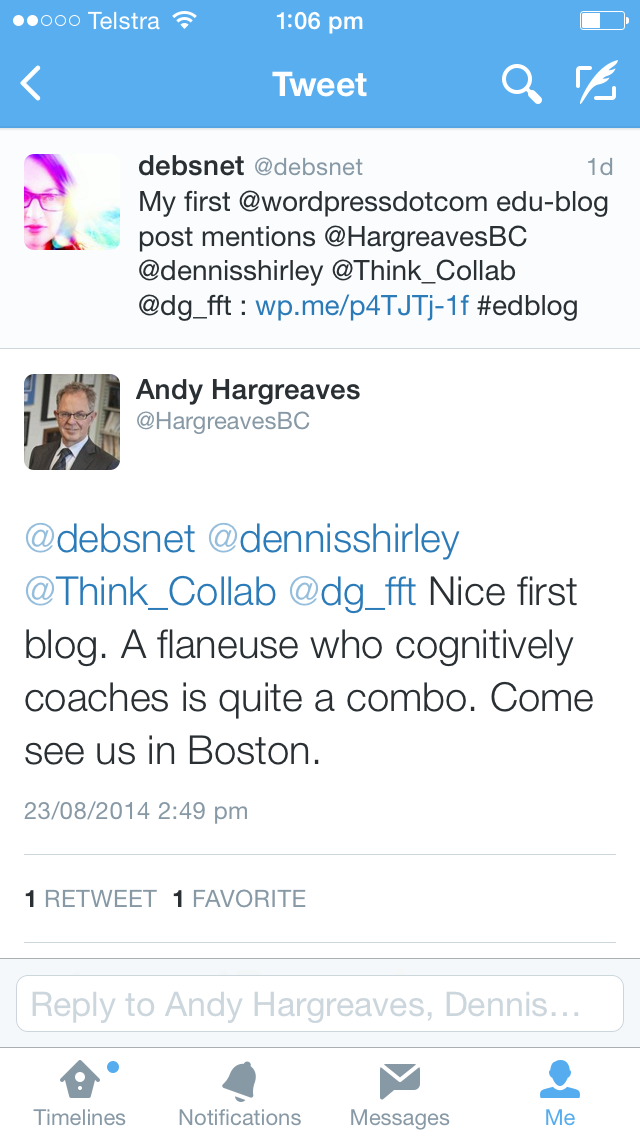
Imagine my delight when global school change titan Andy Hargreaves responded to my first (ever) blog post. Here was social media linking me to one of education’s thought leaders whose work shapes my classroom teaching, my school leadership practice and my PhD research.

In 2013, Kathryn Holmes, Greg Preston, Kylie Shaw and Rachel Buchanan published a paper which found that “Twitter is a valuable conduit for accessing new and relevant educational resources on the internet and also as a viable means of social support for like-minded educators. The cost effective nature of the microblogging platform ensures that it can act as a medium for sustained professional development, while leaving the individual participants to control and take ownership of the learning.” So Twitter can be socially and intellectually supportive, and it can facilitate and drive sustained engaged learning which is owned by the individual.

Jon Tait explains Twitter’s role as professional development platform in his blog post and has designed this infographic to summarise Twitter uses for teachers.

JonTait_TwitterTeacherInfographic

As I move for the first time from content curation to content creation (this being my second-ever blog post), the functions of the professional social media world and those who engage in it are a point of reflection.  Who will read my words and see my images? Who will interact with my thinking and add their own? How might social media support, connect and educate me?

Lucky (edu)fellow: beginnings of a flânerial professional trip

It’s time to bring the magic and wonder back into teaching. It’s time to recover the missionary spirit and deep moral purpose of engaging and inspiring all our students. It’s time to put down the spreadsheets and look to each other and elsewhere for how to get beyond the present turning point so we can transform our society and our schools. Hargreaves and Shirley, 2009

Two months til take off.

How does an Australian educator end up planning her way to New York City for a week, in search of insights into teacher learning, implementing teacher growth models in school contexts and using the Charlotte Danielson Framework for Teaching?

Because she is a lucky fellow.

I have been fortunate enough to receive a travelling fellowship from my Australian school in order to undertake an investigative series of visits to educators, school leaders, researchers and edu-experts in New York.

My meetings and visits cover one week in and around New York City. My week will be focused, as Hargreaves and Shirley suggest, on looking ‘to each other and elsewhere’ for learning and growth: my professional growth, teachers’ growth and the growth of my school’s professional learning culture.

Hargreaves and Shirley’s focus on the transformative ‘magic and wonder’ of teaching reflects my own fundamental beliefs about commitment to student learning. Our core business as teachers is enabling our students to find magic and wonder in the world around them, and empowering them to be thinkers, learners and leaders. As teachers, we should see teaching and learning as wonder-finding, wonder-generating and wonder-full.

The particular context for my upcoming professional trip is my school’s teacher growth initiative, which emerges from the widespread research-supported assertion that teacher quality is a crucial determinant in improving student achievement and learning.

Since 2012, I have been working with a diverse team of teachers at my school to design and pilot an idiosyncratic professional learning model intended to refine individual practice and capacity for self-reflection, appropriate to my school’s context. Another key aim of our model is the facilitation of a more passionate, reflective, purposeful community of professional learners in which individual teachers participate in ongoing communal activity to continuously develop the effectiveness of student learning by improving the quality of their teaching.

So, our aim has been to craft a process which is teacher-centred, teacher-directed and focused on teachers’ capacities for reflection and self-actualisation. We are using the Charlotte Danielson Framework for Teaching and a Cognitive Coaching model of coaching as the basis of our professional learning model. The Framework for Teaching (one of a number of maps for teacher practice, chosen because of its relevance to our specific context) gives us a common language for talking about our teaching, and a targeted specificity of focus for our reflections and conversations about evidence and practice. Cognitive Coaching is helping us to focus on growth rather than judgment, with our notion of ‘coaching’ being one of mediating the thinking of the teacher, rather than providing instructional feedback.

New York is the perfect place to refine our thinking as we continue to roll out our own model. The Danielson Framework for Teaching is one of those approved by the New York State Education Department as part of its implementation of the provisions of Education Law 3012-c regarding annual professional performance reviews (APPR) of classroom teachers and building principals. The New York City Department of Education (NYCDOE) has been implementing use of the Danielson Framework since June 2013, after three years of piloting and researching it in NYC schools.

During my time in New York, I am especially interested to see in what ways schools and districts have been implementing the Framework for Teaching; what might be success stories or lessons learned from their experiences so far; different approaches to school leadership in these kinds of initiatives; how data are collected and used to measure success; and any resources, references or contacts which might help my school, especially in its implementation stage, to begin in January 2015.

Can any educators out there share their experiences of current teacher growth or teacher evaluation systems?