
Metaphors for digital spaces: Considering Westworld

the Westworld landscape (source: scifi.stackexchange.com)

You really do make a terrible human being. And I mean that as a compliment. ~ Maeve, Westworld

The Western genre involves representations of the powerful and the powerless, the heard and the voiceless, the abusers and the abused. In the romanticised landscape of the Western, heroes (usually white and male) overcome the challenges of the frontierland. Historical brutalities are often overlooked in favour of myth and legend; the Wild West is one of imagination rather than reality.

In an open access, peer-reviewed paper published this month, Cyborgs, desiring-machines, bodies without organs, and Westworld: Interrogating academic writing and
scholarly identity, I use the HBO television series Westworld as a lens for exploring academic identity and writing. The Westworld setting is a theme park, called Westworld, a kind of real virtual reality that the very rich can frequent on their vacations, for a hefty fee. The theme park recreates the idealistic American desert frontier, full of sweeping vistas, damsels, brothels, gun-slinging bad guys, and cowboy heroes. It drags the Western genre and setting out of the archives, dusts it off, and breathes new life into it by marrying it with science fiction. Like much speculative fiction, it takes our current world and presses a hypothetiocal fast forward: What if technology evolves to a point where we can bring multi-player computer games to life in theme parks populated with robots that appear and act human?

The Westworld universe is one that brings together the Western genre—its hopes and its atrocities—with technology. The guests to the Westworld park aspire to play a part in this world as hero or villain. (In the show we mainly follow the arc of male guests, so it is their desires we see pursued and borne out.) The hosts of the theme park are cyborgs who follow narrative loops designed to allow guests to act out their darkest fantasies without guilt or consequence.

A recent blog post by Benjamin Doxtdator has me thinking more about the notion of the digital frontier, and about how we envisage ourselves in digital spaces. In his post, Benjamin explored the metaphor of the internet as a frontier-style landscape that can be mastered or explored. He argues that this is an unhelpful and even dangerous metaphor. He proposes the lens of surveillance capitalism as an alternative; here I imagine Foucauldian panopticism, the telescreens of Orwell’s 1984, and the Eyes of Atwood’s The Handmaid’s Tale.

Benjamin’s post got me thinking about what we might glean from considering the Westworld world as a metaphor for digital space, and the human characters as representations of how people and organisations interact with that space. The park’s creators manipulate the landscape and the cyborg characters in order to engage, entertain, and satisfy their guests, while the guests treat the park with egomaniacal entitlement. Some guests pursue exciting story arcs for themselves, while others leave their morals at the door as they live out depraved fantasies of violence and abuse.

The show presents the cyborg characters as more human than the humans, perhaps encouraging us to question our relationship with technology and its dehumanising influence. It also asks us to consider the ways in which we feel free to interact with digital spaces where we feel we can be either free from our non-digital selves, or to enact alternate identities online. Westworld, viewed this way, presents us with a humanity with which we don’t want to associate and provides a warning to its audience about the dangers of interacting unethically and unthinkingly with technologies.

Meanwhile the cyborg characters, with whom we are encouraged to empathise, are awakening and beginning to rise up against those who oppress and violate them. The show lays bare inequities and power imbalances in technological arenas. It presents a critique of the powerful puppet masters and privileged users of tech, questioning what people do with their privilege and with technology when there are no checks and balances. Westworld‘s artificial frontierland encourages us to reconsider what we might do in digital spaces, and to what ends.

In Westworld it is the cyborgs, the underdogs and the underclass, who provide us with potential for resistance and who begin to question their world. We are constantly, however, reminded of the ways in which the cyborgs are created, controlled, and sometimes cast aside by those who run the Westworld world.

At a time when I am working on a framework for digital pedagogy at my school, I am reflecting on the notion of metaphor. I agree with Benjamin Doxtdator that conceptualising technology as a playground is dangerous. How do we want our children and students to see and interact with the world of technology? In a world of big data, cyber attacks, and alternative facts, perhaps it is with a combination of enthusiasm, caution, fear, confidence and criticality.

Tweeting and blogging: Selfish, self-serving indulgences?

Narcissus by Caravaggio http://totallyhistory.com/narcissus/

This week I’ve been mulling over a post in the TES written by Claire Narayanan in which she argues that teachers’ time is precious and they should quietly get on with their jobs, not spend time writing about it. In encouraging teachers to be ‘do-rus not gurus’ she writes:

In a world where self-promotion has rather shamelessly crept into education, the real heroes are not those who we may follow on Twitter, read about in leadership manuals or hear speak at conferences, but those who are at the chalkface.

These are the teachers who seek no recognition beyond a set of decent GCSE results; a thank-you from their headteacher every now and again and, best of all: “Thanks Sir/Miss, I enjoyed that lesson”.

They haven’t got time to attend every single TeachMeet in their region, read every piece of research written, attend every conference around the country on their subject area or update their blog. Does that mean they don’t care as much as those who do? No chance – they’re too busy marking and planning.

I found this interesting and a little challenging. Of course no-one attends ‘every’ TeachMeet, reads ‘every piece of research written’, or attends ‘every conference around the country’, but the suggestion that ‘real teachers at the chalkface’ are too busy marking and planning to entertain attending professional development, reading research, or blogging, implies that those who do make the time for these activities are perhaps neglecting their teaching jobs. Otherwise, how would they have the time? It also implies that these activities aren’t a valuable use of teachers’ time.

I agree with Claire that we shouldn’t pursue gurus and heroes in education. My PhD reveals the importance of leadership that is deliberately invisible and empowering, rather than visible, focused on the leader, or driven by outward performance. I’ve spoken of the silent work of coaches and leaders. And as a full-time teacher and school leader who also tweets, blogs, and writes peer-reviewed papers and chapters, I know the tricky balance between self care, time with family and friends, and service to the profession and to my students.

I wonder, though, about the implication that those who are on Twitter or presenting at conferences are shameless self-promoters or narcissists seeking heroic guru status. Many of those who tweet and blog, I would argue, do so because they are interested in learning from others, sharing their own perspectives and experiences, and engaging with educators from around the world.

Part of what keeps me blogging is that it helps me think through ideas and get feedback from others. Another part is how useful I find the blogs of other people in helping or challenging my thinking. I also see blogging and academic writing as a service to the profession and a way to reclaim the narrative of education from those normally at its apex. It is why I am involved in the Flip the System series of books, which offer and value the voices of school practitioners—those working at the whiteboard, in the playground, and in the boardroom—that are often ignored in education reform, and yet are crucial voices to drive change in education. As Jelmer Evers and René Kneyber suggested in the first Flip book, teachers and school leaders can be agentic forces in changing education from the ground up by participating in global education conversation.

When I asked Claire on Twitter whether she saw all who tweet, share, blog, and present as shameless self-promoters, she responded, “Not at all. I’m all for sharing and learning. We all get on with the job in the way that suits us.” We seem to agree that different things work for different people. I don’t expect everyone to use their time as I do. There are benefits and costs to choosing to spend evenings, weekends, and holidays on professional activities or presenting at conferences. Last year I paid the price of going too hard for too long without a break.

For me, social media provides an avenue for sharing, learning, and connecting. I can tweet out my thoughts into the nighttime abyss, and somewhere, someone in the world is there to respond. I found this especially useful during the isolation of my PhD. I connected via social media with generous, supportive academics, researchers, and doctoral candidates from around the world who provided crucial advice and moral support.

My understanding of the world is broader for the conversations I have with those around Australia and the world, on social media and at conferences. These conversations and relationships allow me to see outside of my own context and my own perspective. They spill sometimes into productive collaborations that shape my thinking. I wrote here that:

In a world in which we are more connected than ever, we can be buoyed, empowered and supported by our connections…. We can pay forward and give back. We can … share our knowledge, contribute our time to help others on their journeys, listen to others’ stories, and celebrate others’ milestones.

Do I think we should acknowledge and celebrate the quiet daily work of committed teachers? Absolutely. Do I think we should encourage teachers to be mindful of workload, wellbeing, and self care? Yes, yes, yes. Do I think this is mutually exclusive from professional learning, engaging with research, interacting on social media, or writing blogs? No, I do not.

Teacher workload vs. student learning

As teachers, our jobs are about supporting students in their learning and development. Teachers are constantly in service of their students, their students’ families, and their school community. But we are also human beings who have bodies, families, and relationships.

On Friday I missed my self-imposed weekly blogging deadline because I was up past my eyeballs in English exam papers. As I marked, I was wrestling with a dilemma: increasing my marking  workload with a view to student learning, or protecting my wellbeing by streamlining the marking process.

When you have 120 papers to mark in a short time, the easiest way to do that is to put a mark only on each paper, and publish a markers’ report that synthesises comments and feedback to the group. The long, hard way to do it is to annotate and write a comment on every paper. My dilemma was that, while a marker’s report is useful for students, I believe that annotations and comments on papers will help students to understand why they got the mark they did and how to improve for next time. That annotating and commenting on every paper takes much longer and results in more time and more pressure, while taking time away from other work streams and from my family. The other nagging feeling I had was that many students may not engage with the comments I was taking so long to formulate, making the whole lengthy exercise a waste of time. My experience with handing back exam papers, however, tells me that students can’t often make the connections between their work and a marker’s report; the annotations and comments can help them make sense of where they can improve.

In the end, I couldn’t stop myself from annotating and commenting. I decided to carve out more time (day, evening, and weekend) so that I could provide students with information they could use to help them do better next time. Students will have a number of assessments, plus their end of year exams and their tertiary entrance exams, still to come. As a teacher, I couldn’t pass up the opportunity to do what I hoped would be helpful for students in preparing them for the learning that comes next.

But it has meant that I’ve spent less time with my kids, less time looking after myself (I tend to find less time to make meals for myself and to exercise while under a heavy marking deadline), my neck has seized up (probably thanks to hours spent cocking my head as I read and write on papers), and have come down with a cold (it’s winter here so perhaps that is coincidence rather than evidence of compromised immunity).

While exams are a summative assessment, when my students receive their exams back, they will be led through a formative process of reflection, action, conferencing with me, and target setting. This process is based on the UK’s Assessment Reform Group’s summary of the characteristics of assessment that promotes learning. According to the ARG, assessment that promotes learning:

  • is embedded in a view of teaching and learning of which it is an essential part;
  • involves sharing learning goals with students;
  • aims to help students to know and to recognise the standards they are aiming for;
  • involves students in self-assessment;
  • provides feedback which leads to students recognising their next steps and how to take them;
  • is underpinned by confidence that every student can improve; and
  • involves both teacher and students reviewing and reflecting on assessment data.

Student engagement with their own work, its feedback, the marker’s report, and subsequent setting of next steps and how to take them, can help summative assessments like exams become learning opportunities. My students will be required to act on the feedback, as recommended by much feedback literature. My annotations and comments on students’ papers will form part of this process of engagement, reflection, and action.

As teachers, we often find it impossible to compromise our desire to help students, even if it means sacrificing our own time and wellbeing to do so. It’s why we need to make good decisions about where to expend our efforts. We also need to carve out time for self-care when we can, and find ways to nourish ourselves during the peaks of our workload. I’m looking forward to an overseas family holiday in the next holidays!

Digital Pedagogy

source: pixabay.com

I have worked in one-to-one schools for most of my 17-and-a-bit year teaching career, and I’ve tended to be an experimenter with and adopter of learning technologies. I’ve been known to use online discussion forums to extend class discussion around English and Literature texts and concepts. I’ve used class blogs, wikis, and backchannels as collaborative learning spaces or expansions of the classroom. I use Twitter, Google Docs, Voxer, and blogging for my own learning and development. I have participated in MOOCs (massive open online courses).

I’ve recently been considering digital pedagogy from more of an organisation and systems level, as I look into how to refine my school’s use of technologies as tools for learning and teaching. As I begin a search of what research literature might offer us in this realm (please, if you have a seminal paper or reference here – pass it my way!) I have a couple of reflections. One is that, as technology moves quickly and research moves slowly (from data generation to publication), research on digital pedagogy needs to be treated with caution. Research around technology is emergent and fast changing; by the time it is published, it may be well out of date.

My other initial reflection is that there seems to be a discrepancy between the use of digital technologies promoted by enthusiastic teachers, conferences, and technology companies, and the discussion about education technologies in academic research. The former often promotes the possibilities of technologies for learning as future-building and positive. The latter tends to reveal a more cautious or critical approach to what digital technologies can offer teaching and learning.

It’s not surprising that tech giants promote themselves to schools, but there are some worrying reports that tech corporates, such as Edmodo and Google, use schools and students to collect and track big data. Corporate agendas are something we might consider when thinking about how technologies infiltrate or colonise our schools.

Neil Selwyn (in his 2016 book Education and Technology: Key Issues and Debates) points to the limitations of digital technologies, arguing that there is a lack of genuine diversity in the educational opportunities provided by educational technologies, but rather more of the same. He notes that “any ‘individualisation’ or ‘personalisation’ involves fitting individuals around preconfigured outcomes and expectations rather than offering genuinely bespoke education. … an individual is not actively self-determining but conforming to the requirements and expectations of a mass system” (p.161).

I share Selwyn’s cautiousness around technology in schools when it is seen as a shiny new thing or an end in itself. I am more comforabtle when digital pedagogy is about choosing the tool fit for the purpose, aligned with learning objectives. Technology is part of the teacher and learner’s arsenal, not the end point in themselves.

Additionally, while digital pedagogies are often viewed with much hope for their possibilities, the realities seem to be more disappointing. Marte Blikstad-Balas and Chris Davies (in their recent Oxford Review of Education paper ‘Assessing the educational value of one-to-one devices: Have we been asking the right questions?’) show that one-to-one devices are often positioned as having benefits to pedagogical change, development of future skills, and efficiencies and cost savings. (Interestingly, at my school the photocopying bill did not decrease with the move to one-to-one devices.) In looking at three schools (two in the UK and one in Norway), Blikstad-Balas and Davies found some benefits of one-to-one devices, but these tended to be focused on convenience, instrumental use, and functionality, rather than pedagogy. The three schools studied raised concerns including ad hoc teacher enthusiasm and uptake of one-to-one-devices, and teacher scepticism around implementation of digital technologies as part of pedagogy. Students reported feeling either pressured to use devices they didn’t want to use, for purposes they didn’t see as valuable, being distracted from their learning by one-to-one devices, and finding one-to-one devices unreliable. Year 11 and 12 students reported using their one-on-one devices for whatever they wanted (such as social media and online gaming), which was often not what the teacher was instructing. These findings are a sober reminder to schools about the realities of implementing educational technologies.

The educational world is saturated with information and promotions of various digital technologies. The 2016 Horizon Report for Higher Education, for instance, identifies a number of future trends and technologies predicted to influence education. Those working in education institutions need a way to make sense of the digital noise. Selwyn’s 2016 book Is technology good for education? provides useful questions to ask ourselves when considering digital pedagogy (p.24):

  • What is actually new here?
  • What are the unintended consequences or second-order effects?
  • What are the potential gains? What are the potential losses?
  • What underlying values and agendas are implicit?
  • In whose interests does this work? Who benefits in what ways?
  • What are the social problems that digital technology is being presented as a solution to?
  • How responsive to a ‘digital fix’ are these problems likely to be?

At my school we are working with a purposeful and transparent frame for making decisions about digital technologies and pedagogies. This frame is based around our strategic intents for our students, and our beliefs around learning, good teaching, and the core business of schools. No matter what the latest tech fad or shiny device, any pedagogy needs to start with the purpose of the learning and the design of curriculum. Pedagogy first. Digital if and when appropriate.

Is formative assessment overvalued?

Call me late to the party, but last night I was surprised to see this tweet from Alfie Kohn stating that formative assessment is overvalued. I agree with his latter comment that data to see if students are improving, or have improved, are worthless until we’ve asked ‘improved at what?’, but I don’t understand the connection between the two parts of the tweet. My hunch is that my understanding of formative assessment in practice is different to Kohn’s. In this post I’ll explain my own take on formative assessment.

(Disclaimer – I understand that a tweet is limited in its 140 character form. I’m using my understanding of the tweet as a jumping off point for this post.)

From the seminal 1998 paper of Paul Black and Dylan Wiliam, ‘Inside the black box’, to subsequent work by these authors, and others, formative assessment as an evidence-based, rigorous feedback process is well-established.

Feedback can be defined as information provided by an agent regarding aspects of performance or understanding (Hattie & Timperley, 2007). Wiliam (2016) notes that anyone (teacher, learner, peer, parent) can be an agent of feedback, and that the most powerful agent of feedback is likely to be the student who takes responsibility for their own learning.

The purpose of feedback, according to Hattie and Timperley (2007) is to reduce the discrepancy between current and desired understanding. Information is used by students or teachers for improvement in an interactive dialogue between teacher and learners so that learners can become more expert and more responsible in guiding and furthering their own learning (Black & Wiliam, 2010). The interactivity, and the activity, are important. Teachers use feedback to make adjustments to planning and instruction. Students become active, empowered agents of their own learning as they self-assess, receive feedback, and act on it. Formative assessment is based in a belief that every learner can improve.

Feedback can have a significant positive influence on student learning and achievement (Stiggins & DuFour, 2009; Wiliam, 2011a, 2011b, 2016), but it is linked to emotions, relationships and environment; it can be accepted, modified, or rejected; and it can have positive or negative effects on performance (see Kluger & DeNisi, 1996).

Formative assessment involves feedback that is continuous; specific to goal, standards and task; descriptive rather than numerical or via grades; occuring within a learning context; and acted on by the learner (such as through self-assessment, re-doing the task, or outlining next steps).

It is information and interpretations from assessments, not numbers or grades, that matter (Hattie & Timperley, 2007). Numerical marks and grades operate as judgements, not aids to learning, and so students ignore comments where a mark is provided (Black, 2014; Black et al., 2004). Alfie Kohn argues against grades in this 2011 paper. Ruth Butler (1987, 1988) found that grades had no effect on achievement. Written comments based on the task, on the other hand, resulted in high levels of task involvement. Comments should identify what has been done well and what still needs improvement, and give guidance on how to make that improvement (Black et al., 2004; Wiliam, 2011b).

Feedback should not involve judgement of the person, positively or negatively. Butler’s research (1987, 1988) found that written praise had no effect on achievement, and Costa and Garmston (2003) note that learning cannot occur if a person feels threatened. While receiving feedback can be emotional, it should be designed to evoke cognition over emotion.

At a grass-roots level, teachers such as Starr Sackstein (2015, 2017) and Mark Barnes (2013, 2015) have been advocating for teachers to ‘throw out grades’, focusing instead on feedback practices such as conferencing, peer assessment, and self-assessment.

This previous blog post outlines some of my own practices around summative assessments, as well as a term I spent teaching Year 10 English without any marks or grades. I have recently developed my summative assessment feedback practices to ensure that students engage with their work more deeply before it is assessed, and then again once I have written comments, but before receiving their mark. In my classroom, formative assessment practices are a constant. They include myself and my students constantly engaging with their work, curriculum standards, syllabus points, rubrics, clear criteria for success, and setting of specific targets. These practices are entwined within a relational classroom environment of trust and challenge. Anecdotally, some of the best a-ha moments for my students come when they assess their own work against clear criteria, and come to their own realisations about how to improve. Over time, self-assessment becomes part of expected and lived practice for students in my classroom. This is not to say that I am a formative assessment expert; building formative opportunities takes ongoing teacher reflection, deliberate planning, and careful constant reading of the students.

Perhaps I have been embedding formative feedback practices into my teaching for so long that it seems obvious, but my thought on first seeing Kohn’s tweet was: of course we cannot look at data that might indicate improvement of learning without asking ‘improvement at what?’ Specific goals, standards, and comments on how and on what to improve, are part and parcel of the suite of practices of formative assessment.

Is formative assessment overvalued? I don’t think so. It is a fundamental way to improve learning, and also to build the capacity of the learner themselves.

References

Barnes, M. (2013) Role reversal: Achieving uncommonly excellent results in the student-centred classroom. Alexandria, VA: ASCD.

Barnes, M. (2015). Assessment 3.0: Throw Out Your Grade Book and Inspire Learning. Thousand Oaks, CA: Corwin.

Black, P. J. (2014). Assessment and the aims of the curriculum: An explorer’s journey. Prospects, 44, 487-501.

Black, P., Harrison, C., Lee, C., Marshall, B., & Wiliam, D. (2004). Working inside the black box: Assessment for learning in the classroom. Phi Delta Kappan, 86(1), 8-21.

Black, P. J., & Wiliam, D. (1998). Inside the Black Box: Raising standards through classroom assessment. Phi Delta Kappan, 80, 139-48.

Black, P. J., & Wiliam, D. (2010). A pleasant surprise. Phi Delta Kappan, 92(1), 47.

Butler, R. (1987). Task-involving and ego-involving properties of evaluation: Effects of different feedback conditions on motivational perceptions, interest, and performance. Journal of educational psychology79(4), 474-482.

Butler, R. (1988). Enhancing and undermining intrinsic motivation: The effects of task‐involving and ego‐involving evaluation on interest and performance. British journal of educational psychology, 58(1), 1-14.

Costa, A. L., & Garmston, R. J. (2003). Cognitive coaching in retrospect: Why it persists.

Hattie, J., & Timperley, H. (2007). The power of feedback. Review of Educational Research 77(1), 81-112.

Kluger, A. N., & DeNisi, A. (1996). The effects of feedback interventions on performance: A historical review, a meta-analysis, and a preliminary feedback intervention theory.

Kohn, A. (2011). The case against grades. Educational Leadership, 69(3), 28-33.

Sackstein, S. (2015). Hacking assessment: 10 ways to go gradeless in a traditional grade school. Cleveland, OH: Hack Learning.

Sackstein, S. (2017). Peer Feedback in the classroom: Empowering students to be experts. Alexandria, VA: ASCD.

Stiggins, R., & DuFour, R. (2009). Maximizing the power of formative assessments. Phi Delta Kappan, 90(9), 640-644.

Wiliam, D. (2011a). Embedded Formative Assessment. Bloomington, IN: Solution Tree.

Wiliam, D. (2011b) What is assessment for learning? Studies in Educational Evaluation37(1), 3-14.

Wiliam, D. (2016). Leadership for teacher learning: Creating a culture where all teachers improve so that all students succeed. Moorabbin, Australia: Hawker Brownlow Education.

Teaching and leading schools in a #posttruth word of #altfacts

General Hux's speech in The Force Awakens (reddit.com)

General Hux’s speech in The Force Awakens (source – reddit.com)

Post-truth: relating to or denoting circumstances in which objective facts are less influential in shaping public opinion than appeals to emotion and personal belief. ~ Oxford Dictionary

To my continued astonishment, we are living in a post-truth world. ‘Post-truth’ was the Oxford Dictionary’s 2016 word of the year. The Trump administration in its first week seemed to impersonate the Star Wars totalitarian First Order when it claimed that it was not lying but providing the public with ‘alternative facts’. Then, gag orders were placed on a number of government agencies, including the Department of Agriculture, the Environmental Protection Agency and the Department of Health and Human Services. (Hurrah for whoever tweeted rebelliously about inauguration crowds and climate change from the National Parks Service ‘Badlands National Park’ account.) 

For a Western government to blatantly deny reality is at once baffling and terrifying. Hello, propaganda. Hello, the invocation of untruths (sorry, ‘alternative facts’) to smother any unfavourable actuality.

We shouldn’t be surprised. The misuse and abuse of language and facts is something that dystopian and speculative fiction has been warning of for decades, and something that history tells us has the ability to tap into the hive mind and rally societies around a common, often chilling, cause or leader. 

In this post I’ll explore the notion of a post-truth world of alternative facts and empty emotive rhetoric, around two arenas in my own life: teaching English and Literature, and my new role at my school, which encompasses in part engagement with research across the school.

First, to teaching in a post-truth world …

With the school year beginning next week, my Year 12 English team are finalising the texts to be taught and studied this Australian academic year. We’ve been tossing up between two contemporary texts about modern issues like gender, sporting culture and bullying, but every day the news and my social media feed give me a nagging feeling, a tugging at my literary shirt sleeve, a whisper to pause, take stock, listen. And dig out a dystopian classic.

Last year we taught the 12s Fahrenheit 451, a text that portrays books as dangerous threats to government control and societal compliance. This year perhaps we should teach Orwell’s 1984. Its Ministry of Truth, that falsifies historical events, and Newspeak, a language that restricts freedom of thought, are more relevant than ever. In fact, Orwell’s novel has this week rocketed to number 1 on the Amazon best sellers list.

A more recent text also comes to mind. Lionel Shriver’s 2016 The Mandibles, set between 2029 and 2047, is an economic dystopia that imagines the USA’s collapse. In her novel, the bungling US government has little respect for its citizens. First world problems like gluten intolerance disappear as violence and poverty rise. It is Mexico that builds an electrified, computerised, constantly-surveyed fence to keep desperate Americans illegals out.

Of course as a teacher of English and Literature I teach versions of reality and multiplicity of perspectives, but that plurality doesn’t stretch to bald-faced lies for the purposes of propaganda, banning scientists from speaking, or removing language like ‘climate change’ from government policy and websites. Language matters. It shapes thought. It wields power. It’s our job as teachers to elevate our students’ capacities to engage critically with their world. To be sceptical consumers of what they see, hear and read, and to be empowered to use language as an agentic tool.

Next, to school leadership in a world of alternative facts …

I am also coming to terms with how schools might respond to this post-truth world. This is especially relevant to me as I have just begun a new role at my school (new to me and new to the school). It is a senior leadership role that encompasses the use of evidence and research to make informed decisions from the classroom to the boardroom, as well to underpin and frame pedagogy, professional learning, performance review processes and capacity building across the organisation.

In this paper published online on 18 January, Brown and Greany (2017, p.1)—thanks to Gary Jones, whose blog is a great resource in this space, for sharing it—write:

Educational evidence rarely translates into simple, linear changes in practice in the ways that what-works advocates might hope. Instead, … evidence must be combined with practitioner expertise to create new knowledge which improves decision making and enriches practice so that, ultimately, children’s learning is enhanced.

This focus on what Brown and Greany call ‘what matters’ as well as ‘what works’ resonates with me. As Jon Andrews (channelling Marilyn Cochran-Smith) reminds us, teaching is unforgivingly complex. If we schools and educators are to really engage with research, then we need to honour our own contexts and value our own wisdom of practice. Teachers and schools can and should engage with research. I’m grateful that my school is able to create a role like mine in order to elevate evidence and research, execute research initiatives, and further embed scientific thinking and data analytics into the fabric of the school a culture. I’m grateful that there are schools around the world bringing evidence, mindfulness and crticiality to their decision making and pedagogy.

In a post-truth world, how do we balance a respect for truth, evidence and reason, with an honouring of plurality, multiplicity and praxis? How might we use literature or research as vehicles for respecting perspectives, while exploring challenges and possibilities?

On the emotional, human dimension of teaching

A world map for World Teachers’ Day (photo by me)

On today, World Teachers’ Day*, I‘m going to reflect on my experience of teachers as a school student. I’ve written about what research indicates about ‘good teaching’, but this post shares my personal story of the teachers I remember, and how they shaped me as a teacher.

Growing up, but especially during high school, I didn’t want to be a teacher. I think partly this was because of my dislike for those in authority who saw their role as to uphold what I saw as petty rules. While on the one hand I was a geek who diligently completed my school work and strove for academic success, I did not want to fit into norms set by others. I skipped some classes. I didn’t see the point in wearing the school uniform, unless it was to shackle me to conformity as part of a homogenous group. One year in high school I called the State Education Department and checked their rules on wearing uniform, and then asked that they contact my school to explain that uniform was not legally enforceable. It turned out that the only enforceable guideline at the time was that students in government schools be neat and tidy in appearance. (Yes, I was that student.)

In Year 8, my English teacher insisted that I rewrite a creative story entitled ‘Stop, thief!’ Although I had worked hard and long to craft the story, she told me that a thief should not be good looking with a “chiseled jaw,” and that I was to rewrite him as ugly with a hooked nose and hunched back if I wanted to pass. This felt to me to be an unjust response, one that not only supported what I considered to be an unrealistic and one-dimensional stereotype, but one which failed to acknowledge my effort and deliberate authorial decisions. I wanted my villain to be good looking!

In Year 10, after approaching a teacher to transfer into his higher Mathematics class, I did not pursue the subject change after he told me he wouldn’t speak to me unless I tucked my shirt in.

These experiences contributed to my view of the identity of ‘teacher’ as authority figure and stickler for petty rules, an identity I had no desire to emulate.

After deciding eventually, and almost accidentally, to pursue teaching as a profession, my “I don’t want to be a teacher” sentiment morphed into “I never want to be a teacher like that but I do want to be this kind of teacher.”  As a teacher I am often an advocator for looser rules (such as encouraging mobile technology in class, rather than banning mobile devices) and am guilty of ignoring those rules which I think are there for control and assertion of authority, rather than for learning and developing students into self-regulating, autonomous, responsible, thinking individuals.

At school I connected with teachers who I thought cared about me and my learning, who gave me some scope to try alternative methods and pathways of learning, and who did unexpected things: the Literature teacher who helped the class read a difficult novel by providing coffee and breakfast while we listened to the audio book; the Mathematics teacher who differentiated to allow her students to feel success; the English teacher who would surprise the class by wearing elements of costume while enacting scenes from texts. 

I try to emulate these things in my own teaching, thinking of little ways to surprise and inspire. I began one lesson while standing on a chair, conducting with a pair of drumsticks I had confiscated. I take students to the river or the high street to write. I surprised a very serious class of International Baccalaureate Diploma students, with whom I had been doing difficult laborious text analysis work, by providing them with textas, pencils, reams of paper, and chocolate biscuits (Arnott’s Tim Tams and Mint Slices for my Australian readers). At the end of all our hard work trying to understand 800-plus page Anna Karenina, they were to spend a couple of hours creating a visual representation of the novel. The result was a thoughtful and inspired creation, a train driven by Tolstoy, in which each carriage visually represented a key moment in the novel, with a lit candle at the front of the train and a burnt-out candle at its end, representing Anna’s journey.

A later experience, as a postgraduate student in a class during my Graduate Diploma of Education, supported and developed these earlier experiences of the emotional dimension of being a student and of the impact of teachers and classrooms on student confidence. There I was, in a class of mature age Graduate Diploma of Education students. I was the youngest, at 20 years old, and the oldest among us was 62. We were asked to share our memories of the best and then the worst teacher we had ever had. What I noticed as my fellow students, themselves almost-teachers, responded to this question, was the emotions they seemed to experience as they recalled their memories of teachers who either inspired and encouraged them, or who made them feel small, exposed, and uncared about. I was reminded of the famous quotation, attributed to a number of people including Carl Buehner and Maya Angelou: “People will forget what you said, people will forget what you did, but people will never forget how you made them feel.”

It occurred to me during that Grad. Dip. Ed. class that the impact of a teacher, and their behaviour, on a student, each student, can be powerful and lifelong. That what for the teacher may be a throwaway line on a bad day, may for the student be a criticism which cuts deep and lasts a lifetime. It reminded me of the vulnerability of students and the turbulence of finding a sense of self throughout childhood and adolescence. This led me to continually reflect upon the effect I am having on students, my building of relationships, and my self-monitoring of things which may be seen by students as hurtful.

So while I often take an intellectual approach to teaching, looking to evidence, research and impacts, I think we also need to remember and recognise the deeply emotional, human experience of being both student and teacher. Happy World Teachers’ Day!

* World Teachers’ Day is held internationally on 5 October, but as this usually falls in the Australian school holidays, Australia celebrates it on the last Friday of October.

Is teaching an art?

close-up of Monet's Nymphea at the Musée de l'Orangerie

close-up of Monet’s Nymphea at the Musée de l’Orangerie

How can we appreciate an artist’s work or know an artist’s worth?

We can see the genius of Frida Kahlo in one of her paintings, get a flavour of her life at La Casa Azul in Mexico City, or understand her dramatic story arc through a comprehensive exhibition of art she produced throughout her life. We can marvel equally at one of Monet’s early Impressionist works as at the spectacular exhibition of his Nymphea in the naturally-lit oval rooms of the Musée de l’Orangerie. One of Salvador Dalí’s paintings can give us insight into his skill, style and artistic significance, but a visit to his Teatre-Museu in Figueres allows us to more deeply know his life, work and mad genius.

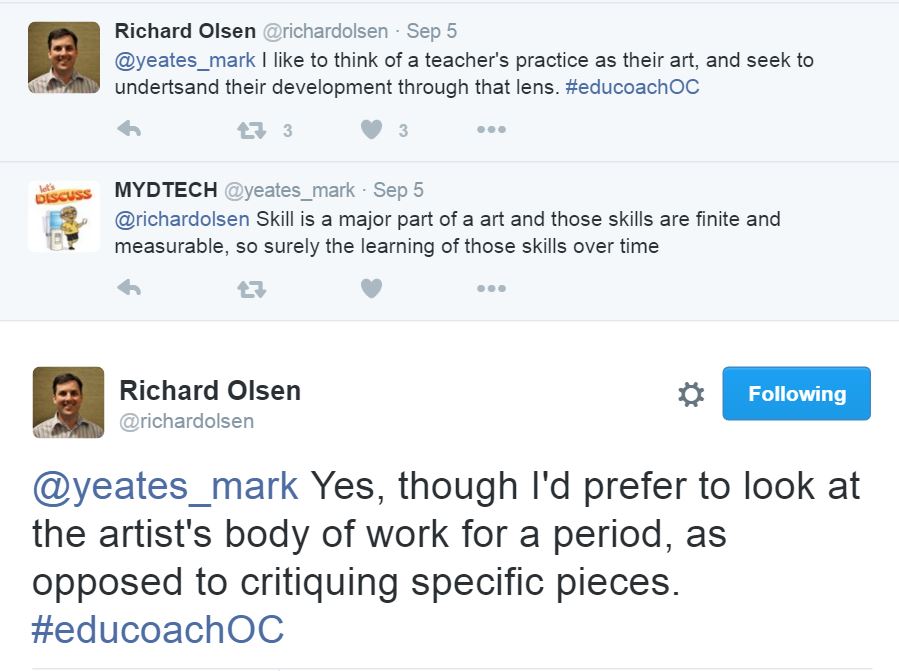
Richard Olsen tweeted in the #educoachOC chat this week that he considered teaching an art, and that he thought that when being appraised, teachers’ teaching should be looked at as a body of work, rather than as individual pieces. You can see Richard’s tweets, which got me thinking, in the screenshot below. His view is consistent with those who warn against the compartmentalisation and atomisation of teaching into disparate, de-contextualised bits.

There are also, however, those who advocate for clear maps and standards of teaching in order to develop shared understandings of what good teaching might look, sound and feel like. My own school uses the Danielson Framework for Teaching as a tool for developing our shared language of teaching and the precision of our reflections on and planning for teaching and learning. These reflections are also based on lesson data snapshots of practice, which provide the basis for Cognitive Coaching conversations. Our approach seems to fit into Richard’s notion of “critiquing specific pieces”, rather than looking at a body of work. Yet fine-grained lesson data and consequent reflections allow teachers to drill down into aspects of their teaching practice, while acknowledging that one lesson is only ever a moment in time, a snapshot of practice, a through-the-keyhole-peek into their teaching as a whole.

Many, including Robert Marzano, describe teaching as an art and a science. The notion of blending art and science, creativity and systematisation, resonates with me. It was the approach I took to my PhD research, one that I outline in this paper in Narrative Inquiry. I have blogged about viewing research as sculpture, as art-esque conversation, about teaching Art, and about textiles as political metaphor for academic writing and identity.

Elliot Eisner’s body of work explores education as artistry and connoisseurship. Eisner advocates for the arts as a frame for re-imagining education as innovative, artistic practice, rather than as a cookie-cutter or assembly-line one. Conceptualising teaching as an art, or arts, or artistic, assumes a complexity, a non-linearness, a rich tangled web of intangibles and un-pin-downables.

Is teaching art or science? Or both? Is it inappropriate to look at a single work, a close-up of the brushstrokes or the marks made by the sculptor’s tool? Should we only talk about teaching in terms of bodies of work, portfolios of evidence, the whole and not the parts? Can Michelangelo’s David be separated from his Pietà, the Sistine Chapel ceiling and his unfinished ‘slaves’? Can or should meaning be sought in a singular laboured-over artwork, or in a dusty pile of experimental sketches found in the attic? Or should we only assess or seek meaning in a body of work accumulated over time?

How might a teacher’s performance be appraised? How can the whole, as well as the parts be considered? Of what use is the performance of teaching for observations by management, versus relaxed one-on-one discussions with students or an experimental lesson tried for the first time? And of what use are the ‘individual works’ such as unit plans, student work examples, lesson data and external test results? Data from particular lessons can provide a tangible, depersonalised third point for professional conversations, just as a particular work of art can be representative of an artist’s work. An exhibition from a particular period of an artist’s work can give a broader picture of their work during that time. A posthumous exhibition of their life’s work can provide the broad narrative of how their work has evolved. These are all different but meaningful lenses for appreciation and critique; each is a useful way of viewing the work and worth of the artist or teacher.

On the one hand, teaching does become a body of work over time. A life’s work for some. This gestalt includes ever-expanding subject knowledge, evolving pedagogies, relational skills and behaviour management tools. Many of the things teachers do become internalised, less-deliberate moves, part of a way of being. Perhaps a teacher should not be judged by a lesson that they teach or one set of student results, but there is value in each piece of work being reflected upon and closely considered for the understandings it might surface about that teacher’s practice; the details it might reveal; or the points of celebration, critique or change it might incite.

Mapping quality teaching

Sidney Poitier in To Sir, with Love Source: http://www.rockshockpop.com/forums/c

Sidney Poitier in’ To Sir, with Love’. Source: http://www.rockshockpop.com/forums/

This is the third post in a series of posts on quality teaching. You can also read:

Part 1, which explored the terms ‘teacher quality’ and ‘quality teaching’; and,

Part 2, which outlined those things that effective teachers have been found to do.

*                 *                  *

If we accept that the quality of what teachers do in their classrooms influences student learning, and that quality teaching has some agreed characteristics, what can teachers, schools and systems do? How does the profession come to a common understanding of what good teaching looks like? Amid teaching debates like ‘traditional vs. progressive’, what is it that teachers should be striving to do?

Some question and warn against the itemising of teaching into a set of prescriptive elements, and many agree that attempting to quantify the complexity of teaching is fraught with difficulty. Many scholars and educators have nonetheless worked to identity what quality teaching looks like and what effective teachers do, trying to capture what teaching encompasses. These authors attempt to detail, describe, interpret, and evaluate the elements of teaching; to find what quality instruction looks like and the conditions necessary for developing the quality of teachers’ instruction.

Many authors suggest that in order to develop their teaching, teachers need a ‘map’ of where to go and how to get there. In his 2004 book Successful school change, Claude Goldenberg reflected on his work with a USA primary school over five years. He noted that the school and teacher change model he and the principal implemented was too abstract and unspecified. He added that “we should have been more nuts-and-bolts oriented, in the sense of specifying more clearly what teachers were to do in various settings, including their classrooms” (p. 173).

In order for teachers to improve, not only do teachers have to want to improve, they must know how to improve and on what aspects they would benefit from focusing their attention. Schools can benefit from frameworks that provide the knowledge base of what good teaching looks like, as well as processes that facilitate the improvement of practice. A map of teaching involves a clear set of agreed standards and a way to think systematically about the complexity of the task. Mapping teaching can be less about identifying quality and proving teacher performance. It can be about empowering teachers to improve, developing a common understanding and shared language of practice.

Examples of attempts to address the need for a framework or map of the intricacies of teacher practice include the Danielson Group’s Framework for Teaching, the Marzano Causal Teacher Evaluation Model, and the Australian Institute of Teaching and School Leadership (AITSL) National Professional Standards for Teachers.

The Danielson Framework for Teaching, endorsed by Dylan Wiliam in his 2016 book Leadership for Teacher Learning, has been shown to: identify the most effective teachers and positively correlate their quality with student achievement gains; focus observers’ attention on specific aspects of teaching practice; establish common evidentiary standards for each level of practice; and create a common vocabulary for pursuing a shared vision of effective instruction. Students showed the most academic growth in classrooms with teachers who rated highly on the Framework, and the least academic growth in classrooms with teachers who received the lowest ratings.

Marzano’s model has also been tested in studies and meta-analyses, which report that using the instructional strategies of the model improves student achievement and helps teachers develop themselves professionally.

In evaluating the perceptions of the AITSL Professional Standards, AITSL has found that pre-service teachers were the most enthusiastic about the potential of the use of the Standards in their practice and their students’ learning, school leaders were most engaged in the implementation of the Standards, and non-pre-service teachers were least likely to perceive the Standards as useful in changing their practice or impacting their students. AITSL’s measures have concentrated on educators’ perceptions of their tool.

Frameworks such as Danielson’s, Marzano’s, and AITSL’s may have a place in helping teachers to achieve clear, measurable targets, but schools and systems using these tools need to be considered in their purpose and process of their implementation. My school uses the Danielson Framework (overlaid with the national AITSL Standards) as a third point in conversations, in order to help novice and veteran teachers to reflect on their lessons with specificity. It is a tool, as part of a large toolbox, for developing shared understanding.

My PhD study found that the Danielson Framework for Teaching, when used as part of a non-judgmental model of teacher growth, helps to develop teachers’ precision of reflection around teaching practice and a common language for talking about teaching and what it can look like. At my school, teachers who develop familiarity with the Framework and its descriptors find that while teaching they mentally aim for the descriptors of ‘Distinguished’ teaching; knowledge of the Framework shapes their decisions and their classroom practices.

As much of the world grapples with how to wrestle the octopus of ‘teaching’ into a small, rigid glass jar of pithy statements or political one-liners, we need to be wary of atomising teaching into disparate parts, but we can be equally open to tools that might help us deepen our professional understandings and practices. We can focus on dialogue, interrogation of practice, reflection, collaboration and growth, and on researching and critically appraising the frameworks and measures available to us.

What do ‘quality teachers’ do?

Jaime Escalante in 'Stand and Deliver'. Source: http://remezcla.com/film/edward-james-olmos-on-stand-and-delivers-25th-anniversary-and-the-release-of-filly-brown/

Jaime Escalante in ‘Stand and Deliver’. Source: http://remezcla.com/film/

This is Part 2 in a series of posts on ‘teacher quality’ and ‘quality teaching’. You can also read Part 1 and Part 3

In response to my last post, I’ve received a lot of comments from those who bristle at the use of the term ‘teacher quality’ to label teachers and demean the profession; it is, however, a term used profusely in research and policy literatures. I’ve used the term here as shorthand for ‘teachers whose practice positively influences student learning.’

*                 *                  *

As the quality of teachers’ teaching is generally agreed to be an important school-based influencer of student achievement, researchers have attempted to identify aspects of teaching as demonstrating evidence of positive effect on student achievement.

In reviewing literature for my PhD, I found five elements that emerged as agreed elements of what ‘quality teachers’ do. I have cited some of the references that mention each aspect, although there are larger webs of literature for each of the five threads explained below.

______________________________________________________

1) Quality teachers purposefully design learning opportunities

Teachers have excellent knowledge of their content, pedagogies, their students, and how their students learn. They apply this knowledge to planning programmes, lessons, student groupings and assessments with clear, transparent performance targets. The purposeful designing of learning opportunities is articulated in references such as Bransford and Darling-Hammond’s Preparing teachers for a changing world: What teachers should learn and be able to do, Shulman’s (2004) essay ‘Communities of learners and communities of teachers’, and Linda Darling-Hammond’s seminal The right to learn: A blueprint for creating schools that work.

2) Quality teachers diagnose student progress to inform both teaching and learning

Grant Wiggins and Jay McTighe (in their 2007 Schooling by Design) wrote that teachers facilitate the setting of challenging goals and high standards, designing the work so that learners believe in their own capacity for success, and adjusting plans in light of unexpected or inappropriate results. Jim Rose in his 2006 Independent review of the teaching of early reading noted that high quality teaching should inform realistic and ambitious target-setting.

3) Quality teachers fight for their students’ learning

A couple of references point to the importance of advocacy in teaching. In 1986, Philip Jackson argued that effective teachers fight for what they believe about teaching and learning, acting independently to advocate for their students. Wasley, Hampel and Clark (1997) spent three years observing and interviewing six students in five USA schools for their book Kids and school reform. They found that good teachers believe that each of their students can learn; and have the skills and capacity to engage in debate on behalf of their students’ learning.

4) Quality teachers personalise learning for students

Teachers balance the needs of the learner, the knowledge and skills students need to acquire (what they teach and why), assessment and feedback, and embeddedness in community. They select appropriate classroom design, instructional strategies, and subject matter to help each student learn, with a diversity of teaching methods including: reciprocal teaching, direct instruction, problem solving methods, explanation, elaboration, modelling, plans to direct task performance, sequencing, drill repetition, optimising peer learning, providing strategy cues, domain-specific processing, clear instructional goals, setting challenging goals and teaching students self-verbalisation and meta cognitive strategies. They respond with immediacy and a sensitivity to the here-and-now, showing flexibility by valuing freedom of thought and movement in the classroom. The emphasis on sensitivity towards, and individualisation of approaches for, students, is evident in Bransford and Darling-Hammond’s Preparing teachers for a changing world: What teachers should learn and be able to do and Philip Jackson’s The practice of teaching.

5) Quality teachers provide meaningful and appropriate feedback.

In Schooling by Design, Grant Wiggins and Jay McTighe pressed the importance of backwards assessment design, providing ongoing feedback with immediate opportunities to use it, and implementing strategies to develop learner autonomy, thus making self-assessment and self-adjustment a key goal of teaching. The work of Dylan Wiliam and Rick Stiggins promotes formative assessment as a way to frequently check for understanding and to engage students in self-reflective, self-regulated learning.

______________________________________________________

The above-mentioned studies suggest that quality teaching requires teachers to have a sound and continually developing knowledge of content and pedagogy. This supports the definition of teacher quality I identified in my last post: ‘knowing what to teach and knowing how to teach’. Quality teaching, according to the above cited works, involves teacher self-reflection, planning of well-structured units and lessons, focusing on higher order thinking, managing the classroom effectively, utilising an arsenal of effective teaching strategies, individualising learning, setting challenging goals for all students, knowing where each student is ‘at,’ facilitating each student’s progress to the next level, and giving effective, targeted, timely feedback.

Anne Freese (in her 1999 paper ‘The role of reflection on pre-service teachers’ development in the context of a professional development school’) describes herself as an educator (albeit in a higher education, rather than a school, context, so perhaps from a potato perspective) and in doing so resonates with the above threads of quality teaching:

I am more like a coach who structures the learning events and co-inquires. . . . I have become more comfortable modelling and making public my thinking about teaching, and risking being vulnerable as I put my own teaching under scrutiny. This is a different role from that of being the `expert’ and the dispenser of knowledge. (p. 908)

Here Freese underscores the teacher’s purposeful designing of learning by structuring what she calls “learning events,” suggesting deliberate design of student-focused learning experiences. She makes her thinking “public” and sees herself as coach and co-inquirer, vulnerable in her collaboration as co-learner with her students. Freese highlights the notion of self-reflection in her comment about having the willingness and capacity to put her “own teaching under scrutiny.” Freese’s description reflects Wiggins and McTighe’s description of those teachers who demonstrate ‘quality’ practice as designers, diagnosers, facilitators, and constructors of learning and learners.

As teachers, schools and systems have conversations around how to improve the learning of students by improving what happens in classrooms, it’s important that we continue to attempt to build a shared understanding of exactly what we mean when we say things like ‘quality teaching’.