Tweeting and blogging: Selfish, self-serving indulgences?

Narcissus by Caravaggio http://totallyhistory.com/narcissus/

This week I’ve been mulling over a post in the TES written by Claire Narayanan in which she argues that teachers’ time is precious and they should quietly get on with their jobs, not spend time writing about it. In encouraging teachers to be ‘do-rus not gurus’ she writes:

In a world where self-promotion has rather shamelessly crept into education, the real heroes are not those who we may follow on Twitter, read about in leadership manuals or hear speak at conferences, but those who are at the chalkface.

These are the teachers who seek no recognition beyond a set of decent GCSE results; a thank-you from their headteacher every now and again and, best of all: “Thanks Sir/Miss, I enjoyed that lesson”.

They haven’t got time to attend every single TeachMeet in their region, read every piece of research written, attend every conference around the country on their subject area or update their blog. Does that mean they don’t care as much as those who do? No chance – they’re too busy marking and planning.

I found this interesting and a little challenging. Of course no-one attends ‘every’ TeachMeet, reads ‘every piece of research written’, or attends ‘every conference around the country’, but the suggestion that ‘real teachers at the chalkface’ are too busy marking and planning to entertain attending professional development, reading research, or blogging, implies that those who do make the time for these activities are perhaps neglecting their teaching jobs. Otherwise, how would they have the time? It also implies that these activities aren’t a valuable use of teachers’ time.

I agree with Claire that we shouldn’t pursue gurus and heroes in education. My PhD reveals the importance of leadership that is deliberately invisible and empowering, rather than visible, focused on the leader, or driven by outward performance. I’ve spoken of the silent work of coaches and leaders. And as a full-time teacher and school leader who also tweets, blogs, and writes peer-reviewed papers and chapters, I know the tricky balance between self care, time with family and friends, and service to the profession and to my students.

I wonder, though, about the implication that those who are on Twitter or presenting at conferences are shameless self-promoters or narcissists seeking heroic guru status. Many of those who tweet and blog, I would argue, do so because they are interested in learning from others, sharing their own perspectives and experiences, and engaging with educators from around the world.

Part of what keeps me blogging is that it helps me think through ideas and get feedback from others. Another part is how useful I find the blogs of other people in helping or challenging my thinking. I also see blogging and academic writing as a service to the profession and a way to reclaim the narrative of education from those normally at its apex. It is why I am involved in the Flip the System series of books, which offer and value the voices of school practitioners—those working at the whiteboard, in the playground, and in the boardroom—that are often ignored in education reform, and yet are crucial voices to drive change in education. As Jelmer Evers and René Kneyber suggested in the first Flip book, teachers and school leaders can be agentic forces in changing education from the ground up by participating in global education conversation.

When I asked Claire on Twitter whether she saw all who tweet, share, blog, and present as shameless self-promoters, she responded, “Not at all. I’m all for sharing and learning. We all get on with the job in the way that suits us.” We seem to agree that different things work for different people. I don’t expect everyone to use their time as I do. There are benefits and costs to choosing to spend evenings, weekends, and holidays on professional activities or presenting at conferences. Last year I paid the price of going too hard for too long without a break.

For me, social media provides an avenue for sharing, learning, and connecting. I can tweet out my thoughts into the nighttime abyss, and somewhere, someone in the world is there to respond. I found this especially useful during the isolation of my PhD. I connected via social media with generous, supportive academics, researchers, and doctoral candidates from around the world who provided crucial advice and moral support.

My understanding of the world is broader for the conversations I have with those around Australia and the world, on social media and at conferences. These conversations and relationships allow me to see outside of my own context and my own perspective. They spill sometimes into productive collaborations that shape my thinking. I wrote here that:

In a world in which we are more connected than ever, we can be buoyed, empowered and supported by our connections…. We can pay forward and give back. We can … share our knowledge, contribute our time to help others on their journeys, listen to others’ stories, and celebrate others’ milestones.

Do I think we should acknowledge and celebrate the quiet daily work of committed teachers? Absolutely. Do I think we should encourage teachers to be mindful of workload, wellbeing, and self care? Yes, yes, yes. Do I think this is mutually exclusive from professional learning, engaging with research, interacting on social media, or writing blogs? No, I do not.
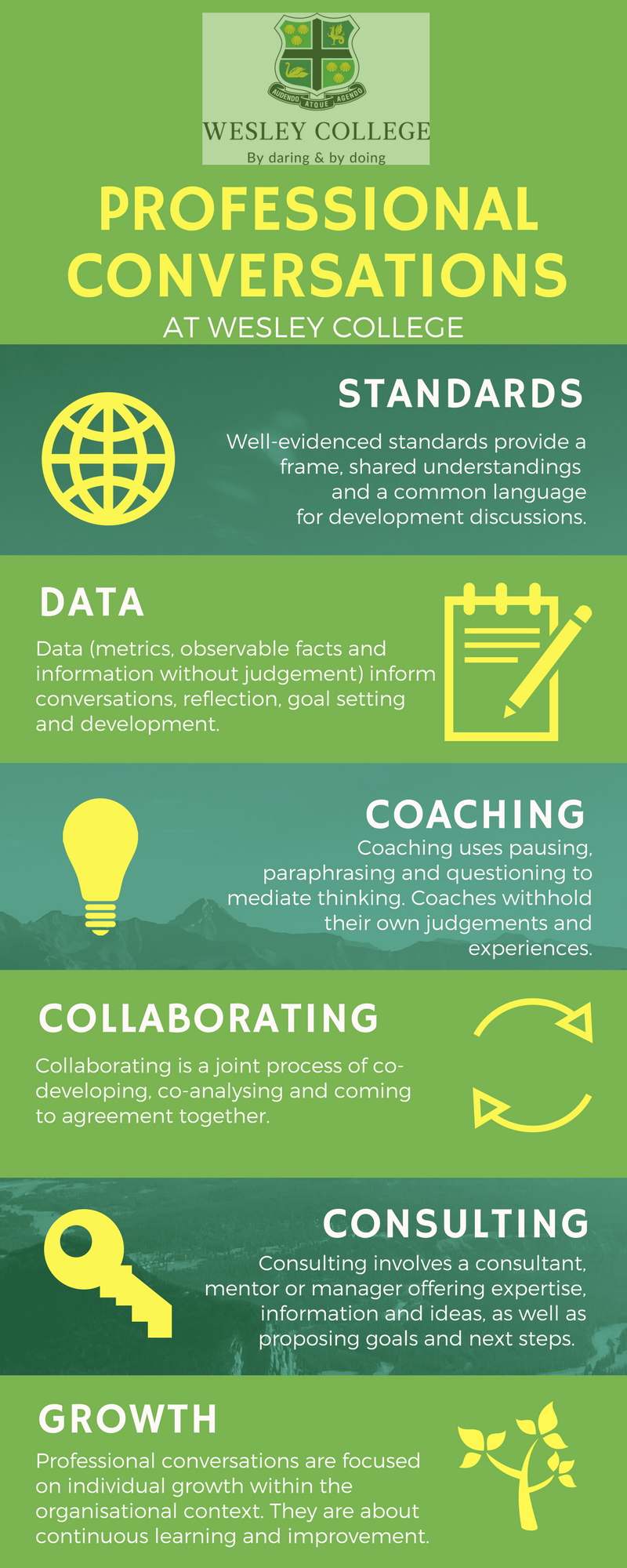
Semantic space: ‘How we talk around here’

I’ve been thinking about talking and talking about talking. The pictured infographic is one I designed to distil my school’s approach to professional conversations. While deceptively simple, it is the result of a lot of research, practice, and writing, over time. In that blog post, I talk about why we use Cognitive Coaching as a coaching model for developing a collaborative professional learning culture, but also when we might deliberately use consulting, collaborating, or evaluating as ways of talking. Rather than adopting deficit models of conversation aimed to fix or tell teachers, we base our professional conversations on a belief in the capacity of everyone in our community to grow and improve.

At the Australian National Coaching Conference in Melbourne last month, I was immersed in talking about coaching, and talking with coaches. I was delighted to be on a conference panel with Christian van Niewerburgh, Rachel Lofthouse, and Alex Guedes, discussing coaching in education research. One of the points I made was around the use of terminology within a community like the one in the conference room. 400 educators and coaches were all talking about coaching at the conference, but not necessarily with the same understanding of what ‘coaching’ means.

Many of the conference attendees had what Christian van Niewerburgh calls a ‘coaching way of being’. A conversation with them is a coaching conversation. These individuals actively and intensely listen, paraphrase, pause, and ask thoughtful questions designed more for the benefit of the talker than the listener. These aren’t conversations where the other person is waiting for their turn to say their piece or pushing a personal agenda; they are ones in which the listener serves the talker via thoughtful and deliberate ways of talking and ways of being in conversation.

At the conference, Rachel Lofthouse talked about Kemmis and Heikkenen’s (2012) notion of a semantic space. I enjoyed this way of thinking about an organisation. Semantics is about linguistic meaning; the logic of language. In organisations I imagine a semantic space is about ‘how we talk around here’, the meanings of words, the way communication happens. Lofthouse and Elaine Hall (2014) define semantic space as one of professional dialogue, constituting tone, choice of words, routines of dialogue, and balance of participation in conversation. Semantic space interacts with organisional structures, physical spaces, and relationships.

Harvard academics and developmental psychologists Robert Kegan and Lisa Lahey (2001) say that our places of work are places in which certain forms of speech are promoted or encouraged, and places where other ways of talking are discouraged or made impossible. What kinds of talk are promoted in our schools? Which are limited or suppressed?

Can it ever be ‘just’ semantics? No. The words we use, the way we talk, and the way we interpret language are vital to our work, especially in education. Members of high-functioning teams, for instance, respectfully challenge one another in order to find the best ways forward. Something Rachel Lofthouse said in her conference keynote stuck with me: “Don’t talk less and work more. The talk is the work. So talk well, talk productively, talk to learn.” The way we talk can influence the way we think and the way we behave. In any organisation it’s important to figure out and work on ‘how we talk around here’ as well as why we talk, when we talk, what we talk about, and how we want to talk.

References

Kegan, R., & Lahey, L. L. (2001). How the way we talk can change the way we work: Seven languages for transformation. John Wiley & Sons.

Kemmis, S. and Heikkinen, H.L.T. (2012). Practice architectures and teacher induction. In: H.L.T. Heikkinen, H. Jokinen, and P. Tynjälä, eds. Peer-group mentoring (PGM): peer group mentoring for teachers’ professional development. London: Routledge, 144–170.

Lofthouse, R., & Hall, E. (2014). Developing practices in teachers’ professional dialogue in england: Using coaching dimensions as an epistemic tool. Professional Development in Education, 40(5), 758-778.

Teacher workload vs. student learning

As teachers, our jobs are about supporting students in their learning and development. Teachers are constantly in service of their students, their students’ families, and their school community. But we are also human beings who have bodies, families, and relationships.

On Friday I missed my self-imposed weekly blogging deadline because I was up past my eyeballs in English exam papers. As I marked, I was wrestling with a dilemma: increasing my marking  workload with a view to student learning, or protecting my wellbeing by streamlining the marking process.

When you have 120 papers to mark in a short time, the easiest way to do that is to put a mark only on each paper, and publish a markers’ report that synthesises comments and feedback to the group. The long, hard way to do it is to annotate and write a comment on every paper. My dilemma was that, while a marker’s report is useful for students, I believe that annotations and comments on papers will help students to understand why they got the mark they did and how to improve for next time. That annotating and commenting on every paper takes much longer and results in more time and more pressure, while taking time away from other work streams and from my family. The other nagging feeling I had was that many students may not engage with the comments I was taking so long to formulate, making the whole lengthy exercise a waste of time. My experience with handing back exam papers, however, tells me that students can’t often make the connections between their work and a marker’s report; the annotations and comments can help them make sense of where they can improve.

In the end, I couldn’t stop myself from annotating and commenting. I decided to carve out more time (day, evening, and weekend) so that I could provide students with information they could use to help them do better next time. Students will have a number of assessments, plus their end of year exams and their tertiary entrance exams, still to come. As a teacher, I couldn’t pass up the opportunity to do what I hoped would be helpful for students in preparing them for the learning that comes next.

But it has meant that I’ve spent less time with my kids, less time looking after myself (I tend to find less time to make meals for myself and to exercise while under a heavy marking deadline), my neck has seized up (probably thanks to hours spent cocking my head as I read and write on papers), and have come down with a cold (it’s winter here so perhaps that is coincidence rather than evidence of compromised immunity).

While exams are a summative assessment, when my students receive their exams back, they will be led through a formative process of reflection, action, conferencing with me, and target setting. This process is based on the UK’s Assessment Reform Group’s summary of the characteristics of assessment that promotes learning. According to the ARG, assessment that promotes learning:

  • is embedded in a view of teaching and learning of which it is an essential part;
  • involves sharing learning goals with students;
  • aims to help students to know and to recognise the standards they are aiming for;
  • involves students in self-assessment;
  • provides feedback which leads to students recognising their next steps and how to take them;
  • is underpinned by confidence that every student can improve; and
  • involves both teacher and students reviewing and reflecting on assessment data.

Student engagement with their own work, its feedback, the marker’s report, and subsequent setting of next steps and how to take them, can help summative assessments like exams become learning opportunities. My students will be required to act on the feedback, as recommended by much feedback literature. My annotations and comments on students’ papers will form part of this process of engagement, reflection, and action.

As teachers, we often find it impossible to compromise our desire to help students, even if it means sacrificing our own time and wellbeing to do so. It’s why we need to make good decisions about where to expend our efforts. We also need to carve out time for self-care when we can, and find ways to nourish ourselves during the peaks of our workload. I’m looking forward to an overseas family holiday in the next holidays!

Digital Pedagogy

source: pixabay.com

I have worked in one-to-one schools for most of my 17-and-a-bit year teaching career, and I’ve tended to be an experimenter with and adopter of learning technologies. I’ve been known to use online discussion forums to extend class discussion around English and Literature texts and concepts. I’ve used class blogs, wikis, and backchannels as collaborative learning spaces or expansions of the classroom. I use Twitter, Google Docs, Voxer, and blogging for my own learning and development. I have participated in MOOCs (massive open online courses).

I’ve recently been considering digital pedagogy from more of an organisation and systems level, as I look into how to refine my school’s use of technologies as tools for learning and teaching. As I begin a search of what research literature might offer us in this realm (please, if you have a seminal paper or reference here – pass it my way!) I have a couple of reflections. One is that, as technology moves quickly and research moves slowly (from data generation to publication), research on digital pedagogy needs to be treated with caution. Research around technology is emergent and fast changing; by the time it is published, it may be well out of date.

My other initial reflection is that there seems to be a discrepancy between the use of digital technologies promoted by enthusiastic teachers, conferences, and technology companies, and the discussion about education technologies in academic research. The former often promotes the possibilities of technologies for learning as future-building and positive. The latter tends to reveal a more cautious or critical approach to what digital technologies can offer teaching and learning.

It’s not surprising that tech giants promote themselves to schools, but there are some worrying reports that tech corporates, such as Edmodo and Google, use schools and students to collect and track big data. Corporate agendas are something we might consider when thinking about how technologies infiltrate or colonise our schools.

Neil Selwyn (in his 2016 book Education and Technology: Key Issues and Debates) points to the limitations of digital technologies, arguing that there is a lack of genuine diversity in the educational opportunities provided by educational technologies, but rather more of the same. He notes that “any ‘individualisation’ or ‘personalisation’ involves fitting individuals around preconfigured outcomes and expectations rather than offering genuinely bespoke education. … an individual is not actively self-determining but conforming to the requirements and expectations of a mass system” (p.161).

I share Selwyn’s cautiousness around technology in schools when it is seen as a shiny new thing or an end in itself. I am more comforabtle when digital pedagogy is about choosing the tool fit for the purpose, aligned with learning objectives. Technology is part of the teacher and learner’s arsenal, not the end point in themselves.

Additionally, while digital pedagogies are often viewed with much hope for their possibilities, the realities seem to be more disappointing. Marte Blikstad-Balas and Chris Davies (in their recent Oxford Review of Education paper ‘Assessing the educational value of one-to-one devices: Have we been asking the right questions?’) show that one-to-one devices are often positioned as having benefits to pedagogical change, development of future skills, and efficiencies and cost savings. (Interestingly, at my school the photocopying bill did not decrease with the move to one-to-one devices.) In looking at three schools (two in the UK and one in Norway), Blikstad-Balas and Davies found some benefits of one-to-one devices, but these tended to be focused on convenience, instrumental use, and functionality, rather than pedagogy. The three schools studied raised concerns including ad hoc teacher enthusiasm and uptake of one-to-one-devices, and teacher scepticism around implementation of digital technologies as part of pedagogy. Students reported feeling either pressured to use devices they didn’t want to use, for purposes they didn’t see as valuable, being distracted from their learning by one-to-one devices, and finding one-to-one devices unreliable. Year 11 and 12 students reported using their one-on-one devices for whatever they wanted (such as social media and online gaming), which was often not what the teacher was instructing. These findings are a sober reminder to schools about the realities of implementing educational technologies.

The educational world is saturated with information and promotions of various digital technologies. The 2016 Horizon Report for Higher Education, for instance, identifies a number of future trends and technologies predicted to influence education. Those working in education institutions need a way to make sense of the digital noise. Selwyn’s 2016 book Is technology good for education? provides useful questions to ask ourselves when considering digital pedagogy (p.24):

  • What is actually new here?
  • What are the unintended consequences or second-order effects?
  • What are the potential gains? What are the potential losses?
  • What underlying values and agendas are implicit?
  • In whose interests does this work? Who benefits in what ways?
  • What are the social problems that digital technology is being presented as a solution to?
  • How responsive to a ‘digital fix’ are these problems likely to be?

At my school we are working with a purposeful and transparent frame for making decisions about digital technologies and pedagogies. This frame is based around our strategic intents for our students, and our beliefs around learning, good teaching, and the core business of schools. No matter what the latest tech fad or shiny device, any pedagogy needs to start with the purpose of the learning and the design of curriculum. Pedagogy first. Digital if and when appropriate.

Education Gurus

It’s easy to make your own guru memes with Canva.

Knowledge and advice for schools and about education often seem to exist in a world of commodification and memeification. There is plenty of disagreement and debate in education, and plenty of competition on bookshelves and in conference programs. Educators and academics position themselves as brands via bios, photographs, and certification badges. As an educator and a researcher I have those whose work I follow closely; academics, for instance, whose presence affects me when I meet them because their reputation and body of work precede them.

In education, we have perceived gurus. These are people who have become ubiquitous in education circles, at education conferences, and in education literature. Teachers and school leaders scramble to get tickets to their sessions and to get photographic evidence of having met them. Their words are tweeted out in soundbites ad infinitum (or is that ad nauseum?), and made into internet memes. Sometimes these individuals partner with publishers or education corporates, and so the visibility and reach of their work grows. They become the scholars or experts most cited in staff rooms, at professional learning water coolers, and in job interviews when asked how research informs practice. 

Sometimes, these gurus are teachers or principals who have gained a large following on social media and subsequently a monolithic profile. Often, they are academics who have built up bodies of work over many years, becoming more and more well-known along the way, and eventually being perceived as celebrities or gurus. Yesterday I had the pleasure of learning from Dylan Wiliam, firstly at a day long seminar, and then at my school. At one point the seminar organisers apologised for running out of Wiliam’s books, acknowledging the desire of delegates to have the book signed.
Marten Koomen has traced networks of influencers in Australian education organisations. In his new paper ‘School leadership and the cult of the guru: the neo-Taylorism of Hattie’, Scott Eacott challenges the rise of the edu guru, those academics whose work is ubiquitous and influential to the point of being uncritically accepted and canonised. Eacott pushes back against the ‘what works’ mentality in education, in which educators are sold ‘what works’ and encouraged to slavishly apply it to their own contexts. Jon Andrews, too, questions the unquestioning way in which the loudest and most prominent voices become the accepted voices. Meta-analysis and meta-meta-analysis, often translated into league tables of ‘what works’ in education, have been the subject of criticism. George Lilley and Gary Jones have both questioned meta-analysis on their blogs. I’ve written about cautions surrounding the use of meta-analysis in education, especially when it drives clickbait headlines and a silver-bullet mentality of having the answers without having to ask any questions. Yesterday Wiliam made his oft-repeated points: that everything works somewhere, nothing works everywhere, and context matters. A guru cannot provide easy answers in education, as education is too complex and contextual for that.

taken at AERA last year

Much of this conversation around the rise of the edu guru has surrounded John Hattie, although he is by no means the only globally renowned education expert likely to make conference delegates weak at the knees. I was personally uncomfortable when he was beamed in via video link to last year’s ACEL conference and began to give an ‘I have a dream’ speech about education. As an English and Literature teacher I understand the power of rhetoric and analogy to persuade and inspire, but appropriating the legacy and words of Dr Martin Luther King Junior seemed a way to gospelise a personal brand of education reform.

I don’t think that education experts, no matter how influential they become, should encourage the uncritical acceptance of their ideas as dogma, or present themselves as the bringers of the One True Thing To Rule All Things of and for education. As Dylan Wiliam, channelling Ben Goldacre, repeatedly said yesterday, “I think you’ll find it’s a little more complicated than that.”

I wonder how perceived gurus feel about being guru-ised by the education masses. In part the famous and the infamous in education are so because of their actions: accepting more and more speaking gigs, performing the game of publishing and promoting their work. Most, I would guess, do this for the same reason someone like me speaks and publishes. To contribute to education narratives and change those narratives, hopefully for the better. To be of service to the profession and the field. To explore and wrestle with ideas, trying to find ways to make sense of the complexity of education in order to improve the learning of students and the lives of teachers and school leaders.

I wondered about the rise to gurudom and the moral obligation of the academic celebrity figure last year when at AERA I saw a panel in which four educational heavy hitters—Andy Hargreaves, Michael Fullan, Linda Darling-Hammond and Diane Ravitch—all advocating for the moral imperative of educational research and practice. They spoke of lifetime journeys of work intended to make the world a better and more just place. I wondered at the time about how much an early career academic can be brave and resistant in their work, as they try to build a career via the performative pressures of the academe. Can only the guru, free from institutional performativities and the financial pressures often associated with early career academia, say what they really want to say and do the work and writing they really want to do?

I don’t think experts in education are dangerous. We need expertise and people willing to commit their lives and work to making sense of and making better the world of education and learning. But in a world where teachers and school leaders are busy racing on the mouse wheels of their own performative pressures, we need to figure out ways to support and facilitate sceptical and critical engagement with research. Even those who are highly influential and highly admired need to have their work engaged with closely and critically. The danger comes when experts become so guru-fied that the words they use become part of an unthinking professional vernacular, used by educators who haven’t looked behind the curtain or beneath the book cover.

Is formative assessment overvalued?

Call me late to the party, but last night I was surprised to see this tweet from Alfie Kohn stating that formative assessment is overvalued. I agree with his latter comment that data to see if students are improving, or have improved, are worthless until we’ve asked ‘improved at what?’, but I don’t understand the connection between the two parts of the tweet. My hunch is that my understanding of formative assessment in practice is different to Kohn’s. In this post I’ll explain my own take on formative assessment.

(Disclaimer – I understand that a tweet is limited in its 140 character form. I’m using my understanding of the tweet as a jumping off point for this post.)

From the seminal 1998 paper of Paul Black and Dylan Wiliam, ‘Inside the black box’, to subsequent work by these authors, and others, formative assessment as an evidence-based, rigorous feedback process is well-established.

Feedback can be defined as information provided by an agent regarding aspects of performance or understanding (Hattie & Timperley, 2007). Wiliam (2016) notes that anyone (teacher, learner, peer, parent) can be an agent of feedback, and that the most powerful agent of feedback is likely to be the student who takes responsibility for their own learning.

The purpose of feedback, according to Hattie and Timperley (2007) is to reduce the discrepancy between current and desired understanding. Information is used by students or teachers for improvement in an interactive dialogue between teacher and learners so that learners can become more expert and more responsible in guiding and furthering their own learning (Black & Wiliam, 2010). The interactivity, and the activity, are important. Teachers use feedback to make adjustments to planning and instruction. Students become active, empowered agents of their own learning as they self-assess, receive feedback, and act on it. Formative assessment is based in a belief that every learner can improve.

Feedback can have a significant positive influence on student learning and achievement (Stiggins & DuFour, 2009; Wiliam, 2011a, 2011b, 2016), but it is linked to emotions, relationships and environment; it can be accepted, modified, or rejected; and it can have positive or negative effects on performance (see Kluger & DeNisi, 1996).

Formative assessment involves feedback that is continuous; specific to goal, standards and task; descriptive rather than numerical or via grades; occuring within a learning context; and acted on by the learner (such as through self-assessment, re-doing the task, or outlining next steps).

It is information and interpretations from assessments, not numbers or grades, that matter (Hattie & Timperley, 2007). Numerical marks and grades operate as judgements, not aids to learning, and so students ignore comments where a mark is provided (Black, 2014; Black et al., 2004). Alfie Kohn argues against grades in this 2011 paper. Ruth Butler (1987, 1988) found that grades had no effect on achievement. Written comments based on the task, on the other hand, resulted in high levels of task involvement. Comments should identify what has been done well and what still needs improvement, and give guidance on how to make that improvement (Black et al., 2004; Wiliam, 2011b).

Feedback should not involve judgement of the person, positively or negatively. Butler’s research (1987, 1988) found that written praise had no effect on achievement, and Costa and Garmston (2003) note that learning cannot occur if a person feels threatened. While receiving feedback can be emotional, it should be designed to evoke cognition over emotion.

At a grass-roots level, teachers such as Starr Sackstein (2015, 2017) and Mark Barnes (2013, 2015) have been advocating for teachers to ‘throw out grades’, focusing instead on feedback practices such as conferencing, peer assessment, and self-assessment.

This previous blog post outlines some of my own practices around summative assessments, as well as a term I spent teaching Year 10 English without any marks or grades. I have recently developed my summative assessment feedback practices to ensure that students engage with their work more deeply before it is assessed, and then again once I have written comments, but before receiving their mark. In my classroom, formative assessment practices are a constant. They include myself and my students constantly engaging with their work, curriculum standards, syllabus points, rubrics, clear criteria for success, and setting of specific targets. These practices are entwined within a relational classroom environment of trust and challenge. Anecdotally, some of the best a-ha moments for my students come when they assess their own work against clear criteria, and come to their own realisations about how to improve. Over time, self-assessment becomes part of expected and lived practice for students in my classroom. This is not to say that I am a formative assessment expert; building formative opportunities takes ongoing teacher reflection, deliberate planning, and careful constant reading of the students.

Perhaps I have been embedding formative feedback practices into my teaching for so long that it seems obvious, but my thought on first seeing Kohn’s tweet was: of course we cannot look at data that might indicate improvement of learning without asking ‘improvement at what?’ Specific goals, standards, and comments on how and on what to improve, are part and parcel of the suite of practices of formative assessment.

Is formative assessment overvalued? I don’t think so. It is a fundamental way to improve learning, and also to build the capacity of the learner themselves.

References

Barnes, M. (2013) Role reversal: Achieving uncommonly excellent results in the student-centred classroom. Alexandria, VA: ASCD.

Barnes, M. (2015). Assessment 3.0: Throw Out Your Grade Book and Inspire Learning. Thousand Oaks, CA: Corwin.

Black, P. J. (2014). Assessment and the aims of the curriculum: An explorer’s journey. Prospects, 44, 487-501.

Black, P., Harrison, C., Lee, C., Marshall, B., & Wiliam, D. (2004). Working inside the black box: Assessment for learning in the classroom. Phi Delta Kappan, 86(1), 8-21.

Black, P. J., & Wiliam, D. (1998). Inside the Black Box: Raising standards through classroom assessment. Phi Delta Kappan, 80, 139-48.

Black, P. J., & Wiliam, D. (2010). A pleasant surprise. Phi Delta Kappan, 92(1), 47.

Butler, R. (1987). Task-involving and ego-involving properties of evaluation: Effects of different feedback conditions on motivational perceptions, interest, and performance. Journal of educational psychology, 79(4), 474-482.

Butler, R. (1988). Enhancing and undermining intrinsic motivation: The effects of task‐involving and ego‐involving evaluation on interest and performance. British journal of educational psychology, 58(1), 1-14.

Costa, A. L., & Garmston, R. J. (2003). Cognitive coaching in retrospect: Why it persists.

Hattie, J., & Timperley, H. (2007). The power of feedback. Review of Educational Research 77(1), 81-112.

Kluger, A. N., & DeNisi, A. (1996). The effects of feedback interventions on performance: A historical review, a meta-analysis, and a preliminary feedback intervention theory.

Kohn, A. (2011). The case against grades. Educational Leadership, 69(3), 28-33.

Sackstein, S. (2015). Hacking assessment: 10 ways to go gradeless in a traditional grade school. Cleveland, OH: Hack Learning.

Sackstein, S. (2017). Peer Feedback in the classroom: Empowering students to be experts. Alexandria, VA: ASCD.

Stiggins, R., & DuFour, R. (2009). Maximizing the power of formative assessments. Phi Delta Kappan, 90(9), 640-644.

Wiliam, D. (2011a). Embedded Formative Assessment. Bloomington, IN: Solution Tree.

Wiliam, D. (2011b) What is assessment for learning? Studies in Educational Evaluation, 37(1), 3-14.

Wiliam, D. (2016). Leadership for teacher learning: Creating a culture where all teachers improve so that all students succeed. Moorabbin, Australia: Hawker Brownlow Education.

Reflecting on the school leader

The bad leader is he who the people despise; the good leader is he who the people praise; the great leader is he who the people say, “We did it ourselves”. ~ Peter Senge, The Fifth Discipline

Part of my PhD literature review encompassed what makes effective school leadership, and effective leadership of change or reform in schools. If you don’t fancy savouring all 300 odd pages of my dissertation, the summary of my literature search determined that effective school leaders:

  • Develop shared vision;
  • Have high expectations and clear accountabilities;
  • Develop an environment of trust;
  • Empower others and allow them autonomy, space, and support to lead;
  • Solve complex problems;
  • Engage with the wider community; act as storyteller and sense-maker; and
  • Balance instructional and transformational leadership.

Many of these points are reflected in the Australian Professional Standards for Principals, which break school leadership down into the following components:

  • Leading teaching and learning;
  • Developing self and others;
  • Leading improvement, innovation, and change;
  • Leading the management of the school; and
  • Engaging and working with the community.

Both of these lists cross over one another, and each seems simple in its short-list nature (5 dot points! How hard can it be?), but looking closely at many of these aspects of school leadership quickly reveals the complexity of the mandate. On top of that, school leadership teams are under pressure from constant measures of their performance. Leadership itself becomes a quantified, evaluated performance. Meanwhile, on a daily basis leaders constantly code-switch as they move from the classroom, to the boardroom, to the parents’ committee, to the community event, to the performance management conversation, to the staff member or student who needs support.

My PhD study found that school leaders are constantly navigating internal, relational, and organisational identities. These complex and sometimes competing identities affect leaders’ experiences and decision making. The leaders in my study were moving, often deliberately and relentlessly, between leadership modes that were directive and empowering, hero and servant, visible and invisible.

Leading is a constant state of becoming and of identity work. Peter Gronn, in his 2003 book The new work of educational leaders: Changing leadership practice in an era of school reform, reminds us that leaders’ senses of who they are, and who they aspire to be, play a pivotal role in their engagement with their work. Having multiple leadership roles in my current school has meant that it is not only me who has had to shift my self-perceptions or identity enactments, but also my colleagues who have had to see me in new ways across my time at the school. Additionally, I have multiple, competing identities that exist simultaneously with my school identity; as parent, spouse, sibling, daughter, researcher. Boundary spanner and pracademic. Identities like plates precariously spinning atop spidery poles.

While Gronn suggests that individuals rework their perspectives in relation to their contexts, my PhD found that, while context does shape professional identity, individuals also choose their contexts to fit their own identities. My leader participants indicated that they stayed in schools that resonated with their senses of professional self, and left schools in which they did not feel aligned with organisational purpose and action. That is, school contexts shape leaders, and leaders shape their contexts. Leaders can and do choose schools with which they feel an identity fit, and leave schools in which they feel they do not fit.

Wellbeing is a real issue in school leadership, as reflected in the results of the longitudinal Riley study, which has found that Australian principals score lower than the general population on positive measures of wellbeing, quality of life, and mental health; but higher on negative measures such as stress, depression and sleeping trouble. Leaders need formal and informal support, as well as their own strategies for self-care and renewal. It might be that school leadership can be summarised in a series of dot points, but it is contextual, complex, and lonely. It is challenging and rewarding, exhausting and exhilarating.

Flashback Friday: The end of the PhD

The end of the PhD. I remember it well, or so my long line of PhD-finishing blog posts might seem to attest. These include (and this is just a selection) …

The end of a doctorate is a rollercoaster of emotion. One, it turns out, I had largely forgotten. While my blog posts act as bread crumbs back to those experiences, the feelings themselves have faded, softened and blunted over time.

Today, I was reminded.

I still connect with the ‘DocVox’ Voxer (voice-to-voice messaging app) group that helped support me through my PhD. This is a group of mostly doctoral (PhD and EdD) candidates from the USA, plus a couple of us from Australasia. I figure staying in the Voxer group despite having finished the PhD helps me to pay back by continuing to support those who are still on their journey. It was via this group that I was today reminded of the visceral nature of the last bit of the PhD.

This morning a candidate from the US was Voxing about the blind panic they were feeling as they near dissertation submission. As I Voxed a response, I tried to reassure the person that their experience was normal. I recalled how in the last months of my PhD I had brutal insomnia. I clenched my jaw in my sleep despite chomping magnesium before bed to try and calm myself down and slow the mania of my obsessive mind. When I did sleep, I had nightmares, a recurring one of which was that I died and my almost-but-not-yet-finished PhD never saw the light of day, but languished, unexamined and unpublished. As I spoke, tears sprang to my eyes and my voice cracked. Some of that emotion returned in an intense flash. Wow, I thought, I didn’t think I was very affected by my experience. I was reminded as I spoke of the isolation of those moments, ones I didn’t really talk about because despite being surrounded by family, friends and colleagues, it didn’t seem something they would understand.

There are times in the PhD when everyone thinks you must be finished by now but you know you have so far to go, and times when it seems you should feel happy but instead you feel strange and empty. It’s a weird, emotional and quite a lonely time.

*                                    *                                    *

It’s almost 13 months since I was doctored. That moment was a glorious one. I awoke in Washington DC, after attending and presenting at the American Education Research Association (AERA) Conference. I had met a number of my academic heroes, as well as colleagues I knew only through Twitter and those that I met at the conference at sessions or in the epically long queue at Starbucks. I had nailed the presentation about my research and spent an hour in the corridor afterwards fielding questions and discussion. One of these discussions carried over to lunch and an ongoing professional connection. I’d had a great conference and was in edu-nerd heaven. It was the perfect moment for doctoring.

So, the day after AERA closed, I awoke in my Dupont Circle Airbnb apartment and checked my email, to find a ‘Congratulations, Doctor Netolicky’ email confirming the conferment of my PhD. I whooped, I shrieked, I clapped. I cried. I fist pumped. I felt overwhelmed and triumphant.

It was my last day in DC and I floated on rainbow-fairy-floss-cloud-nine as I swanned around the city in the magnificent sunshine. I was on my own, so I took this selfie (below) to remind myself of that elation. The iPhone snap mightn’t look like much to anyone else, but whenever I see it, it catapults me back to that moment of pure joy. Unadulterated I-am-now-Dr-Me exhilaration.

Now I have the luxury of being a pracademic, part school leader-teacher-practitioner, part early-career-scholar-researcher. During the PhD, finishing the doctorate always felt like an ending, but as I look back I can see that it was a beginning. I am now able to luxuriate more serenely in the oasis of academic writing, and to enjoy the gentle challenge of scholarly collaboration and conversation. And to apply my doctoral experience to my daily work.

The emotions fade, but it turns out they’re still there, in memory and in deep in the bowels of the iPhone camera roll.

DC doctor selfie

Running the PISA race

The education culture of performativity is wrapped up in notions of measurement. How do we measure student success, teacher performance, effective school leadership, and successful education policy? How do we know which school systems are successful and why they are successful? How can we tease out and understand causes of performance, such as the influence of social and economic factors, the system, the school, and the teacher? These are perennial education questions, and ones which continue to become more and more important in a globalised world in which countries, schools, and teachers can be compared, and in which there is an ever-increasing weight of accountability.

Standardised testing is a central issue in this neoliberal education context. Individual schools have their own approaches to measurement, such as the one I describe in this blog post. In Australia we have NAPLAN and WACE. There is currently talk of a national Phonics Check in the early years, such as that used in the UK. Internationally we have TIMSS, PIRLS and PISA.

Steven Lewis and Anna Hogan have shown how oversimplified reports of international testing measures can contribute to oversimplified ‘fast policy’. As Marten Koomen points out, systems should respond to international testing measures but these systems are complex. Stewart Riddle and Bob Lingard wrote that looking at a single country’s PISA ranking is useless; rather we need to carefully disaggregate the data and consider social and economic factors, and differences between states, schools and groups.

This week I received in the mail a copy of new book The global education race: Taking the measure of PISA and international testing, by Sam Sellar, Greg Thompson and David Rutkowski. (Full disclosure: I got a complimentary copy.) It is a pocket rocket at about A5 size and 99 pages. In the Foreword, David Berliner and Pasi Sahlberg question the value often ascribed to PISA, noting that PISA tests are linked to the social conditions as well as school systems and that “when the race to the top gets tougher … curriculum narrows and children suffer” (p.ix).

The book demystifies the workings of PISA, using the extended metaphor of the ‘race’ as a way to make sense of what PISA is, how it works, how it might be used, and how it shouldn’t be used. The authors make their explanations accessible without ignoring the complexities of standardised international testing on a large scale. The book is at once matter of fact and told with a wry sense of humour (as a reader I’m a sucker for references to Monty Python and 1980s arcade games). The book rails against the commodification of simple solutions to solve complex problems. As I explored satirically in this He-Man inspired post (speaking of 80s references) there are plenty of edu salespeople hoping to profit from the pressures of accountability pressing in on schools and teachers. This book, however, is about helping those on the ground to understand the complexities, inner workings and possibilities of PISA.

What sets Sellar, Thompson and Rutkowski’s book apart from other literature is its ability to engage with complexity in an accessible way; to explain clearly without simplifying; and to avoid binaries and polarising divides while acknowledging differing perspectives. They note, for instance, that PISA has been innovative, carefully developed, and judiciously administered, but that such a big project will undoubtably suffer from technical issues and limitations.  They note that PISA is an assessment of select content areas of one sample on one day, but also argue that transparent standardised tests like PISA can be a useful tool for understanding social systems. They explain validity in understandable ways and show how countries can use PISA data responsibly.

The international examples help the book to be relevant to people in OECD countries around the world. For Australian readers like myself there are some gems, such as that PISA performance has become an end in itself, evidenced by the national target of improving Australia’s PISA ranking by 2025 (articulated in the 2013 Education Act). The authors call this move “astounding”. Their tongues are firmly in their cheeks when they state on page 76 that: “The aim of reversing the trend of declining PISA scores seems to be to improve PISA scores through intensifying those policies that have not worked so far. A bold move.” A bold move, indeed, and one that Simon Birmingham might want to reconsider.

The authors also recognise the desire of policy makers, educators and the media to understand PISA and to glean the most important messages it can tell us. They warn, however, about over-attribution of causality, when correlations become causal claims, pointing to the way the media and policy makers often use PISA to point to particular factors as being the cause of high or declining PISA performance. I’ve written about the dangers of policy moves like performance pay for teachers, and the authors have warnings to offer their readers about the negative effects of pairing standardised testing with punitive accountability regimes, and of governments desperately scrambling to ‘win’ against other countries. Run your own race, they argue.

The global education race presents an important challenge to policy makers and educators alike: to develop informed communities willing and able to engage in discussion of how educational measurement, including system-level measurement tools, can be judiciously used to inform policy and practice. The kind of shift they suggest is a challenge. It will require ministers, media and educators to take a non-divisive, sense-making and collaborative approach of seeking to understand, and of deep, thoughtful engagement with data and with one another.

Engaging the aesthetic

vignettes from home

It is perhaps when our lives are at their most problematic that we are likely to be most receptive to beautiful things. ~ Alain de Botton, The Architecture of Happiness

Aesthetics is concerned with appreciation – of nature, of art, of that which we can experience through our senses. As a philosophy it explores how we perceive and experience beauty. There are studies that have looked at how aspects of aesthetics influence people’s lives. For instance, this one on how the colour of room walls impacts students’ behavior and learning performance in classrooms. Or this one that investigates the impact of hospital aesthetics—such as light, fresh air, nature, colour, sounds, smells and art—on patient wellbeing and recovery.

Like art, which is a culturally-embedded conversation over time, aesthetics is knitted with the fabric of society and culture. Anderson (2014) shows that while harmony and unification have often been seen as important aspects of interior design, this focus can curb individualism and lead to uniformity. She describes the Cult of Beauty of the 1870s and 1880s as “discriminating eclecticism guided by artistic sensibility” (p.345). At this time the homeowner became, according to Edmond de Goncourt, a décorateur or metteur-en-scène; a ‘scene-setter’; an artistic creator of spaces.

In the 19th century, colours and objects were linked to class, social standing and education. Partly as a reaction to mass production of objects and vividly-coloured synthetic fabrics, brightness and shininess were considered garish and distasteful, while subdued secondary or tertiary colours were seen to reveal distinguished taste. With the rare, the exotic and the expensive seen as ‘good taste’, decorating the home was saturated with inflections of societal, cultural and racial superiority.

Aesthetic discourses and disputes continue today. For example, in 2015 the owner of a mansion in Queensland was ordered to undertake an ‘aesthetic overhaul’ after it was found that the architecture was a copy of a unique neighbouring house. This year, a woman was taken to the London high court for painting her Kensington terrace in ‘garish’ candy stripes. People continue to care about the aesthetic experience.

Kyle Chayka challenges us that current aesthetic tropes perpetuate cultural and social divides, describing the ubiquity of reclaimed wood, Edison bulbs, and refurbished industrial lighting (what he calls ‘AirSpace’) as providing ‘familiar, comforting surroundings for a wealthy, mobile elite, who want to feel like they’re visiting somewhere ‘authentic’ while they travel, but who actually just crave more of the same.’ Aesthetics, as it becomes globalised via social media sharing, continues to promote uniformity and entangle with social inequities.

Technology has changed notions of beauty, as well as who can access it. Now, the well-worn patina of an antique rug can be achieved via polypropylene and technology. Found treasures can be upcycled or new leather carefully distressed. A throw on the end of a bed should be artfully flung not neatly folded; it should appear luxurious without seeming to try too hard. Style appears just-so as if by accident.

These days anyone with an Instagram or Pinterest account is an aesthete. The interwebs are full of endless aesthetic noise, constant bombardments of staged and judiciously curated pictures in which the everyday person has become the composer of artistic, filtered images that show snapshots of life. Aesthetics is democratised and commodified in new ways. Influential Instagrammers make money by posting products in carefully cropped snaps. Chompoo Baritone’s photo series shows how real and imperfect details are often omitted in order to create a social media image of beauty.  Lindahl & Öhlund (2013) argue that using images on social media is part of identity marketing and developing a personal brand, and that this is limited and fake, as well as nuanced and expressive. They point to social media aesthetics shaping identities, especially through imitation. As life imitates art, so identity imitates Instagram. Social media allow aesthetics to be accessible across social divides, but also to be manipulated. The aim of uniqueness drowns in a sea of uniformity. There is at once aesthetic individualism and an aesthetic echo chamber of groupthink (or is that groupaesthetics?).

Yes, there are social, cultural, and technological complexities of aesthetics. But in a world in which we are often obsessed by perforance, measurement, fast everything, multi-tasking, and efficiencies, often it’s worth immersing ourselves in the aesthetic of the real, as opposed to the virtual, world. Walking barefoot on grass. Wrapping palms of hands around a warm mug of tea. Watching the sun rise. Listening. Smelling the (actual, paper) pages of a book, feeling them between the pads of fingertips, hearing the swooshing noise they make as they turn. Sinking a vinyl disc onto a record player. Painting. Sewing. Tinkering. Looking and actually seeing. Breathing slow and deep.

bookshelf mis-en-scène

As I’ve been nesting in my new home, I’ve been pulling tactile objects out of boxes and placing them on shelves. Cutting flowers from my garden, drinking coffee to the sunrise song of local birds, letting my eyes wander over vignettes in nooks and corners. And it’s been giving me pretty big doses of contentment, even while I’m aware of the first world nature of my collections – objets d’art from exotic travel locations, international textiles, inherited antiques and collectibles, lots of books. I know these are the accoutrements of a priveleged life, and yet they tell me stories and bring me joy.

Maybe it’s my Fine Art background or my love of the weird and wonderful, but aesthetics have always been important to me. It causes my husband no end of annoyance that the first thing I like to do on moving into a new home is to hang pictures and place ornaments. (We have moved together seven times, not counting house-sitting or being ‘in between’ homes when we’ve moved interstate or overseas). In any home – whether in a tiny rented London apartment full of Argos goods, or an owned home in Australia, big or small – the aesthetic quality of my surroundings have helped to ground me. As well as providing experiences of colour, texture and light, the way we shape our surroundings encapsulates a story about ourselves and can provide a safe or stimulating place for us to burrow, create, or connect.

References

Anderson, A. (2014). Harmony in the Home: Fashioning the “Model” Artistic Home or Aesthetic House Beautiful through Color and Form. Interiors, 5(3), 341-360.

Caspari, S., Eriksson, K., & Nåden, D. (2011). The importance of aesthetic surroundings: A study interviewing experts within different aesthetic fields. Scandinavian Journal of Caring Sciences, 25(1), 134-142.

Lindahl, G., & Öhlund, M. (2013). Personal branding through imagification in social media: Identity creation and alteration through images (dissertation). Stockholm University.

Yildirim, K., Cagatay, K., & Ayalp, N. (2015). Effect of wall colour on the perception of classrooms. Indoor and Built Environment. Indoor and Built Environment, 24(5), 607-616.