
Is teaching an art?

close-up of Monet's Nymphea at the Musée de l'Orangerie

close-up of Monet’s Nymphea at the Musée de l’Orangerie

How can we appreciate an artist’s work or know an artist’s worth?

We can see the genius of Frida Kahlo in one of her paintings, get a flavour of her life at La Casa Azul in Mexico City, or understand her dramatic story arc through a comprehensive exhibition of art she produced throughout her life. We can marvel equally at one of Monet’s early Impressionist works as at the spectacular exhibition of his Nymphea in the naturally-lit oval rooms of the Musée de l’Orangerie. One of Salvador Dalí’s paintings can give us insight into his skill, style and artistic significance, but a visit to his Teatre-Museu in Figueres allows us to more deeply know his life, work and mad genius.

Richard Olsen tweeted in the #educoachOC chat this week that he considered teaching an art, and that he thought that when being appraised, teachers’ teaching should be looked at as a body of work, rather than as individual pieces. You can see Richard’s tweets, which got me thinking, in the screenshot below. His view is consistent with those who warn against the compartmentalisation and atomisation of teaching into disparate, de-contextualised bits.
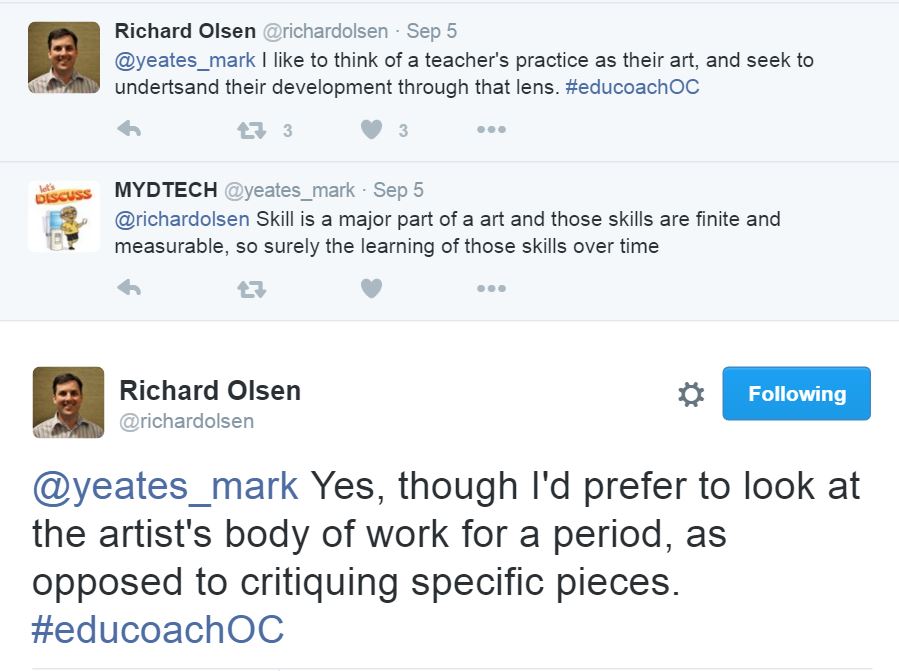
There are also, however, those who advocate for clear maps and standards of teaching in order to develop shared understandings of what good teaching might look, sound and feel like. My own school uses the Danielson Framework for Teaching as a tool for developing our shared language of teaching and the precision of our reflections on and planning for teaching and learning. These reflections are also based on lesson data snapshots of practice, which provide the basis for Cognitive Coaching conversations. Our approach seems to fit into Richard’s notion of “critiquing specific pieces”, rather than looking at a body of work. Yet fine-grained lesson data and consequent reflections allow teachers to drill down into aspects of their teaching practice, while acknowledging that one lesson is only ever a moment in time, a snapshot of practice, a through-the-keyhole-peek into their teaching as a whole.

Many, including Robert Marzano, describe teaching as an art and a science. The notion of blending art and science, creativity and systematisation, resonates with me. It was the approach I took to my PhD research, one that I outline in this paper in Narrative Inquiry. I have blogged about viewing research as sculpture, as art-esque conversation, about teaching Art, and about textiles as political metaphor for academic writing and identity.

Elliot Eisner’s body of work explores education as artistry and connoisseurship. Eisner advocates for the arts as a frame for re-imagining education as innovative, artistic practice, rather than as a cookie-cutter or assembly-line one. Conceptualising teaching as an art, or arts, or artistic, assumes a complexity, a non-linearness, a rich tangled web of intangibles and un-pin-downables.

Is teaching art or science? Or both? Is it inappropriate to look at a single work, a close-up of the brushstrokes or the marks made by the sculptor’s tool? Should we only talk about teaching in terms of bodies of work, portfolios of evidence, the whole and not the parts? Can Michelangelo’s David be separated from his Pietà, the Sistine Chapel ceiling and his unfinished ‘slaves’? Can or should meaning be sought in a singular laboured-over artwork, or in a dusty pile of experimental sketches found in the attic? Or should we only assess or seek meaning in a body of work accumulated over time?

How might a teacher’s performance be appraised? How can the whole, as well as the parts be considered? Of what use is the performance of teaching for observations by management, versus relaxed one-on-one discussions with students or an experimental lesson tried for the first time? And of what use are the ‘individual works’ such as unit plans, student work examples, lesson data and external test results? Data from particular lessons can provide a tangible, depersonalised third point for professional conversations, just as a particular work of art can be representative of an artist’s work. An exhibition from a particular period of an artist’s work can give a broader picture of their work during that time. A posthumous exhibition of their life’s work can provide the broad narrative of how their work has evolved. These are all different but meaningful lenses for appreciation and critique; each is a useful way of viewing the work and worth of the artist or teacher.

On the one hand, teaching does become a body of work over time. A life’s work for some. This gestalt includes ever-expanding subject knowledge, evolving pedagogies, relational skills and behaviour management tools. Many of the things teachers do become internalised, less-deliberate moves, part of a way of being. Perhaps a teacher should not be judged by a lesson that they teach or one set of student results, but there is value in each piece of work being reflected upon and closely considered for the understandings it might surface about that teacher’s practice; the details it might reveal; or the points of celebration, critique or change it might incite.

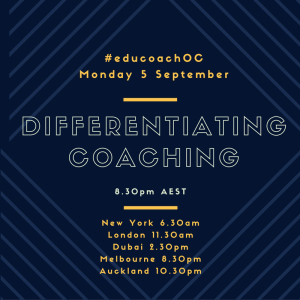
#educoachOC Chat 11: Differentiating Coaching

Tonight (or this morning if you are in the northern hemisphere) is the #educoachOC monthly chat. We’re talking diffefentiating coaching.

I’m really interested in what the global edu-coaching community has to say about how we might tailor coaching to address a variety of coachee needs and contexts.

Dr Deborah M. Netolicky's avatar#educoachOC

educoachOC

This Monday, on 5 September, our monthly #educoachOC chat will be exploring the topic of differentiating coaching.

If coaching is viewed as a catalyst and support for professional growth, then the process should be able to be applied to any individual’s contexts and priorities. Often we see coaching as a model differentiated by its open processes and intent to focus on the individual being coached. But does any coaching process, framework or approach fit most individuals and their growth needs?

In education, coaches are involved in coaching people at a variety of places in their careers and personal lives. People come into a coaching conversation with different priorities, different starting points and different needs. Early career teachers. Mid-career teachers. Veteran teachers. Highly reflective practitioners. Less reflective practitioners. Those struggling with change processes, work contexts or personal events. Aspiring leaders. New leaders. Middle leaders. Executive leaders.

As coaching is about helping…

View original post 235 more words

Power of a nerd herd: Ode to my people

Nerd Face Emoji

It seemed Liv had spent the last eighteen years in search of her people, and in one sudden explosion of fate, they’d all been brought together in this place in time. Her eyes filled with tears as a sudden awareness filled her. They were all nerds.” ~ Danika Stone, All the Feels

The word ‘nerd’ is often given a bad name, being associated with relational ineptitude and being socially outcast. But for me nerdiness is about finding joy in knowledge: attaining it, interrogating it, producing it. Immersion in it. Consuming, curating and creating.

I love it when a nerd is positioned as a central figure of a story. One example is astronaut and botanist Mark Watney, the protagonist in Andy Weir’s 2011 novel The Martian. At one point Watney, stranded on Mars alone, yells, “Hell yeah! I’m a botanist! Fear my botany powers!” Watney embraces his nerdiness, calling himself a “space pirate” and invoking the metaphor of Iron Man when he catapults himself into space near the novel’s end. The story arc of the novel, and the Ridley Scott film in which Matt Damon plays Watney, is carried by this nerd-hero and his melding of science knowledge and affable humour. Watney is the epitome of the lovable nerd.

Recently, I’ve been reflecting on those people in my professional and personal spheres who make me feel like I’m at home when I’m with them. Many of these are fellow nerds. That is, we connect over our mutual love of something geeky (reading, writing, teaching, research, literature, coaching, art, science, story). We have a shared joy in finding things out and in doing purposeful work.

These are family and friends who, while I was completing my PhD, asked me about my research and listened to my responses. They are colleagues who get excited about a project we’re working on. Who co-plan courses, lessons, cross-curricular opportunities and assessments with a fervent enthusiasm and a twinkle in their eye. Who understand, or at least watch with knowing amusement, when I get excited about a new academic text or education book arriving on my desk (O, Book Depository, my faithful friend!), or about a paper being published. Who smile patiently when I cyclone into their office full of ideas busting to get out of my head or words tumbling out of my mouth. They are the past or present principal who continues to show an interest in and support of my work. Who sometimes says ‘yes’ and sometimes challenges me to think and do more.

They are the mentor or coach who waits while I work through my messy thoughts and helps me to arrive at cleaner ones. They are the colleague and bloggers who trust me enough to listen to their unformed thoughts or read their still-emerging ideas.
They are the professional friend who coaches me on Voxer or takes a phone call to help me work through a professional problem or issue. They are my PhD supervisors who gave me the space to explore some off-the-wall ideas, while challenging me to construct airtight rationales for non-traditional approaches. They are the well-known academic who shares their expertise via social media, flattening hierarchies and transgressing time zones. They are the conference-goer who stops me in the corridor after my presentation to talk for an hour, before moving our conversation to the long lunch it deserves. They are the co-author I’ve never met face to face, or spoken to on the phone, but with whom I’ve collaborated, co-written, and whose thinking and writing has pushed mine into new crevices.

They are my kind PLN who engage thoughtfully with me on Twitter, respond to my blog posts and meet up with me in cities around the world. Twitter is full of generosity. In my PhD acknowledgements, I thanked family and friends who had shown an interest and those in the social media world who had provided an antidote to isolation when I felt alone in my own head in the PhD wilderness.

Those people who feel like my tribe provide a space that is at once safe and challenging, celebratory and questioning, inspiring and industrious. It’s a place I can be excited about an idea, a text or a possibility. I can geek out and nerd it up without risking an eye roll or a snigger. I can share narrow interests and pursue broad passions.

In a world in which we are more connected than ever, we can be buoyed, empowered and supported by our connections, our people, our herd, our tribe, our squad. We can pay forward and give back. We can support each other’s nerdy excitement. In the karmic circle of knowing, learning, doing, being, leading and caring, we can share our knowledge, contribute our time to help others on their journeys, listen to others’ stories and celebrate others’ milestones.

Thank you to my fellow nerds who give me a sense of belonging and allow me the luxury of knowing that my personal brand of nerd has plenty of places to call home.

Achievement unlocked: I think I am Nerd Face Emoji.

Achievement unlocked: I think I am Nerd Face Emoji.


Schools can lead and generate research #AHISA16

Rottnest rainbow, by Deborah Netolicky

This week I’m attending the AHISA (Association of Heads of Independent Schools of Australia) conference, which brings school leaders from around Australia together for a few days of visiting schools, conferencing, and networking. In my daily life, conversing with educators, many of whom I’ve never met, in other spaces and places tends to happen through social media (Twitter, blogging, Voxer). This week, however, via the AHISA conference, I’ve had the pleasure of catching up with those I have met and know well: my first principal and a variety of leaders with whom I have worked in Perth, Melbourne, and London. As someone who has worked in independent schools in Australia and the UK (for over 16 years, except for 6 months at a London comprehensive) this conference visit has been in some ways like watching my career flash before my eyes, as I’ve reconnected with various colleagues I’ve worked with at various times and places across the last decade and a half. It’s a reunion and a catch up with those I’ve worked over the years, a chance to talk with current colleagues about how the conference relates to our current work, and a place to make new connections with school leaders from around the nation.

In the conference sessions, I’ve been following a thread that is important for my own current work: professional learning for teachers and leaders, especially that emerging deliberately out of specific contexts. These sessions are relevant to me and my school because I have led a whole-school, evidence-based strategic intervention: a coaching-for-professional-growth model. This role has involved, since 2012, canvassing research literatures, writing papers, presenting to the school Board each year, and leading teams of teachers to prototype and iterate a context-specific model to support teacher and leader growth. This intervention was top-down (driven by the school’s strategic vision) as well as middle-out and bottom-up (developed by teams of teachers, led by me and overseen by the school Executive). It has meant generating data around the impacts of our work and tracing the influence of the model on teaching, learning, leading, school culture and the organisational language of professional conversation.

At the AHISA conference, the best workshop presentations for me have been those that have outlined how a school or system has applied systematic, research-informed, evidence-generating methodologies, with a clear aim.

Dr Gary Jones (2016) points out that schools can use evidence to make better decisions. He elevates the following from Barends, Rousseau and Briner (2014) as a frame for evidence-informed decision making in education:

  • Asking: translating a practical issue or problem into an answerable question;
  • Acquiring: systematically searching for and retrieving the evidence;
  • Appraising: critically judging the trustworthiness and relevance of the evidence;
  • Aggregating: weighing and pulling together the evidence;
  • Applying: incorporating the evidence into the decision making process; and
  • Assessing: evaluating the outcome of the decision taken.

Evidence might include: published academic research that quantitatively or qualitatively analyses empirical data; data, facts, and figures gathered from the school; specialised professional experience and judgements of relevant practitioners; and values, views, and concerns of relevant stakeholders. Schools can value and consider a range of research, as well as tacit knowledge and the richness of their own context.

As Dylan Wiliam points out in his 2016 book Leadership for Teacher Learning (and elsewhere), research cannot tell teachers and schools what to do, but can inform their decision making and their efforts. We can look to research for likely-to-be-productive avenues in education, rather than for recipes or silver bullet solutions to be unquestioningly followed.

In fact, schools can lead research, not just follow it. They can generate research, not only consume it. School leaders and teachers can be researchers, can apply research thinking, and can be critical questioners of research literature. They can challenge each other, participate in respectful debate, investigate contradictory positions, or consider multiple possibilities. They can pilot, prototype, and iterate new ways of doing things, while collecting data on the progress and impacts of interventions.

It has been great this week to connect with past, current, and future colleagues at the AHISA Leading, Learning, and Caring conference. It has been even more pleasing to see the work of some educators and schools in applying evidence-informed and data-generating design thinking to their complex work. Still, there are those who could more rigorously interrogate their assumptions, practices, and uses of research literature. There are those from whom others would benefit if they contributed their thoughts to edu-dialogues. Many of us would benefit from listening more closely to others. Whether affirming, querying, or dissenting, it is a range of thoughtful voices from multiple perspectives that together can shift the narrative, practice, and evidenced understanding of education.

PhD: The gift that keeps on giving

my bespoke graduation shoes

my bespoke graduation shoes

I submitted the PhD last October. I finished my corrections in March. My doctorate was conferred in April. I wrote blog posts about completion: how it felt, struggling with my doctorness, what happens in Australian PhD examination.

So it should feel long ago done-and-dusted by now, right? I should have nothing left to say about the PhD.

Yet I still have PhD reflections and I feel as thought I am still having PhD experiences. I’ve remained in a doctoral Voxer group because the after-the-PhD bit still feels like part of the PhD journey. I continue to blog about the PhD as I am still reflecting on its processes, products and outcomes, some of which emerge overtime.

Here are some of the ways that the PhD keeps on giving …

Academic writing

The wonderful thing about completing the thesis and having it passed is that it frees you up to write more tightly-woven pieces from your PhD literature, method, data and findings. Pat Thomson has recently written a very useful post on how to find journal articles in and from the doctoral thesis. You can look for interesting pieces relevant to particular journals, new ways of looking at your data, specific fields in which your work has something to add. This bit—in which you realise that your work has something to offer scholarly conversations and that you can create new offshoots of writing so that it to be heard in appropriate fields—is empowering and even fun. I’m even becoming better at seeing peer review as a growth process in which I am privileged to participate, rather than an ordeal to be endured.

The three solo-authored peer-reviewed journal articles I’ve had published (or accepted for publication) so far include one on coaching as a professional learning intervention, one around the use of literary metaphor as method in academic writing and one on my findings around professional learning (in press). I have a co-authored paper on method that is under review. I have an ethics paper I’m working on with my supervisors. I have a book chapter in preparation which re-considers my school leader data through a new lens, in a previously unfamiliar field. I have more ideas about what bits and pieces of my thesis might have to offer before I retire it. The more I read and write, the more possibilities I see for reporting on or re-seeing my PhD work.

Acknowledgements

I’ve been told that my PhD adds credibility to my voice when I present and to the work that I do. My thesis has been downloaded from the university website over 250 times since it was uploaded in March. I’m not sure where this number sits in terms of metrics for dissertations, but it does suggest that my thesis is being read (or at least filed away with the intention of reading it).

I’ve been acknowledged via the 2016 ACEL New Voice in educational Research scholarship, which I’ll be receiving in Melbourne in September. My thesis has also been nominated for the Outstanding Research Award in Cognitive Coaching.

Formal recognition of the completed work of the PhD remind me of its worth. Informal feedback, too, in which scholars or PhD candidates get in touch with me to let me know how my work has been influential for them, is also thrilling.

Graduation and the floppy hat

While I’ve been conferred my doctorate and therefore can call myself ‘doctor’, my actual graduation ceremony isn’t until next month.

This is when I get to go up on stage to receive my printed degree. I didn’t attend graduation for my undergraduate degree, but for the PhD I feel like I need this rite of passage, this moment of celebration. To embrace the pomp and find closure in the ceremony. It’s somehow not enough to get the piece of paper delivered to my letterbox.

Unlike Finnish Doctors of Philosphy, who get to wear a top hat and sword as part of their regalia, I get to don a gown, a red-satin-lined hood and the black velvet Tudor bonnet (aka the floppy hat). While I joke that I’ll be wearing my doctoral headgear to the Spring Racing Carnival (Melbourne Cup Day, here I come!), it’s likely that I’ll get more wear out of my graduation shoes, which I designed for the occasion (via Shoes of Prey). After tweeting the above photograph of my shoes, Hilary Davidson pointed me towards her great article on shoes as magical objects, the perfect symbol of PhD power, transformation and completion.

Continuing my research

While my choice has been to continue to work in my school (rather than, for instance, pursuing an alternate career in academia), I’ve also been recently appointed into an honorary research associate role at my university, which allows me to continue to read, research and write in academia after graduation. So I continue to bestride the worlds of practitioner and scholar. Each world, each role and each project informs the others and shapes me.

*                                  *                                  *

So the PhD is done-but-ongoing.

I’m still pursuing doing good work with good people. I’m still thinking, writing and researching around my PhD, although in many ways I can feel myself moving on from it and away from it. The bound thesis is like a frozen snapshot, capturing a moment in time. So, too, each academic paper. As I grow as a scholar, an educator and a writer, I feel freed to frame my PhD data in new ways and to apply alternate theoretical lenses.

Like a pair of shiny red shoes, the finishing of a PhD is both end and beginning. Designed, created and seductively new. Ready to be enjoyed until worn-out, grown-out-of or kicked to the back of the wardrobe. While in many ways I feel that I’m moving away from the PhD, it also continues beyond its end, a shoe that continues to fit and bring joy. For now.

Mapping quality teaching

Sidney Poitier in To Sir, with Love Source: http://www.rockshockpop.com/forums/c

Sidney Poitier in’ To Sir, with Love’. Source: http://www.rockshockpop.com/forums/

This is the third post in a series of posts on quality teaching. You can also read:

Part 1, which explored the terms ‘teacher quality’ and ‘quality teaching’; and,

Part 2, which outlined those things that effective teachers have been found to do.

*                 *                  *

If we accept that the quality of what teachers do in their classrooms influences student learning, and that quality teaching has some agreed characteristics, what can teachers, schools and systems do? How does the profession come to a common understanding of what good teaching looks like? Amid teaching debates like ‘traditional vs. progressive’, what is it that teachers should be striving to do?

Some question and warn against the itemising of teaching into a set of prescriptive elements, and many agree that attempting to quantify the complexity of teaching is fraught with difficulty. Many scholars and educators have nonetheless worked to identity what quality teaching looks like and what effective teachers do, trying to capture what teaching encompasses. These authors attempt to detail, describe, interpret, and evaluate the elements of teaching; to find what quality instruction looks like and the conditions necessary for developing the quality of teachers’ instruction.

Many authors suggest that in order to develop their teaching, teachers need a ‘map’ of where to go and how to get there. In his 2004 book Successful school change, Claude Goldenberg reflected on his work with a USA primary school over five years. He noted that the school and teacher change model he and the principal implemented was too abstract and unspecified. He added that “we should have been more nuts-and-bolts oriented, in the sense of specifying more clearly what teachers were to do in various settings, including their classrooms” (p. 173).

In order for teachers to improve, not only do teachers have to want to improve, they must know how to improve and on what aspects they would benefit from focusing their attention. Schools can benefit from frameworks that provide the knowledge base of what good teaching looks like, as well as processes that facilitate the improvement of practice. A map of teaching involves a clear set of agreed standards and a way to think systematically about the complexity of the task. Mapping teaching can be less about identifying quality and proving teacher performance. It can be about empowering teachers to improve, developing a common understanding and shared language of practice.

Examples of attempts to address the need for a framework or map of the intricacies of teacher practice include the Danielson Group’s Framework for Teaching, the Marzano Causal Teacher Evaluation Model, and the Australian Institute of Teaching and School Leadership (AITSL) National Professional Standards for Teachers.

The Danielson Framework for Teaching, endorsed by Dylan Wiliam in his 2016 book Leadership for Teacher Learning, has been shown to: identify the most effective teachers and positively correlate their quality with student achievement gains; focus observers’ attention on specific aspects of teaching practice; establish common evidentiary standards for each level of practice; and create a common vocabulary for pursuing a shared vision of effective instruction. Students showed the most academic growth in classrooms with teachers who rated highly on the Framework, and the least academic growth in classrooms with teachers who received the lowest ratings.

Marzano’s model has also been tested in studies and meta-analyses, which report that using the instructional strategies of the model improves student achievement and helps teachers develop themselves professionally.

In evaluating the perceptions of the AITSL Professional Standards, AITSL has found that pre-service teachers were the most enthusiastic about the potential of the use of the Standards in their practice and their students’ learning, school leaders were most engaged in the implementation of the Standards, and non-pre-service teachers were least likely to perceive the Standards as useful in changing their practice or impacting their students. AITSL’s measures have concentrated on educators’ perceptions of their tool.

Frameworks such as Danielson’s, Marzano’s, and AITSL’s may have a place in helping teachers to achieve clear, measurable targets, but schools and systems using these tools need to be considered in their purpose and process of their implementation. My school uses the Danielson Framework (overlaid with the national AITSL Standards) as a third point in conversations, in order to help novice and veteran teachers to reflect on their lessons with specificity. It is a tool, as part of a large toolbox, for developing shared understanding.

My PhD study found that the Danielson Framework for Teaching, when used as part of a non-judgmental model of teacher growth, helps to develop teachers’ precision of reflection around teaching practice and a common language for talking about teaching and what it can look like. At my school, teachers who develop familiarity with the Framework and its descriptors find that while teaching they mentally aim for the descriptors of ‘Distinguished’ teaching; knowledge of the Framework shapes their decisions and their classroom practices.

As much of the world grapples with how to wrestle the octopus of ‘teaching’ into a small, rigid glass jar of pithy statements or political one-liners, we need to be wary of atomising teaching into disparate parts, but we can be equally open to tools that might help us deepen our professional understandings and practices. We can focus on dialogue, interrogation of practice, reflection, collaboration and growth, and on researching and critically appraising the frameworks and measures available to us.

What do ‘quality teachers’ do?

Jaime Escalante in 'Stand and Deliver'. Source: http://remezcla.com/film/edward-james-olmos-on-stand-and-delivers-25th-anniversary-and-the-release-of-filly-brown/

Jaime Escalante in ‘Stand and Deliver’. Source: http://remezcla.com/film/

This is Part 2 in a series of posts on ‘teacher quality’ and ‘quality teaching’. You can also read Part 1 and Part 3

In response to my last post, I’ve received a lot of comments from those who bristle at the use of the term ‘teacher quality’ to label teachers and demean the profession; it is, however, a term used profusely in research and policy literatures. I’ve used the term here as shorthand for ‘teachers whose practice positively influences student learning.’

*                 *                  *

As the quality of teachers’ teaching is generally agreed to be an important school-based influencer of student achievement, researchers have attempted to identify aspects of teaching as demonstrating evidence of positive effect on student achievement.

In reviewing literature for my PhD, I found five elements that emerged as agreed elements of what ‘quality teachers’ do. I have cited some of the references that mention each aspect, although there are larger webs of literature for each of the five threads explained below.

______________________________________________________

1) Quality teachers purposefully design learning opportunities

Teachers have excellent knowledge of their content, pedagogies, their students, and how their students learn. They apply this knowledge to planning programmes, lessons, student groupings and assessments with clear, transparent performance targets. The purposeful designing of learning opportunities is articulated in references such as Bransford and Darling-Hammond’s Preparing teachers for a changing world: What teachers should learn and be able to do, Shulman’s (2004) essay ‘Communities of learners and communities of teachers’, and Linda Darling-Hammond’s seminal The right to learn: A blueprint for creating schools that work.

2) Quality teachers diagnose student progress to inform both teaching and learning

Grant Wiggins and Jay McTighe (in their 2007 Schooling by Design) wrote that teachers facilitate the setting of challenging goals and high standards, designing the work so that learners believe in their own capacity for success, and adjusting plans in light of unexpected or inappropriate results. Jim Rose in his 2006 Independent review of the teaching of early reading noted that high quality teaching should inform realistic and ambitious target-setting.

3) Quality teachers fight for their students’ learning

A couple of references point to the importance of advocacy in teaching. In 1986, Philip Jackson argued that effective teachers fight for what they believe about teaching and learning, acting independently to advocate for their students. Wasley, Hampel and Clark (1997) spent three years observing and interviewing six students in five USA schools for their book Kids and school reform. They found that good teachers believe that each of their students can learn; and have the skills and capacity to engage in debate on behalf of their students’ learning.

4) Quality teachers personalise learning for students

Teachers balance the needs of the learner, the knowledge and skills students need to acquire (what they teach and why), assessment and feedback, and embeddedness in community. They select appropriate classroom design, instructional strategies, and subject matter to help each student learn, with a diversity of teaching methods including: reciprocal teaching, direct instruction, problem solving methods, explanation, elaboration, modelling, plans to direct task performance, sequencing, drill repetition, optimising peer learning, providing strategy cues, domain-specific processing, clear instructional goals, setting challenging goals and teaching students self-verbalisation and meta cognitive strategies. They respond with immediacy and a sensitivity to the here-and-now, showing flexibility by valuing freedom of thought and movement in the classroom. The emphasis on sensitivity towards, and individualisation of approaches for, students, is evident in Bransford and Darling-Hammond’s Preparing teachers for a changing world: What teachers should learn and be able to do and Philip Jackson’s The practice of teaching.

5) Quality teachers provide meaningful and appropriate feedback.

In Schooling by Design, Grant Wiggins and Jay McTighe pressed the importance of backwards assessment design, providing ongoing feedback with immediate opportunities to use it, and implementing strategies to develop learner autonomy, thus making self-assessment and self-adjustment a key goal of teaching. The work of Dylan Wiliam and Rick Stiggins promotes formative assessment as a way to frequently check for understanding and to engage students in self-reflective, self-regulated learning.

______________________________________________________

The above-mentioned studies suggest that quality teaching requires teachers to have a sound and continually developing knowledge of content and pedagogy. This supports the definition of teacher quality I identified in my last post: ‘knowing what to teach and knowing how to teach’. Quality teaching, according to the above cited works, involves teacher self-reflection, planning of well-structured units and lessons, focusing on higher order thinking, managing the classroom effectively, utilising an arsenal of effective teaching strategies, individualising learning, setting challenging goals for all students, knowing where each student is ‘at,’ facilitating each student’s progress to the next level, and giving effective, targeted, timely feedback.

Anne Freese (in her 1999 paper ‘The role of reflection on pre-service teachers’ development in the context of a professional development school’) describes herself as an educator (albeit in a higher education, rather than a school, context, so perhaps from a potato perspective) and in doing so resonates with the above threads of quality teaching:

I am more like a coach who structures the learning events and co-inquires. . . . I have become more comfortable modelling and making public my thinking about teaching, and risking being vulnerable as I put my own teaching under scrutiny. This is a different role from that of being the `expert’ and the dispenser of knowledge. (p. 908)

Here Freese underscores the teacher’s purposeful designing of learning by structuring what she calls “learning events,” suggesting deliberate design of student-focused learning experiences. She makes her thinking “public” and sees herself as coach and co-inquirer, vulnerable in her collaboration as co-learner with her students. Freese highlights the notion of self-reflection in her comment about having the willingness and capacity to put her “own teaching under scrutiny.” Freese’s description reflects Wiggins and McTighe’s description of those teachers who demonstrate ‘quality’ practice as designers, diagnosers, facilitators, and constructors of learning and learners.

As teachers, schools and systems have conversations around how to improve the learning of students by improving what happens in classrooms, it’s important that we continue to attempt to build a shared understanding of exactly what we mean when we say things like ‘quality teaching’.

Teasing out ‘teacher quality’

This post is the first in a series exploring the popular notion of improving teacher quality in order to improve student learning and achievement.

You can also read Part 2 ‘What do quality teachers do?‘ and Part 3 ‘Mapping teacher quality‘.

*                 *                  *

For some time, scholarly literatures have generally agreed that, within the school sphere of influence, the quality of teachers’ teaching is the most influential school-based variable in terms of improving student learning and achievement. (We need to remember, however, that student learning and achievement are influenced primarily by many factors that are hardest for policy makers and schools to influence, such as students’ attitudes and abilities, socioeconomic context, parents’ education and peers.) Now, everywhere we look in education there are institutes and government policies and school websites all hailing the catch cry: ‘teacher quality!’

The term ‘teacher quality’ is in danger of being subsumed in what I call the ‘hashtagification’ of education terminology, in which words like ‘mindset’ and ‘grit’ become ubiquitous platitudes shared in sound bites or 140 character tweets. When we use words in education, we need to read the literature and research about them, tease them out, and come to a shared understanding about what are often dense concepts around the complexity of teaching.

During my PhD I spent time (ok, years) reading up on, among other things, ‘teacher quality’. Its definitions, its features, studies that aimed to measure its impacts. While I can’t distil those years of reading into a blog post, this post is a starting point (for comments, conversations, future posts) as well as a call to others to spend time cogitating over and teasing out the terms we use in edu-spheres.

‘Teacher quality’ is used to denote the quality of teachers’ teaching, in terms of its effectiveness in adding value to student learning. While it is sometimes used in terms of the individual teacher, many scholars argue that teacher quality should be considered in terms of collaborative expertise, rather than the solo hero teacher (so wonderfully written about here by Corinne Campbell). That is, while an individual teacher can have an influence on student learning, a move to improve the quality of teaching (and thereby, student learning) needs to focus on teachers as a collective.

One of my favourite images of collaborative expertise comes from Susan Rosenholtz in her book Teachers’ workplace: The social organisation of schools. She writes that in learning-enriched settings “an abundant spirit of continuous improvement” seems to “hover school-wide, because no one ever stopped learning to teach,” describing educators in effective schools as “clumped together in a critical mass, like uranium fuel rods in a reactor” (1991, p. 208). That image is a powerful reminder of what we in schools and education might aim for: a critical mass of huddled-together teachers feeding off each other’s energies, knowledge and practices. It’s also why competitive or punitive measures, like performance pay for teachers, are damaging to the profession. Collaboratively improving teacher quality is based on a notion with which most teachers would agree: that no matter how good our teaching is, no matter how well-planned and well-intentioned, we can always improve.

Two definitions of ‘teacher quality’ resonated with me in my reading. Firstly, the Educational Testing Service, in their 2004 publication Where we stand on teacher quality, defines it as: knowing what to teach and knowing how to teach. This definition hones in on the planning, classroom instruction, and assessment aspects of teacher quality, on the professional knowledge and skills upon which teachers can build in their pursuit of improving the quality of their teaching. Secondly, in their best evidence synthesis of international research on ‘teaching for quality,’ Zammit et al. (2007) define teacher quality as consisting of three intersecting factors: sociocultural context; professional knowledge, skills and practices used to meet student needs; and personal, relational and professional attributes. This second definition reminds us that teachers’ experiences are always situated within their professional contexts and entangled with personal and relational experiences. Teaching is not just about knowledge and skills, but about identities, contexts and emotions, too.

Some of those who write about teacher quality focus on the impact of teaching on student achievement and the others consider how we might break down or compartmentalise teaching in order to distil and define what quality teaching is; how it looks, sounds, and feels, and how it might be mapped, measured, or developed. Many grapple with the tensions between the desire to define and measure teaching, and its immeasurable complexity. In my Australian school, we investigated a number of tools that attempted to map what good teaching might look like. We chose to use the Danielson Framework for Teaching as our frame for professional reflection and conversation. Its rubrics help our teachers to drill down into their own practice, and into the AITSL Professional Standards for Teachers, giving them a sense of what those standards can look like at various levels of practice.

Teaching is such a complex phenomenon, it shouldn’t be reduced down to clichéd catch cries devoid of meaning. Despite the problematic nature of defining what teacher quality actually means, much available research shows that what a teacher does in the classroom is a crucial determinant in improving student achievement, and something we should spend some time teasing out in order to understand it in more detail. When we use terms in education—‘teacher quality’, ‘growth mindset’, ‘coaching’, ‘grit’, ‘vision’—let’s ensure that we work hard at figuring out what those mean and where our understandings might be shared, incomplete or requiring further discussion.

How writing is like cake making. #acwri

this week's home-made asymmetrical Aussie Rule football cake

this week’s home-made Aussie Rules football cake

Why cake ? Because joy and deliciousness are nutrients in their own right. ~ Jude Blereau

I make about two cakes a year, one for each of my children’s birthdays. One year ago, baking and decorating my eldest son’s cake prompted a blog post in which I compared making a novelty birthday cake to doing a PhD. This year, baking his double-layer chocolate cake (decorated as an AFL football field) had me thinking: this cake making business is a lot like writing, particularly academic writing.

My boys are 4 and (just) 6, so on my one-cake-per-child’s-birthday / two-cakes-per-year average, I haven’t baked that many cakes. Yet this week’s cake (pictured above), is the first cake that has felt stress-free to make, and first one for which I haven’t made big mistakes in the making. In the past my cake and icing mixes have split and curdled. I have broken cakes trying to get them out of the pan. There have been times when I decorated cakes the day before serving and the colours from the candy bled into the icing. Once, a heavy cake topper figurine sunk into the cake overnight. Earlier this year, I got a knife caught in the beaters while making icing, which resulted in me icing myself and the whole kitchen, including the ceiling. I didn’t feel quite the Nigella-esque image of domestic goddessery when I couldn’t see through my tears and icing-splattered spectacles.

This week there was none of the cake-anxiety drama. Baking and decorating were calm and enjoyable. Much of this was due to the knowledge and skills I have gained over time, as well as processes I have developed for this task. I knew to leave my ingredients out so that they were room temperature when I used them, preventing mixes from splitting. I knew to alternate mixing in dry and wet ingredients. I knew to take the time to cover the whole inside of the pan with carefully-traced-and-cut-and-placed bake paper so that the cake would slide out easily, with a now-practiced flourish, onto a wire rack. I knew to ice the cake while it was partly frozen to prevent crumbs in the icing, and to leave the extra decorations off until the icing was set so that the colours didn’t bleed. I had a familiar routine set out over a few days which made the process manageable. I also knew my materials better, what they could and couldn’t do. My expectations were managed. The cake was a bit lopsided, the icing a bit uneven, the drawn lines a bit skewwhiff. These imperfections were the marks of me as the maker, and I was ok with those idiosyncrasies. They were the ‘voice’ or the ‘me’ in the cake.

And so, from baking and decorating to writing …

My reflections on my journey as a novice baker and decorator remind me of my arc as an academic writer. The brief for each cake (footy! outer space! race track!), or each paper or chapter (this journal! that book! this field! that theory!), is different, requiring planning and consideration at the outset about how to proceed in order to reach a particular end point. Academic writing requires a nuanced understanding of its ingredients, materials and processes. The writer needs to understand, and be able to expertly manipulate, the language of particular disciplines and the language of particular journals. They build a growing knowledge of theories and literatures.

Like the baker, the writer develops a routine, a flow, an individualised writing process that works for them, including how to time their work, how to structure it, how to build layers of meaning, how to perfect and polish it in the final stages. They acquire tools and strategies for their work, things that make the work smoother and produce a better product. Some knowings and doings become internalized over time, with the writer having to think less about them, able to turn their attentions to refining their craft, developing deeper understandings and pushing the scope of their work beyond the limits of its previous iterations. Writers hone their voice, the ‘me’-ness in their writing, while watching out for their writing tics.

Like a cake made for a particular individual and a specific celebration, a piece of writing is often constructed with a particular audience in mind. Peer review of cake at a child’s birthday party is gentler than that in academia, but the party guest’s purpose is to appreciate and thank the host, while the peer reviewer’s purpose is to critically judge and improve the work. Once writing is published, more feedback comes in the forms of citations, downloads, reviews and social media shares. The audiences are different, but for both baking and writing there are accepted norms of feedback from others. A baker might dread the grimaced smiles of guests pretending to enjoy their cake while they leave slices unfinished, just as a writer might fear Reviewer 3’s scathing critique or the deafening silence of an uncited, un-clicked-upon piece, lying unread in physical and online spaces. Peer review is, after all, often like getting a punch in the face and a high five simultaneously.

While I am a sometimes-baker, I am a regular writer. I’m sure that if I baked with the constancy of my writing, it would improve markedly. I write something almost every day, for different purposes or different audiences. One distinction for me between baking and writing (obviously there are many differences!) is that I find I write my way into understanding, into knowing my own thinking and into interrogating my worlds and the writings of others. Writing is inquiry, identity work, illuminator. It is joy and struggle. And while a cake is devoured until only crumbs remain, writing lives on.

Questioning heroic leadership: The visible-invisible hero

heroes

Our notions of heroism change over time. The construction and reception of heroes is dependent on context. Often the heroes of a time and place are only decided in hindsight when their actions and the consequences of those actions are weighed by the collective, the media or Hollywood scriptwriters.

Texts can reflect the values, anxieties and aspirations of their time and place. For example, the Star Wars franchise has changed its notions of the hero over time. Early Star Wars films had some diversity back in the 1970s. Leia was an independent hero who could stand up for herself and played a key part in the Rebel Alliance. But she was still pictured as the pretty woman handing medals to the male heroes. Lando Calrissian was a non-white heroic figure, but a more minor and less honourable character than the two white males, Luke and Han. Diversity and Otherness were also foregrounded by the multiple alien species in the films, from everyone’s favourite heroic Wookie, to sinister or repulsive villains.

Fast forward almost forty years and Rei and Finn, the heroes of the 2015 Star Wars Episode VII (which I have written about here and here), show the shift in the hero’s representation in terms of gender and race.

Meanwhile, Batman is a hero whose representation has evolved over time, from the silly unintimidating comical figure of the 1960s television show, to the tortured, vengeful, imposing figures of recent films. Newer Batmans, including those played by Christian Bale and Ben Affleck, are psychologically darker and more complex.

In 2016, heroes like Deadpool and the new Ghostbusters question the traditional portrayal of the hero. Deadpool, like the animated hero Shrek, challenges stereotypical hero behaviour. He is rude, lewd and without a noble cause. The new Ghostbusters expand our vision of how heroes might look. The Game of Thrones franchise, too, agitates reader and viewer expectations of the hero by presenting us with complex, shifting characters who dance along and frequently cross the line between heroism and villainy.

To leadership …

How is the realm of leadership affected by the fluid definitions of heroism, dependent as they are on the time and place in which any real, mythological or fictional hero is created and received?

Today I’ll be speaking at the Rise and Future of Heroism Science Conference in order to explore what insights the data from my PhD has to offer the field of heroism, and what heroism has to offer the arena of leadership.

The questions I ask are:

  • Must the school leader hero be a charismatic, selfless visionary? A beacon of bravery and a moral crusader?
  • Are alternate leadership metaphors and narratives helpful for thinking about contemporary leadership in schools?

My answer, based in the emergent themes from the interview data of school leaders in my PhD study, is that the traditional lone hero on an individualistic quest is not an appropriate metaphor for the school leader. The leaders in my study reflected notions of servant, distributed, caregiver or transparent leadership.

Participants offered up their own metaphors for heroic leadership, revealing that heroism when leading others can be fluid, deliberate and imperceptible.

by Deborah Netolicky

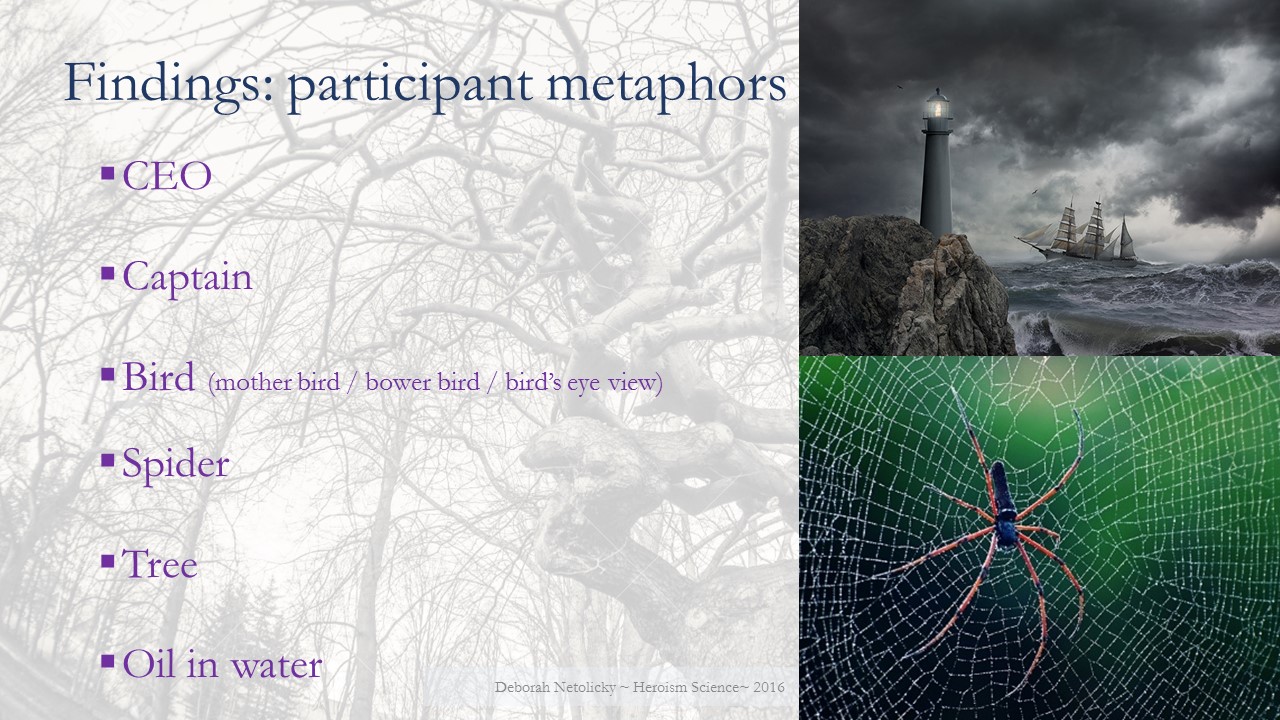
In my PhD thesis, I applied the literary character of the Cheshire Cat to emblematically articulate the visible-invisible school leader, who deliberately appears and disappears, showing only part of themselves depending on the needs of those who they lead. The Cheshire Cat leader empowers others to find their way through their professional Wonderlands. Sometimes they are the encouraging grin, the glimmering eyes, the disappearing tail. At times they are the disembodied voice, mentoring, coaching or guiding. Unlike the autocratic and unlikeable Red Queen, the Cat is a mysterious guide who operates from the aerial view of the tree, with an understanding of the bigger picture.

The image of leaders posturing as white knights of school improvement, wielding swords of change and self-promotion, is seductive but unhelpful. Heroism in school leadership can be deliberate, fluid and at times imperceptible. School leaders can focus on the collective good and intentionally navigate visibility and invisibility (although I wonder to what extent deliberately imperceptible leadership can feel like being an under-appreciated Santa Claus, and how leaders feel when their machinations to build the capacities of others go unnoticed).

My PhD suggests that leadership that serves a community or organisation, and the individuals within it, need not be highly visible. Heroism in leadership can be about deliberate invisibility, the barely discernible swish of a tail and the disappearing gleam of a Cheshire grin.