Mapping quality teaching

Sidney Poitier in To Sir, with Love Source: http://www.rockshockpop.com/forums/c

Sidney Poitier in’ To Sir, with Love’. Source: http://www.rockshockpop.com/forums/

This is the third post in a series of posts on quality teaching. You can also read:

Part 1, which explored the terms ‘teacher quality’ and ‘quality teaching’; and,

Part 2, which outlined those things that effective teachers have been found to do.

*                 *                  *

If we accept that the quality of what teachers do in their classrooms influences student learning, and that quality teaching has some agreed characteristics, what can teachers, schools and systems do? How does the profession come to a common understanding of what good teaching looks like? Amid teaching debates like ‘traditional vs. progressive’, what is it that teachers should be striving to do?

Some question and warn against the itemising of teaching into a set of prescriptive elements, and many agree that attempting to quantify the complexity of teaching is fraught with difficulty. Many scholars and educators have nonetheless worked to identity what quality teaching looks like and what effective teachers do, trying to capture what teaching encompasses. These authors attempt to detail, describe, interpret, and evaluate the elements of teaching; to find what quality instruction looks like and the conditions necessary for developing the quality of teachers’ instruction.

Many authors suggest that in order to develop their teaching, teachers need a ‘map’ of where to go and how to get there. In his 2004 book Successful school change, Claude Goldenberg reflected on his work with a USA primary school over five years. He noted that the school and teacher change model he and the principal implemented was too abstract and unspecified. He added that “we should have been more nuts-and-bolts oriented, in the sense of specifying more clearly what teachers were to do in various settings, including their classrooms” (p. 173).

In order for teachers to improve, not only do teachers have to want to improve, they must know how to improve and on what aspects they would benefit from focusing their attention. Schools can benefit from frameworks that provide the knowledge base of what good teaching looks like, as well as processes that facilitate the improvement of practice. A map of teaching involves a clear set of agreed standards and a way to think systematically about the complexity of the task. Mapping teaching can be less about identifying quality and proving teacher performance. It can be about empowering teachers to improve, developing a common understanding and shared language of practice.

Examples of attempts to address the need for a framework or map of the intricacies of teacher practice include the Danielson Group’s Framework for Teaching, the Marzano Causal Teacher Evaluation Model, and the Australian Institute of Teaching and School Leadership (AITSL) National Professional Standards for Teachers.

The Danielson Framework for Teaching, endorsed by Dylan Wiliam in his 2016 book Leadership for Teacher Learning, has been shown to: identify the most effective teachers and positively correlate their quality with student achievement gains; focus observers’ attention on specific aspects of teaching practice; establish common evidentiary standards for each level of practice; and create a common vocabulary for pursuing a shared vision of effective instruction. Students showed the most academic growth in classrooms with teachers who rated highly on the Framework, and the least academic growth in classrooms with teachers who received the lowest ratings.

Marzano’s model has also been tested in studies and meta-analyses, which report that using the instructional strategies of the model improves student achievement and helps teachers develop themselves professionally.

In evaluating the perceptions of the AITSL Professional Standards, AITSL has found that pre-service teachers were the most enthusiastic about the potential of the use of the Standards in their practice and their students’ learning, school leaders were most engaged in the implementation of the Standards, and non-pre-service teachers were least likely to perceive the Standards as useful in changing their practice or impacting their students. AITSL’s measures have concentrated on educators’ perceptions of their tool.

Frameworks such as Danielson’s, Marzano’s, and AITSL’s may have a place in helping teachers to achieve clear, measurable targets, but schools and systems using these tools need to be considered in their purpose and process of their implementation. My school uses the Danielson Framework (overlaid with the national AITSL Standards) as a third point in conversations, in order to help novice and veteran teachers to reflect on their lessons with specificity. It is a tool, as part of a large toolbox, for developing shared understanding.

My PhD study found that the Danielson Framework for Teaching, when used as part of a non-judgmental model of teacher growth, helps to develop teachers’ precision of reflection around teaching practice and a common language for talking about teaching and what it can look like. At my school, teachers who develop familiarity with the Framework and its descriptors find that while teaching they mentally aim for the descriptors of ‘Distinguished’ teaching; knowledge of the Framework shapes their decisions and their classroom practices.

As much of the world grapples with how to wrestle the octopus of ‘teaching’ into a small, rigid glass jar of pithy statements or political one-liners, we need to be wary of atomising teaching into disparate parts, but we can be equally open to tools that might help us deepen our professional understandings and practices. We can focus on dialogue, interrogation of practice, reflection, collaboration and growth, and on researching and critically appraising the frameworks and measures available to us.

What do ‘quality teachers’ do?

Jaime Escalante in 'Stand and Deliver'. Source: http://remezcla.com/film/edward-james-olmos-on-stand-and-delivers-25th-anniversary-and-the-release-of-filly-brown/

Jaime Escalante in ‘Stand and Deliver’. Source: http://remezcla.com/film/

This is Part 2 in a series of posts on ‘teacher quality’ and ‘quality teaching’. You can also read Part 1 and Part 3. 

In response to my last post, I’ve received a lot of comments from those who bristle at the use of the term ‘teacher quality’ to label teachers and demean the profession; it is, however, a term used profusely in research and policy literatures. I’ve used the term here as shorthand for ‘teachers whose practice positively influences student learning.’

*                 *                  *

As the quality of teachers’ teaching is generally agreed to be an important school-based influencer of student achievement, researchers have attempted to identify aspects of teaching as demonstrating evidence of positive effect on student achievement.

In reviewing literature for my PhD, I found five elements that emerged as agreed elements of what ‘quality teachers’ do. I have cited some of the references that mention each aspect, although there are larger webs of literature for each of the five threads explained below.

______________________________________________________

1) Quality teachers purposefully design learning opportunities

Teachers have excellent knowledge of their content, pedagogies, their students, and how their students learn. They apply this knowledge to planning programmes, lessons, student groupings and assessments with clear, transparent performance targets. The purposeful designing of learning opportunities is articulated in references such as Bransford and Darling-Hammond’s Preparing teachers for a changing world: What teachers should learn and be able to do, Shulman’s (2004) essay ‘Communities of learners and communities of teachers’, and Linda Darling-Hammond’s seminal The right to learn: A blueprint for creating schools that work.

2) Quality teachers diagnose student progress to inform both teaching and learning

Grant Wiggins and Jay McTighe (in their 2007 Schooling by Design) wrote that teachers facilitate the setting of challenging goals and high standards, designing the work so that learners believe in their own capacity for success, and adjusting plans in light of unexpected or inappropriate results. Jim Rose in his 2006 Independent review of the teaching of early reading noted that high quality teaching should inform realistic and ambitious target-setting.

3) Quality teachers fight for their students’ learning

A couple of references point to the importance of advocacy in teaching. In 1986, Philip Jackson argued that effective teachers fight for what they believe about teaching and learning, acting independently to advocate for their students. Wasley, Hampel and Clark (1997) spent three years observing and interviewing six students in five USA schools for their book Kids and school reform. They found that good teachers believe that each of their students can learn; and have the skills and capacity to engage in debate on behalf of their students’ learning.

4) Quality teachers personalise learning for students

Teachers balance the needs of the learner, the knowledge and skills students need to acquire (what they teach and why), assessment and feedback, and embeddedness in community. They select appropriate classroom design, instructional strategies, and subject matter to help each student learn, with a diversity of teaching methods including: reciprocal teaching, direct instruction, problem solving methods, explanation, elaboration, modelling, plans to direct task performance, sequencing, drill repetition, optimising peer learning, providing strategy cues, domain-specific processing, clear instructional goals, setting challenging goals and teaching students self-verbalisation and meta cognitive strategies. They respond with immediacy and a sensitivity to the here-and-now, showing flexibility by valuing freedom of thought and movement in the classroom. The emphasis on sensitivity towards, and individualisation of approaches for, students, is evident in Bransford and Darling-Hammond’s Preparing teachers for a changing world: What teachers should learn and be able to do and Philip Jackson’s The practice of teaching.

5) Quality teachers provide meaningful and appropriate feedback.

In Schooling by Design, Grant Wiggins and Jay McTighe pressed the importance of backwards assessment design, providing ongoing feedback with immediate opportunities to use it, and implementing strategies to develop learner autonomy, thus making self-assessment and self-adjustment a key goal of teaching. The work of Dylan Wiliam and Rick Stiggins promotes formative assessment as a way to frequently check for understanding and to engage students in self-reflective, self-regulated learning.

______________________________________________________

The above-mentioned studies suggest that quality teaching requires teachers to have a sound and continually developing knowledge of content and pedagogy. This supports the definition of teacher quality I identified in my last post: ‘knowing what to teach and knowing how to teach’. Quality teaching, according to the above cited works, involves teacher self-reflection, planning of well-structured units and lessons, focusing on higher order thinking, managing the classroom effectively, utilising an arsenal of effective teaching strategies, individualising learning, setting challenging goals for all students, knowing where each student is ‘at,’ facilitating each student’s progress to the next level, and giving effective, targeted, timely feedback.

Anne Freese (in her 1999 paper ‘The role of reflection on pre-service teachers’ development in the context of a professional development school’) describes herself as an educator (albeit in a higher education, rather than a school, context, so perhaps from a potato perspective) and in doing so resonates with the above threads of quality teaching:

I am more like a coach who structures the learning events and co-inquires. . . . I have become more comfortable modelling and making public my thinking about teaching, and risking being vulnerable as I put my own teaching under scrutiny. This is a different role from that of being the `expert’ and the dispenser of knowledge. (p. 908)

Here Freese underscores the teacher’s purposeful designing of learning by structuring what she calls “learning events,” suggesting deliberate design of student-focused learning experiences. She makes her thinking “public” and sees herself as coach and co-inquirer, vulnerable in her collaboration as co-learner with her students. Freese highlights the notion of self-reflection in her comment about having the willingness and capacity to put her “own teaching under scrutiny.” Freese’s description reflects Wiggins and McTighe’s description of those teachers who demonstrate ‘quality’ practice as designers, diagnosers, facilitators, and constructors of learning and learners.

As teachers, schools and systems have conversations around how to improve the learning of students by improving what happens in classrooms, it’s important that we continue to attempt to build a shared understanding of exactly what we mean when we say things like ‘quality teaching’.

Teasing out ‘teacher quality’

This post is the first in a series exploring the popular notion of improving teacher quality in order to improve student learning and achievement.

You can also read Part 2 ‘What do quality teachers do?‘ and Part 3 ‘Mapping teacher quality‘.

*                 *                  *

For some time, scholarly literatures have generally agreed that, within the school sphere of influence, the quality of teachers’ teaching is the most influential school-based variable in terms of improving student learning and achievement. (We need to remember, however, that student learning and achievement are influenced primarily by many factors that are hardest for policy makers and schools to influence, such as students’ attitudes and abilities, socioeconomic context, parents’ education and peers.) Now, everywhere we look in education there are institutes and government policies and school websites all hailing the catch cry: ‘teacher quality!’

The term ‘teacher quality’ is in danger of being subsumed in what I call the ‘hashtagification’ of education terminology, in which words like ‘mindset’ and ‘grit’ become ubiquitous platitudes shared in sound bites or 140 character tweets. When we use words in education, we need to read the literature and research about them, tease them out, and come to a shared understanding about what are often dense concepts around the complexity of teaching.

During my PhD I spent time (ok, years) reading up on, among other things, ‘teacher quality’. Its definitions, its features, studies that aimed to measure its impacts. While I can’t distil those years of reading into a blog post, this post is a starting point (for comments, conversations, future posts) as well as a call to others to spend time cogitating over and teasing out the terms we use in edu-spheres.

‘Teacher quality’ is used to denote the quality of teachers’ teaching, in terms of its effectiveness in adding value to student learning. While it is sometimes used in terms of the individual teacher, many scholars argue that teacher quality should be considered in terms of collaborative expertise, rather than the solo hero teacher (so wonderfully written about here by Corinne Campbell). That is, while an individual teacher can have an influence on student learning, a move to improve the quality of teaching (and thereby, student learning) needs to focus on teachers as a collective.

One of my favourite images of collaborative expertise comes from Susan Rosenholtz in her book Teachers’ workplace: The social organisation of schools. She writes that in learning-enriched settings “an abundant spirit of continuous improvement” seems to “hover school-wide, because no one ever stopped learning to teach,” describing educators in effective schools as “clumped together in a critical mass, like uranium fuel rods in a reactor” (1991, p. 208). That image is a powerful reminder of what we in schools and education might aim for: a critical mass of huddled-together teachers feeding off each other’s energies, knowledge and practices. It’s also why competitive or punitive measures, like performance pay for teachers, are damaging to the profession. Collaboratively improving teacher quality is based on a notion with which most teachers would agree: that no matter how good our teaching is, no matter how well-planned and well-intentioned, we can always improve.

Two definitions of ‘teacher quality’ resonated with me in my reading. Firstly, the Educational Testing Service, in their 2004 publication Where we stand on teacher quality, defines it as: knowing what to teach and knowing how to teach. This definition hones in on the planning, classroom instruction, and assessment aspects of teacher quality, on the professional knowledge and skills upon which teachers can build in their pursuit of improving the quality of their teaching. Secondly, in their best evidence synthesis of international research on ‘teaching for quality,’ Zammit et al. (2007) define teacher quality as consisting of three intersecting factors: sociocultural context; professional knowledge, skills and practices used to meet student needs; and personal, relational and professional attributes. This second definition reminds us that teachers’ experiences are always situated within their professional contexts and entangled with personal and relational experiences. Teaching is not just about knowledge and skills, but about identities, contexts and emotions, too.

Some of those who write about teacher quality focus on the impact of teaching on student achievement and the others consider how we might break down or compartmentalise teaching in order to distil and define what quality teaching is; how it looks, sounds, and feels, and how it might be mapped, measured, or developed. Many grapple with the tensions between the desire to define and measure teaching, and its immeasurable complexity. In my Australian school, we investigated a number of tools that attempted to map what good teaching might look like. We chose to use the Danielson Framework for Teaching as our frame for professional reflection and conversation. Its rubrics help our teachers to drill down into their own practice, and into the AITSL Professional Standards for Teachers, giving them a sense of what those standards can look like at various levels of practice.

Teaching is such a complex phenomenon, it shouldn’t be reduced down to clichéd catch cries devoid of meaning. Despite the problematic nature of defining what teacher quality actually means, much available research shows that what a teacher does in the classroom is a crucial determinant in improving student achievement, and something we should spend some time teasing out in order to understand it in more detail. When we use terms in education—‘teacher quality’, ‘growth mindset’, ‘coaching’, ‘grit’, ‘vision’—let’s ensure that we work hard at figuring out what those mean and where our understandings might be shared, incomplete or requiring further discussion.

How writing is like cake making. #acwri

this week's home-made asymmetrical Aussie Rule football cake

this week’s home-made Aussie Rules football cake

Why cake ? Because joy and deliciousness are nutrients in their own right. ~ Jude Blereau

I make about two cakes a year, one for each of my children’s birthdays. One year ago, baking and decorating my eldest son’s cake prompted a blog post in which I compared making a novelty birthday cake to doing a PhD. This year, baking his double-layer chocolate cake (decorated as an AFL football field) had me thinking: this cake making business is a lot like writing, particularly academic writing.

My boys are 4 and (just) 6, so on my one-cake-per-child’s-birthday / two-cakes-per-year average, I haven’t baked that many cakes. Yet this week’s cake (pictured above), is the first cake that has felt stress-free to make, and first one for which I haven’t made big mistakes in the making. In the past my cake and icing mixes have split and curdled. I have broken cakes trying to get them out of the pan. There have been times when I decorated cakes the day before serving and the colours from the candy bled into the icing. Once, a heavy cake topper figurine sunk into the cake overnight. Earlier this year, I got a knife caught in the beaters while making icing, which resulted in me icing myself and the whole kitchen, including the ceiling. I didn’t feel quite the Nigella-esque image of domestic goddessery when I couldn’t see through my tears and icing-splattered spectacles.

This week there was none of the cake-anxiety drama. Baking and decorating were calm and enjoyable. Much of this was due to the knowledge and skills I have gained over time, as well as processes I have developed for this task. I knew to leave my ingredients out so that they were room temperature when I used them, preventing mixes from splitting. I knew to alternate mixing in dry and wet ingredients. I knew to take the time to cover the whole inside of the pan with carefully-traced-and-cut-and-placed bake paper so that the cake would slide out easily, with a now-practiced flourish, onto a wire rack. I knew to ice the cake while it was partly frozen to prevent crumbs in the icing, and to leave the extra decorations off until the icing was set so that the colours didn’t bleed. I had a familiar routine set out over a few days which made the process manageable. I also knew my materials better, what they could and couldn’t do. My expectations were managed. The cake was a bit lopsided, the icing a bit uneven, the drawn lines a bit skewwhiff. These imperfections were the marks of me as the maker, and I was ok with those idiosyncrasies. They were the ‘voice’ or the ‘me’ in the cake.

And so, from baking and decorating to writing …

My reflections on my journey as a novice baker and decorator remind me of my arc as an academic writer. The brief for each cake (footy! outer space! race track!), or each paper or chapter (this journal! that book! this field! that theory!), is different, requiring planning and consideration at the outset about how to proceed in order to reach a particular end point. Academic writing requires a nuanced understanding of its ingredients, materials and processes. The writer needs to understand, and be able to expertly manipulate, the language of particular disciplines and the language of particular journals. They build a growing knowledge of theories and literatures.

Like the baker, the writer develops a routine, a flow, an individualised writing process that works for them, including how to time their work, how to structure it, how to build layers of meaning, how to perfect and polish it in the final stages. They acquire tools and strategies for their work, things that make the work smoother and produce a better product. Some knowings and doings become internalized over time, with the writer having to think less about them, able to turn their attentions to refining their craft, developing deeper understandings and pushing the scope of their work beyond the limits of its previous iterations. Writers hone their voice, the ‘me’-ness in their writing, while watching out for their writing tics.

Like a cake made for a particular individual and a specific celebration, a piece of writing is often constructed with a particular audience in mind. Peer review of cake at a child’s birthday party is gentler than that in academia, but the party guest’s purpose is to appreciate and thank the host, while the peer reviewer’s purpose is to critically judge and improve the work. Once writing is published, more feedback comes in the forms of citations, downloads, reviews and social media shares. The audiences are different, but for both baking and writing there are accepted norms of feedback from others. A baker might dread the grimaced smiles of guests pretending to enjoy their cake while they leave slices unfinished, just as a writer might fear Reviewer 3’s scathing critique or the deafening silence of an uncited, un-clicked-upon piece, lying unread in physical and online spaces. Peer review is, after all, often like getting a punch in the face and a high five simultaneously.

While I am a sometimes-baker, I am a regular writer. I’m sure that if I baked with the constancy of my writing, it would improve markedly. I write something almost every day, for different purposes or different audiences. One distinction for me between baking and writing (obviously there are many differences!) is that I find I write my way into understanding, into knowing my own thinking and into interrogating my worlds and the writings of others. Writing is inquiry, identity work, illuminator. It is joy and struggle. And while a cake is devoured until only crumbs remain, writing lives on.

Questioning heroic leadership: The visible-invisible hero

heroes

Our notions of heroism change over time. The construction and reception of heroes is dependent on context. Often the heroes of a time and place are only decided in hindsight when their actions and the consequences of those actions are weighed by the collective, the media or Hollywood scriptwriters.

Texts can reflect the values, anxieties and aspirations of their time and place. For example, the Star Wars franchise has changed its notions of the hero over time. Early Star Wars films had some diversity back in the 1970s. Leia was an independent hero who could stand up for herself and played a key part in the Rebel Alliance. But she was still pictured as the pretty woman handing medals to the male heroes. Lando Calrissian was a non-white heroic figure, but a more minor and less honourable character than the two white males, Luke and Han. Diversity and Otherness were also foregrounded by the multiple alien species in the films, from everyone’s favourite heroic Wookie, to sinister or repulsive villains.

Fast forward almost forty years and Rei and Finn, the heroes of the 2015 Star Wars Episode VII (which I have written about here and here), show the shift in the hero’s representation in terms of gender and race.

Meanwhile, Batman is a hero whose representation has evolved over time, from the silly unintimidating comical figure of the 1960s television show, to the tortured, vengeful, imposing figures of recent films. Newer Batmans, including those played by Christian Bale and Ben Affleck, are psychologically darker and more complex.

In 2016, heroes like Deadpool and the new Ghostbusters question the traditional portrayal of the hero. Deadpool, like the animated hero Shrek, challenges stereotypical hero behaviour. He is rude, lewd and without a noble cause. The new Ghostbusters expand our vision of how heroes might look. The Game of Thrones franchise, too, agitates reader and viewer expectations of the hero by presenting us with complex, shifting characters who dance along and frequently cross the line between heroism and villainy.

To leadership …

How is the realm of leadership affected by the fluid definitions of heroism, dependent as they are on the time and place in which any real, mythological or fictional hero is created and received?

Today I’ll be speaking at the Rise and Future of Heroism Science Conference in order to explore what insights the data from my PhD has to offer the field of heroism, and what heroism has to offer the arena of leadership.

The questions I ask are:

  • Must the school leader hero be a charismatic, selfless visionary? A beacon of bravery and a moral crusader?
  • Are alternate leadership metaphors and narratives helpful for thinking about contemporary leadership in schools?

My answer, based in the emergent themes from the interview data of school leaders in my PhD study, is that the traditional lone hero on an individualistic quest is not an appropriate metaphor for the school leader. The leaders in my study reflected notions of servant, distributed, caregiver or transparent leadership.

Participants offered up their own metaphors for heroic leadership, revealing that heroism when leading others can be fluid, deliberate and imperceptible.

by Deborah Netolicky

In my PhD thesis, I applied the literary character of the Cheshire Cat to emblematically articulate the visible-invisible school leader, who deliberately appears and disappears, showing only part of themselves depending on the needs of those who they lead. The Cheshire Cat leader empowers others to find their way through their professional Wonderlands. Sometimes they are the encouraging grin, the glimmering eyes, the disappearing tail. At times they are the disembodied voice, mentoring, coaching or guiding. Unlike the autocratic and unlikeable Red Queen, the Cat is a mysterious guide who operates from the aerial view of the tree, with an understanding of the bigger picture.

The image of leaders posturing as white knights of school improvement, wielding swords of change and self-promotion, is seductive but unhelpful. Heroism in school leadership can be deliberate, fluid and at times imperceptible. School leaders can focus on the collective good and intentionally navigate visibility and invisibility (although I wonder to what extent deliberately imperceptible leadership can feel like being an under-appreciated Santa Claus, and how leaders feel when their machinations to build the capacities of others go unnoticed).

My PhD suggests that leadership that serves a community or organisation, and the individuals within it, need not be highly visible. Heroism in leadership can be about deliberate invisibility, the barely discernible swish of a tail and the disappearing gleam of a Cheshire grin.

Ecosystems of work, study and relationships

Eduardo Kobra's Chelsea mural, photographed from the High Line in NYC in 2014

Eduardo Kobra’s Chelsea mural, photographed from the High Line in NYC in 2014. Because: relationships. And New York.

How do you do all the things?

I’ve made the conscious decision to be there for my kids while they’re little.

My husband is actually great. He makes the kids’ lunches on Fridays.

I can’t go for that promotion. I’m planning to get pregnant / I’d have to put my kids in after school and vacation care / My husband works full time.

I wish I had the support you do.

How does your husband cope when you’re away? Poor guy!

It’s not the role I wanted but I’m so lucky my work has allowed me to come back part-time after having children.

Wow, you’re amazing!

These are some of the comments that I’ve heard said to myself, to other women or by other women. Meanwhile, my husband has had comments directed his way such as:

How do you cope when your wife is away?

How did you manage while your wife did her PhD?

I bet you haven’t eaten a good meal in months.

Do you get your wife back now?

So it’s Daddy Daycare today?

Wow, you’re amazing!

There seem to be assumptions at work about both the nature of the PhD and the gendered nature of work, study and home. In this recent vlog, Professors Tara Brabazon and Steve Redhead talk about the relational aspects of the PhD experience. Tara talks about the online blogerature that links doing a PhD to divorce or relationship problems. I wonder why that is.

Maybe it’s because the PhD can feel like a lonely experience. It is a hard but wonderful slog that happens inside the head and on the keyboard of the candidate. It must be difficult for a partner or family member to understand what is actually happening for the person conducting research. Conversely, the PhD takes the candidate away from their partner or family or friends while they thrash about with their research and their thesis beast. I imagine that relationships can suffer and people in the candidate’s life can feel abandoned, left to their own brand of loneliness while the candidate furrows their brow in seemingly indulgent internal struggle, disappearing into inner worlds, or like I did, off to cafes to think and write.

The PhD also happens over a long time. Years. Sometimes three years and often longer. Four, five, six, seven, eight, nine, ten years in some cases. And one thing that is guaranteed across such a project is that life will happen. And get in the way. Inevitably, challenges will arise outside of the PhD, whether that be around health or finances or children or career or loss. In my three year candidature, I had some very tough personal times that had an impact on work and study, and on me personally. Life events can put a strain on our delicate ecosystems in which all our commitments interact.

I like Tara and Steve’s approach of supervising the PhD candidate’s whole life, including their web of relationships like partners and children. It takes a holistic view of the PhD, framing it as a collaborative work, rather than a lone journey.

Gender also seems to play a part in common comments about study, work, and their impacts on relationships. Why the frequent assumption that when a husband goes away, wheeling his case out the door with reckless abandon, all is as it should be, while when a wife goes away, she must fill the fridge and freezer with nutritious groceries and organic meals, pre-organise all child care arrangements and tape her itinerary and a list of important phone numbers to her husband’s forehead? Why the oft-joked-about assumption that a husband would struggle to run his own household or look after his own children? My husband and kids have a great time whenever I travel. Granted, they eat more chips and play more iPad than when I’m at home, but I am waved off and welcomed back by smiling faces, just the same as my husband when he goes away.

There are some who have fun with gender assumptions. On Twitter, the @manwhohasitall account makes fun of gendered comments often directed at women, by re-framing them for a male audience. This article on how to avoid a ‘manel’ (all male panel) gives some of the excuses used to exclude women from presenting and paneling.

Jacqueline Lunn here talks about the culture of women feeling grateful for part time work. I can certainly relate to the notion of being appreciative of being allowed flexibility in my workplace, rather than advocating for my bigger dreams, especially when I first returned to work from each of my maternity leaves. 

But I also acknowledge that working part time was a choice. I deliberately sought the time and flexibility that would allow me to do good work while being a good parent. I couldn’t, or rather wouldn’t, have accepted an amazing full time position while my children were pre-school age as I wanted to avoid using before, after school and vacation care if possible. I’m also well aware that my choices are highly personal and privileged. They have only been possible because of the support available to me, in the form of my mum, my husband, friends and bosses. That my husband runs his own business has meant that he has the kind of flexibility not often offered to men in the workplace. Why so few cries for men to ‘Lean out!’ of the workplace for a more balanced life and enriched relationships with partners, family and children?

The choices my husband and I have made are far from perfect; that is, they’ve involved compromise and prioritising. But they are what has worked for us at various times. They have been fluid and shifting choices, as situations evolved. 

Our individual and collective ecosystems of relationships, work and study are delicate and mercurial. My hope is that individuals, partners and families are increasingly able to make the choices that work for them at any given time, without being bombarded with judgement or assumptions from others or media.

The teachable moment: A vignette from Year 12 English

detail from 'Ophelia' by Sir John Everett Millais ~ source: www.tate.org.uk

detail from ‘Ophelia’ by Sir John Everett Millais ~ source: http://www.tate.org.uk

This week was one in which I seized on a teachable moment. I’m not talking here about Robert Havinghurst’s developmental moment, but Frederic Lozo’s notion that a high interest situation can lend itself to discussion of a particular topic. In Unit 4 of Year 12 ATAR English, we’re looking at perspectives, versions of reality, attitudes and values. These are terms with which students are familiar, but concepts that they sometimes struggle to apply effectively to the analysis of texts. We’re exploring how language works to construct viewpoints, and how audiences’ contexts work to make meaning.

As I listened to the radio on the way into work on Monday, I heard the audio of the comments of AFL heavyweights Eddie McGuire, James Brayshaw and Danny Frawley. The radio segment aired last Monday, but it was a blog post by Erin Riley that drew attention to it over the weekend.

Below is the transcript of the controversial Triple M radio segment for the Big Freeze event at the MCG last Monday. In it, the men laugh and joke about drowning female sports journalist Caroline Wilson, before calling her a “black widow” (a North American spider much like the Australian Redback spider that I discuss here). McGuire says he’ll pay $50,000 if she stays under the water, and Frawley says he will “hold her under” the water to make sure she doesn’t come back up.

McGuire: In fact I reckon we should start the campaign for a one-person slide next year. Caroline Wilson. And I’ll put in 10 grand straight away – make it 20. [laughter] And if she stays under, 50. [laughter] What do you reckon guys? Who else is up there? I know you’re in JB?

James Brayshaw: No, yep, Straight in.

Danny Frawley: I’ll be in amongst it Ed.

McGuire: Is Duck there?

Wayne Carey: Yes, I’m here mate.

McGuire: Duck’s in. Danny’s in – already spoken up.

Frawley: Yeah I’m in Ed.

McGuire: I could do an auction here today.

Frawley: I’ll actually jump in and make sure she doesn’t – I’ll hold her under, Ed.

McGuire: I reckon we could charge 10,000 for everyone to stand around the outside and bomb her.

Damien Barrett: I’m on Caro’s side now, Ed. I’m on Caro’s side these days, Ed.

McGuire: She’ll burn you like everyone else, mate. She’s like the black widow. She just sucks you in and gets you and you start talking to her and then bang! She gets you.

Brayshaw: If you ran that auction from down there, I reckon you’d start grabbing some bids out of the seats too. There’d be money piling in everywhere.

McGuire: It’ll be magnificent. I think we should do that next year. It’s all good for footy.

Brayshaw: Bloody oath.

I thought it was an opportunity to tease out key course concepts and text analysis skills with my class of Year 12 boys. Considering this audio as a text would also allow us to talk about the impacts of the language we use about other people, about feminist ideology, and about what might count as acceptable or unacceptable language directed at particular groups, and for whom.

So, I opened Monday’s lesson by playing my class the audio text of this exchange. The questions that led our analysis and discussion were:

  1. What is being valued in this text?
  2. What are the attitudes communicated by the text?
  3. What factors might influence the listener’s response?

The students individually wrote their responses, before we opened it up for a class discussion. Their initial responses ranged from ‘that’s threatening and derogatory’ and ‘they’re being sexist’ to ‘I don’t really see why it’s such a big deal’ and ‘no-one would make a fuss if those comments were about a man’. They pretty much spanned the range of comments being bandied about in new and traditional media. We were able to tease out these comments and explore how each listener’s own context, beliefs, values and attitudes influence their making of meaning. Students were able to challenge each other’s’ views. Some personalised the comments by thinking about women they knew, pointing out that Wilson was someone’s sister or mother or daughter. Most agreed that joking about drowning someone wasn’t “playful banter”. Some talked about the responsibility of those in the public eye to model decent behaviour and respect for other humans. Some questioned whether McGuire was in fact treating Wilson as an equal by saying something he would equally say about a man. Some talked about the text as a reflection of social issues, or of issues within the sporting culture of the AFL. They discussed what was ‘ok’ or ‘not ok’ to say, and why.

I was able to draw this discussion back to teaching points about our key course concept of perspectives. We considered Wilson’s perspective, and listened to her radio comments about the incident. We considered McGuire’s perspective and listened to his first apology (personal side note: yesterday’s first attempt at an apology missed the point so spectacularly that he issued a second apology today). We discussed how texts, and the way we make meaning from texts, reflect values, attitudes and perspectives. I then used this exercise to segue into looking at these concepts in a short story we had read the previous lesson.

The lesson, which emerged partly on the car ride to school, allowed me to seize on a topical news item around people and a context with which my class are familiar. I was able to use this material to present a real-world text example to teach key course concepts. My observation was that students’ responses to the studied short story, in the task that followed, were nuanced and insightful, possibly as a result of this lesson starter. Looking at their work from this lesson, I think they left understanding the terminology more clearly than when they arrived.

I was able to encourage students to reflect on their own assumptions, attitudes and values. For the English course, and for life, they need to be aware of themselves as consumers of information and responders to the language of others. They also need to consider and own the language they use. I do think it is important to be clear about respectful language towards others in our classrooms, but my teacher approach to McGuire et al.’s comments was not to rant from a feminist soapbox. While towards the end of the class discussion, I did briefly share my own response, and model self-reflection about why that was my response, my main techniques were questioning and managing class discussion, thereby drawing out and leveraging students’ own views. 

As a teacher, I think that part of my job is to encourage students be kind, thoughtful human beings willing to call out discrimination and advocate for others, even when it’s uncomfortable to do so. Importantly, the classroom needs to be space where unpopular opinions are heard and explored, not belittled and shut down. The classroom can provide a safe place for robust discussion, thoughtfully-argued disagreement, self-reflection and challenging of viewpoints.

Multiple ways of being: Teacher, researcher, coach, vegetable, fruit.

this post's peer review comment, memefied on the advice of Rachel Buchanan

this post’s comment on peer review, memefied on the advice of Rachel Buchanan

Part of what I love about the work of research and academic writing is that it is brain-bendingly hard. There is always more reading to be done. There is always more writing. It can always be better. It can always be improved. Scholarly thinking requires a constant state of being open to critique from self and others, to finding new ways of knowing, understanding and communicating. This week I’ve received two first round lots of peer review comments. Receiving peer review feels to me like getting a high five and a punch in the face simultaneously. There is always something good, to be celebrated, and something that is mercilessly criticised. It’s both encouraging and brutal.

My thus-far-neophyte experience of academic work, is reflected in Inger Mewburn’s post today. She points out that a scholarly identity is a critical and questioning one. It is one in which the academic or researcher becomes someone always in progress, always learning, always working towards a never-finished goal. Becoming a scholar, Inger suggests, is an acceptance (or at least understanding) that the work is never done.

Pat Thomson this week blogged about research as embodied practices and awarenesses. Pat describes her research practice as being an ingrained part of her. Not grafted on or carried around, but deeply etched into the core of who she is and how she operates. An automatic-pilot way of being. This reminds me of my experiences of the internalisation of teaching, coaching and research, which I notice becoming a part of the ways I operate. Through deliberate practice, I find that I am internally transformed.

As someone who bestrides—and intends to continue to straddle—the dual worlds of teaching and research, not to mention the world of coaching, I am interested in discussions about and expressions of professional identity. (Professional identity was also part of my PhD thesis.) A few months ago, Greg Ashman wondered what it would mean if a person who teaches at a university level identified themselves as a teacher, a potato or Napoleon. Stewart Riddle, school-teacher-turned-academic, who identifies as both teacher and scholar, responded with this satirical one-act play. I also had a go, at that time, at exploring identities and who gets to decide who and what we ‘are’; my conclusion was that we get to shape and define our own identities. I do think, however, that when the voices of teachers are sought, the definition of what ‘teacher’ means, in that context for that purpose, needs to be made clear.

Fascinatingly, to my English teacher self, the word ‘potato’, originally used (flippantly, I think) in Greg’s blog post, gained momentum, taking on a life of its own. Linda Graham used it in this post about who might engage with debates in education, and Naomi Barnes used it in this post about what it means to be a teacher. Naomi proposes that “Who are teachers?” has become a radical question. Then, today, a Twitter conversation, in which one person attempted to attach a label to another, turned into a string of potato wisecracks accompanied by potato GIFs, all relating to the notion of identity. This humorous exchange seemed to engage with the question of who gets to attach labels to who.

I wonder about the humble potato amid this flurry of attention. It’s a staple food, seen as part of the tuber and nightshade families. It’s a reliable, fundamental ingredient in many households and restaurants, and can be prepared in many ways. There are over 100 varieties of potato (personally, I lean towards buying the Royal Blue). Yet despite its ubiquity and versatility, it has become an insult and a joke. (And not just on edu-Twitter. This month the Google car was called an ‘ugly potato’.)

If a potato is shorthand for an academic who works and teaches in a university, I don’t qualify. I’m pretty sure I wouldn’t be accepted as this kind of potato, should I choose to identify as one. While I do some academic writing, have recently completed a PhD and have an affiliation with a university, I cannot claim potato-academic status. Insert sad face emoji.

Perhaps I could adopt as my identity totem another member of the nightshade family. I love the nightshades for their glorious variety. From toxic to medicinal, from ornamentals to weeds, from fruits to vegetables, from spicy to delicious, this family of flowering plants (including the under-appreciated potato) displays the phantasmagoric splendour of the natural world. Perhaps I am an aubergine. Glossy, slightly bitter, smoky and a teeny bit addictive.

The aubergine can be seen as a boundary spanner (a term recently introduced to me by Marten Koomen). It’s often seen as and cooked with vegetables, but is actually a fruit. It has a fancy French name as well as a number of alter egos (eggplant, guinea squash, melongene, garden egg). A vegetable-like fruit that is also called a squash, a plant and an egg! As a teacher-leader-coach-researcher-writer I feel an affinity with the aubergine, its multiple identities and its many labels. My boundary-spanning auberguine-esque self, sitting both astride and between worlds, wonders about my ways of being. Is it possible to embody multiple practices that belong to multiple roles?

If, as Will Durant said (in a quote often attributed to Aristotle),

“we are what we repeatedly do”

then what are we when we do multiple things as we move between multiple roles? How long does it take us to ‘become’ something in the first place? How long does it take for a researcher to stop being a researcher after they stop doing formal research? How long after a teacher’s last class, or coach’s last coaching conversation, or leader’s last formal moment of leading, before they are no longer teacher, coach or leader?

Or do some of our beliefs about the world, and ways of being in the world, become so much a part of us that we continue to embody them? Can we morph from one vegetable-fruit metaphor to another, shedding our potato-aubergine skins? Or do we carry them within us, always?

Gloss and light: On PhDs and education debates

by @debsnet

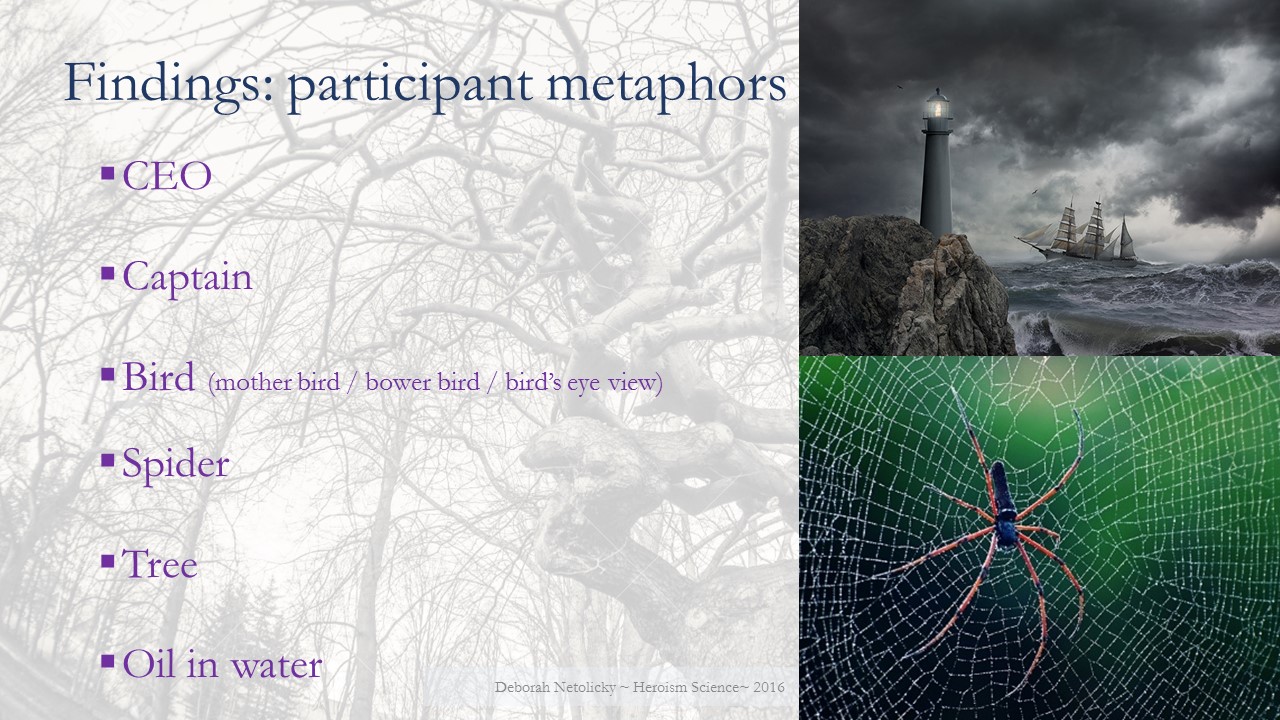
I love a good metaphor. I really do. I blog around metaphors a lot – coaching as strawberry picking, PhD thesis as stone sculpture, selves as kaleidoscopes, connections as webs. Additionally, my PhD data revealed participants’ identity metaphors, which I found invigorating and fascinating to map and interrogate. Metaphors help us to think in different ways. They provide a powerful vehicle and a coherent frame for defining our realities.

So I was interested to read of Brett Salakas’ use of metaphor in his Education Nation keynote this week, ‘PISA Pipe Dreams’. I wasn’t at Education Nation, so only have Twitter and this blog post by Brendan Mitchell on which to base my response. I tweeted some thoughts to Brendan and Brett after I had read the blog post. In my tweets, I noted that I agreed with Brett’s points that education and what works is contextual, that reliance on external testing metrics like PISA needs continued critique, and that education should begin with and be guided by its core purpose. I also had some wonderings around two metaphors Brett used, a couple of which I flesh out below.

Metaphor 1: The glossy PhD

This one got me thinking. Brett had a slide in which he outlined what he was not. One thing he was not, according to this slide, was “someone with a glossy PhD”. As a newly-doctored PhD, I found this way of looking at the Doctor of Philosophy amusing and bemusing. I understand that Brett was outlining his perspective to the audience (and the English teacher in me loves a good adjective), but my experience of the PhD is anything but ‘glossy’.

Gloss suggests both shininess and superficiality. It is shiny and lustrous. A gloss can be a veneer covering a lack of substance or hiding something sinister below the surface. Certainly, I popped champagne and luxuriated in the joy of the beautiful final thesis document, and I’m kind of looking forward to donning my graduation regalia. Yet, the experience of much of the PhD is about being down and dirty, not glossy and sparkling. And certainly not superficial.

To explain the messiness and struggle of the PhD, the rabbit hole became a metaphor for me. I was Alice, tumbling deep into a new world, on a journey of sense-making and self-making. I was simultaneously the rabbit, burrowing into dark earth. Digging, digging, digging, the light far behind me and the unilluminated darkness ahead. The PhD is all about embracing discomfort. It’s about persistence, sweat, tears, keystrokes, insomnia, the pit of despair and occasionally the triumph when breakdowns turn to breakthroughs. It’s the ultimate in transformative learning. And it is hard. Stories of struggle abound. It’s the opposite of gloss and glamour. It’s wailing at a computer screen while wearing your least fashionable pajamas. It’s furrowing your brow for hours at a time as you pour over literatures in an attempt to understand the world in new ways and through new eyes. It’s spending years obsessing over an issue about which you feel passion deep at your core. It is reading and writing and deleting and re-writing and gnashing teeth.

Am I someone with a PhD? Yep. Is it glossy? I don’t think so (although I might buy some fabulous shoes to wear to graduation). I’m someone deeply marked with that experience in the way I think, read, write, learn, talk, assess evidence, and work through critical feedback from others. I know more now about all that I don’t know. I still have the dirt of the rabbit hole beneath my fingernails and the scrapes on my knees from a personal and intellectual journey that was rough and wonderful, not soft and silken.

Metaphor 2: Be the light in the darkness

In his blog post, Brendan shared that the takeaway message from Brett’s keynote was that we as educators need to be beacons of positivity to stave off the darkness and the negativity. In some ways I agree with the notion of ‘being the light’. I tend to be someone who is less combative and more co-operative. I advocate for compassionate and graceful debate, rather than divisive attack. I celebrate and advocate, rather than confront or complain.

However, I also see some dangers in the notion that educators embrace being positive and shining light, without considering ‘the darkness’ or negativity. Some of the most famous stories have two sides, both deeply committed to their cause and believing that their position is right. Folk heroes like Robin Hood and Ned Kelly can be seen as criminal outlaws or people’s heroes, depending on point of view. The Star Wars Rebel Alliance can be viewed as the goodies, or as a rag-tag band of terrorists disturbing the order of the Galactic Empire. I’ve been in school leadership roles now for 15 years, and the more I have led, the more I have learned to value those who question or resist. I ask myself: What can we learn from the perspectives of those who don’t agree, don’t embrace new change, or who have negative things to say? Where are they coming from? How might this change be made meaningful for them? What might be missing? What might their points of view offer? Negative or oppositional voices are not ‘the darkness’, but rather alternate perspectives to be heard, understood and considered.

Bob Garmston and Bruce Wellman, in The Adaptive School: A source book for developing collaborative groups, point out that high functioning groups are not happy agreeable places. In fact, they say that low functioning groups tend to be polite and reluctant to engage in dialogue about differences. High functioning groups are ones that embrace cognitive conflict and graceful disagreement.

But not all disagreement is helpful. Unproductive conflict, Garmston and Wellman argue, includes disagreements over personalised, individually-oriented matters which are destructive and lead to decreased empathy and poorer decisions. Productive conflict, on the other hand, is where substantive differences of opinion are thoughtfully thrashed out in order to increase empathy, develop understanding and make better decisions. In productive disagreement, the aim is to understand conflicting viewpoints and honour all perspectives while working together towards a decision.

If the education community is to be a high functioning one, it too needs to be ok with being challenged and with productive disagreement. We need to poke around in the darkness, trying to understand and illuminate it. Finding ways forward in education is less about divisive arguments or staving off those with whom we don’t agree. It’s more about seeking to understand competing perspectives in order to agree on the why, how and what of education, so we can do the best job for our students.

Thanks to Brendan and Brett for getting me thinking.

Reflections on coaching after ISCAPPED 2016

ISCAPPED2

The International Symposium for Coaching and Positive Psychology in Education (ISCAPPED) happened in Sydney this week. It involved two days of keynotes, breakout sessions and corridor conversations by academics, pracademics and practitioners committed to researching, implementing and sharing their coaching and positive psychology work in schools around the world, and specifically in Australia. The yoking of two fields meant that it was possible to glean the differences in the arenas and the places at which they intersected. What stood out to me as a point of difference was the language used; while positive psychology sessions tended to use words like ‘self-esteem’ and ‘strengths’, coaching presentations were around ‘efficacy’ and ‘capacity’.

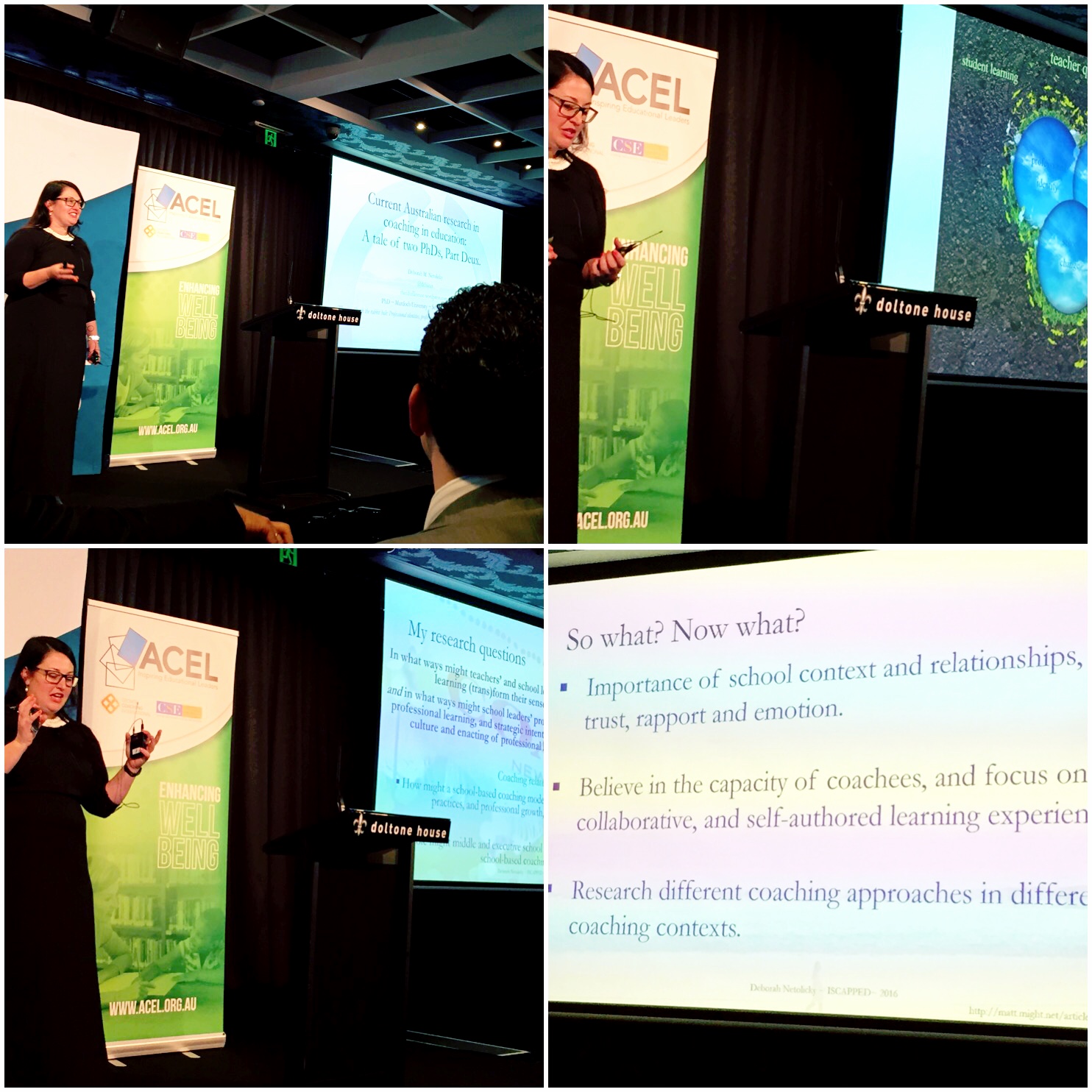
I presented twice at the symposium, once with colleagues, on the journey of our coaching model for teacher growth, and once on the coaching findings of my PhD research, which was set against the context of that school-based coaching model for teacher professional learning.

My colleagues and I outlined the story of the development of our model from its strategically-aligned beginnings, to its teacher-owned development and its whole-school implementation. Our presentation included a structured conversation that used some of the basics of Cognitive Coaching: the pattern of pausing, paraphrasing and posing cognitively-mediative questions, while setting aside the coach’s own patterns of unproductive listening. Our selection of coaches is based on beliefs that, while everyone is coachable and has the capacity to improve, not everyone can be a good coach.

I then shared my PhD research alongside Alex Guedes, who has also conducted research against the backdrop of a school-based coaching model for teacher capacity building. This presentation, which occurred under lights on the stage on which the keynotes were presented, covered the context, foci, method and findings of our PhD studies, with a particular focus on coaching. My findings, which I explore in more detail in this paper in the International Journal of Mentoring and Coaching in Education, include that coaching can be an empowering, identity-forming, relationship-building and language-shaping experience. They also include that coaching, while not a silver bullet, can be an effective part of positive organisational growth.

These findings resonate with Costa and Garmston’s notion of holonomy, in which the parts and the whole are both separate and together; the individual and the organisation grow and influence one another. Identities, language and understandings are collectively constructed. Congruent tools like Cognitive Coaching and the Danielson Framework for Teaching can be used to grow people, teams and systems, within environments and relationships of trust. In the coaching intervention that provided the context for my study, and that continues to operate in my school, non-judgemental data provides a ‘third point’ in coaching conversations, in order to depersonalise teacher reflections. Another third point is the Danielson Framework, our shared standards of teaching practice.

lucky enough to catch Vivid Sydney while we were there

lucky enough to catch Vivid Sydney while we were there

Coaching is hard cognitive work. This Monday, the #educoachOC Twitter chat will explore listening in a coaching context. I’ve recently been exposed to another string to the listening toolbox I use when coaching, which has thus far included careful listening for spoken language use, purposeful paraphrasing and watching eye movement to gauge what thinking is going on for the coachee. Recently, Bruce Wellman, author of The Adaptive School and Learning-focused supervision, came to work with my school on a variety of things. He worked with our team of coaches on something he calls non-verbal paraphrasing. He ran a workshop with us and shared his paper titled, ‘Nonverbal elegance when paraphrasing’.

Bruce couches this idea in research from anthropology, linguistics, cognitive science and neuroscience. Gesture, he explains, reduces the cognitive load of the speaker, saving energy by communicating information through body as well as spoken language. It is also primal in that gestures can reflect emerging or intuitive understandings. That is, our physicality can express those things we might not yet have words to express, or those things we are wrestling with between our knowing and not knowing.

In a coaching context, our brain’s mirror neurons help us to show empathy with the coachee, and we can also be deliberate about mirroring body language in order to be in rapport. Bruce suggests that additionally, we can “listen with our eyes”, watching for how someone’s body language extends, amplifies or makes clearer their thinking. Paying careful attention to how coachees use their hands—to explain concepts, sequence events or place people in their internal world—is a powerful listening skill. It allows the coach to paraphrase, not just the words the coachee uses, but also the physical referencing. Since doing this workshop I’ve noticed myself paying more attention to gesture, and trying to reflect back coachees’ gestures during my paraphrasing.

(Side note: As I type this I’m finding that I am gesturing between keystrokes as I try to figure out my ideas and the words I’ll use to express them. Perhaps that’s because Bruce Wellman’s concept of non-verbal paraphrasing is new to me, and my primal brain is helping me figure out my understandings. I’ve spoken a lot about writing as a mode of inquiry – writing to understand. I’m wondering now about gesturing as a mode of inquiry – gesturing to understand. *gesticulates wildly*)

So there are multiple skills to coaching, which can be honed and developed over time, but as Christian van Niewerburgh’s keynote pointed out, the coaching process and coaching skills aren’t enough. They are necessary but not sufficient. I agree with Christian when he says that transformative coaches are those who adopt coaching as a way of being. I also agree with him that coaching needs a theoretical and evidence base. Coaching isn’t a recipe on a laminated sheet. It is more than a process, a conversation or something anyone can do after a quick training session in which they are given a conversational formula.

Cognitive Coaching, which is the model in which I am trained and that my school uses in our context, is deeply rooted in research, and layered with multiple lenses and skills. The research base for Cognitive Coaching is most rigourously explored in Art Costa and Bob Garmston’s Cognitive Coaching text, now in its third edition (the previous editions were called Cognitive Coaching: A foundation for Renaissance schools). Other references include this 2003 paper on why Cognitive Coaching persists. These references and others (I have plenty!) tease out the reasons why coaching, done well, can be powerful and transformative.

Coaching is not mentoring, or telling, or advice giving, or passing judgement, or giving ‘helpful’ tips that make the feedback-giver feel like they’re being really useful. It is trusting in the capacity of the other person to solve their own problems, decide on their own trajectory of growth and consider how best to improve. The coach’s difficult work is in expertly and deliberately using a toolbox of knowledge and skills. These knowledge and skills are deliberately used as well as internalised and woven into the coach’s way of being, to help move the person’s thinking forward. That’s where the ‘cognitive’ in Cognitive Coaching comes in. The coach mediates thinking, because thought is what drives action. Changing thinking changes behaviour. It’s in the ‘a-ha’ moment, which cognitive coaches call ‘cognitive shift’, that individuals are transformed from the inside out. The magic is that the coach is mirror, conduit, provocateur and nudger, but it is the person being coached who does the thinking and finds their way.