Teaching and leading schools in a #posttruth word of #altfacts

General Hux's speech in The Force Awakens (reddit.com)

General Hux’s speech in The Force Awakens (source – reddit.com)

Post-truth: relating to or denoting circumstances in which objective facts are less influential in shaping public opinion than appeals to emotion and personal belief. ~ Oxford Dictionary

To my continued astonishment, we are living in a post-truth world. ‘Post-truth’ was the Oxford Dictionary’s 2016 word of the year. The Trump administration in its first week seemed to impersonate the Star Wars totalitarian First Order when it claimed that it was not lying but providing the public with ‘alternative facts’. Then, gag orders were placed on a number of government agencies, including the Department of Agriculture, the Environmental Protection Agency and the Department of Health and Human Services. (Hurrah for whoever tweeted rebelliously about inauguration crowds and climate change from the National Parks Service ‘Badlands National Park’ account.) 

For a Western government to blatantly deny reality is at once baffling and terrifying. Hello, propaganda. Hello, the invocation of untruths (sorry, ‘alternative facts’) to smother any unfavourable actuality.

We shouldn’t be surprised. The misuse and abuse of language and facts is something that dystopian and speculative fiction has been warning of for decades, and something that history tells us has the ability to tap into the hive mind and rally societies around a common, often chilling, cause or leader. 

In this post I’ll explore the notion of a post-truth world of alternative facts and empty emotive rhetoric, around two arenas in my own life: teaching English and Literature, and my new role at my school, which encompasses in part engagement with research across the school.

First, to teaching in a post-truth world …

With the school year beginning next week, my Year 12 English team are finalising the texts to be taught and studied this Australian academic year. We’ve been tossing up between two contemporary texts about modern issues like gender, sporting culture and bullying, but every day the news and my social media feed give me a nagging feeling, a tugging at my literary shirt sleeve, a whisper to pause, take stock, listen. And dig out a dystopian classic.

Last year we taught the 12s Fahrenheit 451, a text that portrays books as dangerous threats to government control and societal compliance. This year perhaps we should teach Orwell’s 1984. Its Ministry of Truth, that falsifies historical events, and Newspeak, a language that restricts freedom of thought, are more relevant than ever. In fact, Orwell’s novel has this week rocketed to number 1 on the Amazon best sellers list.

A more recent text also comes to mind. Lionel Shriver’s 2016 The Mandibles, set between 2029 and 2047, is an economic dystopia that imagines the USA’s collapse. In her novel, the bungling US government has little respect for its citizens. First world problems like gluten intolerance disappear as violence and poverty rise. It is Mexico that builds an electrified, computerised, constantly-surveyed fence to keep desperate Americans illegals out.

Of course as a teacher of English and Literature I teach versions of reality and multiplicity of perspectives, but that plurality doesn’t stretch to bald-faced lies for the purposes of propaganda, banning scientists from speaking, or removing language like ‘climate change’ from government policy and websites. Language matters. It shapes thought. It wields power. It’s our job as teachers to elevate our students’ capacities to engage critically with their world. To be sceptical consumers of what they see, hear and read, and to be empowered to use language as an agentic tool.

Next, to school leadership in a world of alternative facts …

I am also coming to terms with how schools might respond to this post-truth world. This is especially relevant to me as I have just begun a new role at my school (new to me and new to the school). It is a senior leadership role that encompasses the use of evidence and research to make informed decisions from the classroom to the boardroom, as well to underpin and frame pedagogy, professional learning, performance review processes and capacity building across the organisation.

In this paper published online on 18 January, Brown and Greany (2017, p.1)—thanks to Gary Jones, whose blog is a great resource in this space, for sharing it—write:

Educational evidence rarely translates into simple, linear changes in practice in the ways that what-works advocates might hope. Instead, … evidence must be combined with practitioner expertise to create new knowledge which improves decision making and enriches practice so that, ultimately, children’s learning is enhanced.

This focus on what Brown and Greany call ‘what matters’ as well as ‘what works’ resonates with me. As Jon Andrews (channelling Marilyn Cochran-Smith) reminds us, teaching is unforgivingly complex. If we schools and educators are to really engage with research, then we need to honour our own contexts and value our own wisdom of practice. Teachers and schools can and should engage with research. I’m grateful that my school is able to create a role like mine in order to elevate evidence and research, execute research initiatives, and further embed scientific thinking and data analytics into the fabric of the school a culture. I’m grateful that there are schools around the world bringing evidence, mindfulness and crticiality to their decision making and pedagogy.

In a post-truth world, how do we balance a respect for truth, evidence and reason, with an honouring of plurality, multiplicity and praxis? How might we use literature or research as vehicles for respecting perspectives, while exploring challenges and possibilities?
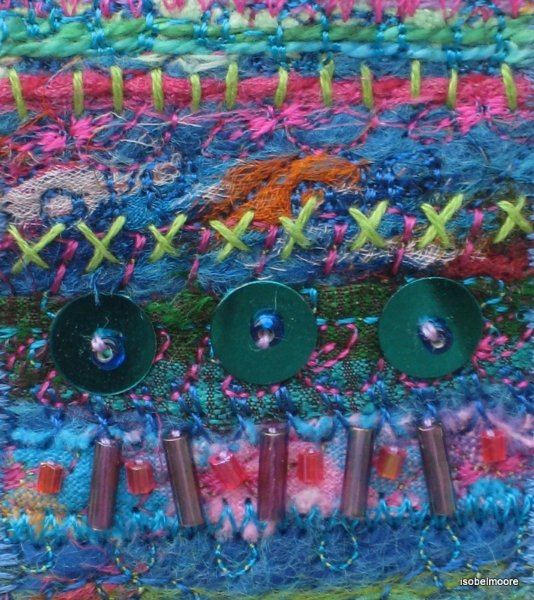
Stitching the shadows: Writing & social media

textile detail by Isobel Moore http://www.threadnoodle.co.uk/

textile detail by Isobel Moore http://www.threadnoodle.co.uk/

This blog post is part of a blogversation. It responds to two blogs, both of which came to my attention via my Twitter feed. This one on qualitative research methods by Naomi Barnes, and this one on tracing the social media interchange that followed, by Ian Guest. This is not the first time I have jumped into a blogversation unannounced and univited. The first time was when Helen Kara challenged Naomi Barnes to the #blimage challenge, after I had first challenged Helen to the same. The post I wrote, in response to Helen’s photograph of spider webs in her garden, echoes the themes of this post – the power and messiness of connectivity on social media. Another of Naomi’s posts had me thinking about diffraction.

The great thing about social media is that by engaging we situate ourselves within a public conversation. It’s when people jump in—to ask a question, make a comment, respectfully challenge, add their lived experience, share their perspective—that dialogue is enriched and we influence each other, across time, space and devices.

In Naomi’s recent post she articulates some ways of thinking that are close to my heart and my keyboard: blogging as inquiry and using metaphors as a method of sense-making. As many of you would know, I used Alice’s Adventures in Wonderland as a literary metaphor through which I viewed and re-constructed my PhD data. Metaphors, as any reader of this blog will recognise, are one way that I make sense of the world. Metaphors also emerged from the stories of the participants of my PhD as they worked to make sense of their selves and worlds.

As une édu flâneuse I was taken with Naomi’s notion of the ‘concept flâneur’. The flâneur, or its feminine alternative the flâneuse, is the attentive observer, the attuned wanderer, a scholar of the world and a chameleonic surveyor of the crowd. The ‘concept flâneur’ reminds me of my own use of bricolage in my PhD that I describe here as rethinking well-worn traditions and stitching them back together in new form. But flânerie is about more than stitching together. It is about rapt observation and devoted contemplation, about deep understanding and applying scholarly thinking. The theoretical flâneur is the insider-outsider, at once looking in and immersed within.

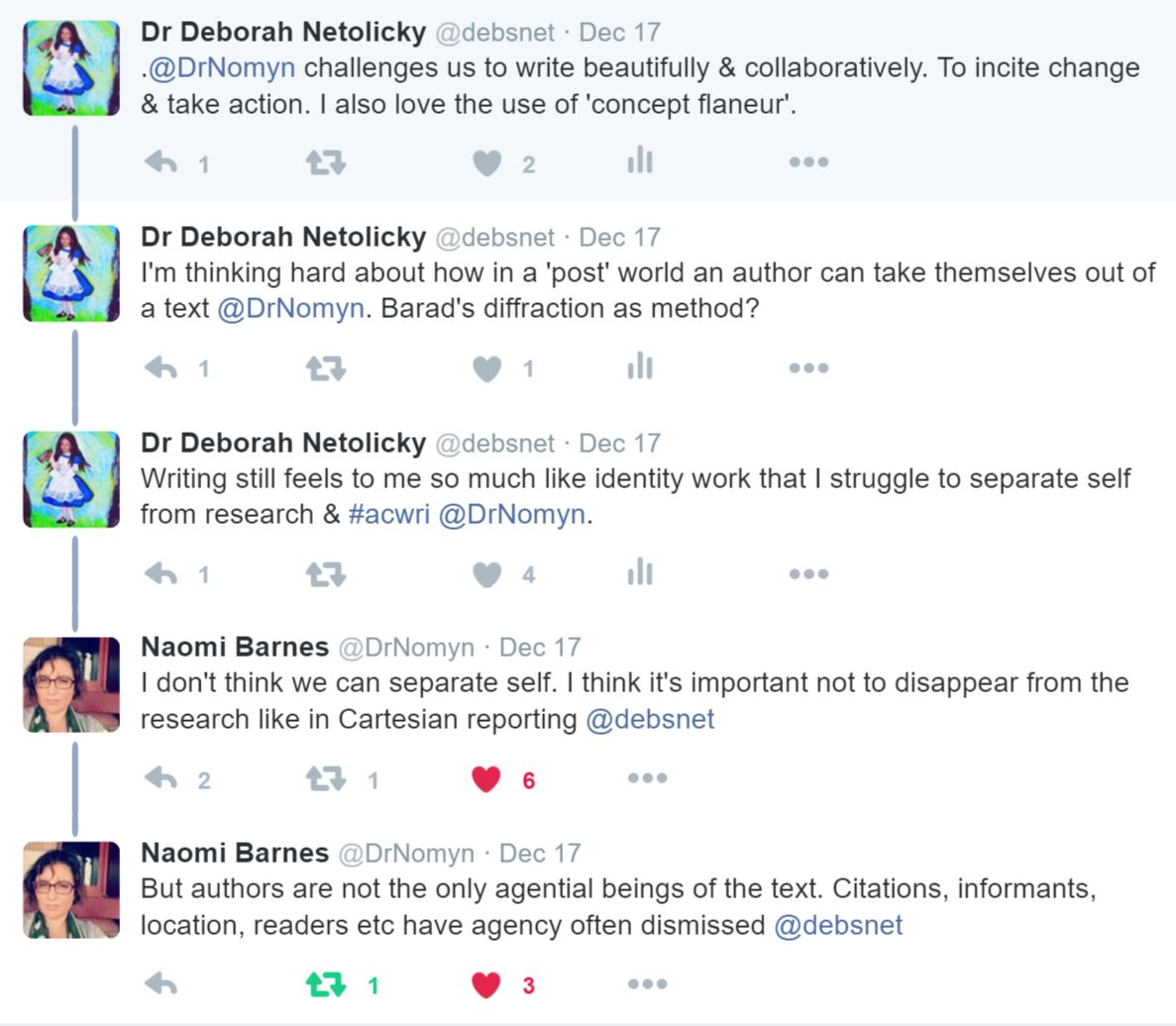
The part of Naomi’s post that challenged me the most was when she stated that qualitative research has stagnated as “the author has become central in the writing. It becomes about writing, rather than the research and the need for change.” It led me to a Twitter exchange in which I explored my own uncertainty around the self in research and the author’s place in writing.

a Twitter exchange resulting from Naomi Barnes' blog post

a Twitter exchange resulting from Naomi Barnes’ blog post

In keeping with Naomi’s metaphor of the sutured-together monster body, I see these kinds of social media interactions as textile. I have written before about textiles as a metaphor for subversion and political activism. We stitch onto shared fabric, adding perspectives, colour, texture, visual elements to a work. Our hands and minds shape the work (our thinking work, our writing work, our collaborative dialogue work), as it shapes us. Needles prick and rub callouses into fingers. We cramp. We struggle with the material. We can be proud of our contribution, working together like a quilting circle on the collaborative work of seeking to understand and to theorise.

Ian, in his post that responds to Naomi’s post, points out the non-linear, messy ways that exchanges happen on Twitter, despite their appearance in the feed as linear threads. I’ve written before about the butterfly effects of Twitter conversations, their serendipitous, surprising and subtly influential moments. Their powerful, unforeseen circumstances.

Ian wonders about the silences and the blurred boundaries between people and thoughts. I agree that it is in the silences, the shadows, the fissures, the dark cracks, of exchanges and of our own thinking, that we are most in a state of becoming and therefore potential change. It’s in the dark and vulnerable spaces that we learn. Blogging can be a bit like this: an exposure, a laying bare, a stripping down.

Ian mentions in his post that he shared a blog post via email despite sitting right next to his colleague; they collaborated via technology despite being in the same room. This reflects the evolving relationship that Naomi and I share. We have begun a co-authorly relationship, via digital tools. Word to word, screen to screen, device to device. When we met in person for the first time recently, we didn’t discuss our writing projects specifically. We saved our writerly collaborations for online spaces: email, Google docs, Twitter. In our fledgling collaboration, for me the digital sphere feels simultaneously a bit sacred and a draft-notebook-type place for working out. We show our workings to each other via our thinking-out-loud digital musings.

The wonderful thing about blogging, tweeting, emailing, writing and reading as inquiry is the acceptance, and even celebration, that it is all unformed. There are moments of awkwardness, uncertainty, openness, weakness, resistance, emotion. It’s all laid bare on screen, and open to tangled-threaded multi-webbed interchanges that have us emerging from the knotted labyrinthine tangles as from a chrysalis, declaring “here I am” so that we can be challenged and changed again.

Arguing on Education Twitter: BINGO

Today I had a draft blog post I was going to finish for publication today, but then I woke up to a tweet in which someone, with whom I’ve had no previous interaction, quoted a tweet of mine (a tweeted summary of an article to which I was sharing the link) and wrote above it the following:

God….. you really do have to laugh. Where do some get their PhDs??? # stupid

I’m still not sure of the reasoning for the tweeter’s ridiculing comment. Were they offended by or did they disagree with the content of the article I shared? It was a long article, at almost 3000 words. With what aspects of the article did they disagree? Did they read the article at all or did they just react to my teaser of its content? While they seemed to question my intelligence—with the #stupid hashtag, the triple question mark next to ‘Where do some people get their PhDs???’, and the suggestion that something about my tweet or my doctorate was laughable—the way in which they engaged with me did little to encourage debate or discussion, or to further either my or their understanding. Perhaps their intention was not to engage in dialogue, communicate their perspective to me, or interrogate my perspective.

This and some of the Twitter discussion that followed, got me thinking about the nature of some debates on edu Twitter, and of the social media tribalism Greg Thompson wrote about on his blog this week.

I’ve written before about the importance of graceful disagreement, such as in this post and in this one. I always learn from listening to the perspectives of those with alternate perspectives and counter arguments. On social media I (mostly) enjoy engaging in debates that help me to understand other viewpoints, see my own perspective from others’ points of view, and on occasion change my mind. If there is one thing my PhD taught me, it’s that there is much I don’t know or deeply understand, and that I have much to learn from others. In my leadership roles I look for ways to get honest feedback from all stakeholders, including and especially those who question, critique and resist. These are important voices to which we should listen.

But perhaps there are those who disagree, criticise or mock without the desire to talk further or understand more.

In anticipation of more enthusiastic debate and derision over the holiday period in the world of education Twitter, I’ve prepared this handy BINGO card for the festive season. It’s an attempt to see the lighter side of what can sometimes get heated as passionate educators fight for ideological corners. I may have thrown ‘Shakespearean insult’ in there as the odd ‘thine face is not worth sunburning’ or ‘thou cream faced loon’ might add interest to some debates.

You’re welcome.

My Edu Twitter BINGO: Watch your feed for these beauties

My Edu Twitter BINGO: Watch your feed for these beauties

Post script (11th December): I have begun to realise that there are aspects of EduTwitter arguing that I left off this BINGO card, like ‘false dichotomy, ‘Twitter poll’, ‘hyperbole’ and ‘subtweeting about someone’s lack of understanding or expertise’. I’d also like to clarify that my intention is not to judge any of these moves. They are used by people with a variety of profiles who argue on multiple sides of various debates. I think many of these moves transgress the debates themselves and reflect more of what brings education tweeters together, rather than what separates us. It’s also my attempt to reclaim my own experiences and to inject some fun into what can get intense or even nasty. I’ve especially enjoyed a few of the Shakespearean insults that have been thrown around since my post. Shakespeare really knew how to write a scathing and masterful take-down (although many of these would be classified as ad hominen or hyperbole in the context of Twitter debate).

I also love that someone made a GIF with my BINGO card.

Use at your leisure.

Use at your leisure.

ECR reflections on #AARE2016

welcome drinks at the Melbourne Cricket Ground

welcome drinks at the Melbourne Cricket Ground

As a neophyte researcher less than five years post doctoral completion, I get to claim the label of ‘early career researcher’ or ‘ECR’. I’ve just this week returned from the Australian Association for Research in Education (AARE) national conference, which provides excellent opportunities for an Australian early career researcher in the field of education: presenting, attending, connecting and thinking.

………………………………………..

Presenting

I was a last minute delegate at AARE this year, so didn’t present myself, but presenting last year was a highlight. ECRs can present alone (but papers are usually grouped with other thematically-like papers), with other ECRs, or with more experienced academics and professors. These presentations are important in helping to refine ideas and develop thinking, of both audience and presenter. While there are some ineffective discussants and unhelpful non-questions from audience members, discussion time after a presentation can be a great opportunity for the presenter to clarify and extend their thinking, thanks to questions, comments and provocations from the audience.

Presenting is also important for refining the precision and effectiveness of your science communication. How have you titled your presentation? How have you designed your slides? How have you distilled the essence of your paper down to a 20 minute presentation? The decision making required in order to present helps to refine ideas, clarify theory and fine-tune language.

Attending

The sessions at AARE are arranged around a number of Special Interest Groups including: Aboriginal and Torres Strait Islander Research; Arts Education and Practice; Assessment and Measurement; Educational Leadership; Gender, Sexualities and Cultural Studies; a number of school-subject specific SIGs; Politics and Policy; various theories and philosophies; Professional and Higher Education; Social Justice; methodologies; and Teacher Education and Research Innovation.

This year I was able to spread my time between sessions relevant to my own research and practice, and those that interested me outside of my normal bubble, such as a session on the intersections and interactions between academia and the media, and a particularly indulgent session on theory and writing, which buoyed and provoked me. That theory session, while not seeming directly relevant to much of my work and research, will influence my writing and the ways I consider research and practice.

One thing that struck me this year was what I learned as an ECR watching more experienced academics. Some of the sessions I attended involved very experienced academics presenting as-yet-unformed ideas. They were sharing and modelling the ways in which they explore a theorist they are reading for the first time, or work through a newborn idea. The vulnerability of these academics–willing not to present the workings-out of their practice and not just the result of layered years of thinking–was a great example to ECRs of embracing what we don’t know. Not only do we evolve as researchers over time, but we can embrace knowing what we don’t know and celebrate working through discomfort to interrogate those gaps.

Connecting

As I attended AARE last year in Fremantle, and I also presented at the AERA (the American Educational Research Association) conference this year, I began to see patterns of those who attend these conferences and those who are active in the research community and in particular SIGs. As I am active on Twitter, there were many additional familiar faces in the room. That’s one thing I love about Twitter – that it allows me to walk into a room in which I’ve barely met anyone, yet feel like I know a number of people.

The AARE conference is a great opportunity to connect with academics across a wide range of Australian and international universities, who approach education research in a variety of ways, through multiple different lenses. Many experienced or well-known academics are very open to meeting ECRs, and most are incredibly generous with their time and their advice. And the great thing about kicking on to dinner with a bunch of researchers is that it’s a wonderful opportunity to go full-nerd and explore all kinds of real and theoretical possibilities in a conversational environment. A Melbourne cocktail or two only adds to the conversation. I can see the potential for many a collaboration or co-authorship to be sparked at an AARE conference.

Additionally, editors from academic publishing firms like Routledge and Sage are at the conference venue, so it is a great opportunity to discuss your book idea.

Thinking

A conference like AARE provides a wonderful opportunity to break from the daily routine and think. While the program is busy, it allows delegates to listen to, cogitate on and talk about those arenas of research and education in which they wish to immerse themselves. The time and space for this kind of immersion and thinking is an excellent opportunity in itself.

………………………………………..

Having been conferred my PhD earlier this year, I am an ECR, but I am also a teacher and school leader. I’m a boundary spanner, a ‘pracademic’, traversing and often transgressing the boundaries between practice and theory, doing and research. The AARE conference allows me to indulge intellectually in the education sphere, and to engage in current thinking in educational research.

I live and breathe teaching and leading for most of the year, but here for a few days I get to engage with multiple lenses for considering and improving that work. What does current educational research have to say about areas of practice? How might I—as teachers, school leader and researcher—positively influence my own contexts, as well as broader narratives of education?

AARE provides the time, space and stimulation to help me do this. No doubt I’ll be back for the next round: Canberra 2017.

Cartoons to communicate science? #scicomm

With the knowledge of science we can solve resource limitations, cure diseases, and make society work happily–but only if people can figure out what in the world scientists are talking about and why they should care. ~ Randy Olson, Don’t be such a scientist

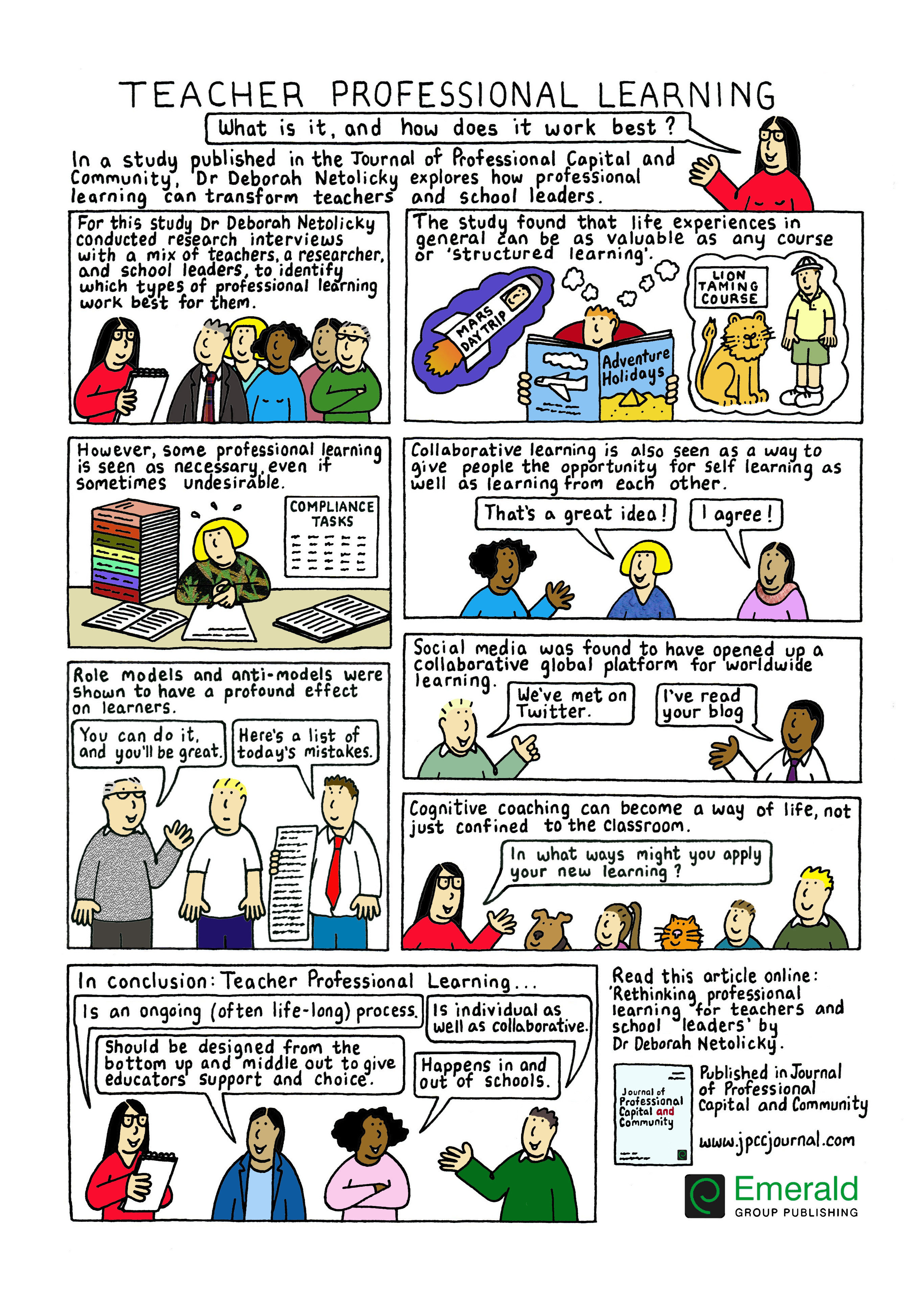
In 2015 the Oxford Dictionary word of the year was the ‘face with tears of joy’ emoji. This year I have seen PhD researchers communicate their theses via emoji on Twitter. Today Emerald Publishing and the Journal of Professional Capital and Community released the following cartoon abstract of my peer-reviewed paper ‘Rethinking professional learning for teachers and school leaders’. The paper itself, which has so far been downloaded over 4000 times, is open access, and I have also blogged about it.

What do you think of the notion of a cartoon or graphical abstract of a research paper? Is this a way forward for science communication? Can we use visual language to make research more accessible and more widely read? Could you or would you be open to designing a cartoon strip or graphic-novel-style summary of your research?

designed by Emerald and posted here on JPCC website: http://jpccjournal.com/teacher.htm

designed by Emerald and posted on the JPCC website

Anchoring, coping, organising: Post-It power

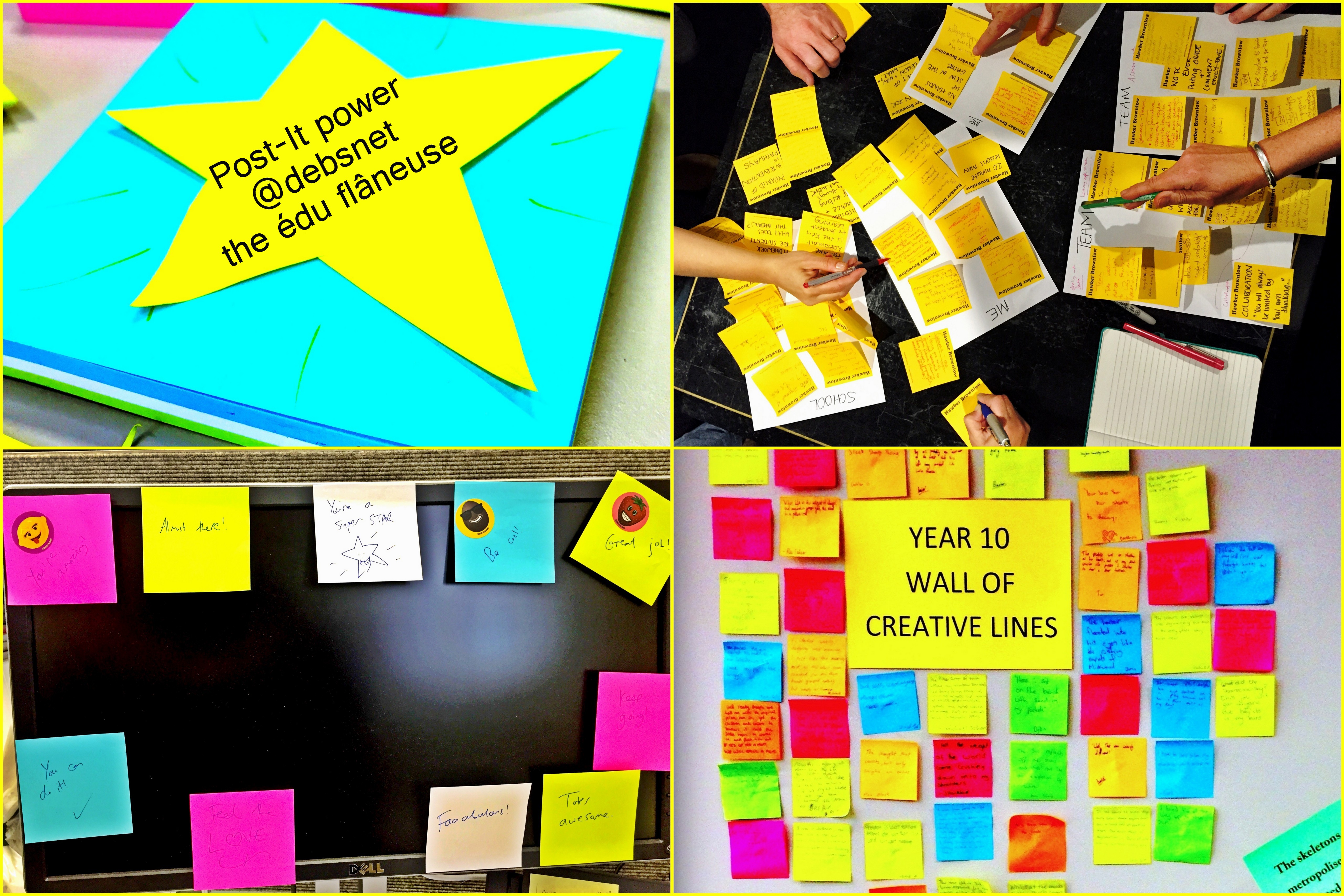
some of my Post-It moments

some of my Post-It moments

Great results, can be achieved with small forces. ~ Sun Tsu, The Art of War

Sometimes when it all seems too much, we need to distil all-the-things down to their essence. We need to simplify, to find a tangible anchor for the chaos of change or a reassuring system to help us bear the weight of pressure.

1940s Hungarian communist leader Mátyás Rákosi coined the term szalámitaktika or ‘salami tactics’. In order to gradually amass power, little bit by little bit, the idea is to attack a huge goal one tiny and deliberate slice at a time. When applied to big tasks or bold goals, szalámitaktika reflects the cliched saying ‘How do you eat an elephant? One bite at a time.’ It’s also reminiscent of Bill Murray’s title character in the 1991 film What About Bob? whose therapist prescribes him ‘baby steps’ to help him get through his day by focusing on literally putting one foot in front of the other. These simple approaches helped me to trudge my way through the work of a PhD. One step, one bite, one slice at a time.

At the moment educators in Australia are coming towards the end of our school year. Many of us dream that this is the time of year that we wind down, gently relaxing towards the summer holidays in a slow-motion dance of joyful teaching and leisurely planning for the next school year. Insert cocktail-drink-with-umbrella emoji.

The reality is that this time of year, for many of us, is manic, overwhelming and crushing in its pace and pressure. My way of dealing with the current mania is by tackling my to-do-lists with military precision and the salami-tactics baby-steps approach. My main arsenal in this operation? Trello? Spreadsheets? A wall of IdeaPaint scrawled with notes? No. It’s a stack of Post-Its.

The humble Post-It, an accidental invention born from a failed adhesive, has potent power. When Steve Jobs died in 2011, around the world people posted Post-It note messages on the windows of Apple Stores around the world. The Apple Store in Munich created a mural of Jobs’ face out of 4001 Post-Its. This month, these jewel-like beacons have been used in Subway Therapy in Manhattan, a post-US-election project incited by artist Matthew Chavez. Chavez set up a tunnel in the NYC Subway as a public art space onto which anyone could post their messages of support, optimism or hopelessness.

Post-Its can be used for collaboration. I’ve enjoyed getting staff or students to use them to draw together and reorganise ideas. Post-Its can be used for annotation, communication, display, feedback, personal notes and even for delight. Last year, a colleague was having a rough week. I took multi-coloured packets of Post-Its and covered her computer monitor with Post-It messages of ‘you can do it’ and ‘you’re awesome!’ and other such platitudes. It was silly enough to lift my colleague’s spirits. She left those notes there for some time.

But what I’m using Post-Its for now is to anchor me, organise me and help me cope with multiple work streams. I’ve used a Post-It note system for some time. I write a weekly or long-term to-do list on a Post-It, or more often a series of notes, and post them up in front of my desk. Sometimes I also have one or more desktop Post-Its going; these are my short term lists.

Importantly, as I complete tasks, I cross things off the Post-It list and triumphantly screw the Post-It up and throw it in the bin when the to-dos are done. The triumphant scrunching and tossing into the bin is an important ritualistic part of this method. It is in the closing of the fist, the flourish of the wrist and watching the note hit the trash that I feel a sense of accomplishment. This year I tried to move to a notepad system, but found that the notepad pages were too big; each could house an overwhelming list of to-dos that grew and grew and never seemed to be done. I could cross them off but I never felt that I was getting near the end of the list. I felt more despair and less success. I returned to Post-Its. They are small. They lend themselves to being do-able.

When I have a lot on the go at once, I adjust my Post-It system. Post-Its can be moved around and re-arranged. I can have different Post-Its for different categories of work. I can colour-code. I currently have a series of long-term and daily Post-Its on the go, but their manageable size means that I can feel a sense of accomplishment when I ‘finish’ one, or I can re-organise my thinking on a new note or series of notes.

My whole year has been about momentum, about putting one foot in front of the other, about being in motion. By deploying Post-It notes with military precision and ninja-like agility (or so I imagine), I am able to slice off one piece of salami, one bite of elephant, at a time. These unexceptional adhesive squares give me something tangible to hold onto in times of intense work. Their modest size allows me to celebrate small, daily successes, and I can breathe deeper and easier as I slowly watch my to-do lists dwindling, changing, or at least becoming more manageable.

It’s the little things.

Managing a rotation curation Twitter account: My week hosting @EduTweetOz

source: gettyimages

source: gettyimages

This week I’m experiencing my first time in the host chair of a rotation curation, or #RoCur, account.

I have followed @EduTweetOz for some time and noticed how different educators seem to breeze through the host chair. I’d never considered the thought they may have had to put into hosting. But once I was invited and then appointed for a week, I felt a greater responsibility than just doing what I do with my personal account, @debsnet. Was what I did and said in my personal account appropriate in a shared account? Surely I couldn’t just dip in and out as I saw fit, jumping down rabbit holes and leaping off on tangents, as whims arose? I felt I needed to have some clarity for myself in terms of how I would approach an account that is not my own; I’m just slipping on the robes for a week.

I was also aware that I needed to manage my time and wellbeing during the week, while honouring the account administrators, the @EduTweetOz community and the commitment I made to hosting. This week I am doing my usual working (teaching! marking! reports! planning for 2017!) and parenting, plus copy editing a textbook, reviewing an academic paper for an international journal and co-authoring a book chapter. So for me, planning how I would approach the account was as much about protecting my mental and physical health in a busy week as it was trying to do a good job. I didn’t want to feel anxious and guilty for letting the account down.

The thing is, there isn’t a clear set of protocols or measures for what doing a good job of hosting @EduTweetOz might be. The host is given carte blanche to manage the account for a week as they see fit. How do the administrators or followers measure a host’s success? Number of new followers? Number of tweets per day? Amount of engagement from others? Tone? Humour? Enthusiasm? Availability? Responsiveness?

Know thy purpose

In the uncertainty that comes with the freedom to do as I saw fit, I set myself my own purpose for the week. I was hoping to engage educators in discussion, and also highlight some of those voices in social media that I rely on in my own personal learning network. What a great opportunity to share with others the value of educators, academics and thinkers who energise and buoy me.

I’ve also been happy to add some of my favourite educators to those followed by the @EduTweetOz account. These were people I think will bring a richness to the community and the account’s timeline.

Be prepared

I knew I wouldn’t manage this week well without a plan, especially considering my multiple commitments. So before my week on the account began, I sat down and scoped it out. To what topics might I draw attention? Which tweeters’ and bloggers’ thinking could I share? My plan was loose but it gave me a sense of direction and I knew I wouldn’t run out of steam or ideas as the week wore on.

I decided to ask a question per day and made up a (regrettably long) hashtag to trace the conversations: #EduTweetOzSlowChat. I pre-prepared slides for each question and scheduled the daily question to be tweeted out each day at 4am Perth time, which is 7am Melbourne/Sydney time.

Scheduling those questions for when I am sleeping allayed some of my worries about being unavailable during the East coast mornings when much of the country is up and ready to engage. Each morning this week, by the time I wake up on the West coast I already have tweets to respond to on the account.

Consider voice

In my own Twitter account I am comfortable with my voice, the way I ‘speak’ and communicate. While I was absolutely comfortable with being myself during my @EduTweetOz week, I also felt a different sense of obligation to the account administrators. Is my authentic social media voice appropriate in an account administrated by others and on which I am a guest? Can I say exactly what I want in precisely the way I want? To what extent do I need to be tactful or restrained?

On my second day I found myself in amongst a lot of humour and parody, and I was wondering if it was ok to indulge in that, or if it might be seen as flippant, and if that mattered, or to whom it mattered (oh, the overthinking!). I found myself, in the first couple of days, hyper aware of what others might think. I have found my groove, though, and settled into it.

Different educators have different styles: friendly, supportive, provocative, intellectual, colloquial, personal, academic. That’s the beauty of a #RoCur account. @EduTweetOz sets this diversity up nicely by posting an interview with the week’s host as a kind of introduction; here’s mine.

Engage with community             

I was aware of the opportunity and responsibility that comes with 10K+ followers, more than double the amount of followers I have on my personal account. I know that if I magnify voices, accounts or tweets across the week, they will have some reach. On what basis am I making decisions about what to project into the Twitterverse from this account to which I briefly have the keys?

I decided to retweet most responses to the account, in order to amplify the conversations being had in that space, and as a mark of respect and appreciation. Most people have been applying the @EduTweetOz Twitter handle to their own tweets for real dialogue rather than blatant self-promotion.

So far, I’ve been pleased with my daily chat questions as a way to begin conversation. Interestingly, my first daily question was the most positive, and has received the least response. The questions that have been around more controversial or complex issues have incited the most community engagement.

I also attempted my first Twitter poll, which is still open for voting at time of writing. I figured that with a large, diverse following, I could canvas a range of community opinion. The options I offered in the poll were crowd-sourced, emerging from the day’s responses to my question around what causes educators to feel skeptical or despairing about education.

………………………………………………..

I still have a couple of days left of hosting the @EduTweetOz account this week. I’m enjoying the foray into a different social media experience. In addition to my own reflections, I can recommend this post that Aaron Davis wrote after he hosted the account last month. Both of us reflect that a rotation curation account comes with ethical decision making and an opportunity to give back to the village.

Meanwhile, I’m here all week. Try the veal.

Writing productivity this Academic Writing Month #AcWriMo 2016

acwri at Melbourne airport

acwri at Melbourne airport

November isn’t just Movember and Dinovember. It’s also Academic Writing Month (#AcWriMo), the time for academics to publicly shout their writing goals from social media soapboxes everywhere. Ironically, at the moment work is taking over all my working and spare hours and my academic writing pipeline is suffering from inertia as a result. I haven’t been able to make the time to acwri, despite making constant lists that include acwri targets (respond to revisions! write draft paper! scope out argument! complete literature review!).

For me, academic writing is both unpaid work and a labour of love. While I don’t need academic publications for the work I do in my school, I write journal and conference papers because a) I think my research and writing have something to offer, something to say, and b) I enjoy the writing, the writing-thinking, the off-shoots of ideas from my PhD thesis that I now get to play with, and opportunities for co-authorship.

This blog both gets in the way of my academic writing and helps with it. It takes time and discipline to blog (I try to blog at least once a week, usually on a Friday), but I find that blogging keeps my writing wheels oiled and turning, which flows over into my scholarly writing. By blogging weekly, I never feel out of writing practice, even during these times when my academic writing slows to a barely perceptible drip.

Despite my inertia of the last few weeks, I share below some of my own approaches to academic writing productivity. I could call this ‘5 tips for productive writing’, but I agree with Naomi Barnes that tips aren’t always helpful.

……………………………………………………

Count more than you can count

I wrote last AcWriMo that successful writing is more than word counts. Sure, sometimes it’s motivating to hit a word count milestone. Every time I hit a 10,000 word number during my PhD felt like I was getting closer to somewhere, something, the end product.

If, like me, you write a lot and often too much, it can be satisfying to cull words, to watch the count go backwards. I cut 15,000 words from my PhD in the final editing stages. There’s joy in word cutting, too. Refining, pruning excess, making the writing better, stronger, clearer.

Sometimes it’s useful to use a Pomodoro timer or a bomb timer to give a sense of writing focus and urgency. I rarely use timers, but I often write to the time I have. One hour while the kids nap. Forty minutes between weekend commitments. Stolen moments before the family wakes. Having such little writing time means that I am highly absorbed when it comes. There’s no time to be distracted, dithery or unfocused. I prepare writing goals and materials for the times I map out, and when they arrive I write like a tropical cyclone.

Write where it works for you

I need quiet or a steady hum to write. Total silence works, but I can’t often get silence, or even solitude, at home, unless my husband takes our sons out.

A busy café with indiscernible noise also works for me. I love writing in cafes because a) I don’t feel alone as I‘m surrounded by people, b) I’m not distracted by domestic chores, c) there’s good coffee and d) it can make writing seem more pleasurable, like a holiday or an indulgence. I love the low hum of indistinguishable conversation as the soundtrack to writing.

I even considered acknowledging some of my favourite writing cafes in m PhD acknowledgments. The owners and baristas recognised me. I was the polite woman who would sit alone, drinking two coffees over two hours, tapping away at my keyboard or shuffling through annotated drafts. Quarantining myself in a public space for a specific block of time allowed and motivated me to just write.

Write when it works for you

Know your most productive times. I am at my best between 7am and 11am. This is when I zing with energy, ideas and the kind of focus that means that words and solutions come easily.

I am at my productivity worst from about 3pm to 6pm, during which I usually have the least physical and mental energy. Then I have a strange energetic renaissance between 8pm and 10pm, which are often the hours that I blog. Yet, sometimes in the evening I am too tired for anything but the most menial tasks: calendar entries, checking references, basic admin. I’ve learned that it’s better to close the laptop rather than stare uselessly in a kind of slo-mo catatonia.

To write my PhD, I had to leverage my best writing times and avoid my worst ones. There’s nothing more frustrating than spending time writing and not getting anywhere.

Use the in-between times

The shower, sleep, a walk, standing at the checkout, taking children to the park. These are all opportunities for cogitation and idea percolation. I often find, especially if I know I’ll be racing between commitments, I will deliberately plant a writing problem in my mind by thinking deeply on it for a time, and then let go of it, knowing that my brain will somehow continue to chip away at it while I do other things. Sometimes I revisit the problem mindfully, and sometimes a solution or idea will bubble up, unsolicited. Our writing solutions and growth often happen while we aren’t watching.

Work with others

I am new to co-authorship, but am finding that the writing relationships I am now nurturing push me beyond the kind of thinking I do on my own. I’m exploring new theorists and fresh methods. Collaborative writing can grow us beyond our writing selves.

……………………………………………………

Despite my inactivity thus far this #AcWriMo, I appreciate the social media reminders of the importance of academic writing, and of making time and space for it. This is true even for someone like me who is on the academia outer, an adjunct and a practitioner in another field.

I can give myself permission to ride the ebbs and flows of work, writing, parenting and being a friend/spouse/daughter/sister/colleague. For now I will keep scribbling my acwri lists, keep revisiting my acwri goals, keep putting my eye to my acwri pipeline. I’ll get it moving again soon.

On the emotional, human dimension of teaching

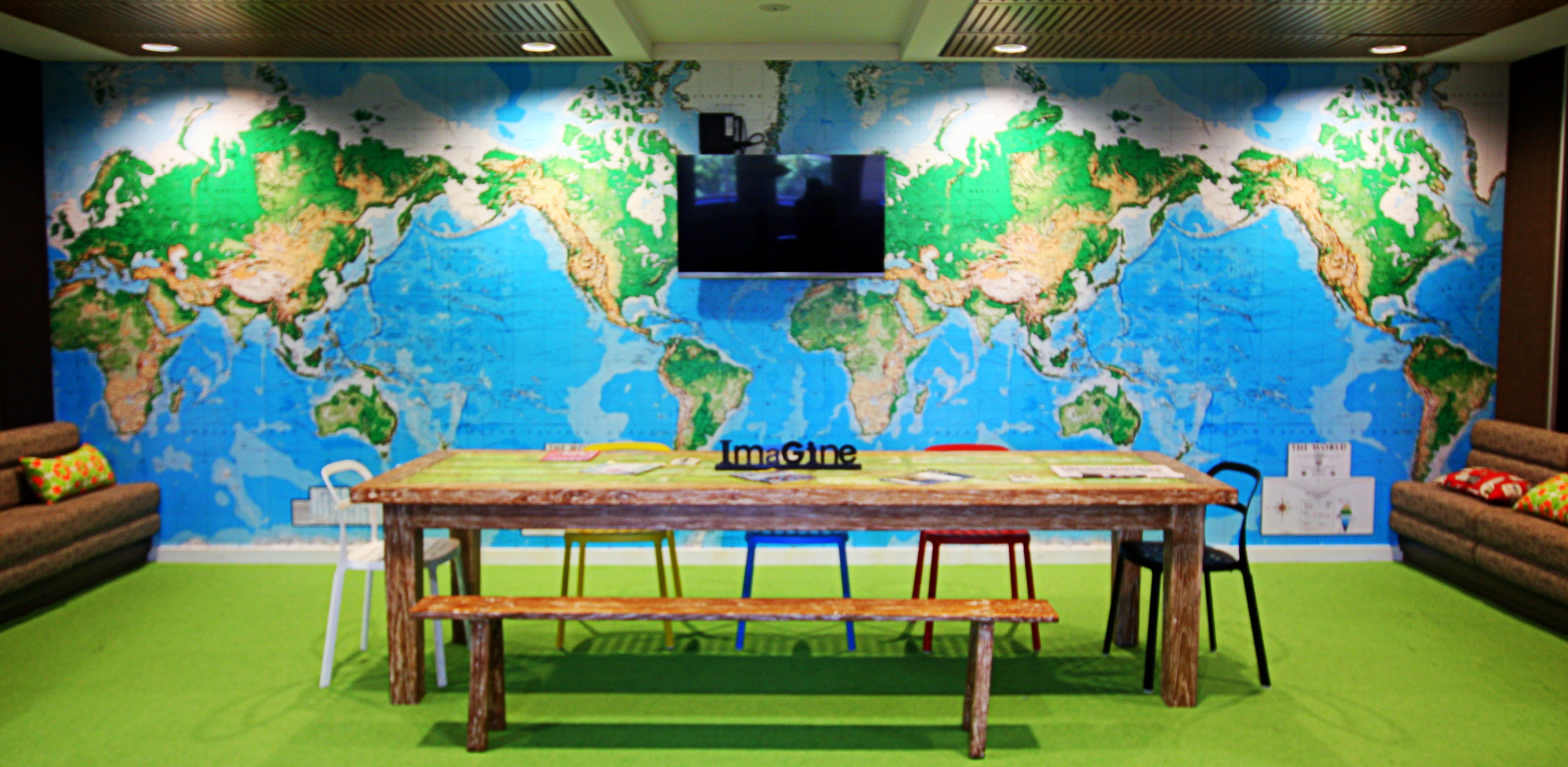
A world map for World Teachers’ Day (photo by me)

On today, World Teachers’ Day*, I‘m going to reflect on my experience of teachers as a school student. I’ve written about what research indicates about ‘good teaching’, but this post shares my personal story of the teachers I remember, and how they shaped me as a teacher.

Growing up, but especially during high school, I didn’t want to be a teacher. I think partly this was because of my dislike for those in authority who saw their role as to uphold what I saw as petty rules. While on the one hand I was a geek who diligently completed my school work and strove for academic success, I did not want to fit into norms set by others. I skipped some classes. I didn’t see the point in wearing the school uniform, unless it was to shackle me to conformity as part of a homogenous group. One year in high school I called the State Education Department and checked their rules on wearing uniform, and then asked that they contact my school to explain that uniform was not legally enforceable. It turned out that the only enforceable guideline at the time was that students in government schools be neat and tidy in appearance. (Yes, I was that student.)

In Year 8, my English teacher insisted that I rewrite a creative story entitled ‘Stop, thief!’ Although I had worked hard and long to craft the story, she told me that a thief should not be good looking with a “chiseled jaw,” and that I was to rewrite him as ugly with a hooked nose and hunched back if I wanted to pass. This felt to me to be an unjust response, one that not only supported what I considered to be an unrealistic and one-dimensional stereotype, but one which failed to acknowledge my effort and deliberate authorial decisions. I wanted my villain to be good looking!

In Year 10, after approaching a teacher to transfer into his higher Mathematics class, I did not pursue the subject change after he told me he wouldn’t speak to me unless I tucked my shirt in.

These experiences contributed to my view of the identity of ‘teacher’ as authority figure and stickler for petty rules, an identity I had no desire to emulate.

After deciding eventually, and almost accidentally, to pursue teaching as a profession, my “I don’t want to be a teacher” sentiment morphed into “I never want to be a teacher like that but I do want to be this kind of teacher.”  As a teacher I am often an advocator for looser rules (such as encouraging mobile technology in class, rather than banning mobile devices) and am guilty of ignoring those rules which I think are there for control and assertion of authority, rather than for learning and developing students into self-regulating, autonomous, responsible, thinking individuals.

At school I connected with teachers who I thought cared about me and my learning, who gave me some scope to try alternative methods and pathways of learning, and who did unexpected things: the Literature teacher who helped the class read a difficult novel by providing coffee and breakfast while we listened to the audio book; the Mathematics teacher who differentiated to allow her students to feel success; the English teacher who would surprise the class by wearing elements of costume while enacting scenes from texts. 

I try to emulate these things in my own teaching, thinking of little ways to surprise and inspire. I began one lesson while standing on a chair, conducting with a pair of drumsticks I had confiscated. I take students to the river or the high street to write. I surprised a very serious class of International Baccalaureate Diploma students, with whom I had been doing difficult laborious text analysis work, by providing them with textas, pencils, reams of paper, and chocolate biscuits (Arnott’s Tim Tams and Mint Slices for my Australian readers). At the end of all our hard work trying to understand 800-plus page Anna Karenina, they were to spend a couple of hours creating a visual representation of the novel. The result was a thoughtful and inspired creation, a train driven by Tolstoy, in which each carriage visually represented a key moment in the novel, with a lit candle at the front of the train and a burnt-out candle at its end, representing Anna’s journey.

A later experience, as a postgraduate student in a class during my Graduate Diploma of Education, supported and developed these earlier experiences of the emotional dimension of being a student and of the impact of teachers and classrooms on student confidence. There I was, in a class of mature age Graduate Diploma of Education students. I was the youngest, at 20 years old, and the oldest among us was 62. We were asked to share our memories of the best and then the worst teacher we had ever had. What I noticed as my fellow students, themselves almost-teachers, responded to this question, was the emotions they seemed to experience as they recalled their memories of teachers who either inspired and encouraged them, or who made them feel small, exposed, and uncared about. I was reminded of the famous quotation, attributed to a number of people including Carl Buehner and Maya Angelou: “People will forget what you said, people will forget what you did, but people will never forget how you made them feel.”

It occurred to me during that Grad. Dip. Ed. class that the impact of a teacher, and their behaviour, on a student, each student, can be powerful and lifelong. That what for the teacher may be a throwaway line on a bad day, may for the student be a criticism which cuts deep and lasts a lifetime. It reminded me of the vulnerability of students and the turbulence of finding a sense of self throughout childhood and adolescence. This led me to continually reflect upon the effect I am having on students, my building of relationships, and my self-monitoring of things which may be seen by students as hurtful.

So while I often take an intellectual approach to teaching, looking to evidence, research and impacts, I think we also need to remember and recognise the deeply emotional, human experience of being both student and teacher. Happy World Teachers’ Day!

* World Teachers’ Day is held internationally on 5 October, but as this usually falls in the Australian school holidays, Australia celebrates it on the last Friday of October.

Personal and organisational vision

vision

The only thing worse than being blind is having sight but no vision. ~ Helen Keller

A key theme in literature about school change is the need for compelling, coherent, and shared vision. See, for instance, Hargreaves and Shirley’s 2009 The fourth way, Senge’s 2012 The fifth discipline, Fullan’s 2001 Leading in a culture of change or Fullan and Quinn’s 2016 Coherence. For Peter Senge, shared vision is one part of nurturing a ‘fearless and open community inquiry’. For Michael Fullan, not only is shared understanding and purpose of members of an organisation important, but any new initiative must be coherently connected with the culture, mission, and moral imperative of the school in order for the change to be sustained over time.

So vision is important, but in order to propel a school forward it must be shared. While the individual teacher is sometimes the focus of school reform (improve the quality of each teacher’s teaching!), it is collective expertise–in teams, schools and the profession–that can shift beliefs, practices and narratives in education.

We need to constantly consider the symbiosis between individual and group, teacher and school, person and system.

Personal vision, that of the individual, is sometimes overlooked in the conceptualisation of vision in education. Yet educators’ identities, emotions, lived experiences and visions (for the kind teachers and leaders we aspire to be, for the influences we aspire to have on our students and school communities) are an important ingredient in the educational landscape. In her 2006 book Seeing through teachers’ eyes, Karen Hammerness longitudinally explored four teachers’ visions, and how these evolved and were enacted over time. She found that teachers were continually searching for a place that aligned with their visions for their students and their classrooms; they were always looking for a match between their identity and their context.

So schools seek to develop commonality of vision and purpose, while individuals seek to align with their contexts in terms of their own beliefs, identities and the purpose that propels them in their work.

Schools are more than workplaces; they are organismic settings for learning, collaboration and transformation. At worst, they can be ill-fitting contexts or pits of anxiety. How we feel and fit in our context influences our work and our community, and the experiences of our students.

I’ve written before about Costa and Garmston’s notion of holonomy (see Cognitive Coaching: A foundation for Renaissance schools), which draws together the individual and the larger system, whether that be team, organisation, profession or system. Costa and Garmston base their conception of holonomy on Arthur Koestler’s work around the word “holon” as something which operates simultaneously as a part and a whole. The holon is independent and interdependent, disparate and united. Koestler combines the Greek word “holos” meaning whole, and the suffix “on,” which indicates a particle or part, in order to conceive of the holon as a part-whole.

Each person is both independent agent and interdependent part of the group, responsive to the larger system. Holonomous individuals, according to Costa and Garmston, possess the capabilities to maintain self-directedness while acting independently and interdependently; they are simultaneously self-regulating, responsive to the organisation and able to influence those around them. They are flexible and efficacious, simultaneously part and whole.

As I work in my own school in the arenas of professional growth and performance review, we are working towards, not just a shared vision, but also processes, practices and structures that are connected with the through-lines of our personal and organisational visioning, our shared beliefs, values and purpose.

Aligning what schools do with shared vision and purpose can be challenging work, requiring constant focus and attention to the relationship between intent and enaction. There are tensions to navigate if a school’s vision is at odds with external measures and expectations. Or if a school’s vision is at odds with those of its individuals.

How might schools find ways to address tensions between their contextual purpose, and an educational system that might rub against their grain? How might schools draw individuals into personal and organisational visioning? How might we each continue to kindle our internal purpose, that of our colleagues and that of our profession? I have some answers for my own context, but am continually asking these kinds of questions.