Presence, Sharing, Strength: 3 words for 2015

presence * sharing * strength ~ words for 2015 against the backdrop of my New Year's Day

presence * sharing * strength ~ my words for 2015 against the backdrop of my New Year’s Day

Hope smiles from the threshold of the year to come, whispering, ‘It will be happier.’ ~ Alfred Tennyson 

We have passed across the threshold of the year to come. The new year is upon us.

While I tend to reflect constantly and set small, achievable goals, it’s been a while since I have set a New Year’s resolution (and I don’t intend to start here; what follows is an alternative approach to finding focus at the inception of another trip around the sun). While I love a good list, and an inspiring goal, I also love a good vision. Like organisations, individuals function optimally when we align our words and actions with a clear, coherent sense of identity and vision. Chris Brogan advocates for a simple personal visioning exercise to develop our own personal vision for the year ahead: ‘3 words’. Interestingly, some people (like educator Kirsten Wilson here) use this approach intuitively.

This is my first year of utilising the 3 words approach, and here they are:

Presence

This is a year of being present for me; of hereness, mindfulness and breathing into each moment. Presence, as I wrote about here, is an ongoing daily focus for me. My life, like most lives, is filled with competing, overlapping commitments, including my family, teaching, leadership role, PhD research, wellbeing and relationships. I have written about how I approach doing a PhD and my thinking around finding work-family commitment. My intention is to commit to being absolutely present in each of these spaces. If I can minimise distractions and focus fully on experiencing the person or task at hand, I can be immersed, productive and joyful. I can nurture relationships and be effective in my work and writing. I don’t want to see 2015 as a mad juggle of life’s components, but as a kind of ecosystem of interconnected wonderfulness in which all elements can be honoured and enjoyed. In amongst the doing needs to be the being.

Sharing

Sharing is reciprocal and collaborative. I read what others share. I share my thoughts on social media and on this blog. I share the stories of others in my PhD (which uses narrative research to examine transformative adult learning and school change). This word could have been ‘connecting’, ‘storytelling’, ‘expression’, ‘conversation’, ‘communication’, ‘collaboration’ or ‘tribe’ but none of those capture quite what I mean by ‘sharing’. In 2015 I am sharing – hopes, dreams, stories, pedagogy, beliefs, leadership approaches, writing strategies – with my friends, family, PhD, supervisors, PLN, Twitterverse, blogosphere and hopefully even some thesis examiners (although that might not be until 2016). As I discussed in my post about writing dangerously, I will be writing various texts in various styles to be shared with various audiences. Sharing our own thinking makes connections, starts conversations and builds collaboration. Sharing is viral, organic and transformational.

Strength

In 2015 I want to be strong in body, convicted in belief, confident in voice and resilient in character. A strength regime therefore involves physical bodily exercise including strength training, development of writerly voice (especially important in the final stages of my PhD), honouring my deeply held beliefs, and confidence in sharing my thinking in blogs, at conferences and in academic articles. Strength in myself and my identity means being able to stand up for my ideas, believe in my approach and be accepting of my own idiosyncracies, my own creative ways of thinking, my own imperfections and my own brand of ‘lovably weird’.

If you are looking for more visioning inspiration, check out the 2015 #3words blog posts of C. C. Chapman, Joyce Sullivan and Sheree Martin. Educators, check out Dave Burgess’s Teach like a PIRATE: Passion, Immersion, Rapport, Ask & analyse, Transformation and Enthusiasm – kind of a vision and a list all rolled into one acronym. ‘Piracy’ would be a pretty good word.

What are your 3 words for 2015? I would love to hear them.

It is a mistake to try to look too far ahead. The chain of destiny can only be grasped one link at a time. ~ Winston Churchill

into the future we go

into the future we go

2015: The Year of Writing Boldly, Abundantly & Dangerously


Writing Dangerously by @debsnet

Get it down. Take chances. It may be bad, but it’s the only way you can do anything really good. ~ William Faulkner

For me, 2014 has been a year of writing thoughtfully, reflectively and introspectively.

As always I have been writing unit plans, assessments and resources for my students. I have been writing 140 character tweets, and participating more and more in education Twitter chats (such as #satchat #sunchat #aussieED #whatisschool and #BFC530). I have started a blog in which I have been experimenting with voice and purpose. I have been writing my PhD, which is currently at almost 80,000 words. As part of my PhD I have written a self-study chapter in which I reflect on myself as learner, educator and leader.

2015 will be my year of writing abundantly, boldly and dangerously.

Writing abundantly

In 2015 I will need to write abundantly. I will need to write words and words of thesis. I will need to pen some papers on my research. I will need to write applications and abstracts for education and research conference presentations. I will write blog posts. I will write tweets.

Each form of writing is a different kind of therapy. I am prone to over-wordiness (I love words!), to verbosity, to an inability to be concise. Thankfully, Twitter is therapy for the verbose. To distil thoughts into 140 character bites is to crystallise thinking down to its essence. I am never more concise than when I tweet. Blogging allows personal exploration of ideas in an informal space. My blog is where I can explore ideas in greater depth than a tweet, but in more informal ways than in academic writing. My thesis is the place where I get to burrow into challenging writing problems and thrash around, working hard until I break through and find a solution. The PhD is writing friend and nemesis, a beast I have to wrestle into its cave, clay I have to mould into its form (or is that stone I have to hack at until it takes shape?).

And the more I write, the more my writerly-self expands and transforms, like a shape shifter, always taking new forms in organic, non-linear ways. I am a hybrid writing being who writes as educator, school leader, researcher and bloggess. 2015 lays the challenge of balancing these overlapping writing selves.

Writing boldly

I will need to be bold in my writing in 2015.

I will need to be boldly honest, self-reflective, self-revealing and authentically-voiced in my blog posts, and in the conversations which bloom from those. I will need to be willing to disagree in Twitter conversations, in order to promote robust discussion instead of an inward-looking echo chamber of the same voices saying the same things.

In my third (and hopefully final) year of my PhD study I will need to be self-assured in discussing the contribution of my work. I will need to be confident in communicating in my own academic voice.

Yet in my boldness I will need to be sensitive to ethical issues such as how to tell others’ stories while protecting their anonymity and the authenticity of their words. Part of the reason I choose to blog and tweet under a pseudonomic identity is to protect my research participants. So boldness needs to be tempered with thoughtfulness.

Writing dangerously

Language is power. Words are tools. As a teacher of English and Literature part of my job is to help students to understand how language works (functionally, socially and globally), and help them to develop the capability to use its power to communicate, share, converse, discuss, disagree and disrupt.

Writing can be dangerous. It can be disruptive. It can be transformational for writer and reader. It can change individuals, groups, organisations and the world.

2015 is the year for all researchers, bloggers, tweeters and writers (or ‘those who write’, but don’t think of themselves as ‘writers’ as Pat Thomson explains in this post) to write fearlessly and compassionately, abundantly and concisely, reflectively and dangerously. I’m going to give it my best shot.

Happy writing!

A writer never has a vacation. For a writer life consists of either writing or thinking about writing. ~ Eugene Ionesco

write fearlessly by @debsnet

Embrace your discomfort zone: bubbling in the crucible of growth

Out of your vulnerabilities will come your strength. ~ Sigmund Freud

my scribblings: Comfort vs. Discomfort Zones

my scribblings: Comfort vs. Discomfort Zones

Scholarly literature and the blogosphere are saturated with thoughts around motivation, growth and what it means to learn, lead and be the best we each can be. Some of this is around what qualities, attitudes or behaviours we need in order to weather life’s difficulties while continuously growing our selves.

Skill sets & mindsets for discomfort and growth

Carol Dweck’s much-touted work on mindset argues that our self-conceptions frame our life paths. If we perceive ourselves as having fixed immovable traits, then we are less likely to be resilient and positive in the face of challenge. Those who perceive that their talents and abilities can be developed are more able to see setbacks as opportunities for learning and growth.

Art Costa and Bob Garmston’s Cognitive Coaching model would suggest that we need to help individuals to reflect upon their own goals and experiences, figuring out their own ways to get better while assuming that each individual has the capacity to do exactly that.

In their recent book Uplifting Leadership Andy Hargreaves, Alan Boyle and Alma Harris talk about a yin-yang balance between positive energised leadership and tenacious hard work. They talk about disciplined innovation and feet-on-the-ground (rather than pie-in-the-sky) creativity. “An uplifting mindset and skill set keeps your head up high while your feet stay firmly planted on the ground.” Hargreaves, Boyle and Harris articulate the need for leaders to have visions and dreams alongside the determination to struggle through hardship and adversity. They remind us that “without dreams, profound human and social change would scarcely be possible” but that we need inspiration that incites action, daring and doing. Leaders, then, are grounded visionaries whose diligent exertion drives imagination and change.

Environments of support and challenge: being held while being pushed

In her work on adult learning, Ellie Drago-Severson talks about organisations as ‘holding environments’, spaces in which adult learners feel ‘held’ and which provide both high support and high challenge. When I spoke with Ellie this year, she emphasised the need for schools to facilitate the development of self-authoring individuals, able to take charge of their own journeys of transformation.

Charlotte Danielson, too, talks about the need for support and challenge for teacher growth. Teachers need an environment of trust, she says, in which it is safe to take risks in the spirit of ongoing professional inquiry. As I explained previously in my reflections on hearing Charlotte speak at the Australian Council for Educational Leadership 2014 conference, the need for balance – between safety in which teachers feel supported and trusting, and enough discomfort to challenge practice and change thinking and behaviour – has been pivotal in my school’s work to provide a setting for the transformation of classroom teaching, professional conversation and collaborative culture.

Enter the discomfort zone, the birthplace of rainbow growth

So while we need to feel supported enough to take risks, we need to be daring enough to be vulnerable, uncomfortable and daring. Margie Warrell calls this the ‘Courage Zone’, the place beyond comfort (but before terror and paralysis) in which risk taking and growth happens.

In my own experiences I have found this discomfort zone to be a tipping point for my own growth. Often it is in the squirmiest spaces of discomfort that my breakdowns become my breakthroughs. As I illustrated (literally) in the drawing above, my discomfort zone is a place of dark messiness, but from which rainbow-like growth can emerge. The comfort zone might be all white fluffy clouds, affirmations and unicorn-blessed pixie dust, but it also tends to be a space of inertia.

My classroom is a place in which my experience and comfort level are best served by being challenged to try new things like a recent term without marks or grades. And while my online PLN and at-school professional friends provide me with support, it is getting out of the supportive echo chamber and into dissenting debate which pushes my thinking and incites my learning.

Some of the most uncomfortable moments of my growth this year have been in my PhD work which often involves wrestling with my thesis. Support and criticism from my supervisors help me to work tenaciously through difficult research and writing problems to find solutions and make progress. As an experienced educator but novice researcher, it is interesting negotiating a space in which my learning curve is dizzyingly exponential. The best thing about grappling with and through discomfort is the unrivalled feeling of satisfaction at solving, innovating or realising learning.

Who, where or what makes you feel ‘held’ and comfortable? How at ease are you in your discomfort zone? Is it a crucible of growth for you? What do you find when you stay there and thrash around for a while?

Suffering has been stronger than all other teaching …. I have been bent and broken, but – I hope – into a better shape. ~ Charles Dickens, Great Expectations

Mostar jumper: leap into discomfort

Mostar jumper: leap into discomfort

Work-family fulfilment: The elusive sweet spot

I have never met a woman, or man, who stated emphatically, “Yes, I have it all.” Because no matter what any of us has—and how grateful we are for what we have—no one has it all. ~ Sheryl Sandberg, Lean In

Usually this édu flâneuse blog is focused on teaching, education, school leadership and research, although I have written about self, travel and gratitude. This post, which was incited by reading Annabel Crabb’s 2014 book The Wife Drought, is about partners, parents and families grappling to find collective fulfilment. What does it mean to be a partner and parent in a world where everyone is leaning in?

my two boys adventuring

my two boys adventuring

Recently, as the mother of a two and a four year old, I went on a work trip, my first solo travel since the birth of my eldest. Apart from the very occasional overnight (drop-off-at-bedtime pick-up-at-breakfast) sleepover, I had never been away from my children. My husband had travelled consistently since they were born, but this experience was new to me. As I strode at a grown-up pace through the airport, wheeling a single teeny carry-on, it struck me: this was the first time in five years, since first falling pregnant, that I had conceived of myself as a singular entity, a human being in my own right. Of course, there was still the invisible umbilical pull, but this experience of thinking-only-of-myself was both foreign and like slipping on my softest old comfies.

It got me thinking: What makes our lives whole? How do we prioritise family time, husband-wife time, career time, self-care time and home time? Can we be whole or can we only be compartmentalised parts? Is there a work-life-family-self sweet spot?
lean in to sandcastle building

lean in to sandcastle building

I like Jennifer Dulski’s concept of the Work-Life Mashup. Be with people you love and do the work that matters, she says. Focus on what’s important. I also resonated with Rosa Brooks’s response to Sheryl Sandberg’s Lean In: lean out! More is not always better. How about also leaning in to family, happiness and wellbeing?

A good friend recently leant me Annabel Crabb’s The Wife Drought: Why Women Need Wives and Men Need Lives. Crabb’s message is that, in order to achieve any semblance of work-family happiness, women need support in the home and men need more flexibility to step out of a traditional work model.

Men: supercharged by wives but missing out on lives

“Men’s careers rattle along uninterrupted,” says Crabb. Their wives are the “invisible power-pellet” which makes them more able to succeed in their own careers. “For fathers, having a family gave them a competitive edge,” while for women children make her, “less likely to be employed.” Men don’t tend to take time out from their careers when they have a family. As their children are born and grow, their work lives rocket forward on unbroken trajectories.

The downside of man as breadwinner and woman as homemaker is that fathers are excluded from “a universe of experience … and that’s a sad thing.” Why is a dad looking after his own children called being “Mr Mum” or “Daddy Daycare”, instead of just ‘being a parent’?

My husband recently went to the weekday parent induction for our eldest son’s new school, and he was one of three dads there; the other forty-plus parents were mums. Hopefully he was seen as neither a hero nor a novelty; just a proud, interested and loving parent.

Half-crazed superwomen: doing it all not having it all

Crabb cites studies and statistics which show that women are the ones who tend to adjust their schedules and take on the lioness’s share of the caring and housework responsibilities. She describes this as the age of the “half crazed ‘superwoman’” who attempts to ‘do’ work and family in equal measure, all while having “that feeling that one ought to work as if one did not have children, while raising one’s children as if one does not have a job. To do any less feels like failing at both.” Women tend to step back, step out, or figure out acrobatically-flexible ways to scratch together a work life while their children are small, or pay others to care for their kids.

I have heard an employer say, “if you want efficiency, hire a part-time mum” and Crabb asserts that she uses “every scrap of the day like an Italian farmer uses all of the pig.” We all have our multi-tasking, time-saving routines. I wrote here about the way I approach my PhD schedule. And there are always circumstances under which the delicate ecosystem of childcare, work, family and self, tips on its axis and sends us sprawling.

Social media: help or hindrance?

Social media allows us all to connect to others and share our lives. While my professional social media is focused on my intellectual interests and cultivating professional conversations, I use my personal social media to share moments of beauty or delight which I’ve carved out or stumbled upon: a sunrise at the beach, my children playing happily, a wonky birthday cake I made from scratch. My aim is not to craft an image of work-life-mashup perfection, or to suggest that this social media output is my complete reality. This is the highlights reel, not the whole picture! Crabb warns, though, that women who try to make work-family-life juggling appear easy can’t complain when the world doesn’t notice how much they are struggling to maintain their appearance of effortless togetherness.

For some, social media posts are an additional pressure. Apparently there is a thing called ‘Facebook life envy’. The mother who sees others’ decontextualised posts might wonder: How will I assemble a perfect outfit, while making grain-free dairy-free sugar-free recipes from whole foods grown in my own garden, mixing my own eco-organic-fairtrade face scrub, engineering creative craft activities, hand making personalised Christmas cards, and take a ‘no filter’ photo of a house sparklingly clean from all-natural chemical-free cleaning products?

We need to remember that social media is not life. And our lives are our own to live. 
social media is not reality

the highlight reel: social media is not reality

Finding the Work-Family Fulfilment sweet spot

Crabb concludes The Wife Drought by suggesting that we become accepting of men taking time for family or working more flexibly to achieve their own work-life-family contentment. Men should be able to lean out, she says, without being the subject of ridicule or novelty.

I’m lucky enough to have the kind of mutually supportive relationship that Tanya Plibersek talks about in Crabb’s The Wife Drought. My husband and I support each other professionally and share what we do at home. My husband believes in me as a mother, a wife, a researcher and a professional. He supports me in my dreams: to nurture a happy, connected family; earn a PhD; build a satisfying career; have a love-filled joyful adventurous life. And I support him in his: to be a present, treasured father to our boys; build a family legacy with them; grow his own businesses; develop his reach and impact; nurture professional connections and make a difference to the industries in which he is immersed.

We need to believe in each other’s capacities for awesome, and in each other’s dreams.

It may not be easy or perfect, and my husband and I may live our weekday lives by the ding of an Outlook calendar, but we both want to actively parent our children and be – really be – in their lives. We both work a semi-flexible working week. We share housework. We both have times when one of us is parenting our children and the other is working or traveling. We have lots of time when we are all together. Our boys see us, I think, as equally their parents. They experience us as a whole family unit in which we all work together to support each other as we seek individual and collective happiness. These choices are based on our beliefs. I know many happy families who make different, equally fulfilling choices for their own circumstances and principles. Each family needs to find its own changing recipe for the sweet spot of ‘this works for us, for now’ and ‘this makes us happy’.

Perhaps discussions about work-family-life fulfilment should be less debates in which we tally the percentage of housework done or hours worked or dollars earned by each partner. Can we focus more on talking with our partners and our employers about how we can support each other in our dreams for our selves and our families? What might that look like for our particular family, based on our visions, dreams, opportunities and resources?

There is no “invisible power pellet” or perfect one-size-fits-all recipe for finding the work-family-life-happiness sweet spot. We can only make choices which work for each family at any given time, riding the ebb and flow of life’s messy randomness together, and with a view to serving each individual (parents and children) and the whole.

carve out time & space for joy & simple pleasures
carve out time & space for joy & simple pleasures

Why blog? Personal evolution & community transformation

There is nothing to writing. All you do is sit down at a typewriter and bleed. ~ Ernest Hemingway

doorway

doorway

I began this blog a few months ago as a way to explore, record and share my thinking around a particular self-directed professional learning experience: a trip from Australia to New York intended to gain insights around teacher effectiveness, teacher evaluation and teacher growth. The trip was amazing personally and professionally. I met with schools, school leaders, teachers, researchers and global edu-experts who challenged and inspired.

Now that initial blogging purpose is sated and I find myself wondering: should I continue blogging?

My first instinct is: yes. And that mainly emerges out of the enjoyment I have found in reflecting, writing, sharing and engaging with others as a result of my posts. I alluded in post about social media for educators, this post about being a connected educator and this one about finding your professional global tribe, that Twitter has been invaluable in connecting me with other like-minded (and non-like-minded – just as important!) people. Blogging, however, allows for much more developed thinking than tweeting. Twitter can facilitate 140 character conversations, but it doesn’t allow you to burrow deep into ideas and give them a shake. So since blogging, I have been blogging about blogging, and now I’m at it again.

My reservations about continuing a blog are primarily about time. I am a parent of two pre-school age children, an educator at an Australian school, and a PhD candidate who is two years, 150 pages and 300 references into my thesis (more about how I juggle those things here). Right now as I write a blog post about whether I’ll write future blog posts, there is a long list of other things I could be doing.

And yet, here I am.

Partly because this blog has allowed me to explore my own thinking around my work and study. It is a free space to write. I have my PhD to write too, but blogging is a space in which I can write without pressure and with more freedom of style and content. It keeps me thinking and learning and connects me with other thinkers and learners.

I also know what other blogs give me. They can be transformational, inciting change, encouraging action and inspiring thinking through the sharing of stories, expertise and others’ intellectual struggles around big and small ideas. They promote reflection, conversation and growth, in the blogger and the reader. Perhaps my own musings might provide insights for others, open a window to my context, challenge another’s thinking or facilitate connections across geographical and philosophical boundaries?

So I feel propelled to continue blogging, but I wonder how that journey might evolve, if anyone will read my posts, and if that even matters. Certainly I would (will?) be a blogger who blogs when I have something to say, rather than to chase numbers of clicks on a page.

Western Australia by @debsnet

possibilities

Transformational adult learning and growth: a conversation with Ellie Drago-Severson

All journeys have secret destinations of which the traveller is unaware. ~ Martin Buber

Columbia University

Columbia University

It was my privilege to meet in New York with someone whose writing has shaped my PhD research and my school-based work in building a teacher growth model: Ellie Drago-Severson.

Ellie is a developmental psychologist and Professor of Education Leadership and Adult Learning & Leadership at Teachers College, Columbia University. Her ‘four pillars’ of professional learning are: teaming or partnering with colleagues within and outside the school; providing teachers with leadership roles; engaging in collegial enquiry; and mentoring (or coaching).

While I have read her work (including Helping teachers learn: Principal leadership for adult growth and development, 2004; Becoming adult learners: Principles and practices for effective development, 2004; and Learning for leadership: Developmental strategies  for building capacity in our schools, with Blum-DeStefano & Ashgar, 2013) it was most interesting to hear her stories of working with teachers, school leaders, schools and districts to help them apply learning theory to practice. One example was of a school which, after working over time on the learning of its teachers, now consistently achieves the highest student achievement scores in its district.

Teachers College

Teachers College

Ellie’s examples of working with educators were based in some fundamental principles:

  • Teachers are adult learners who own their own learning and should be provided with choices. They should be able to choose if they are ready for growth. Even in mandated programs they should be able to choose their own paths.
  • Developmentally, learners may initially want ‘the answers’ or to be told how to improve, but the aim of adult learning should be to develop self-authoring individuals. Coaching should aim to grow individual capacity (e.g. Developmental Coaching, Cognitive Coaching).
  • Talk defines and drives behaviour (similarly to the beliefs of Adaptive Schools I explored here). Robert Kegan and Lisa Lahey’s How the Way We Talk Can Change the Way We Work: Seven Languages for Transformation (2002) looks at how language determines feelings, governs action and impacts learning. As well as talk, the quality of listening has been confirmed by research to be a developmental support for learning.
  • Change should start at a slow pace, with volunteers, building momentum and reach over time.
  • ‘Push back’ (resistance or questioning) should be welcomed and explored.
  • The key to learning is a trusting nurturing environment in which people feel ‘held’; they need to be simultaneously supported and challenged. It is vital to spend the time building culture and developing group norms and ground rules for confidentiality.

Strategies that Ellie uses when working with educators include:

  • Exercises from Developmental Coaching, such as those which help individuals to identify the underlying beliefs driving their behaviour and build a plan to address those beliefs;
  • Informal ‘drop in / drop out’ lunches to which staff are invited but not required. Lunch time conversations based on professional readings and the question ‘What might this look like in your practice?’
  • Journals for teachers / coaches / leaders as a sacred technology-free space for thinking.

There are many affirming ideas here for my school’s work in designing and implementing a teacher growth model, including the importance of a trusting environment, the role of talk and language, deliberately going slow, and providing scaffolds for ownership and differentiation of learning.

Some questions that arise are:

  • To what extent are we differentiating our teacher growth process for teachers? Is it enough for their experience to be one of meaningful, self-driven ownership?
  • What further strategies might we employ to build the cognition and engagement of teachers in their own learning (such as optional journals and online portfolios, or informal lunches to talk about teaching)?
  • How might we support those staff who are not yet self-authoring learners to develop their capacity for self-directed learning?
trust & rapport from the High Line: Eduardo Kobra's mural

trust & rapport from the High Line

Kaleidoscope selves: find your tribe

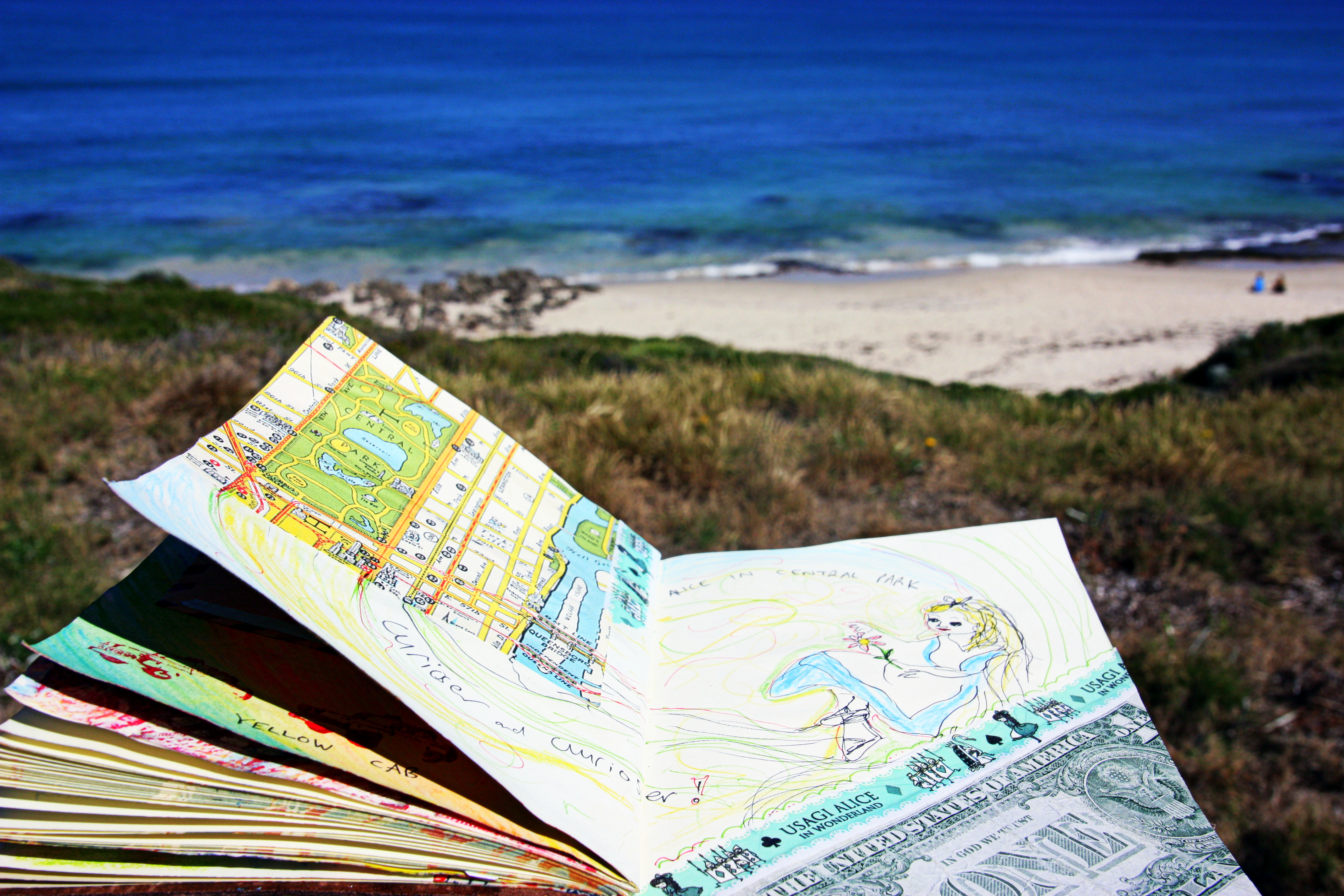
art journal page: Alice in Central Park

art journal page: Alice in Central Park

Who in the world am I? Ah, that’s the great puzzle. ~ Alice, Lewis Carroll’s Alice’s Adventures in Wonderland

José de Creeft’s Alice in Wonderland bronze statue glimmers in Central Park, polished by children’s climbing hands. Alice, of Wonderland fame, is a character who resonates with me. She is ingrained enough in my thinking that she makes more than a passing appearance in my PhD thesis. What I love about Alice is that she is open to new places and perspectives. She is curious, receptive and constantly wondering. She thrives on meeting new creatures and on having unusual, wondrous experiences. She is the imaginative adventuress who at once embodies childhood awe, strong self-assurance, rationality and fear-conquering daring. In many ways she is a flâneuse of Wonderland: wanderer, wonderer, learner and observer.

The question of self is not straightforward. Various aspects of our tangled selves collide and interlock. Or perhaps, rather than tangled webs of gossamer self-threads, we are each kaleidoscopes of self. Forged from a range of asymmetrical elements, we form the spectacularity of the beautiful changeable selves we are when viewed together through a cylinder of mirrors and light.

my precious stone kaleidoscope

my bronze-cylindered Arcana kaleidoscope has wheels made of glass and semi-precious stones: this one is by Australian artists Robert Cook & Jocelyn Teh

My kaleidoscopic self is made up of a number of different selves which my @debsnet Twitter bio attempts to unify:

Wanderer. Wonderer. Dreamer. Reader. Writer. Creator. Educator. PhD researcher. Passionista. Disruptor. Imaginer. Innovator. Flâneuse.

Not included are other personal selves like parent, spouse, child, sibling, friend. There are many contexts in which I share all or some of these self aspects. As the kaleidoscope turns and the light changes, people see different patterns reflected from me.

patterns as seen through my kaleidoscope

mandala-like patterns as seen through my kaleidoscope

My self-threads splinter, intertwine and blossom, as they do through the kaleidoscope viewing hole.

As I reflected in a previous post, connecting with other educators is for me about being my learner self. Connecting and collaborating widens and globalises my perspectives, while encouraging my own thinking and reflection (see Tom Whitby’s recent post about the relationship between connection and reflection). My teacher self is informed daily by my experiences as a parent, my own learning as a PhD candidate and my online participation. My Twitter interactions are influenced by my daily experiences of parenting, researching and working in a school. My parenting is influenced by my teacherly and researcherly thinking about learning and development. My PhD research self interacts with other researchers on social media as well as being informed by my in-practice educator immersion in my academic topic of study. My PhD itself incorporates me as learner, educator, writer, reader, creator and self-conscious researcher. And here on this blog my posts tangle together the threads of my learner, teacher, researcher, parent, writer and artist selves.

A dear friend of mine recently sent me this quote which I’m sure resonates with many of us:

When you find people who not only tolerate your quirks but celebrate them with cries of ‘Me too!’  be sure to cherish them. Because those weirdos are your tribe.  ~ Nanea Hoffman

It strikes me that many of those with whom I connect, in life, in education, in research and in my online PLN, are those whose quirks are similar to mine. Their kaleidoscope colours reach out to me across time, space, geography and social media.

I was recently involved in a Twitter chat with a number of educators. A few people in the chat began talking about being proud to be dorky, to be okay with failure and to constantly be learning. When I tweeted back ‘yes – fellow geeks unite!’ there was a chorus of ‘amen’ and ‘ditto’. I felt like I’d been high fived over Twitter. Here were my fellow weirdos, people who I’ve never met, connecting with me from across the world. “Yes,” they were saying, “In this moment, I get you and you get me.”

Next week I fly to New York to connect in a very real and immersive way with fellow educators, researchers and thinkers who will widen my perspectives. Perhaps I will widen theirs by sharing my Australian story. As this blog attests, I am hoping that my trip will allow my total and joyful submersion in all my aspects of selfhood. I will be thinking, writing, note taking, photographing, drawing and flâné-ing my way to new connections, new reflections and new perspectives.

The word kaleidoscope comes from the Greek words kalos, eidos and skopeō which essentially translate together into ‘beautiful form to observe’. Here’s to finding the beauty in others’ idiosyncrasies and to each of us finding our quirky global tribe.

find wonder, find perspective

The Connected Learner: Reflections on Connected Educator Month #CE14

spring in my garden: iceberg roses blooming

spring in my garden: iceberg roses blooming

Adventure is a path. Real adventure – self-determined, self-motivated, often risky – forces you to have firsthand encounters with the world. The world the way it is, not the way you imagine it. ~ Mark Jenkins

As Spring springs here in Australia and Fall falls in the USA (where I am headed in two weeks), I have been reading a lot about how October is Connected Educator month. You can read more from Craig Kemp (Twitter as PD), Tom Whitby (on the connected mindset) and Pernille Ripp (the downside to being a connected educator).

It has me wondering: what about being a connected learner? Because for me, being a ‘connected educator’ means connecting to be challenged, to be supported and to learn.

Twitter is a platform which allows plenty of connection and learning. On Twitter I …

  • Learn from others around the world – educators, thought leaders, researchers, students, people in other industries, friends and like-minded individuals. I get to read others’ ideas and share my own, and this means I am in a constant place of learning.
  • Contribute to a localised community hub of learning and thinking, sharing ideas on-the-spot such as at conferences during presentations; I simultaneously contribute to and consume the stream of learning-community responses.
  • Engage with people with whom I disagree, thereby engaging in debate and widening my perspectives. Corinne Campbell has written about why we need to be careful about the ‘echo chamber’ and only connecting with those who mirror ourselves.
  • Connect to those in similar situations to myself. This is why I follow #phdchat and #acwri, because as a working parent who is also a PhD candidate (read more about that here), I am not part of a student or researcher community, apart from during my supervisory meetings. Engaging with these hashtags allows me to learn from others while feeling that I am not alone in my PhD experiences. It means that when I am deep in my researching or writing burrow, I can send a shout out (a Twitter SOS, if you like) about my research experience (something that most people in my day to day life don’t connect with) and feel connected to others in the same boat. It allows me, in my moments of isolation and academic struggle, to feel heard by someone out there! I agree with George Couros in his post about why we need to be able to find these kindred spirits outside of our own immediate contexts.

Now, with this recently-begun blogging experiment (Will it continue after my professional learning New York trip? That is yet to be decided!) I have been connecting by sharing my musings (in more than 140 characters), my photographs and my journal scribbles. The very act of writing helps my thinking and the growth of my professional ideas. The subsequent connections with others is about mutual interest and growth. Blogging has helped me refine my own thinking while widening my global learning community (or professional learning network).

Similarly to the ACEL Conference at which I presented this month (you can read my reflections here), my upcoming visit to New York will have me really connecting, face to face, with inspiring thinkers, school leaders, educators and researchers, with whom I have found connections through various avenues, from introductions to cold-emailing. Here Clara Galan reminds us of the importance of connecting in real life as well as in the virtual world.

So for me October is definitely Connected Educator month, but more than that, it is about connected learning. Educators and others around the world connect online and in person, learning together to grow themselves and come up with better outcomes in their arenas of work and influence. Fellow nerds of the world, unite, in any and every way you can!

O, Manhattan!

O, Manhattan!


Social media for teacher professional learning

Teaching is forever an unfinished profession … never complete, never conquered, always being developed, always changing. Grundy & Robison, 2004

One thing that is emerging from my PhD research into teacher learning is the power of social media, Twitter in particular, as a professional learning tool and community.

For educators and researchers, Twitter means we can find like-minded individuals, even when those in our own organisations don’t share our passions or practices.

Social media connects us outside of our physical sphere – our schools, districts and countries – to professionals, thinkers and writers around the world who generate and share information, ideas, practices and activism which inspires, incites or affirms us.

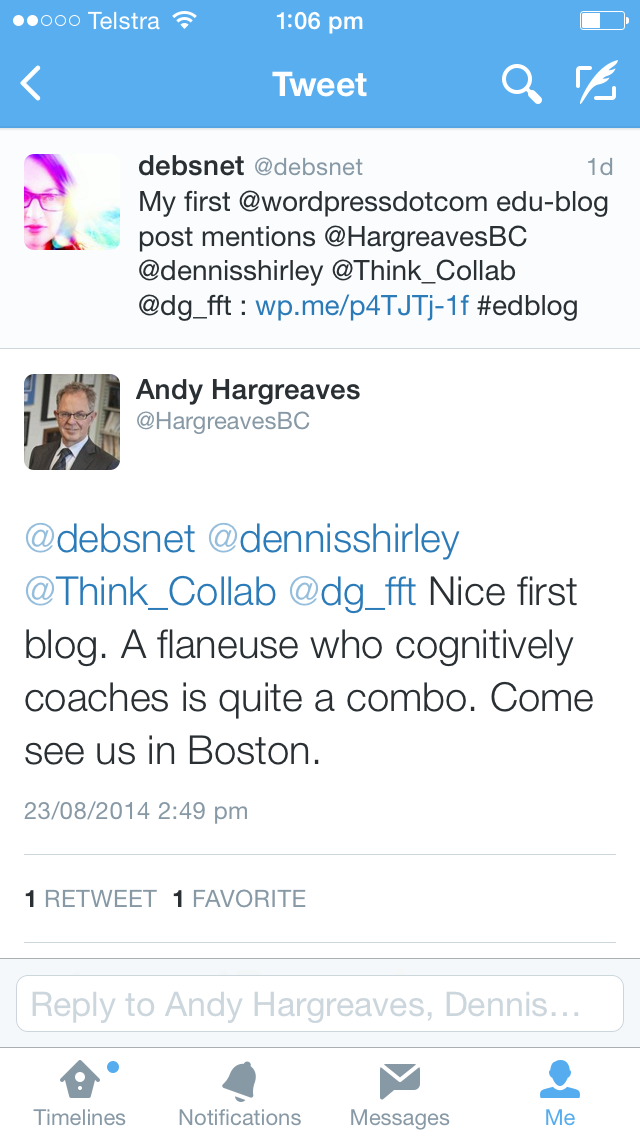
Imagine my delight when global school change titan Andy Hargreaves responded to my first (ever) blog post. Here was social media linking me to one of education’s thought leaders whose work shapes my classroom teaching, my school leadership practice and my PhD research.

In 2013, Kathryn Holmes, Greg Preston, Kylie Shaw and Rachel Buchanan published a paper which found that “Twitter is a valuable conduit for accessing new and relevant educational resources on the internet and also as a viable means of social support for like-minded educators. The cost effective nature of the microblogging platform ensures that it can act as a medium for sustained professional development, while leaving the individual participants to control and take ownership of the learning.” So Twitter can be socially and intellectually supportive, and it can facilitate and drive sustained engaged learning which is owned by the individual.

Jon Tait explains Twitter’s role as professional development platform in his blog post and has designed this infographic to summarise Twitter uses for teachers.

JonTait_TwitterTeacherInfographic

As I move for the first time from content curation to content creation (this being my second-ever blog post), the functions of the professional social media world and those who engage in it are a point of reflection.  Who will read my words and see my images? Who will interact with my thinking and add their own? How might social media support, connect and educate me?