
Reflective school leadership for renewal

Image: by freephotocc on pixabay

Being in the busy

In Australia, we are deep in the kaleidoscope of Term 3, and the life of a school leader is filled with sports games, concerts, school and community events, teaching, meetings at every time of day and night, walks around the yard, crossing duty, yard duty, site visits, interviews to be conducted, speeches to be given, problems to be solved, projects to be managed, strategy to be implemented, situations to be responded to, and communications to be crafted. It is full. It is vibrant. It is deeply rewarding and rooted in community, purpose and service.

When the term is upon us and all around us, our boundaries and protective practices can slip away. Tasks multiply. Weekends are for catching up. Nights are for remembering the to-do list. Perhaps we skip the gym or pilates or our run or meals or time with our family or time with our self. Reflection shrinks. Creativity waits for its moment. Pondering is squeezed out. Strategic thinking is delayed until ‘later’.

School principals can feel unable to separate the personal from the professional and can be overwhelmed by the all-consuming, complex and ambiguous nature of the work (Drago-Severson, 2012). In Australia, the annual Principal Occupational Health, Safety & Wellbeing Survey consistently reports school leader experiences of high stress, burnout, sleep problems, anxiety and depression.

Prioritising renewal

Ellie Drago-Severson (2012) points out that for school leaders to sustain themselves in their work, they must find ways to replenish their inner resources. She proposes reflective practice as a potential ‘holding environment’ or ‘growing space’ for school leaders that can have a positive impact on teacher growth and school climate. That is, when leaders find time and space for reflection and renewal, for sharing their dilemmas, and for receiving and seeking support, everyone in the school benefits.

How and where might those times and spaces be found for school leaders?

Metaphors for reflective practice

Pat Thomson (2019) suggests that school leaders’ systematic engagement in reflective practice might benefit from borrowing from the arts, particularly the metaphor of ‘the studio’. Artists, too, can think about their work most of the time. For them, the studio provides a productive site for this immersive thinking – for experimental ideation, boundless reimagining and creative generating. The studio is a place of imagination and empathy where tensions can be explored, and where not knowing, unknowing and messiness are welcomed. It is a place of respite from certainty and accountabilities, and for integrating theory and practice. The studio provides permission and a protected space for the artist to be, become and inquire.

As a lifelong artist who has painted in oils and acrylics since I was 6 years old, and whose Bachelors and Masters degrees are in Fine Art, the metaphor of the studio resonates with me. There might be other metaphors that offer ways of thinking about how and where leaders can engage with reflective practice. The kitchen could be a site of creation, nourishment, simmering and slow craft. The garden is a place to plant seeds, tend to ideas and cultivate soil. The night sky provides a vast expanse of possibility for noticing, and embracing silence, darkness and seasonality. These metaphors might help school leaders to imagine their own sacred and safe space for reflective practice.

Carving out time and making space

I am working to more consistently engage in reflective practice that is deeper and wider than micro ‘third space’ moments between activities (Fraser, 2012). I have this year been experimenting with crafting small sanctuaries of thinking and being – journalling, a yoga class, reading, writing, podcast listening, podcast recording, and conversations with trusted colleagues and mentors. I wonder how and when to ensure longer periods of deep thinking beyond the day to day.

Renewal is not an indulgence and cannot be an afterthought. We all benefit from spaces that spark play, experimentation, creative thinking and idea generation. Our studio space is not an interruption to the work, but a key part of our work. Fostering reflective practice helps to support people whose energy is sustained, whose purpose is sharpened, and whose reserves are replenished, to allow them to serve their communities.

For more about reflective practice, listen to the latest episode of The Edu Salon podcast, featuring Kristen Douglas.

References

Drago-Severson, E. (2012). The Need for Principal Renewal: The Promise of Sustaining Principals through Principal-to-Principal Reflective Practice. Teachers College Record, 114(12), 1-56.

Fraser, A. (2012). The Third Space. Random House.

Thomson, P. (2019). Thinking about the school most of the time: studio as generative metaphor for critical reflection. Journal of Educational Administration and History, 51(2), 87-102.

Reflections on professional nourishment

Image created with ChatGPT

The profound privilege and the weighty responsibility of serving as a school principal lies in the depth of the humanity of the role combined with the incredible sense of duty and the complexity of the role’s many moving parts. Independent school principals have been described as CEOs, responsible for strategic oversight and management of learning and teaching, daily operations, finances, risk, resources, communications, stakeholders and culture. A 2008 Australian report described principalship as “the best job in the world with some of the worst days imaginable,” encapsulating the intense reward and intense challenge of the role, which can be simultaneously fulfilling and depleting.

I have appreciated recent invitations to share my advice for aspirant school principals, and to speak about my experience in building contributions and networks beyond my immediate school environment. These opportunities for reflection, coupled with the regular release of research reports and media stories indicating the increasing ill-being of those working in schools, have led me to consider what might be described as ‘professional nourishment’. How do those of us leading in schools fill our cups to build buoyancy and resilience that sustain us as we serve the people in our communities, and navigate significant, serious and sometimes surprising complexities?

Like other people-facing roles in schools, principalship is inherently relational and involves the living of relationships throughout the extensive ecosystem of a school. Deb Dana’s concept of finding ‘glimmers’ in our day to uplift us reminds us to seek out sparks of joy and micro-moments of presence. Those of us working in schools can experience nourishment in our roles as we engage in the many and varied student experiences, community events and lives of students, families and staff. There is satisfaction and pride in witnessing the personal growth and achievements of students, sharing in the triumphs and challenges of families, and working alongside inspiring and dedicated colleagues. A ‘glimmer’ might be a conversation with a child in the yard, a thank you email from a parent, visiting a classroom to see a colleague teach, a conversation with an old scholar, attending a performing arts production or sports game, sharing dinner with the boarders, or witnessing a student or staff member overcome a challenge.

Professional nourishment can also come from deliberate reflection on and intellectual engagement in the work. This blog, for example, provides me with one way to share research, practice and thinking. It also engages me in writing as a practice of clarifying, synthesising and developing my thinking. Writing and podcasting provide unique opportunities to participate meaningfully in local, national and global dialogues around education and leadership. A range of platforms can immerse us in diverse perspectives and enable us to actively contribute to wider educational conversations. Ensuring there is time and space for thought, innovation and intellectual engagement, can help to reconnect us to the strategic direction of our schools and the ‘why’ of what we do.

One worry I have about artificial intelligence is that, while it is trained on human writing and coding, using it as a shortcut to exploring and communicating ideas might reduce our time and capacity to sit with, contemplate, and work through complex ideas. Formal or informal writing can be utilised, not just for its resultant output, but for its process of cognitive working out. When I begin writing, I do not know exactly where a piece will take me. The writing process is focused on internal growth and ‘thinking through’ or ‘thinking out loud’, rather than efficiency and end product. In a recent episode of The Edu Salon podcast I talked about the marination of ideas in the human brain as an important part of how we understand more deeply and move our thinking forward. Quiet reflective practice–in which we take the time to pause, interrogate our assumptions, tease out ideas, and carefully consider experiences–can provide an anchor for us to find clarity in the complexity of our work.

When I think of what is professionally nourishing, there is a special place for professional relationships and networks. I am incredibly grateful for those mentors, peers, colleagues and friends to whom I can reach out. Professional organisations and conferences (such as, in Australian education, AHISA, ACEL, AARE and ICSEI) can provide educators with inclusive communities of practice where ideas are shared, respectfully challenged, and refined in a safe and collegial space. Trusted relationships in which we share and talk through problems of practice, provide meaningful connection and mitigate the isolation of our role.

Those leading in schools can work to sustain ourselves by cultivating meaningful professional relationships, prioritising reflective practice, and actively participating in broader educational networks. Learning and connecting beyond our immediate environments can enhance our practice, enrich our schools, pay forward our expertise into the wider educational landscape, and help to sustain us in our roles.

Educator wellbeing: Creating schools where staff flourish

It seems that everywhere educators turn there is a news piece, recent study or professional learning opportunity about educator wellbeing.

Facilitating schools and education systems that support staff to sustain their care, energy and enthusiasm – and thrive as fulfilled, healthy professionals – is an ongoing and oft-discussed challenge for schools. There remain ongoing and increasing concerns around the wellbeing of teachers and school leaders, and system-wide attraction and retention challenges in teaching and school leadership. The International Baccalaureate’s Wellbeing for Schoolteachers report (Taylor et al., 2024) points out that teacher wellbeing has an unequivocal impact on both teachers’ professional performance and the wellbeing and academic success of students. Yet staff cannot flourish without sustainable workloads, appropriate support, and a safe environment of trust, care, open communication, growth, recognition and feedback.

I have had the pleasure of chatting with Helen Kelly and Amy Green on The Edu Salon podcast, who both provide useful insights to those considering staff wellbeing in their organisations. The OECD (2013) defines wellbeing as made up of the following elements.

  • Life evaluation – a reflective assessment on a person’s life or some specific aspect of it.
  • Affect – a person’s feelings or emotional states, typically measured with reference to a particular point in time.
  • Eudaimonia – a sense of meaning and purpose in life, or good psychological functioning.

Martin Seligman’s PERMAH model (Positive Emotion, Engagement, Relationships, Meaning, Accomplishments, Health) also provides a helpful framework for thinking about what contributes to human flourishing.

Patrick and colleagues (2024) highlight the importance of fostering positive relationships in schools, active wellbeing teams, leaders addressing their own wellbeing, building trust within staff, and ongoing initiatives rather than stand-alone wellbeing events. Karnovsky and Gobby (2024) criticise deficit approaches to educator wellbeing that encourage teachers to look after their own wellbeing without addressing systemic and workplace issues “that are complex, institutionalised, entrenched and unlikely to be readily remedied.” The longitudinal Australian Principal Occupational Health, Safety and Wellbeing Survey (Dicke et al., 2024) continues to show declining principal wellbeing; increasing physical, verbal and cyber attacks against principals; and increasing principal sentiment to leave the role altogether. A recent meeting of Australian Education Ministers focused, in part, on teacher and school leader workload and wellbeing.

Additionally, in Australia, the Closing Loopholes Act, or ‘right to disconnect’ law, now offers an opportunity to reshape workplaces and workplace boundaries. The Act means that an employee may refuse to monitor, read or respond to contact (or attempted contact) from their school or a third party (which could include parents or students) outside of their working hours, unless the refusal is unreasonable. The new right does not stop schools from sending emails to employees outside of work hours, but seeks to protect employees who choose to ignore attempts to be contactable from being disciplined or terminated as a result. Schools can review their communication and collaboration practices, and be clear about how staff are supported to disconnect from work after hours.

Despite the swirling mass of talk about staff wellbeing, context, as always, is Queen. Any attempts to address the wellbeing and flourishing of staff need to be embedded in the school and system context, and to include the voices and participation of staff in that school or system. Schools need to ask their staff what their preferences and concerns are, and work alongside staff to find practical ways to address these.

Taylor and colleagues (2024), point to school climate as key to teacher wellbeing, including staff voice in school decision making, work autonomy, good teacher-student relationships, feelings of belonging with the school, and sufficient resources to carry out duties. At my school, in response to a range of staff feedback and the work of our Staff Wellbeing Committee, we are undertaking a process of reviewing and refining our policies, practices and resourcing with a view to how these impact our staff, their workloads, their sense of purpose, their experience of joy, their professional satisfaction, and their emotions about work.

Our school is dedicated to creating a safe and nurturing environment that prioritises the safety and wellbeing of all individuals, treats staff as trusted professionals, and attempts to flexibly and compassionately address individual staff circumstance, and facilitate staff autonomy and growth. Open communication is key to individualising flexible work options that balance empathy, compassion and flexibility, with accountability, high standards and practicality.

We have released our first go at a ‘Staff Wellbeing and Flexible Working Guidelines’ document that makes explicit the school’s approach to supporting staff wellbeing, and outlines flexible work options, while acknowledging that each staff member’s personal circumstances is different, and there is no ‘one size fits all’. These guidelines are an iterative work in progress and will evolve alongside ongoing opportunities for staff to provide honest, respectful feedback to inform decision making.

When speaking about school culture, I have often referred to the words of Peter Drucker (‘Culture eats Strategy for breakfast’), Herb Kelleher (‘Culture is what people do when no one is looking’), and David Morrison (‘The standard you walk past is the standard you accept’). Recently I came across this from Bill Marklein: “Culture is how employees’ hearts and stomachs feel about Monday morning on Sunday night.”

In schools we need to be asking ourselves: How can we all contribute to cultivating an environment where everyone–students and staff–looks forward to coming in on Monday morning? How might we foster cultures and practices in which we celebrate our purpose, find the joy in our work, and think creatively about schools as places of learning, caring, leading and working?

References

Dicke, T., Kidson, P., & Marsh, H. W. (2024), Australian Principal Occupational Health, Safety and Wellbeing Survey: 2023 data, Institute for Positive Psychology and Education, Australian Catholic University

Karnovsky, S., & Gobby, B. (2024). ‘How teacher wellbeing can be cruel: refusing discourses of wellbeing in an online Reddit forum’. British Journal of Sociology of Education, 1-19.

OECD. (2013). OECD Guidelines on Measuring Subjective Wellbeing. OECD Publishing.

Patrick, P., Reupert, A., Berger, E., Morris, Z., Diamond, Z., Hammer, M., … & Fathers, C. (2024). ‘Initiatives for promoting educator wellbeing: a Delphi study’. BMC psychology12.

Taylor, L., Zhou, W., Boyle, L., Funk, S., & De Neve, J-E. (2024). Wellbeing for Schoolteachers (Report No. 2). International Baccalaureate Organisation.

Teachers and school leaders: well-being or ill-being?

Concern about teacher and school leader wellbeing

Teacher and school leader wellbeing is an increasing issue for education systems around the world. Some commentators call teaching a profession in ‘crisis’ or ‘distress’. Many sources point to the emotional, mental, and physical health of those working in schools as something that needs to be seriously considered.

Some literature suggests that one quarter of those who begin teaching leave the profession in the first five years, often citing mental health, emotional exhaustion, workload, and wellbeing issues as reasons.

The Gonski 2.0 report (Gonski et al., 2018) names unstable employment patterns, and a heavy and increasingly complex workload, as reasons for attrition in the teaching profession.

A week ago The Guardian published this article on increasing teacher workload, saying that according to one UK teacher wellbeing index, “nearly three-quarters of teachers and 84% of school leaders now describe themselves as ‘stressed’, and more than a third of education professionals have experienced a mental health issue in the past academic year. Almost half (49%) believe their workplace is having a negative impact on their mental health and wellbeing.”

The longitudinal Australian Principal Occupational Health, Safety and Wellbeing Survey of principals and deputy principals reveals worrying trends in school leader wellbeing. The 2018 survey (Riley, 2019) involved 5934 participants. Its findings include the following.

  • 53% of principals worked upwards of 56 hours per week during term with ~24% working upwards of 61-65 hours per week;
  • 40-45% of participants take prescription medication for a diagnosed condition.
  • Principals experience high levels of job demands (1.5 times the general population) emotional demands (1.7 times) and emotional labour (1.7 times) being the highest demands when compared to the general population. This is correlated with higher levels of burnout (1.6 times higher), stress symptoms (1.7 times higher), difficulty sleeping (2.2 times higher), cognitive stress (1.5 times higher), somatic symptoms (1.3 times higher), and, depressive symptoms (1.3 times higher).
  • The two greatest sources of stress for principals and deputies are Sheer Quantity of Work, and Lack of Time to Focus on Teaching and Learning.
  • Principals’ stress is caused largely by increasing Mental Health Issues of Students, Mental Health Issues of Staff, and Teacher Shortages.
  • The prevalence rate for Threats of Violence is 45%, with close to 1 in 2 principals receiving a threat.

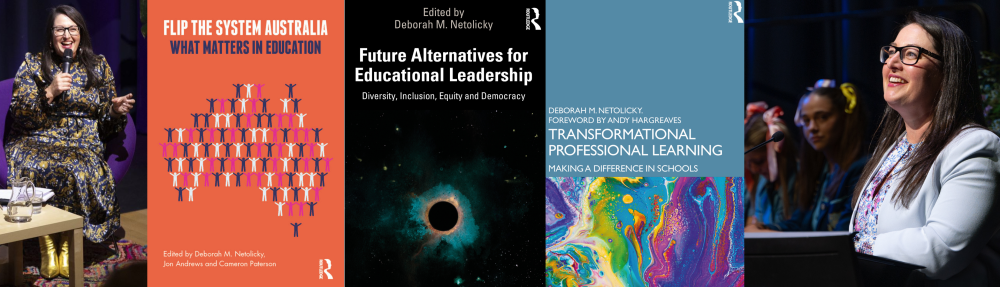
In their chapter in Flip the System Australia: What Matters in Education, Andy Hargreaves et al. (2019) acknowledge that teachers struggle to collaborate effectively amidst the frenetic rate of reform in education and ever-increasing workloads and accountabilities. They assert that there is no student wellbeing without teacher wellbeing, so teacher wellbeing is something we need to care about.

Should teachers and school leaders be expected to put the needs of the children in their care ahead of their own health and their own children? Should they be expected to teach social, emotional, and life skills, as well as the curriculum? Should they be scored and performance managed based on limited and limiting accountability measures? Should they be pressured into spending their leisure time working and their own money on resources because it shows that they care and are ‘good teachers’? Should overwork, late night emails, and accessibility during weekends and holidays be normalised?

If wellbeing of staff is an issue in our education system, what can leaders do, and what can we each do for ourselves?

Leadership of staff wellbeing

School leadership is key to staff wellbeing. Just this week, WorkSafe has launched an investigation into one Australian school, its psychosocial environment, and the psychological and physical safety of its staff.

Wellbeing in schools is about more than meditation, yoga, fitness classes, and complimentary employee counselling. These have their place (and I enjoyed workplace yoga for years), but addressing teacher and school leader wellbeing also means seriously considering workload, expectations, and accountabilities.

Those leading systems and schools need to ask: How do our norms and culture contribute to wellbeing or ill-being? What is the work that is really important and that makes a difference? What can we take off teachers’ plates? How do we balance high professional expectations with high levels of support? What does it look like when we treat our staff as human beings with relationships, bodies, and lives?

Schools need to think carefully about teachers’ multiple, competing duties, and make time for meaningful collaboration around student work, student data, curriculum, and pedagogy, as well as time for teachers’ core business: actually teaching (and planning and assessing).

The Gonski 2.0 report suggests that “much greater assistance could be given to reduce their [teachers’] hands-on administrative workload, particularly in schools that are part of a larger system. This assistance includes: exploring reduction and/or simplification in administrative burdens placed on schools and their reporting requirements (including simplification of work health and safety requirements); appointing more dedicated administrative resources to schools; identifying quality external providers to which schools may be able to outsource some administrative responsibilities; and exploring new models for school management including chief operating officers or business managers accountable to the principal” (p.88).

School leaders can make transparent decisions, underpinned by organisational vision and clear principles. We can exercise compassion. We can resist hyper accountabilities, narrow frameworks for assessing teachers, and negative narratives of schooling. We can create our own measures of success for our schools, teachers, and students. We can enable flexible working arrangements, and ensure we listen to and encourage honest feedback from our staff.

We can also consider an approach to professional learning that is about growth. This can include staff voice and choice, and supportive processes such and mentoring and coaching. In this way, leaders can acknowledge the complexity and humanity of teaching and schooling, and facilitating staff autonomy and agency. Staff can feel like trusted, valued professionals and authors of their own learning and development.

Individual wellbeing

wellbeing

some of my wellbeing spaces

Those of us working in education need to give ourselves permission to protect and nourish our own health and relationships. That means time to sleep, to exercise, to enjoy nutritious food, to be silent and still, to be with our families, to spend time with our friends, to attend our children’s events, to breathe. It means prioritising these things even when the work feels crushing or breakneck in ways that seem to squeeze out everything else.

Like many who work in education, I find putting work to the side a challenge, but the old adage applies: we need to fit our own oxygen mask before we can assist others. We need to look after ourselves if we are to effectively serve our staff, students, and school communities. Personal wellbeing is not optional.

When author, prison officer, social justice advocate and education powerhouse Celia Lashlie died in 2015, her family published some of her final words:

“We become complacent about the need to take care of ourselves… always something more to do. Some of this is driven by our desire to save the world, others driven by the desire we have to reach the many goals we have set ourselves – many of them superficial.

Late last year I slowly became unwell. The stress of the lifestyle I was living, the demands I made of myself, the demands the people made of me and expected to meet became too great and as 2014 closed I was diagnosed with pancreatic cancer that had spread to my liver. No treatment, no cure, only palliative care. I’d waited too long to look after myself and my body broke.”

For me, these words were a sober reminder to educators that while we may want to do our utmost to make a positive difference, we should also work hard at looking after ourselves.


References

Gonski et al. 2018. Through Growth to Achievement Report of the Review to Achieve Educational Excellence in Australian Schools.

Hargreaves, A., Washington, S., & O’Connor, M. (2019). Flipping their lids: teachers’ well-being in crisis. In D. Netolicky, J. Andrews, & C. Paterson (eds.), Flip the System Australia: What Matters in Education, 93-104. Abingdon: Routledge.

Riley, P. 2019. The Australian Principal Occupational Health, Safety and Wellbeing Survey 2018 Data.

Leadership lessons from school principals

source: pixabay.com by @ThinkTanks

Part of my role in overseeing professional learning at my school is building a variety of ways to develop the capacities of leaders. Our termly leadership forum, a new initiative this year, provides a place and space for all of our leaders – from coaches and pastoral leaders, to heads of faculty, senior leadership, and the Executive team. We meet each term for an evening of wine, cheese, provocation, and connection. In Term 1 I ran a session with the Director of Strategy on thinking about leadership in terms of research, organisation, team, and self. In Term 2 we welcomed Professor Dylan Wiliam to our forum.

This term we welcomed a panel of three independent school principals to present to our school’s leaders. These three panellists represented more than three decades of principalship between them. They had some clear messages about leadership for leaders at all levels, including the following.

……

Embrace opportunities

The panel encouraged everyone to embrace and pursue available opportunities, to take on challenges and pursue work and service that energise, inspire, and motivate us, and that align with our framework of personal beliefs and values. For me this is about aiming to do good work, without a clear vision of where this might take me.

Be yourself

All three principals said something that resonates with my own philosophy: in order to lead effectively, we need to be authentic. That is, rather than trying to perform the identity we think others are hoping for, each of us can be ourselves. Being ourselves means knowing ourselves. To be authentic leaders, we each need a clear sense of our own core values and beliefs, and a willingness to be transparent in our thinking.

Back yourself

The stories of these three principals showed that we need to be ‘in it to win it’; that is, to put our hat in the ring even when we might not be the obvious choice for a leadership position. Backing ourselves means having the courage and confidence to put our hands up to take on responsibility, and having the self-awareness to know what we bring (and don’t bring) to the work and leading we do. Part of this also means to be unafraid to challenge others or to call out injustice, and to have the capacity to be decisive even when faced with challenging issues.

Receive and give encouragement

All three principals had at some point received a ‘shoulder tap’ where a colleague or more senior leader had suggested they apply for a leadership position they had not considered. I have also had these experiences where someone has recognised for me an opportunity that I didn’t recognise for myself. These are moments that can help us to reimagine of what we are capable, and where our paths might take us. I am grateful to those who have taken the time or opportunity to challenge me on the limitations I have sometimes set for myself.

We can each listen to advice from others and be open to opportunities we may not have considered for ourselves. Each of us can also find opportunities to recognise, acknowledge, and encourage those around us; to let others know when we see leadership potential in them; and to pull others up with us, championing their work and helping them and others to see their possibilities.

……

The panel also had plenty to say about being a principal. Principalship is leadership as service that can have very real impacts on those in the role. As the results of the Australian Principal Health and Wellbeing survey show, Australian principals score lower than the general population on positive measures of wellbeing, quality of life, and mental health; but higher on negative measures such as stress, depression and sleeping trouble. Our panel discussed their own self-care strategies and the ways in which they look after themselves as they navigate what is complex, unrelenting, ethically-challenging, and often isolated work.

Our panel also noted that ‘principal’ is a leadership position that can be reached via a range of pathways. This encouragement comes at a time when Australia has a shortage of those aspiring to principalship, with a looming shortage as the majority of Australian principals reach or near retirement age.

The message from our panel was that being a principal is doable. Their stories brought a human side to the role and one panellist noted that the principalship is not a special place for an elite few but something to which many can aspire, and in which many can find success. The caveat here was that aspirant principals needed to be those with a strong values framework who is clearly aligned with the core values and mission of the school they are leading, and an ability to make decisions under pressure.

The lessons from this panel of principals are relevant for those aspiring to leadership and those already leading. Whether we have a leadership title, or are seeking opportunities to positively influence the world around us, we can be authentic and true to ourselves. We can be motivated by what energises us and by our desire to make a difference in the world. We can be courageous in our action and communication, make deliberate ethical decisions, and enact well-considered actions that are based on a solid foundation of self-awareness, self-efficacy, and self-belief.