Reflecting on education Twitter chats

How to tune the voices on the airwaves?

How to tune the voices on the airwaves?

Chats can fall prey to … a lack of meaningful connections (with people or ideas), superficial conversations, and a lack of some sort of closure.

If mismanaged, preplanned chats can sometimes feel contrived. Better planned and executed, they might have the feel of a productive town hall meeting.

But like a town hall meeting, people can shout, speak without actually having conversations, or be lost in a crowd. You leave such a meeting asking yourself what just happened or if anything useful took place.

Sometimes the best conversations are the ones that are neither fast or slow. They are spontaneous and come from a place of honesty or concern.

Dr Ashley Tan in his September 2014 blog post

In the education world of Twitter, hashtag chats are ubiquitous and, for many, an important way to connect with other educators. I’ve talked before about how Twitter is a kind of writing and thinking practice, helping me to distil and crystallise my thinking. I participate in Twitter chats for a few reasons. In these forums, people interested in things I’m interested in are likely to be on the airwaves at the same time; I can find a tribe of sorts. I can connect with new and familiar voices in the Twitterverse.

Many chats are scheduled weekly, and happen over the course of an hour, with either one question, or more usually, a series of questions scheduled throughout the hour. There are also ‘slow chats’ which pose one question and allow those from different time zones to engage in discussion across a day or a week. I approach different chats in different ways. Sometimes I immerse myself in the chat. Sometimes I dip in and out. Sometimes I end up in a side chat having tangential conversations with people whose thinking is coalescing with mine in that moment.

You can find a schedule of the global range of education Twitter hashtag chats here.

As Greg Ashman notes in his post today, Twitter chats can connect us with fellow geeks, even when we’re feeling isolated in our own contexts. He also points out that chats often don’t allow participants to engage in the assumptions underlying their questions. In a chat we were both lightly engaged in today, there were, for instance, attempts by some participants to explore the situated, nuanced nature of the topic. There didn’t seem to me to be a clear understanding of what participants meant by the topic, or why or in what ways they felt it was important. At times it felt like people putting sticky notes up on a wall; comments were being placed alongside each other, but they were disparate and not based in the same conversation or on a foundation of common understanding.

I’d agree that often chats deal with complex concepts and unclarified terms, and sometimes they can descend into a superficial cacophony of noise where people are talking but not listening, learning or questioning. Sometimes when I have questioned the use of a term or the premise of a chat question, I’ve been engaged with by others, but I’ve also been ignored or dismissed.

Sometimes, Twitter chats can produce an echo chamber of like-minded people high-fiving each other. In some ways, this feels good, as Twitter is a place many find solidarity and support. In my participation in the PhD Twitter community, it is often moral support that I’ve sought out in times of academic struggle or isolation. But while dissent is hard in 140 characters – and can easily come across as abrasive or attacking, rather than gently provocative or inquiringly questioning – I hope for robust, rather than cursory or jargonistic, discussion from educators. Yet difficult in 140 characters.

Personally, I’ve found a solution of sorts in this blog. I use it to expand my thinking and explain it to others in more depth than even a series of tweets would allow. Blogging opens up the education conversations we have, widening and deepening debate. We can disagree more gracefully if we have more words in which to do it. I’ve really enjoyed those times in which I’ve been engaged in a conversation with other bloggers, as we build on and respond to each other.

More recently, I’ve experienced Twitter chats from the organiser side. A couple of months ago, Chris Munro, Corinne Campbell, Jon Andrews and I launched the monthly #educoachOC chat, one intended to start a conversation around coaching in education at an Oceanic-friendly timezone. My co-moderators are educators I initially met on Twitter, and now our common interests have developed into this collaboration.

After collaborating using tools such as email, Google docs, Voxer, Twitter messaging and Trillo, we planned our approach and our questions for the first chat. We also launched a blog as a home base; we wanted to make our approach clear and our thinking explicit.

The #educoachOC team learned a lot from our first chat. We reflected on how we found the chat as moderators, how we felt the conversation went between participants, and also used a Google survey to allow participants to give us feedback. In that first go, we had too many questions, which left it feeling a little disjointed at times as people jumped off interesting threads of conversation to answer the next question. One participant said they felt as though they had been coached through the chat; that we had modelled coaching through our questioning and format. One said that most contributors were pulling in the same direction and that it would be interesting if opponents of the approach challenged one another. A major reflection from that first chat was around the clarity of terms. We found participants were all talking about coaching, but seemed to have different understandings of what that meant.

In our second chat, we reduced the amount of questions and focused the chat around clarifying the group’s understanding of coaching. We were keen to build a shared understanding amongst this online community. We prefaced the chat with a blog post outlining the contestations and confusions, and some useful resources. It worked better, we reflected, and we’ll continue to collaborate and refine our approach and format. In that second chat (there’s only been two so far), we were trending in Australia, at the same time as #qanda. While we certainly didn’t intend to be a trending hashtag, that was a reflection of the level of discussion and participants’ engagement in the topic and with each other. It felt much more like a conversation which allowed us to deeply explore a topic and some of its complexities.

I think the education Twitter community does wonderful, exciting things, including through Twitter chats, in which I am immersed. But I do think we can be reflective and critical about how we run these chats, how we participate in them and how we use other media such as blogs, podcasts, Periscope and Voxer to take our conversations further, deeper and towards rigorous and elegant debate.

Happy birthday to the édu flâneuse: Reflections on a year of blogging

I don’t think there is any truth. There are only points of view. ~ Allen Ginsberg

happy 1st birthday

happy 1st birthday to me

Over the weekend the édu flâneuse blog had its first birthday, and so I’ve been reflecting about what a year’s worth of blogging has meant for me.

As a blogger, I am small fry. But with 15,000 views in over 100 countries in a year, this blog is being read. That’s many more views in many more places than I am sure my PhD thesis will receive! When I see my analytics I wonder how those people in Libya or Uzbekistan or Iceland have stumbled across my words. What drew them in? In what surroundings and on what device did they read? What did they take away?

The blog’s top 5 most-viewed posts have been:

  1. Teacher Growth: Helping teachers open their gates from the inside. A post about the beliefs underpinning my school’s teacher-growth-focused coaching model.
  2. Can and should teachers be (viewed as) researchers? The first post where I dared to say something which might be considered controversial.
  3. Work-family fulfilment: The elusive sweet spot. In which I attempted to explain my approach to making the family-work-study-self ecosystem work for me.
  4. No grades? No marks? No worries. An explanation of a term of Year 10 English with no marks and no grades, and its surprising outcomes.
  5. 2015: The Year of Writing Boldly, Abundantly & Dangerously. Where I set myself the challenge of being deliberately writerly in 2015, in my blog, my thesis and elsewhere.

Blogging has allowed me the opportunity to reflect, to work through my thinking, to share snippets of those things about which I am passionate, and most importantly to connect with others. It is an antidote to isolation (for me this is so important in my PhD, where I am largely without a face-to-face community of peers). Sometimes it just feels good to throw some thoughts out into the ether in the hope that they might resonate with someone else who comes across them, a kind of blogging message-in-a-bottle tossed out to sea.

Matt Esterman has written about the separate-together-ness of our offline and online identities. This blog allows me to explore parts of myself online which would be mind-yawningly dull to many in my offline life. It has allowed me to find a tribe of like-minded (lovable) weirdoes who want to engage with me around passions, interests and experiences.

Blogging has allowed me to make real connections, with real people, some of whom I chat to on Voxer, and some who I’ve since met with in real actual life. It has expanded the depth of my participation in the online world in a way which isn’t possible in even a long line of 140-character tweets. While Twitter forces us to haiku-ise our ideas (therapy for my verbosity), blogging allows longer-but-still-focused explorations of thought. And it is a free form of writing which provides reflection on, and escape from, the constraints of academic and thesis writing. I find that the more rigid my thesis schedule and the more rigorous my PhD work, the more lyrical and creative my blog posts become.

My favourite posts have been those which opened up online and offline discussion, in which I responded to someone else’s thinking or writing, or from which I was responded to. These posts, connected as they are to other people and other posts in the intricate spider-web network of the blogosphere, add layers to blogversation or lenses to well-worn issues.

Today, Naomi Barnes published a post in direct reply to one of mine, about the knowledge-building nature of blogging in a kind of collaborative parallel dialogue. She writes:

We stop being experts and start being co-learners. We have part of the knowledge. Not all of it and not necessarily true. We break the teacher-student archetype and become networked learners. Use the Web, the network, the connections, to create new knowledge. Crowd sourced, collaborative knowledge. Wikipedia on steroids. ~ Naomi Barnes

Naomi’s post challenges us to consider what the blogosphere and online knowledge might look like if we spoke more collectively, rather than as a cacophony of voices speaking in our disparate shadows or on our disconnected milk crates. She is daring us to harness blogging, the web, social media and technology for what they could do, for what they have the potential to be.

Thank you to my édu flâneuse readership so far, for indulging my pursuit of flânerial being and blogging, and especially to those who take the time to comment, retweet, respond and connect. This blogging thing is a vehicle for personal learning and global communitification. I’m in for another year.

Balance, not division. Compassion, not attack. Conversation, not war.

Compassion is not a relationship between the healer and the wounded. It’s a relationship between equals. Only when we know our own darkness well can we be present with the darkness of others. Compassion becomes real when we recognize our shared humanity. ~ Pema Chödrön

by @debsnet

Often I am struck by argumentative battles in traditional media, on social media and around the blogosphere. I appreciate those writers, commentators and educators who share their musings, experiences, readings, and perspectives, without using divisive loaded language or attack. I think the rantiest I have gotten was this post on the APPR reforms in New York and this one around whether teachers can be researchers, but I attempted to frame my criticism through making transparent my perspective and asking clarifying questions. Balance.

I have written a lot about my school’s coaching model, as it is kind of my baby and it’s something which I think is worth sharing; others might gain from hearing our story. Yet this coaching model is not stand alone. It is not as though teachers at my school are only coached by teacher-coaches in a non-evaluative, non-hierarchical model. In their first year at the school, teachers participate in a rigorous evaluative permanency process. Every year they have a conversation with their line manager, who touches base with them on their work, goals and classroom practice. Every third year, teachers have their coaching cycle with their manager. This is more evaluative and performative by its nature, and by the nature of the relationship. Teachers additionally work with instructional consultants. Leaders work with coaches. Professional learning community teams and action research projects work alongside. Growth and evaluation. Balance.

I have written about the creative things I trial in my classroom like a term without grades and genius hour for students and teachers. These are things at the experimental end of the spectrum of what happens in my lessons, so I share them as stories of experience and part of a conversation. I do these things to develop engagement of my often-reluctant high school English students, to build their self-efficacy and to help them learn to rely on themselves as drivers of learning, rather than entirely on me as Teacher with a capital T.

Does that mean I don’t use explicit instruction? Of course not! I explicitly teach concepts, skills and texts, although I temper this with encouraging students to do their own thinking and to trust their own thinking, rather than expecting that I can fill them, as vessels, with the answers. What are the ideas of the text? What interpretations might be drawn? Answers can come from me or from Spark Notes, but if I do my job properly, students will have the skills, understandings, language and cognitive capacity to draw their own interpretations, from their own contexts, and justify these using logic and evidence. The best student responses comprise original thinking, not regurgitated knowledge. The best teachers focus not just on effective learning (our core business, of course!) but developing learners and passion for consuming, curating and creating knowledge.

In my Head of English roles at three schools I have ensured a balance between explicit instruction and those strategies which propel love of reading, power in writing and deep intellectual engagement in ideas and discussion. Interestingly, Charlotte Danielson’s heavily-researched Framework for Teaching has its ‘proficient’ descriptors describing teaching which is expertly directed by the teacher, and its ‘distinguished’ teaching descriptors outlining lessons in which students are taking responsibility for their own learning and behaviour. Creative and explicit. Balance.

I have written about lyrical metaphors for PhD study, and only occasionally about the unsexy logistics of what the graft actually looks like. My conceptual framework draws in part from fictional literature. Does this mean my PhD is devoid of hard, critical, scientific work? No. My PhD is of course the result of the logical, systematic working through of literature, data and research problems. When writing the Limitations section in the conclusion of my thesis I was highly aware that all research has its limitations. Extensive quantitative data can show us patterns and effects, but these may be faceless. Qualitative data can drill down deep into the messy humanness of lived experience which may be unrepresentative of wider groups and therefore not generalizable. Yet each study adds its tiny piece of understanding to the layers of what is known. Research is conversation. Imaginative and systematic. Broad and deep. Balance.

I would love to use the line ‘I’m a lover not a fighter’ but I think I’m both. I believe in sharing and celebrating our stories, but I will advocate fiercely for my students, fight for what I believe is right and argue for my research. Balance.

From a history of my posts, it is probably clear that I am seduced by the lyrical, by storytelling, by creative approaches and by metaphor. Yet I am not one dimensional. Nor is my teaching, my thinking, my researching or my living. Balance.

I came across this excellent recent TED talk from Jon Ronson on the way social media has moved from giving voices to the voiceless, to an angry mob mentality of shaming and abuse, in which people seem to forget compassion and morality.

While I love robust discussions which take us out of the echo chamber of we-all-agree-high-fiving, I also think we need to approach these with compassion, thoughtfulness and a view of each other as human beings. We can disrupt with respect. We can disagree gracefully. We can advocate with civility. (And if you throw in a metaphor, you’ll totally have me!)

by @debsnet

Tweet, blog or dissertate? On being a writer.

Good evening, ladies and gentleman. My name is Orson Welles. I am an actor. I am a writer. I am a producer. I am a director. I am a magician. I appear onstage and on the radio. Why are there so many of me and so few of you? ~ Orson Welles

book, by @debsnet

Our splintered, kaleidoscopic identities are wonderfully expressed by Orson Welles in the above quotation. Mine include writer, reader, researcher, teacher, leader, learner, mother, partner.

Do you feel like a writer? Does blogging make you a writer? Does micro-blogging? Does being a researcher automatically make you a writer? Professor Pat Thomson has written about ‘being writerly’ and practices which help you to see yourself as a writer. I tried to channel my writerly self in my 2015 – the year of writing dangerously post. I suppose this post is more about Pat’s idea of ‘being writerly‘ rather than ‘being a writer’. If you feel and behave like a writer does that make you one?

From micro to macro, this post focuses on how I use and interact with writing, including writing for purpose and audience. I wonder, are there different keystrokes (or pencil scribblings) that work for different folks? While I’m sure some people prefer tweeting or blogging, or article writing, or putting together a visual or numerical representations of their understanding (interpretative dance, anyone?), I think each platform and tool depends on our purpose for writing and audience to whom and for whom we are writing; each has its usefulness.

Below, I reflect on the platforms and tools I engage with, and what I get out of each.

Tweeting as a writing practice

I find that Tweeting, especially in a Twitter chat, is a kind of speed writing and speed thinking. Graham Wegner recently reflected that a busy Twitter chat can feel like a stampede of groupthinking sheep. Yet it is the torrential speed of Twitter chat tweets that sometimes helps me to clarify my ideas. Being pressured to aphoristically express an idea or viewpoint in a 140-character nutshell often forces me to distil and crystallise my thinking down into its essence, without agonising over it. I have previously called micro-blogging ‘therapy for the verbose’ as it is the antidote to my tendency to say things using too many words. Even my PhD thesis is over its word limit and will need trimming, streamlining and distilling. I have found Tweeting is a writing medium that helps me to most succinctly channel my thinking and keep tangents at bay.

That said, I also like the potentially tangential nature of Twitter chats. Rather than having a fear of missing what’s been said as the tweets roar by, I tend to engage with what I can, and with what peaks my interest. This often means that I spend much of a Twitter chat off to the side in a peripheral discussion, but I tend to prefer this kind of more extended conversation to the one-liner answers to a series of questions. That’s why I like the format of broader chats like #sunchat which work with one question for the hour and allow the conversation to take organic shape depending on the participants. Without the interruptions of regular questions, conversations can be deeper.

Blogging as a writing practice

As I discussed here, blogging has been personally transformative and about global collaboration. I am relatively new to blogging, having started this blog less than a year ago. In that I time I have published 55 posts on my blog, which has been viewed more than 10,000 times in more than 80 countries. Wow! I know that these numbers don’t compare with the superstar bloggers out there, but I am surprised and delighted to have a readership, and more than that, people to whom I’ve connected as a result of my writing, their reading, and our subsequent online, face to face, and voice to voice, conversations.

More than that, blogging has allowed me to take my thinking further than micro-blogging will allow, but more freely and conversationally than academic writing. For instance, I find Twitter a difficult platform to discuss issues of ethics, equity and social justice. Sometimes the subject seems too big for the platform. Some of my blog posts have emerged out of conversations on Twitter in which I have felt too restricted by space to say what I want to say; in these instances a blog can provide the complexity of thought, especially around tricky or contentious issues, which can be lost in the pithy-one-liner nature of tweeting.

PhDing and other academic writing

My PhD is a different writing beast all together, a 300 page monstrosity of a work which I am currently whittling, sculpting and (re)building into a cohesive document. The PhD can feel like a gigantic quilt which threatens to suffocate its maker; it is beautiful, creative, borrowing fabrics and threads from elsewhere while creating something new. The threads of reading and writing overlay and weave together in complex ways which have to come together in a holistic totality, while also working at the level of the small square, each vignette perfectly stitched, formed and embellished.

I recently popped my 110,000 word thesis draft into wordle.net, a website which takes text and distils it down to a visual representation of its most frequently used words. It looked like this:

my thesis wordle

my thesis wordle

I did this to see if my key themes emerged, but was subsequently more interested by words I did not expect to see there: “rather”, “just”, “really” and “something”. This led to an edit of my thesis looking for these words. I discovered that most of them were to be found in my participants’ language, but I did find that many of the “something”s belonged to me, and proceeded to weed them out of the document, replacing them with more precise or concise language. So, even turning words into a visual turned me back into my writing with a new understanding.

Academic writing such as abstracts, journals, conference papers and even the Three Minute Thesis, are others forms again. They require more laser-like focus than the big PhD book, and a clarity of structure and point. While trying to write smaller, more focused texts from the PhD can be a challenge, it is a good exercise in refining and clarifying thinking, while finding different ways to communicate important ideas.

Each of these writing platforms encourages different thinking and writing practices. Writing for different purposes and audiences allows us to layer, appliqué and augment our wordsmithery and our ways of communicating to others and to ourselves.

Every secret to a writer’s soul, every experience of his life, every quality of his mind is written large in his works. ~ Virginia Woolf

Writing, by @debsnet

Blogging under a pseudonym: the politics & ethics of anonymity in online communities

“Who are you?”

“No one of consequence.”

“I must know.”

“Get used to disappointment.”

~ William Goldman, The Princess Bride

Pinnacles shadow, by @debsnet

The literary world has a long history of authors who have written under pseudonyms. Charles Dickens, Stephen King, J. K. Rowling, Isaac Asimov, Agatha Christie, Benjamin Franklin, the Brontë sisters and Dr Seuss all had alternate author identities. Famous author-names Mark Twain and Lewis Carroll are pseudonyms. Yet while author pen names are an accepted reality of the literary world, blogging under a pseudonym often garners criticism and suspicion. I have read posts and comments in which people claim that blogging pseudonomically is about being secretive and hiding oneself behind a shield of cowardice.

For me blogging and tweeting are about being part of global conversations. Blogging allows me to expand my contribution to and engagement in those conversations in more depth than a micro 140-characters-at-a-time platform will allow. It allows me to reveal more of me, to make visible my thinking, to be transparent about my perspective.

I have written before about the ways that being connected with others online helps me to grow and to feel as though I have found my tribe of like-minded kindred spirits in contexts. This blog post, itself emerging from and at the same time inserting itself into a conversation, has arisen out of a chat today with Greg Thompson.

And yet I write this blog (the édu flâneuse) and tweet (@debsnet) from names which do not reveal my entire identity to the world. How can I make real connections in an online world in which I do not reveal my real name? What’s in a name? Is it the ticket to transparency and a guarantee of fidelity?

Those I have connected with seem to accept my authenticity despite being unable to pop my name into a search engine without first engaging in some interaction. I don’t feel that others respond to my online contributions with distrust, but I can’t be sure that some don’t look at this site or my Twitter profile and discount me as someone who lacks honesty or credibility. There are cautionary tales like this one from Corinne Campbell about the impacts of trusting people’s online identities.

There was recently some Twitter conversation about teachers’ considerations when sharing student work, within the context of the #IWishMyTeacherKnew hashtag. While it went viral, those such as Rafranz Davis questioned the issues of trust, privacy and ownership of the work and voice of others. Whose place is it to publically share details about others? In our world of relentless sharing, do we sometimes under-think the ethical ramifications of what we put online and who we might be exposing?

The pseudonymisation of my online identities is not for me about a rigorous building of a fake persona. I write very much as myself and happily share my posts with bosses, colleagues, professionals, friends and family. I discuss and share my blog with people I know in my personal and professional worlds. I enthusiastically introduce myself in real life to those people with whom I connect with online. I share my email address in direct messages on Twitter, thereby beginning lengthy conversations and sustained relationships. But while I don’t think my online persona is a controversial or argumentative one, I wonder about the ethics of publicising my self in terms of the potential ripples for others: my students, my school, my university, my research participants and even my own children.

My choice to exist online as a pseudonym is a result of grappling with issues of ethics. I have a name that is very easily traceable. One entry into Google and all public information about me is revealed, including where I work and study; who I teach and who I research.

At times I would quite like to publically claim the intellectual property in these posts. I could stamp my name on my blog and link it to my Linked In profile: ‘Look! It’s me!’ But I feel like I am being more respectful of my school, university, supervisors, students and research participants if I give them some cover between my words and their identities. My online identity isn’t only about me; I am the gatekeeper of others’ identities too.

Can we be part of a global conversation without full disclosure of who we are? Should we all be free to publically share ourselves and details of our contexts? Are there finer ethical issues at play in the blogosphere?

Perhaps there will come a time when I figure out a rationale for blogging under my name. Maybe when I submit my PhD thesis and publish papers, I’ll realise there is no such thing as ethical protection in an online world. In the meantime, I’ll endeavour to engage in global conversations in ways which are genuine, considered and with an awareness of how my words might impact on others.

Broome shadow, by @debsnetI hoped to keep this secret a little longer, because being Robert Galbraith has been such a liberating experience! It has been wonderful to publish without hype or expectation and pure pleasure to get feedback from publishers and readers under a different name. ~ J. K. Rowling

Powerful & unforseen consequences: our butterfly impacts

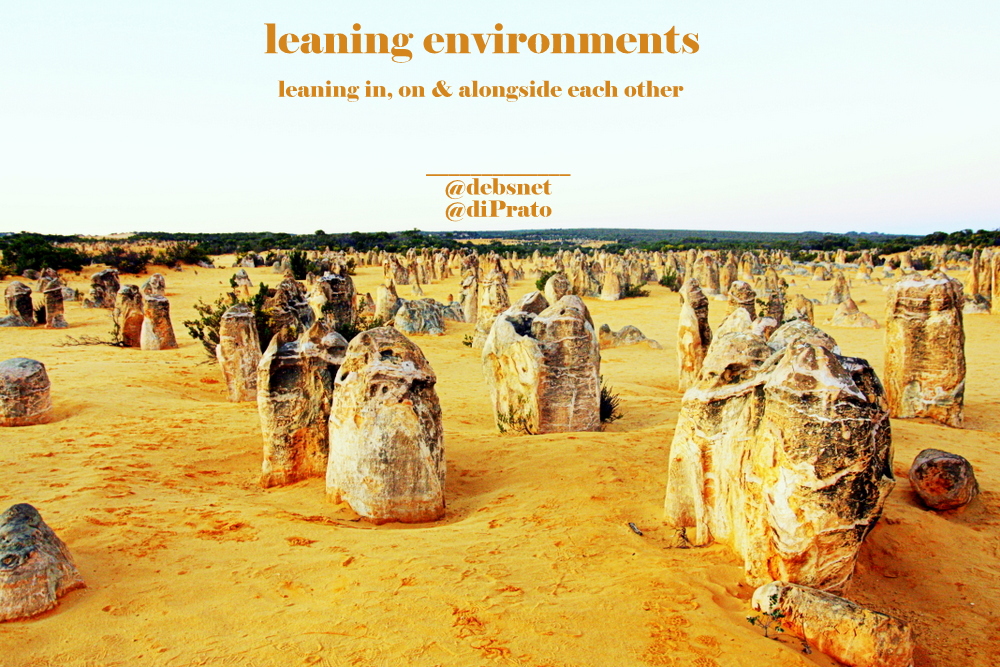
#leaningenvironments - evolution of a new edu-revolution?

#leaningenvironments – evolution of a new edu-revolution?

 A cloud from a minor volcanic eruption in Iceland—a small disturbance in the complex mechanism of life on the Earth—can bring to a standstill the aerial traffic over an entire continent. ~ Slavoj Žižek

With the start of the Australian school year almost here – a year in which I am working to implement the teacher-growth model on which I have been working for two and a half years – I have been thinking about what it is that makes a trusting, impassioned, vibrant community of continuous learners.

Ok, as both the subject of my work and of my PhD research, I have been doing more than thinking about this. I have read close to 300 references and written about 85,000 words around effective school change, what makes effective leadership and what kinds of learning teachers find transformational. I have blogged briefly about some key ideas to anchor school change, about the importance of embracing discomfort for growth and about my own learning environments.

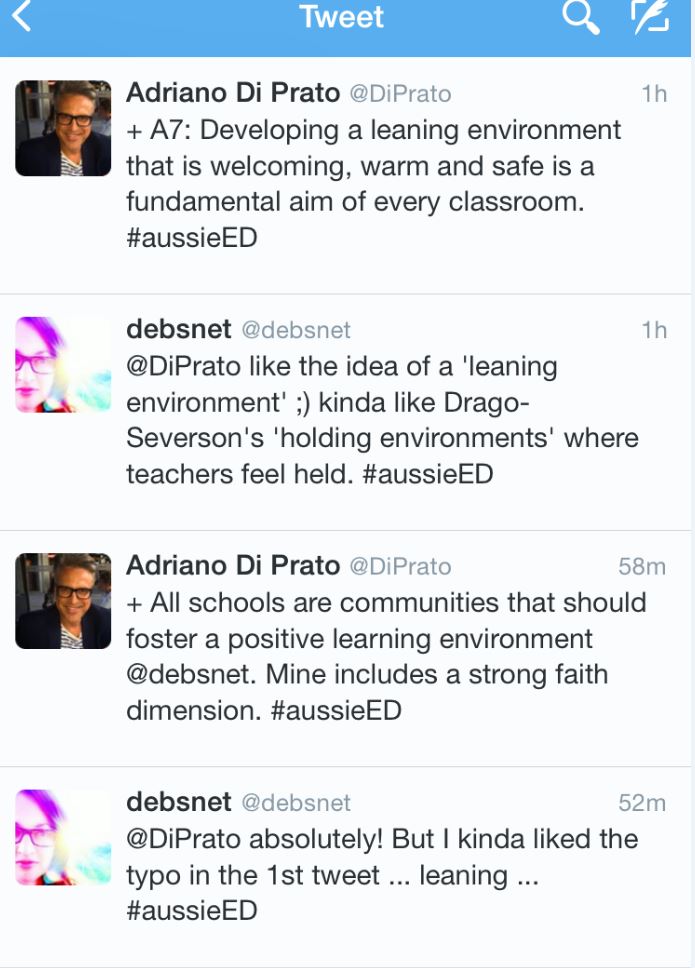
Tonight I was participating in the #aussieED Twitter chat when Australian educator Adriano Di Prato tweeted that ‘developing a leaning environment that is welcoming, warm and safe is a fundamental aim of every classroom.’ Now, I knew that Adriano meant ‘learning environment’ when he typed ‘leaning environment’ in a fast-paced Twitter chat, but it got me thinking: How are schools ‘leaning environments’?

It reminded me of psychologist and professor Ellie Drago-Severson’s notion of ‘holding environments’ (which I wrote a bit about here) in which she asserts the importance of teachers feeling ‘held’ by their learning and working environments, especially if positive change is to take place.

It reminded me of Costa and Garmston’s notion of ‘holonomy’ (explained in the Cognitive Coaching course material) in which the parts (individuals) and whole (organisation) are interdependent.

It reminded me of this great moment last year when a group of commuters on an Australian train platform used their leaning-together momentum to tilt a train and free a man trapped between the train and the platform.

So I tweeted back about ‘leaning environments’, and all of a sudden we were back-and-forthing about how the word ‘lean’ might apply to school environments. Would it be about individuals ‘leaning in’ to the community, to opportunities, towards each other? Could it be about students, teachers, parents and leaders ‘leaning on’ or ‘leaning alongside’ or ‘leaning with’ each other? Might it be ‘leaning out’, away from those things which should matter less but sometimes drive schooling (high stakes testing, grades, league tables)?

the power of a Tweeted typo

the power of a Tweeted typo

Fellow edu-Tweeter Melissa Daniels noticed the banter and asked whether this could be “the education revolution that started with a typo?” leading to another discussion about innovation, revolution and the evolution of ideas, all in 140 character bites.

Tweet @debsnet @DiPrato @PensiveM

This was an invigorating discussion for me, not because I thought it was to be the next big thing in education, but because of the thrill of the unsurprising serendipitous connections, conversations, ideas, thinking and challenges that come out of conversations and connections with like-minded like-passioned others. Here was a vibrant online environment of trusting, holding, leaning (in, out, on, with, alongside), impassioned, creative, continuous learners.

It also reminded me of our unforseen impacts. We never know the impact of a conversation, a word, a decision, or a typo.

I have noticed this in my self, in conversations or moments which stay with me until an idea bubbles to the surface. I have noticed it in my work with teachers and students, who often take some time to realise what moments or relationships have shaped them. I have noticed it in my PhD research participants, many of whom told me that the very act of being interviewed for my research changed something for them, opened something up, surfaced a reflection or became a moment of learning.

So, don’t ignore life’s typos. Even the seemingly tiniest things can have powerful & unforseen consequences.

You never know when you might uncover the next revolution.

Small shifts in your thinking, and small changes in your energy, can lead to massive alterations of your end result. ~ Kevin Michel

Montenegro by @debsnet

Work-family fulfilment: The elusive sweet spot

I have never met a woman, or man, who stated emphatically, “Yes, I have it all.” Because no matter what any of us has—and how grateful we are for what we have—no one has it all. ~ Sheryl Sandberg, Lean In

Usually this édu flâneuse blog is focused on teaching, education, school leadership and research, although I have written about self, travel and gratitude. This post, which was incited by reading Annabel Crabb’s 2014 book The Wife Drought, is about partners, parents and families grappling to find collective fulfilment. What does it mean to be a partner and parent in a world where everyone is leaning in?

my two boys adventuring

my two boys adventuring

Recently, as the mother of a two and a four year old, I went on a work trip, my first solo travel since the birth of my eldest. Apart from the very occasional overnight (drop-off-at-bedtime pick-up-at-breakfast) sleepover, I had never been away from my children. My husband had travelled consistently since they were born, but this experience was new to me. As I strode at a grown-up pace through the airport, wheeling a single teeny carry-on, it struck me: this was the first time in five years, since first falling pregnant, that I had conceived of myself as a singular entity, a human being in my own right. Of course, there was still the invisible umbilical pull, but this experience of thinking-only-of-myself was both foreign and like slipping on my softest old comfies.

It got me thinking: What makes our lives whole? How do we prioritise family time, husband-wife time, career time, self-care time and home time? Can we be whole or can we only be compartmentalised parts? Is there a work-life-family-self sweet spot?

lean in to sandcastle building

lean in to sandcastle building

I like Jennifer Dulski’s concept of the Work-Life Mashup. Be with people you love and do the work that matters, she says. Focus on what’s important. I also resonated with Rosa Brooks’s response to Sheryl Sandberg’s Lean In: lean out! More is not always better. How about also leaning in to family, happiness and wellbeing?

A good friend recently leant me Annabel Crabb’s The Wife Drought: Why Women Need Wives and Men Need Lives. Crabb’s message is that, in order to achieve any semblance of work-family happiness, women need support in the home and men need more flexibility to step out of a traditional work model.

Men: supercharged by wives but missing out on lives

“Men’s careers rattle along uninterrupted,” says Crabb. Their wives are the “invisible power-pellet” which makes them more able to succeed in their own careers. “For fathers, having a family gave them a competitive edge,” while for women children make her, “less likely to be employed.” Men don’t tend to take time out from their careers when they have a family. As their children are born and grow, their work lives rocket forward on unbroken trajectories.

The downside of man as breadwinner and woman as homemaker is that fathers are excluded from “a universe of experience … and that’s a sad thing.” Why is a dad looking after his own children called being “Mr Mum” or “Daddy Daycare”, instead of just ‘being a parent’?

My husband recently went to the weekday parent induction for our eldest son’s new school, and he was one of three dads there; the other forty-plus parents were mums. Hopefully he was seen as neither a hero nor a novelty; just a proud, interested and loving parent.

Half-crazed superwomen: doing it all not having it all

Crabb cites studies and statistics which show that women are the ones who tend to adjust their schedules and take on the lioness’s share of the caring and housework responsibilities. She describes this as the age of the “half crazed ‘superwoman’” who attempts to ‘do’ work and family in equal measure, all while having “that feeling that one ought to work as if one did not have children, while raising one’s children as if one does not have a job. To do any less feels like failing at both.” Women tend to step back, step out, or figure out acrobatically-flexible ways to scratch together a work life while their children are small, or pay others to care for their kids.

I have heard an employer say, “if you want efficiency, hire a part-time mum” and Crabb asserts that she uses “every scrap of the day like an Italian farmer uses all of the pig.” We all have our multi-tasking, time-saving routines. I wrote here about the way I approach my PhD schedule. And there are always circumstances under which the delicate ecosystem of childcare, work, family and self, tips on its axis and sends us sprawling.

Social media: help or hindrance?

Social media allows us all to connect to others and share our lives. While my professional social media is focused on my intellectual interests and cultivating professional conversations, I use my personal social media to share moments of beauty or delight which I’ve carved out or stumbled upon: a sunrise at the beach, my children playing happily, a wonky birthday cake I made from scratch. My aim is not to craft an image of work-life-mashup perfection, or to suggest that this social media output is my complete reality. This is the highlights reel, not the whole picture! Crabb warns, though, that women who try to make work-family-life juggling appear easy can’t complain when the world doesn’t notice how much they are struggling to maintain their appearance of effortless togetherness.

For some, social media posts are an additional pressure. Apparently there is a thing called ‘Facebook life envy’. The mother who sees others’ decontextualised posts might wonder: How will I assemble a perfect outfit, while making grain-free dairy-free sugar-free recipes from whole foods grown in my own garden, mixing my own eco-organic-fairtrade face scrub, engineering creative craft activities, hand making personalised Christmas cards, and take a ‘no filter’ photo of a house sparklingly clean from all-natural chemical-free cleaning products?

We need to remember that social media is not life. And our lives are our own to live. 

social media is not reality

the highlight reel: social media is not reality

Finding the Work-Family Fulfilment sweet spot

Crabb concludes The Wife Drought by suggesting that we become accepting of men taking time for family or working more flexibly to achieve their own work-life-family contentment. Men should be able to lean out, she says, without being the subject of ridicule or novelty.

I’m lucky enough to have the kind of mutually supportive relationship that Tanya Plibersek talks about in Crabb’s The Wife Drought. My husband and I support each other professionally and share what we do at home. My husband believes in me as a mother, a wife, a researcher and a professional. He supports me in my dreams: to nurture a happy, connected family; earn a PhD; build a satisfying career; have a love-filled joyful adventurous life. And I support him in his: to be a present, treasured father to our boys; build a family legacy with them; grow his own businesses; develop his reach and impact; nurture professional connections and make a difference to the industries in which he is immersed.

We need to believe in each other’s capacities for awesome, and in each other’s dreams.

It may not be easy or perfect, and my husband and I may live our weekday lives by the ding of an Outlook calendar, but we both want to actively parent our children and be – really be – in their lives. We both work a semi-flexible working week. We share housework. We both have times when one of us is parenting our children and the other is working or traveling. We have lots of time when we are all together. Our boys see us, I think, as equally their parents. They experience us as a whole family unit in which we all work together to support each other as we seek individual and collective happiness. These choices are based on our beliefs. I know many happy families who make different, equally fulfilling choices for their own circumstances and principles. Each family needs to find its own changing recipe for the sweet spot of ‘this works for us, for now’ and ‘this makes us happy’.

Perhaps discussions about work-family-life fulfilment should be less debates in which we tally the percentage of housework done or hours worked or dollars earned by each partner. Can we focus more on talking with our partners and our employers about how we can support each other in our dreams for our selves and our families? What might that look like for our particular family, based on our visions, dreams, opportunities and resources?

There is no “invisible power pellet” or perfect one-size-fits-all recipe for finding the work-family-life-happiness sweet spot. We can only make choices which work for each family at any given time, riding the ebb and flow of life’s messy randomness together, and with a view to serving each individual (parents and children) and the whole.

carve out time & space for joy & simple pleasures

carve out time & space for joy & simple pleasures

Why blog? Personal evolution & community transformation

There is nothing to writing. All you do is sit down at a typewriter and bleed. ~ Ernest Hemingway

doorway

doorway

I began this blog a few months ago as a way to explore, record and share my thinking around a particular self-directed professional learning experience: a trip from Australia to New York intended to gain insights around teacher effectiveness, teacher evaluation and teacher growth. The trip was amazing personally and professionally. I met with schools, school leaders, teachers, researchers and global edu-experts who challenged and inspired.

Now that initial blogging purpose is sated and I find myself wondering: should I continue blogging?

My first instinct is: yes. And that mainly emerges out of the enjoyment I have found in reflecting, writing, sharing and engaging with others as a result of my posts. I alluded in post about social media for educators, this post about being a connected educator and this one about finding your professional global tribe, that Twitter has been invaluable in connecting me with other like-minded (and non-like-minded – just as important!) people. Blogging, however, allows for much more developed thinking than tweeting. Twitter can facilitate 140 character conversations, but it doesn’t allow you to burrow deep into ideas and give them a shake. So since blogging, I have been blogging about blogging, and now I’m at it again.

My reservations about continuing a blog are primarily about time. I am a parent of two pre-school age children, an educator at an Australian school, and a PhD candidate who is two years, 150 pages and 300 references into my thesis (more about how I juggle those things here). Right now as I write a blog post about whether I’ll write future blog posts, there is a long list of other things I could be doing.

And yet, here I am.

Partly because this blog has allowed me to explore my own thinking around my work and study. It is a free space to write. I have my PhD to write too, but blogging is a space in which I can write without pressure and with more freedom of style and content. It keeps me thinking and learning and connects me with other thinkers and learners.

I also know what other blogs give me. They can be transformational, inciting change, encouraging action and inspiring thinking through the sharing of stories, expertise and others’ intellectual struggles around big and small ideas. They promote reflection, conversation and growth, in the blogger and the reader. Perhaps my own musings might provide insights for others, open a window to my context, challenge another’s thinking or facilitate connections across geographical and philosophical boundaries?

So I feel propelled to continue blogging, but I wonder how that journey might evolve, if anyone will read my posts, and if that even matters. Certainly I would (will?) be a blogger who blogs when I have something to say, rather than to chase numbers of clicks on a page.

Western Australia by @debsnet

possibilities

Kaleidoscope selves: find your tribe

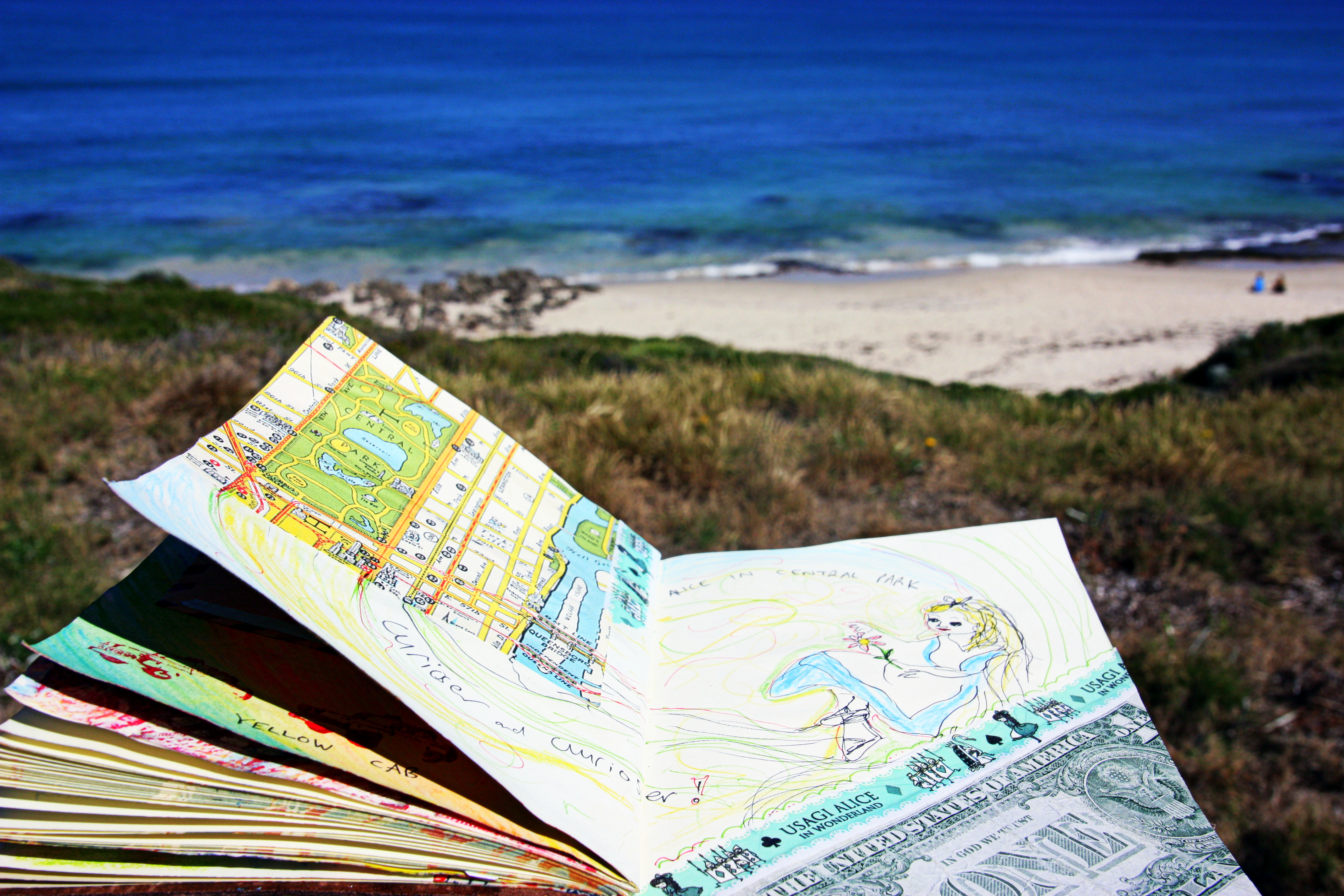
art journal page: Alice in Central Park

art journal page: Alice in Central Park

Who in the world am I? Ah, that’s the great puzzle. ~ Alice, Lewis Carroll’s Alice’s Adventures in Wonderland

José de Creeft’s Alice in Wonderland bronze statue glimmers in Central Park, polished by children’s climbing hands. Alice, of Wonderland fame, is a character who resonates with me. She is ingrained enough in my thinking that she makes more than a passing appearance in my PhD thesis. What I love about Alice is that she is open to new places and perspectives. She is curious, receptive and constantly wondering. She thrives on meeting new creatures and on having unusual, wondrous experiences. She is the imaginative adventuress who at once embodies childhood awe, strong self-assurance, rationality and fear-conquering daring. In many ways she is a flâneuse of Wonderland: wanderer, wonderer, learner and observer.

The question of self is not straightforward. Various aspects of our tangled selves collide and interlock. Or perhaps, rather than tangled webs of gossamer self-threads, we are each kaleidoscopes of self. Forged from a range of asymmetrical elements, we form the spectacularity of the beautiful changeable selves we are when viewed together through a cylinder of mirrors and light.

my precious stone kaleidoscope

my bronze-cylindered Arcana kaleidoscope has wheels made of glass and semi-precious stones: this one is by Australian artists Robert Cook & Jocelyn Teh

My kaleidoscopic self is made up of a number of different selves which my @debsnet Twitter bio attempts to unify:

Wanderer. Wonderer. Dreamer. Reader. Writer. Creator. Educator. PhD researcher. Passionista. Disruptor. Imaginer. Innovator. Flâneuse.

Not included are other personal selves like parent, spouse, child, sibling, friend. There are many contexts in which I share all or some of these self aspects. As the kaleidoscope turns and the light changes, people see different patterns reflected from me.

patterns as seen through my kaleidoscope

mandala-like patterns as seen through my kaleidoscope

My self-threads splinter, intertwine and blossom, as they do through the kaleidoscope viewing hole.

As I reflected in a previous post, connecting with other educators is for me about being my learner self. Connecting and collaborating widens and globalises my perspectives, while encouraging my own thinking and reflection (see Tom Whitby’s recent post about the relationship between connection and reflection). My teacher self is informed daily by my experiences as a parent, my own learning as a PhD candidate and my online participation. My Twitter interactions are influenced by my daily experiences of parenting, researching and working in a school. My parenting is influenced by my teacherly and researcherly thinking about learning and development. My PhD research self interacts with other researchers on social media as well as being informed by my in-practice educator immersion in my academic topic of study. My PhD itself incorporates me as learner, educator, writer, reader, creator and self-conscious researcher. And here on this blog my posts tangle together the threads of my learner, teacher, researcher, parent, writer and artist selves.

A dear friend of mine recently sent me this quote which I’m sure resonates with many of us:

When you find people who not only tolerate your quirks but celebrate them with cries of ‘Me too!’  be sure to cherish them. Because those weirdos are your tribe.  ~ Nanea Hoffman

It strikes me that many of those with whom I connect, in life, in education, in research and in my online PLN, are those whose quirks are similar to mine. Their kaleidoscope colours reach out to me across time, space, geography and social media.

I was recently involved in a Twitter chat with a number of educators. A few people in the chat began talking about being proud to be dorky, to be okay with failure and to constantly be learning. When I tweeted back ‘yes – fellow geeks unite!’ there was a chorus of ‘amen’ and ‘ditto’. I felt like I’d been high fived over Twitter. Here were my fellow weirdos, people who I’ve never met, connecting with me from across the world. “Yes,” they were saying, “In this moment, I get you and you get me.”

Next week I fly to New York to connect in a very real and immersive way with fellow educators, researchers and thinkers who will widen my perspectives. Perhaps I will widen theirs by sharing my Australian story. As this blog attests, I am hoping that my trip will allow my total and joyful submersion in all my aspects of selfhood. I will be thinking, writing, note taking, photographing, drawing and flâné-ing my way to new connections, new reflections and new perspectives.

The word kaleidoscope comes from the Greek words kalos, eidos and skopeō which essentially translate together into ‘beautiful form to observe’. Here’s to finding the beauty in others’ idiosyncrasies and to each of us finding our quirky global tribe.

find wonder, find perspective

Social media for teacher professional learning

Teaching is forever an unfinished profession … never complete, never conquered, always being developed, always changing. Grundy & Robison, 2004

One thing that is emerging from my PhD research into teacher learning is the power of social media, Twitter in particular, as a professional learning tool and community.

For educators and researchers, Twitter means we can find like-minded individuals, even when those in our own organisations don’t share our passions or practices.

Social media connects us outside of our physical sphere – our schools, districts and countries – to professionals, thinkers and writers around the world who generate and share information, ideas, practices and activism which inspires, incites or affirms us.

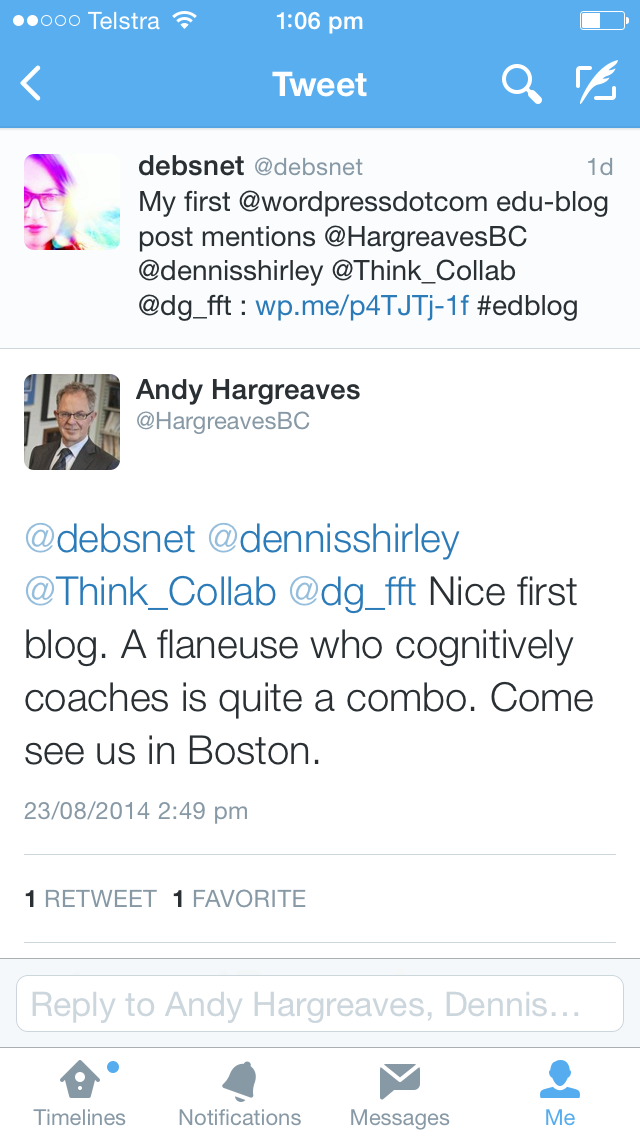
Imagine my delight when global school change titan Andy Hargreaves responded to my first (ever) blog post. Here was social media linking me to one of education’s thought leaders whose work shapes my classroom teaching, my school leadership practice and my PhD research.

In 2013, Kathryn Holmes, Greg Preston, Kylie Shaw and Rachel Buchanan published a paper which found that “Twitter is a valuable conduit for accessing new and relevant educational resources on the internet and also as a viable means of social support for like-minded educators. The cost effective nature of the microblogging platform ensures that it can act as a medium for sustained professional development, while leaving the individual participants to control and take ownership of the learning.” So Twitter can be socially and intellectually supportive, and it can facilitate and drive sustained engaged learning which is owned by the individual.

Jon Tait explains Twitter’s role as professional development platform in his blog post and has designed this infographic to summarise Twitter uses for teachers.

JonTait_TwitterTeacherInfographic

As I move for the first time from content curation to content creation (this being my second-ever blog post), the functions of the professional social media world and those who engage in it are a point of reflection.  Who will read my words and see my images? Who will interact with my thinking and add their own? How might social media support, connect and educate me?