Reflections on six months of principalship

I have worked in education for my whole career – from a graduate teacher, through middle and senior leadership in schools. Teachers know their impact and see it every day in the progress of their students, or when a student they used to teach tells them what a difference they made to the trajectory of the student’s life. Teaching and leading in schools is work full of purpose and meaning. One thing I have never had to wonder is, “What is the point of my work?” or “Why do I do what I do professionally?” From the direct influence on students in the classroom, to more diluted and broader influence through leading, working in schools is literally life-changing work.

Now as a school principal, the ‘why’ of my work is clear. According to the Australian Institute for Teaching and School Leadership (AITSL):

“The role of the principal in a school is one of the most exciting and significant undertaken by any person in our society. Principals help to create the future. Principals are responsible and accountable for the development of children and young people.”

AITSL describes the principal’s job as to raise student achievement, promote equity and excellence, cultivate conditions under which quality teaching and learning thrive, engage with community expectations, deliver on government policy, and contribute to the education system at local, national and international levels.

Through the Australian Professional Standards for Principals, AITSL outlines the scope of the work of principal. Firstly, to lead the vision and values of the school, serving the best interests of the community by upholding high standards and fostering respect. Secondly, principals know, understand and apply the theory and practice of leadership, teaching, curriculum, assessment, reporting, strategy, policy, legislation, and management of human and financial resources. According to the Standards, principals also have the emotional intelligence, empathy, resilience, decision making frameworks and conflict management skills to build trusting, collaborative and positive cultures across the school community. Additionally, AITSL outlines the nature of principals’ work as including: leading teaching and learning; developing self and others; leading improvement, innovation and change; leading the management of the school; and engaging and working with community.

When I think of the role of principal, I think of it as encompassing the roles of: custodian of the school’s history, identity, mission, values, traditions and stories; servant to the school community; chief ambassador, sense-maker, storyteller and advocate; relationship builder; stakeholder engager, seeking to understand multiple perspectives and engaging enthusiasts and dissenters; leader of strategy; ethical decision maker; coach, mentor and builder of others’ capacity; fosterer of high performing teams and a culture of trust; networker beyond the school gates to local and international contexts; and joy-finder, because it’s important to find celebration and wonder among what can be challenging times.

So, knowing all this, how does a principal new to a school begin her work? What have the first six months looked like for me?

In my first semester, importantly, I have been getting to know the people and the school’s specific context; these people and this place at this time. While there is never a dull moment in principalship, and much of a day or a week can be made up of the unexpected and the surprising, below I outline some of what my semester has encompassed as I have sought to get to know community.

I enjoyed visiting classrooms across the school from ELC to Year 12, and teaching my Year 10 class. I love to be in the classroom. It is students that make my heart sing and ground me in the ‘why’ of school. I met students as they got on, and then later off, buses from camp, full of new memories, challenges overcome and strengthened friendships. I hosted lunches with all Year 12 students, in groups of about five, and met regularly with various student leaders and committees. I have gotten to know students through House events and competitions, service opportunities, and attending sports events and arts performances. I am constantly humbled by the resilience and achievements of students in academics, arts, sports and other endeavours.

I connected with parents at coffee mornings, events, committee meetings, school tours and in one-on-one or family meetings. I have begun to understand the school’s rich history and community by meeting alumnae through old scholars’ committee meetings and events.

I partner with the school’s Council of Governors and Executive Leadership Team on actioning the business of the school and its strategic direction in ways that are sustainable, ethical, futures-focused and in the best interests of students. I have been involved in planning and opening new facilities, overseeing budgets, leading staffing decisions and processes, minimising risk, responding to critical incidents, and attending to complex student issues. I have led the refreshing of the school’s values, generated community responses to the school uniform and begun a uniform review, instigated a new scholarship, and launched a new strategic plan.

It was a joy to collaborate in the finalisation of the school’s strategic plan. While I came to the process mid-way, I was able to engage in shaping the threads and themes of consultation and synthesis to fruition. As the principal I need to live and breathe the school’s strategy. I need to feel it in my bones with a resonance that hums through everything from decision making to the way I show up each day. Clear strategic intent anchors all in our community to unite in important shared work around a collective purpose, so it is exciting to have a new plan to shape our decisions, initiatives, actions and opportunities.

My visits to classrooms, walks through the campus, yard duties and staff meetings, have all been opportunities to understand those who together contribute to the work of the school. It has been a pleasure to get to know their knowledge, skills and commitment to our students and families. At the outset of the year, I invited all staff to a one-on-one meeting with me to each share their story and to convey their views on what is great about the school, what might be improved, and how I might support them in their aspirations. These conversations revealed insights into individual staff from across the school as well as into the broader culture and history of the place.

Leadership is built one conversation, interaction and action at a time. As I reflect on my first semester as principal, the highlights have been many. Mother Teresa said, “Not all of us can do great things. But we can do small things with great love.” Our community is made up of students, staff, parents and wider community who are all doing small things with great care, and these kindnesses and micro-moments all add up to make the school the special place it is. In principalship, too, it is the daily actions—undertaken with care, intentionality and the desire to serve and do good—that make up the work.

What Reconciliation Means: National Reconciliation Week 2023

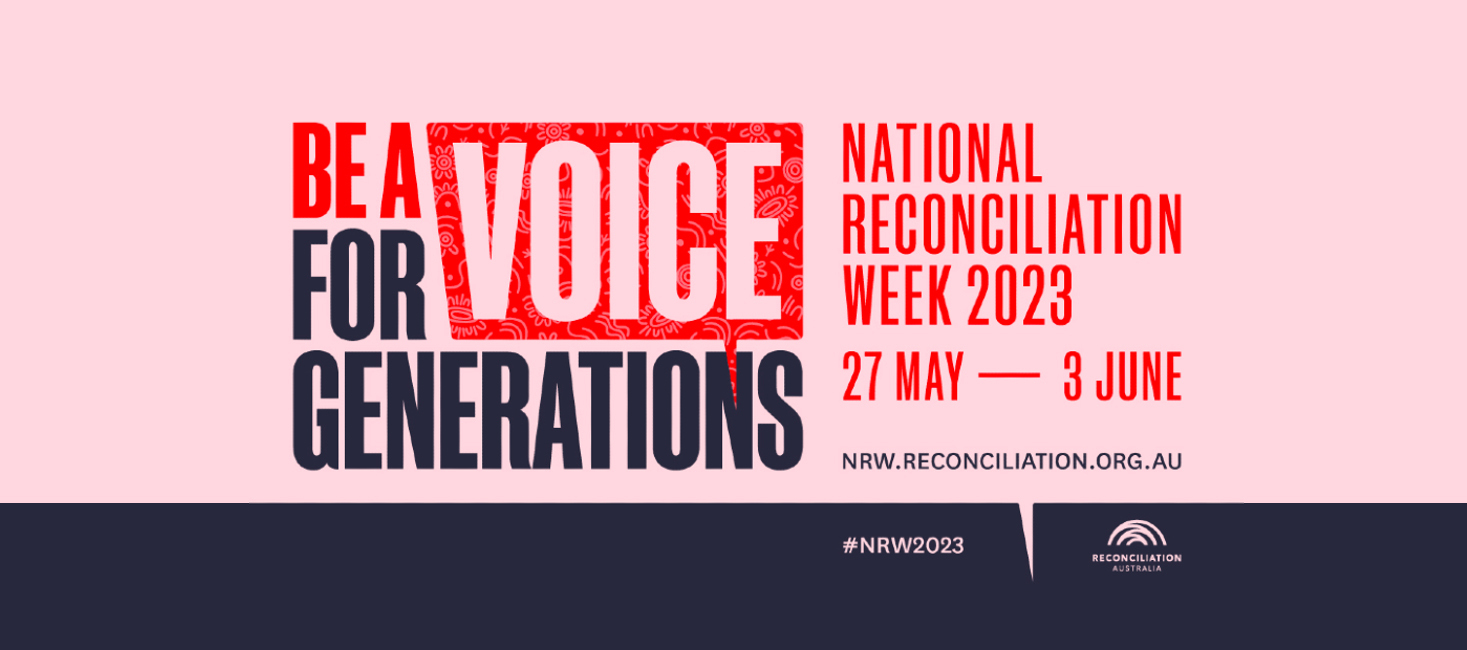
Australia is a diverse country with the oldest continuing living culture in the world, and a colonial past with devastating consequences for First Nations Australians. Reconciliation Australia describes five dimensions of Reconciliation: historical acceptance, race relations, equality and equity, institutional integrity, and unity. ‘Be a Voice for Generations’, the theme of Australia’s National Reconciliation Week 2023, reminds us that Reconciliation is everyone’s responsibility, and that it is a journey of coming together to reflect on past generations, while building a better tomorrow for future generations.

It is my privilege to have been born and raised on Whadjuk Noongar Country, and to have lived and worked in Naarm on the lands of the Kulin Nation. I am now getting to know the traditional lands, waterways and language of the Kaurna people of the Adelaide plains, as well as of other South Australian lands and peoples.

As a non-Indigenous person and second-generation Australian whose parents were both born overseas, for me engaging in Reconciliation means learning about local Indigenous language, culture, histories, stories, and knowledges. It is about seeking out and listening to Aboriginal and Torres Strait Islander voices, as well as considering how I might use my own voice. It means acknowledging and reflecting on traditional Country at events, in meetings, and on my podcast, The Edu Salon. It means seeking out, citing, and recommending the work of Indigenous scholars, educators and artists. For example, I have enjoyed listening to outstanding Indigenous scholars Marnee Shay and Kevin Lowe, both of whom advocate for strengths-based approaches to education for Aboriginal and Torres Strait Islander young people in schools.

In a school context, Reconciliation means having, revising and refining a school Reconciliation Action Plan. It means engaging in conversations about Reconciliation at student, staff and board tables. It means an active Reconciliation Action Plan Committee that meets regularly, includes students and staff, and is focused on collaborative action. It means teachers, from early learning through to Year 12, considering how cultural competence is built through curriculum, pedagogy, texts, issues explored, and language used and learned. It means engaging in, and deeply reflecting on the significance of, cultural protocols such as Welcome to Country and Acknowledgement to Country, including in local language and by local people. It means schools considering student learning and scholarship opportunities, enrolments policies, human resources processes, assembly content, events protocols, student experiences beyond the classroom, and school-wide anti-discrimination strategies. It means providing opportunities for staff and students to engage in reflection, learning, service, and culture. It means considering how to build mutually beneficial relationships with Aboriginal and Torres Strait Islander stakeholders and communities. It means working to consider how we can develop spaces, supports and opportunities for Indigenous young people.

Contributing to the ongoing work of Reconciliation means all Australians engaging regularly in meaningful discussion about, and taking action on, Reconciliation. It means celebrating, amplifying, and making space for the voices of Aboriginal and Torres Strait Islander peoples and communities. It means enshrining an Indigenous Voice to Parliament in our Constitution. It also means acknowledging the violent, unjust, uncomfortable colonial history of our nation and the ongoing intergenerational trauma experienced by Aboriginal and Torres Strait Islander peoples. It means considering what behaviours and structures are normalised in our organisations and systems, who benefits from these, what unconscious biases exist, and how we might recognise and interrogate our own ability to participate in a range of opportunities not equally available to all Australians.

Beyond recognition and acknowledgement is action: considering how we might be an effectual part of positive change towards reconciling the peoples of Australia, every day.

Culture: Who do we want to be, together?

Source: @spalla67 on pixabay

I have talked with staff this week about together creating the conditions for all of us to grow as a community of learners, through fostering an environment of high support and high challenge. Our staff have been preparing for the return of students and coming together to work through the idea of organisational culture, including hearing from students about their experiences of and insights into our school culture.

We have been wondering: Who are we now, and who do we want to be and become?

Peter Drucker famously said that “Culture eats Strategy for breakfast”, implying that strategy falls flat without a positive culture that empowers and supports the people in an organisation to enact the strategy. While most would agree that culture is important in organisations, it is one of those fluid, nebulous, and slippery terms that evades clear definition. Richard Perrin defines organisational culture as “the sum of values and rituals which serve as ‘glue’ to integrate members of the organisation.” The metaphor of glue is central; culture binds individuals together as a collective. Culture is about those things we share, consciously and unconsciously. When I think about culture, those things we share, or aim to share, include:

  • Purpose – Our shared why.
  • Values – What underpins our beliefs and actions.
  • Stories and symbols – What we say about ourselves, to ourselves and to others.
  • Relationships – How and who we are with each other.
  • Behaviours – How we do things around here.
  • Language – How we talk around here.

Herb Kelleher famously said that “culture is what people do when no one is looking.” We perform culture through our presence and our actions, seen and unseen, accepted and challenged. As Lieutenant-General David Morrison’s oft-cited message goes: “The standard we walk past is the standard we accept.” We become enculturated through our immersion in a culture and our observations of how a place and its people present, interact, and operate. As a new principal to a school this year, I am at the outset of my own journey of enculturation; of absorbing, being influenced by, and being initiated into, an existing culture.

In their work on culture this week, our staff were guided by organisational psychologist Hayley Lokan, from ISC Consulting, who described culture and both intangible and palpable. She shared Robert Kreitner and Angelo Kinicki’s definition of culture as “the set of shared, taken-for-granted implicit assumptions that a group holds and that determines how it perceives, thinks about, and reacts to its various environments”. Hayley likened culture to an iceberg and challenged us to look beyond the visible aspects of culture to interrogate our deep-seated assumptions. It reminded me of one of the findings from my PhD study: that in order to change our behaviour we often need to change our beliefs. In order to shift culture we need to challenge our norms, and our accepted attitudes, beliefs, and behaviours. Story, symbols, rituals, and traditions are important markers of and continuers of culture, but we need to be honest about those things that we allow to continue that are not aligned with our moral purpose or current community. Context, as always, is Queen, and our communities and their needs change over time.

This week’s staff workshops and student panel on culture revealed insights into the school. Staff described the school’s culture as supportive, caring, welcoming, inclusive, kind, collaborative, friendly, aspirant, dedicated, proud, respectful, hard working, and with a mixture of tradition and trailblazing dynamism. Students in a panel discussion described the culture as safe, caring, close-knit, empowering, inclusive, and one in which students feel encouraged to be their best while being supported during times of difficulty. In exploratory discussions about the future of our culture, staff began to wonder about how we might elevate wellbeing, agency, and celebration of the diversity of the individual, to strengthen what is great about our culture and to grow with our community.

If we can build and maintain a culture of trust in which there is openness, honest and gracious feedback, diverse voices, varied aspirations, and a commitment to lifting each other up, we can all learn, lead, be well, and be in community with one another. We will continue to ask ourselves, our students and our wider community:

  • What about our culture do we want to keep?
  • What about our culture might we like to change or develop?
  • What are our next steps to move forward with intentionality?

Challenge and change in 2023: What if you fly?

Source: @cocoparisienne via Pixabay

During primary school, my children learned loosely about growth mindset. At times, they came home with mantras such as “I can’t do it … yet”, “I can reach my goals”, and “If it doesn’t challenge you, it won’t change you.” Over the last couple of years, challenge and change have been thrust upon us in spades. ‘Change fatigue’ has taken on a whole new layer of meaning. The Collins Dictionary 2022 word of the year was permacrisis, meaning an extended period of instability and insecurity. This state of ongoing uncertainty is reflected in our exhaustion and concerns about global crises and individual stresses, and the erosion of our individual and collective appetite and energy for facing challenge.

As we enter 2023, concerns about the economy, war, and the climate continue to intensify. The 2022 Mission Australia Youth Survey of 18,800 Australians aged 15-19 found that our young people are concerned about the environment, equity, discrimination, and mental health, and that their personal challenges included academic stress, school workload, anxiety, depression, and relationships. Societies, industries, workplaces, families, and individuals have needed to adapt and re-imagine at a rapid pace. Workplaces, such as Deloitte, are developing increasingly flexible ways of working that allow employees autonomy and choice.

While there is a sense that we are emerging from three years of pandemic-related restrictions and after-effects, wellbeing, inclusion, and agency are areas for continued development. Many of us have found ourselves reconsidering what is important. Some have turned to travel, adventure and personal change, while others have turned to stability, certainty, and returning to home base. Many of us have rethought how we spend our time, including what we do with the time we have and who we spend it with. This includes time with self, family, and work, with the ‘great resignation’ and ‘quiet quitting’ trends showing a paradigm shift in how people are choosing to live their lives. I have always done work that provides me with a sense of purpose, gets me out of bed in the morning, aligns with my values, and makes a contribution to others. Finding meaning and fulfilment are now more important than ever, for our communities and society, as well as for our own individual wellbeing.
When change is all around, and forced upon us, it can be difficult to open up rather than turn inward, to move forward rather than coast along or retreat. I’ve just finished reading Lessons in Chemistry by Bonnie Garmus. At one stage in the novel, set in the 1960s, the main character Elizabeth Zott challenges others to act with courage to design their own futures based on their aspirations and talents, rather than on what they or others might expect of them. The character, who is unapologetically herself despite the constant judgement of others, encourages us to embrace change and move forward without allowing limiting beliefs to hinder us.

“Courage is the root of change – and change is what we’re chemically designed to do. So when you wake up tomorrow, make this pledge. No more holding yourself back. No more subscribing to others’ opinions of what you can and cannot achieve. … Design your own future.”

Lessons in Chemistry

While denial about obstacles and Pollyannaism are unhelpful, in 2023 our task is to find the courage and energy to continue to challenge ourselves, each other, and our organisations to move forward in directions that result in positive outcomes for all. We need to continue to balance competing needs, and navigate tensions such as providing stability while also working towards context-embedded innovation, and supporting wellbeing while maintaining high expectations and forward momentum. We need to co-design the future.

Courage and change do not need to be loud and fast. While we may need to be bold in our intent, it is consistent, incremental nudges and small regular steps that allow us to move forward. The following poem by Australian poet Erin Hanson encourages us to question our concerns about failure, and to take the leap into those opportunities that may result in growth and success.

“There is freedom waiting for you,
On the breezes of the sky,
And you ask ‘What if I fall?’
Oh but my darling,
What if you fly?”

Erin Hanson

A useful starting point for what leaps we might take is to ask ourselves is: What do we want to have achieved by this time next year (or in five years or thirty years)? And if we were to fast forward to this time next year, what will it look like if we’ve been successful?

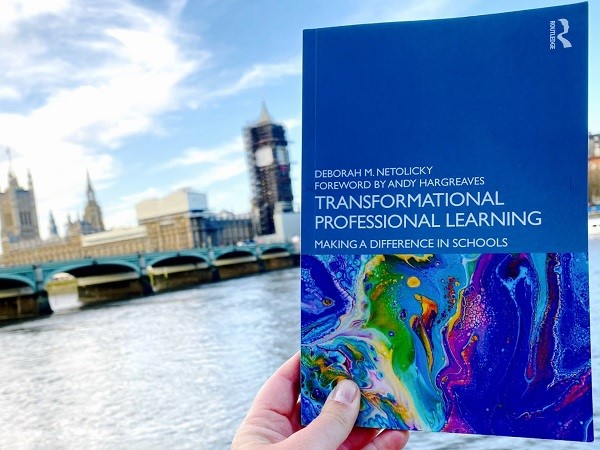
When I wrote my book, Transformational Professional Learning, I put a message on my bathroom mirror that read: “If you wait until you’re ready, you’ll wait forever. Start now.” Starting now is better than waiting for the ‘perfect time’, even if starting now means doing so slowly, quietly, cautiously, gently, and with close attention to those around us.

It’s 2023. Let’s start!

Metaphor as a way of considering future alternatives for educational leadership

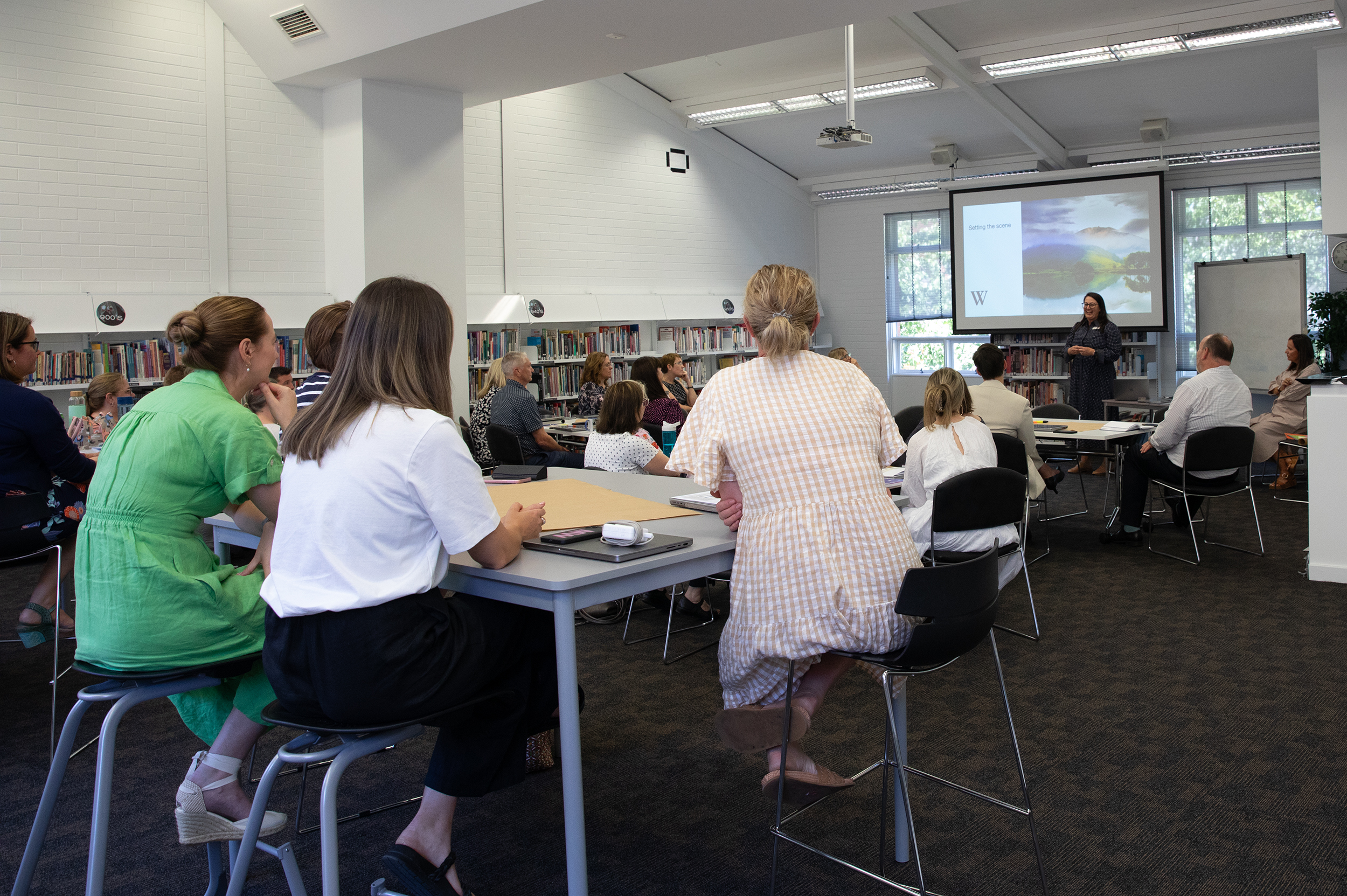
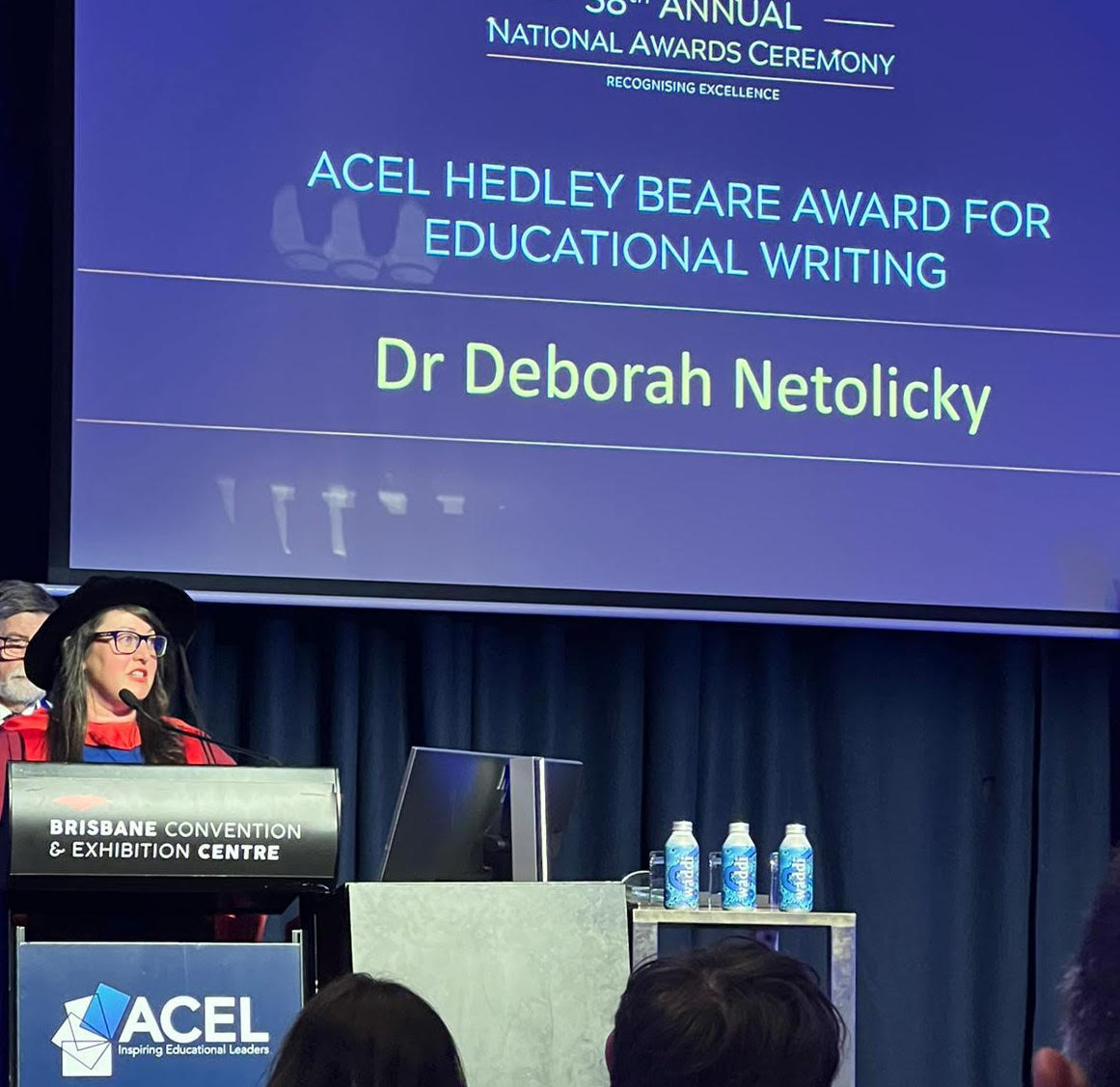
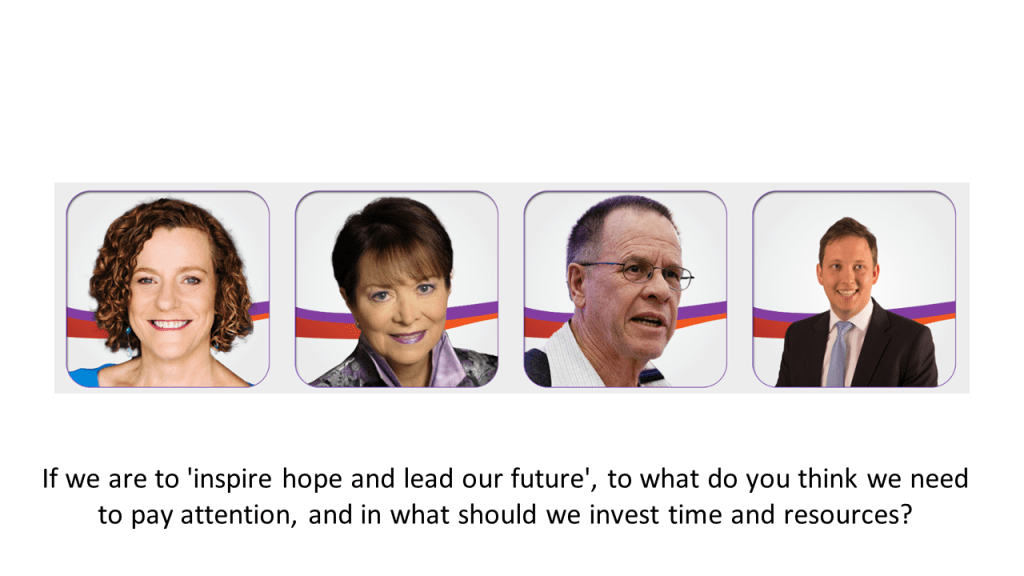
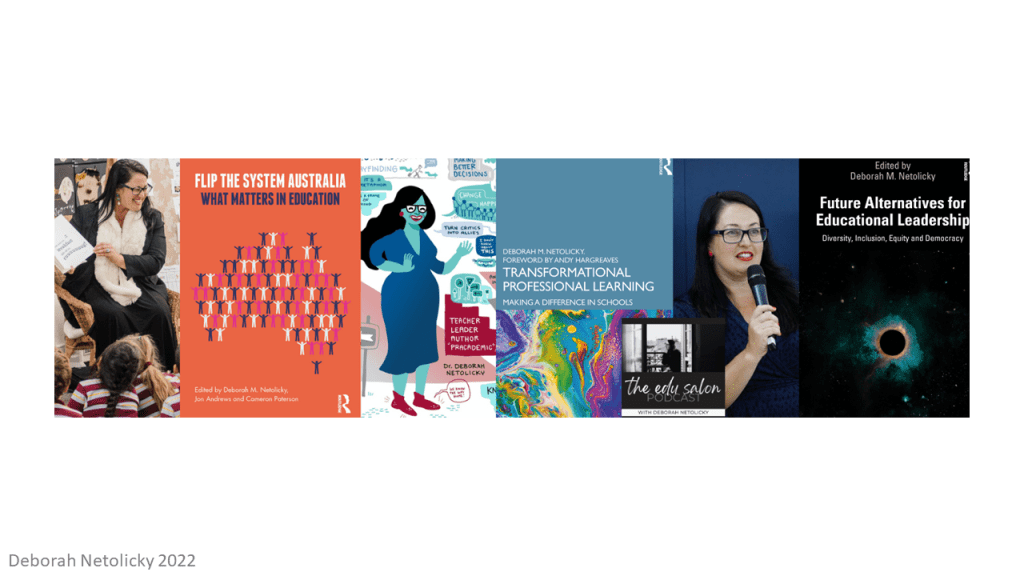
Last week I had the pleasure of presenting a keynote to the Australian Council for Educational Leaders National Conference in Sydney. The presentation was based, in part, on the edited book Future Alternatives for Educational Leadership.

In exploring what leadership looks like now, and what it might look like next, as the book does, I shared some unusual metaphors for leadership, from educational scholarship, that could help to move our thinking beyond normalised paradigms of leadership as largely male, white, and about the individual. These were:

  • The Cheshire Cat (Netolicky, 2019) representing the deliberately visible-invisible leader who navigates fluidity of role, and intentionally provides others with what they need at any given time.
  • The punk rock principal (Heffernan, 2019) as the leader who sees themselves as part of a band, and who is willing to consider and potentially resist compliances and expectations.
  • Network leadership (Azorín, Harris, & Jones, 2021) in which leading is collective, networked, and a social practice.
  • Leadership as a social movement (Rincón-Gallardo, 2021) in which leaders participate as a learners, craft strategy, forge collective commitment, shape the public narrative, and ignite others to action.
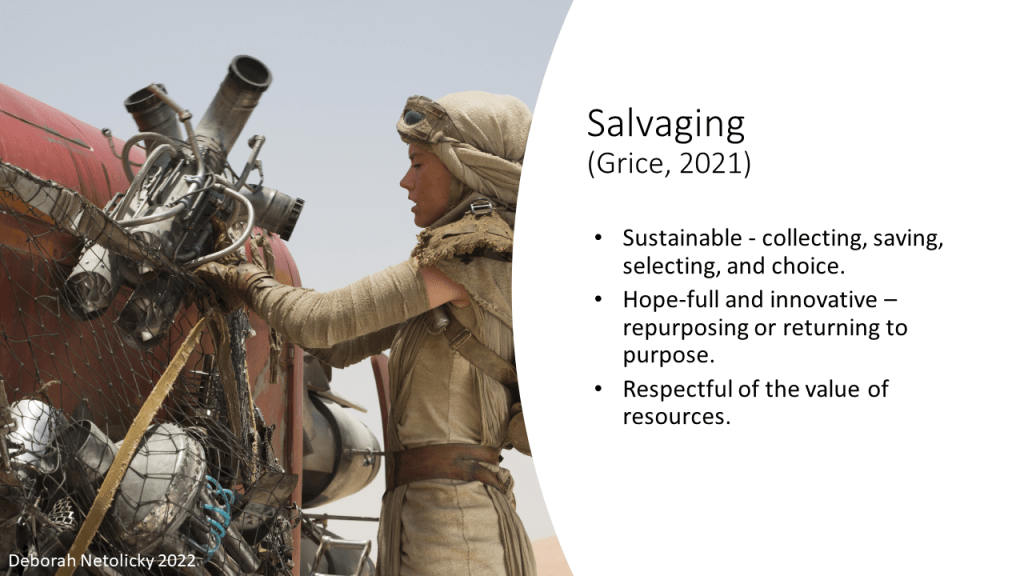
  • Leading as salvaging (Grice, 2021) as a practice of hope and sustainability that involves collecting, saving, selecting, respecting the value of resources, and repurposing or returning to purpose.
  • Wayfinding leadership (Netolicky & Golledge, 2021) in which leaders know and reflect on self, know and respond to their environment, navigate roadblocks, use instruments fit for purpose, and balance tensions by simultaneously applying systematisation and intuition, strategy and empathy.

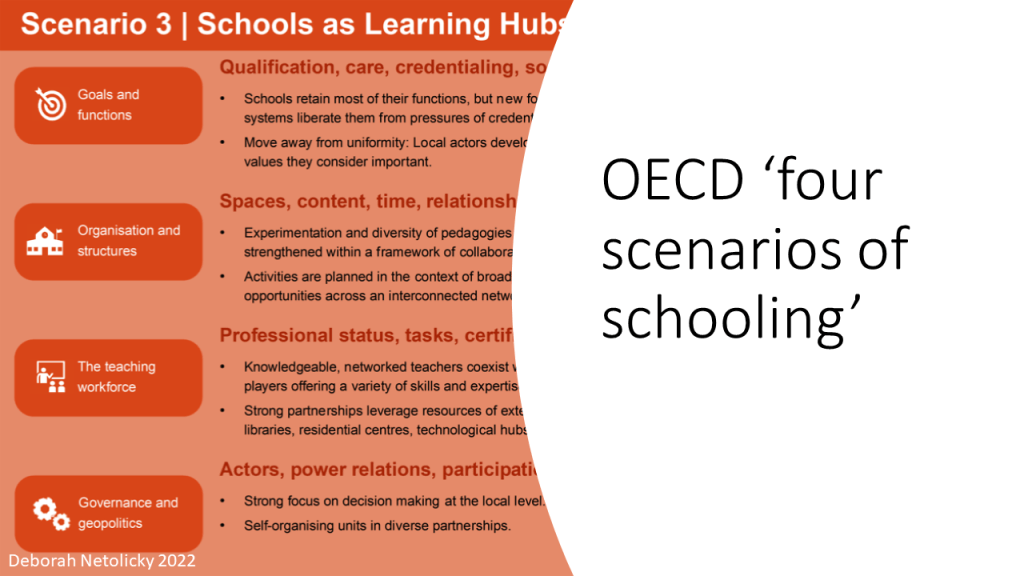
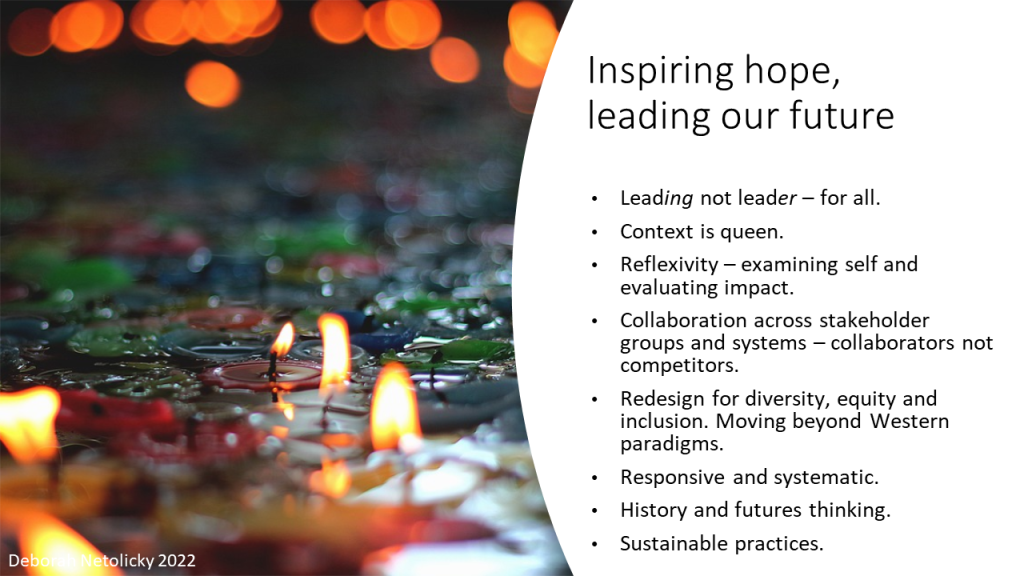
The theme of the conference was ‘inspiring hope, leading our future’, and my takeaways for the audience were that we benefit from:

  • A focus on leading as a practice for all, rather than the leader as a person or title.
  • Knowing that context is queen, including knowing our people and honoring tradition while engaging in futures thinking.
  • Applying reflexive practice by examining self and evaluating impact.
  • Seeing ourselves, as educators and leaders, as collaborators rather than competitors, working together across stakeholder groups and systems.
  • Redesigning for diversity, equity, and inclusion.
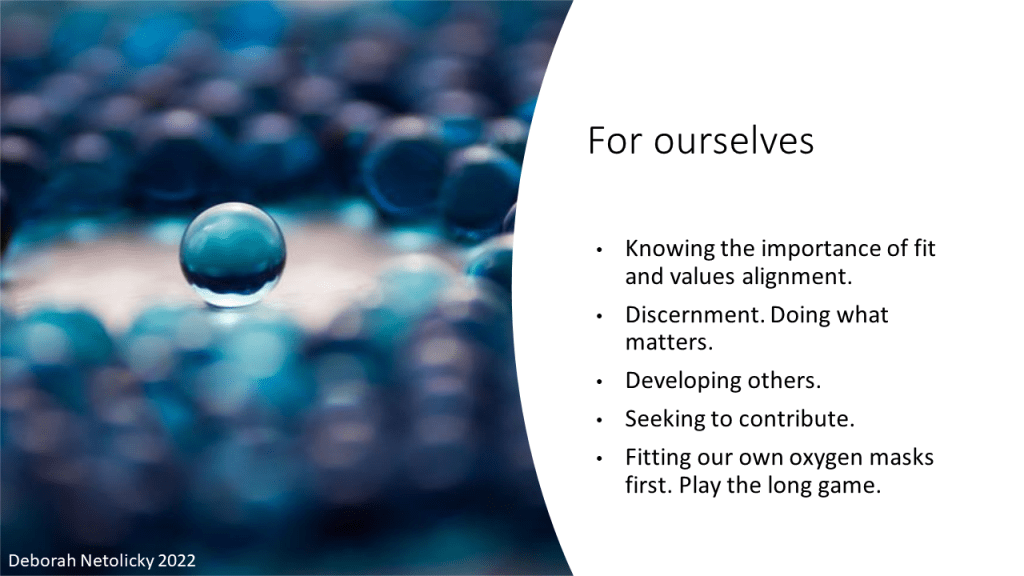
  • Considering sustainable practices, for our schools, our staff, ourselves, and the planet.
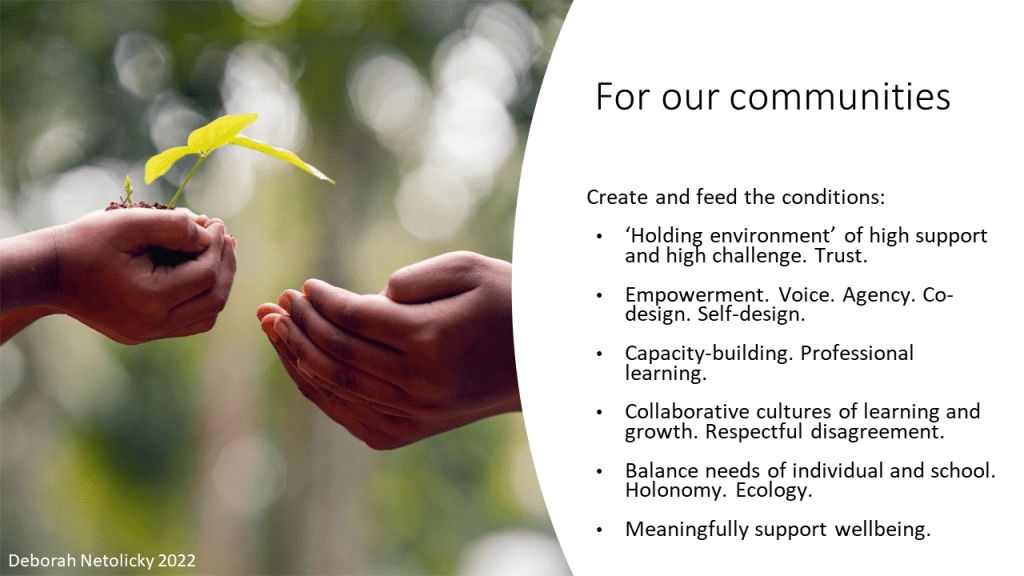
  • Creating and feeding the conditions for an ecosystem of high trust, high support, high challenge, and respectful disagreement.
  • Empowering, building the capacity of, meaningfully inviting the voices of, and co-designing with others.

A core belief of my presentation, and of the conference, was the importance of humanity at the centre of our work as teachers and school leaders.

My slide deck is below.

Reflections on teaching and school leadership during Term 1 2022

source: Sprudge

Term 1 2022 may have occurred at and for about the same time as it usually does in Australia, but it felt like an especially long for educators.                 

In Western Australia, with more restrictions in place than some other states, signature experiences of Term 1 included the following.

  • Mask-wearing for school staff, and for students in Years 3 and up.
  • Classrooms with air purifiers, CO2 monitors and open windows.
  • Schools taking on the role of contact tracing and communication.
  • Restrictions to gatherings at schools, resulting in parent information, parent teacher interviews, assemblies, and activities being held online, outdoors, or in small groups.
  • The latest iterations of remote and hybrid learning as students and teachers were absent from school due to isolation and illness.
  • Teacher absences and shortages.
  • Teachers classed as potential ‘critical workers’.
  • The hard border into WA softening.
  • The acting federal Education Minister making remarks about “dud teachers” “dragging the chain” and “not delivering the learning gains our children need”.

The administrative requirements of Covid-19 directions for schools, combined with restrictions on getting together in person, meant that educators’ experiences of the term were largely transactional, operational, and cumulatively exhausting. School leaders and teachers worked to keep school communities safe, informed, and with a sense of calm normalcy. We put one foot in front of the other, complied with requirements, and ensured that learning and pastoral care continued for students. But we missed some of those things that buoy us in our work: relationality, community, and connection.

At my school we employed as many relief staff as we could to take the pressure off our teachers. We offered opportunities for staff to work flexibly or from home when we could. We scaled back and reimagined meetings, doing these differently or not at all, according to their purpose and our community’s needs. We carefully considered administrative requirements and evaluated the effectiveness, efficiency, and flexibility of assessment tasks and feedback practices. We interrogated the reasons for our ways of doing things, generated alternate ways to achieve our aims, and questioned whether the aims themselves needed to be rethought or relinquished. What was important during this time? What could we do differently? What could be let go?

We found small ways to connect with one another. There were no whole-staff meetings or morning teas, but we met in smaller groups (on balconies, in the quadrangle, in well-ventilated spaces). We held some free coffee Fridays where drinks at the coffee van were paid for by the school, facilitating incidental outdoors conversations between colleagues, as well as offering a gesture of thanks to our hard working staff. We thanked individuals for specific contributions. I called most teachers who were home isolating or ill, to check in and see how they were. We introduced a Staff Appreciation Award so that staff could recognise colleagues for their support.

While it was tempting to hold off on all but the most essential work, we knew that engaging with our professional selves, professional goals, and core purpose was key to staying connected and uplifted. We held our annual goal setting meetings and booked into professional learning experiences. We provided opportunities for staff to collaborate in small groups and teams to have energising, productive conversations around practice, with each other and with external experts. As well as teaching our students, it was pockets of meaningful collaboration that sparked moments of professional delight. Working together with colleagues and engaging in robust dialogue, thoughtful reflection, and collaborative planning, provided a lightness, an energy, and a reminder about our shared moral purpose: educating each student in our school community.

None of this is perfect, but we are doing our absolute best. We remain committed to the learning, care, safety, and success of our students.

Someone asked me recently what I have been proud of, and the first thing that came to mind was: showing up. The challenge for those in schools is to maintain enough wellbeing, community, connection, kindness and belonging, to sustain us through what will continue to be a challenging year. During this break between terms, I hope that educators around the country are filling their empty cups by finding time to regenerate and to connect with themselves and with their families and friends.

Key concepts for leading professional learning

A recent report purports to dispel myths about professional learning, including the apparent ‘commonly held’ beliefs that ‘professional learning is a waste of time and money’ and that ‘districts should implement research-based PL programs with no modifications’. These claims run counter to much literature around professional learning which argues that effective professional learning is a lever for improving student learning and achievement by improving teaching, and that context is crucial for any education model (and that therefore any model should be tailor fit to context).

This week I presented to a group of school leaders about leading professional learning. Part of my preparation for the presentation took me back to the roots of my work in this space, and those concepts I have come across that have stuck with me, become part of my thinking, and continue to anchor my work. I explain some of these below, in addition to others I discussed on the day, such as trust, context, teacher expertise, and teacher agency, self-determination and self-efficacy.

HOLONOMY

Holonomy is an ecological concept that has captured my attention for years, drawing together the individual and the larger system. Art Costa and Bob Garmston (2015) base their conception of holonomy on Arthur Koestler’s work around the word ‘holon’ as something which operates simultaneously as a part and a whole. Holonomy encapsulates the simultaneity that each person is both an independent individual and an interdependent part of the larger system, at once self-regulating, responsive to the organisation, and able to influence those around them.

This speaks to me of what we must consider when leading professional learning: balancing the needs of the individual and the needs of the organisation or system.

HOLDING ENVIRONMENT

Introduced to me through the outstanding work of Ellie Drago-Severson on leading adult learning, is the notion of the ‘holding environment’. With its roots in Donald Winnicott’s psychology concept, this is an environment of psychological safety in which members of the community or organisation feel ‘held’ in a culture of high care and high challenge.

Ellie was the first to really challenge me to consider how we honour where each adult learner is at, differentiate learning for adults in schools, and take an invitational, growth-focused approach to professional learning.

MEANINGFUL COLLABORATION

In Chapter 4 of Transformational Professional Learning, I explore that 1) collaboration does not happen by calling a group of people a ‘team’, or by organising for a group of people to be in a room together; and 2) feeling good working with colleagues is not professionally learning. Politeness, compliance, avoidance, and silence may make for an easy, harmonious-feeling meeting, but do not result in rigorous collective work that moves individual, team and organisation forward.

Rather, collaboration occurs when there is a clear shared purpose, collective accountability, collaborative norms, a focus on data to inform, and protocols for collaborative ways of working. Taking the time to create the conditions for skillful collaboration, to structure and nurture intentional collaborative practices, and to develop people’s skills in graceful disagreement and productive conflict, facilitates meaningful collaborative opportunities that develop teachers and positively impact students.

SEMANTIC SPACE

The importance of language is explored by Robert Kegan and Lisa Lahey (2001), and Bob Garmston and Bruce Wellman (2016). The notion of semantic space—‘how we talk around here’—is outlined by Stephen Kemmis and Hannu Heikkinen (2012), and Rachel Lofthouse and Elaine Hall (2014).

Talk defines and drives emotions, relationships, belonging and action. Talk is a terrific barometer of professional culture, allowing us insights into beliefs, values and behaviours. We can ask: What are the staff water cooler conversations like at our school? How do we collectively talk about our work and practice? What questions do we ask? What contributions do we make? What shared language, and ways of speaking and listening, do we use? How do we talk around here?

In a recent episode of my podcast, The Edu Salon, Adam Voigt says: “The language that the leaders of a culture use, shapes the kids that grow in it, and they leave speaking that way as a result. If you’re looking to transform culture you can’t do it without changing words.”

I have this year written on my office whiteboard something I remember Rachel Lofthouse saying at a conference in 2017:

The talk is the work.

We need to value, focus on, create space for, and put effort, intentionality, time, and learning, into the talk in our schools.

References

Costa, A. L., & Garmston, R. J. (2006). Cognitive coaching: A foundation for Renaissance schools (2nd ed.). Heatherton, Australia: Hawker Brownlow Education.

Drago-Severson, E. (2004). Becoming adult learners: Principles and practices for effective development. Teachers College Press.

Garmston, R. J., & Wellman, B. M. (2016). The adaptive school: A sourcebook for developing collaborative groups. Rowman & Littlefield.

Kegan, R., & Lahey, L. L. (2001). How the way we talk can change the way we work: Seven languages for transformation. John Wiley & Sons.

Kemmis, S., & Heikkinen, H. L. (2012). Future perspectives: Peer-group mentoring and international practices for teacher development. In Peer-group mentoring for teacher development (pp. 160-186). Routledge.

Lofthouse, R., & Hall, E. (2014). Developing practices in teachers’ professional dialogue in England: Using coaching dimensions as an epistemic tool. Professional Development in Education, 40(5), 758-778.

Netolicky, D. M. (2019). Transformational professional learning: Making a difference in schools. Routledge.

Breaking bias

Australia was recently ranked overall 50th in the global gender gap (including 70th in ‘economic participation and opportunity’ and 99th in ‘health and survival’, but equal 1st in ‘educational attainment’). But while gender remains an issue worth discussing, our discussion needs to move beyond ‘women’ and consider complex structures and practices of power and equity. An article in yesterday’s Guardian by Sisonke Msimang argues that white women’s voices and anger are now being presented as central and as relatable, while the voices and stories of “Aboriginal women, women in hijab, women whose skin is far ‘too’ dark, and women who live on the wrong side of town; who can’t go to university and who will never report from parliament or file stories in newsrooms” are ignored. She adds that “Black women have pioneered the landscape of courage. … everywhere you look there are Black women who continue to be punished for loudly wearing their anger.”

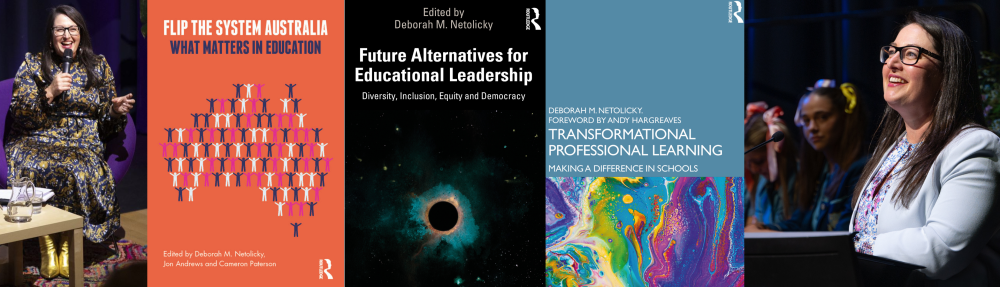
As I reflect on the IWD 2022 theme of ‘break the bias’ I continue to consider how to acknowledge my own biases and privileges, and seek to understand the ways in which I help or hinder the project of diversity, inclusion and equity. I know that posting a blog post, photo or hashtag does little to address existing biases and their impacts on groups and individuals. I know that action and advocacy are needed in micro and macro contexts, and that sometimes appropriate action might be to speak less, take up less space, or question my own way of being in the world. I am proud of edited books such as Future Alternatives for Educational Leadership (which features 19 women out of 25 authors) and Flip the System Australia, but know these are imperfect in their attempts to share a diverse range of voices.

The following blog post is on the WomenEd website as part of a suite of worldwide reflections for International Women’s Day 2022.

Source: @PIRO4D on pixabay

Each year, International Women’s Day is surrounded by questions as to why the day is needed. Yet a dig into data from any country shows that gender equity is far from a reality. Recently, the COVID-19 pandemic has exacerbated gender inequities, as this UN policy brief and this UN technical briefattest. There has been an increase in unpaid domestic and caring duties often taken up by women, an increase in gender-based violence, a decline in the availability of reproductive health services, and lack of women’s representation in pandemic planning response.

The 2022 International Women’s Day theme is ‘Break the Bias’. But how do we ‘break’ bias when it’s unconscious, unacknowledged, or invisible? With so much complexity in the social world, accepting stereotypes, tropes, and assumptions about gender can make the world a simpler place with less cognitive load, easier judgments, and faster decision making. But left unchallenged, biases can block, hinder, and harm individuals and groups in society and in organisations.

The education world should look at how bias might be influencing school communities and students’ experiences of learning, living, and being in the world. In schools, sometimes the racial, ethnic, ability, sexuality, and gender diversity of the staff does not match the diversity of the student and parent community. Sometimes there is a lack of diversity in the community, or in the teaching or leadership staff. Conscious and unconscious biases of those overseeing staff recruitment and promotion can influence who is recruited, who is promoted, and who is overlooked. Biases of educators can affect response to student behaviour.

The questions we ask of ourselves and of others can help us to understand our own biases, to challenge the biases of others, and to encourage different ways of being and behaving. In a recent conversation with Jacob Easley II on my podcast, The Edu Salon, he challenged educators to take the time to explore their professional identities, beliefs, and purpose. He suggests that a place to start is with the question of why a person is entering the teaching profession: “Is it really to work with certain types of students, and not others, those who are more like me, and not those who are different from me?” This is something we should all ask ourselves. How do we respond (to a student, parent or colleague) when someone is not ‘like me’?

We can break open, or splinter bias, if we ask good questions. How about: Do we like to teach those students mostly like ourselves? To what social issues do we draw our organisation’s attention? What and who do we ignore or pay little attention to? Who is visible, celebrated, and recognised? Who is ignored or ridiculed? Who do students see ‘out in front’ at assemblies and events? Who do the school community see in middle and senior leadership?

Do we hire mostly people like ourselves, or do we seek to recruit a diverse workforce? To whom (if at all) do we offer flexible work options? While it may seem fair to apply the same decision-making framework for all people, aiming for meritocracy can perpetuate existing advantage. Is it more equitable to consider the varying needs and barriers of individuals, and to seek to tackle those barriers on a needsbasis? What is our approach to a situation with which we are unfamiliar or to someone whose experiences and perspectives are vastly different from our own? Do we engage in uncomfortable conversations? Do we dismiss or seek to understand concerns?

We can ask these questions of ourselves and others. From there, here’s what else I think we can do.

  1. Interrogate our responses. Be ok with not knowing, with learning, discomfort, and respectful challenge. Be willing to listen and to learn. Work to identify biases in ourselves and our organisations, and the barriers and inequities they create.
  2. Anchor ourselves in our values. Be brave enough to know what kind of individual and what kind of organisation we aspire to be. ‘The community won’t accept this without resistance,’ is not a good enough reason to remain stagnant on issues of equity, social justice, diversity, and meaningful inclusion.
  3. Educate and advocate. Stand up. Support. Resist. For example, when someone is critiqued for their cultural dress or accent, speak out. When someone is not being considered for a role or promotion, question why or point to attributes and experience that may have been ignored.
  4. Implement practices and structures that support mitigating bias, such as transparent and consistent recruitment processes with diverse representation across the decision makers, thoughtful leave policies (including flexible and generous parental leave and carer’s leave), options for flexible working where possible, and an organisational culture in which staff are trusted and professional expectations take into account a diversity of life responsibilities.

We all have influence, and we all have a responsibility to take bias seriously and to engage with its realities and ramifications, even and especially when those biases work in our individual favour. If there is one thing the pandemic has taught me, it’s that we need to work for the greater good over the individual good.

This year’s IWD pose reflects ‘break the bias’.

What matters in education: Reflecting on Flip the System Australia in 2022

I was invited to speak today as part of the Future Schools webinar series. In particular, I was asked to engage with the notion of flipping the education system, based in my work in co-editing the 2019 book Flip the System Australia: What Matters in Education.

That was then

Even though today’s conversation was for a group interested in future schools and the future of schooling, thinking about it required me to reflect back to 2018, when much of the work of the Flip the System Australia book was being done. Back then, my co-editors—Jon Andrews and Cameron Paterson—and I were experiencing the then- educational environment of measurement and surveillance. This included a distrust of schools and teachers, heightened accountabilities according to quantifiable measurables in education, policy rhetoric about educational quality assurance and effectiveness, competitive comparisons of performance in high stakes standardised tests, and a push for teachers to do ‘what works’ according to simplified and dehumanised lists of apparent best practice (although, as Dylan Wiliam says, everything works somewhere, and nothing works everywhere).

Our book built upon the Flip the System books that came before ours (from the Netherlands, Sweden, and the UK) and sought to value and promote a diverse range of voices in education talking about what matters (or what should matter), over what works. We argued for the humanising of educational narratives, the democratising of educational policy and practice, and the development of deep and sustained trust in the teaching profession.

Teachers’ being and becoming

My Flip the System Australia chapter argues for elevating the professional identities and voices of teachers and school leaders in educational research, practice, and policymaking. In the chapter, I explore the quantifying and performative measuring of teacher work as limiting the complexities of that work and reducing teacher identities to a limited range of options. I define identity in my book Transformational Professional Learning as “the situated, ongoing process through which we make sense of ourselves, to ourselves and others” (p.19). It is a constant, context-embedded process of being and becoming, with professional identities inextricably linked to personal identities; we are our whole selves at work, and our lives influence our teaching.

Teaching as a performance disconnected from identity and purpose is unsustainable. Teachers need to feel that their identities are aligned with the purpose of the profession, with shared school values, and with their daily work. Rather than being required to fit themselves to a school, teachers need to feel that they truly belong in a school community in which they share a common moral purpose and are valued for their individual selves, including their gifts and imperfections.

Embracing authenticity and embedding inclusive practices are becoming increasingly important in schools. More than that, as Jelmer Evers wrote in the Foreword to our Australian book, a shared professional identity can transcend borders and nationalities, and can form the basis of reinventing democracy and our schools.

The more things change, the more they stay the same

A focus on the humanity and the positive contribution of education to the lives of all young people remains the core purpose of education. In Flip the System Australia, Carol Campbell describes the purpose of education as “the betterment of humanity” (p.81). In my chapter, I say that “education is not an algorithm but a human endeavour” (p.16). The betterment and care of each child, and thereby the betterment of humanity, includes supporting children to be their best, most agentic and self-determining selves, able to make positive contributions to their communities and to the world.

In Australia, the 2019 Alice Springs Education Declaration, and before it the 2008 Melbourne Declaration on Educational Goals for Young Australians, expressed two key goals:

  • Goal 1: The Australian education system promotes excellence and equity; and
  • Goal 2: All young Australians become: confident and creative individuals; successful lifelong learners; and active and informed members of the community.

Yet Australia remains far from an education system that promotes, for all young Australians, excellence and equity.

Melitta Hogarth’s Flip the System Australia chapter reveals the contradictory nature of policies and practices that appear to be unbiased, but that perpetuate conservative, colonial values, and the silencing of Indigenous voices in education. She argues for Indigenous representation at every level of education leadership and decision making in Australia. Kevin Lowe in his chapter argues for collaborative, productive engagement between schools and Aboriginal and Torres Strait Islander communities. There remains ongoing disadvantage for Indigenous Australian children, in terms of education, social and health outcomes. Systemic inequities have been exacerbated by the pandemic and compounded by Western-centric curriculum and biased measures of educational success.

In Chapter 11 of Flip the System Australia, Andy Hargreaves, Shaneé Washington and Michael O’Connor shared findings on teacher wellbeing that now read as a prelude to the intensification of workload and the impacts of the pandemic that have followed. They commented that “teachers feel they are losing control over their professional decisions, … they are being asked to carry the mounting social problems of the world on their own shoulders, and, in the midst of all these things, they feel constrained and compromised by competencies and assessments they do not always believe in” (p.101). Their chapter asserts that there is no student wellbeing without teacher wellbeing. Since that chapter was written, wellbeing has escalated, making its way up the education agenda. Educators have been reminded of something we have always known that now needs our careful attention and action: that wellbeing is inseparably joined with learning and achievement.

This is now

Flipping the system is about flattening and democratising education. Three years on from the publication of Flip the System Australia, the world is facing unremitting and overlapping crises. We only need to turn on the news to see that our planet and democracy remain in peril. In education, governments are enacting fast policy (with teachers and school leaders often hearing about each new policy twist and turn during a press conference), with schools then quickly implementing the changing guidelines and protocols.

Although there are frightening data around teacher and school leader burnout and retention challenges, teachers and school leaders remain incredibly committed to serving their communities, through the most difficult of circumstances. There has been the need for, and therefore the rise of, school and teacher autonomy during the pandemic, as educators have made context-embedded decisions about what their students and communities need, and how to best work to meet these needs.

Schools have been revealed as places of connectedness, relationality, socialisation, and community, as well as learning. The last couple of years have led schools to develop innovative uses of educational technologies, flexible post-secondary pathways for students, and generous networks of educators collaborating together across countries and sectors to share, support and grow alongside one another. Effective leading has been shown to be an authentic practice of care and hope. Those working in schools have been literally changing education from the ground up, which was the catch cry of the original Flip the System book by Jelmer Evers and René Kneyber.

CONNECTION: 2022 #oneword

Source: @geralt pixabay

In 2021, I chose ‘excelsior’ as one word to help nudge incremental progress through the pandemic we all hoped might be a memory rather than a reality by 2022.

As I reflect on the past couple of years, it has been my networks, collaborations and connections with others that have buoyed and energised me. This includes checking in on friends and finding ways to regularly connect with my family. It involves collaborating with staff at my school, and working with educators from around the globe, often through co-writing or co-presenting. While some collaborations have resulted in products and achievements, conversations are often a reward in themselves.

I want to deepen my focus on being connected, and so my word for 2022 is CONNECTION.

A getaway has been a perfect way to start the year connecting with family, and I have begun to use a meditation app at night to connect with self. In the last week, I have connected with national and global colleagues during the ICSEI (International Congress for School Effectiveness and Improvement) congress, including by being part of two symposia:

  • ‘Educational Leadership Policy and Practice for Diversity and Equity’ with Christine Grice, Claire Golledge, Santiago Rincón-Gallardo and Beatriz Pont. This symposium drew from the work of Future Alternatives for Educational Leadership, specifically the Foreword (Pont) and Chapters 2 (Grice), 3 (Netolicky & Golledge) and 14 (Rincón-Gallardo). It explored new conceptions of sustainable educational leadership through the metaphors of wayfinding, salvaging and social movement. Common threads included the leading as practice, care, learning, wellbeing and hope, as well as tensions between education systems and the realities of schools. Beatriz noted in her discussion that we need to shape and define the future of education as a collective. Video below.
‘Educational Leadership Policy and Practice for Diversity and Equity’ symposium
  • ‘Pracademia: Exploring the possibilities, power and politics of boundary-spanners straddling the worlds of practice and scholarship’ with Trista Hollweck, Paul Campbell, John Mynott, Michaela Zimmatore, Steven Kolber, Keith Heggart and Scott Eacott. In this symposium we explored the tensions and possibilities of the concept of pracademia, ideas and research published in a Special Issue of the Journal of Professional Capital and Community (guest edited by Hollweck, Netolicky & Campbell). A video can be found here.

While there is much to miss about in-person conferences, and challenges to online versions (like presenting at 4am or in a busy household), virtual opportunities continue to provide ways to support and connect with one another.

In thinking about channeling connection, I have additionally decided to finally launch the podcast I have been thinking about for two years: The Edu Salon. I am excited about sharing rich conversations with inspiring educators, and contributing to the networked hive mind of the global education community. We are better when we connect with and learn alongside one another, and engage in talking about (and then doing) what matters.

Here’s to connecting in 2022.